

From Broadway's Oliver! to collectible miniature Dickens Village Christmas figurines, Charles Dickens's works have permeated our cultural imagination. Dickens World, a U.K. theme park, adds yet another reworking to the body of Dickens adaptations. Finding ourselves in London three weeks after the attraction's opening in May 2007, we took the opportunity to visit. A train whisked us from London's Victoria Station to Chatham, Dickens's boyhood home, and a short bus ride took us from the station to Dickens World (Figure 9).
(Color online) “Dickens Parking Lot.” Dickens World, Chatham, England. Personal photograph by Rebecca Mitchell. 18 June 2007.

We entered Dickens World as believers, ready to commit fully to whatever suspensions of disbelief were required. And the opening was promising. A sign on the exterior of what looked to be a large-scale metal warehouse in the recently modernized Chatham dockyards promised eager visitors “THE TIME OF THEIR LIVES.” Beyond the ultra-modern, blandly generic entrance hall and staircase, the air became dank, the walls became timber and plaster, and the light dimmed. A creaky suspension bridge led to an open town square hemmed by false fronts of houses and shops emblazoned with names drawn from Dickens's novels. This space served as the center of the “indoor visitor attraction.” Beneath the bridge we spied an endless parade of empty boats on the Great Expectations Boat Ride.
Downstairs on the main street level, performers wandered about in Victorian costume: chimney sweepers in dirty rags, ladies in lace shawls, and urban bankers in top-hatted finery. A Cockney flower girl in a musty calico dress urged us to purchase an obviously fake rose, and a pale man in a black coat slithered silently by. Nearby, a small group of visiting schoolchildren played with a rustic hoop and a stick. Suddenly, a jaunty street urchin sidled up, stuck his hand into Rebecca's purse, and stealthily stole our Dickens World brochure. Apparently, in Dickens World's version of Victoriana, street crime is all part of the fun.
Our next stop was The Haunted House of 1859, which despite its name was neither haunted nor a house. Nor did it bear any discernable relationship to 1859. Designated as “Scrooge's Haunted House” in the original promotional materials, it was renamed just prior to opening, perhaps to reflect the title of Dickens's 1859 short story, “The Haunted House.” Joining a small group of visitors just inside the door, we followed a woman in a long, shroud-like dress down a series of narrow wainscoted corridors, adorned only with dirty floors and peeling paint. No chain-rattling ghosts or thick layers of cobwebs blocked the pseudo-Victorian passageway. No spooky portraits followed us with their eyes, and no eerie music marked our journey. More perplexed than scared, our group of six arrived at our destination: a window cut into the blank wall. “Wait here.” our guide said. “It'll start in a minute.” And so we stood in front of the window and waited.
Through the window we could see a low wooden bedstead. Next to the bed appeared a holographic Ebenezer Scrooge, bah-humbugging his way across the room. A Marley holograph next appeared, and explained to Scrooge that he would be visited by three other ghosts during the night. In this severely condensed retelling of the familiar story, the ghosts came and went, but Scrooge never left his own bedside, the action occurring entirely within his bedroom walls. The hallway was dotted with three other brief, holographic vignettes, each less scary than the next: Ralph Nickleby's suicide, a parade of miscellaneous characters from Dickens's novels, and an anthropomorphic chair from The Uncommercial Traveler. In the Haunted House, all the ghosts were safely contained behind walls and windows, and they took no notice of the visitors at all.
Outside the Haunted House, a more immersive experience awaited. Judging from the Great Expectations Boat Ride's prominent position in the park's promotional materials, the owners of Dickens World seemed quite proud of this attraction, billed as the longest “dark boat ride” in Europe. With one of Dickens's best known and most engaging plots as its basis, the ride's possibilities seemed endless: scary encounters with Magwitch in the cemetery, an eerily spider-webbed Satis House with a massive rotting wedding cake, tense final moments with the convicts on the Thames – yet not one of these major scenes was represented.
The Great Expectations Boat Ride is the only attraction at Dickens World that takes for its name the title of a novel. Despite this initial framing of the ride within a well-known story, the boat ride is most remarkable for its thorough lack of a narrative. Even in its conception, the ride muddles Great Expectations’, story, as is evident in the description offered in a press release:
As visitors board the boats they will have passed through the Newgate Prison area of the attraction and will have heard whispers about the escape of the convict Magwitch, from Dickens’ Great Expectations novel. These whispers start the beginning of a story that visitors will follow as they journey around the attraction passing through the Tudor building in Quilps [sic] Creek, through a dark and smelly sewer pipe and across the rooftops of London. As the boats tumble down the ‘Fall of Death’ visitors will rejoin the story hearing how Magwitch is escaping across the Kent marshes as they pass through the foundry and cemetery areas of the boat ride, with Dickensian coppers in hot pursuit. (Dickens World 1)
In Dickens World, Quilps Creek overflows the banks of The Old Curiosity Shop to wind up in Great Expectations, and Oliver Twist's rooftop adventure intersects with Magwitch's escape down the river. Appropriate references to Pip's story are limited to Magwitch's voice calling to Pip, a mannequin of a young boy, and Magwitch's face in a window. In between are scenes that have little relationship to the plot of Great Expectations.
Granted, a hard-and-fast plot is not necessary for a successful ride. Disney's Pirates of the Caribbean, a dark boat ride similar in concept, also lacks a narrative, but its series of scenes is brimming with activity, movement, and atmosphere. While Pirates of the Caribbean succeeds on the level of spectacle and the physical pleasure of the ride, the Great Expectations Boat Ride fails to deliver either spectacle or pleasure. We could forgive its failed fidelity to the plot of the novel for which it is named had the ride been otherwise enjoyable. The boat's movement through the ride is laboriously slow, however, and despite its title, the “Fall of Death” is one small flume which doesn't generate enough splash to warrant the ponchos sold in vending machines along the waiting line. A waterwheel also threatens to crush riders, but its pace is so slow as to be almost comical.
After meandering through a cemetery – a scene which would have made more sense at the beginning of the ride instead of the end, per the novel – the boats make their way to a gallery of villains housed in what appear to be jail cells (Newgate Prison, perhaps?). Despite the commanding individuality and idiosyncratic markers that Dickens gave each of these villains, they are not here identifiable by appearance. The first figure, a poorly attired female mannequin with long, brown hair is identified as Madame Defarge by a voice-over narration, without which one might easily confuse her for any number of Dickens's female characters. Defarge stands opposite Daniel Quilp, identified by the voice-over as “an evil, dirty dwarf” and next to Bill Sikes, murderer. The criminal lineup ends with Uriah Heep, whom we are told is “ever so ‘umble, but a real nasty piece of work.” Since all are wearing similar suits and top hats, there is little to distinguish one man from another. As the boats lurched into their docking place and we exited the ride, our expectations, like Pip's, were effectively dashed.
We were now primed for a more formal education in Dotheboy's Schoolhouse. In this single room, Dickens World managed to create an experience that echoed the Victorian – if only by exaggerating our stereotyped vision of the Victorian educational experience as cold and unforgiving – while being fun. The sparse, one-room schoolhouse was grim, as rusty, exposed pipes lined the ceiling and oppressively dark wainscoting skirted antiqued walls adorned only with words of wisdom stenciled in large letters: “Speak When Spoken To.” It was quaint in its austerity, and hosted the most successful of the Dickensish actors, playing a sadistic schoolmaster who took glee in embarrassing the “students.” Dressed head-to-toe in black, he hurled vituperation at the unwitting guests as they wandered in and out of the classroom. Upon entering, for example, we were admonished for being late. The more the schoolmaster berated the guests, the more we seemed to enjoy it. His interaction was spontaneous and funny, and reflected a basic self-awareness that was absent from most of the other attractions: only in a theme park would you willingly adopt the masochistic behavior required to enter a schoolroom to be humiliated and to take a test. An exam and a draconian taskmaster seem apropos since, one may imagine, most non-academics encounter Dickens as part of a school-mandated reading list.
Dotheboy's Schoolhouse recreated a modern day idea of a Victorian experience, hyperbolizing those elements that we fetishize – disciplinary authorities, uncomfortable furniture, rote learning – in light of the more generous educational models operating today. Touch-sensitive video screens lined rows of hard wooden desks, cleverly updating the slates of old with modern technology. In a Chutes-and-Ladders style game, guests-as-students were quizzed on their knowledge of Dickens trivia, much of it biographical (for example, “In what kind of factory did Dickens work as a child?”). Dickens World surely was not produced with the fastidious academic in mind, but it seems at least one designer realized that a number of those interested in visiting Dickens World would be readers, teachers, or scholars. At the end of the quiz game in the Dotheboy's School our scores were reported with more humor-tinged harshness, high achievers earning the following praise: “Well Done! You have worked hard at school. There may be a teaching career for you here, but it won't pay very well” (Figure 10). True indeed!
(Color online) “Trivial Premonitions.” Dickens World, Chatham, England. Personal photograph by Rebecca Mitchell. 18 June 2007.

Up the stairs and across from the school, we found Peggoty's Boathouse tucked away in a dark corner. Once again, the attraction's title was more confusing than enlightening or textually accurate. Instead of Yarmouth Flats or the image of Little Em'ly by the fire, there was a 3-D animated film of Dickens's life. The film managed to balance entertainment with information in a fairly effective way. And the 3-D effects added to the amusement, allowing the spectators to be showered, for example, by the pages of Dickens's manuscripts. The film interwove details from Dickens's domestic life – his marriage, family, and adulterous relationship with Ellen Ternan – with his career, with a surprising focus on Dickens's trips to America. We heard a lot about Martin Chuzzlewit and American Notes as the narrator described the rise and fall of Dickens's star in the United States. Although Dickens World promised to reconnect its visitors with Victorian England, the film's topical focus suggested that it was designed with an audience of American tourists in mind.
The film's suitability for children was reinforced by its use of animation, as well as its proximity to Fagin's Den, a McDonald's-style playground with little connection to anything Victorian at all. In this modern, plastic play area, the only structure in the park specifically intended for children, no effort was made to approximate an authentic Victorian experience. Furthermore, the attraction's wildly inappropriate title, Fagin's Den, conjures up images of depravity and criminality, hardly suggestive of a wholesome family experience. Dickens World deploys the brightly colored padded structures of the modern indoor ball-pit to sanitize the seedier side of Dickens and render it appropriate for a family audience.
If certain attractions catered to specific audiences, the gift shop sought to satisfy universal consumerist desires. Dickens's oeuvre provided the proprietors of Dickens World the perfect title for a souvenir shop, and it seems they could not resist, as the souvenir stand is called The Olde Curiosity Shoppe (with extra e's added to make it seem more authentically Victorian, if less true to Dickens's original). Yet it appears they actively refuse to exploit any of the elements of that term: the store is neither old nor filled with curiosities. To reach the store one must leave the dark, dank interior of the theme park and walk down a staircase into a modern, brightly lit retail space. From here one can gaze – through the wall of windows – across the parking lot to an outlet mall and Cineplex.
For many of us raised in the post-Disney-Land society, vulgar profiteering rarely gets in the way of a good time, at theme parks anyway; the prospect of the gift shoppe at Dickens World was especially tantalizing: T-shirts emblazoned with the pock-marked face of Esther Summerson, Madame Defarge dolls complete with knitting needles and guillotine necklace, a Marley door-knocker. Alas, Dickens World didn't offer such wares. What it did offer was a line of theme park memorabilia (oversized novelty pencils, ball caps, and brightly colored T-shirts), a selection of English heritage items (teas, bath salts, and so forth), and a complete collection of Dickens's novels. Where Dickens is not the literal author of the item, his signature is used to validate the theme park-branded goods. On most of these items the sole graphic representation of the park is the phrase “Dickens World” printed in a font which mimics Dickens's handwriting. “Dickens” alone is enough to confer authenticity on the merchandise: Dickens is the brand. And when Dickens is not the brand, England is.
Though the gift shop set out to satisfy the consumerist desires of all Dickens World visitors, it's not at all clear what sort of audience the theme park as a whole imagines for itself. Is it marketing itself to the Dickens enthusiast who has read most (if not all) the novels and has an insatiable hunger for all things Dickens? With an eye to the finicky demands of Dickens enthusiasts, Dickens World's designers consulted with Thelma Grove, former secretary of the Dickens Fellowship, who “insisted at every stage on absolute authenticity” (Addley). Given this effort, the number of slippages between signifier and signified is puzzling: Peggoty's Boathouse doesn't have anything to do with David Copperfield, and Pip is largely missing from the Great Expectations Boat Ride. Readily recognizable titles, character names, and icons are invoked to render the attractions “Dickensian” despite the fact that few, if any, are textually accurate.
Dickens World enacts Dickens as a shorthand for modern popular notions of “the Victorian,” vividly demonstrating the extent to which Dickens has become a contemporary brand, his name authorizing any and all iterations of Victorian figures, experiences, and products. Though the park will attract some hard-core Dickens enthusiasts, it is safe to assume most visitors to Dickens World have not read the majority of Dickens's novels and so will not be looking for a precise enactment of the texts, but will expect instead an experience that confirms a set of more diffuse cultural assumptions about Victoriana.
J. M. W. Turner (1775–1851) is the Pablo Picasso of English art. No other artist has been so studied, so fawned over, so promoted as emblematic of the art of England. Much of this is due to the Turner Bequest, a posthumous gift of the artist to the nation, which occupies its own wing of Tate Britain in London, the institution that serves as the National Gallery of British Art. As custodian of a massive trove of Turner works and ephemera, Tate has made it its most worthy mission to unearth every element of the artist's production in exhibitions, displays, catalogues, and scholarly conferences. Recently, the institution took a more general view of Turner, organizing a survey exhibition, long in gestation, presenting a broad display largely drawn from the Bequest for an international tour. It was seen in New York at the Metropolitan Museum of Art in the summer of 2008, and was heavy on oils and works on paper, with a very small selection of prints. The show, remarkably the first of its kind in the United States, generally aimed to position Turner as a bridge between the old masters and the modern movement, the twin pillars of the Metropolitan's Western art collection. Its goal was not to situate him in the history of British art, and certainly not as a transition into the Victorian era. An exploration of this display of Britain's greatest painter can suggest some ways that the exhibition reflects the present view of his art, and how he can productively be read as an interesting Victorian artist. Deeper analysis will reveal why the Metropolitan's presentation suffered at the hands of Northeast critics, in sharp distinction to the same writers’ appreciation of a similarly staged retrospective of the works of another Victorian, albeit a French one, Gustave Courbet, also at the Metropolitan. The biases of Northeast critics stand out in stark relief against the Turner exhibition's being heavily attended in New York, and critically welcomed and appreciated in previous stops at the National Gallery in Washington and the Dallas Museum of Art.
In the history of British art, Turner is hardly ever convincingly presented as a Victorian artist, and the Met's show continues this elision – this despite the fascination with Turner's late, unfinished works. These were produced in the 1840s, before Turner's death in 1851, and after Queen Victoria's ascension in 1837. While Turner was born in 1775, squarely in the Georgian era, he ended his life a Victorian. Art history persists in seeing him as a romantic, especially in subject matter, as the works redolent of the sublime in the exhibition's first gallery readily reveal, paintings such as The Pass of St. Gotthard (1803–04, Birmingham, no. 18), and in later rooms, works such as Snow Storm – Steam Boat off a Harbour's Mouth . . . (exh. 1842, Tate, no. 136) – this is safer, certainly, than dipping into the miasma of the purportedly questionable taste and sentimental predilections of Victoria's reign. Yet the late or Victorian Turner is a crucial figure, not just in the criticism of his most earnest and earliest champion, John Ruskin, but also for contemporary art historians.
The first two rooms of Malcolm Warner's ambitious Victorians exhibition at the National Gallery in Washington in 1997 presented just such a Ruskinian idea of Turner to an American audience. Visible on the far left and right walls of gallery one were Turner's Slave Ship of 1840 (Museum of Fine Arts, Boston), the greatest example of his work in the United States, whose present condition precludes any further loans, and Washington's own Keelmen Heaving in Coals by Moonlight (exh. 1835). The doorway between the two afforded a view of John Everett Millais's Ophelia (1851–52, Tate) in gallery two, the most recognized and influential of all Victorian works. This subtle understanding of Turner's transitional role in the Victorian era, first penned by Ruskin in 1851, has been little expanded upon since. The understanding of Turner's achievement remains under debate, and while the metropolitans’ exhibition did not seek to offer any advance in our comprehension of his connection with the Victorians, the very appearance of a show of this scale and quality in 2008, concurrent with the present growth of scholarly and public interest in the Victorian period, could not help but to bring up these issues, along with some persistent prejudices.
To begin to interrogate the importance of Turner's art for the Pre-Raphaelites and other Victorian artists entails looking into the reminiscences of Ruskin, who remains, rightly, the central contemporary figure for the interpretation of Turner's art. One imagines that he thought about the artist, and his work, every single day of the last sixty or so years of his life. In “Roslyn Chapel,” the concluding chapter of volume one of his unfinished memoir, Praeterita, Ruskin ended his assessment of the initial two decades of his life with reflections on both his first experience with the works of Turner, and a twilight image of the illuminated tracery of the ribbed gothic vaults of the eponymous ruin outside Edinburgh, whose intricate and interconnected members echoed the febrile potentialities of his singular mind. This vision served as an aid to understanding his first true awareness of death, through the passing of two close acquaintances. Ruskin quoted Sir Walter Scott's “Rosabelle,” canto vi of The Lay of the Last Minstrel, regarding the mysterious glow that “Blazed every rose-carved buttress fair” across Rosslyn, that in legend marked a death in the ancient St. Clair family.Footnote 1 Turner, Scott, and gothic Scotland combined to fire the author's first inklings of nostalgia, of melancholy, and the onset of maturation symbolized by Rosslyn, a site Turner and Ruskin had both visited and depicted (Butlin and Joll 178). And crucially, in discussing his first impressions of Turner in this chapter, Ruskin wrote that in the mid-1830s
the Academy Turners were too far beyond all hope of imitation to disturb me, and the impressions they produced before 1836 were confused; many of them, like the Quillebœuf, or the ‘Keelman heaving in coals,’ being of little charm in colour; and the Fountain of Indolence, or Golden Bough, perhaps seeming to me already fantastic, beside the naturalism of Landseer, and the human interest and intelligible finish of Wilkie. (Cook and Wedderburn 35: 217)Footnote 2
Ruskin was at this time studying watercolor technique, and only just beginning to appreciate Turner's works.
His reaction was likely a common one for a budding artist of the 1830s – the later Turners, as Victoria's reign commenced, became less recognizable, more masterly, “beyond all hope of imitation,” as Ruskin wrote. Looking again at such works in the Metropolitan's exhibition, and with this idea in mind, it is necessary to think of Turner's effect on Victorian art in Britain as one of intimidation. We recognize, as Ruskin did as early as 1851, as Warner did in 1997, that the inheritors of the vanguard of artistic innovation following Turner were the Pre-Raphaelites, and those young artists clearly respected him – although he was not included on their later published “List of Immortals,” which ignored living artists. John Everett Millais avidly sketched Turner on varnishing days at the Royal Academy. Yet the Pre-Raphaelites could not be influenced by him in the traditional sense of an adopted style. It is important to think of these young and rebellious artists as being in a fully warranted awe of the physically unprepossessing and diminutive artist's considerable painterly gifts, so much in awe that they, like Ruskin before them, took a very different tack, and went for close observation, fine detail, object symbolism, and an absence of weather in their works, abjuring Turner's evocative sweep, supposedly charmless color, brevity of notation, and changeable climes. Clearly Victorian artists were less affronted by Turner's ambition than their contemporaries who wrote criticism, yet as Ian Warrell writes in the exhibition catalogue, the critical reception, for example, of Turner's The Angel Standing in the Sun at the Royal Academy in 1846 (Tate, no. 163) was increasingly tolerant, “no doubt partly carried in Turner's favour by the publication of the first two volumes of Ruskin's Modern Painters (1843–46) . . . exactly what was needed to reveal the profound and richly allusive nature of Turner's art to the sometimes literal-minded Victorian art world” (J. M. W. Turner 224). Amidst a smattering of perceived direct influence in Turner's wake, in the likes of British artists Alfred William Hunt or Philip Wilson Steer, it is perhaps necessary to think of his influence on the Victorians in a more alienative manner (Smiles, Turner Book 150–51).Footnote 3
In addition, as with the thrust of this exhibition, Turner scholarship has been too much focused on revealing what makes him modern, either as a precursor to the international avant-garde of modernism, or a restive innovator in a chaotic age, and has glossed over what his immediate Victorian artistic successors thought of him (Smiles, Making 205–08). This has long been the case in New York museum circles. In particular, there has been an emphasis on the abstraction in his late works. Turner's unfinished oils of the 1840s, best represented by the Taft Museum in Cincinnati's glowing and boundless Europa and the Bull (c.1845, no. 164), and Tate's Norham Castle, Sunrise (c.1845, no. 165), a picture as iridescent as mother-of-pearl, formed the coda to the Metropolitan's exhibition, in a too-small room that gave the incorrect impression of an afterthought. This hang provoked widespread nostalgia in the New York press, and the minds of many visitors, for curator Lawrence Gowing's famed selection of such works at the Museum of Modern Art in New York in 1966, in the exhibition “Turner: Imagination and Reality.”Footnote 4 Victorians did not get to see these unfinished works until the late 1880s, and they were not exhibited as part of the Turner Bequest until 1906. But it remains easier for critics still in the thrall of the modernism of Paris and New York to embrace this purportedly abstractionist Turner, rather than the one who has so much to reveal about the second half of the nineteenth century in Britain.
“Grandeur fatigue” was the memorable, if snarky, line the arts editors of New York magazine's edgy and entertaining “approval matrix” of contemporary culture used to assess the Metropolitan's show. The magazine's art critic, Jerry Saltz, did not review it, and perhaps it is just as well, for in general the large, magisterial, thorough, physically and mentally exhausting yet gratifying survey came under curious attack by the New York critical establishment. It is important to explore such critical reactions to Turner, and what they reveal about the prejudice against British/Victorian art in the mind of the American critic, if not the public, and the continued dominance of a Paris based modernism. To that end, the Metropolitan's Turner show appears to have suffered from following in the footsteps of the useful, and equally massive, show of the works of a French artist in the Victorian era, Gustave Courbet. The Courbet exhibition filled the same rooms in the immediately prior exhibition cycle to Turner, an inspired one-two punch of nineteenth-century monographic shows. However, Courbet in New York could not hope to match its first manifestation in Paris, where major pictures unavailable for loan to the United States were trucked a couple of kilometers along and across the Seine, from the Musée d'Orsay to the Grand Palais.Footnote 5 These included A Burial at Ornans (1849) and The Studio of the Painter: A Real Allegory, Summing up Seven Years of My Artistic Life (1854–55), both vast. The Met had to make due with a more limited range of works, and the presentation resulted in a declawed artist without a center, his political import marginalized, his great ambition of the 1840s and 1850s neutered, his oeuvre dwindling to overanalyzed hunting paintings, nudes uneven in quality, poorly executed and unconvincing seascapes that the artist himself considered potboilers, and a couple of limpid fish by the end. The most important and political picture, Peasants of Flagey Returning from the Fair of 1849 (Musée des Beaux-Arts, Beasançon), was given a back seat in the display, in favor of the museum's own Demoiselles de village (1852). The singular strength of Courbet lay in its opening room, with an astounding array of self-portraits from the artist's early career, revealing by turns his ambition, his links to romanticism, his immodesty, his good looks, and his attempt to force on the public his own cult of personality.
It is ironic that the museum promoted Courbet, the enfant terrible, as a romantic out of time, then presented Turner, who lived through the romantic era proper, as absent of personality. By contrast to Courbet, the Turner exhibit renounced self-portraits. The Tate, in its vast Turner Bequest, owns a gripping one from around 1799, but the organizers decided to avoid it and, by implication, to skip the best access for the museum-going public to the personal, a curious choice that ran throughout the show in the text and audio guide, which hardly mentioned Turner's biography outside his travels. Perhaps this was another gambit serving to distance Turner from the traditional readings of Victorian art, as in the still heavily biographical interpretation of the Pre-Raphaelites, and British art in general. Yet Turner's personal life is exceptionally fascinating for the period, matched only by that of William Blake, and has been the subject of numerous biographies as well as fictionalized treatments. Even the recently deceased photographer and filmmaker Gordon Parks caught the Turner bug, producing an absorbing fictionalized biography titled The Sun Stalker in 2003.
In terms of the art, the room that served as the sixth gallery in both shows is a case study that puts the comparison in perspective. Besides a fine grouping of three of Courbet's four images of The Source of the Loue from 1864, the gallery was dominated by the French artist's artificial and unappealingly clotted seascapes, works that if Ruskin had seen them would possibly have moved him to say that the artist had never been to the coast. Subsequently in Turner it was filled with works that superbly revealed his intimate understanding of the ocean, his technical skill that allowed him increasingly to reveal this convincingly through the most advanced of painterly tendencies, and his subtle sensitivity to the human condition. The room included the swelling waters and swirling mists of Staffa, Fingal's Cave (exh. 1832, Yale Center for British Art, New Haven, no. 102); Disaster at Sea (c.1833–35, Tate, no. 113), Turner's massive, surging, rejoinder to Théodore Géricault's frozen tableau of muscular masculinity in Raft of the Medusa (1819, Musée du Louvre, Paris); Keelmen Heaving in Coals by Moonlight (exh. 1835, National Gallery of Art, Washington, no. 115), a glowing midnight blue work wrongly hammered by Ruskin above; the diaphanous Thames above Waterloo Bridge (c.1830–5, Tate, no. 116); the deliciously opalescent Ancient Rome (exh. 1839, Tate, no. 117); and a number of other equally absorbing masterpieces. Overall, the public appeared to concur with Turner's superiority. Turner, which ran one day longer, outdrew Courbet 259,424 to 216,033, despite being a summer show, and thus not placed in the supposedly more prestigious fall or spring slot on the calendar (a perception that persists in museum circles, and appears to be largely due to the social calendar of city residents, and not foot traffic).
Statistics bear out these suspicions of a vivid public interest in Victorian and British art. The Metropolitan's Edward Burne-Jones exhibition in summer 1998 outdrew Courbet's daily totals with 180,436 over only sixty-eight days. In Washington, Turner drew 237,851 visitors over ninety-seven days. Attendance of recent Victorian shows at the National Gallery has been similarly strong: the above mentioned Victorians show in 1997 drew 239,427 in eighty-five days, James McNeill Whistler in 1995, around 360,000 in eighty-five days, and John Singer Sargent in 1999 an amazing 453,937 over one hundred days. Gallery-goers do not seem fearful of Victorian art. New Yorkers could do with more of it.
But New York critics saw things differently, and their writings reveal a hesitancy to respond positively to British art, a resistance not limited to the Victorian era, in preference to French modernism of the same period.Footnote 6 Roberta Smith in the New York Times, a newspaper that operates without any real competition as the leading mainstream cultural voice in American arts, was left fired by Courbet (“Seductive Rebel Who Kept it Real”) but cold by Turner (“Storm-Tossed Visionary of Light”). For her, Courbet's installation was “majestic,” the Turner exhibition a “wearying” exercise in exhaustion. Turner's unmatched mature watercolors and other works on paper, featured in three whole galleries, received only slight mention. But Smith did not realize, as Ruskin did when he was all of eighteen, that with Turner it is about seeing more than believing. She offered a bizarre and meaningless statement meant as praise, but more canned than considered, writing that Turner's “‘The Houses of Parliament on Fire’ [sic] might almost have been painted by Monet with a little input from Philip Guston.” It is astounding that Smith can see in Turner evidence that the artist “just seems to be in production, churning out oceangoing turmoil and vortices of water, air and sunlight and then locking them in focus with little figures – the victims of bad weather or biblical wrath – struggling at the bottom,” while with Courbet we are told that “No artist before Picasso left so much of himself on canvas.” Smith cites luminous artistic inheritors of Courbet, such as Francis Picabia, Max Ernst, and Lucien Freud, whereas in her Turner review the only other artist mentioned besides the reference to Monet and Guston, was the still active but somewhat obscure Abstract Expressionist Paul Jenkins, hardly a feather in Turner's cap, as she has subsequently described Jenkins's paintings as “frequently . . . too gorgeous for their own good, which means that they can verge on slick” (“Museums and Gallery Listings”).
Smith's conclusion shows her unwillingness to connect with Turner:
This show may be wearying because there is something imperious and impersonal about the sheer force of Turner's ambition. It is almost as if his drive to capture nature or history in motion was so intense that it didn't leave room for anyone else, including the viewer. Maybe that's why despite all his hard work and even the majesty of his vision, you can emerge from this exhibition impressed but oddly untouched, even chilled.
Compare this to her earlier summary of Courbet, and its air of formalist triumph:
More than perhaps any painter of his great painting century, Courbet built elements of rebellion and dissent into the very forms and surfaces of his work. Some were on purpose; others were left for us to discover, to feel in our bones. Even at the end he expressed his defiance in still lifes of fruit that seem impossibly large and overbearing, like him, and in magnificent trout hooked and struggling against the line, even more like him.
In the case of Turner, it is a punishment of his over-commitment; in Courbet, it is an acceptance of the judgment of the generation of 1968 art historians, in the wake of T. J. Clark, ironically, the very reading of Courbet that the Metropolitan's exhibition, and its attendant catalogue, so strenuously tried to avoid.
Other New York media publications also maintained such a bias. Despite publishing an engaging Simon Schama profile of Turner, the New Yorker's lead art critic, Peter Schjeldahl, then showed a familiar disdain for the artist. Schjeldahl, in an ornery mood, described Turner as “hot and bothersome,” full of “a barrage of guileful effects” (“Heavy Weather”). “Indisputably masterful,” if less profound than John Constable, for this critic Turner “conveys only irritable ambition,” “shocking and awing . . . British sensibility.” In the New York Review of Books, in his last art review, John Updike expressed a similar exasperation with this “bear of a show,” regarding an artist who “cannot be dismissed, but . . . cannot quite be embraced, either,” in an ultimately balanced and engaged critique.
New York magazine's phrase “grandeur fatigue,” and Schjeldahl's last quoted line, channeling “shock and awe,” reveal two subtexts at work here, one prejudicial towards a certain type of modern art as already discussed, the other political. On the one hand, there is something draining, apparently, about the experience of splendor on a large scale that is so fundamental to the DNA of Turner's pictures. Yet is such enervation a common complaint in shows of Tiepolo's works? Hudson River School art? Abstract Expressionism? Julian Schnabel, or Anselm Kiefer, or Cy Twombly? Or is it something essentially about subject, and the moment of Turner's greatest efforts in particular? Certainly Turner's most formative experience was to have lived during the age of Napoleon, to have witnessed the greatest challenge to the British Empire before Hitler, to have seen the Union Jack prevail. And at times he represented and celebrated that glory, as in the two titanic images that lined the far wall of the third gallery in Turner: The Battle of Trafalgar, as Seen from the Mizen Starboard Shrouds of the Victory (exh. 1806, Tate, no. 42), and a coup of a loan, The Battle of Trafalgar, 21 October 1805 (1823–24, National Maritime Museum, Greenwich, no. 59).
On the other hand, Turner's greatest political act as an artist was to question the direction of the nation following its consolidation as the world's only superpower. Works from the exhibition such as Snow Storm: Hannibal and his Army Crossing the Alps (exh. 1812, Tate, no. 22), The Decline of the Carthaginian Empire (exh. 1817, Tate, no. 41), and The Field of Waterloo (exh. 1818, Tate, no. 58), all present an intimate a conflicted sense of the consequences and demands of victory. They anticipate and celebrate Britain ascendant, but are cautionary tales, whether they tread on historical or contemporary grounds. In short, they anticipate the very issues of empire that would be so contested in the Victorian era (beginning in the Crimea in 1853–56, an experience so central to the formative years of the Pre-Raphaelites). Consequently, they presage the disaster that was the first half of the twentieth century in Europe.
In the liberal milieu of New York, albeit in the miniature “red state” that is the Upper East Side where the Metropolitan Museum is located, it might have been anticipated that such introspective and reflective works of art would have been appealing in the period of intense political and economic self-doubt that was the final summer of George W. Bush's time in office, on the eve of a contentious and momentous election. Yet, the prevailing sense of a diminished national self in the United States did not translate into a more complex understanding of Turner. Ultimately, the critical establishment preferred Courbet, the French modernist artist the museum presented as drained of his political vitality, and whose genuine resistance to oppressive authority and socialist sympathies were muted in favor of the promotion of a rejiggered romanticism and a lionized facture. Despite the worthy efforts of the museum, with only a limited range of very important works to draw upon, Courbet emerged as a lesser artist, and perhaps this is how he now should be seen. His works after 1855 are simply not incisive, are dead on the wall, and rarely exciting in terms of craft, despite the critics’ myopic hyperventilating – witness Schjeldahl's gushing that Courbet's “art isn't about life; it is life precipitated, with raucous panache” (“Keeping it Real”). Unwittingly, Courbet revealed the artist's new clothes. He speaks to us less and less.
On the contrary, Turner's works consistently bring up the subject of history, its continued potency as a subject, in a manner that brings it bursting into the present, to a moment in 2008 that found critics wanting to move on and close their eyes to the recent past – to a culture intent on ignoring, for instance, the many worthy documentaries and films on Iraq, intent on pushing the recent administration into the dustbin of history, and making victory in Baghdad as distant as Carthage, or Waterloo. The exhibition confronted a media capital suffering from interventionist fatigue. Lost in all this is the pleasure to be found in Turner: an enjoyment borne out in the attendance figures; in the thousands of people who turned out for the museum's public programs around the show, including my own gallery talks there; in the peerless brilliance of watercolors like The Castel dell'Ovo, Naples, with Capri in the Distance (1819, Tate, no. 93); and in the utter mastery of Snow Storm – Steam Boat off a Harbour's Mouth . . ., the greatest single loan object in any show in the United States for eleven months in 2007–08.
All of this is why it is so fascinating that after visiting Washington, Dallas, and New York, the exhibition then headed to Moscow and Beijing. The show's reception there, rapturous by all accounts, and fit subject for further study, would seem to cast a sharp light on the cultural, imperialist, and consumerist attitudes of today's political powers, through the lens of the art of the most trenchant, and grand, artist of the early Victorian age.
Holman Hunt and the Pre-Raphaelite Vision, organized by Toronto's Art Gallery of Ontario (AGO) in association with the Manchester Art Gallery, continues the valuable recuperation of Victorian art seen in the recent large-scale exhibitions of such major Victorian artists as William Powell Frith and John Everett Millais. Yet, of the canonical Victorian painters Hunt most severely challenges our current critical notions. If Dante Gabriel Rossetti fits the mode of the symbolist artist as does Millais, as Elizabeth Prettejohn recently argued in these pages, where can we place Hunt with his detailed hard-edge practice, his seemingly fierce moralism, his reliance on narrative, and his religious mission? And for our contemporary criticism still fixated on the narrative of the avant-garde, Hunt was dauntingly popular. In the AGO galleries where this reviewer saw the scaled-down version of the exhibition assembled at Manchester, the mostly senior viewers keenly puzzling out religious symbolism and admiring the surface verisimilitude provided a glimpse into the kind of admiration that greeted The Light of the World on its global tour.
The task for any Hunt exhibition, then, is to fashion a Holman Hunt for our time. To shape this contemporary Hunt, the curators quite successfully employed several strategies. First, in its very scale the exhibition includes yet moves beyond the familiar moralized narratives such as The Awakening Conscience and religious icons such as The Scapegoat to present the full range of Hunt's achievement, particularly his work as portraitist. Second, the curators and catalogue essayists quite rightly rescue Hunt from Puritanism. In keeping with the contemporary sexualization of the Victorians, the exhibition reconfigures much of Hunt's work not as moralizing exempla but as personal erotic records. Then, too, the organizers at the AGO take advantage of Hunt's nineteenth-century Toronto connection to contextualize his Orientalism within the transatlantic movement of Christian Zionism.
Our sense of Hunt has been both expanded and constrained by setting him within the oft-told story of the Pre-Raphaelite Brotherhood. The Toronto exhibition begins by placing Hunt's early work alongside iconic works of the Brothers in a space rather luridly, but appropriately titled “Sin and Salvation: Hunt and the Pre-Raphaelite Vision.” Here there is some salvation, as with Rossetti's Girlhood of Mary Virgin (1848–49), but also a good deal of sin. Indeed Hunt's early work, such as The Flight of Madeline and Porphyro during the Drunkenness Attending the Revelry (1848), like that of his Brothers, records in coded form the conflict for these young men between sexual constraint and sexual freedom, a dialogue that, as the exhibition nicely suggests, runs throughout Hunt's career. Indeed the method of double reading, seeing a text as simultaneously praising desire and looking to its control, so productive in the analysis of Victorian poetry can be usefully applied to Hunt. As Carole Silver notes, Hunt somewhat disingenuously described Madeline and Porphyro as figuring the “sacredness of honest responsible love” (17). Yet Keats's lovers have consummated their love well before the marriage ceremony: “Into her dream he melted, as the rose/Blendeth its odour with the violet” (“Eve of St. Agnes,” ll. 320–21). Valorized as literary illustration, this veiled paean to erotic freedom applauds the erotic pleasure that the Brothers found with their models.
The figuring of another room as “Love and Pain: Modern Society” extends this sense of the tension between erotics and ethics into Hunt's later narrative paintings. As Carol Jacobi reminds us in her catalogue essay “Women: Portraits and Passion,” Hunt did have a sexual life as unconventional as that of his Pre-Raphaelite Brothers: a working-class model as mistress, a loving marriage and untimely death of his wife, an extra-legal marriage to his deceased wife's sister. Hunt's other illustration of Keats, Isabella and the Pot of Basil (1866–68) implicitly praises sexual fulfillment by employing the Victorian trope, seen also in Millais's Mariana, that assumes madness in women as generated by sexual repression. Set together, such works of the Hunt canon as Claudio and Isabella (1850), Valentine Rescuing Sylvia from Proteus (1850–51), and The Awakening Conscience (1853–54) can be seen less as moralizing illustrations, than as exemplifying the emergent modernist occupation with representing complex and conflicted states of erotic sensibility.
Another section, “Love and Pain: Private Life,” devoted to portraits of family, friends, and lovers continues the exhibition's erotic reading of Hunt's oeuvre while also expanding our sense of his artistic achievement. As Jacobi notes, in the years 1858–68 Hunt turned from narrative paintings to “the more intimate world of the single figure” (“Women” 77) in such works as the portraits of Annie Miller in Il Dolce far Niente (1859) and Edith Hunt in The Birthday (1868); the fine chalk drawing of Edith, Portrait of a Lady (1876); and the chalk Fanny Holman Hunt (1866). The paintings of his wives indicate the strong passion within his marriages. In setting these portraits as a group, the show provides a significant revelation of Hunt's unrecognized skill as a portraitist. Portrait of Mrs. George Waugh (1868; Figure 11) shows Mrs. George Waugh, Hunt's mother-in-law, as a clear-eyed, dignified older woman looking back at the painter with a steely unembarrassed gaze that conveys a sharp sense of self. The clearly delineated wrinkles in the forehead and around the eyes speak to her individuality and to her strength.
(Color online) William Holman Hunt, Mrs. George Waugh. Oil on fabric, 1868. Courtesy of the Cleveland Museum of Art, Mr. and Mrs. William H. Marlatt Fund.
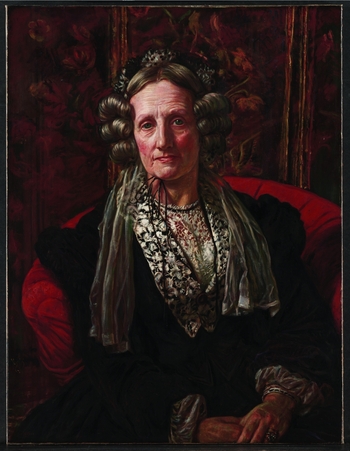
Seeing the full range of Hunt's work, the portraits as well as the secular narratives and religious paintings, brings out his overwhelming if not obsessive occupation with the visual play of light on material objects. In particular Hunt is occupied with the texture of textiles, with their folds and creases, and the reflection of light on these fabrics. Linda Parry in “Textile Background: Cloth and Costume” convincingly traces this interest to the immersion of Hunt's family in the textile business. His father and grandfather both were managers of a textile warehouse and Hunt himself worked as an apprentice in textile design. In the portrait of Mrs. George Waugh the intensely dark dress with its patterned collar, the translucent shawl, and the sofa in rich red compete for attention with the highlighted face. In Isabella and the Pot of Basil the folds of the virtually transparent gown and the embroidered red brocade on the variegated inlay of the wooden chest again vie for interest with the face and sensuously twisted body. This occupation with the surface of materials, particularly of textiles, suggests that for Hunt the concentration on the purely visual exists in tension with and indeed often escapes the moralizing program registered by symbolic detail. Rather than a purely Ruskinian artist, as he is most often seen, Hunt's oeuvre as presented at the AGO suggests a Paterian, even modern strain of form and color for its own sake barely held in check by narrative purpose.
This same tension between the sensuous and the religious informs the art of his trips to the Holy Land represented comprehensively at the AGO. Certainly, the details of the salt waste of the Dead Sea in The Scapegoat (1854) carry rich typological meaning. But the many watercolors of the Middle-Eastern landscape at the AGO, albeit in the fluorescent tints so uncongenial to the contemporary eye, testify to Hunt's fascination with desert light playing on the exotic colors of sere strata, as in his watercolor of The Sphinx (1854). Such landscapes as The Plains of Riphaim (1855), a watercolor heightened with white and surface scratching, has the general typological aura that for Hunt informed any landscape of the Holy Land. Yet clearly his concern is with the contrast of the green of olive trees, the reddish soil, the white stone walls, and the orange-tinted hills.
From his travels to the Middle East comes, too, The Afterglow in Egypt (1854) (Figure 12) a starkly sensual, virtually anthropological figure of an Egyptian fellah woman painted from the life in Egypt and devoid of typological significance. In this full-length portrait, again rich with the play of light on the blue gown, the necklaces, and the multiple colors of the headdress, the young woman looks directly at the painter with a conventional come-hither look, her gown hinting at the curves of her body. Here Hunt paints female beauty beyond the conventional European prettiness of Victorian portraits. This sexual exoticism as a representation of his own erotic impulses resonates with movements on the continent, as in Charles Baudelaire's contemporaneous dream-like evocations of his Caribbean mistress Jeanne Duval.
(Color online) William Holman Hunt, The Afterglow in Egypt. Oil on canvas, 1854–63. Courtesy of Southampton City Art Gallery, Hampshire, UK. The Bridgeman Art Library

The rich section at the AGO devoted to Hunt in the Middle East employs the Toronto connection to testify to another form of Hunt's cosmopolitan affiliations. As outlined in Katherine Lochnan's illuminating “The Canadian Diaspora: Last Rights,” in Palestine Hunt became involved with Henry Wentworth Monk, a Canadian who was a leading figure in the movement termed Christian Zionism, composed of those who for “spiritual and humanitarian” reasons “hoped that a homeland for the Jews could be established in Palestine, and that their return to the ‘Holy Land’ would inaugurate one thousand years of peace on earth” (192). This contextualizing of Hunt's work in a global frame moderates the received notion of his idiosyncrasy and complicates our sense of his Orientalism. Deeply attracted to the charismatic figure of Monk, in 1858–59 Hunt painted a portrait that demonstrates his mastery of portraiture, as in the intensity of the gaze that registers the ideological obsession akin to madness that led Monk to be placed briefly in a mental asylum. The gaze also appears to look into the present and the future simultaneously, as does the typological iconography: “a Bible opened at the Book of Revelation, and a sealed copy of The Times, indicating his belief that ancient prophecies will be fulfilled in modern times” (Lochnan 193). Wearing an Arab gown, as Hunt did in his own self-fashioning photographs of himself, Monk is presented as Hunt's doppelgänger, the painting in a strong sense the self-portrait of the artist as prophet.
The long nineteenth century turns out to be longer than we thought. If we turn to the evidence of both literary fiction and works of popular culture, then it seems that we are still in it – or rather, that we have deliberately, self-consciously rejoined it. The rallying cry of the opening decades of the twentieth century may have been to “make it new” (with “it” referring to any creative activity or artifact). But the equally insistent demand by Western artists of the current decade has been to “make it old” – to make it, in fact, Neo-Victorian.
At the moment, the part of the lengthy nineteenth century that appears to be most attractive to writers, illustrators, and filmmakers is the fin de siècle. In works aimed variously at sophisticated and elite audiences, at mass audiences, and even at audiences composed largely of children, artists are echoing the late-Victorian aesthetes’ determination to make it beautiful and the decadents’ resolve to make it strange. In doing so, they are re-imagining, but also reviving, subjects, styles, principles, and even individual turn-of-the-century figures that modernism supposedly erased or, at least, eclipsed.
How dated, how misguided, now seems the 1983 “Introduction” to the Penguin edition of Edmund Gosse's Father and Son, with its dismissal of the legacy of the fin de siècle as a matter of no importance. In that volume, which is still in print, the British critic and poet Peter Abbs rejects disdainfully all of Gosse's achievements apart from his 1907 family memoir. Before 1920, as Abbs reports, “Gosse was one of the most influential figures in English cosmopolitan literary life”; by “1940 he was all but forgotten.” For what reason? Abbs explains:
The weakness of Gosse lay in his aestheticism . . . [and] this hedonistic approach to literature floundered badly as civilization encountered the irrational slaughter of the First World War; it had no way of engaging with the upheaval because aestheticism itself was ultimately more a symptom of the malaise than interpretation or corrective. In the changing conditions, Edmund Gosse's lightness of touch became not so much sensitivity as a lack of pressure; the super-refinement, in the crisis of civilization, became a mode of superficiality. (15–16)
While casting Gosse's literary “voice” as a mere “disappearing whisper,” Abbs praises the “trenchant” work of the next generation of writers – the modernists, especially Ezra Pound and T. S. Eliot, who rebelled against their aesthetic and decadent predecessors.
What seems increasingly clear, though, is how little those supposedly tough and rugged modernists have been able to offer their successors in the first decade of the twenty-first century, and how faint is the creative inspiration they are providing today. Once again, there is a “crisis of civilization”; once again there has been an “upheaval” in the wake of “irrational slaughter.” But in the post-9/11 transatlantic world of the arts, it is not Eliot and Pound who are supplying the fragments that we shore against our ruins; it is Oscar Wilde and Walter Pater. Aestheticism and decadence have proven themselves more than merely resilient movements. They are now resurgent ones, driving new literary cults such as the past-futuristic genre of so-called “gaslight romance,” and resplendent ones, bursting forth in the gleaming material surfaces of steampunk and in the dark frills of Gothic Lolita fashions.
This revival is no mindless exercise in nostalgia or escapism. Although there are indeed nostalgic and escapist impulses involved, even these are being deployed thoughtfully, often with an element of serious scholarship behind them. Most interesting, however, are the number of works, particularly in the area of literary fiction, that are using the philosophical lens of aestheticism and decadence to examine the challenging issues of contemporary life. For the African-American novelist Louis Edwards, the imagined story of the Black valet who accompanied Oscar Wilde on his 1882 tour of the United States becomes the medium through which to look at racial barriers and class divides and, at the same time, at questions of hybridity and fluidity in both racial and sexual identities. In his Oscar Wilde Discovers America (2003), the novel's protagonist, William Traquair, discovers himself by coming to apprehend “his beauty, his particular beauty that, in the end, was tragic, as the very thing – the way he looked – that had delivered to him so much special treatment, so many privileges, so much, including, he was sure, the love of Oscar, the beauty that had ushered him into the realm of what he desired, [yet] was also what had denied him the thing he wanted most” (280).
For Zadie Smith, too, in her novel On Beauty (2005), lives and fates turn on questions of aesthetic valuation and appreciation, as well as on the dangerous intersections of beauty and erotic desire, all within a framework of bi-racialism, multiculturalism, and transnationalism. Much has been made of the literary conversation that Smith, a Black British writer, enters into so playfully with E. M. Forster's 1910 novel, Howards End. But less has been said about its dialogue with Paterian and Wildean issues of the proper and improper ways to respond to the power, as one of Smith's fictional characters puts it, of “beauty as a physical actuality in the world'” (207). For the house that lies at the center of a property dispute in Howards End, Smith substitutes a work of art: a portrait of “a Voodoo goddess, Erzulie,” who “avenge[s] herself on men,” and who is depicted as “a tall, naked black woman . . . standing in a fantastical white space.” Like the Salome of Oscar Wilde's creation, she is the meeting-point of contradictions: “She represents love, beauty, purity, the ideal female and the moon . . . and she's the mystère of jealousy, vengeance and discord” [ellipses in original]. The Black woman to whom this painting later will be willed by its owner exclaims, in appreciation of her beauty, “She's fabulous” (174–75). Beauty drives the conflicts throughout, and the ghosts of aesthetic debate are everywhere in Smith's twenty-first-century urban landscapes – even in a music megastore in Boston that inhabits “the old municipal library, built in the 1880s in brash red brick with glittering black windows and a high Ruskinian arch above the door . . . In this building Oscar Wilde once gave a lecture concerning the superiority of the lily over all other flowers” (179).
Beauty and its relationship to morality, amorality, and immorality was, of course, at the center of Wilde's own The Picture of Dorian Gray. Thus it is also the focal point of a new graphic novel version of Wilde's text that the illustrator I. N. J. Culbard has produced in conjunction with the writer Ian Edginton, bringing this decadent tale, still in its fin-de-siècle setting, into a genre much favored today by adolescent readers. More surprising, however, is that even younger groups of readers are being introduced through children's books to both beauty and strangeness in a Wildean context.
Daniel Pinkwater and Jack E. Davis add a comic spin in The Picture of Morty and Ray (2003), in which two young friends delight in watching a “scary movie. It was about a handsome guy who had his picture painted . . . The handsome guy behaved like a jerk” (2), until “The rich handsome guy looked handsome as ever, but the picture had changed!” (10). Enthralled by this scenario, the two boys, Morty and Ray, draw each other's portraits, then deliberately misbehave in order to make their pictures change: “The next day we took the last two pickles out of a big pickle jar and stuffed them into our friend Oscar's pants. Then we poured the pickle juice on him and told people he had wet himself” (26). Their images do alter in response to their misdeeds, but they tire of the process of making this happen and give the portraits to Oscar, who responds enthusiastically, “Neat, neat, neat! This is the coolest thing I have ever seen!” (29). Unlike most work for children, the story has no moral and no didactic lesson; it merely celebrates the power of art to influence the spectator and to effect the impossible (Figure 13).
(Color online) Dust-jacket by Jack E. Davis for Daniel Pinkwater, The Picture of Morty & Ray (New York: HarperCollins, 2003). Courtesy of HarperCollins.

Wildean echoes pervade the equally comical Bill in a China Shop (Figure 14), by Katie McAllaster Weaver and also from 2003, in which the aesthetic movement's passion for porcelain drives an ungainly, anthropomorphic bull, who favors the clothes of a late-Victorian dandy and who becomes a determined collector:
(Color online) Dust-jacket by Tom Raglin for Katie MacAllaster Weaver, Bill in a China Shop (New York: Bloomsbury, 2003). Courtesy of Bloomsbury.

Disaster strikes, when this overlarge, albeit impeccably turned out, Wildean-looking figure attempts to purchase “a cup that made him want to shout,/ a cup he could not live without” (7). Inevitably, he stumbles and smashes most of the shop's contents. But all ends happily in Weaver's verse-narrative, as three elderly ladies come to his rescue, and Bill repays them with an invitation to tea in his rooms, which are furnished in high aesthetic style, complete with arts-and-crafts furniture and jars holding peacock feathers.
A more serious exploration of the principle of art-for-art's-sake occurs in yet another surprising work for young readers, Elise Broach's Masterpiece (2008), a tale of art-making and art forgery located in the present. Here, the protagonist is a self-taught visual artist, who not only discovers his gift for drawing, but the ecstasy that goes with creation: “It felt as if time stopped. Marvin was so focused on the work that he lost a sense of everything around him . . . The walls of the room seemed to disappear: The table floated away” (Broach 157). To produce a work of art is “a way of settling deep inside himself, lost to the outside world” (92). But Marvin's “outside world,” unlike that of a late-Victorian aesthete, is a hole in the kitchen wall of a New York City apartment, for he is not only a genius, but a small black beetle, who paints by dipping his delicate front legs into inkpots. Broach's idealistic insect artist experiences conflict with his uncomprehending beetle family and bonds instead with a human boy – one at odds with his own Philistine mother, for whom art is merely a commodity – to form a new sort of domestic partnership.
Some filmmakers, however, appear uncomfortable with the element of social estrangement in the self-exiling figures whom they have disinterred (in some cases, quite literally) from the late-Victorian past. Screenwriters and directors seem intent, therefore, on domesticating these aesthetes and decadents and planting them firmly within the confines of heterosexuality and the bourgeois family. In James Mangold's Kate and Leopold (2001), the marriage-resistant inventor and dreamer from 1876 who drops suddenly, by way of a “portal” in time, into the twenty-first century speaks in Wildean epigrams (“Life is not solely comprised of tasks, but of tastes,” he announces) and demonstrates a close acquaintance with the language of flowers and with opera; yet he must be turned into a heterosexual suitor and representative of hearty masculinity nonetheless.
Tim Burton's Charlie and the Chocolate Factory (2005) gives free rein to the decadent vision of Willy Wonka who, in his long velvet coat and top hat, resembles both Dr. Caligari and Oscar Wilde (and who sports a script “W,” worn as a pendant around his neck, as though to emphasize the latter association). But it is the aesthete, Charlie, who will ultimately triumph – the aesthete who responds to his first sight of the artificial landscape in which Wonka has replaced nature entirely with candy-creations by exclaiming, “It's beautiful!” This is a line of dialogue that exists neither in Roald Dahl's original 1964 story nor in the 1971 film adaptation. Also original to this screenplay by John August is Wonka's offhand reply to Charlie's effusions: “What? Oh, yeah. It's very beautiful.” His is the distracted response of a decadent, preoccupied with perfecting strange effects and indifferent to the aesthete's attitude of appreciation. Charlie, though, is more than an appreciator of beauty; he is also a domesticated aesthete, so deeply bound to his family that he not only convinces the coldly perverse and inhuman Wonka to accept this tie, but to reunite with his own father.
Yet the ultimate taming of the “Wilde” artist, as well as the most literal resurrection of aestheticism, occurs in Wes Craven's English-language segment for Paris, je t'aime (2006), a compilation film made in France with multiple directors. In Père Lachaise cemetery, the audience sees Wilde rising from his own tomb to perform the unlikely function of reconciling a heterosexual couple whose engagement is on the rocks. “What do you want from a husband?” the man demands in frustration of his fiancée. “Lightness,” she replies. Here, it is the quality of “lightness” that Wilde champions, models through his manner, and encourages the would-be husband to discover in himself. Without this “lightness,” which only the figure of Wilde can bequeath to the present, there will be no marrying, no social bonding, and thus no future for the human race.
“Lightness” – the word that Peter Abbs applied to Edmund Gosse pejoratively in 1983, to explain why aestheticism supposedly became anachronistic in troubled times and vanished – returns via the late-Victorians to the popular and high arts alike of the twenty-first century. Now, however, it is a quality that is openly being desired, embraced, and celebrated. So too are aesthetes and decadents themselves returning, arriving in myriad forms and even species. Aestheticism and decadence are very current indeed, and they are inspiring not merely scholarship, but creative works in a wide variety of genres and media, for an equally wide variety of audiences. “How strange!” we might think. But who would not also greet such a development by exclaiming, “It's beautiful!”?
Endless Forms: Charles Darwin, Natural Science and the Visual Arts, on view at the Yale Center for British Art in the spring of 2009, commemorated the two hundredth anniversary of Darwin's birth and the one hundred and fiftieth of the publication of On the Origin of Species. According to its curators Diana Donald and Jane Munro, it drew on contributions from over eighty institutions world-wide: libraries, rare book and manuscript archives, art galleries, and natural history museums as well as research centers on botany, zoology, evolution, and the earth sciences. For two and a half months, the second floor of the YCBA became a complete Victorian museum, packed with miscellaneous wonders and curiosities ranging from the dinner china Charles and Emma Darwin inherited from their Wedgwood grandparents to pigeon skulls to the most luxuriant oils by Dante Gabriel Rossetti and Frederick Sandys. At once gorgeous, instructive, and anxiety-provoking, the exhibition also included maps, drawings, sculptures, books, photographs, fossils, crystals, stuffed Galapagos finches, pornography, hats, and a video supplied by the World Pheasant Association. Ranging across materials and disciplines, from highbrow to low, and from illustration to fine art, the exhibition juxtaposed the amusing (Robert Farren's and Benjamin Waterhouse Hawkins's chubby imaginary dinosaurs from the 1850s) to the creepy (stuffed hummingbirds on a Victorian fan) and the horrific (Punch images of Africans as apes), the microscopically fascinating (Lens Aldous's 1838 vastly magnified head of a flea) to the sublimely campy (Edwin Landseer's heroic stags battling to the death, ca. 1853), and the compellingly peculiar (Odilon Redon's 1883 lithograph series Les Origines) to the outright distinguished (J. M. W. Turner's The Evening of the Deluge [1843], some of Claude Monet's Rouen Cathedral canvasses [1892–94], and John Ruskin's ravishing watercolor, Study of a Peacock's Breast Feather [1873–75], to mention just a few).
All this variety seemed to capture Darwin's unbounded intellectual universe, to demonstrate how every corner of human endeavor was affected by Darwin's revolution, and, too, to remind us how current his ideas still are. Among the exhibits on sexual selection, the video of the male Argus pheasant displaying his amazing feathers, which Darwin said were “more like a work of art than nature” (quoted in Munro 253), drew frequent comment from museum visitors. Men tended to express anxious identification with the male, trying so hard to please, while women seemed defensive about the female's apparently ungracious response:
Grey-haired man (in mock outrage): Hey man, what more does he have to do? She won't even look at him.
Younger woman (coolly): You have to remember, her eyes are on the sides of her head.
And downstairs in the shop, umbrellas in a peacock-feather print were available for purchase. We humans still need Darwin's help as we ponder what kind of animal we are.
Yale marked the bicentenary with much else besides “Endless Forms,” and New Haven became, briefly, a multimedia Darwin circus. There were shows at the Peabody Museum of Natural History and at the specialized libraries (medicine, divinity, science, music); lectures on such topics as biodiversity, creationism, and the reading of fossils; a “Survival of the Fittest” film series, including Planet of the Apes; podcasts on iTunes; a staged reading of Timberlake Wertenbaker's 1998 play, After Darwin; and even a series of boat cruises (on the wooden schooner Quinnipiak, moored in New Haven harbor) intended to demonstrate what life was like on board a nineteenth-century ship and how Darwin might have collected materials on the Beagle. New Haven residents got used to seeing a blowup of William Dyce's ominous Pegwell Bay, Kent – A Recollection of October 5th, 1858 lumbering by on the sides of city buses (looking increasingly smoggy), and Martin Johnson Heade's 1871 Cattleya Orchid and Three Hummingbirds practically everywhere else.
But why an exhibition on Darwin and the visual arts? What was gained by placing world-class paintings next to taxidermy? Did the exhibition merely seek to cover yet one more of the fields where Darwin left a mark? We already have Darwinian economics, social theory, psychology, anthropology, and natural sciences from biology to geology. We know all too much about Darwin's impact on religion, and Darwin and literature has been done to a turn. What was left to do, with the bicentenary coming up? But the exhibition made a strong, original argument, for which the magnificent catalogue's introduction and twelve extensive essays provided the scholarship. Darwin's scientific thinking, the curators and authors argue, was shaped by the rich visual culture of his day, and, in turn, Darwin's works powerfully influenced the subsequent production of visual arts in Britain, Europe, and the U.S., impacting not just the iconography but also the forms of Victorian and modernist art in ways not hitherto sufficiently appreciated.
The second part of this argument should not be surprising, since, as Diana Donald puts it in the Introduction to the catalogue, “his theories . . . permeated the consciousness of his contemporaries” (Donald 2). Yet before this exhibition, few scholars had considered that those contemporaries included visual artists, the notable exception being Jonathan Smith, whose 2006 book Charles Darwin and Victorian Visual Culture is acknowledged by the editors as a predecessor and who has a fine essay in the catalogue. The exhibition demonstrated that such Darwinian concepts as geological change, the dynamism and interconnectedness of natural forms, the struggle for existence, sexual selection, and the descent of humankind from animal ancestors were taken seriously and debated not only in the works of artists deliberately illustrating or refuting these ideas, but also in the works of artists in the canon of nineteenth-century Western art: Turner, Rossetti, Tissot, Cezanne, Monet. Most radically, Diana Donald claims that Darwin influenced not only the subjects that visual artists chose, but also “their whole notion of what art was” (10). By showing that what we call beauty is a function of natural and sexual selection, Darwin undermined the belief that beauty in nature was made by a Creator to please His own and human eyes. Darwin did to art's celebration of natural beauty, Donald argues, what he has long been recognized as having done to religion.
The first proposition of the exhibition's argument – that Darwin's thought was influenced by prior visual representations of nature in the fine arts and in science – is likewise initially somewhat unsurprising, since it is well-known that evolutionary thought had begun to develop before Darwin, in the work of his grandfather Erasmus Darwin, in Charles Lyell's Principles of Geology (1830–33), and elsewhere, and that Darwin read widely in many fields of science. The exhibition and Rebecca Bedell's essay, “The History of the Earth: Darwin, Geology, and Landscape Art,” demonstrate that early and mid-nineteenth-century artists, informed by recent geological studies, had begun to picture a prehuman world, using fossil evidence to reconstruct the appearance of dinosaurs (see Figure 15), and that some painters were depicting landscapes that “were not mere backdrops to human action but had histories of their own” (Bedell 68). J. M. W. Turner's The Fall of the Tees, Yorkshire (1825–26), for example, carefully depicts both the rock strata of which the waterfall's mighty cliffs are composed and their erosion by water, both evidence for Darwin's theory that geological change was slow and gradual, rather than sudden and catastrophic as those who held to the Biblical account of creation believed. (Turner evidently took both sides in this debate, as his The Evening of the Deluge, also exhibited, implicitly represents the Flood as the chief cause of geological change; see Bedell 55–56.) But here again the claim runs deeper than at first appeared. The exhibit, and Donald's Introduction, point out that Darwin's science itself, his scientific way of thinking, depended not only on his powers as an observer but on “the visual dimension of the scientific traditions he inherited” (3). Not only did he learn how to see from the careful observational labors of the natural theologians in whose ranks he started out; he inherited from them the idea that seeing is knowledge. Hence the value of the exhibition's defining Darwin as a specifically visual thinker.
(Color online) Robert Farren, Duria Antiquior (An Earlier Dorset). Oil on canvas, c. 1850. Courtesy of Sedgwick Museum of Earth Sciences, University of Cambridge.

That Darwin could not draw may be why so few have bothered to study his relation to art. Whereas the ability to make detailed observational drawings was necessary for the practice of the visually-oriented naturalism that preceded him (examples of which filled the first few bays of the exhibition), Darwin became a brilliant painter in words, and he relied on others to illustrate his works, or he did not illustrate them: On the Origin of Species contains no pictures and a single, momentous diagram. In stark contrast to the visual riches that greeted the visitor on the second floor of the British Art Center, one spare, hand-sketched diagram of a branching evolutionary tree, headed with the words “I think,” plus a hand-drawn stratigraphic map of an area in Chile, were all the visual materials that Darwin personally contributed to the show. Aside from these items, a couple of portraits of Darwin, some specimens he collected, and some of the hilariously awful photographs he commissioned for his book The Expression of the Emotions in Man and Animals, the cohesion of the show depended on the argumentative underpinnings that tied the eclectic exhibits to Darwin's ideas and to each other.
That every object was displayed in so explicit a frame constituted both the strength and a potential weakness of the show. Many items – such as the ethnographic cartes de visite photographs, the clumsy fantasy paintings of prehistoric humans, or the woman-as-dominatrix porn images, all inspired by popular misconstructions of Darwin's thoughts on race, descent, and sex – were hard to look at and made sense only in a thesis-driven show. The geological and zoological specimens (brought over from the Peabody Museum; the installation at the Fitzwilliam included a similar local hoard) were likewise strictly illustrative. The viewer was never at a loss as to what to think, but also never free to think something else. Other exhibits, such as the major Impressionist works that closed the show, strained against the argumentative rubric under which they were placed: a show that slots such works into one interpretive frame – the demonstration of Darwin's influence on art – is perhaps too thesis-driven. And yet it was interesting, when viewing Paul Cezanne's stratified, massive outcrop in Rocks (ca. 1867–70) or the heaped and fissured stones of his The Grounds of the Chateau Noir (ca. 1900), to learn that he had studied geological history and evolution with his friend the Aix-en-Provence geologist and paleontologist Fortune Marion. Similarly, it shed fresh light on Monet's Rocks at Port-Coton, The Lion Rock, Belle-Ile (1886), his painting of jagged, eroding, volcanic cliffs on Brittany's seacoast, to know that he meant such sea- and rockscapes to depict “the world's dawn . . . the torment of planetary dramas” (quoted in Kendall 312). And the exhibition context highlighted the daring scientific irreverence of his Rouen Cathedral series, in which, as Richard Kendall's essay points out, God's house is reduced – or elevated – into a geological object. In any case, the curators made the best of Darwin's failure to produce his own artwork. That he was the absent center of the exhibition (present nowhere in particular, his presence felt everywhere) replicated his status in relation to Victorian visual art itself. By focusing not on Darwin's copious and brilliant writing but on a form in which he produced nothing, the exhibition could orient itself towards the furthest reaches of his influence.
What new Darwin did this exhibition produce? What does the revelation of the specifically visual nature of his thinking add to our understanding of Darwin's thought and his cultural impact? The exhibition and the catalogue strive, like George Levine in his recent Darwin Loves You, to counteract and complicate popular misperceptions of Darwin as a dour, fatalistic, godless materialist (and, too, misperceptions of him as imperialist, racist, and sexist). Like all recent intellectually responsible Darwins, this exhibition's Darwin is paradoxical and open to interpretation: a believer in racial differences who nonetheless argued for cultural relativism and against the superiority of whites; the bold advocate for the idea that humans descended from animals, who downplayed our scary kinship with the gorilla in favor of the pleasant notion that our pets are like us (he thought Landseer's dog portraits accurately conveyed animal emotion); the dismantler of at least two millennia of received wisdom about the origin and nature of humankind who nonetheless sought to avoid controversy; the awestruck admirer of the “endless forms” of nature who learned that nature's health depends upon a violent “law of struggle”; the evolutionist proud that humans developed the capacity for charity yet afraid that we compromise our evolutionary destiny by keeping the unfit from dying off; a sentimental Victorian who was also the most open-minded man of his day. This morally and intellectually complex Darwin emerges vividly in the exhibition, reflected in the wide array of beliefs circulating amongst those who reveal his influence. But this complexity is not uniquely available through Darwinian visual culture; the Darwin of the literary critics (starting with Gillian Beer and George Levine) was already a complex thinker, an imaginative writer whose reinvention of the human and of the real fostered the great achievements of the Victorian novel.
Although the exhibition elaborated effectively on these recent and relatively familiar Darwins, the most exciting moments came with the work of artists who took his ideas in innovative directions, not just agreeing or arguing thematically but using his ideas to create new forms, such as the naturalism of the Impressionists, whose direct and insistently materialist observations of nature reveal Darwin's influence. The exhibit bays on “The Struggle for Existence” and Diana Donald and Jan Eric Olsen's essay “Art and the ‘Entangled Bank’: Colour and Beauty out of the ‘War of Nature'” present Swedish artist Bruno Liljefors's paintings of animals in their habitats, paintings that give richly imagined life to the idea that evolution selects for animals whose coloration blends in with their environment. In some of these paintings, such as Snipe (1905), the animals’ camouflage is so complete that it takes some work to see what the painting is of, and that is the point. Liljefors's representation of this evolutionary principle not only produces “the subtlest of chromatic harmonies” (Donald and Olsen 102) as he differentiates one faded brown from a range of other faded browns to indicate the barely visible bird standing amid dead grass and mud, but, more significantly, it also produces decentered subjects. As his subjects blend in with their environments, Liljefors's paintings – “so different from the staged and centered motifs of a Landseer” (108) – portray a continuous field of “entangled” biomorphic forms that refuse to serve as focal points, and this is not only a Darwinian way of seeing nature, but also a new way of conceiving a work of art. Although the depiction of the snipe is hyperrealist (and Liljefors, who also painted natural history dioramas, is known as “the father of modern wildlife painting” 102), it is also not far off from modernist color-field painting. Liljefors, write Donald and Olsen, “was increasingly interested in the possibility of freeing color altogether from a representational function” (109).
In contrast to the novelists, who in Beer's and Levine's widely accepted accounts built new forms of realism – new plots, characters, and social worlds – from the new realities Darwin created, the exhibition also foregrounded the anti-realist, fantastic forms that the idea of evolution inspired in some visual artists. Before Darwin, dinosaur fossils had prompted extravagant visions of monsters patrolling the British countryside. Most wonderfully, the “Descent of Humankind” section of the exhibition (and David Bindman's supporting essay, “Mankind after Darwin and Nineteenth-century Art”) displayed Odilon Redon's 1883 lithographs, which he gathered under the title Les Origines, with their exotic Darwin-inspired “missing link” images of centaurs and sirens and their even more exotic images of evolutionary pathways not taken. A winged horse is shown losing the struggle for survival while pre-human forms display human features: floating primeval cells with faces, a “misshapen polyp” with a goofy smile (Figure 16), and a flower that can see. “There was perhaps a first vision attempted in the flower,” Redon subtitled this print (quoted in Bindman 156). Like the Darwin who inspired Monet's scintillating play of light over rough stone and whose influence is seen in Liljefors's move towards abstraction, the Darwin who provoked Redon's symbolist images differs from the novelists’ naturalist, and for this vision of Darwin, as for that of Darwin the proto-modernist, we have this brilliant exhibition to thank.
Odilon Redon, “The misshapen polyp floated on the shores, a sort of smiling and hideous Cyclops.” Lithograph. Plate 3 from Les Origines (Paris: Lemercier, 1883). Courtesy of the Museum of Fine Arts, Boston, Lee M. Friedman Fund.



