Introduction
Ecosystem susceptibility to establishment of a weed species is in part a function of available environmental resources. Conditions such as water, nutrient, and light availability must meet basic requirements to support life (Davis et al. Reference Davis, Thompson and Grime2005). Change in resource availability is often explained by fluctuation in gross resource availability or resource utilization (Davis et al. Reference Davis, Grime and Thompson2000; Harrington Reference Harrington1991). Change in resident vegetation influencing light availability, effect of herbivory and pest outbreaks on water and nutrient use, disease incidence reducing resource utilization, variation in yearly rainfall, and eutrophication increasing nutrient availability are a few examples of how resource availability is in constant flux (Davis et al. Reference Davis, Grime and Thompson2000; Harrington Reference Harrington1991). To be invasive, a species must be able to compete for available resources and enough propagules must enter the new environment to maximize use of these resources (Davis et al. Reference Davis, Thompson and Grime2005; Lonsdale Reference Lonsdale1999). Susceptibility of an ecosystem to invasion is neither a static nor permanent attribute.
In turfgrass, cultural practices interact with environmental resources and biological requirements of a species to determine species invasibility (Burns Reference Burns2004). Irrigation, mowing height, and fertilization regimes are three primary cultural practices that can be manipulated by turfgrass managers to encourage vigorous turfgrass growth and discourage colonization by invasive species (Beard Reference Beard1973). Irrigation must be adequate to prevent wilt; however, excessive irrigation may encourage germination and establishment of invasive species (Busey Reference Busey2003). Regular mowing is necessary to provide a consistent and uniform playing surface. Although some weed species are adequately controlled by mowing alone, mowing increases the amount of light that can penetrate the turf canopy to the soil surface, potentially encouraging germination and establishment of other species (Black Reference Black1975; Dernoeden et al. Reference Dernoeden, Carroll and Krouse1993; Lowe et al. Reference Lowe, Whitwell, McCarty and Bridges2000). To maintain vigorous growth, supplementary fertilizer must be applied; however, excessive nutrient application may create a nutrient surplus that encourages invasion by unwanted species (Lowe et al. Reference Lowe, Whitwell, McCarty and Bridges2000).
Doveweed [Murdannia nudiflora (L.) Brenan] is rapidly expanding its geographic range by becoming a dominant colonizer of managed turf in the southeastern United States. Murdannia nudiflora can quickly establish with aboveground stems that readily root at nodes when contact is made with moist soil, and it is a prolific seed producer (Holm et al. Reference Holm, Plucknett, Pancho and Herberger1977). Murdannia nudiflora competes both laterally and vertically for soil and light resources due to its decumbent growth habit (Holm et al. Reference Holm, Plucknett, Pancho and Herberger1977). It completes its life cycle after seed production in early fall as temperatures begin to decline in the southeastern United States, often coinciding with reduced growth of desirable turf in response to deteriorating seasonal growing conditions. If infestations are left unchecked, large voids in turf cover remain until conditions are again favorable for turf growth (Atkinson Reference Atkinson2014).
Although high soil moisture is typical in areas where M. nudiflora is observed, plants can persist in a wide range of soil types and moisture conditions, opportunistically growing when resources are available (Holm et al. Reference Holm, Plucknett, Pancho and Herberger1977). Flowering and seed production occur rapidly after germination (~6 wk, JL Atkinson, personal observation). Murdannia nudiflora exists as a late-germinating summer annual in the southeastern United States. Due to this, PRE herbicide programs timed to control goosegrass [Eleusine indica (L.) Gaertn.] and crabgrass (Digitaria spp.) in the southeastern United States often do not provide adequate residual activity to control M. nudiflora throughout the growing season (Atkinson Reference Atkinson2014). Control with POST herbicides has been demonstrated to be only partially effective and inconsistent (Atkinson Reference Atkinson2014; Atkinson et al. Reference Atkinson, McCarty, Powell, McElroy, Yelverton and Estes2017).
The goal of this research was to evaluate the effect of mowing, irrigation, nitrogen application, and light availability on M. nudiflora growth and development. An understanding of these effects will aid turf managers in predicting where M. nudiflora invasion will occur and shaping cultural practices to encourage vigorous turfgrass growth while discouraging M. nudiflora establishment.
Materials and Methods
Levels of each experimental factor were selected to represent current recommendations for management of bermudagrass turf in the southeastern United States (McCarty Reference McCarty2011). Seed source for the following studies originated from multiple plants from a naturally occurring M. nudiflora infestation in Augusta, GA, that were then transplanted at the Clemson University Greenhouse Complex for seed production and collection.
Mowing Height
A field study evaluated the effect of regular mowing at various heights of cut on M. nudiflora lateral spread, leaf width, and internode length. The study was conducted between August 15 and October 17, 2012, and repeated between July 25 and September 26, 2013. Plots were fumigated with methyl bromide at 73 kg ai ha−1 before year 1 of the study initiation. Plots were 2 by 2 m with 1 m alleys between plots.
Murdannia nudiflora was established by first germinating seeds in plug trays filled with Fafard® 3B potting mixture (Sun Gro Horticulture, Agawam, MA), then allowed to develop to the 3- to 5-leaf stage. Before sowing, seeds were mechanically scarified by abrasion for 30 s between two sheets of medium-grade emery cloth to remove physical dormancy. Murdannia nudiflora seedlings were then transplanted into bare-ground plots 2-wk before mowing by removing a 2.65-cm-wide by 2.65-cm-deep soil plug and replacing it with a 3- to 5-leaf M. nudiflora plug. Fifty-six 3- to 5-leaf plugs were evenly spaced within each plot on 20-cm centers. Soil type was a Cecil sandy loam (fine, kaolinitic, thermic Typic Kanhapladults).
Plots were mowed twice per week at one of three heights: 1.9, 3.8, or 7.6 cm. A Jacobsen Tri-King® 1900D (Textron, Providence, RI) was used to mow 1.9-cm plots and a Toro Z-Master® (Toro Company, Bloomington, MN) was used to mow 3.8- and 7.6-cm plots. An unmowed control was included for comparison. Plots were irrigated 3 times per week and did not experience drought stress throughout the duration of the study. No supplemental fertilizer was applied.
Leaf width, internode length, and percent cover were measured weekly to identify effects of mowing height on M. nudiflora growth characteristics. Leaf width was quantified within each plot by randomly selecting and measuring the width of four mature, fully expanded leaves at the widest point. Internode length was determined by measuring the length between the second and third rooted nodes attached directly to a mother plant by a stem connected to the original crown. The length of four randomly selected internodes was determined per plot at each measurement date. All leaf width and internode length measurements within each plot were averaged before statistical analysis. Percent cover was measured within 1 d following mowing and quantified by placing a 2 by 2 m 289-square grid with 11.75 by 11.75 cm centers randomly within each plot. Grid squares intersecting M. nudiflora leaf tissue were denoted as a “hit” and counted. Percent cover was calculated as number of hits divided by number of squares in the grid (total hit/total squares×100).
Experimental design was a randomized complete block with three replications. Treatments were arranged in a single-factor design (mowing height) with four levels. The study was repeated in sequential years, and plots were rerandomized between years. Data were subjected to ANOVA for evaluation of main effects and interaction between factor levels and experimental years. Where appropriate, further mean comparisons between factor levels were performed using Fisher’s protected LSD. All comparisons were based on an α=0.05 significance level. All analyses were conducted with JMP Pro v. 10 (SAS Institute, Cary, NC).
Competition with Bermudagrass
A greenhouse study was conducted to evaluate the effect of mowing height and nitrogen fertilization on competition between M. nudiflora and ‘Tifway’ bermudagrass [Cynodon dactylon Burtt-Davy×C. transvaalensis (L.) Pers.]. Mature Tifway sod was harvested on June 1 in 2011 and 2012 from a commercial sod farm in Seneca, SC. Sod was washed free of soil and transplanted to 52-cm-long, 37-cm-wide, and 8-cm-deep flats filled with Fafard® 3B potting mixture. Flats were irrigated daily for the first 10 d after planting to aid in establishment, then every 2 to 3 d on an as-needed basis to prevent wilt. Flats were mowed with a Jacobsen Greens King 522A (Textron). A rail system was constructed to facilitate uniform mower operation at 5.3 cm above the soil surface when flats were placed on the ground between the rails. For 2.65-cm treatments, a 2.65-cm thick section of plywood was placed underneath each flat before cutting to raise the soil surface to 2.65 cm below the mowing plane. Sod was allowed to establish for 1 wk before mowing height establishment, then an additional 4 wk before sowing of M. nudiflora seed.
Murdannia nudiflora seed was sown on July 6 in 2011 and 2012 by placing 2 seeds in 20 evenly spaced locations on 8-cm centers within each flat on the soil–turf interface, totaling 40 seeds flat−1. Before sowing, seeds were mechanically scarified as previously described. Following sowing, flats were irrigated daily for 1 wk to promote M. nudiflora germination. After this period, flats were irrigated every 2 to 3 d as previously described.
Nitrogen treatments were applied as urea (46-0-0) fertilizer twice monthly to total 24.5 or 49 kg N ha−1 mo−1. Fertilizer applications were made by first grouping flats by treatment then shaking a measured amount of granular fertilizer across the group of flats in four directions to ensure even distribution across all flats. During each application, flats were randomly placed within each grouping to minimize location effects.
Effect of fertilization and mowing on M. nudiflora establishment was determined by comparing average lateral spread of individual M. nudiflora plants within each flat. At each measurement date, total M. nudiflora coverage was determined by placing a 52 by 37 cm square grid with 1-cm centers over each flat, then denoting each grid square intersecting M. nudiflora leaf tissue as a “hit” and counted as 1 cm2 of coverage. To determine average lateral spread per plant, the total number of established M. nudiflora plants within each flat was counted and divided into total number of hits. Lateral spread was measured weekly within 1 d following mowing.
Experimental design was a completely randomized design with three replications. A 2 by 3 factorial treatment arrangement included 2 mowing heights (1.3 and 2.5 cm) and three nitrogen rates (0, 24, and 49 kg N ha mo−1). The study was repeated in sequential years. Flats were rotated weekly to minimize localized greenhouse effects. Data were subjected to ANOVA for evaluation of main and interaction effects and interaction between levels of factors and experimental years. Where appropriate, further mean comparisons between factor levels were performed using Fisher’s protected LSD. All comparisons were based on an α=0.05 significance level. All analyses were conducted with JMP Pro v. 10.
Reduced Light Environment Tolerance
A greenhouse study evaluated the response of M. nudiflora to four levels of a reduced light environment (RLE): 0%, 30%, 50%, and 70%. Light reduction by each shade cloth was determined by comparing photosynthetic photon flux (PPF) (µmol m−2 s−1) under the shade cloths at soil level to full-irradiance PPF measurements with an LI-28663 quantum light sensor (Li-Cor, Lincoln, NE): [(PPFfull sun – PPFunder shade cloth)/PPFfull sun]×100.
Experimental units were established by sowing 20 evenly spaced seeds in a 15-cm-diameter by 11-cm-deep pot filled with Fafard® 3B potting mixture. During establishment, experimental units were irrigated daily to encourage M. nudiflora germination. After germination, plants were allowed to grow to the 2-leaf stage, at which point they were thinned to 5 plants pot−1. Plants were thinned so that spacing between plants was maximized within each pot. Plants were allowed to continue development under full irradiance and well-watered conditions until the remaining plants reached the 5- to 8-leaf stage, at which point treatments were imposed. A 10-10-10 N-P2O5-K2O fertilizer was applied at study initiation and 4 wk after study initiation to provide 24.5 kg N ha−1 mo−1.
Reduced light environments were applied for an 8-wk period beginning July 1, 2011, and ending August 31, 2011. The study was repeated beginning February 1, 2014, and ending March 31, 2014. RLEs were applied continuously using neutral density, poly-fiber black shade cloth (models SC-black30, SC-black50, and SC-black70, International Greenhouse, Danville, IL) that removed equal amounts of light across the photosynthetically active light spectrum. Individual shade-cloth tent frames were 1 by 1 m and constructed with 5.3-cm-diameter polyvinyl chloride (PVC) pipes. Shade cloths were attached to PVC frames with zip ties and pulled taut to maintain them at a consistent height above the soil surface and to maintain consistent surface temperature and air movement among all treatments.
At the end of the study, plants were harvested and washed free of soil and debris, then dried at 70 C for 48 h and weighed. Total dry biomass was pooled for each pot and partitioned into shoot and root biomass. Internode length was determined by measuring the length between the second and third node away from the mother plant on a randomly selected stem attached directly to each mother plant within each pot.
Experimental design was completely randomized with three replications. Treatments were arranged in a single-factor design (shade) with four levels. Each treatment level replicate included three experimental units (pots), totaling nine observations per treatment level. Multiple experimental units were included in each replicate to reduce variation within treatment replicates. The study was repeated in sequential years, and each treatment level replicate was repositioned to minimize localized greenhouse effects. Data were subjected to ANOVA for evaluation of main effects and interaction between main effects and experimental years. Where appropriate, further mean comparisons between factor levels were performed using Fisher’s protected LSD. All comparisons were based on an α=0.05 significance level. All analyses were conducted with JMP Pro v. 10.
Soil Moisture
A greenhouse study was conducted to determine the effect of soil moisture on M. nudiflora growth and development. Five soil moisture regimes were studied: 12.5%, 25%, 50%, 75%, and 100% field capacity (FC). Pots 15 cm in diameter and 11 cm in depth were filled with Fafard® 3B potting mixture and weighed to determine pot dry weight. Pots were subirrigated to saturation, then allowed to drain for 6 h, then reweighed to determine FC pot weight. The amount of water within the pot at FC was determined gravimetrically by subtracting individual pot dry weight from FC pot weight. A soil moisture regime was then randomly assigned to each pot and gravimetric treatment weight calculated based on the pots’ individual FC pot weights.
Murdannia nudiflora experimental units were established as described earlier for the RLE tolerance study. Soil moisture treatments were imposed on July 26, 2012, and July 15, 2013. Pots were weighed every 3 d. Following weighing, soil moisture levels for each pot were adjusted to the initial gravimetric treatment weight. A 10-10-10 N-P2O5-K2O fertilizer was applied at study initiation and 4 wk after study initiation to provide 24.5 kg N ha−1 4 wk−1.
Murdannia nudiflora was harvested 8 wk after initiation of soil moisture treatment and washed free of soil and debris. Plants were then dried at 70 C for 48 h and weighed. Total dry biomass was pooled for each pot and partitioned into shoot and root biomass. The experimental design was a completely randomized design with three replications. Treatments were arranged in a single-factor design with soil moisture regimes serving as treatment levels. The study was repeated in sequential years. Data were subjected to ANOVA for evaluation of main effects and interaction between main effects and experimental run. Where appropriate, further mean comparisons between treatment levels were performed using Fisher’s protected LSD. All comparisons were based on an α=0.05 significance level. All analyses were conducted with JMP Pro v. 10.
Results and Discussion
Mowing Height
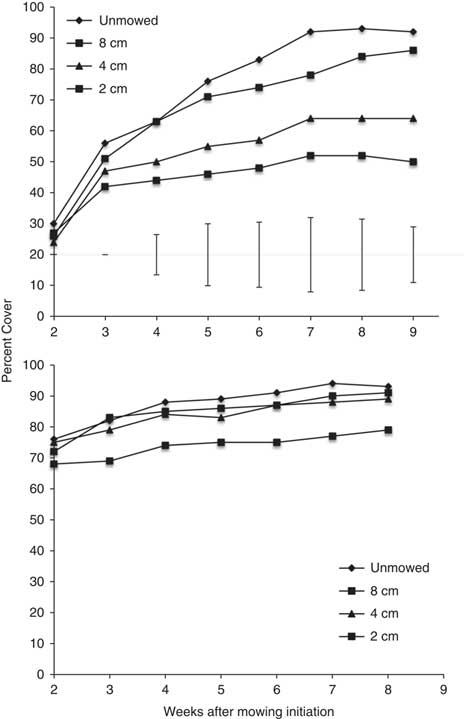
Mowing height affected percent coverage, internode length, and leaf width in both study years at a significance level of α=0.05. Although a mowing height-by-year interaction did not occur when weekly data were combined and analyzed, data were not pooled to provide a picture of how quickly the severity an infestation can increase if left unchecked, regardless of mowing height. Murdannia nudiflora spread slowed as mowing height was lowered in year 1. Mowing height did not influence M. nudiflora spread in year 2 (Figure 1).
Percent Murdannia nudiflora cover in response to various mowing heights, July–August 2012 (top) and 2013 (bottom) in Clemson, SC. Vertical bars represent significant differences as calculated by Fisher’s LSD at α=0.05. No significant differences were detected in 2013.

Four weeks of regular mowing was necessary in year 1 before a significant mowing height effect could be detected (Figure 1). At that point, M. nudiflora spread was 30% less in plots mowed at 2 cm than plots mowed at 8 cm. Mowing at 4 cm did not reduce spread compared with mowing at 8 cm or increase spread compared with mowing at 2 cm. By the end of year 1 (9 wk after planting), M. nudiflora spread was reduced 46% and 30% by mowing at 2 and 4 cm, respectively, compared with unmowed plots and 42% and 26%, respectively, compared with plots mowed at 8 cm (Figure 1).
Overall M. nudiflora pressure was greater throughout year 2 because plants produced seed at the end of year 1 and plots were not fumigated before study initiation in year 2. In response, treatment effects were not significant (Figure 1). This reflects field observations of infestations rapidly escalating over two growing seasons if M. nudiflora growth is left unchecked.
Regular mowing of fine turf is necessary to prevent excessive tissue removal during a single mowing event. Excessive tissue removal can reduce turfgrass density and impair the turf’s ability to regenerate leaf tissue following mowing (Beard Reference Beard1973). Tolerance of a turf species to mowing is dictated by its morphology. Poaceae species are largely tolerant to regular mowing because of intercalary meristems located close to ground level, providing a competitive advantage for Poaceae species used for turfgrass over many weed species (McCarty Reference McCarty2011). In addition, several Poaceae species can rapidly colonize an area due to a stoloniferous or rhizomatous growth habit (McCarty Reference McCarty2011). Murdannia nudiflora shares similar morphological characteristics that are important for plant survival at low mowing heights.
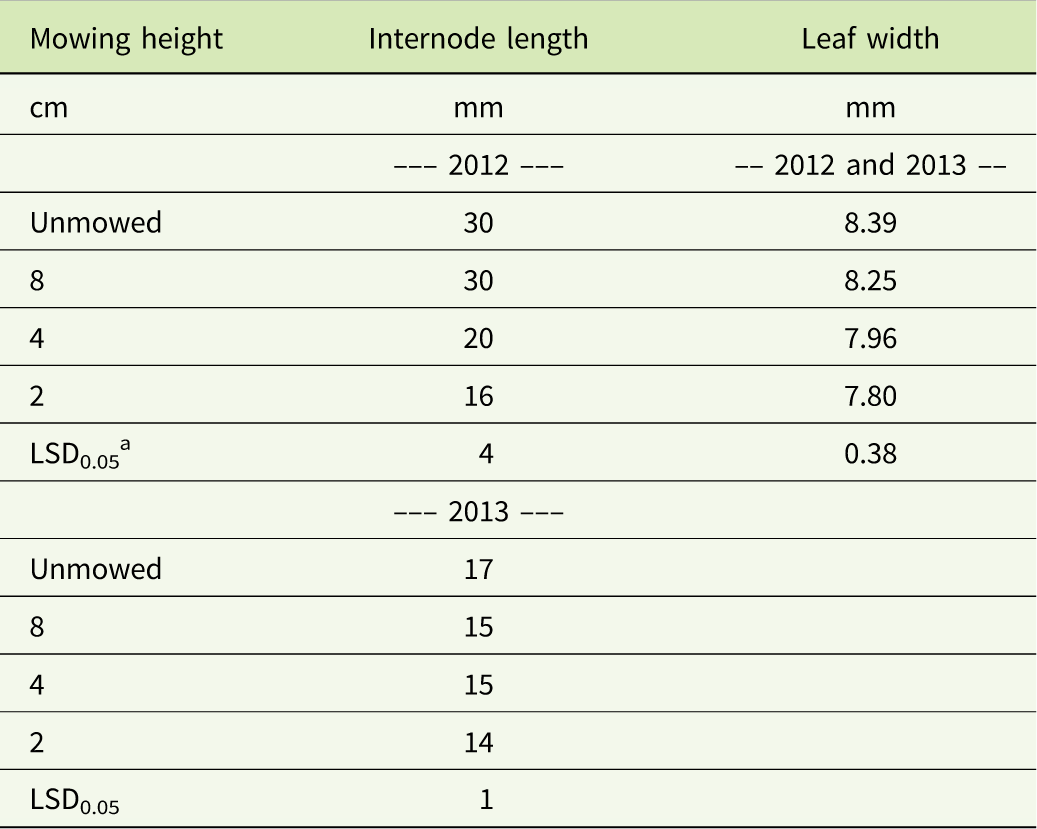
Although low mowing did not limit M. nudiflora survival, mowing height significantly influenced internode length and leaf width. In year 1, internode length averaged 30, 20, and 16 mm in plots mowed at 8, 4, and 2 cm, respectively. In year 2, internode length was reduced across all treatments compared with year 1, possibly due to an increase in intraspecies competition resulting from seedling recruitment (Table 1). In addition, average leaf width was reduced by low mowing, decreasing the total photosynthetic surface area of the plant (Table 1). Photosynthetic capacity can become a limiting growth factor at low mowing heights. Under regular mowing, a plant must manufacture enough photosynthates using limited leaf surface area to fuel normal plant function while preventing depletion of root carbohydrate reserves. Regular mowing at low heights may cause the loss of plant resources at levels that exceed carbohydrate production through photosynthesis, eventually leading to exhaustion of stored carbohydrates (Atkinson et al. Reference Atkinson, McCarty, Liu, Faust and Toler2012; Bunnell et al. Reference Bunnell, McCarty, Faust, Bridges and Rajapakse2004).
Internode length and leaf width of Murdannia nudiflora in response to various mowing heights, July–August 2012 and 2013 in Clemson, SC.

a LSD, least significant difference at α=0.05.
The effect of mowing on other weeds common to managed turfgrass has mostly been evaluated within existing turf stands. Green kyllinga (Kyllinga brevifolia Rottb.) spread and dry weight production doubled when mowing height decreased from 5.0 to 2.5 cm after 8 wk of growth (Lowe et al. Reference Lowe, Whitwell, McCarty and Bridges2000). Smooth crabgrass [Digitaria ischaemum (Schreb.) Schreb. ex Muhl.] invasion into tall fescue [Lolium arundinaceum (Schreb.) Darbysh.] was reduced when mowing height was increased from 3.2 and 5.5 cm to 8.8 cm (Dernoeden et al. Reference Dernoeden, Carroll and Krouse1993). Aside from removal of meristematic tissue, regular mowing may have other effects on species establishment. For example, light is necessary for K. brevifolia seed germination (Lowe et al. Reference Lowe, Whitwell, McCarty and Bridges1999). With lowered mowing height, turf canopy density and the amount of light reaching K. brevifolia seed is increased, thus improving germination and increasing the severity of infestation (Lowe et al. Reference Lowe, Whitwell, McCarty and Bridges1999, Reference Lowe, Whitwell, McCarty and Bridges2000). In species with a high soil temperature requirement for seed germination, such as M. nudiflora, increased light penetration may encourage warming of the soil surface and thus germination.
Mowing did not completely limit M. nudiflora growth and development in this study; however, it effectively slowed lateral spread in year 1, indicating infestations may be less severe at reduced mowing heights. This result supports typical field observations. Regular mowing may also be an effective means for reducing M. nudiflora seed production due to its decumbent growth habit during maturity. In combination with an effective herbicide control program, limiting seed production may reduce establishment from seed in subsequent seasons, lessening infestation of an area. Additional research is necessary to evaluate the effect of mowing height on M. nudiflora seed production and its long-term persistence in a soil seedbank.
Competition with Bermudagrass
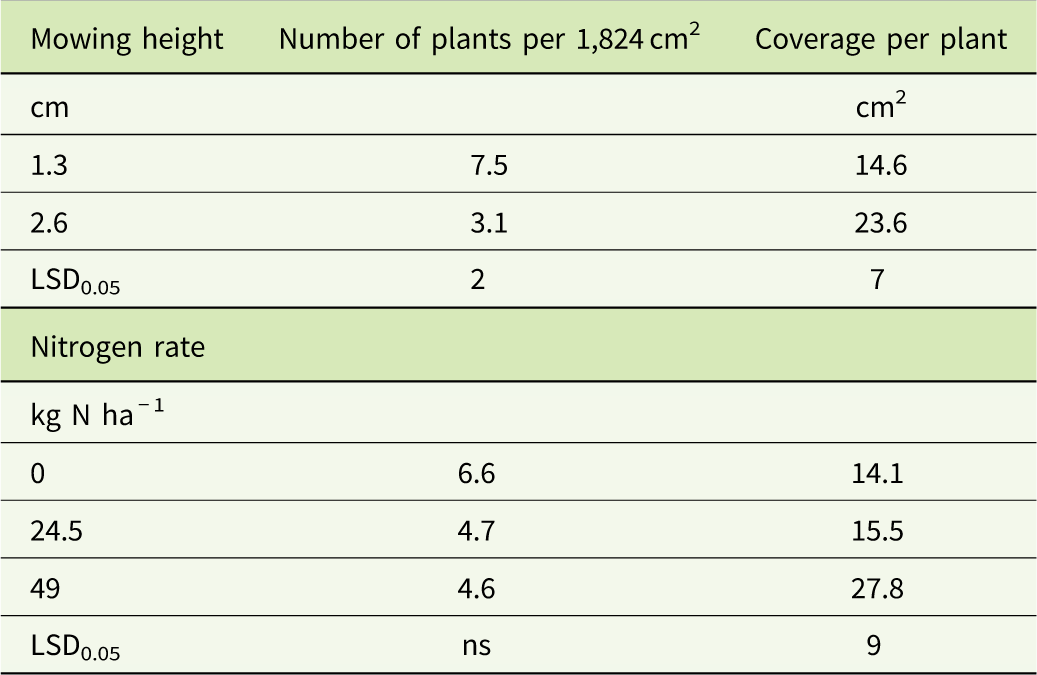
The number of established plants in each flat was not consistent between treatment levels or years. To more accurately represent treatment effects, total M. nudiflora area within each flat was divided by the total number of M. nudiflora plants within each flat to calculate average area per M. nudiflora plant within each flat. Average plant coverage area was then analyzed for main and interactive effects and interaction between treatment levels and years (P=0.05). Mowing height and nitrogen rate effects were detected for number of plants per flat and area coverage per plant. Treatment-by-year interaction for area coverage per plant was not detected; therefore, data from both years were pooled before further analysis.
The number of established M. nudiflora plants decreased as mowing height increased. Flats mowed at 1.3 cm averaged ~8 plants flat−1 and flats mowed at 2.6 cm averaged ~3 plants flat−1 (Table 2). Although light is not necessary for M. nudiflora germination, high soil temperatures (>27 C) encourage rapid germination (Wilson et al. Reference Wilson, Burton, Spears and York2006). Mowing at 1.3 cm may have increased the amount of light penetrating the turf canopy relative to mowing at 2.6 cm, possibly increasing soil temperatures at a more rapid rate, stimulating M. nudiflora germination. Previous research indicated M. nudiflora seed viability is approximately 80% (Atkinson et. al. 2014). Less than 25% germination in this experiment suggests competition from bermudagrass may have influenced M. nudiflora germination and establishment. Nitrogen rate did not influence the number of plants established per flat. Nitrogen rate treatment means ranged between 7 (0 kg N ha−1 mo−1) and 3 (49 kg N ha−1 mo−1) plants flat−1 (Table 2).
Number of Murdannia nudiflora plants and coverage per plant in response to various mowing heights and nitrogen rates in ‘Tifway’ bermudagrass, July–August 2011 and 2012 in Clemson, SC.Footnote a

a Abbreviations: LSD, least significant difference; ns, not significant (α=0.05).
Area coverage of each M. nudiflora plant increased as mowing height increased. In flats mowed at 1.3 cm, M. nudiflora averaged 14.6 cm2 coverage per plant, while M. nudiflora averaged 23.6 cm2 coverage per plant in flats mowed at 2.5 cm (Table 2). This supports conclusions drawn in the mowing height study that M. nudiflora spread is limited by low mowing. Murdannia nudiflora coverage per plant may have also been influenced by intraspecies competition. More M. nudiflora plants established in flats mowed at 1.3 cm than 2.6 cm (Table 2). Murdannia nudiflora mowed at 1.3 cm may have been at a competitive disadvantage for available resources compared with M. nudiflora mowed at 2.6 cm due to fewer M. nudiflora plants. Further research should evaluate the effect of M. nudiflora population density on intraspecies competition and establishment.
As nitrogen rate increased from 24.5 to 49 kg N ha−1 mo−1, surface area coverage per M. nudiflora plant increased ~75% (Table 2). A difference in area coverage per M. nudiflora plant was not detected between plants receiving 0 and 24.5 kg N ha−1 mo−1. Previous studies have indicated invasive Commelinaceae species have higher relative growth rates than noninvasive Commelinaceae species under high nutrient availabilities and all water availabilities (Moriuchi Reference Moriuchi2006). A superior ability to capitalize on resources when they are abundant does not necessarily promote the invasion of habitats where resources are limited (Burns Reference Burns2006). Fertilization should be adequate to promote turf growth while not providing excessive nutrients for growth of weeds (McCarty Reference McCarty2011). Fertilization has mostly reduced the spread of other invasive species in turf by improving the competitiveness of desirable turf. Digitaria ischaemum infestations are more severe when there are voids in turf density, as often results from limited nitrogen application, and K. brevifolia density is reduced in bermudagrass turf following fertilization (Kim et al. Reference Kim, Rossi and Neal1997; Lowe et al. Reference Lowe, Whitwell, McCarty and Bridges2000).
Based on this study, M. nudiflora invasibility can be reduced by avoiding excessive nitrogen fertilization. Results from this study do not conclusively support mowing as a cultural control technique. Additional research is needed to understand the separate effects of mowing on M. nudiflora establishment and spread without the effects of variable intraspecies competition.
Reduced Light Environment Tolerance
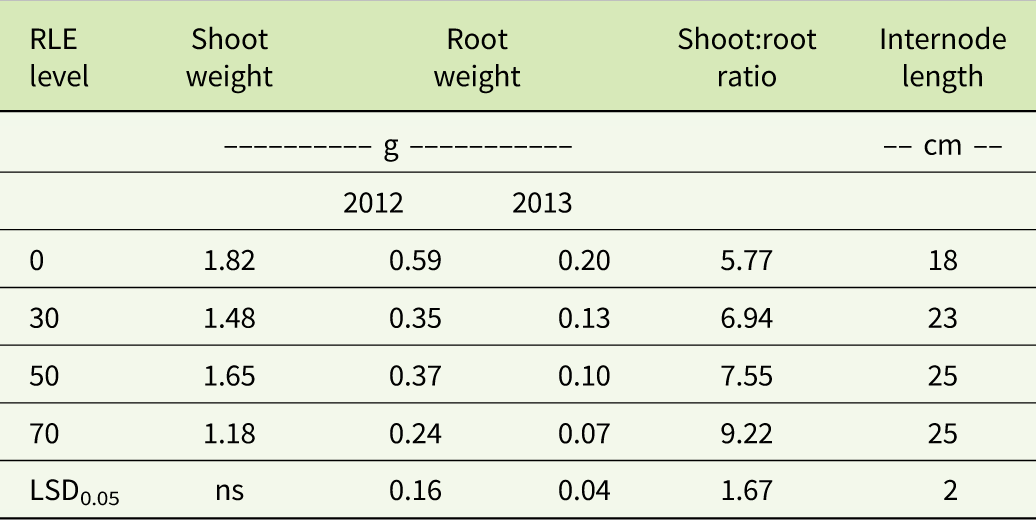
An RLE level-by-year interaction was not detected for shoot weight or internode length at the α=0.05 significance level; therefore data within these parameters from both years were pooled for further analysis. Growth in an RLE did not influence shoot growth on a weight basis; however, internode length was 28% longer in a 30% RLE and 39% longer in 50% and 70% RLEs in comparison with plants grown under full irradiance (Table 3). Internode elongation is a common RLE avoidance mechanism of plants (Gawronska et al. Reference Gawronska, Yang, Furukawa, Kendrick, Takahashi and Kamiya1995). This response improves the ability of a plant to capture adequate sunlight for photosynthesis (Burton et al. Reference Burton, Jackson and Knox1959).
Effect of reduced light on Murdannia nudiflora growth and development, July–August 2012 and 2013 in Clemson, SC.Footnote a

a Abbreviations: LSD, least significant difference; ns, not significant (α=0.05); RLE, reduced light environment.
An RLE level-by-year interaction was detected for root weight; therefore, root weight data were analyzed separately by year. Overall, root weight of plants grown in an RLE was less than plants grown in full irradiance (Table 3). In year 1, root weight was similar between 30% and 70% RLE treatments and between 47% and 59% less than plants grown under full irradiance. In year 2, all RLE treatments again reduced root growth compared with plants grown in full irradiance; however, 46% less root mass was measured in 70% RLE treatments than 30% RLE treatments (Table 3). Root growth was less across all treatments in year 2 than year 1 likely due to less total irradiance during the study period.
A comparison of shoot-to-root ratio suggests excessive shoot elongation in response to an RLE occurs at the cost of root growth. Analysis of shoot-to-root ratio in response to growth in an RLE indicated M. nudiflora increased partitioning of resources to shoot growth when grown in an RLE (Table 3). Physiological responses to an RLE have been observed in other species. Total dry weight, leaf dry weight, leaf area, and total number of shoots and rhizomes are reduced in purple nutsedge (Cyperus rotundus L.) and yellow nutsedge (Cyperus esculentus L.) in an RLE (Patterson Reference Patterson1981). Chamber-bitter (Phyllanthus urinaria L.) growth was reduced>26% in RLEs. Phyllanthus urinaria height was greatest in an 87% RLE, indicating an etiolation response to low light conditions (Wehtje et al. Reference Wehtje, Gilliam and Reeder1992).
In shaded areas, M. nudiflora infestations are often observed in thin bermudagrass turf. A dense turf stand may reduce competitiveness of M. nudiflora in shaded environments. Cultural practices in these areas should focus on promoting a dense turfgrass stand, as results from this study suggest competitive fitness of M. nudiflora is reduced when grown in an RLE.
Soil Moisture Availability
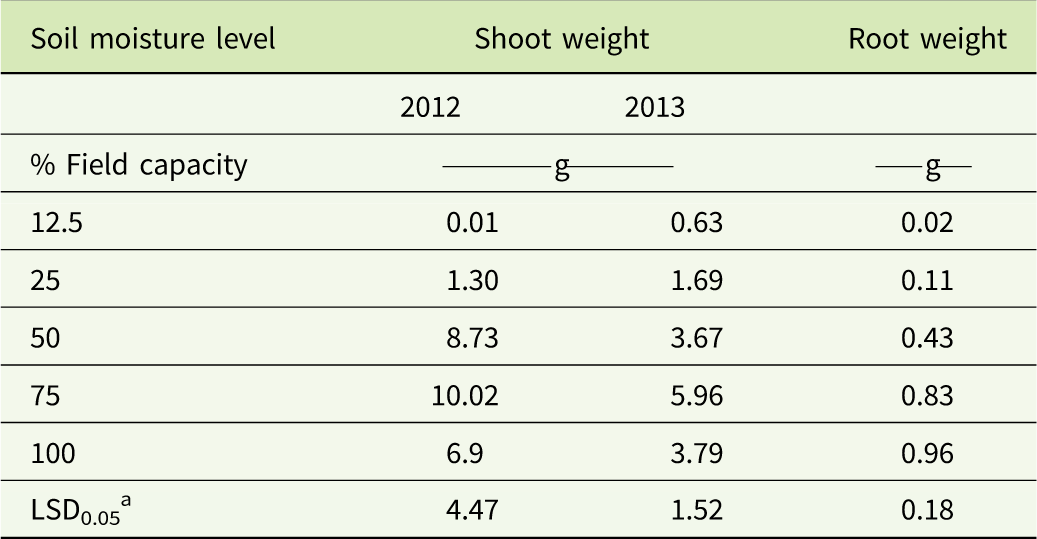
Treatment effects were detected for both shoot and root growth in response to soil moisture availability at the α=0.05 significance level. A soil moisture-by-year interaction was detected for shoot growth; therefore, shoot growth data were separated by year for further mean separations. A similar interaction was not detected for root growth. Therefore, root growth data from both years were combined for further analysis.
Similar numerical trends in shoot growth were observed in years 1 and 2; however, separation between treatments was clearer in year 2. In year 1, plants maintained at 50%, 70%, and 100% FC produced significantly more shoot growth on a weight basis than plants maintained at 25% or 12.5% FC (Table 4). In 2013, increased water availability again increased shoot growth; however, shoot growth was significantly greater in 75% FC treatments than 100% and 50% FC treatments (5.96, 3.70, and 3.66 g, respectively) (Table 4). Comparison with an aquatic congener of M. nudiflora such as marsh dayflower [Murdannia keisak (Hassk.) Hand.-Maz.] under similar environmental conditions would help to determine whether a physiological difference between these species discourages M. nudiflora shoot growth in conditions approaching soil saturation. However, ability to grow across a soil moisture gradient allows M. nudiflora to be invasive in a wide range of soil moisture conditions. Within Commelinaceae, invasiveness of a species is in part determined by plasticity in growth characteristics in response to varying environmental conditions (Burns Reference Burns2004). When compared with a noninvasive congener, M. nudiflora produces more shoot biomass across a water gradient than Murdannia simplex (Vahl) Brenan (Burns Reference Burns2004). In addition, M. nudiflora has a higher relative growth rate across a water gradient than M. simplex, indicating a higher potential for invasiveness under a greater diversity of conditions (Burns Reference Burns2004).
Effect of soil moisture on Murdannia nudiflora growth and development, 2012 and 2013 in Clemson, SC.

a LSD, least significant difference.
Treatments maintained at>75% FC produced more root biomass than 50%, 25%, and 12.5% FC treatments. Although shoot production was greater in 50% FC than 25% and 12.5% FC treatments, 50% FC may not have provided enough water for M. nudiflora to maximize its photosynthetic potential, resulting in a reduction in root growth.
In managed turf, frequent irrigation is often necessary to prevent wilt (McCarty Reference McCarty2011). Irrigation must be adequate to prevent wilt; however, excessive irrigation may encourage germination and establishment of invasive species (Busey Reference Busey2003). Turfgrass managers should irrigate deeply and infrequently to prevent soil moisture from remaining consistently high in the top 3 cm of soil, thus discouraging M. nudiflora germination and growth. Drought-tolerant species such as bermudagrass will have a competitive advantage over M. nudiflora under these conditions.
Murdannia nudiflora is a problematic species in managed turfgrass, in part because of its adaptability to a wide range of environmental conditions. This research demonstrates the ability of M. nudiflora to grow in various levels of soil moisture and light availability, tolerate various mowing heights, and compete with other species for available nutrient resources. Murdannia nudiflora control in turfgrass through cultural practices alone should not be expected; however, cultural practices can be manipulated to slow infestations. The reproductive capacity of M. nudiflora and high germinability of its seeds increases the importance of manipulating cultural practices to favor turfgrass growth before M. nudiflora infestations become severe.
Future research should expand on the effect of nutrient availability on M. nudiflora growth and development, further evaluate the effect of mowing height on M. nudiflora germination and establishment, and evaluate the effect of cultural practices on M. nudiflora fecundity. A broader understanding of cultural practice effects on M. nudiflora growth and development will aid turf managers in formulating a holistic M. nudiflora management program.
Acknowledgments
The authors would like to thank the Carolinas Golf Course Superintendents Association for funding this research. No conflicts of interest have been declared.