Introduction
THE classic rights documents are iconic statements of the claims by which a community articulates its fundamental values. These documents, such as Magna Carta, the US Bill of Rights, the French Declaration of the Rights of Man, and the Universal Declaration of Human Rights (udhr), represent major junctures in the history of human rights. They seem to consolidate ideas and to shape subsequent thinking. Of course, none of these documents entered as a deus ex machina: each drew directly and indirectly from prior attempts at higher law, both secular and spiritual. And each played an important role as a menu for subsequent documents—or so we think. A vexing analytical problem looms over this last assertion. If the major documents simply enshrine conventional wisdom at the time, then how influential were they, really? In this more skeptical reading, these documents come off as merely epiphenomenal: reflections of the era rather than exogenous influences on what would come. We conceptualize this distinction as one of reflective versus formative events.
A case in point is the udhr, adopted by the United Nations General Assembly in December 1948. Prior work convinces us that the udhr—at minimum—reflected leading ideas in midcentury constitutional thought.Footnote 1 We are also persuaded that postwar constitutions share many ideas with the udhr. We're less certain about the udhr's independent role in shaping future constitutions. Our goal in this article is to assemble evidence that will distinguish the udhr from the ideas in which it marinated and to assess the document's formative effects. Ultimately, we're interested in understanding the content and practice of human rights conditional upon the absence of the udhr. Our investigation is relevant for recent debates on critical junctures in the spread of human rights. The conventional wisdom that World War II was a critical turning point has come under attack in recent years from two sets of revisionist accounts. On the one hand, scholars point to sources other than the international covenants adopted between 1948 and 1966. Some have noted the prevalence of earlier transnational movements and judicial institutions, such as those directed at the abolition of slavery; these movements are related to, and certainly foreshadow, later developments.Footnote 2 Other scholars argue that any crucial moments arrived much later than the postwar era. Samuel Moyn, for example, suggests that the international human rights movement didn't gain force until the 1970s, after the decline of utopian, midcentury political projects associated with decolonization and postfascism.Footnote 3 The postwar Universal Declaration of Human Rights, in Moyn's view, was a somewhat defensive document that had few practical implications. It was only in the mid-1970s, he argues, with the adoption of the Helsinki Accords and the enshrinement of human rights as a centerpiece of US foreign policy by President Jimmy Carter, that the institutionalization of human rights truly emerged.
A second set of critics is skeptical of the very project of human rights law and its enforcement. As Eric Posner sees it, human rights discourse flourishes at the same time that governments regularly violate any such commitments, and this lack of efficacy dooms the project.Footnote 4 Taken together, these sets of ideas suggest that little of the international human rights legal structure has seeped into national law and society, or that if it has, the effects have been trivial. Of course, all this skepticism cuts against a line of sociological and political science research that argues that the spread of human-rights speak has infiltrated the national consciousness (for example, along a “World Society” logicFootnote 5 or as part of broader processesFootnote 6) and led to real improvement in rights protection.Footnote 7 Our study investigates a crucial channel along which any such transmission is thought to occur. More generally, the udhr story provides insight into understanding the independent effect of institutions.
Reflective versus Formative Events
In 1952, a group of renowned international architects led by Le Corbusier constructed a midcentury landmark along the East River in Manhattan to house the United Nations. This notable work of architecture helped define midcentury modernism. Subsequent monumental buildings, such as Oscar Niemeyer's National Congress building in Brasilia, would share many of the same design elements. But most architecture critics don't credit the UN building with shaping urban architecture significantly; rather, the building is thought to reflect many modernist ideas already in the air. That is, it was reflective of contemporary ideas (the zeitgeist) but wasn't necessarily a formative influence on future work.
The udhr seems different. For one thing, the document is undeniably unique and, in retrospect, its completion was highly improbable. For one historic moment, countries as disparate as the United States, Ethiopia, and China came together to agree upon a set of basic principles meant to guide politics and society around the world. The American Anthropological Association came out strongly against the project, appalled at the hubris of world leaders who thought to decide the values and precepts by which all cultures should abide.Footnote 8 Indeed, the enumeration of rights inescapably enshrined a particular view of the human condition, even if the principles therein were not concocted de novo. In this article, we will show that the udhr was very much a product of its time but also that its drafters had considerable discretion to select the particular rights that would be included, and in what form. Because of these unique origins and the document's prominence, we have a strong hunch that the udhr and its follow-on covenants have served as an important coordinating mechanism for future constitution-makers. After all, constitution-makers have many instrumental and functional reasons for harmonizing national texts with something as legitimate and authoritative as the udhr.Footnote 9 A prominent, consensual document like the udhr can serve as a useful coordinating device for drafters struggling to produce—under a deadline—universal principles that are meant to endure for generations. These expectations will be familiar to those versed in the theories and evidence of policy diffusion and institutional isomorphism.Footnote 10
Moreover, our strong sense is that scholars share the intuition of the udhr as an influential document. Rarely can we poll colleagues for their sense prior to seeing the evidence, but a 2014 University of Chicago conference that convened human rights scholars (mostly philosophers, legal scholars, and political scientists) was very informative. Prior to any discussion, all but two of the approximately fifty attendees were willing to bet that “the udhr has significantly increased (or decreased) the probability of the adoption of certain rights in subsequent constitutions.” We should also note that the conference was entitled, “Failure of International Law,” and many participants were on the record as alleging such failure.Footnote 11
It's not just scholars who see power in the Universal Declaration. It seems to resonate with citizens, interest groups, legislators, and even businesses. In other work,Footnote 12 we investigate a phenomenon we call chapter-verse branding—that is, naming organizations after important articles of legislation. The udhr is especially inspirational in this way. Its articles are namesakes for everything from a nongovernmental free speech organization (“Article 19”) to a fair-trade jewelry company (“Article 22”), a Boston gastropub (“Article 24”), and an album title (“Article 14”) by American High, the Sacramento rockers.Footnote 13
The udhr would seem influential, but a very reasonable source of skepticism remains.Footnote 14 Simply stated, we can't fully refute the idea that the creation of the udhr, and the subsequent International Covenants that legalized its content, merely articulated prevailing trends in the post–World War II era—trends that also happened to be taken up in post–World War II constitutions. The postwar era is rightly associated with a dramatic turn of events that all seem to compete for credit as formative in nature. After all, the war was ostensibly fought and won for democracy and human rights. The “four freedoms,” as Franklin Delano Roosevelt would characterize the new line of thought, were globally triumphant and resonant around the world. Conversations about human rights abounded everywhere, in universities, legislatures, radio shows, and dining rooms. New, modern rights could just as easily have come from any number of sources besides the udhr. We also know that these new rights were enshrined in contemporary constitutions (such as the French constitution of 1946) that may themselves have been just as important as the udhr in disseminating ideas.
Analytical Approach
If the udhr has been as influential as we think, we should see evidence of that in various forms scattered about the historical record. After all, the effects that we investigate are large macro-historical processes with multiple empirical implications. As we assess the preponderance of evidence, our analysis proceeds in three steps.
To begin, we reason that a formative udhr would be consistent with a set of macro patterns in the spread of rights. In particular, we expect 1948 (the year the udhr was enacted) to be coincident with (1) an upward shift in the overall number of rights, (2) an increased cross-national convergence on some menu of rights, and (3) an increase in the popularity of udhr-included rights. On the one hand, the appearance of these patterns within a few years of the critical event of 1948 would be consistent with a formative role for the udhr. On the other hand, if these trends were already apparent well before 1948, the udhr may merely reflect and consolidate prior trends. To test these expectations, we appeal to original cross-national historical data on the content of national constitutions. In the second step of our analysis, we leverage information about the process of drafting the udhr to identify its signature elements and thus trace its independent influence. This evidence is interesting in its own right, but we also use it as an identification strategy in a multivariate analysis predicting the provision of a particular right in post-udhr constitutions. In our third step, we turn to two sets of direct evidence about the udhr's relevance to constitution-makers. In the first set, we investigate the degree to which post-udhr constitutions refer to and formally incorporate the udhr. In the second, we evaluate the use and relevance of the udhr in the deliberations of two Brazilian constitutional assemblies (held in 1967 and 1988). The stream of evidence that we present flows from the more general to the more specific, with each piece of evidence assessing one empirical assumption or another.
Macro-Level Implications
In this section we consider some macro-level expectations that would be consistent with a formative view of the udhr. We also take the opportunity to sketch the historical landscape of rights development in the interest of establishing empirical benchmarks. We begin by describing the data to be analyzed and discussing some background challenges of conceptualization and measurement.
Conceptualization and Measurement
We analyze data on the presence or absence of 116 rights inscribed in an extensive sample of national constitutions and human rights documents written since 1789. The rights, and a summary of their historical distribution, are listed in Appendix tables A1 and A2. The data collection process, part of a larger inquiryFootnote 15 into the content of constitutions, involved the following steps: (1) developing a chronology of constitutional events (replacements, amendments, suspensions, and so on) for each independent country since 1789; (2) collecting the texts associated with these events; (3) developing a conceptual inventory of constitutional topics and provisions; (4) preparing a survey instrument for coding texts; (5) coding written constitutions (performed by two independent coders); and (6) reconciling instances where the coders do not agree.
The sample for this analysis includes 734 of the 849 constitutional systemsFootnote 16 enacted between 1789 and 2012, as well as 2,590 of the 2,706 amendments to these documents. Although we coded most of the amendments to these systems, our analysis focuses on each constitution in the year of its enactment. Our universe is all independent states, as identified by Kristian Gleditsch and Michael Ward,Footnote 17 and our sample includes every constitution that we've found in our archival search. Our sample of 116 rights represents a relatively complete set of rights that have been articulated in national constitutions and human rights documents. The 116 rights are those that surfaced from our reading of a pilot sample of some 20 percent of the world's constitutions, conducted prior to the development of the survey instrument. There are undoubtedly some rare and fairly modern rights that we don't include, such as the “right to the city” or the “right to internet” (again, tables A1 and A2 list all rights in the sample).
Identifying the “written constitution” involves some judgment. For the vast majority of states, we analyze the formal or nominal constitution in force; for the small number of states that don't have a formal constitution in a single document, we treat as “constitutional” those statutes that create a branch of government or articulate a bill of rights; we presume these laws to be core parts of higher law. Thus, we include the 1998 Human Rights Act of the United Kingdom and the New Zealand Bill of Rights Act, even though these countries don't have single codified constitutions. But we don't include statutory rights. Our intention is to limit analysis to the highest (that is, most foundational and most entrenched) set of norms in the jurisdiction.
One methodological challenge we face—along with citizens of the jurisdiction—is that constitutional texts are not self-interpreting. Judgment is required to ensure that two constitutions are, in fact, addressing the same issues. Consider the right to silence. Brazil's Constitution of 1988 (Article 63) provides that the accused has a right to remain silent, as well as many other criminal procedure protections. But what about the 1858 Constitution of Nicaragua, which liberally provides that the accused “may not be compelled to answer if he refuses to do so; but his silence is presumptive evidence against him”? Is there a right to silence or not? The Brazilian language says nothing about the effect of remaining silent; the Nicaraguan language provides a right but then disincentivizes its invocation. These aren't equivalent, although both can be considered a species of the same right. Our coding protocol allows the selection of “other” for ambiguous cases, which are generally excluded from the analysis.
Our effort has proceeded on the assumption that a rigorous coding protocol can minimize the measurement error introduced through interpretive ambiguity, but we certainly haven't resolved every ambiguous case. Challenges are inherent in any ontology that structures data for interpretation.Footnote 18 At a certain level of abstraction, phenomena may look very similar; move the microscope lens a bit closer and differences become apparent. The level of generality problem is, alas, a general one in philosophy, science, and law.Footnote 19 We have been self-criticalFootnote 20 about the relative comparability/equivalence of our measures and concepts, and we understand that our view of an equivalence class won't always be the same as that of another researcher.
Also, rights are often nested in other rights. For example, a right to personal autonomy might be seen as prohibiting torture and censorship. Consider too, the protection of human dignity, which may be one of the most unbounded constitutional rights in use. Indeed, one is hard pressed to think of any specific rights that don't follow from the right to dignity. Nonetheless, constitutional drafters have often seen fit to enshrine distinct rights, even when those rights may reasonably be presumed to follow from a more general right. The decision regarding how specifically to render rights is a core question facing constitutional drafters. The debate over the Equal Rights Amendment in the United States partly involved this very question. Did the blanket provision of equality enshrined in the Fourteenth Amendment make redundant an equal-rights provision with respect to gender? And even if so, should such redundancy be enshrined?
In many ways, our own effort has sensitized us to the challenges that constitutional courts face when they're called upon to interpret constitutional texts. Such texts are difficult to interpret and meanings can change over time.Footnote 21 In other cases, constitutional interpreters may bootstrap new meanings onto old rights. Such adaptation may obviate the felt need for textual updating. We lack comprehensive local knowledge for the more than eight hundred constitutional systems in our database, and so by necessity we're forced to adopt what we could call a textual theory of constitutional interpretation: we rely on the plain language of the text. It's surely true that the same textual language is understood in quite different ways in different countries, and so at some level, there's no plain language that's comparable across context. We recognize that rights may simply replicate a general feature of communities of discourse: that is, they can be “rhetorical achievements” in which different actors use similar expressions without actually meaning similar things.Footnote 22 But similar expressions are, for our pragmatic and limited purposes, enough to co-categorize two texts. Two communities can express themselves similarly and mean two different things, but we reason that expressing themselves similarly is meaningful in itself. Surely a lesser degree of abstraction or generality would be appropriate for different scholarly purposes.
The Distribution of Rights
As an initial matter, we note that the number and type of rights claims have expanded over the past two centuries. David Law and Mila Versteeg call this development “rights creep.”Footnote 23 We analogize the process as a “one-way ratchet,” which adds the idea of the trend's seeming irreversibility. We view this proliferation as partly a process of disaggregation, whereby a relatively small number of core interests (beginning with the iconic concerns about life, liberty, and property) are gradually refined and elaborated through a political process of claiming and evolution.
We can think of this disaggregation and proliferation of rights as narrowing the intension (meaning) of rights claims and expanding the extension (application) of rights to disparate domains of human activity. We see some of this disaggregation and proliferation in recent innovations, such as the right to food,Footnote 24 the right to form political parties based on indigenous status,Footnote 25 and a proposed right of internet usage.Footnote 26 The 2008 Constitution of Ecuador gained international attention for extending rights to nature herself. These rights may also be evolving with respect to exactly how they're expressed (that is, the particular turn of phrase), but we'll leave that aside for the moment.
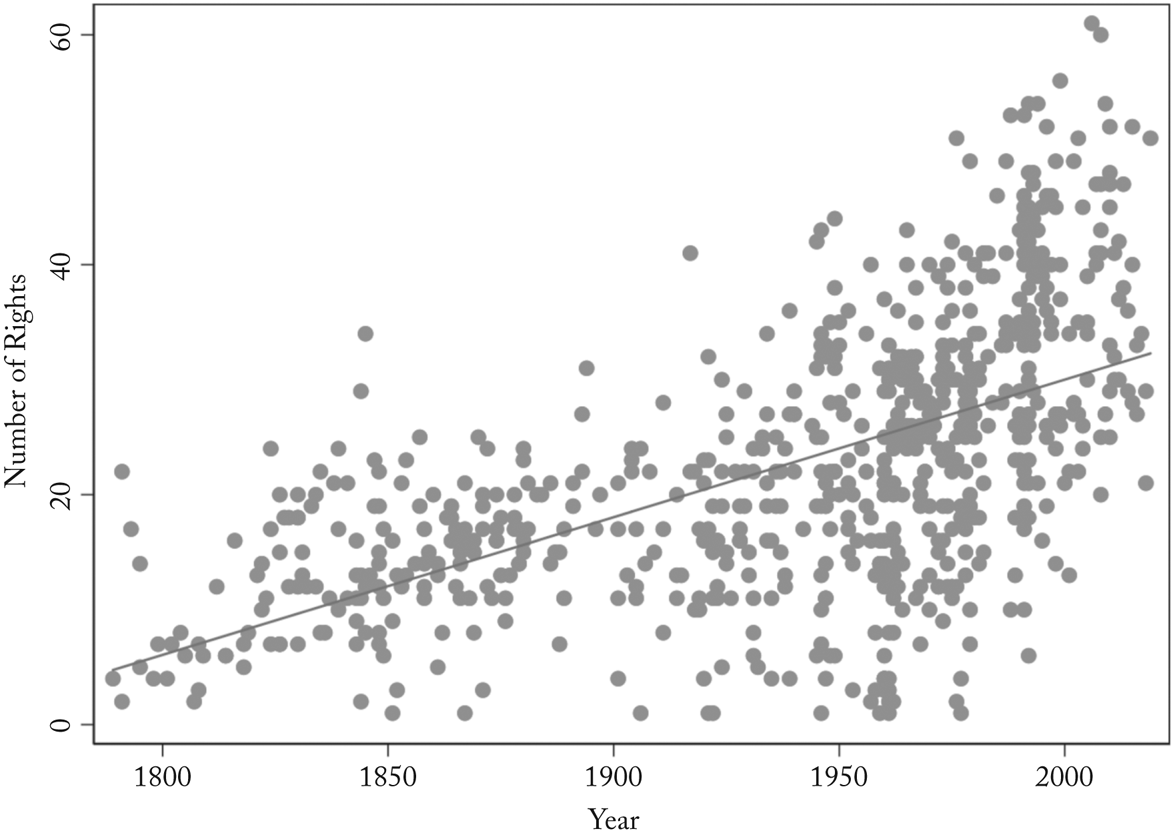
The proliferation is captured, in part, by the number of rights from our list of 116 found in national constitutions (in the year of their enactment) over time, as shown in Figure 1. The average number of rights in a constitution has dramatically increased over the last two hundred years, from roughly ten in 1850 to about forty-eight in 2010. It is also clear from Figure 1 that the variance in this quantity has increased as well, which suggests significant heterogeneity in rights provision among modern constitutions.
Number of Rights Provided, by Year (N = 734 New Constitutions)

The emergence of new-rights claims is part of a staggered process in which particular periods are associated with greater innovation. The relevant question here concerns the role of the udhr in this temporal pattern. One would expect the post–World War II period to be such a moment of innovation—and, most likely, a moment of norm crystallization. Let us consider both of these ideas.
Norm Crystallization (Rights Concentration)
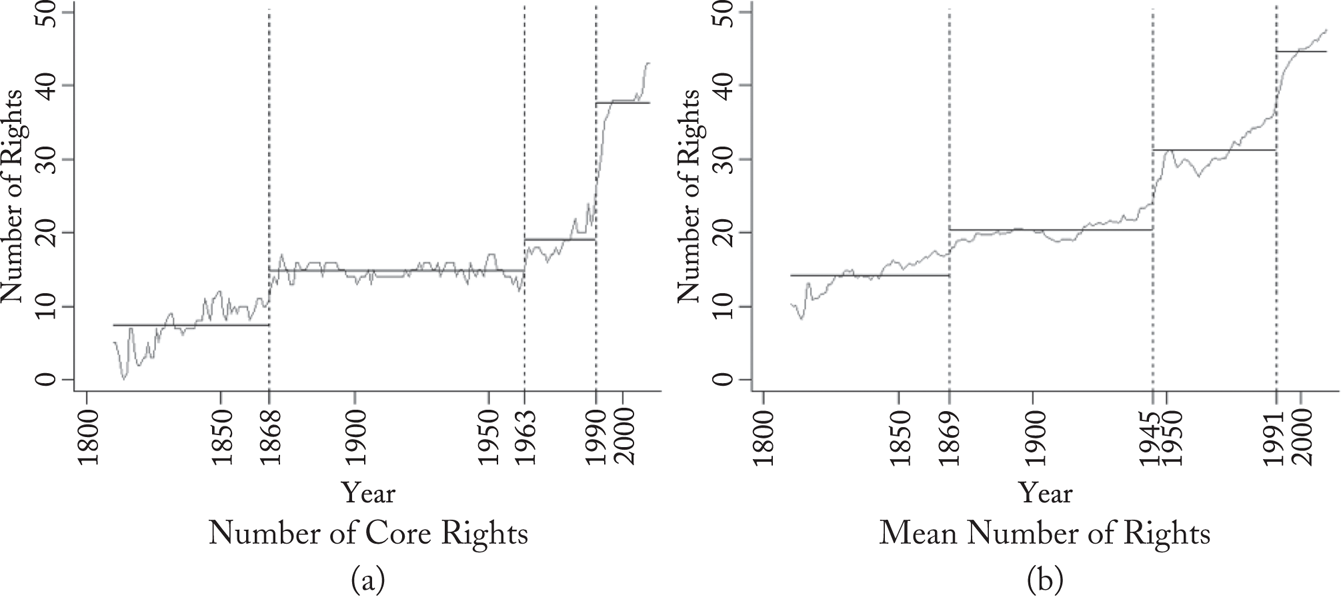
Norm crystallization concerns the degree to which countries converge on a set of rights that are at the core. Mathematically, crystallization amounts to the frequency with which each of these rights appears across constitutions: from nearly universal to exotic. We may consider a right to be mainstreamed in the international community if it's constitutionalized by at least half of the constitutions in force in a given year.Footnote 27 We refer to these rights, variously, as mainstream, consensual, or core rights, and we call the hypothetical constitution that contains all of them (and only them) the vanilla (or median constitution)—an important reference point (document) that we identify in each year under analysis. The number of rights in the vanilla constitution changes dramatically between the years 1810 and 2010 (see Figure 2(a)). The only core right in 1810 is freedom of press, but by 2010, forty-six rights had made it over the majority threshold.
Change Points in the Distribution of Rights from 1810 to 2010.

Innovation (Rights Proliferation)
Tracking the number of core rights tells us something about the must-have elements: namely, we learn if there's a growing consensus about a growing number of rights. But this accounting of core rights doesn't tell us much about the overall population of rights. For example, it's mathematically possible for the number of core rights to increase while the overall population of rights remains constant. But of course, as we suggest above, there has been considerable innovation and corresponding growth in the overall population of rights. One indicator of this growth is the mean number of rights in the world's constitutions, by year. (See Figure 2(b), which—as we'll describe—adds some structural parameters to Figure 1.)
The UDHR and the Concentration and Proliferation of Rights
The trends regarding crystallization and innovation correspond to our general intuition about the historical proliferation of, and convergence on, rights. But how exactly do such trends relate to the udhr? In particular, we wonder whether the udhr is coincident with a shift in the two trends. Figure 2 superimposes inferences from a change-point model over the trend lines. A change-point model, such as the one we use here, usefully identifies structural breaks, or shifts, in a time series.Footnote 28 The dashed vertical reference lines indicate the breaks identified by the model, and the solid horizontal lines indicate the mean number of rights associated with each period or generation. Scholars of human rights often periodize the evolution of rights in terms of generations. Our data confirm four distinct generations of rights, at least in terms of their concentration and proliferation. With respect to rights concentration (Figure 2(a)), the first generation spans the years 1810 to 1867 and is associated with consensus on about eight rights; the second spans 1868 to 1962 (fifteen rights); the third, 1963 to 1989 (nineteen rights); and the fourth, 1990 to 2010 (thirty-eight rights). In terms of rights proliferation (Figure 2(b)), the periodization is similar. One difference is that the third generation begins earlier—in the years immediately following World War II.Footnote 29
The udhr of 1948 is in the “neighborhood” of a dramatic shift in the average number of rights in constitutions (Figure 2(b)). But the change-point analysis suggests—somewhat inconveniently for a theory of formative effects—that this shift began three years before the udhr’s enactment. Thus, the innovation of rights seems to be as much about the era as it is about the udhr—if it's even about the udhr at all. In terms of concentration, the udhr precedes by fifteen years (1963) a major shift in the number of highly consensual rights (see Figure 2(a)). This shift could plausibly be associated with the dissemination of the udhr's ideas over the next two decades. After all, the udhr stimulated the drafting of the two major international covenants meant to legalize the udhr's content, a process that was well underway during the period leading up to the 1963 change point. Regarding the lag, we should note that constitutions aren't especially responsive instruments. Their revision or replacement process is only episodic and, by design, constrained. As such, it's hard to pinpoint the appropriate lag of any udhr effect on national constitutions, although one wouldn't expect it to be immediate.Footnote 30
Clearly, the shifts in the mean and distribution of rights provision are broadly coincident with the udhr and its era. But, importantly, some of the movement in rights seems to be independent of the udhr. Indeed, most of the growth in rights occurs much later, during the third wave of democratization. That period saw a broad extension of constitutional rights and multilateral treaties.Footnote 31 Scholars have identified this democratization period as a key moment for the internationalization of human rights, but there were also significant independent factors that led to domestic incorporation of rights.Footnote 32 And the temporal distance from our critical event of interest makes it harder to draw conclusions about the role of the udhr. The udhr may have accelerated and crystallized the trends in rights, but based only on the sequence of events, we can't tie it directly to the broader shift.
Projection of the UDHR onto Subsequent Constitutions
To what extent does the udhr share content with subsequent constitutions (an effect we summarize as its projection)? We determine the similarities between the udhr and each constitution enacted since 1789, calculated in the year of the constitution's enactment and ignoring later amendments. The similarity measure is calculated from the association of matrices of ones (inclusion of the right) and zeros (exclusion) constructed for the udhr and each constitution—an association calculated with the Jaccard measure of similarity.Footnote 33 The Jaccard formula is simply the quotient of the number of inclusions over the number of rights compared, excluding those that neither text includes. By omitting the mutually excluded rights from the denominator, the Jaccard formula deemphasizes similarity based on shared omission, which may be inflated in the case of two short texts.
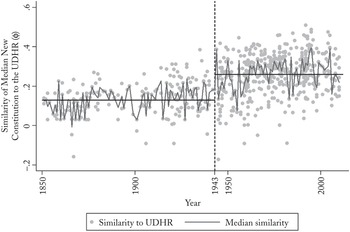
Figure 3 plots the similarity between each constitution and the udhr between 1850 and 2012 and incorporates a change-point analysis (as described above), which helps us pinpoint exactly when similarity to the udhr increased. If the udhr were formative and not reflective, we would expect that similarity to start in 1949 or shortly thereafter. In fact, our analysis—the methodology of which we varied in different ways—consistently returned a different answer: 1943. This inconvenient year suggests that the transformation to udhr-style constitutions began in earnest four full years before the first meeting of the drafting committee (which included Eleanor Roosevelt, René Cassin, Dr. Charles Malik, and John Humphrey). Even more inconveniently, 1943 is also close to the year (1945) in which we noticed a shift in the number of rights in constitutions (see Figure 2(b)).Footnote 34 It seems evident that the udhr was a manifestation of midcentury thinking on rights. Whether it also had its own effect on future constitution-writing, which isn't at all mutually exclusive, is not clear from these analyses.
Change-Point Analysis of Constitutional Similarity to the UDHR

The Unique Content of the Declaration
In this section, we unearth evidence about the construction of the udhr to connect any idiosyncrasies that may mark the document's lasting legacy. We use this information to sharpen our estimate of any udhr projection effect.
The Universal Declaration as Collective Writing
The udhr was one of the first projects established by the newly fledged United Nations after World War II. The document was steered by the Commission of Human Rights, set up under the UN's Economic and Social Council, and drafted initially under the charge of an eight-member drafting committee. The initial draft was produced by Humphrey, a Canadian professor who headed the UN Secretariat's Division of Human Rights. He and his staff combed through a wide array of sources. National constitutions were part of the formative material—fifty of them were included in the background materials—along with national-government proposals and one from the American Federation of Labor.Footnote 35 Cassin, of France, then integrated this material into a working document that formed the basis of further discussion. The document proceeded through the commission to the General Assembly, which adopted it on December 10, 1948.
A substantial amount of scholarship has examined the drafting of the Universal Declaration of Human Rights.Footnote 36 Despite some suspicions that the udhr was a kind of Western imposition, it's more accurate to say that it reflected the culmination of a long-standing international political movement; it wasn't simply an imposition of powerful Western states.Footnote 37 Lebanon's Malik and China's Peng Chun Chang played crucial roles in forming the text of the document, although they often disagreed.
Our sense—both from the highly inclusionary and open process of its drafting and from our analysis of its content—is that the udhr represented an expansive view of constitutional rights that had become popular in constitutions written in the interwar era and immediately after World War II. In an analysis that we only summarize here, we evaluate the dyadic similarity between the udhr and other constitutions that were written prior to 1948.Footnote 38 In regression models of the similarity measure (described above) on various country- and constitution-level attributes, we tested hypotheses that the constitutions of large, wealthy, and politically important countries had served as models for the udhr's drafters. We found no support for any of these hypotheses, which corroborates the characterization of the process as a less systematic one, at least in these senses. The only robust predictor of dyadic similarity was the age of the referenced constitution: more recent constitutions were considerably closer to the udhr than were those drafted in earlier eras. The udhr, by this light, seems more an amalgamated product of its time than the imposition of hegemonic constitutional ideas.
Still, we suspect that the udhr isn't just a reflection of contemporary ideas about rights. The process of drafting constitutional documents—like any collective writing project—is sprawling, chaotic, and sometimes idiosyncratic. The udhr was no exception. Indeed, in terms of constituencies, one could not imagine a broader and more diverse group than that of the world's recognized states. Collectively written documents, as any coauthor knows, often amount to more than the aggregated opinions of the authors. Our research task is to identify indicators of contemporary legal fashion along with elements of the udhr process that were unique to the crafting of this document and that led to particular, identifiable outcomes. These could be elements of the process that suggested a discretionary, contingent affair: that is, simple twists of fate that tipped the balance toward a particular right, or a particular expression of a right. Such twists are the instruments (in a simultaneous-equations sense) that we'll use to trace the udhr's signature effect. If we can follow the effect of these instruments on the udhr and through to subsequent constitutions, we can be more confident of the document's effect.
Would-Be Architects of the UDHR
Was the content of the udhr inevitable? One indicator that this document could have been different is that interested parties imagined and proposed alternative content. A varied group of scholars, organizations, and governments put forth a large and diverse set of proposed drafts in advance of, and during, the drafting process.Footnote 39 The science-fiction writer H. G. Wells produced a draft, as did Professor Hersch Lauterpacht, a distinguished international lawyer at the University of Cambridge.Footnote 40 (Perhaps ironically, Lauterpacht was passed over to represent Britain on the Human Rights Commission in part because he was “a Jew recently come from Vienna.”) Other versions were proposed by Gustavo Gutiérrez of Cuba; Alejandro Alvarez of Chile; Rev. Wilfrid Parsons of the Catholic Association for International Peace; and Robert M. Hutchins, president of the University of Chicago.Footnote 41 Organizations producing drafts included the Institut de Droit International, the American Jewish Congress, the American Association for the United Nations, the World Government Association, the editorial board of Free World, and the American Law Institute.Footnote 42 We don't know much about the use of these models, although Humphrey, the initial drafter, allowed that he borrowed freely from the American Law Institute's draft.Footnote 43 Still, the drafts do represent a credible set of paths not taken.
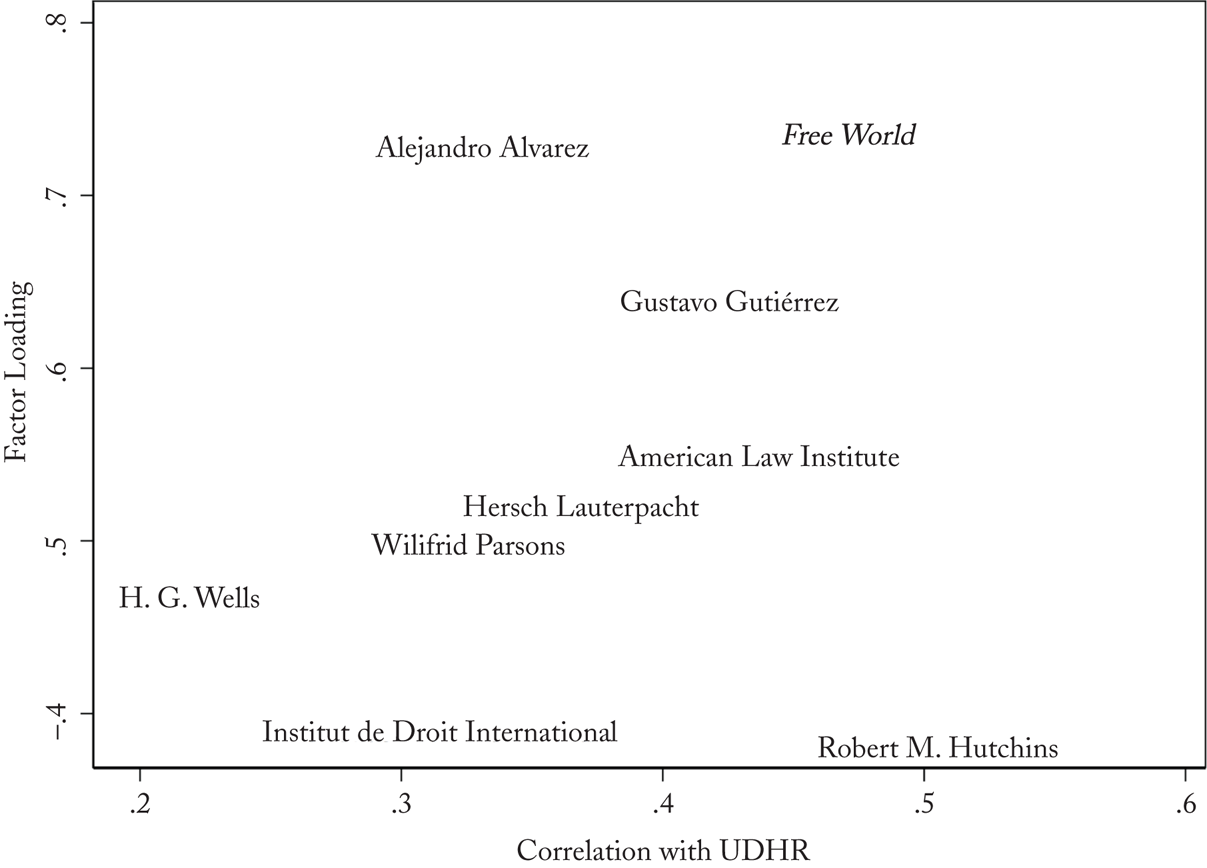
We uncovered and read nine of these drafts, and then coded them for whether or not they included the 116 rights in our sample.Footnote 44 We found that the drafts weren't carbon copies of one another, or of the resulting udhr, although they tend to agree on a core set of rights. One summary measure of the similarity of any two rights documents is their correlation across the set of rights. The correlation matrix for the thirty-six dyadic combinations ranges from 0.06 (Wells with the Institut de Droit) to 0.56 (Alvarez with Free World). This suggests that the authors demonstrated a fair degree of originality in their choices—some more than others, of course, which we summarize by further analyzing the covariance matrix. We fit an exploratory item-response model for the nine raters (authors) across the 116 rights. The model's fit statistics suggest that the authors’ ratings load predominantly on one factor, which allows us to treat the standardized loadings on the first factor as a summary of the degree to which the authors’ assessments coincide with those of the other authors. That is, the higher loading for an author's work, the more intercorrelated the work is with that of the other authors and, presumably, the less original. In Figure 4, we plot these loadings on the y-axis against the correlation of the author's choices with those of the udhr's authors on the x-axis. Together, the scatterplot provides a sense of the authors’ degree of originality (as compared to that of other authors), along with the degree to which the authors’ choices correspond with those of the udhr's drafters. The names toward the northeast corner represent relatively consensual voices whose views corresponded with those of the other proto-drafters and the udhr authors, while names in the southwest corner represent distinct voices, with respect to both their fellow authors and the udhr drafters (clearly, their views were well ahead of their time). Names in the southeast may resemble the architect who wins a design competition for an important building; their views are relatively original and their ideas are picked up by the drafters. And names toward the northwest corner may be those whose views agree with the views of other drafters but not with the views of the udhr drafters.
Architects’ Similarity to One Another and to the UDHR

Figure 4 tells an interesting story about the paths not taken. Indeed, there's something of a common core to these proposals. The degree of intercorrelation is relatively high, but there's also notable variation across the documents. Some, like the editors of Free World and the Institut de Droit International, clearly point in very different directions—one that the udhr largely followed (Free World) and the other that it did not (Institut de Droit).Footnote 45
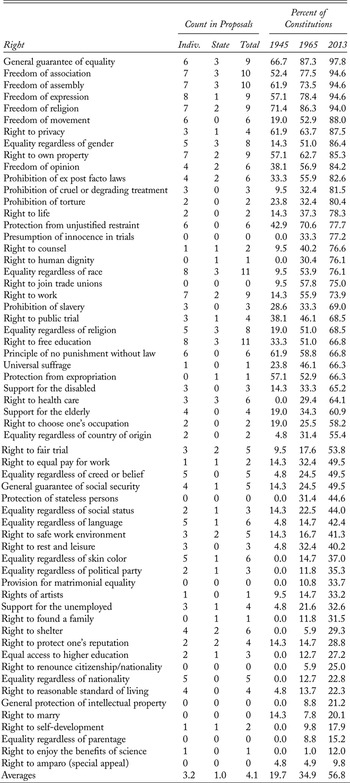
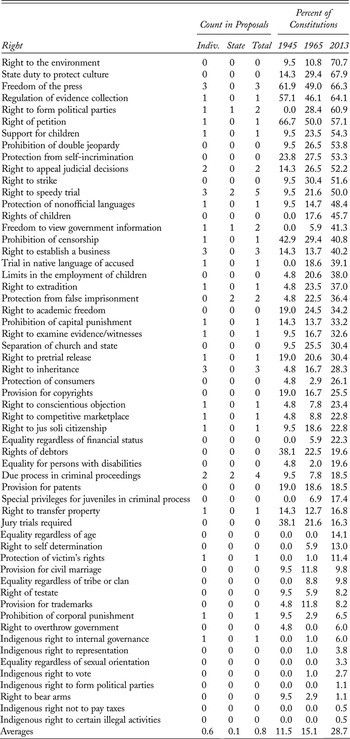
In some ways, the analysis of these alternative documents at the level of a particular right is more revealing. Appendix tables A1 and A2, which are sorted according to whether the udhr included the right, list the number of proposals in which a right was included, as well as the right's popularity in recent constitutions. (Of the 116 rights in our data, exactly half were included in the udhr.) The summary statistics at the bottom of each group of rights tell us more about the udhr's correspondence with its proposals. The fifty-eight rights included in the udhr were also included in an average of four of nine proposals studied, as opposed to an average of fewer than one proposal for the fifty-eight udhr-excluded rights.
This right-by-right analysis also reminds us of the contemporaneous popularity of included versus excluded rights in constitutions. udhr-included rights were found, on average, in 19.7 percent of the constitutions in force in 1945, as compared with 11.5 percent for excluded rights. An eyeballed comparison across columns tells us that, like the udhr, the alternative proposals seem steeped in the ideas prevalent in contemporaneous constitutions. In fact, the correlation between the number of proposals in which the right was included and the popularity of the right in 1945 is 0.57.
Tables A1 and A2 point us toward an understanding of the signature elements of the udhr. The document's idiosyncratic elements may usefully be described, on the one hand, by udhr-included rights that were unpopular in proposals and in extant constitutions, and on the other hand, by udhr-excluded rights that were popular in these documents. We can select rights from each group based on Table A1, but we can also identify them more systematically. As a thought exercise, consider an analysis, with rights as the unit, in which we predict their inclusion in the udhr based on the rights’ popularity in proposals and in extant constitutions. We could then examine the predicted scores for inclusion in the udhr and identify cases that fall off the regression line on either side. The predicted scores are helpful in terms of further statistical analysis, as we systematically trace the independent effect of the udhr, and also as a sampling strategy for case studies. Unpacking the process by which some of the udhr's unexpected choices emerged is potentially illuminating. That is our focus. We describe the process with respect to two rights—one from each of the subtracted and added groups.
Right to Life: An Unexpected Addition
Article 3 of the udhr states, “Everyone has the right to life, liberty, and the security of person.” The formulation echoes John Locke's “life, liberty and property” and the phrase “life, liberty and the pursuit of happiness” in the US Declaration of Independence. For members of the Human Rights Commission, the right to life was hardly an abstract notion. Indeed, the moral atrocities of Nazi Germany were the very reason that they were meeting to draw up a document. Still, the right to life wasn't well understood as a legal concept, nor did it have a firm standing in constitutional law at the time. It would be years before this right became firmly associated with reproductive politics or the death penalty in some countries, not to mention school lunch programs in India. As Jennifer Rutledge describes, the Indian Supreme Court has interpreted the right to life to mean a right to food—a finding that invigorated school lunch programs across the country.Footnote 46 Our reading of the minutes from the commission meetings revealed some of this confusion in applying rights concepts to concrete cases. Consider this telling exchange from the minutes of a commission meeting held on May 27, 1948:
Mr. Lebeau (Belgium) questioned the necessity of saying that every individual had the right to life, as in his opinion the Declaration applied only to those who were already alive.
In reply to Mr. Cassin (France), who pointed out that at a time when millions of people had been deprived of their life it was important that the Commission should raise its voice in defence and emphasis of that right, Mr. Lebeau said that in that case the wording should be “has the right to protection of his life.” If the article were to be put to the vote in its present form, he would have to abstain from voting.
Mr. Pavlov (Union of Soviet Socialist Republics) thought the remarks of the Belgian representative were logical, but since no other wording had been suggested, the article would have to remain in its present form. He recalled that during the discussion of this article in the Drafting Committee he had pointed out that it lacked concreteness and was divorced from actual realities since millions of people were still dying of starvation, succumbing to epidemics and being exterminated in wars.
Mr. Lebeau (Belgium) requested that the article should be voted upon in sections.
The Chairman agreed and put to the vote the phrase: “Everyone has the right to life.”
It was adopted by fourteen votes to none, with one abstention. The phrase “everyone has the right to liberty and to security of person” was adopted by fifteen votes to none.
The Belgian's consternation aside, it's likely that others struggled with applications of the right to life outside the totalitarian context. It would be some time before the right would be associated with reproductive politics, though maybe not with the death penalty. But clearly, after a war that included genocide, the right to life had some resonance. Indeed, it seems likely that if it weren't for the particular juncture in which the commissioners were operating, the right to life would have gone the way of other proposals that were excluded. As it is, the right to life has become one of the core rights in modern constitutions: 77 percent currently include it, compared with just 27 percent of the constitutions in force in 1945. One could point to other examples, such as the heralded right to dignity, which is one of the udhr's more important contributions. That right was included in only 7 percent of the world's constitutions written prior to 1948, but since the udhr was introduced in 1948, it has been enshrined in 62 percent of constitutions.
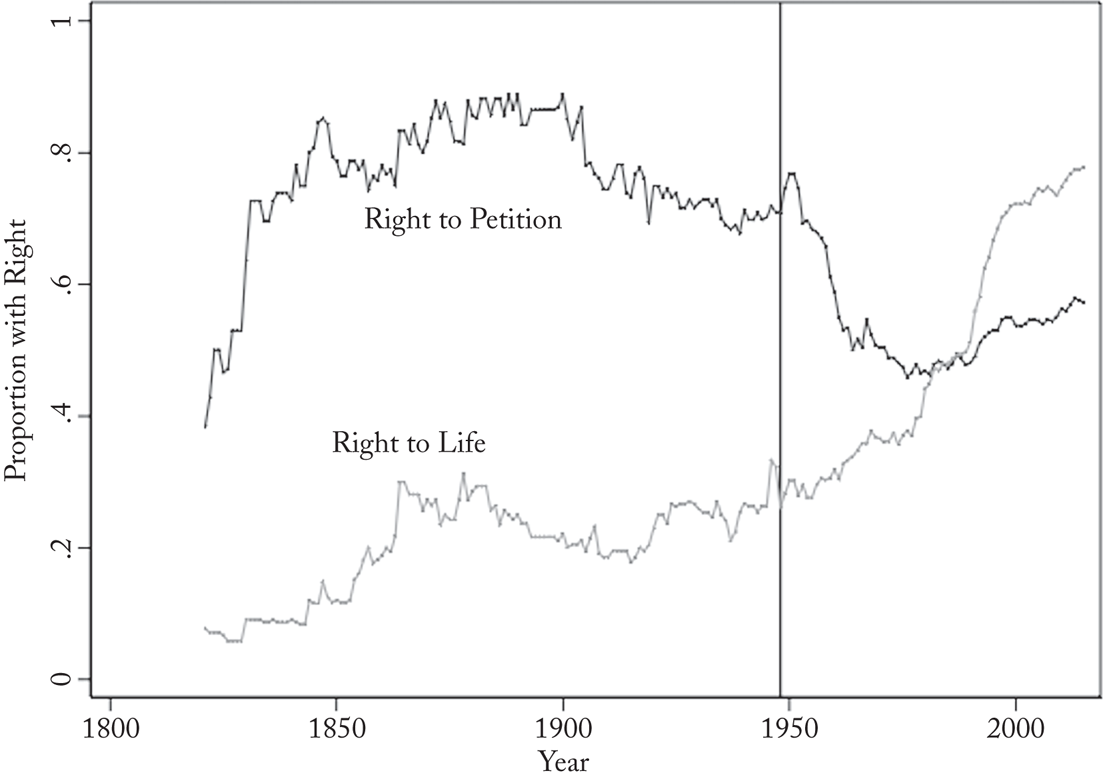
Figure 5 shows the trend of right-to-life provisions in Latin American constitutions against the decline of another provision, the right to petition, which we describe below. (Latin America offers a useful sample of countries for over-time analysis, since the number and configuration of countries in the region has changed little, and the majority have had constitutions throughout most of the past two centuries.)
Provision of Two Rights over Time in Latin America

Right to Petition: An Unexpected Subtraction
One of the most significant, and largely accidental, omissions from the udhr is the right to petition. This idea is found in multiple legal traditions, including those of imperial China and the common law; it was introduced into modern constitutional texts in 1791 in the First Amendment to the US Constitution. The right generally refers to citizens’ prerogative to communicate with state authorities, particularly to seek redress for encroachments on individual rights. For many midcentury drafters, this was a fundamental right that would have enabled and activated the other rights in the charter. It's also a right whose inclusion was highly predicted by midcentury constitutions, if not by the draft proposals. A full 75 percent of constitutions in force in 1945 contained the right, and it was included in the American Declaration on the Rights and Duties of Man, adopted a few months before the udhr. (Interestingly, our data show that only one draft proposal included the right to petition, a surprising discrepancy with the constitutional trends.)
A review of the commission's minutes, collected in William Schabas's volume and in the thoughtful account by Johannes Morsink, suggests that the omission of petition resulted from a failure to separate two strands of the provision. One of these was uncontroversial (the right to petition one's government), but the other was decidedly thornier (the right to petition the United Nations).Footnote 47 Resistance to the idea of petitioning the UN took the form of two different sorts of objections, one pragmatic and the other political. On the pragmatic side, some doubted that the fledgling UN would have either the organizational capacity or the will to consider individual petitions from around the world. The political opposition came mostly from the Soviet Union, whose leaders viewed the idea of citizens’ turning to the UN to denounce their home country as a threat to state sovereignty. A further complication was that some commissioners saw the right as incorporating aspects of legal implementation, a component of the human rights project they'd agreed to consider separately. Regardless of these differences, the basic right to petition was one that most had intended to include, and Morsink views its omission as an organizational and administrative error. He writes, “Considering the time pressures under which the drafters worked, it is amazing how few of these kinds of errors they made.” The critical error appeared to come, from our reading, in the commission's seventy-eighth meeting, held on June 17, 1948. That day, the commission—having failed to reach consensus about the international component of the right to petition—voted to table the matter and flag it for later discussion. In fact, they voted to place it in a rather vulnerable position—listed, but not numbered, as one of the Declaration's rights. The minutes from that day read:
The Commission decided, by 12 votes to 1 with 1 abstention, to retain the article and to place it, unnumbered, at the end of the Declaration, with a note [suggesting its connection to implementation] as suggested by the United Kingdom representative.Footnote 48
By our reading, the one nay appears to have come—at least given the tenor of the discussion in the transcript—from Alfaro Quijano of Panama, who at one point implored his colleagues to reconsider:
Mr. Quijano considered that the article should be adopted at once. The Commission had included in the Declaration all the articles it considered necessary, with the sole exception of that one. The article was clear, and it was undeniable that everyone had the right to submit petitions to a competent authority and to obtain a response; that right was provided for in the constitutions of all the American nations and in those of many others. The Commission could not be making a mistake in including such a provision in the Declaration.Footnote 49
Alas, it was not to be. The unnumbered right was never numbered nor ever incorporated into the udhr. One apparent result is that the right's inclusion in national constitutions has significantly declined. Again, see Figure 5, which shows that the prevalence of the right to petition has been in marked decline since 1948, even in Latin America, a part of the world where the regional Declaration of Human Rights and Duties included it.
Estimating the Effect of the UDHR
How can we statistically model the effect of the udhr on subsequent constitutions? Recall that we have some measure of the extent to which a right could be expected to be included in the udhr. Rights that fall off this regression line would seem to be those that represent the unique contribution of the udhr, either by addition or by subtraction. This implies a relatively simple model in which we predict the inclusion of a right in a post-udhr constitution with the treatment (whether or not the right is included in the udhr) and control for its predisposition (popularity in contemporary constitutions and proposals by the would-be architects in Figure 4).
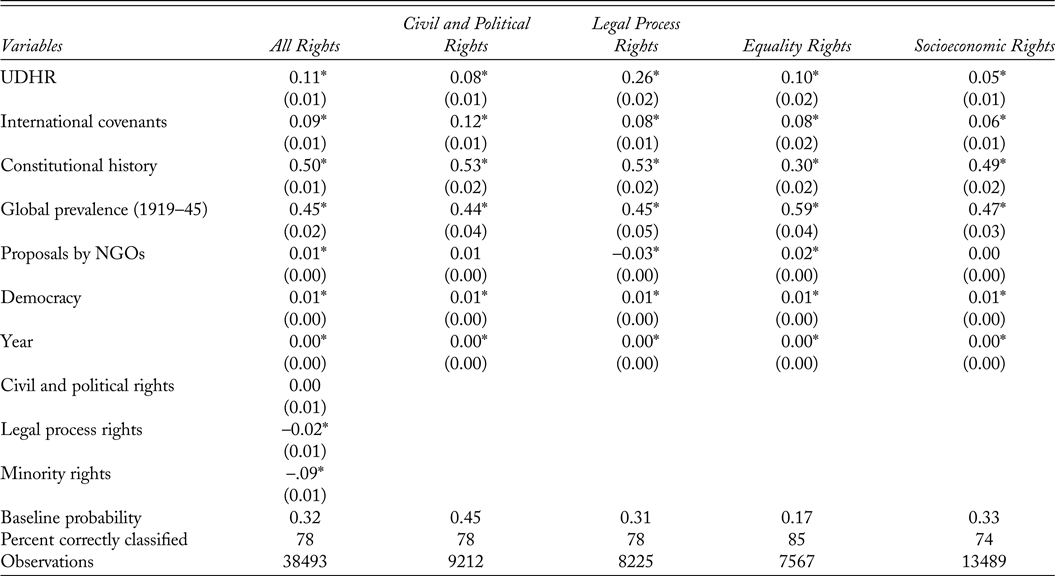
Table 1 shows the marginal effects of a probit model predicting the provision of one of 116 rights in 332 constitutions written since 1948 (in the year of their drafting). The unit of analysis is the constitution-right (for example, freedom of speech in Brazil 1988, right to health in Venezuela 1999, and so on), for an N of 38,512 (116 × 332). We're primarily concerned with the effect of udhr inclusion, our central explanatory variable. We control for (1) inclusion in subsequent international covenants, (2) inclusion in the country's prior constitution, (3) the proportion of countries with the right during the interwar years, (4) the number of proposals that included the right, (5) the level of democracy (Polity score) of the country, and (6) the year of the constitution. We're also interested in the kind of right, and we run the analysis on subsamples of such rights (and control for such in the full model).
Predicting the Enactment of Constitutional Rights (1949–2013)a

* Significant at 1 percent
a Units are constitution rights in the year of a constitution's first enactment (e.g., freedom of speech in Brazil 1988). Estimates from a probit model, expressed as marginal effects. Standard errors in parentheses.
The data suggest that the udhr is indeed influential. In the full set of rights, our estimate is that inclusion in the udhr increases the probability of inclusion in a subsequent constitution by eleven percentage points. This effect ranges somewhat widely by the kind of right—legal process rights seem to be especially boosted by the udhr (the marginal effect is twenty-six points). Note that other variables are even more consequential. For example, if a right was included in a country's constitution prior to 1948, it is fifty percentage points more likely to be included in one after 1948; clearly, domestic constitutional tradition is a strong predictor. And not surprisingly, the global popularity of a right in the period before 1948 is a strong predictor of the inclusion of the right in a constitution.
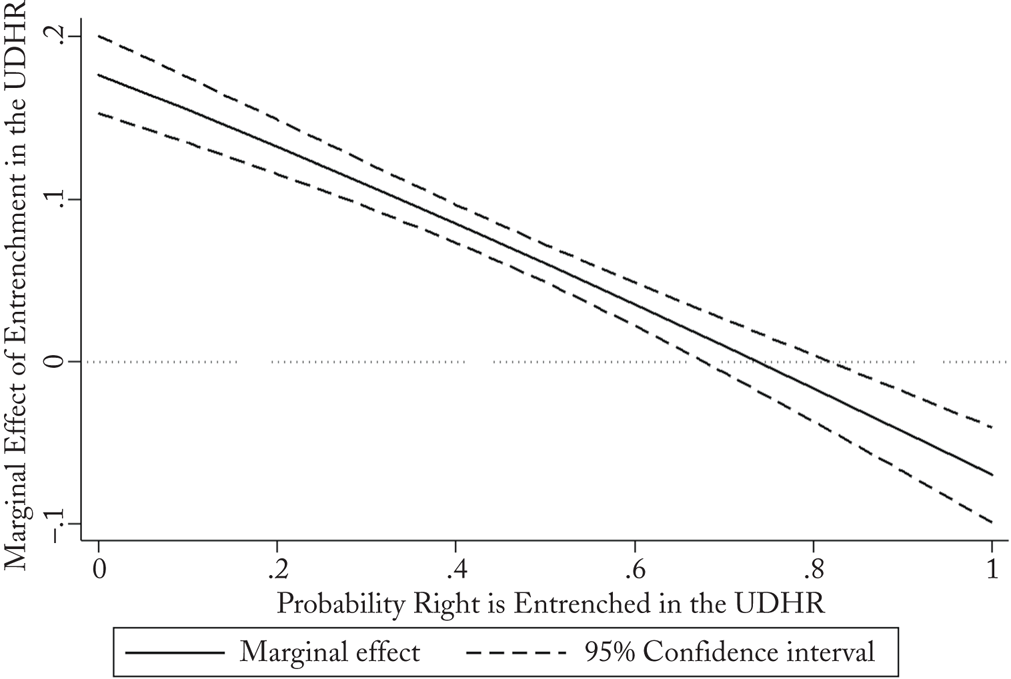
As we may expect, the effect of the udhr depends on the starting point for the right. Some rights are so consensual that the udhr has little effect on their popularity. With this condition in mind, we build a model of the probability of a right's inclusion in the udhr, and estimate the udhr effect at different levels of such (see Figure 6). The effect of the udhr for the most improbable rights (effect = 0.2) is roughly twice that of the most probable ones (effect = 0.1).
Effect of the UDHR on Subsequent Constitutions by Prior Popularity of the Right (1949–1965)

We view these as strong effects. They seem especially strong once we recognize that the spread of the udhr-rights profile to subsequent constitutions is only one way in which that document can exert influence. In practice, it may be that the udhr wields influence by doing exactly the opposite. It could be that the udhr, and its follow-on legal covenants, are so important that constitution-makers choose not to duplicate them but to complement them, or even to treat the international commitments as substitutes for their own law. In the cases of complementarity and substitution, the constitution would not print the right, but would simply refer to the udhr. That is, the effect of the udhr may be implicit as well as explicit. In either sense, the document wields influence. It just means that our test—of explicit duplication—may be a conservative test of such influence.
Micro-Level Evidence of Formative Effects
The UDHR in Brazilian Constitutional Debates
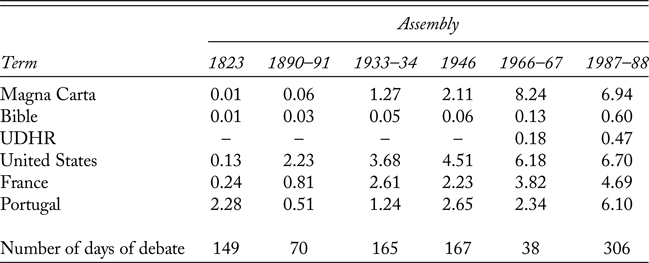
If the udhr were formative in the making of post-udhr constitutions, one would expect to find some evidence of it in the deliberations of constitutional delegates. Our review of the six constitutional debates in Brazil's history provides somewhat of a reference point here. We collected the transcripts of the plenary debates in each of the six Brazilian constitutional assemblies in that country's history. In Table 2, we report the number of instances in which delegates referred to six outside models (in this case, three important documents and three countries) standardized by dividing that figure by the number of days in which the assembly's plenary committee was in session. The transcripts confirm that the udhr was part of the conversation among delegates debating the 1966–67 military constitution (0.18 references per day) and, even more so, among the framers of 1988's expansive democratic constitution (0.47 per day). By way of comparison, the udhr is mentioned about as often as the Bible. Note that it comes up considerably less often than magna carta, but only because the Brazilian delegates use that term to refer more generally to a constitution or charter—not just to the thirteenth-century British document.Footnote 50
Number of References to Selected Terms, per Day, in Brazilian Constitutional Debates

The UDHR in Constitutional Text
Another test of the udhr's relevance to constitution-makers is whether they actually cite the document in the text of their constitutions. Such references strike us as direct and emphatic evidence of udhr influence. It's one thing to duplicate the udhr's rights in a constitution; it's another to identify the udhr as a source, or even to incorporate its ideas as a formal element of the constitution, as some do. Such references are by no means necessary or expected in a constitutional text.
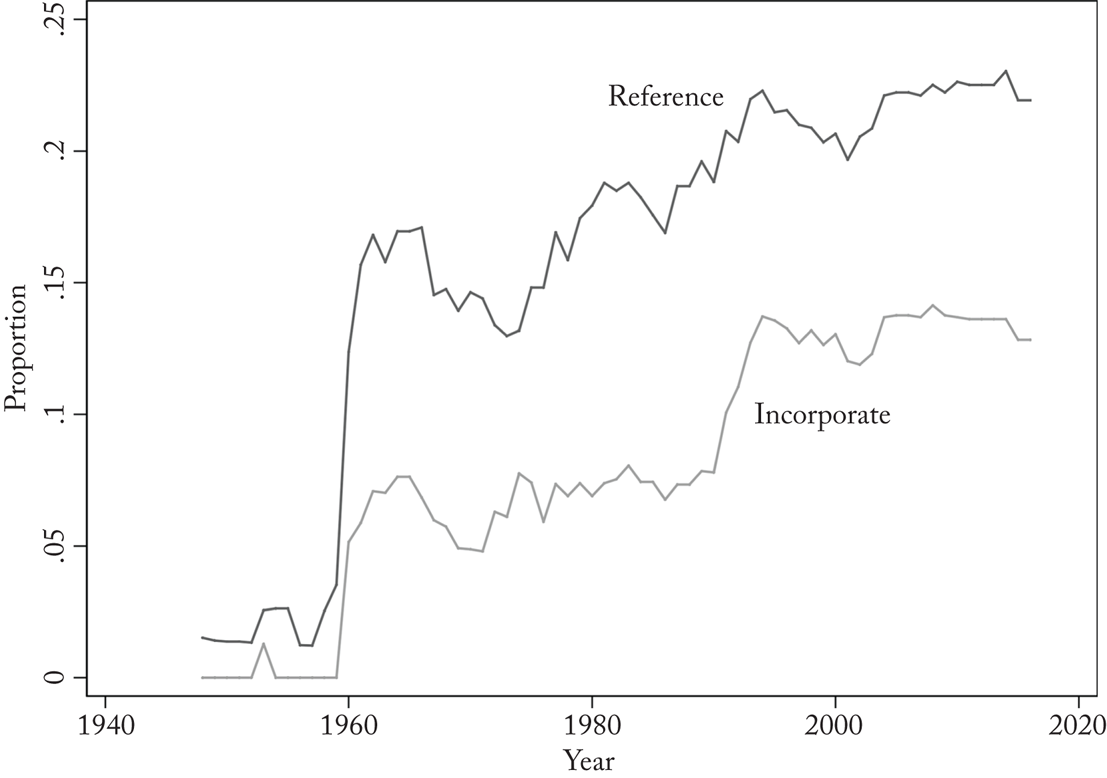
We read and coded each constitution according to whether (and how) it mentions the udhr. Since its adoption in 1948, the Universal Declaration has been referenced in more than one quarter of all constitutions written for independent nation states (118 out of 461) and has been explicitly incorporated into at least 13 percent of those constitutions (N = 59 of 461). We say “at least” because this number represents those that state that fact in the text of the constitution. It may be that the udhr is incorporated as part of higher law in another legislative act. What's more, referencing and incorporating the udhr are on the rise: for constitutions written after 1989, the comparable numbers are 52 and 33, respectively, out of 161—thus, one-third mention the udhr and one-fifth incorporate the document. Figure 7 plots the proportions of constitutions that (1) refer to, and (2) formally incorporate the udhr in their text.
Proportion of Constitutions that Refer to and Incorporate the UDHR

But how do these constitutions refer to the udhr, and does the language provide any guidance regarding the document's impact? Some constitutions explicitly state that the udhr directly influenced their product. In its preamble, Haiti's 1987 constitution, for example, identifies the udhr and the country's own declaration of independence as its most important antecedent documents:Footnote 51
to guarantee their inalienable and imprescriptible rights to life, to liberty and to the pursuit of happiness; in accordance with their Act of Independence of 1804 and with the Universal Declaration of Human Rights of 1948.
Article 19 of the Haitian document, revised in 2012, makes clear that the country's most important rights comply with its legal obligations as a signatory of the udhr:
The State has the absolute obligation to guarantee the right to life, health, and respect of the human person for all citizens without distinction, in conformity with the Universal Declaration of the Rights of Man.
In some cases, it's obvious that constitution-makers recognize the universal—or at least highly inclusive—aspect of the udhr's drafting. The preamble to Egypt's 2014 constitution, for example, suggests that the udhr was a key source of inspiration, and reminds its citizens that Egyptian leaders participated in the udhr's construction:
We are drafting a Constitution that paves the way to the future for us, and which is in line with the Universal Declaration of Human Rights, which we took part in the drafting of and approved.
Similarly, other constitutions specify that the text was written to complement the udhr, and should be interpreted as such. Consider Guinea-Bissau's 1984 constitution (Article 29.2):
Constitutional and legal principles relating to fundamental rights have to be interpreted in harmony with the Universal Declaration of Human Rights.
To recall, we assume in the analysis described above that inspiration from the udhr would result in some overlap (duplication) of rights. But the Guinea-Bissau example, among others, confirms that inspiration can result in complements rather than duplicates, which is consistent with our characterization of the results above as conservative estimates of a udhr effect. Indeed, avoiding udhr rights may well be evidence of deferral to the udhr. Lebanon takes that approach in identifying the udhr as an obligation of international law. Its preamble, revised in 2004, describes the country's identity as an Arab state with strong attachments to its international memberships and obligations:
Lebanon has an Arab identity and belonging. It is a founding active member of the Arab League, committed to its Charter; as it is a founding active member of the United Nations Organization, committed to its Charter and the Universal Declaration of Human Rights. The State embodies these principles in all sectors and scopes without exception.
Mauritania's 1991 preamble is also proudly “udhrist,” as well as staunchly democratic:
Strong from its spiritual values and from the radiation of its civilization, it also proclaims, solemnly, its attachment to Islam and to the principles of democracy as they have been defined by the Universal Declaration of the Rights of Man of 10 December 1948 and by the African Charter of the Rights of Man and of Peoples of 28 June 1981 as well as in the other international conventions to which Mauritania has subscribed.
Sometimes, it also seems clear where the udhr stands in the hierarchy of international norms. Moldova and Romania's texts, for example, mention the udhr as very much first among equals:
Constitutional provisions on human rights and freedoms shall be interpreted and enforced in accordance with the Universal Declaration of Human Rights, and other conventions and treaties to which the Republic of Moldova is a party. —Republic of Moldova 1994, Article 4.1
Constitutional provisions on the rights and freedoms of citizens shall be interpreted and applied in accordance with the Universal Declaration of Human Rights and with other treaties and pacts to which Romania is a party. —Romania 1991, Article 20.1
Even when other treaties are mentioned, the udhr still takes a leading role:
All persons in the national territory shall enjoy State protection and recognition of the rights inherent to the human person, as well as unrestricted respect, promotion and protection of those human rights, and the full applicability of the rights set forth in the Universal Declaration of Human Rights; in the American Declaration of the Rights and Duties of Man; in the International Pact of Economic, Social and Cultural Rights; in the International Pact of Civil and Political Rights of the United Nations; and in the American Convention of Human Rights of the Organization of American States. —Nicaragua 1987, Article 46
References to the declaration are not limited to the modern constitutions of developing countries. Most of the European constitutions currently in force precede the 1948 udhr, and are therefore less likely to refer to the document. But constitutions on the Iberian Peninsula have been adopted since the 1970s and are of interest. Indeed, all the Iberian constitutions, including Andorra's, pay homage to the udhr in their texts:
The provisions of this Constitution and of laws concerning fundamental rights shall be interpreted and construed in accordance with the Universal Declaration of Human Rights. —Portugal (1976), Article 16.2
Provisions relating to the fundamental rights and liberties recognized by the Constitution shall be construed in conformity with the Universal Declaration of Human Rights and international treaties and agreements thereon ratified by Spain. —Spain (1978), Section 1.10.2
The Universal Declaration of Human Rights is binding in Andorra. —Andorra (1993), Article 5
In addition, we see evidence that some of the specific ideas that we identify as characteristic of the udhr, such as dignity, are singled out by constitution drafters as influential:
The object of this Constitution is to facilitate the building of the United Republic as a nation of equal and free individuals enjoying freedom, justice, fraternity and concord, through the pursuit of the policy of Socialism and Self Reliance which emphasizes the application of socialist principles while taking into account the conditions prevailing in the United Republic. Therefore, the state authority and all its agencies are obliged to direct their policies and programs towards ensuring…that human dignity is preserved and upheld in accordance with the spirit of the Universal Declaration of Human Rights. —United Republic of Tanzania (1977), Chapter I, Part II
If anyone doubts that the udhr was an inspirational and legitimating force for constitution-makers, the drafters’ deliberations and their very texts seem to offer an explicit confirmation of such. It may be that the udhr was a product of its age. But it also seems clear that the document crystallized and promoted the ideas of its age.
Conclusion
The Universal Declaration of Human Rights was an inspired project, understandably embraced by many in the wake of a war fought and won for human rights. The document was not inevitable, though it may seem that way now—as do many institutions. In fact, the agenda of international organizations is littered with big (and small) ideas that never materialized. The agreement upon a bill of universal rights by a group of countries with vastly different cultural and economic endowments, not to mention competing political and ideological programs, seems almost heroic from this perspective.
Indeed, the udhr had its skeptics at the time. The American Anthropological Association evidently managed to reach consensus among its members that the project was ill-advised and fraught with epistemological challenges. The association issued a strongly worded letter predicting that the document would have far-reaching and pernicious effects on the globalization of culture and values.Footnote 52 The letter insisted that:
an effective world-order cannot be devised except insofar as it permits the free play of personality of the members of its constituent social units, and draws strength from the enrichment to be derived from the interplay of varying personalities.Footnote 53
In the delicate balance of protecting culture versus human rights, the statement's authors may well have veered too far toward the former, even for subsequent anthropologists, who “have been embarrassed ever since.”Footnote 54
But presumably there were others who were equally unenthusiastic about the idea of the declaration. Clearly, some member countries were wary. Morsink reminds us that the Soviets had only supported the UN itself after Stalin and the Western powers brokered a deal in which two constituent republics were admitted as UN members.Footnote 55 The Soviets and their allies ended up abstaining from the udhr, as did Saudi Arabia and South Africa. And if mixed feelings didn't doom the project, procedural constraints may have done so. The UN is an organization that moves only with deliberate and consensual steps. Serious objections from a member of the Security Council on a bill of rights would have meant an uphill battle, if not a wall.
Suffice it to say that the udhr is lucky to exist. And given its precarious and even miraculous origin story, the counterfactual seems highly relevant. How would the world's constitutions look if the udhr had never been declared? Our conclusion is that subsequent national constitutions—the principal legal device for enforcing rights—would be much different: they would likely include fewer rights, a smaller core of consensual rights, and, outside the core, a different cast of elective rights. It could also be that the societies governed by these rights are today very different places to live because of the rights. There we venture into conjecture, but it's a reasoned one. Many are convinced that written constitutions can serve as important devices for constraining and inducing state action, at least under some conditions, although this isn't the place for a full account.Footnote 56
This article casts light on debates over the timing and efficacy of the international human rights project. Though MoynFootnote 57 argues that the 1970s was the critical turning point for the implementation of human rights, this moment would not have been possible if the udhr hadn't already crystallized and formed agreement on a set of norms—marking an earlier turning point. And for those who, like Posner,Footnote 58 believe that international instruments have had little independent effect, we identify an important channel by which they may do so: adoption by national constitution-makers.
Thus, in the end, the American Anthropological Association probably had it right—at least as a positive, if not normative, matter. Writing down a set of universal rights and then grandly proclaiming them through the auspices of the United Nations, the newly created arbiter of the world order, has had strong globalizing effects. The fabric of human rights law in most countries is noticeably different from what it would have been. But this isn't to say that the udhr was an exogenous force. Quite the contrary. We find that the udhr clearly represented the values and trends of a new, modern world clambering over the wreckage of a human rights catastrophe. In this sense, the udhr importantly reinforced and accelerated the uptake of these values. In other words, the document was both a reflection of its times and highly formative of what was to come. This may well be how one should think of most institutions—less as an exogenous force and more as a mediating force. The udhr represents an institution that has crystallized and reproduced—in constitution after constitution—the wisdom of 1948.
Appendix
Rights in the UDHR

Rights Not in the UDHR

Data
Replication files for this article can be found at https://doi.org/10.7910/DVN/QW3D57.
Acknowledgments
The authors are grateful for helpful comments from John Ferejohn, Lewis Kornhauser, Beth Simmons, Christopher Roberts, Craig Volden, Fabrizio Gilardi, and participants at conferences at Princeton University; the University of Chicago; the University of Iowa; University of California, Berkeley; Notre Dame University; New York University; Oxford University; Göttingen University; and meetings of the American Political Science Association. Special thanks to the Latin Americanist working group at the University of Texas. We gratefully acknowledge the National Science Foundation, the Cline Center for Democracy, the University of Texas, and the University of Chicago for their early or continued investment in the Comparative Constitutions Project. At World Politics, Barbara Peck provided impeccable editing. As always, our deep gratitude to our long-time collaborator James Melton, who contributed enormously to early versions of this article.