I. Introduction
The quest for monopoly in the administration of justice is a defining feature of state building. Across history and political regimes, submitting grievances to central powers has served as a mechanism to mediate conflict among all layers of society. At the same time, rulers have used petitioning institutions to achieve political goals and to consolidate their authority. Yet the literature on the elements of state formation usually ignores the fundamental role of centralizing conflict mediation. This article explores this process in the context of Spanish America from the sixteenth to nineteenth century. In particular, I focus on the establishment and decision-making process of a centralized tribunal that was specifically designed to address indigenous claims, the General Indian Court (gic) of colonial Mexico.
My main argument is that the Spanish Crown established the gic to restrain state agents in colonial Mexico.Footnote 1 As in other contexts of early statehood, the Spanish Crown confronted agency dilemmas that limited its capacity to exercise control. Although the Crown depended on settlers to extract resources, these actors had incentives to increase their economic and political power by overexploiting Indian labor and invading indigenous communal lands. At the same time, because of weak monitoring, local bureaucrats were highly susceptible to corruption and had many opportunities to seek individual enrichment. Under these circumstances, the Crown and the indigenous population had a mutual interest in restraining the excesses of these agents. The centralization of justice implemented by the gic allowed the Crown to address Indian grievances and monitor its agents simultaneously. In a sense, the Indians of colonial Mexico became “the first line of enforcement for the king’s laws and the viceroy’s orders.”Footnote 2
In this article, I show that the central court’s strategic administration of justice served two main purposes: 1) keeping the local elites and bureaucrats weak enough that they didn’t overexploit the indigenous population but strong enough to maintain a productive colony,Footnote 3 and 2) keeping the indigenous population and leadership strong enough to maintain a productive colony for the Crown and counterbalance local elites but weak enough that they didn’t successfully rebel against the colonial state. Simply put, in colonial Mexico, controlling the monopoly of justice emerged as a crucial governance solution to keep agents in check and to maintain the delicate balance of power between settlers, state agents, and the native population.
To provide empirical evidence of the strategic use of the colonial court, I use a multimethod approach and a novel data set of judicial claims. Based on archivists’ summaries and using text analysis techniques, I create the Courts of Colonial Mexico Data Set, containing more than thirty thousand indigenous claims linked to colonial provinces. I complement this data set with human coding of a random sample of three thousand claims and paleographic transcriptions of entire documents. I also code a detailed analysis of a second sample of two thousand claims from unpublished notes by the gic’s early historian, Lesley Byrd Simpson.Footnote 4
In line with the hypothesis that the colonial court acted strategically to balance powers in the colony, I find that indigenous claims related to land grabs and the mistreatment of indigenous labor or raised against local elites and bureaucrats were more likely than other types of claims to receive a favorable ruling. In contrast, claims that directly diminished the fiscal potential of the Crown or compromised its partnership with the Catholic Church were less likely to receive a favorable ruling. Furthermore, I find that the likelihood of a favorable ruling increased significantly when the indigenous population was in decline and when local elites were strong. Conversely, when claims were raised against weaker local elites or by a thriving indigenous population, the likelihood of a favorable ruling decreased. I show that this decision-making process is robust to potential sample biases, the merits of the case, political factors, and alternative coding processes.
This article contributes to a broader understanding of the development of the rule of law and state formation. The process illustrated here contrasts with the paradigmatic case of the rule of law in postrevolutionary England.Footnote 5 In the latter, the rule of law emerged when elites solved a coordination problem that resulted in liberal institutions that restrained the Crown’s powers. I argue that a form of rule of law emerged in the highly authoritarian setting of colonial Mexico not because the Crown’s power was constrained, but because it was relatively unrestricted. I further claim that a centralized court, such as the gic, can be identified as an example of a broader phenomenon of power consolidation in which the administration of justice occupies a central role. A fundamental consequence of this process is that even though the primary goal of the colonial judicial system was to restrain local agents, this limited form of justice provided the indigenous population with property rights and protection from predatory practices.Footnote 6
This article also advances the literature on the political foundations of colonial institutions. According to that literature, the agency problems created by long distances and information asymmetry led principals to rely on different governance solutions, such as kinship ties, patrimonial relations, and coalitions.Footnote 7 In the context of the British Empire of North America, the Crown relied on the separation of powers and settler empowerment to control unruly governors.Footnote 8 A main theoretical contribution of this article is to show that considerations toward the indigenous population—as well as their active participation within the colonial system—also played a fundamental role in the emergence of mechanisms to manage colonial agents.
II. The General Indian court and the Logic of strategic Administration of Justice
Centralization of Justice and State Building
Although a central role of monopolizing conflict resolution is cementing power and legitimacy, mainstream theories of state building often overlook this key process, putting more emphasis on taxation or warfare.Footnote 9 The logic of controlling the administration of justice originates in a fundamental agency problem: under weak monitoring, state agents have strong incentives to deviate from the ruler’s agenda.Footnote 10 For early states that relied on private tax farming, local elites had incentives to overcharge the peasantry for their own benefit.Footnote 11 For modern states with a more developed bureaucratic apparatus, this simply means that individual bureaucrats might be involved in acts of corruption. A common denominator in these agency problems is that the general population is a potential partner for the ruler because the people have strong incentives to address grievances to the central powers. If justice is denied to them at the local level, the general population can be transformed into whistleblowers of bureaucratic malfeasance. From the rulers’ perspective, it’s often more efficient to address “fire alarms” than to deploy constant “police patrols” to monitor executive agents because the former involves less active intervention.Footnote 12
Throughout history, rulers also have had an incentive to adjudicate people’s grievances, as it bolstered their legitimacy among the general population and exercised social control.Footnote 13 By positioning themselves as a source of protection against the rapacity of local elites, central rulers sought to increase their support among the masses. An additional outcome of a centralized court as a legitimate institutional channel to adjudicate grievances was that it offered an alternative to violent collective action: for the peasantry, petitions to the central powers became part of their repertoire of contention.Footnote 14 Ultimately, the capacity of centralized courts to control local agents, increase rulers’ legitimacy, and adjudicate grievances explains the prevalence of petition-making institutions across history and political regimes.Footnote 15
This article illustrates the process of the centralization of justice administration in the context of Spanish America. As stated above, I use the example of the General Indian Court of colonial Mexico, a centralized tribunal established in 1592 to address indigenous grievances.Footnote 16 I argue that as in similar instances of state formation where the ruler confronts agency problems, this court was formed to create a direct link between the general population (Indians) and the ruler to restrain the ruler’s local agents. A key element of my argument is that the indigenous population’s access to justice was subject to the Spanish Crown’s strategic considerations and economic goals. In short, the role of the gic was never intended to end the exploitation of the Indians, “but to restrain excesses [of the local elites and bureaucrats]; in short, to keep exploitation within measure.”Footnote 17
Agency problems in the Spanish Empire
The colonial enterprise of the Spanish empire, which started in the sixteenth century, was subject to a fundamental agency problem. Beginning with its first Caribbean settlements, the Spanish Crown was aware of unique opportunities to obtain rents through the exploitation of Indian labor, resource extraction,Footnote 18 and territorial expansion. Achieving those goals with limited state capacity became a critical problem for it. Throughout the colonial period, the Spanish empire relied on settler entrepreneurs to establish its presence in the New World, which effectively made those settlers state agents in need of monitoring. For this reason, the Crown faced a constant tension between its dependence on local elites and the perils of giving them ample opportunities to overexploit the indigenous population and accumulate wealth and power. Although the colonial state increased its presence and built a complex bureaucratic architecture, the Crown’s capacity to monitor provincial bureaucrats remained limited. Controlling local elites and provincial bureaucrats became a fundamental challenge.
The Spanish Crown was interested in preventing local agents from expanding their economic power beyond what the Crown allowed. In the Spanish empire, local elites were stakeholders of a colonial system that relied heavily on public-private partnerships and cooptation. These elites played a crucial role in tax collection and revenue allocation in the colonies.Footnote 19 During the early colonial period, such partnerships took the form of encomiendas, in which conquistadors received grants to extract resources from native labor.Footnote 20 During the later colonial period, local elites’ wealth also depended on the Crown’s trade monopoly and the concession of special privileges (fueros) to interest groups like miners and merchants.Footnote 21 This economic structure was designed to offer local autonomy to provincial elites and to position the Crown as the ultimate arbiter and regulator.Footnote 22
Local elites were constantly seeking to expand their power and wealth by encroaching on the Indians’ territories and exploiting their labor. The encomendero elite used their control of Indian labor to amass fortunes and to seize control of local governments. On some occasions, encomenderos exercised their positions of power to obtain or even grant themselves portions of communal Indian lands. The paradigmatic example of land accumulation is the Marquessate of the Valley of Oaxaca, a vast seignorial estate granted in 1529 to Hernán Cortés, the commander of the conquest of the Aztec empire, and his descendants in the aftermath of the conquest.Footnote 23 The encomenderos’ political power and economic influence were a threat to the Crown even from the first Caribbean settlements in the early sixteenth century. This problem led to the publication in 1512 of the Laws of Burgos, which regulated the colonists’ behavior with particular emphasis on their treatment of the native population.Footnote 24 But when the Laws of Burgos failed to restrain the Spanish settlers’ abusive behavior, a new code, called the New Laws, was promulgated in 1542, giving the viceroys power to create a judicial system and prohibiting Indian slavery.Footnote 25
During the second half of the sixteenth century, the encomienda was replaced by a debt-peonage system known as repartimiento (mita in Peru).Footnote 26 Under this system, local elites increasingly maximized production by overexploiting the Indian labor force. At the same time, the Spanish owners of the large agricultural estates known as haciendas expanded their properties and increased productivity by invading Indian communal lands. Price fluctuations, storage limitations, and crop irregularities often amplified the burden of the debt-peonage system. Hacienda and ranch owners increased the labor obligations of the Indians until their production needs were met, which had catastrophic consequences for the native population.Footnote 27 As expressed in one contemporary account, “These Indians, it should be noted, are assigned to the repartimiento for only one week, but the farmers, faced with the loss of their crops … keep them … two or three weeks and more … when he [the Indian] returns he finds his wife or children dead, and his fields ruined for lack of cultivation, or destroyed by cattle.”Footnote 28
As part of the process to gain greater control over colonial affairs, the Crown created a large and complex bureaucratic apparatus. But this effort was tarnished by agency problems similar to those experienced with the local elite. The Spanish empire’s bureaucratic architecture relied on provincial administrators, known as alcaldes mayores, to conduct affairs—from tax collection to policing—at the local level.Footnote 29 These officers also had the power to name lieutenants (tenientes) to rule over smaller jurisdictions. The officers’ extensive powers, coupled with their low pay, led to abuses of all sorts. Unlike local elites, alcaldes mayores didn’t have a direct interest in land accumulation.Footnote 30 For their primary source of wealth, they used their positions to manipulate prices in the labor levy system (repartimiento) and distribution of goods (repartimiento de mercancías).Footnote 31 Defying royal legislation, alcaldes mayores constantly traded with subjects, charging excessive prices and issuing loans at considerable interest rates.Footnote 32
Besides bureaucrats and landed elites, the Crown also delegated responsibilities to indigenous elites, and relied on them to maintain control of indigenous villages. Native leaders known as caciques were crucial for maintaining the social order inside communities, collecting royal tributes, and linking the Spanish and Indian worlds.Footnote 33 Although the Indian elites’ sphere of influence was limited to the village level, the Crown still had an interest in controlling their power.Footnote 34 Indigenous elites usually tried to overexploit Indian labor without proper payment and to obtain some benefits during tax collection.Footnote 3535 These actors used their positions not only to accumulate wealth, but also to kindle rebellion or opposition—as occurred in the late eighteenth century with the uprisings led by Túpac Amaru in Peru and by Jacinto Canek in Yucatan. The Crown’s strategic interest was to keep these actors strong enough to maintain social control in the villages and counterbalance non-Indian elites, but weak enough that they didn’t acquire much power or regional influence.
The collapse of the indigenous population in the sixteenth century was a significant concern for the Spanish Crown because it threatened the colonies’ fiscal potential. In central Mexico, the native population declined from about twenty-two million to less than one million,Footnote 36 mainly because of a series of epidemics that began with the first contacts with Spaniards in 1520. These epidemics originated in pathogens brought by the European settlers, for which the natives had no immunity. Referring to the one of the most devastating epidemics, the chronicler Fray Juan de Torquemada wrote in 1576, “A great mortality and pestilence that lasted for more than a year overcame the Indians … the place we know as New Spain was left almost empty.”Footnote 37 Abuse and mistreatment amplified the damage caused by the epidemics, and the surviving native population became malnourished, underclothed, and overworked.Footnote 38
Around 1550, the Crown sought to reduce these negative impacts with a land distribution policy,Footnote 39 giving each indigenous town seventytwo hectares of communal arable land.Footnote 40 These communities, which became known as pueblos de indios, held a certain level of governance autonomy, meaning that—at least in theory—Spanish settlers couldn’t dwell there or own property.Footnote 41 Despite such efforts to isolate the indigenous population and protect them from the local elites’ overexploitation, the demographic collapse made it even easier for settlers to amass large areas of the communal land that had been left vacant.Footnote 42 As a result, the native population’s agricultural potential was much reduced, and the burden imposed on them by provincial bureaucrats only escalated. And while the indigenous population declined rapidly, Spaniards and criollos (the term used for the progeny of Europeans born in the colonies) were relatively unaffected, so provincial bureaucrats seeking stable rents imposed heavier burdens on smaller communities. For the Crown, the sharp population decline meant a drop in royal tribute and the loss of a counterbalance to settlers’ power.
Overall, the Spanish Crown’s governance problems can be summarized as follows: the Crown needed to keep the local elites and bureaucrats weak enough that they wouldn’t overexploit the indigenous population, but strong enough to maintain a productive colony. It was also in the Crown’s interest to keep the indigenous population and its leadership strong enough to maintain a productive colony and to counterbalance local elites, but weak enough that they wouldn’t successfully rebel against the colonial state. These governance problems, I argue, led to the creation of a centralized court. The lack of executive human power and the difficulties in monitoring individual bureaucrats made it clear that the Crown had to rely on a reactive strategy to control local agents and to be ready to put out fires wherever smoke was detected. By allowing and even encouraging complaints against individual bureaucrats, the judicial system made it possible to identify wrongdoers without threatening the foundation of the empire.
The General Indian Court
The General Indian Court was established in 1592 to redress abuses against Indians. Located in Mexico City, the court was headed by the viceroy, the king’s alter ego in the colony, who acted as the ultimate judge. For more than two hundred-fifty years, Indian claimants came from all over New SpainFootnote 43 to air their grievances directly to a group of officers who advised them, helped them write formal complaints, and served as translators.Footnote 44 On many occasions, the Indians received favorable rulings in this court, winning battles on such pressing issues as forced labor, tribute, and land rights.Footnote 45
The petitioning process had clearly defined steps, which were internalized and mastered by indigenous claimants. An Indian complaint was launched when a community delegation or an individual arrived in Mexico City and met with a court agent (solicitador). These agents acted as figurative and literal gatekeepers to the court, since they could reject what they considered trivial matters. Next, the claimant’s representative would present the case to the viceroy and the audiencia, a government body with several magistrates holding executive and legislative authority. If necessary, the court summoned and interrogated the accused party and other witnesses. After the investigation, a specialized court bureaucrat (relator) summarized the case and submitted it to the prosecutor and to the chief adviser, who recommended a verdict. Then the case was sent to the viceroy for his ultimate approval.Footnote 46
Part of the gic’s brilliance was that enforcement required very little of the Crown’s financial and human resources. First, the court’s specialized bureaucratic body was funded by a tax levied on Indian communities. Historian Woodrow Borah describes this as a system of “justice by insurance” because that tax contribution gave Indian communities access to the legal system at no additional cost.Footnote 47 Second, as a reactive body, the court was able to function with only a small number of elite officials who had high enforcement powers and low incentives for corruption. Crucially, the court gave these enforcers several tools, such as removing local officials, imposing fines, seizing assets, or exiling rebel subjects to the Philippines, to execute its rulings.Footnote 48
A key element for the functioning of this centralized court was that its officials were relatively isolated from the local elites’ influence. This doesn’t mean corruption and bribery didn’t exist, but there wasn’t enough of it to derail the court’s functioning.Footnote 49 Moreover, this concern was allayed by the monitoring system and the checks and balances established in the colonial governing body overseeing the court. The viceroy shared power and responsibilities with the audiencia. Although formally, the viceroy presided over the audiencia, this institution had the jurisdiction to curb the viceroy’s abuses of power.Footnote 50 This jurisdictional overlap and the dual scrutiny system served to control the colonial government in favor of the Crown and facilitated the establishment of a centralized court.
For local elites, there were two reasons why the incentives to defy the Crown’s laws competed with pressures to acquiesce to gic rulings. First, as established above, their wealth and prestige depended on the Crown’s trade monopoly and concession of special privileges. In the complex economic architecture of the empire, these exemptions defined the elites’ capacity to capture rents and their right to adjudicate cases in differentiated tribunals. Second, to control large-scale indigenous revolts, the elites needed the support of the central power. The imperial deterrent to Indian rebellion was a fundamental pillar of the Spanish empire’s stability and a crucial element for elites’ cooptation.Footnote 51 During the colonial period, the Crown strongly signaled that it would invest all the resources needed to crush rebels for however long it took to do so.Footnote 52 Therefore, although local elites were constantly seeking ways to increase their wealth, they were also constrained by their dependence on the Crown. As John Coatsworth writes, throughout the colonial period, “elites endured, mostly in silence, an imperial regime that occasionally expropriated wealth by defaulting on the public debt, debasing the currency, and imposing forced loans and predatory taxes, especially in time of war.”Footnote 53
The centralization of Indian justice in colonial Mexico also had broader consequences related to the relationship between the indigenous population and the Crown. To function, the colonial system required the Indians’ willing participation. Even after the huge population collapse, during the entire colonial period, the indigenous population significantly surpassed that of the European settlers.Footnote 54 Despite the conquerors’ military advantages, their control over the native population would have been untenable without the support of the native population at large.Footnote 55 Although Indians were certainly coerced into exploitative colonial practices, they legitimized the imperial project inside the colony by subscribing to its paternalistic policies and recognizing the Spanish king as the ultimate protector.Footnote 56
For the Indians of New Spain, the gic transformed the Spanish king from an abstract and distant protector into a tangible institution.Footnote 57 At the same time, Indians became the first line of enforcement for the king’s laws and the viceroy’s orders. Like other centralized courts that functioned as a legitimizing instrument of the central power, the GIc provided a disenfranchised group with access to justice and agency to shape colonial policies and laws, thus becoming a genuine “weapon of the weak.”Footnote 58
Rule by Law in the Spanish Empire
The gic exemplifies a process in which judicial institutions emerged not because there were limits on the ruler’s behavior, but because the Crown had the capacity to exercise control over local elites and the general population. This case contrasts with that of England after the Glorious Revolution, the paradigmatic case of rule of law development. According to Barry Weingast,Footnote 59 the Bill of Rights of 1689 resulted from an elite consensus that created self-enforcing limits to the Crown’s taxation and coercion powers. Under this perspective, the rule of law emerged after elites managed to overcome collective action and coordination problems and the Parliament became an equal partner in government. The new institutional arrangement allowed the government to commit credibly to protecting property rights and investors.Footnote 60
In contrast, there were no limits set on the coercion and taxation powers of the Crown in Spanish America. Instead, the law imposed limits on the local economic and political elites as an instrument of political power.Footnote 61 This political manipulation of the law, along with the law’s lack of clarity and predictability, places Spanish America in a scenario that can be characterized as rule by law rather than rule of law. Interestingly, the strategic limits imposed by the gic had broader consequences for the general population because they helped to protect indigenous communities and their property rights. Although extraction was undoubtedly a central and destructive feature of the empire’s wealth building, the Spanish Crown was in some respects committed to protecting the indigenous population and addressing their demand for justice. The imperial judicial system not only allowed the indigenous population to resist blatant abuse, but it also gave them access to land independent of the colonial elite.Footnote 62 In short, the gic illustrates how autocratic rulers can use a limited form of the rule of law to curb predation by powerful elites vis-à-vis the rest of the population.
The Spanish Crown’s capacity to advance its interests—by controlling the economic elite and the indigenous population—can be seen in the fact that the gic’s rulings were never intended to establish limits on taxation. The Spanish empire developed a well-organized money-extraction machine designed to provide large surpluses to the metropolis.Footnote 63 The most significant tax for indigenous communities was the tribute tax (tributo), levied on all households in the Indian towns.Footnote 64 Indigenous communities repeatedly complained to the gic to obtain reductions and exemptions from this fiscal burden.Footnote 65 Throughout the colonial period, claims related to taxation had little chance of a favorable ruling, particularly in cases where those claims might reduce the colony’s productive potential for the Crown.Footnote 66
Although the Spanish Crown had a large capacity to use the judicial system to advance its interests, it wasn’t entirely unconstrained, especially when it came to claims related to the Catholic Church. This institution, a powerful actor and ally in the colonial enterprise, received special treatment in cases related to the abuse of indigenous communities. Church members interacted daily with indigenous communities and often misused their power.Footnote 67 gic claims illustrate how these actors coerced, manipulated, and exploited Indians as much as local elites and bureaucrats did. But claims brought against the Church rarely received a favorable ruling in court.
The Catholic Church had played a crucial political role in Spain since early medieval times, acting as a foundation of the Crown’s sovereignty and as an intelligence service to control unruly subjects.Footnote 68 In the colonial period, troops of parish priests and missionary friars carried out the spiritual conquest that facilitated many of the interactions with indigenous groups. The Catholic Church’s critical position as a partner in governance and the colonization enterprise explains why the Crown was reluctant to limit the abuses of this institution’s members. This pattern provides further evidence that the gic “was not so much a court of law as a court of compromise and accommodation.”Footnote 69
Mapping the gic’s Decision-Making Process
To represent more clearly the court’s strategic behavior and to delineate the theoretical expectations of my argument, I link the actors, their incentives as introduced above, and the expected outcomes of the claims. Because the gic ruled explicitly and implicitly in favor of the alleged perpetrators of abuse in a large proportion of cases, it opens the question of whether these decisions were based on legal grounds or on the ruler’s strategic agenda. To disentangle these motivations, we need to understand the court’s decision-making process. More generally, this analysis also seeks to provide some empirical evidence for the argument that the centralization of justice has served to cement power across history by deliberately weakening—or strengthening—local power holders and petitioners and to act as a balance of power.
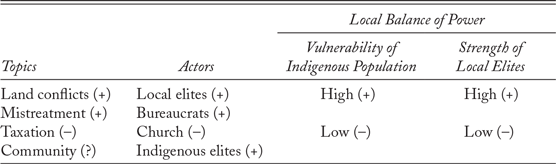
Building on existing studies and a close reading of gic cases, I develop a probabilistic model of the criteria used by the court to make its strategic rulings. In this model, the court’s strategic decision to rule in favor of the indigenous population is a function of three dimensions:Footnote 70 1) the topic of the case, 2) the actors involved, and 3) the local balance of power. Although the court would undoubtedly consider the merits of the case, I argue that strategic concerns outweigh those merits. The probabilistic model implies that not all high-merit cases will receive a favorable ruling, but that the likelihood of it will be much greater with cases that originate in a province where the Crown has strategic con- siderations.Footnote 71
Most cases considered by the court were related to four main topics that had varying levels of strategic interest for the Crown.Footnote 72 One prevalent topic found in gic cases concerns complaints against the royal tribute. The model predicts that these claims would have a lower probability of a favorable ruling because they diminished the Crown’s fiscal goals. A second topic identified in the claims is associated with clashes within Indian communities. In general, the Crown acted as a mediator of internal conflicts and avoided siding with a particular party.Footnote 73 For this reason, the predictions for this topic are uncertain.
A third topic is related to land conflicts. Disputes over productive land have been a constant source of struggle in rural Mexico.Footnote 74 The gic cases include claims about land limits between indigenous towns and haciendas, invasions of communal land, and conflicts between indigenous towns.Footnote 75 As the Crown actively sought to protect indigenous lands, the theoretical expectation is that these cases would have a higher probability of receiving a favorable ruling. From a strategic point of view, the Crown was interested in limiting the accumulation of land by local elites.
A fourth topic refers to the physical mistreatment of Indians and other widespread abuses. These claims include complaints about physical violence, incarceration, and unlawful working conditions. In the model, claims related to this topic would have a higher probability of a favorable ruling because these abuses were a direct affront to the Crown’s decrees, as they diminished the Indian towns’ productive capacity and increased the potential of indigenous rebellion.Footnote 76
As previously established, indigenous communities were threatened by potential extraction by local elites, bureaucrats, indigenous leaders, and Church members. Because the Crown’s primary strategic objective was to control its agents, we should expect that claims brought against local elites (European and criollo) and bureaucrats would have the highest probability of receiving a favorable ruling. Because the Indian leaders’ sphere of influence and their capacity to threaten the Crown’s interest were more limited than those of other state agents, we should expect that claims against these leaders would still receive a favorable ruling, though to a lesser degree. And because a ruling against Church members was against the Crown’s interest, the theoretical expectation is that claims against these actors would have a lower probability of a favorable ruling.
In addition to topics and actors, the court also considered the local balance of power in its decision-making process.Footnote 77 The first element determining the local balance of power was the vulnerability of the indigenous population. I theorize that when the indigenous population was in decline, the court was more likely to grant a favorable ruling to en sure that the colony remained productive and profitable for the Crown. At the same time, the disappearance of indigenous towns could potentially leave lands vacant and at the mercy of local elites, lessening the ability of the indigenous population to act as a counterbalance to local elite power.Footnote 78
The second element shaping the local balance of power was the relative strength of the local elite. Their power varied according to their ability to control local resources and the productive potential of the provinces. Moreover, the expansion of the state’s local presence as a plausible counterbalance wasn’t uniform, with some provinces remaining under the administrative control of local elites until the end of the colonial period.Footnote 79 In the model, Indian claims have a higher probability of a favorable ruling when local elites concentrate higher power levels, because these were a greater threat to the Crown.
Table 1 summarizes the theoretical expectations for how the claim topics, alleged perpetrators, and local balance of power conditions would increase or decrease the probability of a favorable ruling for indigenous claimants. Within each of these dimensions, the associated parameters indicate whether these are related to an increase or decrease in the probability of a favorable ruling. Under the assumptions developed in this section, cases related to land or abuses, cases involving local elites or bureaucratic actors, and cases originating in areas where elite power is high and the indigenous population is vulnerable would be the most likely to receive a favorable ruling. Conversely, cases about taxation, cases involving the Church, or cases originating in places where elite power is low and indigenous population strength is high would be less likely to receive a favorable ruling.
Dimensions and parameters of Decision-Making in the gic a

a The plus and minus signs refer to the associated probability of receiving a favorable ruling.
III. The Courts of Colonial Mexico Data Set
To test the implications of the probabilistic model summarized in Table 1, I use a novel data set of indigenous claims derived from the archivists’ annotations of around 600,000 colonial period documents stored in the Archivo General de la Nación (agn) in Mexico City.Footnote 80 These files cover a range of topics from inquisitional trials to personal letters. I selected the ones most likely to record a conflict between Indians and nonIndians. Most of these documents are stored in the Indios subarchive, although a great number are misclassified in other subarchives.Footnote 81 After parsing the metadata of each description and applying the condition that the document refers to Indians, I uncovered around 30,700 documents likely to record a conflict between Indians and non-Indians.Footnote 82 As such, these files were under the jurisdiction of the gic.
The next step for constructing the data set involved linking each text entry to a geographic location. I identified the main location from the text by using the province division described in Peter Gerhard’s three- volume encyclopedia of colonial Mexico, which lists 215 provinces: the 129 provinces of New Spain, 69 on the northern frontier, and 17 on the southern frontier.Footnote 83 To consider differences in spelling, I allowed for variations of the province names.Footnote 84 After geoparsing these entries, I ended up with nearly 22,000 observations that could be associated with a colonial province.
As exemplified in the case narratives, the complete documents contain the different stages of a case, usually starting with a claim made by an indigenous community.Footnote 85 The archivists’ annotations used to create the data set provide a concise summary of these stages, including the year, place, and nature of the dispute, as shown in these two entries:
—1684. Ordering the Alcalde Mayor to protect the Indians of Atixtac, Tzacualco, Tlachichilco, and Tezcatepec against Martín Flores, current governor, and to supervise that they are not forced to work in the cornfields against their will.Footnote 86
—1596. Requiring the governors and principals of Ilamatlán to force the Indians to pay taxes and go to church. Ilamatlán. Veracruz.Footnote 87
The first annotation refers to a favorable ruling for the Indians, who had complained about being coerced into labor. The second annotation summarizes a case in which the Indians didn’t obtain a favorable ruling, since they were required to pay taxes. Although succinct, these annotations allow us to identify the outcome and the topics described in the probabilistic model shown in Table 1.
Measuring Favorable Rulings
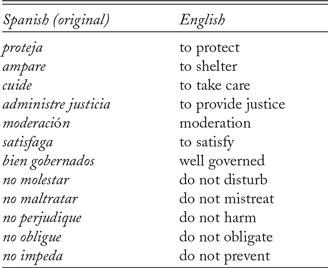
The primary variable of interest is the probability that a document offers a resolution favoring the Indians. To create the dependent variable, I use a dictionary method identifying the presence of a set of unigrams and bigrams commonly related to a favorable ruling.Footnote 88 The legal language of the Spanish empire relied on a rigid structure and juridical jargon derived from the Roman codes; as such, these terms were very stable across time. Table 2 illustrates the coding scheme of the key terms I use to classify a document indicating a favorable ruling.
Key Terms Related to protection

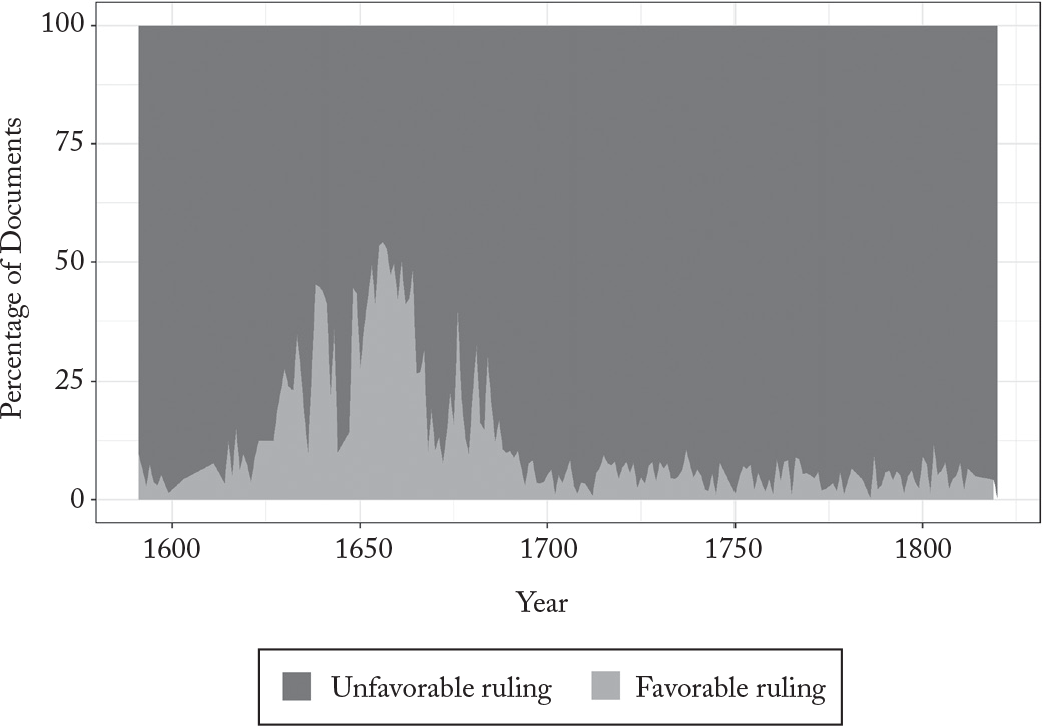
Although an imperfect measure, these words and phrases are clearly associated with the probability of ruling in favor of the indigenous population. On average, around 13 percent of the documents between 1592 and 1820 contain some of these terms. These documents unveil an interesting temporal variation in favorable rulings. Figure 1 shows how the average of protection-related documents was much higher during the seventeenth century (27 percent) than the eighteenth century (5 percent). There is also less variance during the eighteenth century, when the number of protection-related files seems to have reached a plateau.Footnote 89
PROPORTION OF DOCUMENTS BY TYPE OF RULING (1590–1820)a
aTemporal distribution of documents with a favorable outcome within the Indians subarchive. The documents with a protective outcome are those that contain the terms shown in Table 2.

Measuring Topics and Actors
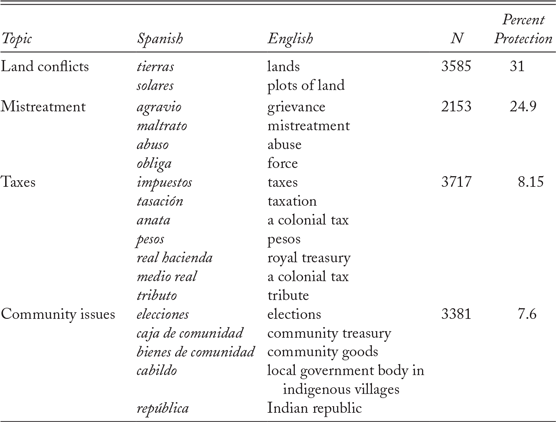
To identify the topics listed in the probabilistic model, I also rely on a rule-based method. As argued, I expect the colonial court to be more inclined to rule favorably for claims addressing land and mistreatment, because these two topics would have a negative effect on both the indigenous population and the Crown. Conversely, I expect the colonial court to be less responsive to claims that diminish its own power (such as tax claims) or claims not directly pertaining to local elites (such as conflicts within Indian communities). Table 3 shows the coding scheme for these topics, the total number of documents coded in each category, and the percentage of documents referring to a favorable ruling in each category. Concretely, for each document a topic becomes a binary indicator taking the value of 1 if the document contains one of these key terms. Note that this classification allows a document to cover several topics at the same time.Footnote 90
Key Terms for Topics

Although applying rule-based methods to the archivists’ annotations yields an accurate representation of topics and favorable rulings, identifying actors is much more challenging because mentions of hacienda owners, alcaldes mayores, encomenderos, or other non-Indian actors might not necessarily mean that these individuals are the alleged perpetrators. The summary of the 1684 case presented above is an excellent example. In it, the alcalde mayor is mentioned, but the accused party is the Indian governor, Martín Flores. In some cases, the presence of three or more actors further amplifies the problem.
To overcome this issue, I employ a second data set resulting from the unpublished personal notes of the historian Lesley Byrd Simpson, who classified thousands of gic cases in the 1930s and ’40s. I manually coded these notes, which are stored in the Bancroft Library at the University of Berkeley. To my knowledge, this is the first systematic classification of this data set.Footnote 91 An advantage of the Lesley Byrd Simpson Files (lbsf) is that they explicitly identify each case’s plaintiff and defendant, resulting in a more accurate classification of the actors involved. For example, they specify whether the perpetrator was an alcalde mayor, a local lieutenant, or a hacienda owner. To test my empirical framework, I classify the actors identified in the lbsf according to the taxonomy from Table 1. I again employ the rule-based method to identify a favorable ruling and the topic of each case.Footnote 92
Measuring Local Balance of power
A first element in the local balance of power dimension is the strength of the indigenous population. Gerhard’s encyclopedia provides statistics of the indigenous population from the Relaciones Geográficas, a census-like data collection that served as the basis for calculating taxes.Footnote 93 Although not all provinces have information for every census, I was able to record a population count for the years 1550, 1570, 1600, 1645, 1745, 1789, and 1808 for most provinces. The data provided by Gerhard usually relate to Indian taxpayers (tributarios).Footnote 94 I use linear interpolation to calculate the population by decades. Following the results from Emily Sellars and Jennifer Alix-Garcia,Footnote 95 I assume that when the indigenous population was in decline it was more vulnerable to predation.Footnote 96
To measure the relative strength of local elites in a given province, I compute the percentage of the indigenous population under the encomienda system. The central assumption for this proxy is that local elites would have a higher capacity to control the resources in a province when the entire population is under this system of indirect rule. The opposite would be the case if the Crown has absolute control of a province. Gerhard’s monographs provide information about the en- comiendas in each province, including their duration. I use the data of localities in the Suma de Visitas Footnote 97 to identify all localities listed by Gerhard in a given province and to compute their percentage contribution to the province’s total population.Footnote 98 I then use each of the census collection periods as a cutoff and the date of dissolution to determine the percentage of a population living under encomienda during that period.Footnote 99 Although this method assumes that the population distribution within a province doesn’t change over time, it does weight larger localities differently, thus providing a granular representation of the transition to direct rule and local elites’ power.
IV. The Elements of Favorable Ruling
Topics and Balance of Power
The theoretical framework of the court’s decision-making process predicts that the cases most likely to receive a favorable ruling are those that are related to land or abuses, that involve local elites or bureaucratic actors, and that originate in areas where elite power is high and the indigenous population vulnerable. The colonial courts data set allows us to test the interaction directly between the topics and the local balance of power dimension.
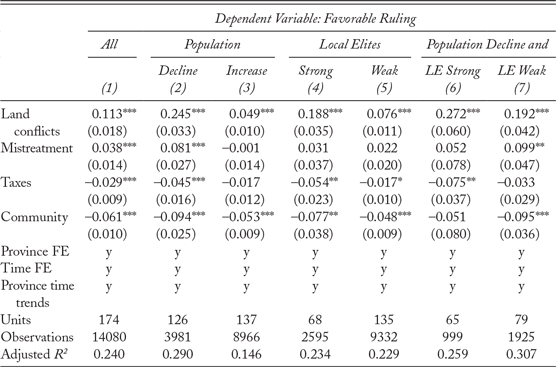
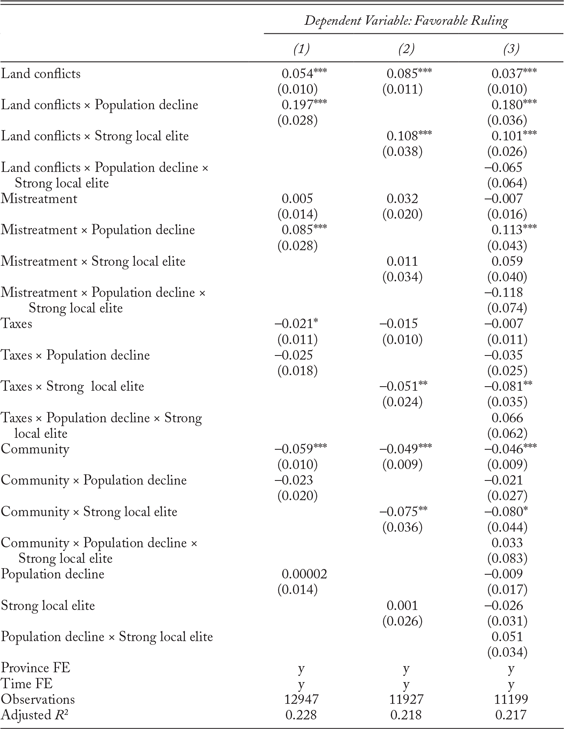
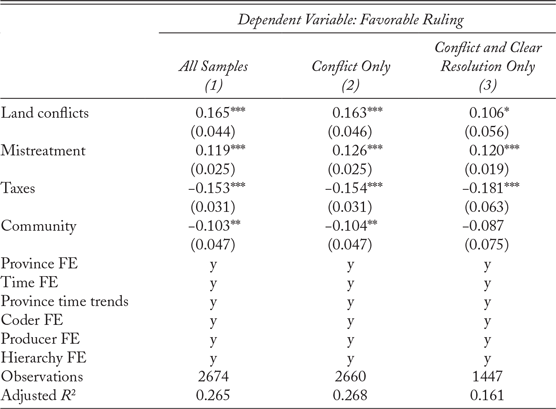
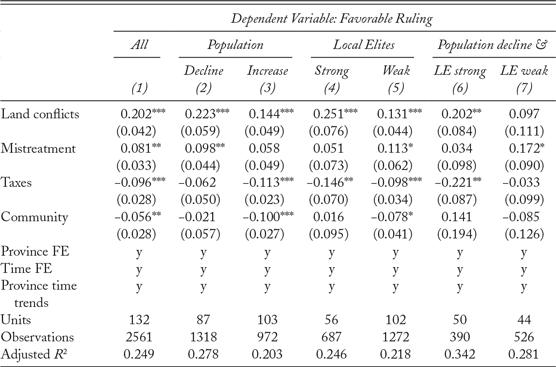
Specifically, I estimate model 1 for a claim i in province p in year t, in which the dependent variable indicates a favorable ruling for a claim in province at year.Footnote 100 The presence of the different topics is measured as a binary indicator. Because there are reasons to believe that the characteristics of the province and the timing of the claim might influence the decision, the model includes year and province indicators (λ and γ, respectively). To account for differential growth trajectories in the rate of a favorable ruling, the model also controls for an interaction between time and province (ϕ).Footnote 101 Additionally, because the sampling process that allows us to study these cases in the first place might vary by province, I cluster the standard errors at this level. Because the gic was located in Mexico City, several cases are mislabeled as having been produced in this location, thus overrepresenting this province. Moreover, the gic had jurisdiction over criminal matters in Indian communities surrounding the city, which are beyond the scope of this article. Thus, I exclude cases from this province. The results appear in Table 4.
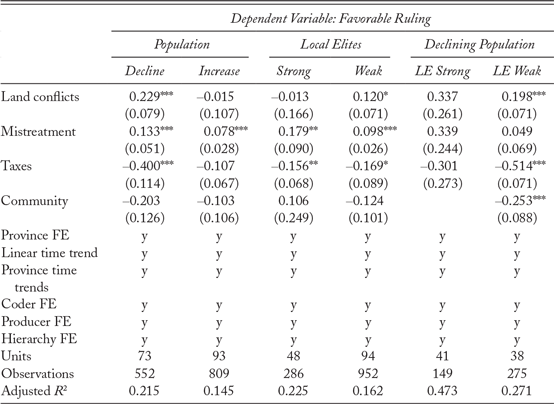
Favorable Ruling, Topics, and Balance of Power a

*p < 0.1, **p < 0.05, ***p < 0.01; all models include province and time fixed effects; standard errors are clustered at the province level
a Linear regressions. The dependent variable is a binary indicator for favorable ruling according to the classification from the rule-based method. The explanatory variables are produced from the same coding process. Column 1 shows the effect of the claim’s topic on favorable ruling using the entire sample. Columns 2 and 3 test the effect of population vulnerability. A province is considered in population decline if the indigenous population is smaller than in the previous decade. Columns 4 and 5 show the effect of elite power. Provinces with powerful local elites are those in which the portion of the population in encomienda is higher than the period average. Columns 6 and 7 show the effect of claims’ topics after conditioning on population decline and different levels of elite strength.
These results show that unconditioned to local balance of power, land and mistreatment-related cases had a higher likelihood of favorable rulings (Table 4, column 1). To test the effect of indigenous population vulnerability, I divide the sample by cases with declining and increasing Indian populations (columns 2 and 3). I measure population change as the ratio of the indigenous population in a province-decade to the population of that province in the previous decade. A ratio larger than one represents a population increase.
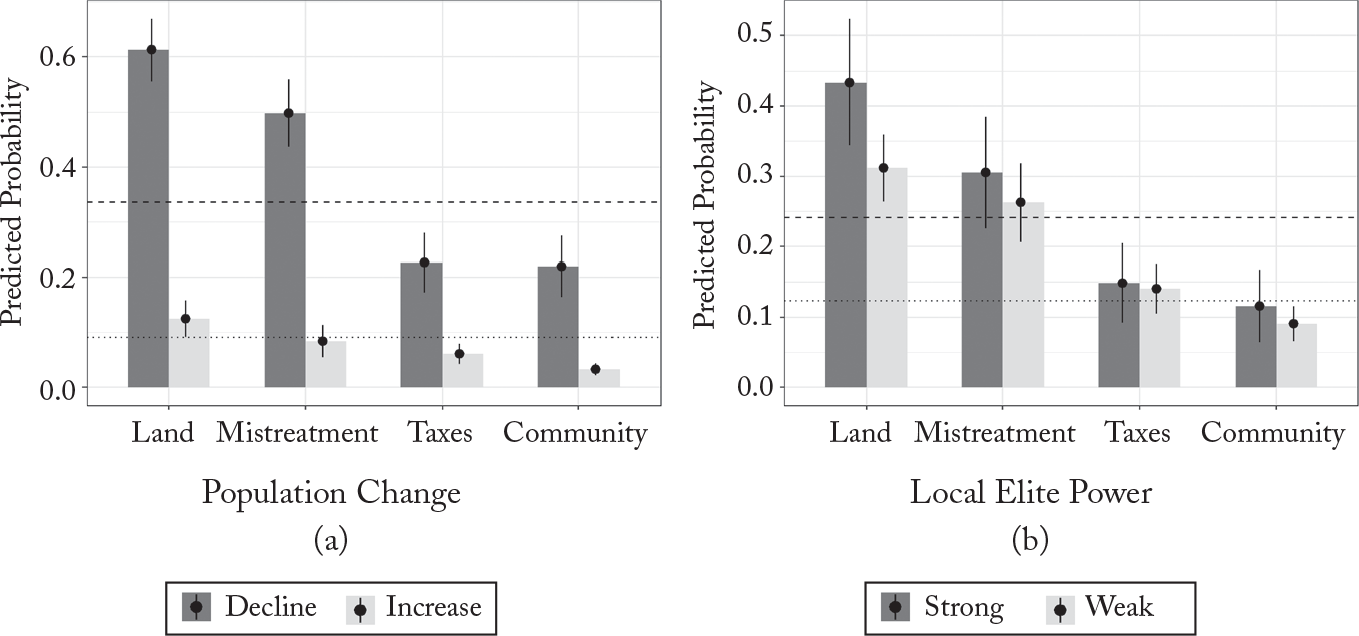
Figure 2 (a) displays the predicted probabilities of a favorable ruling conditioned on the document’s topic and population change. The results of this exercise show that as anticipated by the theoretical framework, the predicted probability of a favorable ruling for land-related cases jumps from 13 to 61 percent when the population is more vulnerable. Similarly, the predicted probability for mistreatment rises from 9 to 50 percent when comparing provinces with increasing and declining populations. These results seem to be driven mainly by provinces within the empire’s core.Footnote 102
Predicted Probability of Favorable Ruling Conditioned on Topics and Local Balance of Powera
aPredicted probability is calculated from estimates in models presented in Table 4. Population change is measured by decade. Provinces with strong local elites are those in which the indigenous population under encomienda is higher than the period average. Vertical lines over the point estimates represent the 95-percent confidence interval. The dashed line represents the average favorable ruling under population decline (panel (a)) and the average ruling when local elites are strong (panel (b)). The dotted line represents the average favorable ruling when population is increasing (panel (a)) and the average favorable ruling when local elites are weak (panel (b)).

An additional step to provide a full test for the balance of powers dimension requires considering the strength of the local elites (Table 4, columns 4 and 5). I classify cases as originating from a province with strong local elites whenever the percentage of the population living under encomienda is larger than the period average.Footnote 103 Figure 2 (b) depicts the predicted probability of a favorable ruling after computing model 1 on a subsample of cases with strong (weak) local elites.Footnote 104 The predicted probability of favorable ruling for land-related cases goes from thirty-one to forty-three when local elites are strong. Likewise, the predicted probability for mistreatment goes from twenty-six to thirty. But this category has a significant overlap in its predicted probabilities. The result suggests that the strength of local elites was more significant for the decision of granting favorable ruling for land cases than for mistreatment cases.
To thoroughly test the implications of the balance of power dimension, I run the model on a subsample of cases with declining populations and different levels of local elite power. The results appear in Table 4, columns 6 and 7. We observe that when the population is declining and local elites are strong, claims related to land conflicts are more likely to receive a favorable ruling than claims related to other topics. Although the coefficient for mistreatment is also positive, it is not significant. When comparing the coefficients between land-related cases with powerful local elites versus those with weak elites, we observe that the likelihood of receiving a favorable ruling is higher for cases with strong elites. By contrast, the likelihood for mistreatment cases isn’t significantly different for these two scenarios. Together, these results suggest that population decline had a strong effect on both land and mistreatment cases, whereas the strength of local elites affected only land-related cases. Because land was the primary source of enrichment for local elites, these results support the theoretical expectation of the court’s strategic behavior.
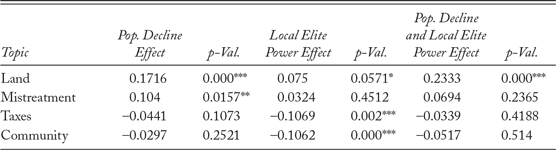
To further test the interdependence between topics, population decline, and local elite strength, I also compute a fully interactive model in Appendix 2. The results from this model, presented in Table A2.1, confirm the insights of the subsample analysis: the effect of population decline on the likelihood of a favorable ruling is positive and significant for both mistreatment- and land-related cases. At the same time, the effect of local elite power on the likelihood of a favorable ruling is positive and significant for land-related cases only.
HUMAN CODING
To address the shortcomings of the rule-based method, in Appendix 3, I analyze a random sample of three thousand manually classified cases. This manual classification allows me to differentiate those cases in which there was a clear conflict between Indians and non-Indians and cases that received an explicitly favorable or unfavorable ruling (thus excluding those with an ambiguous outcome). The results using this sample are consistent with the main findings.
POLITICAL FACTORS
To assess the evolution of the decision-making process and the effect of external political factors, in section S1 of the supplementary material,Footnote 105 I control for short-term political changes, such as individual policies made by the viceroy or king, and the influence of the Spanish involvement in wars. I find no evidence that these factors affected the court’s strategic behavior. I also test the effect of the Bourbon reforms in the eighteenth century. Although favorable rulings decreased during the post-1700 period, I find evidence that strategic considerations were still relevant. I also address how the presence of direct rule might have changed local judges’ incentives to rule in favor of the Crown’s interests. I find that even in provinces where the Crown always exercised direct control, we can identify a different effect by topics. As expected, this effect is weaker in these provinces than in provinces that experienced indirect rule.
WELFARE EFFECTS
Beyond the Crown’s strategic motivations to provide judicial access to the indigenous population, a fundamental question regarding the gic pertains to its substantive welfare effects. The Spanish Crown’s active role in protecting indigenous lands from invasion by local elites might be reflected in the fact that indigenous communities maintained their communal lands until the nineteenth century.Footnote 106 The available data allow us to test the contemporary effects of a favorable ruling by measuring its impact on population decline. Section S2 of the supplementary material shows that places receiving more favorable rulings also presented less variation in indigenous population change and that this effect was particularly relevant for controlling population decline. These results suggest that the court was more than just an escape valve for indigenous grievances, as it had a significant effect in containing the demographic crisis.
ACTORS
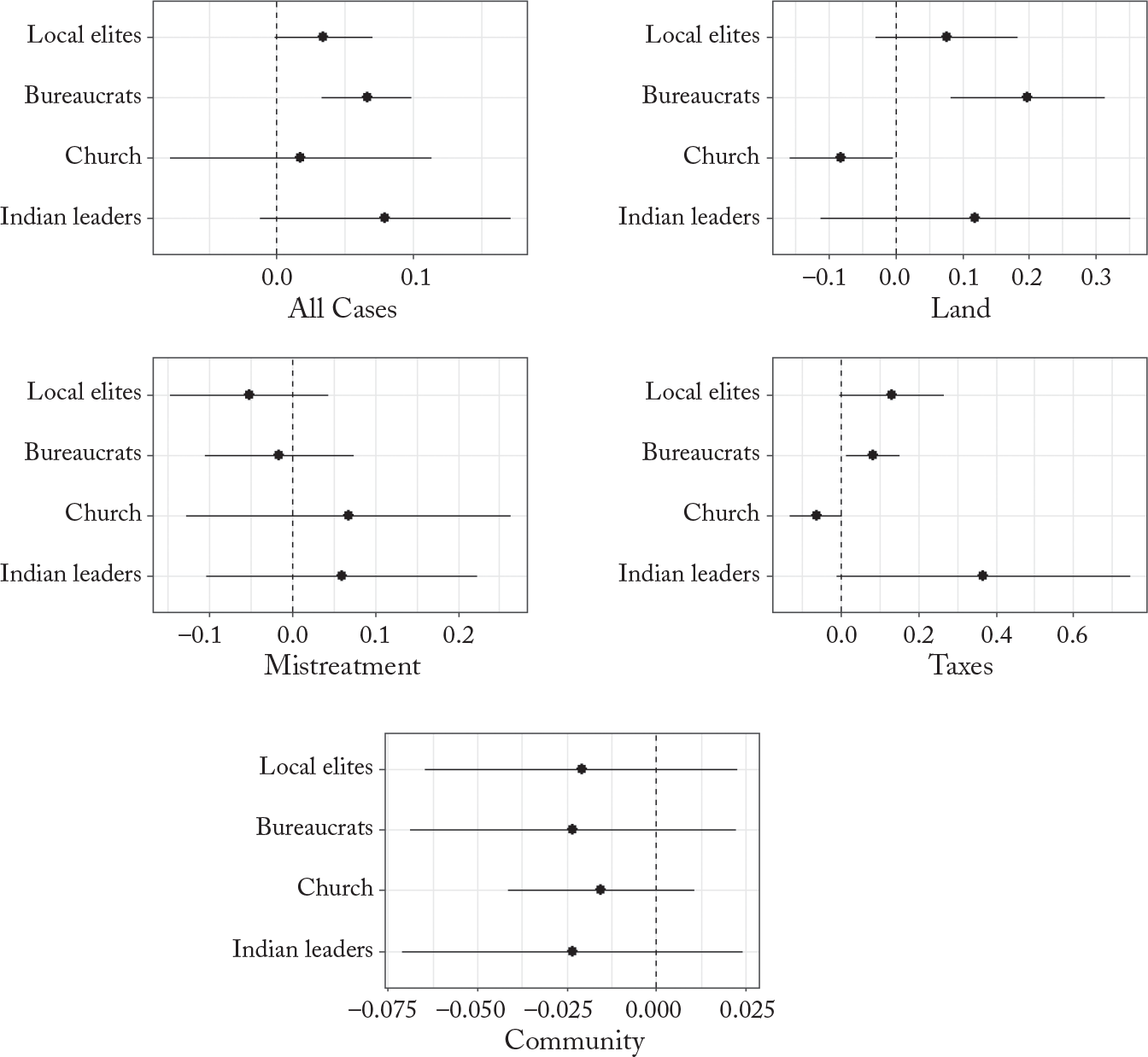
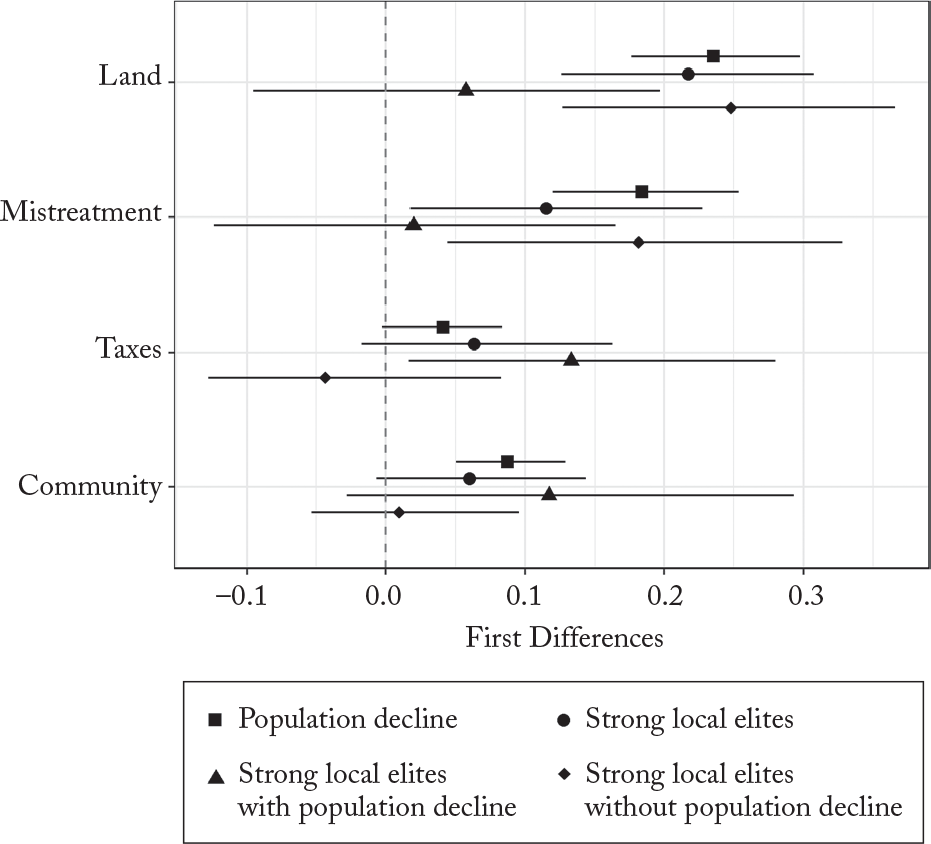
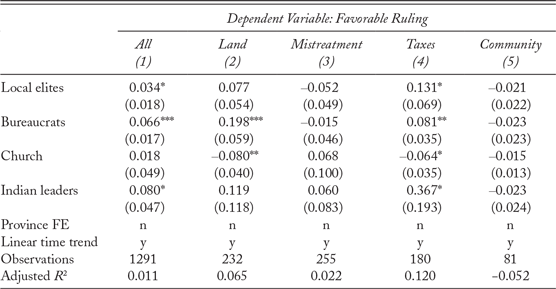
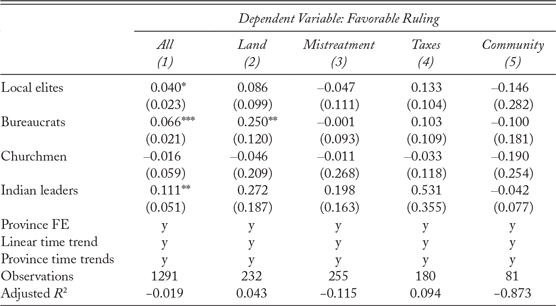
As explained above, one shortcoming of the colonial courts data set is that it might not provide an accurate representation of the actors involved. For this reason, I turn to the LBSF data set, which specifically identifies plaintiff and defendant in each case. Using this data set, I run a model in which the dependent variable is the binary indicator of a favorable ruling and the explanatory variables are the different actors (see the results in Appendix 2, Table 2.1). Figure 3 displays the estimates for the entire sample and different subsamples based on the topics of the claims. As the theory predicts, bureaucrats, local elites, and Indian leaders have a positive relationship with favorable rulings, while the presence of Church actors has a null effect on favorable rulings.

The subsample analysis offers a more detailed explanation of the decision-making process. First, the effect predicted in the theoretical framework is consistent for land-related cases. That is, claims against elites and bureaucrats have a greater likelihood of receiving protection than claims involving Church members. In fact, claims in which a Church actor is a perpetrator are associated with a negative and statistically significant coefficient. Interestingly, contrary to the theoretical expectations, when the complaint is against indigenous leaders, the probability of receiving a favorable ruling is higher than when non-Indian elites are accused. This result emphasizes the Spanish Crown’s interest in restraining the accumulation of power and wealth by native leaders. But because the confidence intervals for the Indian leaders estimate overlap with zero, it’s impossible to provide a conclusive interpretation for these actors.
The estimates for taxes follow a similar pattern, consistent with the theoretical expectations of the probabilistic model. In these cases, different actors were involved in tax collection as agents of the Crown, usually overstepping their responsibilities by extorting money from taxpayers. Again, the involvement of local elites and bureaucrats in tax-related cases yields a positive correlation with a favorable ruling, whereas the involvement of Church actors is negatively correlated with the success of the claim. And the involvement of Indian leaders is correlated with a higher likelihood of a favorable ruling. In this case, the effect is strongly positive and significant, suggesting that the Crown was particularly interested in controlling indigenous leaders when they used their position to undermine the imperial fiscal apparatus.
None of the estimates for either mistreatment or community cases is statistically significant. The results for the mistreatment cases should be interpreted together with those analyzing the universe of cases (see Figure 2). As these results show, mistreatment cases in general are associated with higher levels of a favorable ruling; the fact that the involvement of individual actors doesn’t modify this likelihood suggests that the Crown cared about Indian mistreatment whoever the perpetrator was. Similarly, for community-related cases, the specific perpetrator doesn’t seem to affect the probability of a favorable ruling. But it should be noted that only 5 percent of the cases in the LBSF are associated with this topic, thus limiting the interpretability of these results.
Overall, the analysis of actors using the LBSF shows a strategic court behavior and a strong interest in controlling local elites, bureaucrats, and especially Indian leaders over claims related to land and taxes. When cases were related to mistreatment and community, the actors’ identity seems to be less relevant than other strategic considerations, such as population change.
Addressing the Selection Bias of Cases
One limitation of the results reported above is the potential problem of sample selection bias.Footnote 107 Scholars of judicial politics have argued that the biased nature of how cases arrive at court might affect the interpretation of the court’s behavior.Footnote 108 For the purposes of this article, the crucial question is how does selection bias in court cases limit the interpretation of a strategic court? An unbiased court would make rulings based only on the merits of a case, meaning that no factors are consistently associated with the likelihood of an (un)favorable ruling. In contrast, a strategic court would weigh factors other than the merits of the case (for the gic, these are the case’s topic, the actors involved, and the local balance of power). But it’s also possible that these factors determine the probability of appearing in court in the first place. If this selection bias exists, then court rulings might appear strategic when in fact they’re only a reflection of the types of cases that arrive at court.
In a centralized court like the gic, two types of selection bias can influence the characteristics of the cases observed. The first type is related to the structural characteristics of the province in which the cases originated. The second is litigant-driven, which means that the cases are a function of decisions made by the plaintiff or defendant. I analyze both biases below and explain why, given the existing data, neither is likely to threaten the interpretation of a strategic court.
STRUCTURAL BIAS
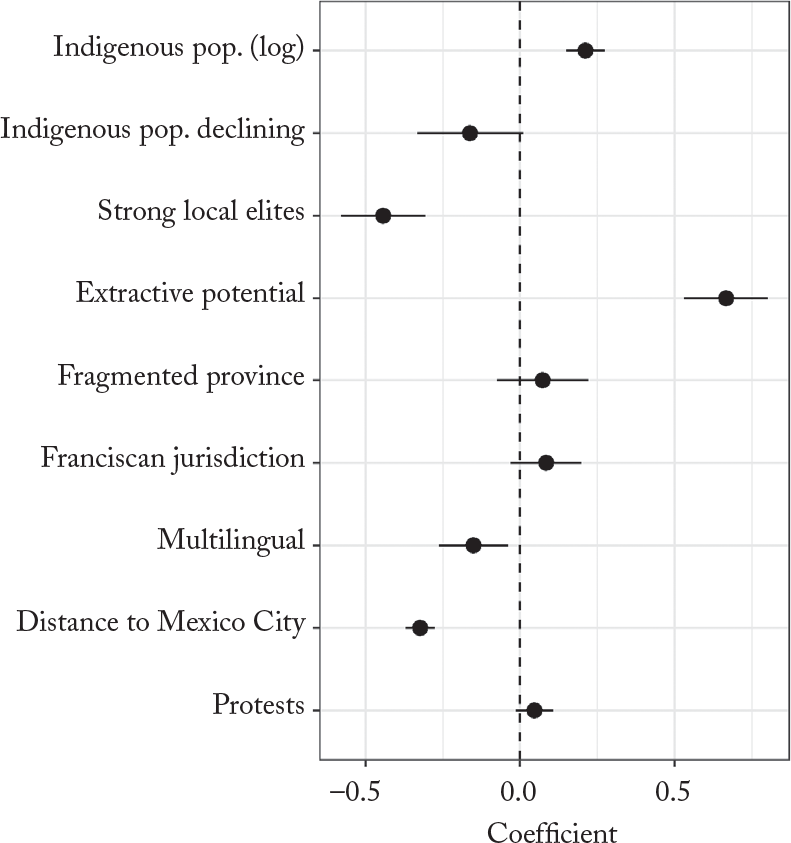
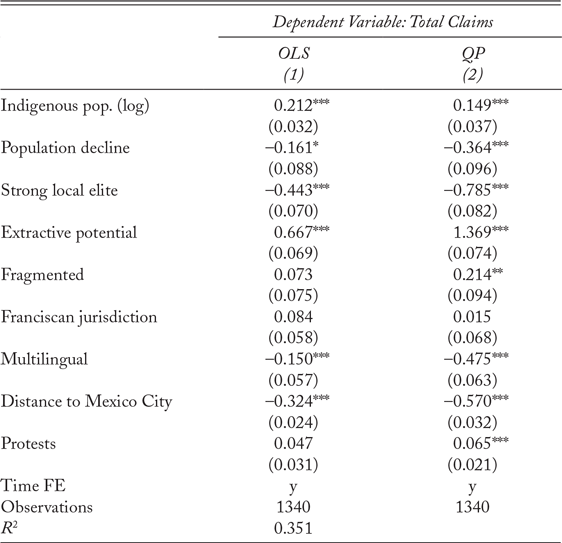
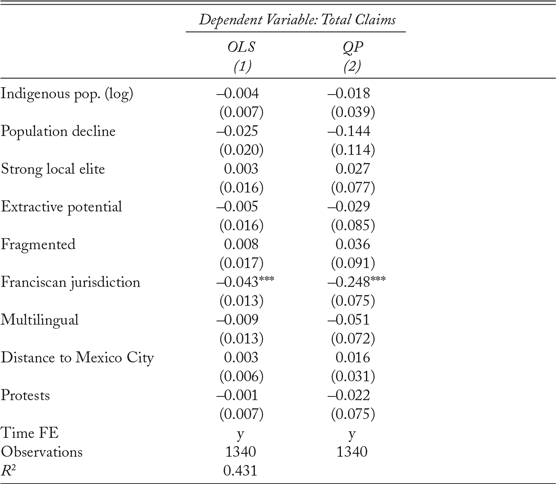
Structural bias can limit our ability to identify whether the gic’s decision is based on strategic grounds because some inherent characteristics of the provinces might be shaping the amount, type, and quality of claims. If the population is under stress, for example, there could be more meritorious cases than otherwise. To explore this bias, I first present the relationship between the inherent characteristics of a province and its total number of claims.Footnote 109 Figure 4 shows that a province’s specific characteristics are related to the total number of cases produced. In particular, provinces farther from Mexico City and with a multilingual population are less likely to bring claims to the court. At the same time, provinces with a greater extractive potential tend to present more claims.Footnote 110

The results presented in Figure 4 also bring attention to the fact that provinces with a larger indigenous population present more claims. In contrast, provinces with stronger local elites and those where the indigenous population is declining tend to present fewer claims. These results suggest that provinces in which the local balance of power doesn’t favor the indigenous population aren’t necessarily producing more claims and thus, they are not overrepresented in court. Therefore, there’s no selection bias associated with the sheer number of cases. But it’s possible that even if these provinces bring fewer claims, these claims can still have greater merit, for example, by representing more violent land invasions or harsher physical abuses. Such differences in merit may explain why these cases are more likely to be ruled favorably.
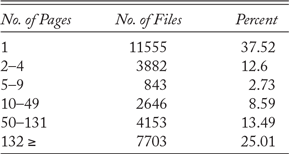
To address this issue, I develop a measure of merit by using the length of a document as determined by its number of pages. Given the geographical limitations and the implicit costs of presenting claims in Mexico City, indigenous communities often compiled several complaints in a single document with multiple chapters. Arguably, documents composed of chapters are more comparable because they point to a higher number of abuses, theoretically carrying more merit than documents referring to a single case. I focus only on cases in the highest quartile of page length.Footnote 111 An analysis of this subsample of more complex cases shows that these tend to be more balanced on their covariates and more comparable (see Appendix 4, Table A4.3).Footnote 112
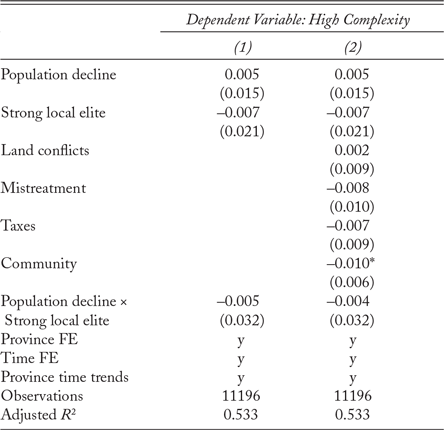
I use this measure of merit to determine whether certain provinces tend to bring more meritorious cases. Table A4.4 in Appendix 4 shows that neither demographic decline, the power of local elites, nor the topic of a case is correlated with this measure of merit. These results strongly suggest there’s no evidence of structural bias. To further test the prevalence of strategic considerations, I run model 1 conditioning on high-complexity cases only. This model considers the characteristics of the province and controls for temporal effects and crucially, for the topic of the case. Results are displayed in Table A4.5. This analysis shows that even after limiting the analysis to high-complexity cases, the results generally hold. Cases related to land and mistreatment are more likely to receive protection, whereas cases related to taxes and community issues are less likely to receive a favorable ruling. Similarly, the local balance of power has the predicted effect with land-related cases: when the population is declining and local elites are strong, cases have a greater likelihood of favorable ruling.
LITIGANT-DRIVEN BIAS
The second type of bias that might threaten the interpretation of a strategic court is the behavior of litigants. This bias can take three forms. First, indigenous plaintiffs might be strategically filing cases with a greater likelihood of receiving protection. Second, bias occurs when the defendant interferes with the process by deterring claimants from arriving at court, either by threatening or bribing them. Third, bias occurs when the strategic behavior comes from both plaintiff and defendant. In this situation, litigants might settle before the case arrives at court. All these types of bias have a similar implication: the gic might only be observing specific types of cases and then making a ruling based on their biased characteristics rather than on its own strategic agenda.
I argue that the strategic behavior of plaintiffs is an unlikely scenario in colonial Mexico because it implies perfect (or close to perfect) information on the distribution of favorable cases across topics. Although an indigenous community certainly had information on its own past rulings and perhaps on those of neighboring communities, it’s unlikely that the community would be aware of how the gic ruled for the universe of cases. To test the existence of a plaintiff learning process, I measure the evolution of cases by topic. The assumption here is that if indigenous plaintiffs updated their claims through time, we should see a spike in topics more likely to receive favorable ruling (land and mistreatment) and a drop in topics less likely to receive favorable ruling (community and taxes). Figure S9.1 in section S9 of the supplementary material shows that this is not the case.Footnote 113 In fact, cases with a low likelihood of receiving a favorable ruling appear in the gic even toward the end of the colonial period. Moreover, Table S9.1 demonstrates how, after controlling for time and province fixed effects, the prior protection rate is not positively associated with land and mistreatment cases. These results suggest that indigenous communities were not Bayesian in the sense that they were not filing cases based on prior information about favorable rulings.Footnote 114
The second form of litigant-driven bias comes from the strategic behavior of defendants. It’s possible that local elites and bureaucrats deterred claimants by threatening or bribing them. If this were the case, then grievances from the provinces with more predatory local elites and more corrupt bureaucrats might be underrepresented because they’re less likely to appear in court. I argue that this misrepresentation doesn’t threaten the interpretation of a strategic court because we might expect that if these claims were to reach the gic, they would be at least as likely as claims from other places with powerful local elites to receive a favorable ruling (see analysis in section S9.2 of the supplementary material). Therefore, the observed coefficients are actually a lower bound of the court’s strategic behavior.
In the third type of bias, a dispute can be settled before arriving in court or even after the procedure has started. These settlements can undermine our ability to identify whether the court is acting strategically because the gic might only observe the cases where settlement agreements are too costly. If litigants can only settle on low-cost disputes over land or mistreatment, then only high-cost disputes would reach the gic. This is problematic because these disputes might also be cases with a high probability of receiving a favorable ruling. Although it’s impossible to represent the out-of-court settlements accurately, the economics of law literature offers clues to the relationship between the allocation of costs and the incentives to settle. According to this literature, the probability of a trial depends on ex ante evaluations of favorable rulings and the amount of the settlement,Footnote 115 the allocation of legal costs,Footnote 116 and the characteristics of the court.Footnote 117 According to the characterization of allocation of costs, in a system favoring the plaintiff these actors pay only their own costs if they lose and nothing otherwise. The gic can be cataloged as an extreme case of a system favoring the plaintiff because the indigenous plaintiffs weren’t expected to pay a trial’s legal costs.Footnote 118 Therefore we should expect weak incentives to reach an out-of-court settlement.Footnote 119
To summarize, although theoretically, the selection bias of cases is a concern for the interpretation of the court’s strategic behavior, the existing data suggest that these processes do not threaten the interpretation of a strategic court.
V. Case Narratives
The quantitative results in this article suggest that the gic acted strategically to protect the Crown’s interests. In this section, I use a selection of cases to illustrate the mechanisms of this decision-making process. These narratives are intended to provide further context for how the different factors theorized in Table 1 influenced court rulings: that is, how the court weighted a case’s topic, the actors involved, and the local balance of power.Footnote 120 120 The narratives also show the complex and nuanced nature of colonial justice.
The theoretical framework posits that cases related to land disputes where local elites are strong and the indigenous population faces an existential threat would be more likely to receive a favorable ruling and royal protection. These elements are illustrated in the claim presented in 1680 by the town of San Miguel Almoloya, in Metepec province.Footnote 121 Three years earlier, the Indians received a license to repopulate their ancient lands in the abandoned town of Santa María Nativitas. The town had probably been abandoned due to the cocoliztli (paratyphoid fever) plague of 1642.Footnote 122 As the Indians were rebuilding the town, a group of men invaded in the middle of the night, lit their precarious homes on fire, stole some religious images from the church, and assaulted the residents. The Indians presented a claim to the gic, including documents attesting to their ancestral rights to the land. During the investigation it came to light that the invaders were acting under the orders of the Count of Santiago, a Spanish nobleman who claimed possession of the land.
The count referred to in this claim was probably Don Fernando Al- tamirano de Velasco Legaspi y Albornoz, the third Count of Santiago de Calimaya.Footnote 123 Like all members of his powerful family, Don Fernando was very influential in the political and economic life of New Spain. As part of his title, he inherited real estate in several provinces, which became a source of conflict with indigenous communities.Footnote 124 But his wealth and power—and violent methods—didn’t help him appropriate the lands of this Indian community. Ultimately, the viceroy sent a decree granting the property to the Indians. Moreover, the viceroy ordered a receptor (a court bureaucrat) to enforce the decree and travel to the area to restore the lands to the Indians.Footnote 125 In that gic decree, the Count’s henchmen were prosecuted but the Count himself faced no legal consequences. This is an example of the court’s limits and its understanding of justice: as long as Indian property was protected, there was no need to antagonize powerful elites. In this case, three predictors of favorable ruling converge: 1) the case is about a land dispute, 2) the case involves a powerful member of the local elite facing no restraint from local bureaucrats, and 3) the case follows a population collapse.
To further understand the court’s decision-making process, I contrast this case with some claims in which factors that predict a non- favorable ruling are present. A complaint from the town of Tesayuca (Texcoco) provides one example. In June 1691, the Texcoco Indians sued Gerónimo de Guzmán, a Spanish rancher who had invaded and seized a piece of land called Tetitlán. The Indians presented two documents: a viceroy’s order from 1552 and an amparo from 1641.Footnote 126 At first the viceroy and court officials issued a statement protecting the Indian property, but Guzmán filed a motion to suspend the order. The rancher also received protection from the local alcalde mayor, who claimed that Guzmán was the land’s rightful owner. As a result, the court reversed its initial order. The Indians kept pressing the matter, providing several documents demonstrating their land rights. But even with this written proof, the gic ruled in favor of Guzmán.Footnote 127 Although this case was about a land conflict (a factor that per se could raise the likelihood of a favorable ruling), labeling Guzmán as a rancher—instead of a hacienda owner—signaled that he wasn’t a member of the powerful landed elite, like the Count of Santiago. Nor did the case reference population decline, a factor that Indian claimants mentioned whenever possible.Footnote 128 Another element to consider here is that, as in the case above, the Indian claimants presented documentation proving ancestral ownership. Therefore, this case had comparable merits but a different outcome.Footnote 129
The theoretical predictions of this article also suggest that the involvement of Church members decreases the probability of a favorable ruling as well. The Indians of Mezquitepec (San Luis Potosí) were denied protection in 1640 when they raised a claim against the Jesuits for invading their lands. Although the Indians had formally received the land rights, the court somehow coerced them into leasing their land in perpetuity to the religious order.Footnote 130 More than eighty years later, in 1721, the Indians of Tenango (Tulancingo) presented several complaints against their priest, Juan de la Rea, even asking the bishop to remove him. Their claims were repeatedly ignored. Tired of the priest’s abuses and the compliance of the gic, they rioted. The gic responded quickly, jailing several Indians but not prosecuting the abusive priest.Footnote 131 These cases show how the Crown sought to avoid conflict with the powerful institution of the Church.
As illustrated in Table 1, physical mistreatment is another element that should increase the favorable ruling probability. This factor is evident in a 1616 case from Turicatio (Michoacán), when the town’s workers complained about being forced to travel forty-six leagues to work in a copper mine.Footnote 132 They also accused a lieutenant of making them work at a cacao plantation. Moreover, the Indians claimed that the town had lost 130 workers in recent epidemics and they asked the gic to reduce their labor duties. In response, the court granted them a temporary exemption and summoned the mine administrator to testify.Footnote 133 In addition to the topic, other elements of the case increase the probability of a favorable ruling, including the presence of strong local elites (the mine and the plantation owners) and the mention of population decline.
This case can be contrasted with a claim from Teposcolula province submitted to the gic in 1612.Footnote 134 The Indians complained that the alcalde forced them to spin cotton for meager wages. They also accused the alcalde of profiteering by paying low prices for cochineal.Footnote 135 When the gic asked the alcalde for an explanation, he didn’t deny the charges; instead, he justified his actions by saying that the wages were fair and implying that the cochineal trade was required to maintain productivity in the province. The case closed with a statement confirming that the alcalde was telling the truth and forcing the town representatives to accept the outcome. This case, like the one immediately above, refers to forced labor in a context of population decline.Footnote 136 But the crux of the Teposcolula claim focuses on royal fiscal benefits, which—as predicted by the model—usually outweighed other elements of a case.
The theoretical framework also predicts that for community conflict cases, the outcome was uncertain when only this dimension is considered. When conflict occurred among Indian community members, the court often opted to act as mediator, siding with neither the plaintiff nor the defendant.Footnote 137 By contrast, when Indian and non-Indian actors were involved, the court tended to side actively with Indian plaintiffs. This dynamic is illustrated in a 1628 claim brought by the Indians of Uruapan (Michoacán). The Indians declared that after they had celebrated a rightful election, the alcalde mayor, in agreement with a local friar and the encomendero, confiscated the documents confirming the election and organized a second vote. The town asked the viceroy to validate only the first election. In this case, the involvement of several non-Indian actors was an actual concern for the Crown. Following the Indians’ petition, the viceroy ordered that all local officials be summoned to perform a new election.Footnote 138
The model also predicts that the presence of indigenous leaders will increase the likelihood of protection. This is clear in a claim in which the Indian town of Chalcatongo (Teposcolula) complained about their cacique in 1600. This case presented a lengthy list of abuses by the local leader, including forced labor, levying additional fees, and electoral fraud. The court did punish the cacique, although not to harshly—another indication that the gic often avoided direct confrontation with local powers, as long as some retribution existed. Instead, the court ordered the local alcalde to reach an agreement requiring the cacique to consent to specific terms. The Indians agreed with this result and vowed to desist from further complaints against him.Footnote 139
V. CONCLUSION
This article illustrates the process of justice centralization as a critical element of state formation and power consolidation. I argue that rulers have implemented centralized courts across history and political regimes to facilitate the control of state agents. When institutions are weak and monitoring is expensive, central rulers might find it appealing to employ the general population as whistleblowers and to view their grievances as fire alarms.Footnote 140 Although the adjudication of justice might remain subject to strategic considerations, this practice shows how the rule of law and property rights can emerge in authoritarian settings.
The General Indian Court of colonial Mexico offers a historical example of this process. In colonial Mexico, the Spanish Crown confronted the fundamental agency problem of controlling unruly local elites and provincial bureaucrats. For the Crown, these state agents’ abuses against indigenous communities threatened the colony’s economic potential and political stability. This article provides empirical evidence of the court’s strategic rulings through a novel data set of indigenous claims. I demonstrate that claimants were more likely to receive a favorable ruling when cases were related to land invasion or physical abuse, involved local elites or bureaucratic actors, and originated in areas where local elites were strong and the indigenous population was more vulnerable. In contrast, claims were less likely to receive a favorable ruling when they directly targeted the Crown’s fiscal potential or involved the influential Catholic Church. I show how the gic deliberately weakened or strengthened local powers to protect its economic and political interests. This analysis makes clear that any study of colonial institutions and their legacies is incomplete without consideration of the endogenous processes behind their emergence.
This article’s theoretical and empirical findings open several avenues for further research. First, they highlight the need for a broader comparative analysis of judicial institutions across colonial powers, including a look at how agency dilemmas influenced their approaches to Indian justice. Besides the gic, tribunals specifically designed to address indigenous grievances were also established in Peru and Yucatan.Footnote 141 The Spanish Crown’s strategic motivations for establishing a centralized court in some colonies but not others can illustrate how the interaction between precolonial arrangements, factor endowments, geography, and agency dilemmas shaped colonial institutions. Moreover, comparing the Spanish approach to Indian justice with that of other colonial powers can further inform how different agency considerations impacted native populations.
Second, this article also seeks to redefine the role of indigenous populations as active participants of the colonial state. The study of colonial institutions in the political economy literature usually assumes that these actors were merely passive recipients of extraction and abuse.Footnote 142 But the historical literature on indigenous agency demonstrates that indigenous populations resisted European control through various means, including uprising, self-isolation, and negotiation.Footnote 143 This article demonstrates that participation in the judicial system became a crucial element of the indigenous repertoire of contention.
Last, this article contributes to a longstanding debate on the origins of inequality in Latin America.Footnote 144 I suggest that Mexico’s Indians had agency and access to mechanisms to defend their land and to receive protection during the colonial period. In other words, the gic uncovers the contingent conditions that allowed an unequal and repressive colonial legal system to become a weapon of the weak.Footnote 145 Recent economic and anthropometric evidence suggests that inequality levels in Latin America were no different from the levels in North American cities and that the inequality increased during the nineteenth century, after independence.Footnote 146 During that century, liberal governments throughout Latin America eliminated the collective rights that had empowered indigenous communities through the gic in the time of colonial rule.Footnote 147 Under this interpretation, whereas the extraction against indigenous populations in Latin America has its origins in the colonial period, its consolidation occurred during the emergence of the nation state.
Appendix 1 Example of a General Indian Court Document
The first two pages of a General Indian Court (gic) document from 1798 are shown in Figure A1. In the document, the claimants of the Indian community of Almoloya, in Zacualpan province, describe how their communal lands are being reduced and their taxes inflated by the local lieutenant’s purposeful miscalculation (left page). The right page shows the court resolution to protect this community. Interestingly, the Indian village is described as el común (the commons), highlighting the communitarian enterprise of these claims. A copy of this document is located in the Bancroft Library, Berkeley, California.Footnote 148
Example of a Document from the General Indian court

Appendix 2 Favorable Ruling Estimations
Interactive Effects
As shown in Table 4 in the main text, changes in the local balance of power affect the coefficients for each topic. Specifically, topics threatening the Crown’s control present a more significant coefficient when the population is in decline and local elites are stronger. To obtain further insights on the statistical significance of these coefficients, I ran the following interactive model:
 $${y_{i,p,t}} = \sum\limits_{j = 1}^N {{\beta _j}} Topic_{i,p,t}^j*Pop.Declin{e_{p,t}}*LEStron{g_{p,t}} + {\lambda _t} + {\gamma _p} + { \in _{i,p,t}}$$
In this model, each topic interacts with a measure of the local balance of power in province p at time t.Footnote 149 The measures of the local balance of power are binary indicators of population decline and powerful local elites. Table A2.1 shows the results for these models. Because interpreting interactive coefficients can be cumbersome, I further tested the differences across coefficients within each model by calculating the simple regression effect for the triple-interaction on each topic and running a Wald test for linear equality. The results are shown in Table A2.2.Footnote 150
Favorable Ruling, Topics, and Balance of Power (Interactive Models)a

*p < 0.1, **p < 0.05, ***p < 0.01; all models include province and time fixed effects; standard errors are clustered at the province level
Simple Regression Effects and Wald Tests for Linear Equality a

*p < 0.1, **p < 0.05, ***p < 0.01
The associated p-value in Table A2.2 is based on a finite-sample F statistic from a Wald test–based comparison. Overall, the results suggest that under population decline, both land- and mistreatment-related claims have an increased likelihood of favorable ruling. As previously suggested in the subsample analysis (Table 4), the effect of local elite power is positive and significant on land-related cases. At the same time, the effect of local elite power on mistreatment is not statistically significant, whereas it seems to have a negative effect on taxes and community-related claims. The results also show a strong effect of the simultaneous occurrence of population decline and strong elites on land-related claims. These results confirm the theoretical expectations of the local balance of power’s effect on a case’s outcome.
Another approach to test the effect of a specific variable is to measure its marginal effect on the predicted values. Contrary to the simple regression effect, this approach introduces some assumptions on the other variables. Using a logistic version of model A2.1 to restrict the range of the predicted values, I computed the predicted values for each topic under different assumptions and calculated the first difference effects for population change, strength of local elites, strength of local elites under population decline, and strength of local elites under population increase.Footnote 151
The results are shown in Figure A2. The first difference effect for population decline is generally large and positive for all topics. Similarly, the effect of local elites’ strength is positive and significant for land and mistreatment cases. This effect seems to be nonsignificant for tax and community-related cases. In general, we also observe that although the additional effect of local elites’ strength is positive under population decline, it tends to be nonsignificant. This result suggests that the relative power of local elites is not a relevant factor when the indigenous population is already under decline. In other words, the gic was already likely to provide a favorable ruling under these circumstances, and the extra value of the strength of local elites was marginal. In addition, for land- and mistreatment-related cases, the local elite strength effect is positive and significant when the indigenous population increases.
First Differences under Diverse Scenariosa
aMarginal effect on the predicted values for each topic calculated with a logistic model and an asymptotic normal approximation of the log-likelihood.

Perpetrator
Table A2.3 shows the effect of individual actors on favorable ruling. The first column includes all types of cases, showing that those involving local elites, bureaucrats, and Indian leaders positively affected favorable ruling. The subsequent columns break down the effects by type of case. For land-related cases, the effect of bureaucrats is positive and significant, whereas the involvement of Church members is negatively correlated with a favorable ruling. The involvement of local elites is also positive, although the confidence intervals overlap with zero. These results are similar for tax-related cases, with the difference being that Indian leaders seem to be highly correlated with a favorable ruling. For mistreatment- and community-related cases, the effect of all actors is not significant.
Because the sample is relatively small, there is a risk that the model will become overspecified by including province and time binary controls. For this reason, the model in Table A2.3 includes only a linear time trend. With this caveat in mind, Table A2.4 shows the results including province controls. Here we see that the main results still hold for the entire sample.
Favorable Ruling, Topics, and Actors a

*p < 0.1, **p < 0.05, ***p < 0.01; all models include a linear time trend; standard errors are clustered at the province level
Favorable Ruling, Topics, and Actors (with Province Controls and Unit-Specific Time Trends)a

*p < 0.1, **p < 0.05, ***p < 0.01; all models include province fixed effects and a province-specific time trend; standard errors are clustered at the province level
Appendix 3 Human Coding
One concern about using archivists’ annotations as the unit of analysis—and about analyzing historical texts in general—is that the language contained in the summaries is complex and sometimes ambiguous. This concern is particularly salient for the definition of the dependent variable. When using key words, there’s a risk of misclassifying cases and of attributing a favorable ruling where it did not happen. And even if using key words captures favorable rulings correctly, bulking together the rest of the documents might be misleading. In some cases, not offering explicit protection might be actively transgressing Indian rights, while in many others, the language might be ambiguous. Differentiating between a negative label and an ambiguous one is relevant for this analysis because it identifies instances where the court actively sided with the perpetrator. To overcome these concerns, I implemented a human classification system in which a team of coders manually classified a random sample of three thousand document summaries. Human classifiers can easily capture nuances of language that might be missed by the dictionary method. The specifics about the coding scheme appear in the supplementary material, section S4.Footnote 152
Table A3.1 presents the results for the human-coded sample. The first column includes all cases that could be linked to a particular province. The second column shows the cases that represent a clear conflict between Indians and non-Indians. The last column presents the results for cases where a clear conflict existed and there was a final resolution made by the court (not ambiguous). Overall, the results show consistency with the parameters of the probabilistic model summarized in Table 1.
Favorable Ruling and Topics of Claims (Human Coding)a

*p < 0.1, **p < 0.05, ***p < 0.01; standard errors are clustered at province level
Table A3.2 jointly tests the topic and balance of power dimensions using cases where a clear conflict existed and a final resolution was issued. The first two columns show the effect of population change, the third and fourth columns show the effect of local elites’ strength, and the last two columns show the two effects together. Overall, using these reduced samples, the results for population changes follow the probabilistic model but the majority of the estimates using the other subsamples lose significance, making it difficult to offer a conclusive interpretation.
Favorable Ruling, Balance of power, and Topics (Human coding)a

*p < 0.1, **p < 0.05, ***p < 0.01; all models include a linear time trend, a province fixed effect, a fixed effect for each individual coder, and controls for the authority that produced the document and the hierarchy of the document; standard errors are clustered at province level
Appendix 4 Addressing Structural-Driven Selection Bias
Determinants of Total Claims
To test the determinants of the number of claims in a given province during a specific period, I created a panel at a province-period level and ran the following linear model:
 $${y_{p,t}} = \mu Po{p_{p,t}} + \lambda \Delta Po{p_{p,t}} + \beta L{E_{p,t}} + \tau X_p^\prime + f(t) + { \in _{p,t}}.$$
Where y is the number of claims in province p at time t, the independent variables are Pop, which is a logarithmic transformation of indigenous population using a decade interpolation; DPop, taking the value of 1 when the population is declining; and LE which is a proxy for local elites’ power (taking the value of 1 if the population under encomienda is larger than the period average). These measures change for each period. Xp represents vector time invariant with the following variables:
—A measure of the province’s extractive potential. If the province was ranked in categories 1 or 2 (highest potential), this variable takes the value of 1, and 0 otherwise. I include the extractive potential of the province as a measure of conflict between the indigenous population and European settlers.Footnote 153
—A binary indicator that takes the value of 1 if two or more indigenous languages are present in the province.
—A binary indicator that takes the value of 1 if the main mendicant order in the province was the Franciscans.
—A binary indicator that takes the value of 1 if the province was geographically fragmented.
—A measure of the distance in kilometers (divided by 100,000 to normalize the coefficients) from the centroid of the colonial province to Mexico City, where the General Indian Court operated.
—A measure of riots and revolts as measured in section S6 of the supplementary material. The goal is to assess the relationship between collective action and judicial claims.
Table A4.1 presents the results for this model. The dependent variable in column 1 is a logarithmic transformation of the number of claims; the dependent variable in column 2 is the total number of claims. To account for the distribution of these counts, in column 2, I run model A4.1 using a quasi-poisson specification. The results show that larger and increasing indigenous populations are correlated with a larger number of claims. This result is particularly relevant because it indicates that even when the court received more claims from more populated places, there’s no implication that based on the number of claims, the court was conceding more protection, thus supporting the strategic model of judicial decision-making. Although places with more powerful local elites appear to produce fewer claims, which might suggest that stronger local elites block access to court, it’s still remarkable that indigenous claims were produced in those areas and were able to reach the court. Provinces with higher extractive potential also present a higher likelihood of claims, suggesting that claims were more likely to occur in places where the indigenous population was more exposed to exploitative behavior.
Determinants of the Number of Claimsa

*p < 0.1, **p < 0.05, ***p < 0.01; standard errors in parentheses.
The results also show that multilingual provinces were less likely to bring cases to court, suggesting a coordination problem in contexts where two cultures might be forced to coexist.Footnote 154 In addition, provinces farther from Mexico City present a smaller number of documents, suggesting that transportation costs did matter. Footnote 155
The Merits of the Case and the Local Balance of Power
As argued in the article’s section IV, the extension of the case could be considered a proxy for its merits. Table A4.2 shows the distribution of documents by number of pages. Note that the large majority of these files have only one page. Because paper was a costly commodity, it’s not surprising to find cases in which complaints, lawyers’ annotations, and resolutions appear on a single sheet of paper. But several cases involved much back-and-forth between the different parties, resulting in lengthy documents. The median length is five pages, whereas the average length is seventy-two. Claims with a large number of complaints were aggregated in chapters (capítulos) of several pages (fojas). I argue that the latter cases are more comparable in their merits. To isolate the cases involving a large number of chapters, I subset the sample to the cases in the upper quartile—that is, cases with documents of more than 132 pages. In total, there are 7,703 cases within this quartile.
Distribution of Documents by Number of pages

The classification of high-merit cases is helpful to differentiate gic behavior as impartial or strategic. If the court was perfectly impartial, only the high-merit cases would receive protection. If the court was purely strategic, only cases from provinces with strong local elites or declining populations would receive protection.
An initial step to determine whether these claims are indeed more comparable is to test whether some characteristics at the provincial level had an effect in increasing or decreasing the number of high-complexity claims. Table A4.3 replicates the results from the panel model A2.2 on high-complexity cases only. In it, we can see that most variables are nonsignificant. These results suggest that high-complexity cases were evenly distributed among provinces. Only provinces under Franciscan jurisdiction seem to present a lower number of these cases. Although the differentiated role of mendicant orders as potential mediators between Indians and non-Indians is beyond the scope of this article, it’s an interesting result to unpack. Footnote 156
Determinants of the Number of Claims (High-Merit Cases)a

*p < 0.1, **p < 0.05, ***p < 0.01; standard errors in parentheses
The next step to determine the characteristics of the court is to calculate the probability of receiving protection in two high-merit cases from different provinces. In a scenario of strategic weighting, this comparison would be
Pr(Favorable = 1|High&Strong) > Pr(Favorable = 1|High&Weak).
That is, a high-merit case would be more likely to receive a favorable ruling when it originated in a province with strong local elites. In the sample, the percentage of Hs cases (high-merit cases from a province with strong local elites) receiving favorable ruling is 27 percent versus only 19 percent of Hw cases. At the same time, we should expect that low-merit cases would receive a lower rate of protection than high- merit cases, but also that
Pr(Favorable = 1|Low&Strong) > Pr(Favorable = 1|Low&Weak).
The observed rate of protection for Ls is 20 percent, whereas for Lw it is 11 percent. Those raw values suggest that the gic was neither perfectly impartial nor purely strategic, but rather that it weighted cases differently. Specifically, it gave more weight to cases from provinces with strong local elites, and even more weight when these cases were considered high merit. This weighting is consistent with the idea that the court’s strategic considerations outweighed those of impartial justice.
To further assess whether a systematic bias within high-complexity cases exists due to factors related to the local balance of power, I run a linear regression on individual cases. Here, the dependent variable is a binary indicator taking the value of 1 if the case is classified in the high- complexity category (132 > pages). The results appear in Table A4.4. In line with the panel analysis, we observe that the variables associated with the local balance of power are not significant predictors of high complexity. That is, population decline and the strength of local elites don’t increase the likelihood of a more complex case. An additional concern might be that claims related to specific topics are consistently more complex. Column 2 in Table A4.4 includes the topics of the cases. Here, we observe that only community-related cases seem to be associated with lower complexity, although the statistical significance is weak. Together, these results show that after controlling for temporal and province-related factors, neither the local balance of power nor the topic of the case seems to be related to its merits.
High Merit and Local Balance of Powera

*p < 0.1, **p < 0.05, ***p < 0.01; standard errors in parentheses
Once we’ve established that high-complexity cases aren’t biased toward specific topics or inherent province characteristics, it’s possible to condition on this subsample to test the prevalence of strategic considerations. The results appear in Table A4.5. Here, we observe that the general results hold for these more meritorious cases. Both land and mistreatment cases have more likelihood of favorable ruling than tax- and community-related cases. The results also show that the likelihood of favorable ruling is greater under population decline and powerful local elites.
Favorable Ruling, Topics, and Balance of power (High-Merit cases/complexity)a

*p < 0.1, **p < 0.05, ***p < 0.01; all models include province and time fixed effects, and a province- specific time trend. Standard errors are clustered at province level
Supplementary Material
Supplementary material for this article can be found at https://doi.org/10.1017/S0043887121000125.
Data
Replication files for this article can be found at https://doi.org/10.7910/DVN/IEM6DL.
Acknowledgments
This study has benefited from comments and suggestions by Carles Boix, Lisa Blaydes, Gary Cox, Francis Fukuyama, Francisco Garfias, Steve Haber, Lindsay Hundley, Alejandra Irigoin, Saumitra Jha, David Laitin, Alex Lee, Beatriz Magaloni, Lachlan McNamee, Emily Sellars, Fiona Shen-Bayh, Shea Streeter, Jeremy Weinstein, and participants of the Stanford Latin American Working Group, the Stanford Interdisciplinary Research Group for Latin American Studies, the Conference on Long-Run Development at London School of Economics, and APSA 2018. I am particularly grateful to Alberto Diaz-Cayeros for sharing his vast knowledge of colonial Mexico. I thank Linda Arnold for pointing me to the Archivo General de la Nación catalog. I also thank the staff of the Bancroft Library at Berkeley for their assistance in locating the Borah-Simpson files, and the staff of the New York Public Library for their assistance in locating the Yndize Comprehensibo de Todos los Goviernos, Corregimientos y Alcaldias Mayores que Contiene la Governacion del Virreynato de Mexico.
Funding
This project benefited from funding from a Diversity Dissertation Research Opportunity grant from Stanford University.
Authors
Edgar Franco-Vivanco is an assistant professor of political science at the University of Michigan. His research interests include Latin America, historical political economy, criminal violence, policing, and indigenous politics. He is working on a book project about how indigenous people resisted and adapted to colonialism. He can be reached at efrancov@umich.edu.


 (Y = 1|Land = 1, Mistreatment = 0, Taxes = 0, Community = 0, Pop. Decline = 1) –