1. Introduction
Trade and competition are intimately related. Anti-competitive business practices endanger gains from trade (WTO, 1997). To regulate these practices, in addition to using domestic policy instruments, states have made persistent efforts to internationalize competition regulation since the 1948 Havana Charter. When such efforts faltered within the multilateral frameworks, preferential trade agreements (PTAs) became a primary vehicle to institutionalize competition regulation at a plurilateral level (Anderson et al., Reference Anderson, Kovacic, Müller and Sporysheva2018). The strength of such competition regulation, however, varies widely across PTAs (Büthe, Reference Büthe, Meunier and McNamara2007; Bradford and Büthe, Reference Bradford, Büthe, Dür and Elsig2015; Büthe and Cho, Reference Büthe and Cho2017; Bradford and Chilton, Reference Bradford and Chilton2021).
A growing body of literature has been devoted to understanding this variation, and although it has generated important insights into this phenomenon, such research is dominated, with a few notable exceptions, by researchers working in the areas of law and economics. (Brusick et al., Reference Brusick, Alvarez and Cernat2005; Sokol, Reference Sokol2008; Teh, Reference Teh, Estevadeordal, Suominen and Teh2009; Bradford and Büthe, Reference Bradford, Büthe, Dür and Elsig2015; Anderson et al., Reference Anderson, Kovacic, Müller and Sporysheva2018; Laprévote, Reference Laprévote2019; Bradford and Chilton, Reference Bradford and Chilton2021; Ikejiaku and Dayao, Reference Ikejiaku and Dayao2021). Competition provisions in PTAs deserve more attention from international political economy scholars, not only because its practical significance has become vital in trade, investment, and development (Bartók and Miroudot, Reference Bartók and Miroudot2008; Sokol, Reference Sokol2008; Voigt, Reference Voigt2009; Büthe, Reference Büthe, Shaw, Mahrenbach, Modi and Yi-chong2019), but also because it provides a valuable venue to further develop existing theories on the design of international institutions.
In this study, I take up the task of explaining the variation of competition provisions in PTAs. Drawing on the literature on the design of international institutions and combining it with the literature on treaty ratification and policy diffusion, I identify five major causal mechanisms through which competition provisions are composed in PTAs. To evaluate them, I employ a range of operationalization techniques to capture the proposed mechanisms. A treaty-level analysis of 319 PTAs over the period 1960–2015 offers strong and robust support for most of the hypothesized relationships.
This study seeks to extend current scholarship on various fronts. First, it adds to a burgeoning strand of literature on competition clauses in PTA (Büthe, Reference Büthe, Meunier and McNamara2007; Bradford and Büthe, Reference Bradford, Büthe, Dür and Elsig2015; Büthe and Cho, Reference Büthe and Cho2017; Bradford and Chilton, Reference Bradford and Chilton2021). It not only tests the conventional strategic enforcement thesis in a more rigorous environment, but also theorizes and evaluates a set of influential factors that shape competition provisions in PTAs. Second, it links to the broad scholarship on the design of PTAs (Baccini et al., Reference Baccini, Dür and Elsig2013). For example, recent research has examined the determinants of dispute settlement provisions (Allee and Elsig, Reference Allee and Elsig2016) and labor standards in PTAs (Raess et al., Reference Raess, Dür and Sari2018; Wang, Reference Wang2020). Focusing on competition provisions in PTAs, this study serves as a useful addition to this growing literature. Additionally, in a more general sense, through the examination of such important provisions as competition, it confirms a number of key propositions made in the design of international institutions literature, from both power-based (Allee and Peinhardt, Reference Allee and Peinhardt2014; Simmons, Reference Simmons2014) and rational calculation approaches (Koremenos et al., Reference Koremenos, Lipson and Snidal2001; Koremenos, Reference Koremenos2005). Finally, it also enriches our understanding of the relationship between trade and competition policy (Bradford and Chilton, Reference Bradford and Chilton2019). Empirical results in this study reveal that policy makers do not consider that competition policy can complement trade. Rather, they tend to believe that trade liberalization renders it less necessary to install extensive competition clauses in trade agreements.
The rest of this article is structured as follows. First, I provide a brief background on competition provisions in PTAs. Second, I review extant literature on the design of competition provisions in PTAs. Third, I present theoretical arguments and empirical expectations. I then give details on data, operationalization, and estimation strategy in the research design section. Fourth, findings are then discussed, followed by checking their robustness. I conclude with a summary and a discussion of the implications.
2. Background: What are Competition Provisions in PTAs?
Competition provisions in PTAs are internationalized competition policy through trade agreements. Competition policy encompasses a wide range of rules, measures, and instruments (Dawar and Holmes, Reference Dawar, Holmes, Heydon and Woolcock2012). Competition law is one essential component of it. Competition law refers to legal instruments that governments use to discipline anticompetitive practices, such as agreements between firms that restrict competition or abuse dominant business positions, which can lead to ‘artificially high prices, predatory pricing, and price fixing’ (Dawar and Holmes Reference Dawar, Holmes, Chauffour and Maur2011, 349). The logic behind national competition laws is that by maintaining a free and fair market competition process, the efficiency of resource allocation will be improved and total social welfare will therefore be maximized. Competition policy also encompasses governmental measures that are employed to determine the conditions of competition and actions that foster competition, such as privatization, deregulation, and enforcing national treatment. In this sense, competition policy has a broader application as it concerns behavior of both governments and firms (Hoekman and Mavroidis, Reference Hoekman and Mavroidis2002; also see Bradford and Büthe, Reference Bradford, Büthe, Dür and Elsig2015; Bradford and Chilton, Reference Bradford and Chilton2019; Büthe, Reference Büthe, Shaw, Mahrenbach, Modi and Yi-chong2019).
PTAs normally contain two types of provisions that are pertinent to competition policy. First are general provisions ‘concerning market access, non-discrimination, or import/export restrictions’ that ‘may have a direct or indirect impact on competition policy’ (Laprévote, Reference Laprévote2019, p. 5). Second are competition-specific provisions. Also according to Laprévote (Reference Laprévote2019), most PTAs currently in force ‘devote specific provisions or even entire chapters to competition-related matters’ (p. 6), although they differ greatly in the extensiveness of these provisions. These provisions often cover obligations to
‘(i) promote competition; (ii) adopt or maintain competition laws; (iii) regulate designated monopolies, SoEs, and enterprises entrusted with special or exclusive rights; (iv) regulate state aid and subsidies to provisions; (v) lay down competition-specific exemptions; (vi) abolish trade defenses; or set forth (vii) competition enforcement principles; (viii) co-operation and co-ordination mechanisms; and (ix) principles governing the settlement of competition-related disputes’ (Laprévote, Reference Laprévote2019, 6).Footnote 1
As listed above, PTAs vary in both the number of provisions that aim to foster free and fair competition and the level of cooperation in each of these provisions. In this article, I focus on the former, which is termed the ambition of competition clauses in PTAs.Footnote 2 Further, in a more abstract way, these competition-specific provisions can be grouped into two categories: harmonization of competition rules among signatories, and cooperation on competition-related issues (Cernat, Reference Cernat, Brusick, Alvarez and Cernat2005). The free trade agreements signed by the EU often contain the former type of provision, such as the 1994 EU–Poland Europe Agreement, whereas the US and Canada tend to include the latter in their trade agreements, such as the 2002 Canada–Costa Rica Free Trade Agreement (Holmes et al., Reference Holmes, Sydorak, Papadopoulos, Kayali, Brusick, Alvarez and Cernat2005).
Regardless of the types of competition provisions in PTAs, they are designed to achieve the possible welfare gains from trade liberalization pursued by these agreements (Mathis, Reference Mathis2005). Next, I will briefly discuss the current scholarship on the determinants of competition clauses in PTAs.
3. Extant Literature: Why are Competition Provisions Incorporated into PTAs in the Way They Are?
Scholars have primarily relied on two theoretical frameworks to explain the design of competition policy in domestic laws and PTAs. The first one is strategic enforcement (Guzman, Reference Guzman1998; Guzman, Reference Guzman2004). It contends that a state's preference over competition policy is a function of its trading status. As a net exporter, it will prefer lax regulations in overseas markets in order to shift costs to foreign producers while keeping benefits for domestic consumers. Conversely, as a net importer, it will demand tighter regulations in domestic markets to achieve the same goal. Empirical research, however, does not entertain conclusive findings on the validity of this theoretical explanation. Bradford and Büthe (Reference Bradford, Büthe, Dür and Elsig2015) merely find somewhat mixed and vague evidence for it: negative comity, which intends to prevent selective enforcement, is rare in PTAs, although provisions that require notifying the other party before action are fairly common, which are also expected to achieve a similar effect. Ikejiaku and Dayao (Reference Ikejiaku and Dayao2021) argue that current institutional arrangements in the EU and the US make strategic enforcement more likely, but give no concrete evidence.
The second framework is built on the effect of liberalization on competition policy. Two opposing views emerge. According to the first view, free trade substitutes competition policy, as removing market barriers improves competition (Helpman and Krugman, Reference Helpman and Krugman1989; Blackhurst, Reference Blackhurst1991; Melitz and Ottaviano, Reference Melitz and Ottaviano2008). In other words, trade liberalization makes antitrust regimes redundant. Therefore, trade will reduce the utility of competition policy both domestically and internationally, including its inclusion and strength in PTAs.
In contrast, the second view advocates for a complementary relationship between trade and competition policy (Bartók and Miroudot, Reference Bartók and Miroudot2008; Bond, Reference Bond, Neumann and Weigand2013; Bradford and Büthe, Reference Bradford, Büthe, Dür and Elsig2015). This is so because market integration not only creates more opportunities for cross-border collusion but also facilitates it by increasing costs of detecting and punishing it (Bradford and Büthe, Reference Bradford, Büthe, Dür and Elsig2015). Early economic modeling reveals that liberalization indeed leads to expansive competition policy in places where trade restrictions are removed (Richardson, Reference Richardson1999; Horn and Levinsohn, Reference Horn and Levinsohn2001). Empirical findings that are more recent lend support to this view. Bradford and Büthe (Reference Bradford, Büthe, Dür and Elsig2015) show that positive comity clauses, indicating a very high level of commitment to legal coordination to strengthen transnational enforcement, appear in almost half of the PTAs they examined. Similarly, Bradford and Chilton's (Reference Bradford and Chilton2021) nuanced descriptive statistics uncover that competition provisions in PTAs are enforceable and their members are overwhelmingly committed to international cooperation regarding competition policy. Although domestically focused, Bradford and Chilton's (Reference Bradford and Chilton2019) research confirms that free trade has contributed to more sophisticated competition laws since the 1950s.
Other works also note that market power plays a significant role in designing competition provisions in PTAs (Büthe, Reference Büthe, Meunier and McNamara2007; Büthe and Cho, Reference Büthe and Cho2017). However, extant literature omits possible mechanisms that are identified by scholarship in the international political economy, particularly in international institutions, i.e., asymmetrical bargaining power, rational design, policy adjustment costs, and diffusion. Exploring these mechanisms can help scholars better appreciate the complexity in political processes that shape the design of competition clauses in PTAs. In addition, heuristic as the results are in the literature, there is no direct test of the widely adopted strategic enforcement mechanism in a multivariate environment (for example, Bradford and Büthe, Reference Bradford, Büthe, Dür and Elsig2015). Filling this gap will reinforce our confidence in findings on the strategic enforcement mechanism as it will be evaluated jointly with competing explanations advanced in this study.
I improve on the existing literature by providing a multi-factor explanatory framework that incorporates insights from both IPE and legal scholarships, and carefully operationalize and rigorously test the proposed mechanisms. Moreover, in order to more precisely pinpoint the theorized co-variation between state's multiple calculations and treaty provisions on competition policy, I relax the strong assumption made by Bradford and Büthe (Reference Bradford, Büthe, Dür and Elsig2015) about what type of clauses are driven by strategic enforcement.
4. Theoretical Explanations and Expectations
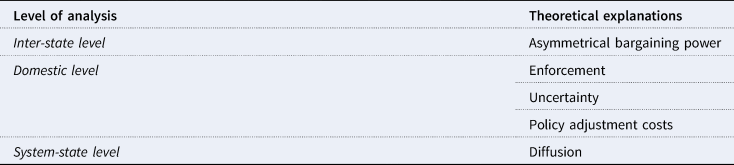
I identify five theoretical mechanisms through which competition policy is incorporated into PTAs at various degrees. They are asymmetrical bargaining power, enforcement, uncertainty, policy adjustment costs, and diffusion. These five mechanisms are organized into three broad categories according to the level of analysis at which each is proposed to work: inter-state level, domestic level, and system-state level. Table 1 displays each explanation and its corresponding level of analysis. Below I will elaborate them in order.
Analytical levels of explanations

4.1 Asymmetrical Bargaining Power
Power shapes treaty making and design (Odell, Reference Odell2000; Thompson, Reference Thompson2010). Economic treaties often reflect the preferences of states with market and capital power. For example, the literature on bilateral investment treaties (BITs) has demonstrated that states with poor economic performance are more likely to accept BITs that capital-exporting states prefer (Simmons, Reference Simmons2014), and that states with a smaller economy tend to agree on third-party arbitration clauses in BITs that are demanded by these capital-exporting states (Allee and Peinhardt, Reference Allee and Peinhardt2014). When applying this logic to bargaining on competition clauses in PTAs, we should expect that the balance of economic power or lack thereof to affect the design of these clauses. Recent studies show that economically powerful countries are able to ensure the competition provisions in PTAs stay closer to their ideal points than their less economically powerful counterparts. Büthe and Cho (Reference Büthe and Cho2017) find that the EU's antitrust agreements with Brazil, China, and India are distinct from those with states that have less economic influence, as the former agreements effectively mirror these large developing economies’ preferences. In contrast, the European Union's 1995 agreement to form a customs union with Turkey strictly requires the latter to bring its domestic law to be in accordance with that of the European Union (Bradford and Chilton, Reference Bradford and Chilton2021).
Economically powerful countries are mostly found in the developed world. When it comes to trade agreement negotiations, some of these developed countries even act in concert, as indicated in the examples given above of the EU. Therefore, the preferences of economically powerful countries over competition policy are significant in the design of competition provisions in PTAs. In general, the developed countries prefer tighter regulations of anti-competition practices. The US led tmodern competition law development through the passage of the Sherman Act of 1890 and the Clayton Act of 1914. In 1957, six major European economies (Belgium, France, Italy, Luxembourg, the Netherlands, and West Germany) incorporated competition policy into the Treaty of the European Community (Papadopoulos, Reference Papadopoulos2010). In the following decades, Germany stood out among these countries through increasingly tighter competition legislations due to its staunch defense of the free market against monopolies (Papadopoulos, Reference Papadopoulos2010). Outside of Europe, Japan has maintained strong competition law since the end of World War II (Bradford and Chilton, Reference Bradford and Chilton2018). Both Canada and Britain considerably strengthened their respective competition laws during the 1970s (Bradford and Chilton, Reference Bradford and Chilton2018). Therefore, developed countries tend to hold strong positions in competition policy. Moreover, as the major source of foreign direct investment, developed countries especially prefer to coordinate competition regulations through international instruments, such as treaties, as doing so can reduce impediments to transnational commercial activities in host countries (Jenny, Reference Jenny2020).
In contrast, for many countries in the developing world, competition policy is a local issue with many variations, and should be the concern and responsibility of the national governments. International coordination does not facilitate the implementation of competition law and thereby fails to enhance the business environment as it omits diverse complexities and challenges facing these countries. Hence, developing countries may agree on the general idea of competition policy but do not wish to incorporate into international agreements the competition clauses entailing precise obligations that restrict their domestic policy autonomy (Jenny, Reference Jenny2020). They are better off keeping their competition laws distinctly local (Cheng, Reference Cheng2020). Also, developing nations often express different understandings of the scope of competition law and policy than their developed counterparts. For example, developing countries may ‘enthusiastically support infant industry policies for selected manufactured products and business service-including limits on competition’ (Hufbauer and Kim, Reference Hufbauer and Kim2009, p. 331). This policy position supposedly prevents their substantive cooperation with the developed participants in PTAs on competition issues. Therefore, the final outlook of competition provisions in a PTA is contingent on the balance of economic power in its negotiation. Expectedly, a large number of developed participants in PTAs will tip the power balance toward their policy preferences, producing extensive competition clauses.
Hence, we have the following hypothesis:
H1: The number of developed nations in a PTA is associated with its ambition of competition clauses.
4.2 Enforcement
The enforcement argument is twofold.Footnote 3 The first is strategic enforcement. When a state heavily relies on exports, it is inclined to advocate easy regulations of anti-competitive practices in destination states. Conversely, when a state receives large imports, it likely supports rigorous policies that protect competition in its own jurisdiction (Bradford and Büthe, Reference Bradford, Büthe, Dür and Elsig2015; Ikejiaku and Dayao, Reference Ikejiaku and Dayao2021). Guzman's (Reference Guzman1998) parsimonious model reveals that net exporters prefer no regulations as they do not bear the welfare losses caused by monopolistic behavior but do care about gains for their firms, whereas net importers indiscriminately block all the perceived anti-competitive practices regardless of the global welfare effects as they have to confront the welfare losses for domestic consumers. The fact that many countries with strong exporting industries grant exemption to their export cartels in competition law illustrates this point, including Germany, Japan, the United Kingdom, and the United States (Guzman, Reference Guzman1998, 1514, fn 35&36). Therefore, high trade surplus discourages states from supporting the inclusion of broad competition provisions in PTAs.
The second part of the enforcement problem concerns state capacity. The literature on treaty enforcement reveals that state capacity affects the extent to which a treaty is implemented in a signatory. A state that maintains strong control over its territory, competent bureaucracy and effective judiciary is more likely to enforce provisions contained in treaties by which it is legally bound (Simmons, Reference Simmons2003; Freeman, Reference Freeman2013; Berliner et al., Reference Berliner, Greenleaf, Lake and Noveck2015; Cole, Reference Cole2015). If a state knows it would be practically unable to keep some of its promises, if they were included in treaties, it would hardly be likely to make them in the first place.Footnote 4 Reputation is at stake. Poor reputation owing to the failure of carrying out contractual obligations can be consequential (Tomz, Reference Tomz2007; Crescenzi et al., Reference Crescenzi, Kthman, Keinberg and Wood2012). This is particularly true of treaties based on reciprocity, such as trade agreements. As a result, high state capacity renders it more possible for a state to accept greater treaty burdens. In the case of designing competition provisions in PTAs, states that can enforce laws domestically with efficacy should have less opposition to inserting many competition clauses in these agreements. Therefore, we have the following hypotheses:
H2a: Large trade surpluses between member states are associated with a less ambitious design of competition clauses in PTAs.
H2b: High governance competence of member states is associated with an ambitious design of competition clauses in PTAs.
4.3 Uncertainty
The rational design of international institutions literature suggests that uncertainty plays a big role in the architecture of international institutions. First, member states are concerned about the behavioral uncertainty of others regarding treaty promises (Koremenos et al., Reference Koremenos, Lipson and Snidal2001; Koremenos, Reference Koremenos2005). States may deviate from treaty provisions they have agreed to implement. Other members lack such information or find it very costly to acquire. Hence, to avoid receiving a temptation payoff due to asymmetrical information, states often seek indication that such uncertainty might be mitigated. For instance, in the crisis bargaining literature, enjoying opposition parties’ support or even acquiescence can be evidence of the incumbent government's resolve (Schultz, Reference Schultz1998). In other words, states pay close attention to others’ ability to credibly convey their commitment. They indeed use various methods to communicate their sincerity (Fearon, Reference Fearon1997; Morrow, Reference Morrow, Lake and Powell1999). Among other things, the democratic regime should be able to reduce the perceived uncertainty of their future behavior when it comes to treaty implementation, as constituencies can electorally punish leaders for failing to keep international promises (Dai, Reference Dai2005). Current scholarship on international cooperation does find consistent and strong evidence that democracies are more likely to honor their treaty promises (Mansfield et al., Reference Mansfield, Milner and Peter Rosendorff2002; Leeds et al., Reference Leeds, Mattes and Vogel2009; von Stein, Reference von Stein2015). Therefore, the strong presence of democratic members in a treaty will enhance the prospect of its being complied with. Logically, the treaty will also likely contain clauses that aim for deep and meaningful cooperation. By applying it to competition policy, a large number of democratic members in PTAs should be able to ameliorate this uncertainty issue and hence deepen cooperation on regulating anti-competitive practices. The depth of competition clauses in PTAs will thus be greater.
Second, the state of the world is another matter on which states can hardly obtain strong certainty and thus affects international institutional design (Koremenos et al., Reference Koremenos, Lipson and Snidal2001). For example, after a treaty enters into force, its member states may experience significantly slow economic growth or confront adverse macro-economic conditions. Such untoward events will likely undermine the ability of a treaty member to continue carrying out its contractual obligations and will therefore diminish expected gains for others from future cooperation. Foreseeing this scenario, states are inclined to lower the level of cooperation by including shallow treaty provisions.Footnote 5 Therefore, when such uncertainty is high, the depth of treaty design tends to be low.
H3a: Low uncertainty of state behavior induced by the strong presence of democratic members is associated with an ambitious design of competition clauses in PTAs.
H3b: High uncertainty of the state of the world held by member states is associated with a less ambitious design of competition clauses in PTAs.
4.5 Policy adjustment costs
Policy adjustment costs affect the design of international institutions too. The literature on the politics of international treaties reveals that when states need to engage in costly policy adjustments after an agreement at issue enters into effect, they prefer not to ratify it (Goodliffe and Hawkins, Reference Goodliffe and Hawkins2006; Wang, Reference Wang2016; Cheong and Kim, Reference Cheong and Kim2022). Therefore, many international agreements do not contain hard legal rules that stipulate precise behavioral prescriptions and impose a third-party judicial process in the instance of disputes (Abbott and Snidal, Reference Abbott and Snidal2000; Kahler, Reference Kahler2003). In other words, states prefer superficial cooperation that prescribes minimum policy changes. They find it easier to comply with the agreements that codify such shallow cooperation (Downs et al., Reference Downs, Rocke and Barsoom1996).
Similarly, when it comes to the competition clause design of PTAs, we should expect that states are prone to negotiating very generic provisions that lack specific behavioral expectations when they believe they will be required to overhaul their existing competition legal system to meet the standards of a trade agreement that they are about to enter. In other words, if a state has only weak competition laws, then highly legalized competition clauses in PTAs will imply greater costs of changing domestic policies to ensure compliance, which it does not want to bear. However, when a state is already equipped with strong competition laws, then it has no issues with including rigid competition clauses in PTAs, as there is no need for it to bring domestic regulations to reach international standards embedded in trade agreements which it plans to accept. This partly explains why PTAs between previously socialist countries do not contain substantial competition clauses (Laprévote, Reference Laprévote2019), where effective domestic competition law is often lacking. Therefore, such a state will prefer loose competition regulations in PTAs in the first place.
H4: The anticipated minimum changes of domestic laws to stay consistent with competition provisions as issues are associated with an ambitious design of these clauses in PTAs.
4.6 Diffusion
Treaty commitments diffuse (Elkins et al., Reference Elkins, Guzman and Simmons2006; Baccini and Koenig-Archibugi, Reference Baccini and Koenig-Archibugi2014). States as agents bring about this diffusion. There are two ways that competition clauses spread across PTAs. First, states’ experience with competition clause design in existing PTAs should affect their choice in future trade agreements. States that have already joined PTAs with highly legalized competition clauses will prefer a similar design in the trade agreements they are negotiating, and vice versa. Put differently, a state's preference over competition clauses revealed through existing PTAs is very likely to travel to the next one that it will enter. Therefore, states’ track record of treaty design regarding competition policy should be an effective predictor of their preferred bargaining position, which tends to be manifest in subsequent treaty negotiation. A recent study has convincingly revealed that contents in PTAs do migrate from one to another sequentially (Allee and Elsig, Reference Allee and Elsig2019).
When members of current PTAs with extensive competition clauses come together to negotiate a new trade agreement, these preferences will govern its design, from which a similar set of provisions will result. This theoretical reasoning resembles that of path dependence in domestic politics. Initial institutional choices are sticky and can constrain the later ones in similar scenarios (Pierson, Reference Pierson2000; Copelovitch and Putnam, Reference Copelovitch and Putnam2014). The path dependence in international institutional design has unveiled itself in the evolution of the World Health Organization (Hanrieder, Reference Hanrieder2014). Dispute settlement mechanisms also migrate from one PTA to another (Jo and Namgung, Reference Jo and Namgung2012). In the case of competition provisions in PTAs, path dependence may take the form of recurring similar clauses across treaties.Footnote 6 Simply put, these clauses diffuse.
In addition, the GATT/WTO may expose states to and help them internalize new policy thinking on regulating and protecting competition through trade agreements. States are socialized to accept a new behavioral standard, or a new norm (Finnemore, Reference Finnemore1996; Kelley, Reference Kelley2004; Checkel, Reference Checkel2005; Baccini and Koenig-Archibugi, Reference Baccini and Koenig-Archibugi2014). It is undeniable that neither the GATT nor the WTO successfully produced binding rules that systemically control anti-competitive conduct in international trade. However, the mechanisms created in both have facilitated the diffusion of the idea that competition policy matters in trade liberalization. For example, GATT adopted ‘the 1960 Decision on Arrangements for Consultations on Restrictive Business Practices’, which ‘recognized that restrictive business practices “may hamper the expansion of world trade and the economic development in individual countries and thereby frustrate the benefits of tariff reduction and removal of quantitative restrictions”’. Ad-hoc mechanisms were also frequently employed to address relevant issues during the GATT years.
The WTO, as a successor to the GATT, has achieved significant progress in fusing competition policy with trade liberalization. It has made competition policy an integral part of the ‘WTO accession packages (i.e., the sets of undertakings that are adopted in relevant Protocols when new members join the WTO)’ and of its trade policy review mechanism (Anderson et al., Reference Anderson, Kovacic, Müller and Sporysheva2018, p. 10). In addition, the WTO has been active in carrying out the study of how competition policy affects trade and development, which helps disseminate and strengthen the idea among members that competition policy should be taken seriously in trade liberalization (Anderson et al., Reference Anderson, Kovacic, Müller and Sporysheva2018, p. 10). As a result, when a PTA negotiation is conducted among a large group of GATT/WTO members, it will likely include extensive competition clauses,Footnote 7 reflecting a collectively more positive attitude toward coordinating competition policy among these members. Indeed, the WTO has left a remarkable and indelible imprint on the contents of PTAs (Allee et al., Reference Allee, Elsig and Lugg2017).
H5a: More states who are already members of trade agreements that contain ambitious competition clauses are associated with an ambitious design of competition provisions in subsequent PTAs.
H5b: More GATT/WTO members are associated with an ambitious design of competition clauses in their PTAs.
5. Research Design
5.1 Data
The dependent variable is the ambition of competition provisions in PTAs. The Design of Trade Agreements (DESTA) project carefully codes competition clauses in PTAs (Dür et al., Reference Dür, Baccini and Elsig2014).Footnote 8 It employs a series of indicators to cover the different aspects of these clauses.Footnote 9 Specifically, DESTA uses the following questions to construct these indicators: 1. Does this agreement include a competition chapter? 2. Is there a provision on undertakings not to distort competition? 3. Is there a provision on the exchange of information or notification? 4. Is there a provision on a general institution responsible for competition? 5. Is there a provision on the establishment of specific bodies for competition? 6. Is there a non-binding provision on the coordination among national authorities? 7. Is there a binding provision on the coordination among national authorities? 8. Is there a provision on the creation of a common authority/institution on competition? 9. Is there a provision on monopolies and/or cartels? 10. Is there a provision on mergers and/or acquisitions? 11. Is there a provision on state-owned enterprises? 12. Is there a provision on state aid? 13. Is there a provision on subsidies? For each question, if the answer is yes, then it is assigned 1; otherwise 0.
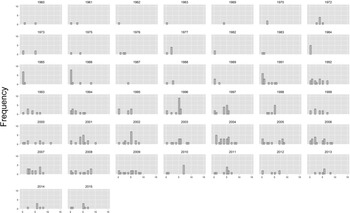
As we can see, these questions capture the scope/level of cooperation among states on competition in PTAs. The assumption here is that, the more such provisions are included in trade agreements, the broader the scope of cooperation on the competition policy. Therefore, I treat these values additive and thus create an aggregate index based on their sum for each treaty. The resulting variable is a continuous one, ranging from 0 to 11 in the sample. The higher value indicates ambitious competition provisions, and vice versa. For example, African the Economic Community (1991) made no competition commitments, which therefore receives a value of 0. The Costa Rica-Peru Free Trade Agreement (2011) contains a moderately ambitious design of competition provisions, which has a value of 5. The EFTA–Mexico Free Trade Agreement (2000) assumes a value of 11, indicating widely spanning competition clauses in it. Figure 1 displays evolution in the ambition of competition provisions in PTAs across time. The frequency is shown, i.e. the total number of PTAs signed in a given year that contain a specific level of ambition of competition provisions.
The Ambition of Competition Provisions in PTAs: 1960–2015

With regard to explanatory variables, I employ the number of OECD countries in a PTA to proxy the bargaining power asymmetry. A similar approach has been used in Allee and Elsig (Reference Allee and Elsig2016). I expect that more OECD countries will increase the depth of cooperation on competition policy in PTAs. To capture the first mechanism of enforcement, I construct a variable, trade surplus, which is calculated for each state within a PTA as the sum of dyadic trade surplus (in natural log) between itself and other members of the treaty.Footnote 10 Following the weakest link principle (Bacciniet al., Reference Baccini, Dür and Elsig2015), I select its minimum value for each treaty. Bilateral trade data come from the Correlates of War project (Barbieri and Omar Keshk, Reference Barbieri and Omar Keshk2016). For the second mechanism of enforcement, I operationalize it using state capacity, the data on which are taken from Hanson and Sigman (Reference Hanson and Sigman2021). I adopt the level of democracy to measure the uncertainty of state behavior, data which are obtained from the Polity IV project (Marshall and Jaggers, Reference Marshall and Jaggers2012). Using the World Development Indicators (WDI) (World Bank, 2016), I then calculate the variance of each member's GDP growth rate over the previous 5 years to approximate the uncertainty of the state of world. Again, I take the minimum values for both variables.
To ascertain policy adjustment costs, I focus on domestic competition laws. Taking advantage of the Competition Law Index (Bradford and Chilton, Reference Bradford and Chilton2018), which is the first systemic effort to codify competition laws around the world over a long time span using a highly refined matrix and which has been utilized in recently published empirical work (Bradford and Chilton, Reference Bradford and Chilton2019), I pick the minimum level of competition law among the member states of a PTA.
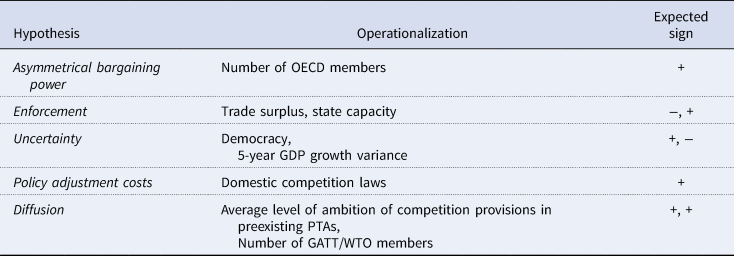
To operationalize the first diffusion mechanism, I use data on the design of competition policy in PTAs (Dür et al., Reference Dür, Baccini and Elsig2014) to calculate the average level of ambition of competition provisions in all the preexisting PTAs to which a member state belongs in a given year. The smallest value of it within each PTA is selected. The second diffusion mechanism is captured by the number of states with membership in the GATT/WTO. Table 2 summarizes the hypotheses, corresponding variables, and their expected signs.
Operationalization of explanatory variables in hypotheses

I finally control for a number of potential confounders. First, I isolate the potential impact of the number of members, which previous literature shows affect treaty design (Koremenos et al., Reference Koremenos, Lipson and Snidal2001). Second, I take into account the divergence of economic power using within-treaty variance of GDP. GDP data are from the WDI. Last, I consider the ratio of dyads that share linguistic affinity over the total number of dyads within a PTA, as cultural similarity may lower the cost of negotiation. Data on linguistic affinity are taken from Baccini and Dür (Reference Baccini and Dür2015).
The resulting observations are 378 in the fully specified model, covering 319 PTAs from 1960 to 2015. In the DESTA, PTAs that change over time are assigned the same treaty numbers. For example, the African Economic Community was established in 1991, and admitted South Africa in 1997. These count as two observations but share the same treaty number 3. The Andorra and EC trade agreement was signed in 1989, and added Cyprus, Czech Republic, Estonia, Hungary, Latvia, Lithuania, Malta, Poland, Slovakia, and Slovenia in 2003, Bulgaria Romania in 2005, and Croatia in 2011. These count as four observations under the treaty number 28. In addition, identical members may alter treaties subsequently, which are treated as different treaties despite the identical member composition (i.e., Argentina and Uruguay trade agreements 1984 and 2003). In robustness checks, when I take into account these two coding choices, the results are in line with those from the main analysis.
Each explanatory variable is lagged one year to deal with potential reverse causality. The final sample comprises cross-sectional data with PTAs as the unit of analysis. I use an OLS estimator to evaluate the proposed hypotheses. The standard errors are clustered on treaties. The equation that will be estimated is as follows:
 $$\!\! \eqalign{Competition\;policy_i& = \beta _0 + \beta _1OECD\;members\;_i + \beta _2Trade\;surplus_i + \beta _3State\;capacity_i \cr & \quad + \beta _4Demmocracy_i + \beta _5Variance\;in\;GDP\;growth_i \cr & \quad + \beta _6Domestic\;competition\;laws\;_i \cr & \quad + \beta _7Average\;level\;of\;ambition\;of\;competition\;provisions\;in\;preexisting\;PTAs_i \cr & \quad + \beta _8Number\;of\;GATT/WTO\;members_{i\;} + \beta _9Number\;of\;members_{i\;} \cr & \quad + \beta _{10}Variance\;of\;GDP_{i\;} + \beta _{11}Ratio\;of\;linguistic\;affinity_{i\;} + \varepsilon _i} $$
In above equation, i indicates a PTA.
5.2 Findings
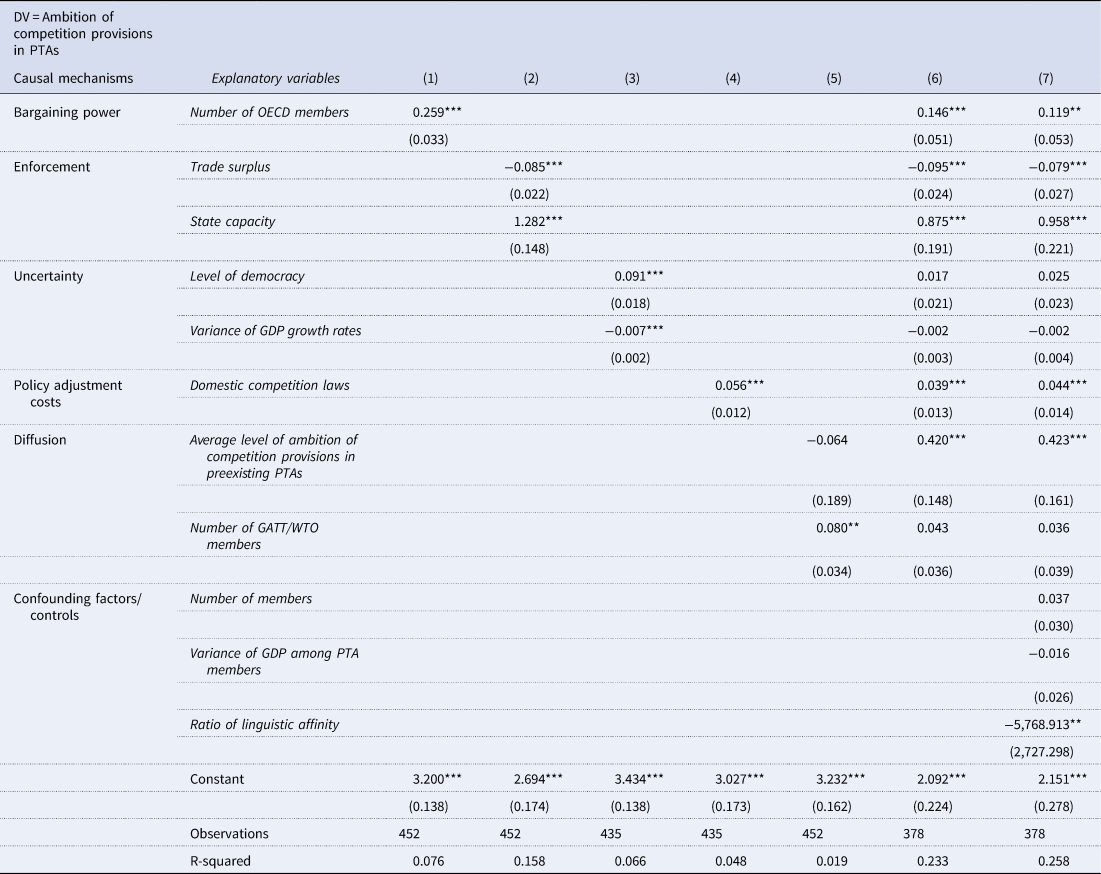
Table 3 reports the estimation results. Columns 1–5 show results on individual mechanisms. Column 6 displays results when all proposed mechanisms are estimated together. First, the number of OECD members is positive and statistically significant at the 99% confidence levels. In other words, divergence in bargaining power strongly predicts the level of ambition of competition provisions in PTAs, providing clear-cut evidence for H1. Second, the enforcement problem is also validated. Both trade surplus and state capacity achieve expected signs and statistical significance at the 95% and above confidence levels. Greater trade surplus dissuades states from engaging in ambitious cooperation on competition in PTAs, adding credence to H2a. Meanwhile, higher governing capacity predisposes states to commit to substantial competition policy in PTAs, comporting to H2b. Third, the evidence is mixed for uncertainty hypotheses. A higher level of democracy, an indicator of lower behavioral uncertainty, improves the ambitious level of competition clauses in PTAs only with the presence of another uncertainty variable. H3a thus receives weak support. Similarly, the uncertainty of the state of the world, as measured by the variance of GDP growth rates over a 5-year period, assumes consistent negative signs, echoing the expectation, but attains statistical significance merely in the absence of other mechanisms and cofounding factors, thereby lending limited support to H3b.
What explains the ambition of competition provisions in PTAs

Notes: Robust standard errors in parentheses.
***p < 0.01, **p < 0.05, *p < 0.1.
Fourth, the hypothesis of policy adjustment costs (H4) secures its confirmation. Rigorous domestic competition laws, indicating lower anticipated costs of adjustment if PTAs with a given level of competition provisions are concluded, are positively correlated with the ambition of competition provisions in PTAs. This relationship is statistically significant at the 99% confidence level. Fifth, diffusion mechanisms are partially verified. Participation in the existing PTAs with an ambitious design of competition clauses leads to a similar design in ensuing trade agreements, which is in line with H5a. In the meantime, the findings fail to provide consistently supportive evidence for H5b that the clustering of GATT/WTO members facilitates the institutionalization in PTAs of the unrealized proclivity for ambitious competition clauses on a global level in the two multilateral institutions.
Regarding controls, the number of members does not exert any statistically significant effect on the design of competition provisions in PTAs, in line with existing research (Baccini et al., Reference Baccini, Dür and Elsig2015). Divergence in economic power as captured by within-treaty variance of GDP shows no discernible effect as well. This is expected, as GDP can merely reflect power difference but omits policy preferences. For example, large developing countries do not necessarily prefer expansive competition provisions in PTAs (Büthe and Cho, Reference Büthe and Cho2017). The number of OECD members, however, effectively combines both, which picks up the effect of asymmetrical bargaining power more readily. Surprisingly, when more negotiating states share linguistic affinity, they are less likely to include extensive competition clauses in their PTAs, which finding entails further exploration in further research.
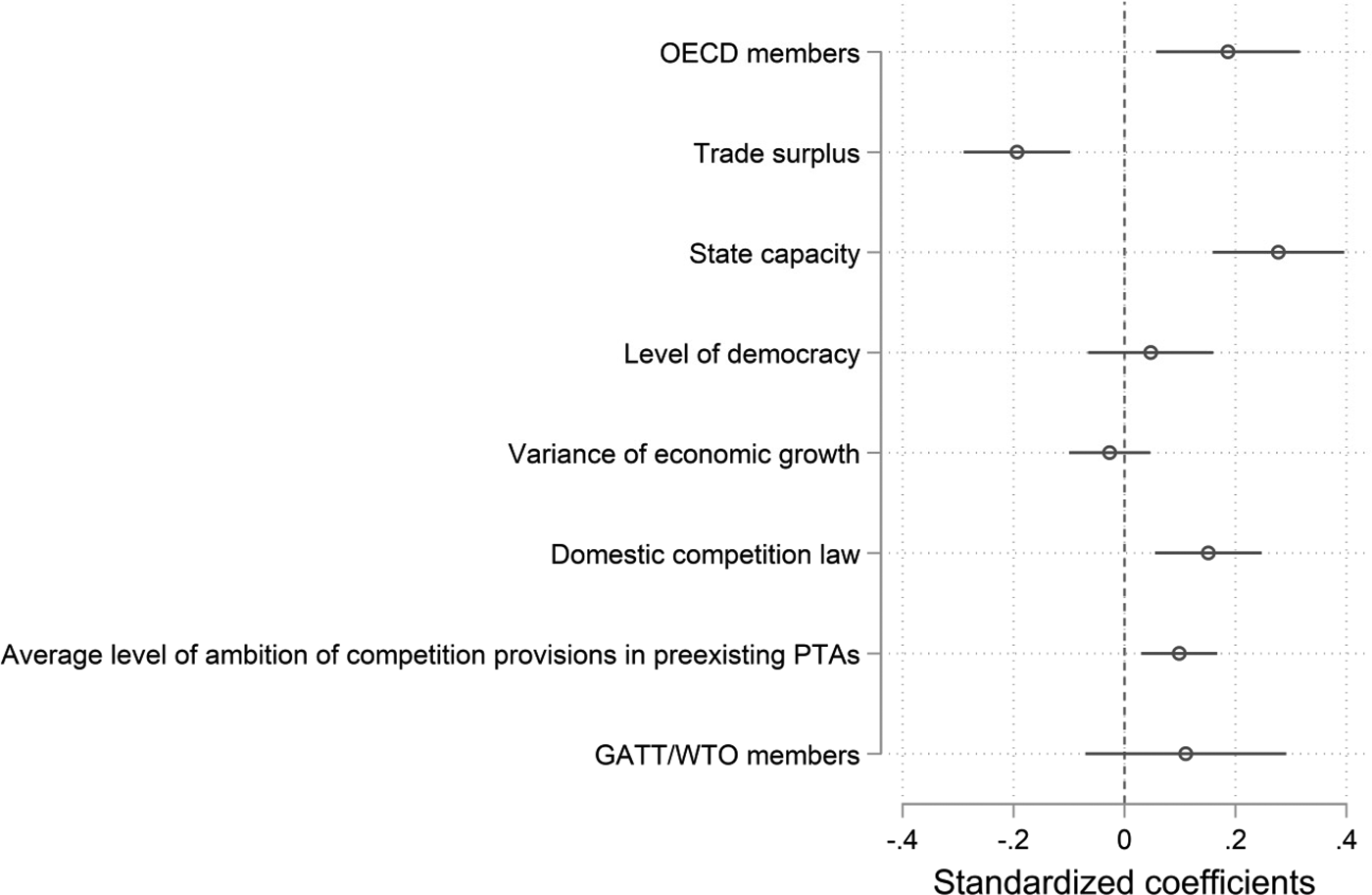
To compare the magnitude of the effects across independent variables, I plot the standardized coefficients in Figure 2 based on model 6 in Table 3. As it evidently depicts, the largest influential factor is state capacity, whereas the smallest one is the average ambitious level of competition provisions in extant PTAs.
Standardized coefficients
Note: The 95% confidence intervals are shown.

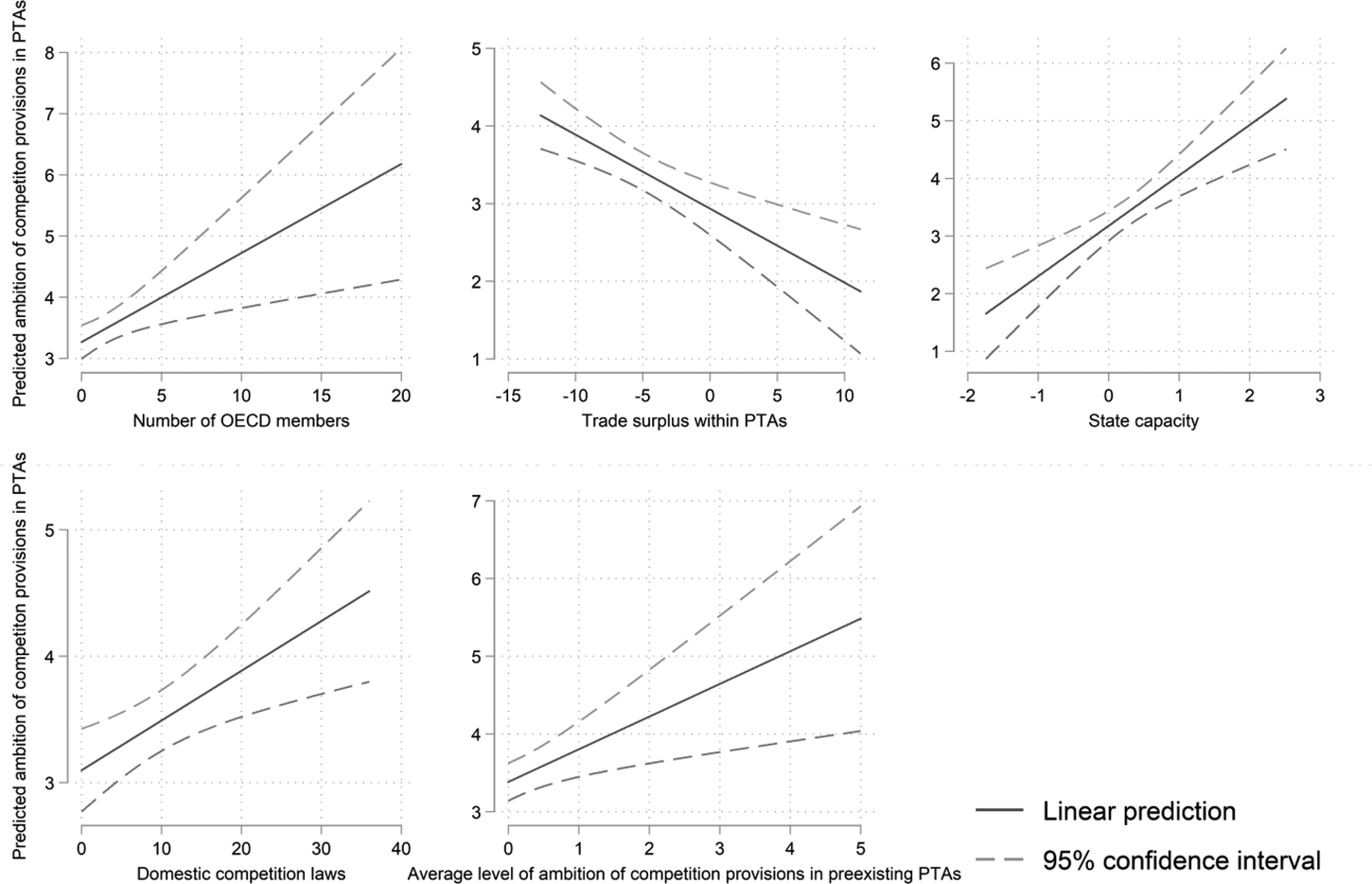
Figure 3 displays graphs for the effects on the level of ambition of competition provisions in PTAs of individual explanatory variables that are statistically significant at the conventional levels while holding others constant at their means.
What explains the ambition of competition provisions in PTAs: Out of sample predictions
Note: This figure is created based on model 6 in Table 3. Only statistically significant variables are shown.

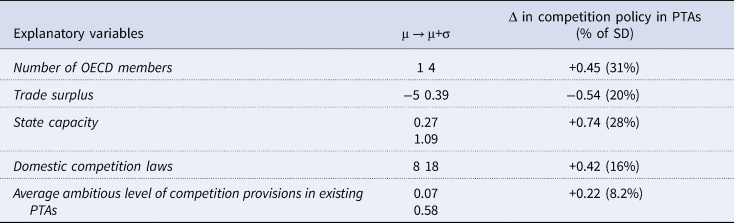
I also calculate the substantive effects of the explanatory variables (Table 4). To do so, I summarize each variable in the sample, and find out their respective means and standard deviations. I then calculate how much change in the dependent variable one standard deviation of increase from mean in each explanatory variable causes while holding others constant. One standard deviation increase from the mean of the number of OECD members, i.e. from one OECD member to 4, raises competition ambition in PTAs by 0.45, about 31% of one standard deviation of the dependent variable (which is 2.65). Similarly, the same quantity of change in trade surplus decreases competition ambition in PTAs by 0.34, roughly 10% of one standard deviation of the dependent variable. By the same logic, state capacity contributes to 0.55 units of increase in competition ambition in PTAs, approximately 17% of one standard deviation of the dependent variable. Domestic competition laws add about 23% of one standard deviation of the dependent variable. Competition ambition in preexisting PTAs strengthens competition ambition in the following PTAs by 11% of one standard deviation of the dependent variable. Combining these changes together, they can generate roughly 3 points of increase in the level of competition ambition, which is the improvement from Central American Free Trade Agreement (CAFTA)–Dominican Republic (2004) trade agreement with 1 in competition ambition to Czech and Slovak Republic–EFTA (1992) with 4 in competition ambition, from Australia–Papua New Guinea (1991) with 1 in competition ambition to EFTA–Poland (1992) with 4 in competition ambition, or from Association of Southeast Asian Nations–China Services agreement (1997) with 4 in competition ambition to EC–Korea (2010) with 7 in competition ambition.

5.3 Further Tests
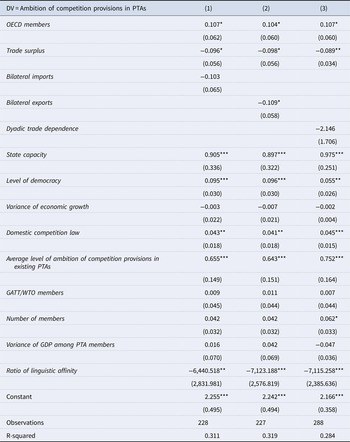
The complementarity thesis argues that trade liberalization reinforces competition policy at both domestic and international levels (Bradford and Büthe, Reference Bradford, Büthe, Dür and Elsig2015; Bradford and Chilton, Reference Bradford and Chilton2019). To isolate this cofounding effect, I construct three different variables for further estimations: bilateral imports, bilateral exports, and dyadic trade dependence.Footnote 11 Again, I select minimum values within a PTA for each. The results are presented in Table 5. As we can see, all three variables are signed negatively, suggesting potentially suppressing effects. However, only one acquires conventional statistical significance. These findings seem to imply that there exists somewhat substitution between competition provisions in PTAs and trade liberalization, counter to the prediction of the complementarity thesis. At least it is intended so by decision makers who design competition provisions in PTAs.
What explains the ambition of competition provisions in PTAs: Considering the complementarity thesis

Notes: Robust standard errors in parentheses
***p < 0.01, **p < 0.05, *p < 0.1.
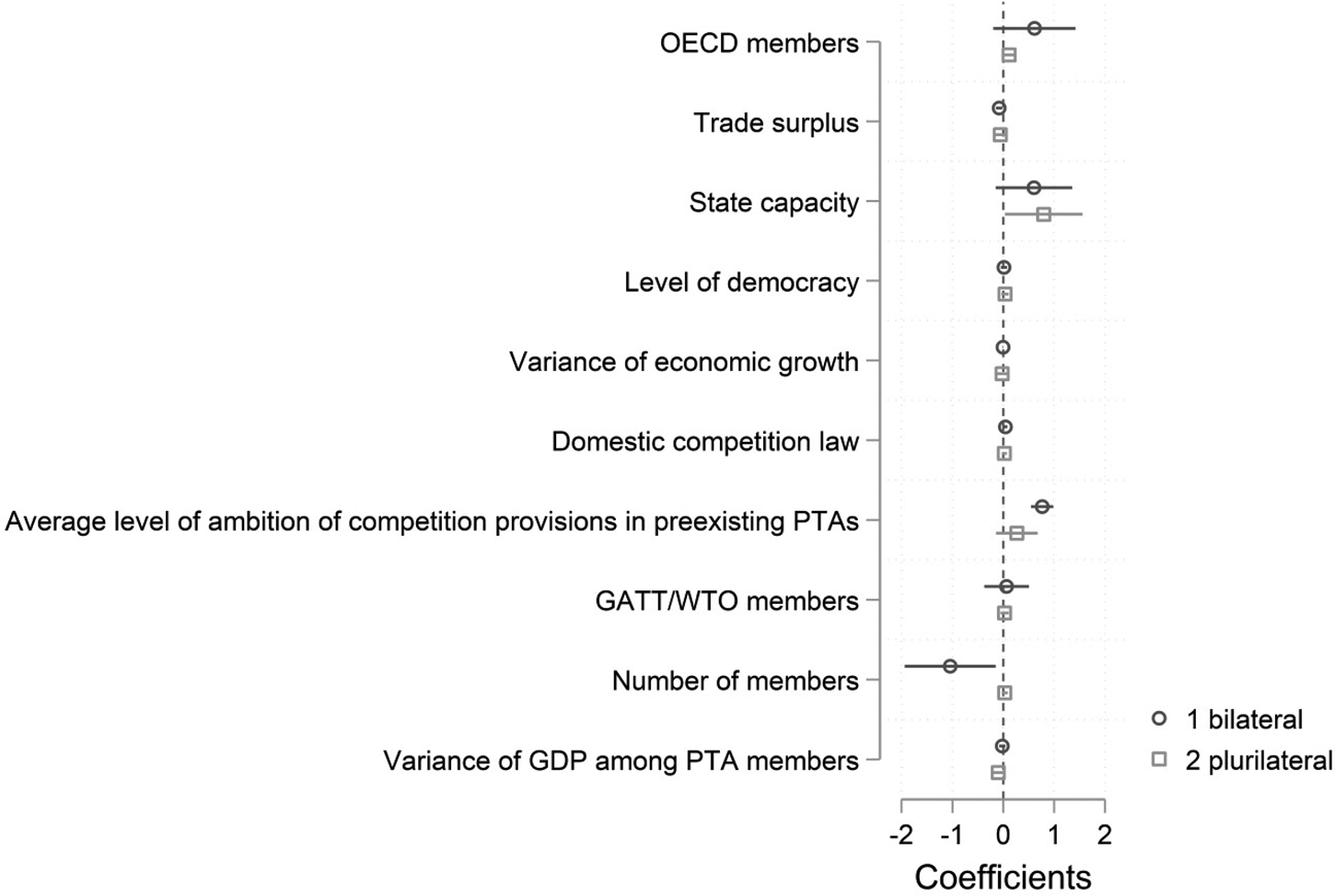
I also perform an analysis by types of PTAs: bilateral and plurilateral (including all non-bilateral types). The results are plotted in Figure 4. They reveal further variation in the working of mechanisms emerging from the whole-sample estimation. Among the proposed mechanisms, strategic enforcement as measured by trade surplus, policy adjustment costs as measured by domestic competition law, and treaty diffusion as measured by competition provisions in other PTAs drive the design of competition clauses in bilateral PTAs. In contrast, the asymmetrical bargaining power as measured by the number of OECD members and enforcement as measured by state capacity are the major driver of the design of competition provisions in plurilateral ones.
What explains the ambition of competition provisions in PTAs: Bilateral vs. plurilateral
Note: The ratio of linguistic affinity is omitted to increase the legibility as its magnitude is unproportionally large. The 95% confidence intervals are shown.

5.4 Robustness ChecksFootnote 12
To ensure the main results are not unique to certain variable construction, model specifications, estimation strategy, or sample sizes, I run a series of robustness checks. First, I experiment with alternative operationalization strategies for all proposed mechanisms. To start, I use the ratio of OECD countries in a PTA to capture divergence in bargaining power. Second, I adopt the minimum overall trade surplus (in natural log) between a member state of a PTA and all other states in the world to replace the specific within-treaty dyadic trade surplus as employed in the main analysis. Third, I calculate the variance of state capacity within a PTA to approximate member states’ ability to implement it. Fourth, I select the median democracy level within a PTA to capture the uncertainty of behavior. Fifth, I utilize 5-year (prior to signing a PTA) inflation averages of member states to measure the perceived uncertainty of the state of the world within a PTA. Sixth, I employ the median value of domestic competition laws within a PTA as a proxy of policy adjustment costs. Similarly, I take the median depth of competition clauses in previous PTAs of members in a PTA as a measurement of the first proposed diffusion mechanism. Finally, I calculate the ratio of GATT/WTO member over the total number of states in a PTA to operationalize the second diffusion mechanism. Results from all alternative measurements retain consistency with those in the main analysis (Supplementary Table A1).
Then, I control for dyadic dependence on FDI, the ratio of alliance,Footnote 13 and the duration of GATT/WTO membership within each PTA. None of these possible confounding variables achieves conventional statistical significance. The inference on proposed hypotheses from the main analysis remains unchallenged (Supplementary Table A2).
Afterwards, I use the Comparative Competition Law Preferential Trade Agreements (PTA) Dataset (Bradford and Chilton, Reference Bradford and Chilton2021) to replace the data taken from the DESTA. With the exception of asymmetrical bargaining power and PTA diffusion, results on all other proposed mechanisms echo those from the main analysis (Supplementary Table A4).
Furthermore, there might be a concern that what drives states to enter into a PTA also affects the design of competition provisions in it. To mitigate such concern, I therefore estimate a Heckman selection model to control for the possible selection issue in PTA making and see how that issue affects the design of competition provisions in a dyadic environment. When I remove the selection effect, the results still strongly support all the hypotheses except trade surplus (Supplementary Table A5).
Moreover, I drop cases with duplicate treaty numbers and treaty names in turn. The results from these two data manipulations exhibit great accordance with what is revealed in the foregoing analysis (Supplementary Table A6). Finally, I perform an ordered probit estimation. The results resemble those from the main model.
6. Conclusion
In this study, I explore the determinants of competition provisions in PTAs. Drawing on insights from both IPE and law and economics literature, I propose five explanations. A treaty-level analysis of 319 PTAs from 1960–2015 provides strong and robust evidence for most of these theoretical conjectures. Specifically, I find that strong bargaining power enjoyed by developed countries increases the ambition of competition provisions in PTAs. Trade surplus, an indicator of strategic enforcement, indeed favors a less ambitious design of competition provisions in PTAs. States with high competence facilitate the adoption of ambitious competition provisions into PTAs. Similarly but to a much lesser and inconsistent extent, a large presence of democratic states somewhat reduces the perceived behavioral uncertainty of members and therefore increases the ambitious level of competition provisions in PTAs. The uncertainty of the state of the world also rarely affects the competition clause design. States with rigorous competition laws fear less the costs of policy adjustment after a trade agreement is signed with ambitious commitment to competition provisions and hence collectively embrace an extensive design. States’ participation in existing PTAs that are equipped with substantial competition provisions are inclined to carry this preference into future ones, thereby multiplying PTAs with a similar design. However, more GATT/WTO members present in the negotiation of a PTA seldom make it more likely to incorporate ambitious competition provisions into the agreement. Additionally, the impact and its magnitude of these proposed mechanisms vary with the type of PTAs. Finally, there is no evidence for the assumed complementarity between trade liberalization and competition provisions in the trade agreements.
This study makes contributions to scholarships on competition provisions in PTAs and the design of PTAs in particular, and on the design of international institutions in general. It also aids researchers in better grasping the relationship between trade and competition policy. Through analyzing the case of competition clause design in PTAs, this study confirms insights from the international institution literature and the law and economic scholarship and expands both. Asymmetrical bargaining power, reflecting the economic dominance of OECD countries and their policy preferences, indisputably influences the design of competition clauses in PTAs. This is not surprising, as PTAs have been used as a strategic tool to pursue foreign policy goals by developed countries (Wesley, Reference Wesley2008). Robust evidence in support of the enforcement mechanism reveals that negotiating states are governed by their respective trade surpluses in trade agreement bargaining, lending strong credence to the strategic enforcement thesis in the law and economic literature as its impact on the design of competition clauses remains distinct and significant across econometric settings. Evidence for enforcement in regard to state capacity also reaffirms the enforcement consideration prevalent in the design of international institutions literature, by showing that states pay intensive attention to each other's ability to carry out treaty promises. However, when it comes to competition clause design, states do not give much consideration to uncertainty – be it the willingness to comply or the sustainability of favorable conditions – which qualifies the application of one theoretical pillar in the design of international institutions literature. Moreover, in line with the diffusion scholarship in international political economy, treaty design does diffuse from one to another. There is path dependence in states’ accepted design of competition clauses in PTAs, as future design closely follows the prior ones. Last but not least, the absence of complementarity between trade liberalization and competition clauses in PTAs promotes us to ponder more on their relationship.
This study echoes and extends the current literature on the design of PTAs (Baccini et al., Reference Baccini, Dür and Elsig2015; Lechner, Reference Lechner2016). If we have to generalize, then in a very abstract fashion, trade cooperation and broad economic cooperation is rendered possible by facilitative domestic political and economic conditions as well as differentially positioned bargaining preferences and accumulated international experiences. From a perspective of legal scholarship, this study demonstrates the utility of international relations scholarship in exploring the sources of the institutional variation in international law. In this sense, it humbly adds to the broad efforts to seek and establish the political foundation of international law (Hafner-Burton et al., Reference Hafner-Burton, Victor and Lupu2017).
Practically, the findings in this study suggest that coordination among OECD countries can increase the extensity of competition clauses. Furthermore, to enhance cooperation or harmonization in competition policy, states with such preferences might want to focus on domestic reforms in legislation and judicial administration in their targets by providing needed support. This can be done across regimes. Also, invoking existing competition clauses can be a good negotiating tactic.
Given the exercises in this study, I am optimistic that there are two related directions along which scholars may consider pursuing fruitful research. First, it might be meaningful to deploy the findings in this study to explain other significant provisions in PTAs, such as those on environment and taxation, as well as to the design of other important economic treaties, such as bilateral investment treaties. Doing so will promisingly extend current intellectual horizons on these mentioned areas (see Allee and Peinhardt, Reference Allee and Peinhardt2010; Simmons, Reference Simmons2014; Morin et al., Reference Morin, Pauwelyn and Hollway2017; Thompson et al., Reference Thompson, Broude and Haftel2019; Noonan and Plekhanova, Reference Noonan and Plekhanova2020). Second, unpacking PTAs’ impact on trade and foreign direct investment based on differential provisional designs will effectively push forward the existing studies (i.e., Büthe and Milner, Reference Büthe and Milner2008; Büthe and Milner, Reference Büthe and Milner2014). Some latest research has already demonstrated the fruitfulness of such endeavor (i.e., Brandi et al., Reference Brandi, Schwab, Berger and Morin2020).
Supplementary Materials
To view supplementary material for this article, please visit https://doi.org/10.1017/S1474745623000307.
Acknowledgement
I thank Sodhi Harjot for his excellent research assistance to this project.