I. Introduction
Data are increasingly central to the modern economy. The “data products and services” market, comprising various technologies related to data collection, storage and analysis, has prospered in the past two decades.Footnote 1 In recent years, this trend has accelerated with the maturation of artificial intelligence (“AI”) technologies which rely heavily on data to generate new insights and develop innovative applications.Footnote 2 Such data-driven products and services are already in use across a broad range of fields, including, for example, personalised recommendation systems in e-commerce (e.g. after booking a flight, additional services at the destination, such as hotels, are promoted) and various automated decision-making tools used in essential sectors such as finance (e.g. decisions on loan or insurance terms), healthcare (e.g. decisions concerning medical procedures and treatment) and transportation (e.g. decisions made by autonomous vehicles).Footnote 3 These developments have contributed to what many describe as the “data economy”, in which access to and control over data has become a central driver of commercial value and economic growth.Footnote 4
Recognising that data-driven innovation constitutes a key pillar of contemporary economic growth, the EU adopted the Digital Single Market Strategy in 2015 and the European Strategy for Data in 2020, with the aim of promoting data-driven innovation across sectors.Footnote 5 Building on these strategic frameworks, the EU undertook an intensive process of designing different regulations to maximise the potential inherent in data. All these regulations directly or indirectly address various aspects of control over or enable access to data. Yet, the legal frameworks addressing data sharing or access to data are, to some extent, incoherent, often involving a confused discussion regarding data with varying characteristics in diverse contexts. This situation has led to a very complex and convoluted legal framework pertaining to data, with many uncertainties.Footnote 6 In response to these shortcomings, the EU proposed a Digital Omnibus in 2025 aimed at simplifying and consolidating several aspects of the existing legal frameworks.Footnote 7
Moreover, existing European regulatory mechanisms are grounded in legal frameworks that frequently give rise to direct or indirect proprietary regimes over data. For example, intellectual property laws may occasionally contribute to the establishment of exclusivity over data, even if only indirectly.Footnote 8 Control over data, and thus exclusivity, may also be established through possession of the data-storage device; through technological protection measures such as encryption and access controls creating “digital locks”;Footnote 9 or through contractual arrangements that restrict access to data.Footnote 10 Additionally, privacy interests are often invoked to limit data sharing, arguably contributing to an exclusionary regime.Footnote 11 Collectively, these legal frameworks reflect a clear tendency towards the “propertisation” of data.
A comprehensive analysis of these frameworks reveals a patchwork of rules resulting in inconsistencies regarding whether, and to what extent, data should be subject to a proprietary regime. The fragmented legal framework governing data access has created ambiguity and has arguably restricted data sharing,Footnote 12 and is said to contribute to the underutilisation of data for innovation.Footnote 13 This reality raises important questions about how data sharing should be regulated as an essential driver of innovation – questions that have become central to the data economy landscape.Footnote 14
This article addresses the challenge of data-sharing regulation by offering a systematic analysis of the concept of data and proposing a regulatory matrix grounded in a guiding principle that may enhance legal coherence. We argue that data governance, and particularly data sharing, requires a foundational theoretical approach that can serve as a determinant principle for recognising exclusivity over data. The European strategy for data regulation explicitly refers to the goals of innovation, efficiency and social welfare, reflecting a utilitarian orientation in policy design.Footnote 15 This discourse therefore also engages with traditional theoretical justifications for intellectual property rights, which have been extensively discussed for decades.Footnote 16 Within this broad discourse, scholars have increasingly questioned the applicability of the incentive-based utilitarian approach to data.Footnote 17 Building on this critique, we propose a conceptual framework for understanding data that can serve as a foundation for data-sharing regulation. To serve the public interest in fostering data-driven innovation markets more effectively,Footnote 18 we advocate adopting a general default rule that favours broad access to data or the depropertisation of data, while recognising the establishment of exclusive rights only as a justified exception.
The data fuelling the thriving data economy originates in activities across all sectors, private and public, either as a primary goal or as a by-product of their operations. This multifaceted data undoubtedly presents a major challenge for regulators, yet it calls for a structured data governance framework that promotes innovation for the benefit of society. The proposed matrix is built on varying data characteristics and, to construct it, we introduce a taxonomy of data based on three guiding questions:
-
(1) What are the characteristics of data?
-
(2) Who collected and stored the data?
-
(3) Why were the data collected and stored?
We argue that data-sharing regulation should take account of this taxonomy, in which the questions of why the data were collected – whether incidentally or purposefully, for commercial or non-commercial use – and who collected the data should serve as key considerations. Exclusive control over data generated through the operation of digital products and services should be acknowledged only when it is necessary as an incentive for collecting and storing the data, typically when the data have been collected purposefully – that is, intentionally – for commercial purposes and as part of the business model of the collecting entity. In practice, data-collection activities are varied and complex. The proposed matrix is designed to address these contingencies and offers a spectrum of regulatory approaches that can be determined according to the level of merited exclusivity. At one end lies a fully open-access model with unrestricted data sharing; at the other, a proprietary model that grants full exclusivity. Between these extremes lie complex scenarios, which are the most challenging to design. In these cases, under the proposed matrix, the rule should be calibrated to either deviate from the proprietary model by imposing data-sharing obligations or to soften the open-access model by allowing some exclusivity, based on the required incentives, as assessed through the matrix’s guiding taxonomy questions.
The significance of this matrix lies in its potential to stimulate the development of a comprehensive and systematic framework for data-sharing regulation. The proposed analysis may serve as a tool for the critical assessment of existing regulations and could provide a foundation for coherent future developments in the emerging field of “data law” (lex data), in a manner that maximises the public good by promoting data innovation.Footnote 19
This article proceeds as follows. Part II describes the centrality of data in the age of AI. Part III reviews the frameworks governing data, including traditional frameworks – such as intellectual property rights and possession – as well as newer EU data regulations. This review highlights the ongoing transition from exclusive to access-oriented approaches to data. Part IV discusses the need to shift from an exclusive to an open-access regime, which lies at the heart of the policy matrix, and Part V presents the taxonomy underlying its development. Part VI explains the proposed data-sharing regulation matrix. Part VII discusses the advantages and limitations of the proposal, and Part VIII concludes.
II. Data in the Age of Artificial Intelligence
The information age is characterised by an unprecedented acceleration in data generation and collection. This proliferation stems from a multitude of digital interactions between individuals, electronic devices (e.g. computers, mobile and medical devices) and other entities.Footnote 20 Data typically move through a life cycle of generation, collection and storage. Generation occurs, for example, through individuals’ activities (such as user online interactions), sensor operations (such as telecommunications signals) or automated processes (such as autonomous vehicle operations); collection brings data under an entity’s control; and storage enables their retention over time. However, the distinction between data generation and data collection is not always clear-cut as in many digital systems data are generated and captured simultaneously. Nevertheless, while generation marks the creation of data, control over data is exercised primarily at the stages of collection and storage.Footnote 21
These immense volumes of collected and stored data, commonly referred to as “big data”, serve as a significant resource for information processing and knowledge creation, facilitating the development of innovative products, processes and markets.Footnote 22 The convergence of extensive databases, advanced computing capabilities and sophisticated algorithms has enabled more comprehensive and nuanced data analysis, contributing to the rapid advancement of data-driven products and services.Footnote 23 A substantial leap in data markets has been associated with the emergence of mature AI technologies, which have significantly enhanced the capacity for large-scale data analysis and the generation of novel insights.Footnote 24 AI technologies are developed on the basis of large-scale databases and their continued development necessitates the increasing use of extensive and up-to-date data resources.Footnote 25 Therefore, in the current age of AI, access to data and its use have become key policy questions.
III. Data Propertisation: A Patchwork of Traditional and New Legal Frameworks
Data are regulated by a wide range of legal frameworks. The evolution of these frameworks reflects the challenges posed by rapid technological development and the various ways in which the law responds to the complex realities associated with data. Within this evolutionary process, traditional legal frameworks have been adapted to address data, alongside newer regulatory initiatives specifically targeting data governance. While none of these frameworks establishes full-fledged ownership in data as such, they acknowledge forms of control over data that generate legally protected exclusivity. Considered together, they reveal a cumulative tendency that increasingly transforms control over data into data “propertisation”.
These developments result from a combination of legal mechanisms, including new legislative initiatives within established intellectual property regimes, as well as the application of traditional property and contract doctrines, to emerging technological realities. Privacy frameworks have also been developed to address specific concerns relating to personal data. Each of these frameworks pursues distinct objectives and operates through different doctrinal logics. Nevertheless, they converge in practice by enabling data holders to exercise varying degrees of control over access to and reuse of their data. Such control may arise indirectly from the protection of intangibles, from rights in physical infrastructure, from private ordering or from regulatory constraints grounded in personal-data protection. Collectively, these mechanisms contribute to what amounts to a process of data propertisation, even in the absence of explicit property rights in data.
In addition to these traditional legal frameworks, since 2015 the EU has pursued an extensive regulatory agenda on data governance. This growing body of norms introduces further layers of regulation governing access to and control over data and increasingly constitutes what is commonly referred to as the emerging “law of data”. While these instruments reflect diverse regulatory ambitions – ranging from promoting innovation to safeguarding fundamental rights – they also add to an already fragmented legal landscape. The result is a patchwork of overlapping regimes that operate cumulatively to shape exclusionary outcomes, often without a coherent normative foundation.
This conceptual framing provides the foundation for the normative argument developed in the subsequent sections and underscores the need for a principled framework to assess when, if ever, exclusive rights in data are justified.
A. Traditional Frameworks: From Intellectual Property, through Possession, to Privacy Laws
The analysis that follows traces the different pathways through which data become enclosed across intellectual property, property law, private ordering and data protection. By mapping these mechanisms together, this section seeks to demonstrate how various forms of control, spanning from formalised legal frameworks to factual contingencies and exhibiting varying degrees of explicitness, are progressively converted into de facto exclusivity over data.
1. Intellectual property: copyright and sui generis database right
Intellectual property regimes provide a paradigmatic example of how legal protection designed for intangible subject matters may indirectly operate to restrict access to and use of data. Although copyright law does not protect data as such, it plays a central role in the broader process of data propertisation by extending exclusionary control over informational resources embedded in protected works and databases.
Copyright law protects intangible original works of authorship. Traditionally, it protects expressions, as opposed to ideas, facts, raw data or information as such.Footnote 26 In response to technological developments, the EU has adopted various legislative initiatives, two of which are particularly illustrative of the evolving regulation of control over and access to data. These initiatives mark, respectively, the early treatment of data in the context of digital technologies in the late 1990s and the most recent wave of extensive reform in the late 2010s, which already extends to AI technologies.
The first example is the EU Database Directive 1996, which harmonised legal protection for databases across Europe.Footnote 27 The Directive recognises two distinct forms of protection: copyright for databases demonstrating originalityFootnote 28 and a sui generis right for databases involving “substantial investment” in obtaining, verifying or presenting their contents.Footnote 29 Consistently with copyright principles, copyright protection applies to the structure of databases and does not extend to the data they contain.Footnote 30 The sui generis right was introduced to address disparities in the protection of databases among Member StatesFootnote 31 and restricts the extraction or reutilisation of substantial parts of a database for 15 years.Footnote 32 The Directive limits rights holders’ control by allowing “lawful users” to extract or reuse insubstantial partsFootnote 33 and enabling Member States to set specific exceptions.Footnote 34
The sui generis right has faced significant criticism for restricting data access and stifling innovation.Footnote 35 Although Recital 46 clarifies that this right should not establish ownership over data per se, its practical effect often blurs the boundary between databases and the data they contain.Footnote 36 Therefore, legal protection directed at database structures and investment may function in practice as a gateway to controlling downstream data use. For example, the Court of Justice of the European Union (“CJEU”) has broadly interpreted the scope of protection as precluding the extraction and reutilisation of certain geographical information taken from the claimant’s geographical map, where such extraction is assessed qualitatively by reference to the investment reflected in the data and with particular regard to its potential commercial exploitation by third parties.Footnote 37 Under this approach, even an individual piece of information may fall within the scope of protection.Footnote 38 The European Commission’s 2005 and 2018 evaluation reports found that, despite its intent, the right “comes close to protecting data as property”.Footnote 39
The second example is a legislative initiative adopted almost two decades later: the Copyright in the Digital Single Market Directive 2019 (“Copyright Digital Market Directive”).Footnote 40 Aimed at harmonising aspects of EU copyright law for digital and cross-border uses, the Copyright Digital Market Directive introduced a framework governing text and data mining – computer-based analysis of data to generate new knowledge. Text and data mining have become central to research and a key driver of innovation.Footnote 41 Because text and data mining may involve acts of reproduction, it can fall within the scope of copyright exclusivity.Footnote 42 Articles 3 and 4 of the Copyright Digital Market Directive define when such acts are permitted. Article 3 establishes a mandatory exception for research organisations and cultural heritage institutions with lawful access to works, for scientific research purposes.Footnote 43 Article 4, by contrast, applies to all users and allows rights holders to reserve their rights,Footnote 44 for example through technological measures or website terms of use.Footnote 45 Although the reservation must be proactive, namely rights holders must opt out of the exception, it also places a burden on users to verify the conditions of use and obtain permission where necessary.Footnote 46
These provisions have sparked debate. Doctrinally, it was questioned whether they apply to AI training using copyright-protected works.Footnote 47 From a policy perspective, critics argue that these provisions strengthen exclusivity over protected works and databases and may hinder innovation.Footnote 48 Although copyright does not protect data as such, the ability of rights holders to opt out of text and data mining may nonetheless operate indirectly, in practice, as another form of de facto control over data. However, others view these provisions as a balanced compromise between proprietary control and access.Footnote 49
Taken together, these copyright-based mechanisms illustrate how regimes formally detached from data ownership nonetheless contribute to data enclosure by converting exclusivity over protected works and databases into practical limits on data access and reuse.
2. Intellectual property: trade secrets
Trade-secret law, traditionally classified within intellectual property, illustrates a robust pathway to data exclusivity by focusing on information itself, rather than creative expression or organisational structure, based on its secrecy and commercial value. While formally framed as protection against unlawful acquisition, it operates in practice as a mechanism for converting informational secrecy into legally supported control over data.
According to the EU Trade-Secrets Directive, a trade secret means information that meets three requirements: it is secret in the sense that it is not generally known or accessible; it confers an economic benefit on its holder because the information is not publicly known; and it has been subject to reasonable steps to keep it secret.Footnote 50 The protection is provided only when the information at stake has commercial value that stems from its secrecy, that is, its commercial value would lapse by its disclosure.Footnote 51 Such a requirement means that the economic value of a trade secret is derived from keeping it secret and not necessarily from the mere investment in collecting the information.Footnote 52
The protection provided for trade secrets is against the unlawful acquisition, such as by unauthorised access. Trade-secret protection provides limited exclusivity because various means for accessing the information are regarded as lawful. For example, “independent discovery” and “any other practice which […] is in conformity with honest commercial practices” are regarded as legitimate ways of acquiring the information.Footnote 53 In other words, trade-secret protection does not treat the information as protected per se, but rather, it treats as unlawful certain ways for gaining access to the information. The question of whether trade-secret and confidential-information protection is a property right is not new.Footnote 54 The courts occasionally use the notion of property with regard to information metaphorically to convey the idea of “ownership” over the information.Footnote 55
Information that may be protected as a trade secret includes data and databases stored in digital form.Footnote 56 Trade-secret protection therefore constitutes another significant legal framework for exercising control over data, regardless of the absence of property rights in information as such and irrespective of whether trade secrets are classified as a “strong” form of property right or as a “quasi property”, within a softer framework.Footnote 57 By grounding exclusivity in the secrecy and commercial value of information, including data, trade secrets provide a powerful mechanism for enclosing data, which may in practice significantly contribute to the cumulative process of data propertisation.
3. Possession
Outside the realm of intellectual property, property law doctrines governing tangible chattels provide another pathway through which control over data may be established. A particularly significant concept in this context is that of “possession” – a deeply rooted and powerful concept in property law,Footnote 58 under which the holding of a tangible “thing” or “object”, which generates exclusive control over such “thing”, may be recognised as legal ownership.Footnote 59 Thus, possession is a central element in establishing property rights by granting legal force to a de facto reality of exclusive control.Footnote 60 This legal move raises the fundamental question of whether possession is a fact or a right, as stating that someone “has possession” tends to convey, indirectly or by implication, the understanding that the law will recognise certain advantages akin to legal ownership.Footnote 61 The concept of possession originates in Roman law and has been adopted in both common law and continental legal systems.Footnote 62
The concept of possession affects control over data in several ways. First, although data are intangible and non-rival, they are stored in tangible devices such as computers and servers.Footnote 63 As physical objects, servers are subject to exclusive holding and control.Footnote 64 Thus, the entity that collects and stores data gains possession of the devices storing the data (i.e. the servers), thereby effectively controlling the data stored and the ability to limit access to them. The physical possession of tangible objects thus indirectly extends control to the data they contain, generating an additional, significant mechanism of de facto data propertisation.Footnote 65
The path of control over data through physical possession of the tangible data container may raise practical concerns. For example, a data collector who stores data using the services of a third party, such as an external cloud provider, does not exercise direct physical control over the storage infrastructure. The question then arises whether contractual arrangements, together with the application of the concept of “possession through another”, recognised in traditional property law (e.g. where physical control over a tangible asset is exercised on behalf of another person),Footnote 66 may be extended to the context of data storage, thereby maintaining control over the data.Footnote 67
It should be noted that physical possession of a tangible data container may also be subject to legally recognised exclusivity under the trade-secrets framework.Footnote 68 However, for information, that is, data, to qualify for trade-secret protection, certain requirements must be met, including that the information is kept secret and derives independent commercial or economic value from its secrecy.Footnote 69 Physical possession of a tangible data container, which may indirectly generate a form of legally recognised exclusivity over the data itself, should therefore be distinguished from intellectual property frameworks such as trade-secret protection, which are subject to stricter eligibility requirements for conferring exclusivity over information.
A second, and more challenging, path through which the concept of possession may affect control over data concerns its application directly to non-tangible data itself. The concept of possession, as developed in traditional property law, is rooted in tangible assets.Footnote 70 By contrast, in intellectual property law, which grants exclusive rights over intangible subject matter, the concept of possession is more complexFootnote 71 and is often understood as having evolved metaphoricallyFootnote 72 or as a by-product of legal exclusivity.Footnote 73 Many doctrines in intellectual property law may have some linkage to the notion of possession, based on the notion of “first holding”,Footnote 74 albeit often by way of analogy.Footnote 75 The question, then, is whether data ownership has evolved into a distinct and legally recognised concept,Footnote 76 based on similar metaphorical foundations, such as the notion of “first holding” that is found in intellectual property law. It has been suggested that the idea of data ownership represents a broader reconceptualisation of “ownership” as “control”,Footnote 77 which, though closely related, remains conceptually distinct.Footnote 78 In the ongoing evolution of legal frameworks governing data, such a development may represent a future trajectory, signalling a significant paradigm shift towards the direct propertisation of data, with far-reaching implications for the data economy.Footnote 79
4. Private ordering: contractual arrangements and technological measures
Beyond formal proprietary regimes, private ordering provides another powerful pathway to establishing control and thereby exclusivity over data. Through contracts and technological measures, data holders may transform factual control into enforceable restrictions on access and reuse, even in the absence of established property rights in data.
Contracts play a crucial role in securing commercial interests associated with data (e.g. data sharing agreements, data service agreements).Footnote 80 Through contractual arrangements across a wide range of relationships, data holders may acquire exclusive control, which, although effective only inter partes, may, when applied extensively across multiple contractual relationships, such as through standard-form contracts, generate broad de facto control over data.Footnote 81 The use of private ordering through contractual means has been addressed in copyright law, particularly in relation to the question of whether exceptions and limitations should be treated as mandatory, even in the absence of an explicit statutory provision or whether they may be circumvented through the exercise of contractual freedom, thereby effectively expanding the scope of exclusivity.Footnote 82 Similar effects may be observed in relation to the use of contractual arrangements to exercise control over unprotected subject matter, including data.Footnote 83
Technological measures, including encryption and access controls, are commonly used safeguards to protect data from unauthorised access and breaches of contractual obligations.Footnote 84 These technological measures may grant actual control over access to data and its use in various circumstances, beyond legal exclusivity. A prominent example is technological protection measures used in relation to copyright-protected works, which can prevent access not only to the copyright-protected content but indirectly also to unprotected data included within that content.Footnote 85 While the CJEU determined that the use of such measures is legitimate insofar as they are proportionate and closely tied to the prevention of copyright infringement,Footnote 86 the application of these standards nonetheless leaves rights holders considerable leeway, in practice, to exercise extensive control.Footnote 87
Therefore, private ordering frameworks, such as contractual arrangements and technological measures, establish control over data, which generates yet another de facto exclusivity regime,Footnote 88 adding a significant element to the cumulative tendency of data propertisation.
5. Privacy and personal-data rights-related arguments
The complex legal frameworks addressing data are further complicated by an additional prominent body of law introducing distinct concerns relating to privacy and personal data. This regime regulates the collection, use and control of personal information in a comprehensive and systematic manner.
Personal-data protection is governed in the EU by the General Data Protection Regulation (“GDPR”), which establishes strict requirements for collecting, using and storing personal data by entities operating within the EU or offering goods or services to EU residents.Footnote 89 The GDPR aims to grant individuals greater transparency and control over the processing of their personal information, including the right to access, correct and delete data pertaining to them. The GDPR also establishes rules regarding data portability.Footnote 90 A central issue addressed by the GDPR is the definition of personal data, framed broadly to include data relating to an identified or identifiable natural person.Footnote 91
Yet, although personal-data protection regulation is designed to safeguard the interests of individual data subjects, data controllers may invoke it as a means of exercising control over data and avoiding data sharing for commercial reasons. In such cases, the asserted protection of personal information may function less as a genuine privacy safeguard and more as a strategic mechanism for maintaining control over data. For example, personal-data protection arguments may be deployed strategically to resist sharing data for competition-related reasons and to preserve market dominance, even when technical measures could effectively address privacy concerns.Footnote 92 In this way, privacy regulation may operate, in practice, as an implicit and indirect exclusionary framework, providing data holders with an additional vehicle for extracting commercial value from their mere control over data.Footnote 93 While personal-data protection rules are therefore relevant to the discussion of data control, they will not be further addressed in detail.
* * *
In sum, the key frameworks reviewed reveal various mechanisms through which greater control over data is achieved, even if only indirectly. Taken together, these mechanisms depict a cumulative trajectory towards data propertisation. This cumulative effect should not be overlooked, as the growing number of regimes conferring actual control over data may ultimately amount to a substantive transformation in the perception of data as an asset subject to exclusivity.
B. The New EU Data Regulation: Transitions between Exclusivity and Pro-Access Approaches to Data
The increasingly expansive mechanisms addressing control over data within traditional legal frameworks have been accompanied by a further major regulatory development: the emergence of EU data law. Since 2015, the EU has been promoting an extensive body of legislation on data governance,Footnote 94 reflecting a fundamental tension between competing approaches to data regulation. While some regulatory initiatives adopt a pro-access orientation, promoting a non-proprietary approach to data, others preserve control and exclusivity over data, directly or indirectly, thereby reinforcing the tendency towards data propertisation. EU data law is a highly dynamic and ongoing project, responding to multiple and often conflicting considerations, generating a complex web of regulatory frameworks addressing data.Footnote 95
The first EU milestone clearly reflecting a pro-access and non-proprietary approach to data was Directive (EC) 98/2003 (“PSI Directive”),Footnote 96 later amended and renamed by Directive 1024/2019 (“Open Data Directive”).Footnote 97 Its objective is to increase the availability of public-sector information across the EU. The PSI Directive requires public bodies to make information available for reuse by electronic means, where possible and appropriate, subject only to limited fees.Footnote 98 The Open Data Directive builds on this foundation by promoting real-time access to data through appropriate technical means and expanding the categories of public data available for reuse, including from public undertakings and research organisations.Footnote 99 It also seeks to prevent exclusive arrangements that could limit data accessibility. In essence, the Open Data Directive broadens the scope of public-sector data that should remain open to the public.Footnote 100 Alongside the PSI Directive, these instruments advance the principle that data generated and held by public bodies should be publicly accessible.Footnote 101
Aligned with these frameworks, the EU’s Data Governance Act aims to establish a single European data space,Footnote 102 enabling the secure sharing of certain public-sector data among businesses, public bodies and individuals.Footnote 103 While the Act reflects a pro-access approach, its practical effect remains limited, as it applies only to specific categories of public data already addressed by the PSI and Open Data Directives.
While the PSI and Open Data Directives promoted broad access to public-sector information, a more cautious stance emerged with the adoption, in 2022, the Digital Services Act (“DSA”).Footnote 104 Although primarily aimed at ensuring a safe and accountable online environment, the DSA also reflects a more limited pro-access data policy, particularly regarding private-sector data. Article 40 DSA regulates access to data collected and stored by online platforms, subject to oversight by a designated coordinator. These data are valuable for research across sectors, yet access is restricted to digital service coordinators and vetted researchers for the specific purpose of studying systemic risks in the EU.Footnote 105 Therefore, although Article 40 grants some researchers limited access to previously undisclosed data, enabling new research opportunities, it does not open data to the broader public and its strict limitations raise doubts about its effectiveness. Ultimately, the DSA adopts a restrained approach to data sharing, leaving most platform-held data under an exclusive control regime. Public criticism of these limitations prompted the European Commission to launch a public consultationFootnote 106 and, in response, various opinions called for greater access to these data.Footnote 107
It may be argued that the difference in approaches between the Open Data Directive and the DSA stems from the distinction between data originating from the public and the private sectors. Yet, in 2023 the EU adopted the Data Act,Footnote 108 which reflects an attempt to foster an open-access approach to private-sector data through the establishment of new data access and data-sharing rights for users.Footnote 109 Therefore, while the EU Data Act constitutes a milestone in the evolving project of EU data law, its conceptual turn highlights the inconsistency in the EU’s approach to private-sector data.
The EU Data Act sets rules for the use of data generated by connected products, defined as items that generate or collect data about their use or their environment, as well as by services related to those products.Footnote 110 It requires that such data be made “by default, easily, securely, free of charge, in a comprehensive, structured, commonly used and machine-readable format”Footnote 111 and grants users the right to share data with third parties, subject to specific conditions.Footnote 112 Internet of Things (“IoT”) devices are connected products supported by related digital services and are therefore notably regulated under the Act.Footnote 113 In this way, the Act promotes data sharing by private-sector entities, offering potential benefits for consumers, businesses and society at large.Footnote 114
By rejecting attempts to adopt a new sui generis data producers’ rightFootnote 115 and adhering instead to a pro-data-sharing approach, the EU Data Act reflects a turning point in the EU’s treatment of data, extending the pro-access agenda beyond public-sector data to data held by private actors. This move is of great conceptual importance and marks a significant leap in the evolution of EU data law,Footnote 116 nevertheless the EU Data Act has been criticised on various grounds. A major concern relates to significant uncertainties surrounding the practical implementation of the data access and data-sharing mechanisms,Footnote 117 as well as the Act’s relationship with other legal frameworks, such as copyright and the sui generis database rightFootnote 118 and other data regulations.Footnote 119 One key uncertainty involves coordination with trade-secrets protection, particularly regarding the implementation of the exception in the EU Data Act that allows a data holder to oppose data sharing if it may cause severe economic harm to trade secrets.Footnote 120 Moreover, the EU Data Act’s impact is limited by its narrowed definition of connected products, which excludes computers and mobile phones,Footnote 121 and instead covers devices such as household appliances or industrial and agricultural machinery. Furthermore, broader concerns have been raised that the EU Data Act may fail to fulfil its objectives because of various market failures, including flaws in the data-sharing mechanism and barriers raised by the de facto control of data holders in the private sector.Footnote 122
Alongside the EU Data Act, another instrument supporting greater access to privately held data is the Digital Markets Act (“DMA”), adopted in 2022.Footnote 123 The DMA seeks to make EU digital markets fairer and more contestable by imposing obligations on large digital platforms designated as “gatekeepers”.Footnote 124 Some of these obligations concern data access – most notably, requiring gatekeepers to grant business users access to data generated through their use of platform services, subject to certain limitations.Footnote 125 This reflects the view that gatekeepers’ control over data entrenches market power, which should be mitigated through greater data access to foster competition.Footnote 126
The DMA also enhances end users’ access to their own generated data,Footnote 127 reinforcing individual control consistent with the GDPR’s data portability provisions.Footnote 128 However, unlike the EU Data Act, its data access rights apply only to gatekeepers – dominant platforms such as Alphabet and Meta.Footnote 129 The DMA thus mandates private-sector data sharing based on competition law principles.Footnote 130
As with the EU Data Act, questions persist regarding the practical implementation of data access and portability, including technological and legal barriers.Footnote 131 Moreover, as a competition-oriented regulation, the DMA has faced criticism for uncertainties in its relationship with existing competition law frameworksFootnote 132 and doubts about its effectiveness in lowering market entry barriers.Footnote 133
To sum up, the evolving EU project of data law is adding a substantial regulatory layer addressing questions of control over and access to data, alongside traditional legal mechanisms. However, the EU has not assembled the various pieces of legislation under one umbrella and the treatment of these questions remains fragmented. This policy has been criticised because the result is a legislative labyrinth of occasionally inconsistent provisions, ultimately making it difficult to understand the applicable law.Footnote 134 The regulatory approach to actual control over privately held data is particularly inconsistent and the resulting uncertainty could have a chilling effect on innovation.Footnote 135
IV. The Need to Shift from Exclusivity to an Open-Access Regime
The legal landscape described above, whether based on traditional legal frameworks or on existing EU data regulation, illustrates the conflict between mechanisms that facilitate legal protection of data and the competing need to enable data access, sharing and use for fostering innovation, particularly in AI technologies. The tendency to expand control over data evokes the enduring tension in intellectual property law between natural law theories and utilitarian or instrumental approaches.
Natural law justifications for intellectual property rights are traditionally associated with labour and personality theories and are most commonly invoked in relation to creative endeavours.Footnote 136 In the context of data, natural law approaches are particularly evident in the concept of possession, which transforms the fact of physical holding – a “natural” situation – into a legal entitlement.Footnote 137 Yet the question remains why such legal recognition, even if only indirect, should apply to data, an “industrial” intangible that does not involve creative or personality-based endeavours.Footnote 138 This question is particularly pressing when data are collected without substantial labour.
Utilitarian approaches, by contrast, focus on legal entitlements that maximise public benefit and are closely tied to economic reasoning.Footnote 139 Since EU policy-makers explicitly frame data governance as a means to promote the data economy, it should primarily rest on utilitarian and economic principles.Footnote 140
Focusing on utilitarian approaches highlights the economic and social dilemmas inherent in developing a coherent framework for information regulation: the need to incentivise the development of databases and information products, while also ensuring access to raw data.Footnote 141 This issue, debated since the 1990s, has been reignited by the rise of AI and the growing centrality of data, bringing it to the forefront of contemporary legal discourse.Footnote 142 In today’s environment, where the data economy drives growth and welfare, policy-makers – particularly in the EU – seek to promote data-driven innovation.Footnote 143 To this end, policy instruments aim to enhance the efficient use of data through mechanisms that foster sharing.Footnote 144 Within this discourse, traditional utilitarianism and law-and-economics approaches both appear,Footnote 145 yet it seems necessary to revisit the incentive theory and its assumption of market failure as applied to data.Footnote 146
According to incentive theory, proprietary protection for intangibles facilitates investment recovery and profit generation that serve the public interest in innovation.Footnote 147 Propertisation thus enhances market efficiency by addressing a market failure, that is, the lack of incentives to innovate.Footnote 148 Traditional law-and-economics theories further view property rights as promoting efficient resource allocation (e.g. the Coase theorem).Footnote 149 Yet, in an era of large-scale data accumulation at modest cost, it is doubtful that a market failure exists requiring additional incentives for data collection and storage.Footnote 150 As the cost of data-related activities falls, the need for incentives declines.Footnote 151 Recognising property rights may paradoxically hinder innovation, since exclusivity restricts public use of intangibles, creating a social cost without a corresponding social benefit. Property rights in data may therefore impede data-driven innovation, undermining efficiency and societal welfare.Footnote 152
Similar criticism may be raised with respect to a further strand of utilitarian justifications, which focus not on incentivising the ex-ante creation of intangibles, but on their efficient use after creation, for example through refinement and further development, and on preventing underutilisation.Footnote 153 This justification for extending control over data collection raises serious concerns. It risks entrenching anti-competitive effects that undermine utilitarian goalsFootnote 154 and it is of doubtful relevance in the context of data, which function as the raw “materials” of data-driven markets and, particularly in the age of AI,Footnote 155 are not plausibly subject to risks of underutilisation.
Moreover, as investment becomes less decisive in determining whether to engage in data collection, the justification for addressing a potential market failure diminishes.Footnote 156 The validity of the incentive theory as a basis for data property thus erodes, as data collection, in many instances, is ancillary to the primary and intentional activities of data collectors.Footnote 157 Much of the data now held by entities were collected as by-products of primary business operations that would have occurred regardless of legal protection. Therefore, one could argue that profits from such incidentally collected data are largely opportunistic, since their collection was not contingent on proprietary expectations.Footnote 158 This is particularly evident in the case of so-called “spin-off” databases, where data originally collected for a certain purpose is later repurposed or monetised in ways that go beyond the scope of the original activity,Footnote 159 raising further questions about the appropriateness of proprietary claims.
In the absence of a demonstrable need for proprietary rights to establish data collection and storage activities, especially given falling data-storage costsFootnote 160 and, without reliance on the potential profits from this activity per se, it is difficult to justify ownership claims over the results of such activities. Although data can yield commercial advantages to its holder, we argue that in the absence of a normative justification of property rights, not every commercial advantage created by collected data should result in exclusive rights.Footnote 161 The granting of such rights is the flaw in the logic underlying the proprietary tendency, which induces a legal property right from the fact that an entity performed an action on data and, therefore, claims ownership of them.Footnote 162 This circular reasoning has been often observed in the legal treatment of information.Footnote 163
The model of data sharing and the denial of proprietary control may, in many cases, have a positive effect by fostering market development and competitiveness for the benefit of the public.Footnote 164 The public interest in maximising data accessibility may justify adopting a guiding principle of a default non-proprietary regime.Footnote 165 Only where substantial incentives are needed to collect and store data, and the result serves the public good, can limited exclusivity be justified.Footnote 166 Such a norm may also constrain the legal mechanisms that leverage possession into a de facto control over data, including more institutionalised legal frameworks such as trade-secrets protectionFootnote 167 and private ordering through technological measures or contracts.Footnote 168 Recognising the circular reasoning that drives proprietary impulses and its adverse effects on innovation, particularly in AI, is a necessary step towards establishing a coherent and public-oriented data policy.
V. Data Taxonomy: What, Who and Why?
In the rapidly evolving landscape of data regulation, the importance of data taxonomy cannot be overlooked. Data taxonomy serves several critical functions in regulation: as a foundational method for categorising data to enhance their understanding;Footnote 169 to provide a common language for stakeholders in various sectors, facilitating clearer communication and understanding of data-related issues; and to ensure consistency of the increasingly complex regulatory requirements. The development of a robust taxonomy is essential for creating a legal system that is both comprehensive and flexible to accommodate the dynamic nature of data and can serve as a basis for designing coherent foundations for norms.Footnote 170 Last, a taxonomy makes possible the development of regulatory approaches that can be tailored to the unique characteristics of various data categories.
We will examine three primary questions: What are the data characteristics? Who collected the data? Why were the data collected?
A. What?
The “what” classification of data refers to their unique characteristics. One of the most critical distinctions is between “identifying” and “non-identifying data”. “Identifying data” contain personal information that can be directly linked to an individual, such as names and biometric data.Footnote 171 These data are subject to personal-data regulations, which significantly limit their accessibility. “Non-identifying data”, by contrast, have been stripped of all personally identifying information. They may include aggregated statistics or anonymised datasets that cannot be traced back to individuals. Although “non-identifying data” offer greater flexibility of usage and sharing, advanced data analysis techniques can, occasionally, re-identify individuals from anonymised data, raising ongoing privacy concerns.Footnote 172 Consequently, the distinction between identifying and non-identifying data – which underpins the analytical matrix proposed in this paper – must be understood as ideal-typical, rather than absolute. Mixed datasets that include both identifying and non-identifying elements present particular challenges, especially when data separation entails significant costs or technical barriers.Footnote 173 Ensuring that data remains truly non-identifying may require not only technical safeguards but also continuous monitoring of re-identification risks, particularly as analytical capabilities evolve.
The level of data organisation and refinement is another key characteristic of data. Structured data are well organised, typically stored in databases or spreadsheets with clearly defined fields and relationships. This type of data is easily searchable and analysable using standard data processing tools and commonly reflects deliberate investment and commercial intent.Footnote 174 By contrast, raw or unstructured data often collected incidentally and lack a predefined format or organisation. This can include text documents, social media posts or sensor outputs.Footnote 175 Although raw data retain their original form and potentially valuable nuances, they often require significant processing and cleansing before they can be effectively analysed. Therefore, their less-processed nature may indicate the absence of purposeful commercial exploitation.
B. Who?
Understanding who collects and stores the data is crucial for assessing its reliability, accessibility and potential embedded biases. Data collection is carried out by both private and public entities, each operating under distinct motivations and regulatory frameworks.
Private entities, such as corporations, collect data to inform business decisions, improve products or services and gain competitive advantages.Footnote 176 Examples include e-commerce platforms collecting purchase history and social media companies tracking user interactions. Public entities, including government agencies and academic institutions, collect data for purposes such as policy-making, administrating public services, scientific research and ensuring public welfare.Footnote 177 Examples include census data collected by national statistics offices and health data gathered by public health departments.
The differentiation between public-sector and private-sector entities is often characterised by their institutional status as “for-profit” or “not-for-profit”. However, this distinction is not entirely binary. The term “hybrid organisations” is used to describe entities that combine market-oriented activities with social or public-interest objectives. This category most commonly refers to for-profit entities engaged in socially driven activities, but it may also include not-for-profit entities that engage in commercially oriented activities.Footnote 178 All entities across this spectrum may be engaged in data collection.
C. Why?
The motivations behind data collection profoundly influence how data are gathered, used and shared. Data collection can be categorised based on the level of intentionality behind it. Intentional data collection can also be treated as value-driven; it occurs when an entity deliberately gathers data for a specific purpose.Footnote 179 This type of data collection gathers data with the explicit intent of deriving insights, making predictions or creating new products or services. This approach often involves strategic planning and significant investment in data analytics capabilities.Footnote 180
Incidental, casual or passive data collection, also known as operational data collection, occurs as a by-product of other activities or systems, without the data themselves being the object of the activity or a primary asset at the time of collection.Footnote 181 This can include data generated through Internet browsing, mobile phone usage or operation of IoT devices, or as a result of transaction records or customer service interactions. Although incidental data collection can provide vast amounts of data, it may raise concerns regarding consent and privacy.Footnote 182
Finally, the commercial intent behind data collection significantly influences the data collection objectives. Commercial data collection is driven primarily by profit motives, aiming to improve business operations, target marketing efforts or develop new revenue streams.Footnote 183 This type of data collection is subject to market forces and competitive pressures. Non-commercial data collection, by contrast, is typically aimed at advancing scientific knowledge, informing policy decisions or providing public services.
However, the commercial/non-commercial distinction is far from clear-cut. A distinction may be drawn between who collects the data, referring to the institutional status of the entity as for-profit or not-for-profit, which itself is not entirely binary,Footnote 184 and why the data are collected, namely the motivation underlying the activity, which may be commercial or non-commercial. Accordingly, not-for-profit entities, such as research institutions,Footnote 185 may nonetheless engage in commercial activities, for example through technology transfer and licensing,Footnote 186 and data collected by government agencies may have secondary commercial uses.Footnote 187 However, as such revenues are ultimately intended to support overarching non-profit objectives, such as advancing scientific knowledge or public service,Footnote 188 these activities may be more accurately characterised as “semi-commercial”, consistent with their hybrid organisational nature. As there is a range of hybrid entities, their activities likewise involve diverse degrees of semi-commerciality.Footnote 189
In sum, the taxonomy of data encompasses various dimensions; however, the various categories are not dichotomous and often involve mixed contingencies. Understanding these aspects provides valuable insights regarding the underlying principles of data regulation.Footnote 190
VI. A Matrix of Data-Sharing Regulation
Regulatory frameworks should rest on clear normative justifications,Footnote 191 achieved through the consistent application of principles and resistance to unfounded “logical” tendencies.Footnote 192 Accordingly, any recognition of proprietary rights in data must align with normative principles and data-sharing norms are no exception. To this end, we propose a matrix that may serve as a tool for critically examining existing regulations and may also assist in building the backbone of future data sharing or access regulations. The proposed matrix does not prescribe specific type of regulation or concrete rules, but rather it functions as a roadmap, ensuring that emerging data governance models remain grounded in coherent theoretical foundations. Under the proposed matrix, the norm adopted should match the need to provide incentives for the collection and storage of data, which is the bedrock of any norm granting exclusive rights to data. In the absence of a need to incentivise these activities, the default should be a pro-access and non-proprietary approach to data. Regulatory frameworks pertaining to data apply to diverse situations, reflecting the complexity of the data ecosystem. Therefore, the various applicable frameworks under the proposed matrix comprise a range of norms, from a pure open-access and unrestricted data-sharing model at one end to a proprietary model that grants exclusive rights and control over data at the other. Under the open-access model, data holders would be obliged to allow access to data and its reuse, and data sharing may be based on a mandatory proactive basis. Between these extremes lie models which we term “calibrated access”, addressing mid-range situations that are the most challenging. These include cases that may justify limiting data exclusivity through data-sharing obligations, at least to a certain degree, or softening mandatory data sharing by recognising limited exclusivity. Under the proposed matrix, the applicable models, ranging from fully proprietary, through calibrated access, to fully open access, should be determined according to the three questions – “what”, “who” and “why” – used in the taxonomy above. Data taxonomy, therefore, aligns the adopted norms with key factual parameters.
As described above, the justification for applying a proprietary model to data lies in the need to provide an incentive for collection and storage of data. Therefore, under the proposed matrix, the most important factors are those associated with the question of “why” the data were collected, whether purposefully, as part of the collector’s core activities, or incidentally, as a by-product and whether for commercial, semi-commercial or entirely non-commercial purposes. The commercial motivation to collect data may also indicate “who” the collector is – that is, whether the collector is a private or a public entity; however, the situations in this regard are complex and may be hybrid. As the intentions underlying data collection and the degree of commerciality of these activities vary across entities, the applicable regulatory model adjusts accordingly to reflect this complex range of scenarios. The types of data involved – that is, the “what” question – are significant in indicating the degree of personal interest in the data, which may affect its potential accessibility or portability. Additionally, the degree of data organisation may signal the intentions of the data holder.
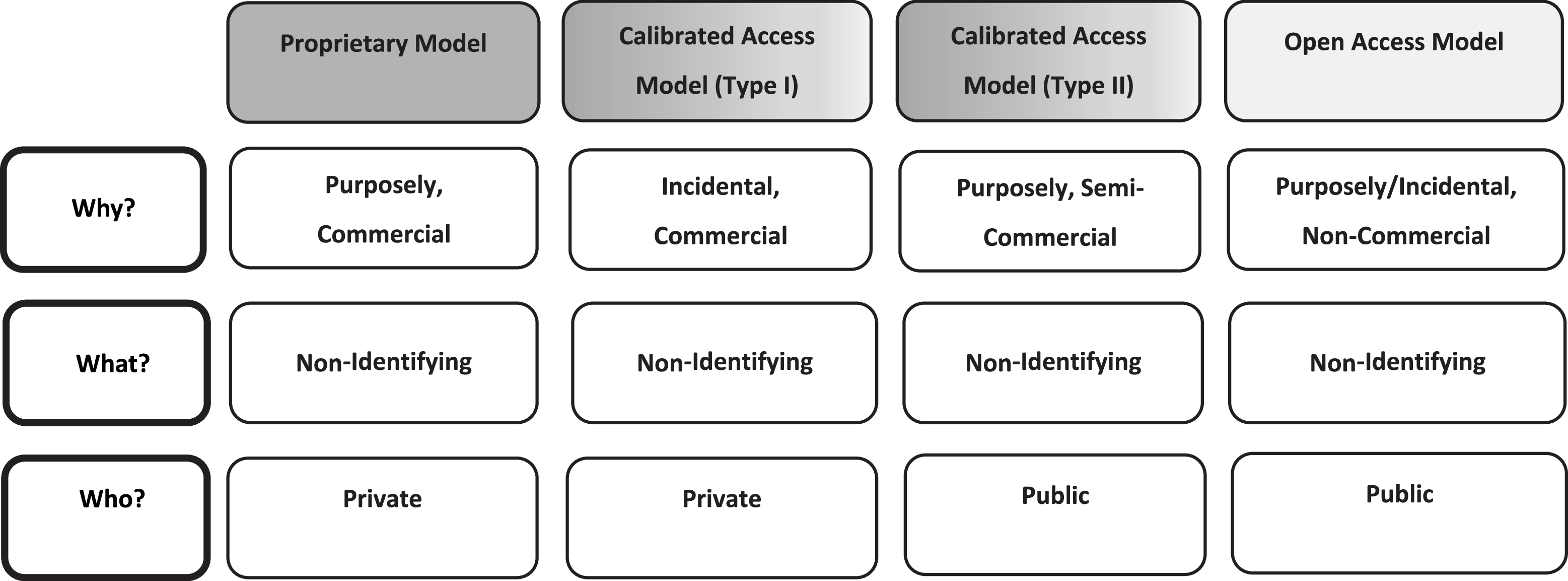
Figure 1 illustrates our proposed matrix of data-sharing regulation.
Proposed matrix of data regulation.

Figure 1 Long description
The table presents a proposed matrix of data regulation, comparing four different models: Proprietary Model, Calibrated Access Model Type I, Calibrated Access Model Type II, and Open Access Model. The table is organized into three main categories: Why, What, and Who. The ‘Why’ category explains the purpose of the data collection (purposely or incidental), and its commercial/non commercial nature. The ‘What’ category specifies that the data collected is non identifying. The ‘Who’ category indicates whether the data is collected by private or public entities. Row 1: Proprietary Model, Purposely Commercial, Non-Identifying, Private. Row 2: Calibrated Access Model Type I, Incidental Commercial, Non-Identifying, Private. Row 3: Calibrated Access Model Type II, Purposely Semi-Commercial, Non-Identifying, Public. Row 4: Open Access Model, Purposely/Incidental Non-Commercial, Non-Identifying, Public. The table highlights the differences in data access and usage across these models, emphasizing the balance between purposely or incidental data collection, and the entity type collecting the data..
Under the proposed matrix, only data collected purposefully – that is, not incidentally as a by-product of another primary task and for commercial purposes – merit inclusion under the fully proprietary model because otherwise there may not be sufficient incentive for its collection and storage.Footnote 193 The incentive theory is primarily relevant to entities from the private business sector. An example is a commercial entity proposing services based on a dataset established and processed as part of its core business model.Footnote 194 The relevance of the incentive theory diminishes as we move away from these circumstances and the justification for applying a fully proprietary model that grants exclusive rights decreases.
At the second pole of the matrix, we propose adopting a fully open-access model as the normative default for non-commercial activities of data collection. This model is primarily relevant to public-sector entities. According to the proposed matrix, incidental collection of data, as a by-product of non-commercial activity, should be subject to a fully open-access model because there is no legitimate expectation of providing an incentive for data collection as a matter of policy under such a scenario. By the same principle, data purposefully collected in the course of public-sector non-commercial activities should be also subject to a fully open-access model because sharing does not undermine the motivation to collect the data. Datasets generated as part of the activities of public-sector entities belong to the public and should be accessible for the public good, subject to any other legal constraints such as privacy or national security obligations.Footnote 195 This captures the full-fledged meaning of the principle, according to which the default rule is a non-proprietary, open-access approach to data.
Between the two poles lies a broad range of scenarios reflecting the complexity of data-collection activities, where the matrix “needle” shifts in response to the taxonomy’s factors, thereby adjusting the applicability of the default non-proprietary, pro-access rule. For these mid-range situations, we therefore propose a calibrated access model that determines when it is justified to deviate from either pole. We identify two paradigmatic scenarios, arising in either private- or public-sector activities and accordingly term them “Type I” and “Type II”. In general, Type I scenarios in the private sector support a move towards an open-access model, whereas Type II scenarios in the public sector support a move towards a proprietary model. However, the diversity and complexity of these situations require further fine-tuning within each type.
The Type I calibrated access model concerns the private sector and addresses incidental collection of data – that is, data collected as a by-product of another primary task that is carried out in the course of a commercial activity. Such data do not require applying a proprietary model because there is no need to provide an incentive for their collection and storage. A prominent example is the data collected by various online platforms providing services not directly associated with the data collected, such as social media services. While it is acknowledged that storing and managing such data involves non-trivial infrastructure costs, these are typically part of the broader operational model and not driven by the standalone value of the data itself at the time of collection.Footnote 196 As such, the normative justification for exclusive rights in such data may still be weaker than in cases where data collection is deliberate, targeted and value-driven. In these cases, the default rule of open access should prevail and mandatory data-sharing obligations should apply. In economic terms, granting exclusivity over this type of data may generate revenues beyond what is necessary to promote the activity (e.g. operating a social media service), thus reflecting a deadweight loss to the public good. Nevertheless, the commercial nature of the activity may justify some reservations in applying a full-fledged data-sharing obligation because the question of whether the data were collected and stored purposefully or incidentally may not always be easily answered. Therefore, we propose to adopt some exceptions to the general pro-access and data-sharing obligation rule for cases in which the data collected are part of the collector’s core business model, which may reasonably be classified as data collected on purpose. The data products and services market is highly dynamic and the regulatory framework should be designed to accommodate complex and evolving business models, as it aims to promote data-driven innovation. Thus, the calibrated access model applicable to privately collected data, while adopting a pro-open-access rule, would nevertheless remain attentive to the broader commercial context in which these activities take place.
Further along the matrix, we propose adopting a second, the Type II calibrated access model, applicable to the public sector, which addresses cases in which the data are collected purposefully in the course of revenue-generating activities carried out by public-sector and not-for-profit entities, amounting to what may be characterised as semi-commercial activity. Although the not-for-profit status of the collecting entity may suggest the absence of economic incentives and thus support a stronger case for applying a fully open-access model, in practice many such entities purposefully collect data through activities that require significant investment of resources. In such cases, exclusivity over data may be justified as an exception to the general pro-access model, where it is necessary to provide an incentive for the activity. Universities offer a paradigmatic example. Although they operate primarily for non-profit purposes, they frequently engage in revenue-generating through technology transfer activities,Footnote 197 illustrating hybrid settings, combining societal missions with semi-commercial considerations.Footnote 198 In such cases, a deviation from a fully open-access model may be justified where control over the data is required to incentivise the activity.Footnote 199
We recognise that not all public data is alike. Some public-sector entities engage in structured and resource-intensive data collection, such as national statistics, mapping or meteorological data and may operate under self-financing models. In such cases, full and immediate access may be balanced against the need to sustain the data infrastructure and differentiated approaches, such as access fees covering partial costs, may be appropriate. Where such entities pursue revenue maximisation rather than mere cost recovery, they may fall under the Type II calibrated access model, which captures public-sector entities operating in semi-commercial contexts, if incentives are required to sustain the activity. Thus, the calibrated access model applicable to publicly collected data moderates the pro–open-access rule in light of the hybrid, semi-commercial context in which these activities take place.
The proposed matrix is intended to adjust the general regulatory model – ranging from pro-proprietary to pro-open-access approaches – to the various scenarios associated with the specific characteristics of data in each case. This matrix does not address the precise tailored norm applicable to the various scenarios, nor does it specify the concrete form or regulatory technique through which the rule should be crafted. Notably, the most challenging aspect of rule-making lies in designing pro-access and data-sharing obligations in cases where the data are in the possession of a data holder, particularly in the private sector, but also in hybrid public-sector scenarios. In such cases, regulation should not only establish that de facto possession does not create a legal right but also impose an affirmative obligation on the data holder to take active steps to enable data sharing. These scenarios may face conceptual resistance due to the common perception that de facto control over data implies a legal entitlement. However, once this conceptual barrier is overcome, the path is opened for developing regulatory obligations aimed at unlocking data. These regulatory techniques may evolve over time in response to legal and technological developments. The discourse on regulatory models for unlocking data is expanding, including debates over the pros and cons of coercive data-sharing rules (i.e. hard law) versus softer approaches such as “data spaces”.Footnote 200
VII. Advantages and Limitations of the Matrix
The proposed matrix offers a systematic and coherent basis for determining when exclusive rights over data are justified. It can be used as a tool to critically assess existing frameworks and may serve regulators and policy-makers as a roadmap for navigating the complex data environment while resisting stakeholder pressure to grant exclusivity. Property rights should not be acknowledged by inertia or, worse, by acceptance of a reality dictated by data possessors.
The proposed matrix is dynamic and technology-neutral, capable of adapting to future developments.Footnote 201 It considers a broad range of interests, including those of possessors, users and the public, facilitating access to information and fostering competitive markets. It thus provides a principled infrastructure for an efficient regulation of data.Footnote 202
The proposed matrix is a skeletal model, designed to replace the prevailing assumption of vested exclusivity in data with a presumption of openness. Under this baseline, a proprietary legal model to data requires a robust justification. Shifting the default towards non-exclusivity could transform the data markets and promote the public good.
Several objections may be raised. The key parameter, the “Why” question, asking whether the data were collected purposefully or incidentally as a by-product, is occasionally fuzzy and consequently may be subject to manipulations.Footnote 203 Data holders, particularly from the private sector, may claim that all data collected during their operations form part of their business model and therefore merit proprietary protection.Footnote 204 This reflects the proprietary impulse described earlier, whereby all commercially valuable outputs are perceived as owned assets. The answer lies in public policy, which supports depropertisation of data as the general rule. Physical control does not equate to ownership. Moreover, not all data collected by private entities are part of their core business.Footnote 205 For example, social media algorithms process only certain user-generated data, not all of it.Footnote 206 Claims by platforms over all data collected during their activities should therefore be rejected. While firms may legitimately monetise their activities, exclusivity over data should not rest solely on its inclusion within a business model. Evidentiary materials such as business documentation, purpose statements and actual usage patterns can help distinguish between purposefully and incidentally collected data.Footnote 207 Analogies may be drawn from other legal fields – such as tax, competition or contract law – where legal systems regularly differentiate between core and peripheral activities.Footnote 208
Business models also evolve. Data collected without commercial purpose may later acquire value, yet proprietary rights should not be granted retroactively where no incentive for its collection was needed. Our argument is not that all data should be free or that private companies cannot profit from data, but rather that property rights must rest on principled justification, not mere technical control. Normative coherence in determining the boundaries of data ownership is essential and must be supported by clear regulatory or judicial mechanisms.Footnote 209
A further objection is that the matrix may seem less progressive than the EU Data Act, which mandates data sharing for certain categories. Under the proposed matrix, data collected incidentally in the course of commercial activity would fall under the Type I calibrated access model, which deviates from the full-fledged proprietary model and mandates data sharing, while allowing limited exceptions in light of the commercial context. Critics may thus argue that the matrix steps back from the EU Data Act’s more interventionist stance. However, the matrix is a principle-based model, designed to facilitate data sharing, while recognising justified cases for exclusivity. It offers a conceptual tool for assessing the legitimacy of any data law.
In this light, the matrix actually supports the EU Data Act’s baseline rule that data generated and collected through the operation of IoT devices by commercial entities should be shareable. Yet, applying the matrix reveals that the EU Data Act’s sharing obligation is limited – restricted mainly to data users rather than to other interested businesses.Footnote 210 Compliance with personal-data protection may partly explain this narrow scope. Similarly, the DMA requires gatekeepers to share data with originators (either business-to-business or business-to-customer), therefore it is not establishing a general pro-access regime in which data is open to all. The matrix helps expose the limited reach of these frameworks and encourages discussion of their normative basis.
The EU Data Act’s trade-secret exception – the so-called “hand-brake mechanism”, which allows data holders to withhold data that qualify as trade secretsFootnote 211 – also merits analysis under the matrix. Trade-secret protection applies to information that confers a competitive advantage derived from its secrecy. The EU Data Act mandates an objective, case-by-case framework for assessing trade-secret claims.Footnote 212 Is this exception supported by the matrix? The answer might be yes. Data that form part of the core business are typically collected purposefully, structured for added value and may qualify as trade secrets exempt from the sharing obligation. Data collected from connected vehicles to develop autonomous driving systems, is one example.Footnote 213 Conversely, data collected incidentally in the operation of IoT devices, often have no expected or feasible business advantage and therefore remain raw, without further organisation by its collector. Such data should be subject to a data-sharing model. Data from smoke detectors is an example.Footnote 214 While it could be argued that any data collected from connected devices and services may acquire commercial value simply by being inaccessible to others, this alone does not justify proprietary protection. Under the proposed matrix, the mere fact of secrecy is insufficient; exclusivity over data should only occur where there is intentional collection, purposeful structuring or demonstrable planned commercial use.
Another major concern relates to enforcement feasibility. Critics may argue that requiring private entities to share data is impractical, echoing similar objections raised under the DMA’s gatekeeper obligations.Footnote 215 Enforcement of data-sharing duties poses genuine challenges. However, enforcement difficulties have long accompanied intellectual property rights themselves, yet this has never precluded their recognition where justified. Similarly, data-sharing obligations can and should be accompanied by robust enforcement mechanisms, including regulatory oversight, penalties for non-compliance and clear procedural guidance.
VIII. Concluding Remarks
Contributing to ongoing discussions in the emerging field of data law, this article proposes a matrix that provides a principled framework for assessing when data exclusivity is warranted. It can be used to evaluate current policies, reveal inconsistencies and guide the design of future data governance. By shifting the default assumption from exclusivity to access, the matrix challenges the inertia of data propertisation and promotes a balanced approach, grounded in public interest and which seeks to avoid simplistic outcomes.