INTRODUCTION
Relative to HIV-negative adults, adult persons living with HIV (PLWH) experience higher rates of neuropsychiatric symptoms, including depression, anxiety, and apathy (Benton, Reference Benton2008; Bing et al., Reference Bing, Burnam, Longshore, Fleishman, Sherbourne, London and Shapiro2001; Bogdanova, Diaz-Santos, & Cronin-Golomb, Reference Bogdanova, Diaz-Santos and Cronin-Golomb2010; Clark, Cohen, Westbrook, Devlin, & Tashima, Reference Clark, Cohen, Westbrook, Devlin and Tashima2010; Clark et al., Reference Clark, Walker, Cohen, Devlin, Folkers, Pina and Tashima2015; Do et al., Reference Do, Rosenberg, Sullivan, Beer, Strine, Schulden and Skarbinski2014; Morrison et al., Reference Morrison, Petitto, Ten Have, Gettes, Chiappini, Weber and Evans2002), as well as neurocognitive difficulties (Clark & Cohen, Reference Clark and Cohen2010; Heaton et al., Reference Heaton, Clifford, Franklin, Woods, Ake, Vaida and Grant2010), particularly in the area of executive function (EF) (Heaton et al., Reference Heaton, Franklin, Ellis, McCutchan, Letendre, Leblanc and Grant2011). Notably, a burgeoning line of research has begun to reveal that, in adult PLWH, high levels of early-life stress (ELS) exposure contribute to increases in neuropsychiatric and neurocognitive symptoms (Clark, Arce Rentería, Hegde, & Morgello, Reference Clark, Arce Rentería, Hegde and Morgello2018; Clark et al., Reference Clark, Cohen, Sweet, Gongvatana, Hana, Westbrook and Tashima2012; Clark, Sweet, Morgello, Philip, & Cohen, Reference Clark, Sweet, Morgello, Philip and Cohen2017; Spies, Fennema-Notestine, Archibald, Cherner, & Seedat, Reference Spies, Fennema-Notestine, Archibald, Cherner and Seedat2012; Womersley, Seedat, & Hemmings, Reference Womersley, Seedat and Hemmings2017). These recent findings align with a larger body of research indicating that high ELS exposure increases vulnerability to neuropsychiatric and neurocognitive symptoms in non-HIV samples (Hedges & Woon, Reference Hedges and Woon2011; Pechtel & Pizzagalli, Reference Pechtel and Pizzagalli2011; Philip et al., Reference Philip, Sweet, Tyrka, Price, Carpenter, Kuras and Niaura2013; Teicher & Samson, Reference Teicher and Samson2016; Teicher, Samson, Anderson, & Ohashi, Reference Teicher, Samson, Anderson and Ohashi2016).
There is substantial evidence to suggest that levels of ELS exposure are elevated in HIV+ cohorts relative to non-HIV samples (Machtinger, Wilson, Haberer, & Weiss, Reference Machtinger, Wilson, Haberer and Weiss2012; Paxton, Myers, Hall, & Javanbakht, Reference Paxton, Myers, Hall and Javanbakht2004; Spies, Afifi, et al., Reference Spies, Afifi, Archibald, Fennema-Notestine, Sareen and Seedat2012). Although few studies have conducted direct comparisons of ELS exposure rates in demographically-matched HIV+ and HIV-negative samples (Reisner, Falb, & Mimiaga, Reference Reisner, Falb and Mimiaga2011), rates of abuse and other forms of ELS in HIV+ cohorts range from 32% to 76% (Simoni & Ng, Reference Simoni and Ng2000; Spies, Afifi, et al., Reference Spies, Afifi, Archibald, Fennema-Notestine, Sareen and Seedat2012; Villar-Loubet et al., Reference Villar-Loubet, Illa, Echenique, Cook, Messick, Duthely and Potter2014; Walton et al., Reference Walton, Co, Milloy, Qi, Kerr and Wood2011; Whetten et al., Reference Whetten, Leserman, Lowe, Stangl, Thielman, Swartz and Van Scoyoc2006), compared to 14% to 32% reported in non-HIV samples (Spies, Afifi, et al., Reference Spies, Afifi, Archibald, Fennema-Notestine, Sareen and Seedat2012). Collectively, these studies suggest that HIV+ samples experience an increased burden of ELS exposure relative to non-HIV samples. Such data underscore the critical need to understand the effects of high ELS in HIV+ samples.
Yet, in order to develop appropriate prevention and intervention strategies for PLWH who have experienced high ELS we may need to develop a more nuanced understanding of the effects of ELS exposure on functional outcomes in this population. Studies examining the effects of high ELS on neuropsychiatric and neurocognitive outcomes in PLWH have primarily focused on the total number of adverse childhood experiences (ACEs), due in part to the evidence that ACEs commonly co-occur (Dong et al., Reference Dong, Anda, Felitti, Dube, Williamson, Thompson and Giles2004). Such an approach assumes that different types of adversity impact development in a similar manner, but converging evidence from animal and human research suggests that different types of ACEs may have differential effects on neuropsychiatric and neurocognitive outcomes (McLaughlin, Sheridan, & Lambert, Reference McLaughlin, Sheridan and Lambert2014). Furthermore, because ACEs commonly co-occur, investigations that examine only cumulative effects fail to tease apart, and can thus obscure, the independent impacts that specific types of adversities have on different outcomes (Lambert, King, Monahan, & McLaughlin, Reference Lambert, King, Monahan and McLaughlin2017).
An emerging line of research examining two dimensions of ACEs, threat exposure (experiences that represent a threat to one’s physical integrity) and deprivation (an absence of expected cognitive and social inputs) (Sheridan & McLaughlin, Reference Sheridan and McLaughlin2014), hypothesizes that threat-related stressors may contribute uniquely to affective dysfunction, whereas deprivation-related stressors may have greater effects on cognition (e.g., associative learning) (McLaughlin, Sheridan, & Nelson, Reference McLaughlin, Sheridan and Nelson2017), including higher-order EFs (Lambert et al., Reference Lambert, King, Monahan and McLaughlin2017; Letkiewicz, Funkhouser, & Shankman, Reference Letkiewicz, Funkhouser and Shankman2021). While it remains unclear whether a true double dissociation exists, this hypothesis is supported by data indicating that experiences of abuse in childhood significantly increase the risk of developing depression and anxiety in adulthood (Li, D’Arcy, & Meng, Reference Li, D’Arcy and Meng2016), whereas studies examining the effects of early-life deprivation (e.g., low socioeconomic status, physical neglect, institutionalization) commonly reveal significant effects on EF, including reductions in working memory, cognitive flexibility, inhibition, and planning (Bos, Fox, Zeanah, & Nelson III, Reference Bos, Fox, Zeanah and Nelson2009; Farah et al., Reference Farah, Shera, Savage, Betancourt, Giannetta, Brodsky and Hurt2006; Haft & Hoeft, Reference Haft and Hoeft2017; McLaughlin, Reference McLaughlin2016; Raver, Blair, & Willoughby, Reference Raver, Blair and Willoughby2013). This differential pattern of effects is also reflected in data from animal research and human neuroimaging studies, which indicate that threat-related experiences are associated with abnormalities in brain regions involved in affective processing (e.g., amygdala), whereas early-life deprivation has greater impacts on neural regions implicated in EF (e.g., dorsolateral prefrontal cortex, anterior cingulate) (McCrory et al., Reference McCrory, De Brito, Kelly, Bird, Sebastian, Mechelli and Viding2013; McCrory et al., Reference McCrory, De Brito, Sebastian, Mechelli, Bird, Kelly and Viding2011; McLaughlin, Peverill, Gold, Alves, & Sheridan, Reference McLaughlin, Peverill, Gold, Alves and Sheridan2015; McLaughlin et al., Reference McLaughlin, Sheridan and Lambert2014; Sheridan, Sarsour, Jutte, D’Esposito, & Boyce, Reference Sheridan, Sarsour, Jutte, D’Esposito and Boyce2012).
Similarly, recent data from an fMRI study conducted with an adolescent/young adult sample (13–20 years old) showed that deprivation was independently associated with prefrontal and parietal activation during an EF task (working memory), whereas levels of threat were unrelated to these measures (Sheridan, Peverill, Finn, & McLaughlin, Reference Sheridan, Peverill, Finn and McLaughlin2017). In another study conducted in a sample of young children (4–7 years old), researchers found that deprivation, but not threat, was associated with reductions in EF (cognitive control), whereas threat, but not deprivation, was associated with affective functions (fear learning) (Machlin, Miller, Snyder, McLaughlin, & Sheridan, Reference Machlin, Miller, Snyder, McLaughlin and Sheridan2019). While some studies report that both threat-related and deprivation-related childhood adversities impact affective symptoms in nonclinical adult samples (Chu, Williams, Harris, Bryant, & Gatt, Reference Chu, Williams, Harris, Bryant and Gatt2013; Li et al., Reference Li, D’Arcy and Meng2016), and deprivation may impact affective brain regions in children (Noble, Houston, Kan, & Sowell, Reference Noble, Houston, Kan and Sowell2012), there is evidence that some of the observed overlap in the effects of threat and deprivation on mental health outcomes may arise due to a lack of controlling for comorbid exposures. For example, data from a study conducted with adolescents (16–17 years old) suggest that threat exposure is associated with emotion regulation abilities, but not cognitive control, whereas deprivation exposure (poverty) is associated with cognitive control, but not emotion regulation (Lambert et al., Reference Lambert, King, Monahan and McLaughlin2017). Notably, the specificity of these associations was not apparent when researchers assessed each adversity type in isolation. That is, the specificity of these associations was only revealed when using a multivariate approach that controlled for co-occurring exposures. Taken as a whole, these data suggest that an examination of the unique contributions of specific types of ACEs, grouped according to their underlying dimensions, may provide a more nuanced understanding of the relation between ELS and functional outcomes in PLWH.
We currently lack a comprehensive understanding of ELS-related effects in PLWH. Relatively few studies have examined ELS effects on mental health outcomes in PLWH, despite known elevations in neuropsychiatric and neurocognitive symptoms relative to HIV-negative samples and overlaps in HIV-related and ELS-related neuropathology (Clark et al., Reference Clark, Walker, Cohen, Devlin, Folkers, Pina and Tashima2015; Cohen, Grieve, et al., Reference Cohen, Grieve, Hoth, Paul, Sweet, Tate and Williams2006). Because PLWH exhibit greater neuropsychiatric and neurocognitive symptoms in the context of stress relative to HIV-negative samples (e.g., Clark et al., Reference Clark, Sweet, Morgello, Philip and Cohen2017; Watson et al., Reference Watson, Sundermann, Hussain, Umlauf, Thames, Moore and Moore2019), we sought to gain a better understanding of whether and how ELS effects, specifically early-life threat and deprivation exposures, impact mental health outcomes in PLWH. Our first aim in this preliminary study was to compare the rates of threat-related and deprivation-related ACEs reported in a cohort of adult PLWH and HIV-negative adults matched on key demographic factors associated with ELS risk (e.g., race) (Slopen et al., Reference Slopen, Shonkoff, Albert, Yoshikawa, Jacobs, Stoltz and Williams2016). Our second goal was to utilize a multivariate approach to simultaneously examine whether two dimensions of adversity, threat and deprivation, contribute differentially to neuropsychiatric symptoms and executive dysfunction in PLWH. We predicted that threat exposure would be associated with greater neuropsychiatric symptoms and deprivation with greater EF impairments. Altogether, these analyses aim to better characterize the nature of, and specific risks associated with, ELS in PLWH.
METHODS
Participants
Seventy-two adult PLWH and 85 HIV-negative control (HC) adults were recruited from the Mount Sinai Hospital in New York, NY and The Miriam Hospital in Providence, RI. One investigator (USC) oversaw all procedures. The Institutional Review Boards at the Icahn School of Medicine at Mount Sinai and The Miriam Hospital approved this research. All participants gave their informed written consent and were financially compensated for their time.
Inclusion criteria required that participants were between 21 and 70 years of age, right-handed, completed 8 or more years of education, and were native English speakers. All participants obtained a score of ≥ 25 points on the Mini-Mental State Exam (MMSE) (Folstein, Folstein, & McHugh, Reference Folstein, Folstein and McHugh1975). HIV serostatus was documented by ELISA and confirmed by Western blot test. All participants were enrolled in studies of ELS exposure; hence, the sample was selected such that degree of high ELS exposure was roughly balanced within and across our groups (Table 1). Here, as in prior studies (Clark et al., Reference Clark, Arce Rentería, Hegde and Morgello2018; Clark et al., Reference Clark, Cohen, Sweet, Gongvatana, Hana, Westbrook and Tashima2012; Clark et al., Reference Clark, Sweet, Morgello, Philip and Cohen2017; Seckfort et al., Reference Seckfort, Paul, Grieve, Vandenberg, Bryant, Williams and Gordon2008), high ELS exposure was defined as an endorsement of 3 or more ACEs on the Early Life Stress Questionnaire (ELSQ) (Cohen, Paul, et al., Reference Cohen, Paul, Stroud, Gunstad, Hitsman, McCaffery and Gordon2006) and low ELS as an endorsement of fewer than 3 ACEs.
Demographic, neuropsychiatric, and cognitive characteristics of the participant groups

Note. ACEs = adverse childhood experiences; ARV = antiretroviral; ELS = early-life stress; HC = HIV-negative control; HIVL = HIV viral load; KMSK = Kreek–McHugh–Schluger–Kellogg scale; PSS = Perceived Stress Scale; SS = standard score; WTAR = Wechsler test of adult reading.
1 Analysis controls for demographic variables on which the groups differed significantly (KMSK-A, KMSK-C, hepatitis C status).
Exclusion criteria included self-reported history of uncorrected abnormal vision; developmental disability; learning disability; major psychiatric illness (e.g., bipolar disorder, posttraumatic stress disorder, major depressive disorder, generalized anxiety disorder, attention deficit hyperactivity disorder); neurological illness affecting the central nervous system (e.g., stroke, progressive multifocal leukoencephalopathy); and traumatic head injury with loss of consciousness >10 min. Substance use exclusion criteria were reported current alcohol dependence as per the Mini-International Neuropsychiatric Interview (Sheehan et al., Reference Sheehan, Lecrubier, Sheehan, Amorim, Janavs, Weiller and Dunbar1998); use of heroin/opiates or any intravenous drug within the past 6 months; use of cocaine within the past month; and positive urine toxicology at the time of assessment (cocaine, opiates, methamphetamine, amphetamine, benzodiazepine, barbiturates, methadone, oxycodone).
Demographic Measures
Antiretroviral (ARV) use and nadir CD4 levels (i.e., the lowest ever CD4 T-cell count) and were obtained via self-report (Buisker, Dufour, & Myers, Reference Buisker, Dufour and Myers2015; Cunningham, Rana, Shapiro, & Hays, Reference Cunningham, Rana, Shapiro and Hays1997) and verified against the medical record. All PLWH were prescribed ARV medications. Current CD4 levels and plasma HIV viral loads (HIVL) were measured at the study visit. HIVL was log 10 transformed to normalize the distribution. Participants were assessed for hepatitis C virus (HCV) infection, defined as positive HCV antibody. HCV data were not available for 2 HIV+ and 8 HC participants. Alcohol and drug use histories for all participants were quantified using the Kreek–McHugh–Schluger–Kellogg scale (KMSK) (Kellogg et al., Reference Kellogg, McHugh, Bell, Schluger, Schluger, LaForge and Kreek2003), which provided 3 subscales characterizing lifetime consumption of alcohol (KMSK-A), cocaine (KMSK-C), and opiates (KMSK-O). The Wechsler Test of Adult Reading (WTAR) estimated intellectual function (Wechsler, Reference Wechsler2001); scaled scores were derived using published normative data. WTAR scores were not available for 3 HIV+ and 2 HC participants. The Perceived Stress Scale (PSS) (Cohen, Kamarck, & Mermelstein, Reference Cohen, Kamarck and Mermelstein1983) measured levels of current stress. See Table 1 for group characteristics.
Threat and Deprivation
ACEs were assessed using the Early Life Stress Questionnaire (ELSQ) (Cohen, Paul, et al., Reference Cohen, Paul, Stroud, Gunstad, Hitsman, McCaffery and Gordon2006), a widely-used measure (Baker et al., Reference Baker, Williams, Korgaonkar, Cohen, Heaps and Paul2013; Clark et al., Reference Clark, Arce Rentería, Hegde and Morgello2018; Clark et al., Reference Clark, Cohen, Sweet, Gongvatana, Hana, Westbrook and Tashima2012; Clark et al., Reference Clark, Sweet, Morgello, Philip and Cohen2017; Cohen, Grieve, et al., Reference Cohen, Grieve, Hoth, Paul, Sweet, Tate and Williams2006; Paul et al., Reference Paul, Henry, Grieve, Guilmette, Niaura, Bryant and Gordon2008; Seckfort et al., Reference Seckfort, Paul, Grieve, Vandenberg, Bryant, Williams and Gordon2008) that assesses the occurrence of 17 ACEs (e.g., parental divorce, sexual abuse) prior to age 18 years. To capture experiences related to the dimension of threat, consistent with prior research (Lambert et al., Reference Lambert, King, Monahan and McLaughlin2017), we examined items associated with experiences of interpersonal violence in the school, home, or neighborhood setting. Seven ACEs were included in this domain (sexual, physical, or emotional abuse; domestic abuse; bullying; family conflict; warfare). As in prior studies (Lambert et al., Reference Lambert, King, Monahan and McLaughlin2017), individuals who endorsed any ACE within this domain were assigned a threat score of 1; all others were assigned a threat score of 0. To capture experiences related to the overarching dimension of deprivation, consistent with prior research (Lambert et al., Reference Lambert, King, Monahan and McLaughlin2017; McLaughlin et al., Reference McLaughlin, Sheridan and Lambert2014; Sheridan & McLaughlin, Reference Sheridan and McLaughlin2014), we examined items related to poverty and physical neglect. Three items from the ELSQ were included in this domain (not having enough to eat; lack of care provided by parent/caretaker; having to wear dirty clothes). As in prior studies (Lambert et al., Reference Lambert, King, Monahan and McLaughlin2017), individuals who endorsed any ACE within this domain were assigned a deprivation score of 1; all others were assigned a deprivation score of 0.
Neuropsychiatric Measures
Neuropsychiatric symptoms known to be elevated in PLWH were examined (Benton, Reference Benton2008; Bing et al., Reference Bing, Burnam, Longshore, Fleishman, Sherbourne, London and Shapiro2001; Bogdanova et al., Reference Bogdanova, Diaz-Santos and Cronin-Golomb2010; Ciesla & Roberts, Reference Ciesla and Roberts2001; Clark et al., Reference Clark, Cohen, Sweet, Gongvatana, Hana, Westbrook and Tashima2012; Clark et al., Reference Clark, Cohen, Westbrook, Devlin and Tashima2010; Clark et al., Reference Clark, Sweet, Morgello, Philip and Cohen2017; Clark et al., Reference Clark, Walker, Cohen, Devlin, Folkers, Pina and Tashima2015; Do et al., Reference Do, Rosenberg, Sullivan, Beer, Strine, Schulden and Skarbinski2014; Morrison et al., Reference Morrison, Petitto, Ten Have, Gettes, Chiappini, Weber and Evans2002), including levels of current depression, anxiety, and apathy, quantified using the Center for Epidemiological Studies-Depression Scale (CESD) (Radloff, Reference Radloff1977), the Beck Anxiety Inventory (BAI) (Beck, Epstein, Brown, & Steer, Reference Beck, Epstein, Brown and Steer1988), and the Apathy Evaluation Scale (AES) (Marin, Biedrzycki, & Firinciogullari, Reference Marin, Biedrzycki and Firinciogullari1991), respectively. As in prior studies (Clark et al., Reference Clark, Arce Rentería, Hegde and Morgello2018; Clark et al., Reference Clark, Sweet, Morgello, Philip and Cohen2017), for each participant, Z-scores were calculated for each measure based on the mean of the HC group for that measure; the three Z-scores were then averaged to create a composite index score for each participant. Accordingly, this index Z-score represents the overall degree of neuropsychiatric difficulty reported across the three domains assessed. To verify this, we conducted a principal components analysis (PCA) on the three measures (Bartlett’s test: χ 2 = 174.7, p < 0.001; KMO = 0.564). Only one component had an eigenvalue over 1; this component explained 70% of the total variance (all communalities >0.572). Across the entire sample, correlations between the three measures were significant (all rs >.339, ps < .001). In both the HIV+ and HC groups, component scores correlated strongly with composite index scores [HIV: r(72) = 0.99, p < 0.001; HC: r(85) = 0.99, p < 0.001], supporting the use of the composite (Z-score) index in subsequent analyses. Higher scores indicate greater neuropsychiatric symptoms.
Executive Function Measures
Three neurocognitive tests sensitive in detecting HIV-related EF impairments (Heaton et al., Reference Heaton, Grant, Butters, White, Kirson and Atkinson1995) were administered, including the Trail Making Test (TMT), Part B (Reitan & Davison, Reference Reitan and Davison1974), a test of verbal fluency (FAS) (Aita et al., Reference Aita, Beach, Taylor, Borgogna, Harrell and Hill2019; Borkowski, Benton, & Spreen, Reference Borkowski, Benton and Spreen1967), and the WAIS-III Letter-Number Sequencing (LNS) (Wechsler, Reference Wechsler1997), consistent with prior studies (Castelo, Courtney, Melrose, & Stern, Reference Castelo, Courtney, Melrose and Stern2007; Clark et al., Reference Clark, Cohen, Sweet, Gongvatana, Hana, Westbrook and Tashima2012). Raw scores were computed to Z-scores based on published normative data (Spreen & Strauss, Reference Spreen and Strauss1998; Tombaugh, Reference Tombaugh2004; Wechsler, Reference Wechsler1997), which permit comparisons with prior studies and which include age (TMT, FAS, and WAIS-III) and education (TMT) corrections. Z-scores were averaged to compute a domain-specific composite score for each participant (Castelo et al., Reference Castelo, Courtney, Melrose and Stern2007; Clark et al., Reference Clark, Cohen, Sweet, Gongvatana, Hana, Westbrook and Tashima2012). Hence, this score represents an overall average EF ability score. To verify this, we conducted a PCA on the three measures (Bartlett’s test: χ 2 = 67.5, p < 0.001; KMO = 0.663). Only one component had an eigenvalue over 1; this component explained 60% of the total variance (all communalities > 0.597). Across the entire sample, correlations between the three measures were significant (all rs > .390, ps < .001). In both the HIV+ and HC groups, component scores correlated strongly with composite index scores [HIV: r(72) = 0.95, p < 0.001; HC: r(84) = 0.94, p < 0.001], supporting the use of the composite (Z-score) index in subsequent analyses. Composite scores were not available for one HC participant. Lower scores indicate greater executive dysfunction.
Statistical Analyses
Differences in demographic and clinical factors between groups were assessed using independent-samples t-tests and chi-square tests. HIV+ and HC group differences in neuropsychiatric symptoms and EF were assessed using ANCOVAs; in these models, demographic variables on which the groups differed significantly were included as covariates. Partial eta-squared (η p2) was used as an indicator of effect size, where values of .01, .06, and .14 indicate small, medium, and large effects, respectively (Cohen, Reference Cohen1988). Rates of threat and deprivation exposure in HIV+ and HC samples were compared using chi-square tests.
A primary aim was to assess whether early-life threat and deprivation exposures impact neuropsychiatric and neurocognitive outcomes in PLWH. Accordingly, we examined the association of threat and deprivation exposure to our outcome measures (neuropsychiatric symptom Z-scores; EF Z-scores) in the HIV+ sample using two linear regression analyses, one for each outcome measure. In each model, the outcome measure was entered as the dependent variable, and threat and deprivation scores were entered as predictor variables. Hence, each model examined the unique associations of threat and deprivation exposure to the outcome variable of interest. Covariates included demographic and clinical factors that differed significantly between HIV+ groups with and without threat or deprivation exposure (current CD4, prior alcohol use) to control for the potential effects that these factors might have on the dependent variable, and thus better assess unique associations between ACE exposures and the dependent variable. Multicollinearity checks were run for all regression models to ensure that correlations between predictor variables did not exceed acceptable limits (tolerance <0.2) (Menard, Reference Menard1995). All statistical analyses were conducted using SPSS (version 24).
RESULTS
Demographic Measures
Demographic data for the HIV+ and HC groups are reported in Table 1, including group means and statistics. HIV+ and HC groups did not differ significantly with respect to estimated intelligence (WTAR, p = .13), current stress levels (PSS, p = .66), or racial composition (p = .76); however, relative to the HC group, the HIV+ group reported higher levels of prior alcohol (p < .01) and cocaine (p < .01) use, and had higher rates of HCV infection (p = .02).
Among the HIV+ sample, we examined differences in demographic and clinical factors in those with and without threat exposure. Compared to HIV+ participants without threat exposure (N = 24), those with threat exposure (N = 48) exhibited higher current CD4 levels [499.7 vs. 747.0 cells/μl, respectively; t(70) = 3.20, p < .01] and prior alcohol use [KMSK-A, 6.21 vs. 8.35, respectively; t(70) = 2.55, p = .01]; however, groups did not differ significantly in age (p = .84), sex (p = .86), estimated intelligence (p = .32), racial composition (p = .13), ethnicity (p = .81), current stress (p = .06), prior history of cocaine (p = .08) or opioid (p = .87) use, HCV status (p = .95), nadir CD4 (p = .31), or HIVL (p = .07). Comparisons of HIV+ participants with and without deprivation exposure (N = 9 and N = 63, respectively) were nonsignificant (ps > .05).
Threat and Deprivation
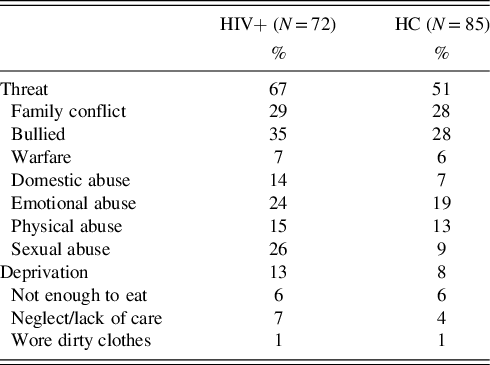
The HIV+ group reported higher rates of threat exposure than the HC group (67% vs. 51%, respectively; p = .04), while rates of deprivation did not differ significantly across the groups (13% vs. 8%, respectively; p = .38) (Table 1). Figure 1 shows the rates of threat, deprivation, and comorbid exposures in the HIV+ and HC groups. In addition, Table 2 shows exposure rates for individual ACEs in the HIV+ and HC groups.
Percent of participants reporting early-life threat, deprivation, and comorbid exposures in the HIV+ and HC groups.

Percent of participants reporting threat-related and deprivation-related adverse childhood experiences (ACE) in the HIV+ and HC groups

Neuropsychiatric Measures
The HIV+ group exhibited trend-level elevations in neuropsychiatric symptoms relative to the HC group when covarying for demographic variables on which the groups differed significantly (KMSK-A, KMSK-C, HCV status) [F(1,142) = 3.45, p = .07, η p2 = .02] (Table 1).
Executive Function Measures
Rates of executive dysfunction did not differ significantly between HIV+ and HC participants [F(1,154) = .95, p = .33, η p2 = .01], even when covarying for demographic variables on which the groups differed significantly (KMSK-A, KMSK-C, HCV status) (p = .23, η p2 = .01) (Table 1).
Relation of Threat and Deprivation to Neuropsychiatric & Executive Functions in PLWH
A multivariate approach (Lambert et al., Reference Lambert, King, Monahan and McLaughlin2017) was used to examine whether threat and deprivation contributed uniquely to neuropsychiatric symptom elevations in PLWH. The model predicting neuropsychiatric symptoms revealed that threat exposure was significantly associated with neuropsychiatric symptom levels when controlling for deprivation [B = .59, 95% confidence interval (CI) = .17, 1.01, β = .32 (t = 2.79, p < .01)] (Figure 2). By contrast, deprivation was unrelated to neuropsychiatric symptoms when controlling for threat [B = .12, CI= −.49, .72, β = .04 (t = 0.39, p = .70)]. In this model, threat exposure accounted for 11% of the variance in neuropsychiatric symptoms, whereas deprivation accounted for less than 1%. The association between threat and neuropsychiatric symptoms remained significant [B = .68, CI = .20, 1.15, β = .37 (t = 2.83, p < .01)] even after controlling for variables on which the HIV+ exposure groups differed significantly (current CD4, KMSK-A). In exploratory post hoc analyses, this model was rerun using each neuropsychiatric measure as the dependent variable to examine the specificity of the observed association; results from all three models revealed significant associations with threat (CESD: p < .05; BAI: p < .01; AES: p < .05) but not deprivation (ps >.05).
Threat (violence) exposure is associated with greater affective symptoms in HIV+ adults. Note: rpb = point biserial correlation coefficient; effects unadjusted for deprivation exposure.

The model predicting EF in PLWH revealed a trend-level association between deprivation and executive dysfunction when controlling for threat [B = −.80, CI = -1.71, .12, β = −.21 (t = 1.74, p = .09)] (Figure 3). By contrast, threat was unrelated to EF when controlling for deprivation [B = −.10, CI = −.74, .54, β = −.04 (t = 0.32, p = .75)]. In this model, deprivation accounted for 4% of the variance in executive abilities, whereas threat accounted for less than 1%. The association between deprivation and EF remained at a trend level [B = −.77, CI = -1.70, .16, β = −.20 (t = 1.66, p = .10)] even after controlling for variables on which the HIV+ exposure groups differed significantly (current CD4, KMSK-A). In exploratory post hoc analyses, this model was rerun using each EF measure as the dependent variable. Results revealed trend-level associations between deprivation and Trails B (TMT: p = .10; FAS: p > .05; LNS: p > .05); associations with threat were non-significant in all three models (ps >.05).
Deprivation (poverty/neglect) is associated with greater executive dysfunction in HIV+ adults. Note: rpb = point biserial correlation coefficient; effects unadjusted for threat exposure.

DISCUSSION
To our knowledge, this is the first study conducted to compare rates of exposure to different dimensions of adversity in a demographically matched sample of HIV+ and HC adults. Our data revealed elevated rates of threat-related ACEs (e.g., sexual abuse; domestic abuse; bullying) in adult PLWH relative to HC adults. This elevation was observed despite the fact that rates of high ELS exposure did not differ between these two groups. That is, although the HIV+ and HC groups were matched with respect to the overall degree of ELS burden, differences in the rate of exposure to specific types of ACEs were still observed, where a higher rate of threat-related adversities was present in the HIV+ group than in the HC group (67% vs. 51%, respectively). This finding is consistent with prior reports indicating elevated rates of abuse and trauma in HIV+ cohorts (Machtinger et al., Reference Machtinger, Wilson, Haberer and Weiss2012; Spies, Afifi, et al., Reference Spies, Afifi, Archibald, Fennema-Notestine, Sareen and Seedat2012). Accordingly, our results suggest that, in HIV+ samples, the nature of ELS exposure may differ from that of HC samples, with threat-related adversities being more prevalent in HIV+ than in HC samples. Importantly, these differences could impact the ways in which ELS-related effects are expressed in HIV+ and HC samples, as prior data indicate that threat-related exposures are independently associated with affective dysregulation in non-HIV samples (Lambert et al., Reference Lambert, King, Monahan and McLaughlin2017).
Consistent with this notion, in the HIV+ sample we observed that threat-related ACEs exhibited unique associations with neuropsychiatric symptom elevations, accounting for 11% of the variance in neuropsychiatric symptoms, whereas deprivation was unrelated to neuropsychiatric symptoms. Our findings thus implicate threat-related ACEs as unique contributing factors in ELS-related neuropsychiatric symptom elevations previously reported in PLWH (Clark et al., Reference Clark, Sweet, Morgello, Philip and Cohen2017). Additionally, we also observed unique trend-level associations between early-life deprivation and executive dysfunction in adult PLWH, whereas threat was unrelated to EF. These results are consistent with an emerging literature describing links between deprivation and EF difficulties in non-HIV samples (Farah, Reference Farah2017; Haft & Hoeft, Reference Haft and Hoeft2017; Letkiewicz et al., Reference Letkiewicz, Funkhouser and Shankman2021). Notably, this differential pattern of associations aligns with findings from neuroimaging studies, which indicate that early-life threat exposure (violence, trauma) is associated with aberrant patterns of activation in regions implicated in affective response (e.g., amygdala), whereas early-life deprivation is more commonly associated with abnormalities in the structure and function of brain regions implicated in EF (e.g., dorsolateral prefrontal cortex, anterior cingulate) (McCrory et al., Reference McCrory, De Brito, Kelly, Bird, Sebastian, Mechelli and Viding2013; McCrory et al., Reference McCrory, De Brito, Sebastian, Mechelli, Bird, Kelly and Viding2011; McLaughlin et al., Reference McLaughlin, Peverill, Gold, Alves and Sheridan2015; McLaughlin et al., Reference McLaughlin, Sheridan and Lambert2014; Sheridan et al., Reference Sheridan, Sarsour, Jutte, D’Esposito and Boyce2012). Accordingly, future studies that investigate whether threat-related and deprivation-related ACEs are associated with unique neural effects in HIV+ samples may be warranted to enhance our understanding of the pathophysiological sequelae of ELS in the context of HIV.
Data from prior studies in non-HIV samples suggest that the developmental processes underlying these associations may be partly dissociable. Exposures to threat-related ACEs result in aberrant processing of affective stimuli, including elevated reactivity to and attention toward potential threats (van Marle, Hermans, Qin, & Fernandez, Reference van Marle, Hermans, Qin and Fernandez2009). It is hypothesized that such reactions may be adaptive in unsafe environments, but become problematic over time, as they are associated with physiological processes (e.g., HPA axis dysregulation) that increase risk for psychopathology (e.g., depression, anxiety) (Danese & Lewis, Reference Danese and Lewis2017; Heim, Newport, Mletzko, Miller, & Nemeroff, Reference Heim, Newport, Mletzko, Miller and Nemeroff2008; Milojevich, Norwalk, & Sheridan, Reference Milojevich, Norwalk and Sheridan2019; Shea, Walsh, Macmillan, & Steiner, Reference Shea, Walsh, Macmillan and Steiner2005; Teicher et al., Reference Teicher, Samson, Anderson and Ohashi2016). Early-life deprivation, on the other hand, is thought to be associated with a decrease in exposures to environmental stimuli (e.g., cognitive inputs, language with complicated syntax, learning opportunities, other cognitively enriching activities) that promote the elaboration of cognitive abilities over time in the typically developing brain (Sheridan & McLaughlin, Reference Sheridan and McLaughlin2014; Spratt et al., Reference Spratt, Friedenberg, Swenson, Larosa, De Bellis, Macias and Brady2012). Yet, a complete separation between these two dimensions is unlikely, as responses to many ACEs involve cross-dimensional aspects. For example, threat exposures (e.g., abuse) are sometimes associated with a reduction in environmental engagement (e.g., social isolation, withdrawal behaviors) (Elliott, Cunningham, Linder, Colangelo, & Gross, Reference Elliott, Cunningham, Linder, Colangelo and Gross2005), while deprivation-related ACEs (e.g., neglect) can involve insecure attachments with caretakers/parental figures (Cyr, Euser, Bakermans-Kranenburg, & Van Ijzendoorn, Reference Cyr, Euser, Bakermans-Kranenburg and Van Ijzendoorn2010) that have the potential to impact the development of affective functions. Nevertheless, there is burgeoning evidence that early-life exposures to threat and deprivation may be associated with unique, developmentally relevant trajectories that involve specific effects on brain and behavior (Lambert et al., Reference Lambert, King, Monahan and McLaughlin2017; McLaughlin, Reference McLaughlin2016). In this context, our findings provide initial evidence to suggest that future investigations aimed at teasing apart and elucidating these effects in PLWH are warranted.
Our findings have potential clinical implications, as we observed unique associations between ACE exposures and mental health outcomes in HIV+ adults. Hence, our data suggest that assessing for early-life adversity, particularly threat and deprivation exposures, may assist in the identification of PLWH who may require more frequent screening and/or in-depth assessment of psychological and cognitive functions, and who may benefit from preventative and supportive services (e.g., psychotherapy). Interventions tailored to addressing specific threat-related ACEs (e.g., sexual abuse) have been shown to reduce neuropsychiatric symptoms in PLWH (Seedat, Reference Seedat2012; Sikkema et al., Reference Sikkema, Hansen, Kochman, Tarakeshwar, Neufeld, Meade and Fox2007). Such findings align with data from non-HIV samples suggesting psychotherapeutic interventions (e.g., cognitive-behavioral therapy, mindfulness) could be particularly effective for adults who have experienced ACEs (Blalock et al., Reference Blalock, Minnix, Mathew, Wetter, McCullough and Cinciripini2013; Korotana, Dobson, Pusch, & Josephson, Reference Korotana, Dobson, Pusch and Josephson2016; Nemeroff et al., Reference Nemeroff, Heim, Thase, Klein, Rush, Schatzberg and Keller2003; Zobel et al., Reference Zobel, Kech, van Calker, Dykierek, Berger, Schneibel and Schramm2011). Additional research is needed to further investigate this possibility in PLWH.
Several issues merit further consideration. First, although significant group-related differences in the rates of threat-related ACEs were detected, significant group differences in deprivation were not observed. Our sample was recruited with the intention of balancing rates of high ELS exposure (≥3 ACEs) within and across our groups, which likely affected the rates at which individual ACEs were observed in our sample. While the average number of ACEs in the current HIV+ group was generally in line with prior randomly selected HIV+ samples (Clark et al., Reference Clark, Arce Rentería, Hegde and Morgello2018; Clark et al., Reference Clark, Cohen, Sweet, Gongvatana, Hana, Westbrook and Tashima2012; Clark et al., Reference Clark, Sweet, Morgello, Philip and Cohen2017) (3.4 vs. 3.3, respectively), the average number of ACEs in the HC group was slightly higher than that reported in prior large-scale studies (Cohen, Paul, et al., Reference Cohen, Paul, Stroud, Gunstad, Hitsman, McCaffery and Gordon2006) (2.8 vs. 2.2, respectively), which suggests an overestimation of exposure rates in our HC sample. Accordingly, additional investigations conducted in community-based samples are needed to provide greater clarity regarding the degree to which rates of early-life threat and deprivation exposures differ in HIV+ and HC samples. Nevertheless, as noted above, we suggest that the observation of significantly higher rates of threat-related ACEs in PLWH relative to HC adults, even in the context of high ELS exposure rates that do not differ significantly between these groups, only further underscores the relevance of threat-related ACEs to HIV+ samples. Second, it is possible that the relatively low rate of deprivation in our HIV+ sample, and associated reductions in power, may have impacted our ability to detect associations with outcome variables beyond the level of a trend, as the low frequency of those experiencing deprivation only (vs. deprivation and threat combined) reduces our ability to ascertain individual effects. Future studies conducted with larger samples, as well as those using different methods to assess deprivation (e.g., estimations of socioeconomic status during childhood), are needed to clarify this issue. Similarly, studies that utilize a continuous rather than a binary approach to quantifying threat and deprivation exposures could better assess potential dose-response effects (LaNoue, George, Helitzer, & Keith, Reference LaNoue, George, Helitzer and Keith2020). Lastly, levels of neuropsychiatric symptoms and executive dysfunction in the HIV+ group, while elevated, did not differ significantly from the HC group – findings that diverge from prior reports (Clark et al., Reference Clark, Sweet, Morgello, Philip and Cohen2017; Heaton et al., Reference Heaton, Franklin, Ellis, McCutchan, Letendre, Leblanc and Grant2011); however, as discussed above, our sample was somewhat unique in that rates of high ELS exposure were roughly balanced in the HIV+ and HC groups, which may have elevated levels of executive dysfunction and neuropsychiatric symptomology in our HC sample. Also, the degree of variability in the HIV+ and HC groups’ scores suggests the potential presence of latent subgroups for whom ACE-related effects may be more prominent. Future studies with larger sample sizes are needed to further examine these possibilities.
In summary, findings from this study suggest that examining different dimensions of adversity may enhance our understanding of the specific consequences of ELS exposure in PLWH. Using this approach, we found that PLWH experienced higher rates of threat-related ACEs, which contributed uniquely to neuropsychiatric symptom elevations. By contrast, we found that deprivation demonstrated unique trend-level associations with executive dysfunction in PLWH. Our results thus illuminate the ways in which different types of early-life adversity elevate the risk of neuropsychiatric and neurocognitive symptoms in HIV+ samples. To our knowledge, this is the first report of independent associations between different dimensions of ACEs and mental health outcomes in PLWH. Our results support the need for further clinical research in this population; if confirmed in larger community-based samples, such findings may be applied to more precisely identify PLWH at risk for developing neuropsychiatric and neurocognitive symptoms. Importantly, future studies that investigate whether threat and deprivation are associated with unique neural and/or pathophysiological mechanisms in HIV+ samples (Womersley et al., Reference Womersley, Seedat and Hemmings2017) appear warranted as such studies may help to refine interventions aimed at addressing ELS-related maladies in adult PLWH. Lastly, future studies using longitudinal approaches will be needed to clarify the direction of the observed effects, as well as the potential role of contributory mechanisms (e.g., sleep dysfunction) (Agorastos, Pervanidou, Chrousos, & Baker, Reference Agorastos, Pervanidou, Chrousos and Baker2019; Syed & Nemeroff, Reference Syed and Nemeroff2017; Taylor, Reference Taylor2010).
ACKNOWLEDGMENTS
We thank all of the individuals who participated in this study. In addition, we gratefully acknowledge Susan Morgello, MD, Rhonda Burgess, MBA, and additional team members at the Manhattan HIV Brain Bank, as well as Ronald A. Cohen, Ph.D., Karen T. Tashima, MD, Timothy P. Flanigan, MD, and the teams at The Miriam Hospital Immunology Center, who provided valuable aid in our recruitment efforts.
FINANCIAL SUPPORT
This work was supported by grants from the National Institutes of Health (Grants K23 MH096628 [USC], R25 MH080663 [USC], UL1 TR000067 [USC], P30 DA027827 [USC], R01 MH074368). The views expressed in this article are those of the authors and do not necessarily reflect the position or policy of the NIH.
CONFLICTS OF INTEREST
All authors reported no biomedical financial interests or potential conflicts of interest.
ETHICAL STANDARDS
This study was carried out in accordance with the recommendations of the Institutional Review Boards at the Icahn School of Medicine at Mount Sinai and The Miriam Hospital. All subjects gave written informed consent in accordance with the Declaration of Helsinki. The protocol was approved by the Institutional Review Boards at the Icahn School of Medicine at Mount Sinai and The Miriam Hospital.