Introduction
Interest in the study of mental wellbeing (MWB) among individuals aged 80 years or above, usually referred to as ‘oldest old’ (World Health Organization, 2001), is increasing, in line with the rapidly growing population projections for this segment of the population (United Nations, 2019). Efforts to promote healthy ageing and to maintain a good quality of life, including MWB, within this population group are of great importance.
MWB includes emotional responses to life events, domain satisfaction, and global judgements of life satisfaction (Diener et al., Reference Diener, Suh, Lucas and Smith1999). Evaluative wellbeing captures life satisfaction and the global evaluation that people make about their life (Kapteyn et al., Reference Kapteyn, Lee, Tassot, Vonkova and Zamarro2015), experienced – also known as hedonic – wellbeing refers to the positive and negative emotions that people experience daily (Kahneman et al., Reference Kahneman, Krueger, Schkade, Schwarz and Stone2004), whereas eudaimonic wellbeing focuses on self-realisation, sense of purpose, and meaning in life (Ryan and Deci, Reference Ryan and Deci2001). Many authors attempted to identify these different facets of MWB and the main social determinants shaping individual behaviour and feelings, life satisfaction and happiness. In this regard, the concept of social capital has become prominent in health promotion and research (World Health Organization, 2004), and its theory seems very useful to frame the relation between MWB and the social dimension. Robert Putnam (Reference Putnam1993: 167) defined social capital as ‘features of social organization, such as trust, norms, and networks, that can improve the efficiency of society by facilitating coordinated actions’. The concept includes connections between individuals and the values that arise from these connections, and it usually evaluates social interaction by social networks, participation, trust and social cohesion. This can be related to the activity theory (Lemon et al., Reference Lemon, Bengtson and Peterson1972), which emphasises the importance of maintaining social activity and participation at older ages, substituting new meaningful social roles for those that are lost due to age, which could ultimately enhance MWB.
Previous studies have shown that mental health and MWB improved by and relied on socio-relational aspects, such as social networks, social participation, and the experience of trust (Almedom, Reference Almedom2005). In a recent focus group study, the social dimension arose as the most important dimension for enhancing MWB (Lara et al., Reference Lara, Martín-María, Forsman, Cresswell-Smith, Donisi, Ådnanes, Kaasbøll, Melby, Nordmyr and Nyholm2020). The social dimension of MWB, to which this article also refers, reflects groups and relationships of individuals as well as connections, resources and values of a neighbourhood or a community. A previous qualitative study found similar results, with social life factors being mentioned by participants twice as often in comparison to the other domains, including activities and health (Douma et al., Reference Douma, Steverink, Hutter and Meijering2017). Therefore, a deeper analysis of the social dimension seems to be justified, as it appears to be fundamental in terms of quality of life and MWB, especially in the oldest old population (Key and Culliney Reference Key and Culliney2018). The oldest old age, in fact, is related to socio-relational changes, characterised by increased support needs, emotional losses and reduced participation (Cohen-Mansfield et al., Reference Cohen-Mansfield, Shmotkin, Blumstein, Shorek, Eyal and Hazan2013). This phenomenon may be buffered by the perceived quality of the social network, which has shown strong associations with life satisfaction (Berg et al., Reference Berg, Hassing, McClearn and Johansson2006).
Concerning the relationship between MWB and social factors, prior research has also shown that older adults tend to intensify their relationships with their closest network, and reduce relations that become superficial (Löckenhoff and Carstensen, Reference Löckenhoff and Carstensen2004). A qualitative research with semi-structured interviews reported that the participants maintained strong ties with a limited number of people, as, even if in the past they had active interactions with their friends, few of them were still living (Komatsu et al., Reference Komatsu, Yagasaki, Kida, Eguchi and Niimura2018). This reduction may make older adults particularly vulnerable to feeling lonely or to becoming isolated (Cohen-Mansfield et al., Reference Cohen-Mansfield, Hazan, Lerman and Shalom2016). Contacts with family members and lifelong friendships impact older adults’ MWB, thanks to mutual appreciation and trust, social support and a sense of belonging through common social activities (Forsman et al., Reference Forsman, Herberts, Nyqvist, Wahlbeck and Schierenbeck2013). For example, in a systematic review of the existing literature on the social needs of the older population by ten Bruggencate et al. (Reference ten Bruggencate, Luijkx and Sturm2018), the feeling of connectedness to others and to a community, as well as staying active by participating in voluntary activities and social leisure activities, contributed to older adults’ MWB. Participants in the study of Komatsu et al. (Reference Komatsu, Yagasaki, Kida, Eguchi and Niimura2018) also mentioned that they still managed to find joy in life, although the range of activities they could perform was declining.
It is important that social networks are studied within their context and in relation to the values and social norms of the different societies (Litwin, Reference Litwin2009). Moreover, conceptions of MWB are reported to be dependent on not only personal but also contextual circumstances (Borglin et al., Reference Borglin, Edberg and Hallberg2005). Social networks of older adults in Mediterranean countries have been found to be more familial in scope and in character (Kalmijn and Saraceno, Reference Kalmijn and Saraceno2008), generally exhibiting larger families and more exchange of assistance within the household (Litwin, Reference Litwin2009). On the contrary, non-Mediterranean older adults may receive greater exchange of assistance outside the household. Furthermore, older non-Mediterranean men are more likely to engage in social activities and with more frequency compared to Mediterranean men (Litwin, Reference Litwin2009). Within the context, the welfare state also has to be considered. In fact, the MWB of the oldest old could be linked to and influenced by specific aspects, such as the organisation of short- or long-term health care, social assistance and benefits. The Nordic model, characterised by a comprehensive welfare state, has a robust public sector funded by taxes (Scaratti et al., Reference Scaratti, Leonardi, Silvaggi, Ávila, Muñoz-Murillo, Stavroussi, Roka, Burger, Fheodoroff and Tobiasz-Adamczyk2018), with a high emphasis on redistribution, social inclusion and universality (Aiginger and Leoni, Reference Aiginger and Leoni2009). On the other hand, the Mediterranean model of a familistic welfare system is built on generous state pensions, employment-related welfare benefits, labour market regulation (Scaratti et al., Reference Scaratti, Leonardi, Silvaggi, Ávila, Muñoz-Murillo, Stavroussi, Roka, Burger, Fheodoroff and Tobiasz-Adamczyk2018) and low levels of social transfers, partly counterbalanced by the strong supportive role of family networks (Aiginger and Leoni, Reference Aiginger and Leoni2009).
Overall, previous evidence is based on quantitative approaches, meaning nuances of social factors may not come through (Williams et al., Reference Williams, Popay and Oakley1999). In contrast, qualitative methods take into consideration subjective views of participants themselves that are embedded in the complexity of their perspectives, circumstances and experiences (Jopp et al., Reference Jopp, Wozniak, Damarin, De Feo, Jung and Jeswani2014). Moreover, a sizeable amount of work has focused on quality of life when studying the wellbeing of the older population, despite previous literature stating that MWB should be analysed separately rather than included under the catch-all umbrella of quality of life (Hendry and McVittie, Reference Hendry and McVittie2004). Finally, while much of the earlier literature generally focused on older adults, it is important to fill the gap in knowledge among the oldest old age group.
In light of the above, the present study started from the previous qualitative work of Lara et al. (Reference Lara, Martín-María, Forsman, Cresswell-Smith, Donisi, Ådnanes, Kaasbøll, Melby, Nordmyr and Nyholm2020), which tried to depict what MWB means to the oldest old age group, identifying four main dimensions: functional, social, personal and environmental. In that study, the social dimension seemed to be the most important aspect for enhancing MWB. This article aims to gain a deeper understanding of the social dimension, first of all exploring the socio-relational aspects related to MWB in accordance with the experiences of the oldest old of four European countries and, consequently, examining which domains and aspects differ between the samples from Mediterranean and Nordic countries.
Materials and methods
Study setting
The European Welfare Models and Mental Wellbeing in Final Years of Life project (www.emmyproject.eu) is an inter-disciplinary and mixed-methods comparative study aimed at delineating the concept of MWB in the oldest old and examining the impact of welfare systems on it.
The present research analysed data from participatory focus groups from two Mediterranean countries (Spain and Italy) and two Nordic countries (Finland and Norway), representing different social welfare models. This methodology was chosen to provide insights into the participants’ opinions, experiences, perceptions, and attitudes about MWB. Moreover, it seemed appropriate in terms of purpose, as it allows the generation of new ideas and a discussion about them within participants (Breen, Reference Breen2006). Finally, focus group are preferentially used when a research based on qualitative data aims to expand knowledge, answering questions about an already-existing concept (Halcomb et al., Reference Halcomb, Gholizadeh, DiGiacomo, Phillips and Davidson2007).
All focus group were conducted from April 2017 to January 2018. Prior to them, ethical approval was obtained from each of the local ethics research review committees: Ethics Research Committee National Institute for Health and Welfare, Finland; Ethics Committee of the Verona and Rovigo Provinces, Italy; Regional Ethics Committee, Regional Committees for Medical and Health Research Ethics, Norway; and Ethics Research Committee Universidad Autónoma de Madrid, Spain.
Participants signed a written informed consent or recorded a verbal consent (in case of mobility difficulties) after being informed of the purpose of the study and their right to refuse to participate in any moment. All personal information was confidential, and transcripts were anonymised by using five-digit numerical codes.
Participants
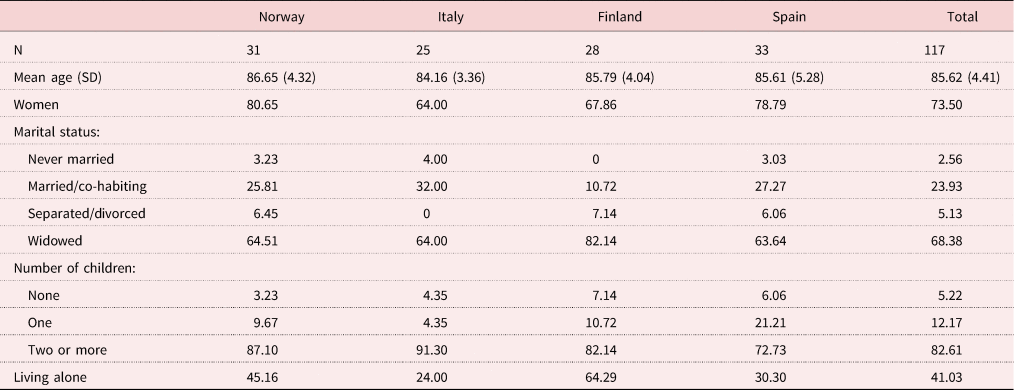
Individuals were offered the opportunity to participate, or alternatively were invited to take part by personnel from the centres, regardless of whether they were women or men. A total of 117 participants were recruited: 43 from senior community centres, 31 from adult day care centres and 43 from nursing homes. They were selected along the following criteria: (a) being over 80 years of age; (b) cognitively able to participate; and (c) able to speak fluently in the language of the focus group. Table 1 shows the socio-demographic information of the participants. Most of them were women, who are more prone to be involved in research activities.
Socio-demographic and social characteristics, by country and overall

Notes: Values are percentages unless otherwise indicated. SD: standard deviation.
Theoretical framework
This work is based on the relativism position, as reality could be seen as ‘relative’ according to how individuals experience it at any given time and place (Moon and Blackman, Reference Moon and Blackman2014). The epistemological framework was social constructionism, with an interpretivism approach, meaning the interpretation of reality is historically situated and culturally derived (Moon and Blackman, Reference Moon and Blackman2014), which is a starting assumption for the comparison between Mediterranean and Nordic countries. Interpretivist approaches are generally qualitative, as the present study. These approaches look at individual cases to try to understand a phenomenon (Crotty and Crotty, Reference Crotty and Crotty1998), as the focus groups tried to depict what MWB meant to the oldest old age group, regardless of the scientists’ pre-understanding on the topic (Patton, Reference Patton2002). Additionally, a hermeneutic method was followed: the hidden meaning of the transcriptions was also interpreted, beneath the apparent ones.
Data collection
A semi-structured topic guide was built, including several open-ended questions about what MWB means for the participants, what it means to feel well and what is important to feel well (see the online supplementary material).
Theoretical saturation criterion, meaning the point when a category is overloaded (Glaser and Strauss, Reference Glaser and Strauss2017), was followed, in order to guarantee qualitative rigour in terms of judging when to stop data collection. Following recommendations about the number and design of the focus group (Krueger and Casey, Reference Krueger and Casey2000), a total of 24 focus groups were performed. Each focus group included three to eight individuals.
Before being introduced to the study aims, participants were informed about the confidentiality of the data collection and were asked about their socio-demographic characteristics. Participants’ own experiences, thoughts and views on MWB were explored, encouraging them to discuss the topic freely. Researchers made sure that they all had the opportunity to share their experiences on the phenomenon. Participants living in nursing homes or attending day care centres knew each other, while individuals from senior centres might or might not know other users. Focus group sessions were carried out in the local language of each region and were led by a moderator and an assistant with previous experience in developing and performing focus groups. All moderators and assistants participated in a training course in order to standardise procedures in all countries. Whenever possible, the focus groups were carried out in a private room of the institution where the participants had been recruited. In some cases, personnel from the centres were present in the room to help participants with special needs or higher levels of physical disabilities.
Data analysis
Qualitative content analysis with an inductive approach was carried out on all data (Graneheim et al., Reference Graneheim, Lindgren and Lundman2017). This method moves from the data to a theoretical understanding by emphasising variations, similarities and differences in the data. It is characterised by a search for patterns, which are then classified in nodes on various levels. Researchers went deeper in the meaning of participants’ words by analysing both manifest and latent content at varying levels of interpretation. That is, latent analysis requires a high level of interpretation while the study of manifest content is based on a description of the data. These analyses were conducted based on the guidelines offered by Bengtsson (Reference Bengtsson2016): the results were presented as categories, divided into smaller sub-categories or pooled into broader themes. One researcher coded all focus groups – reading them several times, highlighting words and phrases (i.e. meaning units) judged to reflect the social dimension impact on MWB, and assembling these units into broader themes, categories and smaller sub-categories. This categorisation was reviewed and discussed with three other researchers. Once the categories were agreed upon, a second researcher independently coded a random selection of six (25%) from the focus group. The agreement between researchers in the way data were labelled and sorted was assessed in order to address reliability and to improve validity (Graneheim and Lundman, Reference Graneheim and Lundman2004) and a high degree of concordance between the two researchers who independently analysed the focus group was achieved, with 99.64 per cent of the statements being identically coded. One focus group was excluded as the audio recording was faulty and it was deemed not to have fulfilled the quality criteria. Qualitative analysis was performed, assisted by the computer software NVivo version 12 (QSR International, Melbourne).
Results
The respondents’ perspectives were classified into five themes: social network, opportunities for social engagement, social support, value of social interactions and social connectedness, and each one was further classified into various categories.
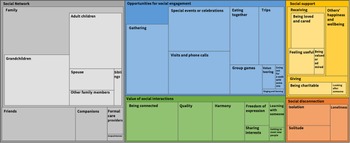
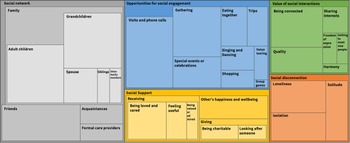
Figures 1 and 2 show a conceptual model of the socio-relational aspects for Mediterranean and Nordic countries, respectively. These maps include all themes (in the darkest colours), categories (in medium-light colours) and sub-categories (in the lightest colours), and their grade of importance according to the participants’ experiences. ‘Grade of importance’ means which themes, categories or sub-categories received more citations by participants when analysing the data (i.e. in terms of frequency). Quotations provide a comprehensive overview of the findings and enhance differences between countries, although the importance of the social dimension for MWB in later life appeared in all focus groups in a consistent way.
Hierarchical map: conceptual model of themes of the social dimension of mental wellbeing according to the Mediterranean participants’ experiences.
Notes: The intensity of the colours represents, from the darkest to the lightest, themes, categories and sub-categories. The size of each rectangle corresponds to the strength of codification (i.e. bigger rectangles represent more statements).

Hierarchical map: conceptual model of themes of the social dimension of mental wellbeing according to the Nordic participants’ experiences.
Notes: The intensity of the colours represents, from the darkest to the lightest, themes, categories and sub-categories. The size of each rectangle corresponds to the strength of codification (i.e. bigger rectangles represent more statements).

Social network
Social network was the most relevant aspect among all the themes. It was divided into five categories: family, friends, acquaintances, formal care providers and companions/residents. A major part of the codifications referred to the family category, particularly for participants from Italy and Spain. The closest family was described as the most important social contact, providing social support, practical help and care, and feelings of love:
I feel good with my family. Primarily with my family. With all my family in general. It is with whom I feel better. (Spain)
Children and grandchildren were the most frequently mentioned relatives for supporting the MWB of the oldest old. With a slight difference to Nordics, grandchildren seem to have a major weight in the MWB of the oldest old from Mediterranean countries. Many participants described how grandchildren added meaning to their lives and that looking after them brought them joy. Otherwise, in the Nordic context, participants mentioned their adult children more frequently. Furthermore, participants underlined the importance of having friends, sharing time and interests with them, and remembering old times together, especially in the Nordic context:
I have many friends, both younger and older, I think that I fit in everywhere (laughter). That is enough for me. (Finland)
Participants from Mediterranean countries mentioned companions (i.e. the residents they live with – a category described by participants living in nursing homes) as relationships enhancing their MWB, whereas participants from Nordic countries mentioned them very few times and generally in relation to activities done together in the residential home. In addition, formal care providers were identified as part of the social network influencing the MWB of the oldest old mainly in Nordic countries. They discussed the availability and kindness of the formal care providers, as well as their attention if something happened and they needed help and care, all of which enhanced their MWB:
And we are so well taken care of here. And these nurses are so kind … The girls [nurses], these from … from Bosnia, they say hello and are always happy. One never sees grumpy faces from them, I think that is really positive. (Finland)
Acquaintances – i.e. people whom the participants know slightly, but who are not close friends, such as neighbours or former workmates – seemed to have the same importance as the formal care providers in Finland and Norway, whereas Mediterranean participants barely mentioned them:
I have to say that I have a large social network and I am quite social. I think I have many friends and acquaintances and it makes a big difference if you have a social network, it does a lot for one's wellbeing … at least for me. (Finland)
Some participants felt that staying in a nursing home was a limitation for accessing their usual social contacts or enjoying their everyday surroundings, especially in the Nordic context. Nevertheless, also in the Nordic context, they mentioned activities within the residential homes as a way to appreciate a new sense of social life. Neither Mediterranean nor Nordic people felt this change of living situation as worsening their MWB. In some cases, they expressed their gratitude for leaving behind the isolation of their own home and they felt they had relieved their children from the caring responsibilities.
Opportunities for social engagement
This theme was divided into ten categories that described various social activities: singing and dancing, eating together, gathering, shopping (e.g. doing the groceries or buying clothes), group games (e.g. playing cards or bingo), special events or celebrations, travelling, visits and phone calls, volunteering and going out for a walk with someone. All the activities reported to be meaningful for MWB included a social nuance (i.e. opportunities to get to know new people, meet friends or share moments with the spouse).
Having opportunities for social engagement showed a great importance in both Nordic and Mediterranean contexts. ‘Gathering’ referred to a group of individuals meeting together for a specific purpose, mainly with family members. Participants stressed the importance of seeing all of their family members together, of having opportunities to talk freely, laughing, sharing moments and celebrating special events for their MWB. They mentioned actively trying to gather all family members a few times a year because these were the happiest moments. These positive emotions seem to be linked, on the one hand, to feeling connected, and on the other, to seeing that their loved ones are doing well, are satisfied with their life, healthy and in harmony with their own families:
I'm feeling good when we gather about six times per year with daughters, sons-in-law and grandchildren. In family … we gather and that is my biggest happiness. My biggest happiness is to see all of them together. (Spain)
When you mentioned something that makes you happy, something that is very close to me right now, is that my husband will turn 85 at the end of the month … that is very nice when our children are gathered … We really look forward to being together on Friday, Saturday and Sunday. (Norway)
‘Volunteering’ specifically referred to helping someone else via an organisation, which can be considered to be different from informal help (see below). Volunteering had a very positive impact on the oldest old's MWB, as it promoted feelings of altruism and of being appreciated. Moreover, most participants involved in voluntary work underlined the positive relationships they developed when they helped others.
Some participants reported appreciating group activities, such as ‘walking in a group’, as enhancing MWB in Mediterranean countries, whereas this category did not appear in the Nordic context, where respondents said they enjoyed walking alone in nature to find serenity (see below in the category of ‘solitude’).
‘Visits and phone calls’ was slightly more important in the Nordic countries, as a way to keep in touch with loved ones. Participants described feeling good not only when receiving visits, but also when they are the ones to go visiting other residents to make them feel better:
And then a good wellbeing for me is that I have a boyfriend lasting 30 years. He calls me both morning and evening, he has called already today, and that means a lot. (Finland)
‘Eating together’ makes the oldest old very happy, especially in the Mediterranean countries. They appreciated going out for dinner, but also cooking themselves for the whole family. They experienced the meal like a moment, an occasion for gathering and sharing, with the addition of the pleasure of the good food:
We have a small house. We put two tables together. It looks like a wedding. I love cooking and that they come to eat broth and paella. I don't mind cooking all day long. (Spain)
Social support
The theme social support described connections between individuals, the values arising from these connections, and the moral and practical help received or given. It implied companionship, a sense of belonging, trust in one another, and the degree to which a person is integrated within a social network. This theme was divided into three categories: others’ happiness and wellbeing, the social support received and the social support given.
In the Nordic context, the most cited sub-category was ‘being loved and cared for’, under the category ‘social support received’:
And you are so lucky that you live in your own home and feel fine there as well. That's very important, and having someone who cares for you. (Norway)
On the other hand, in Mediterranean countries the aspect most frequently mentioned was ‘others’ happiness and wellbeing’ (to know that their loved ones were well or had been successful in terms of work or personal matters):
Many times at home, when my daughter or my son phone and tell me: look, X has already got a job, Y has already settled down. And they tell me things … and so I feel very satisfied and happy. And, the same with the others. If they tell me that a nephew has had success in his job, and things like that. (Spain)
In general, considering the social support given and received, it seemed that receiving social support (e.g. be loved and cared for) had a greater influence on MWB than giving social support. Nevertheless, being able to help other people in everyday life also had a positive impact on MWB, making participants feel needed and useful, and producing a beneficial role in terms of being able to promote the MWB of another person.
Value of social interactions
Within this theme, the most frequently mentioned category was ‘being connected’, underlining the need and the benefits derived from being surrounded by others, from good communication and having company, which creates a sense of connection.
‘Quality’ referred to the type of relations and to the communication with others, indeed the quality of the relationships in all its facets. It described trust in people, to be kind and friendly, to be surrounded by nice people, to be a tight-knit family and to feel comfortable with others. That was the second most cited category both in Nordic and Mediterranean countries:
I feel good when I have someone to stay with, who is a nice, sweet and loving person. (Spain)
And also good relationships with the family. No unfinished business. That's good. (Norway)
There were two other categories linked to this one: ‘harmony’ and ‘freedom of expression’. The former referred to being at peace with others, not to be upset or to argue, but to get along or to mediate in conflicts. The second one was linked to sincerity and to the possibility to speak openly and spontaneously about anything. While harmony was frequently mentioned in Spain and Italy, it was rarely mentioned in Finland and Norway. In contrast, participants in Nordic countries expressed the importance of sharing interests, moments or activities as a way to maintain intergenerational contact:
We are all collectors. Three of us went to the jumble sale last Saturday, and I had a grandchild from Oslo with me who also likes jumble sales. She is an engineer. And she likes going to jumble sales. I think it's very nice that at least one of my grandchildren is seriously interested in jumble sales. (Norway)
Social connectedness
Social connectedness means to stay or feel alone, and it reflects both the positive and negative aspects. It includes the feeling of loneliness, the feeling of solitude and the experience of being isolated. While loneliness could be conceptualised as the discrepancy between the desired and actual interaction with others, and so a measure of the negative feelings held by individuals about their levels of social interaction (Victor et al., Reference Victor, Scambler, Bond and Bowling2000), solitude refers to the situation of being alone as a choice, enjoying this state. Isolation means the objective experience of being alone, a lack of integration with social networks and of meaningful social ties (Victor et al., Reference Victor, Scambler, Bond and Bowling2000).
Solitude had a significantly higher number of citations in Nordic countries, as the oldest old from Nordic countries appeared to appreciate solitude to a greater extent than the Mediterranean participants, resulting in a higher number of codifications for this category. They described feeling good having a walk alone, enjoying a natural landscape, the sounds of nature and the sunny weather. Solitude had a positive nuance, as it was related to a sense of autonomy, feelings of calm, inner peace and the opportunity to devote time to something they enjoy:
I am the type of person that is comfortable alone too. I do not suffer from it. Our priest suggested that I should search for another life partner, and I said no, I think it is fine to be on my own. And then I read somewhere that ‘to be alone is hell, but being able to be alone is heaven’. (Finland)
However, in general, participants also feared the possibility of experiencing loneliness and they were worried about being abandoned. This perception was especially felt by Mediterranean people:
I am 86 years old and what makes me upset the most is loneliness. (Spain)
They described how they actively tried to maintain their meaningful social network and the contact with friends by participating in different social activities in order to avoid the experience of loneliness. Isolation was less cited than loneliness, probably due to the fact that the experience of loneliness is the feeling that makes people feel sad, but in all countries most participants expressed the preference to be connected with people and not to be left alone or isolated.
Discussion
To the best of our knowledge, this is the first study that provides a comprehensive comparison of the social aspects affecting the MWB of the oldest old between Mediterranean and Nordic countries.
The same five main themes were identified in all participating countries. The oldest old reported that having social contacts, as well as interactions with those close to them, were essential for their MWB. Family seemed to be the most important driver of the MWB of the oldest old. Simply knowing that their loved ones were feeling and doing well, and providing support to them, enhanced the participants MWB. This need to feel connected and appreciated by others concurs with previous studies showing that social relationships have an essential role for MWB, health and survival, and are particularly important during old age (Holt-Lunstad et al., Reference Holt-Lunstad, Smith and Layton2010; Halaweh et al., Reference Halaweh, Dahlin-Ivanoff, Svantesson and Willén2018).
Our results revealed that the relationships with the immediate family and life-long friends are important for the MWB of the oldest old, and line up with earlier evidence (Forsman et al., Reference Forsman, Herberts, Nyqvist, Wahlbeck and Schierenbeck2013; Gouveia et al., Reference Gouveia, Matos and Schouten2016). This seemed to be related to the social support received, as well as generating feelings of being loved and cared for, of mutual trust and a sense of security, findings in line with the above-cited Putnam's theory (Putnam, Reference Putnam1993). These factors have been found to be important for the MWB of the oldest old (Bowling and Gabriel, Reference Bowling and Gabriel2007), and have been previously associated with positive self-perception, happiness and healthy ageing (Thomas, Reference Thomas2009). High-quality relationships enhanced MWB through the sense of belongingness (Fiori et al., Reference Fiori, Antonucci and Cortina2006), and participants in the current study reported that they enjoyed sharing life events and related memories with people close to them. Friends of the same age were not only more likely to share common interests, but also to experience similar situations across their lives, contributing to feelings of being understood and accepted. Among family members, the relationships with grandchildren seemed to have a special importance, the experience of being a grandparent is a positive and desired event for many older adults (Breheny et al., Reference Breheny, Stephens and Spilsbury2013). These findings could be supported by the socio-emotional selectivity theory (Carstensen et al., Reference Carstensen, Fung and Charles2003), which suggests that older people benefit from meaningful social relationships and value them more than younger people, as they tend to intensify only meaningful relationships with their loved ones (Löckenhoff and Carstensen, Reference Löckenhoff and Carstensen2004).
Remaining and feeling connected to others and to the community appears to be one of the most powerful keys to MWB. Moreover, it seemed that, despite social relationships being the most significant drivers of MWB in oldest old age, they must be harmonious, peaceful and positive, with good communication and freedom of expression in order to be meaningful. The quality of the social relationships may also contribute towards staving off feelings of loneliness. Previous studies have also confirmed that having high-quality relationships is one of the most important predictors of MWB, happiness and physical health across the lifespan (Leung et al., Reference Leung, Kier, Fung, Fung, Sproule, Shinjini and Antonella2013). These findings are in line with the social capital theory, as it considers the values that arise from connections and relationships (Putnam, Reference Putnam1993).
Furthermore, participants emphasised that their MWB was fostered through opportunities for helping and promoting others’ wellbeing, producing a feeling of being needed and useful. A past study reported that giving support to others, especially to close friends and family members, could contribute to MWB in older adults, encouraging a sense of identity and usefulness (Thomas, Reference Thomas2009).
In a similar way, respondents reported that being engaged in volunteering fostered their MWB, not for the activity itself, but for the opportunity to build a relationship with those they helped. Volunteering was reported to affect MWB in older adults positively (Morrow-Howell et al., Reference Morrow-Howell, Hinterlong, Rozario and Tang2003), particularly when the nature of these activities is challenging and meaningful. This could be seen as a form of self-realisation, sense of purpose and meaning in life (eudaimonic MWB). This could be linked again with the socio-emotional selectivity theory, which suggests that older people perceive life as at its end, the future as limited, so they focus on present-oriented purposes to maximise positive emotions and to avoid the negative ones (Löckenhoff and Carstensen, Reference Löckenhoff and Carstensen2004).
Meaningful social activities are an essential part of everyday life for maintaining social contacts, enabling interpersonal relationships and enhancing a sense of belonging. In some cases, these activities also let participants feel needed or appreciated, maybe strengthening their self-esteem. Our findings support anterior evidence linking MWB and social participation in the oldest old (Forsman et al., Reference Forsman, Herberts, Nyqvist, Wahlbeck and Schierenbeck2013). Participants also reported changes in their activities due to the ageing process, and this is supported by the activity theory (Lemon et al., Reference Lemon, Bengtson and Peterson1972): new activities can replace those activities that are withdrawn due to limitations, changes in events or situations, or disabilities. Novel and fruitful activities can enhance a sense of growth and MWB, and can in some way address adaptation, also helping to achieve the need for competence and autonomy (Neubauer et al., Reference Neubauer, Schilling and Wahl2017). Participants reported to be satisfied with their lives, even if they had to abandon some activities and hobbies, or even if they had lost some friends (evaluative MWB). It seems that they were aware that they had already lived their life at the best, and at the present moment they focused on savouring the little moments (hedonic MWB), and their happiness came most from the happiness and wellbeing of their loved ones, as they wished for them the same life satisfaction that they had experienced. They also tended to tell past wonderful memories, and it seems that they felt well just reminiscing about them.
Regarding the second aim of the article, some differences appeared between the participants living in Nordic and Mediterranean countries. Mediterranean participants appeared to place more value on the interactions with the closest family, whereas Nordic participants described the importance of autonomy, as well as of the relationships with friends to a greater extent. This is in line with earlier research indicating that the social life in the Mediterranean region differs substantially from the one in the Nordic regions (Viazzo, Reference Viazzo2003). In Mediterranean countries, people rely more on family members (Kalmijn and Saraceno, Reference Kalmijn and Saraceno2008), with adult children providing more support to their parents (Daatland and Herlofson, Reference Daatland and Herlofson2003), while in Nordic countries there is a larger exchange of assistance outside the family. For instance, in Norway, retirement pension is provided universally to all, regardless of previous job circumstances. Therefore, the state rather than the family is perceived as the main economic provider for older adults (Daatland and Herlofson, Reference Daatland and Herlofson2004). Moreover, in more collectivistic countries such as Mediterranean ones, family and community are highly valued, while in more individualistic countries such as in the Nordic ones, interactions with friends are highly valued (Lykes and Kemmelmeier, Reference Lykes and Kemmelmeier2014). Nordic countries showed more trust among citizens, feelings of safety and higher social cohesion, while Mediterranean countries may rely more on immediate social network (i.e. family) (Helliwell et al., Reference Helliwell, Layard, Sachs and De Neve2020). Specifically, the social dimension of MWB appears to be key to strengthening health outcomes for older people in Spain, with a strong role for the social support from younger family members. In Italy, marital status and personal satisfaction about exchanges with family and non-family members is documented to play a crucial role in the assessment of MWB, as well as family support (Hitchcott et al., Reference Hitchcott, Fastame, Ferrai and Penna2017).
Participants from Mediterranean countries mentioned other residents from the nursing homes as relationships enhancing their MWB, whereas oldest old from Nordic countries made few such mentions, and generally in relation to activities done together. Furthermore, formal care providers were identified as part of the social network influencing the MWB of the oldest old mainly in Nordic countries. These findings line up with a Norwegian qualitative study that found personal relationships with companions not to be essential for enhancing MWB among all residents in nursing homes (Bergland and Kirkevold, Reference Bergland and Kirkevold2008). The same authors reported in another study that receiving appropriate care from kind formal care providers made life easier for all residents, although it contributed to promoting MWB only for some (Bergland and Kirkevold, Reference Bergland and Kirkevold2005).
Respondents showed a greater fear of loneliness in the Mediterranean context, whereas solitude was mentioned as an important value in Nordic countries. This is in line with a study suggesting that people in Mediterranean countries express a greater sense of loneliness than those in non-Mediterranean ones (Litwin, Reference Litwin2009). On the other hand, people living in Nordic countries would experience a high sense of autonomy and freedom (Helliwell et al., Reference Helliwell, Layard, Sachs and De Neve2020). Another study found out that older Norwegian adults are more likely to focus on their individual responsibility to secure their psychological sense of community and MWB, by being involved and participating with friends and neighbours and in the community. In this way, they also shape old age-related transitions – such as retirement, friends and community members dying, and children getting their own family – and try not to undertake them alone (Bahl et al., Reference Bahl, Nafstad, Blakar and Geirdal2017). More collectivistic societies may give greater importance to interpersonal ties and so they have higher expectations regarding social contact and interactions. The lack of such ties is likely to be experienced as painful, increasing feelings of loneliness, as loneliness constitutes a psychological response when an individual does not fulfil cultural expectations (Lykes and Kemmelmeier, Reference Lykes and Kemmelmeier2014). Otherwise, in the Nordic countries the feeling of loneliness was more strongly linked to the need for assistance, presumably because relying on others contrasts with the ideal of personal independence and self-determination (Lykes and Kemmelmeier, Reference Lykes and Kemmelmeier2014). Moreover, it could be that the high level of social activity of the Nordic countries results in a lower prevalence of loneliness among older adults, compared to the rest of the European countries (Hansen and Slagsvold, Reference Hansen and Slagsvold2016). Interestingly, even if most Finnish participants were living alone, they did not report feelings of loneliness as much as their Mediterranean counterparts. This could be again related to cultural differences among these participants, so that living alone may have more harmful effects on those from southern countries. On the contrary, individuals from Nordic countries would recognise the value of autonomy. The theme social connectedness thus attempts to cover all these related but different concepts. Solitude was mostly mentioned by the Nordics, otherwise, the Mediterranean participants reported feeling lonely more frequently than their Nordic counterparts. Further, the reported experiences of isolation and loneliness could be influenced by the fact that many participants were living alone (Table 1), due to the ageing process and the changes that this could bring.
Strengths and weaknesses
The strengths of the study were including four European countries and involving a participant sample with different levels of functioning. Focus groups were held in a neutral context, meaning that they were held in a standard meeting room of a centre where participants lived or which they attended regularly. There was no previous relationship between the researchers and the participants, and, despite the semi-structured data collection method, researchers were very careful to not influence the participants’ answers. Moreover, this semi-structured discussion guide was evaluated through a pilot focus group to ensure trustworthiness, accuracy and validity. There was no hierarchical relationship between participants, meaning they were comfortable to express themselves freely, which ultimately results in higher trustworthiness (Graneheim et al., Reference Graneheim, Lindgren and Lundman2017). Furthermore, the qualitative method allowed for nuances to be expressed, and detailed analysis of the social dimension to be made. It also allowed researchers to focus on how respondents made sense of their experiences and transformed experiences into consciousness, attempting to find the essence of the studied phenomenon (Patton, Reference Patton2002).
However, the study findings should also be considered in light of some limitations. Firstly, even though data were collected from a neutral perspective (Bengtsson, Reference Bengtsson2016), misinterpretations and bias may be possible due to ‘pre-understanding’ on the part of the researchers. However, the use of a topic guide during the discussions and a multiple coding method to analyse the data, which are regarded as measures of inter-rater reliability (Mays and Pope, Reference Mays and Pope1995), were used to reduce this possibility. Secondly, the results are based on a convenience sample (e.g. most of our participants were women), so their generalisation cannot be assured. Thirdly, participants were not directly asked to speak about what negatively affected their MWB, but to focus on the positive aspects that maintain and strengthen MWB, so the relevance of the theme of social connectedness could have been underestimated. Finally, the translation process could have slightly modified the real conversation with the loss of some nuances.
Study contribution
The results of the present study emphasise the importance of socio-relational aspects to enhance and maintain the MWB of the oldest old. Interactions with family and close friends should be promoted, as they are major contributors of MWB in oldest old age. Staying in a residential location could affect and restrict the oldest old's social network, so it could be useful to plan solutions to facilitate connections with their life-long relationships. Participation could enhance positive relationships and their sense of integration and belonging, positively affecting their MWB.
The differences between Nordic and Mediterranean countries suggest the possibility of a cultural influence on MWB. It then seems important to analyse MWB in the light of cultural differences, as well as by the distinct welfare states. The possibility of a cultural influence on MWB could also open up to different potential interventions and policies to promote MWB. For example, as the oldest old in Nordic countries have a strong motivation and enjoy participating in their local communities, initiatives that promote their participation might enhance their MWB. On the other hand, the Mediterranean countries could benefit from actions promoting and finding ways to make the oldest old keep in touch with their families, giving them the opportunity to be active agents in these relations.
In all cases, formal care providers should be aware of the relevance that their interactions with the oldest old have on their MWB. They could also be aware of the availability, types and frequency of interactions among them, better identifying those who may need additional support. Given the more limited social network of the oldest old and the experiences of loss they could have had, their social inclusion is an urgent issue that should be addressed in order to reduce loneliness and social isolation. It has been found that participatory music engagement has the capacity to support MWB (Perkins et al., Reference Perkins, Mason-Bertrand, Fancourt, Baxter and Williamon2020). Introducing this activity into nursing homes could be feasible and useful. It could be important to include these individuals in the society, with active roles in the community, not only because the oldest old would benefit from this participation, resulting in better mental and physical health, but also because the society itself would benefit from their experience and contribution. Understanding the different needs of the oldest old should be the first step towards the development of optimal attention to an ageing population.
Conclusion
The social dimension seemed to be crucial for MWB in oldest old age, with the social network and its quality having been found to be fundamental. Family seemed to be the most important driver of MWB, in particular for participants in the Mediterranean context, followed by the relationship with close friends, especially for those from Nordic countries. Participants felt better when they felt they were needed, cared for, loved, and connected to other people. Participants also feared loneliness and isolation, and reported these as negatively affecting their MWB. Feelings of solitude were appreciated mainly from participants of the Nordic context. Initiatives to promote positive interactions with friends and family, as well as social activities within the community, may contribute to strengthen MWB in oldest old age.
Supplementary material
The supplementary material for this article can be found at https://doi.org/10.1017/S0144686X21001458
Acknowledgements
Our deepest appreciation to all the individuals who helped with the recruitment process: the Departamento de Programación, Evaluación y Desarrollo; Dirección General de Personas Mayores y Servicios Sociales; Área de Gobierno de Equidad, Derechos Sociales y Empleo; Ayuntamiento de Madrid; and Agencia Madrileña de Atención Social, Consejería de Políticas Sociales, Familias, Igualdad y Natalidad in Spain. We also thank the study participants for their generous contribution, which made this work possible.
Author contributions
Conceptualisation: CC, MM, EL; investigation and methodology: MM, EL, NM-M, JC-S, AKF, JN, MA, VD, FA; data curation: MM, EL, NM-M, JC-S, AKF, JN, MA, VD; formal analysis: CC, EL; writing – original draft preparation: CC, MM, EL, NM-M; writing – review and editing: CC, MM, EL, NM-M, JC-S, AKF, JN, MA, VD, FA; supervision: MM, EL; funding acquisition: MM, FA.
Financial support
This work was supported by The Joint Programming Initiative (JPI) ‘More Years, Better Lives – The Potential and Challenges of Demographic Change’; the ‘Acciones de Programación Conjunta Internacional 2016’ programme (PCIN-2016-118) of the Spanish Research Agency (AEI) of the Spanish Ministry of Science and Innovation; the Italian Ministry of Health; the Academy of Finland; the Research Council of Norway; the Universidad Autónoma de Madrid, Spain (CC and NMM, ‘Contratos predoctorales para Formación de Personal Investigador, FPI-UAM’); the Sara Borrell postdoctoral programme (CD18/00099) from the Instituto de Salud Carlos III (Spain) co-funded by the European Union (ERDF/ESF, ‘Investing in your future’) (EL).
Conflict of interest
The authors declare no conflicts of interest.
Ethical standards
Ethical approval was obtained from each of the local ethics research review committees: Ethics Research Committee National Institute for Health and Welfare, Finland; Ethics Committee of the Verona and Rovigo Provinces, Italy; Regional Ethics Committee, Regional Committees for Medical and Health Research Ethics, Norway; and Ethics Research Committee Universidad Autónoma de Madrid, Spain.