Introduction
Tics are defined as involuntary sudden, recurrent, non-rhythmic, stereotypical motor movements or vocalizations (Diagnostic and Statistical Manual of Mental Disorders, fourth edition, text revision; DSM-IV-TR; American Psychiatric Association, 2000), varying from almost indiscernible eye-blinking to complex motor movements involving multiple muscle systems. The DSM-IV-TR (American Psychiatric Association, 2000) distinguishes four categories of tic disorders: Tourette's disorder, also called Tourette's syndrome (TS), chronic motor or vocal tic disorder, transient tic disorder, and tic disorder not otherwise specified (NOS). Tic diagnosis depends on age of onset, duration and type (motor, vocal or both). Tics typically first manifest between the ages of 4 and 6 years, and peak in severity between 10 and 12 years (Erenberg et al. Reference Erenberg, Cruse and Rothner1987). Over 70% of patients experience significant reduction in tic frequency and intensity by adulthood (Bloch & Leckman, Reference Bloch and Leckman2009; Cath et al. Reference Cath, Hedderly, Ludolph, Stern, Murphy, Hartmann, Czernecki, Robertson, Martino, Munchau and Rizzo2011).
Community-based studies have produced disparate TS prevalence estimates in children and adolescents – ranging from 0.5 to 38 cases per 1000 (Apter et al. Reference Apter, Pauls, Bleich, Zohar, Kron, Ratzoni, Dycian, Kotler, Weizman, Gadot and Cohen1993; Scahill et al. Reference Scahill, Sukhodolsky, Williams and Leckman2005; Hirtz et al. Reference Hirtz, Thurman, Gwinn-Hardy, Mohamed, Chaudhuri and Zalutsky2007; Robertson et al. Reference Robertson, Eapen and Cavanna2009; Knight et al. Reference Knight, Steeves, Day, Lowerison, Jette and Pringsheim2012; Mathews et al. Reference Mathews, Scharf, Miller, Macdonald-Wallis, Lawlor and Ben-Shlomo2014; Miller et al. Reference Miller, Scharf, Mathews and Ben-Shlomo2014). In a review study Scahill et al. (Reference Scahill, Dalsgaard, Bradbury, Martino and Leckman2013) concluded that the prevalence of TS in children between the ages of 6 and 18 years lies between 0.5% and 0.7%. Estimates for chronic motor tics range from 0.3% to 0.8% (Kurlan et al. Reference Kurlan, McDermott, Deeley, Como, Brower, Eapen, Andresen and Miller2001; Khalifa, Reference Khalifa2006; Scahill et al. Reference Scahill, Williams, Schwab-Stone, Applegate and Leckman2006; Cubo et al. Reference Cubo, Gabriel y Galán, Villaverde, Velasco, Benito, Macarrón, Guevara, Louis and Benito-León2011; Kraft et al. Reference Kraft, Dalsgaard, Obel, Thomsen, Henriksen and Scahill2012) in several studies in children. Male:female ratios vary between 3:1 and 4:1, with higher prevalence rates in boys (1.06% to 4.5% in boys, and 0.25% to 1.7% in girls; Lichtenstein et al. Reference Larson, Anckarsäter, Gillberg, Ståhlberg, Carlström, Kadesjö, Råstam, Lichtenstein and Gillberg2010; Knight et al. Reference Knight, Steeves, Day, Lowerison, Jette and Pringsheim2012).
In adults, tic prevalence rates are considerably lower, with estimates of 0.05% to 0.1% for TS, and of 0.08% to 6.7% for any tic disorders (Zohar et al. Reference Zohar, Ratzoni, Pauls, Apter, Bleich, Kron, Rappaport, Weizman and Cohen1992; Apter et al. Reference Apter, Pauls, Bleich, Zohar, Kron, Ratzoni, Dycian, Kotler, Weizman, Gadot and Cohen1993; Robertson et al. Reference Robertson, Verril, Mercer, James and Pauls1994; Eapen et al. Reference Eapen, Laker, Anfield, Dobbs and Robertson2001; Wenning et al. Reference Wenning, Kiechl, Seppi, Müller, Högl, Saletu, Rungger, Gasperi, Willeit and Poewe2005; Bar-Dayan et al. Reference Bar-Dayan, Arnson and Elishkevits2010; Schlander et al. Reference Schlander, Schwarz, Rothenberger and Roessner2011; Knight et al. Reference Knight, Steeves, Day, Lowerison, Jette and Pringsheim2012). A Swedish population-based twin study (n = 21 911) found prevalence rates of 6.7% for having any tic, and 1.4% for having TS (not taking the DSM-IV-TR criterion of presence of at least one vocal tic into account) (Pinto et al. Reference Pinto, Monzani, Leckman, Rück, Serlachius, Lichtenstein and Mataix-Cols2016).
The causes of individual differences in tic disorder characteristics and severity are poorly understood. Genetic and environmental factors contribute to phenotypic variation. There is some suggestion of assortative mating (i.e. spousal resemblance) for tics (Kurlan et al. Reference Kurlan, Eapen, Stern, McDermott and Robertson1994; Hasstedt et al. Reference Hasstedt, Leppert, Filloux, van de Wetering and McMahon1995) but studies have been scarce. The presence of parental data allows us to take into account assortative mating. This is important, as assortative mating in the parental generation may in their offspring increase the genetic correlations between siblings including dizygotic (DZ) twins (these are on average 0.5 under random mating). This may bias the results obtained from the classical twin design, with underestimation of heritability and overestimation of shared environmental effects. In family studies, heritability estimates of TS and tic symptoms range from 0.18 to 0.77 (Pauls et al. Reference Pauls, Raymond, Stevenson and Leckman1991; Mathews & Grados, Reference Mathews and Grados2011; de Haan et al. Reference de Haan, Delucchi, Mathews and Cath2015; Hirschtritt et al. Reference Hirschtritt, Lee, Pauls, Dion, Grados, Illmann, King, Sandor, McMahon, Lyon, Cath, Kurlan, Robertson, Osiecki, Scharf and Mathews2015; Mataix-Cols et al. Reference Mataix-Cols, Isomura, Pérez-Vigil, Chang, Rück, Larsson, Leckman, Serlachius, Larsson and Lichtenstein2015). Tic risk in first-degree relatives of tic sufferers is high (Mataix-Cols et al. 2015). In one small clinical twin study (Price et al. Reference Price, Kidd, Cohen, Pauls and Leckman1985) of 30 monozygotic (MZ) and 13 DZ twin pairs, concordance rates were 0.53 for MZ pairs and 0.08 for DZ pairs. When criteria were broadened to include any tic, concordance rates were 0.77 for MZ pairs and 0.23 for DZ pairs.
Three population-based twin heritability studies have been performed in children or adolescents, and one in adults (Bolton et al. Reference Bolton, Rijsdijk, O'Connor, Perrin and Eley2007; Lichtenstein et al. Reference Larson, Anckarsäter, Gillberg, Ståhlberg, Carlström, Kadesjö, Råstam, Lichtenstein and Gillberg2010; Anckarsäter et al. Reference Anckarsäter, Lundström, Kollberg, Kerekes, Palm, Carlström, Långström, Magnusson P, Halldner, Bölte, Gillberg, Gumpert, Råstam and Lichtenstein2011; Pinto et al. Reference Pinto, Monzani, Leckman, Rück, Serlachius, Lichtenstein and Mataix-Cols2016). The longitudinal Child and Adolescent Twin Study in Sweden assessed tic disorders in 17 000 twins aged 9–12 years. The assessment consisted of three questions on tic occurrence which the twins' parents answered during a telephone interview (Anckarsäter et al. Reference Anckarsäter, Lundström, Kollberg, Kerekes, Palm, Carlström, Långström, Magnusson P, Halldner, Bölte, Gillberg, Gumpert, Råstam and Lichtenstein2011). Tics were further assessed using the ‘autism – tics, attention-deficit hyperactivity disorder and other comorbidities’ inventory (A-TAC) (Hansson et al. Reference Hansson, Svanström Röjvall, Rastam, Gillberg, Gillberg and Anckarsäter2005; Larson et al. Reference Larson, Anckarsäter, Gillberg, Ståhlberg, Carlström, Kadesjö, Råstam, Lichtenstein and Gillberg2010). Correlations for tic disorder were 0.38 in MZ and 0.11 in DZ twins, and heritability estimates were 0.26 in girls and 0.39 in boys. The heritability estimate of a binary TS diagnosis based on these data (3.1% diagnosed as affected) equalled 0.56 (Lichtenstein et al. Reference Larson, Anckarsäter, Gillberg, Ståhlberg, Carlström, Kadesjö, Råstam, Lichtenstein and Gillberg2010). Furthermore, the Genetic and Environmental Effects on Emotion study estimated the heritability of tic disorders based on a binary diagnosis in 4662 twin pairs aged 4 to 6 years old (Bolton et al. Reference Bolton, Rijsdijk, O'Connor, Perrin and Eley2007). Mothers were interviewed in a two-stage telephone screen with questions on tic occurrence in their 4-year-old twins. The high-scoring sample from stage 1 was selected for stage 2 (n = 854 pairs) and re-interviewed. Using a liability threshold model, the heritability estimate was 0.5. A Japanese twin study employed a liability threshold model to assess the heritability of mother-rated tics in a sample of 1896 twin pairs aged between 3 and 15 years (Ooki, Reference Ooki2005). The mothers rated their twins with respect to the frequency of tic behaviors. Tic heritabilities estimates were 0.28 (boys) and 0.29 (girls), with shared environmental effects explaining 41% of the variance in boys and 32% in girls. Finally, Pinto et al. (Reference Pinto, Monzani, Leckman, Rück, Serlachius, Lichtenstein and Mataix-Cols2016) studied the co-variation of tics, obsessive–compulsive symptoms and attention-deficit/hyperactivity disorder (ADHD) in adult twins (n = 20 821). The tic heritability estimate based on liability threshold modeling was 0.33 (Pinto et al. Reference Pinto, Monzani, Leckman, Rück, Serlachius, Lichtenstein and Mataix-Cols2016). In sum, heritability estimates from epidemiological studies vary between about 0.28 and 0.56, with different tic definitions and rating methods used and most studies estimating tic heritability of a single phenotypic operationalization.
The aim of the present study was to examine the genetic and environmental contributions to tic symptoms using different DSM-IV-TR-derived tic phenotypic definitions in a population-based adult twin-family sample. As different studies use different measures of tics, it is highly useful to explore the influence of these varying measurement methods on variation in tic heritability. In addition, for future genome-wide association studies (GWASs) or other studies using genetic variants, it seems paramount to use those phenotypic tic definitions that capture the most optimal heritability estimates; ‘most optimal’ meaning a combination of significant non-zero heritability and narrower confidence intervals (CIs), reflecting the largest information content.
In addition, an adult twin-family sample has the advantage that lifetime tics are taken into account, allowing tics to be included that develop in adolescence. An extended twin design was used, including twins, siblings and their parents. The presence of parental data allowed us to further study the influence of assortative mating, a topic that has been scarcely addressed in TS (Kurlan et al. Reference Kurlan, Eapen, Stern, McDermott and Robertson1994; McMahon et al. Reference McMahon, van de Wetering, Filloux, Betit, Coon and Leppert1996; Hanna et al. Reference Hanna, Janjua, Contant and Jankovic1999). This is important, as assortative mating may increase the additive genetic correlation among DZ twins (i.e. 0.5 given random mating), which may bias the results obtained when analysing only data from twins. Specifically assortative mating results in overestimation of shared environmental effects, and underestimation of genetic effects. In addition, an extended twin design confers greater power than the classical twin design (Posthuma & Boomsma, Reference Posthuma and Boomsma2000). Our aims were to: (1) quantify the genetic contributions to the various tic phenotypes, using both lenient and strict phenotypic definitions of tics and tic severity; (2) explore the role of assortative mating and dominance effects; and (3) determine how much the heritability estimates vary with phenotypic definition.
Method
Participants
This study is part of an ongoing longitudinal study of twins and families registered in the Netherlands Twin Register (NTR), in which participants complete a series of questionnaires on health and behavior every 2–4 years. A tic questionnaire was included in the 2008 survey (see Willemsen et al. Reference Willemsen, Vink, Abdellaoui, den Braber, van Beek, Draisma, van Dongen, van ‘t Ent, Geels, van Lien, Ligthart, Kattenberg, Mbarek, de Moor, Neijts, Pool, Stroo, Kluft, Suchiman, Slagboom, de Geus and Boomsma2013 for a more detailed description of the data collection). Data from 8323 adult twins and 7164 family members (clustered in 7311 families) were available. Family members included twins, and parents and siblings of twins. From each family, data from two twins, two additional siblings, and their parents, if available, were selected. Non-biological parents and non-full siblings were excluded. In cases of triplets or higher-order multiples, the first- and second-born twins were included. In cases of more twin pairs per family, one twin pair was included. Online Supplementary Table S1 gives the number of family members. Data from both twins were present in 2748 families (38%), and data from twins as well as parents were present in 804 (11%) of the families. Zygosity of same-sex twins was determined by blood type, DNA markers or questionnaire (Rietveld et al. Reference Rietveld, van Der Valk, Bongers, Stroet, Slagboom and Boomsma2000). There were 2714 complete twin pairs with known zygosity (98.8% of all complete twin pairs): 388 MZ and 200 DZ male pairs, 1129 MZ and 507 DZ female pairs, and 490 DZ pairs of opposite sex. The age of twins ranged from 17 to 97 years (mean = 33.1, s.d. = 14.5 years), and the age of siblings from 11 to 88 years (mean = 37.1, s.d. = 13.8 years) and of the 5441 parents from 37 to 94 years (mean = 54.9, s.d. = 8.6 years). Ethical approval for the study was obtained from the Medical Ethical Committee of the VU University Medical Center.
Measures
Data on tics from NTR Survey 8 were collected using the abbreviated Schedule for Tourette and Other Behavioral Syndromes (STOBS-ABBR) that provides a semi-structured assessment on tics, obsessive–compulsive and ADHD symptoms (Pauls & Hurst, Reference Pauls and Hurst1996). This scale has been used widely by the Tourette Syndrome Association International Consortium for Genetics, both as an interview and as a self-report measure. For the NTR 2008 survey, the STOBS was abbreviated to include nine items on the most frequent tics occurring in clinical samples (Freeman et al. Reference Freeman, Fast, Burd, Kerbeshian, Robertson and Sandor2000; Cath et al. Reference Cath, Hedderly, Ludolph, Stern, Murphy, Hartmann, Czernecki, Robertson, Martino, Munchau and Rizzo2011); see online Supplementary Table S2 for the STOBS-ABBR. Participants indicated for each tic type whether they ever/never experienced it. When given the response ‘ever’, they indicated whether the tic had occurred 0–1 year ago, 1–5 years ago, or more than 5 years ago. Subsequently, given a positive response on tic presence, items were filled in on age at onset, duration of tics (<1 year v. >1 year), and tic frequency/severity in three additional self-report items. A paper version of the questionnaire was completed by 7028 participants (45%), and an online version was completed by 8459 participants.
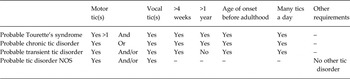
Using the STOBS-ABBR, all participants were classified according to DSM-IV-TR criteria (American Psychiatric Association, 2000) into the following mutually exclusive categories: probable TS, probable chronic (motor or vocal) tic disorder, probable transient tic disorder, or probable tic disorder NOS (see Table 1 for a summary of tic definitions). We added the term ‘probable’, since subjects were classified based on self-report, whereas a tic diagnosis is usually established through interview and observation by experienced clinical experts, a requirement that we were unable to fulfill in this large population-based study. The DSM-IV-TR requires an age at onset before 18 years to fulfill criteria for a tic disorder diagnosis. However, in view of the age-at-onset distributions of our data (Fig. 1) and as used by the Tourette Syndrome Study Group (Anonymous, 1993), we adopted an age of onset ⩽21 years as a requirement for the definitions of ‘probable TS’, ‘probable chronic (motor or vocal) tic disorder’ and ‘probable transient tic disorder’. ‘Probable tic disorder NOS’ did not require the age-of-onset criterion.
Reported age of onset of tics for participants that fulfill criteria of Tourette's syndrome (TS), chronic tic disorder (td.) and transient td. (including the age-of-duration criterion but without the age-of-onset criterion).

DSM-IV-TR criteria for the different tic disorders

DSM-IV-TR, Diagnostic and Statistical Manual of Mental Disorders, fourth edition; NOS, not otherwise specified.
To classify as probable TS, the following was required: (1) positive responding (‘ever’) to at least two motor and one vocal tics; (2) age of onset ⩽21 years; and (3) a tic duration of ⩾1 year. The same criteria were used to classify as a probable chronic tic disorder, except that either one vocal or one motor tic was required. These subjects were further subdivided based on the nature of their tics (motor/vocal). ‘Probable transient tic disorder’ required: (1) one or more motor and/or vocal tics; (2) age at onset ⩽21 years; and (3) tic duration of <1 year. Participants who reported at least one tic, but without an age at onset ⩽21 years, and/or with a tic duration of <1 year were categorized as a probable tic disorder NOS.
For genetic modeling we classified subjects as affected or non-affected according to different inclusion criteria: (1) all subjects who scored any tic at any age of onset for any period of time included as affected (‘any probable tic’ – the most lenient phenotype); (2) subjects with ‘probable TS’, ‘probable chronic tic disorder – motor’, or ‘probable tic disorder – vocal’ were classified as affected; (3) all subjects with probable TS and probable chronic tic disorder – motor tics were classified as affected. One additional definition was considered with three categories: ‘no tic disorder’ (unaffected), ‘probable tic disorder NOS’ combined with ‘probable transient tic disorder‘(affected), and ‘probable chronic tic disorder – motor’, ‘probable chronic tic disorder – vocal’ and ‘probable TS’ (affected).
Statistical analyses
Population prevalences of the different tic disorder definitions were estimated in the entire sample of 15 487 individuals. Fitting the genetic models and calculating correlations between family members were done by assuming that a normally distributed liability underlies the discrete phenotypes (Falconer, Reference Falconer1965, Reference Falconer1967). In the case of a dichotomous phenotype, the threshold separates the two classes of subjects, namely the ‘affected’ and ‘unaffected’. For the trichotomous phenotype, two thresholds were estimated, separating three classes following the definition described above.
To assess the significance of covariates prior to the genetic modeling, we performed logistic regression, examining the covariates sex, age at filling in the questionnaire, method of reporting (paper v. Internet survey) and their interactions. To correct for family clustering, we used the generalized estimation equation (GEE; Dobson & Barnett, Reference Dobson and Barnett2008) with the R package ‘GEE’ and the logistic link function. For all analyses and model-fitting procedures the threshold for significance was set at α = 0.05. We obtained initial estimates of familial resemblance by estimating tetrachoric and polychoric correlations between the liabilities of the family members using the R package ‘polychor’ (https://cran.r-project.org/web/packages/polycor/index.html).
Genetic model fitting was conducted in R package OpenMx version 2.2.4 (Boker et al. Reference Boker, Neale, Maes, Wilde, Spiegel, Brick, Spies, Estabrook, Kenny, Bates, Mehta and Fox2011). Parameters were estimated by raw data maximum-information likelihood. We first tested whether parent–offspring correlations were equal to DZ and sibling correlations (as all share on average 50% of their segregating genes). For the two strictest variable definitions, we encountered computational problems due to the low prevalence, giving rise to empty cells in the tables. We therefore excluded data from siblings and parents. Next, we fitted genetic variance decomposition models. These decompose variance in the liability to have tics into additive genetic (A), unique environmental (E), common environmental (C) and/or dominant genetic factors (D). Since C and D cannot be estimated together, we included C if the MZ correlation was less than twice the DZ twin correlation. If the MZ correlation was larger than twice the DZ correlation, we included D. The influence of common environmental factors and of genetic dominance was tested by comparing a nested AE model with either the ACE or the ADE model using likelihood-ratio tests. The AE models are depicted in online Supplementary Figs S1 and S2.
Results
Descriptive statistics
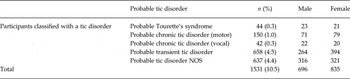
Prevalence rates of STOBS-ABBR tic items are summarized in online Supplementary Table S3. Given these symptoms we derived four probable tic disorder diagnoses in accordance with the DSM-IV-TR (i.e. TS, chronic motor/vocal tic disorder, transient tic disorder and tic disorder NOS). Prevalence rates of these disorder diagnoses varied from 0.3% (probable TS) to 4.5% (probable transient tic disorder; Table 2).
Descriptive statistics: prevalence rates of DSM-IV probable tic disorders

DSM-IV, Diagnostic and Statistical Manual of Mental Disorders, fourth edition; NOS, not otherwise specified.
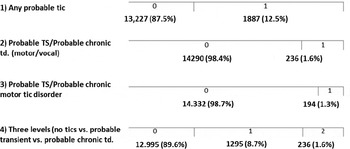
Genetic analyses were performed on the four tic phenotypes grouped together in different ways for the various genetic analyses as described above in the Method section. Fig. 2 shows the prevalence rates for each of these four (three dichotomous and one trichotomous). Depending on the strictness of the phenotype definition, prevalence rates varied from 1.3% (‘probable TS or probable chronic motor tic disorder’) to 12.5% (‘any probable tic’, the most lenient phenotype).
Descriptive statistics: number of unaffected (‘0’) and affected (‘1’ and ‘2’) participants, according to each of the four phenotypes. The fourth phenotype has two thresholds and is a combination of the first and second dichotomous phenotypes. TS, Tourette's syndrome; td., tic disorder.

Thresholds and covariate effects
The locations of the thresholds and effects of covariates are shown in online Supplementary Fig. S3. In all baseline models, separate thresholds were estimated for offspring and parents (e.g. for the ‘any probable tic’ phenotype when only twins and parents were included, one threshold estimate instead of four resulted in a significantly worse fit: χ2 3 = 15.25, p = 0.002; two threshold estimates, one for parents and one for offspring, did not significantly reduce the fit: χ2 2 = 3.07, p = 0.22). Thus, for the ‘any probable tic’ phenotype, threshold estimates for parents were higher than for offspring, indicating that parents reported fewer tics. This was not seen in the more strict dichotomous phenotypes, indicating that the frequency of more severe tic disorders, based on self-report, and after correction for age, did not differ between parents and offspring.
Covariate effects were similar for the dichotomous variables (with the ‘any probable tic’ phenotype corresponding to the lowest threshold and the ‘probable TS or probable chronic tic disorder’ and ‘probable TS or probable chronic motor tic disorder’ phenotypes corresponding to the second threshold). Males were affected more often than females (e.g. for the ‘any probable tic’ dichotomous variable: b = −0.38, s.e. = 0.07, p < 0.001). We observed a decrease in the reporting of tics with increasing age (‘any probable tic’ phenotype, with standardized age: b = −0.17, s.e. = 0.05, p < 0.001). Participants who answered the paper version of the questionnaire (instead of the online version) reported more tics (‘any probable tic’ phenotype: b = −0.16, s.e. = 0.08, p = 0.045; for the stricter tic disorder phenotypes this was not significant; see online Supplementary Table S4). The interaction between age and method of reporting for the second dichotomous phenotype (probable chronic tic disorder and TS v. mild or no tic disorder) was found to be significant (b = −0.33, s.e. = 0.15, p = 0.03).
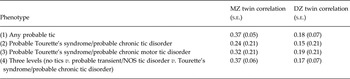
Familial correlations and assortative mating
Familial correlations are shown in Table 3. MZ twin correlations were higher than DZ twin correlations and correlations in other first-degree family members. Online Supplementary Table S5 summarizes the correlations between other family members. Since the correlation structure among relatives did not provide consistent evidence for either dominant genetic or common environmental effects, models with both dominance (ADE) and common environmental effects (ACE) were considered.
MZ and DZ twin polychoric correlations for each phenotype

MZ, Monozygotic; DZ, dizygotic; s.e., standard error; NOS, not otherwise specified.
With respect to exploration of the influence of assortative mating: our data do not support evidence for assortative mating using any of the phenotypic definitions.
Genetic model fitting
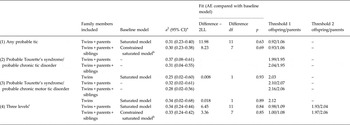
Table 4 shows the results of genetic model fitting, where ACE and ADE differ in that the first model attributes familial resemblance to additive genetic and common environmental factors, and the second model attributes resemblance to additive and non-additive (dominance) genetic factors. In all models the C and D parameters were not significant: comparison with the more parsimonious AE model did not show a significant drop in the fit (e.g. for the first dichotomous phenotype, when twins, parents and siblings were included; AE v. ACE: χ2 1 < 0.001, p > 0.99, and AE v. ADE: χ2 1 = 2.59, p = 0.11). Heritability point estimates ranged from 0.25 to 0.37. Thus, familial resemblance can be explained solely by additive genetic factors. The 95% CIs were wide and all overlapping. The ‘any probable tic’ phenotype showed the narrowest CI (0.31, 95% CI 0.23, 0.38).
Estimated parameters, and fit indices of genetic analyses for each of the four phenotypes

CI, Confidence interval; A, additive genetic factors; E, unique environmental factors; –2LL, minus 2 log likelihood; df, degrees of freedom; NOS, not otherwise specified.
a c 2 and d 2 were tested but never significant; the remainder of the variance comes from unique environmental effects (e 2).
b Parent–offspring correlations are set equal and full sibling correlations are set equal.
c No tics v. probable transient tic disorder/probable tic disorder NOS v. probable Tourette's syndrome/probable chronic tic disorder.
Discussion
The aim of this study was to estimate the heritability of increasingly strict phenotypic definitions of lifetime tic disorders that were mostly in line with current DSM-IV and DSM-5 criteria for tic disorders, in a large adult population-based sample Further, using an extended twin design, we estimated the relative contribution of additive and non-additive genetic effects, effects of common and unique rearing environment, and the role of assortative mating. In line with Walkup et al. (Reference Walkup, Ferrao, Leckman, Stein and Singer2010), we were specifically interested in obtaining a clear understanding of the core phenomenological features of tics, taking one step further, i.e. by investigating whether and to what extent the various phenotypic definitions influence estimates of genetic and environmental contributions to tics (Walkup et al. 2010). The STOBS-ABBR that we used is in line with both DSM-IV-TR and DSM-5 criteria of the various tic disorders with respect to their core criteria of tic characteristics, duration and age at onset, except for criterion D (i.e. the disturbance is not attributable to a medical condition). In sum, the first nine items of the STOBS-ABBR asked about tic characteristics (pertaining to criterion A), one additional item asked about age at onset (before v. after age 18 years) and one item asked about duration of tics (<1 year or > 1 year).
Our prevalence rates of a tic disorder are in the expected range (i.e. between 0.3 and 4.5%). In epidemiological studies in children, prevalence rates are between three and eight cases per 1000 between the ages of 6 and 18 years (Scahill et al. Reference Scahill, Dalsgaard, Bradbury, Martino and Leckman2013). Our rates are higher than reported in most epidemiological studies in adults (0.001–0.05%), but in line with the other tic twin study in adults using self-reports by Pinto et al. (Reference Pinto, Monzani, Leckman, Rück, Serlachius, Lichtenstein and Mataix-Cols2016), who reported prevalence rates of TS between 0.4 and 1.4% depending on strictness of phenotypic definition. Also, the prevalence rates of the most lenient definition of ‘any probable tic’ of 12.5% in our sample is by and large in accordance (although somewhat higher) with the rates reported by Pinto et al. of 7.2% for any tic in men and 6.5% in women (Pinto et al. Reference Pinto, Monzani, Leckman, Rück, Serlachius, Lichtenstein and Mataix-Cols2016). An explanation for the somewhat higher rates in our twin study and previous epidemiological studies (Pinto et al. Reference Pinto, Monzani, Leckman, Rück, Serlachius, Lichtenstein and Mataix-Cols2016) might be that, using DSM-III and -IV criteria (American Psychiatric Association, 1994), earlier studies included an impairment/disability criterion for TS which has been subsequently removed from the DSM-IV-TR and DSM-5 (American Psychiatric Association, 2000). This may have caused a relative underestimation of tic prevalence.
In our cross-sectional sample self-reported tic frequencies tended to decrease during adolescence and throughout adulthood, which is fully in line with interview-based epidemiological and clinical studies across the lifespan indicating that self-reported tic measures can be reliably used in large-scale studies. The decrease in tic frequencies with age might be the result of maturation of the frontal lobes, and – as a result – increased inhibitory efficiency of the cortico-striato-thalamo-cortical circuitry (Felling & Singer, Reference Felling and Singer2011). However, recall bias, resulting in under-reporting of milder tics with age, should also be taken into account as a contributor to decrease of tic severity and frequency with age.
In this study, (narrow-sense) heritability estimates ranged from 0.25 to 0.37, with large CIs that overlapped across the phenotypic definitions and that were in line with the other tic twin study in adults (Pinto et al. Reference Pinto, Monzani, Leckman, Rück, Serlachius, Lichtenstein and Mataix-Cols2016) and somewhat lower than some family studies and twin-family studies in children (Bolton et al. Reference Bolton, Rijsdijk, O'Connor, Perrin and Eley2007; Lichtenstein et al. Reference Lichtenstein, Carlström, Råstam, Gillberg and Anckarsäter2010; Anckarsäter et al. Reference Anckarsäter, Lundström, Kollberg, Kerekes, Palm, Carlström, Långström, Magnusson P, Halldner, Bölte, Gillberg, Gumpert, Råstam and Lichtenstein2011; Mathews & Grados, Reference Mathews and Grados2011).
Possibly, with time, unique environmental mediators become increasingly important in the expression of these complex disorders. To conclude, in the present study heritability estimates for both mild and severe tic phenotypes were consistent, ranging from 0.25 to 0.37. However, the prevalences of the severe tic phenotypes were low, resulting in relatively low power to estimate the most strict thresholds models. As a consequence, CIs of the heritabilities for the severe tic disorders are wide, and the narrow-sense heritability for severe tic disorders might be as large as 56% (the upper border of the CI when siblings are included). Family-based studies specifically ascertaining probands with TS corroborate the data provided by this study, and suggest that heritability estimates might actually be on the high end of this estimate (58–77%) (Hirschtritt et al. Reference Hirschtritt, Lee, Pauls, Dion, Grados, Illmann, King, Sandor, McMahon, Lyon, Cath, Kurlan, Robertson, Osiecki, Scharf and Mathews2015).
Interestingly, we found that heritability estimates of the ‘any tic’ definition showed the narrowest CIs, yielding moderate heritability estimates. Thus, the ‘core’ tic phenotype that included only DSM-IV-TR and DSM-5 criterion A of the various tic disorders definitions (i.e. presence of a tic) seems to render the most reliable heritability estimates. In our opinion, in line with Walkup et al. (2010), this pleas for a relatively clear and simple phenotypic definition of tics in future data collection efforts for genetic studies, provided that the core phenotypic characteristics of tic disorders have been met, i.e. presence of tics, defined as ‘sudden, rapid, recurrent, non-rhythmic, stereotyped motor movements or vocalizations’.
We found no evidence for assortative mating with respect to any of the tic phenotypes. In addition, we found no evidence of a contribution of common environment (C) or non-additive genetic effects (D), implying that all phenotypic definitions of probable tic disorders (mild/severe) are influenced by additive genetic factors and unique environmental factors. The absence of C is consistent with the Swedish twin study in children (Lichtenstein et al. Reference Lichtenstein, Carlström, Råstam, Gillberg and Anckarsäter2010; Anckarsäter et al. Reference Anckarsäter, Lundström, Kollberg, Kerekes, Palm, Carlström, Långström, Magnusson P, Halldner, Bölte, Gillberg, Gumpert, Råstam and Lichtenstein2011; Pinto et al. Reference Pinto, Monzani, Leckman, Rück, Serlachius, Lichtenstein and Mataix-Cols2016). The discrepant findings by a Japanese twin study (Ooki, Reference Ooki2005), who found a large contribution of shared environmental effects on tics, might be due to cultural differences; i.e. cultural adaptations reflect differences in shared environmental contributions to heritability estimates in cross-group comparisons.
The heritability estimates mentioned so far were estimated using the twin method. Davis et al. (Reference Davis, Yu, Keenan, Gamazon, Konkashbaev, Derks, Neale, Yang, Lee, Evans, Barr, Bellodi, Benarroch, Berrio, Bienvenu, Bloch, Blom, Bruun, Budman, Camarena, Campbell, Cappi, Cardona Silgado, Cath, Cavallini, Chavira, Chouinard, Conti, Cook, Coric, Cullen, Deforce, Delorme, Dion, Edlund, Egberts, Falkai, Fernandez, Gallagher, Garrido, Geller, Girard, Grabe, Grados, Greenberg, Gross-Tsur, Haddad, Heiman, Hemmings, Hounie, Illmann, Jankovic, Jenike, Kennedy, King, Kremeyer, Kurlan, Lanzagorta, Leboyer, Leckman, Lennertz, Liu, Lochner, Lowe, Macciardi, McCracken, McGrath, Mesa Restrepo, Moessner, Morgan, Muller, Murphy, Naarden, Ochoa, Ophoff, Osiecki, Pakstis, Pato, Pato, Piacentini, Pittenger, Pollak, Rauch, Renner, Reus, Richter, Riddle, Robertson, Romero, Rosàrio, Rosenberg, Rouleau, Ruhrmann, Ruiz-Linares, Sampaio, Samuels, Sandor, Sheppard, Singer, Smit, Stein, Strengman, Tischfield, Valencia Duarte, Vallada, Van Nieuwerburgh, Veenstra-Vanderweele, Walitza, Wang, Wendland, Westenberg, Shugart, Miguel, McMahon, Wagner, Nicolini, Posthuma, Hanna, Heutink, Denys, Arnold, Oostra, Nestadt, Freimer, Pauls, Wray, Stewart, Mathews, Knowles, Cox and Scharf2013) used single nucleotide polymorphism (SNP) data from a GWAS of clinical TS cases to estimate the heritability attributable to the contribution of SNPs (e.g. GCTA; Yang et al. Reference Yang, Lee, Goddard and Visscher2011). In contrast to our findings, Davis et al. (Reference Davis, Yu, Keenan, Gamazon, Konkashbaev, Derks, Neale, Yang, Lee, Evans, Barr, Bellodi, Benarroch, Berrio, Bienvenu, Bloch, Blom, Bruun, Budman, Camarena, Campbell, Cappi, Cardona Silgado, Cath, Cavallini, Chavira, Chouinard, Conti, Cook, Coric, Cullen, Deforce, Delorme, Dion, Edlund, Egberts, Falkai, Fernandez, Gallagher, Garrido, Geller, Girard, Grabe, Grados, Greenberg, Gross-Tsur, Haddad, Heiman, Hemmings, Hounie, Illmann, Jankovic, Jenike, Kennedy, King, Kremeyer, Kurlan, Lanzagorta, Leboyer, Leckman, Lennertz, Liu, Lochner, Lowe, Macciardi, McCracken, McGrath, Mesa Restrepo, Moessner, Morgan, Muller, Murphy, Naarden, Ochoa, Ophoff, Osiecki, Pakstis, Pato, Pato, Piacentini, Pittenger, Pollak, Rauch, Renner, Reus, Richter, Riddle, Robertson, Romero, Rosàrio, Rosenberg, Rouleau, Ruhrmann, Ruiz-Linares, Sampaio, Samuels, Sandor, Sheppard, Singer, Smit, Stein, Strengman, Tischfield, Valencia Duarte, Vallada, Van Nieuwerburgh, Veenstra-Vanderweele, Walitza, Wang, Wendland, Westenberg, Shugart, Miguel, McMahon, Wagner, Nicolini, Posthuma, Hanna, Heutink, Denys, Arnold, Oostra, Nestadt, Freimer, Pauls, Wray, Stewart, Mathews, Knowles, Cox and Scharf2013) found a high chip-based heritability estimate of 0.58, which is remarkably high compared with most SNP-based studies of complex disease (Wray & Maier, Reference Wray and Maier2014). We do not have a clear explanation for these divergent findings, although power issues and sample selection (clinical v. epidemiological) might play a role.
We did not attempt to model all phenotypic operationalizations simultaneously, as this is impossible due to the many empty cells in the cross-tables. However, we assume that the variation in scoring of the various phenotypic definitions has a direct bearing on the diagnostic threshold, but not on the underlying liability. This implies that the estimates of the genetic and environmental contributions to individual differences in the liability should be equal. Our results are consistent with this, as the CIs largely overlap across phenotype definitions, suggesting a continuous normally distributed liability for having a mild or severe tic phenotype. However, as the different phenotypic definitions did yield small but significantly different heritability estimates, this suggests that small (but significant) quantitative differences exist in genetic liability to tics.
The relatively modest heritabilities as found in this study, coupled with relatively large contribution of unique environmental influences, are consistent with the conceptualization of TS as a complex disorder like other complex psychiatric disorders, such as obsessive–compulsive disorder and anxiety disorders (Hettema et al. Reference Hettema, Neale and Kendler2001; van Grootheest et al. Reference van Grootheest, Cath, Beekman and Boomsma2005; van Grootheest et al. Reference van Grootheest, Bartels, Cath, Beekman, Hudziak and Boomsma2007; Pauls, Reference Pauls2010; Zilhão et al. Reference Zilhão, Smit, Den Braber, Dolan, Willemsen, Boomsma and Cath2014; Shimada-Sugimoto et al. Reference Shimada-Sugimoto, Otowa and Hettema2015). In line with this, various environmental factors (such as stress, fatigue and life events) have been found to be relevant to the expression of tics (Findley et al. Reference Findley, Leckman, Katsovich, Lin, Zhang, Grantz, Otka, Lombroso and King2003; Swain & Leckman, Reference Swain and Leckman2005). Importantly, this study has relevance for molecular genetics and GWASs. GWASs in complex traits have not been very successful to date, partly as a consequence of difficulties in defining and standardizing phenotypes (Sabb et al. Reference Sabb, Burggren, Higier, Fox, He, Parker, Poldrack, Chu, Cannon, Freimer and Bilder2009; Wray et al. Reference Wray, Lee and Kendler2012; Smith et al. Reference Smith, Hay El, Farhat and Rekaya2013; Wray & Maier, Reference Wray and Maier2014). Our work indicates that the heritability estimates from multiple tic phenotypic definitions largely overlap, strongly suggesting that future studies may use lower thresholds for tic classification, hence taking advantage of the increased power due to the higher number of cases that can be included in GWASs.
Results from this study should be interpreted in light of some limitations. The data collected are based on self-report measures (as this is a population-based study) and not on clinician-administered structural interviews, which might have led to misclassification. Additionally, since lifetime tics have been reported retrospectively, recall bias might have caused inaccuracy in recollecting past occurrences of tics.
In conclusion, our results indicate that genetic and unshared environmental factors contribute to the phenotypic variability across the full range of tic disorders. No shared environmental or genetic dominance effects were found to contribute. Finally, there was no/little evidence for assortative mating. Our findings replicate and extend previous work in adults (Pinto et al. Reference Pinto, Monzani, Leckman, Rück, Serlachius, Lichtenstein and Mataix-Cols2016), suggesting a relatively large contribution of environmental factors to the phenotype. However, these environmental influences might also include epigenetic or even genetic effects (private mutations). The heritability estimates of the different phenotypic definitions are comparable (considering the CIs), which is consistent with the liability threshold model, in which alternative scoring has a bearing on the threshold(s), but much less on the contributions of genetic and environmental factors to individual differences in the liability.
Supplementary material
The supplementary material for this article can be found at https://doi.org/10.1017/S0033291716002981
Acknowledgements
We are grateful to the twin families for their participation. This project has been financed by FP7-People-2012-ITN, project: TS-Eurotrain (grant number 316978); BBR Foundation (NARSAD) (21668); ZonMW (Addiction) (31160008); the European Research Council (ERC-230374); and project MH096767 (C.A.M. principal investigator).
Declaration of Interest
None.