Each option for the surgical treatment of aortic valve diseases in the paediatric age group has certain limitations. Half of the children who undergo bioprosthetic aortic valve replacement need reoperation within 10 years. Reference Alsoufi, Manlhiot and McCrindle1 Mechanical valves have better durability, but they require long-term use of anticoagulants, and even the smallest ones may not be implanted without aortic root replacement. Reference Alsoufi, Al-Halees and Manlhiot2 Homografts do not require anticoagulants, but they have worse long-term durability than bioprosthetic valves. The Ross procedure is another option. It has the advantages of having growth potential and being applicable for patients of any age, and even for those who have left ventricular outflow stenosis. It provides excellent haemodynamics and does not require anticoagulants. On the other hand, it has disadvantages such as being a complicated surgical procedure; the requirement of pulmonary artery conduit replacement for the right ventricle. Reference Mokhles, Rizopoulos and Andrinopoulou3–Reference Hanke, Stierle and Boehm5
For all these reasons, aortic valve repair techniques have become important in the last 20 years. The main purpose of aortic valve repair or reconstruction techniques is to provide high survival rates and improve the quality of life of patients with minimal risk of reoperation. Reference d’Udekem6 The purpose of this article is to analyse the outcomes of paediatric patients who underwent aortic valve repair.
Materials and methods
Patients under 18 years of age who underwent aortic valve repair in our clinic between 2014 and 2019 were retrospectively analysed. These patients were evaluated based on diagnosis, age, valve repair methods and materials, and valve pathology leading to the preoperative surgical indication. Echocardiographic follow-up evaluations of the patients were performed once a month for the first 6 months and then once every 6 months. Considering the most recent echocardiographic findings of the patients in the early postoperative period and the follow-up period, we investigated the factors that could be effective in severe valve dysfunction, reoperation, morbidity, and mortality. Mortality was defined as hospital mortality. Aortic valve gradients were given as mean gradients. Degrees of aortic insufficiency; it was 0 – none, 1 – mild, 2 – moderate, and 3 – severe.
Statistical analysis
For statistical analyses, Number Cruncher Statistical Systems software was used. Descriptive statistical methods were used for the evaluation of the data obtained in this study with the calculation of mean, standard deviation, median, frequency and percentage, and minimum and maximum values. The conformity of quantitative data to normal distribution was tested using the Shapiro–Wilk test and graphical examinations. Normally distributed quantitative variables were compared between two groups using the Student t-test, and for non-normally distributed quantitative variables the Mann–Whitney U test was used. In comparisons of non-normally distributed quantitative variables for more than two groups, Kruskal–Wallis and Dunn–Bonferroni tests were used. Qualitative data were compared using the Pearson chi-square test, Fisher exact test, and Fisher–Freeman–Halton test. For survival analysis, Kaplan–Meier survival analysis and log-rank tests were used. Statistical significance was accepted at p < 0.05.
Results
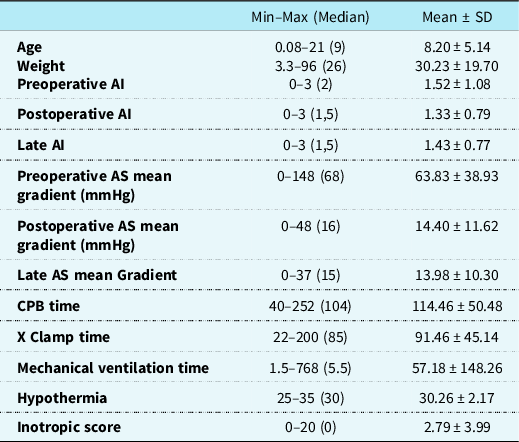
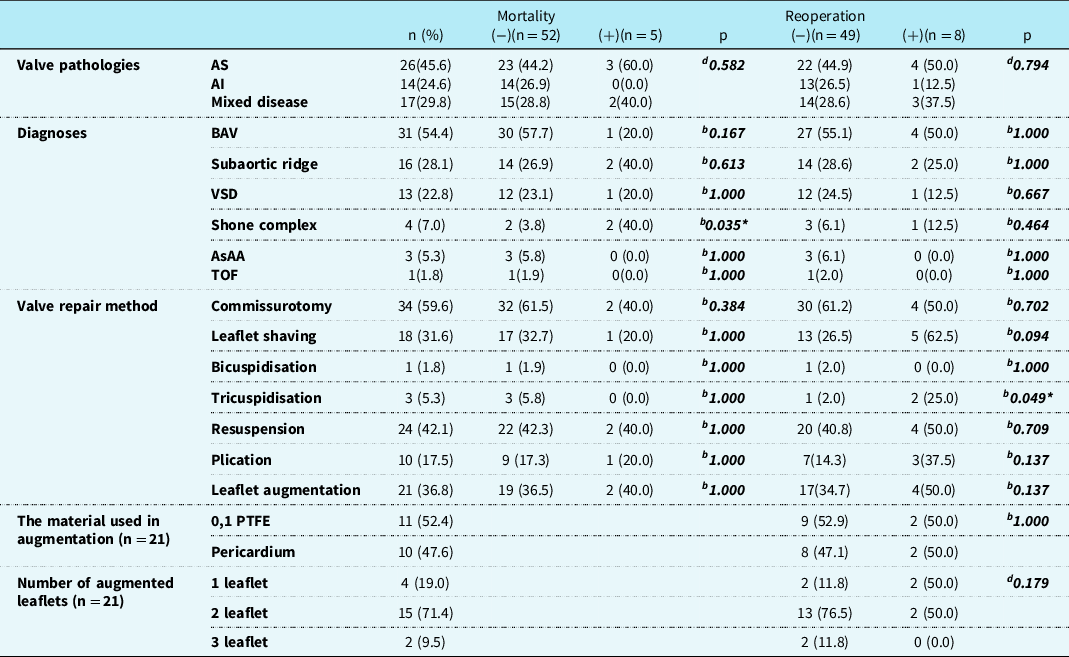
The distributions of the demographic characteristics of the patients are given in Table 1. Of these patients, 44.2% (n = 23) had aortic stenosis, 26.9% (n = 14) had aortic insufficiency, and 28.8% (n = 15) had mixed disease. The predominant diagnoses were bicuspid aortic valve in 82.6% and Shone complex in 17.4% of the patients in the aortic stenosis group, ventricular septal defect in 64.2% of the patients in the aortic insufficiency group, and subaortic ridge in 66.7% of the patients in the mixed disease group. Regarding valve pathology, there was no significant difference in the early postoperative findings (Table 2). Thirty-one percent of the patients had a history of prior percutaneous intervention or prior cardiac surgery. The patients with a history of percutaneous intervention (n = 8) had aortic insufficiency, while patients with prior cardiac surgery (n = 10) had aortic insufficiency and mixed-type disease.
Demographic data of patients

Abbreviations: AI: aortic insufficiency, AS: aortic stenosis, CPB: cardiopulmonary bypass, Lac: lactate.

Abbreviations: AI: aortic insufficiency; AS: aortic stenosis; BAV: bicuspid aortic valve; VSD: ventricular septal defect; AsAA: ascending aortic anuerysm; TOF: Tetralogy of Fallot.
a Mann–Whitney U test.
b Fisher’s exact test.
c Pearson Chi-square test.
d Fisher Freeman Halton test.
*p < 0,05, **p < 0,01.
Patients were compared in terms of reoperation and mortality according to valve pathologies, diagnoses, and valve repair technique (Table 2). The distribution of patients by diagnosis was as follows: 54.4% (n = 31) bicuspid aortic valve, 28.1% (n = 16) subaortic ridge, 22.8% (n = 13) ventricular septal defect, 7% (n = 4) Shone complex, 1.8% (n = 1) tetralogy of Fallot, and 5.3% (n = 3) ascending aortic aneurysm. The mortality rate was 8.8% (n = 5). Early mortality was due to low cardiac output and sepsis, and 66.6% (n = 2) of these patients had required intensive care hospitalisation and inotrope administration due to preoperative heart failure. No late mortality was observed.
Those with a bicuspid aortic valve had the lowest mortality rate, while those with Shone complex had the highest (p = 0.035, p < 0.05). The distribution of applied valve repair methods was as follows: 59.6% (n = 34) commissurotomy, 31.6% (n = 18) leaflet shaving, 1.8% (n = 1) bicuspidization, 5.3% (n = 3) tricuspidization, 42.1% (n = 24) resuspension, 17.5% (n = 10) plication, and 36.8% (n = 21) leaflet augmentation. Regarding mortality, there was no difference between valve repair techniques, while the patients who underwent tricuspidisation had the highest rate of reoperation. The reoperation rate was 14% (n = 8). Twenty-five percent (n = 2) of those patients were tricuspidised, and AI developed progressively after six postoperative months. One of the patients required reoperation in the 9th month and the other in the 40th month. The other patient who underwent tricuspidisation is still being followed due to moderate aortic insufficiency. There were no other patients with significant recurrent disease. More than one repair technique was applied to all other patients requiring reoperation.
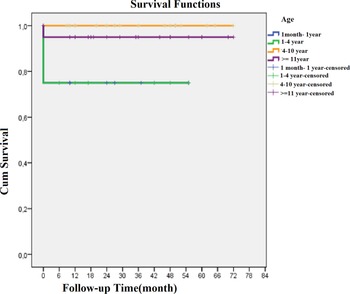
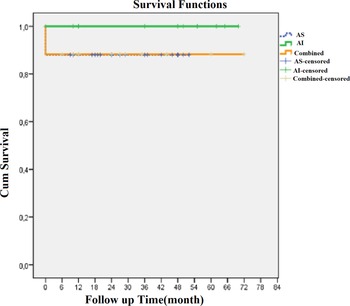
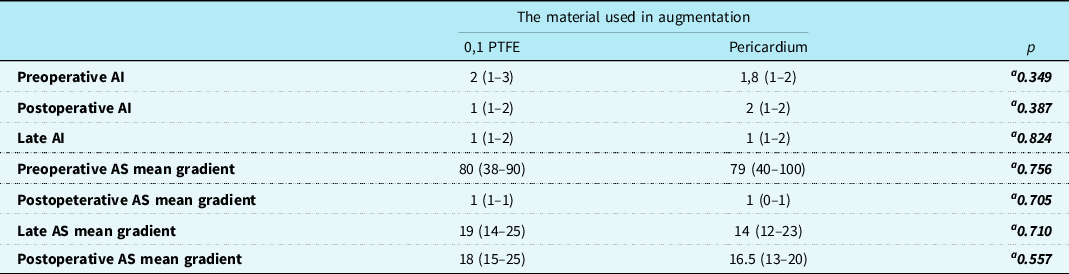
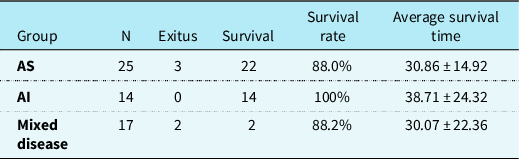
When patients who underwent augmentation were compared regarding the materials used (0.1 polytetrafluoroethylene or autologous pericardium), the number of cusps, and the techniques used, no difference was found in terms of reoperation or mortality (Table 3). The mean age was 8.20 ± 5.14 years (range: 2 weeks to 17 years). Being younger than 1 year at the time of surgery was found to be significant in terms of mortality (p = 0.032, p < 0.05). The mortality rate decreased with age. The mean duration of cardiopulmonary bypass was 114.46 ± 50.48 min, while the mean X-clamp time was 91.46 ± 45.14 min; no significant difference was found for X-clamp or cardiopulmonary bypass time regarding mortality. The mean follow-up period was 29.86 ± 21.30 months and survival rates were 88%, 100%, and 88.2% in the aortic stenosis, aortic insufficiency, and mixed disease groups, respectively. No significant difference was found in terms of valve pathologies when they were evaluated with the log-rank test (p > 0.05) (Tables 4 and 5, Figs. 1 and 2).
Survival curves by age.

Survival curves by valve pathologies.

Comparisons by material used in augmentation

Abbreviations: AI: aortic insufficiency; AS: aortic stenosis.
a Mann–Whitney U test.
Analysis of survival by age

Kaplan–Meier analysis.
Survival analysis by groups

Kaplan–Meier analysis.
Discussion
The present study was undertaken to evaluate the effects of age, diagnosis, and aortic valve repair technique on the outcomes of aortic valve repairs. Being younger than 1 year of age was a risk factor for surgical mortality, while a bicuspid aortic valve was a good prognostic indicator. The repair technique to be applied was chosen based on the patient’s preoperative diagnosis and echocardiographic findings.
The success of aortic valve repair is associated with a thorough understanding of the anatomy and pathology. Waroux et al. identified some key points for aortic valve repair. Smooth, thin, and large leaflets with excess tissue were considered repairable, while small, restrictive, and thickened leaflets were considered likely to prevent the repair. The quality of the repair and that of the tissue were considered equivalent. It was suggested that these were valid criteria for adult aortic valve pathologies in the later periods but were not suitable for the paediatric age group because the valve pathologies in children were usually congenital and aortic stenosis was the most common valve pathology. Isolated aortic insufficiency was rare and usually secondary. When valvuloplasty failed in the paediatric age group, obtaining materials for replacement was not as easy as it was for adults. Reference le Polain de Waroux, Pouleur and Goffinet7
Regarding tissue quality, Mastrobuoni and El Khoury proposed two scenarios for surgery: 1) lesions with sufficient or excess tissue (or both together) or 2) lesions with tissue deficiency (such as valves after unicuspid and balloon valvotomy). The first scenario may allow for successful primary repair through free edge plication, with no need for exogenous material, in addition to several different surgical options. Reference Mastrobuoni and El Khoury8 In the second scenario, the surgical management of tissue-deficient lesions is difficult and controversial. Diseases within this group are defined as complex aortic valve diseases. Aortic valves with aortic insufficiency and mixed disease are both in this group, and they have higher reoperation rates. For many different reasons, the valve requires repair, delaying the gold-standard procedure, even if aortic valve surgery does not provide perfect correction. Reference Cuttone, Alacoque and Leobon9
Aortic stenosis is the predominant pathology that requires intervention in children, and aortic valve repair should sıklıkla be the preferred treatment strategy. In our study, 44.2% (n = 23) of the patients had aortic stenosis, 26.9% (n = 14) had aortic insufficiency, and 28.8% (n = 15) had mixed disease. Regarding valve pathology, there was no difference in the postoperative complications, reoperation rates, or mortality rates of the patients (p > 0.05).
Commissurotomy, leaflet shaving, bicuspidisation, and tricuspidisation techniques were generally used for patients in the aortic stenosis group, while plication and resuspension were primarily performed for patients in the aortic insufficiency group and leaflet augmentation can be preferred for both pathologies. The rate of reoperation was 14% (n = 8), and no statistical difference was found regarding diagnoses (Table 3). When evaluated based on repair techniques, tricuspidisation was found to be a risk factor for reoperation. Three patients underwent tricuspidisation and 66.7% of them needed reoperation due to aortic insufficiency. As described by d’Udekem et al., leaflets were observed to remain attached to the aortic wall during reoperations. Reference d’Udekem, Siddiqui and Seaman10 Therefore, we recently stopped performing this procedure in our clinic.
In our study, leaflet augmentation was performed for 36.8% (n = 21) of the patients, and it was not identified as a risk factor for reoperation. In addition, considering the materials used in augmentation, autologous pericardium was fixed with 0.1 polytetrafluoroethylene for 52.4% (n = 11) of the patients and with glutaraldehyde for 47.6% (n = 10) of the patients. In their published work on bicuspid aortic valves, Schneider et al. stated that reoperations are performed often due to aortic insufficiency, claiming that pericardial patch and leaflet augmentation are risk factors. They also argued that commissural resuspension had no effect on postoperative valve dysfunction. Reference Schneider, Feldner and Hofmann11 The study of bicuspid aortic valves conducted by Siddiqui et al. in 2013 suggested that the use of pericardium treated with glutaraldehyde improved the resistance to calcification and degeneration. Tricuspidisation, on the other hand, was considered to be a predisposing factor for reoperation in the late period and, therefore, its use has been discontinued. Reference Siddiqui, Brizard and Konstantinov12 d’Udekem et al. published a large series of augmentations performed with autologous pericardium. In that series, non-reoperation survival rates were 97% and 80% at 1 year and 7 years, respectively. Reference d’Udekem, Siddiqui and Seaman10 Expanded polytetrafluoroethylene was used as a patch material. In theory, polytetrafluoroethylene is relatively more stable and resistant to calcification. It is considered superior to other materials in terms of flexibility and biostability, but no comprehensive study on its use in children has been published. Reference Nosal, Poruban and Valentik13 The materials used in our study and the number of leaflets were not found to cause any differences in terms of the postoperative gradient, valve failure, or reoperation and mortality rates (Tables 3 and 4). It is not believed that the use of pericardium in leaflet augmentation in patients with bicuspid aortic valves causes the risk of aortic insufficiency. The inability to create a long and adequate coagulation line may be determinative in this regard.
Another crucial point is the timing of surgery, which is a critical variable in the treatment of children. The valve phenotype is certainly important in the prediction of reoperation (tricuspid > bicuspid > unicuspid), but age at the time of surgery is a key obstacle to the durability of the repair. In addition, moderate aortic insufficiency and an average transvalvular gradient of <20 mmHg at the time of discharge were found to be predictive of late valve insufficiency. Reference Poncelet, El Khoury and De Kerchove14 Absence of prolapse (below the point of coaptation and the level of aortic annulus), coaptation length of >4 mm, and the symmetry of the leaflets are considered to be determinants of the stability of the repair. Reference Stern, White, Verghese, Del Nido and Geva15 In their published major series, Melbourne et al. described the long-term results of such cases. Their study enrolled 142 patients and the 7-year postoperative survival rate was 80%. Risk factors for reoperation were reported as being younger than 1 year of age and having leaflet augmentation. Young age at the time of repair was also shown to be a risk factor by d’Udekem et al. Reference d’Udekem, Siddiqui and Seaman10
In their study published in 2015, Kandakure et al. reported the mortality rate to be 7.7%. In their series, all deaths were observed in patients younger than 40 days old. Reoperation-free survival at 1 year was reported to be 80%. Reference Kandakure, Prior and Soda16 The mortality rate in our study was 8.8% (n = 5). More specifically, survival rates were 88%, 100%, and 88.2% in the aortic stenosis, aortic insufficiency, and mixed disease groups, respectively, and no significant difference was found in terms of valve pathologies when they were evaluated with the log-rank test (p > 0.05) (Tables 5, Figs. 1 and 2). When outcomes were evaluated based on diagnoses, having Shone complex was not found to be a risk factor for mortality (p = 0.035, p < 0.05). In patients with Shone complex who underwent biventricular repair, the survival rate was reported to be 86% at 10 years by Nicholson et al., 73% at 7 years by Brauner et al., and 73% at 7 years by Brown et al. Reference Nicholson, Kelleman and De la Uz17–Reference Brown, Ruzmetov and Vijay19 The causes of variation in survival rates between studies were shown to be the numbers of patients enrolled in each study, patients’ ages, and inclusion criteria. Reference Elmahrouk, Ismail and Arafat20
In the present study, there was no difference between repair techniques in terms of mortality. When the mortality rates of patients according to their ages were evaluated, being under the age of 1 year at the time of surgery was found to be significant in terms of mortality (p = 0.032, p < 0.05). The mortality rate decreased with increasing age. This is consistent with the results reported in the literature. X-clamp and cardiopulmonary bypass times were not found to be significant for mortality.
Conclusion
Regardless of the pathology of the valve, aortic valve repair techniques should be the first choice in the paediatric age group due to their acceptable reoperation and mortality rates. Being under 1 year of age and having Shone complex are significant for mortality. Leaflet augmentation can be safely performed for these patients when necessary, while tricuspidisation should be performed only as a last resort.
Limitations
The number of patients was the main limitation. The number was even smaller when patients were subdivided according to age and diagnosis. More than one repair techniques were applied to the patients. This may be another limitation in the evaluation of postoperative results.
Acknowledgement
No funding was obtained for this study.
Financial support
This research received no specific grant from any funding agency, commercial, or not-for-profit sectors.
Conflicts of interest
None.