Implications
Estimates of the avoidable cost of mastitis, necessary information when the economic viability of preventive measures is evaluated, are provided. Reducing the incidence of mastitis by 50%, from 32 clinical and 33 subclinical cases per 100 cow-years increased net return by 5% (€55 per cow-year). Withdrawing milk with high somatic cell count (SCC) was not profitable because the decreased amount of delivered milk was not offset by increased milk price. It is therefore more profitable for farmers to deliver a larger amount of milk with higher SCC than to withdraw milk with high SCC to obtain payment premiums.
Introduction
Economically efficient dairy herds are a necessary prerequisite for a sound dairy industry. Milk yield per cow and incidence of mastitis are significant indicators of economic performance (Hansson, Reference Hansson2007). Indeed, mastitis is usually considered the most costly disease in dairy production, mainly because of its high prevalence and negative impact on milk yield and composition.
The impact of mastitis on herd profit can be reduced by implementing control programmes to reduce the incidence of mastitis, thus achieving higher milk production and better milk quality in a long-term perspective. Preventive measures do, however, incur extra costs for the farmer in terms of investments and labour. Thus, it is necessary to have access to accurate estimates of the cost of mastitis so that investments in preventive measures can be evaluated against the potential gains that they can achieve. In a previous study (Hagnestam-Nielsen and Østergaard, Reference Hagnestam-Nielsen and Østergaard2009), we estimated the average cost per case of clinical mastitis (CM) at €428, taking into account that the yield loss varies depending on when in lactation the cow develops CM. Other European studies have arrived at estimates between €164 and €347 (Østergaard et al., Reference Østergaard, Chagunda, Friggens, Bennedsgaard and Klaas2005; Huijps et al., Reference Huijps, Lam and Hogeveen2008). The cost per case of subclinical mastitis (SCM) is less well documented, although it is expected that subclinical cases are responsible for a large proportion of the economic loss caused by mastitis (Yalcin, Reference Yalcin2000; Huijps et al., Reference Huijps, Lam and Hogeveen2008). To fully examine the impact of mastitis on the profitability of a dairy herd, CM and SCM must therefore be considered simultaneously.
Mastitis is associated with increased somatic cell count (SCC). In most countries, there is a regulatory limit on the maximum bulk tank SCC (BTSCC) allowed in milk intended for human consumption and incentives for reducing SCC are provided by penalties and premiums in the milk payment system. In practice, a cow producing milk with high SCC might be culled in order to reduce BTSCC and avoid payment penalties. However, culling incurs a cost of replacement and might be more costly than accepting milk quality penalties (Dekkers et al., Reference Dekkers, Van Erp and Schukken1996). An alternative approach to reduce BTSCC and limit the impact of mastitis on herd profit is to withdraw milk with high SCC. Decisions to withdraw milk with high SCC have traditionally been based on SCC information obtained from the milk-recording scheme. Such information is typically collected on a monthly basis, resulting in crude decisions. Recent technological advancements allow SCC to be recorded in-line during milking and thus provide means to make decisions on whether the milk from a certain cow is to be delivered to the dairy in connection with each milking. The profitability of withdrawing milk with high SCC based on the results of an in-line SCC sensor has not been studied yet. Although in-line measurements remove problems with delayed information, its profitability can be expected to depend on how accurately SCC can be measured. If uncertainty is high, there would be a risk of misclassifying milk, which would result in improper decisions and, as a consequence, lower economic benefit of withdrawing milk with high SCC.
The main aim of this study was to simultaneously assess the impact of CM and SCM on the technical and economic results of a dairy herd under current Swedish farming conditions. The second aim was to investigate the effects of withdrawing milk with high SCC, under the current milk-pricing system, based on the results of an in-line composite SCC sensor, and to estimate the consequences of different levels of uncertainty relating to its ability to correctly measure SCC.
Material and methods
The SimHerd model
SimHerd is a dynamic bio-economic model with stochastic elements and the individual animal as the simulation unit. Unless otherwise stated, the assumptions of the model were the same as in Hagnestam-Nielsen and Østergaard (Reference Hagnestam-Nielsen and Østergaard2009).
SCC in uninfected cows
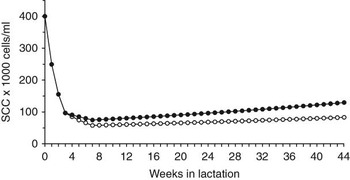
Average lactation curves for SCC in cows without both CM and SCM, separate for primiparous and multiparous cows, were parameterized based on the findings of De Haas et al. (Reference De Haas, Barkema and Veerkamp2002) and were modelled using three-phase linear spline functions (Figure 1). Random variation, modelling deviation from the average lactation curve for SCC, was created by adding random numbers drawn from a normal distribution with a mean value of 0 and a standard deviation of 0.64. Standard deviations close to 0.64 among ln(SCC) obtained from laboratory analyses have been reported (Laevens et al., Reference Laevens, Deluyker, Schukken, De Meulemeester, Vandermeersch, De Muecaronlenaere and De Kruif1997). Variation in SCC between test days (TD) originates from both actual variation and measurement error. The estimate obtained by Laevens et al. (Reference Laevens, Deluyker, Schukken, De Meulemeester, Vandermeersch, De Muecaronlenaere and De Kruif1997) was therefore reduced by 12% according to the coefficient of variation for repeatability of laboratory tests of SCC, as reported by Faust and Timms (Reference Faust and Timms1995).
Lactation curves for SCC in primiparous (○) and multiparous (●) cows without mastitis.

Mastitis
Whether or not a cow developed mastitis was generated stochastically through a disease risk parameter, which included the effects of parity, week in lactation, yield level and previous cases of mastitis. The risk parameter was compared with a number drawn at random from a uniform distribution. When the risk was higher than the random number, the cow was modelled to develop mastitis. A second stochastic procedure determined the severity of the case. The probability of a case being clinical was assumed to be 47% based on the distribution of clinical and subclinical cases reported by De Haas et al. (Reference De Haas, Barkema and Veerkamp2002). Mastitis occurring in the dry period and recurrences of mastitis within and between lactations were modelled in the same manner as in the study by Østergaard et al. (Reference Østergaard, Chagunda, Friggens, Bennedsgaard and Klaas2005). When multiple cases developed within a lactation, yield loss was defined based only on the impact of the most recent case and the severity of a recurrent case was therefore triggered so that the yield loss was not reduced because of the new case. Consequently, a recurrent case of mastitis was always assumed to be clinical if the yield loss incurred by a new case of SCM would have been less than that already suffered as a consequence of an earlier occurrence of CM. No inter-relationships between mastitis and other disorders were modelled.
Risk factors
The base risk, which differed between primiparous and multiparous cows, was determined by week in lactation and did, together with two risk factors, yield level and previous occurrences of mastitis, determine the overall risk for an individual cow.
The general effects of parity and week in lactation were modelled by means of the three-phase linear spline function used by Hagnestam-Nielsen and Østergaard (Reference Hagnestam-Nielsen and Østergaard2009). It was, however, adjusted to fit an overall incidence of 32 CM cases per 100 cow-years to simulate an average number of 1.3 cases per affected lactation, based on the recurrence rate of CM in the research herd of the Department of Animal Breeding and Genetics, Swedish University of Agricultural Sciences.
The impact of milk yield on the risk for mastitis was modelled as an odds ratio of 1.04 per kg of milk produced above the parity-specific herd average (Østergaard et al., Reference Østergaard, Chagunda, Friggens, Bennedsgaard and Klaas2005).
Effects of mastitis
Mastitis was modelled to directly affect SCC, milk yield, feed intake and milk withdrawal (CM only). When multiple cases occurred within the same lactation, the effects were defined based on the impact of the most recent occurrence. Indirectly, through the effect on milk yield in the first half of lactation, mastitis affected culling.
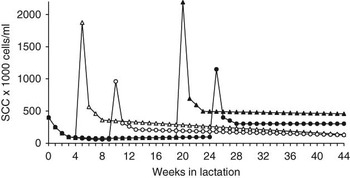
The increase in SCC induced by CM was modelled through three-phase linear spline functions (Figure 2). The spline functions expressed the increase in SCC relative to SCC in uninfected lactations, and they were obtained by generalizing the effects of CM caused by Staphylococcus aureus, Escherichia coli, Streptococcus dysgalactiae and Streptococcus uberis, as reported by De Haas et al. (Reference De Haas, Barkema and Veerkamp2002). The effect of SCM on SCC was assumed to be 50% of that of CM (Østergaard et al., Reference Østergaard, Chagunda, Friggens, Bennedsgaard and Klaas2005). The effects of both CM and SCM on SCC were assumed to stop at drying off.
Lactation curves for SCC in primiparous cows diagnosed with clinical mastitis in the 5th week of lactation (Δ), primiparous cows diagnosed with subclinical mastitis in the 10th week of lactation (○), multiparous cows diagnosed with clinical mastitis in the 20th week of lactation (▴) and multiparous cows diagnosed with subclinical mastitis in the 25th week of lactation (●).

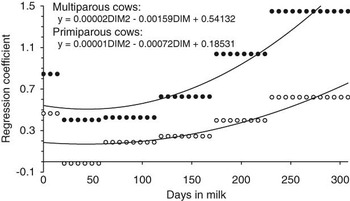
The production loss associated with mastitis occurring in different stages of lactation was primarily modelled by means of SCC. It was defined based on the data and methodology previously described by Hagnestam-Nielsen et al. (Reference Hagnestam-Nielsen, Emanuelson, Berglund and Strandberg2009). Daily yield loss, expressed as the linear effect of SCC on milk yield, was estimated from lactations free of CM. The regression coefficients estimated in the study by Hagnestam-Nielsen et al. (Reference Hagnestam-Nielsen, Emanuelson, Berglund and Strandberg2009) were plotted against days in milk and a quadratic regression was fitted (Figure 3). The obtained polynomial, expressing regression coefficients as a function of days in milk, was used to model the yield loss associated with the increased SCC caused by mastitis at a certain day in milk. Given the high uncertainty related to estimates of yield loss in early lactation, the polynomial was considered sufficiently accurate for the purpose of the simulations conducted in this study.
Linear regression coefficients of daily milk yield (kg ECM) on log-transformed somatic cell count, estimated by Hagnestam-Nielsen et al. (Reference Hagnestam-Nielsen, Emanuelson, Berglund and Strandberg2009), expressed as a function of days in milk in both primiparous (○) and multiparous (●) cows. The resulting polynomial was used to model yield loss caused by increased SCC in the simulations.

The entire yield loss associated with SCM was modelled through the impact of SCM on SCC and thus on milk yield. Both an indirect and a direct effect were, however, used to describe the yield loss caused by CM. The indirect effect was determined based on the increase in SCC caused by CM and the polynomial defining its effect on milk yield. The indirect yield loss was compared with the yield loss, expressed relative to the potential yield of mastitic cows had they not developed CM, modelled by the linear yield-loss pattern described by Hagnestam-Nielsen and Østergaard (Reference Hagnestam-Nielsen and Østergaard2009), assuming that CM occurred at the median day of diagnosis (at 11 and 55 days in milk in primiparous and multiparous cows, respectively). It was found to be substantially smaller. Indeed, CM has been reported to give rise to a larger yield loss than what can be explained by the increase in SCC alone (Bennedsgaard et al., Reference Bennedsgaard, Enevoldsen, Thamsborg and Vaarst2003). Therefore, the indirect effect was supplemented by a direct effect of CM on milk yield, which was defined as the difference between the yield loss modelled by the linear yield-loss pattern in the study by Hagnestam-Nielsen and Østergaard (Reference Hagnestam-Nielsen and Østergaard2009) and the indirect effect modelled by means of SCC. For both SCM and CM, the effect on milk yield was assumed to stop at drying off. After a case of mastitis, the effect on SCC and thus the yield loss often lasted throughout lactation.
The length of the withdrawal period after CM treatment was specified at 8 days (assuming 4 days of treatment and a 4-day waiting period) based on the legislated withdrawal period in Sweden (conventional herds) for the most commonly used drugs.
Withdrawal of milk with high SCC
Different strategies
Six approaches to withdraw milk with high SCC based on the results of an in-line SCC sensor were compared. In these, the decision to withdraw milk was based on herd-level information in three scenarios and cow-level information in three scenarios. Irrespective of the level of the decision, all strategies implied that the decision to withdraw the milk produced by an individual cow was based on predictions of her daily milk yield and SCC. Predicted daily milk yields and SCC were modelled by adding uncertainty to the simulated true values. In practice, this uncertainty could be attributed to error in the prediction of milk yield and SCC at the time when the decision was made.
Decisions to withdraw milk with high SCC based on herd-level information were taken when the predicted BTSCC exceeded a certain threshold value. It was conducted by withdrawing the milk produced by one cow at a time until the predicted BTSCC dropped below the desired threshold, starting with the cow with the highest predicted SCC and milk yield. When the decision to withdraw milk with high SCC was based on cow-level information, the procedure was initiated when the predicted SCC in an individual cow’s milk exceeded a specified threshold value.
The withdrawn milk was assumed to be fed to the calves, thereby reducing the amount of milk replacer needed, and was assigned an alternative value of 80% of the value of delivered milk. The amount of withdrawn milk that exceeded the calves’ needs was discarded and did not generate an alternative value.
Uncertainty in measurements and predictions
SimHerd provides estimates of the true SCC, but in practice farmers need to base decisions to withdraw milk with high SCC on predictions of SCC. SCC can be measured and predicted more or less precisely and the profitability of withdrawing milk with high SCC can be expected to be influenced by the level of uncertainty. If uncertainty related to measurement and prediction of SCC is high, the effectiveness of withdrawing milk with high SCC would be less than if uncertainty is low because a larger proportion of normal milk would be withdrawn, whereas a larger proportion of milk with high SCC would be delivered.
To mimic uncertainty in decisions because of measurement and prediction errors, random values drawn from normal distributions with a mean of 0 were added to the simulated true values of ln(SCC). Two normal distributions with different standard deviations were used, each representing different extent of measurement and prediction error. The standard deviations were defined by assuming that the variance corresponded to 50% and 25% (referred to as high and low uncertainty) of the variance between monthly TD results of ln(SCC) in individual cows, obtained from laboratory analyses, as reported by Laevens et al. (Reference Laevens, Deluyker, Schukken, De Meulemeester, Vandermeersch, De Muecaronlenaere and De Kruif1997).
Decisions on whether the milk from an individual cow should be withdrawn were based not only on SCC, but also on the expected milk production of the cow. In practical farming, the milk yield of a cow is measured using a milk meter. The measured milk yield is thus also subjected to uncertainty because of measurement and prediction errors. The magnitude of these errors depends on the equipment used and when milk yield is measured relative to when the decision whether the milk should be withdrawn is made. To reflect these uncertainties, a random value, drawn from a normal distribution with a mean of 0 and a standard deviation of 4.1, was added to the true value of daily milk yield in individual cows. The standard deviation was defined by assuming that the variance because of measurement and prediction errors was 50% of the variance between monthly TD in second-parity cows in the data used to estimate the lactation curves in SimHerd (explained by Kristensen et al., Reference Kristensen, Østergaard, Krogh and Enevoldsen2008).
Three different values of BTSCC were generated in each time step. First, the true BTSCC, which was estimated based on true daily milk yields and SCC in individual cows. Second, the predicted BTSCC, which was estimated based on daily milk yields and SCC in individual cows, accounting for uncertainty because of measurement and prediction errors. Third, the BTSCC measured by the dairy’s test laboratory from a milk sample collected from the bulk tank at the time of delivery. The uncertainty due to measurement error in the latter was defined by adding a random number, drawn from a normal distribution with a mean value of zero and a standard deviation of 0.24, to the true BTSCC. The standard deviation was defined by assuming that the variance was 12% of that between-monthly TD results of ln(SCC) in individual cows, obtained from laboratory analyses, according to the results of Faust and Timms (Reference Faust and Timms1995) and Laevens et al. (Reference Laevens, Deluyker, Schukken, De Meulemeester, Vandermeersch, De Muecaronlenaere and De Kruif1997).
Herd description
SimHerd was parameterized to model a Swedish herd with 150 cows. The average herd size is currently smaller, that is, 55 cows (Swedish Dairy Association, 2008b), but the trend is towards larger herds. The majority of investments is into barns with substantially higher capacity, and the average herd size can be projected to be over 100 in the near future. The chosen herd size would thus represent a modern herd were it would be most likely to find an in-line SCC sensor. Cows were assumed to be of the Swedish Holstein and Swedish Red breed and milk yield was calibrated to a level of 9000 kg of energy-corrected milk (ECM) per cow-year (Swedish Dairy Association, 2008b). Cows were dried off 8 weeks before the next calving or when their daily milk yield dropped below 10 kg of ECM.
The oestrus detection rate was assumed to be 0.50 in both cows and heifers. The average conception rate in Swedish Holstein and Swedish Red cows in 2005 was 0.44Footnote 1. The model parameters for conception rate (at 42 days after insemination) were adjusted to fit this figure.
The frequencies of various production diseases were parameterized based on the indices in the research herd studied by Hagnestam et al. (Reference Hagnestam, Emanuelson and Berglund2007).
No quota constraint was modelled, which is a reasonable assumption since Sweden does not fill the quota. A non-grazing system was assumed for reasons of simplicity.
Simulated scenarios
In total, 105 scenarios were simulated. These involved various combinations of mastitis incidences, strategies for withdrawing milk with high SCC and levels of uncertainty in the measurement and prediction of SCC in individual cows.
Five different incidences of mastitis were modelled to study their herd-level consequences and investigate whether the profitability of withdrawing milk with high SCC was influenced by the incidence of mastitis. The incidence of mastitis modelled by the risk functions was the incidence given the initial management practice. Herd-level consequences of 50% lower and higher incidence of mastitis were modelled. In addition, scenarios where the incidence of CM was kept constant while there was no SCM and where the incidence of SCM was kept constant while there was no CM were modelled to study the separate impact of CM and SCM on the performance of the herd.
Different strategies to withdraw milk with high SCC were compared. In three of these, the decision to withdraw milk was based on herd-level information and withdrawal was initiated when the predicted BTSCC exceeded 220 000, 200 000 and 180 000 cells/ml, respectively. Three strategies were based on cow-level information and withdrawal was initiated when the predicted SCC in an individual cow’s milk exceeded 1 000 000, 750 000 and 500 000 cells/ml, respectively. The impact of measurement and prediction errors on the profit obtained by withdrawing milk with high SCC was investigated by applying three levels of uncertainty to the estimates of SCC: high (default), low or none.
Simulation procedure
Scenarios were simulated over 20 years and replicated 250 times. To reduce the impact of the parameterization of the initial herd, only the average annual results from the last 10 years of each replicate were studied.
Analysis of results
Statistical modelling
The results, which were expressed as averages of the 250 replicates, were analysed using univariate ANOVA. Simultaneous pairwise comparisons of scenarios were conducted using t-tests (P < 0.05).
Economic factors
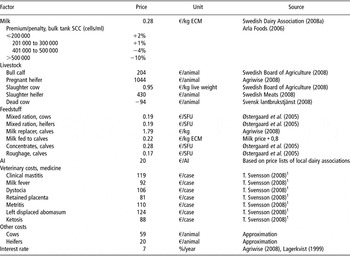
The impact of the scenarios on herd net return was evaluated by applying prices and costs to the results. Prices and costs, in 2007 Swedish market prices, are shown in Table 1. Net return was calculated as income from sales less variable costs for cows and replacements. Variable costs included feed, artificial insemination, veterinary costs, drugs and other costs. Labour and management costs were not included as variable costs. Costs for veterinarian and drugs are average costs charged by veterinarians employed by the state, according to the Swedish Board of AgricultureFootnote 2. Such costs are subsidized in Sweden and the presented figures are thus the amount of money that farmers are charged.
Applied prices and costs

ECM = energy-corrected milk; SFU = Scandinavian feed unit; AI = artificial insemination.
1Thomas Svensson, Swedish Board of Agriculture (personal communication).
Results
Different incidences of mastitis
Technical results
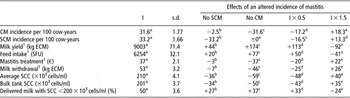
The initial simulated incidence of mastitis was 32 clinical and 33 subclinical cases per 100 cow-years. These were altered in order to simulate the herd-level consequences of different incidences of mastitis. Technical outcome variables that were significantly affected by the change in incidence are shown in Table 2.
Simulated technical results given the initial incidence of mastitis (32 clinical and 33 subclinical cases per 100 cow-years) and when that incidence was altered (averaged over 250 replicates, each consisting of 10 years)

I = initial incidence; SCM = subclinical mastitis; CM = clinical mastitis; ECM = energy-corrected milk; SFU = Scandinavian feed unit; SCC = somatic cell count.
Different superscripts within rows indicate significant differences between the results (P < 0.05).
These results apply to scenarios where milk with high SCC was not withdrawn.
1Per cow-year.
The average yield loss per case of CM was estimated at 551 kg ECM and was calculated by dividing the increase in production in the scenarios where no CM was simulated by the CM incidence given the initial incidence of mastitis. Similarly, the milk withdrawal per case of CM was estimated at 146 kg ECM. The average yield loss per case of SCM was 133 kg ECM.
In the scenario where the incidence of mastitis was reduced by 50%, a substantial reduction of the average SCC in the produced milk was observed. The effect was slightly smaller on BTSCC because milk produced in the withdrawal period after CM was not delivered and therefore not put in the bulk tank.
Cases of mastitis were not modelled to directly affect the culling rate (only which cow to cull), neither to influence fertility or the incidence of other disorders. The replacement rate was thus 38% in all scenarios. The proportion of culled cows was simulated at 36% and the mortality rate was simulated at 2%. Out of all culled cows, 63% was culled on a voluntary basis. Irrespective of scenario, the average number of inseminations per cow-year was 1.8 and the calving interval was 390 days. Primiparous cows constituted slightly more than one-third (36%) of the herd, resulting in stable herd demography irrespective of the simulated incidence of mastitis. In all scenarios, the incidence, expressed per 100 cow-years, of milk fever was 10.9, of veterinary assisted calving 0.3, of retained placenta 2.7, of metritis 0.8, of displaced abomasum 2.5 and of ketosis 1.0.
Economic results
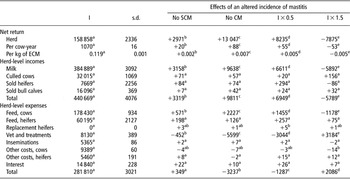
The herd-level net return increased by 5% in the scenario where the incidence of mastitis was reduced by 50%, as compared to the scenario where the initial incidence was modelled (Table 3).
Simulated annual economic results (€) given the initial incidence of mastitis (32 clinical and 33 subclinical cases per 100 cow-years) and when that incidence was altered (averaged over 250 replicates, each consisting of 10 years)

I = initial incidence; SCM = subclinical mastitis; CM = clinical mastitis.
Different superscripts within rows indicate significant differences between the results (P < 0.05).
Results apply to scenarios where milk with high SCC was not withdrawn.
The higher net return was mainly due to increased income from milk sales because of higher production per cow-year and higher milk price as a result of an increased proportion of delivered milk with SCC below 200 000 cells/ml (Table 2). Both the average price per kg ECM and the average price per delivered kg ECM was €0.288 when the initial incidence of mastitis was simulated and increased by €0.001 in the scenario with a 50% reduction of the initial incidence. Substantially, reduced costs for veterinary treatment also contributed to the higher net return when the incidence of mastitis was reduced by 50%. The simulated results indicated that eliminating all cases of CM increased net return by more than four times as much as eliminating all cases of SCM, primarily because of higher milk sales and considerably reduced costs for veterinary treatment.
The cost per case of CM was estimated at €278 and the cost per case of SCM was estimated at €60. They were calculated by dividing the increase in net return per cow-year in the scenarios without CM or SCM, respectively, by the corresponding incidence given the initial incidence of mastitis.
Withdrawing milk with high SCC
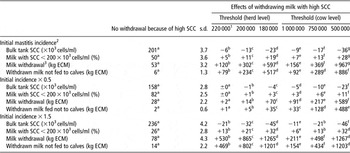
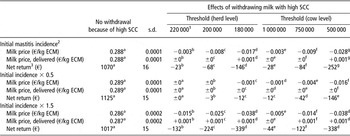
Simulations showed that the effect of withdrawing milk with high SCC varied depending on the incidence of mastitis. Generally, withdrawing milk with high SCC markedly affected the amount of withdrawn milk, BTSCC and the proportion of delivered milk with an SCC below 200 000 cells/ml (Table 4). Thus, withdrawing milk with high SCC also affected the economic results of the herd (Table 5).
Simulated technical results obtained by withdrawing milk with high SCC in herds with different incidences of mastitis (averaged over 250 replicates, each consisting of 10 years)

SCC = somatic cell count; ECM=energy-corrected milk.
Different superscripts within rows indicate significant differences between the results (P < 0.05).
Results apply to when SCC was measured and predicted with high uncertainty.
1Cells/ml.
2An incidence of 32 clinical and 33 subclinical cases of mastitis per 100 cow-years.
3Per cow-year.
Simulated economic results (€) obtained by withdrawing milk with high SCC, expressed relative to the situation where milk with high SCC was not withdrawn, in herds with different incidences of mastitis (averaged over 250 replicates, each consisting of 10 years)

SCC = somatic cell count; ECM = energy-corrected milk.
Different superscripts within rows indicate significant differences between the results (P < 0.05).
Results apply to when SCC was measured and predicted with high uncertainty.
1Cells/ml.
2An incidence of 32 clinical and 33 subclinical cases of mastitis per 100 cow-years.
3Per cow-year.
When the initial incidence of mastitis was simulated, withdrawing milk with SCC above 180 000 cells/ml based on herd-level information reduced BTSCC by 11% and increased the proportion of delivered milk with an SCC below 200 000 cells/ml by almost 20%, as compared with the scenario where no withdrawal of milk with high SCC was performed. The amount of milk that had to be withdrawn to obtain a BTSCC below 180 000 cells/ml corresponded to 7% of the milk yield per cow-year, most of which did not generate an alternative value, and resulted in lower net return per cow-year, although the average price per delivered kg ECM increased. A reduction of net return was also observed when decisions to withdraw milk were based on cow-level information. Withdrawing milk with SCC above 500 000 cells/ml resulted in substantial improvement of BTSCC, but at a cost of 18 times larger milk withdrawal that reduced net return per cow-year by 24%. Simulations indicated that withdrawing milk at higher SCC thresholds had similar, but less pronounced, effects on the results achieved given the initial incidence of mastitis.
In a herd with a mastitis incidence of 14.4 clinical and 16.7 subclinical cases per 100 cow-years, withdrawing milk with high SCC based on herd-level information only slightly affected net return per cow-year because the effect on BTSCC was limited. Withdrawing milk with SCC above 500 000 cells/ml based on cow-level information improved BTSCC, but resulted in reduced net return per cow-year because of a substantial increase in the amount of withdrawn milk not fed to calves. Withdrawing milk with SCC above 1 000 000 cells/ml based on cow-level information generated results of negligible importance from a practical point of view, whereas withdrawing milk with SCC above of 750 000 cells/ml resulted in intermediate effects.
Simulations showed that withdrawing milk with high SCC in a herd with high incidence of mastitis (50 clinical and 46 subclinical cases per 100 cow-years) resulted in a substantial improvement of BTSCC. However, this was achieved at the cost of withdrawing a large amount of milk that did not fulfil the quality requirements, most of which exceeded the amount of milk needed for the calves. Withdrawing milk with high SCC in a high incidence herd thus resulted in reduced net return per cow-year, irrespective of the strategy applied. The highest economic loss (33%) was observed when milk with SCC above 180 000 cells/ml was withdrawn based on herd-level information and when milk with SCC above 500 000 cells/ml was withdrawn based on cow-level information because of a massive increase in the amount of withdrawn milk.
Uncertainty in measurements and predictions
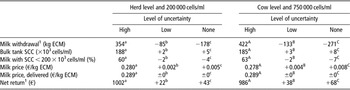
The level of uncertainty in decisions because of measurement and prediction errors significantly influenced the effects of withdrawing milk with high SCC when the initial incidence of mastitis was simulated (Table 6). However, only milk withdrawal per cow-year and net return per cow-year were markedly affected. Scenarios with no uncertainty in the measurement and prediction of SCC resulted in less milk withdrawal. Simulations showed that the impact of measurement and prediction errors was less important when decisions to withdraw milk were based on herd-level information.
Effects of reducing uncertainty in the measurement of SCC on the simulated results obtained by withdrawing milk with SCC above 200 000 cells/ml based on herd-level information and above 750 000 cells/ml based on cow-level information, expressed relative to the default situation where SCC was measured with high uncertainty (averaged over 250 replicates, each consisting of 10 years)

SCC = somatic cell count; ECM = energy-corrected milk.
Different superscripts within strategy indicate significant differences between the results (P < 0.05).
Results apply to a herd with 32 clinical and 33 subclinical cases of mastitis per 100 cow-years.
1Per cow-year.
Discussion
Different incidences of mastitis
Mastitis was associated with reduced net return. The simulated results indicated that a substantially lower BTSCC could be achieved if the incidence of mastitis was halved in herds with an initial incidence of 32 clinical and 33 subclinical cases per 100 cow-years. This in turn would result in a 66% increase in the proportion of delivered milk with SCC below 200 000 cells/ml. Furthermore, more milk could be sold due to less milk withdrawal and reduced milk loss as a consequence of mastitis. The veterinary costs could also be reduced. Thus, dairy farmers have economic incentives to implement preventive measures to reduce the incidence of mastitis.
To reduce the incidence of mastitis by 50%, 1.3 h of extra labour per day, at a cost of €17.8/h (hired labour, Agriwise, 2008), could be spent on preventive work such as regrouping cows and optimizing the milking order. Alternatively, €58 000 could be invested in improved milking equipment, which might contribute to better udder health status or be invested in technical tools, such as an in-line SCC sensor, which would facilitate monitoring of the udder health in the herd. The maximal investment was calculated by the annuity method, with a real interest rate of 7%/year and a depreciation period of 10 years.
Cost of mastitis
The estimated cost of mastitis included costs related to yield loss (which was partly offset by reduced feed cost), withdrawn milk, lower milk price because of increased SCC, veterinary fees, drugs and increased risk of recurrent cases, culling and mortality. The cost of extra labour requirement was not accounted for. In SimHerd, labour is not included as a variable cost (Østergaard et al., Reference Østergaard, Chagunda, Friggens, Bennedsgaard and Klaas2005) and labour related to tasks such as withdrawing milk with high SCC, taking care of the withdrawn milk and feeding it to calves, as well as labour requirement in connection with other disorders and prevention of disorders, was consequently not included either.
Whether extra labour has been included in the cost of mastitis in previous studies varies. For instance, Miller et al. (Reference Miller, Bartlett, Lance, Anderson and Heider1993), Bar et al. (Reference Bar, Tauer, Bennett, Gonzalez, Hertl, Schukken, Schulte, Welcome and Gröhn2008) and Huijps et al. (Reference Huijps, Lam and Hogeveen2008) accounted for the value of extra labour, whereas Kossaibati and Esslemont (Reference Kossaibati and Esslemont1997), Østergaard et al. (Reference Østergaard, Chagunda, Friggens, Bennedsgaard and Klaas2005) and Steeneveld et al. (Reference Steeneveld, Swinkels and Hogeveen2007) did not. Extra labour requirement should be valued based on its opportunity cost, that is, the value of the next best alternative foregone as the result of having to assign time to mastitis. Opportunity cost is readily calculated if labour is of external source, but, if labour is of internal source, its opportunity cost is foregone profits from labour reallocated away from other farm enterprises to manage mastitis cases or the value that the farmer assigns to his or her free time. It may be argued that the cost of labour should be included in the cost of mastitis because as herds become larger, a larger share of the labour supply originates from hired labour and/or the opportunity cost of farmer’s own time tends to increase. From a managerial perspective, it is important to note that the amount of time that can be spent on a mastitic cow in reality is limited because the available time per cow and day in a 150-cow herd is less than 4 min. Hence, in the absence of more accurate estimates of the time requirements for a mastitis case, we chose not to include the cost of labour in this study. If, however, the same labour requirement per clinical case as in Hagnestam-Nielsen and Østergaard (Reference Hagnestam-Nielsen and Østergaard2009) had been assumed, that is, 2 h per case, and if the initial incidence of CM was reduced by 50%, this would have resulted in 51.6 h less labour requirement per year (0.172 cases per cow-year × 150 cows × 2 h per case). Given a cost of €17.8/h (hired labour, Agriwise, 2008), including the cost of labour would have added €918 to the yearly avoidable cost of mastitis.
In this context, it should be noted that the conclusions regarding the cost of SCM and withdrawal of milk with high SCC do not depend on how labour is treated.
Consistency with previously published estimates
The estimated avoidable cost of mastitis (€55/cow-year) can now be compared with the results from previous studies that simultaneously assessed the economic impact of CM and SCM. Estimates from Western European studies, published within the past 10 years, are used to secure that their spatiotemporal contexts were reasonably comparable to those of the present study. It needs to be stressed that the cost of mastitis is highly dependent on the specific context in which it has been estimated because of differences between countries and regions as regards prevalence, management practices and price levels of inputs and outputs. Furthermore, the methodology used to obtain the cost of mastitis also affects the result of the analyses. The external validity of estimates are thus low and comparisons between studies are problematic. Comparisons are therefore only made to place our estimates in a wider context.
The cost of mastitis (CM and SCM) averaged over pathogens in Denmark was estimated at €146/cow-year using an earlier version of SimHerd (Østergaard et al., Reference Østergaard, Chagunda, Friggens, Bennedsgaard and Klaas2005). In the Netherlands, the corresponding cost has been estimated at €140 (Huijps et al., Reference Huijps, Lam and Hogeveen2008). These studies did, however, calculate the total cost of mastitis relative to a theoretical situation where no cases of mastitis occurred. Such an approach will lead to overestimation of the cost of mastitis because not all cases can be avoided by changes in management. For this reason, the cost of mastitis needs to be expressed relative to a more realistic reference level and the 10th percentile of the clinical incidence has been recommended (Seegers et al., Reference Seegers, Fourichon and Beaudeau2003). This reference level was applied in our previous study (Hagnestam-Nielsen and Østergaard, Reference Hagnestam-Nielsen and Østergaard2009) when estimating the maximum avoidable cost of CM and a cost of €97/cow-year was arrived at. In this study, we used a higher reference level to obtain an estimate of the benefit that can be achieved by reducing the incidence of mastitis to a more practically feasible level.
The cost of mastitis has been found to vary depending on BTSCC (Huijps et al., Reference Huijps, Lam and Hogeveen2008). In herds with high BTSCC (>400 000 cells/ml), Huijps et al. (Reference Huijps, Lam and Hogeveen2008) estimated the cost of mastitis at €182/cow-year, whereas the cost/cow-year was estimated at €114 in herds with low BTSCC (<100 000 cells/ml). The result obtained for low BTSCC herds is in close agreement with the estimate obtained in this study, keeping in mind that our estimate was calculated relative to a level of mastitis corresponding to 50% of the initial incidence, whereas Huijps et al. (Reference Huijps, Lam and Hogeveen2008) estimated the cost relative to a situation without mastitis. This seems reasonable given that we modelled a fairly low BTSCC (∼200 000 cells/ml in the default scenario).
SCM has been reported to cause higher economic loss than CM (Huijps et al., Reference Huijps, Lam and Hogeveen2008). This was not confirmed by this study. Yet, it is clear that SCM constitutes an important part of the mastitis complex and ignoring it in a total economic assessment of the impact of mastitis on the results of a dairy herd will undoubtedly underestimate the true economic loss associated with the disease.
Withdrawing milk with high SCC
Withdrawing milk with high SCC was never profitable. In all scenarios, it resulted in limited negative or no effect on net return per cow-year, even though withdrawing milk with high SCC improved BTSCC. For instance, withdrawing milk with SCC above 200 000 cells/ml based on herd-level information, given the initial incidence of mastitis, resulted in improved milk quality but reduced net return per cow-year by 6.4%. The explanation was that withdrawing milk with high SCC in most cases generated a substantial amount of milk withdrawal, most of which exceeded the amount of milk needed for the calves. The lower amount of delivered milk was not offset by a sufficient increase in average price per delivered kg ECM. This was clearly demonstrated by the finding that the negative effect of withdrawing milk with high SCC on net return per cow-year was largest when the incidence of mastitis was high. Thus, the quality of delivered milk had less impact on herd net return than the amount of delivered milk, supporting the results of Hansson (Reference Hansson2007), who did not find milk quality to be a significant indicator of economic performance in Swedish dairy herds, whereas milk yield per cow and incidence of mastitis were significant indicators.
The presented results question the current milk-pricing system. Clearly, the extra premiums received when delivering milk with low SCC do not compensate for the economic loss incurred by withdrawing milk with high SCC, at least in herds with BTSCC within the simulated range. If the milk-pricing system is supposed to serve as motivation for farmers to put effort into delivering only milk with low SCC, then the premiums and penalties need to be revised. This, of course, invokes the issue of at what level these need to be to make withdrawal of milk with high SCC profitable in all types of herd, but more research is needed before new, well-founded, regulatory limits can be proposed.
No clear benefit of making decisions to withdraw milk with high SCC based on herd-level information was observed, even though such decisions utilized all available information, whereas decisions based on cow-level information were made based only on information on SCC in individual cows’ milk. However, the results indicated that the profitability of withdrawing milk with high SCC based on herd-level information was more dependent on the incidence of mastitis than the profitability of decisions based on cow-level information.
In the context of withdrawal of high SCC milk, it needs to be stressed that feeding milk, produced by cows receiving treatment, to calves is not a recommended practice because it increases the resistance of gut bacteria of calves to antibiotics (Langford et al., Reference Langford, Weary and Fisher2003). Feeding milk produced by mastitic cows or cows being treated with antibiotics to calves is not recommended by Swedish veterinarians. Much of the withdrawn milk in this study was, however, produced by clinically sound cows, that is, much of the withdrawn milk would have been considered normal in the absence of an in-line SCC sensor and had consequently been delivered to the dairy. In most scenarios involving withdrawal of high SCC milk, quite a large proportion of the withdrawn milk was not fed to calves (Table 4), and this would allow for further sorting of milk as to discard milk from clinical cows or cows receiving treatment and only feed the remaining milk to calves.
Uncertainty in measurements and predictions
The default uncertainty related to measurement and prediction of SCC was defined based on the literature. Most changes in herd results when uncertainty was reduced were logical and indicated that the parameterization of high uncertainty was trustworthy. A less expected finding was that BTSCC at a given strategy increased with decreasing uncertainty. When the uncertainty of predicted ln(SCC) is reduced, misclassification according to a threshold will decrease. As the threshold defines the upper right tail of the distribution, misclassification will affect more milk below than above the threshold. Therefore, reduced uncertainty results in less milk withdrawal. Subsequently, as all withdrawn milk (misclassified and truly above the threshold) belongs to the upper part of the distribution of true ln(SCC), reduced uncertainty results in increased BTSCC.
The impact of level of uncertainty seemed to be greater when decisions to withdraw milk with high SCC were based on cow-level information. This could be explained by the fact that herd-level decisions were based on information from all cows, which limited the impact of incorrect cow-level decisions.
Low uncertainty reduced the amount of withdrawn milk per cow-year by one-third as compared to when high uncertainty was modelled. The level of uncertainty will consequently affect the profitability of withdrawing milk with high SCC. If milk with high SCC is to be withdrawn, an in-line SCC sensor with high accuracy should be used to increase the proportion of correct decisions and thereby minimize the amount of milk withdrawal per cow-year.
Possible impact of other factors on profitability of withdrawing milk with high SCC
No beneficial effects of withdrawing milk with high SCC on herd profit were detected. This does, however, not necessarily mean that withdrawing milk with high SCC is never profitable. The impact of withdrawing milk with high SCC on net return per cow-year is likely to depend not only on the incidence of mastitis and the uncertainty with which SCC can be measured, but also on other herd factors such as herd size and BTSCC, issues beyond the scope of this study. Less effect of withdrawing milk with high SCC can be expected in large herds because the impact of the milk from individual cows on BTSCC will be less. A relatively large herd was simulated in this study, which might partly explain why no major effect of withdrawing milk with high SCC was observed. Likewise, the average BTSCC simulated in this study varied between 158 000 and 236 000 cells/ml depending on the incidence of mastitis (considering only scenarios where both CM and SCM were modelled). According to the Swedish Dairy Association (2008b), 22% of the herds in the Swedish milk recording system had an average geometric BTSCC above 251 000 cells/ml in 2006 to 2007. Such herds receive lower average milk price per delivered kg ECM and could be expected to benefit more from withdrawing milk with high SCC than herds similar to those simulated in this study. Indeed, Dekkers et al. (Reference Dekkers, Van Erp and Schukken1996) reported that net return per cow-year increased by >$30 (Canadian) just from penalty savings when average yearly BTSCC was reduced from 400 000 to 250 000 cells/ml, whereas the marginal value of reducing average yearly BTSCC by 1 U in somatic cell score was negligible when it was below 263 000 cells/ml. It should be kept in mind, however, that herds with high average BTSCC are likely to have high incidence of mastitis and, in this study, the most negative effects of withdrawing milk with high SCC were observed when the initial incidence of mastitis was increased by 50%. The combination of lower average milk yield due to yield loss associated with CM and SCM and a necessary high amount of milk withdrawal will influence the possible impact that withdrawing milk with high SCC could have on profit also in such herds.
This study did not aim at estimating the impact of herd size, average BTSCC and other herd factors on the profit that could be achieved by withdrawing milk with high SCC. Rather, a new module of SimHerd was developed, which can be used to study herd-level effects of withdrawing milk with high SCC, as well as the impact of the above-mentioned factors on its profitability. It is now available for future, more in-depth, work on the subject.
Methodological issues
Model structure
The SCC in an individual cow’s milk depends on a number of cow characteristics related to age, lactation stage and health status. BTSCC depends not only on the SCC in each of the individual cows’ milk, but is further complicated as it is affected also by herd demography and decisions made by the farmer concerning withdrawal of the milk produced by cows with high SCC. This problem can be dealt with in a mechanistic model approach. The SimHerd model is mechanistic as it simulates two organizational levels: herd and animal levels. The herd level is the entity of interest and the production and development within the herd are determined indirectly by simulation of production and changes in state of individual cows and heifers. The state of an animal is defined by age, parity, lactation stage, milk yield potential, actual milk yield, SCC (in produced and delivered milk), body weight, culling status, reproductive status (oestrus and pregnancy) and disease status. The state of the herd is defined by the amount of input and output factors and herd demography. In an empiric model, it had not been possible to consider the complexity of BTSCC in a realistic manner.
Assumptions of model
The mastitis incidence and the yield loss associated with mastitis were parameterized based on a data set sampled in a research herd. This might have influenced the results because closer surveillance of animals, than in commercial herds, can be expected, leading to higher detection rate. Some of the reported cases were therefore probably milder than those reported by practicing veterinarians. Moreover, as more cases were detected, the action rate was likely higher, with less yield loss as a consequence. These factors might have biased the size of the estimated yield loss per case of mastitis downwards and reduced the economic impact of changes in mastitis incidence.
Yield loss caused by CM was modelled to occur not only during the clinical phase but throughout lactation even though the yield loss several weeks after diagnosis and treatment, at least partly, is likely to be attributed to SCM. Thus, we assumed that SCM was a natural part of CM. The yield loss caused by CM would consequently have been less if only the loss occurring during the clinical phase had been considered.
The cost of a case of CM has been found to depend on the month of lactation in which CM develops (Huijps et al., Reference Huijps, Lam and Hogeveen2008). In this study, we did not account for differences in the magnitude of yield loss caused by CM developing in different stages of lactation because no substantial impact between such detailed modelling and modelling considering only one yield loss, irrespective of when in lactation CM developed, on herd results was found in our previous study (Hagnestam-Nielsen and Østergaard, Reference Hagnestam-Nielsen and Østergaard2009).
The economic impact of reducing the incidence of mastitis was estimated without accounting for necessary investments. It was assumed that preventive measures were already applied in the herd and that they served to control mastitis to a level corresponding to the initial incidence and the estimated cost of mastitis applied to the remaining cases. Farmers investing in an in-line SCC sensor are likely to do so to monitor the udder health of the cows, not necessarily to withdraw high SCC milk. The latter can therefore be regarded as a secondary use of the sensor and the investment was consequently not included in the cost of withdrawing milk.
Validation of parameterization
Comparison of the technical results given the scenario with initial incidence of mastitis and statistics on Swedish dairy production (Swedish Dairy Association, 2008b) indicated that SimHerd had been successfully parameterized to model a Swedish herd. Effects on various outcome variables in the scenarios where the incidence of mastitis was altered indicated sound modelling assumptions. The internal validity of the results was consequently judged as satisfactory.
Some consequences of mastitis, which might have been expected on practical farms, were not observed, that is, increased replacement rate, reduced fertility and effects on other disorders. The absence of a visible effect on replacement rate originated from the way in which culling decisions were modelled. Culling was mediated through milk yield. Cows with a yield level below the parity-specific average were allowed a shorter insemination period and were thereby culled earlier. Mastitis reduced milk yield of affected cows, resulting in a higher proportion of mastitic cows being culled, and thus, causing a shift in cows which were culled while maintaining the same replacement rate. If mastitic cows were just culled earlier, without postponing the culling of non-mastitic cows, then a reduced risk of mastitis would lead to a reduced replacement rate. However, this is not likely to result in a higher estimate of the cost of mastitis because, when a mastitic cow is being culled, it is a decision made by the farmer to optimize herd economy rather than a direct effect of mastitis in the affected cow. No effects of mastitis on fertility and other disorders were modelled as the evidence was weak. If such effects are present, this will increase the economic loss associated with mastitis.
Conclusions
The yearly avoidable cost of mastitis in a Swedish 150-cow dairy herd with an initial incidence of mastitis of 32 clinical and 33 subclinical cases per 100 cow-years, assuming that the initial incidence could be reduced by 50%, was estimated at €8235. This cost corresponded to 5% of the net return given the initial incidence of mastitis. Expressed per cow per year, the avoidable cost was €55. The cost per case of CM was estimated at €278 and the cost per case of SCM was estimated at €60. Withdrawing milk with high SCC to reduce BTSCC was never profitable because it resulted in a substantial amount of milk withdrawal that was not offset by sufficiently increased milk price. Under the current milk-pricing system, the results thus suggest that it is more profitable for farmers to sell a larger amount of milk with high SCC than to withdraw milk with high SCC to obtain increased payment per kg milk, at least in herds with mastitis incidences within the simulated ranges.