Introduction
Traits in insects conferring resistance to insecticides are often associated with fitness costs (Roush & McKenzie, Reference Roush and McKenzie1987; Carrière et al., Reference Carrière, Deland, Roff and Vincent1994; Coustau et al., Reference Coustau, Chevillon and ffrench-Constant2000) or, occasionally, with fitness advantages (Arnaud et al., Reference Arnaud, Brostaux, Assiè, Gaspar and Haubruge2002, Reference Arnaud, Haubruge and Gage2005) in the absence of the selection. Fitness costs can affect many characters, including life-history traits (Alyokhin & Ferro, Reference Alyokhin and Ferro1999; Wyss et al., Reference Wyss, Young, Shukla and Roe2003), diapause induction (Carrière et al., Reference Carrière, Roff and Deland1995), movement behaviour (Foster et al., Reference Foster, Harrington, Devonshire, Denholm, Clark and Mugglestone1997), mating and fertilization ability (Alyokhin & Ferro, Reference Alyokhin and Ferro1999; Wyss et al., Reference Wyss, Young, Shukla and Roe2003), response to pheromones (Foster et al., Reference Foster, Denholm, Thompson, Poppy and Powell2005) and avoidance of predation (Agnew et al., Reference Agnew, Berticat, Bedhomme, Sidobre and Michalakis2004; Berticat et al., Reference Berticat, Duron, Heyse and Raymond2004). Fitness costs are often condition dependent, being greatest in the most stressful environments. For example, reduced survival and/or reproduction associated with insecticide resistance have been observed to occur under unfavourably low temperatures (McKenzie, Reference McKenzie1990; Chevillon et al., Reference Chevillon, Denis Bourguet, Rousset, Pasteur and Raymond1997; Alyokhin & Ferro, Reference Alyokhin and Ferro1999; Carrière et al., Reference Carrière, Christa Ellers-Kirk, Patin, Sims, Meyer, Liu, Dennehy and Tabashnik2001) and on low quality host plants (Janmaat & Myers, Reference Janmaat and Myers2005). In fact, studies of resistance to Bacillus thuringiensis (Bt) in the diamondback moth, Plutella xylostella L. (Lepidoptera: Plutellidae), demonstrate that fitness costs depend on particular interactions between genes and environmental factors (Raymond et al., Reference Raymond, Sayyed and Wright2005). Knowledge of fitness costs associated with insecticide resistance is essential for understanding the evolution of resistance in the field and could be useful for designing effective resistance management strategies (Foster et al., Reference Foster, Denholm and Devonshire2000, Reference Foster, Harrington, Dewar, Denholm and Devonshire2002; Tabashnik et al., Reference Tabashnik, Dennehy and Carrière2005).
The diamondback moth is one of the most destructive pests of cruciferous crops worldwide. This insect pest is well known for its capacity to evolve resistance to all insecticides that have been used against it for any length of time (Tabashnik et al., Reference Tabashnik, Cushing, Finson and Johnson1990; Talekar and Shelton, Reference Talekar and Shelton1993; Zhao et al., Reference Zhao, Li, Collins, Gusukuma-Minuto, Mau, Thompson and Shelton2002; Sayyed et al., Reference Sayyed, Omar and Wright2004).
Spinosad is the first member of the Naturalyte class of insecticides and is primarily comprised of two macrocyclic lactones, spinosyn A and spinosyn D, which are fermentation products produced by Saccharopolyspora spinosa Mertz & Yao (Thompson et al., Reference Thompson, Dutton and Sparks2000). Spinosad is both a contact and a stomach poison with a unique mode of action. Primarily, spinosyns simultaneously alter the function of nicotinic acetylcholine receptors and GABA-gated chloride channels (Thompson et al., Reference Thompson, Dutton and Sparks2000). Spinosad has proven highly effective against many insect pests and relatively compatible with many insect natural enemies (Thompson et al., Reference Thompson, Dutton and Sparks2000; Williams et al., Reference Williams, Valle and Vinuela2003). Although spinosad has an unique mode of action, resistance to this insecticide has been detected in field populations of P. xylostella (Zhao et al., Reference Zhao, Li, Collins, Gusukuma-Minuto, Mau, Thompson and Shelton2002; Sayyed et al., Reference Sayyed, Omar and Wright2004; Yang et al., Reference Yang, Li, Liu and Liu2004; Zhao et al., Reference Zhao, Collins, Li, Mau, Thompson, Hertlein, Andaloro, Boykin and Shelton2006) and the leafminer Liriomyza trifolii (Burgess) (Ferguson, Reference Ferguson2004) after only a few years of intensive application. In addition, laboratory selection of field-collected colonies of the tobacco budworm, Heliothis virescens (F.) (Young et al., Reference Young, Bailey and Roe2003), and the housefly, Musca domestica L. (Shono & Scott, Reference Shono and Scott2003), produced a highly spinosad-resistant strain of each species.
Yang et al. (Reference Yang, Li, Liu and Liu2004) compared the development and survival of immature stages of two homogenous strains of P. xylostella, one susceptible (SS) and other resistant (RR) to spinosad, at a median and two cold constant temperatures, and found that high resistance to spinosad in this insect was associated with reduced survival at low temperatures. In this study, we compared the development, survival and reproduction of the SS and RR strains at low, median and high fluctuating temperatures and analyzed the data using life-fertility tables. Our objectives were to assess fitness changes associated with spinosad resistance in this insect under a range of more realistic temperature conditions and to determine a preliminary pattern of these temperature-dependent fitness costs.
Material and methods
Insect strains
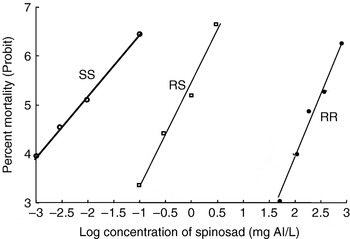
Two P. xylostella strains, one susceptible to spinosad (SS) and one highly resistant to spinosad (RR), were used (table 1 and fig. 1). Details for the selection of the SS and RR strains are presented in Yang et al. (Reference Yang, Li, Liu and Liu2004) and Li (Reference Li2005). Briefly, these two homozygous SS and RR strains with a similar genetic background were obtained by crossing between a spinosad-susceptible strain (WS) and a spinosad-resistant strain (WR) (WS×WR). The WS strain was originally collected from Wuhan (114.3°E, 30.5°N), Hubei, China in 1990, and was maintained on Brassica plants from 1990 to 2004 without exposure to any insecticides. The spinosad LC50 against the WS strain was 0.082 (95%CL 0.059–0.109) mg (AI) L−1 in December 2001, when a portion of the WS culture was used for the selection and development of SS and RR strains. The WR strain was originally collected in May 2001 from Wenzhou (120.6°E, 28.0°N), Zhejiang, China, where spinosad had been commonly used since 1998. The WR strain was intensively selected by exposure to spinosad in the laboratory for nine generations from May to November 2001. The WR strain showed a LC50 of 110.5 (95%CL 60.7–218.1) mg (AI) L−1 for spinosad in December 2001, when it was used for the selection and development of SS and RR strains. As resistance to spinosad was probably controlled by one locus (Zhao et al., Reference Zhao, Li, Collins, Gusukuma-Minuto, Mau, Thompson and Shelton2002; Sayyed et al., Reference Sayyed, Omar and Wright2004), the WS and WR strains were probably homozygotes of spinosad-susceptible and spinosad-resistant strains. However, as these two strains were originally collected from two localities that are approximately 700 km apart, their genetic backgrounds might differ. In December 2001, the WS and WR strains were crossed to select homozygotes of spinosad-susceptible (SS) and spinosad-resistant (RR) strains with a similar genetic background.
Log concentration-mortality lines of spinosad applied to 2nd instar larvae of susceptible homozygotes (SS), heterozygotes (RS) and resistant homozygotes of Plutella xylostella in the first generation after selection in February 2002.

Susceptibility of 2nd instar larvae of susceptible homozygotes (SS), heterozygotes (RS) and resistant homozygotes (RR) of Plutella xylostella to spinosad.

a LC50 and LC99 are expressed in mg (AI) L−1; CL, confidential limit.
b TR (toxicity ratio)=(LC50 of SS)/(LC50 of RR) using bioassay results of both strains at the same time.
At the start of the selection programme, 10♀ of WS and 10♂ of WR were placed in one cage for crossing between them, and 10♀ of WR and 10♂ of WS were placed in another cage for crossing. Approximately 200 eggs were randomly collected from each of the two cages and mixed to be reared to derive F1 (RS). F1 males and females mated to produce F2, which constituted RR, RS and SS genotypes. Previous bioassay data showed that no WS individuals could survive application of 1.0 g (AI) L−1 spinosad, and all WR individuals could survive 10.0 g (AI) L−1 spinosad. Thus, 1.0 g (AI) L−1 and 10.0 g (AI) L−1 spinosad were used as discriminating concentrations to separate the SS and RR genotypes. To obtain the RR genotype, 80 2nd instar larvae were randomly collected from F2 and exposed to 10.0 g (AI) L−1 spinosad. Of the 80 F2 larvae exposed, three survived and developed to one male and two female adults. These three adults mated to produce F3. When the F3 developed to the 2nd instar, 40 larvae were randomly collected and exposed to 50.0 g (AI) L−1 spinosad. All the 40 larvae survived and developed normally to adults, and these adults were used as the starting colony of the RR strain (for more detail, see Yang et al., Reference Yang, Li, Liu and Liu2004).
To obtain the SS genotype, 91 pairs (1♀×1♂) of F2 were each placed in a small cage to mate and produce an individual family of F3. Spinosad at the discriminating concentration of 1.0 g (AI) L−1 was applied to a portion of the 2nd instar larvae in each of the 91 families. In two of the 91 families, all the larvae exposed died (100% mortality at 1.0 g (AI) L−1 spinosad). These two families were determined as the SS genotype. One family from the two was used as the starting colony of the SS strain (for more detail, see Yang et al., Reference Yang, Li, Liu and Liu2004). The homogenous status of the SS strain was further confirmed by bioassays of the F1 from backcrosses of this strain with WR (Li, Reference Li2005).
Spinosad (Success™, 2.5 g (AI) per 100 g), obtained from Dow AgroSciences, was used in the resistance selection and bioassays.
Cultures of the SS and RR strains were maintained on potted common cabbage, Brassica oleracea L. var. capitata cv. Jingfeng No. 1 in the laboratory for 27 and 35 generation, respectively, from February 2002 to May 2005 (Li, Reference Li2005). The two cultures were reared on cabbage plants in stainless steel-framed cages (55×55×55 cm, with a glass top, screen-covered opening on three sides and a clear plastic front door) in separate cubicles of a temperature-controlled room. The SS strain was maintained without any exposure to insecticides, while the RR strain was exposed to selection with 50–100 mg (AI) L−1 spinosad once every four generations (Li, Reference Li2005). The comparative experiments described here started in early December 2003, when the SS and RR strains had been maintained for 18 and 24 generations, respectively (table 1). To avoid maternal effect of spinosad toxicity, the sub-culture of RR strain used did not receive spinosad treatment for three generations prior to the comparative experiments.
Cabbage plants were cultivated in greenhouses under ambient temperature and lighting conditions, and plants of the same cultivar were used for maintaining the cultures and conducting experiments.
Temperature regimes
Liu et al. (Reference Liu, Chen and Zalucki2002) report that the low and high temperature limits for the survival of P. xylostella are 6°C and 36°C under constant conditions, and 6°C and 32°C under fluctuating temperatures when temperatures are expressed as daily means and the daily amplitude of fluctuation is ±4°C of the mean. Using the information from Liu et al. (Reference Liu, Chen and Zalucki2002) as guidelines, we designed the following three fluctuating temperature regimes for the experiments:
(i) a low, unfavourable temperature regime that fluctuates from 2 to 10°C with a daily mean of 6°C;
(ii) a median, favourable temperature regime that fluctuates from 20 to 28°C with a daily mean of 24°C; and
(iii) A high, unfavourable temperature regime that fluctuates from 28 to 36°C with a daily mean of 32°C.
Long-term continuous recordings of temperature in the field in east China show that daily minimum and maximum temperatures usually occur at 05:00 and 14:00, with a 9 h phase of temperature rise followed by a 15 h phase of temperature falling (Su & Lin, Reference Su and Lin1986). The following formulas, thus, were used to simulate the daily fluctuations:


Where T is temperature, t is the hour of the day, and T l and T h are minimum and maximum temperatures; note that for simplicity of calculation the time of the day from 00:00 to 05:00 was taken as from 24 to 29.
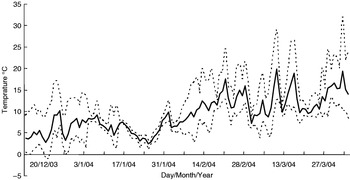
With the environmental chambers available to us, we were unable to produce the low temperature regime in the laboratory but used outdoor winter temperature and lighting conditions for the low temperature treatment (fig. 2). Using SANYO versatile growth chambers (model: MLR-350HT), we produced the median and high temperature regimes for the experiments, both with a photoperiod of 14 h light/10 h dark and a relative humidity level of 70–80%. Temperature and relative humidity in all three regimes were monitored continuously and recorded once per hour using Jingying® electronic data loggers (model: ZDR-20).
Daily minimum, mean and maximum temperatures recorded for the low temperature treatment. The dotted lines below and above the continuous line indicate daily minimum and maximum temperatures.

Observations and measurements at low temperature
Rearing cages of the test insects consisted of a clear, cylindrical plastic container (14.5 cm high, with a 9-cm-diameter top and 13-cm-diameter base). The top was covered with a fine stainless steel mesh gauze for ventilation. A cabbage leaf was fixed in the cage by inserting its petiole through a hole in the centre of the cage base. The cage was placed onto a 500-ml glass bottle containing a plant culture solution and the petiole of the cabbage leaf was inserted in the solution to maintain freshness.
The experiment at the low temperature regime was initiated on 19th December 2003 with 752 newly deposited eggs (0–12 h at 25°C, laid on a clear plastic sheet) of the SS strain and 823 newly deposited eggs of the RR strain. Eggs of each strain were divided into 15 groups, approximately 50 eggs each, to be inoculated on cabbage leaves in 15 rearing cages as 15 replicates (table 2). Observations were made once every four days from 19th December 2003 to 31st January 2004, when the daily mean temperatures were mostly in the range of 4–8°C; once every two days from 1–20 February, when the daily mean temperatures were mostly in the range of 8–15°C; and then daily from 21 February to 3 April 2004, when the daily mean temperatures were mostly in the range of 10–18°C (fig. 2). The leaves were replaced with fresh ones as necessary. Events of hatching, deaths, pupation and adult emergence were recorded as they occurred at each observation. Each pupa was collected and weighed on the day of pupation and placed singly in 1.5×8.0 cm glass tubes.
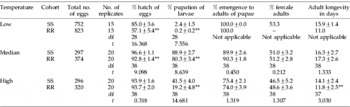
Survival and sex ratio of Plutella xylostella SS and RR cohorts at low, median and high fluctuating temperature regimes.

Note: Data are expressed as mean±SD of the replicates except that of adult longevity, which is based on individual adults.
*, ** indicate significant difference of the parameters between RR and SS at the same temperature regime at the 0.05 or 0.01 levels by Student t-test.
Adults were provided with 15% honey-water as food and paired on the day of emergence in the tubes. Each pair of adults (1♀×1♂) was provided with a new piece of 1.5×5.0 cm leaf daily for oviposition until they died. Eggs laid were counted at each observation.
Observations and measurements at median and high temperatures
Experiments at median and high temperature regimes were also conducted with detached leaves in rearing cages. At each of the two temperature regimes, 300–380 newly-deposited eggs of each strain were divided into 20 groups to be inoculated on cabbage leaves in 20 rearing cages as 20 replicates (table 2). Observations were made daily to record events of hatching, deaths, pupation and adult emergence. Each pupa was collected and weighed on the day of pupation and placed singly in 1.5×8.0 cm glass tubes. During the peaks of adult emergence, one pair of adults (1♀×1♂) was taken from each replicate and placed into a 1.5×8.0 cm glass tube. Each pair of adults was provided with a new piece of 1.5×5.0 cm leaf daily for oviposition until they died. Eggs laid were counted at each observation.
Statistical analysis
Life-history traits, including % hatch of eggs, % pupation of larvae, development time, pupal weight, % emergence to adults, sex ratio, fecundity and longevity, between the SS and RR strains at each temperature regime were compared by Student t-test. All proportional data were transformed by arcsine square root before they were subjected to Student t-tests. For the statistical analysis on % hatch of eggs, % pupation of larvae, % emergence to adults of pupae and % female adults, the average value in each replicate was taken as a ‘single value’, and comparison was done on the two means of these single values between the SS and RR strains at a given temperature regime (table 2). For the statistical analysis on adult longevity, development time, pupal weight and number of eggs laid, comparison was done on the data of individuals (tables 2 and 3). All calculations were done with the statistical software Statistica® (Statsoft, 2003).
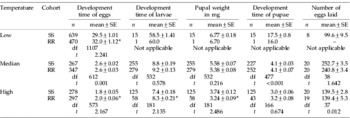
Development time in days, pupal weight and number of eggs laid per female of Plutella xylostella SS and RR cohorts at low, median and high fluctuating temperature regimes.

* indicates significant difference of the parameters between RR and SS at the same temperature regime at the 0.05 level by Student t-test.
The data of development time, survival and fecundity of each strain at each temperature regime were used to construct age-specific life (l x) table and fertility (m x) table on a daily basis. The net reproductive rate (R o) and the intrinsic rate of increase (r m) were calculated following the procedures of Krebs (Reference Krebs2001).
Results
At the low temperature regime, eggs started to hatch during 9–12 January 2004 (21–24 days after oviposition) and the hatching continued until the 24th January (36 days after oviposition). Pupation occurred from 14–23 March 2004, and adult emergence occurred from 2–8 April 2004. The RR strain achieved significantly lower levels of survival for both egg and larval stages and experienced a longer development time of eggs than the SS strain (tables 2 and 3). Because only one individual out of 823 eggs of the RR strain survived to pupation, other life-history traits, including pupal survival, sex ratio, adult longevity, larval development time, pupal weight, pupal development time and fecundity could not be compared statistically between the two strains (tables 2 and 3).
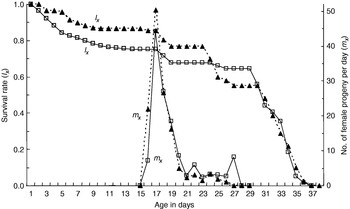
Age-specific survival and fertility rates of SS and RR cohorts of Plutella xylostella at a median fluctuating temperature regime (minimum, mean and maximum were 20, 24 and 28°C, respectively) (----▲---, SS; —□—, RR).

At the median temperature regime, the RR and SS strains performed much more similarly except that the RR strain had significantly lower levels of egg hatch and larval survival than the SS strain (tables 2 and 3). However, when the reduction in survival is calculated as a relative value using the formula, %relative reduction=((%survival of SS−%survival of RR)×(% survival of SS)−1)×100, the relative reductions in survival at the median temperature regime were only 4% and 10% for eggs and larvae, respectively, compared to 33% and 92% relative reductions in survival for these two stages at the low temperature regime (tables 2 and 3).
At the high temperature regime, the RR strain showed a significantly lower level of larval survival, a shorter adult longevity, a longer development time for both egg and larval stages, and a lighter pupal weight than the SS strain (tables 2 and 3).
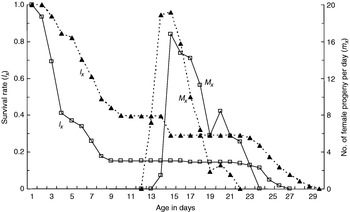
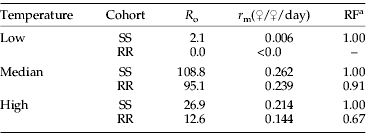
The differences in performance between the SS and RR strains were further shown in their life and fertility tables and population parameters. Because of the very low level of survival of the RR strain at the low temperature regime, no attempt was made to construct the age-specific life and fertility tables for this strain at this temperature. The life and fertility tables of the SS strain at the low temperature regime were constructed but are not shown because no comparison between the two strains was desired here. At the median temperature regime, the life and fertility tables between the two strains were similar except that the RR strain had a slightly lower level of survival during immature and early adult stages (fig. 3). At the high temperature regime, the RR strain showed a lower level of survivorship from birth to death and a later and lower fertility curve than the SS strain (fig. 4). The differences in life and fertility tables between the two strains are further reflected in their population parameters. At the low temperature regime, the SS showed a positive r m value; in contrast, the RR strain showed a negative r m (table 4). At the median temperature regime, the RR strain showed a 9% decrease in its r m compared to SS; and at the high temperature regime, the RR strain showed a 33% decrease in r m compared to SS strain (table 4).
Age-specific survival and fertility rates of SS and RR cohorts of Plutella xylostella at a high fluctuating temperature regime (minimum, mean and maximum were 28, 32 and 36°C, respectively) (----▲---, SS; —□—, RR).

Population parameters of Plutella xylostella SS and RR cohorts at low, median and high fluctuating temperature regimes.
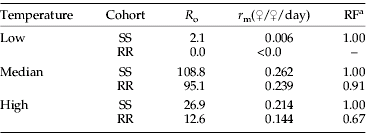
a RF (relative fitness)=r m of RR r m−1 value of SS.
Discussion
In an earlier study using constant temperatures, we found that resistance to spinosad in P. xylostella was associated with a significant fitness cost at low temperatures but with only a marginal fitness cost at a median temperature (Yang et al., Reference Yang, Li, Liu and Liu2004). These findings of temperature-related fitness cost of resistance to spinosad in this insect were confirmed here by experiments at natural/fluctuating temperature regimes. The temperature in the winter of 2003 (fig. 2) was typical of that season in Hangzhou. At this realistic field temperature condition, the RR cohort produced no viable offspring, while the SS cohort was still able to achieve a positive population growth (table 4). In addition, the current study revealed a significant fitness cost associated with the resistance at high temperatures in this insect.
Severe fitness costs associated with insecticide resistance to survive low temperatures have been demonstrated for several insects, including the Australian sheep blowfly, Lucilia cuprina (Wiedemann) (McKenzie, Reference McKenzie1990), the mosquito, Culex pipiens L. (Chevillon et al., Reference Chevillon, Denis Bourguet, Rousset, Pasteur and Raymond1997), and the Colorado potato beetle, Leptinotarsa decemlineata Say (Alyokhin & Ferro, Reference Alyokhin and Ferro1999). In the pink bollworm, Pectinophora gosypiella (Saunders), resistance to transgenic Bt cotton is associated with severe overwintering cost (Carrière et al., Reference Carrière, Christa Ellers-Kirk, Patin, Sims, Meyer, Liu, Dennehy and Tabashnik2001). In the peach-potato aphid, Myzus persicae, insecticide resistance is associated with slower movement away from senescing leaves of host plants in cold and wet conditions and, consequently, lower survival (Foster et al., Reference Foster, Harrington, Devonshire, Denholm, Clark and Mugglestone1997). In these examples, relative survival through overwintering in the resistant strains is usually reduced by 50–95%, compared to the susceptible strains.
Interestingly, fitness costs associated with insecticide resistance to survive high temperatures have not been reported. In P. xylostella, resistance to spinosad is also associated with some fitness cost to survive high, unfavourable temperatures (table 4), although the cost is not as high as that at the low temperatures within the range examined in this study.
Apart from fitness cost to survive low temperatures, resistance to spinosad may be associated with other costs. In the tobacco budworm, H. virescens, resistance to spinosad has been shown to be associated with slower development, smaller body size and reduced reproductive competitiveness for males (Wyss et al., Reference Wyss, Young, Shukla and Roe2003). Another interesting phenomenon associated with fitness cost is that the effect may be carried over between generations. Yang et al. (Reference Yang, Li, Liu and Liu2004) showed that when the RR strain of P. xylostella experienced temporarily sublethal low temperatures during pupal stage, the eggs produced by the ensuing adults had a markedly lower hatchability than that of the SS strain.
Fitness changes associated with resistance to insecticides and Bt toxins in P. xylostella have been investigated in several studies. Fitness costs have been reported for resistance to Bt toxins (Groeters et al., Reference Groeters, Tabashnik, Finson and Johnson1994; Raymond et al., Reference Raymond, Sayyed and Wright2005), fenvalerate (Chen & Nakasuji, Reference Chen and Nakasuji2004) and avermectins (Li et al., Reference Li, Gao, Zheng and Liang2000). Fitness advantages have been reported for resistance to chlorfluzuron (Yamada et al., Reference Yamada, Tanaka, Fahmy and Miyata1993). The studies of resistance to Bt and its insecticidal Cry toxins by various authors suggest that fitness costs can be variable and cryptic but are usually expressed at stressful conditions (Raymond et al., Reference Raymond, Sayyed and Wright2005). Reports of a lack of fitness costs are often associated with experiments conducted at favourable temperature and nutrition conditions (Tang et al., Reference Tang, Gilboa, Roush and Shelton1997; Sayyed & Wright, Reference Sayyed and Wright2001). The evidence obtained in this study and Yang et al. (Reference Yang, Li, Liu and Liu2004) for the temperature-dependent fitness costs of resistance to spinosad point out again the necessity to investigate such costs at more stressful conditions.
Fitness costs associated with insecticide resistance can play a major role in the evolution of resistance in the field. In M. persicae, various fitness costs, including reduced overwintering ability, lower rate of movement away from senescing plant leaves at low temperatures, reduced responses to alarm pheromones and reduced reproduction, have appeared sufficient to maintain a fluctuating polymorphism of susceptible and resistant forms in the UK (Foster et al., Reference Foster, Denholm and Devonshire2000, Reference Foster, Harrington, Dewar, Denholm and Devonshire2002, Reference Foster, Denholm, Thompson, Poppy and Powell2005). In the pink bollworm, P. gosypiella, fitness costs at low temperatures associated with resistance appeared to be an important determinant in the delayed resistance of this insect to Bt cotton (Carrière et al., Reference Carrière, Christa Ellers-Kirk, Patin, Sims, Meyer, Liu, Dennehy and Tabashnik2001; Tabashnik et al., Reference Tabashnik, Dennehy and Carrière2005). Apparently, when fitness costs are high at low temperatures, relaxation of selection pressure is likely to favour a population's reversion to susceptibility in regions with a relatively cold winter. So far, severe resistance to spinosad by P. xylostella has been reported only from regions of warm or mild climate such as Hawaii and Georgia, USA (Zhao et al., Reference Zhao, Li, Collins, Gusukuma-Minuto, Mau, Thompson and Shelton2002, Reference Zhao, Collins, Li, Mau, Thompson, Hertlein, Andaloro, Boykin and Shelton2006) and Cameron Highlands of Malaysia (Sayyed et al., Reference Sayyed, Omar and Wright2004). The pattern of the temperature-related fitness costs of resistance to spinosad revealed in this study warns that spinosad should not be applied intensively in regions with warm or mild temperatures to avoid or delay resistance development. In regions with cold winters and/or hot summers, effort should be made to take advantages of the fitness costs at low and high temperatures to develop effective resistance management strategies to increase the longevity of this ‘soft’ insecticide in the field.
Acknowledgements
This study was supported by the National Natural Science Foundation of China (Project No. 30300237). We thank Dr J.Z. Zhao, Department of Entomology, Cornell University, New York State Agricultural Experiment Station, USA and Dr Mike Furlong, School of Integrative Biology, University of Queensland, Australia, for helpful comments on the manuscript.