INTRODUCTION
Parasitological studies consistently demonstrate that, in natural conditions, an individual host is typically infected by multiple parasites (Petney and Andrews, Reference Petney and Andrews1998; Cox, Reference Cox2001). The health impact of multiple infections has been known for some time, with most information from human studies (Haswell-Elkins et al. Reference Haswell-Elkins, Elkins and Anderson1987; Ferreira et al. Reference Ferreira, Ferreira and Nogueira1994; Needham et al. Reference Needham, Kim, Hoa, Cong, Michael, Drake, Hall and Bundy1998; Brooker et al. Reference Brooker, Miguel, Moulin, Luoba, Bundy and Kremer2000; Pullan and Brooker, Reference Pullan and Brooker2008). However, few studies have investigated the impact on wild vertebrate host health (for a review see Bordes and Morand, Reference Bordes and Morand2011). There is a clear need to consider full pathogen communities rather than single relevant pathogen species when assessing the impact of infections (Serrano and Millán, Reference Serrano and Millán2014).
In fish, especially in predator species, both infection intensity and pathogen richness typically increase with the size and age of hosts. The rationale is rather simple since for trophically transmitted parasites infection rates rely on the ingestion of infective intermediate hosts, and hence older individuals have had more opportunities to accumulate parasites than younger ones (Dogiel Reference Dogiel1958; Poulin, Reference Poulin2000; Luque and Poulin, Reference Luque and Poulin2004; Kamiya et al. Reference Kamiya, O'Dwyer, Nakagawa and Poulin2014). Due to this bioaccumulation, fish are likely to suffer multiple infections in their lifetime, and the impact of disease severity in the host fitness may depend on interactions among co-infecting pathogens (Pedersen and Fenton, Reference Pedersen and Fenton2007) and the co-evolution between parasite and host (Lymbery et al. Reference Lymbery, Morine, Kanani, Beatty and Morgan2014). In general, hosts limit the harm caused by a given parasite burden without any direct negative effects on the parasite (tolerance), or by direct attack on parasites by activation of the immune system (resistance, according to Råberg et al. Reference Råberg, Graham and Read2009). Tolerance and resistance are different but complementary host traits that require reallocation of host resources, and therefore tend to carry physiological costs (Råberg et al. Reference Råberg, Graham and Read2009; Medzhitov et al. Reference Medzhitov, Schneider and Soares2012; Schneider and Ayres, Reference Schneider and Ayres2008). Both defensive strategies have also been described in fishes (e.g, see Boots and Bowers, Reference Boots and Bowers1999; Blanchet et al. Reference Blanchet, Rey and Loot2010). The equilibrium between the two strategies, disease severity and host fitness, are specific to each host–parasite system (Roy and Kirchner, Reference Roy and Kirchner2000). However, little is known about the defensive strategies in the case of co-infection with multiple pathogens (Råberg et al. Reference Råberg, Graham and Read2009).
The biological cost resulting from parasites in wild fishes has been evaluated by measuring the body condition (e.g. Gérard et al. Reference Gérard, Trancart, Amilhat, Faliex, Virag, Feunteun and Acou2013; Lefebvre et al. Reference Lefebvre, Fazio, Mounaix and Crivelli2013), the immune response (e.g. Seppänen et al. Reference Seppänen, Kuukka, Voutilainen, Huuskonen and Peuhkuri2009; Rohlenová et al. Reference Rohlenová, Morand, Hyršl, Tolarová, Flajšhans and Šimková2011) and stress during infection (e.g. Iwama et al. Reference Iwama, Pickering and Sumpter2011). The rationale for using such indicators of the cost of infection is the following: body condition is defined as the tissues necessary for a functionally normal life and those accumulated in anticipation of periods of shortage. Body condition has previously been used in different fish studies to evaluate the impact of parasites on host health (e.g. Lemly and Esch, Reference Lemly and Esch1984; Tierney et al. Reference Tierney, Huntingford and Crompton1996; Arnott et al. Reference Arnott, Barber and Huntingford2000; Maan et al. Reference Maan, Van Rooijen, Van Alphen and Seehausen2008; Lefebvre et al. Reference Lefebvre, Fazio, Mounaix and Crivelli2013). However, we use the scaled mass index (SMI), as a proxy of body condition, because it is considered as an excellent measure of the energy capital accumulated in the body as a result of feeding and has previously been validated with data on body components such as fat and protein (Peig and Green, Reference Peig and Green2009). To the authors’ knowledge, this novel condition index has only been recently used in fish (Maceda-Veiga et al. Reference Maceda-Veiga, Green and De Sostoa2014). Due to the costs of parasitism, as in body condition, it is expected that the eel's SMI decreases as parasite intensity and richness increase.
The immune response is an evolved strategy to defend hosts efficiently against the effects of parasites on host fitness (Møller and Saino, Reference Møller and Saino2004). The spleen, a secondary lymphatic organ, plays a highly important role in haematopoiesis and immune reactivity of teleost fish producing antibodies and participating in clearance of pathogens and foreign particles from the blood stream (Dalmo et al. Reference Dalmo, Ingebrigtsen and Bøgwald1997; Lamková et al. Reference Lamková, Šimková, Palíková, Jurajda and Lojek2007). The splenic somatic index (SSI), is the simplest method for estimating the absolute or relative abundance of immunologically active cells (Owens and Wilson, Reference Owens and Wilson1999), and is widely used as a simple measure in immune response against parasites in fish (Manning, Reference Manning and Turner1994; Kortet et al. Reference Kortet, Taskinen, Sinisalo and Jokinen2003; Lefebvre et al. Reference Lefebvre, Mounaix, Poizat and Crivelli2004; Ottová et al. Reference Ottová, Šimková, Jurajda, Dávidová, Ondračková, Pečínková and Gelnar2005, Reference Ottová, Šimková and Morand2007). If parasites cause an immune reaction, one would expect the spleen to increase in size due to its important haematopoietic function for leucocyte synthesis.
Another way to evaluate the costs of parasites in wild fishes is by measuring the stress that parasite infection produces on the host. Stress may be considered as a change in biological condition beyond the normal resting state that challenges homeostasis and, thus, presents a threat to the fish's health (Barton and Iwama, Reference Barton and Iwama1991). Fluctuating asymmetry (FA), a direct measure defined as a non-directional deviation from symmetry in bilateral traits, is related to stress (reviewed in Leung and Forbes, Reference Leung and Forbes1996). Therefore, FA could be analysed as a measure of parasite virulence (Allenbach, Reference Allenbach2011) since parasites can cause direct stress on the host through metabolic costs (Møller, Reference Møller1992; Polak, Reference Polak1993). Thus, with an increase in parasite intensity and richness, FA would increase.
The present study will evaluate whether wild eel health, using FA, SSI and SMI as proxy, is affected by polyparasitism by means of partial least square regression models (PLSR). At the same time, since co-infections in European eels are common (Martínez-Carrasco et al. Reference Martínez-Carrasco, Serrano, de Ybáñez, Peñalver, García, García-Ayala, Moran and Muñoz2011), in this work we are interested in understanding whether the effects of parasitation on eel health were due to a particular species or, on the contrary, relied on the additive effects of several parasites. This analysis was used to understand the defence strategy (tolerance or resistance) used by eels to cope with co-infection.
MATERIALS AND METHODS
Area of study
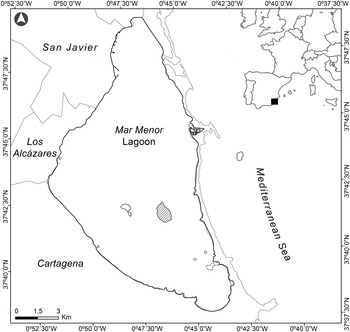
Mar Menor lagoon is located in Southeastern Iberian Peninsula (37°38′N, 0°42′W), Spain (Fig. 1). It is the largest saltwater lake in Europe with an area of 180 Km2 and 73 Km of coastline. The maximum depth is 7 m. It is isolated from the sea by a 24 Km-long sandbar known as La Manga. The water exchange and, therefore, the passage of fish species between the Mar Menor and the Mediterranean Sea occurs naturally through natural openings or passages, and there are no artificial barriers that limit the passage of eels. Its salinity levels (43–46·5 g/L) are greater than the adjacent Mediterranean Sea due to low precipitation (around 300 mm per year) and high evaporation rates (mean annual temperature 18 °C).
Map showing the location of Mar Menor lagoon.

Eel biometry and indexes
A total of 189 wild European eels were collected by local fishermen during 2010 and frozen until processed. Eels were measured to the nearest 0·5 mm using a nylon tape (mean length: 528·46 ± 72·05 mm) and weighed to the nearest 0·01 g on a digital scale (mean weight: 261·90 ± 115·48 g).
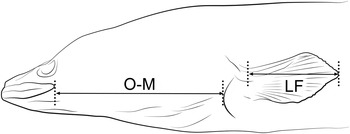
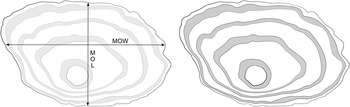
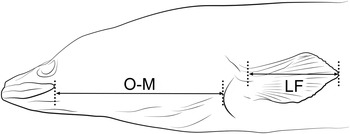
The maximum pectoral fin length (LFR, LFL for right and left measures, respectively) and the distance between the operculum and labial commissure on each side (O–MR, O–ML for right and left measures, respectively) (Fig. 2) were measured with a digital calliper. Maximum otolith length (MOLr; MOLl, for right and left measures, respectively) and maximum otolith width (MOWr; MOWl, for right and left measures, respectively, Fig. 3) were measured using a stereoscope ZEISS model Stemi 2000-C connected to a computer-enhanced video image-analysis (SPOT version 4.6). All measurements were carried out twice by the same observer according to the recommendations of Palmer and Strobeck (Reference Palmer and Strobeck1986).
Anterior part of the eel body. Arrows indicate the distances in mm between operculum and dorsal fold mouth of each side (O–M) and maximum length of pectoral fins (LF).
Eel otolith and an overlook of the otolith rings. MOL, maximum otolith length and MOW maximum otolith width.

SMI was calculated according to Peig and Green (Reference Peig and Green2009) as M ii = M i (Lo/Li)b SMA where M i and L i are the body mass and linear body measurement of an individual i respectively; b SMA is the scaling exponent estimated by the standardized major axis (SMA) regression of lnM on lnL; L 0 is an arbitrary value of L (e.g., the arithmetic mean value for the study population); and Mii is the predicted body mass for individual i when the linear body measure is standardized to L0. SSI was calculated as the residuals of the ratio of the spleen weight to total body weight, and used to correct the fish condition effect.
Age determination
In brief, sagittal otoliths were removed from each eel by slicing the head open longitudinally from the dorsal surface with a sharp, heavy-bladed knife. Thus, they could easily be removed from the otic capsules with forceps, cleaned and stored dried. For better reading, due to their small size and thinness, whole otoliths were cleared in glycerine (ICES, 2009), and examined under a stereoscopic microscope (40X magnification), with reflected light, against a dark background and immersed in glycerine to allow increased light penetration.
By convention, the age reference date was set as the 1st of January, eels were age 0 in their year of arrival to continental water, and age was estimated based on counts of otolith winter rings. As is recommended, age was estimated from each left otolith by two independent readers, EMH and PM (ICES, 2009).
Parasitological analysis
Briefly, eels were examined for ectoparasite detection. They were then dissected and the body cavity and mesenteries were inspected. Internal organs were cut and observed under a stereomicroscope. Digestive content was also examined under a stereomicroscope. Swim bladders were inspected for the presence of adult and larval stages (L3 and L4) of Anguillicoloides crassus. Muscle tissue was artificially digested for detection of anisakid larvae. Parasites were stored in 70% ethanol until their identification. Prevalence, intensity and abundance of infection for each parasite species were defined according to Bush et al. (Reference Bush, Lafferty, Lotz and Shostak1997). Specifically, the prevalence is the number of hosts infected with a particular parasite species (or taxonomic group) divided by the number of hosts examined for that parasite species, whose value is measured as percentage. The intensity is the ratio among number of individuals of a particular parasite species in a single infected host and the number of infected individuals of the host species in the sample, whose value is measured in specimens per infected animal. And finally, the abundance is number of individuals of a particular parasite species per host examined, whose unit is measured as specimens per analysed animal.
Statistical analysis
Two analyses were performed to examine FA with multiple traits. For the first analysis, a FA-index that reflects absolute differences between right and left side separately for each trait for each individual was calculated following the recommendations of Palmer and Strobeck (Reference Palmer, Strobeck and Polk2003) (FA1 = |(mean R)−(mean L)|). The Composite Fluctuating Asymmetry index 2 (CFA2) was then estimated (Leung et al. Reference Leung, Forbes and Houle2000) as the summation of standardized absolute FA2 values (FA1 values of a given trait divided by the average absolute FA for that trait). Every FA index of a single trait depends heavily upon statistical inference, and consequently a number of conditions should be evaluated beforehand to obtain reliable CFAs.
Linear regression, Pearson correlation and a Kruskal–Wallis test were used to analyse the relationship of eel age (treated as continuous or categorical variable) and size (length) to richness, total intensity of infection and individual parasite intensity. To assess whether older individuals had accumulated more parasites than the younger ones, post hoc tests were also performed between age classes.
Moreover, the influence of parasite community traits (i.e. parasite composition and intensity of infection due to specific parasite species) on the selected eel health-related parameters was assessed using a PLSR approach. This statistical tool is an extension of multiple regression analysis where associations are established with factors; that is to say, combinations of dependent variables extracted from predictor variables that maximize the explained variance in the dependent variables. The relative contribution of each variable to the derived factors is calculated by means of square predictor weights. PLSR is a distribution-free technique and does not require specific distribution data. In our case, the response variables (SMI, the residuals of SSI regression and CFA2) make up the Y-component, which is defined as health status, whereas the explanatory variables (called ‘parasites block’) were parasitic richness (i.e. the number of different parasite species found in an eel) and specific parasite intensity (i.e. number of individuals from a parasite species found in an individual eel). We also obtained the variable importance for projection (VIP) and modified weights and scores of the variables. VIP explains the power of a given predictor X j on the block of responses Y. Moreover, VIP provides another way to classify the predictors in terms of their explanatory power of Y. Those predictors with a VIP > 1 are considered the most relevant to the construction of the Y-component. The modified weights are the values used for calculating the components with the original block of predictors. The X-scores, which contain the extracted PLS components, and the Y-scores are the components associated with the response variable. PLSR was implemented in the ‘plspm’ library (Sanchez and Trinchera, Reference Sanchez and Trinchera2012) of the statistical package R version 3.0.3 (R Development Core Team, 2013).
RESULTS
Eel biometry and age
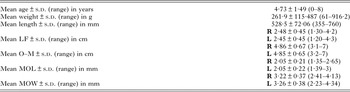
Morphological and otolithometrical characteristics are shown in Table 1, while Table 2 summarizes all FA values. FA values were significant in two traits analysed (O–M and MOW) while no significant FA were observed in LF or in MOL (see Appendix).
Morphological and otolithometrical characteristics of the 189 eels sampled from Mar Menor lagoon

LF, length of the pectoral fins; O–M, distance between the operculum and labial commissure; MOL, máximum length of the otoliths; MOW, máximum width of the otoliths; s.d., standard deviation, L, left; R, right.
Fluctuating asymmetry values of four bilateral characters

FA, means raw values of fluctuating asymmetry for each measured, LF, length of the pectoral fins; O–M, distance between the operculum and labial commissure; MOL, maximum length of the otoliths; MOW, maximum width of the otoliths; s.d., standard deviation.
Relationship among parasite status and age and eel size
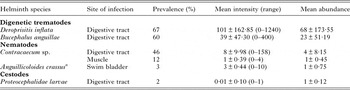
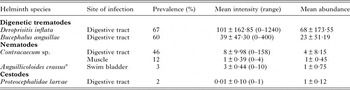
The composition of the parasite community (prevalences, abundances and intensities) in this eel population was described in Mayo-Hernández et al. (Reference Mayo-Hernández, Peñalver, García-Ayala, Serrano, Muñoz and Ruiz de Ybáñez2014) (see Table A1 in the Appendix). The nematode A. crassus and Proteocephalidae larvae were removed from further analysis due to their low prevalences (<5%).
Age, analysed as a quantitative variable, was positively and significantly correlated to the log-transformed whole parasite intensity (R 2 = 4%, F1,154 = 6·55, P-value = 0·01) while no significant correlations to specific parasite species were observed. When age was pooled in classes (e.g. 1 year, 2 years, etc), Contracaecum intensity of infection was significantly different between age classess (Kruskal–Wallis chi-squared = 14·83, d.f. = 6, P-value = 0·022), and had a positive and significant linear correlation to log-transformed Bucephalus anguillae intensity (R 2 = 8·6%, F6,145 = 2·27, P-value = 0·04). Nevertheless the post-hoc comparisons indicated no significant effect of age on Contracaecum sp. and B. Anguillae intensity of infection. No significant correlation was found to richness or to Deropristis inflata intensity.
Regarding size (length), we detected a positive significant relationship with: richness (R 2 = 7·4%, F4,182 = 3·64, P-value = 0·01) and with parasite intensity (R 2 = 7·9%, F1,184 = 15·8, P-value < 0·01); also with log-transformed intensities of D. inflata (r = 0·15, P-value = 0·05), B. anguillae (R 2 = 8·2, F1,184 = 16·64, P-value = 6·718 × 10−5); and Contracaecum sp. intensities of infection (R 2 = 12%, F1,185 = 25·26, P-value = 1·179 × 10−6). It should be noted that the residuals of the last linear correlations did not show a normal distribution.
Impact of co-infections on host health
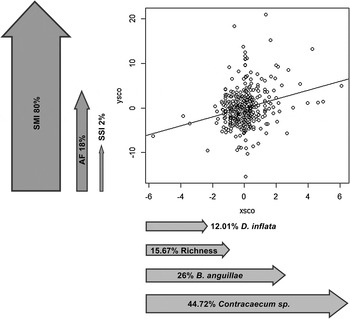
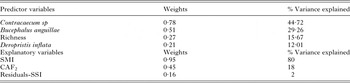
The results of the PLSR analysis are represented graphically (Fig. 4), and predictor and explanatory variable weights and scores are shown in Table 3. The graphic shows a linear and positive correlation between individual parasitic intensity and richness (X-component) and SMI, FA and SSI (Y-component). Moreover, the analysis revealed that the parasites block (X-component) is responsible for 44% of the variance of the eel's health status (Y-component). Moreover, the nematode Contracaecum sp. was the strongest predictor variable, explaining 44·72% of the response variables block. The 29·26% was explained by B. anguillae, which along with the Contracaecum sp., was considered the most relevant to the construction of response variables Y, since they had a VIP = 1·0 and a VIP = 1·5, respectively. Subsequently, 15·67 and 12·01% of the response variables block were explained by richness and D. inflata, respectively.
Relationship on a PLSR model among co-infecting helminths intensities and parasites richness (X-component) and the body condition, the SSI and the FA (Y-component) on 189 eels from Mar Menor. This plot represents the best PLSR model shown in table 3. Arrow direction indicates either an increase or a decrease of the component value, and arrow thickness directly indicates the weight of the component. The nematode Anguillicoloides crassus and Proteocephalidae larvae were excluded from the analysis due to their low prevalences (< 5%).

Predictor weights of the partial least squares regression (PLSR) model explaining the effects of co-infection by community parasites on health of 189 eels from Mar Menor lagoon
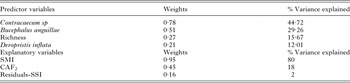
Predictor weights (parasitic richness and specific parasite intensity) were transformed in percentage to explain the contribution of each to the PLSR's Y axis, represented by SMI, fluctuating asymmetry and SSI. Explanatory weights (correlation between the Y-components and the Y) of the partial least squares regression (PLSR) model explaining the percentage of the Y-component explained by the explanatory variables.
DISCUSSION
Relationship among parasite status and age and eel size
Our results from wild eels are in line with previous studies (Dogiel Reference Dogiel1958; Bell and Burt, Reference Bell and Burt1991; Poulin, Reference Poulin2000; Luque and Poulin, Reference Luque and Poulin2004; Kamiya et al. Reference Kamiya, O'Dwyer, Nakagawa and Poulin2014), which have shown that both parasite intensity and diversity of infection increase with age or size of fish hosts due to parasites accumulated over time.
Impact of co-infections on host health
The analysis revealed that the parasites block (X-components) is responsible for 44% of the variance in eel health status. The present study showed that although parasite intensity and richness increase, causing stress and immune system activation, eels continue to develop. The parasites block included two digenea (D. inflata and B. anguillae), the nematode Contracaecum sp. and parasite richness. Both Digenea, native and eel-specific, the most prevalent parasitic group in Mar Menor eels, can destroy the mucosal epithelium covering the villi, and cause its necrosis and degeneration (Dezfuli et al. Reference Dezfuli, Manera, Onestini and Rossi1997), showing strict specificity for their niche (intestine). Therefore, D. inflata and B. anguillae compete for the same sources and may interact directly (Pedersen and Fenton, Reference Pedersen and Fenton2007). On the other hand, eels serve as intermediate hosts for Contracaecum spp., a generalist parasite that matures in piscivorous birds and mammals (Anderson, Reference Anderson1992). The L3 larvae of this nematode can be found in musculature and viscera, with its migration and feeding leading to lesions (Rohde, Reference Rohde1984; Williams and Jones, Reference Williams and Jones1994). However, the host can induce L3 larvae encystment in the tunica propia and along the stomach and intestinal wall, as previously reported in eels by Dezfuli et al. (Reference Dezfuli, Szekely, Giovinazzo, Hills and Giari2009), which may contribute to their evasion of the host's immune response (Sitjà-Bobadilla, Reference Sitjà-Bobadilla2008).
The eels' health status block (Y-component) was defined by the response block (SMI, SSI and FA). Eighty percent of the health status was represented by SMI variation. Negative parasite effects on host condition are widely known (e.g. Maan et al. Reference Maan, Van Rooijen, Van Alphen and Seehausen2008; Gérard et al. Reference Gérard, Trancart, Amilhat, Faliex, Virag, Feunteun and Acou2013 ) and expected, but there is no a priori reason to assume that this relationship would always be negative as there are also reports of better relative condition among parasitized fish (Arnott et al. Reference Arnott, Barber and Huntingford2000; Costa-Dias et al. Reference Costa-Dias, Dias, Lobón-Cerviá, Antunes and Coimbra2010; Guidelli et al. Reference Guidelli, Tavechio, Takemoto and Pavanelli2011; Lefebvre et al. Reference Lefebvre, Fazio, Mounaix and Crivelli2013). The present study showed a positive relationship between SMI and parasite intensity and richness, which corroborates the finding that the relationship between fitness loss and infection intensity is not necessarily linear (intensity-dependent virulence) (Rollinson and Hay, Reference Rollinson and Hay2011). Some studies concluded that changes in body condition depend on the presence of determinate parasites and interactions among them (e.g. Arnott et al. Reference Arnott, Barber and Huntingford2000; Khokhlova et al. Reference Khokhlova, Krasnov, Kam, Burdelova and Degen2002; Hoffnagle et al. Reference Hoffnagle, Choudhury and Cole2006). Seppänen et al. (Reference Seppänen, Kuukka, Voutilainen, Huuskonen and Peuhkuri2009), Khan (Reference Khan2012) and Santoro et al. (Reference Santoro, Mattiucci, Work, Cimmaruta, Nardi, Cipriani, Bellsario and Nascetti2013) reported that effects on body condition can be influenced by the level of infection, the size of the parasites and the host tissue or organ affected. In Mar Menor eels, the parasite community composition, the low mean intensity of parasitization (102 ± 200·87) and parasite localization (explained in the parasites block) may be responsible for this positive relationship.
The association between spleen size and parasitism by metazoan parasites has been tested in many intraspecific studies (e.g. Taskinen and Kortet, Reference Taskinen and Kortet2002; Ottová et al. Reference Ottová, Šimková, Jurajda, Dávidová, Ondračková, Pečínková and Gelnar2005; Vainikka et al. Reference Vainikka, Taskinen, Löytynoja, Jokinen and Kortet2009). Positive correlations between spleen enlargement and nematodes (Arnott et al. Reference Arnott, Barber and Huntingford2000; Morand and Poulin, Reference Morand and Poulin2000; Lefebvre et al. Reference Lefebvre, Mounaix, Poizat and Crivelli2004) or digenean (Seppänen et al. Reference Seppänen, Kuukka, Voutilainen, Huuskonen and Peuhkuri2009) parasites have been reported. However, in our study, the parasite community showed a very low variance in the SSI residuals (2%) reflecting a weak spleen immune response to those species. Similar results have been described by Vainikka et al. (Reference Vainikka, Taskinen, Löytynoja, Jokinen and Kortet2009) and may be due to the long-term coevolution between the parasites in the PLSR model, all of them native, and the eel populations (Peeler et al. Reference Peeler, Oidtmann, Midtlyng, Miossec and Gozlan2011).
Eighteen percent of the Y-component (health status) was due to stress, measured by FA, indicating a slight influence of parasite intensities and richness on FA. A positive relationship between parasite infection level and developmental instability in fish has been reported previously (Møller, Reference Møller2006; Reimchen, Reference Reimchen1997; Sasal and Pampoulie, Reference Sasal and Pampoulie2000; Reimchen and Nosil, Reference Reimchen and Nosil2001; Bergstrom and Reimchen, Reference Bergstrom and Reimchen2002), while no consistent relationship was found in other studies (Escos et al. Reference Escos, Alados, Emlen and Alderstein1995; Berg et al. Reference Berg, Adkison and Quinn1997; Campbell and Emlen, Reference Campbell and Emlen1996). Fazio et al. (Reference Fazio, Lecomte-Finiger, Bartrina, Moné and Sasal2005) found no asymmetry in European eels due to A. crassus, considered highly pathogenic in eels (Kennedy, Reference Kennedy2007); however, similar to our results, they did find a positive relationship between asymmetry and digenean parasites in yellow eels. They suggested that digeneans may be responsible for part of the asymmetry by disturbing, either directly or indirectly, the metabolism of some nutrients. It is also important to note that some asymmetrical fishes are free of parasites (and the reverse is also true), indicating that it is impossible to determine whether the presence of parasites is the cause or the consequence of the phenotypic variation in the selected traits (Sasal and Pampoulie, Reference Sasal and Pampoulie2000). Therefore, according to Allenbach (Reference Allenbach2011), both FA and parasitism can be used as biological indicators of stress. For this reason, we recommend further studies to test other possible stressors as contamination.
Tolerance vs resistance
Our results show a positive link between parasitism and eel health status. Undergoing multiple parasitic exposures while maintaining good condition, strongly suggests that Mar Menor eels tolerate multiparasitism. Tolerance ameliorates the damage that parasites cause, allowing infected hosts to live longer, and thus, increases the infectious period and increases rather than decreases parasite prevalence, which in Mar Menor eels was 95%, leading to a positive feedback loop (Roy and Kirchner, Reference Roy and Kirchner2000). The low prevalence (3%) of the invader species A. crassus in Mar Menor eels (Mayo et al. Reference Mayo-Hernández, Peñalver, García-Ayala, Serrano, Muñoz and Ruiz de Ybáñez2014) should be emphasized. The severe adverse effects produced by this nematode at the population level could be due to a lack of immunity in new hosts (Peeler et al. Reference Peeler, Oidtmann, Midtlyng, Miossec and Gozlan2011), since there has been no co-evolution between host and parasite. In fact, the eventual higher prevalence of this invasive parasite may be responsible for poorer health status in eels.
Although, we did not investigate the immune system in its entirety but the low percentage of SSI variance explained by the parasite community would indicate little investment in immunity. Although further studies are needed to identify other factors affecting European eel fitness, such as contaminant accumulation or other immunity indexes, as oxidative stress. Based on parasite community damage, we propose that eels from the hypersaline Mar Menor lagoon are probably able to migrate and reproduce, contributing to the recruitment and gene pool of the A. anguilla population, but more definitive studies using swim tunnels will be required to assess whether health effects caused by parasites impair migration of eels from this ecosystem to the spawning area.
ACKNOWLEDGEMENTS
The authors are thankful to Jose Miguel Mayo H. for his collaboration with the illustrations and João Carvalho (Unidade de Vida Selvagem, Universidade de Aveiro) for the map.
FINANCIAL SUPPORT
This work was supported by La Fundación Séneca, Coordination Centre for Research (grant 04538/GERM/06). E. Serrano was supported by the postdoctoral program (SFRH/BPD/96637/2013) of the Fundação para a Ciência ea Tecnologia, Portugal.
APPENDIX
Fluctuating asymmetry analysis for O–M; LF; MOL and MOW was carried out according to Palmer and Strobeck (Reference Palmer, Strobeck and Polk2003).
-
1) First, data were inspected for poor raw measurements or aberrant individuals. The box plots of replicate measurements of right (R) and left (L) and (R–L) differences of all traits (O–M; LF; MOL; MOW) did not reveal any outliers.
-
2) Differences due to measurement error between-sides by a Mixed-ANOVA of sides (fixed factor) * individuals (random factor) were tested, and the results revealed that the variation between-sides was significantly greater than that expected due to measurement error in traits for O–M (sides * individuals F184,369 = 8·99, P-value < 0·0001), LF (sides * individuals, F185,371 = 2·5, P-value < 0·0001) and MOW (sides * individuals, F42,42 = 3·09, P-value = 0·0002). However for MOL, measurement error was higher than the variation between-sides (sides * individuals F42,42 = 0·567, P-value = 0·9652), meaning that the measurements were not made correctly, and these measurements are thus rejected from the analysis.
-
3) The independence between FA (|R−L|) and trait size [(R+L)/2] was then checked through a Pearson correlation test, and independence was found in LF measurements (r = −8·603568 e-05, t = −0·0012, P-value = 0·9991) and MOW measurements (r = 0·103295, t = 1·2761, P-value = 0·2039). However, correlation in the size parameter in O–M (r = 0·1820509, t = 2·5046, P-value = 0·01313) was found, and for this reason, O–M FA corrected by size (FAs-O–M) was selected to calculate the CAF2.
-
4) Because the advantage of combining FA indices (Leung et al. Reference Leung, Forbes and Houle2000) from different traits decreases as the degree of correlation between traits increases, we previously checked for the correlation between FA indices through a Pearson correlation test. Values for all analyses were uncorrelated (LF~O–M: r = 0·0120833, t = 0·163, P-value = 0·8707; LF~MOW: r = 0·09862025, t = 1·2056, P-value = 0·2299; O–M~MOW: r = −0·07307574, t = −0·8884, P-value = 0·3758).
-
5) We also checked for departures for directional asymmetry. The R–L of MOW (Mixed-ANOVA step 2, sides = F1,42 = 1·19, P-value = 0·2810) and O–M (Mixed-ANOVA step 2, sides = F1,369 = 8·20, P-value = 0·0044) did not exhibit directional asymmetry. However, LF did exhibit directional asymmetry (Mixed-ANOVA step 2, sides = F1,371 = 18·0 P-value < 0·0001). For this reason, LF was not included in the CAF2 calculations.
-
6) The last step was to calculate the CAF2 as the summation of standardized absolute FA values of MOW and M–O, which fulfilled all requirements.
The composition and levels of infection of the helminth community in 189 eels from the Mar Menor lagoon; mean values ± standard deviation