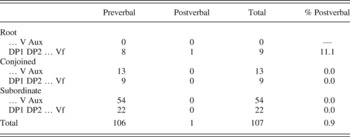
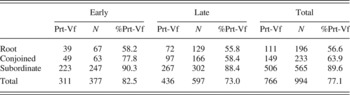
A standard observation concerning basic constituent order in Old English (henceforth OE) is that the position of finite verbs varies by clause type (cf., e.g., Mitchell, Reference Mitchell1985; Traugott, Reference Traugott and Hogg1992; van Kemenade, Reference Kemenade1987). In root clauses, the finite verb tends to occur toward the beginning of the clause, and we frequently find Verb Second (V2) order. In contrast, in subordinate clauses, finite verbs generally occur toward the end of the clause, and these clauses are frequently verb-final.
In line with these traditional observations, it is generally assumed that verb-final order can occasionally be found in OE root clauses but that it is a marginal phenomenon. For example, Bean (Reference Bean1983) includes the word order patterns SXV (verb in absolute final position) and SXVX (verb separated from the subject but additional material after the verb) in her analysis of the Anglo-Saxon Chronicle and her quantitative data show that, although these patterns are very common in subordinate clauses, they occur only rarely in root clauses. Taking all the data presented by Bean (Reference Bean1983:67), we obtain frequencies for SXV of 7.5% (86/1150) and for SXVX of 3.0% (35/1150). These findings are confirmed by Bean's analysis of some smaller text samples (1983:130ff.). Thus, the SXV and SXVX patterns are not found at all in the Ohthere main clauses analyzed by Bean (0/77); they both occur only once in the Wulfstan sample (1/45 = 2.2% for each pattern); and in Ælfric's Preface to Genesis, SXV comprises 1.3% (1/79) and SXVX comprises 2.5% (2/79) of the main clauses.
Similar observations have been made within generative analyses of OE word order. In generative syntactic theory, the occurrence of finite verbs toward the end of a clause has generally been analyzed in terms of a syntactic structure in which the verb occupies the head of a projection whose complement occurs to the left. In contrast, in clauses where the verb occurs toward the beginning of the clause, the complement is assumed to occupy a position to the right of the head. This variation is schematically represented in (1). A is the position occupied by the finite verb, and XP is the complement selected by A, which may include a variety of other syntactic constituents.Footnote 1
(1)


A structure such as (1a) is referred to as a head-initial structure (head A before complement XP), whereas (1b) illustrates a head-final structure (head A after complement XP). With subjects occupying a specifier position (i.e., a position to the left of the partial structures in (1)) and A being occupied by the verb, (1a) derives a SVX surface order whereas (1b) derives SXV. Generative analyses of OE word order generally conclude that verb-final root clauses (and, hence, the occurrence of the finite verb in a head-final structure as in (1b)) are very rare. Thus, Koopman (Reference Koopman1995:142) claims that “the percentage of verb-final main clauses was low throughout the OE period.” According to his Table 4 (1995:139), the frequencies of verb-final order in root clauses range from 0.6% to 6.1% depending upon the text. Similarly, Fischer et al. (Reference Fischer, van Kemenade, Koopman and van der Wurff2000:122) confirm that “the V-final pattern is a very minor one in root clauses.” Expressing this in structural terms, Pintzuk (Reference Pintzuk1993:22, fn. 22) observes that in the data she collected, “there are 252 independent (i.e., non-conjoined) main clauses … and 16 of these (6.3 percent) are Infl-final,” where Infl-final corresponds to head-final structure. This figure thus confirms Koopman's estimate.
In this article, we challenge the traditional assumption that verb-final orders and, hence, the occurrence of the finite verb in a head-final structural position are rare in OE root clauses. We present new data demonstrating that the frequency of head-final structure in OE root clauses is much higher than previously acknowledged. We then explore some of the implications of this finding for the general structural analysis of OE. The article is organized as follows: first, we outline our five basic assumptions about the structure of OE clauses; second, we show how the position of particles, negative objects, stranded prepositions, and pronominal objects can be used as diagnostics for underlying clause structure; third, we measure and analyze the frequency of head-final constituent order in clauses with the four diagnostics; and finally, we present conclusions and implications.
CLAUSE STRUCTURE AND MOVEMENT IN OE
In this section, we briefly outline our basic assumptions concerning the structural analysis of OE constituent order. The aim is to express the variation in (1) in terms of specific proposals on clause structure made in generative syntactic theory. We show that not all types of surface word order can be used to determine underlying structure, and therefore, that specific diagnostics are needed to measure the frequency of head-final structure.
As observed earlier, OE seems to exhibit a root-subordinate asymmetry with respect to the distribution of the finite verb, with the verb occupying a position near the beginning of the clause in root clauses and near the end in subordinate clauses. This contrast is reminiscent of that found in modern Germanic asymmetric V2 languages such as Dutch and German, which have V2 in root clauses but V-final in subordinate clauses. The minimal initial assumption, therefore, would be that OE can be analyzed along the lines proposed for these languages. This indeed was the hypothesis defended by van Kemenade (Reference Kemenade1987). We can interpret her work within the framework of Chomsky (Reference Chomsky1986) and much subsequent work, according to which basic clause structure consists of three layers, VP (verb phrase), IP (inflectional phrase), and CP (complementizer phrase), with CP the highest projection in the structure and VP the lowest. Expressed in these terms, van Kemenade proposed that the finite verb moves to I and then to C in root clauses; in subordinate clauses, the finite verb moves only to I because the presence of a complementizer in C blocks verb movement to C. Van Kemenade assumed that the I head follows its complement, that is, that IP is head-final (cf. (1b) with A = I and XP = VP). The basic distribution of finite verbs follows from such an analysis. Because CP is head-initial and the finite verb is in C in root clauses, the verb generally occurs near the beginning of the clause. The finite verb in subordinate clauses is generally toward the end of the clause because IP is head-final and the verb is in I.
Although some basic aspects of OE syntax are captured by such an analysis, it has been shown that this approach cannot account for the full range of OE constituent order patterns. First, there is evidence suggesting that the finite verb occupies a head-initial rather than a head-final projection in certain subordinate clauses (cf. Haeberli & Haegeman, Reference Haeberli and Haegeman1995; Pintzuk, Reference Pintzuk1999). Second, root clause V2 syntax in OE has properties that distinguish it from modern Germanic V2 syntax (cf., e.g., Pintzuk, Reference Pintzuk1999; van Kemenade, Reference Kemenade1987). For example, subject-verb inversion in clauses with a nonsubject constituent in initial position is systematic in modern Germanic, but in OE, subject-verb inversion is normally found only with full determiner phrase (DP) subjects, as in (2a). If the subject is a personal pronoun, the verb occurs in third position (V3), after the initial constituent and the (uninverted) pronominal subject, as shown in (2b). The only exceptions to V3 with pronominal subjects are found in a restricted set of clause types (e.g., direct questions, þa/þonne “then” clauses, and negative clauses), where pronominal subjects systematically invert with the finite verb, as shown in (2c). In addition, subject-verb inversion is not categorical with full DP subjects although, in contrast to clauses with pronominal subjects, V3 is a minority pattern here (cf., e.g., Haeberli, Reference Haeberli, Zwart and Abraham2002a).Footnote 2
(2)
a. eall ðiss aredaðse reccere suiðe ryhte
all this arranges the ruler very rightly
“The ruler arranges all this very rightly.”
(cocura,CP:22.169.3.1145)
b. æfter his gebede he ahof þæt cild up
after his prayer he lifted the child up
“After his prayer, he lifted the child up.”
(cocathom2,+ACHom_II,_2:14.70.320)
c. On hwylcen heowe steahhe up
In what form rose he up
“In what form did he rise up?”
(coeluc2,Eluc_2_[Warn_46]:40.31)
Given these observations, an analysis of OE corresponding to that of modern Germanic asymmetric V2 languages has generally been abandoned in the recent literature. Instead, the following five assumptions (I) through (V) are made (cf., e.g., Fischer et al., Reference Fischer, van Kemenade, Koopman and van der Wurff2000; Haeberli, Reference Haeberli and Lightfoot2002b; Pintzuk, Reference Pintzuk1999), and they will also be adopted here:
(I) The headedness of projections varies. In particular, the functional projection whose head is occupied by the finite verb may be either head-initial or head-final.Footnote 3 The nature of this projection has given rise to some discussion in the literature. Here, we will simply label it IP but nothing will hinge on this assumption: the conclusions reached in this article remain the same even if a more complex split IP structure is adopted, as in the references cited earlier.Footnote 4 Our main focus will thus be the structural variation illustrated in (3), where the Specifier of IP is a subject position:
(3)

(II) Finite verbs categorically move from V to I, regardless of the position of I.
(III) In most root clauses, the finite verb stays in I. Clause-initial constituents, usually called (syntactic) topics, occupy the specifier of CP (Spec,CP). Full DP subjects can remain in their VP-internal base position below I if they are not fronted to Spec,CP. As clitics or weak pronouns, pronominal subjects always move at least to Spec,IP. These assumptions account for the following types of root clause constituent orders.
(4)
a. [CPGod [IP [Iascunað] leasunga]]
God hates lies
“God hates lies”
(coaelive,+ALS[Ash_Wed]:128.2768)
b. [CP eall ðiss [IP [Iaredað] se reccere suiðe ryhte]]
all this arranges the ruler very rightly
“The ruler arranges all this very rightly.”
(cocura,CP:22.169.3.1145)
c. [CP æfter his gebede [IPhe [Iahof] þæt cild up]]
after his prayer he lifted the child up
“After his prayer, he lifted the child up.”
(cocathom2,+ACHom_II,_2:14.70.320)
In all three clauses in (4), the finite verb has moved to I in a head-initial IP. (4a) is a subject-initial root clause, with the subject in Spec,CP. In (4b), a nonsubject has been fronted to Spec,CP, and the full DP subject remains in its base position below IP. This derives subject-verb inversion and, hence, a V2 pattern in (4b). In (4c), there is again a nonsubject topic; here, however, the subject is a pronoun. Because subject pronouns move to the highest subject position in IP, we therefore obtain a V3 order in (4c).
(IV) In a restricted set of exceptional clause types, the finite verb moves further from I to C. Examples of these clause types are given in (5): an interrogative clause in (5a), and a clause with initial þa “then” in (5b).
(5)
a. [CP On hwylcen heowe steah [IPhe up]]
In what form rose he up
“In what form did he rise up?”
(coeluc2,Eluc_2_[Warn_46]:40.31)
b. [CP ða andwyrde [IPEugenia þyssere olecunge]]
Then answered Eugenia this flattery
“Then Eugenia responded to this flattery”
(coaelive,+ALS_[Eugenia]:162.290)
Because these clauses involve V movement to C, all types of subjects invert with the finite verb in these contexts, including pronominal subjects: compare (5a) with (4c).
(V) As for noninitial complements and adjuncts, their distributional properties suggest that both rightward movement (postposition) and some form of leftward movement (scrambling) must be assumed to be possible (cf., e.g., Pintzuk, Reference Pintzuk1999). This hypothesis is based on the observation that objects are not always adjacent to the verb whose complement they are. This is shown in (6) (see also (15) below for further illustration).
(6) þæt he ofslean wolde þa geleaffullan Iudei
that he slay would the believing Jews
“… that he would slay the believing Jews.”
(coaelive,+ALS_[Maccabees]:549.5191)
In (6), þa geleaffullan Iudei is the object of the nonfinite verb ofslean. If we make the standard assumption that the object is base generated as a complement of the verb and thus in a position adjacent to it, then we have to conclude that the object has left its base position and postposed, appearing to the right of the finite modal. Nonadjacency between verbs and objects can also be observed to the left of the verb, suggesting that scrambling to the left is also an option in OE.
For the purposes of our study of the position of finite verbs and headedness in root clauses, the observation that certain constituents can undergo scrambling or postposition is important, because the optionality of rightward and leftward movement of complements and adjuncts gives rise to potential ambiguity in the structural analysis of a clause. This is illustrated in (7) (t V = position of the verb before movement; t DP = position of the object DP before movement):
(7) Ambiguity in SVO clauses
a. Head-initial IP, with leftward movement of the finite V to I
God [IP [I ascunað] [VP leasunga t V]]
b. Head-final IP, with rightward movement of the finite V to I and rightward movement of the postverbal constituent
God [IP [VPt DPt V] [I ascunað]] [DP leasunga]
The example in (7) shows that because objects can move rightward (see (6)), the structural analysis of a simple SVO clause cannot be unambiguously determined. The SVO order can be derived from either head-initial or head-final structure. A similar type of ambiguity might also arise due to the optionality of leftward movement of constituents. Thus, some element may occur in a position preceding the finite verb either because it has undergone movement to the left of the verb in a head-initial structure or because the structure is head-final.
The points in (I) to (V) summarize the main theoretical assumptions we will make for our investigation of the status of head-final structure in OE root clauses in this article. Points (I) to (IV) provide an analysis of some basic word order patterns in OE. For the purposes of our investigation of the frequency of head-final structure in root clauses in this paper, our main assumption is that, with the exception mentioned in (IV), the finite verb always occupies the same structural position in root clauses. It is the head-initial/head-final variation related to this structural position (i.e., I) that will be our main concern here. However, before we can focus on the issue of headedness, the consequences of point (V) have to be considered in more detail. What (V) and in particular example (7) mean is that a large number of clauses cannot be used to measure the frequency of head-initial and head-final structure because they are compatible with both. To determine exactly how frequent head-final root clauses are, we have to restrict our database to clauses that can be assigned a unique structural analysis, either head-initial or head-final. The goal of the next section is to identify such a database.
DIAGNOSTICS FOR THE HEADEDNESS OF OE CLAUSES
As discussed in the context of point (V), the distribution of objects and adjuncts is generally not sufficiently restricted for them to be used as clear indicators of the directionality of the IP. To determine whether an underlying structure is unambiguously head-initial or head-final, we need elements that have a fixed position within the structure. If such fixed elements exist, linear order provides direct evidence for the underlying directionality of the IP. When an element that can move neither rightward nor leftward follows the finite verb in I, it occupies this position only because the IP is head-initial: with a head-final IP, postverbal complements and adjuncts are necessarily derived by rightward movement, as was illustrated in (7b). Similarly, when an element that can move neither rightward nor leftward precedes the finite verb in I, we can conclude that the IP is head-final; with a head-initial IP, preverbal complements and adjuncts are necessarily derived by leftward movement.Footnote 5
Fixed elements that can be used as diagnostics for underlying structure do indeed exist in OE. As observed by Pintzuk (Reference Pintzuk1999, Reference Pintzuk and Lightfoot2002, Reference Pintzuk2005) in the context of subordinate clauses, particles, stranded prepositions, negative objects, and pronouns are generally much less mobile than adjuncts or other types of complements, and these elements therefore can be used as diagnostics for the headedness of IP as discussed previously. In the following subsections, we will establish the suitability of these elements as structural diagnostics, first by presenting evidence that they do not undergo movement to the right and then by presenting evidence that, except for pronominal objects, they do not move leftward.
Constraints on rightward movement
Whether an element can undergo rightward movement or not can be determined on the basis of clauses that are clearly head-final. If the element can occur to the right of the finite verb in such clauses, we have to conclude that postposition is possible. If the element does not appear postverbally in head-final clauses, the conclusion must be that it does not postpose. The question that then arises is what types of clauses can be considered as being clear cases of head-final IP structure. Two contexts will be included here: (a) clauses with nonfinite main verb–finite auxiliary constituent order, as illustrated in (8a); and (b) clauses with at least two full DP arguments preceding the finite main verb, as in (8b).Footnote 6 Here Aux is the finite auxiliary verb, V is the nonfinite main verb, Vf is the finite main verb, and DP is a nominal constituent of any type (subject or object).
(8)
a. … V Aux
þa he ða eft þonan utfaran wolde
When he then again thence out-go wanted
“When he wanted to go out again from there …”
(cochronA-2b,ChronA_[Plummer]:905.8.1182)
b. DP1 DP2 … Vf
swa þæt se scinenda lig his locc upateah
so that the shining flame his locks up drew
“… so that the shining flame drew up his locks”
(cocathom2, +ACHom_II,_39.1:295.241.6706)
Both constituent orders are clearly head-final in subordinate clauses: because the complementizer is in C, the subject must be below CP, in Spec,IP. If the IP in these clauses were head-initial (see structure (3a)), there would be no obvious structural position that could be assigned to the other preverbal constituents (the adverbials and the nonfinite main verb in (8a), the second DP in (8b)). Hence, only a head-final structure can account straightforwardly for the constituent orders (8a) and (8b) in subordinate clauses.Footnote 7
As for root clauses, the situation is slightly more complex because topicalization (i.e., movement to the CP domain) may be involved in root clause constituent orders. More structural positions therefore are potentially available to the left of a verb under a head-initial I in root clauses than in subordinate clauses. In particular, it is possible that two or more constituents can be moved to CP (multiple topicalization), giving rise to a constituent order such as DP1 DP2 … Vf with a head-initial IP. However, our data suggest that such processes are sufficiently rare so as not to interfere with our findings (see Tables 1 through 4). Therefore, we will use the same criteria for head-final structure in root clauses as in subordinate clauses with the caveat, however, that the criteria may be slightly less clear-cut for root clauses.
Position of particles in OE head-final clauses

Rightward movement of particles
Using the constituent orders in (8a) and (8b) as diagnostics for head-final structure, we can now consider whether particles, stranded prepositions, negative objects, and pronouns can follow the finite verb in these contexts, that is, whether they can undergo rightward movement.
We first examine the behavior of particles with respect to postposition. However, not all particles are of interest for our purposes. As in modern Germanic OV languages, OE particles often precede the verbs they are associated with. If the particle in question is a verbal prefix that moves along with the verb, its position tells us nothing about the headedness of projections, because the particle precedes the verb regardless of whether it is in a head-final or head-initial IP. Therefore, only particles that are systematically stranded by verb movement are of interest to us. Such particles occur to the right of the verb if the verb has moved to a head-initial I but to the left of the verb if the verb has moved to a head-final I. This is illustrated in (9).
(9)
a. Head-initial IP:[IP [I V][VPparticle t V]]
b. Head-final IP:[IP[VP particle t V] [I V]]
However, how can we tell whether a particle is systematically separated from its verb or not? Because all OE particles can typically be found in both V-particle and particle-V orders, we cannot be certain whether the particle-V orders occur because the particle optionally behaves like a prefix, moving with the verb to (head-initial or head-final) I, or because the particle has indeed been separated from the verb when the V moves to head-final I, because verb movement in head-final IP simply maintains the particle-V order, as shown in (9b). V-to-I movement contexts therefore are not conclusive with respect to whether a particle is systematically stranded or not. However, another context is more revealing here. As observed with respect to example (5), certain types of root clauses involve V-movement to C. Because CP is always head-initial, the occurrence of a particle in a preverbal position in V-to-C movement contexts necessarily means that the particle is a prefix that has moved along with the verb to C. Such a particle is not one that is systematically stranded. Therefore, to avoid inclusion of such particles, we restricted our data in this section to those particles that are always stranded (i.e., occur to the right) when the finite main verb has moved to C: adun “down,” æfter “after,” aweg “away,” in “in,” niþer “under,” ongean “back,” up “up,” ut “out.”Footnote 8
Let us now consider the distribution of these particles in contexts involving head-final IP. The examples in (8) provide illustrations of cases where the particle precedes the verb in the two contexts we use as diagnostics for head-final structure. As shown in Table 1,Footnote 9 this order (i.e., particle preceding V) is systematically found in these contexts in our data. We distinguish three clause types in this and other tables in this article: root clauses, conjoined (root) clauses, and subordinate clauses. We treat root clauses and conjoined clauses as distinct because it has often been observed that conjoined clauses have subordinate clause constituent order more frequently than nonconjoined root clauses with respect to the position of the finite verb (cf., e.g., Mitchell, Reference Mitchell1985:694; Traugott, Reference Traugott and Hogg1992:277). The order verb-particle is generally ruled out in the head-final contexts illustrated in (8). The only counterexample we found in our data is given in (10).
(10) þæne se geatweard lætin
That-one the goatherd lets in
“That one, the goatherd lets in.”
(cowsgosp,Jn_[WSCp]:10.3.6596)
As pointed out earlier, our criteria for head-final structure may not be equally strong for root clauses as for subordinate clauses. Example (10) is a root clause and one possible analysis of this example does not involve head-final structure. It could be argued that although full DP subjects may remain in a position below IP (cf. example (4b)), they do not have to do so but can optionally move to the higher subject position in Spec,IP. The object þæne “that one” in (10) could then be analyzed as the topic in Spec,CP, as shown in (11).
(11) [CP þæne [IP se geatweard [I læt] [VP in t V]]]
This derives the constituent order in (10) in terms of a structure in which the verb occupies the head of a head-initial IP. Hence, (10) is not a clear counterexample to the hypothesis that verb-particle order is ruled out in head-final contexts. Given that all the remaining 106 examples confirm this hypothesis, it seems safe to conclude that particles cannot undergo rightward movement in OE.
Rightward movement of stranded prepositions
Prepositions in OE can be stranded by wh-movement as found in questions and relative clauses or by clitic or weak pronoun movement of the pronominal object. Example (12) illustrates preposition stranding in the two contexts that we use for head-final structure, that is, clauses with V-Aux order (12a) and with DP1 DP2 … Vf order (12b).
(12)
a. wh-movement:
þam hæþenscype þe hy ont afedde wæron
the idolatry that they on nourished were
“… the idolatry that they were nourished on …”
(coaelhom,+AHom_19:347.2854)
b. pronoun movement:
þæt Drihten [him]i þone wol framt iafyrsode
that God him the disease from dispelled
“… that God dispelled the disease from him …”
(cogregdC,GDPref_and_3_[C]:15.208.18.2759)
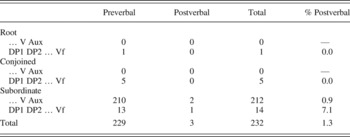
In both examples in (12), the stranded preposition precedes the main verb. The same observation can be made for nearly all the other cases of preposition stranding in head-final contexts, as Table 2 shows.
Position of stranded prepositions in OE head-final clauses

Among the total of 232 examples, only 3 have the order verb–stranded preposition. These three examples are given in (13).
(13)
a. for ðan ðe [ælcum menn]i his agen dom cymðtot i
because each man his own fate comes to
“because to each man comes his own fate”
(cocathom1,+ACHom_I,_17_[App]:540.171.3303)
b. þæt [þær]icuman wolde tot i onsigendan here
that there come would to invading army
“that an invading army would come thereto”
(coaelive,+ALS_[Martin]:548.6321)
c. þa gewæda þe heo bewunden wæs midt
the clothes that she wound was with
“the clothes in which she was wound”
(coaelive,+ALS_[+Athelthryth]:93.4197)
The constituent order in (13a) is comparable to that of example (10). If we assume that topicalization can, at least marginally, occur in subordinate clauses,Footnote 10 it could be analyzed along the same lines, with topicalization of the initial DP from a head-initial IP, rather than postposition of the stranded preposition. For the two remaining examples, it is difficult to avoid the conclusion that the stranded preposition has been moved rightward.Footnote 11
Despite the three exceptions, the overall picture is clear. In head-final structures, stranded prepositions overwhelmingly precede the finite verb. Hence, we can conclude that rightward movement of stranded prepositions is largely excluded; if it occurs at all, it is only at a low frequency.
Rightward movement of negative objects
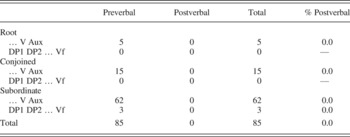
Negative objects behave like particles and stranded prepositions. In unambiguously head-final clauses, they precede the finite verb, as illustrated in (14). The relevant figures are given in Table 3.
(14)
a. þæs gebedes eac swylce Zosimus nan þingongytan ne mihte
(of) the prayer also thus Zosimus no thing understand neg could
“And Zosimus could thus understand nothing of the prayer.”
(comary,LS_23_[MaryofEgypt]:264.179)
b. þæt eower gleda nane hætan minum lichaman ne gedoð
that your embers no heat my body neg give
“… that your embers give no heat to my body”
(cocathom1,+ACHom_I,_29:425.213.5814)
Given these data, the conclusion is once again that rightward movement is not possible. Note that this is in clear contrast to nonnegative full DP objects that can undergo postposition, as the following examples involving head-final contexts show.Footnote 12
(15)
a. þæt he ofslean wolde þa geleaffullan Iudei
that he slay would the believing Jews
“… that he would slay the believing Jews.”
(coaelive,+ALS_[Maccabees]:549.5191)
b. þæt ænig mon atellan mæge ealne þone demm
that any man count-up can all the damage
“… that any man can count up all the damage”
(coorosiu,Or_2:8.52.6.998)
c. þa ða ærendwrecan eft Eadwine sægdonþas word
When messengers again Eadwin said these words
“When messengers again said these words to Eadwin”
(cobede,Bede_2:8.120.17.1143)
Position of negative objects in OE head-final clauses

Rightward movement of pronominal objects
The last type of element to consider is pronominal objects. (16) gives examples with pronominal objects occurring in the two contexts that we use as diagnostics for head-final structure: V-Aux in (16a) and DP1 DP2 Vf in (16b).
(16)
a. Nu ic incgeseman ne mæg
Now I you-two reconcile neg can
“Now I cannot reconcile the two of you”
(coblick,LS_32_[PeterandPaul[BlHom_15]]:181.167.2304)
b. hwæðer ænig man him mete brohte
whether any man him food brought
“… whether any man brought him food”
(cowsgosp,Jn_[WSCp]:4.33.6012)
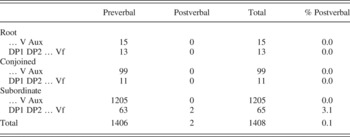
In both examples in (16), the pronominal object precedes the finite verb. This also holds for nearly all the other head-final clauses that contain a pronominal object, as Table 4 shows. The two head-final clauses with a postverbal pronominal object in Table 4 involve a single token that is repeated in the text.Footnote 13
(17) gif ge sylfe hwæs biddaþ æt minum halgan Fæder eow on minum naman
if you self something ask from my holy Father you-refl in my name
“… if you yourself ask something from my holy Father in my name”
(coaelhom,+AHom_8:20.1176), (coaelhom,+AHom_8:56.1197)
Despite the very large number of head-final clauses (1408), (17) is the only example where the pronominal object follows the finite verb. This suggests that rightward movement of pronominal objects is ruled out in OE or, at best, is very rare. Again, this is in contrast to nonnegative full DP objects that, as is shown in (15), do undergo rightward movement.
Position of pronominal objects in OE head-final clauses

Conclusions
In the preceding subsections, we have identified four elements that do not move rightward in OE: particles, stranded prepositions, negative objects, and pronominal objects.Footnote 14 For the purposes of identifying clear criteria for headedness in OE, this is an important finding: it means that if any one of these four diagnostic elements occurs postverbally, the structure is head-initial. Therefore, the constituent order in (18) is not structurally ambiguous. It can be derived only by V-to-I movement within a head-initial IP.
(18)
a. YP [IP [I V] [VP X t V]],
where X = particle, stranded P, negative object, pronominal object
b. Hi [IP [I nabbað] [VP nanne lichaman t V]]
They neg-have no body
“They have no body”
(coaelhom,+AHom_12:24.1798)
Constraints on leftward movement
In the previous subsection, we showed that the occurrence of particles, stranded prepositions, negative objects, and pronominal objects in postverbal position indicates head-initial structure. From the point of view of determining the frequency of head-initial and head-final structure, the crucial question that now arises is whether these diagnostic elements are always postverbal when IP is head-initial. In other words, we want to know whether diagnostic elements can move to the left of I, deriving the surface order diagnostic element–V from a head-initial structure, as shown in (19).
(19) YP X [I V] [VPt Xt V]
where X = particle, stranded P, negative object, pronominal object
If this option is available in OE, the frequency of postverbal diagnostic elements in surface strings corresponds only to the lower limit of the frequency of head-initial structure (and, hence, the upper limit of head-final structure) and does not provide a precise measurement of the underlying frequencies. In contrast, if this type of leftward movement is generally impossible for our diagnostic elements, then they can be used as unambiguous surface manifestations of directionality, with postverbal diagnostic elements corresponding to head-initial structure and preverbal diagnostic elements to head-final structure.
The question to be addressed then is whether our diagnostic elements can move to the left, or whether they are as resistant to leftward movement as they are to rightward movement. Different movement contexts and landing sites must be distinguished here: (a) movement above the (preverbal) subject, that is, to the left periphery of the IP or higher; (b) clause internal leftward movement below the (preverbal) subject.
Leftward movement above the subject
Movement above the preverbal subject is possible for particles, negative objects, and pronominal objects, as shown in the examples in (20); we have found no instances in the YCOE of stranded prepositions to the left of a subject.
(20)
a. ða ut he gan wolde
when out he go would
“when he would go out”
(cobede,Bede_5:5.396.29.3965)
b. swa þæt … nan hæðengyld se hagol ne belæfde
so that … no heathen-place-of-worship the hail neg spared
“so that no heathen place of worship was spared by the hail”
(coaelive,+ALS_[Julian_and_Basilissa]:422.1202)
c. swa swa him Crist gewissode
just as them Christ instructed
“just as Christ instructed them”
(coaelive,+ALS_[Sebastian]:344.1418)
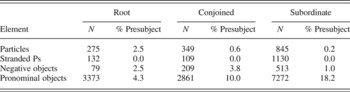
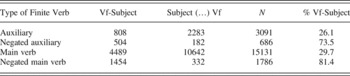
Table 5 shows that pronominal objects have the highest frequency of leftward movement above the subject in all clause types. This is not surprising, given that pronominal objects have been analyzed as clitics or weak pronouns in OE (see note 7).
Frequency of diagnostic elements in presubject position in clauses with finite auxiliaries or finite main verbs

The structural analysis of clauses with diagnostic elements in presubject position is beyond the scope of this article. For our purposes, it is necessary only to note that they cannot be used as evidence for underlying structure, because they can be derived from either head-initial or head-final IPs, as illustrated in (21) for (20c); t O is the trace of the (pronominal) object. We therefore exclude such clauses from our calculations of headedness of structure in the section “Measuring the Frequency of Head-Final Structure in Root Clauses” below.Footnote 15
(21)
a. head-initial IP:
swa swa him [IP Crist [I gewissode] [VPt Ot V]]
b. head-final IP:
swa swa him [IP Crist [VPt Ot V] [I gewissode]]
Similarly, we exclude clauses with nonovert subjects, because the diagnostic element may be positioned before the subject, with the IP either head-initial or head-final, as illustrated in (22). In the structures below, the nonovert subject is indicated as e:
(22)
a. & nan sæd ne læfdon
and no offspring neg left
“And (they) left no offspring”
(cowsgosp,Lk_[WSCp]:20.31.5324)
b. head-initial IP:
& nan sæd [IPe [I ne læfdon] [VPt Ot V]]
c. head-final IP:
& nan sæd [IPe [VPt Ot V] [I ne læfdon]]
Clause-internal leftward movement
Although movement to the left of the subject can be dealt with in a straightforward way by simply excluding the relevant clauses, the clause-internal leftward movement of diagnostic elements to a position below the subject presents a more complex problem. Our assumption is that particles and objects are adjacent to their verbs in underlying structure, and therefore that nonadjacency indicates movement.Footnote 16 Examples (23), (24), and (25) show that such leftward movement is possible for particles, negative objects, and pronominal objects, because these elements can appear after the subject but separated from their governing verb.
(23) Particles
a. þæt he his lichaman up ða gelogode on ðam endlyftan geare his geendunge
that he his body up then placed in the eleventh year (of) his death
“that he then placed his body up in the eleventh year of his death”
(cocathom2,+ACHom_II,_10:90.333.1858)
b. þæt he þonne aweg hine astyrian mæge
that he then away him move might
“that he might then move him away”
(coverhom,HomS_4_[ScraggVerc_9]:118.1309)
(24) Negative objects
a. þæt þu nanne brydguman næfre me ne namige
that you no bridegroom never (to) me neg name
“that you will never name to me a bridegroom”
(coaelive,+ALS[Lucy]:36.2189)
b. þæt man nan þincg forneah ðær geseon ne mihte buton smic ænne
that one no thing very-near there see neg may but smoke alone
“so that one could see nothing near there but smoke alone”
(cosevensl,LS_34_[SevenSleepers]:28.24)
(25) Pronouns
a. æfre fram ðam dæge þe ge hine ærest dræhton
ever since the day that you him first vexed
“ever since the day that you first vexed him”
(coaelive,+ALS_[Julian_and_Basilissa]:155.1033)
b. and he hine orsorhlice axian ongan
and he him rashly ask began
“and he rashly began to ask him”
(coaelive,+ALS_[Martin]:1364.6872)
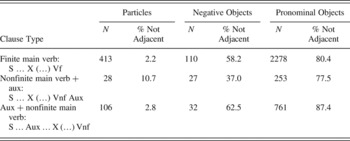
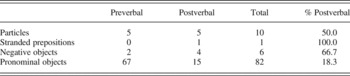
In these examples, the diagnostic elements are separated from their governing verbs by adverbials and other constituents. If the underlying position of these elements is adjacent to the verb, then we must conclude that they have undergone leftward movement. Table 6 shows the frequency of nonadjacency derived by leftward movement in three contexts: clauses with finite main verbs (S … X (…) Vf), clauses with nonfinite main verbs followed by finite auxiliaries (S … X (…) Vnf Aux), and clauses with finite auxiliaries before the nonfinite main verb (S … Aux … X (…) Vnf).Footnote 17 Although the frequency of leftward movement for particles is low, it is high for negative and pronominal objects.
Frequency of nonadjacency with main verb of three diagnostic elements (particles, negative objects, and pronominal objects)

S = subject, X = diagnostic element, Aux = finite auxiliary, Vf = finite main verb, Vnf = nonfinite main verb.
The leftward movements illustrated in (23) through (25) do not necessarily interfere with our attempt to identify directionality frequencies, because these data do not constitute evidence that leftward movement goes beyond I. Instead, all the examples could involve a type of low scrambling that targets a position between I and VP. This would mean that the landing site of the leftward movements in (23) through (25) is not high enough to derive a diagnostic element–verb surface order from head-initial structure with V in I. Instead, if the landing site is below I, head-initial structure would still derive only verb–diagnostic element orders and head-final structure would derive only diagnostic element–verb orders, as illustrated in (26). Surface order would therefore still directly reflect directionality.
(26)
a. head-initial structure with low scrambling
[IP S [I V] … X … [VPt Xt V]]
b. head-final structure with low scrambling
[IP S … X … [VPt Xt V] [I V]]
The only type of leftward movement that is problematic for a direct correspondence between surface constituent order and structure is movement to a position between the subject and the finite verb in a head-initial structure. In other words, the question is whether a constituent order like (27a) could be derived as shown in (27b), or, more generally, whether configurations like (27c) are possible in OE.
(27)
a. we elles nanum oðrumne geþafiað
we otherwise no other neg tolerate
“otherwise we do not tolerate any other”
(cobenrul,BenR:71.130.15.1258)
b. we elles [DP nanum oðrum] [I ne geþafiað] [VPt DPt V]
c. YP X [I V] [VPt Xt V]
where X = particle, stranded P, negative object, pronominal object
The structural position of X in (27c) is not obvious (see note 7). However, for our present purposes, it is not necessary to adopt a specific analysis for (27c). If we assume that a plausible structural account of (27c) can be devised, our main concern here is whether there are empirical reasons for proposing such an account. Evidence bearing on this question is hard to find. For example, there are no clear criteria that would determine unambiguously that (27a) involves head-initial structure with leftward movement of the negative object rather than head-final structure with no leftward movement of the object.
An additional clause type may seem relevant here: clauses with finite auxiliaries before nonfinite main verbs. In these clauses, our diagnostic elements occur most frequently below the auxiliary, either before the nonfinite main verb or after it, as shown in (28) and (29). However, diagnostic elements also occur between the subject and the finite auxiliary, as shown in (30).
(28)
a. Isaias se witega wæs awægfarande
Isaiah the prophet was away going
“The prophet Isaiah was going away”
(coaelive,+ALS_[Book_of_Kings]:421.3959)
b. þæt he ne mæge nan goddon
that he neg can no good do
“that he can not do any good”
(coaelive,+ALS_[Memory_of_Saints]:295.3490)
c. Ac þa reðan deor ne dorston hireppan
But the wild animals neg dared them touch
“But the wild animals didn't dare to touch them”
(coaelive,+ALS_[Julian_and_Basilissa]:405.1194)
(29)
a. þæt hi sceoldon feallanadune
that they must fall down
“that they must fall down”
(cocathom2,+ACHom_II,_1:9.226.197)
b. ac he nolde biddannanre miltsunge
but he neg-would ask no blessing
“but he wouldn't ask for any blessing”
(cocathom2,+ACHom_II,_18:173.118.3828)
c. ic wylle fylianþe leof
I will follow you master
“I will follow you, Master”
(coaelive,+ALS_[Memory_of_Saints]:175.3428)
(30)
a. þæt hi hine ut sceoldon wurpan
that they him out should throw
“that they should throw him overboard”
(coeust,LS_8_[Eust]:168.173)
b. ðætte he nane lade ne mæge findan
that he no excuse neg can find
“that he can find no excuse”
(cocura,CP:26.185.10.1224)
c. and eall þæs mædenes mod him wearð ameldod
and all the maid's intent (to) him was made-known
“and all the maid's intent was made known to him”
(coaelive,+ALS_[Eugenia]:63.227)
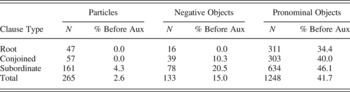
The clauses in (30) all have (at least) two structural analyses: they could be derived from head-final structure by verb (projection) raising (see Haeberli & Pintzuk, Reference Haeberli and Pintzuk2006), or from head-initial structure by the scrambling of the diagnostic element to a position between the subject in Spec,IP and the finite auxiliary in I, similar to the structure shown in (27c). The frequency of clauses like those in (30) with diagnostic elements between the subject and the auxiliary is shown in Table 7. The total N for each clause type is the sum of clauses like those in (28) through (30).
Frequency of diagnostic elements between subjects and finite auxiliaries

The quantitative patterns are revealing here in two respects and suggest that head-final structure with verb (projection) raising is the correct analysis. First, note that the frequency of diagnostic elements between the subject and the finite auxiliary is highest in subordinate clauses and lowest in root clauses. If these examples were derived from head-initial structure, we would expect them to be more common in root clauses than subordinate clauses, because subordinate clauses are generally assumed to be more frequently head-final; this assumption will be supported in the section “Measuring the Frequency of Head-Final Structure in Root Clauses” below. Second, note that negative and pronominal objects appear in this position much more frequently than particles. Haeberli and Haegeman (Reference Haeberli and Haegeman1995), in their discussion of verb (projection) raising in a head-final language such as West Flemish, point out that negative objects cannot remain in the raised verb projection and still participate in negative concord, and scramble out of the verb projection before it is raised. They suggest that negative objects in OE behave in the same way. Similarly, Wurmbrand (Reference Wurmbrand, Everaert and van Riemsdijk2005) shows that pronominal objects in verb clustering languages do not usually remain within the raised projection; in contrast, particles are more tightly bound to the nonfinite verb and may remain in preverbal position. We will therefore assume that clauses like those in (30) do not provide conclusive evidence for leftward movement of diagnostic elements to a position before I in head-initial structure.
Nevertheless, there are some rare contexts that do allow us to test whether movement to the left as in (27c) can be found with our diagnostic elements. What we need is a diagnostic element occurring in a context that is clearly head-initial. In the section “Constraints on rightward movement” above, we have identified such a context: clauses with a diagnostic element occurring to the right of the finite verb. In other words, we need clauses containing two diagnostic elements. One of them must be postverbal, thereby indicating head-initial structure. As for the second element, it has to be postverbal as well if it cannot undergo leftward movement of the type shown in (27c). If a diagnostic element can undergo leftward movement, however, then we would expect cases where one of the elements is preverbal and the other one is postverbal.
Let us therefore consider the distribution of the diagnostic elements in clauses containing two diagnostic elements. There are three possibilities (X1 = first diagnostic element; X2 = second diagnostic element): (i) V-X1-X2, (ii) X1-X2-V, (iii) X1-V-X2. All of these orders can be found in OE. Examples are given in (31). In (31a), the diagnostic elements are both postverbal. In (31b), they are both preverbal. Finally, in (31c), one of them is preverbal and the other is postverbal.
(31)
a. & þa apostolas tugonhieup
and the apostles pulled them up
“And the apostles pulled them up.”
(coblick,LS_20_[AssumptMor[BlHom_13]]:143.104.1759)
b. ðæt land … þe ðu ustosendest
The land … that you us to sent
“The land … that you sent us to”
(coaelhom,+AHom_21:153.3156)
c. and hy hitwurpon þa ut
and they it cast then out
“And then they cast it out”
(coaelhom,+AHom_15:19.2147)
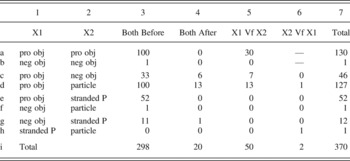
Table 8 provides quantitative data for the different orders in clauses with two diagnostic elements in the YCOE. Column 1 lists the category of the first diagnostic element (X1) and column 2 the category of the second one (X2). Constituent orders like those in (31a) are listed in column 3, those corresponding to (31b) in column 4, and those corresponding to (31c) in columns 5 and 6. In the discussion that follows, we will refer to particular cells in Table 8 by a combination of column (1–7) and row (a–i), for example, 7i for the total of all clauses.
Position of diagnostic elements in OE clauses with finite main verbs and more than one diagnostic element

In the large majority of clauses, the two diagnostic elements are in preverbal position: 298 out of 370 = 80.5% (3i and 7i). These are not relevant for the issue of leftward movement discussed in this section. For this issue, it is the 72 clauses in columns 4 to 6 that are crucial, that is, clauses with at least one postverbal element. According to our conclusions in the section “constraints on rightward movement” above, these 72 clauses all have head-initial structure, and 52 of them (those in columns 5 and 6) have diagnostic elements on both sides of the verb. This suggests at first blush that movement to the left of a head-initial I as shown in (27c) is indeed possible in OE. Notice, however, that 50 of the 52 clauses (all of those in column 5) involve pronominal objects preceding the finite verb. We can therefore conclude that pronominal objects productively undergo movement to the left of a head-initial I. Furthermore, this movement is very frequent. In unambiguously head-initial clauses with two pronominal objects, one of them always moves to the left of the verb (4a and 5a, 30 out of 30 clauses). In unambiguously head-initial clauses with one pronominal object and another diagnostic element, leftward movement of the pronoun occurs in 20 (5c + 5d + 5e) out of 39 cases (4c + 5c + 4d + 5d + 4e + 5e). Leftward movement of pronominal objects was illustrated in example (31c), where a particle to the right of the verb indicates head-initial structure. Two additional examples involving two pronouns are given in (32).Footnote 18
(32)
a. ic ðeforgyfehi
I you forgive them
“I forgive you for them.”
(cootest,Josh:8.18.5391)
b. gif we hitsecgaðeow
if we it say you
“if we say it to you.”
(colwstan1,+ALet_2_[Wulfstan_1]:155.219)
Therefore, the first conclusion that we draw from the data in Table 8 is that pronominal objects can be used as surface diagnostics only for head-initial structure (cf. the section “Rightward movement of pronominal objects” above) but not for head-final structure. When they follow the finite verb, they indicate head-initial structure, but when they precede the finite verb, they may appear there due to leftward movement within a head-initial structure or else due to head-final structure. Therefore, pronominal objects do not allow us to precisely determine the frequency of head-final structure in OE. Instead, the position of pronominal objects with respect to the finite verb can only provide us with an indication of the upper limit of the frequency of head-final structure.
Let us now consider the status of the other diagnostic elements according to the data in Table 8. Negative objects occur 14 times in unambiguously head-initial clauses with 2 diagnostic elements (4b + 5b + 6b + 4c + 5c + 6c + 4f + 5f + 6f + 4g + 5g + 6g), and they never precede the verb in these clauses. Most revealing are the seven examples with two postverbal elements (4b + 4c + 4f + 4g). These would still have been identified as head-initial even if the negative element had undergone leftward movement. However, leftward movement has occurred in none of these. This suggests that the structure in (27c) is ruled out for negative objects, although this conclusion must be somewhat tentative because of the small number of relevant examples in our data.
The problem of low numbers arises even more sharply with the stranded preposition data. Among the clauses with head-initial structure in Table 8, only two contain a stranded preposition (4e + 5e + 6e + 4g + 5g + 6g + 4h + 5h+ 6h). Neither of the two has the stranded preposition to the left of the verb. Thus, as with negative objects, there is no evidence for leftward movement of the type shown in (27c) within the limited amount of data that is available to us.Footnote 19
Let us finally consider particles. In Table 8, there are 28 head-initial clauses containing a particle (4d + 5d + 6d + 4f + 5f + 6f + 4h + 5h + 6h). Two of them (6d + 6 h) have the particle in preverbal position; the clauses are given in (33). Note that both clauses contain the preverbal particle ut “out.”Footnote 20
(33)
a. & þa he utadrafhine on heora midlene
and when he out-drove him into their centre
“and when he drove him out into their centre”
(cowsgosp,Lk_[WSCp]:4.35.3868)
b. Tirrenum, þe Tiber sio ea utscyton
Tyrrhenian, which Tiber the river out flows into
“… Tyrrhenian, which the river Tiber flows into”
(coorosiu,Or_1:1.21.14.424)
The data in (33) could be interpreted in two ways: either they could involve leftward movement of the particle in a head-initial structure along the lines of (27c), or they could involve rightward movement of the pronoun in (33a) and of the stranded preposition in (33b) in a head-final structure.
The leftward movement analysis may be more plausible for (33a). As observed in the section “Rightward movement of pronominal objects” above on the basis of a considerable amount of data (1408 clauses), rightward movement of pronominal objects seems to be to a large extent excluded in OE. For (33b), the situation is less clear. In the section “Rightward movement of stranded prepositions” above, we found 3 cases out of 232 where a stranded preposition could have been postposed (1.3%). This frequency is similar to what we would find in Table 8 if (33b) indeed involved postposition of the stranded preposition. Table 8 lists 63 cases of stranded prepositions in head-final structure (3e + 3g + 3h). If the one postverbal stranded preposition ((33b), 6h) were derived by postposition, the frequency of postposition for stranded prepositions in Table 8 would be one out of 64 = 1.6%. However, given the low frequency, we cannot conclusively treat (33b) as an instance of head-final structure with postposition. Instead, leftward movement of the particle in a head-initial structure remains an option, particularly because this seems to be a plausible analysis for (33a).
Although we are dealing here with only one or two potential cases of leftward movement of a particle, the examples in (33) cannot be dismissed as insignificant. As pointed out earlier, Table 8 contains only 28 instances of head-initial structures with particles. One or two examples, therefore, compose 3.6% or 7.1% of the data. If leftward movement of particles is possible, then some of the 100 clauses with a preverbal particle and a preverbal pronoun (3d) could have been derived from head-initial structure by leftward movement of both diagnostic elements. Thus, on the basis of the particle data in Table 8, we cannot exclude the possibility that movement of particles to the left of head-initial I can occur in OE, either as the result of independent leftward movement of the particle or as the result of “parasitic” movement to I as a prefix of the verb. However, evidence for this type of movement is restricted to the particle ut.
Conclusions
In this section, we have presented the evidence for our claim that particles, stranded prepositions, and negative objects can be used as diagnostic elements for the headedness of clauses with finite main verbs. We have shown that there are almost no cases of rightward movement of these elements in head-final clauses (Tables 1–4) and that if rightward movement occurs at all in OE, it is at a very low frequency. Therefore, we concluded that when the diagnostic elements are postverbal, the IP must be head-initial—in other words, the verb–diagnostic element surface order directly reflects head-initial underlying structure. This conclusion was drawn on the basis of substantial amounts of data: 107 head-final clauses with particles, 232 with stranded prepositions, 85 with negative objects, and 1408 with pronominal objects.
For head-final structure, the correspondence between surface order and underlying structure is not as clear, for three reasons. First, there is evidence that pronominal objects can prepose to a position before I in head-initial clauses, and therefore that preverbal pronominal objects cannot be used as a diagnostic for head-final structure. Second, we have found two examples of preverbal particles in head-initial clauses (33a), (33b); they may be in this position either because they have moved leftward from postverbal position to the position before I or because they have moved with the finite verb to I. Although two clear cases may seem an insignificant number, their existence means that the frequency of leftward movement of particles is difficult to calculate, because the total number of relevant clauses is very small. Third, although there are no clear cases of preverbal negative objects or stranded prepositions in head-initial clauses, again the total number of relevant clauses is very small. The problem here is the limited size of our dataset, a problem for which there is no solution.Footnote 21 Our conclusion is that the frequency of preverbal diagnostic elements represents an upper limit to the frequency of head-final structure.
MEASURING THE FREQUENCY OF HEAD-FINAL STRUCTURE IN ROOT CLAUSES
Having established that certain elements can be used as diagnostics for the headedness of the syntactic structure in OE, we can now return to our initial question of the frequency of head-initial and head-final structure in OE root clauses. In each of the following subsections, we will consider one diagnostic element and determine the frequency of head-final constituent order on the basis of the element's distribution with respect to the finite verb. For these data, we use only clauses with finite main verbs and overt subjects preceding the verbs. These restrictions guarantee that the data are the “normal” type of OE V2 clauses like those in (4a), with the verb in I and not in C. As noted in the conclusions to the previous section, the frequency of head-final constituent order may represent only an upper limit of the frequency of head-final clause structure. However, given that we have identified only marginal potential interference by the leftward movement of diagnostic elements, the actual frequency of head-final structure should not deviate substantially from this upper limit. This issue will be discussed further in the section “Variation among diagnostics” below.
Head-final constituent order in clauses with particles
Because particles do not move to the right of a verb occupying the head position of a head-final IP, and because movement to the left of a verb occupying the head position of a head-initial IP is limited, the surface distribution of particles can be used to estimate the upper limit of the frequency of head-final structure. When the particle follows the finite main verb, the structure must be head-initial, as in (34a), whereas it may be head-final when the particle precedes the finite main verb, as in (34b).
(34)
a. Head-initial IP:
Hi eodon þa ealle ut
They went then all out
“Then they all went out”
(coaelive,+ALS[Agnes]:199.1846)
b. Head-final IP:
Apollonius þa uteode
Apollonius then out went
“Then Apollonius went out”
(coapollo,ApT:16.26.326)
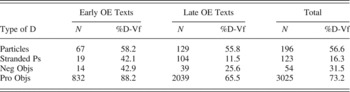
The numbers and frequencies of particle–finite main verb orders in different types of clauses (root, conjoined root, subordinate) in the YCOE are given in Table 9. The data are divided into two groups: early OE texts and late OE texts, with 950 used as the date dividing the two periods.Footnote 22 For Tables 9–13, we have reported significance using chi-square tests for the totals of early versus late data, root versus conjoined clauses, root versus subordinate clauses, and conjoined versus subordinate clauses. In all but one case, the differences were significant. In many cases, comparisons using further subdivisions of the data were also significant, for example, early versus late subordinate clauses, although we have not reported these results.
Position of particles in OE clauses with the overt subject before the finite main verb, by period (early = before 950, late = after 950)

Early vs. late: chi-square = 11.573, p ≤ .001. Root vs. conjoined: chi-square = 2.386, p ≤ .5 (not significant). Root vs. subordinate: chi-square = 102.823, p ≤ .001. Conjoined vs. subordinate: chi-square = 73.556, p ≤ .001.
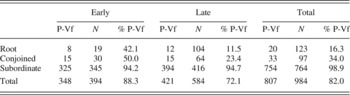
Position of stranded prepositions in OE clauses with the overt subject before the finite main verb, by period (early = before 950, late = after 950)

Early vs. late: chi-square = 36.908, p ≤ .001. Root vs. conjoined: chi-square = 9.944, p ≤ .005. Root vs. subordinate: chi-square = 647.565, p ≤ .001. Conjoined vs. subordinate: chi-square = 9.305, p ≤ .005.
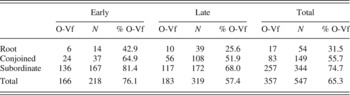
Position of negative objects in OE clauses with the overt subject before the finite main verb, by period (early = before 950, late = after 950)

Early vs. late: chi-square = 20.074, p ≤ .001. Root vs. conjoined: chi-square = 9.305, p ≤ .005. Root vs. subordinate: chi-square = 40.662, p ≤ .001. Conjoined vs. subordinate: chi-square = 17.544, p ≤ .001.
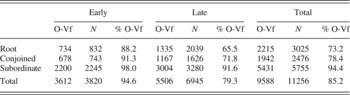
Position of pronominal objects in OE clauses with the overt subject before the finite main verb, by period (early = before 950, late = after 950)

Early vs. late: chi-square = 443.725, p ≤ .001. Root vs. conjoined: chi-square = 20.016, p ≤ .001. Root vs. subordinate: chi-square = 788.341, p ≤ .001. Conjoined vs. subordinate: chi-square = 470.910, p ≤ .001.
The position of diagnostic elements in OE root clauses with overt subjects and finite main verbs

Three main observations can be made with respect to Table 9. The most striking fact from the point of view of earlier work on headedness in OE is that there is a very high frequency of head-final constituent order in root clauses with a finite main verb and a particle. More than half of the root clauses containing a particle exhibit head-final order (56.6%). The other two main findings confirm observations made in earlier work. First, there is a decrease in head-final order from early OE to late OE in all contexts. Second, the frequency of head-final order differs depending on the clause type. It is higher in subordinate clauses than in conjoined root clauses and higher in conjoined root clauses than in nonconjoined root clauses.
Head-final order in clauses with stranded prepositions
As observed in the section “Diagnostics for the Headedness of OE Clauses” above, the distribution of stranded prepositions can also be used as a diagnostic for the headedness of IP. This is illustrated in (35).
(35)
a. Head-final IP:
Drihten [him]i þa tot icwæð
Lord him then to spoke
“The Lord then spoke to him”
(coblick,LS_1.2_[AndrewMor[BlHom_19]]:235.133.3036)
b. Head-initial IP:
Se Hælend [hyre]icwæðtot i
The Lord her said to
“The Lord said to her:”
(coaelhom,+AHom_6:89.924)
Looking at clauses with a finite main verb and a stranded preposition in the YCOE, we obtain the results shown in Table 10.
Subordinate clauses have the highest frequency of head-final constituent order, followed by conjoined root clauses, which in turn are followed by nonconjoined root clauses. Furthermore, the frequencies decrease from early OE to late OE, with the exception of subordinate clauses where the rate of head-final constituent order remains stable.Footnote 23 Focusing on root clauses, we observe an average frequency of 16.3% of head-final constituent order over the OE period. This frequency is much higher than the previous estimates of head-final structure presented in the literature, which did not go beyond 6.3% (cf. the estimate of Pintzuk [1993]). However, the frequency is also considerably lower than the frequency measured for root clauses with particles in the previous subsection (56.6%). This difference will be discussed further in “Variation among diagnostics.”
Head-final constituent order in clauses with negative objects
The third diagnostic for head-final structure that we identified in “Diagnostics for the Headedness of OE Clauses” is the distribution of negative objects. A negative object occurs preverbally in head-final structure and postverbally in head-initial structure.
(36)
a. Head-final IP:
we elles nanum oðrumnegeþafiað
we otherwise no other neg tolerate
“otherwise we do not tolerate any other”
(cobenrul,BenR:71.130.15.1258)
b. Head-initial IP:
Hi nabbaðnanne lichaman
They neg-have no body
“They don't have a body”
(coaelhom,+AHom_12:24.1798)
The frequencies of head-final IP constituent order with negative objects in the YCOE are shown in Table 11.
Once again, we can observe the same general patterns as before. Head-final constituent order is most frequent in subordinate clauses and least frequent in root clauses, with conjoined root clauses between the two. Diachronically, there is a decrease in head-final structure in all clause types. As for constituent order in root clauses, we again have a high frequency of head-final clauses. The frequency of 31.5% is higher than that found with stranded prepositions but lower than that observed with particles.
Head-final constituent order in clauses with pronominal objects
As observed in the section “Diagnostics for the Headedness of OE Clauses” above, pronominal objects do not have the same status as a diagnostic for headedness as particles, stranded prepositions, and negative objects. We showed in the section “Rightward movement of pronominal objects” above, that they do not move to the right, and therefore, they identify clauses with a postverbal pronoun as unambiguously head-initial, as in (37).
(37) Head-initial IP:
He [IP [Icidde] [VP eac himt V]]
He blamed moreover him
“Moreover he blamed him”
(coaelhom,+AHom_3:96.464)
However, as we have seen in the section “Constraints on leftward movement” above, pronominal objects do undergo leftward movement at a substantial frequency (see Table 8). Therefore, surface pronoun-verb constituent order, as in (38a), cannot be used as an indication of head-final structure. A pronominal object may occur in preverbal position either because the IP is head-final, as in (38b), or because the IP is head-initial and the pronoun has moved to the left of I, as in (38c).
(38)
a. Hwæt ða Eugenia higebletsode
Lo then Eugenia her(self) blessed
“Lo, then Eugenia blessed herself”
(coaelive,+ALS_[Eugenia]:171.295)
b. Head-final IP
Hwæt ða Eugenia [VP hi t V] [I gebletsode]
c. Head-initial IP
Hwæt ða Eugenia hi [I gebletsode] [VPt ProObjt V]]
Given the ambiguity in (38), surface constituent order only allows us to determine the upper limit of the frequency of head-final clauses. The upper limit would be attained if all clauses of the type shown in (38a) were head-final. However, because a certain number of these may be head-initial, the actual frequency of head-final IP is most likely to be lower than the frequency of occurrence of constituent orders like (38a). Hence, we cannot give a precise estimate of the frequency of head-final structure on the basis of surface constituent orders involving pronominal objects. Instead, the distributional frequencies in the YCOE shown in Table 12 provide an upper limit for head-final IP.
The data in Table 12 suggest that the average frequency of head-final structure in OE root clauses is not higher than 73.2%. This figure is compatible with the frequencies obtained in the previous subsections for the other three diagnostics, which ranged between 56.6% and 16.7%. Note also that, although the figures in Table 12 do not provide exact estimates of head-final structure, they nevertheless confirm the general trends observed earlier among the different subgroups in our data. The upper limit of head-final structure is highest in subordinate clauses and lowest in root clauses and it decreases from early OE to late OE.
Variation among diagnostics
Table 13 summarizes our findings with respect to the frequency of head-final constituent order in root clauses containing different diagnostic elements for headedness in OE.
Two main observations can be made with respect to the data in Table 13. First, as discussed in previous subsections, the frequencies suggest that head-final IP in OE root clauses is much more common than generally thought. Earlier studies concluded that head-final root clause structure is a very marginal phenomenon, with frequencies up to 6.3% only. The results obtained for each of the different diagnostic tests in Table 13 are well above this figure, with the lowest average frequency (16.7% for stranded Ps) being more than two and a half times higher than 6.3%.
The second observation that can be made on the basis of Table 13 is that the frequency of head-final constituent order varies considerably with the different diagnostic elements. Thus, the frequency of head-final constituent order with particles is more than three times higher than the frequency with stranded prepositions, with negative objects in between. The frequency of head-final constituent order with pronominal objects is even higher than that for particles, but we have seen that pronouns move leftward in head-initial structure. The variation among diagnostic elements seems surprising at first sight. Assuming that OE was a period of grammatical competition between head-final and head-initial IP constituent order, we might expect that head-final constituent order is used at a certain frequency and that this frequency, with minor variation, should obtain regardless of the subset of the data under consideration. The conclusion that clauses containing particles have a frequency of head-final structure that is three times higher than that found in clauses with stranded prepositions may therefore be problematic.
There are several explanations that might account for this unexpected variation. First, the phenomena that we have been looking at here are relatively low frequency phenomena. Hence, it could be argued that the numbers are too low to be representative for the use of head-final structure in general and that there may be a certain degree of randomness in the results, leading to the variation observed in Table 13. However, this conclusion seems implausible, because we have seen that in other respects, the data are entirely systematic. We have shown that there are two general trends for all three diagnostic elements: early texts have a higher frequency of head-final structure than late texts in all clause types; and for each period, the frequency of head-final constituent order is higher in subordinate clauses than in conjoined root clauses, and higher in conjoined root clauses than in nonconjoined root clauses. If there were a certain degree of randomness in the results, it would be surprising that this randomness does not interfere with these systematic trends.
A second explanation is that certain independent factors may contribute to an increase or a decrease in the frequency of head-final constituent order for one or more diagnostic elements. We have not taken into account factors such as text genre, author, influence of translation from Latin,Footnote 24 and others that have been shown to have an effect on constituent order (see, e.g., Pintzuk & Taylor, Reference Pintzuk, Taylor, van Kemenade and Los2006). We will not pursue this possible explanation further, but rather leave it as an area for future research.
A third factor is the potential leftward movement of diagnostic elements in head-initial structure. Table 8 in the section “Clause-internal leftward movement” above provides some evidence that pronominal objects and particles can move leftward. Particles are involved in two counterexamples to our expectation that, when there are two diagnostic elements in a sentence, they should occur on the same side of the finite verb. In both of these counterexamples, the particle precedes the finite verb. This could mean that particles can undergo leftward movement. Although the frequency of this process may be low, its viability nevertheless implies that equating head-final constituent order to head-final structure is not straightforward here. If some of the cases of head-final constituent order are derived from head-initial structure (either by independent leftward movement of the particle or by movement to I of the particle with the verb), then our estimate of 56.6% head-final structure is too high (see also note 8).
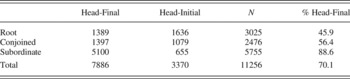
As for pronominal objects, the data discussed in the section “Clause-internal leftward movement” above showed clearly that they can undergo leftward movement and that leftward movement, therefore, interferes with our attempt to establish underlying structure from surface word order. However, a closer analysis of the data in Table 8 may allow us to adjust for leftward movement and therefore obtain a more precise estimate of head-initial versus head-final structure with pronominal objects. In Table 8, there are 355 examples in which a pronominal object co-occurs with another diagnostic element (rows a, c, d, and e). In 69 of these examples, a diagnostic element (a second pronominal object, a negative object, or a particle) follows the verb (4c + 4d + 5a + 5c + 5d). These 69 clauses, therefore, are clear cases of head-initial structure. We want to estimate the frequency of leftward movement of pronouns based on these clauses, taking into account the fact that the clauses in cell 5a contain two pronouns, one of which has moved, the other of which has remained in situ in postverbal position. In these 69 clauses, 50 pronouns (5a + 5c + 5d) have moved leftward, but 49 (5a + 4c + 4d) have remained in situ. According to these data, the rate of leftward movement of pronominal objects in head-initial structure is therefore 50/99 = 50.5%, and the rate of in situ objects is 49.5%. If we now adjust the data in Table 12 for the rate of leftward movement, we obtain the results shown in Table 14. The method of calculating the results in Table 14 is as follows for root clauses: we assume that the rate of leftward movement of pronouns in head-initial structure is the same in all clause types. The total number of clear head-initial root clauses in Table 12 is N – the number of O-Vf order, that is, 3025−2215=810. This number corresponds to 49.5% of the head-initial clauses, as the object has moved leftward in the remaining 51.5%. The actual number of head-initial clauses is therefore 810/.495 = 1636 (rounded from 1636.36), and the actual number of head-final clauses is, therefore, 3025−1636 = 1389. We thus obtain a frequency of head-final structure in root clauses of 1389/3025 = 45.9%. The adjusted frequencies for conjoined and subordinate clauses are calculated in the same way.
Estimated frequency of head-final structure in OE clauses with pronominal objects, adjusted for leftward movement

Compare the final column in Table 14 to the final column in Table 9: the frequencies of head-final structure calculated here for the three clause types are close to the frequencies shown for clauses with particles in Table 9, even given the limited amount of data on which the frequency of leftward movement of pronominal objects must be based. Because the high frequency of head-final structure does not vanish when the frequency of leftward movement is taken into account, and because the regular pattern of frequencies among clause types is maintained, these calculations serve to verify our previous findings.
As for the question of why head-final structure is considerably less frequent in clauses with stranded prepositions than in clauses with other diagnostic elements, the following observations may be relevant. Consider first the early OE period. As was shown in Table 13, clauses with stranded prepositions have almost exactly the same frequency of head-final structure as clauses with negative objects (42.1% vs. 42.9%) in early OE. Thus the apparently distinctive behavior of clauses with stranded prepositions is entirely due to a large drop in the frequency of head-final structure from the early to the late period, which is much larger than for clauses with particles or negative objects. So the main issue in connection with stranded prepositions is why the rate of head-final structure is so unexpectedly low in late OE. In Table 13, there are 104 clauses with stranded prepositions in the late OE period, and 92 of them (88.5% of 104) have the head-initial order Vf–stranded P. A closer look at these 92 clauses is revealing, because more than half are of a very specific type by the same author: Ælfric, in his Lives of Saints, Supplemental Homilies, and Catholic Homilies I and II, uses the construction Subject-Object(pronoun)-say-to: Direct speech 58 times. Two examples are given in (39).
(39)
a. Se Hælend hyre cwæð to, La hu ne sæde ic þe …
The Lord her said to lo how neg said I you
“The Lord said to her: ‘Look, did I not tell you …’”
(coaelhom,+AHom_6:89.924)
b. Basilius him cwæð to, ne beo ðu afyrht
Basilius him said to neg be you frightened
“Basilius said to him: ‘Don't be frightened.’”
(coaelive,+ALS_[Basil]:427.751)
The structure illustrated in (39) seems to be a formulaic expression introducing direct speech, and its repeated occurrence (with no occurrence of a corresponding sentence with head-final structure) may lead to a nonrepresentative increase in the frequency of head-initial structure in our data set. If structures like (39) are omitted from our counts, the frequency of head-final structure in clauses with stranded prepositions is again very much in line with what we find for negative objects in the late OE period: 12/46 = 26.1% for stranded prepositions, compared with 25.6% for negative objects. The variation observed with stranded prepositions may therefore simply be an artifact of the data that is available to us.
CONCLUSIONS AND IMPLICATIONS
In this article, we have examined the position of particles, stranded prepositions, negative objects, and pronominal objects with respect to the finite main verb in OE clauses. The quantitative patterns are very regular: late OE texts have a lower frequency of head-final constituent order than early OE texts; root clauses have a lower frequency than conjoined clauses, which in turn have a lower frequency than subordinate clauses. We have provided clear evidence that these elements do not postpose in head-final structure; and for particles, stranded prepositions, and negative objects, we have shown that the frequency of preposing from postverbal position in head-initial structure, if it does occur, is low. We conclude that the frequency of head-final constituent order is comparable to head-final structure, although not identical to it. It seems likely that the frequency of head-final constituent order is somewhat higher than the frequency of head-final structure, although it is difficult to quantify this difference, given the small amount of data. Notice that if the position of the finite verb is a reflection of the headedness of the clause (however that is interpreted, either head-final versus head-initial underlying structure or overt movement versus its lack within a uniform head-initial structure), the quantitative difference between the early and late texts can be viewed as a type of grammatical competition. Regardless of how it is analyzed, it is very clear that the frequency of head-final structure in root clauses (and, in fact, in the other two clause types) is much higher than has previously been assumed or demonstrated.
One obvious question to ask is why the high frequency of head-final structure in OE root clauses has not been noticed before. Why, for example, do Fischer et al. (Reference Fischer, van Kemenade, Koopman and van der Wurff2000), Koopman (Reference Koopman1995), and Pintzuk (Reference Pintzuk1993) claim that the frequency of head-final structure is very low? We believe this is due to the fact that many instances of V2 constituent order in OE are derived from head-final structure by other processes, such as V-to-C movement, as in (5a), (5b), repeated as (40a), (40b); verb (projection) raising, as in (41a), (41b); and postposition, as in (7b), repeated as (42). Examples (40) through (42) are shown as head-final IP structures, although their constituent orders may also be derived from head-initial structure. All of them result in clauses with the finite verb as the second constituent.
(40) V-to-C movement:
a. [CP On hwylcen heowe steah [IPhe up t V]]
In what form rose he up
“In what form did he rise up?”
(coeluc2,Eluc_2_[Warn_46]:40.31)
b. [CP ða andwyrde [IPEugenia þyssere olecunge t V]]
Then answered Eugenia this flattery
“Then Eugenia responded to this flattery”
(coaelive,+ALS_[Eugenia]:162.290)
(41)
a. Verb raising:
[CPStanas [IPt Vnft Vf [Imagon]] [Vnf hnexian]]
Stones can give-way
“Stones can give way”
(coaelive,+ALS[Agatha]:26.2029)
b. Verb projection raising:
[CPÆðeldryð [IPt VPt V [Iwolde]] [VP ða ealle woruldþincg forlætan]]
Æthelthryd would then all worldly-goods abandon
“Then Æthelthryd wanted to abandon all worldly goods”
(coaelive,+ALS_[+Athelthryth]:31.4159)
(42) Postposition:
[CPGod [IP [VPtDP tV] [Iascunað]] [DP leasunga]]
God hates lies
“God hates lies”
(coaelive,+ALS[Ash_Wed]:128.2768)
There is some evidence to show that the frequency of these processes, like the frequency of head-final structure itself, is higher than has been previously acknowledged. First, consider V-to-C movement. Pintzuk (Reference Pintzuk1999) demonstrates that in clauses with pronominal subjects, the subject always follows the finite verb in V-to-C clauses; in clauses without V-to-C movement, the subject always precedes the finite verb, regardless of which constituent has been topicalized. The examples in (40a) (repeated as (43a) and (43b)) sketch the accepted analysis:
(43)
a. V-to-C movement:
[CP On hwylcen heowe steah [IPhe up t V]]
In what form rose he up
“In what form did he rise up?”
(coeluc2,Eluc_2_[Warn_46]:40.31)
b. No V-to-C movement:
[CP æfter his gebede [IPhe [Iahof] þæt cild up]]
after his prayer he lifted the child up
“After his prayer, he lifted the child up.”
(cocathom2,+ACHom_II,_2:14.70.320)
Thus the position of pronominal subjects can be used as a diagnostic for V-to-C movement. Table 15 shows the position of pronominal subjects with respect to the finite verb in nonconjoined root clauses. The frequency of inversion, and therefore the frequency of V-to-C movement, is much higher in negated clauses than in nonnegated clauses; but in all clause types and with all verb types, the frequency of V-to-C movement is greater than 25%.
The position of pronominal subjects with respect to the finite verb in root clauses

Second, consider the frequency of verb (projection) raising (V(P)R), illustrated in (41). Pintzuk (Reference Pintzuk1999), on the basis of a small corpus of 1242 subordinate clauses, estimated the frequency of VR in OE to be 11.8%, and the frequency of VPR to be 7.1%. In contrast, Haeberli and Pintzuk (Reference Haeberli and Pintzuk2006), using the YCOE, estimated the frequency of V(P)R in subordinate clauses to be 30% to 36% depending upon the analysis and diagnostic used. If we apply the same analyses and diagnostics to root clauses, we obtain an estimate for the frequency of V(P)R of 74% to 81%. This observation helps to explain why the findings reported in earlier work differ from those in this article, because earlier estimates of head-final structure were often based on clauses with auxiliaries and, therefore, on clauses where V(P)R may interfere.
We can see that the relatively high frequency of these two movements, V-to-C movement and V(P)R, derives a large number of root clauses with the finite verb as the second constituent, even though the initial structure was head-final. Thus it is not surprising that linguists who analyze OE texts have the strong impression that OE is a V2 language, or at least that it is head-initial.
Our finding that OE root clauses exhibit head-final structure much more frequently than previously assumed means that both qualitative and quantitative analyses of many aspects of OE clausal syntax must be revisited and almost certainly revised. In particular, the status of OE as a V2 language should once again be reexamined in light of this new information about its structure. In the history of generative research in this area, we have travelled from Allen (Reference Allen1980), who suggested that V2 was optional in OE, to van Kemenade (Reference Kemenade1987), who claimed that OE was an asymmetric V2 language like Modern German or Dutch but with clitic pronouns, to Pintzuk (Reference Pintzuk1999), who claimed that OE was a symmetric V2 language like Icelandic but with a low frequency of head-final structure in root clauses. Finally, it has sometimes been pointed out (cf., e.g., Haeberli Reference Haeberli, Zwart and Abraham2002a) that OE differs from typical V2 languages in that there is a nonnegligible number of clauses where two heavy constituents precede the finite verb. In particular, in contexts where some nonsubject XP is in initial position (except XPs of the type shown in (40), which trigger V-to-C), the absence of subject-verb inversion with nonpronominal subjects (i.e., V3) is not uncommon. The data discussed in Haeberli (Reference Haeberli, Zwart and Abraham2002a:250) suggest that V3 of this type occurred in approximately 30% of the cases where some nonsubject constituent is in initial position.
The findings presented in this paper could now lead us to the following hypothesis. OE is fundamentally a V2 language, and the regular violations of V2 order are simply due to the relatively high frequency of head-final structure identified in this article. In other words, if we consider V2 as a configuration in which some initial constituent is in a specifier position X, the verb is in a head position Y, and Y linearly immediately follows X, it could be argued that non-V2 orders are not the consequence of some fundamental violation of the basic structural configuration but simply due to the fact that Y can take its complement to the left rather than to the right. Thus instead of having the order X-Y-Z (V2), we get X-Z-Y (V > 2) due to head-final structure.Footnote 25 However, such a proposal would make the following prediction. In cases where V2 is violated, the diagnostic elements we have identified in the section “Diagnostics for the Headedness of OE Clauses” above should always occur to the left of the finite verb. They cannot undergo rightward movement, and therefore, this is the only position in which they can occur in head-final clauses. This prediction is not borne out, as the examples in (44) show.
(44)
a. þæne se geatweard lætin
That-one the goatherd lets in
“That one, the goatherd lets in.”
(cowsgosp,Jn_[WSCp]:10.3.6596)
b. Witodlice þes nahtenahtoþres to his agnum bryce
Truly this neg-owed nothing other to his own gain
“Truly, this owed nothing other to his own gain”
(cogregdC,GDPref_and_3_[C]:26.229.11.3175)
c. nu þin cyning þe cymðto gedæfte
now your king youi comes to ti gentle
“Now your king, gentle, comes to you”
(cowsgosp,Mt_[WSCp]:21.5.1391)
d. Æfter þan se ðe gilti beo biddehim forgifnysse
After that he who guilty is asks him forgiveness
“After that, the guilty one asks him for forgiveness.”
(cochdrul,ChrodR_1:16.36.321)
These clauses must be head-initial, because diagnostic elements do not postpose. Nevertheless, the finite verb remains after the subject, in spite of the fact that a nonpronominal constituent has been fronted to the normal topic position. Pintzuk (Reference Pintzuk1999) suggested that some elements, particularly temporal adverbs, can appear in a high position outside the clausal structure, but our current view is that these constituents are in the CP domain but do not trigger movement of the finite verb above the full DP subject. Table 16 shows the distribution of diagnostic elements in root clauses where a nonpronominal constituent has been fronted before the nonpronominal subject. Although the number of clauses in Table 16 is small, the fact that diagnostic elements appear in both preverbal and postverbal position shows that the occurrence of V > 2 orders cannot simply be related to head-final clause structure. Instead, OE exhibits word orders that are genuine violations of V2 even in head-initial contexts.
Position of diagnostic elements in OE root clauses with XP–subject–finite verb constituent order

The picture of OE root clause syntax that we obtain then is one that removes OE considerably further from the modern Germanic languages than was previously thought in much generative work. Our findings suggest that (a) OE had a large number of root clauses in which the finite verb occupies the head of a head-final projection, a phenomenon that cannot be found in modern Germanic; (b) OE does not behave like a V2 language, contrary to most of the modern Germanic languages with the exception of English.
The conclusions reached in this article also have implications for the analysis of the transition from OE to Middle English (ME). Whereas in early generative work, the structural changes between these two periods were considered as very substantial and abrupt, more recent work (e.g., Pintzuk, Reference Pintzuk1999; Pintzuk & Taylor, Reference Pintzuk, Taylor, van Kemenade and Los2006) suggested a slightly smoother transition: there was already considerable variation in head-final/head-initial structure in OE, and ME simply represented the end point of a gradual increase in head-initial structure. However, the results presented here seem to open the gap between OE and ME once again, because the drop in the frequency of head-final structure must have been rather substantial, not only in subordinate clauses but also in root clauses: Kroch and Taylor (Reference Kroch, Taylor, Pintzuk, Tsoulas and Warner2000) find very little evidence for head-final clausal structure in Early ME.
Many questions remain unanswered. When we reach a better understanding of why there is variation in the frequencies of head-final constituent order for clauses with particles, stranded prepositions, and negative objects, and what syntactic/semantic/discourse factors significantly influenced the choice of head-initial versus head-final structure for OE speakers, then we will be able to form a more coherent and explanatory picture of OE syntax and the change from OE to ME.