Introduction
A large number of studies (see reviews in Bialystok, Reference Bialystok, Kroll and de Groot2005, and in Costa, Hernández, Costa-Faidella & Sebastián-Gallés, Reference Costa, Hernández, Costa-Faidella and Sebastián-Gallés2009) have shown that early bilingualism acquired through the family or the social community can positively influence cognitive development, particularly attentional and executive functioning, in children (Bialystok, Reference Bialystok1999; Bialystok & Martin, Reference Bialystok and Martin2004; Carlson & Meltzoff, Reference Carlson and Meltzoff2008; Martin-Rhee & Bialystok, Reference Martin-Rhee and Bialystok2008) and adults (Bialystok, Craik, Klein & Viswanathan, Reference Bialystok, Craik, Klein and Viswanathan2004; Bialystok, Craik & Ryan, Reference Bialystok, Craik and Ryan2006; Bialystok, Martin & Viswanathan, Reference Bialystok, Martin and Viswanathan2005b; Costa, Hernández & Sebastián-Gallés, Reference Costa, Hernández and Sebastián-Gallés2008; Costa et al., Reference Costa, Hernández, Costa-Faidella and Sebastián-Gallés2009), as well as in older adults (Bialystok et al., Reference Bialystok, Craik, Klein and Viswanathan2004; Bialystok et al., Reference Bialystok, Craik and Ryan2006; Bialystok et al., Reference Bialystok, Martin and Viswanathan2005b), and even in bilingual infants as young as seven months old (Kovács & Mehler, Reference Kovács and Mehler2009) or 24 months old (Poulin-Dubois, Blaye, Coutya & Bialystok, Reference Poulin-Dubois, Blaye, Coutya and Bialystok2011).
The positive impact of bilingualism has been observed over a variety of specific cognitive domains: for example, better flexibility in a symbol reorganization task (Peal & Lambert, Reference Peal and Lambert1962), superior performance at inhibiting distractors in a number concept task (Bialystok & Codd, Reference Bialystok and Codd1997), superior symbolic representation and attentional inhibition skills in appearance–reality tasks (Bialystok & Senman, Reference Bialystok and Senman2004). All of these tasks implicate a common cognitive process: executive control. More specifically, some studies have shown a positive impact of bilingualism on executive control in children. For example, Bialystok (Reference Bialystok1999) and Bialystok and Martin (Reference Bialystok and Martin2004) compared executive function in young bilingual and monolingual children using the Dimensional Change Card Sort task (DCCS – Zelazo, Frye & Rapus, Reference Zelazo, Frye and Rapus1996). In the DCCS, children were asked to sort a series of cards by one dimension (e.g. color), then to switch and sort by another dimension (e.g. shape). These authors observed that kindergarten bilinguals outperformed matched monolinguals and switched the previous sorting rule more successfully. Results showing advanced executive skills in bilingual children were replicated notably in two other studies using various measures of executive function, such as the Advanced Dimensional Change Card Sort task (Carlson & Meltzoff, Reference Carlson and Meltzoff2008), a modified version of the original DCCS, and the children's version of the Simon task (Martin-Rhee & Bialystok, Reference Martin-Rhee and Bialystok2008). In the Advanced DCCS task, bilinguals scored significantly higher than monolinguals (Carlson & Meltzoff, Reference Carlson and Meltzoff2008). In the children's version of the Simon task, in which fifty percent of the trials were “incongruent” (the correct responses were in conflict with the salient and competing cues), bilinguals performed more rapidly than monolinguals, but only on conditions in which the demands for interference suppression were high (incongruent trials) (Martin-Rhee & Bialystok, Reference Martin-Rhee and Bialystok2008; but see also Morton & Harper, Reference Morton and Harper2007, Reference Morton and Harper2009, for a critical discussion of the evidence supporting this notion).
However, Carlson and Meltzoff's (Reference Carlson and Meltzoff2008) and Martin-Rhee and Bialystok's (Reference Martin-Rhee and Bialystok2008) other measures of executive function did not reveal any benefit of early bilingualism on children's cognitive development. Indeed, Carlson and Meltzoff (Reference Carlson and Meltzoff2008) found no advantage in bilingual children on delay tasks, which require children to control and restrain impulsivity. Likewise, Martin-Rhee and Bialystok (Reference Martin-Rhee and Bialystok2008) found no advantage in bilingual children on tasks like the Day–Night Stroop task, which require children to inhibit the prepotent responses in order to give the expected verbal ones.
The apparently inconsistent results on these different measures of executive function could be explained by considering the cognitive processes involved in the different tasks used to assess the impact of bilingualism (Bialystok et al., Reference Bialystok, Craik, Klein and Viswanathan2004). In all studies, the tasks on which bilingual children outperformed monolingual children required a common ability: the ability to resolve a perceptual conflict by inhibiting misleading and distracting information (interference inhibition), focusing selective attention on non-salient cues, and switching between competing alternatives (mental flexibility). Bilinguals performed better than monolinguals when such interference inhibition was required, but not when a different aspect of inhibition was required, the inhibition of an automatic response, like in the Day–Night Stroop task for example (Bunge, Dudukovic, Thomason, Vaidya & Gabrieli, Reference Bunge, Dudukovic, Thomason, Vaidya and Gabrieli2002; see also Colzato, Bajo, van den Wildenberg, Paolieri, Nieuwenhuis, La Heij & Hommel, Reference Colzato, Bajo, van den Wildenberg, Paolieri, Nieuwenhuis, La Heij and Hommel2008). These findings suggest that bilingualism has a positive influence not on inhibitory control in general but on interference inhibition, which requires attentional control (Martin-Rhee & Bialystok, Reference Martin-Rhee and Bialystok2008). The fact that bilingualism boosts the development of a part of executive functioning (see Bialystok et al., Reference Bialystok, Craik, Klein and Viswanathan2004; Martin-Rhee & Bialystok, Reference Martin-Rhee and Bialystok2008) could be explained by finding seen in a large number of psycholinguistics studies (e.g., Brysbaert, Reference Brysbaert1998; Gollan & Kroll, Reference Gollan, Kroll and Rapp2001; Kroll & Dijkstra, Reference Kroll, Dijkstra and Kaplan2002) showing that the two languages of a balanced bilingual remain simultaneously active when s/he is using either one of them. Bilinguals thus apparently need to exercise attentional control over both of their two languages to be able to keep in mind and communicate fluently in the required language while inhibiting the undesired language in order to avoid any interference from it (Bialystok, Reference Bialystok2001; Green, Reference Green1998; Paradis, Reference Paradis1984). According to this hypothesis, it could be assumed that bilingual children exercise interference inhibitory control massively and regularly, and thus develop this executive function more rapidly than monolingual children. In fact, neither bilingualism nor monolingualism involves the withholding of habitual responses in the manner required in response inhibition, a process associated with univalent stimuli. So bilinguals do not outperform monolinguals on a response inhibition task (Martin-Rhee & Bialystok, Reference Martin-Rhee and Bialystok2008). But in order to communicate properly, bilinguals have to choose one of two bivalent competing languages while suppressing the other one – this reasoning could help to understand why they outperform monolinguals on an interference inhibition task typically consisting in selectively paying attention to one feature while inhibiting interference from another feature, such as the computerized Simon task (Martin-Rhee & Bialystok, Reference Martin-Rhee and Bialystok2008) or the Attentional Network Task (ANT – Fan, McCandliss, Sommer, Raz & Posner, Reference Fan, McCandliss, Sommer, Raz and Posner2002) (Costa et al., Reference Costa, Hernández and Sebastián-Gallés2008, Reference Costa, Hernández, Costa-Faidella and Sebastián-Gallés2009). To perform the Simon task, participants are required to pay attention to the color of the target while ignoring its position on the screen (congruent or incongruent). Similarly, to perform the ANT, participants are required to indicate whether a central arrow points to the left or the right while ignoring flanker arrows pointing either in the same direction (congruent trials) or the opposite direction (incongruent trials). In monolingual participants as well as in bilinguals, reaction times tend to be slower for incongruent trials than for congruent ones. This effect, called the “Simon effect”, reveals the cost of resolving the conflict between the target stimulus and conflicting representations. In early bilinguals, however, the Simon effect tends to be smaller than in monolinguals (Bialystok et al., Reference Bialystok, Craik, Klein and Viswanathan2004; Costa et al., Reference Costa, Hernández and Sebastián-Gallés2008, Reference Costa, Hernández, Costa-Faidella and Sebastián-Gallés2009). These results show that bilinguals are less affected by incongruent trials than monolinguals and show more effective inhibition of interference.
All of the above-mentioned studies were based on early and highly proficient bilinguals who had been exposed to a second language (L2) either at home from birth (for example, one parent spoke one language and the other parent spoke another language) or very early in their community speaking another language than the one used at home. Because those studies established that early bilingualism is likely to have a positive impact on cognitive development, it is of great interest to compare it to other L2-acquisition situations (with different degrees of exposure to a second language) and determine whether these situations lead to similar benefits for cognitive development.
Besides family or community L2-acquisition situations, it is also possible to acquire a second language at school. Among the various school-based L2-learning methods, a particularly effective method is the “Content and Language – Integrated Learning” method (CLIL) (Comblain & Rondal, Reference Comblain and Rondal2001), an immersion method characterized by the fact that L2 is not academically taught as a foreign language but instead is used to teach other academic subjects. In the French-speaking part of Belgium, this L2-immersion method starts in kindergarten, when children are five years old; by this age, they are still non-readers, so they are first faced with the phonological aspects of L2. In first grade, children learn to read either in L2 or in L1 depending on the immersion educational program which their school has chosen. The teaching of the other written language starts in second grade. Each elementary school year, L2 is used to teach academic subjects during at least 50% of classroom hours. Most of the teachers in classes taught in L2 are native speakers of L2; in some cases, they are L1 native speakers with native-like proficiency in L2.
Despite the growing use of this L2 acquisition method all over the world, the effect of bilingualism acquired through L2-immersion school education on attentional and executive skills has thus far received little interest. For example, Carlson and Meltzoff (Reference Carlson and Meltzoff2008) explored the impact of bilingualism acquired through an L2-immersion school program on executive functioning, more specifically in English-speaking children attending a kindergarten class in an immersion school for a period of six months. After this short period, no positive influence of bilingualism was shown: the immersed children and the control monolingual children performed equally on each of the nine measures of executive function used in the study. This finding is not surprising in light of the results of previous studies (Ricciardelli, Reference Ricciardelli1992; Bialystok & Majumder, Reference Bialystok and Majumder1998) suggesting that bilingualism's positive impact on cognitive development depends on the degree of bilingualism. In other words, bilingualism must be of a sufficiently high level to confer detectable advantages in executive tasks (Carlson & Meltzoff, Reference Carlson and Meltzoff2008). In addition, Bialystok and Barac's (Reference Bialystok and Barac2012) study with children enrolled in L2-immersion elementary school programs has shown that children's executive control performance, assessed using a flanker task and a task-switching paradigm, improved with increased experience and length of time (number of years) in the bilingual education environment. In other words, the accumulated practice of procedures for language selection determines the extent to which executive control is positively affected (Bialystok & Barac, Reference Bialystok and Barac2012).
The present study examines the impact of bilingualism acquired through an L2-immersion school program on cognitive development, specifically in French-speaking children who have been attending an English-immersion school for a period of three years. The central question posed in this study is: Do these children undergoing immersive L2 education show accelerated attentional and executive control compared to monolingual children similar to what has been found previously in early highly proficient bilingual children? Because the immersion period in our study is much longer than in Carlson and Meltzoff's (Reference Carlson and Meltzoff2008) study, our participants’ level of bilingualism can be assumed to be higher, increasing the chances that the cognitive training inherent in the school bilingual situation has gone long enough to detect greater attentional and executive control in immersed children than in monolingual children.
Despite the very interesting conclusions of previous research, one of their general limitations is that each study has used only a few measures of executive function (except for example in Carlson & Meltzoff, Reference Carlson and Meltzoff2008; Bialystok, Craik & Luk, Reference Bialystok, Craik and Luk2008). Since the executive control system is not a unitary system and involves a large number of functions that are at once interrelated and separable (e.g., Norman & Shallice, Reference Norman, Shallice, Davidson, Schwartz and Shapiro1986; Miyake, Friedman, Emerson, Witzki, Howerter & Wager, Reference Miyake, Friedman, Emerson, Witzki, Howerter and Wager2000), our study was designed to explore a large set of attentional and executive skills within the same group of participants. The following skills were measured: alerting (the ability to achieve and maintain an alert state), selective attention, divided attention, mental flexibility, interference inhibition and response inhibition.
Even though L2-learner children attending an L2-immersion school program since the age of five years have a different, less intensive degree of exposure to a second language than the early family or community bilingual children described in the literature, this school immersion in a bilingual environment, which happens quite early, could nevertheless confer some cognitive advantages. This is why, in keeping with the results of studies with early bilingual children, we hypothesized that children with L2-immersion education would outperform monolingual children in the following measures of attentional and executive function: selective attention, mental flexibility and interference inhibition, but not response inhibition. In addition, given Costa et al.'s (Reference Costa, Hernández and Sebastián-Gallés2008) finding that the alerting network functions faster in bilingual than in monolingual adults, we also hypothesized that our young participants with L2-immersion education would show faster alerting than monolingual controls. And finally, according to some authors, such as Miyake et al. (Reference Miyake, Friedman, Emerson, Witzki, Howerter and Wager2000), divided attention also constitutes an executive skill. Given that children with L2-immersion education are involved, at least during the 50% of classroom hours where academic subjects are taught in L2, in a permanent double task, our exploratory prediction was again that immersed children would outperform monolinguals in a divided attention task. This is our prediction despite the lack of data about divided attention in the early bilingualism literature, apart from Bialystok's (Reference Bialystok2011) study wherein eight-year-old bilingual children showed better executive control and maintained better accuracy than matched monolingual children on a dual – visual and auditory – task.
Method
Participants
Participants included a total of 106 French-speaking eight-year-old children drawn from two language groups. The immersion group consisted of 53 children (21 boys and 32 girls) with a mean age of 8;7 years (range: 97–109 months) who had been enrolled in an English-immersion school program since the age of five years; the monolingual group consisted of 51 children (25 boys and 28 girls) with a mean age of 8;5 years (range: 97–109 months) who had been enrolled in a traditional monolingual French-speaking school program. An additional two participants had to be removed from the second group due to outlier performance on the ANT.
All the children were selected from third grade-level classes respectively in immersion schools and traditional monolingual schools located in Liege area, in Belgium. More precisely, the children in the immersion group were selected from five English-immersion classrooms in three different schools (one of the schools had three grade 3 immersion classrooms). The immersion educational program was exactly the same in the three schools: in kindergarten, first and second grade, English was used to teach academic subjects during 75% of classroom hours; in third grade, it was used during 50% of classroom hours. In first grade, children learned to read and spell in English; French written language teaching started in second grade. The children lived in monolingual French-speaking families and a French-speaking community, and spoke English only at school or during school activities.
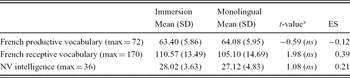
The two groups were equivalent on measures of socioeconomic status (SES) as well as on verbal and nonverbal abilities (see Results section below).
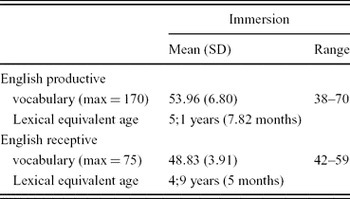
In addition, in the immersion group, English lexical development was measured to evaluate eight-year-old children's L2 lexical development after a three-year L2-immersion school experience, given that their L1 lexical development is within the normal range for their age. Their English productive and receptive vocabulary knowledge was equivalent respectively to those of 5;1-year-old (SD = 7.82 months) and 4;9-year-old (SD = 5 months) native English-speaking children.
Parental consent was obtained for each child. Parents were also administered a questionnaire to verify that the children's native language was French, that their auditory acuity was normal, and that they had no learning disabilities or language impairments.
Materials and procedure
Preliminary measures
Socioeconomic status
Since some studies (e.g., Mezzacappa, Reference Mezzacappa2004) have suggested that SES may have implications for the assessment of specific aspects of cognitive development such as attention and executive functions, it was important to ensure that the children in our two groups lived in families with similar socioeconomic backgrounds. Our two groups were thus divided, according to the mother's level of education as reported in the parent questionnaire, into “low” (no educational qualifications at all), “medium” (elementary school qualifications, up to the age of 16-year-old) and “high” (higher school qualifications, at least 18-year-old or degrees) strata.
Nonverbal intelligence
Nonverbal intelligence was assessed using Raven's Coloured Progressive Matrices (Raven, Court & Raven, Reference Raven, Court and Raven1998) as control measure of nonverbal reasoning abilities to ensure the comparability of the two groups. On this test, the children were required to identify which of a set of 6 patterned segments corresponded to the missing piece in a larger visuo-spatial pattern. The total number of correct identification attempts was scored for each child (maximum possible score = 36). Raw scores were used in the analyses presented below.
Verbal intelligence
Verbal intelligence was controlled using two measures of French lexical development to ensure that the two groups were comparable in this respect as well.
French productive vocabulary knowledge was measured using the NEEL (Nouvelles Epreuves d'Examen du Langage – Chevrie-Muller, Simon, Le Normand & Fournier, Reference Chevrie-Muller, Simon, Le Normand and Fournier2001), a picture naming task. The total number of correct naming responses was scored for each child (maximum possible score = 72: a well-pronounced correct answer was credited with 2 points, and a correct answer containing a slight phonological alteration was credited with 1 point).
French receptive vocabulary knowledge was measured using the EVIP (Echelle de Vocabulaire en Images Peabody – Dunn, Thériault-Whalen & Dunn, Reference Dunn, Thériault-Whalen and Dunn1993), a French adaptation of the Peabody Picture Vocabulary Test (Dunn & Dunn, Reference Dunn and Dunn1981). On this test, the children were required to select one of four line drawings that corresponded to the word spoken by the examiner. Raw scores were used in the analyses presented below.
English lexical development
With the immersion group only, two further standardized tests were used to assess English lexical development in order to compare immersed French speaking children's vocabulary knowledge with native English speaking children's vocabulary knowledge.
English productive vocabulary knowledge was measured using the EOWPVT (Expressive One-Word Picture Vocabulary Test, 3rd edition – Gardner, Reference Gardner2000), a picture naming task. The children were shown a test booklet containing a set of pictures each showing a line drawing of an object or action, and were required to name the pictures. Minor misarticulations were given full credit for a correct response (maximum possible score = 170). Raw scores were used in the analyses presented below.
English receptive vocabulary knowledge was measured using the BPVT (British Picture Vocabulary Test – Dunn, Dunn, Whetton & Pintilie, Reference Dunn, Dunn, Whetton and Pintilie1982). The children were required to select drawings corresponding to English words. The English words were recorded by a male native English speaker, stored on a computer disk and presented to the children via high-quality headphones connected to a portable computer. The total number of correct word-to-picture matching responses among the 75 first items on the test was scored for each child. Raw scores were used in the analyses presented below.
Attentional and executive measures
Alerting, selective attention, divided attention, mental flexibility and response inhibition were assessed with the Test for Attentional Performance in Children (KITAP – Zimmermann, Gondan & Fimm, Reference Zimmermann, Gondan and Fimm2002), a computerized standardized test battery that assesses various aspects of children's attention. According to the authors, this version was conceived to ensure optimal motivation for children during testing through an attractive design. Interference inhibition was assessed with the Attentional Network Task (ANT – Fan et al., Reference Fan, McCandliss, Sommer, Raz and Posner2002), which relies as little as possible on language and working memory abilities, and is less contaminated by other cognitive skills than other tasks such as the Simon task (Costa et al., Reference Costa, Hernández and Sebastián-Gallés2008).
Alerting
Alerting was investigated with the KITAP subtest “The Witch”. The children were asked to press a reaction key as quickly as possible when a visual stimulus (a witch) appeared at the centre of the screen. Reaction times were measured.
Auditory selective attention
Auditory selective attention was investigated using the KITAP dual-task subtest “The Owls”. The auditory component of the task was administered alone first. In this single-task version, the children had to listen carefully to an auditory sequence during which squeaky and deep owl screeches were presented one at a time in regular alternation. The children were required to press a reaction key as quickly as possible each time they detected an irregularity in the sequence. Reaction times as well as number of errors were measured.
Divided attention
Divided attention was investigated using the KITAP dual-task subtest “The Owls”, this time administered as a dual task, to investigate the children's ability to divide attention between an auditory target and a visual target. Again the children had to listen carefully to an auditory sequence during which squeaky and deep owl screeches were presented one at a time in regular alternation. These owls were not visible, but the children had to watch another owl in the middle of the screen at the same time. They were required to press a reaction key as quickly as possible each time they detected an irregularity in the auditory sequence, and also each time they saw the visible owl closing its eyes. Reaction times as well as number of omissions were measured.
Mental flexibility
Mental flexibility was investigated with the KITAP subtest “The Dragons’ House”. This task investigates the ability to switch attention in response to situational demands. In this self-paced task, the children had to alternate between two target stimuli. A blue and a green dragon appeared simultaneously on the screen, one on the right side and one on the left side. The children could press on two reaction keys, one with the left hand and the other with the right hand. In the first trial, they were asked to press the reaction key on the side where the green dragon was located; in the next trial, they had to press the reaction key on the side where the blue dragon was appearing and so forth. The side on which the next target stimulus would appear was unpredictable. When the children pressed the reaction key, the stimuli vanished and a new pair of dragons appeared. Acoustic feedback was given for errors. Reaction times as well as number of errors were measured.
Response inhibition
Response inhibition was measured with the KITAP subtest “The Bat”, a go/no-go task. In this task, black bats and cats randomly appeared on the screen one at a time. The children were asked to press a reaction key as quickly as possible only when a bat appeared on the screen. Accordingly they had to withhold their responses when a cat appeared. Items remained visible on the screen for one second. Reaction times as well as number of errors were measured.
Interference inhibition
Interference inhibition was investigated using the short version of the ANT (Fan et al., Reference Fan, McCandliss, Sommer, Raz and Posner2002), a computerized flanker task (Eriksen & Eriksen, Reference Eriksen and Eriksen1974) assessing executive control.Footnote 1 On the screen, a series of five horizontal black arrows was presented above or below a central fixation point (a plus sign: +), which the children were instructed to focus on. The central arrow pointed to the right or to the left, and was flanked by two arrows pointing in either the same direction (congruent trials →→→→→) or the opposite direction (incongruent trials ←←→←←). The children were asked to click the left button on a computer mouse as quickly as possible when the central arrow pointed leftward, and the right button when the central arrow pointed rightward (for more details see Costa et al., Reference Costa, Hernández and Sebastián-Gallés2008). To be successful on this task, participants had to inhibit the interfering tendency to be influenced by the direction of the distracting flankers and instead answer according to the direction of the target only. This short version of the ANT contained 144 “flanker type” trials (50% congruent trials, 50% incongruent trials) divided into three blocks of 48 trials each. The experiment consisted of a demonstration and a training block followed by the three experimental blocks, each presented in a random order. The stimuli were programmed using E-Prime 1.1 software (created by Psychology Software Tools, 2002). The means and standard deviations of the children's reaction times as well as numbers of correct responses were measured, both in congruent and incongruent conditions (maximum possible score for the congruent trials = 72; maximum possible score for the incongruent trials = 72; maximum possible total score = 144). The Simon effect was also calculated: namely, the difference in reaction times between congruent and incongruent trials. Indeed in previous studies (e.g., Bialystok et al., Reference Bialystok, Craik, Klein and Viswanathan2004; Costa et al., Reference Costa, Hernández and Sebastián-Gallés2008, Reference Costa, Hernández, Costa-Faidella and Sebastián-Gallés2009), bilinguals not only responded faster to both congruent and incongruent trials, but also showed a smaller Simon effect, indicating less disruption in incongruent trials regardless of speed (Bialystok et al., Reference Bialystok, Craik, Klein and Viswanathan2004), at least in high-monitoring conditions.
General procedure
The children were seen individually in their respective schools. The different tasks were administered in a fixed order in two different sessions, each lasting approximately one hour. During the first session, the children were administered all the attentional and executive tasks from the two computerized test batteries, KITAP and ANT; the stimuli were presented on a laptop computer with a 30.5 cm × 18.3 cm screen; the children were seated at a comfortable distance from the computer screen. During the second session, the children were administered the control tasks (French vocabulary knowledge and nonverbal intelligence tasks), as well as the English vocabulary knowledge tasks for the immersion group.
Results
Preliminary measures
Socioeconomic status
As a reminder, the participants’ families’ SES was classified into low, middle and high SES according to the mother's educational level for both the immersion and monolingual groups. No mother had a “low” level of education; five mothers in the immersion group and six mothers in the monolingual group had a “medium” level of education (up to the age of 16); 48 mothers in the immersion group and 45 in the monolingual group had higher education (until 18 years old or university degrees). A chi-square test showed that the two groups’ SES was similar, χ2 (1) = 0.15, ns.
Verbal and nonverbal intelligence
Descriptive statistics and mean comparisons between the immersion group and the monolingual group are presented in Table 1.
Descriptive statistics and mean comparisons for verbal and nonverbal intelligence.

adf = 102
ES = effect size (Cohen's d); NV = nonverbal; ns = not significant
A series of t-tests were carried out on each of these control measures to determine whether there were differences between the two groups. The results showed no difference between the groups on any of the control measures, confirming that the basic cognitive skills of the children in the two groups were equivalent.
English lexical development
Descriptive statistics for the immersion group are presented in Table 2.
Descriptive statistics for English lexical development in the immersion group.

Attentional and executive measures
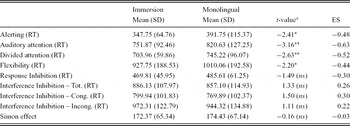
Descriptive statistics and mean comparisons between the immersion group and the monolingual group are presented in Table 3. All tasks yielded balanced levels of performance with no marked floor or ceiling effects. However, only reaction time data is presented, since a series of t-tests carried out on the accuracy scores showed no statistical difference between the groups on any of the attentional and executive tasks. Therefore no further analysis on the accuracy scores was conducted.
Descriptive statistics and mean comparisons for the attentional and executive tasks (Reaction Times).

adf = 102
ES = effect size (Cohen's d); RT = reaction times (in milliseconds); Tot. = total; Cong. = congruent trials; Incong. = incongruent trials; * p < .05; ** p < .01; ns = not significant
A series of t-tests were carried out on reaction times in each of the attentional and executive tasks, to determine whether there were differences between the two groups. The results showed that the immersion group reacted faster than the monolingual group in the tasks assessing alerting, t(102) = –2.41 (p < .05), auditory attention, t(102) = –3.16 (p < .01), divided attention, t(102) = –2.26 (p < .05), and flexibility, t(102) = –2.20 (p < .05), as expected. No difference was found on the response inhibition task, also as expected. But surprisingly, no difference was found on the task assessing interference inhibition (ANT). The reaction times were also examined with a two-way repeated measures analysis of variance (ANOVA) for language group and trial type. Overall, responses on incongruent trials were slower, F(1,102) = 712.72, p < .001, than responses on congruent trials. A Simon effect was observed in each group. There was, however, no effect of language group on this Simon effect, F(1,102) = 1.76, ns: it was not statistically smaller in the immersion group, and there was no language group by trial type interaction, F(1,102) = 0.025, ns.
Discussion
The purpose of the present study was to determine to what extent bilingualism acquired through an early L2-immersion school program might have a positive impact on attentional and executive functioning similar to that of early family or community bilingualism. In other words, the present study aimed to explore whether immersion education, a bilingual context involving less extended and less intensive exposure to a second language than early bilingualism, might also confer some cognitive benefits. We hypothesized that French-speaking children attending an English-immersion school for a period of three years would develop better attentional and executive skills than matched French-monolingual children. A large range of attentional and executive function measures was measured and analyzed. We expected the immersion group to outperform the monolingual group in alerting, auditory selective attention, divided attention, mental flexibility and interference inhibition, but not in response inhibition. In fact, the results showed that the immersion group performed better (more specifically, faster) than the monolingual group on tasks assessing alerting, auditory selective attention, divided attention, and mental flexibility, but not on tasks assessing response inhibition, as predicted. However, contrary to our hypothesis, no difference was found between the two groups on the interference inhibition task.
The majority of these results are consistent with the findings of previous research with early highly proficient bilingual children (Bialystok, Reference Bialystok1999; Bialystok & Martin, Reference Bialystok and Martin2004; Carlson & Meltzoff, Reference Carlson and Meltzoff2008; Kovács & Mehler, Reference Kovács and Mehler2009; Martin-Rhee & Bialystok, Reference Martin-Rhee and Bialystok2008). As mentioned above, early highly proficient bilinguals have to continuously exercise attentional control over their two languages to assure fluency in speech production in the relevant language while actively inhibiting the undesired and interfering language (Bialystok, Reference Bialystok2001; Green, Reference Green1998; Martin-Rhee & Bialystok, Reference Martin-Rhee and Bialystok2008; Paradis, Reference Paradis1984). They also need to be able to switch flexibly from one language to the other one if the communication situation demands it. This is why Bialystok (Reference Bialystok1999) and Bialystok, Craik, Grady, Chau, Ishii, Gunji and Pantev (Reference Bialystok, Craik, Grady, Chau, Ishii, Gunji and Pantev2005a) suggested a bi-directional influence between language and executive functioning: the frontal cortex is involved in shaping language, and in the opposite direction, the development of the frontal cortex (center of activation of executive functions) can benefit from language experiences such as those involved in the development and exercise of bilingualism. Children with early exposure to two languages and highly proficient bilingualism benefit from intensive practice in controlling attention, keeping one language in mind while suppressing the other, and switching between the two. They may thereby develop more efficient executive skills than children with exposure to only one language (Carlson & Meltzoff, Reference Carlson and Meltzoff2008).
Similarly, in the present study, the children in the immersion group seem to have developed more efficient attentional and executive skills than the monolingual children, even though the second-language exposure of children enrolled in an L2-immersion school program is not simultaneous but sequential, and is not as intensive as in family or community bilingualism. Moreover, after a three-year period of English immersion, eight-year-old French-speaking children are far from balanced and highly proficient bilinguals. Indeed, in our immersion group, the English productive and receptive lexical development were respectively equivalent to those of 5;1-year-old and 4;9-year-old native English speaking children (SD = 7.82 and 5 months), meaning that there was a 3-year discrepancy between the immersed children and native English speakers of the same age. Thus, children in the immersion group had acquired English knowledge, but they were still unbalanced and not highly proficient bilinguals; French was still the dominant language at that moment. At this stage in these children's development, their English cannot be yet activated automatically as easily as their French. According to Paradis (Reference Paradis, Rondal and Seron2000), because of gaps in their L2 knowledge, unbalanced bilinguals have to compensate by making even greater use of their working memory, actively and non-automatically controlling their metalinguistic awareness, and drawing on additional attentional resources. In other words, automaticity (referring to the absence of attentional control) in highly proficient bilinguals is more developed than in weaker bilinguals (Segalowitz & Hulstijn, Reference Segalowitz, Hulstijn, Kroll and de Groot2005). Given this fact, it seems reasonable to assume here that because of gaps in their L2 knowledge, children involved in an L2-immersion education must exercise greater cognitive control when engaging in L2 communication (production and comprehension), at least during the first years of the immersion program, when they are not yet fluent in L2. Thus, children are likely to need to mobilize much greater attentional and executive skills in this specific in-school L2 learning situation than in a traditional monolingual school situation.
But to be more precise, what cognitive control skills are we talking about? The answer is perhaps best illustrated with some examples of daily situations in an immersion school.
Our results on the alerting network were similar to those of Costa et al.'s (Reference Costa, Hernández and Sebastián-Gallés2008) study with young bilingual and monolingual adults, showing faster reaction times in L2-immersed children than in monolinguals. According to Tomlin and Villa (Reference Tomlin and Villa1994), alertness is important in a situation of second language acquisition, because it reflects motivation, interest in the L2 and readiness to learn in the classroom (Schmidt, Reference Schmidt and Robinson2001). Indeed, during the first years of the immersion program, because L2 is not yet fluent and automatic, children have to maintain their cognitive system in a state of continuous readiness for effortful processing – that is, for monitoring and trying to understand academic courses given in L2. This immersion situation might train children to attain and/or maintain a high level of alertness, allowing them to react faster to environmental demands.
A separate issue is that of selective attention skills. Previous studies (e.g., Bialystok et al., Reference Bialystok, Craik, Klein and Viswanathan2004; Costa et al., Reference Costa, Hernández and Sebastián-Gallés2008) have concluded that, under some conditions, early bilinguals can react faster than monolinguals to focus their attention on visual stimuli. However, given that bilingual language control is essentially auditory and that some attentional control processes and their respective neuronal networks are specific to the sensory input modality (Zimmermann et al., Reference Zimmermann, Gondan and Fimm2002), we decided to assess auditory selective attention. The results showed faster reaction times in L2-immersed children than in monolinguals. This advantage could be explained by the children's need to massively and selectively focus their auditory attention on L2 auditory messages, spoken in a language they do not yet understand very well, to be able to process those messages as deeply as possible (Carr, Reference Carr and Posner2004).
In addition, despite the lack of data in the early bilingualism literature on divided attention, we also explored the impact of L2-immersion program skills on this skill. Once again, L2-immersed children reacted faster than monolinguals. Indeed, as we just mentioned, these children have to focus their attention on L2-auditory messages. But many classroom situations in an L2-immersion program also train divided attention skills, requiring the children to distribute their attentional resources, for example, between what the teacher is explaining orally and what s/he is showing (gesture, images, etc.) at the same time to help them to better understand the L2 auditory messages without translation; or, when faced with new academic content, to assimilate this information while acquiring new L2 phonological, lexical and syntactic forms.
Finally, a measure of mental flexibility showed that, like early bilinguals (Bialystok et al., Reference Bialystok, Craik, Klein and Viswanathan2004, Reference Bialystok, Craik and Ryan2006; Costa et al., Reference Costa, Hernández and Sebastián-Gallés2008), L2-immersed children performed faster than monolinguals. In an L2-immersion school program, where some teachers speak L1 and others speak L2, where some academic contents are taught in L1 and others in L2, children are required and trained to switch very regularly between the two languages.
Previous research has shown that training in one type of cognitive abilities may positively affect other related abilities (e.g., Green & Bavelier, Reference Green and Bavelier2003), and that environmental demands corresponding to extensive training in specific processes may lead to local change in the structure of the human brain (Maguire, Gadian, Johnsrude, Good, Ashburner, Frackowiak & Frith, Reference Maguire, Gadian, Johnsrude, Good, Ashburner, Frackowiak and Frith2000). Thus, in an immersion school program, because a large part of the children's instruction is taught in a second language that is to be learned in parallel, all of the school situations listed above could be understood as massive and daily exercise of attentional and executive skills, and may be expected to result in more powerful cognitive functioning. On the contrary, in a traditional monolingual school program, because instruction is given only in the already well-known, fluid and automatic first language, children are required to focus only on the academic subject matter, without the challenges involved in switching from one language to another one and learning (in) a new language.
However, we unexpectedly failed to find better interference inhibition performance in children enrolled in an L2-immersion education than in monolingual children. Here we can only give a seemingly reasonable, albeit tentative, possible interpretation of these results. Balanced bilinguals need to exercise attentional control over the two simultaneously active languages (e.g., Brysbaert, Reference Brysbaert1998; Gollan & Kroll, Reference Gollan, Kroll and Rapp2001; Kroll & Dijkstra, Reference Kroll, Dijkstra and Kaplan2002) to be able to communicate fluently in the required language while inhibiting the undesired language in order to avoid any interference from it (e.g., Bialystok, Reference Bialystok2001; Green, Reference Green1998; Paradis, Reference Paradis1984); balanced bilingualism thus gives bilinguals the opportunity to massively and regularly exercise interference inhibitory control. First, however, after three years of L2-immersion education, children are still unbalanced bilinguals. It might be argued that in this case, in order to correctly select L2 lexical representations, children have to inhibit stronger interference from L1 while they try to speak the less dominant L2 than in the opposite situation, in which L2 interference inhibition is likely to be less effortful (Costa & Santesteban, Reference Costa and Santesteban2004; Green, Reference Green1998; Meuter & Allport, Reference Meuter and Allport1999). Thus, training interference inhibitory control is less massive and intensive in young L2-immersed unbalanced bilinguals than in balanced bilingual children, all the less so since children enrolled in L2-immersion education experience a particular bilingualism situation, which happens mainly at school, most of the time inside a classroom with around 20 pupils and only one teacher. In this situation the children are required to be passive more often than active, practicing L2 comprehension more often than L2 production. Furthermore, the L2 acquisition process follows the same course as an L1 acquisition process: a stage of comprehension learning, preceding the first speech productions. Since L1 interference inhibition occurs during L2 production, and since the time devoted to L2 production is quite limited in comparison to time devoted to L2 comprehension during the first years of immersion, the training in interference inhibitory control that young L2-immersed unbalanced bilinguals practice is thus less frequent than that of balanced bilingual children. All of this may explain why children receiving an L2 immersion education do not outperform monolingual children in an interference inhibition task, even after an immersive period of three years. Inurritegui (Reference Inurritegui2009) obtained similar results, finding that only simultaneous-balanced bilingual children, but not sequential-unbalanced bilinguals, outperformed monolingual peers in an interference inhibition task. Indeed the way that someone becomes bilingual – simultaneously or sequentially (Butler & Hakuta, Reference Butler, Hakuta, Bhatia and Ritchie2004; Romaine, Reference Romaine and Barret1999) – as well as relative proficiency in the two languages – balanced or unbalanced – seem to be factors affecting the possible impact of bilingualism on cognitive control (Cummins, Reference Cummins, Homel, Palij and Aaronson1987; Inurritegui, Reference Inurritegui2009).
Conclusions
The results reported in this study allow us to conclude that already after a period of three years, an L2-immersion school experience produces some of the attentional and executive benefits associated with early highly proficient bilingualism, although possibly not for exactly the same reasons. Thus, even though these L2 immersion learners are not yet highly proficient bilinguals, this three-year L2-immersion school experience tends to yield cognitive benefits. These results are very important given the constantly growing number of immersion schools, particularly in the French-speaking part of Belgium.
However, in the future, these findings should be reexamined in a longitudinal study with two groups of participants matched on age, verbal and nonverbal intelligence, SES and cognitive development: an immersion group of children about to begin an L2 immersion program, at the age of five years, and a control group of monolingual children.
Finally, while this study allows us to extend the results of Carlson and Meltzoff's (Reference Carlson and Meltzoff2008) study, with a larger sample of children involved in L2-immersion education for a longer period, it also raises the following question: given that in later phases of L2 learning a greater degree of L2 automaticity should reduce the related attentional cost (Segalowitz & Hulstijn, Reference Segalowitz, Hulstijn, Kroll and de Groot2005), will the same attentional and executive benefits of L2 immersion school experience still be observed in young adults with greater L2 proficiency who were enrolled in an L2-immersion elementary school program from the age of 5 to 12 years? This will be the topic of a forthcoming study.