Introduction
In the first three decades of research on courtroom talk, sociolinguists have documented a number of specific ways in which defendants and witnesses are controlled, coerced, and manipulated through the rigid and asymmetrical discourse structure of courtroom hearings, which restricts the interactional rights of witnesses to providing answers to specific questions (see, for example, Woodbury Reference Woodbury1984; Cotterill Reference Cotterill2003; Gibbons Reference Gibbons2003).
In contrast to the focus in much of this research on investigating inequality and imbalance within the courtroom, some recent studies have been asking about consequences beyond the courtroom, within an approach that integrates structure and agency. This approach examines courtroom talk not just in its immediate context, but also in its social, cultural, and historical contexts. For example, Matoesian (Reference Matoesian1993, Reference Matoesian2001) and Ehrlich (Reference Ehrlich2001) show how the patriarchal social order is reproduced through talk in rape trials in their analyses of how victims are questioned in court, and how their accounts of their experiences are transformed by lawyers' questions and summaries. Like most of the sociolinguistic research on courtroom talk to date, this article focuses on the common law legal system, as found in Australia, the UK, most of the US, and most of Britain's other former colonies.
This article draws on my recent Australian work (e.g. Eades Reference Eades2008), which examines the social consequences of courtroom talk in ongoing neocolonial control of the state over Aboriginal people, and which has shown, for example, how lawyer questions and summaries can define Aboriginal people as a threat to public safety on the streets (Eades Reference Eades2006). In this article I focus on language ideologies, their role in facilitating problematic interactional practices in court, and their impact on the interpretation and understanding of what witnesses say, as part of my response to the call by Conley & O'Barr (Reference Conley and O'Barr2005) for analysis of the actual mechanisms through which the legal system fails to deliver justice.
The article begins by setting the background for understanding the particular context of inequality dealt with in this article, namely the neocolonial situation of Australian Aboriginal people. This is followed by a section introducing the concept of language ideologies, and then a section which narrows the focus to four language ideologies centrally involved in storytelling and retelling in the legal process. The article then examines a case study, from Brisbane (Queensland), which exemplifies the workings of these language ideologies. Known as the Pinkenba case, it involved three teenage Aboriginal boys giving evidence in court in the committal hearing against six police officers charged with their abduction. Analysis of extracts from this case study is followed by a consideration of how and why these language ideologies were privileged in this hearing, used to normalize bullying and harassment of the child witnesses by the two defence counsel. This involves an understanding of both the function and practice of cross-examination, and the role of this case in the struggle between Aboriginal people and the state, connected as it is to ongoing moral panic. The article then glimpses a crucial step in the perpetuation of moral panic, with the focal language ideologies from cross-examination operating beyond the courtroom, in the print media. The conclusion deals with the wider sociopolitical consequences of this hearing, particularly highlighting the role of courtroom language ideologies in connecting the questions and answers in court with ongoing naturalization of the neocolonial control of police over the movements of Aboriginal people.
Understanding neocolonial control
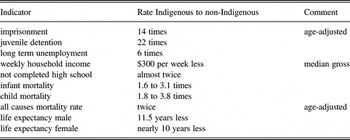
Following colonization by the British in the late 18th century, Indigenous AustraliansFootnote 1 were under colonial domination until the second half of the twentieth century, when they were granted formal equality with other Australians. However, there are many ways in which this apparent equality is a mere fiction. As with other Indigenous minorities around the world, Australian Aboriginal people experience the legacies of colonial dispossession, with living conditions typical of people in third world countries. Several recent reports have drawn attention to “wide gaps” between Indigenous and non-Indigenous Australians. The most recently published report of “Indigenous disadvantage” in Australia states that many indicators show that these gaps “are not improving, or are even deteriorating” (SCRGSP 2011:4).
The summary presented in Table 1 gives substance to the claim that the end of colonialism between the 1960s and the 1980s has not resulted in equality. More specifically, the work of criminologists such as Cunneen (Reference Cunneen2001) highlights the way in which government power, through the criminal justice system, systematically oppresses Indigenous Australians, for example through overpolicing and overimprisonment (discussed below). Cunneen (Reference Cunneen2001:232) argues that the term “neocolonial” is particularly apt here, as it “recognises the fact that the relationship between Indigenous people and the dominant society is still manifestly colonial, although the modality of colonial power may have changed with the formal emphasis on equality and citizenship.”Footnote 2
Summary of key indicators of “Indigenous disadvantage” (drawn from SCRGSP 2011).

The aim of this article is to contribute a new dimension to the understanding of how neocolonial control is perpetuated, by examining the work being done by courtroom talk. An important aspect of the critical sociolinguistics approach in my work is the notion of the integrated nature of micro-practices with macro-structure (Eades Reference Eades2008:47–49, 334–36), as found in the work of sociolinguists such as Cicourel (Reference Cicourel, Knorr-Cetina and Cicourel1981), Collins (Reference Collins1988), Matoesian (Reference Matoesian1993), and Heller (Reference Heller, Coupland, Sarangi and Candlin2001). Studies such as these show that the sociolinguistic investigation of language and inequality has much to learn from the social theoretical study of power relations and power struggles, and the complex relationships between structures—such as the legal system—and the agency of individuals and groups—what particular people do. In this case, we find that outrageous actions by individual police officers—taking young teenage Aboriginal boys out of town late at night and abandoning them—are only one part of the story of ongoing neocolonial control. The regular functioning of the legal process—particularly the practices and interpretations in cross-examination—provides an essential ingredient in the legitimization of this control. Sociolinguistic analysis provides a key to understanding how this neocolonial control works.
Language ideologies
In exploring the link between individual moments of agency and the perpetuation of structural inequalities, sociolinguists and linguistic anthropologists are turning attention to the taken-for-granted assumptions about how language works, which are termed language ideologies (sometimes also linguistic ideologies, folk views, or folk linguistics). Blommaert (Reference Blommaert2005:253) defines language ideologies as “Socially, culturally and historically conditioned ideas, images and perceptions about language and communication” (see also Woolard & Schieffelin Reference Woolard and Schieffelin1994; Kroskrity Reference Kroskrity and Duranti2004).
Central to work on language ideologies is the understanding that “ideologies of language are not about language alone” (Woolard Reference Woolard, Schieffelin, Woolard and Kroskrity1998:3). In fact, they often serve the interests of a specific social or cultural group, and in this way they can play an important role in the reproduction of inequality. One of the major contributions that sociolinguistics can make to the study of social life is to uncover the ways in which language ideologies can “often serve to rationalise existing social structures, relationships and dominant linguistic habits” (Swann, Deumert, Lillis, & Mesthrie Reference Swann, Deumert, Lillis and Mesthrie2004:171). Thus, for example, Angermeyer's work in New York courts (Reference Angermeyer2008) shows how the powerlessness of immigrants in the legal process is perpetuated through the monolingual language ideology. This assumption that monolingualism is the norm in society and the best way for the operation of society generally and the legal system specifically, was found by Angermeyer to be intrinsically bound up with the court's inability to recognize the complexities of bilingualism. Thus, the courts in New York, as in many other jurisdictions around the world, appear unable to understand that many people require an interpreter some of the time, but also have both the ability and the desire to communicate some of the time in the language of the court (here, English), for example in answering fairly straightforward questions. So, as Angermeyer found, the monolingual language ideology results in a situation in which people with degrees of bilingual fluency are forced to act as monolinguals. People who do not hide the fact that they have some bilingual fluency run the risk of being seen as misrepresenting their need for an interpreter.
It is language ideologies involved in the discursive testing of witnesses' stories in court that are the focus of this article. Given that the work of sociolinguists revolves around studying how people use language, how people talk about language use, and what happens when people use language in particular ways, we are in a good position to uncover and reflect on disjunctions or contradictions between these three aspects of language use. In this article these three aspects of language use are examined in relation to the evaluation of witnesses telling their stories in court in common law legal systems. Drawing on the detailed study of an Australian case provides the opportunity to see both the operation and the impact of these language ideologies, which lie beyond interactional practices, such as the ways in which witnesses' talk is constrained. While some of the issues to be dealt with in this article are relevant also to the continental legal system, my discussion of what happens in “the legal process” should be understood to be specifically about the legal process in common law jurisdictions.
The analysis in this article will show how language ideologies facilitate certain interactional practices, and further, how they impact on the interpretation and understanding of what people say. But I argue that more is involved in the case study examined here than these beliefs about how language works and the constraints on language use that are built into and accepted in the common law system. An understanding of the sociopolitical work being done through the case is also required in order to make sense of the courtroom talk. I show below that this sociopolitical work is enabled through discursive practices that are naturalized by the language ideologies.
Storytelling and retelling in the legal process
Perhaps the most important and pervasive assumptions about how language works in the legal process are those related to storytelling and retelling, and here the work on entextualization, which began in linguistic anthropology, is particularly relevant. Entextualization is defined by Bauman & Briggs (Reference Bauman and Briggs1990:73) as “the process of rendering discourse extractable, of making a stretch of linguistic production into a unit—a text—that can be lifted out of its interactional setting” (emphasis in original; see also Blommaert Reference Blommaert2005). This process involves decontextualization—taking a story (or part of it) out of its context—and recontextualization—retelling the story (or part of it) in a new context. These processes of entextualization, decontextualization, and recontextualization occur in all social contexts. It is both the practices and the assumptions involved that make them of interest to the investigation of how language works in the legal process.
In lawyer interviews, police interviews, courtroom hearings, and informal and alternative legal processes, laypeople are required to tell their side of the story. Often these stories have to be retold at a later stage in the legal process. Sometimes the story has to be retold by the original teller, as, for example, when a witness in court has to retell the story they had earlier told in a police interview. At other times the story is retold by an officer within the legal process. For example, police officers and lawyers summarize the stories of their interviewees, and lawyers summarize witnesses' stories in the propositions of cross-examination questions. This process of decontextualization and recontextualization can involve significant transformations (e.g. Trinch Reference Trinch2003). Further, many legal decisions involve the evaluation of individuals' stories, in terms of such features as consistency, accuracy, reliability, and honesty. I now turn to four recurring language ideologies that are central to the evaluation and assessment of people's stories and their recontextualizations in the legal process.
The ideology of inconsistency (Matoesian Reference Matoesian2001): The assumption that inconsistency between different tellings of a story indicates lack of truthfulnessFootnote 3
Exposing inconsistencies between different tellings of a story in different legal contexts forms a central strategy in challenging the credibility of a witness in cross-examination (provided for in rules of evidence in terms of the legal strategy known as “raising prior (or previous) inconsistent statements”; see Eades Reference Eades2011). While it may appear that inconsistency can be a reliable symptom of untruthfulness, jurors are often reminded that not all inconsistencies are lies. For example, in a striking example of a triple negative construction, the jurors in the O. J. Simpson case were reminded that “Failure of recollection is a common experience, and innocent misrecollection is not uncommon” (Tiersma Reference Tiersma1999:253). In fact, there are a number of other factors that may give rise to inconsistency in aspects of a witness's account, only one of which is untruthfulness; others are memory problems, variations in different tellings of the same story (Norrick Reference Norrick1998; Schiffrin Reference Schiffrin2006), and the different effect of different interviewer questions. However, the evaluation of inconsistencies in story retelling in order to determine witness credibility relies on a number of problematic assumptions. One of these is the assumption that people always tell the same story in the same way. Recent sociolinguistic work on narratives shows that this is a naïve assumption. For example, Schiffrin's (Reference Schiffrin2006) analysis of individuals retelling a particular story over a period of time (not in a legal context) shows that no two tellings are the same: there are shifts in perspective and different details are included or omitted, highlighted or backgrounded.
But these social and perceptual dimensions of inconsistency in storytelling are often ignored by the legal system, which, as Matoesian (Reference Matoesian2001:37–38) points out, conceives of inconsistency as “logical” incongruity. Matoesian argues, on the contrary, that inconsistency is not necessarily an attribute or failing of an individual; it can be interactively constituted and sustained. That is, inconsistency can be achieved through the interactional work that is done during the hearing. This interactionally achieved inconsistency between two or more tellings of a story, whether by different witnesses or the same witnesses in different contexts, is used by lawyers to guide the decision makers in their “findings of fact.”Footnote 4 Thus, in the way in which “the facts” are determined in a legal matter, there is an underlying “linguistic ideology of inconsistency” (Matoesian Reference Matoesian2001:68), that is the assumption that inconsistency between different tellings of a story indicates lack of truthfulness. In this linguistic ideology underpinning the adversarial cross-examination process, the interactional nature of inconsistency is not considered: it is the failing of individual witnesses, who can be therefore deemed to be lacking reliability and truthfulness. We see an illustration of this below.
The ideology of decontextualized fragments: The assumption that individual words or fragments taken from a story can be understood without their context
One of the ways in which recontextualization often works is through the decontextualization of very short extracts of earlier texts, sometimes as short as one word. Decontextualizing words or phrases enables the questioner to change important aspects of the original text. This is particularly noticeable with an important strategy used to raise prior inconsistent statements, namely reading in cross-examination a quotation from the transcript of an earlier interview, and then asking questions about it. This decontextualization of evidence from its interactional production is consistent with the attention in legal decision-making to “what is said” rather than “how it is said” (see Eades Reference Eades and Kniffka1996b).
Transcripts present propositional content, and do not record many important elements of the talk, which are part of their linguistic context, such as emphasis, intonation, volume, and pauses (Eades Reference Eades and Kniffka1996b). But it is impossible to read aloud a transcript without making (often subconscious) choices about these aspects of speech. Such choices can make a fundamental difference in meaning. For example, the simplest monosyllabic answer “yes” can be read from a transcript to convey confident agreement, when it may have been uttered after a lengthy pause in a tentative and barely audible voice. Thus the decontextualized fragment of a witness's earlier telling of their story can be presented by a lawyer in cross-examination in such a way as to convey a rather different version of the story or part(s) of it, as well as a rather different impression of the witness's demeanour in the earlier interview. And the rules of evidence that control courtroom talk make it difficult for even the most analytical of witnesses to present a meta-commentary on such a transformation of their story. I use the term ideology of decontextualized fragments to refer to this assumption that individual words or fragments taken from a story can be understood without their context.
The ideology of narrator authorship (Trinch Reference Trinch2003): The assumption that a witness's or interviewee's story is solely their own account
But it is not just that entextualization in the criminal justice process takes utterances out of their original context and transforms them in this way. This decontextualization also conceals the process by which stories are generated, and the role of the interviewer in the ways in which stories are told, including what is left out, what is included, and what is emphasized. The ways in which such interactional processes involve collaboration between interlocutors in everyday storytelling have been studied by researchers such as Norrick (Reference Norrick1998).
In the legal context, several scholars have found that while written witness or suspect statements result from an interactional process, namely an interview, they are presented as the product of a single person, that is, the person being interviewed. (See e.g. for police interviews the work of Rock Reference Rock2001, Komter Reference Komter2002, Reference Komter2006, and Jönsson & Linell Reference Jönsson and Linell1991; for lawyer and paralegal interviews, the work of Trinch Reference Trinch2003; and for investigative interviews with asylum seekers the work of Maryns Reference Maryns2006). An important consequence of the transformation of interviews into the product of the interviewee alone is what Jönsson & Linell term “the blurring of source distinctions” (1991:434). They explain that “one cannot know from reading the reports under what conditions a given piece of information has been introduced.” For example, has it been introduced “more or less spontaneously by the suspect in a narrative turn,” or is it introduced in the proposition of the interviewer's question and only then “confirmed (or sometimes, modified or denied) by the suspect” (1991:434)?
Trinch's work on lawyers and paralegals producing written statements on the basis of interviews with clients establishes the “ideology of narrator authorship” (2003:49–50): the assumption that a witness's or interviewee's story is solely their own account. She points out that it is found not just in the culture of the law, but more generally in Western culture. This ideology relies on the “prevalent” and “tenacious” cultural notion of the “true story,” but ignores the collaborative nature of storytelling. As Trinch points out, one of the problematic consequences of this ideology comes in the form of challenges to the credibility of the narrator, in ways that link this ideology of narrator authorship with the ideology of inconsistency. This linking plays an important role in cross-examination, and we see it in (1) below.
The studies referred to above demonstrate that it is problematic to view the stories that emerge from interviews as the sole product of the interviewee, although this is exactly the way in which such stories are typically received and assessed within the adversarial legal process.
The ideology of repeated questioning: The assumption that repeated questioning provides the opportunity to properly test a witness's truthfulness
One of the most important language ideologies underpinning the cross-examination process is that repeated questioning provides the opportunity to properly test a witness's truthfulness. As with the ideology of narrator authorship, this ideology is found not just in the culture of the law, but more generally in Western culture. But this assumption about repeated questioning can be particularly problematic in providing clues about truthfulness in court, particularly with certain groups of witnesses. For example, research has documented a common tendency among children to change their answers when they are asked the same question more than once in the same interview (e.g. Ceci & Bruck Reference Ceci and Bruck1993). Also relevant is the well-recognized tendency of Australian Aboriginal people to use “gratuitous concurrence,” that is, to say “yes” in answer to a question (or “no” to a negative question), regardless of actual agreement, or even understanding of the question. Gratuitous concurrence has long been recognized by people working with Aborigines (see e.g. Liberman Reference Liberman1981; Mildren Reference Mildren1999; and the references in Eades Reference Eades2008:92–96). It is a common feature of the ways in which Aboriginal people respond to questions. In fact, this pragmatic feature is one of the most significant features of Aboriginal ways of communicating throughout Australia.
Within legal contexts, there is an awareness that some people are particularly suggestible, that is they are easily led into providing a required answer. In a much-quoted Australian case (Mooney v. James 1949:22), which established that there “is no absolute right to put leading questions in cross-examination,” Justice Barry explained that:
The basis of the rule that leading questions may be put in cross-examination is the assumption that the witness's partisanship, conscious or unconscious, in combination with the circumstance that he is being questioned by an adversary will produce a state of mind that will protect him against suggestibility. But if the Judge is satisfied that there is no ground for the assumption, the rule has no application, and the Judge may forbid cross-examination by questions which go to the length of putting into the witness's mouth the very words he is to echo back.
In Queensland, the Criminal Justice Commission (1996:52) found that this “discretion to disallow the use of leading questions is rarely exercised by the courts.” This discretion is generally seen as applicable in some instances to intellectually disabled people and children, who are taken as lacking the normal adult ability to resist suggestion. But a sociolinguistic approach would go further than this psychological approach, by recognizing that the belief that repeated questioning can reveal the truth is based on strong cultural practices and norms. And for some sociocultural groups this belief does not hold, such as for Australian Aboriginal people. Morrow (Reference Morrow1996) reports a similar communicative pattern among English speaking Yup'ik Eskimos, as does Berk-Seligson (Reference Berk-Seligson2009) for US Hispanics. For sociocultural groups such as these, it is arguably problematic to assign any significant probative value to repeated questioning (that is, to see that repeated questioning enables proof or evidence to emerge). There is a serious challenge, therefore, for the justice system to allow cross-examination, which is the right of all defendants, while protecting “suggestible” witnesses.
But while this fourth language ideology raises particular issues for Aboriginal people (and some other groups), the first three ideologies can be used in problematic ways in cross-examination against people of any sociocultural group.
The Pinkenba case
Having introduced four language ideologies that are central to cross-examination in the adversarial process, this section shows these language ideologies at work with an example from the Pinkenba case. This case resulted from six police officers approaching three young teenage Aboriginal boys in a Brisbane street late one night, and telling them to get into three separate police cars. Although never charged for any offence in relation to that night, the boys were then driven 14 kms out of town to a dark industrial wasteland, where they were threatened and abandoned. The boys' complaints led to an independent investigation that resulted in charges of “unlawful deprivation of liberty” being laid against the six police officers. Thus the boys became prosecution witnesses in a criminal hearing against the six accused police officers. This hearing provides an extreme example of the way that cross-examination works in the common law system. Not all cases operate in this way, but extreme cases are valuable because they bring to the surface assumptions and practices that may ordinarily be too subtle to be perceived or understood (and to analyze in a journal-length article). While my detailed analysis of this case has been the subject of a monograph-length study (Eades Reference Eades2008), this is the first article to examine how inequality and neocolonial control over Aboriginal Australians is perpetuated by language ideologies that are taken for granted in cross-examination. The analysis here builds on twenty-five years of sociolinguistic research and applied practical work with Aboriginal people in the legal process. Much of my interactional sociolinguistic work has focused on intercultural communication in legal contexts involving research, mainly in courtroom hearings (e.g. Eades Reference Eades and Gibbons1994, Reference Eades2000), training workshops and publications for legal professionals (e.g. Eades Reference Eades1992), and presentation of expert evidence in specific cases (e.g. Eades Reference Eades1996a).
The prosecution against the police officers in the Pinkenba case relied almost completely on the evidence of the three young teenage boys. The repeated recontextualizations of their stories can be seen as a filtering process through which each of the boys' stories were “heard” by the legal system. This filtering process included six stages, the first three of which took place within a few weeks of the incident. The last three stages took place some ten months after the incident, when the case went to court for a committal hearing, in which a magistrate (equivalent to a lower court judge in the US) hears the case against the accused in order to make a decision about whether to send the case to a jury trial.Footnote 5 The stages in the filtering of the boys' stories were: (i) interview with lawyers from Aboriginal Legal Services (ALS), (ii) interview with investigators from the Criminal Justice Commission, (iii) interview with prosecutor, (iv) examination-in-chief (= direct examination) questioning by prosecutor in the courtroom hearing, (v) cross-examination questioning by first defence counsel (representing three of the police officers) in the courtroom hearing, and (vi) cross-examination questioning by second defence counsel (representing the other three police officers) in the courtroom hearing. In (v) and (vi) lawyers read excerpts from the transcripts of (ii) and (iv) in order to expose apparent inconsistencies by raising prior inconsistent statements.
It is important to point out that there was never any doubt that the six armed police officers had taken the boys, in three separate police vehicles, out of town in the middle of the night to Pinkenba and left them there to find their own way back. Although the boys were never charged with any offence that night, the police union president told the media that the the boys were ‘taken down to Pinkenba to reflect on their misdemeanours’Footnote 6 (ABC 1996). The case centered on the issue of whether the boys knew they had the right not to get in the police cars when the police officers told them to. The defence case was that the boys ‘gave up their liberty’ and that ‘there's no offence of allowing a person to give up his liberty,’ and therefore that ‘the deprivation of liberty was not unlawful’ (as quoted by the magistrate in his decision, 24 Feb. 1995).
In the courtroom recontextualization (in stages iv–vi) of the boys' reports of being taken for a ride by police, beliefs about storytelling and truth (in particular the four language ideologies discussed above) combined with constraints on ways of talking in court and adversarial manipulation. This powerful combination of language ideologies and interactional practices enabled the two defence counsel to reverse the boys' allegation of police abuse, and instead to construct the boys as liars who were out to ‘get even with the police.’
From investigative interview to cross-examination
The example below concerns the middle of the three witnesses, Albert, who was thirteen years old at the time of the event and the court hearing ten months later. (All personal names are pseudonyms). The two defence counsel worked hard to establish that Albert was a liar (using the words ‘lie,’ ‘lies,’ ‘lied,’ or ‘lying’ forty-three times while cross-examining him). Unsurprisingly, the main strategy in the defence construction of Albert as a liar involved the ideology of inconsistency. For example, the defence lawyers read excerpts from the transcripts of (ii) and (iv) in order to expose apparent inconsistencies between different occasions on which Albert had told the story of the boys' abduction. Then, whenever they found an inconsistency they overtly interpreted it as ‘a lie,’ ignoring other well-recognized reasons for inconsistencies between different tellings of the same story.
An important issue in Albert's cross-examination came from part of his interview with lawyers and a field officer of Aboriginal Legal Services (ALS) on the day after the incident occurred. In this interview, Albert had apparently used the verb ‘grab’ in his account of what happened when the police first came up to them in the mall, saying, ‘They grabbed the three of us- two grabbed Barry- two grabbed me.’ Ten months later, he gave his evidence-in-chief (= direct evidence) in court, answering the prosecutor's questions about what had happened on that day that the police had taken them for the ride. Here Albert did not say that they were ‘grabbed,’ but rather that they were ‘told to get in the police cars,' and that they did. Then in cross-examination, the first of the two defence counsel (DC1) seized on this inconsistency between what Albert had said in court earlier that day, and what he had said to investigators ten months earlier. Questioning Albert about this inconsistency, DC1 read out the section of the interview with ALS in which Albert had said they were ‘grabbed,’ and then proceeded to make much of the inconsistency. Such recontextualizing of a statement that a witness has made during the investigation is standard practice during cross-examinations generally. It is used to raise prior inconsistent statements, and it relies on both the ideology of inconsistency and the ideology of decontextualized fragments. But, we have seen that the assumption that honest witnesses should always tell their story in the same words is at odds with ways in which people often retell their stories.
(1) DC1 to Albert (Eades Reference Eades2008:103)Footnote 7

In making sense of this extract, it is important not to rely on negative assumptions about the use and meaning of silence in interactions.Footnote 8 The widespread Anglo convention of interpreting silences as indicating that something is not working (e.g. Jefferson Reference Jefferson, Roger and Bull1989) is not shared with Aboriginal people, who often use lengthy silences in either formal or informal interaction, and who find them neither uncomfortable or remarkable (e.g. Eades Reference Eades, Kotthoff and Spencer-Oatey2007; Mushin & Gardner Reference Mushin and Gardner2009; see also Basso Reference Basso1970 and Scollon Reference Scollon, Tannen and Saville-Troike1985 for North American indigenous societies). This contrasts with the dominant assumption in the legal system that silence in answer to a question is generally “interpreted to the detriment of the silent person,” such as implying that the person asked the question has something to hide (Kurzon Reference Kurzon1995:56).
In turn 5 DC1 put the proposition that the reason that Albert had said that they were ‘grabbed’ (by the police) was to ‘make things look worse for the police.’ In his reply (turn 6), Albert denied this proposition, and indeed one might think of a number of different reasons why a child might have said something different in the earlier interview (such as confusion, emotional reaction, tiredness, possible exaggeration, or difficulty in remembering all the details). It is also worth pointing out he did not say anything about being ‘grabbed’ in his evidence-in-chief, and thus his evidence in court was consistent. This thirteen-year-old witness was given no credit for what may well have been his careful attention to avoiding exaggeration in court, following the magistrate's warnings about telling the truth in the court. It is also not at all clear whether Albert had used the word ‘grab’ in his earlier report to mean physically take hold of, for example by taking his arm, or his shirt, or in the more colloquial sense of taking him aside, such as in ‘I was working in my office when the boss came and grabbed me for an urgent meeting,’ where no physical contact is being reported. So we see here the impact of the ideology of decontextualized fragments. Defence counsel has taken the word ‘grab’ out of the context of its original telling, and the thirteen-year-old witness has no way of explaining what he had meant when he used that word in his story ten months earlier.
But DC1 relied on the ideology of inconsistency to presuppose (in turn 9) that Albert had lied when he used the word ‘grab’ in the initial investigative interview, despite the prosecutor's attempt to object that ‘inconsistent answers don't necessarily imply lies.’ It is quite likely that Albert's answer in turn 12 was gratuitous concurrence (discussed above), as he heard DC1's increased impatience, although of course we cannot know what was in the witness's mind.
From these repeated accusations—in turns 9, 11, 13, and 15—that Albert was ‘lying,’ DC1 went back in turn 15 to the proposition that the witness has already denied in turn 6, and repeated the tag question ‘didn't you?’, until the witness gave in after a 3.5 second silence and answered ‘˚Yes˚,’ in a barely audible voice, in turn 16. While of course we cannot know what was in the witness's mind, this extract has the hallmarks of classic gratuitous concurrence: saying yes to a question even if you don't agree with it, or even understand it. The witness was in a powerless situation, and was given no choice but to comply with the harassment of the lawyer. This is one of several occasions in the cross-examinations of the child witnesses in this case, where this defence counsel refused to accept the witness's answer and harangued the witness like this until he gave the answer defence counsel wanted. But the court appears to have ignored research about the likelihood of children changing their answer when asked the same question more than once in the same interview, as well as the Aboriginal tendency to use gratuitous concurrence. Albert's answers in this extract, which are highly likely to have involved gratuitous concurrence, were interpreted literally as agreements to the propositions questioned. And this literal interpretation became central in the way in which the legal system ended up deciding that the police had no case to answer, highlighting the central role in courtroom hearings of the ideology of repeated questioning, that is, that repeated questioning will enable the truth to emerge.
Closing address, magistrate's decision, and judicial review
After the witnesses had given evidence in both examination-in-chief and cross-examination, the lawyers made their closing addresses to the court. The other (second) defence counsel used the exchange presented in extract (1) to argue that Albert was a liar and therefore an untrustworthy witness.
(2) DC2 closing address (Eades Reference Eades2008:271)
[Albert] told Mr Thorpe in cross-examination that the reason that he'd said the police had grabbed him and forced him into the car was to make- things- look- worse- for- the- policeFootnote 9
But we have seen that Albert did not tell Mr. Thorpe (DC1) that. He had initially refused to accept this suggestion, answering ‘˚No˚’ in turn 6 in (1). But DC1 had refused to accept this answer, and had continued to harass the witness until he finally said ‘˚Yes˚’ in turn 16, after a considerable pause. However, in DC2's closing address Albert's one-word ‘˚yes˚’ answer was decontextualized and counted as uttering a damning twenty-five-word statement. This is one of many instances in which DC2 switched authorship attribution, a discursive practice seemingly allowable because of the ideology of narrator authorship. That is, the propositions in lawyers' questions can be taken as originating with the witness, even if all he did was say ‘˚yes’˚ when he was bullied and harassed into giving this answer. But we see nothing of this in DC2's summary, which blurred source distinctions. So DC2's recontextualization of Albert's story misrepresented what Albert had said, relying on the ideologies of decontextualized fragments, repeated questioning, and narrator authorship and its related practice of switching authorship attribution.
The defence counsels' recontextualization of the stories of all three witnesses was very effective. In his decision the magistrate dropped the charges against the police, finding that the boys ‘all knew that they had the right to refuse to get in the police motor vehicle, but despite of [sic] this knowledge they proceeded and got in.’ (One-third of his decision comprised criticism of the character and identity of the three boys). He also referred specifically to the inconsistency over the use of the word ‘grabbed’ between Albert's interview with the investigators and his evidence in court, completely ignoring the interactional context of this inconsistency. In a very unusual development, the families of the boys appealed against the magistrate's decision to drop the charges against the police officers. Thus, the case was reviewed by a judge, who fully supported the magistrate's decision. And, as with DC2 in his closing address, and the magistrate in his decision, the review judge also used Albert's early use of the word ‘grab’ to refer to the police actions as evidence of his unreliability.
Why were these language ideologies privileged in this hearing?
A question frequently asked about this case is “how did the lawyers get away with such bullying and harassment?” Surely there is more happening here than the normalized assumptions about how language works in the legal process, and the related normalized assumptions about how to interpret the evidence of witnesses and how to evaluate their credibility. Why were these language ideologies privileged in this hearing, to such an extent that experienced lawyers said that the cross-examination was the worst bullying and harassment they had ever seen in cross-examination? To answer this question, we need to examine two further issues that connect to the work being done by these everyday cross-examination language ideologies in this case, namely the function and practice of cross-examination, and the role of this case in the ongoing struggle between Aboriginal people and the state.
The function and practice of cross-examination
A cornerstone of the legal system is the principle given in Article 11 of the Universal Declaration of Human Rights: “Everyone charged with a penal offence has the right to be presumed innocent until proven guilty according to law in a public trial at which he has had all the guarantees necessary for his defence.” In the common law legal system, cross-examination plays a central role in protecting this basic human right. Thus, for example, a lawyer hired to present the defence of an accused person has the duty to be an advocate for that person, and to “cross-examine competently, effectively and with the ‘maximum zeal permitted by law’” (Boyd & Hopkins Reference Boyd and Hopkins2010:155–56, citing Luban Reference Luban1999:140). Boyd & Hopkins further explain that although “defence lawyers are bound by evidential, procedural and ethical rules which may facilitate discovery of the truth, their purpose is not to uncover the truth … unless the truth happens to coincide with their clients' instructions” (2010:156). Further, when a defence lawyer is representing a client who has pleaded not guilty (as with the police officers in the Pinkenba case), the lawyer is legally obliged to challenge the truthfulness of the complainant/s (that is, the prosecution witness/es whose evidence substantiates the charge being tried, as is the situation of the three boys in this case).
In the Pinkenba case, we see two defence lawyers whose cross-examining “zeal” on a number of occasions amounted to haranguing, harassing, and even bullying abuse (see Eades Reference Eades2008 for almost 100 excerpts). In the extremes to which a defence lawyer can go in defending their client's presumption of innocence, what protections exist for the complainant witnesses, who are called to substantiate the prosecution case? Courtroom hearings within the common law system are adversarial, with the legal contest enacted as a dispute between two opposing parties. What mechanisms exist to bring a balance between the zeal of the defence on the one hand, and the role of the prosecution in protecting the community through bringing charges against persons accused of crime, on the other hand?
First, the prosecution can cross-examine witnesses for the defence, using the same linguistic strategies for challenging the truthfulness of these witnesses. But, this case was not unusual in having no defence witnesses, and thus there could be no such cross-examining balance. Integral to the presumption of innocence in the common law system is the right of accused persons to remain silent in court (as in police interviews). This means that accused persons often choose not to give evidence themselves, or to call any witnesses in their defence. The onus is on the prosecution to prove the charge, and it is typical for prosecution witnesses to play a major role in the work of the prosecution. But, in such cases where there are no defence witnesses, the main mechanism to balance the zeal of the defence with the role of the prosecution takes the form of the rules or laws of evidence, which place restrictions on the ways in which evidence can be sought, given, and used in the deliberations about the guilt of the accused. The operation of these rules of evidence relies on the authority of the court (that is, the presiding judge or magistrate) and it is common for a lawyer on one side to object to a question from a lawyer on the other side, where the first lawyer believes that the second has contravened one of the rules of evidence. Unless the lawyer whose questioning is being objected to concedes to the objection, it is up to the presiding judge or magistrate to make a decision on the objection, usually after hearing the views of both lawyers.
We saw an example of the prosecutor objecting to a cross-examination question in turn 10 in (1). Referring to DC1's presupposition in turn 9 that Albert had lied when he had told the investigators that the boys were ‘grabbed’ by the police, the prosecutor objected with an incomplete utterance: ‘With respect- inconsistent answers don't necessarily imply lies and the witness hasn't yet accepted that either of them is a lie- I'd ask my friend to uh.’ Before the magistrate had the opportunity to respond to the objection, DC1 took the floor at the prosecutor's hesitation of ‘uh,’ effectively conceding, while complaining in turn 11 that he ‘can take half an hour trying to get an answer from [Albert].’ DC1 then proceeded to ask Albert if his earlier statement had been ‘a lie,’ using raised volume in a successful elicitation of Albert's apparent agreement (which may well have been an instance of gratuitous concurrence, as discussed above). The prosecutor raised few objections during the cross-examination of the boys, and as we saw in (1), the objections he did raise were not raised strenuously, nor did he engage in argument about them.Footnote 10
The rules of evidence were explicitly referred to by DC1 in his closing address, while justifying his aggressive cross-examination. In this justification he indirectly relied on the assumption that repeated questioning enables the truth to emerge, saying:
(3) DC1 closing address (Eades Reference Eades2008:274)
there are times in court when there has to be- aggressive cross-examination- it's not very often that one has to resort to that- but if the cross-examination on my part was not aggressive … we wouldn't have obtained the truth of the situation … there's nothing wrong with aggressive cross-examination …
He then went on to co-opt the magistrate, pointing out that the magistrate had chosen not to exercise his legal right to stop questions, saying:
(4) DC1 closing address (Eades Reference Eades2008:274)
had I've been out of order your worship would have done something about it- your worship would have stopped me- you have the power under the Evidence Act- to stop questions if you feel I'm badgering a witness or- insulting or am scandalous or browbeating a witness- you have a duty and a power in relation to your running of the court to stop me
Here defence counsel is referring to Section 21 of the Queensland Evidence Act 1977, which gave the magistrate the power to stop any questions “intended only to insult or annoy” or which are “needlessly offensive in form.” This power is analogous to the power in Section 41 of the Uniform Evidence Act (which applies to Commonwealth and New South Wales jurisdictions), which was found to have been “not always well-managed by judges who very often felt reluctant to intervene” (Wood Reference Wood2004:4, cited in Boyd & Hopkins Reference Boyd and Hopkins2010:159).Footnote 11
No doubt, there could be argument over whether any of the questions in the short excerpt given in (1) constitutes a question “intended only to insult or annoy” or “needlessly offensive in form.” The fact that DC1 raised his voice on several occasions in this extract and repeated the tag question ‘didn't you?’ would have been sufficient grounds for some magistrates and judges to say to the defence counsel something like ‘You can't talk to the witness like that in this court’ (as I have heard in other cases). Certainly, there were many examples throughout the cross-examination of the boys where the questioning could have constituted utterances “intended only to insult or annoy” or “needlessly offensive in form.” Some examples of metapragmatic directives addressed during questioning of these witnesses include (Eades Reference Eades2008:163):
(5) (Eades Reference Eades2008:163)
a. Come on you'll answer me boy. (to thirteen-year-old David)
b. Stop chewing your fingernails. (to thirteen-year-old Albert)
c. I don't care how long you stay there- you'll answer me.
(to fifteen-year-old Barry).Footnote 12
But maybe it is not surprising that the prosecutor raised so few objections, and the magistrate did not use his power to stop any question, when we look at the situated power relationships within this courtroom. The defence counsel were the two most highly paid defence barristers in Queensland. While the magistrate had the ultimate decision-making power, he was definitely subordinate to each of the two defence counsel in terms of legal training, experience, income, and status. The prosecutor, who was from the Office of the Director of Public Prosecutions and had been a suburban police officer until about two years prior, had considerably much less courtroom experience than the defence counsel.
The struggle between Aboriginal people and the state
Why was this case conducted with such an imbalance between defence and prosecution? In order to address this question, we need to turn to the role of the Pinkenba case in the ongoing struggle between Aboriginal people and the state over police control of the movements of Aboriginal people. A consideration of this issue helps to understand the courtroom imbalance in this case, which privileged the language ideologies to such an extent that such extreme questioning tactics were used and allowed.
The police removal of the three Aboriginal boys from the shopping mall and their abandonment of them in a swampy industrial wasteland fourteen kilometers away was not an isolated incident. Indeed many Aboriginal people have reported similar incidents over a number of years (Eades Reference Eades2008:3). Within the city of Brisbane, where this incident occurred, Aboriginal people have been accustomed to police harassment, often accompanied by violence, for which no police officer has ever been convicted. In late 1993, some six months before the Pinkenba incident, a young Aboriginal dancer (Daniel Yock) died in a police van where he was detained for behaving in a disorderly manner near a park during the daytime. Such detention for making a public disturbance was widely argued to be unnecessary overpolicing. His death was followed by a riot outside police headquarters, and ten days later by a peaceful protest and city march by about 4000 demonstrators. Five months later, the investigation by the Criminal Justice Commission investigation into his death found that there were insufficient grounds to charge any of the police officers involved. There was much anger and frustration in the Aboriginal community, with one of its leaders, Mary Graham, reporting that “the general feeling [in the Brisbane Aboriginal community] is that the police have got away with it again . . . they are never going to find the justice authorities guilty of anything in this country” (Walker Reference Walker1994).
Relations between Aborigines and police in Queensland have increasingly been seen since Yock's death in terms of war (e.g. Solomon Reference Solomon1993). Indeed, in his song “The Young Dancer is Dead,” which laments Yock's death and asks “how long will these killings go on?”, Aboriginal singer songwriter Kev Carmody sings “Our young dancer is dead, young warrior is dead” (emphasis added). This war between Aboriginal people and the police provided the immediate context for the Pinkenba incident, an incident that once again undeniably involved overpolicing in restricting the movements of Aboriginal people. It is not difficult, therefore, to see why the police union employed the most senior defence barristers to defend the six charged police officers in this case. And it is hard not to suggest that the state may have chosen a junior prosecutor out of some kind of loyalty to the charged officers, given the usually strong links between police and prosecution. When the committal hearing in the Pinkenba case opened, one year after the finding about Yock's death, it was clear that a new battle in the war between Aboriginal people and the police was about to begin.
For the defence to make their case that the actions of the police officers in taking the boys for a ride was ‘not unlawful deprivation of liberty,’ they needed to show that the boys went willingly with the police, despite knowing that they did not have to. Yet, more than one-third of the cross-examination was not about the events on the night in question, but about the boys' criminal records. While the boys were not charged with an offense on that night, they all had criminal records for such offences as “unlawful use of motor vehicle,” “break enter and steal,” and “destruction of property” (smashing street lights). Despite the fact that they had been dealt with by the law for these offences, and in this Pinkenba case were complainants, they were treated throughout their cross-examination as ‘criminals.’Footnote 13 Thus, a key aspect of the cross-examination was the construction of the boys as ‘lying criminals’ who were a threat to public safety. Indeed the actions of the six police officers in taking them for a ride and abandoning them out of town was discussed in media interviews by police union officials in terms of the difficulties faced by these officers in ‘dealing with juvenile offenders’ (ABC 1996). So to understand the cross-examination in this case requires a consideration of the wider social context of moral panic about Aboriginal people as criminals who need to be removed from the streets, and the related justification of police as having the right to go beyond the law.Footnote 14
This moral panic is not a recent development, but has been a part of the colonial and neocolonial discourse since the beginnings of colonization at the end of the eighteenth century. Cunneen (Reference Cunneen, White and Adler1994, Reference Cunneen2001) highlights the central role of the police in the process of colonization, starting with open warfare. The earliest police presence was in the form of a paramilitary force, fighting a “bloody frontier war” against Aboriginal people, in which police duties were comparable to that of the US army on the American frontier (Foley Reference Foley, Hanks and Keon-Cohen1984:161). From the end of the nineteenth century until the 1960s, police played a major role in moving Aboriginal people away from home and family for their “protection,” especially taking children away from parents and wider family to dormitories and foster homes. (Earlier referred to as the “protective era,” this is now known as the “stolen generations”.) Officially, colonization formally ended in Queensland in 1984, when special laws governing Indigenous people on reserves were abolished. Until that time people could and did go to prison for drinking alcohol, or for leaving the reserve without permission (e.g. to go to another town to visit a relative). Again the police played a major role in these restrictions on the liberties of Aboriginal people. Despite formal equality since the later part of the twentieth century, police still play a major role in bringing about separations of Aboriginal young people from their families and communities. This occurs through the criminalization process, which starts with selective policing and overpolicing. Research on police discretionary decisions shows that it is not that Aboriginal people are involved in more criminal activity than non-Aboriginal people, but that they are more often subject to police intervention (Cunneen Reference Cunneen2001). For example, Cunneen (Reference Cunneen2001:136) cites one report that found that the rate at which Aboriginal offenders are dealt with by an official police caution (or warning) is one-third of that of non-Aboriginal offenders. While the non-Aboriginal offenders are formally warned about possible consequences of such future offending behavior, Aboriginal offenders are arrested and charged. The criminalization process is not restricted to the actions of police officers. It is supported by legislation, which leads to people being arrested and detained for disturbing the peace or swearing in public. And it is further supported by widespread moral panic, which is fuelled by some sectors of the media, including print media and radio “shock-jocks” (Sercombe Reference Sercombe, Bessant, Carrington and Cook1995; Trigger Reference Trigger1995; Eades Reference Eades2008:60–63).
Beyond the courtroom to the print media
The role of the print media in fuelling this moral panic is easy to see in this case. Specifically, the recontextualization of the part of Albert's story seen in the example above happened not only in the courtroom, and in the magistrate's decision as well as the judicial review, but also in the print media. Just as the DCs in their closing addresses took propositions from cross-examination questions and recast them as propositions uttered by the boys, so too did newspaper reports. In ignoring what had actually been said by the boys and what had been said by the lawyers, some newspaper reports assumed that the story that emerged during the interaction in cross-examination was the sole production of the boys (highlighting once again the ideology of narrator authorship). And as with the second defence counsel in his closing statement in extract (2), some newspaper reports went further and switched authorship attribution. And once again, the misleading impression of verbatim accuracy was used in recontextualization of evidence on issues central to the case. In (1) we saw DC1's harassment to gain Albert's minimal answers of agreement to his insistence that Albert ‘lied to make things look bad for the police.’ On the day after Albert's evidence, the Brisbane newspaper, The Courier Mail, carried the headline “‘I lied to embarrass police’” with the subheadline “Boy, 13, tells ‘dumping’ trial.”Footnote 15 The statement “I lied to embarrass police” was enclosed in quotation marks, which together with the verb “tells” gives the clear, but completely wrong, impression that these were the exact words used by the witness. As we have seen, the most that the witness ever said on this point was a very soft ‘˚Yes˚’ after repeated harassment and DC1's rejection of his earlier answer of ‘˚No.˚’ A few days after this newspaper headline, I discussed its misleading nature with one of the journalists involved. He told me that it is “journalistic license” for newspapers to use quotation marks for utterances attributed to speakers, but not actually uttered by them. He saw no problem with it, and refused to correct the misleading impression it had caused.
The story below the headline gave some transcript excerpts, which were edited in a misleading way. This is how the newspaper quoted the questions and answers on this point:
(6) Newspaper extract (see n. 15)
“You lied to make things look bad for the police?” Mr. Thorpe asked.
The boy replied: “Yes.”
“You made these things up - made things up to make the police look bad?” Mr.
Thorpe repeated.
The boy replied: “Yes”
The way that the second question was quoted in the newspaper gives the impression that it was a fairly close transcription, seeming to record the lawyer's false start (although after repeated listening to the tape recording I am unable to find any utterance that matches this, and neither is it an accurate quote of the official transcript). However, “journalistic license” was used to omit repeated tag questions, and there was no mention of the shouting, which we saw in the transcript given as (1). Further, there was no mention that the boy denied this proposition (as we saw in turns 6 and 8) until he was harassed into agreeing with it. In fact as we have seen in (1), of which turns 15 and 16 are repeated below in (7), a more accurate transcription of the first exchange quoted from the newspaper above would have found a way of indicating DC1's shouting, his repeated tag questions, the long delay before Albert's response, and the noticeable softness in this response.
(7) DC1 to Albert (Eades Reference Eades2008:103)

The second exchange in (6), given in the newspaper as if it is verbatim and as if it immediately followed the first exchange, is actually a summary of three questions and their answers, which occurred some minutes later. This six-turn exchange involved similar harassment as the first, as well as soft responses from Albert (but with less shouting by DC1). The newspaper summary of this six-turn exchange in the last two lines of (6), has resulted in a transformation of Albert's answers, to support the presentation of him as a brazen teenager who ‘lied to make things look bad for the police.’ Here we see the operation of the ideology of decontextualized fragments, taking individual utterances out of their context, and removing crucial information such as that about volume and repetition. Such journalistic practices, supported by this language ideology, do the work of perpetuating moral panic, as does the practice of switching authorship attribution, which we saw in the newspaper headline, and which is supported by the ideology of narrator authorship. The media also have other linguistic strategies for fuelling moral panic, such as their choice of labels. For example, a newspaper headline on the day after the evidence of the first (youngest) witness read “Police dumped us: Teen thief.”Footnote 16 Referring to thirteen-year-old David as a “teen thief” was consistent with defence counsel's construction of the boys not as victims of police abuse, but as criminals legitimately removed by police.
It is interesting to reflect on the significance of the fact that the newspaper extract discussed above in (6) was published on the day following Albert's evidence, and one day preceding the closing addresses (as exemplified in (2)). The newspaper did not wait for defence counsel to switch authorship attribution in its closing addresses, before it did just that in its headline, “I lied to embarrass police.” The language ideologies of decontextualized fragments and narrator authorship are clearly at work in print media as well as courtroom cross-examination.
Conclusion
In many ways the Pinkenba case is extremeFootnote 17: it reverses the usual positioning where police officers are prosecution witnesses against Aboriginal defendants. It is one of only a handful of cases in Australia where police officers have gone to court for alleged abuse of an Aboriginal person, and the only such case involving six police officers. This high stakes case in the ongoing struggle of Aboriginal people against police control resulted in a hearing characterized by the most extreme courtroom harassment and bullying witnessed by experienced lawyers. Elsewhere (Eades Reference Eades2008:315–17), I have discussed the punitive effects of the cross-examination in this case. Repeated rebukes and reprimands, and menacing and aggressive questioning of the boys, arguably comprised a form of punishment for their complaints, which had lead to charges against police officers. And the naturalizing effects of the cross-examination in this case seem unbelievable to many people: the courts legimitized the ongoing police practice of removing Aboriginal people from public spaces, even when they cannot find any grounds to charge them with an offence, and even though this removal contravenes legislated policing guidelines.
This article has shown the role of courtroom talk in the perpetuation of neocolonial control over Aboriginal Australians—not just through the language used, but also through language ideologies that facilitate these linguistic practices as well as their interpretation. Examining part of Albert's report about how the police got him and his friends into the police cars, we have seen the work done by the ideologies of decontexualized fragments, narrator authorship and repeated questioning. Albert's use of the word ‘grab’ was interpreted literally and out of context. Then the ideology of inconsistency was used to present the interactionally constructed inconsistency as proof that the witness was a liar. The witness was then bullied into providing apparent agreement to the proposition that he had ‘lied to make things look bad for the police.’ The language ideologies at work through this process provided powerful interpretive devices leading to an important courtroom impact: the evidence of the boys was discounted and the charges against the police officers were dropped. The most significant wider consequences beyond the courtroom were:
• the constructed inconsistency in Albert's story, and the established “fact” that he ‘lied to make things look bad for the police,’ provided valuable “evidence” to support the moral panic that Aboriginal people cannot be trusted, especially in relation to claims of police abuse;
• this construction of Albert and the other two boys as unreliable witnesses, whose story of police abuse could not be believed, resulted in the legitimization of the actions of police officers in removing Aboriginal people from the streets, driving them out of town and abandoning them there, without any charges or arrest;
• the construction of the Aboriginal boys in this case as lying criminals was not confined to the courtroom: it was taken up by the print media, who play a major role in fuelling social panic about Aboriginal people as a danger on the streets.
This case highlights the fact that language ideologies are not just about language, and that they have consequences, not just in court, but in terms of actions and relationships beyond the courtroom. Sociolinguistic analysis can contribute to the understanding of how social inequality is practiced in and through the legal process, by examining widely held assumptions about language and communication, and the working of these assumptions in both the facilitation of problematic interactional practices and the evaluation of witnesses and their stories.
Appendix: Transcription conventions
- DC1
first defence counsel (defending police officers)
- DC2
second defence counsel (defending police officers)
- Pros
prosecutor (prosecuting police officers)
- Mag
magistrate (= lower court judge)
- small caps
raised volume
- underline
emphasis
- °word°
very low volume
- (2.0)
length of pause in seconds
- hyphen
a pause within a turn of less than 0.5 seconds
- equals sign
latched utterances: no pause between end of one and start of next