1. Introduction
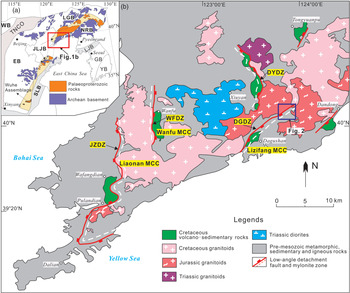
The North China Craton (NCC) is one of the oldest cratons (Liu et al. Reference Liu, Nutman, Compston, Wu and Shen1992; Wan et al. Reference Wan, Liu, Nutman, Zhou, Dong, Yin and Ma2012) and can be divided into the Western and Eastern blocks, which collided to form the Trans-North China Orogen at c. 1.85 Ga (Fig. 1a; Zhao et al. Reference Zhao, Sun, Wilde and Li2005, Reference Zhao, Peter, Li, Wilde, Sun, Zhang, He and Yin2012). The Eastern Block can be further divided into the Longgang Block (LGB) and Nangrim Block (NRB), separated by the Jiao–Liao–Ji Belt (JLJB) formed at c. 1.9 Ga (Fig. 1a; Zhao et al. Reference Zhao, Sun, Wilde and Li2005, Reference Zhao, Peter, Li, Wilde, Sun, Zhang, He and Yin2012; Zhang et al. Reference Zhang, Zhao, Li, Sun, Liu, Wilde, Kröner and Yin2007, Reference Zhang, Zhao, Li, Sun, Wilde, Liu and Yin2009, Reference Zhang, Zhao, Li, Sun, Chan and Shen2012). The Eastern NCC underwent intense lithospheric thinning and cratonic destruction during the Mesozoic Era (Zhang et al. Reference Zhang, Sun, Zhou, Fan, Zhai and Yin2002; Gao et al. Reference Gao, Rudnick, Yuan, Liu, Liu, Xu, Ling, Ayers, Wang and Wang2004, Reference Gao, Rudnick, Xu, Yuan, Liu, Walker, Puchtel, Liu, Huang, Wang and Yang2008, Reference Gao, Zhang, Xu and Liu2009; Zhang, Reference Zhang2009; Zheng & Wu, Reference Zheng and Wu2009; Zhu & Zheng, Reference Zhu and Zheng2009; Zhu et al. Reference Zhu, Chen, Wu and Liu2011, Reference Zhu, Jian, Zhang and Chen2012a , b; Zheng et al. Reference Zheng, Xu, Zhao and Dai2018), accompanied by crust-scale geological activity including magmatism (Wu et al. Reference Wu, Lin, Wilde, Zhang and Yang2005), exhumation of metamorphic core complexes (MCC) and the formation of fault-bounded extensional basins (Liu et al. Reference Liu, Ji, Shen, Guan and Davis2011, Reference Liu, Shen, Ji, Guan, Zhang and Zhao2013). The Liaodong Peninsula is a major component of the Eastern NCC (Fig. 1a; Li et al. Reference Li, Zhao, Sun, Han, Hao, Luo and Xia2005, Reference Li, Zhao, Santosh, Liu, Dai, Suo, Tam, Song and Wang2012), and was selected for this study because it preserves the best records of Mesozoic lithospheric thinning within the Eastern NCC (Wu et al. Reference Wu, Lin, Wilde, Zhang and Yang2005; Liu et al. Reference Liu, Ji, Shen, Guan and Davis2011, Reference Liu, Shen, Ji, Guan, Zhang and Zhao2013).
(a) Tectonic division of the Eastern Block (after Zhao et al. Reference Zhao, Sun, Wilde and Li2005). (b) Geological sketch map of the Liaodong Peninsula (modified after Liu et al. Reference Liu, Shen, Ji, Guan, Zhang and Zhao2013). WB – Western Block; EB – Eastern Block; TNCO – Trans-North China Orogen; JLJB – Jiao–Liao–Ji Belt; LGB – Longgang Block; NRB – Nangrim Block; LJB – Lmjingang Belt; GB – Gyeonggi Belt; YB – Yeongnam Block; SLB – Su–Lu Belt; JZDZ – Jinzhou detachment fault zone; WFDZ – Wanfu detachment fault zone; DYDZ – Dayingzi detachment fault zone; DGDZ – Dagushan detachment fault zone.

Three major magmatic events are recognized to have occurred in the Liaodong Peninsula, during Late Triassic, Middle–Late Jurassic and Early Cretaceous time (Fig. 1b; Wu et al. Reference Wu, Lin, Wilde, Zhang and Yang2005; Reference Yang, Sun, Chen, Wilde and WuYang et al. 2007a , b; Yang & Wu, Reference Yang and Wu2009; Zhang et al. Reference Zhang, Zhao, Davis, Ye and Wu2014). Previous studies interpreted that the latter two events were caused by lithospheric thinning (Gao et al. Reference Gao, Rudnick, Xu, Yuan, Liu, Walker, Puchtel, Liu, Huang, Wang and Yang2008, Reference Gao, Zhang, Xu and Liu2009; Liu et al. Reference Liu, Davis, Ji, Guan and Bai2008, Reference Liu, Ji, Shen, Guan and Davis2011, Reference Liu, Shen, Ji, Guan, Zhang and Zhao2013; Zhu et al. Reference Zhu, Chen, Wu and Liu2011, Reference Zhu, Xu, Zhu, Zhang, Xia and Zheng2012b ; Zheng et al. Reference Zheng, Xu, Zhao and Dai2018). Similar magmatic activity has been reported from the Jiaodong Peninsula (Zhao et al. Reference Zhao, Wang, Deng, Santosh, Liu and Cheng2018). Contemporaneous structures (e.g. volcano-sedimentary basins, low-angle detachment faults and shear zones) also manifested the lithospheric thinning of the NCC (Liu et al. Reference Liu, Davis, Ji, Guan and Bai2008, Reference Liu, Ji, Shen, Guan and Davis2011, Reference Liu, Shen, Ji, Guan, Zhang and Zhao2013). Studies of two typical MCCs (Liaonan and Wanfu) indicated that the detachment of the upper–middle crust was a major driver of lithospheric thinning (Liu et al. Reference Liu, Shen, Ji, Guan, Zhang and Zhao2013). Most previous studies of lithospheric thinning within the NCC mainly focused on the Mesozoic magmatism and deformation; however, very few studies have been conducted on crustal anatexis (Zhao et al. Reference Zhao, Wang, Deng, Santosh, Liu and Cheng2018).
Outcrops of Middle Jurassic – Lower Cretaceous migmatites have been mapped out in the Dagushan low-angle detachment fault and shear zone (DGDZ) (Fig. 2). Anatexis is generally associated with crustal thickening (Brown, Reference Brown1994; Sawyer, Reference Sawyer2001). As a partial melting product between metamorphic and igneous processes, it is an important component of crustal recycling (Brown, Reference Brown2001, Reference Brown2013; Sawyer, Reference Sawyer2001, Reference Sawyer2008; Kelsey et al. Reference Kelsey, Clark and Hand2008). In the Liaodong Peninsula, the temporal and spatial distribution of the migmatites is similar to that of the DGDZ, showing an intimate link between the DGDZ and anatexis. In addition, the melts generated by anatexis can change the rheology of the continental crust (Cavalcante et al. Reference Cavalcante, Viegas, Archanjo and Da Silva2016) and enhance the deformation. Anatexis within the DGDZ may therefore have affected rheological properties and element transport during extensional deformation and magmatism. Characterization of anatexis in the Liaodong Peninsula can provide new insights into lithospheric thinning within the NCC.
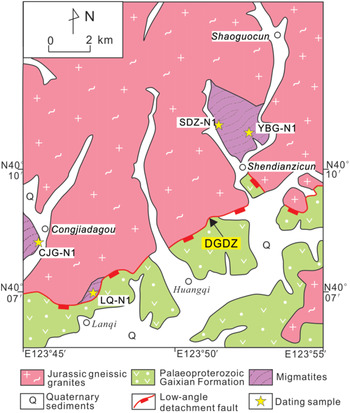
Geological sketch map of the Shendianzi–Congjiagou area in the southeastern Liaodong Peninsula.

In this study, we carried out detailed field investigations, systematic petrology and geochemistry, zircon U–Pb age and Lu–Hf isotopic analysis on the newly discovered migmatites to constrain their protoliths, timing of anatexis and melting reactions. The results are combined with previous studies to elucidate the role of anatexis in the extensional deformation and crustal recycling in the Liaodong Peninsula.
2. Geological background
The Liaodong Peninsula consists of three major tectonic units: the LGB, JLJB and NRB (Fig. 1a). The oldest rocks within the NCC are 3.8–3.0 Ga tonalite–trondhjemite–granodiorite (TTG) gneisses in the Anshan area of the LGB, which were intruded by voluminous granitoids at c. 2.5 Ga (Liu et al. Reference Liu, Nutman, Compston, Wu and Shen1992, Reference Liu, Liu, Zhao, Wang and Peng2017b ; Wan et al. Reference Wan, Liu, Yin, Wilde, Xie, Yang, Zhou and Wu2007, Reference Wan, Liu, Nutman, Zhou, Dong, Yin and Ma2012, Reference Wan, Ma, Dong and Liu2015). In contrast, the basement of the NRB comprises mainly c. 2.5 Ga TTGs and Palaeoproterozoic igneous rocks (Zhai, Reference Zhai2016; Zhai et al. Reference Zhai, Zhang, Zhang, Wu, Peng, Li, Li, Guo, Li, Zhao, Zhou and Zhu2019). The basement of the JLJB mainly comprises rocks of the Palaeoproterozoic Liaohe Group and Liaoji granitoids. The Liaohe Group was deposited at 2.1–1.9 Ga, and comprises volcano-sedimentary rock units. Its lower, middle and upper parts are dominated by volcanic-, carbonate- and argillaceous-rich materials, respectively (Zhang & Yang, Reference Zhang and Yang1988; Luo et al. Reference Luo, Sun, Zhao, Li, Xu, Ye and Xia2004, Reference Luo, Sun, Zhao, Li, Ayers, Xia and Zhang2008; Liu et al. Reference Liu, Liu, Wang, Liu and Cai2015). The Liaoji granitoids are typical A-type granites and most were emplaced at 2.2–2.1 Ga (Liu et al. Reference Liu, Zhang, Liu, Yin, Zhao, Li, Yang and Dou2018; Xu & Liu, Reference Xu and Liu2019). The Liaohe Group and Liaoji granites underwent greenschist- to amphibolite-facies (locally up to granulite-facies) metamorphism at 1.90–1.85 Ga (Yin & Nie, Reference Yin, Nie, Yin and Harrison1996; Liu et al. Reference Liu, Liu, Wang, Liu and Cai2015). In addition, weakly deformed or undeformed syn- and post-collision monzogranites and alkaline syenites intruded at 1900–1840 Ma, and are widespread within the southern JLJB (Lu et al. Reference Lu, Wu, Lin, Sun, Zhang and Guo2004, Reference Lu, Wu, Guo, Wilde, Yang, Liu and Zhang2006; Reference Liu, Liu, Itano, Iizuka, Cai and WangLiu et al. 2017a ; Xu & Liu, Reference Xu and Liu2019). Thick Neoproterozoic–Palaeozoic sedimentary sequences overlie the Liaodong Peninsula basement.
The Late Triassic (233–210 Ma) magmatism in the Liaodong Peninsula formed a large amount of granite, syenite, diorite, dolerite and lamprophyre intrusions (Fig. 1b; Wu et al. Reference Wu, Lin, Wilde, Zhang and Yang2005; Reference Yang, Sun, Chen, Wilde and WuYang et al. 2007a , b; Duan et al. Reference Duan, Zeng, Yang, Liu, Wang and Zhou2014). Coeval volcanic rocks have not been reported in this area. From the Middle Jurassic to Early Cretaceous time, the eastern NCC, including the Liaodong Peninsula, underwent extensive lithospheric thinning and craton destruction, which caused voluminous magmatism and intense extensional deformation mainly at c. 125 Ma (Fig. 1b; Gao et al. Reference Gao, Rudnick, Xu, Yuan, Liu, Walker, Puchtel, Liu, Huang, Wang and Yang2008, Reference Gao, Zhang, Xu and Liu2009; Liu et al. Reference Liu, Davis, Ji, Guan and Bai2008, Reference Liu, Ji, Shen, Guan and Davis2011, Reference Liu, Shen, Ji, Guan, Zhang and Zhao2013; Zhu et al. Reference Zhu, Chen, Wu and Liu2011, Reference Zhu, Xu, Zhu, Zhang, Xia and Zheng2012b ; Zheng et al. Reference Zheng, Xu, Zhao and Dai2018). A series of low-angle detachment faults developed in the Liaodong Peninsula, including the Jinzhou, Wanfu, Dayingzi and Dagushan faults (Fig. 1b). Shearing on these detachment faults caused ductile and brittle deformation. Liu et al. (Reference Liu, Shen, Ji, Guan, Zhang and Zhao2013) inferred that Mesozoic extension in the Liaodong Peninsula initiated shearing along the Jinzhou detachment fault and exhumation of the Liaonan MCC before c. 134 Ma. The Lizifang MCC comprises a detachment fault (i.e. the DGDZ), a footwall of metamorphic rocks and Mesozoic granites, and a hanging wall of lower Palaeoproterozoic meta-sedimentary rocks (i.e. Gaixian Formation) and Cretaceous basins (Fig. 2; Zhong et al. Reference Zhong, Wu, Liu, Zhang, Wang, Gao, Pan and Gao2019). The DGDZ is a NE-striking detachment fault that dips to the SE at 15–30°. Abundant mylonitic and gneissic rocks are distributed within the DGDZ; among these, the Gaixian Formation consists of mica-bearing schist, fine-grained biotite-bearing gneiss and metamorphosed feldspar–quartz sandstone. The metasedimentary rocks experienced ductile deformation, characterized by sheared feldspar porphyroclasts, asymmetric folds and elongated quartz grains.
3. Field relationships and petrography
Four outcrops of migmatite (Yabagou (YBG), Shendianzi (SDZ), Lanqi (LQ) and Congjiagou (CJG)) were recently mapped out close to the NE–SW-trending DGDZ on the eastern margin of the Liaodong Peninsula (Fig. 2). Generally, the host rocks of these migmatites contain a well-developed foliation parallel to the DGDZ. These migmatites consist of leucosomes and melanosomes. The leucosomes form thin layers, veins and lenses that are parallel to, or cross-cut, the foliation (Figs 3–6). The host rocks are mainly biotite-bearing gneiss, sillimanite-bearing two-mica gneiss, orthopyroxene-bearing biotite gneiss and titanite-bearing biotite gneiss (Figs 3–6).
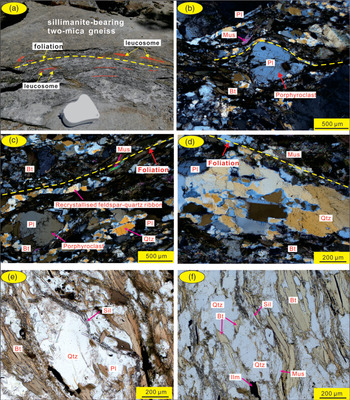
Field photographs and microphotographs of the YBG migmatite. (a) The outcrop of YBG migmatite contains c. 5–10 vol% of thin leucocratic layer and isolated lenses, approximately distributed along the foliations. (b–d) Mylonitic features include well-developed foliation defined by orientated biotites, porphyroclasts of feldspar in a matrix of quartz-feldspar-mica, and recrystallized feldspar and quartz ribbons. (e, f) Embayed and corroded biotite and muscovite reflect breakdown during fluid-absent melting; reaction products (i.e. sillimanite, ilmenite and melt) are distributed along the boundaries of reactant minerals. Bt – biotite; Kfs – K-feldspar; Ilm – ilmenite; Pl – plagioclase; Mus – muscovite; Qtz – quartz; Sil – sillimanite.

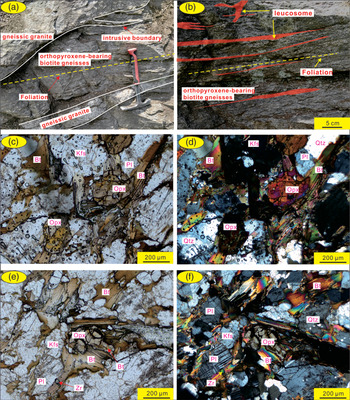
Field photographs and microphotographs of the LQ migmatite. (a, b) The outcrop of the LQ migmatite occurs as xenolith within the Jurassic gneissic granites, and the thin leucocratic layers are distributed along the foliation. (c–f) Mineral assemblages of the LQ orthopyroxene-bearing biotite gneiss: the biotite and plagioclase are corroded by reaction products (e.g. peritectic orthopyroxene and K-feldspar and melt), mainly located at the boundaries of the reactant grains. Bt – biotite; Kfs – K-feldspar; Pl – plagioclase; Opx – orthopyroxene; Qtz – quartz; Sil – sillimanite; Zr – zircon.

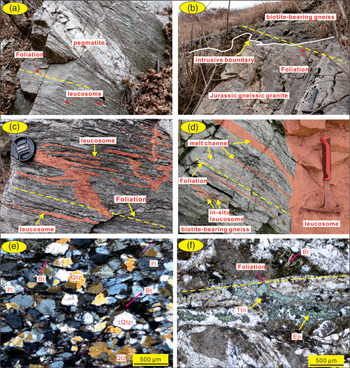
Field photographs and microphotographs of the SDZ migmatite. (a, b) The Jurassic gneissic granite and pegmatite intruded into the SDZ migmatite. (c, d) The thin vein or layer distributed parallel to the foliation; in contrast, wider and oblique leucocratic dykes that are oriented at a high angle to the foliation reflect linked arrays along the plane of the foliation and compositional layering. (e) Mineral assemblages show remnant clastic textures in some leucosome-free domains. (f) Mineral assemblages of the SDZ biotite-bearing gneiss: the peritectic epidotes and titanites together with felsic melts are mainly located along the foliation, where biotites are apparently corroded. Bt – biotite; Ep – epidote; Pl – plagioclase; Qtz – quartz; Ttn – titanite.

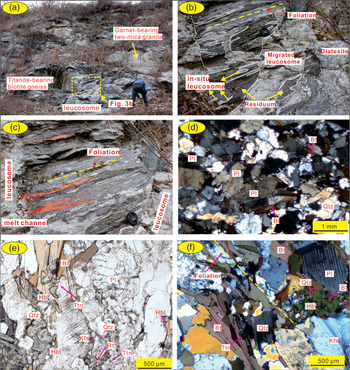
Field photographs and microphotographs of the CJG migmatite. (a–c) The CJG migmatite contains c. 30 vol% leucosomes, which are mainly present as thin layers parallel to the foliation, isolated in situ leucocratic lenses and high-angle leucocratic dykes. (d) Mineral assemblages show phanerocrystalline textures in some leucosome-free domains. (e, f) Mineral assemblages of the CJG titanite-bearing biotite gneiss: biotite grains are featured by embayed and corroded shapes, which reflecting biotite breakdown during anatexis. The anatectic melts and peritectic minerals (e.g. hornblende, titanite, rutile and orthopyroxene) are mainly distributed along the grain boundaries at a grain-scale and parallel to the principal fabric (i.e. foliation). Bt – biotite; Hbl – hornblende; Kfs – K-feldspar; Pl – plagioclase; Opx – orthopyroxene; Qtz – quartz; Ttn – titanite; Rt – rutile.

Outcrop YBG, close to the Yabagou Village, west of Dandong City, is dominated by sillimanite-bearing two-mica gneiss that contains plagioclase, quartz, biotite, muscovite and sillimanite with accessory zircon and opaque minerals. Geological mapping indicates that the YBG migmatite occurs as xenoliths in the wall-rock Jurassic gneissic granite. The sillimanite-bearing two-mica gneiss has a crystalloblastic texture (Fig. 3a). The host rocks of the YBG migmatite show mylonitic features in thin-section, including well-developed mylonitic foliation defined by oriented biotites, porphyroclasts of feldspar in a matrix of quartz–feldspar–mica, recrystallized feldspar and quartz ribbons (Fig. 3b–d). Some leucosome-free samples show preferred alignment, of which the clastic texture and rounded quartz and plagioclase grains indicate a sedimentary origin. On the outcrops, the YBG migmatite contains 5–10 vol% of thin leucocratic layers (most < 5 mm wide) and isolated leucosome lenses (Fig. 3a). The leucosomes occur commonly within the foliation (Fig. 3a). Biotite and muscovite are typically embayed, rounded or corroded, reflecting that they were broken down during partial melting (Fig. 3e, f). Embayed and corroded reactant minerals (e.g. biotite, muscovite, plagioclase and quartz) surround cuspate patches of crystallized melt, comprising quartz, plagioclase and peritectic sillimanite (Fig. 3b–f). The crystallized melts heterogeneously distribute and occur mainly along grain boundaries. Patches of crystallized melts on the margins of adjacent reactant biotite and muscovite grains are interconnected (Fig. 3b–f). In contrast, crystallized melt trapped in the matrix of residual grains (e.g. plagioclase, quartz, biotite, muscovite) forms isolated leucocratic patches (Fig. 3a).
Migmatite outcrop LQ is located at the Lanqi Village, Dandong City. It is dominated by orthopyroxene-bearing biotite gneiss and leucocratic veins (Fig. 4a, b). Intrusive contacts between Jurassic gneissic granites and migmatites, and intrusion of gneissic granite veins into the LQ migmatite (Fig. 4a), indicate that the migmatite is a xenolith within the granite. The relict phanerocrystalline texture and discontinuous foliation within the host rock might reflect an igneous origin for the protolith of the LQ migmatite. The gneissic granite and LQ migmatite display a NE-trending foliation that is parallel to the DGDZ. The leucosomes present as thin veins (0.5–2 cm wide) oriented parallel or sub-parallel to the foliation (Fig. 4b). Locally, thin leucocratic layers show a high angle to the layering (Fig. 4b), reflecting the melt coalescence and migration. The orthopyroxene-bearing biotite gneiss comprises reactants plagioclase (50 vol%), biotite (15 vol%) and quartz (5 vol%); and reaction products orthopyroxene (5 vol%), melt (mainly quartz and plagioclase, 15 vol%), minor K-feldspar (5 vol%) and accessory minerals (total of 5 vol%; e.g. zircon and monazite) (Fig. 4c–f). The host rocks display a crystalloblastic texture and aligned biotites define a gneissic fabric (Fig. 4a, b). Partial melting is recorded by embayed and corroded biotite and plagioclase (Fig. 4c–f).
Migmatite outcrop SDZ is well-exposed in the Shendianzi Village, Dandong City. The migmatite is intruded by Jurassic gneissic granite and pegmatite (Fig. 5a, b), and comprises mainly leucosomes and biotite-bearing gneisses (Fig. 5c, d). Based on their mineralogy and features (e.g. remnant bedding and clastic textures) that reflect a sedimentary origin (Fig. 5e), the host rocks are inferred to be metagreywackes. The gradational change of the contact from the SDZ migmatite to the Gaixian Formation indicates that the migmatite used to be part of the Gaixian Formation. The leucosomes occur as two main types: (1) thin veins or layers distributed parallel to the foliation (Fig. 5c, d); and (2) broader leucocratic dykes at a high angle to the foliation (Fig. 5c, d). The two types form arrays that link the foliation planes and compositional layering. The host rocks are dominated by grey biotite-bearing gneiss with a crystalloblastic texture and a gneissic fabric defined by aligned biotite (Fig. 5f). Their mineral assemblage includes quartz (50 vol%), plagioclase (30 vol%), biotite (10 vol%) and minor epidote and titanite (5 vol%) (Fig. 5f). Epidote and titanite co-exist with the leucosomes and corroded biotites on foliation planes (Fig. 5f), indicating that a pre-existing fabric might affect the distribution of leucosome during anatexis.
Migmatite outcrop CJG is located at the Congjiagou area of Dandong City, and is dominated by titanite-bearing biotite gneisses and leucosomes (Fig. 6a–c). Compared with the YBG and SDZ migmatites, the host rocks of the CJG migmatite show relatively discontinuous schistosity. They show a phanerocrystalline texture and massive structure in some leucosome-free domains (Fig. 6d). These features indicate that the protolith of the CJG migmatite was most likely of igneous origin. The leucosomes (c. 30 vol%) occur as widespread thin veins and layers, irregular lenses and dykes (Fig. 6a–c). Three main types of leucosome occur in the CJG migmatite: (1) thin layers parallel to the foliation, inferred to have crystallized from in situ anatectic melts (Fig. 6b, c); (2) isolated leucocratic lenses, possibly representing in situ leucosomes, characterized by diffuse margins with melanosomes (Fig. 6b, c); and (3) leucocratic dykes at a high angle to the layering, propagating upwards and linking layer-parallel leucosomes (Fig. 6a–c). Sawyer (Reference Sawyer2001) suggested that high-angle discordant leucosomes like these formed last, and could represent pathways that channelled melt from melting layers. The host rocks have a crystalloblastic texture and gneissic fabric, and comprise plagioclase (45 vol%), biotite (10 vol%), quartz (15 vol%), hornblende (10 vol%), titanite (10 vol%), K-feldspar (5 vol%) and minor orthopyroxene, rutile, zircon, apatite and ilmenite (total of 5 vol%) (Fig. 6e, f). Biotite grains are embayed and corroded, consistent with biotite breakdown during anatexis. The crystallized partial melts are distributed mainly along the grain boundaries and are aligned parallel to the foliation (Fig. 6f). Two types of hornblende are observed in the host rocks. The first type is relatively coarse-grained and euhedral to subhedral, with inclusions of reactant minerals (e.g. biotite, quartz, plagioclase) (Fig. 6f), and is interpreted as peritectic. The other type is fine-grained with eroded margins and embayment (Fig. 6e), and is interpreted as a reactant mineral.
4. Sampling and analytical methods
Four samples (LQ-N1, SDZ-N1, YBG-N1 and CJG-N1) were selected for geochronological study from the host rocks of migmatite outcrops LQ, SDZ, YBG and CJG, respectively. Zircon grains were separated at the Langfang Regional Geological Survey, Hebei Province, China and mounted in epoxy resin. The mounts were polished to expose the grain centres, and imaged by cathodoluminescence (CL) using a CL system installed on a Quanta 200 FE-SEM at Nanjing Hongchuang GeoAnalysis, Nanjing, China. Zircon was analysed for U–Pb and Lu–Hf isotope compositions by laser ablation – inductively coupled plasma – mass spectrometry (LA-ICP-MS) at Yanduzhongshi Geological Analysis Laboratories, Beijing, China. The LA-ICP-MS operating conditions and data-reduction techniques are described by Liu et al. (Reference Liu, Gao, Hu, Gao, Zong and Wang2010). The external U–Pb standard was zircon 91500, and the Plesovice zircon was used as a secondary standard. Weighted-mean 206Pb/238U ages obtained for Plesovice zircon are consistent with the reference value of 336.86 ± 0.76 Ma (Solari et al. Reference Solari, Gómez-Tuena, Bernal, Pérez-Arvizu and Tanner2010). The Lu–Hf isotopes were analysed with a Neptune-Plus multi-collector (MC-) ICP-MS instrument equipped with a NewWave UP213 laser. The laser spots for Lu–Hf analysis were 30 μm in diameter, and located as close as possible to the U–Pb analysis spots. The analytical software and correction protocols are described by Wu et al. (Reference Wu, Yang, Xie, Yang and Xu2006).
A total of 19 samples were collected from domains without leucosomes, considered to represent the mineralogical and chemical characteristics of the protoliths. Major- and trace-element analyses were undertaken at the Yanduzhongshi Geological Analysis Laboratories, Beijing, China. Fresh samples were crushed to centimetre-sized pieces, and fresh pieces selected and powdered to < 200 mesh in an agate mill. The powders were fluxed with Li2B4O7 (1:8) at 1250°C to make homogeneous glass discs using a V8C automatic fusion machine. The glass discs were analysed for major elements by X-ray fluorescence spectrometry using an XRF-1800. The AGV-2 and GSR-1 standards were used for quality control purposes, and analytical accuracy was better than 2%. For trace-element analysis, sample powders were dissolved in distilled HF + HNO3 in a screw-top Teflon beaker for 4 days at 100°C before analysis of the solution using an Agilent 7500 A ICP-MS instrument. The analytical precision was < 10% relative for Cr, Sc and Sr, and < 5% relative for other elements. The GSR-2 standard was used for quality control purposes and its analysis results were consistent with reference values. Further details of the analytical procedure are provided by Qi et al. (Reference Qi, Hu and Gregoire2000).
5. Results
5.a. Zircon U–Pb geochronology
5.a.1. Sample LQ-N1
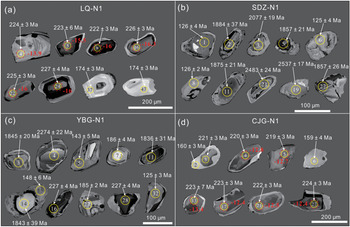
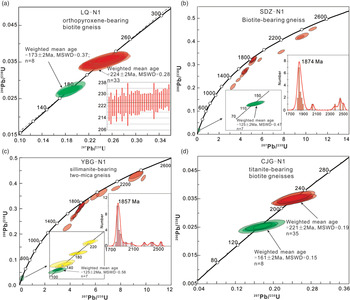
Sample LQ-N1 is an orthopyroxene-bearing biotite gneiss of the LQ migmatite. Zircons from this sample are typically 100–200 μm in diameter with aspect ratios of 1–2. They are irregular or prismatic and typically exhibit distinct cores and rims in CL images (Fig. 7a). Most zircon cores display oscillatory zonation, but the rims have little internal structure and are homogeneous or display blurred oscillatory zoning (Fig. 7a). Yakymchuk & Brown (Reference Yakymchuk and Brown2014) proposed that some zircons are expected to survive heating to peak temperature, and new zircons grow subsequently from melt trapped along grain boundaries during cooling to the solidus. The zircon cores are therefore inferred to be sourced from the protolith and the rims to have formed during anatexis. A total of 33 analyses of the zircon cores yielded tightly clustered 206Pb/238U ages of 228–220 Ma and high Th/U ratios of 0.33–1.02 (online Supplementary Table S1, available at http://journals.cambridge.org/geo). Most zircon core analyses are concordant (concordance > 99%) and yield a weighted-mean 206Pb/238U age of 224 ± 2 Ma (Fig. 8a), which is interpreted as the crystallization age of the protolith. The eight rim analyses have low Th/U ratios (0.06–0.26) and tightly clustered 206Pb/238U ages of 176–171 Ma, with a weighted-mean age of 173 ± 2 Ma (Fig. 8a) that is interpreted as the age of zircon growth during anatexis.
CL images of representative zircons from the host rocks showing internal textures.

LA-ICP-MS zircon U–Pb dating concordia diagrams for the samples of the host rocks.

5.a.2. Sample SDZ-N1
Sample SDZ-N1 is a biotite-bearing gneiss from the SDZ migmatite. Zircons from the sample are < 100 μm in diameter. CL images indicate distinct cores and rims (Fig. 7b). Zircon cores have complex structures, including concentric oscillatory, banded, planar and blurred zones (Fig. 7b), indicative of a detrital origin. In contrast, the rims are relatively bright and display homogeneous zoning, indicative of an anatectic origin. The zircon rims have low Th/U ratios (0.01–0.05). Seven analyses of the zircon rims yielded 206Pb/238U ages of 126–122 Ma and a weighted-mean age of 125 ± 2 Ma (Fig. 8b), interpreted as the age of zircon growth during anatexis. The zircon cores yielded variable 207Pb/206Pb ages of 2537–1857 Ma and Th/U ratios of 0.03–1.24 (online Supplementary Table S1). The most common age recorded by the zircon cores is 1921–1857 Ma, followed by ages of 2537–2411 Ma (Fig. 8b). Five zircon cores with ages of 1.92–1.87 Ga have extremely low Th/U ratios of 0.03–0.07 (online Supplementary Table S1) and CL images with blurred or fan oscillatory zones, consistent with a metamorphic origin.
5.a.3. Sample YBG-N1
Sample YBG-N1 is a sillimanite-bearing two-mica gneiss of the YBG migmatite. Zircons from this sample are typically 80–150 μm in diameter, and most have distinct cores and rims (Fig. 7c). The zircon cores can be divided into two groups. Some show clear concentric oscillatory or banded zoning and relatively high Th/U values of 0.21–1.38 (online Supplementary Table S1), indicative of an igneous origin, whereas others show blurred oscillatory zoning and relatively low Th/U ratios of 0.04–0.17 (online Supplementary Table S1), indicative of a metamorphic origin. The zircon rims display homogeneous zoning with low Th/U ratios of 0.01–0.03 (online Supplementary Table S1), indicative of an anatectic origin. A total of 22 zircon cores yielded variable ages of 2536–1830 Ma and nine analyses yielded ages of 227–142 Ma, interpreted as mixed ages. A group of zircon cores with ages that range from 1937 to 1830 Ma yield a peak at 1855 Ma (Fig. 7c), whereas the older dates range from 2536 to 1992 Ma. Seven analyses of the zircon rims yielded 206Pb/238U ages of 127–121 Ma with a weighted-mean age of 125 ± 2 Ma (Fig. 8c), interpreted as the age of zircon growth during anatexis.
5.a.4. Sample CJG-N1
Sample CJG-N1 is a titanite-bearing biotite gneiss of the CJG migmatite. Most zircons from this sample display typical core–rim structures and are 100–200 μm in size (Fig. 7d). Zircon cores have clear and wide oscillatory zoning (Fig. 7d) and high Th/U ratios (0.55–1.22), whereas the rims have homogeneous or blurred oscillatory zoning and lower Th/U values of 0.11–0.77 (Fig. 7d). The zircon cores are inferred to be magmatic, but the rims have relatively higher Th/U values than the zircons that formed during anatexis (generally < 0.1). Previous studies suggested that anatectic zircons with high Th/U values could be formed by recrystallization under fluid-rich conditions (Pidgeon, Reference Pidgeon1992; Rubatto & Hermann, Reference Rubatto and Hermann2003; Dong et al. Reference Dong, Xie, Kröner, Wang, Liu, Xie, Song, Ma, Liu and Wan2017). These zircon rims are therefore inferred to have formed during anatexis. A total of 35 analyses of the zircon cores yielded tightly clustered 206Pb/238U ages of 225–217 Ma with a weighted-mean 206Pb/238U age of 221 ± 2 Ma (Fig. 8d; online Supplementary Table S1), interpreted as the crystallization age of the protolith. Eight zircon rim analyses yielded 206Pb/238U ages of 162–159 Ma with a weighted-mean age of 161 ± 2 Ma (Fig. 8d; online Supplementary Table S1), interpreted as the age of zircon growth during anatexis.
5.b. Whole-rock major- and trace-element data
The geochronological data record tightly clustered Triassic ages and an igneous origin for the protoliths of samples LQ-N1 and CJG-N1 (c. 220 Ma; Fig. 8a, d). In contrast, the age spectra of samples SDZ-N1 and YBG-N1 are characteristic of sedimentary rocks with depositional ages younger than c. 1857 Ma (Fig. 8b, c).
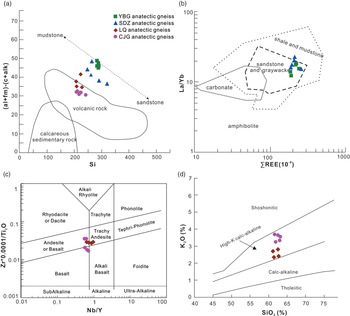
The protoliths of metamorphic rocks can also be constrained by their geochemistry (Simonen, Reference Simonen1953; McLennan et al. Reference McLennan, Taylor and McCulloch1990). The protoliths of the LQ and CJG migmatites plot in the field of volcanic rocks in the ((Al + fm) – (c + alk)) – Si diagram (Fig. 9a), consistent with an igneous origin. In contrast, the protoliths of the SDZ and YBG migmatites plot nearer the field of sedimentary rocks (Fig. 9a), consistent with a sedimentary origin. Furthermore, the SDZ and YBG migmatites plot in the sandstone and greywacke fields in the (La/Yb)–(ΣREE) diagram (ΣREE is total rare-earth element content) (Fig. 9b). These findings are consistent with the protoliths inferred from the geochronological results and field observations.
(a) (al + fm)–(c + alk) v. Si diagram (after Simonen, Reference Simonen1953); (b) (La/Yb) v. ΣREE diagram (after Wang et al. Reference Wang, He, Chen, Zheng and Geng1987); (c) Nb/Y v. Zr/TiO2 geochemical classification diagram (Winchester & Floyd, Reference Winchester and Floyd1977); (d) K2O v. SiO2 (Rickwood, Reference Rickwood1989). Σ = Al2O3 + 2Fe2O3 + FeO + MgO + MnO + CaO + Na2O + K2O; al = (Al2O3/Σ) × 100; fm = (2Fe2O3 + FeO + MgO + MnO)/Σ × 100; c = (CaO/Σ) × 100; alk = (Na2O + K2O)/Σ × 100; al + fm + c + alk = 100; Si = (SiO2/Σ) × 100.

5.b.1. SDZ and YBG migmatites
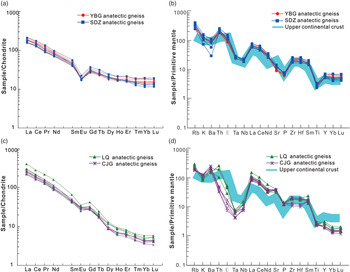
Many geochemical features of the SDZ and YBG hosts are similar. The samples have relatively high SiO2 (62.27–69.59 wt%) and CaO (1.38–2.08 wt%) contents, and low total Fe2O3 (4.73–6.47 wt%) and K2O (2.89–3.66 wt%) contents (online Supplementary Table S2, available at http://journals.cambridge.org/geo). They have relatively high ΣREE contents of 182.0–252.2 ppm (online Supplementary Table S2), and are slightly enriched in light REE (LREE) ((La/Yb)N = 8.81–15.94) with strongly negative Eu anomalies (Eu/Eu* = 0.45–0.56) (Fig. 10a). Previous studies concluded that the protoliths of these migmatites are sedimentary rocks, and this interpretation is supported by a comparison of the trace-element characteristics of these samples with those of the upper continental crust (UCC) (Fig. 10b). The SDZ and YBG migmatite samples are enriched in large-ion lithophile elements (LILEs; e.g. Rb, Ba and Th), depleted in the high-field-strength elements (HFSEs; e.g. Nb, Ta, Ti and P) and plot near the UCC in the primitive-mantle-normalized multi-element diagram (Fig. 10b).
(a, c) Chondrite-normalized REE and (b, d) primitive mantle-normalized trace-element spider diagrams for the samples. The data for chondrite and primitive mantle-normalized are from Sun & McDonough (1989), and the upper continental crust values are from Rudnick & Gao (Reference Rudnick and Gao2003).

5.b.2. LQ and CJG migmatites
Samples of the LQ and CJG hosts also share similar geochemical features. They plot in the basalt–andesite field in the (Nb/Y)–(Zr/TiO2) diagram (Fig. 9c) and have moderate SiO2 (61.19–63.14 wt%) and total Fe2O3 (4.42–5.74 wt%) contents and relatively high Al2O3 (15.16–17.05 wt%), MgO (3.36–4.55 wt%) and CaO (3.93–4.75 wt%) contents (online Supplementary Table S2). On oxide versus SiO2 diagrams (Fig. 11), SiO2 shows linear correlations with MgO, total Fe2O3, TiO2 and P2O5. The Mg numbers are relatively high (58–65), K2O/Na2O ratios low (0.73–1.26) and A/CNK ratios variable (0.90–1.18) (online Supplementary Table S2). Most of the samples plot in the high-K calc-alkaline field in the K2O–SiO2 diagram (Fig. 9d). Their ΣREE contents (229.7–400.8 ppm) are high, with small negative Eu anomalies (Eu/Eu* = 0.65–0.84). They are enriched in LREE ((La/Yb)N = 39.26–81.21) and strongly depleted in HREE in the chondrite-normalized multi-element diagram (Fig. 10c; online Supplementary Table S2). The samples are also enriched in LILEs (e.g. Rb, Ba and Th) and depleted in HFSEs (e.g. Nb, Ta, Ti and P) relative to the primitive mantle (Fig. 10d).
Major oxides v. SiO2 for the CJG and LQ anatectic gneisses.

5.c. Zircon Lu–Hf isotopic compositions
The Lu–Hf isotopic compositions of zircon cores from samples LQ-N1 and CJG-N1 were determined in situ (Table 1) and are similar and relatively homogeneous (excluding analysis CJG-N1-34). The initial 176Hf/177Hf and 176Lu/177Hf ratios are in the ranges 0.282174–0.282294 and 0.000157–0.000631, respectively. The ϵHf(t) values are negative (−16.3 to −12.1) and yield two-stage Hf model ages (T DM2) of 2282–2016 Ma (Table 1). Analysis CJG-N1-34 records a relatively low initial 176Hf/177Hf ratio (0.282033) and ϵHf(t) value (−21.3) and a high value of T DM2 (c. 2593 Ma; Table 1).
Zircon Hf isotopic data for the sample LQ-N1 and CJG-N1

6. Discussion
6.a. Depositional age and provenance of protoliths of SDZ and YBG migmatites
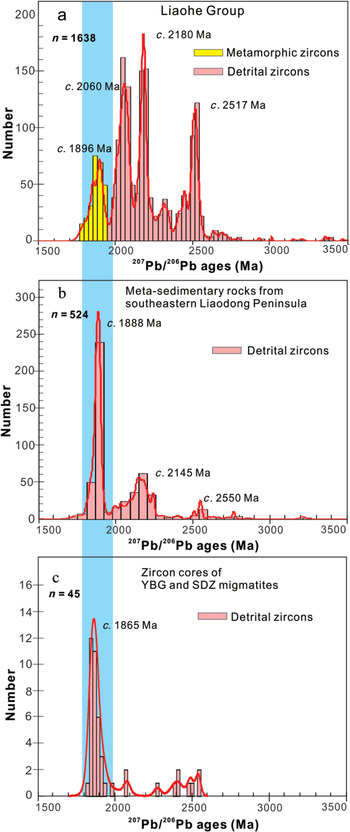
The youngest group of detrital zircons from samples SDZ-N1 and YBG-N1 has age peaks at 1874 and 1857 Ma (Fig. 8b, c), respectively. The depositional age is therefore younger than c. 1857 Ma, but older than the age of leucosome crystallization at 125 ± 2 Ma.
Samples SDZ-N1 and YBG-N1 have distinctly different age spectra to metasedimentary rocks of the Liaohe Group (Fig. 12). For example, the largest age peaks in samples SDZ-N1 and YBG-N1 (1937–1830 Ma) are different to those of Liaohe Group samples (Fig. 12). The depositional age of the Liaohe Group is c. 2.0–1.9 Ga (Li et al. Reference Li, Chen, Wei, Wang and Han2015; Liu et al. Reference Liu, Zhang, Liu, Yin, Zhao, Li, Yang and Dou2018), older than the depositional age of the protolith of SDZ-N1 and YBG-N1. It has recently been suggested that metasedimentary rocks of the SE Liaodong Peninsula, which were thought to be part of the Gaixian Formation, were deposited after the Liaohe Group (Meng et al. Reference Meng, Liu, Cui and Cai2013; Wang et al. Reference Wang, Liu, Liu, Cai, Ji, Liu and Tian2018). The most common age of detrital grains in metasedimentary rocks from the Changhai Island is 1916–1856 Ma, with a peak at c. 1887 Ma (Meng et al. Reference Meng, Liu, Cui and Cai2013). Wang et al. (Reference Wang, Liu, Liu, Cai, Ji, Liu and Tian2018) also reported an age peak at c. 1863 Ma for a metamorphosed feldspar–quartz sandstone from the SE Liaodong Peninsula, which was previously thought to be part of the Gaixian Formation. The detrital zircon age spectra of samples SDZ-N1 and YBG-N1 are similar to those of metasedimentary rocks from the SE Liaodong Peninsula (Fig. 12). A suite of Palaeoproterozoic metasedimentary rocks is widely exposed in the eastern part of the DGDZ (Fig. 2). They have similar lithological and deformational characteristics to the metasedimentary rocks reported by Meng et al. (Reference Meng, Liu, Cui and Cai2013) and Wang et al. (Reference Wang, Liu, Liu, Cai, Ji, Liu and Tian2018). The protolith of the SDZ and YBG migmatites may therefore be related to these metasedimentary rocks, rather than the Liaohe Group.
Summary histogram of the reported zircon ages for (a) the Liaohe Group in the northern and central JLJB, (b) the meta-sedimentary rocks from the southeastern Liaodong Peninsula and (c) YBG and SDZ migmatites. Data from Luo et al. (Reference Luo, Sun, Zhao, Li, Xu, Ye and Xia2004, Reference Luo, Sun, Zhao, Li, Ayers, Xia and Zhang2008), Meng et al. (Reference Meng, Liu, Cui and Cai2013, Reference Meng, Wang, Li, Li, Yang, Cai, Ji and Ji2017a , b), Li et al. (Reference Li, Chen, Wei, Wang and Han2015), Liu et al. (Reference Liu, Zhang, Liu, Yin, Zhao, Li, Yang and Dou2018) and Wang et al. (Reference Wang, Liu, Liu, Cai, Ji, Liu and Tian2018).

Strong magmatic–hydrothermal activity was widespread in the SE Liaodong Peninsula at 1.90–1.85 Ga. Late Palaeoproterozoic rocks formed there at that time have been studied in detail. These include the Kuangdonggou syenite (1.87–1.85 Ga; Cai et al. Reference Cai, Yan, Mu, Xu, Shao and Xu2002; Reference Yang, Wu, Xie and LiuYang et al. 2007c ), Tonghua diorite–monzogranite–syenite complex (1.87–1.85 Ga; Reference Liu, Liu, Itano, Iizuka, Cai and WangLiu et al. 2017a ) and Qingchengzi granite (c. 1.89 Ga; Wang et al. Reference Wang, Peng, Wang and Yang2017). It is likely that the 1921–1857 Ma zircon grains from sample SDZ-N1 and YBG-N1 were derived from these late Palaeoproterozoic (1.90–1.85 Ga) igneous rocks. In addition, five zircon cores with metamorphic origin yield ages of c. 1.92–1.87 Ga, which are consistent with the metamorphic ages of the Liaohe Group (Fig. 12; Yin & Nie, Reference Yin, Nie, Yin and Harrison1996; Liu et al. Reference Liu, Liu, Wang, Liu and Cai2015, Reference Liu, Zhang, Liu, Yin, Zhao, Li, Yang and Dou2018). These five zircons may therefore be sourced from the Liaohe Group. Other zircon ages of 2.5–2.1 Ga are consistent with those of NCC crystalline basement in the Liaodong Peninsula, such as the Palaeoproterozoic Liaoji granites (2.2–2.1 Ga; Liu et al. Reference Liu, Zhang, Liu, Yin, Zhao, Li, Yang and Dou2018) and Neoarchean TTGs (2.7–2.5 Ga) (Wan et al. Reference Wan, Ma, Dong and Liu2015; Wang et al. Reference Wang, Liu, Cawood, Bai, Guo, Guo and Wang2016). It is therefore likely that some zircons were derived from the crystalline basement.
6.b. Petrogenesis of the protoliths of LQ and CJG migmatites
Petrological, geochemical and geochronological data indicate that the protoliths of the LQ and CJG migmatites were igneous rocks. However, these data do not reveal whether the igneous rocks were intrusive or extrusive. The protolith of the LQ and CJG migmatites formed during Late Triassic time (c. 220 Ma). A number of Late Triassic plutons are recognized in the Liaodong Peninsula (Fig. 1b; Table 2), including the Saima–Bolinchuan nepheline syenite (233–231 Ma; Wu et al. Reference Wu, Lin, Wilde, Zhang and Yang2005), Xiuyan granite and associated mafic microgranular enclaves (213–210 Ma; Wu et al. Reference Wu, Lin, Wilde, Zhang and Yang2005; Yang et al. Reference Yang, Wu, Wilde and Liu2007b ), Yujiacun syenite (221 Ma; Wu et al. Reference Wu, Lin, Wilde, Zhang and Yang2005), Yinjiacun and Daheshangshan dolerites (213–212 Ma; Yang et al. Reference Yang, Sun, Chen, Wilde and Wu2007a ), Shuangdinggou granite (224 Ma; Duan et al. Reference Duan, Zeng, Yang, Liu, Wang and Zhou2014) and Qingchengzi lamprophyre (227–210 Ma; Duan et al. Reference Duan, Zeng, Yang, Liu, Wang and Zhou2014). Triassic volcanic rocks have not been reported. Based on this observation and the geochemistry, the protoliths of the LQ and CJG migmatites are inferred to have been the Late Triassic intrusive rocks, which can be further classified as diorites in the Nb/Y versus Zr/TiO2 diagram (Fig. 9c).
Summary of geochronological data for the Late Triassic igneous rocks in the Liaodong Peninsula. LA-ICP-MS – laser ablation inductively coupled plasma mass spectrometry; TIMS – thermal ionization mass spectrometry

The LQ and CJG diorites have moderate SiO2, K2O + N2O, total Fe2O3 and Al2O3 contents, consistent with a crustal origin. Their MgO (3.36–4.55 wt%) and CaO (3.93–4.75 wt%) contents and Mg number values (58–65) are relatively high, possibly recording the addition of mantle materials and/or fractional crystallization. The systematic variations in SiO2, MgO, total Fe2O3, TiO2 and P2O5 contents (Fig. 11) are consistent with fractionation of amphibole, rutile and apatite. Previous studies on the coeval Xiuyan granitoids and their mafic enclaves (Yang et al. Reference Yang, Wu, Wilde and Liu2007 b) and the Daheikeng diorites (Wang et al. Reference Wang, Lv, Liu, Zhao, Li, Wu, Wang and Li2019) in adjacent regions have revealed that mantle- and crust-derived magma mixing was a common feature of the Late Triassic magmatism in the Liaodong Peninsula. The high MgO and CaO contents and Mg number values of the LQ and CJG diorites may therefore reflect a contribution by mantle materials. Zircons from the LQ and CJG diorites have negative ϵHf(t) values (−16.3 to −12.1; Table 1), indicating the parent magmas were partial melts of recycled ancient crust. The old T DM2 ages (2282–2016 Ma) are also consistent with derivation of the parent magmas from mafic Palaeoproterozoic crustal material. The c. 2.1 Ga mafic rocks of the JLJB have high positive ϵHf(t) values (Meng et al. Reference Meng, Liu, Liu, Liu, Yang, Wang, Shi and Cai2014; Fig. 13) consistent with derivation directly from depleted mantle. The Hf isotopic compositions of the proposed diorite protoliths of the LQ and CJG rocks and the c. 2.12 Ga mafic rocks are similar (Fig. 13), implying that the mafic rocks melted to form the parental magma of the LQ and CJG diorites. Other Upper Triassic intrusive rocks within the Liaodong Peninsula have similar Hf isotopic compositions to the LQ and CJG samples (Yang et al. Reference Yang, Sun, Chen, Wilde and Wu2007 a, b; Duan et al. Reference Duan, Zeng, Yang, Liu, Wang and Zhou2014; Fig. 13), indicating that they share a common source. Furthermore, the LQ and CJG rocks have high Sr/Y ratios (46.5–90.2) and are HREE-depleted (Fig. 10), indicating that garnet was a residual phase in the magma source region. Yang et al. (Reference Yang, Sun, Chen, Wilde and Wu2007 a, b, 2012) inferred that delamination of thickened continental crust caused the Late Triassic magmatism in the Liaodong Peninsula. Based on the above, it is concluded that the parental magmas of the LQ and CJG protoliths were partial melts of thickened Palaeoproterozoic mafic lower crust that were mixed with mantle-derived magma and experienced fractional crystallization during ascent.
ϵHf(t) v. age diagram for the sample CJG-N1 and LQ-N1 and analysed Triassic igneous rocks from the Liaodong Peninsula. Published data from Yang et al. (Reference Yang, Sun, Chen, Wilde and Wu2007 a, b) and Duan et al. (Reference Duan, Zeng, Yang, Liu, Wang and Zhou2014).

6.c. Relationship between Jurassic–Cretaceous anatexis and lithospheric thinning
There is consensus that the eastern NCC underwent lithospheric thinning and craton destruction during the Mesozoic Era (Zhang et al. Reference Zhang, Sun, Zhou, Fan, Zhai and Yin2002; Gao et al. Reference Gao, Rudnick, Yuan, Liu, Liu, Xu, Ling, Ayers, Wang and Wang2004, Reference Gao, Rudnick, Xu, Yuan, Liu, Walker, Puchtel, Liu, Huang, Wang and Yang2008, Reference Gao, Zhang, Xu and Liu2009; Zhang, Reference Zhang2009; Zhu et al. Reference Zhu, Chen, Wu and Liu2011, Reference Zhu, Jian, Zhang and Chen2012a , b; Zheng et al. Reference Zheng, Xu, Zhao and Dai2018). Variable models have been proposed to illustrate the mechanisms, such as delamination of the lower crust (Gao et al. Reference Gao, Rudnick, Yuan, Liu, Liu, Xu, Ling, Ayers, Wang and Wang2004, Reference Gao, Rudnick, Xu, Yuan, Liu, Walker, Puchtel, Liu, Huang, Wang and Yang2008, Reference Gao, Zhang, Xu and Liu2009; Wu et al. Reference Wu, Lin, Wilde, Zhang and Yang2005), underplating of the asthenosphere (Xu, Reference Xu2001; Zheng et al. Reference Zheng, Sun, Zhou and Robinson2005) and the effects of Pacific Plate subduction (Zheng & Wu, Reference Zheng and Wu2009; Zhu & Zheng, Reference Zhu and Zheng2009; Zhu et al. Reference Zhu, Chen, Wu and Liu2011, Reference Zhu, Jian, Zhang and Chen2012a , b; Wu et al. Reference Wu, Xu, Zhu and Zhang2014; Zheng et al. Reference Zheng, Xu, Zhao and Dai2018). Regardless of the different models, partial melting in 173–125 Ma in the SE Liaodong Peninsula was intimately related to lithospheric thinning and craton destruction. For the first time, we have reported Mesozoic anatexis in this area. This conclusion is consistent with the coeval magmatism and extensional features (e.g. MCCs, ductile shear zones and fault basins) reported in the SE Liaodong Peninsula (Wu et al. Reference Wu, Lin, Wilde, Zhang and Yang2005; Liu et al. Reference Liu, Davis, Ji, Guan and Bai2008, Reference Liu, Ji, Shen, Guan and Davis2011, Reference Liu, Shen, Ji, Guan, Zhang and Zhao2013; Yang & Wu, Reference Yang and Wu2009; Lin et al. Reference Lin, Monié, Faure, Schärer, Shi and Breton2011; Shen et al. Reference Shen, Liu, Hu, Ji, Guan and Davis2011).
Geochronological studies have documented three major magmatic events in the Liaodong Peninsula during Late Triassic (233–212 Ma), Jurassic (180–156 Ma) and Early Cretaceous (131–117 Ma) time (Wu et al. Reference Wu, Lin, Wilde, Zhang and Yang2005; Yang et al. Reference Yang, Sun, Chen, Wilde and Wu2007 a, b, 2012) (Fig. 14). The two ages of leucosome crystallization reported in the present study (173–161 Ma and 125 Ma) are consistent with the Jurassic–Cretaceous magmatism in the Liaodong Peninsula. Field observations of leucocratic veins and dykes at a high angle to layering are indicative of the migration of anatectic melts. These melts may therefore have contributed to the Jurassic–Cretaceous magmatism, and the relationship between the anatectic melts and the Jurassic–Cretaceous igneous rocks requires further investigation.
Age histogram of the published Mesozoic plutons in the Liaodong Peninsula.

Traditionally, anatexis was considered to occur during upper amphibolite- to granulite-facies metamorphism associated with the crustal thickening during orogeny (Brown, Reference Brown2001; Sawyer, Reference Sawyer2001, Reference Sawyer2008; Kelsey et al. Reference Kelsey, Clark and Hand2008). In the past, Jurassic–Cretaceous amphibolites and granulites have not been reported in the eastern NCC. Migmatites are common within low-angle detachment faults and shear zones related to MCCs in the Liaodong Peninsula. Wang et al. (Reference Wang, Burov, Gumiaux, Chen, Lu, Mezri and Zhao2015) inferred that high local thermal gradients and asymmetric strain localization might have played a key role in the formation of these MCCs. Anatexis at 173–161 Ma and 125 Ma may therefore be related to formation of the MCCs.
Muscovite and biotite are the most common hydrous reactants that contribute to fluid-absent melting (Weinberg & Hasalová, Reference Weinberg and Hasalová2015). Petrological observations indicate that biotite and muscovite experienced breakdown during the partial melting (Figs 3–6). Biotite fluid-absent melting typically occurs at 750–850°C (Patiño Douce & Johnston, Reference Patiño Douce and Johnston1991; Skjerlie & Johnston, Reference Skjerlie and Johnston1993; Weinberg & Hasalová, Reference Weinberg and Hasalová2015). However, as mentioned above, it is likely that the migmatites were produced by shallow partial melting of metasedimentary rocks and diorites. Temperatures of 750C–850°C are higher than those expected in the shallow crust, even in the presence of a thermal anomaly, so other factors must have reduced the reaction temperature.
Previous studies have found that water-rich fluids decrease melting temperatures (Yardley & Barber, Reference Yardley and Barber1991; Weinberg & Hasalová, Reference Weinberg and Hasalová2015) and increase the rate of melting (Rubie, Reference Rubie1986; Acosta-Vigil et al. Reference Acosta-Vigil, London and Morgan2006). Metamorphic reactions commonly preserve metastable assemblages at temperatures of < 500°C, with reaction progress depending on the amount of free fluid available (Wang et al. Reference Wang, Burov, Gumiaux, Chen, Lu, Mezri and Zhao2015). Anatectic zircons from sample CJG-N1 have high Th/U ratios (0.11–0.76), similar to zircons formed by recrystallization under fluid-rich conditions (Pidgeon, Reference Pidgeon1992; Rubatto & Hermann, Reference Rubatto and Hermann2003; Dong et al. Reference Dong, Xie, Kröner, Wang, Liu, Xie, Song, Ma, Liu and Wan2017). If anatexis occurred within the shear zones, as discussed above, fluids might infiltrate the rocks to enhance the melting. A water-rich fluid phase may therefore have played a critical role in anatexis at 173–161 Ma and 125 Ma.
The host rocks of the YBG and SDZ migmatites, which have a greywacke protolith, commonly have peritectic sillimanite, epidote and titanite adjacent to relict biotite, or along the contacts between quartz and plagioclase (Figs 3, 5). This relationship suggests that the melting reaction was (biotite or muscovite) + quartz + plagioclase + H2O-rich fluid = sillimanite + epidote + melt ± titanite ± ilmenite. Brown (Reference Brown1979) and Milord et al. (Reference Milord, Sawyer and Brown2001) describe similar relationships in rocks from St Malo, France, where a greywacke protolith underwent fluid-present local anatexis under upper amphibolite-facies conditions without formation of peritectic cordierite or garnet. The host rocks of the LQ and CJG migmatites commonly have peritectic hornblende, titanite, orthopyroxene and K-feldspar on the reactant grain boundaries (Figs 4, 6), which are aligned parallel to the foliation. The peritectic hornblende contains biotite, plagioclase and quartz inclusions, consistent with water-fluxed melting (Weinberg & Hasalová, Reference Weinberg and Hasalová2015). Brown (Reference Brown2013) inferred that mica- and hornblende-bearing leucosomes in host rocks that lack anhydrous minerals are likely to have formed by fluid-present melting. Gardien et al. (Reference Gardien, Thompson and Ulmer2000) suggested that hornblende forms only during melt production in the presence of external water. The following melting reactions are proposed for the LQ and CJG migmatites, based on the above observations, experimental results and thermodynamic modelling of diorites and granodiorites (e.g. Escuder-Viruete, Reference Escuder-Viruete1999; Slagstad et al. Reference Slagstad, Jamieson and Culshaw2005; Cherneva & Georgieva, Reference Cherneva and Georgieva2007; Reichardt & Weinberg, Reference Reichardt and Weinberg2012): (1) biotite + quartz + plagioclase + H2O-rich fluid = orthopyroxene + K-feldspar + melt; and (2) biotite + quartz + plagioclase + H2O-rich fluid = hornblende + K-feldspar + titanite + melt ± orthopyroxene ± rutile.
In summary, anatexis at 173–161 Ma and 125 Ma is inferred to have been associated with the breakdown of muscovite and biotite in the presence of a water-rich fluid. Locally, a thermal anomaly and strain softening facilitated partial melting. Lithospheric thinning of the NCC provides a broader geodynamic setting for this anatexis event.
7. Conclusions
-
(1) Geochronological and geochemical evidence indicates that the protoliths of the SDZ and YBG migmatites were metagreywackes that were deposited sometime after c. 1857 Ma. The protoliths of the CJG and LQ migmatites were the Upper Triassic (c. 224–221 Ma) diorites formed by partial melting of recycled ancient crust.
-
(2) Anatexis occurred at 173–161 Ma and 125 Ma as a consequence of the breakdown of muscovite and biotite in the presence of water-rich fluid under an anomalous thermal regime.
-
(3) The 173–161 Ma and 125 Ma anatectic events most likely resulted from the Mesozoic lithospheric thinning of the NCC. Newly generated melts further weakened the crust and enhanced the regional extension.
Acknowledgements
We are grateful to editor Dr Kathryn Goodenough and two anonymous reviewers for their thorough and insightful reviews and valuable suggestions to improve the quality of our manuscript. This study was jointly funded by the Fundamental Research Funds for the Central Universities (grant nos 32110-31650011 and 32110-31610343), the China Postdoctoral Science Foundation (grant no. 2018M633210) and the 12th Chinese 1000 Young Talents Program (2016-67, grant no. 32020002).
Declaration of Interest
None.
Supplementary material
To view supplementary material for this article, please visit https://doi.org/10.1017/S0016756820000552