Introduction
Out-of-hospital cardiac arrest (OHCA) represents a major health problem, and survival rates vary considerably among communities and regions.Reference Mathiesen, Bjørshol, Høyland, Braut and Søreide 1 The chance of survival after cardiac arrest increases two- to three-fold when lay rescuers provide cardiopulmonary resuscitation (CPR) before the Emergency Medical Services (EMS) arrives.Reference Berdowski, Berg, Tijssen and Koster 2 However, common barriers to providing CPR are fear of infection, legal repercussions, causing damage, and feeling incapable of providing CPR.Reference Sasson, Rogers, Dahl and Kellermann 3 , Reference Savastano and Vanni 4 The ability to overcome the fear of confronting death is required to provide CPR.Reference Sasson, Haukoos and Bond 5 Consequently, an OHCA incident can create a feeling of being exposed to risk, which may influence the lay rescuer’s decision to intervene or not. Perception of risk varies according to psychological, social, and cultural factors.Reference Axelsson 6 Such factors may explain some of the divergent CPR rates between different regions and countries.Reference Mathiesen, Bjørshol, Høyland, Braut and Søreide 1
To improve OHCA survival, initiatives have to be holistic, inclusive, and based in the society.Reference Renn 7 To study how real-life lay rescuers have perceived risk while providing CPR would be beneficial in gaining a better understanding of why barriers to providing CPR are overcome.
The aim of this study was to explore how risk perception influences lay rescuers in providing CPR in an OHCA incident.
Theory
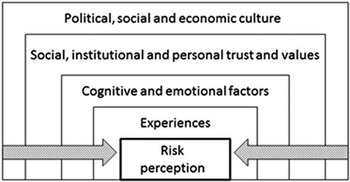
A risk perception perspective was utilized for studying how the lay rescuers experienced the OHCA incident (Figure 1). Risk perception means how humans process information about harmful events or activities and form judgments about the seriousness, likelihood, and acceptability of the respective event or activity.Reference Axelsson 6 Risk perception implies weighing opportunities and risks involved in challenges and is influenced by knowledge, values, emotions, and a sense of being judged by others.Reference Axelsson 6
Four Context Levels of Risk Perception; An Adapted, Simplified Model.Reference Axelsson 6

Methods
Setting
The Stavanger (Norway) region is populated by 330,000 inhabitants, with Stavanger University Hospital (SUH) as the only receiving hospital for OHCA victims.Reference Cone and Middleton 8 , Reference Lindner, Søreide, Nilsen, Torunn and Lossius 9 The Emergency Dispatch Center coordinates the EMS and has provided telephone-guided CPR for the past 24 years. The prehospital emergency response system has been described in detail elsewhere.Reference Cone and Middleton 8 High bystander CPR rates in the community are reported previously.Reference Cone and Middleton 8 It is assumed that the reasons for the high bystander CPR rate in the Stavanger region are related to the long-lasting, ongoing, national and local focus on CPR training for school children and lay people.Reference Cone and Middleton 8 Also, the local offshore and medical industries focus on health, safety, and the environment.
Study Design
A retrospective design was used by identifying lay rescuers from the local Utstein-style reported OHCA registry.Reference Lindner, Langørgen and Sunde 10 Inclusion criteria were bystanders over 18 years of age who had provided CPR or alerted the EMS at a witnessed or unwitnessed, non-traumatic, adult OHCA with no professional obligations in the incident. Also, they had to be residing in the Stavanger region and be able to communicate in a Scandinavian or English language.
In this qualitative study, a combined deductive and inductive research strategy to explore the psychological, social, and cultural factors that might influence lay rescuers in providing CPR in an OHCA incident was used. The deductive strategy is useful for explaining any social regularity that has been discovered, but not understood.Reference Jacobs, Nadkarni and Bahr 11 Conversely, also exploring new understandings/patterns that emerged in the data with an inductive (bottom-up) research strategy.Reference Blaikie 12
Data Collection and Sampling
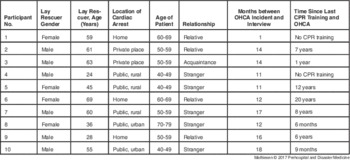
Nine family members of nine patients that underwent cardiac arrests and survived to discharge from the hospital were invited by mail, and one was approached in the intensive care unit, to participate in the study. Two OHCA were excluded due to the lay rescuers’ inability and rejection to participate. In sum, 10 lay rescuers involving eight OHCAs participated in the study (Table 1). In six of the OHCA, the invitation to the study was forwarded to lay rescuers outside the family of the cardiac arrest victim. All lay rescuers provided CPR, except for one, who only communicated with the EMS and assisted another bystander.
Characteristics of Lay Rescuers and OHCA Victims

Abbreviations: CPR, cardiopulmonary resuscitation; OHCA, out-of-hospital cardiac arrest.
The study was conducted between March 2012 and January 2013. An in-depth, open-ended, semi-structured interview guide (Supplemental Material; available online only), to be used in interviews with lay rescuers to OHCA victims, was designed and implemented. The study was approved by the Norwegian Social Science Data Services (Bergen, Norway).
The interview guide was based on the study by Axelsson et al. who stated that in order to provide CPR, a bystander needs CPR training and skills, psychological preparedness, and the personal courage to overcome fear and repugnant feelings that may be generated.Reference Ridenour and Isadore. 13 Axelsson et al. also proposed five main categories of perceptions: (1) a sense of humanity; (2) having competence; (3) to feel an obligation; (4) to have courage; and (5) to feel exposed.Reference Ridenour and Isadore. 13 These types of perceptions served as a framework for the interview guide.
Data Analysis
Qualitative content analysis was used to facilitate a deeper understanding of the OHCA experiences by the bystanders.Reference Axelsson, Herlitz and Fridlund 14 The interviews lasted between 29 and 56 minutes, were audio recorded, and then were transcribed verbatim by the interviewer (WTM). To capture the overall meaning, each interview was read through several times. The analysis process was started by coding meaning units with the aim of capturing the lay rescuers’ risk perception of the OHCA incident. Meaning units were defined as constellations of statements that related to the same central meaning.Reference Axelsson, Herlitz and Fridlund 14 , Reference Graneheim and Lundman 15 Further, the codes were sub-categorized. Based on the sub-categories with similar content, categories and one overarching theme were developed: overcoming individual and contextual barriers to provide CPR. During the analysis process, two of the authors (WTM and CB) discussed the choices until a consensus was reached. The text was organized using a computer program, Atlas.ti (6.2, free trial version; Scientific Software Development GmbH; Berlin, Germany).Reference Karlsson, Hedman and Fridlund 16
Results
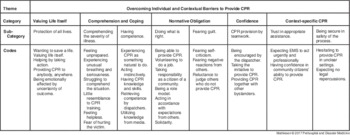
The results are presented by congregating the similarities and differences that were obtained through the interviews and exemplified in selected statements. Table 2 shows the study’s progression from a deductive to an inductive (codes, sub-categories, categories, and theme) research approach and with an overview of findings revealed during the analysis process. The overarching theme, “overcoming individual and contextual barriers to provide cardiopulmonary resuscitation,” describes the findings in this study which illuminates the complexity of CPR provision. All the participants described the OHCA incident to have influenced their lives, though some were affected more than others.
Overview of the Overarching Theme Categories, Sub-Categories, and Codes

Abbreviations: CPR, cardiopulmonary resuscitation; EMS, Emergency Medical Services; OHCA, out-of-hospital cardiac arrest.
Valuing Life Itself
All the lay rescuers considered life as invaluable, took action in accordance with what they believed to be expected by any responsible community citizen, and stated that they would provide CPR to anybody, anywhere, regardless of appearance or socioeconomic status:
Participant No. 1: “It is a human being, whether he is an alcoholic, drug-addict, or businessman. In the end, there are no differences between us. Everybody has the same right to help. What if I had greasy hair and wore trainers and fell on the street, and somebody had judged me for being someone other than I am, and passed by because I did not look as though I was worthy of help? No. That was not in my thoughts. A human being is a human being to me.”
Several lay rescuers described how they had been affected emotionally by the uncertainty of outcome of the OHCA victim:
Participant No. 7: “I was thinking and dreaming a lot about him. He was always in my head. Until the day he came with flowers and a card. Then I stopped thinking about him.”
Comprehension and Coping
Both trained and untrained rescuers stated that they intuitively provided CPR without prior reflection. Few had, however, imagined they would ever witness a cardiac arrest in real-life:
Participant No. 5: “I never imagined or thought of finding a person in cardiac arrest while I was outdoors jogging.”
Generally, the lay rescuers had comprehended the unusual breathing and abnormal skin color of the OHCA victim to represent a critical condition, but without necessarily realizing that a cardiac arrest was the cause:
Participant No. 2: “I saw he was turning bluish, and that indicated that he wasn’t getting any air. So, that was the reason for starting CPR.”
Unintentionally watching CPR being performed on television had helped one untrained lay rescuer by showing her where to put her hands and how to compress the chest. Rescuers with CPR training within the last year made independent decisions with less need for advice from the dispatchers. Several lay rescuers considered the quality of their CPR provision to be improved by the dispatcher’s instructions:
Participant No. 4: “But, as the dispatcher said to me on the phone, when you are alone, concentrate on the chest compressions, and only that. So, I did. But of course, if I had not had her on the line, I don’t know; I suppose I would have started chest compressions, anyway. But I wouldn’t have known if it was right or not. I felt I had control, because I had a competent person on the phone.”
Normative Obligation
For the lay rescuers, being a community citizen and able to help, it was self-evident to act in the OHCA incident:
Participant No. 1: “I believe we have a responsibility to our fellow human beings. I think so. We have, anyhow. So, we are a community which interacts. I believe that having a helping attitude makes us better humans.”
They all feared that doing nothing would have led to feelings of guilt for not trying to save a life. They expected others present in the OHCA incident to assist, and were disappointed if help was not offered. Still, most of the lay rescuers were reluctant to judge them by explaining that they possibly were not capable to provide CPR.
Because the lay rescuers believed there was no reason for extraordinary praise for fulfilling an obvious responsibility, they stated that any extensive attention would have been disturbing to them:
Participant No. 3: “But I didn’t want all this. Some flowers would have been fine. It was enough for me to know that he is alive today.”
Confidence
Communicating with the dispatcher was important to several of the lay rescuers in contributing to decision making, being assured by the approaching EMS-personnel, supervising CPR, and reducing the sense of solitude:
Participant No. 1: “It was certainly an enormous help to me. The calm voice that told me what to do. Of course, it was fantastic help in that situation. For one thing, you don’t feel so alone; and you have a voice that gives you instructions without increasing the intensity by even a small amount; and she hears the panic in me. Do you see? Of course she does. So, she was a fantastic help. All my respect goes to her.”
Some CPR-trained rescuers took the lead in the OHCA incident and organized others by assigning who should do what:
WTM: “You had no doubt about that your mates would help you?”Participant No. 10: “Oh no, I had no doubt about that. I wasn’t the only one there. There were three of us.”WTM: “So, you simply expected them to help in the incident?”Participant No. 10: “Yes, I did. It was not an issue. We didn’t talk about it.”
Context-Specific CPR
Assuming a high, local, public CPR awareness and knowledge, they were confident that other citizens would have the ability and willingness to provide CPR to them, if needed. In addition, they were certain that the EMS would assist them in an urgent and professional way. When the lay rescuers were asked to imagine an OHCA incident in their own neighborhood, with themselves not providing CPR, this was considered to be a strange and remote alternative. However, when questioned about providing CPR in an unfamiliar and unclear setting, the lay rescuers revealed more hesitation. If doubting whether the incident was a genuine cardiac arrest, or a situation with their own safety at stake, a clear reply was hard to give:
Participant No. 5: “The fact that it was night-time would have stayed in the back of my mind. Perhaps I wouldn’t have dared to stop, because of my own fear that somebody might not really need my help, but rather might want to attack me.”
The lay rescuers did not fear any legal consequences when providing CPR. However, one rescuer was very specific about not providing CPR in a foreign country without knowing all the possible implications, as he would not take any action that might threaten himself or the safety of his family:
Participant No. 9: “I want to help people. But I do not want to go to prison. They may even kill me later. They will simply say that I have killed him.”
Discussion
A qualitative approach was used to study how real-life lay rescuers, in a community with a high CPR rate,Reference Cone and Middleton 8 perceive risk in OHCA incidences. This could help to better understand which psychological, social, and cultural factors influence lay rescuers in providing CPR. Overall, a general willingness to provide CPR to anybody, anywhere was found. Cardiopulmonary resuscitation provision was regarded to be the expected behavior in OHCA incidents. Mutual trust between community citizens, and towards social institutions as the dispatchers, enhanced the confidence to provide CPR. This may be interpreted as a function of the general expectation of great availability to public health services in the Norwegian population. In imagined unfamiliar OHCA settings, hesitation about providing CPR because of uncertainty concerning safety was revealed.
Providing CPR to an OHCA victim demonstrates the willingness and ability to protect life. However, studies have shown great willingness to provide CPR, but with a distinct discrepancy between the willingness and the actual behavior. 17 This discrepancy may indicate that other circumstances hinder bystanders in acting according to their values and might well be associated with a feeling of risk.
Several lay rescuers in this study provided CPR, but without comprehending the cause for the life-threatening incident to be a cardiac arrest. In addition, two lay rescuers had never been trained in CPR. Thus, unlike the study by Axelsson et al,Reference Ridenour and Isadore. 13 the findings in the present study demonstrate the potential for providing CPR, even without CPR knowledge, training, and mental preparation. This study also shows that unintentional learning through television programs featuring CPR can be a way of acquiring CPR knowledge. However, the importance of CPR training for bystanders cannot be ignored.Reference Lee, Hwang, Cha, Cho, Yang and Rho 18 , Reference Strömsöe, Andersson and Ekstrom 19 Knowledge may reduce the feeling of uncertainty.Reference Axelsson 6 The telephone instructions by the dispatchers can be seen as communicating knowledge to lay rescuers and creating a possible potential for CPR provision, as well as reducing the feeling of risk.
The lay rescuers felt obliged to provide CPR and were certain of receiving help from other bystanders present during the OHCA incident. This confidence in others was interpreted as some form of mutual trust in the general population. The level of trust among Norwegian citizens is found to be high in several studies.Reference Tanigawa, Iwami, Nishiyama, Nonogi and Kawamura 20 , Reference Skirbekk 21 Mutual dependence was also reflected when the lay rescuers used phrases as “should” or “must” provide CPR when needed. This attitude was taken as a normative obligation, or a common, expected behavior. This norm may, to some extent, explain the high CPR bystander rate in the region where the study was conducted, as social interactions can heighten or attenuate perceptions of risk and influence risk behavior.Reference Axelsson 6 , Reference Fugelli and Ingstad 22 Thus, protecting life is likely to be more an expression of mutual dependence in communities rather than a particular altruistic behavior.Reference Roeser 23 , Reference Helsloot and Ruitenberg 24 Accordingly, an effective strategy for influencing people to provide CPR might be to emphasize the mutual dependency between community citizens.
Although Bohm et al. stated that there is limited evidence to support any benefit from dispatch-assisted CPR instructions,Reference Mathiesen, Bjørshol, Braut and Søreide 25 lay rescuers in this study followed and appreciated the dispatcher’s guidance. The trust and acceptance can be interpreted as obeying a command to act. Providing the recommended CPR to an OHCA victim is not necessarily a natural thing to do, as it includes both compressions of the chest and mouth-to-mouth contact with a stranger. Thus, it is understandable that some bystanders might be afraid to cause damage or contract a disease.Reference Sasson, Rogers, Dahl and Kellermann 3 Citizens in Scandinavian countries commonly exhibit a high level of trust in social institutions (ie, public offices, services, or agencies, organizations, and the political system) and in fellow community citizens,Reference Bohm, Vaillancourt, Charette, Dunford and Castren 26 and this trust also may transfer into the high CPR bystander rate.Reference Cone and Middleton 8 Conversely, distrust in local government authorities has been noted as a reason for not alerting health services in an OHCA, due to the fear of undesirable consequences.Reference Savastano and Vanni 4 , Reference Segaard and Wollebæk 27 This means that a bystander may provide CPR in one setting, but omit to do so in another. This can explain why the lay rescuers in this study initially insisted in the interviews that they would provide CPR anywhere and for anyone, but later modified their statements to include conditions for providing CPR. To understand the behavior of individuals, the cultural context, and the context within the life of a human being, is particularly important to know.Reference Sasson, Meischke and Abella 28 As people are risk-averse if the stakes for losses are high,Reference Manger, Nordahl and Hansen 29 this study shows that adequate CPR knowledge and skills are not sufficient to achieve a high degree of CPR provision,Reference Kahneman and Tversky 30 but that this probably also depends on factors like mutual trust and normative obligations.
Limitations
There are several limitations to this study. First, use of qualitative risk perception assessments in lay rescuers is a novel approach, with limited supportive research available. This could also be considered to be a strength in the present study, as a new approach may bring out new information. Secondly, all respondents in this study had taken part in successful resuscitations. This may have affected their answers. Rescuers who have taken part in unsuccessful resuscitations might have presented other risk perception perspectives. This may have biased the results. Still, based upon successful resuscitations, information at least about a minimum set of possible important barriers is gained. Further, hypothetical questions about how the lay rescuers would have handled an OHCA situation in unfamiliar settings were asked. Their answers may not reflect their actual actions in such an event. At last, findings and discussion are related to a Norwegian cultural and political context and may therefore not be applicable to other settings.
Conclusions
Mutual trust between community citizens and towards social institutions may be reasons for overcoming barriers in providing CPR by lay rescuers. A normative obligation to act, regardless of CPR training, and importantly, without facing any adverse legal reactions, also seems to be an important factor behind CPR provision. Ensuring support from the dispatchers is of vital importance in helping community citizens to overcome a natural reluctance to provide CPR. Future community campaigns directed at improving bystander CPR rates should focus on dispatcher-directed CPR, and at the same time, the obligation to help a fellow citizen.
Supplementary Material
To view supplementary material for this article, please visit https://doi.org/10.1017/S1049023X16001278