I
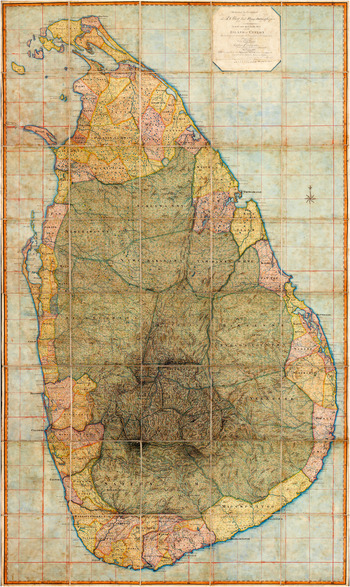
It is a July evening in the Sri Lanka of 1848, then the British crown colony of Ceylon (Figure 1). Thirty-three years have passed since Kandy, the kingdom that once ruled the island's interior, was conquered by the British. The colonists mounted an invasion from the occupied maritime provinces – ruled by the Dutch from the seventeenth century and the British from 1796 – and swiftly dethroned the king, Sri Vikrama Rajasimha. Three years later, a rebellion in Kandy's name was crushed and, in 1832, Vikrama Rajasimha died in exile.
A map of Ceylon (Sri Lanka), showing the maritime and interior (Kandyan) provinces, the latter formerly provinces of the kingdom of Kandy. The city of Kandy, where the king once resided, lies in the mountains to the south, with the seat of the colonial government, Colombo, adjacent on the western coast. Gualterus Schneider, ‘A new and correct map of the island of Ceylon, including an accurate delineation of the interior provinces’, draft, 1822. Copyright © The British Library Board, IOR/X/14000/FD10/84/SCHNEIDER.

On this particular evening in 1848, a seventy-year-old Buddhist priest named Ambalambe Unnanse is bathing in a pool outside the cave temple of Dambulla, an ancient spiritual site set high up on a mountain rock overlooking miles of dense jungle. Behind him, illuminating the caves, are many intricate paintings illustrating the life of Buddha. Beneath them are hundreds of carefully sculpted statues of Buddha, Kandy's former kings, and the Hindu gods Vishnu and Ganesh.Footnote 1
According to the testimony he later relayed to the acting queen's advocate, transcribed in a dispatch to the Colonial Office in London, Ambalambe heard a shout as he finished his bath. He made his way to the courtyard to investigate the noise and was approached by two men. They announced the arrival of ‘the king and a great number of people’ and demanded that Ambalambe hand them the keys to the temple. He did so and the temple entrance was soon flanked by guards. Ambalambe estimated that between 700 and 800 people gathered in the courtyard.
Some time later, Ambalambe entered the temple building and saw a short, stout man sitting atop a pillow, at the site where offerings were made. The man, who appeared to be in his late thirties, was good looking, with a pale face decorated by long whiskers and a curled moustache. On his head was a striped yellow silk turban and he wore a gold and white cloth jacket that extended down to his waist. A single ring adorned his right forefinger. He inquired as to Ambalambe's movements, before asking him whether he was ‘attached’ to ‘the religion of Boodhoo [sic]’ or ‘the Government’. When Ambalambe replied that he was attached to both, the man grew angry. ‘Which sword do you think is the sharper’, he asked, ‘the English or the Singhalese [sic]?’Footnote 2
Ambalambe left soon afterwards. While he was away, the man made an offering to Buddha and a declaration before Vishnu, in which he swore that he was the grandson of King Kannaswami. His behaviour indicated that he was reclaiming the crown of Kandy. His appearance at Dambulla highlighted the critical relationship between the sangha, or congregation of Buddhist monks, and the court – the king was patron of the sangha, while the sangha legitimized the king – which forged the style of politics and power in Kandy.Footnote 3 The man's call to the signifiers of Buddhism and Hinduism, meanwhile, followed the example of the kingdom's last ruling lineage, the Nayakkars, who embraced the practices of Buddhism despite their Hindu ancestry. Kannaswami was the birthname of Vikrama Rajasimha, the final Nayakkar king. The man himself is known to posterity as a pretender named Gongalegoda Banda, an iconic figure in present-day Sri Lanka.Footnote 4
When Ambalambe returned, Banda took a palm leaf from his waist and placed it on a chair opposite an image of Vishnu. He left it there for a moment before picking it up and reading it aloud. Written on the leaf was Banda's official name, ‘Sreewickkereme Taraawe Siddihi [Sri Vikrama Tarawa Siddhi]’, and a request that the priests of Dambulla conduct a ritual investing him as king of Kandy. One witness described how the priests ‘pronounced the hymns of victory and blessings over a vase full of water’, and anointed Banda, after which the crowd prostrated themselves in front of him and declared that they were opposed to British government. Banda and his followers took a palanquin and left in the early hours of the morning.Footnote 5
This story recounts one of many episodes that transpired between 1820 and 1850 in Sri Lanka, in which religious ceremonies, legal concepts, and regal traditions formerly linked with Kandy's king and his court were reappropriated by islanders as a form of resistance.Footnote 6 These episodes were recorded in colonial dispatches sent to London. They were used to construct a narrative of Sri Lanka as an island home to an indiscriminately rebellious people with a subversive national culture, namely the Kandyans. An 1849 parliamentary report noted that the ‘rapid succession…identity of action and system’ in all of the episodes indicated that they were ‘periodical manifestations of one abiding and continuous feeling in the minds of the Kandyan people – impatience of British supremacy – and a determination to restore a native Kandyan sovereignty’.Footnote 7 Unpicking Ambalambe's story, however, reveals that repurposing kingliness was a more considered process than this narrative implies. Banda strove to represent himself as a legitimate Kandyan king, travelling to Dambulla to be anointed and adhering to Buddhist rituals, at a time when the British were reducing the status of Buddhism in Sri Lanka.Footnote 8
Through analysis of dispatches sent to London, this article reinterprets these episodes as distinct and creative instances of resistance that expressed legitimate and alternative futures for Sri Lanka when the state threatened ways of living. It will show how islanders deployed networks, practices, and ideas from across the Indian Ocean and appealed to historical, colonial, and global contexts in the articulation of these futures. Critically, it will describe how islanders used transoceanic and imperial networks of religion and transportation for the purposes of resistance.Footnote 9 At the same time, this article will suggest that the colonial characterization of islanders as indiscriminately rebellious has obscured our understanding of the relationship between resistance and the state. Although reappropriations largely failed, British misunderstandings of resistance gradually destabilized autocracy, the mode of colonial governance in Sri Lanka. Together, these points emphasize the dynamism of the colonized and forms of resistance and locate aspects of imperial change within the extra-imperial world.
This article begins by exploring the historiographical and contextual background, before bringing together three episodes from 1820, 1834, and 1848. It describes how different ceremonies and concepts were taken up according to the threats to which islanders were responding and examines their influence over British governance.
II
The reappropriation of kingly ceremonies and concepts was primarily undertaken by small groups or individuals from different backgrounds.Footnote 10 While many of these people had no formal connection to the kingdom of Kandy, repurposing kingship drew on a longer history of crown pretenders in courtly politics that dated back to at least the early seventeenth century. Historically, kings of Kandy had numerous progeny and identifying the legitimate heir to the throne was not always straightforward even before the kingdom's fall. On occasion, chiefs and monks backed alternative rulers, legitimizing them through religious ceremonies and customary appeals. Islanders would therefore have understood the process of reappropriation as a meaningful way of challenging ruling authorities.Footnote 11
Thus, in 1820, a village of veddas (a people seen as aboriginal in present-day Sri Lanka) contested the seizing of their cattle by crowning a king. Several months later, a chief adopted similar tactics, assuming the title of first adigar (chief minister) under the auspices of a former pretender. In March 1823, a Kandyan headman assumed royal honours during a quarrel with a tithe collector. In 1834, chiefs incensed by the abolition of rajakariya (the Kandyan system of forced labour) plotted to restore the monarchy. In May 1842, a man near Kandy declared himself king, likely in response to European encroachments onto islanders’ lands. Another claimant appeared in 1843, while the final episode was that described by Ambalambe in 1848.Footnote 12
Deploying Kandyan regality was not the only way of opposing the colonial state. At least one of the examples described above, that of 1848, was tied to rebellion.Footnote 13 For the purposes of this analysis, reappropriation should not be understood as a synonym for rebellion. While there was an overlap between the two practices, in that they sometimes appeared together, the former refers to an act of repurposing and recreation, while the latter explicitly denotes violent resistance against the state. In fact, rebellion often emerged because reproductions of kingliness created a banner through which different groups came together to articulate their grievances. As K. M. de Silva has noted, the rebellion of 1848 incorporated a variety of variously disaffected islanders from across Kandyan society.Footnote 14 This distinction was not contemporaneous. While the colonists nominally distinguished between different forms of resistance, there was little consistency in the terminology that they used and they often generalized between events. The parliamentary report referenced above, for instance, opined that, since 1815, there had been ‘six treasonable movements…open rebellion thrice (in 1817, 1823, and 1848); and three conspiracies detected before their explosion in 1820, 1834, 1843; besides treasonable plots which gave rise to arrests in 1816, 1819, 1820, 1830, and 1842’.Footnote 15 As a result, various insights have been overlooked. Distinctions must be made and reappropriations brought to the fore.
Critically, reappropriations were linked to the events of the early nineteenth century, setting them apart from earlier instances of pretendership. When the British invaded Kandy in 1815, they targeted the king and his court for destruction, leaving the kingdom's provinces and administrative structures intact. Signing an agreement known as the Kandyan Convention, they promised to protect the status of chiefs and safeguard Buddhism.Footnote 16 This was a calculated move – by retaining particular traditions, the British believed that they could harness popular support – but it had unintended consequences. Historically, Kandy was a galactic polity: a symbolic centre with a divine king based in the city of Kandy, surrounded by twelve largely autonomous provinces arranged according to cosmological principles.Footnote 17 Each province was separately administered by a disava (governor), as well as a variety of other chiefs, priests, and assemblies that differed between regions, yet each engaged in a tributary relationship with the kingdom's centre.Footnote 18 As such, eliminating only the court removed the nucleus from the cell but allowed the cell to live on. Anyone, particularly if they still held an influential position, could recreate the court and lay claim to the symbolic authority the centre had once held over the extant provinces. Even after the British dismantled the Kandyan provinces in the 1830s, the structures and agreements outlined in the Convention remained a point of reference. Consequently, when the colonial state threatened ways of living, reproducing Kandy's centre provided an effective means of articulating an alternative future, in which Lanka was ruled by a legitimate king.
Kandy's fall in 1815 was followed by a rebellion in 1817, during which rebels utilized kingly ceremonies, concepts, and traditions for this purpose. The rebellion was a seismic event that shook the foundations of British Ceylon.Footnote 19 Beginning mid-year, it tore through the Kandyan provinces under the leadership of a chief, Keppetipola, and a pretender king, Wilbawe. Wilbawe claimed to be descended from the Nayakkars, wrapped his communications in white silk (a regal colour), and adopted the titles of a Kandyan king. The tide only turned in 1818, when British military superiority came to bear and Wilbawe was uncovered as an imposter. The rebellion then rapidly collapsed. The defeat coincided with a strengthening of British power over the island's interior, while accounts of the rebellion influenced British depictions of Kandy as a violent backwater.Footnote 20 Even so, the rebellion set the scene for future reclamations to take place. Wilbawe's use of kingly regalia was integral to his gaining widespread authority and his later exposure as a pretender was fatal to the rebellion, signifying the centrality of authentic kingship to any resistance effort.Footnote 21
The proximity of 1817 to the conquest of Kandy, the involvement of numerous prominent chiefs and the scale of resistance necessitates that the rebellion is considered apart from later events. Yet a corollary of 1817's contemporary and historical significance is that subsequent resistance efforts, with the occasional exception of 1848, have been viewed as derivative, simplistic, and, through an appropriation of the colonial gaze, conceptualized as part of a long-running strand of indiscriminate, violent opposition to the state.Footnote 22 Historians have spoken of a Kandyan ‘tradition of resistance’ to foreign rule as connected to ‘the emergence of modern nationalism in Ceylon’. K. M. de Silva described the ‘national consciousness of the Kandyans’ as ‘the most formidable political problem that confronted the British in Ceylon’.Footnote 23 Kumari Jayawardena has noted the ‘continuous underlying hostility among the people to the policies of the foreign rulers’, and diagnosed, in the words of the Marxist scholar Antonio Gramsci, a case of ‘perpetual ferment’.Footnote 24 The economic suppression of the Kandyan provinces, she argues, inaugurated a period of tension in peasant society, which encouraged an intolerance of foreign rule, as well as social banditry and rebellion. This reasoning elevates the colonial state into a position of dominance, in which it is the arbiter of change, while the masses, to borrow Gramsci's words once more, ‘are incapable of giving a centralized expression to their aspirations and needs’.Footnote 25
Characterizing the colonial state as dominant and the ‘masses’ as unsophisticated speaks to a narrative that sees the British government emerge as hegemon after 1817 and denies resistance any impact.Footnote 26 This bears comparison to the imagining, in Indian historiography, of the colonial state as a monolithic and bureaucratic machine that was enterprising in its all-knowing despotism.Footnote 27 Like its counterpart in India, the Sri Lankan narrative of colonial dominance is not fully accepted.Footnote 28 The economy, for instance, was a source of contestation. Islanders fought European enclosure and challenged economic injustices.Footnote 29 Much to the chagrin of European planters, islanders allowed their cattle to trespass over plantations.Footnote 30 Colonial capital became a frequent target of criminal activity, which undermined confidence in and siphoned large sums of cash out of the economy.Footnote 31
The first half of the nineteenth century was, indeed, a period of sustained contestation and change, where multiple cultures and concepts clashed, connected, and were reshaped anew. These years were marked by the effects of ‘converging revolutions’ which fundamentally remodelled societies from Asia to the Americas, as empires old and new collapsed, mutated, and arose.Footnote 32 Consequently, conceptualizing resistance as an expression of nationalism is also problematic. Michael Roberts and Sujit Sivasundaram have argued that, insofar as there were concepts of the Kandyan ‘nation’ being articulated through this period, they were associational. Palm-leaf texts reflected compound ideologies in which the British were portrayed as kings in the Kandyan fashion, while other islanders, from the maritime provinces, adopted the trappings of ‘Sinhalaness’.Footnote 33 The inconsistency of any ‘national’ thought is compounded by the participation of veddas and islanders from the maritime provinces in resistance.Footnote 34
Reinterpreting reappropriations as distinct and creative instances of opposition introduces this globalizing logic into the study of resistance in nineteenth-century Sri Lanka. By moving beyond dislocating narratives of nationalism, and by shifting the analysis away from a focus on the destructive power of resistance, one can appreciate the intricacy with which reproductions of kingship were put together, as well as the ways in which islanders interwove their reproductions with transregional networks, practices, and ideas. It was through this engagement with transregionality that islanders channelled many of the changes and contests of the nineteenth-century world. They appealed to the wider Buddhist ecumene for support, while also manipulating prisoner networks in an attempt to communicate with the French, who, it was proposed, might be awarded ownership of the island in return for an alliance in the wars to come.Footnote 35 This indicates that islanders were not partaking in nationalist movements but were, in fact, looking outwards when recreating regality.
Sri Lanka's place in the wider world has already gathered some attention, enabling the reinterpretation of the first half of the nineteenth century as a key period in the island's history. These years bore witness to the rise of British rule and Sri Lanka's ‘islanding’ at the hands of the colonists through the recycling of Kandyan traditions.Footnote 36 The period, however, is often considered in a longer-term context that spans centuries – a longue durée – and ends with the formation of present-day Sri Lanka. Although a longer-term perspective is informative, it sometimes results in details being overlooked. Besides 1848, the instances of resistance described in this study rarely attract much attention due to their small size, obscuring any insights they may offer.Footnote 37 This article adopts a narrow temporal focus and a wider geographical outlook in order to expand upon the complexities and globalisms of these events and understand their intersection with a critical point in Sri Lanka's history.
Throughout this article, therefore, Kandy is understood as a kingdom that had once had strong transregional connections, of which islanders were aware. It connected with the Buddhist ecumene across south-east Asia through the training of monks. During the reign of Kirti Sri Rajasimha, delegations of Siamese monks travelled to Sri Lanka to conduct ordination rituals and instruct their Kandyan counterparts. Some of these movements were connected to resistance, as in 1760, when several Kandyan monks conspired with a Siamese prince to overthrow Kirti Sri. At the same time, the syncretism of Hinduism and Buddhism in the line of Nayakkar kings built spiritual and diplomatic ties between the kingdom and south India, while Kandyan ambassadors travelled aboard Dutch ships to Siam via Malacca, Sumatra, and Aceh.Footnote 38 Within this context, islanders’ transregionalism when reproducing kingship may be understood as an acknowledgement of the former kingdom's far-reaching stature, drawing also on the role played by other regional powers in supporting earlier pretenders. References to Kandy – and, by association, Buddhism and Hinduism – should be seen as necessarily outward-looking, either consciously or sub-consciously seeking to re-establish the global influence that Kandy once wielded.
By highlighting islanders’ reworkings of a variety of networks, practices, and ideas in this way, this article argues for an appreciation of the ingenuity of the colonized in the face of encroaching empire. Although different peoples across the world are often described as having joined together particular ideas and ideologies during this period, the examples documented here further complicate the picture by demonstrating how Lankans traversed numerous contexts at once.Footnote 39 This is especially revealing, in that it shows the limited success of British efforts to define Lanka as an isolated island space.Footnote 40
Concurrently illuminating the relationship between resistance of this sort and the decline of autocracy, this article also seeks to further our understanding of the British empire. Recently, historians have begun to assess the global aftermaths of resistance, noting that the repurcussions of the Indian Rebellion of 1857 were felt across the empire.Footnote 41 The events described here reveal a different narrative within the Sri Lankan context. While the worldwide reverberations of resistance from Sri Lanka were seemingly minor, these events channelled global influences into local contexts, proving influential over British rule on the island and with implications for the empire as a whole.
C. A. Bayly has touched upon the relationship between resistance and autocracy. Bayly describes the years between the second half of the eighteenth century and the first half of the nineteenth as the ‘imperial meridian’, that is, a phase encompassing the rise, apogee, and decline of the Second British Empire. The Second Empire was home to the proponents of many conflicting ideas, interweaving anti-slavery with territorial expansion through the establishment of autocratic colonial states. It crumbled towards the end of this period, as it was subjected to financial difficulties and a wave of liberal reform that curtailed governors’ untrammelled powers.Footnote 42 Bayly acknowledges that local pressures, like rebellion, played an important role in this decline, but he does not always offer siginificant details.Footnote 43 By exploring the link between kingly reappropriations and the end of autocracy, this article will expand upon the aspects of the Second Empire's fall at which Bayly hints.
It builds on another of Bayly's works to make this connection. In Empire and information (1996), Bayly argues that the colonial authorities in India, driven by an obsession with intelligence-gathering, misread the information they collected and failed to anticipate the rebellion of 1857.Footnote 44 In Sri Lanka, as in India, the government relied on local knowledge to administer, expand, and subjugate, employing spies, informants, and go-betweens to gather information.Footnote 45 This information would be channelled through a figure like John D'Oyly – spymaster, scholar, polyglot, and Resident of Kandy – or the acting queen's advocate.Footnote 46 It would be used to justify an arrest or the monitoring of an individual and to build evidence for their trial and punishment.Footnote 47 Misreadings of this information reinforced prejudices fostered in the aftermath of 1817, which cast certain islanders as inherently violent and rebellious. In turn, these prejudices influenced colonial governance, with consequences for autocracy. Believing that subversive activity was ingrained across the island's interior, governors and their officials acted increasingly irrationally, threatening colonial control and subjecting the government to a chorus of criticism that interwove with the ascent of liberalism. Fundamentally, the state's later failures were linked to earlier information-gathering efforts conducted during episodes of reappropriation. Of these earlier efforts, the colonial response to the events of 1820 provides the first glimpse.
III
The 1820s were a repressive decade in Sri Lanka, characterized by Governor Edward Barnes's use of forced labour to construct roads and bridges into the island's interior.Footnote 48 While the Kandyan provinces and their administrative structures still remained, the British were making moves to supersede Kandyan practices with their own. In the aftermath of the rebellion of 1817, British officials were given greater powers over the island's judicature and the influence of the chiefs was reduced.Footnote 49
Between 1819 and 1820, an islander, Kumaraswami, together with some veddas, took up legal concepts and recreated regal traditions in the eastern Kandyan province of Bintenna. Kumaraswami was frustrated by the colonial legal system which, through a mixture of inaccessibility and hostility, denied his royal blood. Although Kumaraswami's claim seemingly set him up against the colonial state, he argued that he had no intention of overthrowing the government, for he only desired kingship over Bintenna. The veddas were upset by the incursions of the local disava of Bintenna into their lands, alleging that he had stolen their property and cattle. Kumaraswami and the veddas situated their activities within a global context that appealed to both Buddhist and colonial sensibilities.Footnote 50
Perhaps Kumaraswami was sensitive to these sensibilities. Born in Kandy as a descendant of the former king, Rajadi Rajasimha, his life had been marked by encounters with the colonists. His uncle was beheaded for siding with the British during their invasion of Kandy in 1803. Following the outbreak of rebellion in 1817, Kumaraswami, now a travelling priest, was arrested and detained. Found on his person were numerous papers gathered from officials stationed along the coast, granting him permission to pass through their districts.Footnote 51 While it has been alleged that Kumaraswami was being prepared as an alternative pretender – he was in communication with the rebels at the time of his arrest – he seems to have perceived that his future lay with the British.Footnote 52 After leaving prison in 1819, Kumaraswami attempted to appear before the British Resident of Kandy, John D'Oyly, presumably to clear his name. D'Oyly, however, proved inaccessible, as he moved between provinces.Footnote 53
Shortly afterwards, Kumaraswami happened upon the village of Maraka, where he joined with the veddas. He was inaugurated as king in a ritual that saw 1,000 veddas prostrating themselves in front of him and ended after he was conducted across the Mahaweli River to a palace. Kumaraswami then appointed several chiefs, ordering that the local disava be informed of his intention to request kingship over Bintenna from the British. If the British agreed, Kumaraswami could settle the veddas’ dispute, while receiving the recognition he craved. The British did not agree and Kumaraswami was arrested.Footnote 54
These reappropriations were a creative endeavour that drew on aspects of the Kandyan legal system and bolstered the legitimacy of Kumaraswami's kingship, in order to reject colonial law and challenge the seizure of the veddas’ property. One of the king's functions in Kandy was to act as the highest court in the land, with his judicial authority derived from his divinity.Footnote 55 The prostration of the veddas mirrored a Kandyan ritual through which islanders would launch legal appeals to the king. The construction of Kumaraswami's palace proximal to the Mahaweli River and his movement over the water evoked Kumaraswami's godliness by invoking the palace and Great Lake in Kandy. The Lake symbolized cosmic waters and highlighted the king's position as the divine centre of the galactic polity.Footnote 56
Concurrently, Kumaraswami reinforced his legitimacy through Buddhism. He expressed a desire to capture the Tooth Relic, an artefact housed in Kandy and described as the tooth of Buddha, the possession of which was believed to be essential to a legitimate claim to rule Lanka.Footnote 57 A message delivered to the disava of Bintenna also referred to Kumaraswami's reception of the ‘Gold Sword of Victory’ under the Bodhi tree in the holy city of Anuradhapura.Footnote 58 These references to sites and artefacts of a wider importance picked up on Buddhism's transregional history to award Kumaraswami a globalizing authority. His appeal to the British, perhaps concocted on the day of his arrest, was likely a more cynical move designed to draw the support of the government. Nonetheless, it indicated that Kumaraswami engaged with Sri Lanka's changing global situation.
While Kumaraswami and the veddas failed in their objectives, their efforts had a lasting impact on the state by influencing the characterization of islanders through colonial information gathering. In January 1820, Governor Brownrigg wrote to Earl Bathurst, the colonial secretary, with an assessment of events, based on information gleaned from Kumaraswami and others. Following his arrest, Kumaraswami had surrendered the details of his reasoning and behaviour. Brownrigg misread these details as indicative of certain islanders’ inherent violence and selectively deployed facts that reinforced his conclusions. Here was a ‘fresh disturbance’, he noted, concocted ‘among the Vedahs [sic]’, who were a ‘savage race’.Footnote 59 Kumaraswami was portrayed exclusively as a man giving ‘himself out to be the rightful King of Kandy’, while his efforts to engage with the state were not noted.Footnote 60 It was observed that the veddas and their Kandyan leader had ‘committed some acts of violence on more civilized and peaceable inhabitants’, but there was no suggestion that they had been wronged in any way.Footnote 61 These characterizations justified Brownrigg's contrasting treatment of Kumaraswami and the disava of Bintenna, who had orchestrated the arrest. Kumaraswami was to be tried by martial law. The disava was richly rewarded, with ‘a Present of Five Hundred Porto Novo Pagodas, a house with furniture, and a splendid dress’.Footnote 62 Although Brownrigg expressed his satisfaction with this outcome, the characterizations of islanders that were developed here would later return to haunt the government.
IV
A haunting occurred in 1835. Over the preceding two years, a group of dissenting disavas, aided by some priests, planned to take up regal concepts and traditions as a way of resisting British reforms. Like Kumaraswami, they contextualized their activities globally, appealing to the Buddhist world and manipulating colonial networks as a means of establishing transimperial dialogues with allies. While the disavas eventually drew the government's attention and were arrested, the ultimate outcome reflected the increasing fragility of British autocracy.
This episode occurred amidst debate over the future of the colonial state in Sri Lanka. In 1833, the Colebrooke–Cameron Commission, part of the Commission of Eastern Inquiry, made recommendations for the modernization of the government and economy. Although the Commission clashed with the more conservative members of the colony's administration, several important changes were introduced.Footnote 63 Rajakariya was abolished and the boundaries of the island's administrative regions were redrawn, eliminating the distinction between the Kandyan and maritime provinces. The commissioners also emphasized the power of juries to regulate islanders’ behaviour.Footnote 64 The disavas believed that many of these reforms were pernicious, with the abolition of rajakariya a particular bugbear. They also believed that their powers were being degraded and that Buddhism would be ‘annihilated’.Footnote 65
The disavas argued that the most effective means of resisting the reforms was to bring ‘unanimity’ to the fractured Kandyan provinces. ‘There was no arresting these innovations from the want of union’, one observed, at a meeting in 1834. ‘What is there we could not do, if we could but bring about unanimity?’Footnote 66 They had many ideas as to how to bring about ‘unanimity’ – proposing marriages amongst prominent families and a petition to the British king, William IV – but amongst the most significant was a plan to crown a king. One disava suggested ‘the Grandson of King Kirtisingha [sic], whose family he said were known to be at Madura’.Footnote 67 He was later rejected in 1834, in favour of a king whom the first adigar had at hand. The disavas consented to this at once, as, ‘if the Adigar selected a king, it would have a greater effect in the country’.Footnote 68
The search for ‘unanimity’ was influenced by the disavas’ use of imperial networks. In January 1832, the British established the Colombo Journal, with the intention of controlling the flow of information across the island.Footnote 69 Reading the journal, the disavas became aware of the Bengali reformer Rammohan Roy's visit to England, to campaign for the recognition of Indian rights and customs.Footnote 70 They pondered raising a national subscription to do the same and believed that it would almost certainly enable their grievances to be redressed.Footnote 71 They applied to the disava of Saffragam on the subject but ultimately dropped the idea.Footnote 72 At about the same time, they received new information from Mauritius, most likely through a prisoner network established by the government, that encouraged them to take a different path.
Following the rebellion of 1817, the government exiled prominent Kandyans to the crown colony of Mauritius. The first twenty-five departed Sri Lanka in February 1819 aboard the HMS Liverpool. Exile became a popular form of punishment. In 1823, Governor James Campbell discouraged the death sentence in the case of thirteen Kandyans implicated in resistance, in favour of their transportation.Footnote 73 When these exiles returned from Mauritius, they brought back experiences that they shared with the disavas. One former exile named Weyadapola, who also acted as an informant for the government, recounted the numerous conversations that he had with the disavas and also hinted that information from Sri Lanka travelled back to Mauritius. He had learnt of certain plans to turn Malay soldiers against the government, he implied, while still in exile.Footnote 74 It was likely from these former exiles that the disavas learnt that slave owners in Mauritius had joined together to resist the abolition of slavery there. This news was essential in encouraging their search for unanimity. ‘The same ought to be done here’, one observed, ‘but as there is not unanimity among us, it would fail.’Footnote 75
Like Kumaraswami, the disavas also sought to capture Buddha's tooth in Kandy. A facsimile of the relic ‘was to be prepared in ivory’ and George Turnour, a civil servant, ‘was to be told by the Priests that they were desirous of having an exhibition of the Relic, as they were not certain that it had not by supernatural means disappeared’. The curtain of the altar would then be set on fire and ‘the facsimile substituted for the real relic’.Footnote 76
Through the simultaneous manipulation of imperial networks and appeals to the Buddhist ecumene, the disavas opened up multiple contexts in which to situate their resistance, enlisting the French and the Burmese as potential allies. Looking towards Burma, where British and Burmese relations were tense in the aftermath of the First Anglo-Burmese War, they proposed using the re-establishment of the Buddhist upasampada ritual (an ordination ceremony) as cover to dispatch messengers to the city of Amarapura, ‘to ascertain whether either the King of that Country would not invade this country himself, and if he could not, whether he would not form a treaty for the purpose with the French’.Footnote 77 Turning back towards Mauritius, a former French colony, the disavas proposed gathering ‘a contribution of money’ and sending ‘an intelligent person to ascertain if we could not get the French to cooperate with us’. This plan would be realized through a man named Ihagama Nilame, who had ‘lately returned from the Isle of France [Mauritius], who spoke French well and was an intelligent man’. Nilame would be sent to a French colony ‘as if on a trading speculation, with ivory manufactured and other articles, and getting up a subscription to pay his expenses’.Footnote 78 Another disava suggested employing Pilima Taluawa, who was ‘intimate with the French authorities, and…had even married a French lady and consequently must have relations amongst those people’, to take a letter to the French, surrendering the island to them on certain terms and pledging to pay tribute if the British were removed.Footnote 79
Facilitated on the one hand by faulty information gathering and by prejudice on the other, colonial officials misread the complexities of this episode as indicative of islanders’ rebelliousness and dishonesty. Soon after the reception of the first rumours of dissent in March 1834, they began to collect information about the disavas and their priestly accomplices. While the information they gathered included reports which documented the plans described above, it was also comprised of observations which demonized islanders and cast the dissenters’ plans as the result of an enduring animosity towards the British. One account noted that officials should not ‘imagine that the Priests are faithful to the government’.Footnote 80 Another described the propensity of the disavas to spread malicious rumours about the government's land tax.Footnote 81 The colonists were dismissive of the idea that fact might be separated from fiction in these reports. ‘The population have unfortunately so little regard for truth or consistency’, wrote one official, later in the year.Footnote 82 Within four months, government paranoia had grown to fever pitch and, on the night of 15 July, Governor Robert Wilmot-Horton issued arrest warrants for the disavas ‘founded upon Evidence which has been received of their having been guilty of treasonable projects and practices, having for their object the subversion of British rule’.Footnote 83 Wilmot-Horton's presumption of guilt, even before the trial, indicated that the colonial government had stacked the odds against the dissenters through the information they had gathered. Indeed, the documents on the episode that predate the trial's beginning on 12 January 1835 span nearly 500 pages in the Colonial Office file.Footnote 84
This dogged misreading proved to be the government's undoing. The prosecution's case, in presenting much of the information gathered over the preceding year, necessarily included brazen statements that privileged rumours as valid forms of evidence. One witness, a Kandyan priest, stated to the court that there ‘was not a chief or a headman entitled to wear a cap who does not speak with dissatisfaction of Government and the late changes’.Footnote 85 The king's advocate pressed the point further, describing the evidence as ‘pregnant with matter’ and warning the jury that the ‘poison’ may have spread further had the state not intervened.Footnote 86 Here was the blossoming of ideas fermented amidst the chaos of 1817 and 1820. The defence seized on the way that the case was presented to disregard some of the prosecution's more salient observations. The evidence, they argued, was no more than ‘a conversation with others’ and was not, therefore, admissable, as ‘words [do] not constitute treason’. The jury – which was mixed, with six Europeans and seven ‘natives’ – agreed. Knowledge, when misrepresented, did not equal power, and the defendants were acquitted. The governor found his de facto jurisdiction circumscribed by the judicature. The years of untrammelled autocracy were over.Footnote 87
V
Despite growing criticism, elements of autocracy endured until the mid-century, perpetuated by governors like Viscount Torrington. Torrington imposed a series of contentious taxes and repressed a rebellion in an overtly militaristic fashion.Footnote 88 The rebellion was that of 1848, the year in which Ambalambe recited his story to the acting queen's advocate in Kandy. Sri Lanka's rebellion had two main loci: the capital, Colombo, where anti-government sentiment was excited by the machinations of a ‘violent tempered’ newspaper editor, Christopher Elliott, and the former Kandyan provinces, where Gongalegoda Banda was crowned king.Footnote 89 The colonial government documented different causes of unrest, from religious grievances and objections to new taxes, to a fear that Queen Victoria intended to destroy Kandy's temples.Footnote 90
As described above, Banda recreated ceremonies that established him as a legitimate Kandyan king, as a way of resisting British efforts to reduce the status of Buddhism. In 1844, the colonial government reneged on the Kandyan Convention and disassociated itself with its former commitment to safeguard Buddhism. The decision, which occurred against the backdrop of an increasing missionary presence in Sri Lanka, was reaffirmed by Earl Grey, the colonial secretary, in 1847.Footnote 91 British informants indicated that the move generated resentment throughout the island's interior. ‘The Kandyan subjects are highly aggrieved and annoyed since the British Governors ceased the interferences and protection to uphold their Religion as was proclaimed by the convention of 1815’, wrote ‘A Native’ in July 1848.Footnote 92 While it would be ahistorical to homogenize islanders, at least Banda himself seems to have been motivated by these beliefs, for he made clear the distinction between ‘the Government’ and ‘the religion of Boodhoo [sic]’.Footnote 93 By crowning a king and performing kingly ceremonies, Banda and his followers were able to create an alternative authority that would keep safe the Buddhist religion.
Banda's kingship was proclaimed at Matale, a town close to the city of Kandy and some thirty miles south of Dambulla.Footnote 94 He then marched north to Dambulla for his accession ritual, mapping out, in miniature, a kingdom that circumvented Kandy itself.Footnote 95 These movements announced Banda as a legitimate ruler. North was the direction in which a king marched at the start of his reign, in a ritual which honoured the gods of the Hindu pantheon. On the day of Kirti Sri Rajasimha's consecration in 1751, the new king moved north from his palace in Kandy to the temple of Vishnu.Footnote 96 In Banda's case, Matale seems to have acted as a stand-in for the palace in Kandy, while Dambulla provided a substitute for the temple of Vishnu. Orders distributed by Banda referred to the ‘Palace at the Fort of Matele where His Highness resides’, while an account of Banda's accession emphasized the centrality of ‘the Image of the Maha Vishnu’ inside the temple.Footnote 97
Similar stylings were apparent in Banda's accession ritual at Dambulla. The ceremony satisfied the requirements for kingship stated in the preface to the Mahavamsa, the Buddhist chronicle of the Kandyan kings, including the need for a king to obtain water from the Ganges River and prove his ksatriya blood.Footnote 98 The water with which Banda was anointed symbolized the holy waters of the Ganges; typically, the latter could be represented by water from the Mahaweli River or the holy city of Anuradhapura and so water sanctified by the priests of Dambulla would likely have had a similar effect. Banda's claim to be a descendant of Vikrama Rajasimha satisfied the need for ksatriya blood, ksatriya being a broad caste of Hinduism typically dedicated to kings, governors, and warriors. This was reinforced by Banda's posturing over the writing of his name on a palm leaf manuscript, mirroring a ceremony from Kirti Sri's accession when that king's name was written on a gold leaf and pronounced for all around to hear.Footnote 99 These activities reassociated Buddhism with the highest forms of leadership; a sharp riposte to the colonists’ betrayal of the religion.
Failing to learn the lessons of 1834 – indeed, by stubbornly deploying the misunderstandings of that unfortunate episode – Torrington's administration made a serious political miscalculation in the way that it responded to this resistance. Across Sri Lanka, martial law was imposed and, in the interior, the rebels were brutally crushed with troops imported from India. The ringleaders, including priests, were executed by firing squad.Footnote 100 The outcry in the House of Commons and amongst the public in Britain and Sri Lanka was enormous. ‘What did the most mischief’, Earl Grey informed Torrington, ‘was the very impudent statement…that a Priest had been shot in full robes…the light manner in wh[ich] you speak of it, has been most injurious to you in public estimation here.’Footnote 101 The affair caught the imagination of the London press, with the Illustrated London News printing a special supplement on the rebellion in August 1850.Footnote 102 Torrington was recalled to London, an inquiry established into the rebellion and a motion of censure against the Ceylon colonial government introduced in the House of Commons in May 1851. Although it failed by 80 votes, 282 against 202, any remaining hint of autocracy in Sri Lanka was eliminated and the death-knell sounded for the Second British Empire.Footnote 103 Torrington's successor, George William Anderson, ran an administration that carefully balanced the needs of various elements of society, making overtures to Buddhism and behaving in a financially cautious fashion.Footnote 104
At odds with this controversy, Torrington wholeheartedly believed in his actions. He embraced the idea the Kandyans were perpetually conspiring against the British government. Consequently, militaristic measures appeared to him entirely appropriate, even unremarkable. It would ‘be some time before it would be wise or prudent to reduce our force in the Kandyan country’, he told Grey, for ‘we can place no reliance [on the Kandyans], their treachery to us is [of] the deepest dye’. It was ‘impossible to overestimate the value’ of martial law. Although the newspaper editor, Christopher Elliott, was partly to blame for the disturbances, he, as well as the government, was ‘ignorant of the deep and long considered plot of the Kandians to overturn the government’. A misreading of Banda's activities informed his perspective and he identified the religious aspect of the resistance as ‘an evil’ that dated back to the first violations of the Kandyan Convention before 1817.Footnote 105
Torrington's interpretation of the disturbances drew on prejudices fostered in 1834 and 1835. During the parliamentary inquiry into his government, the Colonial Office put together several reports on rebellion in Ceylon, which, citing a variety of dispatches, made this link explicit. Torrington vouched for the reports’ ‘great correctness as to truth’, although he observed that they were ‘not dressed up enough for Parliament’.Footnote 106 One report drew detailed comparisons between resistance in 1848 and 1834, using the same information that had failed to convince the jury in the 1835 trial to justify the contemporary government's behaviour. ‘The rebellion of 1848’, it argued,
Corresponds with the prior demonstration in 1834, when it was expressly urged, as one of the grounds of disaffection and incitements to revolt, that the nationality of the Kandyans had been invaded…It was this intense feeling of violated nationality that operated to drive the people into insurrection in both cases.Footnote 107
At other times, information from 1834 was altered to bring out further similarities between the two episodes. Where a priest during the earlier trial had opined that every chief spoke ‘with dissatisfaction of Government and the late changes’, the 1849 report changed the observation so that every chief had ‘participate[d] in the general disaffection’, immediately giving all Kandyans a more active role in the resistance and neutering any suggestion that unrest may have stemmed from changes introduced by the government.Footnote 108 The strong influence of prejudices fostered in 1834 and 1835, along with yet another misreading of resistance, evidently had a decisive influence over the decisions taken by Torrington in 1848 and contributed to the end of autocracy in Sri Lanka.
VI
After reading Ambalambe's story in August 1848, Torrington wrote to Earl Grey in London. He observed that Ambalambe had ‘borne a good character’, but ridiculed his implication ‘that there was a degree of antagonism’ between the government and Buddhism ‘that rendered them inconsistent the one with the other’.Footnote 109
Ambalambe's observations were not ridiculous, as this article has argued. In fact, dispatches sent to London reveal that episodes of reappropriation were complex and creative forms of resistance that brought together transregional networks, practices, and ideas to offer an alternative future for Sri Lanka when the colonial state was found wanting. On another level, the dispatches demonstrate the close relationship between resistance and the decline of autocracy. They reveal that officials frequently misread complex events as simplistic, fostering pernicious characterizations of islanders which proved fatal to the autocratic forms of rule that had sustained the Second British Empire. Coinciding with a growing chorus of criticism from the more liberal corners of the empire, the above examples formed, in an indirect way, some of the strongest ‘local’ pressures for change in the British colonies.
The term ‘reappropriation’ is a historical rather than a contemporary descriptor, but its use in this context is nonetheless deliberate. As opposed to the more straightforward ‘appropriation’, ‘reappropriation’ refers to the repurposing or reclaiming – the taking back – of something, through its recreation, reproduction, or reuse. In this case, Kandyan regality was taken back from the British, who had professed the authority to abolish the monarchy, laid claim to the king's former jurisdiction, and even adopted some of the trappings of kingship themselves.Footnote 110 The emphasis on reclamation implies that this was a process that could happen repeatedly – something might be reclaimed multiple times – albeit in a considered and thoughtful way each time, and dependent on particular conditions, not unlike the recurrent pretenderships of pre-colonial times.Footnote 111 It also indicates the familiarity of the repurposed thing to those doing the reclaiming, distinguishing it from, say, ‘recycling’, which has been used to refer to the incorporation of external knowledge into the cycles of colonial movement.Footnote 112 Despite this emphasis on recurrence and reclamation, both of which sound inherently conservative, ‘reappropriation’ also denotes a measure of creativity in the act of repurposing. While ‘appropriation’ is plagiaristic, ‘reappropriation’ signifies reinvention in the way that the repurposed thing has to be recreated or reproduced. Different networks, practices, and ideas can be enlisted in the act of recreation. The use of this term consequently serves to highlight the imaginative and thoughtful aspects of some nineteenth-century examples of resistance in Sri Lanka, the existence of which this article has attempted to demonstrate.
This argument is based on the idea that the colonial archive has more to offer than is typically assumed. Colonial sources are sometimes believed to illustrate only the opinions of the state and, ever since Edward Said, particular representations of local people, through which the state was able to justify its rule.Footnote 113 This stance is problematic. As this article has shown, particular colonial stereotypes abounded during the nineteenth century. Reading between the lines of colonial sources, however, reveals a much more complex picture, with multiple agencies at work within any one source. The colonial misreading of resistance illustrates the divergence between the information presented in colonial sources and the representations of the colonized about which we often hear. This is certainly not the only history of colonized peoples that can be written, but picking out these details brings new insights to the fore and emphasizes the multiple agencies present in colonial histories. These sources have, in fact, been under-utilized in Sri Lankan historiography, with historians sometimes citing them through secondary material.Footnote 114
Looking away from Sri Lanka, these events tell a broader tale of ingenuity in the face of encroaching empire. What happened to this ingenuity after 1848? As far as the colonial sources are concerned, it all but disappeared. There are no obvious references to resistance of any sort. In the past, the disappearance of resistance has been attributed to the growth of the plantation system and the corresponding rise of a proletariat and bourgeoisie over which monarchism held little sway.Footnote 115 Perhaps, or maybe, with time, islanders who would once have looked towards a king used their global connections to look beyond the island for alternative inspiration.Footnote 116 It is possible that both of these statements are, in some way, true. It is also possible that the state reclassified reappropriations after the controversies of 1848 and accounts of their occurrence are yet to be found within the archive.