Introduction
Informal Carers are defined as non-professionals who provide unpaid help and support to those who are disabled or chronically ill (Singleton et al. Reference Singleton, Maung, Cowie, Sparks, Bumpstead and Meltzer2002) and who may spend in excess of 100 hours/week in their supportive role (McDaid, Reference McDaid2001). However, the role of caring may also have negative consequences frequently referred to as ‘caregiver burden’. Caregiver burden refers to the caregiver’s perceived emotional, social, and financial consequences of care provision (Zarit et al. Reference Zarit, Reever and Bach-Peterson1980).
Providing care for a person with dementia or other chronic illness at home often places stress on the primary caregiver (Brodaty & Donkin Reference Brodaty and Donkin2009). The stress can have many causes including the need to be available to the person with the chronic illness at all times as well as problems with communication and behavioural disturbances associated with mental or physical illness (Grant et al. Reference Grant, McKibbin, Taylor, Mills, Dimsdale, Ziegler and Patterson2003). Stress of caring can also be exacerbated by lack of a supportive response from local health and social services, and by lack of support and sometimes criticism from other family members (Shaji et al. Reference Shaji, Smitha, Lal and Prince2003). Such stress can have a range of adverse effects including the breakdown of the relationship between patient and caregiver, a poorer quality of care and physical and psychological morbidity for both the patient and caregiver (Neufeld & Harrison Reference Neufeld and Harrison2003; Pinquart & Sörensen, Reference Pinquart and Sörensen2006; Parker et al. Reference Parker, Mills and Abbey2008). In addition, emotional distress is an independent risk factor for mortality and stroke in caregivers (Schulz & Beach, Reference Schulz and Beach1999) and in some cases violence and other forms of abuse may be precipitated (Maayan et al. Reference Maayan, Soares-Weiser and Lee2014).
In addition to psychological stress and burnout carers generally report poor health and greater use of the health services compared to those non-caregiving matching controls (Kiecolt-Glaser et al. Reference Kiecolt-Glaser, Dura, Speicher, Trask and Glaser1991; Baumgarten et al. Reference Baumgarten, Battista, Infante-Rivard, Hanley, Becker and Gauthier1992; Wawrziczny et al. Reference Wawrziczny, Berna, Ducharme, Kergoat, Pasquier and Antoine2016).
The carer’s burden is influenced by many factors; for instance, behavioural disturbances in the care recipient are associated with carer burden (Black & Almeida, Reference Black and Almeida2004), lack of social support (Gaugler et al. Reference Gaugler, Roth, Haley and Mittelman2008), the level of self-efficacy of the carer (Gilliam & Steffen, Reference Gilliam and Steffen2006) as well as sociodemographic factors (Luchesi et al. Reference Luchesi, Souza, Gratão, Gomes, Inouye, Alexandreda, Marques and Pavarini2016) including the age of the carer (Pinquart & Sörensen, Reference Pinquart and Sörensen2006), gender and country (Prince et al. Reference Prince, Brodaty, Uwakwe, Acosta, Ferri, Guerra and Sosa2012).
However, to be a caregiver can also be rewarding (Andrén & Elmståhl, Reference Andrén and Elmståhl2005) and can have positive effects (Roth et al. Reference Roth, Haley, Hovater, Perkins, Wadley and Judd2009, Reference Roth, Perkins, Wadley, Temple and Haley2013; Buyck et al. Reference Buyck, Bonnaud, Boumendil, Andrieu, Bonenfant, Goldberg, Zins and Ankri2011). In addition, not all the studies have found a causal relationship of specific behavioural problems and carer burden (Ornstein & Gaugler, Reference Okorie, Cryan, McEniff, Banks, Gethin, McLaughlin and Sweeney2012) and a weak association between severity of cognitive or functional impairment and carer burden has also been reported (Brodaty & Hadzi-Pavlovic, Reference Brodaty and Hadzi-Pavlovic1990). Given those observations the term of resilience has been introduced and a number of factors related have been investigated including social support, relationships, utilisation of services, self-esteem and others (Donnellan et al. Reference Donnellan, Bennett and Soulsby2015; Joling et al. Reference Joling, Windle, Dröes, Meiland, van Hout, MacNeil Vroomen, van de Ven, Moniz-Cook and Woods2016).
There are ~274 000 informal carers in Ireland (Care Alliance Ireland, 2015). In a study commissioned by the Department of Public Health (1999) in 1999, which investigated carer burden amongst carers residing in western rural counties of Ireland (Galway, Mayo and Roscommon) it was found that ~67% of carers experienced extreme physical or mental tiredness, 43% reported a decrease in their quality of life and 28% reported a deterioration in their physical health since taking on a caregiving role (DPH, 1999).
A previous study in the same geographical area (Molyneux et al. Reference Molyneux, McCarthy, McEniff, Cryan and Conroy2008) has found high levels of depression in the primary carers of community-dwelling patients attending an old age psychiatric service. The patients’ behaviour and their cognitive and functional ability conferred greater risk of carer depression or strain than their diagnosis. Those findings were in concordance with other findings from different areas and countries which make the carers stress an universal phenomenon.
Carers can also experience burden when the person they are caring for moves from home to an acute in-patient setting. Amongst carers of patients with psychiatric difficulties it is often the carer who steps in when the person becomes acutely unwell (de Haan et al. Reference de Haan, Peters, Dingemans, Wouters and Linszen2002). In a recent paper by Ranieri et al. (Reference Ranieri, Madigan, Roche, McGuinness, Bainbridge, Feeney, Hallahan, McDonald and O’Donoghue2016) the level of caregiver burden and psychological distress were explored in those carers of patients who had an admission to an acute psychiatric ward. They showed that the legal status of the patient did not affect the degree of burden experienced but that 15% of carers in this study reported high levels of psychological distress.
In carers of those patients with chronic medical illnesses such as colorectal cancer it has been shown that carers experience high degrees of burden. In a recent paper by Maguire et al. (Reference Maguire, Hanly, Hyland and Sharp2016) the authors developed a predictive model which aimed to identify those most at risk, with time spent in the caring role identified as the most consistent predictor.
Furthermore local research into carers’ needs and burden of care emphasises the need to create individualised carer support interventions in order to minimise burden and reduce patient admissions and consequently expenditure to long-term care services (Okorie et al. Reference Ornstein and Gaugler2010).
Therefore, the main aim of this study is to explore carer burden, in carers of adults with mental health difficulties (including dementia) in the North West. Secondary aims of the study are to explore resilience factors including the influence of locus of control on carer burden, social relationships, personal and social factors, and utilisation of respite care after controlling for the degree of behavioural problems of the person being cared for that impact upon carer burden.
Methods
Setting-participants
This study was a cross-sectional study conducted in a community setting. Informal carers who were referred to a local carers support organisation were eligible for this assessment. There were no further inclusion or exclusion criteria employed. Carers were contacted over the phone, consent for participation was obtained and a meeting was arranged for a face-to-face interview to take place either in the carer’s home, or the carers support organisation facilities.
Measurements
Demographics: demographics (age, gender, marital status, relationship) for both carer and person cared for were collected. Also, diagnosis (es) and time since the person was first diagnosed were collected. In addition, information on the use of respite care was gathered.
Carers were asked to complete the following assessments related to carer distress and burden: Neuropsychiatric Inventory (NPI) (Cummings, Reference Cummings1997), the Social Network Index (SNI), General Health Questionnaire (GHQ-12), Short Form Survey (SF-12 v.2), the Zarit Burden Interview (ZBI), Locus of control (Brown) and Hamilton Depression Rating Scale (HDRS).
-
∙ NPI (Cummings, Reference Cummings1997): This consisted of 10 behavioural and two neurovegetative (sleep, appetite) domains. For each behavioural domain there are four scores: frequency, severity, total (frequency×severity) and caregiver distress. The purpose of the NPI was to obtain information on the presence of psychopathology in patients with brain disorders. The NPI was developed for application to patients with Alzheimer’s disease and other dementias, but it can be used in the assessment of behavioural changes in other conditions (Lai, Reference Lai2014). The total NPI score is the sum total of all of the individual domain scores with a range of 0–144 (higher scores indicate more behavioural problems). The caregiver distress level does not count towards the total NPI score. The amount of time required to complete the NPI is around 20–30 minutes.
-
∙ SNI: It assesses participation in 12 types of social relationships. These include relationships with a spouse, parents, parents-in-law, children, other close family members, close neighbours, friends, workmates, schoolmates, fellow volunteers, members of groups without religious affiliation and religious groups. One point is assigned for each type of relationship (possible score of 12) for which respondents indicate that they speak (in person or on the phone) to persons in that relationship at least once every 2 weeks. The SNI can produce three separate measurements. (a) Number of high-contact roles (network diversity). This is the number of social roles in which the respondent has regular contact (i.e. at least once every 2 weeks) with at least one person. (b) Number of people in the social network, which is the total number of people with whom the respondent has regular contact (i.e. at least once every 2 weeks); and (c) number of embedded networks which is the number of different network domains in which a respondent is active. The maximum possible is eight. They are: family, friends, church, school, work, neighbours, volunteering and groups. To receive a point for a domain, a respondent must have at least four high-contact people within that domain (Cohen et al. Reference Cohen, Doyle, Skoner, Rabin and Gwaltney1997).
-
∙ GHQ-12: The GHQ-12 was developed by Goldberg & Blackwell (Reference Goldberg and Blackwell1972) and has been excessively used as a reliable screening instrument for psychological distress in adults.
-
∙ SF-12 v.2: The 12-item SF-12 v.2, derived from the SF-36, and has been demonstrated to be reliable and valid in clinical and population-based samples (Lundberg et al. Reference Lundberg, Johannesson, Isacson and Borgquist1999). The SF-12 assesses eight domains. Physical functioning, role limitation as a result of physical health, role limitation as a result of emotional health, pain, mental health, vitality, social functioning and general health. The scores are transforming to a 0–100 T-scores. Physical and Mental Health Composite Scores (PCS and MCS) are computed using the scores of the twelve items above and range from 0 to 100, where a zero score indicates the lowest level of health measured by the scales and 100 indicates the highest level of health (Ware et al. Reference Ware, Kosinski, Turner-Bowker and Gandek2002).
-
∙ The ZBI: It is a popular caregiver self-report measure originated as a 29-item questionnaire (Zarit et al. Reference Zarit, Reever and Bach-Peterson1980). The revised version contains 22 items. Each item on the interview is a statement which the caregiver is asked to endorse using a five-point scale. Response options range from 0 (Never) to 4 (Nearly Always). A higher score indicates an increased burden.
-
∙ Locus of control (Brown): The Brown Locus of Control Scale (BLOCS; Brown & Granick, Reference Brown and Granick1983) yields three subscales: Internal, External Social and External Other. The questionnaire consists of a total of 25 items. Each item of the BLOCS is rated on a Likert scale from 1 to 6 (1=‘strongly disagree’, 6=‘strongly agree’).
-
∙ HDRS: It is a multiple-item questionnaire used to provide an indication of depression, and as a guide to evaluate recovery (Hamilton, Reference Hamilton1960) The questionnaire is designed for adults and is used to rate the severity of their depression by probing mood, feelings of guilt, suicide ideation, insomnia, agitation or retardation, anxiety, weight loss and somatic symptoms. The scale that we used is the version with the 17 items. A score of 0–7 is considered to be within the normal range.
Ethics
The study was reviewed and approved by the Research Ethics Committee at Sligo University Hospital.
Statistical analysis
IBM SPSS Statistics Version 22 was used to perform the statistical analysis of the data. Continuous variables are summarised as means and standard deviations while categorical variables as proportions and percentages. Linear regression analysis with the backward method was carried out to find the independent risk factors of carer burden.
Results
Description of the sample
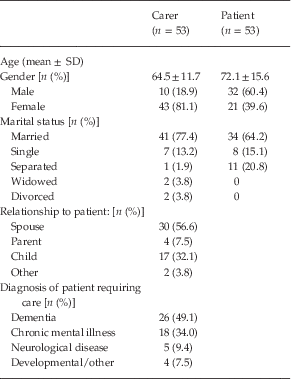
The sample included 53 carers, 43 (81.1%) female and 10 (18.9%) male, age range 32–81 years. The corresponding 53 patients consisted of 21 (39.6%) females and 32 (60.4%) males, age range 17–92 years (Table 1). The mean time since the patient was diagnosed was 10.87 years (S.D.: 12.58), median 5 years and the range from 1 to 52.
Carer and corresponding patient demographic characteristics and main diagnoses

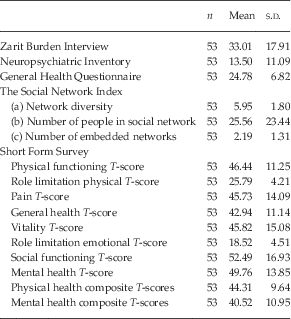
Using the HDRS as dichotomous with cut-off point eight and above, 25 (47.2%) of the carers were diagnosed with depression. Regarding locus of control (BLOCS), 37 (69.8%) of the carers were identified as Internal, nine (17%) as External Social and seven (13.2%) as External Other. In Table 2 the means and standard deviations of the continuous variables that have been measured are presented.
Means and standard deviations of continuous measurements

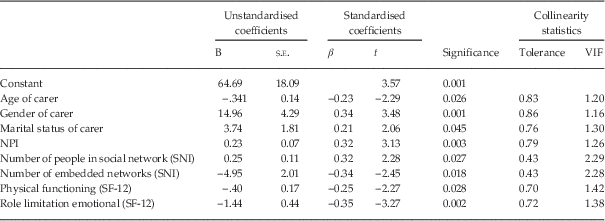
Linear regression analysis with the backward method was carried out to find the associated factors of carer burden. The initial model had ZBI scores as the dependent variable and the following as independent variables: age of carer, sex of carer, marital status of carer, relation of carer–patient, receiving respite previously, major diagnosis of patient, years of illness of patient, patient NPI score, BLOCS, SNI, HDRS and the eight domains of SF-12 scale. The GHQ-12 was not included in this model because it had high correlation with the mental health scores of SF-12 (r=−0.56, p<0.0001) and HDRS (r=0.321, p=0.029). The final model is presented in Table 3. The data were screened for multicollinearity and the standardised residuals for normal distribution. No violations of the assumptions for linear regression were found (tolerance <1 and variance inflation factor <10.0).
Independent factors that predict carer burden as measured with the Zarit Burden Interview (ZBI)

VIF, variance inflation factor; NPI, Neuropsychiatric Inventory; SNI, Social Network Index; SF-12, Short Form Survey.
The sign (+ or −) in the second and fourth column implies the direction of the relationship between the variable and ZBI scores. For example, younger age of the carer is associated with higher scores in ZBI (higher burden) at a significance level of p=0.03.
As it can be seen from Table 3 significant risk factors for carer burden are patients’ behavioural problems as indicated by the NPI, younger age of the carer, female carer, unmarried or divorced carer, small number of fixed networks but high number of people in social networks, lower physical functioning and limitation of role due to emotional problems. Insignificant factors excluded from the model were the diagnosis of patient (p>0.05), years of illness of patient (p>0.05), locus of control (p>0.05), presence or not of depression in the carer, and previous use or not of respite care (p>0.05).
Discussion
Patients’ characteristics
The results suggest that only one patient characteristic – behavioural problems was a significant factor for carer burden, the rest were individual personal and social characteristics of the carer.
The finding of this study that behavioural disturbances are a risk factor for carer burden is in line with previous research (Donaldson et al. Reference Donaldson, Tarrier and Burns1998; Donaldson & Burns, Reference Donaldson and Burns1999). In a meta-analysis (Black & Almeida, Reference Black and Almeida2004) but only in patients with dementia further supported the notion that patients’ behavioural problems is a predictor of burden of carer. More recent research and meta-analyses (Ornstein & Gaugler, Reference Okorie, Cryan, McEniff, Banks, Gethin, McLaughlin and Sweeney2012; Prince et al. Reference Prince, Brodaty, Uwakwe, Acosta, Ferri, Guerra and Sosa2012; Sutcliffe et al. Reference Sutcliffe, Giebel, Jolley and Challis2015) also confirm those findings. Prince et al. also reported that ZBI increased by approximately one point for every one point increase in NPI severity. In concordance with other studies (e.g. Dauphinot et al. Reference Dauphinot, Delphin-Combe, Mouchoux, Dorey, Bathsavanis, Makaroff and Krolak-Salmon2015) diagnosis and years of illness were not significant factors for carer burden.
Carers’ demographic characteristics
Similarly, female gender is often reported as a significant risk factor for carer burden (Donaldson & Burns, Reference Donaldson and Burns1999; Sutcliffe et al. Reference Sutcliffe, Giebel, Jolley and Challis2015) not only in patients with dementia but as well as in patients with other chronic illness or terminally ill (e.g. Schrank et al. Reference Schrank, Ebert-Vogel, Amering, Mekel, Neubauer, Watzke, Zehetmayer and Schur2016). A number of explanations of this consistent finding have been suggested among them that females carers assume that care is their obligation (García-Calvente et al. Reference García-Calvente, Mateo-Rodríguez and Maroto-Navarro2004), and thus they ask less often for help (Casado-Mejía & Ruiz-Arias, Reference Casado-Mejía and Ruiz-Arias2016), that there is an influence of social roles and cultural factors (Ingersoll-Dayton, Reference Ingersoll-Dayton2011) which protect male compared to female carers. Females are involved more emotionally in care tasks, use more emotion-focussed styles when facing stress, perform more intense and complex tasks, while males protect their personal space, use more problem-focussed coping styles, do mainly instrumental tasks, have less emotional involvement and ask for help more easily (Garity, Reference Garity1997; Ducharme et al. Reference Ducharme, L’evesque, Lachance, Zarit, Vezina, Gangbe and Caron2006; Robinson, Reference Robinson2014; Casado-Mejía & Ruiz-Arias, Reference Casado-Mejía and Ruiz-Arias2016). In the same line previous research has also reported that marriage is a protective factor for carer burden (Prince et al. Reference Prince, Brodaty, Uwakwe, Acosta, Ferri, Guerra and Sosa2012; Casado-Mejía & Ruiz-Arias, Reference Casado-Mejía and Ruiz-Arias2016; Nagata et al. Reference Nagata, Nakajima, Shinagawa, Plitman, Graff-Guerrero, Mimura and Nakayama2016); however, not many studies have explored this further to identify the reasons.
In addition, our predictive model shows an association of younger age and increased carer burden. Previous studies have shown inconclusive results. For instance, Liang et al. (Reference Liang, Guo, Luo, Li, Ding, Zhao and Hong2016) and Rinaldi et al. (Reference Rinaldi, Spazzafumo, Mastriforti, Mattioli, Marvardi, Polidori, Cherubini, Abate, Bartorelli, Bonaiuto, Capurso, Cucinotta, Gallucci, Giordano, Martorelli, Masaraki, Nieddu, Pettenati, Putzu, Tammaro, Tomassini, Vergani, Senin and Mecocci2005) reported that increased age was a higher risk factor for depression and anxiety in carers, while others (e.g. Cooper et al. Reference Cooper, Balamurali and Livingston2006, Reference Cooper, Katona, Orrell and Livingston2007) reported no association. However, the above studies have investigated depression and anxiety while studies which investigate only the burden or strain on carers found similar results with the present study (Casado-Mejía & Ruiz-Arias, Reference Casado-Mejía and Ruiz-Arias2016; Sousa et al. Reference Sousa, Santos, Turró-Garriga, Dias, Dourado and Conde-Sala2016). This finding might be because younger carers have also other responsibilities like work or family commitments, the ‘sandwich’ generation caught between childcare and ‘parent’ care, and thus they are more susceptible to burden (Ben-Galim & Silim, Reference Ben-Galim and Silim2013).
Carers’ social networks
Another finding from this study was that the higher the number of embedded networks has a protective effect but conversely, the higher the number of people with whom the carer has regular contact increases the burden. A number of previous studies have also pointed out that stable networks are a protective factor (Wilks & Croom, Reference Wilks and Croom2008; Dias et al. Reference Dias, Santos, Souza, Nogueira, Torres, Belfort and Dourado2015). However, high number of social contacts has been shown to have a negative effect on mental health not only in caregivers (e.g. Wilks & Croom, Reference Wilks and Croom2008) but also in other stressful situations like disasters (Solomon & Smith, Reference Solomon and Smith1994). The presence of moderate levels of social support perhaps relieves the burden by emotional support which has been shown to be an important moderator to stress. In contrast, high numbers of social contacts could also pose burden as social networks demand time, responsibilities and can potentially increase stress. Embedded networks represent more structural aspects of social networks and represents the network of people who might provide or did provide these supportive acts.
Carers’ personal factors
Two more factors were found to increase the carer burden in the above results, lower physical functioning and role limitation due to emotional problems. Although nearly half of the examined sample was identified as having depression, depression was not a risk factor. This finding might be because ‘emotional problems’ is a wider concept than depression and thus this variable had a stronger effect in the model compared to depression. Previous research also is in line with this finding (Chumbler et al. Reference Chumbler, Grimm, Cody and Beck2003; Di Mattei et al. Reference Di Mattei, Prunas, Novella, Marcone, Cappa and Sarno2008). However, it also has been reported that levels of emotional distress reach a plateau and remain stable or even improve as caregiving continues but physical problems continue to accumulate during caregiving (Pavalko & Woodbury, Reference Pavalko and Woodbury2000).
Limitations
The first limitation of our study is that the cross-sectional design limits any conclusions in a causal direction. Those relationships need to be examined longitudinally to conclude any direction of cause-effect. However, predictive factors to have meaning and utility need to be identified in a single assessment.
A second limitation of our study is the biased sample. We interviewed only carers who have been referred or self-referred to the Carers Association (Now Family Carers Ireland) and thus our predictive model is limited only to those. Despite this, from our results and in comparison with previous studies it seems that those factors which we identified as risk factors are universal.
Perhaps it could be argued that a limitation of this study is the sample size, however, the sample size was enough to allow calculations and extraction of the model as the number of subjects was more than two per variable as recommended (Austin & Steyerberg, Reference Austin and Steyerberg2015).
One further limitation was the time spent in the caring role. As we did not collect data related to the years of caring but only the years since the first diagnosis, the authors may have overestimated them. However, the years since the diagnosis were not found to be a significant predictor for carer burden.
Conclusions
This study shows that the presence of behavioural disturbances in the patient, and carer variables including female gender, younger age, and unmarried together with emotional and physical functioning limitations as well as having a small number of embedded social networks and high numbers of contacts are risk factors for a higher burden of care. The ability to predict which carers are more susceptible to burden allows physicians to more quickly to identify ‘higher risk’ carers more quickly, facilitating routine check-ups by physicians and carer support services.
Other predictive models in the literature are often confined to specific conditions. For example, in a paper published in the nursing literature (Kim et al. Reference Kim, Chang, Rose and Kim2012) the authors use a hierarchal multiple regression analysis to identify at risk carer groups. Impaired function in care recipients as well as carer factors were all predictors of burden. In a study looking at burden amongst carers of stroke patients a predictive model based on multiple regression analysis was carried out showing that burden was related to age, sex, chronic illness, use of respite care, caregiving hours and care-recipient functional status (Morimoto et al. 2003).
A strength of our paper is that it seeks to explore carer burden amongst a more heterogenous population of carers who are availing of a local carer support service. Novel social factors have been identified in the analysis.
Before the authors’ predictive model can be implemented the authors feel that it needs to be further tested in a new prospective study. Other areas of future research that the authors feel is warranted is an investigation of the use of respite care as an alleviator of carer burden.
Acknowledgements
The authors wish to thank all the carers who participated in this study.
Financial Support
The work was supported by the HRB Summer Studentship Grant.
Conflicts of Interest
None.
Ethical Standards
The authors assert that all procedures contributing to this work comply with the ethical standards of the relevant national and institutional committee on human experimentation with the Helsinki Declaration of 1975, as revised in 2008. The authors assert that ethical approval for publication of this audit has been provided by their local Research Ethics Committee.