Introduction
Cultivated carrot (Daucus carota L. subsp. sativus Hoffm.), 2n = 2x = 18, belongs to the family Apiaceae and is an important root vegetable crop in the world. The genus Daucus contains 40 species and the wild forms grow mostly in Mediterranean region and south west Asia. Carrot is of Central Asian in origin (Vavilov, Reference Vavilov1951). The molecular investigation also suggests the Central Asian origin of carrot (Iorizzo et al., Reference Iorizzo, Senalik, Ellison, Grzebelus, Cavagnaro, Allender, Brunet and Van Deynze2013). The estimated production of carrot in India is around 1.87 million tonnes from an area of 0.106 million ha (https://desagri.gov.in). Asia contributes 63.3% of world carrots and turnips production, followed by Europe (21.3%), Americas (8.9%), Africa (5.7%) and Oceania (0.9%) (https://www.fao.org/faostat). China is the leading producer of carrots and turnips in the world (18.08 million tonnes), followed by Uzbekistan (3.15 million tonnes), USA (1.43 million tonnes) and Russian Federation (1.30 million tonnes) (https://www.fao.org/faostat). Carrot is an important crop grown for its fleshy edible and colourful roots varying from white, yellow, orange, deep orange, red, purple to almost black. The orange carrot is a rich source of β-carotene (provitamin A) that helps in the prevention of night blindness and possess anti-carcinogenic property (Arscott and Tanumihardjo, Reference Arscott and Tanumihardjo2010; Ahmad et al., Reference Ahmad, Cawood, Iqbal, Ariño, Batool, Tariq, Azam and Akhtar2019). The purple carrot is rich in anthocyanin, which is a powerful antioxidant due to its ability in preventing lipid oxidation (Marja and Marina, Reference Marja and Marina2003; Iorizzo et al., Reference Iorizzo, Curaba, Pottorff, Simon and Cavagnaro2020; Pérez et al., Reference Pérez, Carvajal, Beretta, Bannoud, Fangio, Berli, Fontana, Salomón, Gonzalez, Valerga, Altamirano, Yildiz, Iorizzo, Simon and Cavagnaro2023). It is a highly cross-pollinated annual or biennial crop and protandrous. The inflorescence of carrot is a compound umbel. There are two types of cultivated carrot, temperate and tropical. The temperate carrots are generally biennial, sets seed in temperate areas and are orange in colour with self-core (core and cortex of same colour). The desi red carrot, known as Asiatic or tropical carrot is annual, sets seed in the plains of North India and has bigger core. The tropical red carrot has more of lycopene while temperate carrot has β-carotene as major carotenoids pigment (Arscott and Tanumihardjo, Reference Arscott and Tanumihardjo2010; Saha et al., Reference Saha, Kalia, Sureja, Singhal and Sarkar2015). Heterosis breeding in carrot was started in late 1960s (Bunin and Yoshikawa, Reference Bunin and Yoshikawa1989), after the discovery of male sterility in carrot. Before that mass selection was the most common method of breeding in carrot. The high inbreeding depression in carrot limits the use of homozygous inbreds as parents for heterosis breeding and practical difficulty of manual emasculation in carrot flowers was the main reason for non-adaptation of heterosis breeding. Only after the discovery of male sterility, hybrid breeding in carrot has become economical and feasible.
In carrot, ‘brown anther’ type and ‘petaloid’ type are the two widely used male sterility systems. The brown anther type (ba) was first described by Welch and Grimball (Reference Welch and Grimball1947) and was characterized by the presence of deformed, brown-coloured anthers without functional pollen. The petaloid male sterility (pt) was first discovered in 1953 by Munger in a North American wild carrot (D. carota subsp. carota) and was later termed ‘Cornell-CMS’ (Thompson, Reference Thompson1961; Peterson and Simon, Reference Peterson, Simon and Bassett1986). This type is characterized by transformation of anthers into petals or petal-like structures which are unable to produce functional pollen. It is the most widely used form for production of commercial carrot hybrids. This type of male sterility is stable over a wide range of environments throughout flowering and seed production. But in some genetic backgrounds, petaloidy breaks down and late season umbels can be fertile (Simon et al., Reference Simon, Freeman, Vieira, Boiteux, Briard, Nothnagel, Michalik, Kwon, Prohens and Nuez2008).
Estimation of combining ability forms an integral part of heterosis breeding. Combining ability is the ability of parents to combine among each other during hybridization such that desirable genes or traits are transmitted to their progenies. Combining ability analysis is used to identify superior parents for breeding programmes or to identify promising cross-combinations. In order to develop heterotic hybrids, it is important to select suitable parental pairs with corresponding morphological traits and biological parameters. The value of parental pairs is best outlined by their combining ability which is established by trait inheritance in hybrids (Karkleliene et al., Reference Karkleliene, Bobinas and Staniene2005). Thus, the knowledge of combining ability is significant in crossing programme to obtain the desired heterotic hybrids. There are two types of combining ability, general combining ability (GCA) and specific combining ability (SCA). The former refers to the average performance of a line and is useful in the selection of parents for hybridization. SCA refers to the specific performance of a cross and is useful in the selection of superior hybrids. Basic knowledge of heritability and combining ability of lines plays an important role in reducing the costs and time of carrot breeding (Jagosz, Reference Jagosz2012). Knowledge about trait inheritance and genetic basis of heterosis is not well known in tropical carrots, since very little work had been carried out in tropical carrot improvement. Very few public and private sector hybrids have been released so far in tropical carrot. Thus, the studies on combining ability and heterosis would be helpful in the development of superior tropical carrot hybrids.
Heterosis can be enhanced when genetically distinct parents belonging to distinct heterotic pools are utilized in hybrid breeding (Reif et al., Reference Reif, Hallauer and Melchinger2005), due to increase in heterozygosity. Therefore, there has been constant effort to develop heterotic pools in crops to improve the efficiency of hybrid breeding in different crops namely, maize, sunflower, rice, triticale and sorghum. Studies in pearl millet suggested that genetic diversity results using SSRs were able to characterize germplasm into genetically similar groups (Ramya et al., Reference Ramya, Ahamed, Satyavathi, Rathore, Katiyar, Raj, Kumar, Gupta, Mahendrakar, Yadav and Srivastava2018). Hence, molecular divergence using SSR markers could be used to increase hybrid performance. Therefore, the main objectives of this study were, (i) to examine the combining ability of petaloid cytoplasmic male sterility (CMS) lines for important horticultural traits, (ii) to study the magnitude of heterosis for yield-related traits and (iii) to determine association between heterosis and molecular divergence.
Materials and methods
Plant materials
The experiment was carried out in two seasons, spring–summer 2017–18 for production of F 1 hybrid seeds using four petaloid male sterile lines and 15 testers and rabi (winter season) 2018–19 for evaluation of hybrids at ICAR-Indian Agricultural Research Institute (IARI), New Delhi. The experimental plot is located at 28°40′N latitude and 77°12′E longitude with an altitude of 228.6 m above mean sea level. The four petaloid male sterile lines DCatCMS-7, DCatCMS-53, DCatCMS-91 and DCatCMS-98 and 15 male fertile inbred testers DCat-3, DCat-4, DCat-34, DCat-39, DCat-54, DCat-76, DCat-92, DCat-96, DCat-100, DCat-116, DCat-122, DCat-124, DCat-126, DCat-131 and Pusa Meghali were crossed in line × tester mating design to produce 60 F 1 hybrids (online Supplementary material 1). The lines, testers, F 1 hybrids and commercial check/standard check Pusa Vasuda (F 1 hybrid) were evaluated for different vegetative and economic traits in randomized block design with three replications with the spacing of 10 cm between plants and 45 cm between the rows.
Estimation of vegetative and economic traits
Four vegetative traits viz. plant biomass, leaf length, leaf number per plant and shoot weight and seven economic traits viz. root maturity, root length, root diameter, root weight, core diameter, harvest index and root yield were recorded for estimating combining ability and heterosis. Root maturity was measured by counting the days from sowing to marketable root maturity stage. Length of roots was measured in centimetres from shoulder end to root tip using a measuring scale. Root diameter was measured at broadest point of root near the shoulder with Vernier calliper. Harvest index was calculated as the ratio between root weight (economic yield) at marketable root maturity and plant biomass (biological yield) and expressed as percentage. The intensity of green colour of leaf was scored as light, medium or dark based on visual observation using Royal Horticultural Society colour chart at marketable root maturity stage. The anthocyanin colouration and green colour of shoulder were scored as present or absent based on visual observation. These traits were recorded at marketable root maturity stage by taking ten plants/roots at random from each replication for all the genotypes and hybrids.
Statistical analyses
The mean data of each replication for vegetative and economic traits recorded for the hybrids were subjected to line × tester analysis. The mean sum of squares along with the variance of GCA of the parent and SCA of the hybrids were worked out following the method given by Kempthorne (Reference Kempthorne1957) using Statistical Package for Agricultural Research data analysis (SPAR 2.0) developed by Indian Agricultural Statistics Research Institute, New Delhi. Significance of the combining ability effects was determined at 5 and 1% probability. The analysis of variance was calculated as outlined by Panse and Sukhatme (Reference Panse and Sukhatme1967). The significance of difference among treatments was tested by F-test using the statistical package SPAR 2.0 (https://iasri.icar.gov.in/statistical-packages/).
The following model was used to estimate GCA and SCA,

where μ – population mean, gi – GCA effects of ith line (female parent), gij – GCA effects of jth tester (male parent), sij – SCA effects of ijth the cross (hybrid), eijkl – error associated, i – number of female parents, j – number of male parents, k – number of replications, l – number of individual in each replication.
The magnitude of heterosis was calculated for all the mentioned traits based on mid-parent, better parent and over commercial check using the formulae, mid-parent heterosis = [(F 1 − MP)/MP] × 100; better parent heterosis = [(F 1 − BP)/BP] × 100 and standard check heterosis = [(F 1 − SC)/SC] × 100, respectively. Significance was tested through F test at 5 and 1% probability using the statistical package SPAR 2.0 (https://iasri.icar.gov.in/statistical-packages/).
Molecular analyses
A set of 34 polymorphic genomic SSR primers were taken for genetic diversity analysis. These SSRs were selected among a set of 124 SSRs reported by Cavagnaro et al. (Reference Cavagnaro, Chung, Manin, Yildiz, Ali, Alessandro, Iorizzo, Senalik and Simon2011). DNA was extracted from young leaves of each of the lines and testers using cetyltrimethylammonium ammonium bromide (CTAB) method. In total, 1–2 g of young leaves was ground using CTAB buffer and kept in water bath for 1 h at 65°C. Then equal volume of chloroform:isoamyl alcohol (24:1) was added and centrifuged at 13,416 g force for 10 min at 25°C. Equal volume of isopropanol was added to the supernatant and kept at −20°C for 1 h/overnight followed by centrifugation at 10,000 rpm for 10 min at 4°C. Supernatant was discarded and pellets were washed with 70% ethanol. Then the pellets were air dried and dissolved in nuclease-free water or Tris EDTA buffer. RNase treatment was given to the extracted DNA and stored at 4°C for further use.
Polymerase chain reactions (PCR) were carried out in 0.2 ml PCR tubes containing 10 μl reaction mixture. The reaction mixture contained 5 μl master mix, 0.5 μl forward primer, 0.5 μl reverse primer, 1 μl DNA and 3 μl nuclease-free water. The reaction mixtures were mixed thoroughly and subject to amplification in DNA thermo cycler as follows, the initial denaturation step at 95°C for 5 min, followed by 35 cycles at 94°C, 50–58°C (based on respective annealing temperature for each primer) for 30 s, 72°C for 45 s followed by an extension step at 72°C for 5 min. The PCR products were subjected to gel electrophoresis in 3% Agarose gel at 120 V for 3 h. A 100 bp ladder was used to determine the amplicon size and gel image was captured using UV-based gel documentation system. The list of primers and their sequences used for diversity analysis along with annealing temperature is given in online Supplementary material 2. The simple matching dissimilarity coefficient was represented as genetic distance (GD) using DARwin software version 6.0.017 (Singh et al., Reference Singh, Dey, Bhatia, Kumar, Sharma and Behera2019).
The correlation between GD and relative heterosis of quantitative and quality traits was estimated using Pearson correlation coefficient. Significance was tested through F test at 5 and 1% probability.
Results
Morphological characterization of CMS lines and testers
The CMS lines and testers were assessed for 11 qualitative traits (Table 1). Leaf division was medium for all CMS lines and testers except for DCatCMS-7, Pusa Meghali and DCat-4 which had coarse leaf division. Intensity of green colour of leaf was dark in DCat-3, DCat-34 and DCat-126 while it is medium for other lines and testers. Anthocyanin colouration in root shoulder was absent in all lines except DCatCMS-91 while it was absent in five testers. Green colouration in root shoulder was present only in Pusa Meghali. The testers DCat-54 and DCat-96 had strong scars on root surface while weak scars were found in DCat-126. The testers DCat-126 and Pusa Meghali had purple and orange root colour, respectively, in contrast to red and pinkish red colour in other lines and testers.
Agro-morphological characterization of parents (CMS lines and testers) for 11 important qualitative traits

The diameter of the core relative to total diameter was small in most of the lines and testers except in DCat-126 and Pusa Meghali. DCat-126 had very small core diameter while Pusa Meghali had medium core diameter. As many as nine genotypes including two lines and seven testers had pinkish red core and red cortex in contrast to red core and cortex in other lines and testers. Pusa Meghali had orange self-core while DCat-126 had purple self-core. Two lines and eight tested possessed self-core. Green colouration in root interior in longitudinal section was observed only in Pusa Meghali.
Analysis of variance for lines, testers and F 1 hybrids
The partitioning of mean squares of vegetative and economic traits into replications, lines, testers and line × tester interactions (online Supplementary material 3) revealed that mean squares due to lines (female parents) were significant for leaf number per plant, shoot weight, root length, root diameter and core diameter. Mean square due to testers (male parents) was significant only for plant biomass and root diameter. The mean squares due to line × tester interactions were significant for all the vegetative and economic traits studied.
The estimates of genetic components of variance for different vegetative and economic traits were presented in Table 2. For traits like plant biomass, leaf length, leaf number per plant, shoot weight, root diameter, root weight, harvest index and root yield, the values of σ 2GCA were lower than σ 2SCA. For plant biomass, root weight and root yield, the σ 2GCA was in negative direction. The proportions of σ 2GCA/σ 2SCA were less than unity in all traits except root maturity, root length and core diameter. Similarly, σ 2D was greater than σ 2A for all the traits except leaf length, leaf number per plant, root maturity, root length and core diameter. However, the predictability ratio was less than unity for all the quantitative traits.
Genetic components of variance for vegetative and economic traits in tropical carrot

σ 2A: variance of additive genetic component; σ 2D: variance of dominance genetic component.
General combining ability (GCA effects) of the parental lines
The GCA of lines and testers was estimated for different vegetative and economic traits (Table 3) and significant negative GCA was preferred for traits leaf length, leaf number per plant, shoot weight, root maturity and core diameter while positive GCA was desirable for plant biomass, root length, root diameter, root weight, harvest index and root yield. The estimates of GCA effects of lines and testers for vegetative and economic traits revealed that among the four CMS inbred lines, DCatCMS-53 was a good general combiner for root maturity and a poor general combiner for root length, core diameter and harvest index. The line, DCatCMS-7 was a good general combiner for root length, root diameter and core diameter and a poor general combiner for root maturity, whereas DCatCMS-98 was a good general combiner for root length, shoot weight, core diameter and harvest index.
GCA effects of parents (CMS lines and testers) for different quantitative traits in tropical carrot

SE, standard error; CD, critical difference; *, **significant at 5 and 1% probability, respectively.
Among the testers, five were good general combiners for plant biomass, four for leaf length, five for leaf number per plant and three for shoot weight. Four testers were good general combiners for root maturity, five for root length, six for root diameter, five for root weight, five for core diameter and six for harvest index. For root yield, the testers DCat-92, DCat-100, DCat-116 DCat-126 and Pusa Meghali were found to be a good general combiner. Among the 15 testers, DCat-100, followed by Pusa Meghali, DCat-126, DCat-131 and DCat-4 were good general combiners for most of the yield-related quantitative traits.
Specific combining ability (SCA effects) of hybrids
Among 60 F 1 hybrids studied for estimating SCA of vegetative and economic traits (online Supplementary material 4), significant negative SCA were observed in 30 crosses for leaf number per plant; 26 crosses for shoot weight and leaf length; 23 crosses for root maturity and core diameter since negative SCA effects were desirable for these traits. Significant positive SCA effects were observed in 26 crosses for root diameter; 24 crosses for plant biomass, root length and harvest index and 22 crosses for root yield and root weight. The hybrid DCatH 5331 (average × good general combiner) exhibited highest negative SCA for root maturity, followed by DCatH 9139 (poor × poor general combiner) and DCatH 914 (poor × poor general combiner). For plant biomass, the hybrid DCatH 9122 (good × poor general combiner) exhibited highest positive SCA, followed by DCatH 7124 (average × poor general combiner) and DCatH 5326 (poor × good general combiner). The hybrids DCatH 776 (average × average general combiner), DCatH 9139 (poor × good general combiner) and DCatH 754 (average × average general combiner) were the best specific combiners in negative direction for leaf length. The best specific combiners for leaf number per plant were DCatH 5354 (poor × poor general combiner), DCatH 7116 (poor × poor general combiner) and DCatH 9176 (average × good general combiner).
The highest significant positive SCA effect for root length was recorded in the hybrid DCatH 534 (poor × good general combiner), followed by DCatH 739 (average × poor general combiner) and DCatH 9192 (poor × average general combiner). For root diameter, the highest positive SCA effect was observed in the hybrid DCatH 5396 (poor × average general combiner), followed by DCatH 73 (average × good general combiner) and DCatH 983 (poor × good general combiner). The best specific combiners in negative direction for shoot weight were DCatH 9124 (poor × good general combiner), DCatH 9176 (poor × average general combiner) and DCatH 9826 (average × average general combiner). The highest significant negative SCA effect for core diameter was observed in the hybrid DCatH 739 (average × poor general combiner), followed by DCatH 9124 (poor × average general combiner) and DCatH 9126 (poor × average general combiner). For harvest index, the highest positive SCA effect was observed in DCatH 9124 (poor × poor general combiner), followed by DCatH 9122 (poor × good general combiner) and DCatH 9176 (poor × poor general combiner). For both root weight and root yield, the highest positive significant SCA effect was observed in the hybrid DCatH 9122 (average × poor general combiner), followed by DCatH 5326 (poor × good general combiner) and DCatH 5392 (poor × good general combiner).
Heterosis for vegetative and economic traits
High and significant heterosis in both directions was recorded for all the vegetative and economic traits under study (Tables 4 and 5). Negative heterosis was preferred for leaf length, leaf number per plant, shoot weight, root maturity and core diameter while positive heterosis was desirable for other quantitative traits. Mostly top heterotic hybrids showed highly significant SCA effects. On analysing their GCA effects, it was observed that at least one of the parents involved was a high or medium general combiner except for shoot weight. For plant biomass, the testers DCat-92 and DCat-100 involved in top heterotic crosses found to have highly significant positive GCA effect even though the line DCatCMS-53 involved had negative GCA effect. For leaf length and leaf number per plant, even though the lines involved in top heterotic crosses did not show significant negative GCA effect, the testers Pusa Meghali and DCat-4 showed highly significant negative GCA effect for leaf length and leaf number per plant, respectively. For shoot weight, the line DCatCMS-91 involved in two of the top three heterotic crosses had significant negative GCA effect.
Range of heterosis and combining ability of top three heterotic hybrids and respective parental lines for vegetative traits

M.P., mid-parent; B.P., better parent; S.C., standard check (Pusa Vasuda); L, low; M, medium; H, high GCA effects.
*, **Significant at 5 and 1% probability, respectively.
Range of heterosis and combining ability of top three heterotic hybrids and respective parental lines for economic traits

M.P., mid-parent; B.P., better parent; S.C., standard check (Pusa Vasuda); L, low; M, medium; H, high GCA effects.
*, **Significant at 5 and 1% probability, respectively.
The line DCatCMS-7 was involved in all the top three heterotic crosses for root maturity; however, it has significant positive GCA effect. The line DCatCMS-98 involved in two of the top three heterotic crosses for root length showed significant positive GCA effect for this trait. For core diameter, the line DCatCMS-53 and the tester DCat-96 were involved in two of the top three heterotic crosses but showed significant positive GCA effect. The tester DCat-100 involved in top heterotic crosses for harvest index showed significant positive heterosis for this trait. For root weight and root yield, the tester DCat-92 involved in two of the top three heterotic crosses showed highly significant positive GCA effect for these traits.
Correlation between molecular divergence and heterosis
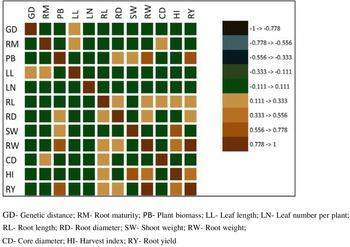
Pearson correlation coefficient (r) was calculated to estimate the association between genomic SSR-based GD and mid-parent heterosis of different vegetative and economic traits. However, none of the quantitative traits showed significant association between GD and mid-parent heterosis (Fig. 1).
Correlation between SSR marker based genetic distance and mid parent heterosis for different quantitative traits.

Discussion
Carrot is an important vegetable crop, grown commercially for its edible roots around the world. Combining ability analysis and heterosis breeding strategies are vital for hybrid development programme in carrot. Combining ability analysis provides information about the gene action involved in the expression of important traits. It also paves the way for selection of best parent (GCA) and superior hybrids (SCA). The estimation of GCA effects is useful in selection of parents for generating superior breeding populations. This was evident from the hybrid DCatH 9892 which was third highest for root yield and root weight. This hybrid was a result of crossing between medium (DCatCMS-98) and high (DCat-92) general combiner. The highest performing hybrids of most of the vegetative and economic traits contain at least one of the parents as a medium or high general combiner. Thus, selecting medium and high general combiners may yield heterotic hybrids. Similar results were observed by Talukder et al. (Reference Talukder, Karim, Ahmed and Amiruzzaman2016) in maize where highest SCA effects were manifested by crosses having good combiner parents. Another study by Fasahat et al. (Reference Fasahat, Rajabi, Rad and Derera2016) stated that high performance of hybrids could be obtained by selecting at least one parent with high GCA. Furthermore, highly significant positive correlation was reported between parental performance and GCA by Ofori and Becker (Reference Ofori and Becker2008) in Brassica rapa. On the other hand, some of the hybrids like DCatH 5396 with the highest harvest index and DCatH 5354 with the highest root diameter were having low × low general combiners as parents. Thus, it is evident that superior hybrids may also evolve from poor combiners. Kushlaf and Kalia (Reference Kushlaf and Kalia2012) reported that poor performing parents may also give high heterotic response in tropical carrot.
The top heterotic hybrids which showed significant positive SCA effects viz. DCatH-5392 for root yield, root weight and plant biomass; DCatH 9126 and DCatH 9876 for root length, also had the highest per se performance for the respective traits. Similarly, significant negative SCA effects were observed in the hybrids DCatH-9826 and DCatH-534 for leaf number per plant, DCatH-5396 for shoot weight, DCatH-9124 for leaf length and DCatH-5326 for core diameter. These hybrids showed highest per se performance for respective traits since significant negative SCA was preferred for these traits. Therefore, identification of SCA of hybrids is equally important in the development of superior hybrids. Previous studies also concluded that the crosses with desirable SCA effects could be used for increasing hybrid performance and could be best utilized in heterosis breeding programme (Singh and Chaudhary, Reference Singh and Chaudhary1979; Talukder et al., Reference Talukder, Karim, Ahmed and Amiruzzaman2016).
In our study, highest heterosis percentage (33%) was observed for root yield and root weight per plant. Duan et al. (Reference Duan, Wang, Ren and Du1996) also recorded highest heterosis for root yield in carrot. It was observed that the hybrids and inbreds with highest per se performance for root weight had highest root yield also. This might be due to the direct effect of root weight on root yield (Gupta and Verma, Reference Gupta and Verma2007). Some crosses which contain high general combiner as one of the parents have not shown significant positive SCA effects. This can be seen in the hybrids DCatH-9892 for root weight and root yield, DCatH-700 for plant biomass, DCatH-9831 for root length, DCatH-9896 for core diameter and DCatH-9100 for harvest index. This may be due to the absence of any interaction among favourable alleles contributed by parents (Dey et al., Reference Dey, Singh, Bhatia, Parkash and Chandel2014).
Highly significant mean squares for lines indicate the existence of additive variance for leaf number per plant, shoot weight, root length, root diameter and core diameter. Despite non-significant effects of lines and testers for some of the traits, line × tester interactions were found to be significant for all the studied traits. On analysing the genetic components of variance for yield-related traits, it was found that the ratio between variance of GCA:SCA shows less than unity value for all the traits except for root maturity, root length and core diameter. This indicates the participation of non-additive effects in most of the traits. On the other hand, high value of σ 2GCA/σ 2SCA ratio in root length, root maturity and core diameter signify greater GCA effect and indicates the participation of additive effects in these traits.
However, GCA:SCA ratio was near to 1 in root length (1.16) implying the importance of both additive and non-additive effects in this trait. Jagosz (Reference Jagosz2012) also reported that low and high value of GCA:SCA variances are indicative of non-additive and additive gene effects, respectively. The predominance of non-additive gene action in yield-related traits can also be confirmed by less than unity value of predictability ratio. It was also observed that σ 2A was lower than σ 2D for plant biomass, shoot weight, root diameter, root weight, harvest index and root yield which suggests greater significance of non-additive gene action. Most of the yield-contributing quantitative traits had non-additive gene action; therefore, hybrid breeding can be effectively practiced to improve these traits in tropical carrots.
The association between GD and mid-parent heterosis of different vegetative and economic traits was estimated to find whether molecular diversity could be useful for predicting hybrid performance. But none of the traits showed significant correlation between GD and mid-parent heterosis. This may be attributed to smaller number of SSR markers used in the study. Also, carrot inbred lines usually possess strong inbreeding depression that negatively influence hybrid heterosis and correlation value due to narrow genetic base of inbreds (Jagosz, Reference Jagosz2011). Thus, GD cannot be used for the prediction of heterosis in our study. Cheres et al. (Reference Cheres, Miller, Crane and Knapp2000), Jordan et al. (Reference Jordan, Tao, Godwin, Henzell, Cooper and McIntyre2003), Geleta et al. (Reference Geleta, Labuschagne and Viljoen2004), Teklewold and Becker (Reference Teklewold and Becker2006) and Legesse et al. (Reference Legesse, Myburg, Pixley, Twumasi-Afriyie and Botha2008) also considered that estimation of molecular divergence was a poor tool for superior hybrid identification. Kawamura et al. (Reference Kawamura, Kawanabe, Shimizu, Nagano, Saeki, Okazaki, Kaji, Dennis, Osabe and Fujimoto2016) also confirmed that the GD does not predict heterotic phenotype.
Conclusion
The present study on combining ability and heterosis for yield-related traits in tropical carrot showed that most of the commercially important root traits such as root yield, root weight and harvest index showed non-additive gene action. It was also observed that highest per se performance was obtained from crosses between high, medium and low general combiners. This may be due to dominant, over dominant or epistatic gene action in the hybrids. Also, the top heterotic hybrids with significant positive SCA for root yield, root weight and plant biomass had highest per se performance for respective traits. Thus, it was found that estimating SCA is more important in determining hybrid performance in carrot. Highly significant heterosis was observed for all the studied traits over standard check and parental genotypes with root yield and root weight showing highest heterosis percentage. However, the present study suggested the use of a greater number of molecular markers and estimation of GD could not be used to predict heterosis. The best performing hybrids with highest per se performance in root yield and root weight with significant SCA are DCatH 5392, DCatH 700 and DCatH 9892. Hence, it is evident from the study that heterosis could be exploited commercially for yield-related traits in tropical carrot and crosses with significant SCA could be used in improving hybrid performance.
Supplementary material
The supplementary material for this article can be found at https://doi.org/10.1017/S1479262123000692.
Acknowledgements
The authors gratefully acknowledge the funding by ICAR-Indian Agricultural Research Institute, New Delhi. Assistance from Mr Sudarshan during the study is acknowledged.
Author contributions
A. K. S. conceptualized the study. R. J. and A. K. S. conducted the field trials. R. J. and S. S. D. did the SSR marker analysis. R. J. and S. G. K. carried out the statistical analysis of data. R. J. drafted the manuscript with inputs from A. K. S., S. S. D., B. S. T., R. B. and S. G. R. The manuscript was critically reviewed by all the authors.
Funding statement
The funding provided by ICAR-Indian Agricultural Research Institute for conducting this study is gratefully acknowledged. R. J. acknowledges the financial support from ICAR, New Delhi for providing Junior Research Fellowship.
Competing interests
None.