Introduction
Polychaetes are among the most abundant marine organisms. They have played important roles in marine ecosystems throughout the Phanerozoic such as sediment reworkers (i.e., bioturbation) and suspension feeders, as revealed by the good fossil record of their traces and the remains of biomineralizing worms such as machaeridians, serpulids, and sabellids (Seilacher, Reference Seilacher2007; Vinther et al., Reference Vinther, Van Roy and Briggs2008; Vinn and Mutvei, Reference Vinn and Mutvei2009). In addition, polychaetes of the order Eunicida have sclerotized jaw parts, or scolecodonts, that are more resilient to decay than soft tissue and other sclerotized parts such as aciculae or chaetae (Briggs and Kear, Reference Briggs and Kear1993). The earliest scolecodonts are known from the late Cambrian of North America (Williams et al., Reference Williams, Nowlan, Barnes and Batten1999). In general, they are common microfossils in Phanerozoic marine sedimentary rocks, at least from the early Middle Ordovician onward (Eriksson and Bergman, Reference Eriksson and Bergman2003). However, little is known about soft-bodied and non-tubiculous polychaetes, principally due to their low potential of preservation (Briggs and Kear, Reference Briggs and Kear1993; Fitzhugh et al., Reference Fitzhugh, Sroka, Kruty and Henderson1997), which strongly biases our understanding of the early origins and diversity of many polychaete crown groups through time.
Despite this, several soft-bodied specimens with exceptional preservation are known from Lagerstätte around the world, offering a unique opportunity to study the anatomy of early polychaetes, and to increase our understanding of polychaete evolution, their phylogenetic relationships, and their historical biogeography. These fossil Lagerstätten include the Cambrian Burgess Shale (e.g., Conway Morris, Reference Conway Morris1979; Eibye-Jacobsen, Reference Eibye-Jacobsen2004), the Devonian Hunsrück Slate (e.g. Briggs and Bartels, Reference Briggs and Bartels2010), and the Carboniferous Mazon Creek fauna (e.g., Fitzhugh et al., Reference Fitzhugh, Sroka, Kruty and Henderson1997), all from the Paleozoic (Briggs and Kear, Reference Briggs and Kear1993). The only Mesozoic Lagerstätte containing well-preserved polychaete fossils corresponds to the Cretaceous Haqel fauna (Bracchi and Alessandrello, Reference Bracchi and Alessandrello2005). The herein reported aphroditiform Protopholoe colombiana new species from the Coniacian (mid Late Cretaceous) of Colombia, represents the first fossil soft-bodied polychaete from the Neotropics, and extends the geographic and geologic range of Mesozoic aphroditiforms into the Late Cretaceous of Tropical America.
The aims of the paper are (1) to systematically describe a new exceptionally preserved polychaete fossil from the Cretaceous of Colombia, (2) to discuss its taxonomic affinities, and (3) to discuss the paleobiogeographic distribution of aphroditiforms.
Location and stratigraphy
Protopholoe colombiana n. sp. was found in dark gray terrigenous and fossiliferous mudstones of the Conejo Formation, associated with other benthic macrofossils such as the gastropod Rostellaria sp., abundant shrimp caudal fans, indeterminate decapod remains, and the brachyuran crab Cenomanocarcinus Van Straelen, Reference Van Straelen1936 (Luque, unpublished data). The ammonite ?Paralenticeras spathi Reyment, Reference Reyment1958, and the bivalve Magadiceramus sp., suggest a late Coniacian age (Walaszczyk and Cobban, Reference Walaszczyk and Cobban2006, Reference Walaszczyk and Cobban2007; Etayo-Serna, personal communication, 2011). The presence of Peroniceras sp.,?Gauthiericeras margae (Schlüter, Reference Schlüter1867), and ?G. nouelianum (D’Orbigny, Reference D’Orbigny1850), approximately 70 meters stratigraphically above the layer containing the palaeoaphroditid, confirms the late Coniacian age for the stratigraphic interval (Kennedy, Reference Kennedy1984; Etayo–Serna, pers. comm., 2011). In addition to P. colombiana n. sp., the only other known fossil polychaete from the Conejo Formation is a pectinariid-like tubeworm of early Santonian age (Vinn and Luque, Reference Vinn and Luque2013).
Methods
The specimen (IGM p880663) was photographed using a Macropod; a technology by Macroscopic Solutions, LLC, which incorporates the Canon 6D, 65 mm 1×–5×lens, 25 II ext. tube, and MT-24EX twin light flash. The resulting images were processed in Zerene Stacker and enhanced using Photoshop CS5.
Systematic paleontology
Class Polychaeta Grube, Reference Grube1850
Order Phyllodocida Dales, Reference Dales1962
Suborder Aphroditiformia Levinsen, Reference Levinsen1882
Family uncertain
Genus Protopholoe Alessandrello, Bracchi and Riou, Reference Alessandrello, Bracchi and Riou2004
Type species
Protopholoe rhodanitis Alessandrello, Bracchi and Riou, Reference Alessandrello, Bracchi and Riou2004, by original designation.
Included species
Protopholoe rhodanitis Alessandrello, Bracchi and Riou, Reference Alessandrello, Bracchi and Riou2004; P. colombiana n. sp.
Geologic range
Middle Jurassic to late Cretaceous.
Remarks
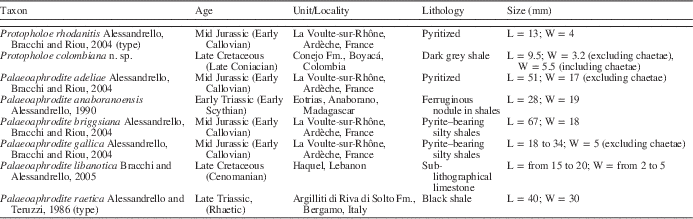
The oldest remains of aphroditiforms (Order Phyllodocida) belong to Protonimpha Clarke, 1903 from the Devonian of North America (Alessandrello and Teruzzi, Reference Alessandrello and Teruzzi1986; Conway Morris and Grazhdankin, Reference Conway Morris and Grazhdankin2005), while extant aphroditiform families such as Aphroditidae Malmgren, Reference Malmgren1867, have their oldest confirmed record in the Triassic (Table 1). Palaeoaphrodite Alessandrello and Teruzzi, Reference Alessandrello and Teruzzi1986 is a Mesozoic-restricted aphroditid-like genus known from France, Italy, Madagascar, and Lebanon (Table 1). Palaeoaphroditids share an overall ovate, fusiform outline, the occurrence of chaetae arranged in tufts, and the possession of elytra that suggest affiliation with Aphroditidae (Alessandrello, Reference Alessandrello1990). Nevertheless, similar characters could be present in Polynoidae Malmgren, Reference Malmgren1867 (Fitzhugh, personal communication, 2014), and it is very likely that some of these fossil aphroditiforms have not shared the same most recent common ancestors, and Palaeoaphrodite as it currently stands might not be a monophyletic genus. Another aphroditiform-like genus, Protopholoe, is known from the Middle Jurassic of France, at a location where Palaeoaphrodite is also reported (Table 1). Alessandrello et al. (Reference Alessandrello, Bracchi and Riou2004) included Protopholoe among aphroditiforms, but with uncertain familial affinities. The authors suggested a plausible affiliation with Sigalionidae Malmgren, Reference Malmgren1867 based on overall similarities with the extant genus Pholoe Johnston, Reference Johnston1839, which was previously considered as belonging to that family (e.g., Glasby et al., Reference Glasby, Hutchings, Fauchald, Paxton, Rouse, Russell and Wilson2000, Alessandrello et al., Reference Alessandrello, Bracchi and Riou2004, Bracchi and Alessandrello, Reference Bracchi and Alessandrello2005). Although Pholoe is currently a genus within Pholoidae, this family has been recovered in phylogenetic analyses as either in a polytomy with sigalionid taxa (e.g., Wiklund et al., Reference Wiklund, Nygren, Pleijel and Sundberg2005), or even nested within Sigalionidae (e.g., Norlinder et al., Reference Norlinder, Nygren, Wiklund and Pleijel2012). Given the scarcity and partial preservation of Mesozoic protopholoids and palaeoaphroditids, their phylogenetic relationships with extant Aphroditidae, Polynoidae, Pholoidae, or Sigalionidae remain to be studied. In particular, the structure of the head region, the jaws, and that of the neurochaetae (compound vs. simple) are very important to distinguish the different families of aphroditiforms, and only fossil material preserving diagnostic traits will shed light onto their phylogenetic affinities. Keeping these limitations in mind, we follow Alessandrello et al. (Reference Alessandrello, Bracchi and Riou2004) and maintain Protopholoe tentatively within an uncertain aphroditiform family.
Protopholoe colombiana new species
List of species of Protopholoe and Palaeoaphrodite known to date, their ages, geographic provenance, lithostratigraphic units, and size range

L=length; W=width.
Protopholoe colombiana n. sp. holotype IGM p880663, Upper Cretaceous (Coniacian), lower Conejo Formation, Boyacá, Colombia. (1) Specimen in dorsal view showing the anterior (A) and posterior (P) margins, the chaetal tufts (Ch), the intersegmental spaces (Is), the neural cord (white arrow), and the two perforations produced by fossil remains (black arrows); (2) negative image for topographic contrast.
Types
Holotype and sole specimen of Protopholoe colombiana n. sp., deposited in the paleontological collections of the Colombian Geological Survey, Bogotá DC, Colombia, under the acronym and catalog number IGM p880663.
Diagnosis
Aphroditiform-like polychaete of small size, elongate oval in outline, bearing at least ten pairs of chaetae tufts on each margin. Body widest at chaetiger 6. Chaetal tufts about 2.0 mm long and 0.8 mm wide in the middle part of the body, separated by interspaces about as wide as the chaetal tufts. Notochaetae form a radiating bundle, and individual, apparently stout chaetae can be distinguished. The specimen is incomplete posteriorly. No aciculae or elytra are visible on the holotype.
Occurrence
Dark gray shales from the lower Conejo Formation, Upper Cretaceous (Coniacian, ~88 Ma), outcropping near the town of Toca, Department of Boyacá, Colombia (Latitude 05°37′30′′ N, 073°12′36′′ W).
Description
Polychaete elongate, oval in outline, completely compressed dorsoventrally, ~9.5 mm long measured from anterior margin to the posteriormost preserved portion. Body widest at chaetiger 6, ~5.5 mm including chaetae (~3.2 mm, excluding chaetae). An elongated structure of darker coloration runs nearly axially, which could represent neural cord or digestive tract visible due to dorsoventral compression. An elongated structure also protrudes at the level of the second chaetigerous segment, which could correspond to jaw parts, or a puncture artifact of the preservation by another fossil remain. Posterior margin poorly exposed. Small indeterminate cuticular? fragments, probably from other taxa, are found scattered along the posterior portion of specimen (Fig. 2). Chaetae grouped in tufts, with at least ten pairs on each margin. On some of the anterior parapodia, the neurochaetae and notochaetae are visible, although their detailed structure (i.e., compound vs. simple) remains unclear (Fig. 1). Notochaetae form a radiating bundle, and individual, apparently stout chaetae can be distinguished. Due the small size of the specimen and despite its exceptional preservation, it is not possible to determine if notochaetae are simple or compound. The neurochaetae are probably much thinner (individual chaetae are undistinguishable). Chaetal tufts are at most ~2.0 mm long and 0.8 mm wide in the middle part of the body. There are interspaces between chaetal tufts that are at most as wide as chaetal tufts. No aciculae are visible on the specimen. The segments and parapodia cannot be clearly delineated, and their location can only be inferred based on the positions of chaetal fascicles. The specimen is white to beige, contrasting with the dark gray mudstone matrix that it is embedded in.
Close-up of indeterminate fossil remains overlapping the posterior margin of Protopholoe colombiana n. sp. holotype IGM p880663, Upper Cretaceous (Coniacian), Lower Conejo Formation, Boyacá, Colombia. (1) Specimen showing the posterior portion of the neural cord (white arrow), and the most posterior perforation produced by a fossil remain (black arrow), plus three different fossil cuticular? remains; (2) negative image for topographic contrast.
Etymology
The specific epithet derives from the country where the specimen was collected.
Remarks
Many of the characters necessary to affiliate this specimen with extant aphroditiform families with certainty are not apparent (e.g., elytra, jaws, compound neurochaetae, structure of the head region). However, based on observed characters like the overall arrangement of chaetal tufts and the ovate body outline, the Colombian specimen resembles Palaeoaphrodite and Protopholoe species. All palaeoaphroditids described to date comprise approximately 20 segments, the shorter ones being incomplete specimens. Roughly three general shapes can be distinguished: (1) a distinctively oval shape (Palaeoaphrodite adeliae Alessandrello, Bracchi, and Riou, Reference Alessandrello, Bracchi and Riou2004, P. briggsiana Alessandrello, Bracchi, and Riou, Reference Alessandrello, Bracchi and Riou2004, P. libanotica Bracchi and Alessandrello, Reference Bracchi and Alessandrello2005, and P. raetica Alessandrello and Teruzzi, Reference Alessandrello and Teruzzi1986); (2) a more elongated and flexible shape (P. gallica Alessandrello, Bracchi, and Riou, Reference Alessandrello, Bracchi and Riou2004); and (3) a slender, apparently stiffer shape with marked intersegmental spaces (Protopholoe rhodanitis). Palaeoaphrodite anaboranoensis Alessandrello, Reference Alessandrello1990, is missing its anterior part (only 14 segments long), but its body shape seems to fall into the elongated and flexible shape type. Based on these traits, the Colombian specimen most closely resembles Protopholoe rhodanitis in the slender and stiffer shape with intersegmental spaces (Fig. 1); thus, we have assigned tentatively the new species to this genus. In addition, Protopholoe colombiana n. sp. and P. rhodanitis have similar proportions and are widest at the sixth chaetiger. Although incomplete posteriorly, the overall shape of the holotype of P. colombiana, and the reference provided by P. rhodanitis suggest the species should comprise about twice the number of segments that are visible. Protopholoe rhodanitis lacks the longitudinal groove found in P. colombiana, but this could be due to the difference of preservation. In addition, P. rhodanitis is a three-dimensional fossil and P. colombiana is dorsoventrally compressed, rendering the comparison of the shape of the segments difficult. The outline of the anterior part of P. colombiana, however, is more triangular than that of P. rhodanitis, which is bullet-shaped. Although elytra cannot be clearly distinguished, these soft structures could have been degraded as in P. rhodanitis.
Protopholoe colombiana n. sp. differs from all species of Palaeoaphrodite in the marked intersegmental spaces, but in general, the new species shares an elongate oval body and relatively long chaetal tufts with Palaeoaphrodite raetica and P. anaboranoensis, although differs on its broader body. It also shares long chaetal tufts with P. adeliae, P. briggsiana, and P. gallica, but differs in body proportions. Palaeoaphrodite libanotica differs from P. colombiana in the longer chaetae with respect to the body maximum width, particularly those positioned anteriorly and posteriorly, being noticeably shorter in P. colombiana.
Discussion
The holotype of Protopholoe colombiana n. sp. was discovered in black shales that were deposited under relatively low oxygen conditions, which could have favored the preservation of soft tissue, restricted bacterial decay, and prevented scavenging. The specimen exhibits an elongated, transversal structure protruding anteriorly at the level of the second chaetigerous segment (Fig. 1, upper left black arrow). The nature of this structure is uncertain and could correspond to poorly preserved jaw elements, or even represent an artifact association of a structure similar to those found in the same sample near the specimen (Fig. 2.1, bottom left black arrow). Such structures, likely organic remains, could have punctured the specimen after burial and compaction.
Decay experiments on the extant nereidid Alitta virens (M. Sars, Reference Sars1835) by Briggs and Kear (Reference Briggs and Kear1993) showed that specimens went through different morphological stages of decay in a matter of days: from freshly killed to only the jaws and chaetae remaining, passing through intermediate stages of degradation. The overall preservation of Protopholoe colombiana n. sp., characterized by its flattened body with conspicuous body contour, the lack of associated cuticle, elytra, or aciculae, but with chaetae still attached to the parapodia, and the brownish axial structure that could represent the digestive tract or the neural cord indicate that the specimen must have undergone a rapid, early diagenetic mineralization. This type of preservation is reminiscent of the morphological stage of decay 3 of Briggs and Kear (Reference Briggs and Kear1993), suggesting that the worm must have been preserved in matter of days. Regarding the brownish axial structure, the lack of lateral segmental paired caecae might indicate that it does not correspond to the digestive tract, but rather the neural cord. As for most polychaetes, the neural cord of extant aphroditiforms is flanked by two thick bundles of longitudinal muscles that create a groove in which the neural cord is visible. After compression and preservation in a fossil, it is possible that the groove remains visible dorsally.
Conclusions
Among fossil aphroditiform-like polychaetes, the overall morphology and arrangement of chaetal tufts seen in Protopholoe colombiana n. sp. are reminiscent of those seen among species of Palaeoaphrodite and Protopholoe. Protopholoe colombiana, from the Coniacian (late Cretaceous) of Colombia, appears to be closer to Protopholoe rhodanitis from the mid-Jurassic of France, because both share the presence of well-developed intersegmental spaces unlike Palaeoaphrodite species. Although the familiar affiliations of Palaeoaphrodite and Protopholoe are unclear due preservational biases, the new species represents the first record of soft-bodied fossil polychaetes in the Neotropics, and the second Protopholoe species known to date, indicating that aphroditiform-like polychaetes may have been more widely distributed during the Mesozoic than previously thought.
Acknowledgments
Many thanks to A.R. Palmer (University of Alberta, Canada), C. Jaramillo (STRI, Panama), and the Smithsonian Tropical Research Institute for providing partial facilities and funds for the development of the present research. C. Silva and J. Vanegas for field assistance. M. R. Smith, A. Evans, and D. Saftner (Macroscopic Solutions, LLC, USA) for their valuable help on the photographic process. G. Read (NIWA, New Zealand), T. Hegna (Western Illinois University, USA), and P. Sucerquia (Universidade de Sao Paulo, Brazil) for valuable discussions and for providing literature items. K. Kerr (STRI, Panama) for improving the manuscript, and F. Etayo-Serna (Colombian Geological Survey) for intellectual support on the fossil mollusks. J. Arenas (Colombian Geological Survey) supplied the export permits. O.V. is indebted to the Sepkoski Grant (Paleontological Society), Estonian Science Foundation grant ETF9064, Palaeontological Association Research Grant, Estonian Research Council grant IUT20-34, and the target-financed projects (from the Estonian Ministry of Education and Science) SF0180051s08. We are very grateful to Kirk Fitzhugh (NHM, USA), an anonymous reviewer, and Journal of Paleontology editor S. Hageman for their constructive comments. This work was supported by a Natural Science and Engineering Research Council of Canada Postgraduate Scholarship (NSERC CGS-D; Canada) to J.L. Partial funding for this project was provided by an NSERC Canada discovery grant A7245 to A. Richard Palmer.