INTRODUCTION
Tropical forests worldwide harbour much of earth's terrestrial biodiversity and provide other important global ecosystem services such as carbon sequestration. As deforestation rates increase in some tropical countries while at the same time they are decreasing elsewhere (DeFries et al. Reference DEFRIES, HANSEN, NEWTON and HANSEN2005, Hansen et al. Reference HANSEN, POTAPOV, MOORE, HANCHER, TURUBANOVA, TYUKAVINA, THAU, STEHMAN, GOETZ and LOVELAND2013), forest regeneration means that a growing area of tropical forest will consist of second growth in the future (Brown & Lugo Reference BROWN and LUGO1990). Consequently, deeper and broader ecological understanding of second-growth forest dynamics following disturbance is crucial for future management and restoration of tropical forests (Chazdon Reference CHAZDON2014).
Recruitment is a critical stage of tree population dynamics (Beckman & Rogers Reference BECKMAN and ROGERS2013) because it is the first step in establishing new individuals following forest disturbance (Dupuy & Chazdon Reference DUPUY and CHAZDON2008, Uriarte et al. Reference URIARTE, CANHAM, THOMPSON, ZIMMERMAN and BROKAW2005). Juveniles often have low survival rates and experience a biotic and abiotic environment that may be quite different from larger trees in every aspect, from light, water balance and heat to herbivory (Grubb Reference GRUBB1977, Harper Reference HARPER1977). Tree recruitment in tropical rain forest is extremely variable in time and space (Connell & Green Reference CONNELL and GREEN2000, Metz et al. Reference METZ, COMITA, CHEN, NORDEN, CONDIT, HUBBELL, SUN, NOOR and WRIGHT2008, Wright et al. Reference WRIGHT, MULLER-LANDAU, CALDERON and HERNANDEZ2005). It is not well known to what degree those factors affecting spatial patterns of recruitment may vary both spatially and temporally (Nicotra et al. Reference NICOTRA, CHAZDON and IRIARTE1999).
Many studies, including ours, measure juvenile (seedling plus sapling) density as an indicator of recruitment. We previously reported preliminary results of spatial patterns of juveniles 2.5 y following tropical cyclone disturbance in second-growth versus late-successional forest (Franklin & Rey Reference FRANKLIN and REY2007). The cyclone disturbance was moderate and gap forming, not stand replacing (Franklin et al. Reference FRANKLIN, DRAKE, MCCONKEY, TONGA and SMITH2004). We found that spatial patterns of recruitment were predictably related to the hypothesized regeneration niches (light requirements for establishment and reproduction) of the species, and differed in late-successional versus second-growth forest. Shade-tolerant species that tend to be large-seeded and dispersal-limited were recruiting under the forest canopy and near conspecific adults, and were more clumped in second-growth forest than in late-successional forest. Light-tolerant gap-establishing and pioneer species were recruiting in gaps and not necessarily near conspecifics, and tended to be clumped no matter the forest successional stage.
There has been a call for a greater understanding of interannual variation in tropical tree seedling recruitment and its affect on community composition and diversity (Metz et al. Reference METZ, COMITA, CHEN, NORDEN, CONDIT, HUBBELL, SUN, NOOR and WRIGHT2008). Our observations of post-disturbance forest damage and recovery in a little-studied region (Franklin & Rey Reference FRANKLIN and REY2007, Franklin et al. Reference FRANKLIN, DRAKE, MCCONKEY, TONGA and SMITH2004) were limited by logistical constraints (availability of boat transport, ability to navigate to and relocate plots following the disturbance). We were, however, able to survey a few plots in two successive years and documented large variation in juvenile recruitment in both second-growth and late-successional forest (Franklin Reference FRANKLIN2007). This repeated spatial sampling of juveniles in the same plots 1 y apart, allowed us to investigate how robust our spatial models of recruitment were given the highly dynamic recruitment landscape. Estimating spatial models for over 16000 juveniles of eight tree species over 2 y allowed us to address the following hypothesis: relationships between species recruitment syndrome and spatial patterns of juvenile density following moderate, gap-forming disturbance are robust to interannual variation in recruitment.
METHODS
Study site and data collection
The tropical rain forest studied corresponds to coastal and lowland small-island forest (Mueller-Dombois & Fosberg Reference MUELLER-DOMBOIS and FOSBERG1998). Data from three plots from among 40 established in 1995 (Franklin et al. Reference FRANKLIN, DRAKE, BOLICK, SMITH and MOTLEY1999) in the Vava'u Island Group (18°40’S, 174°02’W), Kingdom of Tonga, in the tropical south-west Pacific, were used in this study. Study plots and their disturbance history are the same as reported in Franklin (Reference FRANKLIN2007), and are summarized here. On 31 December 2001, the eye of Tropical Cyclone Waka passed directly over Vava'u, affecting all forests surveyed with Category-3 winds, heavy rain and storm surge. The storm resulted in complete but short-term defoliation and an average of 6% tree mortality in Vava'u’s forests, while many trees suffered major (uprooted, snapped or leaning) and minor (branch loss) damage but were resprouting (Franklin et al. Reference FRANKLIN, DRAKE, MCCONKEY, TONGA and SMITH2004). Three plots (named 2, 8 and 23 in Franklin et al. Reference FRANKLIN, DRAKE, BOLICK, SMITH and MOTLEY1999) were revisited in July–August 2004 (30 mo or 2.5 y following disturbance) and July 2005 (42 mo or 3.5 y post-disturbance) when adult and juvenile trees were identified and mapped in three sites (Franklin Reference FRANKLIN2007). Plots U2 and V8 respectively exhibited 5% and 2% tree mortality, and 27% (68%) and 18% (82%) major (minor) canopy damage, documented in 2002, 6 mo following the cyclone. (Plot E23 could not be reached during that 2002 post-cyclone survey but was relocated later, in 2004; Franklin & Rey Reference FRANKLIN and REY2007.)
All trees > 5 cm diameter at 1.3 m height were mapped in a 50 × 45-m tree plot. Juvenile density, including seedlings (<10 cm tall), saplings (10 cm–2 m tall) and very small trees (>2 m tall but < 5 cm diameter), was mapped in 30 contiguous 5 × 5-m subplots nested 10 m inside the tree-plot boundaries.
Tree species were assigned to four disturbance response groups based on their regeneration niches – light requirements for establishment and reproduction (Franklin Reference FRANKLIN2003, Franklin et al. Reference FRANKLIN, DRAKE, MCCONKEY, TONGA and SMITH2004). The groups, defined in Clark & Clark (Reference CLARK and CLARK1999), are: A, establishes and grows in shade (late-successional); B, establishes in shade but grows best in gaps (shade-establishing); C, establishes in gaps but can grow in shade (gap-establishing); and D, establishes and grows in gaps (pioneers). All species discussed in this paper have seeds that are bird- and/or bat-dispersed in Tonga (McConkey et al. Reference MCCONKEY, FRANKLIN, DRAKE and TONGA2004a, Reference MCCONKEY, MEEHAN and DRAKEb). Nomenclature followed Smith (1979–Reference SMITH1991); for species not treated by Smith, Yuncker (Reference YUNCKER1959), Whistler (Reference WHISTLER1991) and Wagner et al. (Reference WAGNER, HERBST and SOHMER1999) were used, with updates from the Taxonomic Name Resolution Service.
Spatial regression analysis
Models to predict species’ juvenile density were estimated using the number of juveniles in each subplot as the response variable and five explanatory variables expected to affect the spatial pattern of tree regeneration (Franklin & Rey Reference FRANKLIN and REY2007): (a) the number of other juveniles within the subplot (regeneration), a proxy for productive microsites, expected to be positively associated with density of the focal species for shade-tolerant (A, B) species; (b) conspecific adult basal area (adult), and adult basal area inclusive of first and second order neighbouring subplots (adult lag), expected to be positively associated with density of the focal species for shade-tolerant (A, B) species that are large-seeded poor dispersers; (c) total tree basal area in the subplot (cover), and cover inclusive of first- and second-order neighbours (cover lag), a proxy for canopy cover and resource competition and shade, expected to be positively correlated with juvenile density of shade-tolerant species (A, B) and negatively with gap species (C, D).
Seemingly Unrelated Regression (SUR) is a method that has been used in econometrics and other social sciences to test restrictions that involve parameters in different equations when the error terms of the equations are correlated. Taking the cross-equation error correlation into account results in a feasible generalized least squares estimator that is asymptotically superior to equation-by-equation ordinary least squares (OLS) estimation. SUR has been used in forest ecology to develop models of tree growth that account for the correlation between trees within a plot, improving parameter estimation efficiency (Rose & Lynch Reference ROSE and LYNCH2001), and to develop biomass equations that assure the additivity of biomass components (Carvalho & Parresol Reference CARVALHO and PARRESOL2003), but to our knowledge has not been applied to models of tree recruitment. We used this modelling framework to test for differences in models of species juvenile density within the same plot between the two survey years using a Chow test.
Residuals from all models were tested for spatial dependence using multiple diagnostics tests, including classic Lagrange multiplier tests for error dependence (Anselin & Rey Reference ANSELIN and REY1991) and robust versions of these tests (Anselin et al. Reference ANSELIN, BERA, FLORAX and YOON1996), so that spatial autocorrelation in recruitment not explained by the regression models could be identified and appropriate autoregressive models could be fitted where necessary using maximum likelihood estimation. All estimation and testing relied on the spreg module of the PySAL spatial analysis library (Rey & Anselin Reference REY, ANSELIN, Fischer and Getis2010).
RESULTS
Recruitment patterns
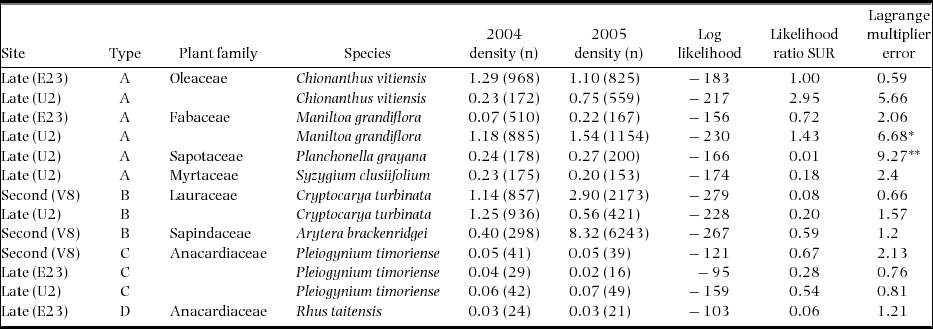
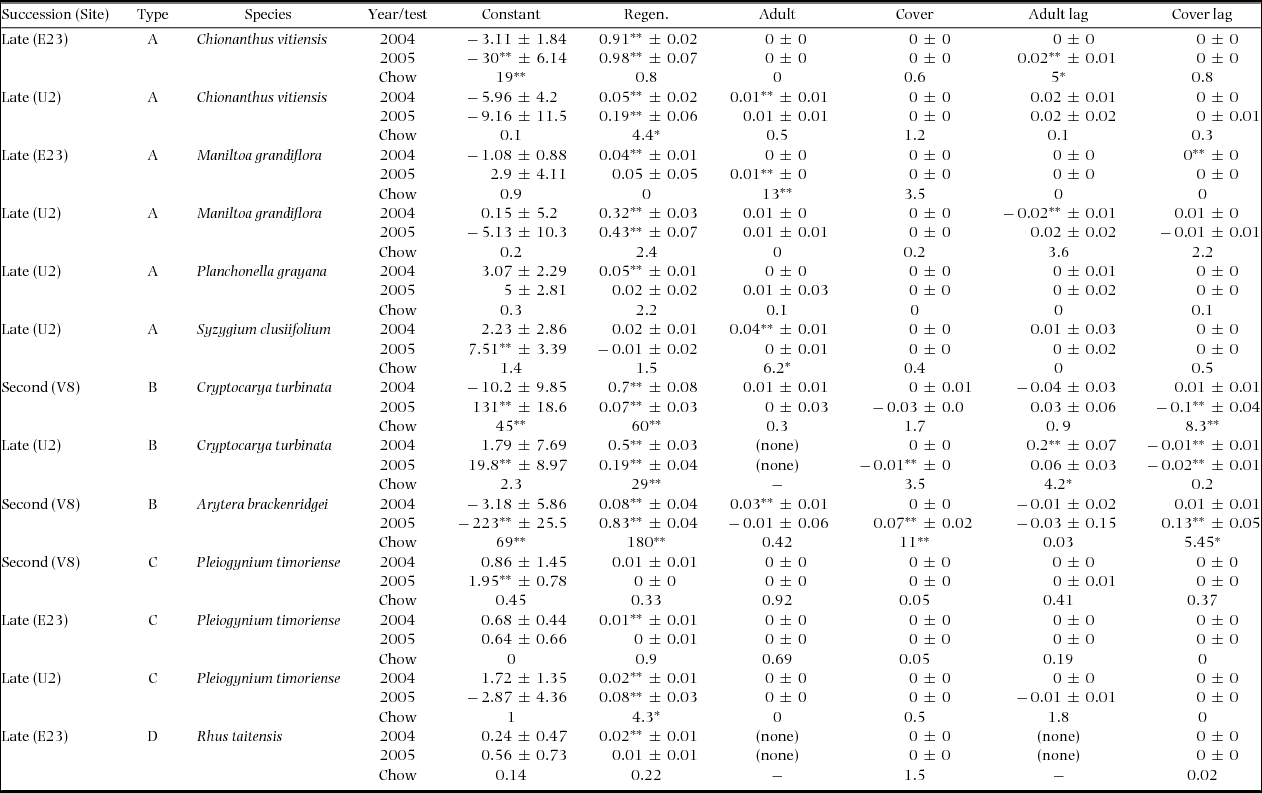
Among those species whose juvenile density was surveyed in the late-successional and second-growth plots in both years, density was typically higher in 2005, with large new cohorts of recruits (Table 1 and Franklin Reference FRANKLIN2007). The likelihood ratio tests for cross-equation error correlation based on the SUR indicate no significant time-wise correlation. Model residuals were spatially autocorrelated (P < 0.05) for two large-seeded, shade-tolerant (A-type) species (Maniltoa grandiflora, Planchonella grayana) in one late-successional site (Table 1). Significant differences between estimated coefficients for 2004 versus 2005 were identified, often because a predictor was significant in one year but not the other (Table 2). The intercept (constant) was frequently significant in 2005 when juvenile densities were generally higher, but not 2004. Otherwise there was no single pattern (of change in the magnitude of coefficients for various predictors) among species or within successional types. B-type (shade-establishing) species tended to be more strongly associated with tree cover (Arytera brackenridgei) or gaps (Cryptocarya turbinata) in 2005 when they were more abundant than in 2004. A-type (late-successional) species were in some cases more strongly associated with conspecific adults in 2004 and in other cases in 2005 (Table 2). The two surveys captured the interannual variability in recruitment but provided complementary information rather than revealing any strong trend in the correlates of recruitment.
Summary of juvenile density (m−2) (and total n) surveyed in the same secondary and late-successional sites in the Vava'u Island Group, Tonga, in 2004 (Franklin & Rey Reference FRANKLIN and REY2007) and 2005 (Franklin Reference FRANKLIN2007), and of Seemingly Unrelated Regressions (SURs) relating juvenile density to site factors (see Table 2; N = 30 subplots): Log Likelihood for joint model across years; Likelihood Ratio Test for cross equation error correlation in SUR models; Lagrange Multiplier test for spatial autocorrelation in model residuals (significant differences * P < 0.05; ** P < 0.01).

Seemingly Unrelated Regressions (SURs) coefficients (and standard errors) for models relating juvenile density to site factors (see also Table 1) in second-growth and late-successional sites in the Vava'u Island Group, Tonga. Type, refer to text. Explanatory variables: Regen, density of juveniles of other species in subplot; Adult, basal area of conspecific adults in subplot; Adult lag, basal area of conspecific adults in area including a two subplot buffer around each subplot; (none), no conspecific adults in subplot; Cover, basal area of all trees in subplot; Cover lag, basal area of all trees in area including a two subplot buffer around each subplot. Chow test for coefficient differences between years. Significance: * P < 0.05; ** P < 0.01.

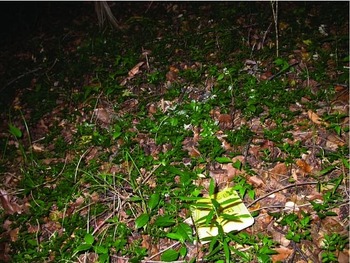
Juvenile establishment of shade-tolerant (A) species in late-successional sites tended to be positively associated with productive sites (regeneration), conspecific adults (adult) and/or with shady, dense patches of forest (cover; Table 2). In second-growth forest, however, juveniles of shade-establishing (B species) Cryptocarya turbinata tended to be negatively associated with patches of dense tree cover (cover), and show positive or no relationship to nearby conspecific adults (adult). Only one B species (Arytera brackenridgei) was positively associated with cover. These recruitment patterns in second growth were even more apparent in 2005 than 2004 (coefficients had greater magnitude and significance) when shade-establishing species were abundantly recruiting (Table 1, Figure 1). The common gap-establishing (C, D), bird- and bat-dispersed species Pleiogynium timoriense and Rhus taitensis only showed a positive correlation with regeneration and not with the other measured site variables (Table 2).
Second-growth forest plot Vaka'eitu 8 (V8), Vava'u Island Group, Tonga, showing abundant recruitment of seedlings in 2005, 3.5 y following tropical cyclone disturbance. Most visible seedlings are Arytera brackenridgei (compound leaf) and Cryptocarya turbinata (simple leaf) – see Table 1. Notebook is 12 ×18 cm for scale. Photo by J. Franklin, 22 July 2005.

DISCUSSION
Shade-tolerant (A-type) species were the most abundant recruits in late-successional sites where the same species dominate the overstorey, and shade-establishing (B-type) species were the most abundant recruits in second-growth forest where they also constitute the canopy trees. This pattern of species recruitment following a gap-forming natural disturbance reinforces the important role of remnant trees as biological legacies following canopy loss (Elmqvist et al. Reference ELMQVIST, WALL, BERGGREN, BLIX, FRITIOFF and RINMAN2001, Fensham & Butler Reference FENSHAM and BUTLER2004, Foster et al. Reference FOSTER, KNIGHT and FRANKLIN1998). A second year of sampling also confirmed the divergent successional trajectories previously observed for second-growth and late-successional tropical forest in Vava'u (Franklin Reference FRANKLIN2007) and elsewhere (Barlow et al. Reference BARLOW, LENNOX, FERREIRA, BERENGUER, LEES, NALLY, THOMSON, FERRAZ, LOUZADA, OLIVEIRA, PARRY, RIBEIRO DE CASTRO SOLAR, VIEIRA, ARAGÃO, BEGOTTI, BRAGA, CARDOSO, JR, SOUZA, MOURA, NUNES, SIQUEIRA, PARDINI, SILVEIRA, VAZ-DE-MELLO, VEIGA, VENTURIERI and GARDNER2016, Chazdon Reference CHAZDON2014). The hypothesis that patterns of species recruitment following disturbance are robust to interannual variation in recruitment is supported with respect to different forest successional stages on the landscape.
In late-successional forest, shade-establishing species were recruiting where overstorey trees were dense, near adult trees of the same species, and associated with sites where juveniles of all species were found – that is, in shady, productive sites to which they were able to disperse (Denslow Reference DENSLOW1987, Wright Reference WRIGHT2002). Species-specific seedling microhabitat associations have been identified in other species-poor tropical island forests (Inman-Narahari et al. Reference INMAN-NARAHARI, OSTERTAG, CORDELL, GIARDINA, NELSON-KAULA and SACK2013). Furthermore, juveniles establish near conspecific adults in disturbed forests where seed dispersers have been extirpated (Zambrano et al. Reference ZAMBRANO, COATES and HOWE2014).
Juveniles near conspecific adults may seem counter to the expectation of disproportionately high mortality of juvenile trees near adults in tropical forest, i.e. the Janzen–Connell model (Connell Reference CONNELL, den Boer and Gradwell1971, Janzen Reference JANZEN1970). High mortality is expected because of the accumulation of above- or below-ground natural enemies near adults (Mangan et al. Reference MANGAN, SCHNITZER, HERRE, MACK, VALENCIA, SANCHEZ and BEVER2010). Our findings do not refute or support the Janzen–Connell model, however. Initial seedling recruitment is expected to be clustered near adults, and our study detected this, but our limited observation window is not adequate to detect age-specific, distance-dependent mortality (Clark & Clark Reference CLARK and CLARK1984).
In second-growth forest, shade-establishing, gap-growing species dominated the overstorey. They were abundantly recruiting where tree abundance was low. This is consistent with studies that have shown that second-growth tropical forest tends to lack gaps and gap species are limited to recruiting in those diffuse gaps (Dupuy & Chazdon Reference DUPUY and CHAZDON2008).
Although the same predictors of juvenile density were often significant for a given species and successional plot, their coefficients were frequently significantly different between years. Thus the hypothesis that factors related to the spatial patterns of juveniles within plots are invariant between years is weakly supported. These differences in coefficients may not be unexpected when recruitment is highly variable (Table 1) and the predictors (proximity of conspecific basal area, total basal area) are simple surrogates for direct causal factors (seed source, gaps, shade). Surveys over greater periods of time are required to fully understand juvenile recruitment dynamics in tropical forests (Harms et al. Reference HARMS, WRIGHT, CALDERA, HERNANDEZ and HERRE2000). SUR provided a useful modelling framework for analysing juvenile recruitment patterns, nonetheless, in this little-studied, remote tropical forest for which only 2 y of observations were available. The two surveys provided complementary information rather than revealing any expected temporal trend in the correlates of recruitment (for example, greater structuring of juvenile populations, among more shade-tolerant species with time since disturbance). The use of SUR allowed for a pooling of observations across these two time periods resulting in improved estimation efficiency of model parameters. This regression framework provides a spatially explicit analysis method, accounting for spatial and temporal variability, in systems where sufficient data do not yet exist for more mechanistic modelling of forest regeneration dynamics (Huth & Ditzer Reference HUTH and DITZER2001, Liu & Ashton Reference LIU and ASHTON1998, Uriarte et al. Reference URIARTE, CANHAM, THOMPSON, ZIMMERMAN and BROKAW2005). Using this framework highlighted the heterogeneity in recruitment across only two years after a moderate canopy disturbance, and emphasizes the need for long-term monitoring of tropical forest dynamics following human and natural disturbance (Chazdon Reference CHAZDON2003). Long-term studies of forest dynamics are still limited to relatively few sites, many of them emphasizing tree-fall gap recruitment rather than large-scale disturbance (Anderson-Teixeira et al. Reference ANDERSON-TEIXEIRA, DAVIES, BENNETT, GONZALEZ-AKRE, MULLER-LANDAU, WRIGHT, ABU SALIM, ALMEYDA ZAMBRANO, ALONSO and BALTZER2015).
ACKNOWLEDGEMENTS
Permission to conduct this research was granted by the Kingdom of Tonga (Cabinet Decisions 648 and 906) and supported by the National Geographic Society's Committee on Research and Exploration (5132-93) and the San Diego State University Research Foundation. We thank Amanaki, N. Afeaki, D. Drake, S. Fotu, M. Halefihi, T. Hoponoa, K. McConkey, K. Paea, N. Prescott, H. Schmalbach, L. Spears-Lebrun, D. & L. Smith, D. W. Steadman, Filipe Tonga, Fabiano Tonga, M. & L. Tonga, Hon. Fanetupouvava'u Tuita and K. Vaipuna for advice and assistance. R. and R. Bryce (CocoNet) generously provided boat transport to field sites in 2005.