1. INTRODUCTION
Education is not directly addressed in America's founding documents, but it was never far from the minds of those who wrote them. Thomas Jefferson described education as “the most certain and most legitimate engine of government.” “Educate and inform the whole mass of people,” he argued, “enable them to see that it is in their interest to preserve peace and order, and they will preserve it.”Footnote 1 In his first message to Congress in 1790, George Washington described knowledge as the “surest basis of public happiness.” “In one in which the measures of government receive their impressions so immediately from the sense of the community as in ours,” he stated, “[education] is proportionately essential.”Footnote 2 In the Northwest Ordinance, passed by the Confederation Congress in 1787, lawmakers declared, “religion, morality, and knowledge, being necessary to good government … schools and the means of education shall forever be encouraged.” Two years before the Northwest Ordinance, the Confederation Congress adopted a land ordinance stipulating that one-sixteenth of every western township be set aside for “the maintenance of public schools.”Footnote 3 The framers of the Constitution believed that only an educated citizenry could sustain a government founded upon consent and equality.
Despite a shared belief in the link between education and self-government, the framers did not “constitutionalize” education policy. Nowhere did they specify the source and quality of educational “encouragements”: how schools were to be funded, maintained, filled, and run, or who would make these choices. As a result, the location and relative power of government to provide children with an education has long been the subject of political contestation. By exploring debates over the federal government's role in guaranteeing Americans an education, we therefore gain important insights into the historical development of the American state.
By the late nineteenth century, primary and secondary schooling were “almost exclusively a state and local concern.”Footnote 4 Individual states set out in their constitutions how they intended to provide children with a “public” education: one that was “free, open to all students of a specified age … and financed and governed by public authorities.”Footnote 5 Schools were primarily funded through property taxes determined and collected by the states themselves.Footnote 6 Decisions about hiring, length of the school year, subjects taught, and building and renovations were also made by local officials. Inconsistency ruled. Per capita expenditures on schools in 1890, for example, ranged from a high of $4.29 (California) to a low of $0.44 (North Carolina).Footnote 7 Connecticut provided a 121-day “school year” for its children; in South Carolina, children attended for only fifty-one days per year. Signaling further the exclusive role played by state governments, the Department of Education was “downgraded” in 1869 to a bureau inside the Department of the Interior, making it, according to Morton Keller, “little more than a data-gathering agency.”Footnote 8 The federal government purchased and made available public land for secondary and elementary schools, but not much else.Footnote 9
Commenting on the superiority of state over federal authority in education, a report commissioned by the Hoover Administration in 1929 to study education reform proposals attributes support for local control to the conditions faced by early settlers. “The frontier was characterized by the relative isolation and necessarily self-contained nature of community life,” the report's authors argued. “Hence was developed a unique and powerful habit of local responsibility and control which was so much taken as a matter of course that it was at first universally accepted as the only proper basis of federal relations to education.”Footnote 10 This governing arrangement—state control, almost no federal involvement—remained in place until 1965, when Congress passed the Elementary and Secondary Schools Act (ESEA). As part of President Lyndon Johnson's Great Society program, the ESEA, for the first time, directed federal money to schools in districts serving children more likely to come from low-income, historically disadvantaged backgrounds.Footnote 11
We argue that the resilience of local control needs to be explained, not simply attributed to habit or tradition. Through multiple periods during which federal power expanded in significant ways—Reconstruction (1865–1877), the Progressive Era (1900–1916), and the New Deal (1932–1952)—the federal government's role in primary and secondary education went largely unchanged.Footnote 12 In this article we examine the first sustained effort to assert federal authority over primary and secondary schools, instigated during the 1880s by Senator Henry Blair (R-NH). Blair sought enactment of legislation that would turn Congress into a reliable source of funds and oversight for the nation's schools. Like the 1965 ESEA, Blair's proposal targeted money to those states most in need of federal support (more on this below). Early versions of the bill also empowered Congress to play a meaningful role in setting and enforcing standards as to how the money would be spent. Blair's efforts failed, but had he been successful, later political battles over a variety of issues related to equal access might have played out differently.Footnote 13 Furthermore, because the ESEA reflected principles central to late twentieth-century liberalism—bureaucratization and centralized administration—its implementation was judged according to “procedure and process” rather than a “focus on student or school results.”Footnote 14 Delaying federal intervention until the 1960s, in other words, had consequences for how the program was implemented.
Our analysis therefore contributes to a corpus of research examining the uneven course of American state development.Footnote 15 In the United States, periods of national state expansion are not evenly distributed over all aspects of the federal government. Federal power grew at different speeds, and with different levels of opposition. For this reason, political development should not be seen as a “single interruption in political and social life.” Instead, it unfolds “dynamically over time.”Footnote 16 Thus, we argue that the ESEA marks the end of a political conflict initiated in the 1880s, rather than simply one more policy enactment associated with the Great Society.Footnote 17 To explain how Congress enacted the ESEA, we need to understand how and why Great Society Democrats overcame or avoided obstacles that plagued would-be education reformers like Henry Blair. Thinking historically in this way—in particular by documenting the pivotal role race and nativism played in early conflicts over education policy—makes clear why contemporary debates over education also implicate issues of social and political equality.
Where the Hoover Administration sees “habit” and “universal acceptability” as explanations for the American commitment to local control, we instead identify a group of lawmakers who, for a variety of reasons, blocked Blair's effort to bring federal power to bear in education policy.Footnote 18 To substantiate this claim, we explore the decade between 1880 and 1890, during which Congress debated Blair's proposal. We describe the coalition that pushed versions of his bill through the Senate multiple times. We show that it won endorsements from Republican presidents, and it was central to the GOP's political agenda.Footnote 19 Yet after a decade of prolonged debate, with unified control of government, the Republican-controlled Senate surprised Blair in 1890 by voting to kill his bill. Its failure signaled the end, for generations, of meaningful efforts to provide federal aid to the nation's schools. That is, the Blair Bill was not only the first bill to propose direct federal aid to state primary and secondary schools, it was the only bill to do so that passed the House or Senate between the 50th Congress (1887–89) and the 80th Congress (1947–49).
Due to its substantive importance, as well as the interesting political debate it generated, the Blair Bill has received some scholarly attention.Footnote 20 David Bateman, Ira Katznelson, and John Lapinski, for example, explain how the fight over the Blair Bill suggests the “possibility of an alternative South” in which Southern Democrats and Northern Republicans worked across racial, partisan, and geographic lines on issues that “struck a compromise between a fading, but still real, national concern for the condition of southern blacks, and the local autonomy that was the overarching purpose of white Democratic politics.” Blair failed, they argue, because the Southern supporters he worked so hard to win over abandoned him in 1890.Footnote 21
We support this view. The Blair Bill sought to appropriate federal money to the states to support primary and secondary schools. The bill's formula stipulated that the amount of money a given state received annually would be based on the number of “illiterates” (a census-defined group) living within its boundaries.Footnote 22 Conditioning funding on literacy levels rather than population ensured that Southern states, with high proportions of illiterate residents, would receive almost two-thirds of the money appropriated.Footnote 23 Blair's plan also obligated any recipient state with segregated schools to distribute its portion of money equally. In so doing, the bill put the federal government on record supporting separate-but-equal schooling well before Plessy v. Ferguson (1896) declared it constitutionally acceptable. In short, Blair hoped to “buy” Southern Democratic support with federal aid and a promise not to interfere with school segregation. Yet by empowering Congress to set conditions on how the money would be appropriated, and by legislating oversight mechanisms—even weak ones—the Blair Bill would have reallocated the distribution of power between states and the federal government.Footnote 24
Yet we also expand on Bateman, Katznelson, and Lapinski's analysis of Blair's fragile coalition by exploring the behavior of northerners—both Republicans and Democrats—whose opposition played an important role in the bill's failure. Winning the support of Southern Democrats was central to Blair's strategy, but their votes alone were insufficient to ensure passage. Blair also needed the votes of those lawmakers representing non-Southern states with lower proportions of illiterate residents. The bill therefore included language explicitly prohibiting federal funds from going to support Catholic schools.Footnote 25 This provision fit a broader pattern of Republican Party hostility toward disproportionately Catholic, immigrant communities in the Northeast and Midwest.Footnote 26 The money Blair proposed to spend also fit with the Republican Party's economic commitments. By spending down the federal surplus, his bill undermined efforts by Democratic lawmakers to reduce the tariff.Footnote 27 Last, Blair wrote his bill seeking to win votes from those with some lingering commitment to the postwar civil rights agenda. Bateman, Katznelson, and Lapinski rightly argue that Blair's proposal was a “deeply ambivalent and uneven civil rights measure.”Footnote 28 It endorsed segregated schools and failed to provide a clear mechanism for punishing state officials who short-changed black schools. Yet the bill did win support from black civic organizations and civil rights activists.Footnote 29
In short, Blair's success hinged on the cooperation of a fragile coalition: tariff supporters, nativists, freedmen, and Southern Democrats. Analyzing votes in both the House and Senate, we demonstrate that such a coalition was possible, but failed to materialize under the weight of racial, economic, and regional tensions. More specifically, we show that Northern lawmakers representing constituencies with higher proportions of foreign-born residents opposed the bill.Footnote 30 Blair intentionally pitted those concerned with the Republican Party's nativism against advocates for federal aid, many of whom saw the bill as promoting black civil rights. He positioned himself as an inheritor of the GOP's historic commitment to racial equality, yet he also bolstered the party's hostile attitude toward immigrants, especially Catholics. This tension cost Blair much-needed political support.Footnote 31 In Blair's defeat we see Southern Democrats wholly opposed to the exercise of any federal power on behalf of black citizens cooperating with Northern lawmakers who believed that they had no obligation to provide an education to freed men and women living, primarily, in the South.
Understanding why the Blair Bill failed to pass offers insights into how the nation's education system remained, until the latter half of the twentieth century, protected from federal intervention. The durability of local control is not attributable to widespread endorsement of or “universal acceptance” of state over federal responsibility. Blair and his allies challenged, and nearly brought down, this governing arrangement.Footnote 32 Our analysis makes clear how and why local control went unchanged at what David Bateman and Dawn Langan Teele call a “relevant counterfactual node,” that is, a “temporally defined instance in which an outcome actually was possible but did not occur.”Footnote 33
Going into the 51st Congress, Blair had reason to be confident that his bill would pass. It had already passed the Senate three times, only to languish in the Democratically controlled House. After the 1888 elections, however, the Republicans would control the House, Senate, and presidency. Even if some Republicans opposed the bill, Blair had worked to cultivate bipartisan support. And since President Benjamin Harrison was a supporter of the bill, Blair felt confident that if he could get the bill through Congress, it would be signed into law. Local control was thus under credible assault and the political context seemed likely to ensure its demise. Yet the status quo went unchanged, and federal intervention would not occur until 1965.
Our analysis of the Blair Bill proceeds as follows. Section II describes how and why the Blair Bill made it onto the congressional agenda as often as it did. Drawing on the work of John Kingdon and Richard Valelly, we posit the 1880s as a moment when the “policy window” opened, allowing for potential reform.Footnote 34 Section III describes the Blair Bill, traces its legislative history, and sketches out the political battle it instigated. Here we also analyze roll call votes as a way to highlight the partisan rivalries that brought the bill down. Section IV concludes by articulating how our discussion of the Blair Bill debate sheds light on the Great Society's education reform bill.
2. NATIONAL POLITICS IN THE AFTERMATH OF RECONSTRUCTION
Political change, John Kingdon explains, is produced by the confluence of three different processes: problem recognition, presentation of alternatives, and political conflict.Footnote 35 When these processes collide, the result is what he describes as a “policy window.” When a policy window opens, those advocating for specific proposals find themselves with an opportunity to “push their pet solutions” or “draw attention to their special problems.” In short, status quo governing arrangements collapse when skilled politicians take advantage of an unsettled political environment to force action on a specific problem. Kingdon also makes clear that favorable circumstances for a policy change are not sufficient for change to occur. Skillful political entrepreneurship is also necessary. Entrepreneurs attach “solutions to problems, overcoming the constraints by redrafting proposals, and taking advantage of politically propitious events.”Footnote 36
American political development (APD) calls our attention to such entrepreneurs and highlights the formative role they play.Footnote 37 Less discussed, though still important, are the decisions of would-be entrepreneurs who failed in otherwise favorable circumstances. Failures of this kind do not simply highlight the political and institutional constraints faced by any lawmaker pushing a reform agenda. Near misses also allow us to consider plausible paths not taken and to appreciate the contingent nature of even long-standing governing arrangements.
Senator Henry Blair (R-NH) found himself with a window of opportunity in the 1880s to durably enhance federal power at the expense of the states. Provided with the chance to reallocate authority for primary and secondary schools from the states to the federal government, Blair's entrepreneurialism can be seen in his effort to build a national coalition composed of mostly Southern freedmen, white Southern Democrats, and Northern Republicans. This coalition, he believed, could force federal action to mitigate the illiteracy problem in a way that would simultaneously allow the GOP to pursue a broader political goal: its survival in the ex-Confederacy. Blair recognized that turmoil within the Democratic Party, as well as the desire among some southerners for federal money, made possible bipartisan and interregional cooperation. He wagered that an explicit appeal to southerners would compensate for any opposition from Northern Democrats or members of his own party.
Blair's wager grew out of an important political reality: The internal dynamics of both parties were particularly unsettled once Reconstruction ended in 1877. Forced to withdraw federal troops from the South, the GOP almost immediately saw its political position weaken. Through violence, intimidation, and voter fraud, Democrats acted quickly to reestablish political supremacy. As a consequence, Republicans found themselves confronting two questions: Did it make sense to commit time and resources to Southern states, where the GOP was increasingly unpopular? And, if so, what was the best strategy for winning support there?
Republican Presidents Rutherford Hayes, James Garfield, Chester Arthur, and Benjamin Harrison put varying amounts of effort into increasing the GOP's fortunes in the South. The strategies they implemented were not identical, but they do reflect the party's well-established political commitments and practices: a lingering commitment to black equality, support for the tariff, opposition to currency reform, generous use of patronage and federal aid to incentivize support from persuadable skeptics, and, increasingly, nativism targeting immigrant populations in urban centers.Footnote 38 By 1890, however, the party's internal tensions were such that Blair's federal aid proposal met with an insurmountable level of intraparty opposition.
Democrats also faced internal tensions. As a consequence of the Panic of 1873 and the economic austerity supported by some Democratic governors, a number of splinter groups emerged to speak on behalf of those most harmed by retrenchment.Footnote 39 Self-styled “Greenbackers,” “Independents,” and “Readjusters” voiced internal dissatisfaction with the party's positions on monetary policy, taxation, federal aid for internal improvements, and payment of state debts incurred during the Civil War. Held together by the war and then Reconstruction, “the disaffected partners could scarcely wait until Redemption was achieved to air their grievances and fall upon the leaders of the dominant element of Redeemers.”Footnote 40 Federal aid to public education—and the Blair Bill specifically—emerged as a wedge issue dividing Southern Democrats. Opinion throughout the South was mixed with some seeing education funding as a potentially vital source of aid, and others as an unconstitutional expansion of federal power.Footnote 41
Federal education aid also led to regional divisions. The Republican Party took the lead in spearheading aid proposals, and most of them explicitly endorsed prohibitions on any appropriations for Catholic institutions. This explicit anti-Catholicism reflected a broader “nativist revival” led by the party's reformist wing. Lawmakers like Blair were hostile toward Catholics and immigrants, who, they believed, were a threat to national cohesion and a potential source of labor radicalism.Footnote 42 Irish Catholics, in particular, “whose politics were overwhelmingly Democratic, whose Negrophobia was raw and overt, and whose concentration in cities and heavy use of alcohol,” argues Keller, “irritated Protestant Republican sensibilities.”Footnote 43 With record levels of transatlantic immigrants settling primarily outside the South—areas of the country in which the GOP had a clear partisan advantage—Republican lawmakers also recognized a growing political threat. Nativism served those Republicans not accountable to foreign-born voters. Also, with dramatically fewer foreign-born Catholics living in the South, lawmakers there faced less political pressure from constituents worried about nativist policy.Footnote 44
Taking office in 1877, Rutherford Hayes was the first Republican president to confront the dilemma generated by the newly redeemed Southern states. Unwilling to give up on the South, Hayes believed that continued Republican success there required a dual program of patronage and internal improvements. He immediately began appointing “ex-Confederates, old-line Whigs, Douglas Democrats, and plain Democrats.”Footnote 45 Overall, one-third of Hayes's Southern appointments during the first months of his administration went to Democrats.Footnote 46 In his diary, Hayes wrote that this patronage policy alone might “secure North Carolina, with a fair chance in Maryland, Virginia, Tennessee, and Arkansas,” and maybe even “Louisiana, South Carolina and Florida.”Footnote 47
Hayes combined his patronage with a program of federal aid. In his inaugural address, he acknowledged that the war had “arrested [the] material development,” of the South. To rebuild, the former Confederacy needed “the considerate care of the national government within the just limits prescribed by the Constitution and wise public economy.”Footnote 48 Hayes repeatedly “expressed himself in very decided terms in favor of a system of internal improvements calculated to benefit and develop the South.”Footnote 49 Part and parcel of this aid program was federal funding for schools. “Liberal and permanent provision should be made for the support of free schools by the state governments,” he argued, “and, if need be, supplemented by legitimate aid from national authority.”Footnote 50 The GOP thus actively sought to leverage material incentives to win Southern support.
Hayes's decision to link federal aid for internal improvements turned Blair's proposal into a vehicle for Republicans to pursue policy reform and political advantage. Federal aid addressed the concerns of many in the South who recognized that state funds were insufficient relative to what the region needed. Southern poverty handicapped state school systems. Per the 1880 Census, more than 72 percent of “illiterates” living in the United States called the South home.Footnote 51 Southern state governments collectively spent less than a fifth of what non-Southern states spent on education in 1880.Footnote 52 Blair acknowledged these trends when he argued that the “nation as such abolished slavery as a legal institution; but ignorance is slavery, and no matter what is written in your constitutions and your laws slavery will continue until intelligence, the handmaid of liberty, shall have illuminated the whole land.”Footnote 53
Federal aid for the nation's primary and secondary schools played a central role in the plans of postwar reformers, both black and white. W.E.B. Dubois's analysis of Reconstruction reported that “the first great mass movement for public education at the expense of the state in the South came from Negroes.”Footnote 54 These efforts showed real results. Between 1865 and 1870, the Freedman's Bureau spent more than $5 million on schools throughout the South. By July 1870, there existed 4,239 schools, which employed 9,307 teachers and educated 247,333 students.Footnote 55 One Vermont native who traveled to Mississippi and became active in the public school movement there declared education to be the “energizing agent of modern civilization.” It was an “answer to the race problem in southern society” because only schooling could “enlighten the white masses” and thereby erode their anti-black prejudices.Footnote 56 Black citizens in particular viewed a commitment to education as central to their political and material advancement. According to Eric Foner, they were even willing to overcome their skepticism of segregated facilities because they believed that separate schools were better than no schools.Footnote 57 Daniel Crofts argues that the Blair's goal of providing federal aid to schools represented “the one politically promising piece of national legislation which offered something blacks wanted.”Footnote 58 Black newspapers editorialized in favor of the bill, black historian George W. Williams called it “the grandest measure of our times,” and in September 1883, the Colored National Convention endorsed Blair's proposal.Footnote 59
Yet for white audiences paying attention in the late nineteenth century, Blair's invocation of slavery carried a double meaning. First and most obviously, Blair was referring to the central outcome of the war: A largely illiterate population of ex-slaves now expected to play a role in civic life. Yet Republicans also frequently portrayed the Catholic Church as an institution opposed to human freedom. In a speech to Civil War veterans, for example, President Ulysses Grant endorsed federal aid to public schools. In the same speech, he condemned any appropriation for Catholic schools because, he proclaimed, they teach “superstition, ambition, and ignorance.”Footnote 60 In his 1875 campaign for governor of Ohio, future president Hayes explained his plan to use debate over federal aid to public schools as a weapon to contest the influx of “Catholic foreigners.” In speeches backing Hayes's gubernatorial campaign, future president James Garfield portrayed the Church as “moving the whole of its front against modern civilization.” “Our fight in Ohio,” he went on, “is only a small portion of the battlefield.”Footnote 61 Federal aid advocates saw in public schools an opportunity to contend with what they portrayed as an “invasion” of foreigners who threatened to grow the ranks of radicals and Catholics.Footnote 62 Even participants at the annual convention of the National Education Association convention in 1888 linked public school education with the fight against nonnative residents.Footnote 63
The plans hatched by liberal reformers, and implemented throughout the South, proved expensive. As the troops withdrew, and the nation tired of the Reconstruction project, so did the momentum for their continuation. Democratic-controlled state houses abolished boards of education, cut state and local property taxes, and “all but dismantled the education systems established during Reconstruction.”Footnote 64 State funds appropriated for public education were frequently used to pay interest on state debt, so teachers frequently went without pay.Footnote 65 So dire was the threat to Southern schools, argued one reformer, that the “little that has been done [already] … far surpasses anything that the friends of education can or will do in the South for the next twenty years if they are compelled to rely upon their own resources.”Footnote 66
As Democratic state governments retrenched, factions within the party emerged to request federal money. Disaffected Democrats, in other words, supported Blair. For example, Readjusters in Virginia—a splinter faction of agrarian Democrats—fought to reopen public schools for blacks and whites alike after the legislature defunded the state's young school system.Footnote 67 They also broke with the party in calling for the “readjustment” of state war debts so that more money could be spent on the economically distressed.Footnote 68 This aspect of their agenda departed from the GOP's commitment to “fiscal conservatism”—hard money, balanced budgets, and industrial tariffs. And while Henry Blair counted himself among the party orthodoxy, he campaigned for Readjuster candidates prior to the 1882 election because of their support for public education. Blair was thus willing to set aside potential disagreement over economic policy in order to convince southerners to support the bill.
Support for public education funding from Democratic dissidents proved particularly important once President James Garfield embraced a “divide the Democrats” political strategy by promoting Southern candidates affiliated with various splinter groups. Following Garfield's assassination, President Chester Arthur continued working to “unite Republicans, Readjusters, Greenbackers, Independents, and ‘Liberals’” in order to displace the Democratic state governments.Footnote 69 Secretary of the Navy William E. Chandler outlined this strategy in a letter to Senator James Blaine (R-ME). “Our straight Republican, carpet-bag, Negro governments … have been destroyed and cannot be revived,” he wrote, “and without these coalitions or support from Independents we cannot carry enough southern votes to save the House from Bourbon Democratic control, and carry the next presidential fight.”Footnote 70 Victory in the South—a GOP goal throughout the 1880s—required them to make common cause with local whites.
Arthur's plan to ally the GOP with Democratic dissidents is important for two reasons. First, it generated intraparty tensions. In seeking the support of free silver and anti-debt advocates, Arthur and his supporters would force some Republicans to accept compromises to important planks of the party's pro-business agenda. Next, and most importantly, Arthur's approach failed. When he took office, Republicans controlled the White House and both chambers of Congress.Footnote 71 In the 1882 midterms, however, the GOP suffered a crushing defeat, resulting in a seventy-nine-seat disadvantage in the House and a much smaller majority in the Senate. In 1884, Democrat Grover Cleveland was elected president, and the Democrats would continue to control the House during his first administration. During these years, Republican and Independent electoral efforts in the South faltered considerably.Footnote 72 By the late 1880s many Republicans were losing faith in the prospect of an interregional coalition that included disaffected Democrats and black citizens.
Following the 1888 election—when Republican Benjamin Harrison was elected president and the GOP regained control of both chambers of Congress—Republicans acted on this skepticism when they pushed a federal elections bill, which sought to shift the power to manage House elections from the states to the federal judiciary. This effort failed when a GOP faction in the Senate—those referred to as “silver Republicans”—defected and joined with Democrats to kill the bill.Footnote 73 The GOP's western wing would also prove pivotal to the fate of Blair's proposal. In the early 1880s, however, Blair was confident that he could put together a coalition of Republicans and Southern Democrats to get his bill passed. His confidence was justified by inter- and intraparty tensions that made possible this kind of unlikely political coalition.
The 1880s were a time of “insecure majorities” and, consequently, intense partisan conflict.Footnote 74 At the same time, conflict raged within each of the two major parties. Blair sought to capitalize on this moment by pushing a reform proposal, addressing a salient public problem, in a way designed specifically to win bipartisan supporters. Had he been successful, Blair may have set the stage for additional cooperation across partisan and geographic lines even as he eroded local control of education. We now turn to a discussion of the debate over the Blair Bill, which will reveal the reasons for Blair's failure.
3. THE BLAIR EDUCATION BILL
Entering the House of Representatives in 1875, Henry Blair almost immediately demonstrated interest in education policy. Even before he was the official Republican nominee, Blair wrote William E. Chandler—then a powerful GOP newspaperman in New Hampshire—to request “some data showing the present condition of the cause of education in the South and the means of showing the work accomplished there by the Republican Party among both whites and blacks.”Footnote 75 Blair recognized primary and secondary education policy as ripe for reform. He also recognized that pursuing such reform offered GOP lawmakers an opportunity to build a national, bipartisan, interracial coalition.
After serving two House terms, Blair was elected to the Senate in 1879. In his first term, Blair was made chairman of the Committee on Education and Labor. Soon thereafter he introduced S. 151—“to aid in the establishment and temporary support of common schools.”Footnote 76 This bill proposed $105 million in federal appropriations distributed over ten years, allocated in proportion to the number of “illiterates” more than ten years old living in a given state. This provision guaranteed that approximately 75 percent of all money appropriated would go to Southern states because illiteracy rates there were dramatically higher than in the North.Footnote 77 The bill also mandated that recipient states appropriate funds equal to those provided by the federal government. In its first year, the federal government would spend a total of $15 million; for each subsequent year, the total amount appropriated would decrease by $1 million. Blair structured the bill in this way to preempt arguments that he sought a federal takeover of the nation's schools. He claimed that the allocation formula would allow states to use federal funding as a way to jump-start self-sustaining public education systems. Permanent federal intervention would not therefore be necessary.Footnote 78 To ensure that the funds would be spent wisely, the bill created a federal supervisor for each state who was empowered to recommend a rescission of funds as punishment for fraud or misuse.
In an important concession to Southern members, S. 151 “demanded literal adherence to the idea of ‘separate but equal.’”Footnote 79 In particular it stipulated, “nothing herein shall deprive children of different races, living in the same community but attending separate schools, from receiving the benefits of this act, the same as though the attendance therein were without distinction of race.”Footnote 80 This provision, however, guaranteed that the only way white children would receive federal funds would be for states to ensure that schools serving black children received an equal proportion of total funds spent. If states did not provide equal allocation to black schools, they would have to forego federal support.
In a three-hour speech advocating for his bill, Blair marshaled mountains of census data to illustrate “actual condition of popular education in this country.” He revealed how little Southern states in particular were doing to educate their children. Republican government would only survive if the public could read and write, he claimed. Universal education was one part of a strategy for ending the last “part of the [Civil] War” against the “forces of ignorance.”Footnote 81 Providing federal funds to elementary and secondary schools was an important way in which the government worked to preserve itself.Footnote 82 Accordingly, Blair argued, the opportunity for learning to do both must “be provided at the public charge.”Footnote 83 Many Southern Democrats endorsed this view. Senator Lucius Lamar (D-MS), for example, declared his support for S. 151 because “no state could stand secure but on the ground of right, virtue, knowledge, and truth.”Footnote 84
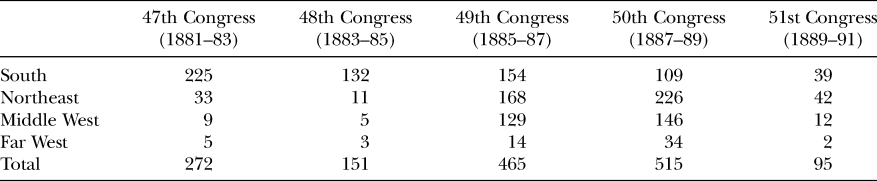
Congress took no action on Blair's proposal prior to adjournment in August 1882. Between August and December, when Congress reconvened for a lame-duck session, President Arthur, the American Social Science Association, and the National Education Assembly endorsed S. 151.Footnote 85 The Interstate Education Alliance—a coalition of white, Southern educators—also called on Congress to enact the proposal. Teachers’ associations, associations of state superintendents, and other local civic organizations operating throughout the South also mobilized to push for the bill.Footnote 86 Finally, as Table 1 illustrates, Congress received 272 petitions calling for the Blair Bill's enactment between 1881 and 1883.Footnote 87
Number of Petitions Supporting the Blair Bill by Region, 1881–1891
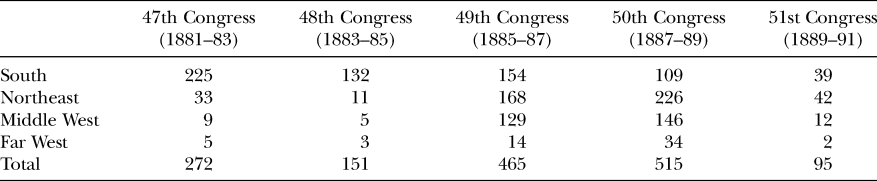
Source. Adapted from Gordon Canfield Lee, The Struggle for Federal Aid, First Phase: A History of the Attempts to Obtain Federal Aid for the Common Schools, 1870–1890 (New York: Bureau of Publications, Teachers College, Columbia University, 1949), 95.
Responding to these demonstrations of support, Blair moved quickly to procure a special order that would bring his bill up for debate. Here he ran into the first instance of Republican opposition. Senator John Logan (R-IL) had authored his own education proposal, which he did not want to set aside. Where the Blair Bill sought to fund education through general revenue, Logan's bill aimed to raise funds through a new tax on whiskey.Footnote 88 More importantly, Logan also opposed appropriating money in proportion to state illiteracy rates. Speaking on the floor, he argued “that the proposition to distribute this money according to illiteracy is a proposition to ask a certain number of states to pay taxes to educate others. I do not think the country is in favor of any such proposition.”Footnote 89 The sectional basis of Logan's opposition would consistently handicap Blair's efforts. Logan reflected a view held by some within the GOP that the federal government owed nothing to black citizens beyond emancipation. From Logan's perspective, residents of Illinois had no obligation to support the education of black southerners only recently freed from hundreds of years of slavery. Republican infighting thus led the Senate to table both education bills until the next Congress met.Footnote 90
When the 48th Congress (1883–85) convened in December 1883, Blair immediately reintroduced his bill.Footnote 91 By this time, the political environment had shifted considerably. While the Republicans controlled the presidency and had a two-vote majority in the Senate, the Democrats now controlled the House.Footnote 92 The new political context convinced Blair that his policy and political goals could not be achieved without the support of Southern members. This largely explains the substantive differences between S. 151 and the newly introduced bill, S. 398. Highly suspicious of federal intervention into state functions, Southern Democrats opposed the federal supervisors created by Blair's initial bill. In an August 1883 speech before the National Education Assembly, Blair made known his willingness to instead allow for state administration of funds.Footnote 93 As we discuss below, the effort to weaken this provision led to intraparty conflict among Republicans.
Blair also worked to maintain Southern support by once again protecting funding for states with segregated schools. Despite being a concession to Southern whites, this provision did not disqualify the bill in the eyes of many black citizens. An April 1884 story in the Washington Post, for example, describes a “largely attended mass meeting” organized by the Union Bethel Historical and Literary Association to support the Blair Bill. Frederick Douglass and other notable black public intellectuals were among those at the meeting.Footnote 94 Douglass would continue speaking on behalf of the bill until it failed for the final time in 1890.Footnote 95 Black teachers’ associations in some Southern states also pressed elected officials to support the bill.Footnote 96 While Daniel Crofts makes clear that black civic organizations and leaders were not uniformly supportive of Blair, he does find that many believed federal education funding to be a “ray of hope.”Footnote 97 In this way, the Blair Bill served as a political vehicle for Republicans to continue cultivating the support of black voters in the South.
Debate on Blair's new proposal began in March 1884. Once again, he began with a long floor speech built upon a foundation of education statistics culled from the 1880 Census. To meet the nation's educational need, S. 398 proposed to distribute $105 million over ten years. In addition, the bill called for funds to be allocated to states based on the illiteracy rate, required states to match one-third of federal funds appropriated over the first five years after enactment and dollar-for-dollar during the last five years, and allowed states—rather than a federal authority—to oversee the expenditures.Footnote 98
Blair spent a significant amount of time defending the separate-but-equal provision. He argued that separate but equal was acceptable as long as it was enforced. “The distribution shall be made in such a way as to equalize the money that goes to each child per capita throughout the state … to produce an equalization of school privileges throughout the state,” Blair claimed, “I do not think that anything could be more just.”Footnote 99 Blair was left to put his faith in state-level officials throughout the South who would be responsible for distributing the money Congress appropriated.
Senate consideration of Blair's proposal ran through March and into April 1884. Over the course of these four weeks, Blair again confronted opposition from fellow Republicans—mostly from the West. For example, John Ingalls (R-KS) questioned the view that “we are under any obligation to educate the blacks of the South.”Footnote 100 Similarly, Joseph Dolph (R-OR) argued that states outside the South had no obligation to provide funds to educate the poor white citizens or poor black citizens of the former Confederacy.Footnote 101 This internal resistance to the bill demonstrates in early form the Silver-Republican bloc whose influence would peak in the 1890s.Footnote 102 Contemporaneous observers also noted the regional bases of GOP opposition. A March 1884 article in the Washington Post, for example, argued that should the bill fail, Republican “sectional conspirators” would be to blame.Footnote 103
Democrats, on the other hand, tended to object for “constitutional” reasons. The 1884 Democratic Party Platform, for example, declared the party “opposed to all propositions which, upon any pretext, would convert the general government into a machine for collecting taxes to be distributed among the states or the citizens thereof.”Footnote 104 Contemporaneous news accounts attributed this provision to those who opposed the Blair Bill.Footnote 105 As we discuss more below, Democratic opposition also came from those who saw federal expenditures for education as a way to sabotage efforts to reduce the tariff.
To agree on a compromise, Senate Republicans met as a caucus and established a nine-member committee charged with developing a consensus approach to federal aid.Footnote 106 This committee produced a revised measure that appropriated $77 million over eight years, stipulated that states would not receive more money from the federal government than they spent on education at the state or local level, required that black and white schools receive equal funding, and mandated that states submit annual reports to the federal government detailing how they spent the money they received.Footnote 107
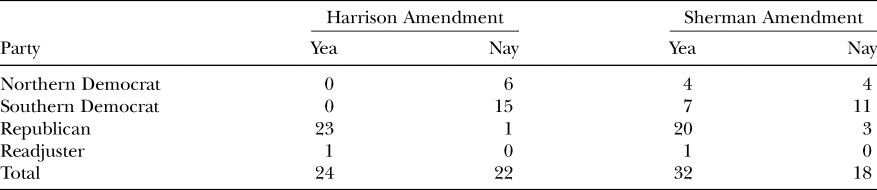
In early April 1884 the Senate considered important provisions to the newly revised bill. One such provision, offered by Senator Benjamin Harrison (R-IN), addressed Blair's willingness to trust that Southern members would distribute money equally between schools for black children and those for white children. Harrison's amendment empowered the secretary of the interior to “hear and examine any complaints of misappropriations or unjust discrimination in the use of funds.”Footnote 108 The amendment also required the secretary to present the findings of his investigation to Congress before any additional money would be spent in the state under suspicion. In this way, Harrison addressed a concern raised by some Republicans that the bill did not provide enough federal oversight. Harrison's amendment passed 24–22, in a near party-line vote (see Table 2).Footnote 109 Southern Democrats’ united opposition demonstrated their continued resistance to the exercise of federal power for the purpose of ensuring equal treatment of black citizens.
Senate Votes on Harrison and Sherman Amendments, 48th Congress
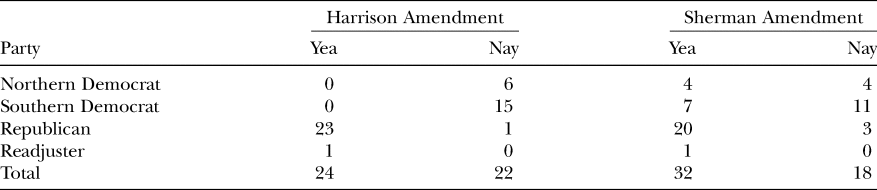
Source. Congressional Record, 48th Congress, 1st Sess., April 7, 1884, 2719; April 7, 1884, 2093.
Maintaining the support of this fragile coalition also led the GOP to adopt an amendment authored by Senator John Sherman (R-OH). The Sherman amendment explicitly prohibited Congress from spending any money on “sectarian” schools. While Sherman proclaimed his intentions were simply to keep government from “propagat[ing] any faith,” it was clear to contemporaneous observers that he was actually targeting Catholics.Footnote 110 Significant opposition to Sherman's amendment, as well as the overall bill, appeared in widely distributed Catholic periodicals. The Catholic World, for example, warned its readers that the “Protestant orientation of the common school offered serious danger to Catholics.”Footnote 111 Sherman's amendment passed 32–18. But unlike the vote on the Harrison amendment, there were intraparty divisions. As Table 2 indicates, the GOP supported the Sherman amendment by a wide margin (20–3), while the Democrats were split (11–15).Footnote 112
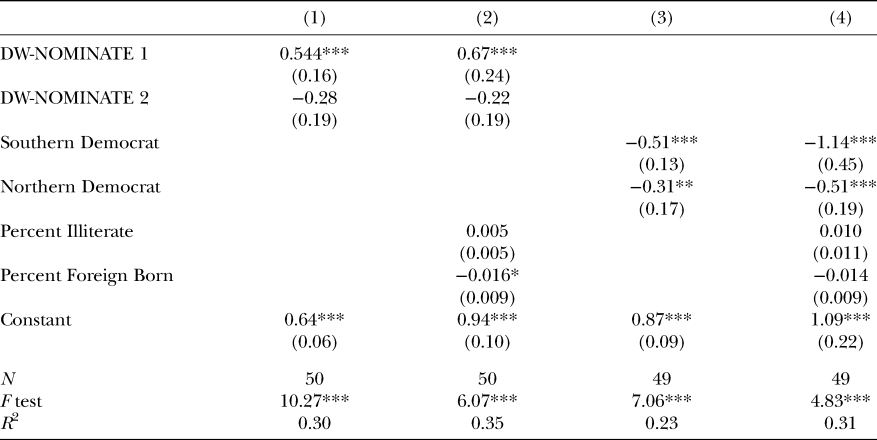
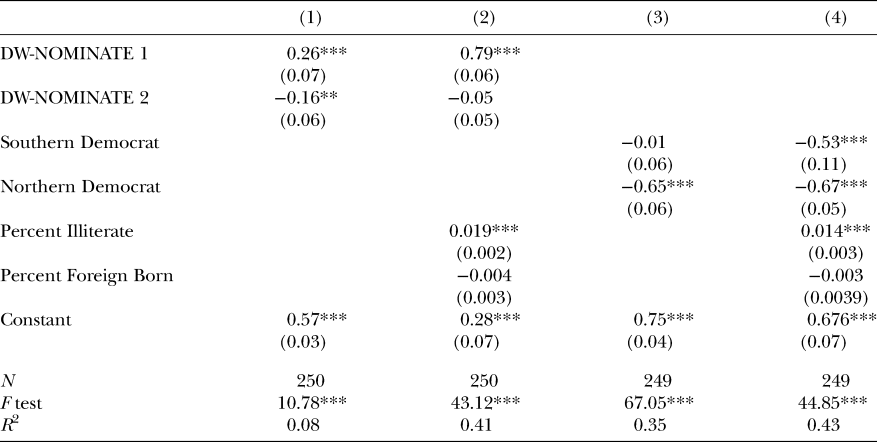
To further illustrate those factors influencing votes for and against Sherman's amendment, we examine this roll call in a multivariate regression model. Here we are primarily interested in the extent to which nativist sentiment motivated members to support Sherman's amendment. The dependent variable is a “Pro-Sherman Vote,” denoted as 1 if the senator voted for the Sherman amendment and 0 otherwise. Our independent variable of interest is the percentage of foreign-born citizens living in a given senator's state.Footnote 113 We expect that senators representing states with higher levels of foreign-born residents would be less likely to support the Sherman amendment (all else equal) due to concerns about angering a politically active subset of their voters.Footnote 114 To control for other factors that might influence a senator's vote, we include measures of each senator's ideology, as measured by first- and second-dimension DW-NOMINATE scores. Traditionally, the first NOMINATE dimension is seen as distinguishing members based on their attitudes toward government intervention into the economy. A more “liberal” member (negative on the NOMINATE scale) would support intervention, while a more “conservative” member (positive on the NOMINATE scale) would oppose it.Footnote 115 Note that in the late nineteenth century, positive scores register support for the GOP's economic agenda (pro-tariff, hard money), while negative scores register opposition to that program.Footnote 116 The second NOMINATE dimension sometimes picks up additional cleavages over time; however, in the 49th Congress, no additional cleavage is apparent.Footnote 117 Nevertheless, for completeness, we include it. To measure partisanship, we include dummy variables for Southern and Northern Democrats (with Republican thus representing the excluded category).Footnote 118 Finally, we control for the illiteracy rate in a given state, as lawmakers from states with more “illiterates” stood to gain in purely monetary terms from Blair's proposal.
The results, as reported in Table 3, provide some confirming evidence for our claim about the influence of nativism. In Model 2, we find a negative and significant relationship between support for Sherman's amendment and the proportion of foreign-born residents.Footnote 119 This relationship fits with John Higham's claim that the reformist wing of the GOP held deeply anti-immigrant attitudes.Footnote 120 There is also a strong relationship between a senator's party and his first-dimension NOMINATE score and his support for the Sherman amendment. In the former case, Democrats were significantly less supportive than Republicans. In the latter case, as a given senator's support for the GOP's economic program increases, so does the likelihood he will support Sherman's effort to prohibit state expenditures on Catholic schools.
Senate Vote on Sherman Amendment, 48th Congress
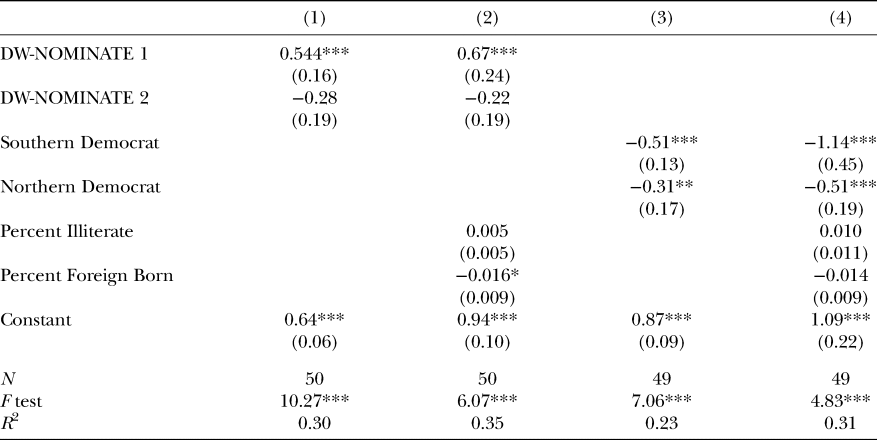
Notes. Coefficients are linear probability estimates, with standard errors in parentheses; *p < .10, **p < .05, ***p < .01.
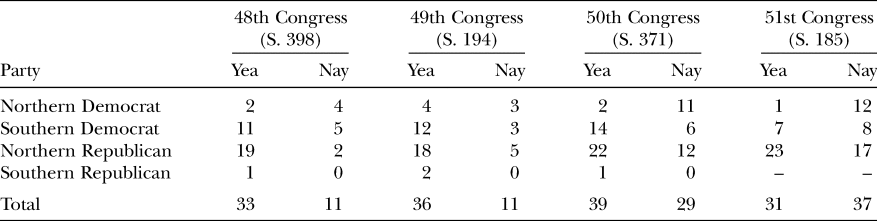
Following a series of votes on narrower aspects of the bill, the Senate passed S. 398 on April 7, 1884. As the first column of Table 4 illustrates, Republicans and Southern Democrats supported the bill by wide margins, while Northern Democrats (those outside the eleven states of the former Confederacy) opposed it.Footnote 121 Despite the lopsided Republican vote, GOP support was weaker than the numbers suggest. Eleven Republicans—including many of the bill's most outspoken opponents—recognized the political liabilities incurred by voting against the measure and chose to absent themselves instead of voting “no.”Footnote 122 The support provided by Southern Democrats would also prove weaker than the vote suggests. As sectional tensions increased during the latter half of the decade, it would be harder for Blair to keep this part of the coalition in line.
Final-Passage Votes in the Senate on the Blair Bill, 48th–51st Congresses
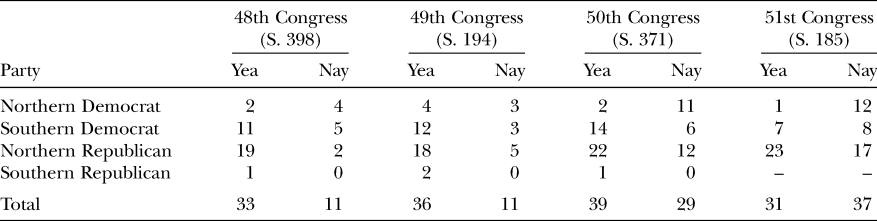
Notes. “South” here refers to the eleven ex-Confederate states. This differs slightly from the definition by the Inter-university Consortium for Political and Social Research (ICPSR) for this time period, which also categorizes Kentucky as a Southern state.
Source. Congressional Record, 48th Congress, 1st Sess., April 7, 1884, 2724; 49th Congress, 1st Sess., March 5, 1886, 2105; 50th Congress, 1st Sess., February 15, 1888, 1223; 51st Congress, 1st Sess., March 20, 1890, 2436.
Senate passage was just the first step for Blair and his supporters. Next, they needed to get a similar bill through the House, where the Democrats were in control. The chief obstacle proved to be House Speaker John C. Carlisle (D-KY). Styling himself as a Democrat in the mold of Andrew Jackson, Carlisle was dead-set against GOP tariff policy. One contemporaneous account favorable to Carlisle described his motivation as “support for the rights of people against monopolists of all kind.”Footnote 123 In the mid-1880s tariff reform—which meant the reduction of tariff rates—was central to the Democratic Party's agenda, putting the House majority at odds with Blair and his supporters. Carlisle's biographer makes clear that he believed “no greater danger threatened the States than the possibility that the surplus [which was created by the GOP's high tariff rates] would be used for purposes which would take from them their right to determine their individual and local affairs.”Footnote 124 Once implemented this is precisely what the Blair Bill would do.
As speaker, Carlisle leveraged his institutional power to prevent the House from taking up the Blair Bill prior to adjournment in early fall 1884.Footnote 125 This delay would prove particularly important because in November 1884, Democrat Grover Cleveland defeated Republican James G. Blaine in the presidential election. As a consequence, Gordon McKinney argues, “many Republicans who felt comfortable with a Republican president overseeing the Southern Democrats’ administration of the program were much less enthusiastic about having a Democratic administration in charge.”Footnote 126
The 48th Congress took no additional action on Blair's proposal, so he reintroduced the bill in early January 1886, near the start of the 49th Congress (1885–87). Public support for the measure was still high, as measured by the number of petitions received (see Table 1), a threefold increase over the prior Congress. Before debate began on the bill (S. 194), which was identical to the one passed in 1884, Blair wrote President Cleveland in an attempt to win his support. “Should the bill become law,” Blair argued, “that administration which should carry its provisions into execution would become illustrious in the annals of America and of mankind.”Footnote 127 Blair also worked hard to convince skeptical Republicans that the Democratic president could be trusted to administer the program. While Cleveland chose not to take a stand on S. 194, Senate Republicans again voted overwhelmingly in support (see Table 4).Footnote 128
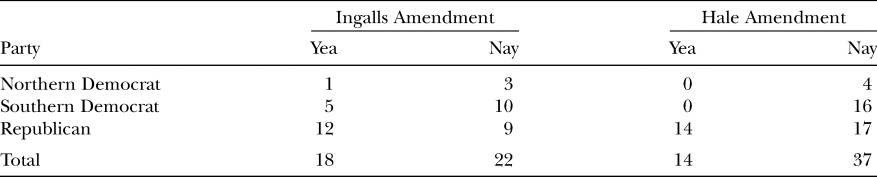
Here again, however, the vote tally obscures GOP skepticism toward Blair's proposal. Echoing many of the objections heard in 1884, Senator Ingalls (R-KS) inveighed against the bill because of its lopsided distribution of funds to Southern states. He then introduced an amendment mandating that the federal government distribute aid based on the number of school-age children living in a state, not the number of illiterates. If adopted, this amendment would have significantly reduced the money committed to the South, thereby putting at risk the Democratic portion of Blair's coalition.Footnote 129 Ingalls's amendment lost, 18–24. As Table 5 makes clear, however, it split the GOP, with twelve of twenty-one Republicans voting in favor.Footnote 130 This indicates again the precariousness of Blair's coalition, as a majority of Republicans supported an amendment that would have likely killed the bill.
Senate Votes on Ingalls and Hale Amendments, 49th Congress
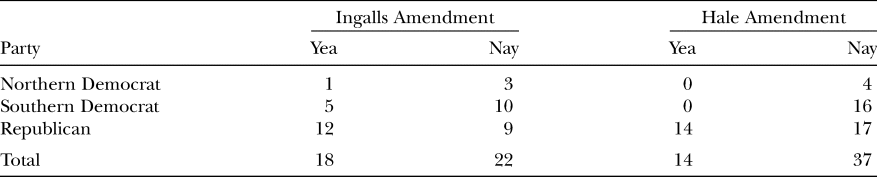
Source. Congressional Record, 49th Congress, 1st Sess., February 17, 1886, 1561; March 5, 1886, 2102.
The next Republican challenge came from Senator Eugene Hale (R-ME), whose amendment sought to change the bill's appropriation formula by stipulating that funding would be based on the “proportion that the illiteracy of white and colored persons … had to each other.”Footnote 131 If adopted, this amendment would have required states with the same number of white and black school-age children, but with two times as many illiterate black children, to spend twice as much money on black schools. “Because it threatened such a drastic reduction of possible federal aid for white public schools in the South,” Crofts explains, “the [Hale] amendment made the bill unpalatable” to many Southern senators.Footnote 132 As expected, Hale's amendment lost, 14–37, as all Southern Democrats opposed this change. But, perhaps ominously, it again split the GOP (14–17).Footnote 133
Despite the failure of both amendments, the GOP support that they received suggests that a significant number of Republican senators were looking for a politically acceptable way to undermine Blair's proposal. Many appeared to be voting for any provision with the potential to turn Southern members against the bill. And, overall, much of the support for these amendments came from the party's western/midwestern wing.
After passing the Senate, the Blair Bill once again ran into the intractable opposition of Speaker Carlisle. In the 49th Congress, Carlisle used the Education Committee, which he had packed with anti-tariff Democrats, as the vehicle for blocking House consideration of the proposal. The committee median on the first NOMINATE dimension for this Congress is negative (−0.201).Footnote 134 This supports the view that, broadly speaking, the economic commitments of committee members made it a hostile venue for the federal aid bill.Footnote 135 And, indeed, once the committee had the bill, it voted to postpone any action on the measure.Footnote 136
With federal aid languishing once again, Blair's counterpart in the House, Rep. Albert Willis (D-KY), put together a bipartisan coalition of members to goad the House into action. On March 29, 1886, Willis introduced a federal aid bill identical to the one that had passed in the Senate (H.R. 7266).Footnote 137 He then sought to have this version referred to the Labor Committee, a less staunchly anti-tariff committee, which he felt would deal with it more favorably. And while the Labor Committee median on the first NOMINATE dimension for this Congress was also negative (−0.141), it appeared more amenable to the GOP's economic agenda than the Education Committee.Footnote 138
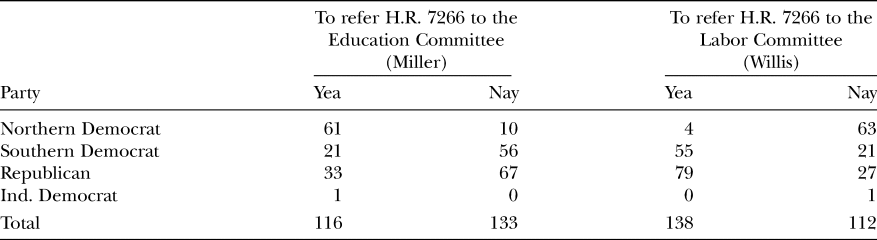
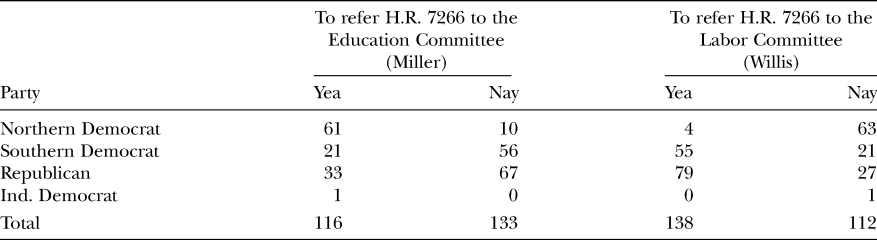
The House took two separate roll call votes on Willis's strategy (see Table 6). The first, spearheaded by James Miller (D-TX) was to force H.R. 7266 back to the Education Committee. That vote failed, 116–133. The House then voted to approve Willis's motion, 138–112, with a majority of Southern Democrats and a majority of Republicans opposing nearly all Northern Democrats. Because it was designed to ensure a final vote on the Blair Bill in the House, the Willis motion should be seen as a “test vote” to measure overall House support.Footnote 139
House Votes on Miller and Willis Motions, 49th Congress
Source. Congressional Record, 49th Congress, 1st Sess., March 29, 1886, 2881; March 29, 1886, 2882.
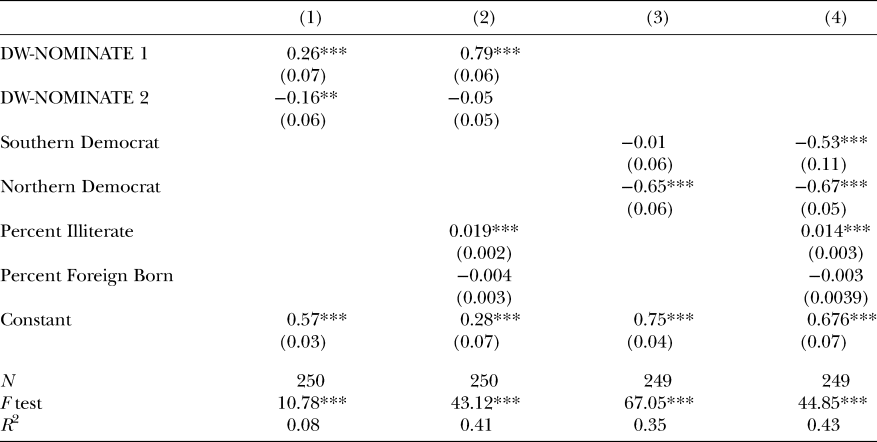
We examine the roll call on the Willis motion in a multivariate model to see how ideology, party, potential distributive benefits based on illiteracy rates, and district demographics—percent foreign born, specifically—influenced members’ votes. The results, which appear in Table 7, show the contours of the House coalition that Blair would need to rely upon. We find that support for the GOP's economic agenda significantly predicts support for the Willis motion. As a given member of the House becomes more conservative on the first NOMINATE dimension, his support for the Willis motion increases. State-level illiteracy rates are also a reliable predictor of member support, suggesting that House members were sensitive to the distributional benefits offered by the bill.
House Vote on Willis Motion, 49th Congress
Notes. Coefficients are linear probability estimates, with standard errors in parentheses; *p < .10, **p < .05, ***p < .01.
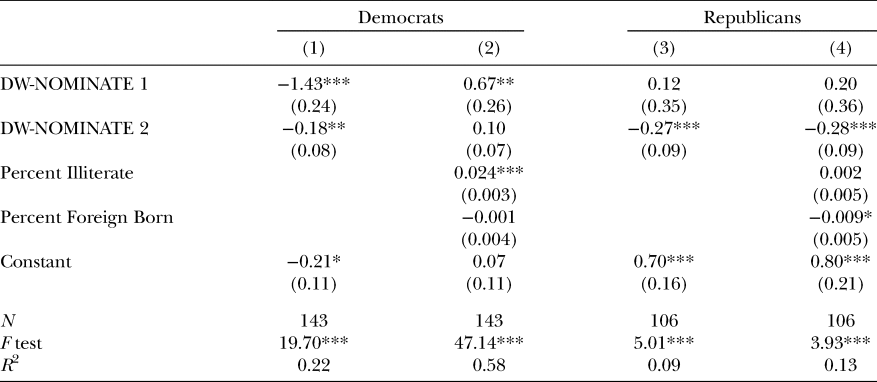
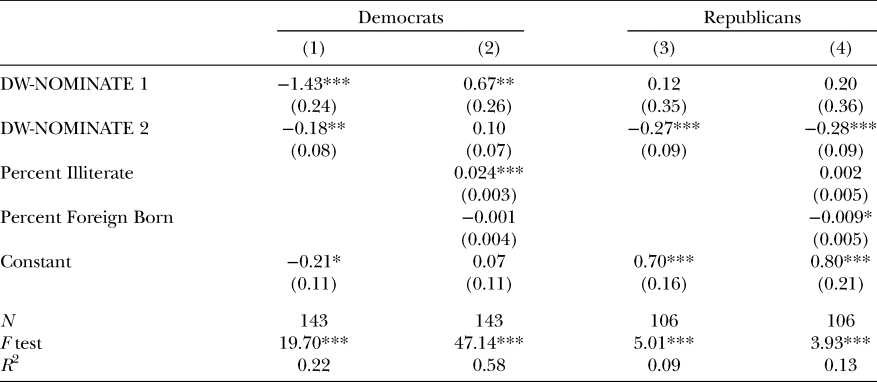
Moving now to an examination of support within the parties, we run models for Democrats and Republicans individually. Table 8 reports the results by party. Democrats who are more conservative on the first NOMINATE dimension—those who are more “pro-tariff”—were significantly more likely to vote for the Willis motion (Model 2). In other words, Blair's bipartisan support hinged on those Democrats who were, on average, less opposed to the GOP's economic program. State-level illiteracy rates are also significant, meaning that Democratic Party support was driven by the distributional gains offered by Blair's proposal.
House Vote on Willis Motion by Party, 49th Congress
Notes. Coefficients are linear probability estimates, with standard errors in parentheses; *p < .10, **p < .05, ***p < .01.
Among Republicans, we find that those members from districts with higher proportions of foreign-born residents were significantly less likely to support Willis's motion and therefore less likely to support the underlying bill. GOP House members, like their Senate counterparts, seem to reflect the party's nativist tendencies. State-level illiteracy rates, however, are unrelated to a given member's vote. We also see that the second-dimension NOMINATE score is highly predictive of opposition to the bill, thereby suggesting that those with more conservative views on currency issues (bimetallism)—which defined the second NOMINATE dimension in the House from the Civil War through the realignment of the 1890s—were less likely to support the Willis motion.Footnote 140
These results demonstrate that a bipartisan, interregional coalition supportive of Blair's approach did exist in the House. Moderate Republicans joined with Democrats from states with high illiteracy rates to push the Blair proposal.
Unfortunately for Willis and his supporters, the change in venues did not bring about the desired results. The Labor Committee instead replaced the provisions allocating funding based on the number of illiterates living in a state with language guaranteeing all states an equal amount of federal aid.Footnote 141 This change was unpalatable to Blair's Southern coalition. Proponents of the substitute amendment understood this and used it as a mechanism to sink the bill. Indeed, one of the amendment's cosponsors, Rep. William Crain (D-TX), characterized the proposal as an “unholy offspring of an ill-assorted alliance between the bleak hills and chilly atmosphere of New Hampshire and the blue-grass fields and sunny clime of Kentucky.”Footnote 142 In the end, House leadership refused to allow a vote on any legislation with language identical to the Blair Bill, so federal aid once again died.
At the beginning of the 50th Congress (1887–89), Blair reintroduced his bill (now S. 371). He had reason to be optimistic about its fate. Public support, as measured by petitions sent to Congress, remained high (see Table 1). In addition, the Democratic Party's advantage in the House had also shrunk to fifteen seats, 167–152. Crofts attributes a portion of those losses to opposition to the Blair Bill, further testifying to its popularity.Footnote 143 When the Senate opened debate in January 1888, Blair immediately worked to capitalize on what he saw as broad public support by presenting it as an electoral issue. The impending presidential election provided him with an “opportunity to go directly to the people to secure backing for the bill.”Footnote 144 Accordingly, the Republican Party Platform provided explicit support for the bill. “The State or Nation, or both combined,” Republicans argued, “should support free institutions of learning sufficient to afford every child growing up in the land the opportunity of a good common school education.”Footnote 145 In addition, Benjamin Harrison—the GOP presidential nominee in 1888—had supported the Blair Bill while serving in the Senate.Footnote 146
When the bill came up for debate in the Senate, Blair's opponents took their usual positions. Some Democrats opposed the measure because they did not believe in education for black citizens. Senator John Morgan (D-AL), for example, claimed that state-sponsored schooling for black children would keep them “out of the cotton fields, where their labor was needed.”Footnote 147 More important than these explicitly racist arguments, however, was an increasingly bipartisan sentiment that federal aid would do more harm than good. A New York Times editorial in February 1888, for example, stated that “one of the most precious rights of a State is that character for stability and self-control which comes of the necessity of taking care of its own interests.”Footnote 148
As he had in the past, Blair overcame all of the bill's opponents. As the third column of Table 4 illustrates, however, the number of Republican senators opposing the bill grew significantly (from five to twelve) in just two years. In an editorial published immediately following Senate passage, the New York Times offered one explanation for the growing Republican opposition: “The fact is that [Blair's proposal] has little support in public opinion of the country.”Footnote 149 Absent reliable polling data, any assessment of public opinion is guesswork. Yet the Senate vote provides some evidence of an increasing willingness on the part of Blair's copartisans to publicly oppose federal education aid.
Blair and his supporters would be stymied yet again in the House, as the bill was sent to the Education Committee, now chaired by Rep. Crain, where it languished. But Blair's coalition found some reason for optimism after the 1888 election, as GOP victories resulted in unified Republican control of government for the first time since 1875.Footnote 150 Blair took this as a sign that his bill's time had finally come. According to Gordon McKinney, he attributed Republican electoral successes to support for his bill.Footnote 151
Yet because the Blair Bill relied so much on the support of Southern Democrats, the Republican landslide generated a new political problem. Perhaps aiming to capitalize on his party's political advantage, President Harrison used his inaugural address to call for “further safeguards” to ensure the legitimacy of national elections. Here he was suggesting strengthened federal powers over the electoral process, a policy change wholly unpalatable to Southern Democrats. By 1889–90, racial violence had increased, and according to Albion Tourgee—a long-time advocate for black rights in the South—the year 1890 represented “the most dangerous epoch [for blacks] since 1860.”Footnote 152 As a consequence, Southern Democrats proved more skeptical of all Republican-initiated federal programs.Footnote 153
Debate on Blair's proposal (now S. 185) began for the final time on February 5, 1890. By this point, the arguments for and against the bill were so well known that few members lingered in the chamber to hear Blair once again make his case. More to the point, Blair's long-windedness was frustrating fellow senators. According to one contemporaneous account, “when Mr. Blair began his speech there was a general exodus of senators on both sides of the chamber, and of the eighty-two senators, only five remained while Blair was talking. The press gallery also vacated.”Footnote 154 An editorial in the New York Times characterized Blair as a “bore” and argued that his continued advocacy on behalf of the bill simply allowed him to “relieve his own mind.”Footnote 155 By mid-March, fellow Republican Preston Plumb (KS) was arguing that Blair's effort to “keep this bill here, all the time, week after week, and month after month, in such a way as to disarrange all the business of the Senate, is not fair.”Footnote 156
What distinguishes this iteration of the debate from those preceding it was, according to Blair, the fact that “several leading Republicans who had always supported the bill … would do so no longer.”Footnote 157 This pattern started with President Harrison who, in his first annual message as president, chose not to provide an endorsement. Only three years earlier, Harrison had implored the Senate to pass the Blair Bill so that “an increasing body of Southern men” would be taught to show a more “kindly disposition toward the elevation of the colored man.” In early 1889, however, Harrison expressed dissatisfaction with the bill's plan to appropriate money over eight years. “One Congress cannot bind a succeeding one,” he now argued.Footnote 158 Moreover, when Republicans called for a final vote on the measure in March 1890, President Harrison did not explicitly call on Senate Republicans to vote for it.Footnote 159
Opposition to Blair's proposal among Senate Republicans demonstrates how the party's eroding commitment to black civil rights contributed to the durability of local control. John Coit Spooner (R-WI), an influential Republican who had voted for the Blair Bill in the 49th Congress, provided the most thorough defense of those party members who came to oppose federal aid. Spooner began by “deny[ing] that the Republican Party is committed to the bill.” Downplaying the GOP's clear role in pushing Blair's proposal, Spooner pointed to its bipartisan support as evidence for his claim that it “can hardly with justice be said to be a party measure.”Footnote 160 Its failure, he implied, could not be attributed solely to Republican defections. Moreover, he used the bill's bipartisan, interregional appeal as a reason for opposing it.
After disclaiming responsibility for the bill's failure, Spooner went on to make an explicitly sectional argument to defend himself and other Republican opponents. Citing “leading newspapers in the South” that had editorialized against Blair, as well as the growing Southern economy, Spooner claimed that southerners no longer wanted or needed federal aid. He held that Southern state governments could now fund their own schools, and he was no longer willing to ask “farmers of the west and northwest” to contribute to the education of black and white residents of the South.Footnote 161 Similar claims were made by Senators Preston Plumb (R-KS), Gilbert Pierce (R-ND), John Sherman (R-OH), and Eugene Hale (R-ME).Footnote 162 Prioritizing their concern for white farmers in the West, the GOP knowingly abandoned one of the last remaining policy reforms aimed at advancing civil rights and shoring up the party's Southern wing.
Republicans also used the murder of a deputy U.S. marshal in Florida to further justify the party's turn against federal aid to the South. Protesting that the Blair Bill did not do enough to ensure that the appropriated money would be spent in accordance with the principle of separate but equal, Republicans like Spooner and Sherman claimed that the bill conceded too much to the South.Footnote 163 The GOP, in other words, was willing to deny black southerners aid it had promised for nearly a decade as a way of punishing the region's white majority. The Republican coalition supporting the measure collapsed under the weight of GOP opposition because some argued that the bill did too much—proposing too much spending and binding the federal government to fund years into the future—and because it did not do enough—as oversight mechanisms were too weak. Coalitional tension of this kind therefore helped to shore up local control of education.
In an interview published in the New York Mail and Press, Blair recounted his dawning awareness that a significant number of Republicans had turned against the measure. “If an early vote was taken,” Blair recalled, “the bill would be defeated by about a ten or twelve [vote] majority.” In response, he “adopted the tactics of getting time.” From February 17 to 20, Blair mounted a one-man “reverse filibuster” on behalf of his bill. Over those four days, he begged Republicans to honor their obligations to the freedmen and their families. “You can reconstruct the South,” Blair argued, “in no other way than by beginning with the children.”Footnote 164
After nearly two months of debate on the measure, Blair agreed to bring his bill to a vote. Newspaper accounts published on March 20, 1890, predicted a close result, but according to Daniel Crofts and Gordon McKinney, Blair was confident that he had the necessary support to ensure its enactment.Footnote 165 He miscalculated. “Sometime during the night,” Blair recalled in an interview, Senators Henry Payne (D-OH) and John Sherman (R-OH) both decided to reverse positions and oppose the measure. Sherman's reversal in particular surprised Blair.Footnote 166 But Sherman was not alone. The final vote tally shows a significant number of defections, as slightly more than 40 percent of Republicans cast votes to kill federal education aid (see the fourth column of Table 4). They were joined by a bare majority of Southern Democrats and all but one Northern Democrat.
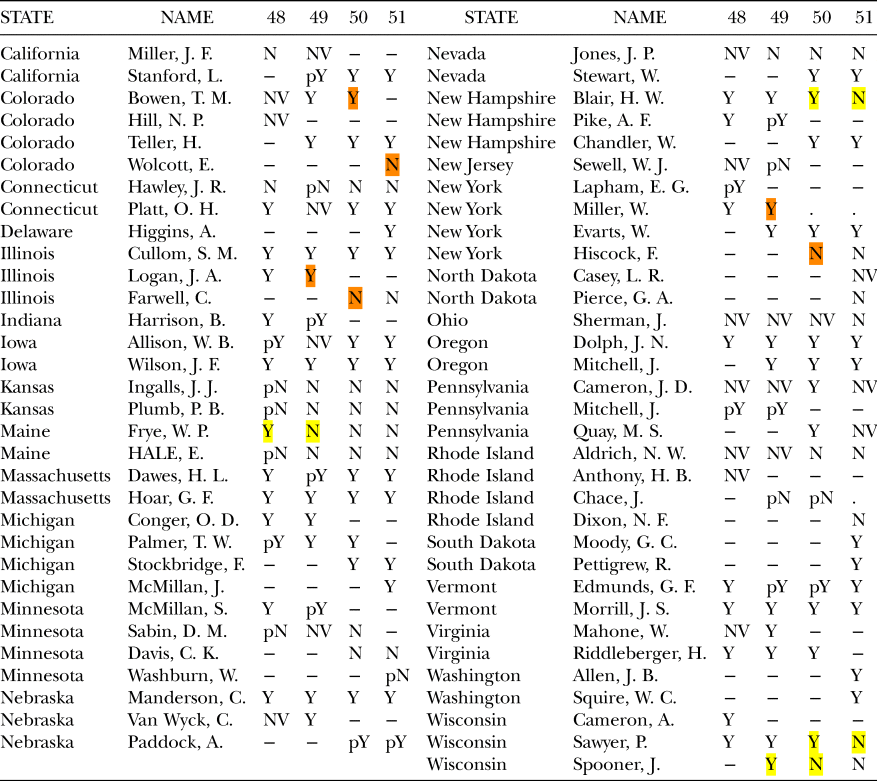
To better understand the dynamics of the voting on the Blair Bill, we drill down and examine the individual vote choices of Republicans and Democrats in the Senate—including “pairing”—on the four final-passage votes between the 48th and 51st Congresses.Footnote 167 Our goal is to identify when changes occurred, and whether they were due to sitting senators switching their vote (conversion) or new senators casting a different vote (replacement). On the Republican side (Table 9), support remained strong between the 48th and 49th Congresses, as only one senator (William Frye, RI) switched from yea to nay. Between the 49th and 50th Congresses, only one GOP senator (John Spooner, WI) again switched; however, two new GOP senators—Charles Farwell (IL) and Frank Hiscock (NY)—voted nay in the 50th Congress after replacing Republicans John Logan (IL) and Warner Miller (NY), who had voted yea in the 49th Congress. Three of the other four GOP nay votes in the 50th Congress came from senators who were present but did not vote in the 49th Congress: John Hawley (WI); Dwight Sabin, (MN), and Nelson Aldrich (RI).Footnote 168 Between the 50th and 51st Congresses, two Republican senators switched their votes from yea to nay: Philetus Sawyer (WI) and Henry Blair (RI). Blair switched from yea to nay because he saw that his proposal was about to lose, and by switching before the final tabulation was announced, he put himself in a position to call for reconsideration. Edward Wolcott (CO) also voted nay, after replacing Thomas Bowen (CO), who had voted yea in the previous Congress. Finally, John Sherman (OH) cast a vote, after sitting out the previous three. He had voiced support for the bill, but ultimately chose instead to vote nay.Footnote 169
Republican Votes in the Senate on the Blair Bill, 48th–51st Congresses
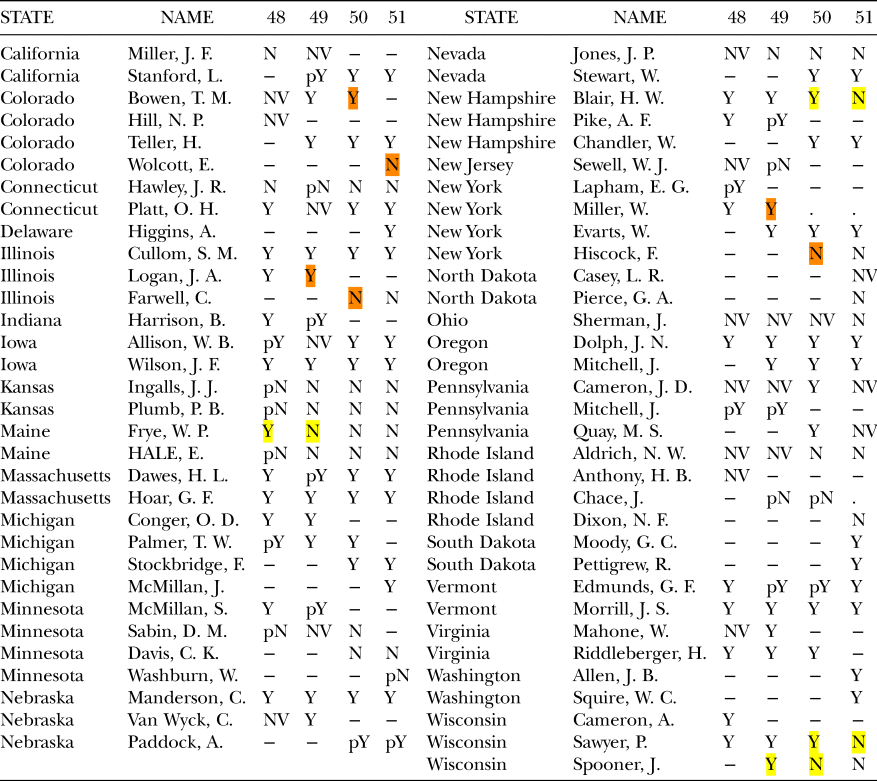
Notes. Codes for votes are as follows: Y = yea; N = nay; pY = paired yea; pN = paired nay; NV = not voting; and − = not a member. Yellow indicates a shift in support for the Blair bill by the same person. Orange indicates a shift in support for the Blair bill due to replacement (of one senator for another).
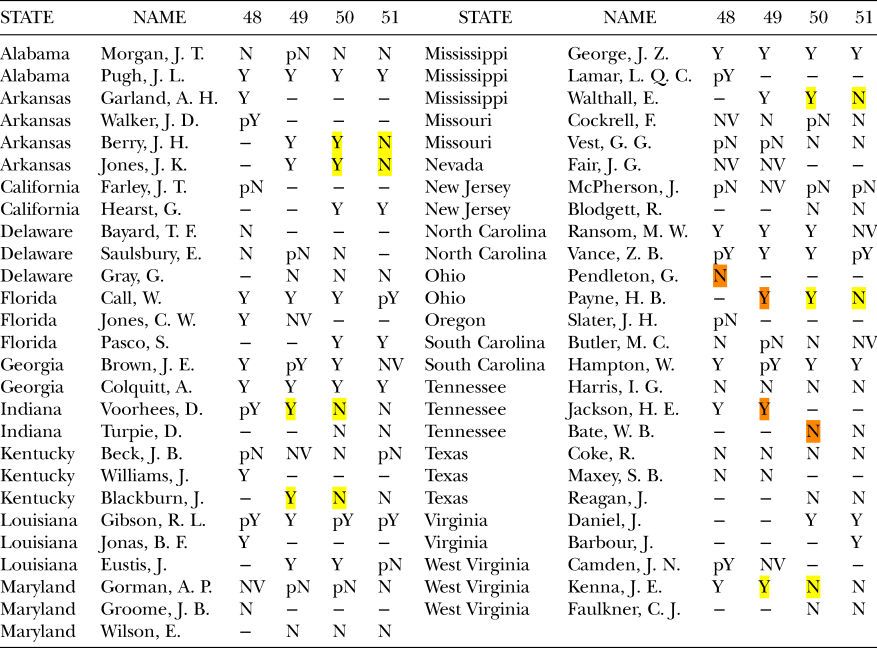
On the Democratic side (Table 10), some significant switches occurred between the 49th and 50th Congresses: Daniel Voorhees (IN), Joseph Blackburn (KY), and John Kenna (WV) all switched from yea to nay, while William Bate (TN) voted nay after replacing Howell Jackson (TN), who voted yea in the previous Congress. Here we see clear erosion of Southern support for the Blair Bill. Between the 50th and 51st Congresses, three Southern Democrats, perhaps fearing that Republicans would go back on some of their states’ rights promises regarding administration of the new education program—switched from yea to nay: James Berry (AR), James Jones (AR), and Edward Walthall (MS). And four other Southern Democrats who voted yea in the 50th Congress chose to pair off or not vote at all: Wilkinson Call (FL), James Eustis (LA), Matt Ransom (NC), and Zeb Vance (NC). Henry Payne (OH) also switched from yea to nay.
Democratic Votes in the Senate on the Blair Bill, 48th–51st Congresses
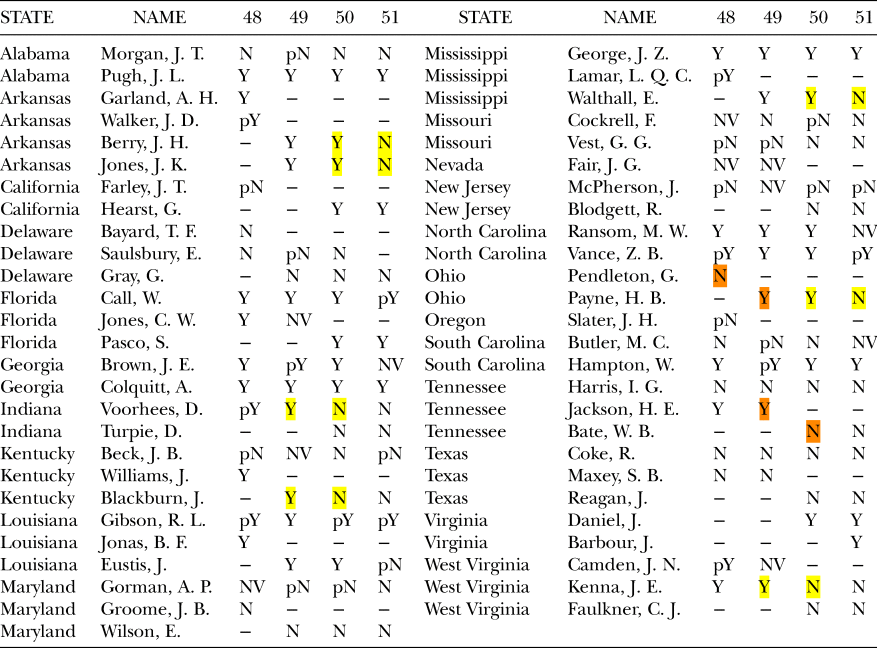
Notes. Codes for votes are as follows: Y = yea, N = nay, pY = paired yea, pN = paired nay, NV = not voting, and − = not a member. Yellow indicates a shift in support for the Blair bill by the same person. Orange indicates a shift in support for the Blair bill due to replacement (of one senator for another).
Historians have not reached a consensus on why Republicans turned against the Blair Bill. McKinney suggests that Republicans from the Midwest believed economic issues to be more of a priority than the education bill, while Crofts suggests that sectional tensions generated a belief among Republicans that the Blair Bill was too conciliatory.Footnote 170 Blair himself frequently relied on nativist appeals to explain Congress's repeated failures to enact his legislation. Speaking on the floor of the Senate in 1888, he recalled being shown “the letter of a Jesuit priest, in which he begged a member of Congress to oppose this bill and to kill it, saying that they had organized all over the country for its destruction, that they had succeeded in the committee of the House, and … if they had only known it early enough they could have prevented its passage through the Senate.” Continuing, Blair warned of a “Jesuit organization which has set out to control this country … they have come to our shores and they are among us today, and they understand that they are to secure the control of the continent by destroying the public school system of America.”Footnote 171 Repeating this charge three years later, Blair contrasted “the Jesuits who have undertaken the overthrown of the public school system of this country,” with “the twenty-five millions of people who inhabit the Southern States.” Unlike “the people of the North,” southerners “are Protestants and liberals and are free from the vast influx of immigration which has overflowed and transformed Northern states, in whose school systems the Jesuit has now much power.”Footnote 172
Blair's conspiracy theories notwithstanding, Table 1 does show that enthusiasm for his federal education bill—marked by the number of petitions sent to Congress on behalf of the legislation—declined significantly between the 50th and 51st Congresses.Footnote 173 Perhaps reflecting this decline in support, GOP opposition played a pivotal role in the bill's defeat. If the same number of Republicans who had voted for the bill in 1888 had done so again in 1890, the Blair Bill would have made it through the Senate. Of course, the bill had passed the Senate on three prior occasions, so there was no guarantee that Senate passage portended enactment. Yet with a Republican president and a GOP majority in the House, this appeared to be Blair's best chance for success. By 1890, however, Senate Republicans looked askance at the Blair Bill. The party instead set its sights on economic reforms and, for a brief time, a new federal elections bill.Footnote 174
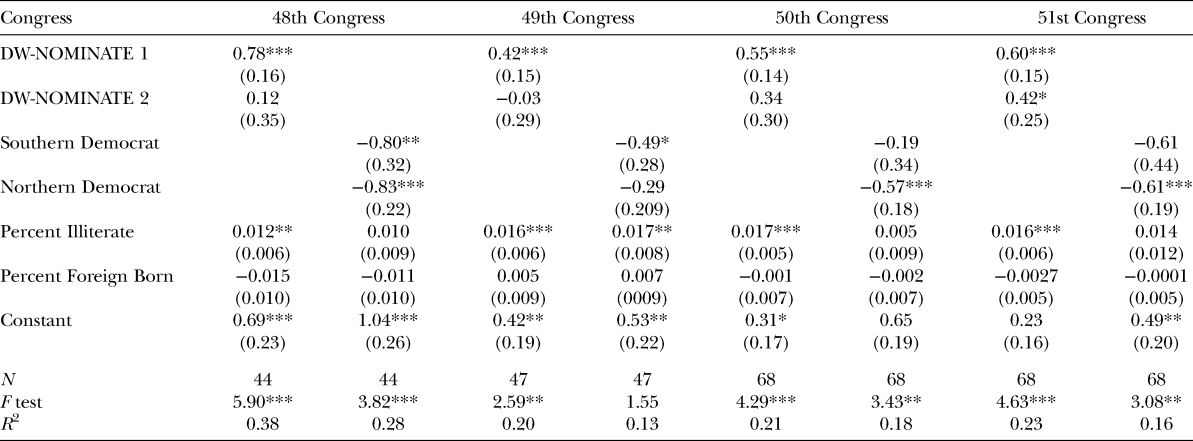
Before concluding, we present regression results (Table 11) examining the final-passage votes on the Blair Bill in the Senate in the 48th, 49th, 50th, and 51st Congresses. Across each Congress we find that economic conservatism consistently predicts support for the Blair Bill. We also find reliable support from members representing states with higher illiteracy levels. If we replace ideology with party, we find that the most reliable supporters of the Blair Bill were Republicans. (Although by the 50th Congress, increasing GOP defections had made Southern Democrats—all else equal—as likely to support the bill as Republicans.) Importantly, in none of these models is the proportion of foreign-born residents in a state a significant predictor. This finding is mitigated by the fact that nativism explains vote choice on amendment votes (as we discuss above) and that immigrants tended to congregate inside specific congressional districts, thereby diluting their statewide influence.
Final-Passage Votes in the Senate on the Blair Bill, 48th–51st Congresses
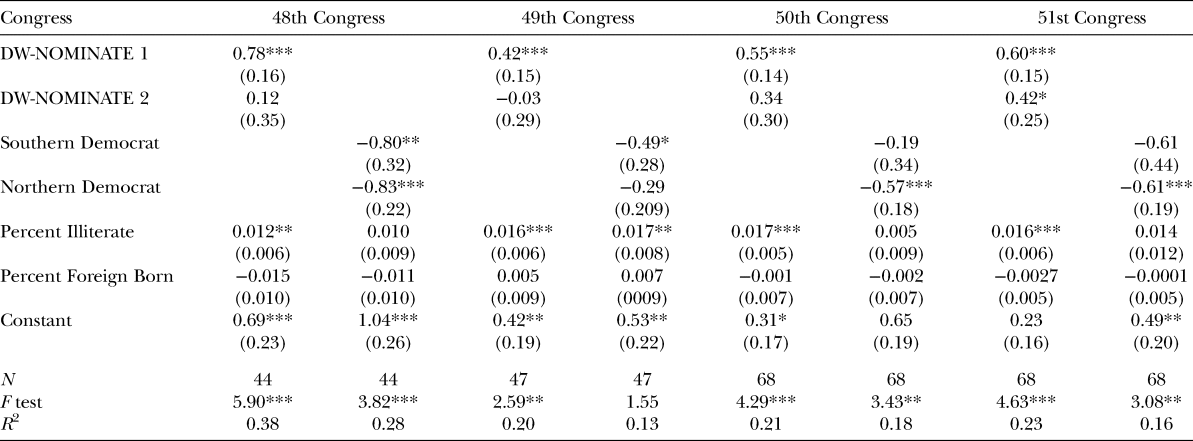
Notes. Coefficients are linear probability estimates, with standard errors in parentheses; *p < .10, **p < .05, ***p < .01.
4. CONCLUSION
Senator Henry Blair's proposal to provide federal aid to state primary and secondary schools was the most significant threat to local control of education from Reconstruction until the Great Society. Recognizing that illiteracy was a pressing social problem in need of a solution, and that the political environment of the 1880s made significant political reform possible, Blair sought to become a political entrepreneur. He worked to craft a bipartisan, interracial, interregional coalition of supporters who, he hoped, would help force his bill through a closely divided Congress. The ingredients necessary for successful reform were available to Blair, yet he simply could not master the racial, regional, and ethnic tensions existing both within and between the two parties. Blair almost spearheaded a truly landmark political reform effort. By exploring his failure, we argue, scholars of APD gain insights into the uneven course of national state development.
In short, “local control” proved to be a useful rallying cry for Blair's opponents. His bill incentivized the cooperation of Northern and Southern Democrats who, at times in the 1880s, seemed to be growing apart. It also made appealing defections from some Republicans who, after considering the bill, were motivated to abandon black citizens. Appeals to the status quo allowed Southern Democrats to take a stand against any future effort to turn federal appropriations into a vehicle for influencing how state schools dealt with black students. Furthermore, Southern elites recognized that as long as schools were wholly reliant on the state funding, they retained the power to entirely defund those serving black children. Protecting the status quo also allowed some Republicans to mask opposition to the bill motivated by economic interests as a commitment to racial integration. It also fit the agenda of Northern lawmakers who rightly feared the Republican Party's nativist wing. Finally, it allowed those seeking tariff reductions to accuse Blair and his supporters of simply looking for ways to obscure their commitment to protectionism.Footnote 175
The conditions prevailing when Congress finally did break down the policy regime protecting local control—through enactment of the Elementary and Secondary Education Act in 1965—represent a stark contrast with those faced by Henry Blair. Congress began debate on the ESEA during the 89th Congress (1965–67), when Democrats held unified control of government and supermajorities in both the House and the Senate. Democrats, not Republicans, were now pushing federal aid, and they were doing so at a time when they were at a significant political advantage. Interparty compromises would not be needed. Furthermore, President Lyndon Johnson viewed the ESEA as a critical component of the Great Society domestic agenda.Footnote 176 As we discuss above, Henry Blair only occasionally found an ally in the White House. His bill was often used opportunistically as one component of a party-building strategy, but was never an integral part of a policy agenda pushed by the president himself.
The 1964 Civil Rights Act also facilitated enactment of the ESEA by nullifying concerns over school segregation. As Julian Zelizer notes, once the federal government committed itself to ending segregation, there no longer existed any reason for Southern members “not to climb on the federal gravy train for their schools, just as they had done for their military bases, dams, and highways.”Footnote 177 The 1964 Act, in other words, defused the kind of intraparty conflict that brought down the Blair Bill, even as the overwhelming Democratic majorities in the House and Senate counteracted the interparty balancing that so often befuddled Henry Blair. The Democrats in the 1960s were further aided by the fact that they were not forced to “build eleven brand-new political parties all at once in the former confederate states.”Footnote 178 For them, the ESEA was an effort to deliver on behalf of a biracial coalition that already existed. For Blair, federal education funding was an effort to construct such a coalition. As we have shown, the complications that resulted from his effort to construct an interracial, intersectional, bipartisan alliance all served to aid those defending local control.
From a twenty-first-century perspective, Henry Blair's proposal to provide federal aid to state primary and secondary schools is deeply problematic. It was a defense of separate but equal, and its supporters were outspoken nativists. Yet it was one of the last efforts from the Republican Party to act on behalf of Southern freedmen. In that sense, it is also illuminating. By the late 1880s the radical wing of the GOP was in sharp decline, and its historic foundation in ethnic nationalism was reemerging. Much of the energy driving the radical policy changes had dissipated, the public had grown tired of debates over civil rights policy, and the party's turn westward dampened the political power of freedmen in the South. “The defeat of the Blair bill,” argues Thomas Adams Upchurch, “marked a tragic turning point in both African American history and the history of education in America.”Footnote 179 For this reason, its failure provides a clear indication of the political forces that helped bring the “first civil rights era” to a close.