Introduction
In 2015, while undertaking a field expedition in the Western Hajar Mountains of Oman, Abdulrahman Al Hinai and Omar Al Amri (both Oman Botanic Garden) discovered an unknown species of Lavandula (Lamiaceae). The species was found growing on a steep cliff in Sharafat Al Alamein in the Western Hajar Mountains, together with other species endemic to Oman, such as Dionysia mira (Jaub. & Spach.) Wendelbo (Primulaceae), Campanula akhdarensis A.G.Mill. & Whitc. (Campanulaceae) and Pycnocycla prostrata Hedge & Lamond (Apiaceae). It was immediately recognised that this Lavandula species was not yet reported from Oman.
This area is part of the Jabal Shams mountain, the highest mountain in the Western Hajar mountain range. The new Lavandula species was found on steep cliffs along a newly constructed mountain road. Because the flora of the Western Hajar Mountains is relatively well known (Patzelt, Reference Patzelt2015a), it is very rewarding to still find new species in this area; the last time a species new to science was described from the Western Hajar Mountains was in 2004 (Orobanche perangustata M.J.Y.Foley; Orobanchaceae). This adds further significance to the description of the new Lavandula.
Further research on several field trips in 2017 and 2018 in the area indicate that the new species occurs in small populations and is, to date, confined to two locations. During further field trips, herbarium vouchers and fruiting material, and detailed habitat and plant community information were collected.
The Lamiaceae is represented in Oman by 43 taxa in 16 genera. Only three genera have at least six species in Oman: Salvia, with eight species; Teucrium, with six species; and Lavandula, with six species (including the new species).
Lavandula L. is an Old World genus distributed from Macaronesia in the west, across northern Africa, the Mediterranean region, Southwest Asia, Arabia, and western Iran, with a disjunction to India in the east (Upson & Andrews, Reference Upson and Andrews2004). Upson & Andrews recognised 39 species. With the new species included, the total number of Lavandula species is now 40.
Miller (Reference Miller1985) was seminal in establishing the diversity of Lavandula in Arabia. He recorded a total of 14 Lavandula species from Arabia and tropical northeast Africa. Two further species from Arabia were described in 2004: Lavandula samhanensis Upson & S.Andrews from Oman and L. qishnensis Upson & S.Andrews from Yemen (Upson & Andrews, Reference Upson and Andrews2004). Including the new Lavandula species, this brings the total number of Lavandula species from Arabia and tropical Northeast Africa to 17. Eight of them are endemic to Arabia, three are endemic to Somalia and two are range-restricted to Arabia and Somalia. Therefore, a total of 13 of 17 species are range-restricted to Arabia and Northeast Africa; 11 of them belong to section Subnudae.
Miller (Reference Miller1985) stated that section Subnudae is centred on the southern Arabian Peninsula and Somalia. These areas, once geographically connected, are now separated by the Gulf of Aden. However, they are still characterised and linked by similar vegetation types and share numerous species in common. Collectively, the areas form part of the Somali–Masai centre of endemism (White & Leonard, Reference White and Leonard1991).
Southern Arabia and East Africa represent a major centre of diversification of the Lavandula genus outside the Mediterranean region and Macaronesia, where the majority of the other species occur (Miller, Reference Miller1985). The present work and the description of this species build on Miller (Reference Miller1985) and confirm his conclusions. The description of the new species as a narrow endemic clearly further supports the general pattern of Arabia and Northeast Africa as a centre of speciation in section Subnudae.
Members of section Subnudae are typically woody-based perennials with pinnatifid leaves, although some are leafless. The ovate bracts with a spinescent apex are characteristic. The nutlets bear a lateral scar a quarter of their length, ornamented with a pusticulate pattern. The single-flowered cymes are spirally arranged (Upson & Andrews, Reference Upson and Andrews2004). The species of section Subnudae are distinguished mainly on the form of the bracts and their length compared with the calyx, on the character of the indumentum, and to a lesser extent, on the presence of leaves, their form and the habit of the plant (Upson & Andrews, Reference Upson and Andrews2004).
In Oman, Subnudae is the principal section, containing five taxa excluding the new species. Only one species, Lavandula hasikensis A.G.Mill., belongs to section Hasikenses, a section containing just two species (Upson & Andrews, Reference Upson and Andrews2004). The section Hasikenses has several unique characters that are not shared with the section Subnudae.
In Oman, the Lavandula species are typically shrubs or subshrubs and are represented in a number of habitats. Only two Lavandula taxa are found in northern Oman: L. subnuda Benth. and the new Lavandula. All other Lavandula taxa in Oman are found in southern Oman. Two taxa, the new species and Lavandula samhanensis, are restricted to cliff habitats.
Of the seven Lavandula taxa in Oman, five (including the new species) are range-restricted. Lavandula subnuda is a regional endemic found in northern Oman and the adjacent United Arab Emirates. The new Lavandula is endemic to the Western Hajar Mountains of northern Oman. Four taxa are endemic to the mountains of southern Oman: Lavandula dhofarensis A.G.Mill. subsp. ayunensis, L. dhofarensis A.G.Mill. subsp. dhofarensis, L. hasikensis and L. samhanensis. Lavandula samhanensis is very distinctive because of the presence of multicellular glandular hairs on the bracts and the calyx, which is a characteristic thought to be unique within the genus (Upson & Andrews Reference Upson and Andrews2004) but is now known to be also present in the newly described Lavandula. Only Lavandula macra Baker has a slightly wider distribution outside the Arabian Peninsula, as it is found in southern Oman, Yemen and Somalia.
The new species reflects the pattern of narrow endemics within the wider section. Other endemics outside Oman within the section are Lavandula galgalloensis A.G.Mill., L. somaliensis Chaytor and L. aristibracteata A.G.Mill. (all Somalia), L. qishnensis (Yemen), L. nimmoi Benth. (Socotra) and L. setifera T.Anderson (Yemen and Somalia). The new species differs from all other species in that section except Lavandula samhanensis due to the indumentum of stalked multicellular hairs on calyx and bracts. It differs from Lavendula galgalloensis, L. somaliensis and L. aristibracteata in that the bracts are shorter than the calyx. It differs from Lavandula somaliensis in that the apex is not abruptly acuminate and the veins of the bracts are not reticulate. It is different from Lavandula qishnensis in that the undersides of the leaves do not have a dense indumentum of sessile glands, and from L. nimmoi in that the new species does not become glabrous above and the indumentum is not villous.
Materials and Methods
A detailed morphological study of herbarium vouchers of Lavandula sp. nov. and a comparative study with all Lavandula species of Oman and the wider region was undertaken. Morphological studies included both qualitative and quantitative features of leaves, flowers, fruits and seeds, and have been described in detail. Herbarium specimens from the two known locations were studied.
The specimens of the new Lavandula were compared with herbarium material of all Lavandula taxa occurring in Oman and recorded from the Arabian Peninsula as well as adjacent areas such as East Africa and Southeast Asia (Miller, Reference Miller1985; Upson & Andrews, Reference Upson and Andrews2004). The online herbaria of the Royal Botanic Garden Edinburgh (no date) and Royal Botanic Gardens Kew (no date) were used as well.
Authorities of cited taxa follow the International Plant Names Index (2012–), whose records come from the Royal Botanic Gardens, Kew; Harvard University Herbaria and Libraries; and the Australian National Botanic Gardens.
Description of the New Species
Lavandula nooruddinii A.Patzelt & A.Al Hinai, sp.nov.
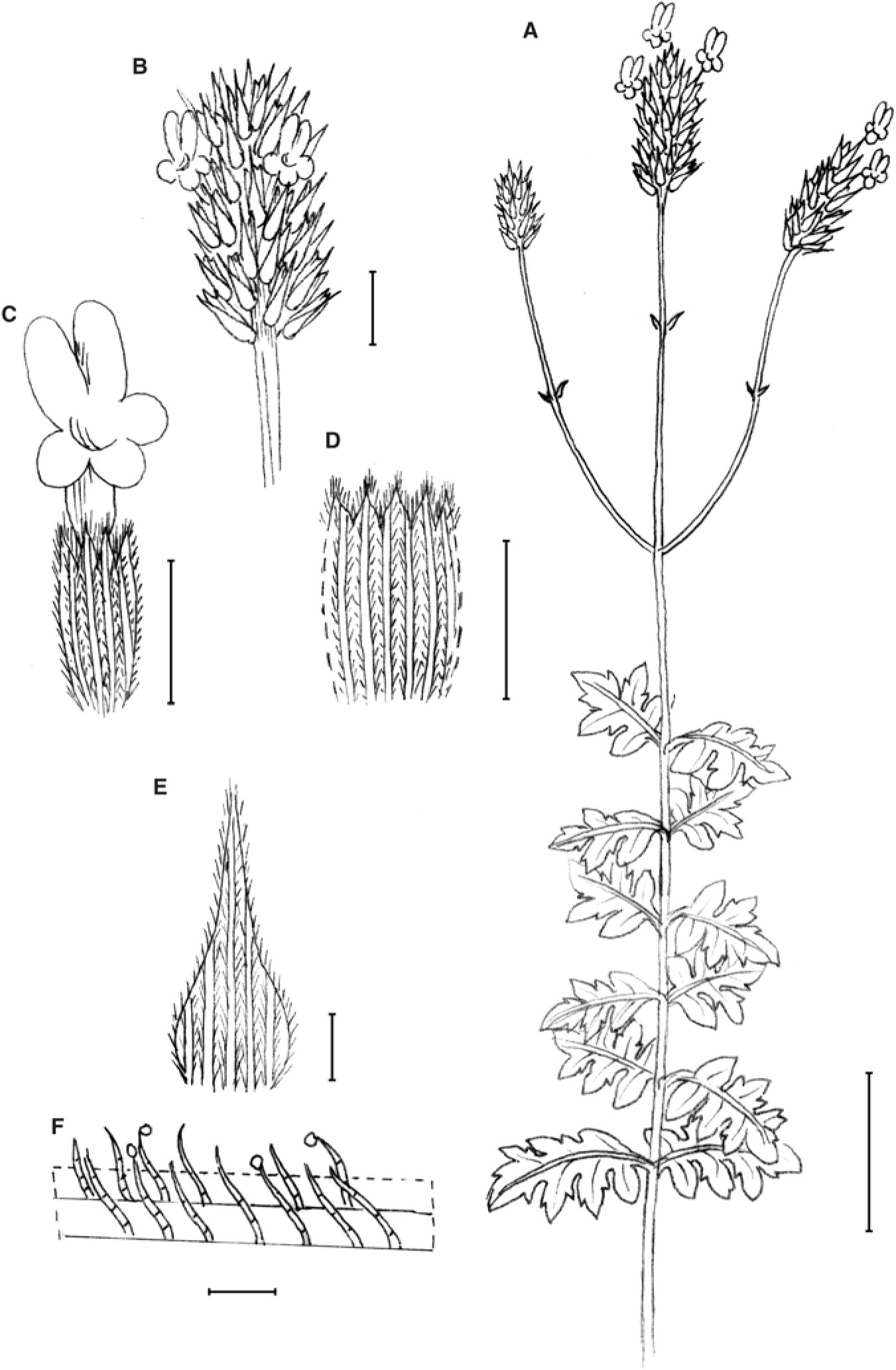
Lavandula nooruddinii is most closely related to L. dhofarensis A.G.Mill. subsp. dhofarensis and L. samhanensis Upson & S.Andrews. Lavandula nooruddinii shares with L. dhofarensis subsp. dhofarensis the sparse to dense lanate indumentum, the overall habit and the pinnatifid leaves with 3–4(–5) pairs of segments. Lavandula nooruddinii differs from L. dhofarensis subsp. dhofarensis in its lanate indumentum of bracts and calyx with long multicellular and eglandular hairs whereas those of L. dhofarensis subsp. dhofarensis are shortly tomentose on the bracts and shortly lanate with branched hairs and sessile glands between veins on the calyx and the length of bracts and calyx. With Lavandula samhanensis it shares bracts and calyx having stalked multicellular glandular hairs. However, the indumentum of Lavandula samhanensis is densely tomentose with highly branched hairs and the undersides of the leaves are covered with numerous sessile glands. – Type: Oman, Jabal Shams, Wadi Bani Awf, between Bilad Sait and Sharafat Al Alamein, 23°10′14.1′′N, 057°25′31.2′′E, seepage with trickling water, 1567 m, 19 x 2017, A. Patzelt & A. Al Hinai, AP 4894/APAH 2 (holo OBG, iso E). Fig. 1 .
Lavandula nooruddinii sp. nov. A, Flowering shoot; B, young flower spike; C, single flower and calyx; D, spread calyx; E, bract; F, calyx indumentum. Scale bars: A, 2 cm; B–D, 5 mm; E and F, 1 mm. Drawn from AP 4894/APAH 2 (OBG) by Laila Al Jahwari.

Habit a small woody shrub, leafy. Stems erect and highly branched, up to 20 cm in height, indumentum lanate of long mainly eglandular hairs, with unbranched glandular hairs and sessile glands. Leaves ovate, pinnatifid with 3 or 4 pairs of rounded blunt lobes, incised about two-thirds of the depth of the lamina, 1–1.8 × 1–1.2 cm, lanate indumentum on both surfaces of long unbranched hairs, more dense on the veins. Inflorescence a dense and cylindrical spike, 1.5 cm when young, elongating up to 10 cm in length when ripe. Bracts ovate with acuminate apex, 4–5(–5.5) × 2 mm, 0.8–0.9 times the length of the calyx, indumentum lanate of simple hairs and distinctive long multicellular eglandular and glandular hairs. Calyx 5 × 6 mm in length, lobes subequal, indumentum lanate of simple hairs and distinctive long multicellular eglandular and glandular hairs. Corolla tube widening from one-third of its length, becoming curved in the upper third, outside with long multicellular hairs and sessile glands, 8–9 mm in length, upper lobes erect and shallowly lobed, 1 mm, the lower lobes spreading, 1.25 × 1.5 mm, shades of blue-violet. Nutlet reddish brown, ± oblong, c.1.3 × 0.7 mm, areole 0.25–0.33 times as long as nutlet.
The plant does not have the characteristic pleasant scent of many other Lavandula species.
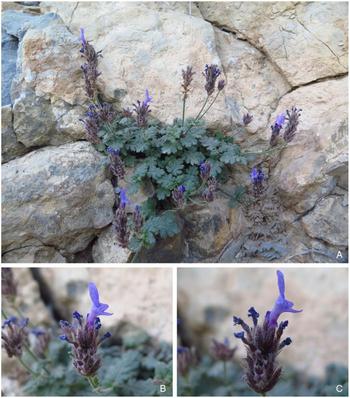
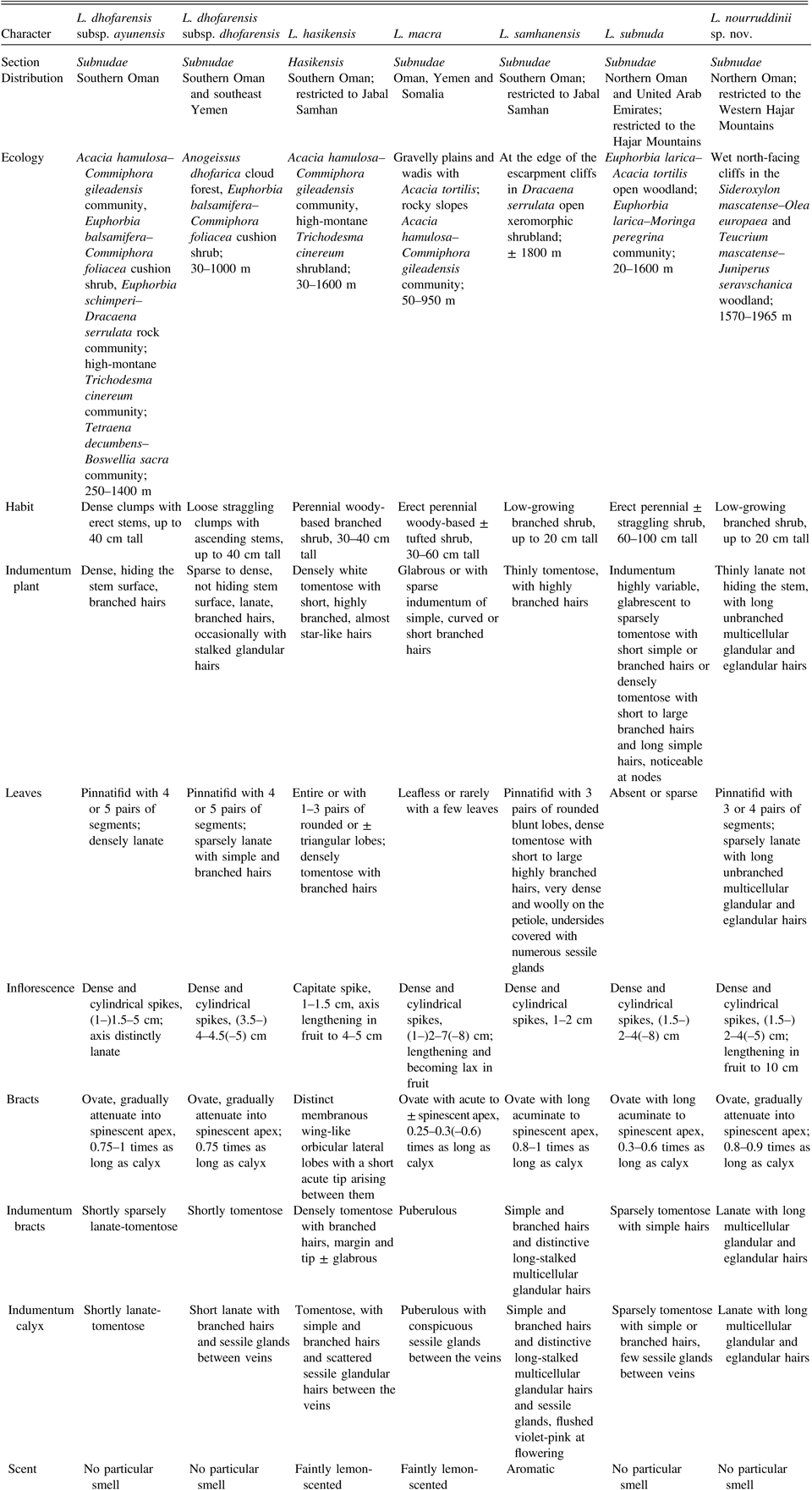
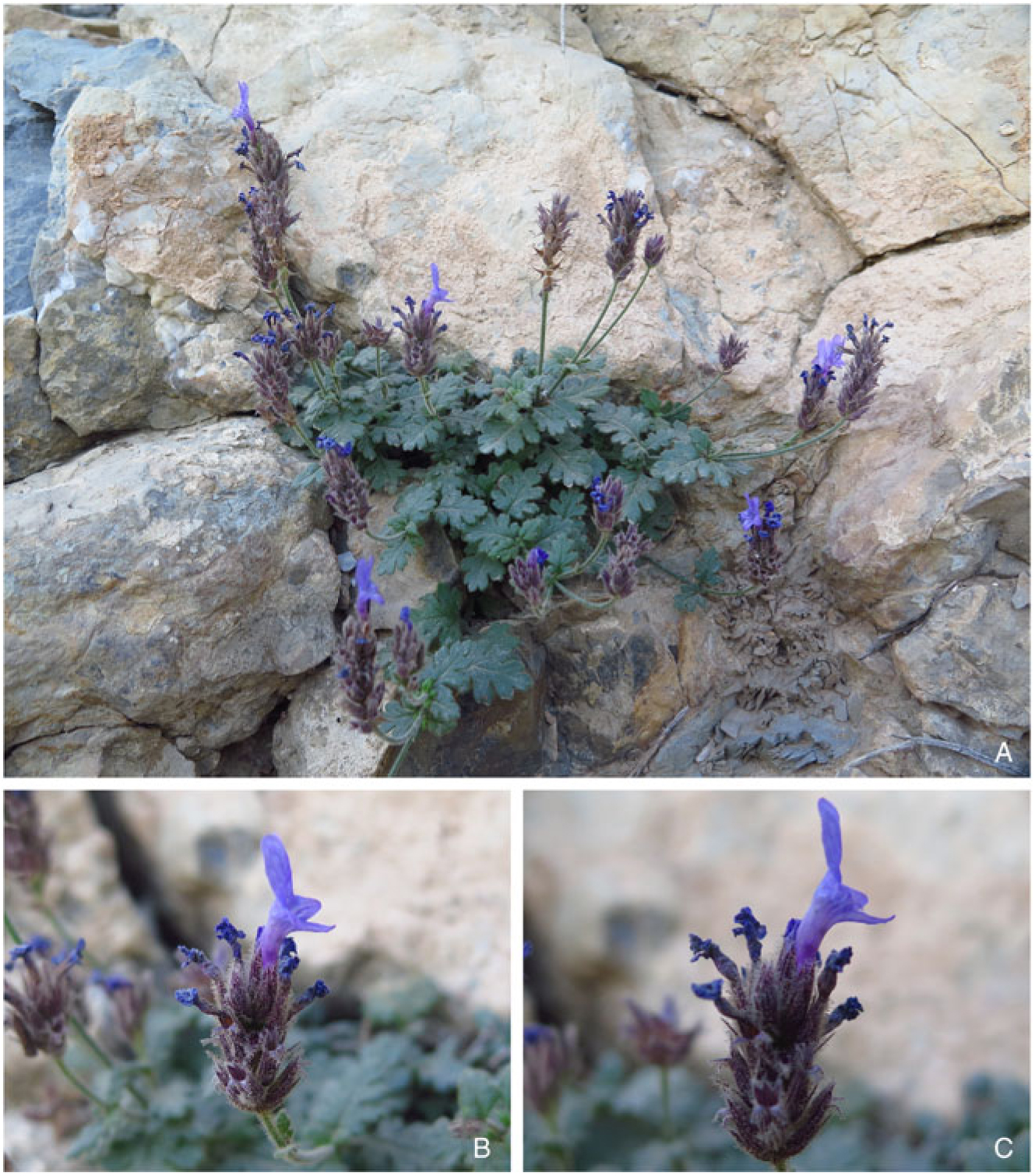
Figures 1 and 2 show the growth habitat of the species as well as the inflorescence. Lavandula nooruddinii differs in a number of characters from the other Lavandula species that occur in Oman (Table).
A, Lavandula nooruddinii is a clear chasmophyte, found on north-exposed slopes at high altitudes. B, The spikes of Lavandula nooruddinii are dense and cylindrical. C, The bracts and the calyx show a distinct indumentum of long glandular and eglandular hairs. Photographs by Annette Patzelt (October 2017).
Flowering period. Throughout April to October. The observations are based on many repeat field trips to the two known locations. The flowering period seems to be related to the higher temperatures during this period.
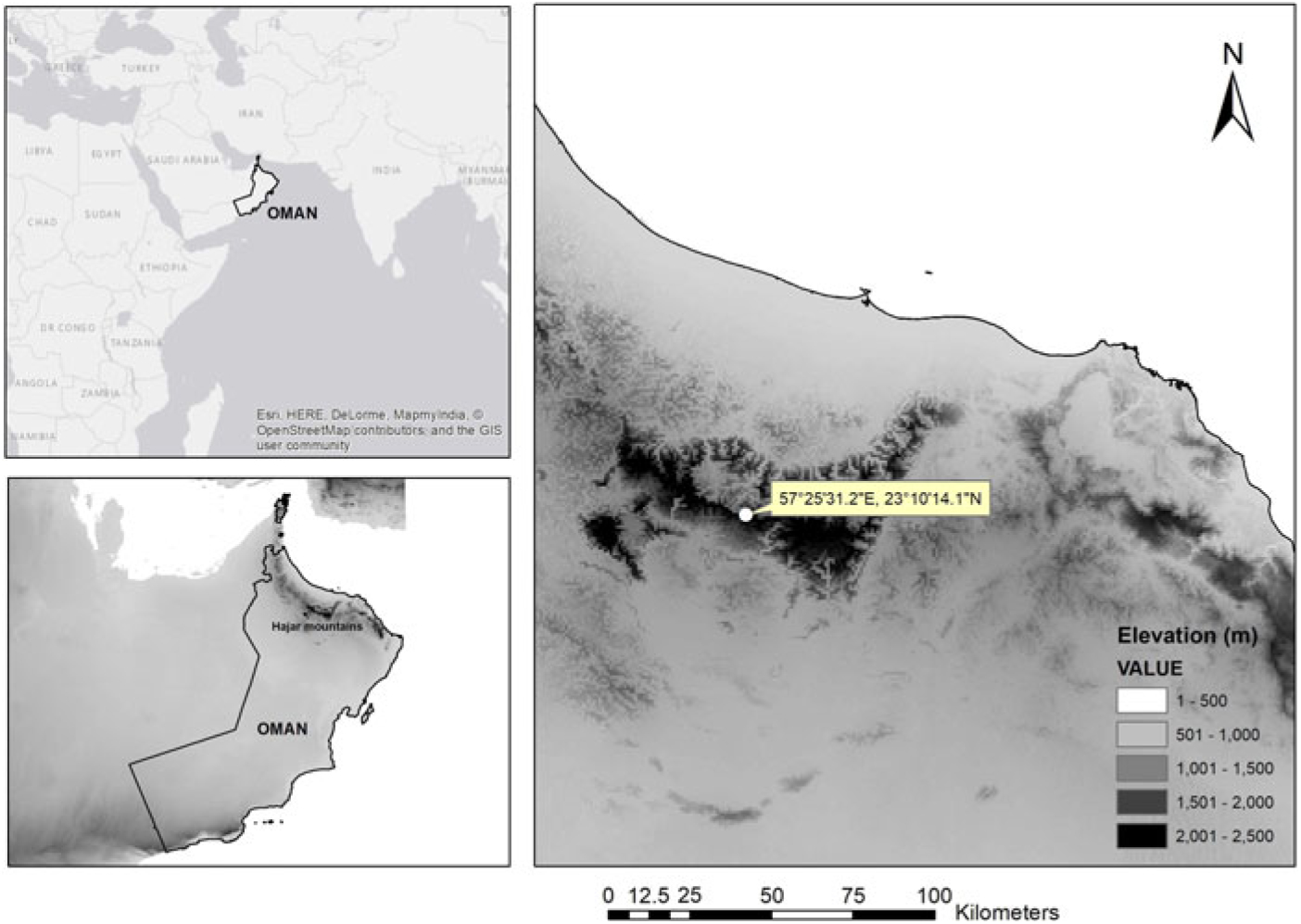
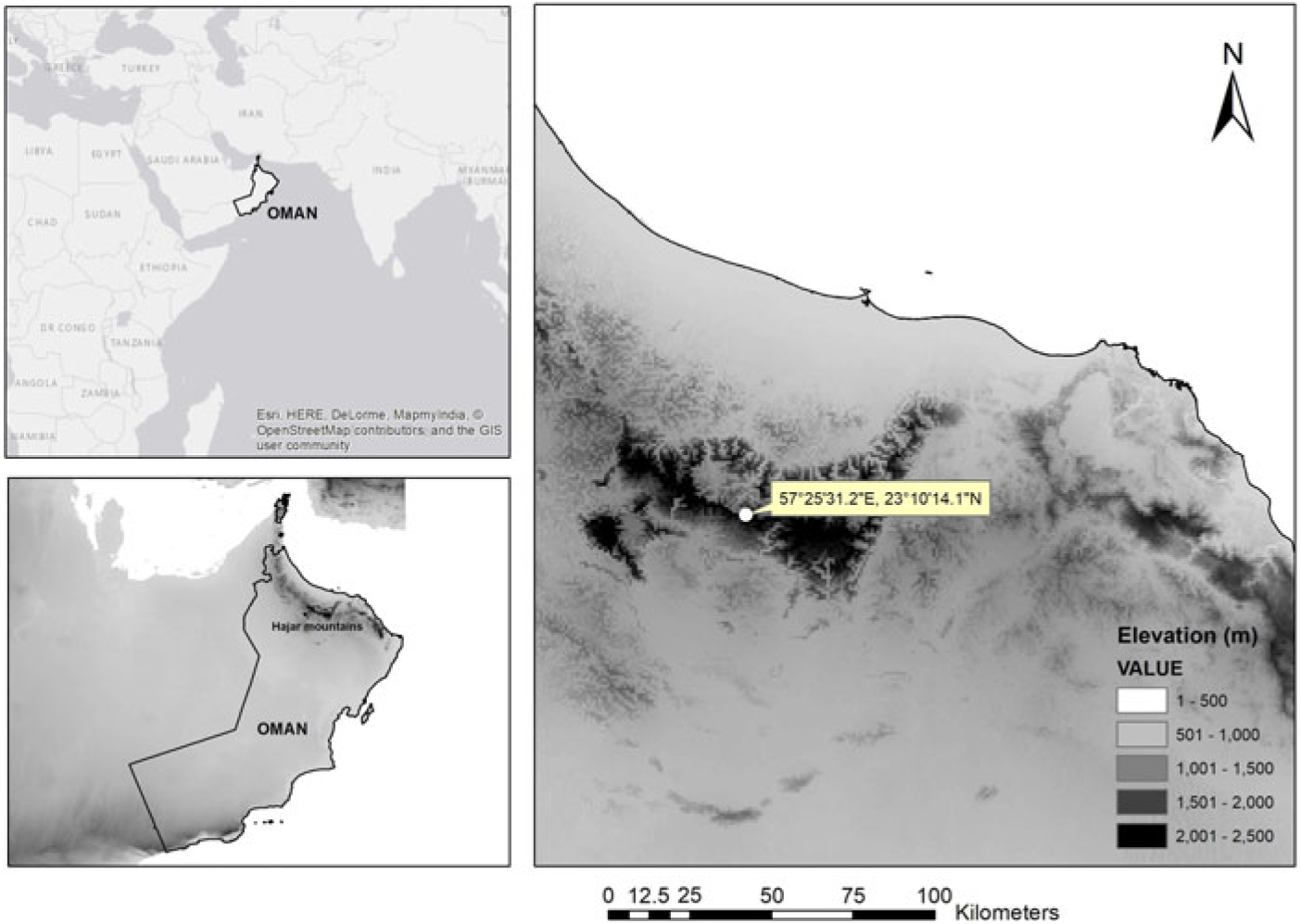
Distribution. Oman, Western Hajar Mountains, Wadi Bani Awf, between Bilad Sait and Sharafat Al Alamein. Known only from the type locality and one other location on the same mountain slope (Fig. 3). The exact distance between the two locations is 0.52 km.
Known distribution of Lavandula nooruddinii in Oman.
Additional specimens examined. Oman. Jabal Shams, Wadi Bani Awf, between Bilad Sait and Sharafat Al Alameyn, 23°09′58.8′′N, 057°25′23.2′′E, 1948 m, 11 iv 2017, A. Al Hinai, AHIN 119 (E, OBG, ON); Jabal Shams, Wadi Bani Awf, between Bilad Sait and Sharafat Al Alameyn, 23°09′58.7′′N, 057°25′22.5′′E, 1962 m, 3 v 2018, A. Patzelt & A. Al Hinai, APAH 78/AP 4959 (OBG, ON); Jabal Shams, Wadi Bani Awf, between Bilad Sait and Sharafat Al Alameyn, 23°10′13.7′′N, 057°25′22.5′′E, 1962 m, 3 v 2018, A. Patzelt & A. Al Hinai, APAH 81/AP 4962 (E, OBG).
Etymology. The species is named after Sheikh Nooruddin Al Salmi (1871–1914), a well-known Omani scientist who was born in Rustaq, a town close to the area where the new Lavandula species was discovered. He was a historian, a poet, a visionary thinker and a pioneer of thought and knowledge in Oman.
Ethnobotany. No uses recorded.
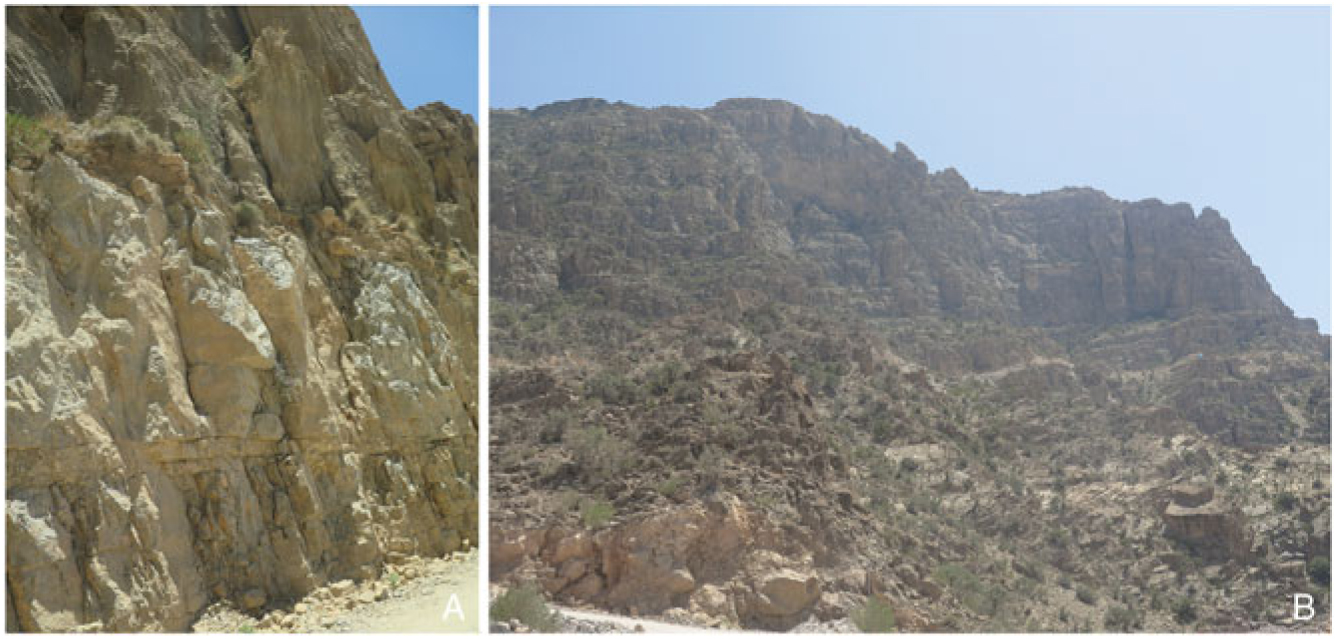
Habitat and ecology. The mountainous area of Jabal Shams is dominated by extensive exposed limestone and dissected by steeply incised wadis and precipitous cliff faces (Fig. 4). The mountains are subjected to high summer temperatures and are semi-arid (mean annual precipitation, c.350 mm), with rainfall usually occurring in spring (February to April) and autumn (August to September), variable in both time and location. However, in isolated areas small seepages occur, facilitating the presence of moist plant communities especially on north-exposed steep slopes and cliffs. Lavandula nooruddinii is found in these steep inaccessible north-exposed moist cliffs; it is a distinct chasmophyte.
A, The habitat is almost inaccessible and the population sizes are very small. B, The steep slopes of the Western Hajar Mountains hold only very few suitable habitats for Lavandula noorruddinii populations. Photographs by Annette Patzelt (May 2018).
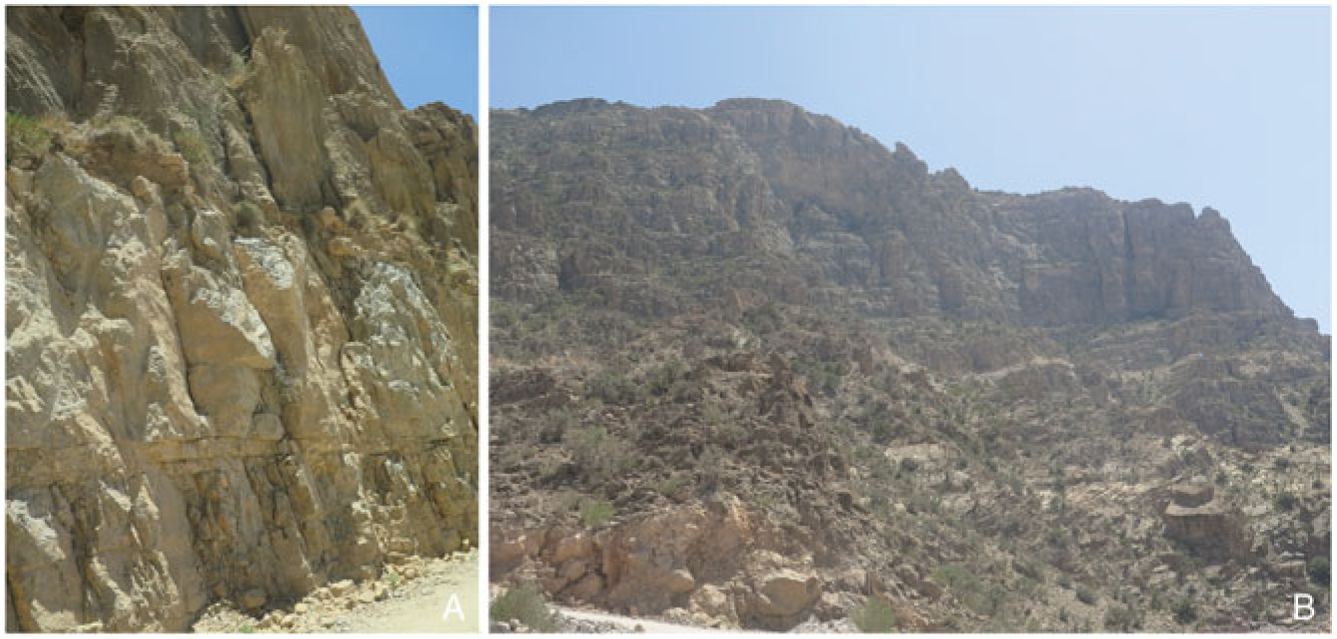
The rare Lavandula nooruddinii is endemic to the Western Hajar Mountains in Oman. Even within this single mountain, suitable localities for Lavandula nooruddinii are few and far between. The habitat is almost impossible to access, but it has been possible to investigate plants that are found at the foot of the cliffs along a road. Accompanying species are several chasmophytes such as Dionysia mira, Pycnocycla prostrata and Campanula akhdarensis, all of which are endemic to the Hajar Mountains.
To present knowledge, Lavandula nooruddinii is found in only two locations, on the same mountain slope, at ± 1493 m altitude and at ± 1962 m altitude. Additional detailed inspection of the larger area in May 2018 did not result in locating any other individuals.
At lower altitude (± 1493 m), Lavandula nooruddinii is found at the drier edge of a hydrophilous plant community dominated by the maidenhair fern Adiantum capillus-veneris L. (Pteridaceae), the orchid Epipactis veratrifolia Boiss. & Hohen. (Orchidaceae), the rare and endemic Dionysia mira and chalk-encrusted mosses. This association Adianto capillus-veneris–Epipactidetum veratrifoliae (Deil, Reference Deil1989) is found in Oman along permanent water courses and in seepages in the Western and Eastern Hajar Mountains and in Musandam. Other species growing with Lavandula nooruddinii were Isodon rugosus (Wall. ex Benth.) Codd (Lamiaceae) and Diplotaxis harra (Forssk.) Boiss. (Brassicaceae).
At higher altitude (± 1962 m), Lavandula nooruddinii is found on a slightly drier vertical cliff. Accompanying species are Dionysia mira, Euryops arabicus Steud. ex Jaub. & Spach (Asteraceae), Diplotaxis harra, Pulicaria glutinosa (Boiss.) Jaub. & Spach (Asteraceae) and Isodon rugosus.
Conservation status. Using IUCN Red List Categories and Criteria (IUCN, 2012), a threat assessment of CR B1ab(iii)+2ab(iii) has been assigned, reflecting the limited extent of occurrence and area of occupancy of Lavandula nooruddinii as well as the recent road construction extension directly affecting both populations. Both populations are found growing on cliffs directly next to the road, and further road construction activities are expected to take place in the near future. Both populations are 0.52 km apart from each other; the chance of pollination between them is considered limited.
Population estimates of the population at 1493 m were about 30 plants, and about 20 plants at the higher elevation of the cliff (May 2018). A survey in the wider area of similar habitats did not reveal any additional plants.
Seeds have been collected for the seed bank in Oman Botanic Garden, and plants are in cultivation in the Oman Botanic Garden nursery.
Comparison of characters of all Lavandula taxa in Oman. a

a Plant community names follow Patzelt (Reference Patzelt2015b).
Acknowledgements
The authors would like to thank Omar Al Amri, Mohammed Al Balushi and Raid Al Mamari from Oman Botanic Garden for their invaluable support during fieldwork.
We are very thankful to Dr Tim Upson (University Botanic Garden, Cambridge, UK) for helpful comments on Lavandula species of Oman and Arabia, and to Dr Darach Lupton and Andrew Anderson (both Oman Botanic Garden) for comments on the manuscript. We also would like to thank Laila Al Jahwari for her drawings of Lavandula nooruddinii and Laila Al Harthy for the preparation of Figure 3 (both Oman Botanic Garden).