Young children's acquisition and use of relative clauses has been investigated in typologically diverse languages (e.g., Arnon, Reference Arnon2010; Brandt, Diessel, & Tomasello, Reference Brandt, Diessel and Tomasello2008; Courtney, Reference Courtney2006; Hamburger & Crain, Reference Hamburger, Crain and Kuczaj1982; Ozeki & Shirai, Reference Ozeki and Shirai2010). The order of acquisition and frequency of different types of relative clauses in child speech, and their functions in child-directed interactions differ across languages (e.g., Chen & Shirai, Reference Chen and Shirai2015; Kirjavainen, Kidd, & Lieven, Reference Kirjavainen, Kidd and Lieven2017; Ozeki & Shirai, Reference Ozeki, Shirai, Matsumoto, Oshima, Robinson and Sells2007). Here we investigate the acquisition and use of relative clauses by Turkish-speaking children within a large age range (0;8 to 5;4) through examining their spontaneous conversations with their caregivers and peers. Turkish is a head-final and morphologically rich language presenting language-specific characteristics different from Indo-European and East Asian languages to the child learner. There is no detailed study of Turkish-speaking children's productions of relative clauses that simultaneously examines semantic and syntactic features for a wide age span. This study fills this gap by examining longitudinal child–caregiver talk and cross-sectional peer interactions. We investigated the age of emergence and the patterns of use of relative clauses in Turkish child speech in relation to caregiver input, in a comparative cross-linguistic approach encompassing children learning other languages. Specifically, we charted the frequency of different types of relative clauses (e.g., subject and object relatives) in child and child-directed speech developmentally, and examined the semantic and structural complexity of children's relative clauses in relation to the ones found in child-directed speech.
Acquisition of relative clauses
Subject relatives modify a head noun that functions as the subject of the relative clause (e.g., the book that was on the shelf), object relatives modify the direct object (e.g., the book that I lost), and oblique relatives modify an oblique element (e.g., the book that the baby played with). Experimental studies in various languages have mostly focused on the differences in children's processing of subject versus object relative clauses. A subject relative clause advantage, in other words, easier processing of subject compared to object relative clauses, has been found in many Western languages. For children, this advantage was demonstrated as more accurate comprehension (Hebrew: Friedmann & Novogrodsky, Reference Friedmann and Novogrodsky2004), production (Danish: Jensen de López, Sundahl Olsen, & Chondrogianni, Reference Jensen de López, Sundahl Olsen and Chondrogianni2014), and repetition (English and German: Diessel & Tomasello, Reference Diessel and Tomasello2005) of subject relative clauses. However, studies conducted in Basque (Gutierrez-Mangado, Reference Gutierrez-Mangado2011), Finnish (Kirjavainen et al., Reference Kirjavainen, Kidd and Lieven2017), and Japanese (Suzuki, Reference Suzuki2011) revealed that this advantage is not universal and cannot be accounted for by syntactic accounts only (such as the Noun Phrase Accessibility Hierarchy (Keenan & Comrie, Reference Keenan and Comrie1977) and the Linear Distance Hypothesis (Gibson, Reference Gibson1998)). That not only syntactic but also semantic features of relative clauses affect their processing has been shown by studies finding that both adult and child speakers find object relatives with inanimate head nouns and personal pronominal subjects (e.g., the building that I saw) much easier to process than the ones with animate head nouns and lexical subjects (e.g., the bird that the cat saw) (Arnon, Reference Arnon2010; Kidd, Brandt, Lieven, & Tomasello, Reference Kidd, Brandt, Lieven and Tomasello2007; Mak, Vonk, & Schriefers, Reference Mak, Vonk and Schriefers2006; Traxler, Morris, & Seely, Reference Traxler, Morris and Seely2002).
Another factor that affects children's acquisition and processing of relative clauses is their distribution in the input. Studies using naturalistic data provide further possibilities of examining the role of child-directed speech on the acquisition patterns over time. In spontaneous speech studies, relative clauses were generally coded for the syntactic role of the head noun both in the relative clause and in the matrix clause to investigate the frequency distribution of different types of relative clauses (e.g., subject, object) and the types of matrix constructions they are attached to in child and caregiver speech to assess the complexity of the structures. English-speaking children, followed between ages 1;9 and 5;2, produced relative clauses mostly in simple constructions such as presentational constructions (e.g., that is the sugar that goes in there) or without a matrix clause (e.g., another picture I made) (Diessel, Reference Diessel2004; Diessel & Tomasello, Reference Diessel and Tomasello2000). Children heard object relatives more frequently than subject relatives in child-directed speech. Until age 3, children produced more subject than object relatives and both structures were produced with similar frequencies between the ages of 4 and 5;2. The authors argued that an explanation for the abundance of subject relatives in younger children's speech was their relative ease of processing in English as they have a similar surface structure to simple sentences (e.g., subject relative clause: the man that laughs; simple sentence: the man laughs).
In contrast, Japanese-speaking children (up to the age of 3;11) produced subject, object, and oblique relatives with similar frequencies; a pattern very similar to the distribution in their caregiver speech, as demonstrated in the speech of the mother of one of the children (Ozeki & Shirai, Reference Ozeki, Shirai, Matsumoto, Oshima, Robinson and Sells2007, Reference Ozeki and Shirai2010). Japanese is classified as an attributive (i.e., noun-modifying) clause language where a modifying clause is merely attached to the head noun without further syntactic operations (e.g., movement) (Comrie, Reference Comrie, Boeder, Schroeder, Wagner and Wildgen1998a, Reference Comrie and Ramat2002), and it has no overt marker for relative clauses syntactically or morphologically. Thus, it was argued that the ease of producing different types of relative clauses was similar, as these do not necessitate syntactic operations at different levels of complexity.
In the speech of children speaking Mandarin Chinese (up to the age of 3;5), the complexity of relative clauses increased with children's increasing morphosyntactic ability indexed by their MLU levels. Object relatives, which are similar to simple sentences in terms of word order and are more frequent than other types in the input, emerged first and were more frequent (Chen & Shirai, Reference Chen and Shirai2015). For the acquisition of relative clauses in different languages, Chen and Shirai proposed that multiple factors such as structural complexity, similarity to simple sentence structure, and input frequency jointly determine the course of acquisition where structural complexity seems to play a more predominant role in relative clause languages compared to attributive clause languages.
Another relative clause language where spontaneous speech data were analyzed is Finnish. In Finnish, relative pronouns are inflected for case and number, where subject, object, and single-word oblique relativizers are similar in terms of lexical complexity (Kirjavainen et al., Reference Kirjavainen, Kidd and Lieven2017). A Finnish-speaking child followed between ages 1;7 and 3;6 produced oblique relatives most frequently, closely mirroring the input of her caregivers (Kirjavainen & Lieven, Reference Kirjavainen, Lieven and Kidd2011). In line with the data from other languages, Finnish-speaking child's relative clauses were in general low in complexity, as the majority of the relative clauses were uttered without a matrix clause. A similar gradual pattern of development was found in Hebrew, where younger children erroneously used resumptive pronouns, and more complex relative clauses in terms of semantic content (e.g., talking about future, possible, and necessary events) emerged later (Arnon, Reference Arnon and Kidd2011).
To summarize, there are two important outcomes of spontaneous speech studies: first, the morphosyntactic and semantic complexity of children's relative clauses increases with age. And second, multiple factors relating to the syntactic, morphological, and semantic complexity of relative clauses, and input distribution, seem to affect the course of acquisition. When structural complexity and distributional patterns in the input match (as in Japanese and Mandarin), it is easy to predict that structurally less complex structures that are more frequent in the input will be acquired by the children more easily. But when structural complexity and distributional patterns do not match (as in English), then it is more difficult to form expectations about children's acquisition of a particular structure. The presence of a mismatch between structural complexity and input frequency informs us about the relative contributions of these variables to children's acquisition patterns. The present study aims to assess the role of structural complexity and input frequency in the acquisition of relative clauses by Turkish-speaking children.
Turkish offers a good testing ground since limited evidence shows that object relatives, which are morphosyntactically more difficult than subject relatives in Turkish, may be more frequent in caregiver speech directed to children (Altınkamış & Altan, Reference Altınkamış and Altan2016). Hence if Turkish-speaking children find subject relatives easier to produce than object relatives, despite the fact that their caregivers produce object relatives highly frequently, then Turkish-speaking children would act like their English-speaking counterparts; a finding highlighting the importance of structural complexity. However, if Turkish-speaking children produce object relatives more frequently than or similarly to subject relatives, then this would mean that the input frequency may override the morphosyntactic difficulty in some languages. Hence, investigating Turkish-speaking children's acquisition of relative clauses provides new information about the relative contribution of different factors to the acquisition of complex language structures.
Relative clauses in Turkish and their acquisition
Turkish is different from the languages that have been studied in several important ways. Turkish is an agglutinative head-final SOV language with a relatively flexible word order. Turkish differs from head-initial languages like English, Finnish, and Hebrew as it has prenominal relative clauses that do not require a relative pronoun. Turkish also differs from Mandarin Chinese and Japanese in that it marks relative clauses morphologically, and is classified as a relative clause language (i.e., involving extraction from the position relativized) as opposed to an attributive clause language (Comrie, Reference Comrie1998b, Reference Comrie and Ramat2002). Examples (1) to (3) demonstrate a subject, an object, and an oblique relative clause in Turkish.

Nouns and verbs in Turkish relative clauses possess inflectional markers. Subject relatives (in OVS order) are denoted with the −(y)An suffix, whose main function is to mark subject relatives.Footnote 2 Non-subject relatives (in SVO order) are marked with the −DIK suffix which has other functions like marking subordination and adverbial clauses (Göksel & Kerslake, Reference Göksel and Kerslake2005). In non-subject relatives, the subject is further denoted with the genitive suffix, and the −DIK marker is followed by a possessive suffix that marks agreement with the subject. The verbs constructed with the affixes −(y)An and −DIK are in non-finite form, and the tense indicated within the relative clause is inferred from the context or denoted with the tense markers –mIş and –EcEK (e.g. kızın gör-eceğ-i kuş ‘the bird that the girl will see’ or kızın gör-müş ol-duğ-u kuş ‘the bird that the girl had seen’).
Another relativizing construction that Turkish corpus studies focused on is the locative construction that does not contain a verb and is formed by combining the pronominalizer −ki suffix with the locative suffix −DA (see example (4)) (Altınkamış & Altan, Reference Altınkamış and Altan2016; Slobin, Reference Slobin, Slobin and Zimmer1986). These grammatical forms can be used to identify referents spatially or temporally, and are thought to correspond to reduced relatives in English (Erguvanlı, Reference Erguvanlı1980).

Experimental studies conducted with Turkish-speaking children point to an advantage in processing subject relative clauses. In various elicitation tasks, children aged between three and eight produced more subject relatives than object relatives, and the production of subject relatives was more accurate (Ekmekçi, Reference Ekmekçi, Imer and Subaşı1998; Özge, Marinis, & Zeyrek, Reference Özge, Marinis, Zeyrek, Chandlee, Franich, Iserman and Keil2010a; Yumrutaş, Reference Yumrutaş2009). In their erroneous responses to object relatives, children usually maintained the correct word order, but used the subject relative clause marker instead (Özcan, Reference Özcan, Göksel and Kerslake2000; Özge et al., Reference Özge, Marinis, Zeyrek, Chandlee, Franich, Iserman and Keil2010a; Uzundag & Küntay, Reference Uzundag and Küntay2018; Yumrutaş, Reference Yumrutaş2009). In some cases, both children and adults avoided using object relatives by producing other types of constructions like conjoined clauses (hani inek onu kovalıyor ya işte o koyun ‘you know the cow is chasing it, that sheep’) or passive sentences (itilen koyun ‘the sheep that is being pushed’) (Özcan, Reference Özcan, Göksel and Kerslake2000; Özge et al., Reference Özge, Marinis, Zeyrek, Chandlee, Franich, Iserman and Keil2010a; Uzundag & Küntay, Reference Uzundag and Küntay2018).
In terms of the comprehension of relative clauses, Turkish-speaking children showed a similar asymmetry between subject and object relatives. In sentence–picture matching or sentence–character matching tasks, children at preschool and primary school ages gave more correct answers to subject relatives compared to object relatives (Kükürt, Reference Kükürt2004; Özge, Marinis, & Zeyrek, Reference Özge, Marinis, Zeyrek, Ay, Aydın, Ergenç, Gökmen, İşsever and Peçenek2009). Similarly to findings in other languages (Arnon, Reference Arnon2010; Kidd et al., Reference Kidd, Brandt, Lieven and Tomasello2007), comprehending object relatives was difficult only if the described relationship took place between two animate entities, i.e., the relationship was reversible. If a non-reversible relationship between an animate and an inanimate entity was described (e.g., the ice cream that the child is holding), then children performed close to ceiling.
Overall, experimental studies conducted with Turkish-speaking children in preschool and primary school years showed that children find object relatives more difficult than subject relatives in comprehension and production tasks when a relation between two animate entities is described. That the non-subject relative marker also has other functions in the language, and the existence of the genitive and possessive suffixes in the non-subject relative construction are thought to pose difficulties in processing non-subject relatives for children (Özge et al., Reference Özge, Marinis, Zeyrek, Chandlee, Franich, Iserman and Keil2010a; Slobin, Reference Slobin, Slobin and Zimmer1986). Apart from morphological complexity, input frequency may be another factor affecting children's processing, such that structures that are less frequent in the input may be more difficult to process for children in experimental settings. We will now turn to two corpus studies in Turkish that found a different order of frequencies of subject and object relatives in child-directed speech.
There are only two studies that examined Turkish-speaking children's spontaneous speech productions for relative clauses. Slobin (Reference Slobin, Slobin and Zimmer1986) analyzed the speech of 57 Turkish-speaking and 57 English-speaking children with ages ranging from 2 to 4;8. Children's interactions were recorded during their conversations with the experimenters, while the children were engaged in psycholinguistic tasks (e.g., act-out task with animal toys). Overall, Turkish-speaking adults (i.e., the experimenters) and children produced relative clauses less frequently than English speakers. In child speech, there were 96 relative clauses in English and 42 in Turkish. In his analysis, Slobin regarded locative constructions (see example (4)) as subject relatives. If locative constructions are omitted, then only 14 subject and 5 non-subject relatives were found in Turkish-speaking children's speech. Turkish-speaking adults produced 22 relative clauses where 15 of these were subject relatives. English-speaking children showed a more accelerated growth curve in terms of the number of relative clauses they produced with increasing age. Slobin consequently suggested that relative clauses are a late accomplishment in Turkish, and children master these constructions after the late age of 4;8, the oldest age group examined in the study.
Altınkamış and Altan (Reference Altınkamış and Altan2016) provided the first analysis of the use of Turkish relative clauses in spontaneous child–caregiver interactions. They examined the longitudinally collected data of five children between the ages of 1;0 and 2;4, and four children between the ages of 2;0 and 3;6. Additionally, they used cross-sectional data from 21 children (between 9 months and 3 years of age) that included children's interactions with their mothers during free-play, toy-play, and book-reading (reading a wordless picture-book) activities. Relative clauses were scarce in child speech – in fact, only two examples uttered by the same child at age 2;4 were provided. Contradicting Slobin's (Reference Slobin, Slobin and Zimmer1986) findings, non-subject relatives (N = 151) were more frequent than subject relatives (N = 71) in child-directed speech. Locative constructions, which are assumed to be simpler than relative clauses, were the most frequent category in the input (N = 399).
In sum, studies about the acquisition of Turkish relative clauses were generally experimental, and studies of spontaneous speech found contradictory results and did not provide information about children's use of relative clauses in relation to the input they receive. The goal of the current research was to investigate the age of emergence and patterns of use of relative clauses by Turkish-speaking children in relation to child-directed speech in a cross-linguistic framework with reference to similar studies in other languages. We examined data from a younger (up until 36 months) and an older group (43–64 months) of children to see both emergence and further development of the construction within a wide age span. Specifically, we investigated which types of relative clauses (e.g., subject vs. object relative clauses) were more frequent in child and child-directed speech, whether the frequency of caregivers’ production of relative clauses depended on parental education, and the complexity of children's relative clauses in terms of various semantic and structural dimensions. Based on morphosyntactic difficulty alone, one would expect subject relative clauses to occur more frequently than object relative clauses in Turkish child speech. However, if Turkish-speaking children hear object relative clauses more frequently than subject relative clauses in the input (as found by Altınkamış & Altan, Reference Altınkamış and Altan2016), then this may ease the production of object relative clauses, resulting in the predominance of object relative clauses or similar frequencies of both relative clause types in child speech. As observed for other languages, we expected the semantic and structural complexity of children's relative clauses to increase with age and children to exhibit less complexity than their caregivers in their productions.
Method
Corpora
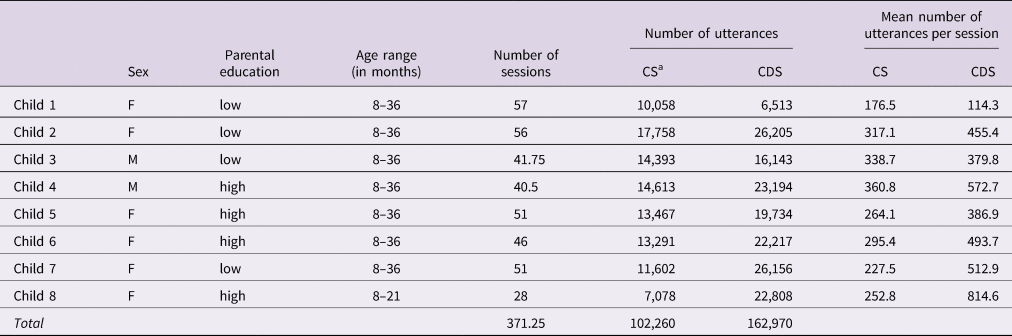
We employed two different corpora to study both early and late child speech. The corpus of child–caregiver interactions contained longitudinal recordings of spontaneous speech from eight children and their caregivers (e.g., mother, grandmother, babysitter) (KULLDD corpus: Küntay, Koçbaş, & Taşçı, Reference Küntay, Koçbaş and Taşçı2015). Seven children were followed from 8 to 36 months, and one child was recorded between 8 and 21 months. Four of the children had parents with lower levels of education (parental educational attainment of 8, 8, 5, and 5 years), and four had parents with higher levels of education (parental educational attainment of 15, 11, 15, and 21 years). Children were video-recorded bimonthly in their home environment while engaging in daily activities like eating and playing. The duration of each recording was one hour. Table 1 gives information about the amount of child and caregiver speech for each individual child in the KULLDD corpus.
Properties of the Longitudinal Corpus of Child–Caregiver Interactions

Notes. a CS: child speech; CDS: child-directed speech.
For studying child speech from older children (late child speech), we used a peer interaction corpus of nearly 26,000 utterances, which was originally collected to study children's conversational conflict management strategies (Köymen, Reference Köymen2005). This corpus contained video-recorded peer interactions of triads of 78 children between 43 and 64 months of age while they were carrying out game-like tasks assigned by the researcher in their preschool. Children mostly had parents with higher levels of education: 65 children had at least one parent with a degree from university or vocational college, and the remaining 13 children had at least one parent with a degree from high school. During data collection, 22 target children (11 girls) were selected randomly, and each triad of children was formed on the basis of teacher's reference with two of the target child's friends with whom she or he spends a considerable amount of time. Each target child participated in a same-sex triad (composed of the target child and two same-sex peers) and a mixed-sex triad (composed of the target child, a boy, and a girl). Triads of children engaged in four different tasks. Two of these tasks were collaborative, where children had to do the task together (building something out of Lego, and drawing), and two of them were competitive, such that there would be a winner (playing with memory cards and playing a game). Each task's duration was approximately 15 minutes. The experimenter only intervened if there was a risk of physical injury.
Coding
For the corpus of child–caregiver interactions, each utterance that contained a relative clause formed with the affixes −(y)An, −DIK, −mIş, −EcEK, or a locative construction formed with the −DAki affix, was extracted from child speech and child-directed speech via an R script. Since the morphological coding of the corpus is not yet completed, we made the searches in the ‘FLO’ transcription lines, which are simplified versions of the main CHAT lines with markers of retracing, errors, and overlaps removed. We searched for the lines that had a word either ending with the suffixes that mark subject relatives (i.e., en, an), containing the suffixes that mark non-subject relatives (i.e., dık, dik, duk, dük, tık, tik, tuk, tük, dığ, diğ, duğ, düğ, tığ, tiğ, tuğ, tüğ), or the combination of subject relative clause suffixes and other suffixes that mark case, possession, and plural (eni, anı, ene, ana, ende, anda, enden, andan, enin, anın, enle, anla, enim, anım, enimiz, anımız, eniniz, anınız, enler, anlar). Utterances with these markers that convey different meanings (e.g., adverbial clause: istediğin kadar al ‘take as much as (you) want’), song lyrics, and idiomatic expressions were excluded (N = 239 in child–caregiver interactions). For the peer interaction corpus, since the CHAT format was not employed in the transcription, the first author manually checked all the transcripts to locate the utterances that contained relative clauses and locative constructions.
Following the coding scheme in previous corpus studies (Chen & Shirai, Reference Chen and Shirai2015; Diessel & Tomasello, Reference Diessel and Tomasello2000; Kirjavainen & Lieven, Reference Kirjavainen, Lieven and Kidd2011; Ozeki & Shirai, Reference Ozeki, Shirai, Matsumoto, Oshima, Robinson and Sells2007), relative clauses in child and child-directed speech were first coded according to (a) the syntactic role of the head noun in the relative clause, and (b) the syntactic role of the head noun in the matrix clause in which the relative clause is located, as will be elaborated below. Then, to assess the complexity of the relative clauses and to allow for a cross-linguistic comparison, we coded for (c) whether the subject of the relative clause was pronominal or lexical (e.g., gördüğüm kitap ‘the book that (I) saw’ vs. kadının gördüğü kitap ‘the book that the woman saw’), (d) whether the head noun was missing (e.g., gelenler ‘(the ones) that are coming’ vs. gelen insanlar ‘people that are coming’), and (e) whether the head noun (if overt) was a generic noun such as yer ‘place’, şey ‘thing’, or biri ‘one’. Finally, we coded for (f) the animacy of the head noun. Characters in books and toys that could be perceived as animate were coded as animate entities.
Syntactic role of the head noun in the relative clause
With respect to the syntactic role of the head noun in the relative clause, an utterance was classified as either a subject relative, direct object relative, oblique relative, or genitive relative. These categories are exemplified in examples (5) to (8) below. Indirect object relatives were not found in the data.

Syntactic role of the head noun in the matrix clause
We coded the role of the head noun within the minimal matrix clause that contained the relative clause or locative construction. The following categories were used:

Inter-rater reliability
For the corpus of child–caregiver interactions, the first author coded each relative clause and locative construction in child and child-directed speech (N = 924) and a linguistics graduate student independently coded 45% of the data. The inter-rater reliability was calculated with Cohen's kappa, and it was κ = .950 (95% CI, .925 to .975) for the syntactic role of the head noun in the relative clause, κ = .851 (95% CI, .812 to .890) for the syntactic role of the head noun in the matrix clause, κ = 1.0 for pronominal subject, κ = .995 (95% CI, .985 to 1.0) for the overt presence of the head noun, κ = .989 (95% CI, .975 to 1.0) for generic head noun, and κ = .958 (95% CI, .927 to .989) for animacy.
For the peer interaction corpus, the first author coded all the relative clauses and locative constructions (N = 218), and a linguistics graduate student coded 23% of the data. The inter-rater reliability for the raters was κ = .973 (95% CI, .920 to 1) for the syntactic role of the head noun in the relative clause, κ = .828 (95% CI, .712 to .944) for the syntactic role of the head noun in the matrix clause, κ = 1.0 for pronominal subject, κ = .961 (95% CI, .885 to 1) for the overt presence of the head noun, κ = .961 (95% CI, .885 to 1) for generic head noun, and κ = .854 (95% CI, .695 to 1) for animacy. All disagreements were resolved by discussion.
Results and discussion
In this section, we first present frequencies of relative clauses in child and child-directed speech and how these patterns compare to other languages. We also present data about the frequency of relative clauses in caregiver speech coming from different parental education levels. Then we present our findings about how relative clauses are distributed in child and caregiver speech according to the syntactic role of the head noun in the relative clause and in the matrix clause. Finally, we provide information about the complexity of children's relative clauses in comparison to caregiver speech and children learning other languages. For each section, we first report our findings for early child speech followed by our findings for late child speech in relation to child-directed speech.
Frequency
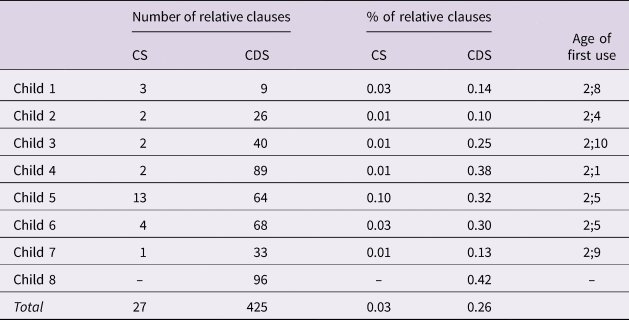
We identified 27 child-produced and 425 child-directed utterances that contained relative clauses in the child–caregiver interaction corpus. Table 2 shows the number and proportion of relative clauses within child and caregiver speech for each child. The age range for a relative clause to first appear in the corpus varied between 2;1 and 2;10 across children.
Number and proportion of relative clauses and the age of emergence in the Corpus of Child–Caregiver Interactions

Notes. Child 8, who was followed until 21 months, did not produce a relative clause in the recordings; CS: child speech; CDS: child-directed speech.
As seen in Table 2, relative clauses were just emerging in child speech before 36 months. Only a total of 27 relative clauses were found in a corpus composed of 95,182 child utterances. Child 5, who produced more relative clauses than the other children, produced 10 out of her 13 relative clauses by using the same verb yaşa- ‘live’, where 7 of these were recorded in one session and 3 were recorded in another session. Turkish relative clauses comprised only 0.03% of child speech as opposed to 0.23%, 0.95%, and 0.05% in English, Mandarin Chinese, and Finnish, respectively (Chen & Shirai, 2005; Diessel & Tomasello, Reference Diessel and Tomasello2000; Kirjavainen & Lieven, Reference Kirjavainen, Lieven and Kidd2011).Footnote 3 If only the data of the two English-speaking children that were followed until a similar age as in the present study (3;1 and 3;3) were examined, then relative clauses in these children's speech comprised 0.09% and 0.21% of their total speech. Thus, corroborating previous findings (Altınkamış & Altan, Reference Altınkamış and Altan2016; Slobin, Reference Slobin, Slobin and Zimmer1986), the production of relative clauses occurs relatively late in Turkish-speaking children's language development.
In the peer interaction corpus, 155 relative clauses were found in total, which corresponded to 0.6% of the total number of utterances (N = 26,000). Fifty out of 78 children produced at least one relative clause (M = 2.0, SD = 2.5, Range = 0–12). Hence, as was expected, the older children produced more relative clauses than the younger children.
Turning to caregivers’ speech, relative clauses were again less frequent in Turkish (0.26%) compared to Finnish (0.45%) and Mandarin (1.72%). The fact that Turkish-speaking caregivers did not produce relative clauses frequently may suggest that they turn to simpler alternative structures when speaking to children as opposed to when speaking to adults. Therefore, we first checked the proportion of relative clauses in adult-to-adult conversations in the corpus of child–caregiver interactions.Footnote 4 We found that, when speaking to other adults, relative clauses constituted 1.11% (N = 402/36,111) of adult speech; a ratio much higher than in child-directed speech. Thus, adults used fewer relative clauses when addressing children than when addressing adults. Then, we searched the corpus for alternative structures that children and adults may have used as a substitute for relative clauses. Slobin (Reference Slobin, Slobin and Zimmer1986) argued that, by using the discourse particles hani and ya (roughly translated as ‘you know’) to refer to the shared information between the child and the listener, children may avoid using relative clauses (e.g., hani ev var ya böyle damı ‘you know there is a house with a roof like that’ instead of using the relative clause böyle damı olan ev ‘a house that has a roof like that’). We searched for the use of hani in the longitudinal corpus and found only two instances of this type of use in child-directed speech. Hence, the use of modifiers with these discourse particles does not seem to explain the low frequency of relative clauses in child and child-directed speech. We then examined the frequency of locative constructions (see example (4)) that may be used as another alternative structure under certain circumstances. Previous corpus and narrative elicitation studies showed that locative constructions were more frequent than relative clauses in Turkish-speaking children's speech (Dasinger & Toupin, Reference Dasinger, Toupin, Berman, I and Slobin1994; Slobin, Reference Slobin, Slobin and Zimmer1986). We found that, before 36 months of age, children produced more locative constructions (N = 50) than relative clauses (N = 27). In late child speech, locative constructions were not as frequent (N = 63) as relative clauses (N = 155). And finally, in child-directed speech, locative constructions (N = 422) were as frequent as relative clauses (N = 426). Hence, Turkish speakers seem to use locative constructions, which are morphosyntactically simpler than relative clauses, whenever the referent can be identified spatially (yerdekini sen al ‘you get the one on the floor’), temporally (bizim çocukluğumuzdaki şarkılar ‘the songs in our childhood’), or deictically (buradaki kelebek ‘the butterfly over here’).
The relation of parental education to caregiver input
We observed individual differences between children in terms of the amount and proportion of relative clauses they heard from their caregivers. The proportions of relative clauses in child-directed speech were compared across parental education levels with an independent samples t-test after applying arcsine transformation to the proportions. Results showed that children who had parents with higher levels of education heard more relative clauses (M = 0.36%, SD = 0.05) than children who had parents with lower levels of education (M = 0.15%, SD = 0.07) (t(6) = 4.61, p = .004, d = 3.45). The relation of parental education to children's productions could not be assessed in the peer interaction corpus as parental education was mostly similar across children.
Syntactic role of the head noun in the relative clause
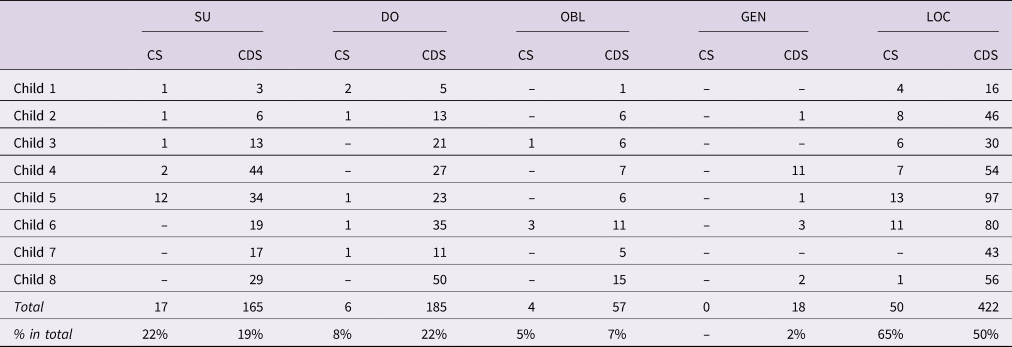
SU relatives were most frequent (N = 17) followed by DO (N = 6) and OBL (N = 4) relatives in early child speech. Table 3 shows the individual uses of children and their caregivers. The predominance of SU relatives is due to one child's (Child 5) more frequent use of these structures compared to other children. Among the remaining children, two produced both types of relatives; two produced only SU; and two produced only DO relatives. Hence, by looking at these data, we cannot say that Turkish-speaking children find SU relatives easier to produce than DO relatives, as was observed in experimental studies (e.g., Özge et al., Reference Özge, Marinis, Zeyrek, Chandlee, Franich, Iserman and Keil2010a). OBL relatives were produced by two children only, and GEN relatives by none, which were also absent in three of the children's input. In general, locative constructions were more frequent than relative clauses both in child and caregiver speech.
Uses of SU, DO, OBL, and GEN relatives and locative constructions (LOC) by younger children and their caregivers

Notes. CS: child speech; CDS: child-directed speech.
Overall, within relative clauses (when locative constructions were excluded), DO relatives (43%) seemed to be slightly more frequent in caregiver speech than SU relatives (39%), although this difference was not significant by a binomial test. These findings differed from Slobin's (Reference Slobin, Slobin and Zimmer1986) findings, which showed a higher frequency for SU relatives (68%) than non-subject relatives (32%) in child-directed speech. Also unlike Altınkamış and Altan's (Reference Altınkamış and Altan2016) findings, DO relatives were not much more pronounced than SU relatives in caregiver speech. Further binomial tests showed that DO relatives were significantly more frequent than SU relatives in the speech of the caregivers of Child 6 (p = .04) and Child 8 (p = .02).
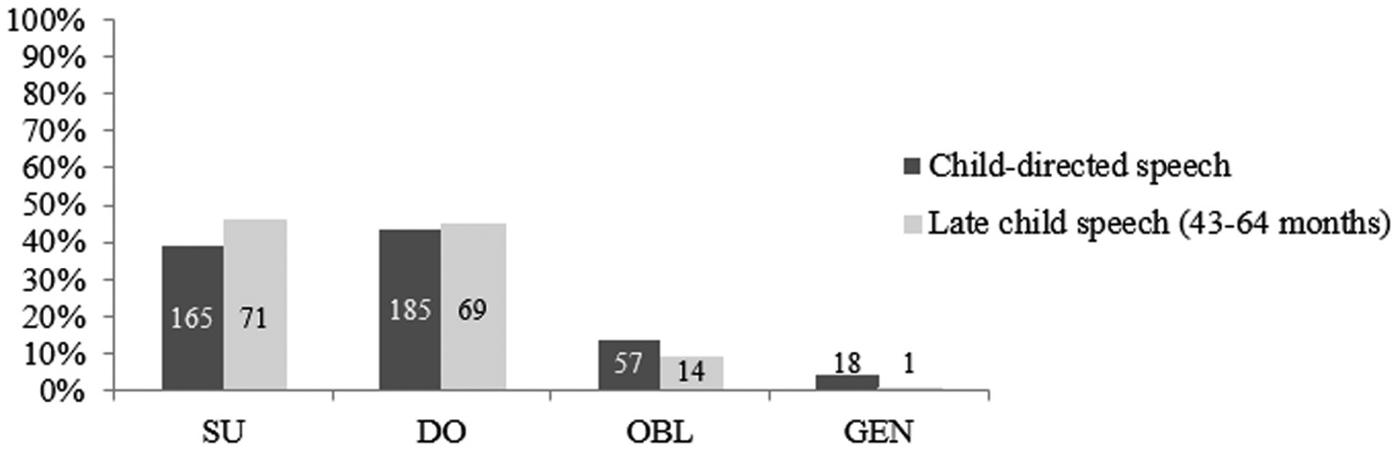
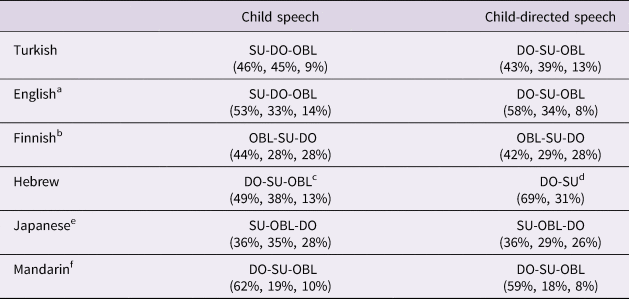
In late child speech, SU (46%, N = 71) and DO (45%, N = 69) relatives were produced with almost equal frequencies. Figure 1 shows a very similar distribution of different types of relative clauses for late child speech and caregiver speech to the younger children.
The proportion of relative clauses by the syntactic role of the head noun in the relative clause in child-directed speech and late child speech. (The number of different relative clauses is shown on the bars.)

This similarity shows that more frequently heard structures were produced by the children more frequently, as in the other languages presented in Table 4. Although English seems to present a different case than other languages presented here, findings in Turkish and English are quite similar when only the productions of similar age groups are taken into account. In both languages, object relatives are considered more difficult than subject relatives in terms of syntactical and/or morphological constraints. However, preschool-aged Turkish-speaking children produced object relatives as frequently as subject relatives, just like the English-speaking children between the ages of 4;0 and 5;2 (Diessel & Tomasello, Reference Diessel and Tomasello2000). This finding seems to highlight the role of the input distribution where object relatives were produced as frequently as or more frequently than subject relatives in both languages.
Cross-linguistic comparison of the distribution of the syntactic role of the head noun in the relative clause

Notes. SU: subject relative; DO: direct object relative; OBL: oblique relative. Turkish data are based on late child speech (43–64 months); a. Diessel (Reference Diessel2004); b. Kirjavainen & Lieven (Reference Kirjavainen, Lieven and Kidd2011); c. Arnon (Reference Arnon and Kidd2011); d. Arnon (Reference Arnon2010); Only transitive subject and object relative clauses were reported by this study; e. Proportion values were obtained by personal communication (Hiromi Ozeki, 22 February 2018); f. Chen & Shirai (Reference Chen and Shirai2015).
OBL relatives were not very frequent in late child speech (9%) and caregiver speech (13%). Before 36 months, only four instances of OBL relatives were produced. Children and caregivers produced OBL relatives for marking a location (e.g., senin olduğun yerde ‘in the place where you are’), direction (e.g., kaçacak bir yerin yok ‘there is no place that you can run to’), instrument (e.g., Banyo yaptığın şeye mi benzettin? ‘Does it look like the thing that you bathe with?’), source (aldığın yere koy ‘put (it) where you got (that) from’), and time (e.g., hani kedinin seni tırmaladığı gün ‘you know, the day that the cat scratched you’). GEN relatives, which are probably most difficult to process due to their different information structure (e.g., in example (8), the verb in the relative clause is about the possessed item (tail) rather than the head noun (fish)), were missing in early child speech, and constituted only 1% of the relative clauses in late child speech and 4% in caregiver speech.
Syntactic role of the head noun in the matrix clause
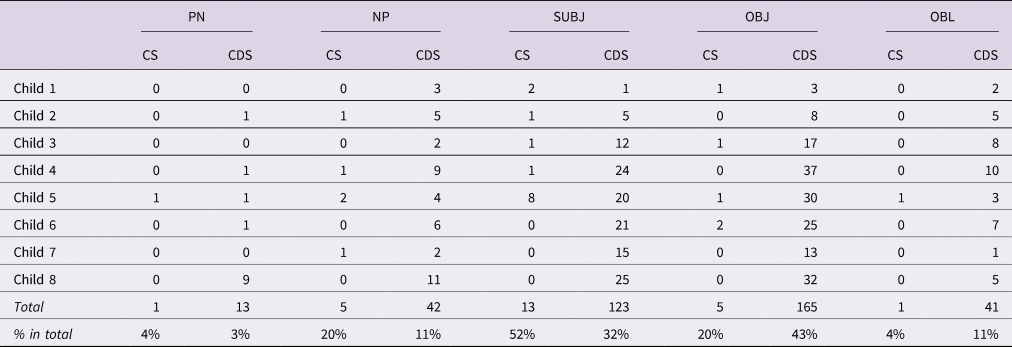
Before 36 months of age, the head noun of the relative clauses usually functioned as the subject of a matrix clause (N = 13). Less frequently, the head noun was used in isolation (N = 5), functioned as the object (N = 5), the adjunct (N = 2), the oblique element (N = 1), or the predicate nominal (N = 1). Table 5 shows the number of uses of different syntactic roles of the head noun for each child and his/her caregivers. The higher frequency of SUBJ relatives in child speech is in part due to Child 5's more frequent use of this category than other children. In general, the productions of the caregivers of different children were similar, such that the head noun mostly functioned as the object of the matrix clause followed by its subject function. When tested with a binomial test, the difference between SUBJ and OBJ relatives was significant in overall child-directed speech (p = .016).
Frequency of individual uses of PN, NP, SUBJ, OBJ, and OBL relatives by younger children and their caregivers

Note. CS: child speech from the corpus of child-caregiver interactions; CDS: child-directed speech.
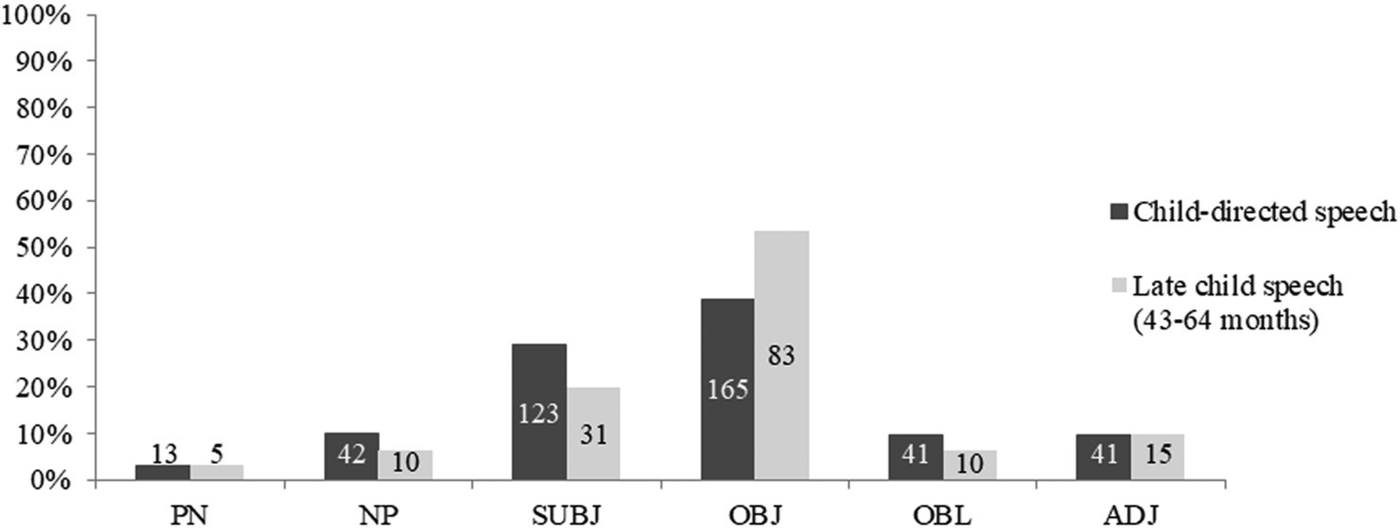
Younger and older children's use differed in terms of the syntactic role of the head noun in the matrix clause, such that OBJ relatives were much more frequent than SUBJ relatives in older children's speech. The difference between SUBJ and OBJ relatives in late child speech was significant with a binomial test (p < .001). One explanation of the discrepancy between younger and older children's use of relative clauses could be related to the context, as older children usually talked about the actions they did or were planning to do, and what other children did (e.g., niye sen aynı olmayanları alıyorsun ‘why are you taking the ones that are not the same?’). Another explanation would be that older children use relative clauses similarly to the ones found in child-directed speech. As seen in Figure 2, older children and adults demonstrated a very similar usage of relative clauses, as also shown by a strong correlation (r(5) = .93, p = .023).
The proportion of relative clauses by the syntactic role of the head noun in the matrix clause in child-directed speech and late child speech. (Raw frequencies are shown on the bars.)

In both child and child-directed speech, the head noun mainly functioned as the object or the subject of the matrix clause, with other uses being less frequent. The most frequent combination of the syntactic role of the head noun in the relative and matrix clauses was the combination of DO and OBJ relatives, meaning that the head noun of object relative clauses mostly functioned as the object of the matrix clause. We observed an asymmetry between subject and object relatives in terms of the syntactic role of the head noun in the matrix clause. In caregiver speech to young children, the head noun of 65 subject relatives functioned as the subject of the matrix clause, and the head noun of 54 object relatives functioned as the object of the matrix clause. A similar distribution was observed for late child speech, where the head noun of 23 subject relatives functioned as the subject of the matrix clause, and the head noun of 32 object relatives functioned as the subject of the matrix clause. For subject and object relatives, this distribution was almost symmetrical, in other words, the head noun of subject and object relatives functioned as the subject of the relative clause with similar frequencies (n.s.). However, for OBJ relatives there was an asymmetry such that the head noun of the object relatives functioned as the object of the matrix clause more frequently than the head noun of subject relatives in late child (p = .007) and child-directed speech (p < .001). In late child speech (and in child-directed speech), the head noun of 51 object relatives (93 in child-directed speech) assumed the role of the object in the matrix clause, whereas only the head noun of 6 object relatives (59 in child-directed speech) functioned as the subject of the matrix clause.
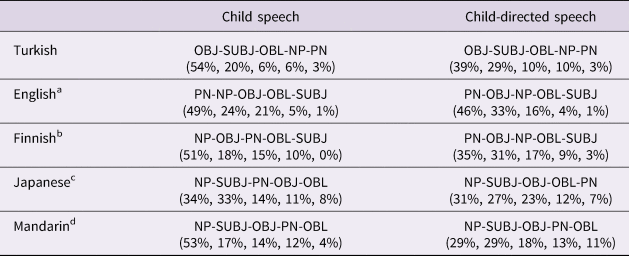
As seen in Table 6, how children and caregivers speaking different languages use relative clauses with respect to the syntactic role of the head noun in the matrix clause differs across languages. In all the languages except Turkish, children mostly uttered relative clauses in isolation, attached to a noun phrase or as the predicate nominal of a copular matrix clause (i.e., NP and PN uses were frequent). Children's preference for NP and PN relatives in other languages were explained by the high frequency of these relatives in the input, their relative simplicity, and the pragmatic function they serve in child speech (e.g., producing NP relatives to answer caregivers’ questions) (Chen & Shirai, Reference Chen and Shirai2015; Diessel & Tomasello, Reference Diessel and Tomasello2000; Kirjavainen & Lieven, Reference Kirjavainen, Lieven and Kidd2011). NP and PN relatives were regarded as relatively simple since they convey a single meaning to the addressee.
Cross-linguistic comparison of the distribution of the syntactic role of the head noun in the matrix clause

Notes. PN: predicate nominal; NP: isolated noun phrase; SUBJ: subject; OBJ: object; OBL: oblique element; the proportions of different categories are listed in descending order and do not add up to 100% since the adjunct category is not presented here. Turkish data are based on late child speech (43–64 months); a. Diessel (Reference Diessel2004); b. Kirjavainen & Lieven (Reference Kirjavainen, Lieven and Kidd2011); c. proportion values were obtained by personal communication (p.c. Hiromi Ozeki, 22 February 2018); d. Chen & Shirai (Reference Chen and Shirai2015).
In the speech of English-speaking children, 73% of the utterances that contained relative clauses conveyed a single meaning where the corresponding proportions were 66% for the Finnish-speaking child, 65% for the Mandarin-speaking children, and 44% for the Hebrew-speaking children (Arnon, Reference Arnon and Kidd2011). In Turkish, in addition to the NP and PN relatives, we also considered the utterances where the relative clause was attached to an existential verb (as in example (5): ormanda yaşayan bir ördek var ‘there is a duck that lives in the forest’) as relatively simple and mono-propositional SUBJ structures. Before 36 months, we found that 16 out of 27 relative clauses (59.3%) produced by children conveyed a single meaning. In late child speech, we found an increase in complexity such that only 28% of the older children's utterances that contained relative clauses were composed of single propositions. Hence, the developmental pattern can be characterized as moving from single-propositional relative clauses to multi-propositional ones.
We can further say that the relative clauses produced by older Turkish-speaking children were located in more complex constructions than the relative clauses produced by children speaking the other languages shown in Table 6. We suggest that several factors in combination are responsible for this difference. One of the reasons for this greater complexity may be related to children's tendency to use the relative clauses in a way that adults use these structures (see Figure 2). In child-directed speech, NP and PN relatives were not common and the head noun mostly functioned as the object or the subject. Another reason may be that children in the peer interaction corpus (43–64 months) were older than the children studied in the languages of Finnish (19–41 months), Japanese (up to 47 months), and Mandarin (up to 41 months), although the age-range of English-speaking children (up to 62 months) was similar. Finally, the fact that Turkish is a prenominal language might have affected children's productions, as will be discussed later.
Semantic complexity
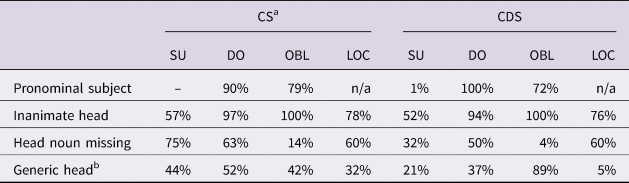
Object relatives produced in spontaneous speech were semantically and structurally different from the ones used in the experiments. In experimental settings, children are usually asked to describe a relation between two animate entities by using a lexical subject (e.g., the camel that the cow is hitting). For spontaneous speech we found that all of the object relative clauses produced by the caregivers, 88% (61/69) produced by the older children, and 4 out of 6 object relative clauses produced by younger children had pronominal subjects (e.g., okuduklarımız ‘the ones that we read’). In this respect, Turkish children's usage patterns were similar to those of English- and German-speaking children (Kidd et al., Reference Kidd, Brandt, Lieven and Tomasello2007). Furthermore, inanimate head nouns were found in 94% (173/184) and 97% (67/69) of object relatives in caregiver and late child speech, and in all object relatives produced by younger children (before 36 months). This finding was similar to findings in English, Finnish, and German (Diessel, Reference Diessel2009; Kidd et al., Reference Kidd, Brandt, Lieven and Tomasello2007; Kirjavainen et al., Reference Kirjavainen, Kidd and Lieven2017).
Previous studies showed that the use of pronominal instead of lexical subjects, and inanimate instead of animate head nouns, reduces the processing complexity of object relative clauses (Arnon, Reference Arnon2010; Kidd et al., Reference Kidd, Brandt, Lieven and Tomasello2007). Hence, these findings first indicate that children hear and produce simpler constructions than what they have been tested on in experiments. Second, there is a close correspondence between children's productions and what they hear in their daily interactions. Finally, across diverse languages, object relative clauses have similar properties (i.e., pronominal subjects and inanimate head nouns) related to their discourse functions, such as linking new information in the matrix clause to old information presented in the relative clause (Fox & Thompson, Reference Fox and Thompson1990).
When we look at subject relatives, we see a different pattern about the animacy of the head noun. Previous research in English and Finnish spontaneous speech showed that inanimate heads were more common in subject relatives in child speech, although the gap between the use of animate and inanimate head nouns tends to be smaller compared to the object relatives (Diessel, Reference Diessel2009; Kirjavainen et al., Reference Kirjavainen, Kidd and Lieven2017). In a similar vein, we found that 52% (86/165) of subject relatives in caregiver speech and 55% (39/71) in late child speech had an inanimate head noun. However, when children were just starting to produce relative clauses, they associated subject relatives with animate agents, as 16 out of 17 subject relative clauses they produced before 36 months contained an animate head. This finding may be related to younger children's tendencies to associate animate entities with the agent role and thus the subject of the relative clause. Unlike object relatives, subject relatives almost always had lexical subjects instead of pronominal ones (99% of subject relatives in caregiver speech and 100% in child speech).
We further assessed the complexity of the relative clauses by the overt presence of the head noun (see Table 7 in the ‘Appendix’ for more detailed information). In early child speech, 11 out of 27 relative clauses (41%) were headless. The proportion of headless relative clauses was 67% (104/156) in late child speech and 35% (148/424) in child-directed speech. We assumed that headless relative clauses would be easier for children to produce since the entity they refer to can easily be identified perceptually or from a previous mention (Göksel & Kerslake, Reference Göksel and Kerslake2005). Indeed, the referents of most of the headless relative clauses produced by children were contextually available in the here-and-now (e.g., aynı olmayanları almışsın ‘you took the ones that are not the same’). The reason that caregivers mostly used an overt head noun may be to ease young children's understanding of which entity the relative clause structure refers to.
Another feature of the relative clauses in late speech that indicated low complexity was that the majority were constructed with early acquired and highly frequent verbs. The verbs yap- ‘do’ and iste- ‘want’ were found in 62% of the DO relatives, and the verb ol- ‘be’ was found in 59% of the SU relatives.Footnote 5 A similar pattern was found in early child speech; children used verbs such as ‘sleep’, ‘take’, ‘give’, ‘talk’. Finally, in 49% of the relative clauses in late child speech that had an overt head noun, the head noun was generic, such as ‘thing’, ‘place’, ‘or (some)one’. It might be that children used these relative clauses when they referred to something general instead of specific (e.g., bundan yapacak bir şey bulalım ‘let's find something that we can do with this’) or when they had a difficulty in naming the referent (e.g., Şu çizgili şöyle olan şeyi mi? ‘(Do you mean) the thing that is like that with the stripes?’). Generic head nouns were in general less frequent in child-directed speech (see Table 7 in the ‘Appendix’).
General discussion
We investigated the acquisition and use of relative clauses by Turkish-speaking children by examining their spontaneous conversational speech in relation to child-directed speech and in comparison to children speaking typologically different languages. We focused on the syntactic role of the head noun in the relative clause and in the matrix clause, and on the semantic and syntactic complexity of children's relative clauses. We showed that: (1) the production of relative clauses in early Turkish child speech is relatively late when compared to other languages; (2) how frequently children hear relative clauses in caregiver speech varies with years of parental education; (3) the semantic and structural complexity of children's relative clauses increased with age; and (4) in spite of the morphosyntactic difficulty of object relative clauses, preschool-aged children uttered subject and object relative clauses with similar frequencies, highlighting the interaction of multiple factors (i.e., input frequency, morphosyntactic and semantic difficulty) that affect children's use of relative clauses.
Late acquisition
Supporting previous findings in Turkish (Altınkamış & Altan, Reference Altınkamış and Altan2016; Slobin, Reference Slobin, Slobin and Zimmer1986), we found that the acquisition of relative clauses by Turkish-speaking children as evidenced in their naturalistic conversations is indeed a late accomplishment. One of the main sources of this late acquisition seems to be the low frequency of relative clauses in the input. That the frequency of a construction affects its acquisition has been shown in various studies for words, inflectional morphology, and syntactic structures (see Ambridge, Kidd, Rowland, & Theakston, Reference Ambridge, Kidd, Rowland and Theakston2015, for a review). Another factor bringing about the late acquisition seems to be the morphosyntactic difficulty of relative clause structures in Turkish. That the relative clauses deviate from the canonical word order, require inflectional case markers, and are non-finite (see Kerslake, Reference Kerslake, Rehbein, Hohenstein and Pietsch2007, for further discussion about finite and non-finite structures) increase the processing difficulty of these language structures.
The case of object relative clauses
With the present study we aimed to assess the role of structural complexity and input frequency in the acquisition of relative clauses by Turkish-speaking children. We predicted that, if structural complexity and distributional patterns in the input match, i.e., if structurally less complex subject relatives are more frequent in the input, then simpler and more frequent structures (i.e., subject relatives) would be acquired early and exhibit more frequency in child speech. Conversely, if structural complexity and input frequency do not match, i.e., if object relatives are more frequent in the input, then one of the hypotheses was that Turkish-speaking children would be similar to English-speaking children in that subject relatives are acquired earlier and found more frequently in child speech because of their structural complexity. An opposing proposal was that object relative clauses would be more frequent than subject relative clauses in child speech due to their higher input frequency. Our findings showed that, when addressing young children, caregivers produced subject and object relatives in similar amounts leading to an almost equal representation of both types of relative clauses in the input. Our findings further showed that preschool-aged Turkish-speaking children produced subject and object relative clauses with similar frequencies. Taken together, these findings indicate that input frequency assumes an important role in children's acquisition of a complex language structure. It seems that hearing complex structures frequently eases their production by the children.
We must note that our findings do not comply with the findings in English (Diessel & Tomasello, Reference Diessel and Tomasello2000), where children produced subject relatives earlier and more frequently despite hearing object relatives from their caregivers to a greater extent. We suggest that basic differences between these languages are responsible for the differences in the acquisition of relative clauses. Since English has a strict word order and is not a morphologically rich language, word order is the most important cue to make sense of the sentence structure (Slobin & Bever, Reference Slobin and Bever1982). Hence, young speakers of English may pay more attention to the word order and thus find subject relatives, which are more similar to a simple sentence in terms of word order, and easier to understand and produce despite the abundance of object relatives in the input. In contrast, Turkish is a morphologically rich language where the case system is acquired relatively early (Aksu-Koç & Slobin, Reference Aksu-Koç, Slobin and Slobin1985). One can argue that a similar distribution of subject and object relative clauses in child-directed speech renders the morphological structure of different relative clause types accessible to the child, leading to similar frequencies of subject and object relatives in spontaneous speech. Yet, although Turkish-speaking preschool children produce object relatives as frequently as subject relatives in spontaneous speech, they experience difficulties in experimental settings (e.g., Özge et al., Reference Özge, Marinis, Zeyrek, Ay, Aydın, Ergenç, Gökmen, İşsever and Peçenek2009, Reference Özge, Marinis, Zeyrek, Chandlee, Franich, Iserman and Keil2010a). We found that object relatives in child and child-directed speech usually occurred with pronominal subject-inanimate head combinations that are semantically less demanding. This shows that, although children learn how to use the object relative clause marker to form object relatives, their use is limited and heavily affected by the use in child-directed speech. An alternative explanation for the abundance of object relative clauses in late child speech is that the context may have favored their production. Since children were engaged in activities (e.g., drawing) where they paid attention to the objects they were presented with, the use of object relatives might have been prompted by the communicative urge to clearly refer to these objects and children's actions on those objects (e.g., hemen benim istediklerimi vereceksin ‘you will give me what I want at once’).
Syntactic role of the head noun in the matrix clause
Language characteristics affect how speakers use relative clauses within matrix clauses. As seen in Table 6, relative clauses that modified the subject of a matrix clause were fairly frequent in the prenominal languages Turkish, Japanese, and Mandarin, and highly infrequent in the postnominal languages English and Finnish. Previous research suggested that speakers of postnominal languages may avoid using relative clauses that modify a noun in the subject position of a matrix clause to avoid producing center-embedded structures. It was hypothesized that center-embedded clauses (e.g., ‘the juice [that the child spilled] stained the rug’) would pose more processing difficulty than left- or right-branching clauses (e.g., ‘the child spilled the juice [that stained the rug]’) (Chomsky, Reference Chomsky, Fodor and Katz1961; Kuno, Reference Kuno1974). Indeed, participants provide erroneous responses when paraphrasing center-embedded sentences (Larkin & Burns, Reference Larkin and Burns1977), and they need more time to judge center-embedded sentences for acceptability than right-branching ones where the former is further associated with greater memory load indicated by additional brain activity (Stromswold, Caplan, Alpert, & Rauch, Reference Stromswold, Caplan, Alpert and Rauch1996). That speakers avoid center-embedded clauses also explains why center-embedded PN relatives (see example (9)) are less frequent in prenominal compared to postnominal languages (see also Dasinger & Toupin, Reference Dasinger, Toupin, Berman, I and Slobin1994, for similar findings in Turkish). Based on these findings, one would expect OBJ relatives (i.e., where the head noun is the object of the matrix clause) not to be very frequent in Turkish since they lead to center-embedding as well. However, contrary to this expectation, the head noun mostly functioned as the object of the matrix clause in both caregivers’ and children's productions. This discrepancy can be explained by the fact that Turkish allows for the dropping of the subject and has a relatively free word order. Following Ozeki and Shirai (Reference Ozeki, Shirai, Matsumoto, Oshima, Robinson and Sells2007), we coded OBJ relatives as center-embedded only if the relativized noun phrase was not at the sentence-initial position (e.g., sen anlamıyorsun ki dediğimi ‘you don't understand what I'm saying’). Then, only 34% of the OBJ relatives and 26% of all relative clauses in late child speech were center-embedded. Hence, supporting our other findings, children opted for simpler constructions when producing relative clauses.
Overall, OBJ relatives were more frequent than SUBJ relatives in late child speech. One possible reason is that object relatives in the object role in the matrix clause are easier to process than object relatives in the subject role of the matrix clause. However, experimental findings with Turkish-speaking children and adults do not lend support to this idea (Özcan, Reference Özcan, İmer and Uzun1997; Özge, Marinis, & Zeyrek, Reference Özge, Marinis, Zeyrek, Kincses-Nagy and Biacsi2010b). Another possible reason is the influence of the input; OBJ relatives were more frequent than SUBJ relatives in child-directed speech.
The role of input
We assessed the role of input in children's productions via examining the similarity of children's relative clauses to the ones in the input, and comparing the input across different levels of parental education. As observed for other languages such as Finnish (Kirjavainen et al., Reference Kirjavainen, Kidd and Lieven2017) and Hebrew (Arnon, Reference Arnon2010), children's relative clauses were highly similar to the ones in the input semantically and structurally. The finding that children with highly educated parents were exposed to more relative clauses than children who had parents with low education may stem from the contexts that elicit the production of relative clauses. For instance, shared reading may increase the likelihood of relative clause production and occur in high-SES families more frequently (Yarosz & Barnett, Reference Yarosz and Barnett2001). In line with our findings, previous research showed that the complexity of parental input measured by the frequency of multiclause structures was greater in middle-SES than in low-SES families (Huttenlocher, Vasilyeva, Cymerman, & Levine, Reference Huttenlocher, Vasilyeva, Cymerman and Levine2002). More data are needed to examine the relation of parental education and SES to children's production of relative clauses.
Conclusion
By using a relatively large corpus of data from children of a wider age-range compared to earlier studies, our study has strongly verified that Turkish relative clauses, which are morphosyntactically difficult and relatively rare in the caregiver input, emerge late in children's spontaneous speech. Preschool-aged children, who were linguistically more advanced than younger children, produced relative clauses more frequently and in more complex structures that conveyed beyond a single clausal meaning to the addressee. Children's use of relative clauses was very similar to adults’ use in terms of the syntactic function of the head noun in the matrix clause and in the relative clause, and the use of animate and inanimate entities within relative clauses. However, children's productions were still less complex, such that most of the relative clauses were constructed with a limited set of verbs indicating that the use of relative clauses was still developing in the preschool years. Despite the morphosyntactic difficulty of object relative clauses in Turkish, and prior experimental findings showing a subject relative clause advantage, preschool-aged children produced object relative clauses as frequently as subject relative clauses. Object relative clauses in spontaneous speech were semantically less demanding (i.e., had pronominal subjects and inanimate head nouns) than the ones used in experiments. Together, these findings suggest that multiple factors such as input frequency and complexity at both the semantic and structural level affect the patterns of acquisition. Our findings further suggest that language characteristics have an impact on adult speech, which in turn affects child speech, and highlight the importance of studying diverse languages in a cross-linguistic approach.
Acknowledgment
We thank Noyan Dokudan for helping with the coding and Bahar Köymen for sharing her data.
Appendix
Complexity measures of relative clauses and locative constructions produced in late child speech and child-directed speech