INTRODUCTION
There is growing interest in international new ventures (INVs) originating from emerging economies (Deng, Jean, & Sinkovics, Reference Deng, Jean and Sinkovics2018; Kiss, Danis, & Cavusgil, Reference Kiss, Danis and Cavusgil2012; Musteen, Datta, & Francis, Reference Musteen, Datta and Francis2014; Yamakawa, Peng, & Deeds, Reference Yamakawa, Peng and Deeds2008). To enhance their growth prospects, some emerging economy INVs seek to upgrade their capabilities, notably in innovation clusters (Prashantham & Dhanaraj, Reference Prashantham and Dhanaraj2015; Zhou, Barnes, & Lu, Reference Zhou, Barnes and Lu2010). Given that these firms’ legitimacy deficits make this upward shift in competences more desirable and difficult at the same time, network ties – which help to ameliorate INVs’ liabilities of newness and foreignness and enhance their legitimacy – are arguably even more valuable in an emerging economy setting (Contractor, Hsu, & Kundu, Reference Contractor, Hsu and Kundu2005; Puthusserry, Child, & Rodrigues, Reference Puthusserry, Child and Rodrigues2014).
However, there is an incomplete understanding of the differential and joint effects of different types of ties – such as coethnic ties and MNE ties – on INVs’ legitimacy-building efforts as they upgrade their capability set in an emerging economy setting. These two sets of ties warrant highlighting because they are especially valuable in emerging economies. Ethnic ties in overseas markets (and ties with returnees) represent a relatively accessible source of social capital that can compensate for the focal venture's knowledge deficits vis-à-vis international markets (Prashantham, Dhanaraj, & Kumar, Reference Prashantham, Dhanaraj and Kumar2015). Ties with subsidiaries of technologically advanced foreign MNEs could be an attractive alternative to new ventures in emerging economies vis-à-vis partnering with domestic firms as a source of valuable know-how and credibility by association (Prashantham & Dhanaraj, Reference Prashantham and Dhanaraj2015).
Although the value of ethnic ties and MNE ties has been recognized, their effects have typically been examined in isolation of each other. Prior emerging economy studies in international entrepreneurship (and adjacent areas) is fragmented, typically highlighting either coethnic ties (e.g., Nanda & Khanna, Reference Nanda and Khanna2010; Sonderegger & Täube, Reference Sonderegger and Täube2010) or MNE ties (e.g., Prashantham & Dhanaraj, Reference Prashantham and Dhanaraj2015; Terjesen, O'Gorman, & Acs, Reference Terjesen, O'Gorman and Acs2008), but not both simultaneously. Yet, for INVs from emerging economies, both sets of relationships are likely to be important, and should ideally be analyzed holistically (Manolova, Manev, & Gyoshev, Reference Manolova, Manev and Gyoshev2010). Part of the difficulty in doing so is the lack of an integrative conceptualization that simultaneously takes into account both sets of ties in a way that is relevant to emerging economy realities.
One approach, based on economic geography, that we think holds promise in offering a more cohesive understanding of the role of ethnic ties and MNE ties is Lorenzen and Mudambi's (Reference Lorenzen and Mudambi2013) connectivity theory of clusters, which explains the catch-up processes of clusters like the Bangalore software cluster. These scholars pay attention to what they term as individual-based linkages such as global diasporas and organizational-based linkages with the local subsidiaries of foreign MNEs. Such network connectivity would appear to also hold value at the level of the firm in addressing legitimacy deficits (Pant & Ramachandran, Reference Pant and Ramachandran2012) as it seeks to ‘move up the value chain toward higher value-added activities’ (Lorenzen & Mudambi, Reference Lorenzen and Mudambi2013: 521). Yet how this network connectivity enables emerging economy INVs to overcome legitimacy deficits remain underexplored.
In this conceptual article we therefore ask: How does network connectivity via individual- and organization-based ties influence the perceived legitimacy of internationalizing new ventures from emerging economies? [Footnote 1] Although the issues of connectivity and legitimacy would be relevant to advanced economy settings as well, they warrant particular attention in emerging economies. Recent decades have witnessed developments such as the WTO, deregulation and Internet technologies that led to a global environment that was, by and large, supportive of internationalization by emerging economy firms (Ramamurti, Reference Ramamurti2012). Yet these firms tend to be limited in their experiential learning about internationalization, a deficiency which magnifies the challenge they face (Madhok & Keyhani, Reference Madhok and Keyhani2012). For emerging economy INVs, capability upgrading is desirable and difficult at the same time (Zhou et al., Reference Zhou, Barnes and Lu2010).
Building upon Lorenzen and Mudambi (Reference Lorenzen and Mudambi2013), we argue that individual-based ties with returnees (e.g., technologists of Indian or Chinese origin returning from the West to India and China, respectively) potentially enable a given emerging economy-based new venture to gain the know-how needed to upgrade their capabilities; this can have an uplifting effect on the self-belief of insiders (employees) and thus internal legitimacy (Drori & Honig, Reference Drori and Honig2013). Furthermore, organization-based ties, such as partnerships with locally based subsidiaries of foreign MNEs, provide a halo effect to the focal venture that helps it get taken seriously by outsiders (prospective exchange partners, notably customers), thus constituting a valuable source of external legitimacy (Podolny, Reference Podolny2001). We extend this analysis to highlight the role of coethnic expatriates working in such MNEs’ headquarters (e.g., an India-origin manager working for Microsoft in the US) in fostering cross-border legitimacy.
By bringing together insights from research on cluster connectivity and on INVs, we shed light on the complementarities between individual- and organization-based ties. We contribute to research on international entrepreneurship in emerging economies by highlighting the complementary (and mutually reinforcing) role of personal ties (e.g., returnees) and pipelines (e.g., MNE ties) in building INVs’ internal and external legitimacy, respectively. This nuanced understanding is useful in highlighting the increased burden of gaining legitimacy in emerging economies for an INV addressing the capability upgrading imperative: not only must it do so vis-à-vis external customers, but also vis-à-vis internal employees.
We also extend Lorenzen and Mudambi's (Reference Lorenzen and Mudambi2013) work by surfacing the intriguing prospect of ties with ‘people within pipelines’ – a hitherto understudied nuance. For an emerging economy INV (say, one from India), such individuals (e.g., Indian managers of Microsoft in the US) can play a powerful boundary-spanning role. Our conceptualization is distinct from Lorenzen and Mudambi (Reference Lorenzen and Mudambi2013) in that they focus on cluster-level outcomes whereas we are concerned with firm-level outcomes, specifically in relation to INVs. Thus while they focus primarily on people and pipelines that come into play at the ‘destination’ – that is, the focal cluster of interest (e.g., Bangalore where India-origin returnees move to or MNE subsidiaries are established) – we also consider connectivity at the ‘origin’ (e.g., the US where India-origin diaspora members reside or the MNE parent's headquarters are based), since we focus on outcomes at the level of internationalizing firms.
Through an illustration of a Bangalore-based INV that we provide, we also highlight that Indian new ventures may be particularly well placed to benefit from ties with people from pipelines given the large number of Indian-origin managers in positions of responsibility within Western MNEs around the world (Ghemawat & Vantrappen, Reference Ghemawat and Vantrappen2014). Indeed, a brief contrasting example of a Beijing-based new venture suggests that Indian INVs may have access to a greater abundance of people within pipelines i.e. senior managers from the mother country working for large MNEs in the West, an idea strengthened by anecdotal evidence such as the rise of India-origin CEOs at companies like Microsoft and Google. As such, the Indian context represents a fruitful setting for exploring this phenomenon in future research.
BACKGROUND
International New Ventures from an Emerging Economy: Legitimacy Deficits
Capability upgrading represents a vital yet challenging imperative for emerging economy INVs (Zhou et al., Reference Zhou, Barnes and Lu2010). The desirability and difficulty associated with such capability building stem from the same root cause: legitimacy deficits (Pant & Ramachandran, Reference Pant and Ramachandran2012). Legitimacy is ‘a generalized perception or assumption that the actions of an entity are desirable, proper, or appropriate within some socially constructed system of norms, values, beliefs, and definitions’ (Suchman, Reference Suchman1995: 574). Following from Meyer and Rowan's (Reference Meyer and Rowan1977) depiction of organizations acting to gain legitimacy in accordance with existing institutions, much of the legitimacy literature treats organizations as actors acting to legitimate themselves. In their comprehensive review of the legitimacy literature, Suddaby, Bitektine, and Haack (Reference Suddaby, Bitektine and Haack2017) distinguish between three research streams.
The first is termed the legitimacy-as-property perspective (e.g., Zimmerman & Zeitz, Reference Zimmerman and Zeitz2002: 45), according to which ‘legitimacy is a thing – that is, a property, a resource or a capacity of an entity’; the focus is on the legitimacy owner. The second is termed the legitimacy-as-process perspective (e.g., Suddaby & Greenwood, Reference Suddaby and Greenwood2005), focusing on an interaction process between multiple actors (chiefly organizations) that produce legitimation outcomes; the focus is on change agents. The third, which is termed the legitimacy-as-perception perspective (e.g., Bitektine, Reference Bitektine2011), ‘sees legitimacy as a cross-level process of perceptions, judgments of appropriateness, and actions that occur in interactions between the collective and the individual’ (Suddaby et al., Reference Suddaby, Bitektine and Haack2017: 45); the focus is on legitimacy evaluation. In other words, legitimacy ‘lies in the eye of the beholder’ (Ashforth & Gibbs, Reference Ashforth and Gibbs1990).
A virtue of the legitimacy-as-perception perspective is that it builds upon and incorporates aspects of the other two views. Suddaby et al. (Reference Suddaby, Bitektine and Haack2017: 463) observe: ‘This approach [legitimacy as perception] retains the notion of legitimacy as a property, but…uses the metaphor of property as taste, assessment, or judgment of the appropriateness of an organizational product, practice, or characteristic’. Furthermore, they note: ‘This approach also retains the understanding of legitimacy as process, but focuses their attention on processes of making judgments’. As such, the legitimacy-as-perception view offers a holistic yet focused way of thinking about legitimacy for our purposes.
The legitimacy-as-perception view focuses attention on the perceptions of audiences. These perceptions, in turn, can be influenced by the network ties of the focal actor since the company one keeps signals strategic intent and capability (Khoury, Junkunc, & Deeds, Reference Khoury, Junkunc and Deeds2013). Thus, network ties can be an important source of social capital that enhances the perception of a new venture's legitimacy (Shane & Cable, Reference Shane and Cable2002). In applying the legitimacy-as-perception view, we distinguish between internal and external legitimacy pertaining to internal and external audiences – employees and exchange partners (chiefly customers), respectively (Drori & Honig, Reference Drori and Honig2013; Fisher, Kuratko, Bloodgood, & Hornsby, Reference Fisher, Kuratko, Bloodgood and Hornsby2017). Highly relevant to the internal-external distinction, Podolny (Reference Podolny2001) offers an insightful perspective on how reducing uncertainty can enhance the legitimacy of a new venture by distinguishing between egocentric (i.e., the focal actor's) uncertainty and altercentric (i.e., prospective exchange partners’) uncertainty regarding the quality of the focal actor.
Internal legitimacy
Internal legitimacy refers to the consensual ‘acceptance or normative validation of an organizational strategy’ (Drori & Honig, Reference Drori and Honig2013: 345) by organizational members, and includes the idea of self-belief by employees in the ability of the venture to deliver on its aspirations. Such legitimacy accrues from the reduction of egocentric uncertainty and is more likely when internal members have self-belief in their venture (Podolny, Reference Podolny2001). Given that not all ventures are founded with the optimal level of human capital and technical skills, attracting the right talent is likely to be an important means of achieving and bolstering such self-belief. In particular, attracting the right professional managers to lead the organization is crucial since a leader with a reputation for capability and vision will likely motivate employees to believe in a venture's goals (Drori & Honig, Reference Drori and Honig2013). This helps attract high quality talent and retain the best employees since belief in the leadership is likely to foster commitment to the organization (Dirks & Ferrin, Reference Dirks and Ferrin2002).
External legitimacy
External legitimacy conversely refers to ‘legitimacy in the eyes of potential consumers…and [other] exchange partners’ (Podolny, Reference Podolny2001: 33). This is important since, as Fisher et al. (Reference Fisher, Kuratko, Bloodgood and Hornsby2017: 52) note, ‘For members of an external audience to provide a new venture with resources and support they need to perceive the venture as legitimate’. External legitimacy accrues from the reduction of altercentric uncertainty, often when external members perceive a halo effect resulting from new ventures coopting large strategic partners. Given that ventures are themselves unknown entities, collaborating with high-status partners is likely to be an important means of gaining the reflected glory of a halo effect. Associating with prestigious organizations draws the attention of external stakeholders, especially in high-technology industries associated with high uncertainty (Stuart, Reference Stuart1998). Allying with established partners reflects glory on new ventures, such that stakeholders discern the quality of the new venture positively from the very fact that it has been able to attract a reputed partner (Rao, Chandy, & Prabhu, Reference Rao, Chandy and Prabhu2008). Alliances with high-status firms with resource complementarity are typically performance-enhancing for new ventures (Lin, Yang, & Arya, Reference Lin, Yang and Arya2009).
Cross-border legitimacy
In the context of INVs, a third form of legitimacy worth paying attention to is cross-border legitimacy. While gaining some degree of internal and external legitimacy in the domestic market is a useful start, this does not directly translate into cross-border success. As noted, INVs suffer not only from the liability of newness (therefore internal and external legitimacy deficits in the domestic market) but also the liability of foreignness (Mudambi & Zahra, Reference Mudambi and Zahra2007). When a new venture from an emerging economy seeks business overseas on the basis of intellectual property, its legitimacy deficits are exacerbated owing to negative country-of-origin perceptions associated with a weaker institutional environment (Ciravegna, Lopez, & Kundu, Reference Ciravegna, Lopez and Kundu2014; Madhok & Keyhani, Reference Madhok and Keyhani2012; Nanda & Khanna, Reference Nanda and Khanna2010). Cross-border legitimacy, both internal and (especially) external, is not easy to achieve. Attracting talented people in foreign markets to enhance internal cross-border legitimacy is challenging. Also crucial is external cross-border legitimacy vis-à-vis prospective customers in foreign markets.
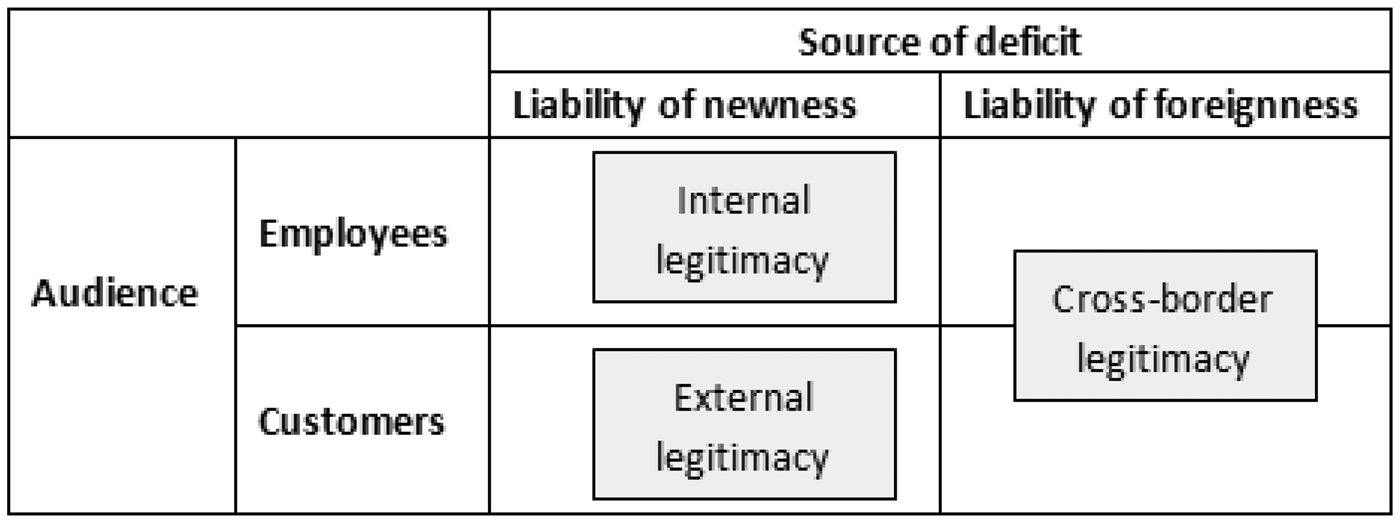
Figure 1 summarizes the above typology of legitimacy. A question that remains is how new ventures in emerging economies – which are typically scarce in human capital and innovative companies – build these forms of legitimacy? A useful network-based conceptualization, which incorporates ties with both individuals and collectives, is proffered by Lorenzen and Mudambi's (Reference Lorenzen and Mudambi2013) connectivity perspective, which we turn to next.
Types of legitimacy for INVs.

People- and Pipeline-based Connectivity in Emerging Economies
Combining perspectives from network theory and economic geography, Lorenzen and Mudambi (Reference Lorenzen and Mudambi2013) formulated a theory of cluster connectivity to explain how emerging economy clusters attempt to catch up with their advanced economy counterparts. Their insightful conceptualization synthesizes the role of individual- and organization-based ties in assisting emerging economy firms to upgrade their capabilities and catch up with their advanced economy counterparts. The organization-based ties are termed ‘pipelines’ while the individual-based ties are referred to as ‘personal ties’.
Pipeline-based connectivity
In relation to organization-based ties (pipelines), Lorenzen and Mudambi (Reference Lorenzen and Mudambi2013: 506) identify ‘strong and dominant local subsidiaries of foreign MNEs’ as the pipeline ties of greatest importance in the Bangalore software cluster. The subsidiaries of Western MNEs are viewed as an important organizational link between Bangalore and other knowledge-intensive locations in advanced economies. Bangalore represents an intriguing setting for viewing how connectivity facilitates new venture internationalization within a context of catch-up since ‘Bangalore enjoyed global ties from its inception [since]…within a very short period of time, virtually every major ICT MNE had substantial operations in Bangalore’ (Lorenzen & Mudambi, Reference Lorenzen and Mudambi2013: 520). They go on to note: ‘Although foreign subsidiaries themselves focused on serving their overseas parents, there were nonetheless notable knowledge spillovers to domestic firms’ (Lorenzen & Mudambi, Reference Lorenzen and Mudambi2013: 521).
People-based connectivity
In relation to individual-based ties (personal ties), Lorenzen and Mudambi (Reference Lorenzen and Mudambi2013: 506) point to personal ties with ‘the multitude of independent diaspora members, each with a job in several clusters, who leverage commonalities of language and culture as well as experience and contacts from one cluster to start up business ventures in another’. Diasporas can thus accelerate the development of clusters, especially in emerging economies (Sonderegger & Täube, Reference Sonderegger and Täube2010). Lorenzen and Mudambi's (Reference Lorenzen and Mudambi2013) conceptualization captures the role of individuals of Indian origin who behave like ‘Argonauts’ (Saxenian, Reference Saxenian2006) – that is, they connect their country of origin with their adopted country (e.g., the US). Saxenian (Reference Saxenian2005: 36) notes that ‘the same individuals who left their home countries for better lifestyles abroad are now reversing the brain drain, transforming it into “brain circulation” as they return home to establish business relationships or to start new companies while maintaining their social and professional ties to the United States’.[Footnote 2]
People within pipelines
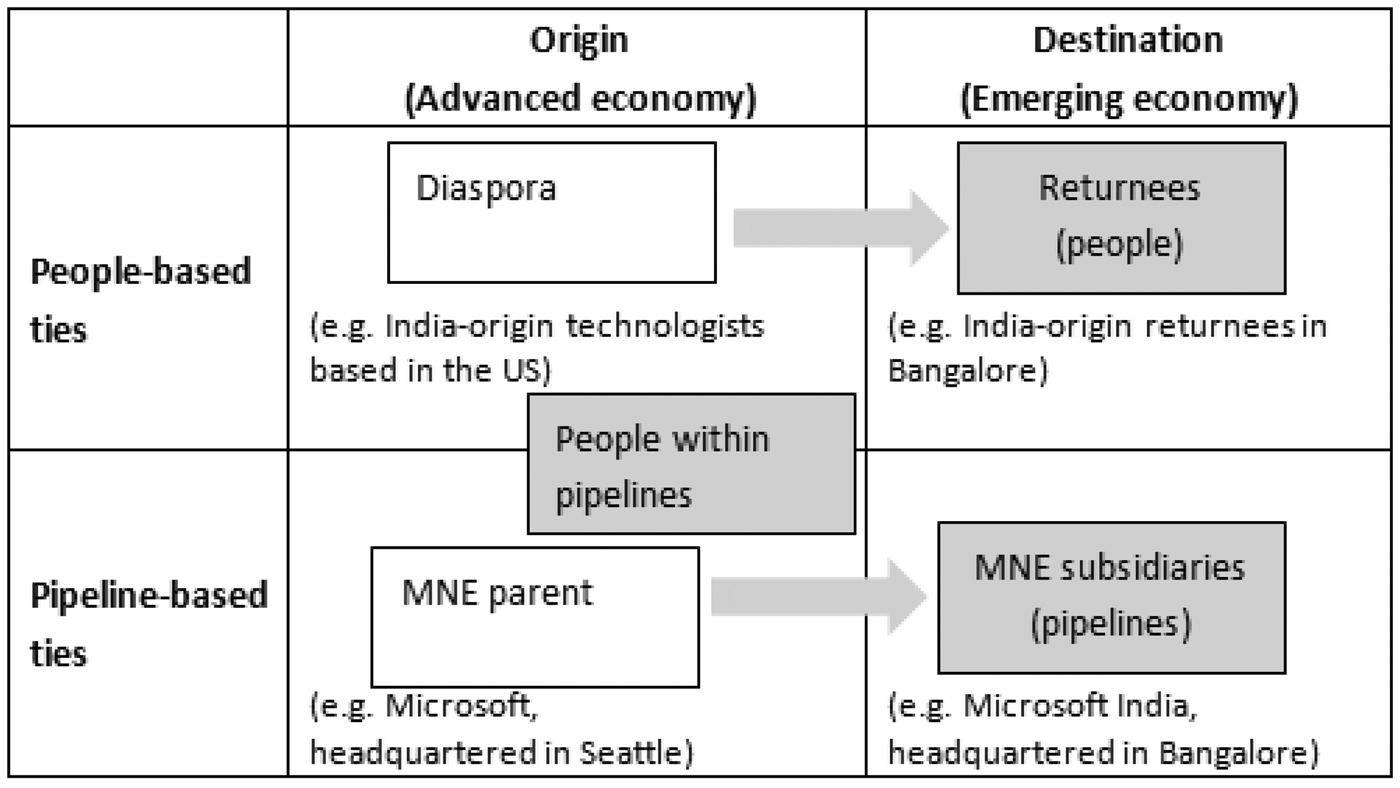
However, before we proceed with our theory-building effort, we add a further category of tie by bringing together the preceding two concepts: people within pipelines. Here we refer to the prospect of an INV coopting expatriate managers, from the country of origin of the focal venture, working abroad for a large MNE. Thus, distinct from returnees who are now resident in the focal venture's domestic milieu, these individuals’ locations are outside of the focal venture's home market. This creates the possibility that emerging economy-based entrepreneurs could build on an initial local tie with an MNE subsidiary to cultivate ties with coethinic managers working in that MNE's headquarters or other foreign subsidiaries – who thus manifest brain circulation rather than brain drain (Saxenian, Reference Saxenian2005, Reference Saxenian2006). Coethnic managers may extend support to a promising new venture due to altruistic motivations (Portes, Reference Portes1998) and the prospect of receiving kudos for identifying external sources of complementary innovation (Doz, Santos, & Williamson, Reference Doz, Santos and Williamson2001).
We summarize the above typology of network connectivity in Figure 2 below. The two parts of the Background section – on legitimacy types and forms of network connectivity available in emerging economy clusters like Bangalore – provide the building blocks of our theorizing. In the next section we identify how individual- and organization-based ties influence, separately and in concert, the legitimacy of INVs from emerging economies as they undertake ‘steps to speed up the upgrading process’ in emerging economies (Lorenzen & Mudambi, Reference Lorenzen and Mudambi2013: 522).
Types of network connectivity

THEORY-BUILDING
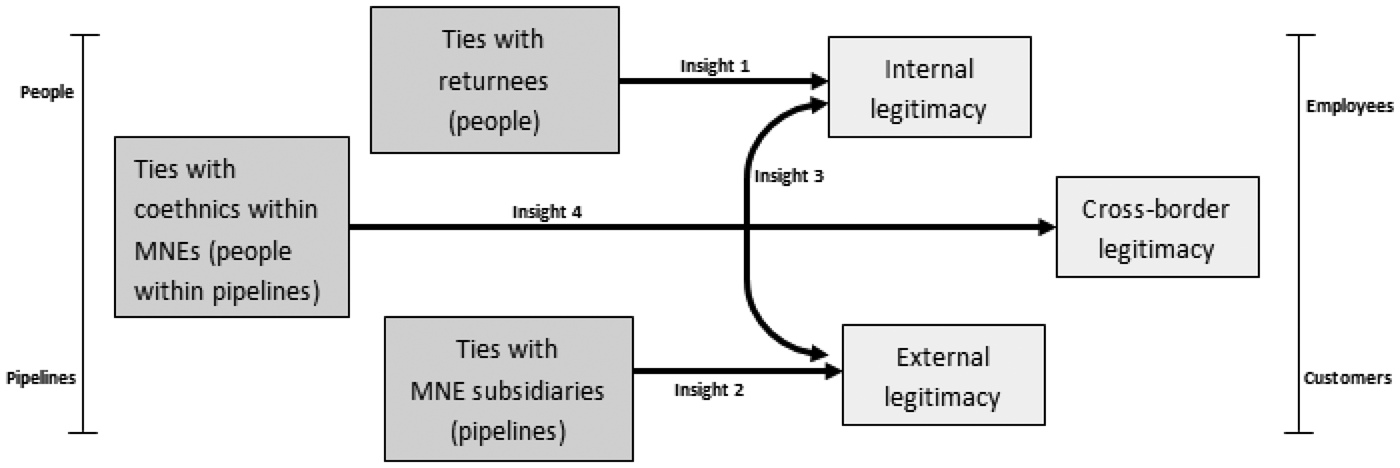
The internationalization trajectory that we describe here entails tapping people-based connectivity (returnees from the diaspora) and pipeline-based connectivity (local subsidiaries of foreign MNEs), and expanding engagement to cross-border ties with, say, that MNE's headquarters by cultivating ties with people (e.g., coethnics) within those pipelines (Figure 3). While we can envisage this occurring in advanced economies – for instance, Ireland which has a number of returnees and foreign MNE subsidiaries – we see this as being particularly relevant to emerging economy new ventures where internal, external and cross-border legitimacy deficits are accentuated. Leveraging people- and pipeline-based connectivity is thus of potentially great value for INVs in emerging economies.
Network connectivity and legitimacy building by INVs from emerging economies

Leveraging People-based Connectivity for Internal Legitimacy
Based on the premise that capability upgrading represents an uphill task for aspiring INVs from emerging economies, the key to addressing the internal legitimacy challenge is to attract appropriate human capital into the venture. But of course, this is a chicken-and-egg problem in an emerging economy context: such human capital typically does not exist in abundance within the domestic milieu in which a new venture is founded. The challenge is thus somehow attracting human capital from elsewhere which can translate into internal legitimacy through the reduction of what Podolny (Reference Podolny2001) refers to as ego-centric uncertainty.
As Lorenzen and Mudambi (Reference Lorenzen and Mudambi2013) have insightfully pointed out, diaspora networks can be extremely valuable in yielding returnees who become key personnel in ventures with high aspirations, as has been seen time and again in economies such as China (e.g., Filatotchev, Liu, Buck, & Wright, Reference Filatotchev, Liu, Buck and Wright2009) and India (e.g., Pruthi, Reference Pruthi2014). (Of course, once an individual is hired by the focal venture then he or she ceases to be an external tie.) The point is that personal relationship-based connectivity can be an important source of key employees who, when attracted to join the firm, help to uplift internal legitimacy. That said, returnees do not add uniformly high levels of value in terms of enhancing the internal legitimacy of ventures in an emerging economy that seek capability upgrading. Two factors are vital in determining the efficacy of a returnee in adding valuable human capital, and thereby internal legitimacy, to an aspiring INV in an emerging economy: competence and motivation.
In relation to competence, returnees have differing storylines with differential impacts in terms of their value-add with regard to human capital. In some cases, individuals leave the mother country for graduate studies and return straightaway; their impact in terms of injecting human capital might be relatively light. In other cases, an individual may be transferred overseas on a work assignment and return thereafter; they too can likely add some value upon their return, but the magnitude may be limited if the tenure overseas was not substantial (Armanios, Eesley, Li, & Eisenhardt, Reference Armanios, Eesley, Li and Eisenhardt2017; Filatotchev et al., Reference Filatotchev, Liu, Buck and Wright2009). Perhaps the most potent returnees are those who combine both education and work experience overseas, in particular in an advanced economy setting. It is not uncommon for such individuals to return in the first instance on an MNE expatriate assignment (Choudhury, Reference Choudhury2016) and then end up setting up a venture (Pruthi, Reference Pruthi2014); the latter can be considered an emerging economy variant of ‘spinout entrepreneurship’ (Klepper & Sleeper, Reference Klepper and Sleeper2005).[Footnote 3]
In relation to motivation, some returnees are better able than others at bridging their social identities vis-à-vis their mother country (e.g., China or India) and their adopted country (e.g., US or UK), and are intrinsically motivated to be involved in such economic activity. Drawing upon Kane and Levina (Reference Kane and Levina2017), we expect that returnees who are more emotionally comfortable with being reconnected with their mother country – without losing out on their acquired identity as members of their adopted home – are more likely to be committed to ventures that they found or join upon return. This in turn will make them more credible to the venture's internal audience than returnees who seem aloof and disconnected from the mother country. Additionally, returnees could also have career-related incentives to benefit from opportunities in their emerging economy of origin (Saxenian, Reference Saxenian2006).
Given sufficient competence and incentives, returnees with relevant experience of a given knowledge-intensive domain in another more advanced setting can provide a much needed fillip to the capability upgrading process of an emerging economy new venture (Armanios et al., Reference Armanios, Eesley, Li and Eisenhardt2017). This, in turn, helps reduce egocentric uncertainty, resulting in greater self-belief and ultimately internal legitimacy. Synthesizing, we suggest:
Insight 1:
Ties with skilled and motivated returnees have the potential to contribute to internal legitimacy of an aspiring INV seeking to upgrade its capabilities in an emerging economy setting.
Leveraging Pipeline-based Connectivity for External Legitimacy
For an emerging economy venture, the mere fact of possessing valuable human capital through returnees occupying key positions in a new venture – and therefore a reduction in internal legitimacy deficits – does not of itself directly translate into external legitimacy. For this, the burden remains on the new venture to make other suitable signals of capability (Khoury et al., Reference Khoury, Junkunc and Deeds2013). While access to leadership with relevant experience is a great asset, that of itself may be insufficient to convince exchange partners, especially prospective enterprise customers. Even if the new venture has confidence in its ability and knows what it is doing, convincing an external party to do business with it will be difficult.
These concerns would be magnified for emerging economy firms that have typically undertaken lower value activities in a global value chain but are now seeking to upgrade (Mudambi, Reference Mudambi2008). Despite the cluster's efforts at playing catchup, external actors are likely to take time to favorably alter their perceptions of the capabilities of indigenous actors (Goerzen, Reference Goerzen2017). Simply put, emerging economy-based new ventures seeking to internationalize on the basis of upgraded capabilities face the significant challenge of gaining external legitimacy through the reduction of what Podolny (Reference Podolny2001) refers to as alter-centric uncertainty.
Becoming associated with a well-known strategic partner (Baum, Calabrese, & Silverman, Reference Baum, Calabrese and Silverman2000; Stuart, Hoang, & Hybels, Reference Stuart, Hoang and Hybels1999) is one solution that translates into external legitimacy, via reflected glory or a halo effect. But again, a chicken-and-egg problem exists in emerging economies: these settings are unlikely to possess credible local companies to coopt as partners since the technology giants that emerge (e.g., Infosys in India or Xiaomi in China) are typically regarded highly for process or business model innovation, but not quite as much for genuine breakthrough product innovation.
In this regard, ties to foreign MNE subsidiaries in the domestic milieu (e.g., IBM China or Microsoft India) can be valuable; as Lorenzen and Mudambi (Reference Lorenzen, Mudambi, Archibugi and Fillpetti2015) note, in emerging economies ‘pipelines are typically brought in by foreign MNEs and operated by local subsidiaries’. Foreign MNEs like IBM and Microsoft have unambiguously strong technological credentials that local emerging economy firms typically lack. External audiences are therefore likely to harbor positive feelings (i.e., altercentric uncertainty reduces) when a new venture partners with these organizations. As Stuart et al. (Reference Stuart, Hoang and Hybels1999: 315) note,
‘…faced with great uncertainty about the quality of young companies, third parties rely on the prominence of the affiliates of those companies to make judgments about their quality and that young companies “endorsed” by prominent exchange partners will perform better than otherwise comparable ventures that lack prominent associates…Because strong relations with prominent organizations convey the fact that young companies have earned a positive evaluation from experienced and influential actors, associations with high-status organizations elevate the reputation of new ventures’.
Of course, gaining a partnering opportunity with the likes of an IBM or Microsoft in the first place does not come easy. It would be necessary for the new venture to be able to signal its capability and compatibility. The former is greatly facilitated by access to strong human capital, an important source of which, as discussed in Insight 1 above, is the pool of returnees from the overseas diaspora. The latter can be achieved through, for instance, adopting the platform technology of the MNE in question when building its own productized offering. Also, attracting the attention of an MNE subsidiary in an emerging economy is more likely to occur in high-reputation subnational locations such as the Bangalore software cluster or the Zhongguancun high-tech district of Beijing which have been dubbed the Silicon Valley of India and China, respectively.
To illustrate in the specific case of the software industry, MNE ties could potentially offer a fast-track route to enhancing the acceptability of its offering to prospective customers if the venture utilizes platform technologies of a large MNE such as Microsoft, IBM or SAP as building blocks for its software product (Gawer, Reference Gawer2014). For these large MNEs, there is a vested interest in gaining new adopters of their platform technologies since there is a clear revenue payoff in that every time the adopter (the venture) sells a license of its software the MNE gains revenue for the bundled license of the underlying technology. Moreover, such subsidiaries may also be keen to augment their own competences in the process (Cantwell & Mudambi, Reference Cantwell and Mudambi2011).
Thus, we argue:
Insight 2:
Ties with a foreign MNE subsidiary have the potential to contribute to external legitimacy of an aspiring INV seeking to upgrade its capabilities in an emerging economy setting.
Mutual Reinforcement Between Internal and External Legitimacy
Internal and external legitimacy are likely to be mutually reinforcing. As competent individuals are attracted to the venture, thereby enhancing internal legitimacy, it is also more likely to attract the interest of large strategic partners or customers because of the greater potential prowess of the firm (Baum et al., Reference Baum, Calabrese and Silverman2000; Stuart et al., Reference Stuart, Hoang and Hybels1999). That is, with high-quality people on board, prospective strategic partners and customers will view the venture as being more capable of delivering on its offering, especially in knowledge-intensive sectors (e.g., software and biotech) in which firms are heavily reliant on the extent and quality of their human capital (Dirks & Ferrin, Reference Dirks and Ferrin2002; Drori & Honig, Reference Drori and Honig2013). Moreover, a prospective MNE partner may view the venture as more attractive because having a returnee at the helm may facilitate smoother relationship management since he or she is used to dealing with that MNE's home market context (Prashantham & Birkinshaw, Reference Prashantham and Birkinshaw2008).
Attracting such large strategic partners, in turn, leads to kudos (external legitimacy) which in turn makes it easier to attract good people (Rao et al., Reference Rao, Chandy and Prabhu2008). This is because gaining well-known strategic partners acts as a signal of quality that makes prospective hires more inclined to join it (Stuart, Reference Stuart1998). This is particularly important in an emerging economy context, where both high-quality firms and high-quality personnel (especially those with experience and aspirations of pursuing intellectual property) are a scarce resource (Prashantham & Dhanaraj, Reference Prashantham and Dhanaraj2015). In sum, as ego-centric uncertainty reduces, it is more plausible for the venture to dampen alter-centric uncertainty, and as alter-centric uncertainty declines it becomes possible to further reduce ego-centric uncertainty. Thus, we suggest:
Insight 3:
A virtuous cycle could ensue whereby ties to returnees (people) and a foreign MNE subsidiary (pipelines), in effect, contribute to both internal and external legitimacy in a mutually reinforcing manner.
Leveraging People Within Pipelines for Cross-border Legitimacy
Pipeline-based ties with MNE subsidiaries based in the INV's home market – such as a Bangalore-based INV's tie with Microsoft India – hold the attraction of potentially connecting the focal INV to international markets (Terjesen et al., Reference Terjesen, O'Gorman and Acs2008). However, such potential is not automatically realized (Prashantham & Birkinshaw, Reference Prashantham and Birkinshaw2008). People within the pipeline (e.g., Indian managers working for Microsoft in the US) are likely to be critical for lubricating these pathways to international markets for the focal new venture by facilitating boundary-spanning (Schotter, Mudambi, Doz, & Gaur, Reference Schotter, Mudambi, Doz and Gaur2017). They have not only the opportunity and ability to help the focal INV, but also in some cases the (altruistic) motivation (Portes, Reference Portes1998). Thus, an aspiring INV that has forged a tie with a foreign MNE subsidiary in its (i.e., the venture's) home market may seek to extend that tie from a single- to a multi-country one.
To achieve this transformation, the focal new venture would likely have to form additional ties with the MNE headquarters or other subsidiaries outside of the venture's home market (Johanson & Vahlne, Reference Johanson and Vahlne2009; Prashantham & Birkinshaw, Reference Prashantham and Birkinshaw2008). Such ties could lead to working alongside the salesforce of that MNE's various subsidiaries or forging ties with its channel partners in foreign markets. However, it would be difficult for an emerging economy-based venture to develop such ties as an unknown entity without a proven track record or strong country of origin. Of great value, then, to an aspiring INV in this situation would be internal champions within the MNE helping it to build cross-border ties to headquarters and other units. Viewed from this boundary-spanning angle, a potential source of cross-border legitimacy is ‘people within pipelines’.
This is not to suggest, however, that all coethnic managers are always willing to help. As Kane and Levina (Reference Kane and Levina2017: 543) observe, ‘Having the capability to span boundaries is not sufficient because boundary spanning requires practical actions…individuals must be inclined to engage’. They point out that overseas-based coethnics are more likely to be efficacious boundary-spanners vis-à-vis their country of origin when they embrace, rather than distance themselves from, the social identity of their home culture. Also, we are not suggesting that the focal venture will be the recipient of any unfair advantages but rather that the easier rapport that coethnics typically share may help lubricate the tie with the MNE. Their familiarity with local conditions helps them to make good judgements in picking potential winners worth championing and, as internal champions, they are well-placed to channelize resources to the new venture, thereby increasing the odds of their success (and justify the support that they have provided). By championing the venture's cause, these coethnic managers can enable its boundary-spanning within the wider MNE network. Hence, we suggest:
Insight 4:
Ties with overseas-based coethnic managers working within the wider network of partner-MNEs have the potential to contribute to cross-border legitimacy for an INV from an emerging economy.
Vulnerabilities for INVs Leveraging People and Pipeline Connectivity
It is important to complete the picture by noting that leveraging people and pipelines is not a guaranteed path to success. There are certain vulnerabilities associated with this internationalization pathway, which reflect the ‘dark side’ of networks. Putnam and Goss (Reference Putnam, Goss and Putnam2002: 8) point out that ‘although the phrase “social capital” has a felicitous ring to it, we must take care to consider its potential vices, or even just the possibility that virtuous forms can have unintended consequences that are not socially desirable’. We highlight two vulnerabilities that INVs face when they leverage people- and pipeline-based connectivity: overembeddedness and malfeasance. The former relates to uncritically cooperative behaviors and the latter to overly conflictual behaviors.
First, in relation to the prospect of overembeddedness, Uzzi (Reference Uzzi1997: 57) notes, ‘The same processes by which the embeddedness creates a requisite fit with the current environment can paradoxically reduce an organization's ability to react’. It is conceivable that an INV becomes overembedded through overreliance on a small set of people- or pipeline-based ties that reduce the opportunity set it pursues or limits creativity by fostering groupthink. That is, the INV could end up becoming overly narrow in terms of aligning with a single worldview to the detriment of being able to pursue a wide set of opportunities due to key personnel's cognitive limitations or bias. Or this could also mean that over time only a limited range of strategic options are explored each time, to avoid rocking the boat with existing partners, thus stifling the INV's capacity to creatively explore other possibilities. As Hitt, Lee, and Yucel (Reference Hitt, Lee and Yucel2002: 357) point out, social capital may be unhelpfully ‘sticky’ in that ‘ties within one network may forestall ties in other networks’. In the long run this could have a highly limiting effect on the firm's growth prospects.
Second, in relation to the prospect of malfeasance (i.e., wrongdoing), the power asymmetry between an INV and large MNE partner, heightened in an emerging economy setting (Prashantham & Dhanaraj, Reference Prashantham and Dhanaraj2015), means that INVs could be vulnerable to being exploited. More powerful actors tend to appropriate the lion's share of the value created (Alvarez & Barney, Reference Alvarez and Barney2001), and the INV's significance could diminish over time relative to the MNE. Furthermore, while an INV's partnership with an MNE is typically predicated on the former developing offerings that are complementary to that of the latter (Vandaie & Zaheer, Reference Vandaie and Zaheer2014), there is no guarantee that the MNE will not encroach upon the INV's space. Thus, today's complementors can become tomorrow's competitors. Concerns of malfeasance are evident in phrases describing MNE-INV engagement such as ‘swimming with sharks’ (Katila et al., Reference Katila, Rosenberger and Eisenhardt2008) and ‘dancing with gorillas’ (Prashantham & Birkinshaw, Reference Prashantham and Birkinshaw2008).
Synthesizing, we suggest:
Insight 5:
An emerging economy INV that coopts people- and pipeline-based connectivity will succeed in the long run if it guards against the vulnerabilities of overembeddedness and malfeasance.
AN ILLUSTRATION FROM BANGALORE
To illuminate the above insights, we briefly describe the case of Skelta[Footnote 4], an INV from the Bangalore software cluster, a setting that provides part of the backdrop for Lorenzen and Mudambi's (Reference Lorenzen and Mudambi2013: 519) theorizing and one that those authors describe as ‘the seminal Indian ICT cluster’.
As Lorenzen and Mudambi (Reference Lorenzen and Mudambi2013) note, the Bangalore cluster co-evolved with Western MNEs’ software development units in that region (Arora, Arunachalam, Asundi, & Fernandes, Reference Arora, Arunachalam, Asundi and Fernandes2001; Patibandla & Petersen, Reference Patibandla and Petersen2002). This, in part, contributed to a burgeoning software services industry. However, the subsequent slowdown in industry growth prompted some young software services firms with an appetite for internationalization (Varma, Nayyar, & Bansal, Reference Varma, Nayyar and Bansal2016) to consider developing intellectual property and becoming software product companies. Making this shift, however, is non-trivial and calls for considerable capability upgrading (Lee, Park, & Krishnan, Reference Lee, Park and Krishnan2014). Originally founded as a software services venture, Skelta internationalized having upgraded its capabilities to transform into a software product venture and became one of the early entrants into Microsoft's partner ecosystem as a software product company in India.
The Case of Skelta
Leveraging people-based connectivity for internal legitimacy
When the founders of a Bangalore-based software services venture called NetGalactic Internet Solutions set their sights higher on becoming a software product company in 2004, which they called Skelta, they lacked a credible CEO to take over. Although returnees themselves, the two main co-founders had experience with software services rather than software products. This was a source of internal anxiety and uncertainty (Podolny, Reference Podolny2001). Indeed, the proposed move from an IT services oriented company to product development elicited criticism from industry observers as being too ambitious for an Indian software company. One reason was the imperative to undertake significant upfront costs in advance of revenue generation, which is in contrast to a more risk-averse software services firm with which clients can work on a trial basis, thus allowing it to generate revenue from the outset (Krishnan & Prashantham, Reference Krishnan and Prashantham2018). Also, for an emerging economy venture seeking to upgrade its capabilities beyond the service business, a major constraint would be gaining access to product-centric talent.
Skelta's founders therefore tapped into the pool of other returnees, attracting Sanjay Shah, who had previously co-founded and run a small software product company in the US, as CEO of Skelta. After completing his undergraduate studies in India (IIT Bombay), he went to the US to pursue a Master's degree, after which he co-founded a software company. However, he and his co-founders did not have sufficient funds and eventually started Accel Computers with the intent to assemble or build computers. Eventually they sold Accel, after which Shah co-founded an ERP (i.e., software product) company called Everest Software. He then moved to India, managing a software unit in Bangalore for Everest, before taking on the challenge of spearheading Skelta.
Although his arrival as CEO did not of itself mitigate external ‘criticism’, which in our terms relates to the lack of external legitimacy (Podolny, Reference Podolny2001), it provided the co-founders and employees of the earlier services entity with self-belief and confidence, and lent internal legitimacy that encouraged key employees to feel motivated and remain with the firm.
Leveraging pipeline-based connectivity for external legitimacy
Despite Shah being at the helm, Skelta still had to combat the lack of external legitimacy. Consistent with our arguments, the decision to pursue a pipeline-focused tie with Microsoft proved to be valuable. Skelta decided that its productized offering would be built on Microsoft's .NET platform technology, and it sought to build a tie with Microsoft India, which was based in Bangalore.
From the perspective of a Bangalore-based venture that is new to the software product game, there would be a potential payoff from working with an MNE like Microsoft in terms of technical input and greater credibility in the marketplace. Having a product that was certified to run on, say, Microsoft's Azure platform, would give greater confidence to a potential client (Gawer, Reference Gawer2014). Even more significantly, the decentralized pipelines associated with MNE subsidiaries (e.g., Microsoft India, which is headquartered in Bangalore) could provide local new ventures the opportunity to establish valuable ties leading to active partnering around joint sales rather than a passive technical collaboration (Terjesen et al., Reference Terjesen, O'Gorman and Acs2008).[Footnote 5]
The decision to ally its product technologically with Microsoft was a significant decision taken early on by the company founders. Microsoft technology was seen as attractive, given its widespread adoption by a range of companies across several countries. Skelta's Shah believed that building the products using Microsoft platform technologies gave it a better chance of being integrated with client companies’ extant Microsoft-based applications. However, as a relative rarity in Bangalore, initially Skelta had to be somewhat of a trail-blazer in establishing a tie with Microsoft India. As a result of Skelta's relationship-building efforts, it was invited to become a member of Microsoft's Technology Adoption Program, which gave the venture the opportunity to work on new Microsoft technologies in advance of their release.
This tie with Microsoft opened doors to clients in India, including the Indian subsidiaries of international companies. It became easier to get into large organizations using Microsoft as a reference point. Clearly, the tie helped to open doors for Skelta. It would not have been easy without the Microsoft association to have been taken seriously as a software product player. As such, the tie with Microsoft India clearly provided a boost to the venture's external legitimacy. This in turn made it easier to attract more people – for instance, a Microsoft manager joined Skelta as the head of sales – which gave its employees and prospective customers even more confidence. This suggests a virtuous cycle between external and internal legitimacy.
Leveraging people within pipelines for cross-border legitimacy
While the above represented good progress, the ultimate goal of Skelta was to gain significant international revenues. Gaining one or two domestic clients was considered important to be able to have reference customers, but beyond that the venture saw a far bigger opportunity in advanced Western economies. However, being taken seriously in those locations would be daunting. Skelta sought to tap coethnic managers within Microsoft.
Skelta's top managers took advantage of the burgeoning cadre of influential Microsoft executives of Indian origin. In some cases, they could leverage ties with individuals who had been transferred from the Bangalore operations to Microsoft headquarters in Redmond, US. In other cases, these were Microsoft managers based overseas (typically in the US) within relevant product teams. It was relatively easy to build rapport because of their cultural affinity. Also, the Microsoft managers of Indian origin were intrigued by Skelta's efforts to create compelling intellectual property, a relative rarity in India, and were inclined to be supportive.
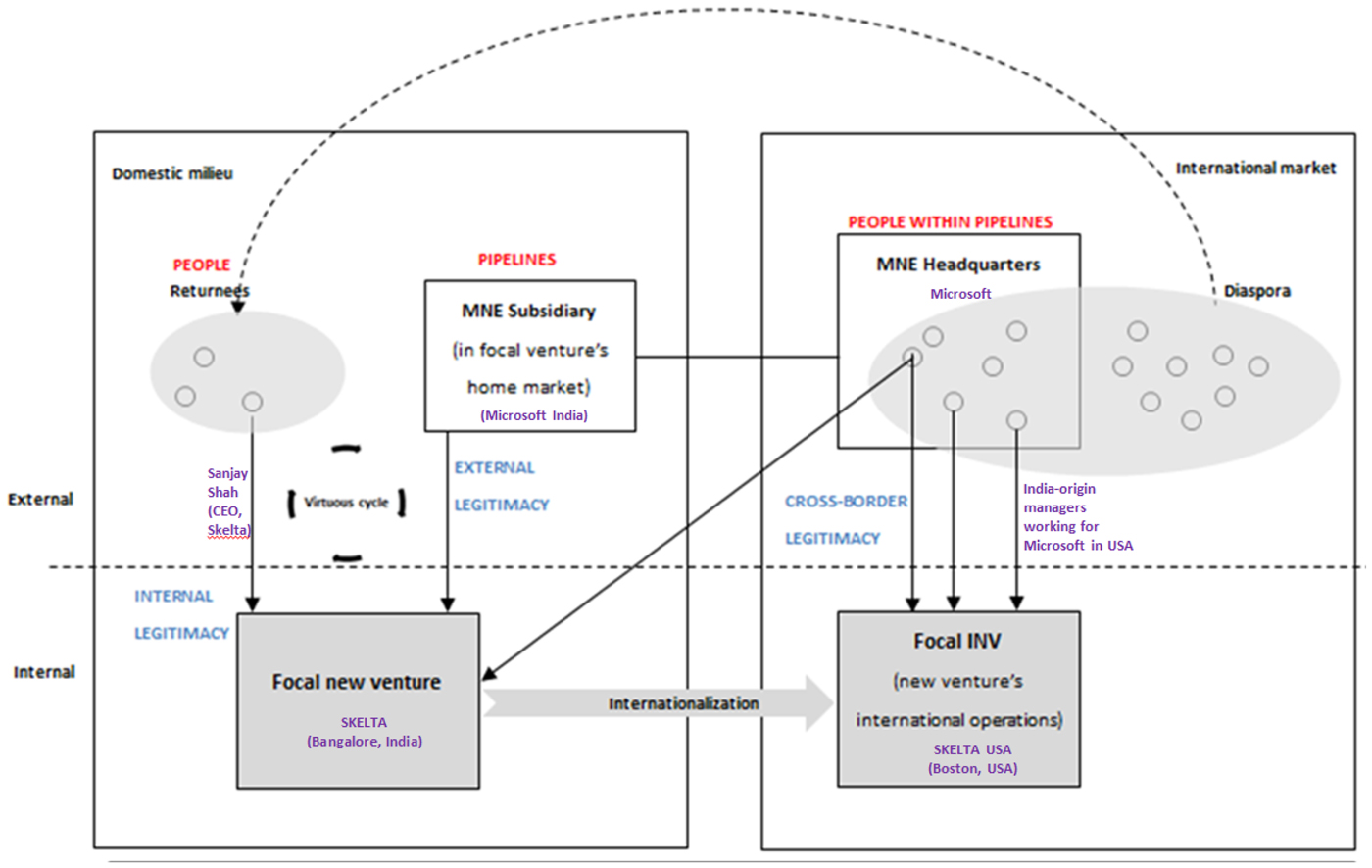
Such individuals proved to be especially helpful in supporting Skelta's efforts to lobby Microsoft headquarters to establish – and then include it within – a partner program for overseas ventures. This tangible outcome was a major source of cross-border legitimacy as Skelta was now able to make certain sales visits in the US with a Microsoft manager in tow. Furthermore, through these expanded ties within the MNE, Skelta was able to establish partnerships with distributors that were fellow-partners of Microsoft in markets across Western Europe and Asia. As it expanded internationally, Skelta grew at a rapid clip to become a leading niche player in the embeddable business process management space; 80% of its revenues accrued from international markets. We provide a depiction of the case of Skelta in Figure 4.
Skelta: Illustration of an INV from Bangalore.

Did Skelta face the vulnerabilities of over embeddedness and malfeasance? Interestingly, within about five years of close engagement with Microsoft, Shah and his team did begin to consider how they could ensure that they were not overly dependent on Microsoft. However, shortly thereafter the venture was acquired by Invensys, a large company that itself worked closely with Microsoft. Thus, the potential vulnerabilities did not quite play out, but the top managers had become cognizant of these possibilities.
Boundary Condition: Emerging Economy Context – A China-India Comparison
Given the heterogeneity among emerging economies (Ramamurti, Reference Ramamurti2012), it is useful to consider whether the Bangalore experience applies to other emerging economies, by briefly considering another successful partnership between a new venture and Microsoft – in Beijing, China. While the Indian software industry faces several challenges of an emerging economy such as limitations in scientific know-how (Krishnan & Prashantham, Reference Krishnan and Prashantham2018), it also has certain distinguishing features vis-a-vis other emerging economies such as China. For instance, the size of the domestic market is generally considered to be small, whereas Chinese software firms primarily cater to a large home market. Also, the role of the government is not as pervasive as in China, and as a result there is rather less access to state support and infrastructure. Finally, India has fewer restrictions compared to China's ‘great firewall’.[Footnote 6]
The Chinese new venture we describe briefly, Gridsum,[Footnote 7] was founded in the Zhongguancun high-tech district of Beijing, by a Tsinghua University alumnus who, as a student, had interned at the Zhongguancun-located Microsoft research facility, which had been a recipient of strong support from the Chinese government. This exposure influenced an early decision to develop Gridsum's offerings based on Microsoft's platform technologies. As in the Indian case, attracting credible individuals to reduce egocentric uncertainty was important, and the founder successfully attracted a few returnees to join his team, including one individual who became the Chief Marketing Officer.
Furthermore, the association with Microsoft did yield valuable external legitimacy. It helped that Gridsum made an early positive impression on the giant MNE by applying its own technology to help Microsoft China solve an online marketing challenge. Gridsum's tie with Microsoft moved to a new level when it became the first Chinese start-up to be invited to join an elite partnering program of Microsoft, reserved for its 100 most innovative start-up partners, worldwide. Soon afterwards Gridsum received funding from Steamboat Ventures, an international firm, following an introduction made by Microsoft.
In terms of transforming the local tie with Microsoft into a global one, corporate managers in Microsoft's US offices did begin to take notice of this Chinese start-up, especially as China had been identified as a key market for its new technologies. A high-profile event in Beijing was arranged in which then Microsoft CEO Steve Ballmer showcased Gridsum's innovation. However, when we consider the internationalization outcomes of the venture, we find a stark contrast with Skelta: despite these accolades and its long-standing technology alliance with Microsoft, Gridsum does not undertake any business outside of China. Thus, whereas Skelta went on to span global boundaries within the MNE network to gain 80% of its revenue from overseas, Gridsum remained wholly focused on the Chinese domestic market despite its internationalization aspirations.
Why were Skelta's internationalization outcomes different from those of Gridsum? Access to people and pipelines was not dissimilar between the two cases and contributed to internal and external legitimacy. Rather, the main difference seems to be in relation to cross-border legitimacy, and it would appear that local context may be a boundary condition for the extent of a venture's access to ‘people within pipelines’. A top manager of Gridsum attributed their lack of success in international markets to a paucity of coethnic (China-origin) senior managers in Microsoft's headquarters, and envied the access that Indian ventures had to India-origin managers. According to him, although a large number of Chinese-origin engineers worked for Microsoft in the US, when it came to senior managers they were vastly outnumbered by Indian-origin ones. (Microsoft's cloud business division was then headed by Satya Nadela, who went on to become CEO.) Thus, even assuming an inclination to help other coethnics (Kane & Levina, Reference Kane and Levina2017; Roberts & Beamish, Reference Roberts and Beamish2017), the abundance of people within pipelines – i.e. the connectedness or sheer number of connections (Lorenzen & Mudambi, Reference Lorenzen and Mudambi2015) – may be a boundary condition for Insight 4.
DISCUSSION
In this conceptual article, we address the following: How does network connectivity via individual- and organization-based ties influence the perceived legitimacy of international new ventures from emerging economies? In doing so, we bring together two bodies of work. One takes an economic geographic perspective to highlight the role of organization- and individual-based ties in facilitating the progress of clusters, such as the Bangalore software cluster (Lorenzen & Mudambi, Reference Lorenzen and Mudambi2013), but stops short of making explicit observations at the level of the firm. The other stream of work focuses on INVs, which notes the prospect of leveraging MNE ties and coethnic ties but does not adopt the holistic view of network ties seen in the cluster-related work.
As such, by bringing together these two research streams, there is scope to enhance understanding of the complementarities between the effects of individual- and organization-based ties on the legitimacy of INVs, particularly in the context of capability upgrading in a setting like Bangalore. Below we discuss our contributions, limitations, research directions and implications for practice.
Contributions
Contributions to the INV Literature
We contribute to the INV literature, in particular the stream of work focused on emerging economies, by importing notions of people and pipelines from Lorenzen and Mudambi's (Reference Lorenzen and Mudambi2013) connectivity theory of clusters to explicitly integrate the influence of ethnic ties and MNE ties. While network ties are helpful to INVs in general (Coviello, Reference Coviello2006), their role is accentuated in the context of emerging economies because resource constraints, particularly in relation to innovation, tend to be more pronounced. Yet the effects of two forms of ties that can be especially relevant in these settings – ethnic ties and MNE ties – are typically examined in a siloed fashion, and an integrative view of these different sets of ties has been elusive. By drawing upon Lorenzen and Mudambi (Reference Lorenzen and Mudambi2013), we conceptualize the separate and joint effects of ethnic ties and MNEs ties in relation to new venture internationalization from emerging economies. Specifically, we conceptualize complementary – and reinforcing – effects of these ties on legitimacy building.
In so doing, we shed light on the role of network connectivity in helping emerging economy INVs overcome their legitimacy deficits, in terms of returnees facilitating internal legitimacy, ties with MNE subsidiaries yielding external legitimacy, and people-within-pipelines helping the focal venture build cross-border legitimacy. While we know that capability upgrading is important, and that network relationships can facilitate this process, a key overlooked mechanism concerns the role of network relationships in addressing legitimacy deficits, which are typically greater for INVs from emerging economies in comparison to their counterparts from advanced economies. It is telling that in the Kiss et al. (Reference Kiss, Danis and Cavusgil2012) review paper, the term ‘legitimacy’ appears only thrice, in relation to future research suggestions, not in the discussion of the extensive literature review on IE research in emerging economies.
Furthermore, our work provides some insight into specific emerging economy settings – notably India; including as a contrast, China. The considerable value that both coethnic ties and MNE ties hold for Indian INVs (Kundu & Katz, Reference Kundu and Katz2003; Prashantham & Dhanaraj, Reference Prashantham and Dhanaraj2015; Puthusserry et al., Reference Puthusserry, Child and Rodrigues2014) may reflect what Lorenzen and Mudambi (Reference Lorenzen and Mudambi2013: 520) refer to as ‘benign neglect’ from the government. This is in contrast to advanced economies like France (Goerzen, Reference Goerzen2017) or other emerging economies like China, where state intervention is ubiquitous (Armanios et al., Reference Armanios, Eesley, Li and Eisenhardt2017; Filatotchev et al., Reference Filatotchev, Liu, Buck and Wright2009). Scholars of Chinese INVs have noted ‘the more important role of political ties…compared with business ties’ (Zhang, Ma, Wang, Li, & Huo, Reference Zhang, Ma, Wang, Li and Huo2016). Thus, although ethnic ties as well as MNE ties are relevant in a Chinese context, they are arguably even more crucial for Indian INVs as a substitute for state support – although this is improving in India – of the ongoing process of catch-up by Indian software firms (Athreye, Reference Athreye2005; Krishnan & Prashantham, Reference Krishnan and Prashantham2018).
Extending Lorenzen and Mudambi's connectivity perspective
We shed valuable light on ‘the concerted working of MNE pipelines and individual-based personal relationships’ (Cano-Kollmann, Cantwell, Hannigan, Mudambi, & Song, Reference Cano-Kollmann, Cantwell, Hannigan, Mudambi and Song2016: 260). The insight about ‘people within pipelines’ adds a valuable nuance to Lorenzen and Mudambi's (Reference Lorenzen and Mudambi2013) connectivity theory of clusters. It has been recognized that ‘the real world contains a multitude of examples of mixed forms that include aspects of both organization-based and individual based linkages…’ (Lorenzen & Mudambi, Reference Lorenzen and Mudambi2013: 506). This article provides a different take on the ‘mixed forms’ by focusing attention on people within pipelines[Footnote 8] who have the potential to assist INVs from emerging economies. From a network theory perspective, an intriguing insight that this focus on people within pipelines suggests is that it gives entrepreneurs access to ties characterized by interpersonal homophily (cultural affinity) within a context of interorganizational heterophily (MNE-INV asymmetry).
An inferential insight that we add to Lorenzen and Mudambi's (Reference Lorenzen and Mudambi2013) connectivity theory is that the reduction of egocentric uncertainty through people-based connectivity and of altercentric uncertainty via pipeline-based connectivity may reflect somewhat different mechanisms. The former, which provides an injection of knowledge (i.e., human capital) into the venture, represents the view of network ties as ‘pipes’ while the latter depicts the role of network ties as ‘prisms’. As Podolny (Reference Podolny2001: 58) has noted, there are ‘two alternative ways in which network scholars have conceptualized networks in markets. One is as a conduit or pipe for information and resources. The second is as a lens or prism through which the qualities of actors are inferred by potential exchange partners’. Scope for learning from MNEs exists of course. But this takes time to accrue. In the short term the benefit of being associated with an MNE is likely to be primarily through a network-as-prism mechanism. As such, pipelines can be more than ‘pipes’; they can also be ‘prisms’.[Footnote 9]
Limitations and Future Research Directions
Researchers interested in building upon our ideas must pay attention to their limitations, which also point to research directions. First, ours is an exploratory conceptualization supported by a single illustration, and thus requires much more empirical work, both qualitative and quantitative, to establish the rigor of these ideas. Second, in focusing our attention primarily on India (and specifically Bangalore) we trade off contextual depth for broader generalizability. In particular, we see great scope for further comparing the Indian and Chinese contexts and urge future researchers to do so. Third, in discussing external legitimacy we focus on prospective customers. However, investors constitute an important external audience for new ventures. Future research could usefully extend our analysis to this audience. Also, our discussion has primarily kept in mind software firms in the ICT industry. However, capability upgrading is occurring among emerging economy firms in a whole range of industries including pharmaceuticals and automotive (Kumaraswamy, Mudambi, Saranga, & Tripathy, Reference Kumaraswamy, Mudambi, Saranga and Tripathy2012). Future research could extend our analyses to multiple industries.
Finally, the local context could be an important boundary condition. Access to people within pipelines cannot be guaranteed in all cases of emerging economy INVs; the case of Skelta may be a reflection of the abundance of such actors from India, specifically in the ICT sector. Thus, Indian ventures may be particularly well placed to tap these network resources. Furthermore, ability and willingness to help a new venture may not be uniformly high among coethnics within an MNE. Indeed, more generally our ideas could provide a basis for thinking about locational differences: for instance, certain locations (e.g., Israel) may be rich in both MNE ties and diaspora ties whereas others may have a greater abundance of one set of ties than the other (e.g., perhaps more ethnic ties in Pakistan and more MNE ties in Singapore). Future research could usefully unpack such differences in locational context.
Managerial Implications
Our ideas, if empirically supported, hold managerial implications. First, aspiring new ventures in emerging economies that seek to upgrade their capabilities and internationalize would be well advised to actively cultivate and utilize network ties in their domestic milieu. Second, they must take a holistic approach in assessing different types of ties – both individual- and organization-based ties – and recognize that different types of ties have different dominant benefits. Such discernment can lead to more effective network outcomes and less disappointment with alters (partners). Third, emerging economy INVs would benefit from a learning orientation vis-à-vis network actors. Public policy efforts of local governments in emerging economies that seek to enhance the competitiveness of indigenous ventures should aim to increase the active, discerned and reflective utilization of network ties.
CONCLUSION
To conclude, by bringing together insights from two research streams – cluster connectivity and INVs – we shed light on the complementarities between individual- and organization-based linkages in terms of their separate and combined effects. Specifically, we have sought to proffer a holistic picture of individual- and organization-based ties as enablers of legitimacy enhancement, which is crucial for new ventures in an emerging economy setting that seek to upgrade their capabilities. We hope future research at the intersection of international entrepreneurship and clusters will build on our ideas and provide a deeper understanding of INVs emanating from emerging economies.