1. Introduction
Steady progress in planting, regulating and researching biotech (transgenic or genetically modified (GM)) crops in Africa is being made. South Africa, Egypt, Burkina Faso and Sudan currently grow biotech crops, while Kenya, Ghana, Malawi, Nigeria and Uganda have already conducted confined field trials. Biotech crops grown include soybean, cotton and maize; there are ongoing research activities on staple crops including drought-resistant maize, sorghum, cassava, banana and sweet potato. In South Africa about 2.3 million hectares have been planted to biotech crops, gaining a total farm income of US$809 million in the past decade (Brookes and Barfoot, Reference Brookes and Barfoot2012). Meaningful annual potential benefits from Bt Cotton are predicted for other African countries, ranging from US$22 million (Bouët and Gruère, Reference Bouët and Gruère2011) to US$214 million (Anderson et al., Reference Anderson, Valenzuela and Jackson2008) in Sub-Saharan Africa. In Uganda, potential annual benefits ranging from US$179 million to US$365 million are expected if a disease-resistant GM banana is adopted (Kikulwe et al., Reference Kikulwe, Wesseler and Falck-Zepeda2008), while other studies report large potential benefits from staple crops (e.g., Horna et al., Reference Horna, Smale and Falck-Zepeda2007). To access such benefits, however, several regulations and policies have been designed and implemented. One important example is GM food labelling. To date, little is known about GM labelling in Africa (e.g., Botha and Viljoen, Reference Botha and Viljoen2009) and, moreover, no study has documented the determinants of consumers' trust in GM food labels in Africa.
Over 40 African countries are party to the Convention on Biological Diversity and the Cartagena Protocol on Biosafety (Moola and Munnik, Reference Moola and Munnik2007), and participate in Codex standard-setting processes of the Codex Alimentarius Commission that aims to promote the health of consumers and supports ‘fair trade’ practices. In addition to their main obligations, Codex Alimentarius, the Cartagena Biosafety Protocol, and the World Trade Organization are the main international bodies discussing the issue of labelling GM food; to date, no international standard has been agreed upon (Gruère and Rao, Reference Gruère and Rao2007).
Some African countries have announced plans to implement mandatory or voluntary labelling systems for GM food; the laws across countries do vary though (Phillips and McNeill, Reference Phillips and McNeill2000; Gruère and Rao, Reference Gruère and Rao2007; Gruère et al., Reference Gruère, Carter and Farzin2009). These countries include, among others, South Africa, Mauritius, Namibia and Cameroon. However, only South Africa has implemented a mandatory labelling regime for GM food (as prescribed in regulation 7 of the Consumer Protection Act of 2008), which has been criticized by different stakeholders along the food chain due to its complexity. Mauritius has a GM food labelling policy, while Cameroon, Ethiopia, the Ivory Coast, Sudan, Namibia and Zambia are considering GM food labelling legislation (Gruère et al., Reference Gruère, Carter and Farzin2009).
As GM labelling involves costs and often requires identity preservation along the whole supply chain, considerable costs are anticipated, especially in Africa. A rigid labelling policy may render the introduction of a GM crop impossible and therefore prevent African countries accessing the technology and the ensuing potential benefits. Furthermore, alternatives to the ‘right to know’ claim in line with a mandatory label need to be considered, such as voluntary negative labels (‘does not contain GMOs’). Private solutions like ‘GM free’ labels have also surfaced – a practice becoming increasingly common in the European Union (EU) (Venus and Wesseler, Reference Venus and Wesseler2012). Hence, before regulators introduce mandatory labelling systems, information about the determinants of trust in labelling can be used to improve decision making.
Measuring and explaining the determinants of general trust in developing countries using trust games (or revealed trust) and trust surveys (or survey based-stated trust) have rapidly increased in the past years (see Wilson and Eckel, Reference Wilson, Eckel, Drunckman, Green, Kuklinski and Lupia2011, as reported in Johansson-Stenman et al., in press).Footnote 1 However, trust remains difficult to measure (Johansson-Stenman et al., in press). On the one hand, trust games have been used to measure trust and trustworthiness, unconditional altruism and risk preferences (e.g., Glaeser et al., Reference Glaeser, Laibson, Scheinkman and Soutter2000; Cox, Reference Cox2004; Karlan, Reference Karlan2005; Schechter, Reference Schechter2007; Johansson-Stenman et al., in press). On the other hand, trust surveys are more preferred for measuring and explaining economic growth differences among countries (Knack and Keefer, Reference Knack and Keefer1997) and in cases where information is impossible to obtain via revealed behavior (Johansson-Stenman et al., in press). Recently some studies have also been conducted in Uganda (e.g., Mosley and Verschoor, Reference Mosley and Verschoor2005; Zerfu et al., Reference Zerfu, Zikhali and Kabenga2009) to measure trust. Mosley and Verschoor (Reference Mosley and Verschoor2005), for example, used a trust game to understand and explain the determinants of general trust in two rural villages in eastern Uganda. They showed that insurance offers higher trust if it is associated with education and group membership. Likewise, Zerfu et al. (Reference Zerfu, Zikhali and Kabenga2009) used a survey based-stated trust approach to analyze whether or not ethnicity matters for trust at the individual level in eight countries in Africa, including Uganda. The authors revealed that attitudinal trust levels are generally low in Uganda, a country that is highly ethnically fractionalized, and trust strongly decreases in cases where there is ethnic nepotism. Likewise, other socioeconomic factors, including education, age, income, religious affiliations and population density, were found to have strong effects on general trust.
Although there is some existing literature on generalized trust, such literature does not explain the potential distrust towards GM food labels that may arise due to the GM food controversies. We add to this literature by using a survey based-stated trust approach to explore the determinants of trust in GM food labels in Uganda should GM foods be placed on its market. We used face-to-face surveys and employed an ordered logit regression to measure the relative effect of various individual and household characteristics on labelling policy. We differentiate between consumer groups using the following parameters: differences by income group; willingness-to-pay (WTP) for GM bananas; spatial location; and whether or not they, as consumers of bananas, are also banana producers. This allowed us to investigate whether or not wealthier consumers may trust GM food labels, as those consumers are often opposed to GMOs, as suggested by Paarlberg (Reference Paarlberg2008) and confirmed for Uganda by Kikulwe et al. (Reference Kikulwe, Birol, Wesseler and Falck-Zepeda2011a).
We also investigate the trust consumers have both in the government to regulate GM food production and sale, and in the information provided by food labels, and we compare this with their individual preferences for nutritional and food safety characteristics. In doing so we examine whether a general trust in different institutions has a positive or negative impact on GM food labels trust. Alesina and La Ferrara (Reference Alesina and La Ferrara2002) find that trust in existing institutions may affect trust in other people. Yet, Kikulwe et al. (Reference Kikulwe, Wesseler and Falck-Zepeda2011b) reveal significant differences in institutional general trust, with most consumers trusting the public sector or government-owned institutions more than the private sector. This may imply that, if a mandatory GM food labelling regime is to be implemented by the government, consumers are more likely to trust such labels than if done by the private sector. Further, trust in food labels as well as differences in trust among different consumer groups can have important implications for food policy. If a government policy on GM labelling is not supported and in particular is not supported when GM food products are introduced, other stakeholders such as private consumer organizations might play an important role in the smooth introduction of a food product not appreciated by an influential consumer section, say wealthy consumers, but considered to be safe and poverty alleviating.
As of now, the food labelling in Uganda is predominantly handled by the private sector, including manufacturers, wholesalers, retailers, etc. However, quality assurance systems that enhance consumer protection, public health and safety, among others, are implemented by the government's Uganda National Bureau of Standards (UNBS) organization. The supplier (or producer) is responsible for ensuring that the product is appropriately labelled and that the required information is easily accessible by the likely purchaser (or consumer) when the product is for sale on the Ugandan market. Standard guidelines are provided by the UNBS. However, labelling regulations and policy for GM foods so far do not exist in Uganda.
The remainder of the paper is arranged as follows: the next section describes the conceptual framework, showing how individual and household characteristics may affect trust in food labels. Section 3 describes the methods and data used for the study. This is followed by the presentation and discussion of the empirical results. Concluding remarks are made in the final section.
2. Conceptual framework
Food labels are an important source of information for consumers who have positive attitudes towards labels (Wandel, Reference Wandel1997). Now consider a consumer who is to choose between two food types A and B: food A is labelled with GM information (L GM ) and food B is not labelled with GM information (L NGM ). The choice of either food type is assumed to be dependent on the trust (T i ) a given consumer has in the food labels. Following Huffman et al. (Reference Huffman, Rousu, Shogren and Tegene2004), the consumer's utility function is denoted as:
 $$U=U \left(L_{GM}\comma \; L_{NGM}\semicolon \; T_i \right).$$
Recent studies have shown that consumer's individual- and household-level characteristics play a significant role in their relative trust. For instance, a number of studies have reported significant and positive income effects on trust (e.g., Glaeser et al., Reference Glaeser, Laibson, Scheinkman and Soutter2000; Karlan, Reference Karlan2005; Schechter, Reference Schechter2007; Johansson-Stenman et al., in press). Several studies have also reported that education of the respondent has positive and significant effects on trust (e.g., Frewer et al., Reference Frewer, Howard, Hedderley and Shepherd1999; Holgado et al., Reference Holgado, Martinez-Gonzalez, De Irala-Estevez, Gibney, Kearney and Martinez2000; Bellemare and Kröger, Reference Bellemare and Kröger2007; Lobb et al., Reference Lobb, Mazzocchi and Triaill2007; Zerfu et al., Reference Zerfu, Zikhali and Kabenga2009), while others have found education to show negative effects (e.g., Johansson-Stenman et al., in press). Similarly, some studies show that older respondents have higher levels of trust than younger ones (Zerfu et al., Reference Zerfu, Zikhali and Kabenga2009), while others report a decreased level of trust with increase in age (e.g., Huffman et al., Reference Huffman, Rousu, Shogren and Tegene2004). Gender also plays a significant role. Women are more likely to trust food labels, and read nutritional labels before purchasing their food (e.g., Nayga, Reference Nayga1996; McLean-Meyinsse, Reference McLean-Meyinsse2001) than their male counterparts. Sources of information have also been reported to be significant determinants of trust (Roosen et al., Reference Roosen, Lusk and Fox2003). In the EU, for instance, consumers prefer government-mandated labelling programs for beef from cattle fed on GM crops. Similarly, the Eurobarometer (2006) survey shows that in the EU the most trusted sources of information regarding food risks are consumer organizations, doctors and scientists, followed by public authorities. Kikulwe et al. (Reference Kikulwe, Wesseler and Falck-Zepeda2011b) reveal that most consumers trust the public sector or government-owned institutions more than the private sector to control the production and sale of GM products in Uganda. In a stated trust survey, Johansson-Stenman et al. (in press) found that trust is significantly and positively affected by the consumers' confidence in institutions. Similarly, Bahry et al. (Reference Bahry, Kosolapov, Kozyreva and Wilson2005) found that inter-ethnic stated trust is positively related to trust in politicians. Therefore, the level of trust is a function of the consumer's individual and household characteristics (X), and can be expressed as:
 $$T_i =f_i \lpar X\rpar .$$
The relevance of all the Xs will be tested empirically.
If Pr GM is the price of food A, Pr NGM is the price of food B and Y is the consumer's budget, at any given time, the consumer maximizes his or her utility subject to his or her budget constraint (Y) as well as his or her individual and household characteristics (X):
 $$MaxU\lpar L_{GM}\comma \; L_{NGM} \comma \; T_i\rpar \comma \; T_i =f\lpar X\rpar \quad \hbox{s.t.} \quad \hbox{Pr}_{GM} L_{GM} +\hbox{Pr}_{NGM} L_{NGM} \le Y.$$
The marginal rate of substitution of food A for food B can then be written as:
 $$\displaystyle{{MU_{GM} \lpar L_{GM} \comma \; L_{NGM} \semicolon \; T_i\rpar } \over {MU_{NGM} \lpar L_{GM} \comma \; L_{NGM} \semicolon \; T_i}} = \displaystyle{{{\rm Pr}_{GM}} \over {{\rm Pr}_{NGM}}}$$
where MU GM is the marginal utility with respect to food A and MU NGM is the marginal utility with respect to food B. The consumer's marginal rate of substitution of food A for food B is a function of the market prices of the two food types and the consumer's individual and household characteristics (X), which affects the level of trust in food labels. Through differentiation with respect to X, the impact of the change in X for the two food types can be examined. However, for simplicity, let us assume that a change in X has differential impacts on the level of trust for ONLY the marginal rate of substitution of GM-labelled food A. This implies that a change in trust level has no impact for foods that are not labelled as GM foods (or non-GM food). If a positive change in the consumer's X reduces his or her trust in food labels which then lowers the respective marginal utility of GM-labelled food A, it causes the marginal rate of substitution of food A for food B to decrease. The consumer will then purchase more of the non-labelled GM food at the prevailing price. Hence, changes in the level of trust in food labels affect the demand for the two food types.
3. Methodology
3.1. Data and descriptive statistics
A face-to-face survey using a pre-tested questionnaire was conducted among 421 randomly drawn banana-consuming households in the eastern, central and south-western regions of Uganda in July and August of 2007. The survey included individual and household level characteristics, attitudinal questions regarding GM and non-GM food products, and choice questions to identify WTP for GM bananas. A detailed description of the study is reported in Kikulwe et al. (Reference Kikulwe, Birol, Wesseler and Falck-Zepeda2011a).
Consumers were asked to show their strength of agreement or disagreement with the following statement: ‘Information about food safety and nutrition on food labels can be trusted.’ On average, 51 per cent responded that they would strongly or moderately trust the information on the labels, whereas 30 per cent would strongly or moderately disagree with the statement, and 19 per cent could not decide on a clear position. For the subsequent analysis, we used 342 observations of the original sample, equivalent to 81 per cent,Footnote 2 whose responses ranged from strongly disagree (1) to strongly agree (4). We analyzed the responses using an ordered logit model (Long, Reference Long1997).
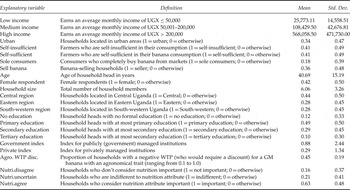
The individual and household level characteristics of the sample are reported in table 1. Individual characteristics including age, education and gender were captured. The average age of a household head was 40 years, with the majority of the household heads having a formal education up to primary level (seven years of school attendance), and a small proportion (10 per cent) with post-secondary education (more than 13 years of school attendance). On average, 42 per cent of the interviewees were female. The household level variables of income, family size, location of the household and consumer type were included. Income was approximated by summing the total amount of money received by different members of a household from on-farm and off-farm sources. Households were then classified into three quartiles: low, medium and high. Each household comprised about six members (children and adults). The central region, which has the largest number of banana consumers in Uganda, constituted about 50 per cent of the total sample, with the eastern and south-western regions each comprising 25 per cent of the sample. A third of all households were urban, while two-thirds were rural. The selected households ranged from net-banana producers (self-sufficient in bananas) to net-consumers (sole consumers), with the middle category being self-insufficient producers purchasing bananas from the market to supplement their production.
Definition and descriptive statistics of explanatory variables used in the empirical analysis of consumers' attitudes toward food labelling in three regions of Uganda

Notes: UGX denotes Uganda Shillings.
WTP for an agronomic trait possessing disease resistance that could lead to higher banana production (Agro.WTP disc), nutrition – a proxy for product quality and trust in institutions (Institution), were included in the analysis. The variable ‘Agro.WTP disc.’ was the estimated probability that a consumer belongs to a population segment that had a negative WTP for GM bananas with an agronomic trait, and falls in the range 0.1–1.0.Footnote 3 We also measured the importance of the product attribute ‘nutrition’. Using a 5-point Likert scale, respondents were asked to rate the importance of nutrition as a food characteristic before making their food-purchasing decision. The 5-point Likert scale sought to measure the degree of agreement of a respondent, where 1 represented strongly disagree and 5 strongly agree. This scale was later condensed to three points: 1 representing agree (Nutri.agree), 2 uncertain (Nutri.uncertain), and 3 disagree (Nutri.disagree) at the analytical level. This examined whether such factors can influence Ugandan consumers' attitudes towards food safety and nutrition information on food labels. About two-thirds of the respondents strongly or moderately consider nutrition as an attribute while purchasing their food products, whereas about a fifth do not.
To assess and analyze the level of trust in the organizations involved in the sale of foods, beverages And seed, each respondent was asked a general trust question: Do you have confidence that the named institution can prevent harmful products from being sold in shops, supermarkets and restaurants? The question had three alternatives: ‘yes’, ‘no’ and ‘don't know’. The organizations were grouped by category (see Kikulwe et al., Reference Kikulwe, Wesseler and Falck-Zepeda2011b) for a detailed description. For each category an institution index was calculated: responses were given scores or weights (−0.5 for ‘no’, 0 for ‘don't know’ and 0.5 for ‘yes’). Average scores were calculated for each institutional category by taking the mean of the organizations in that category. For this study, the institutions were regrouped further in two groups based on aggregated summation of the generated indices: a government sector category index (composed of leadership, extension service, research and education, government-owned ministries and parastatals categories, government index) and a private sector category index (made up of private sector and NGOs category, private index). These two variables, Government index and private index, were finally included in the regression. Higher positive scores indicate a greater trust in a given institution, while negative scores show less trust. We run Spearman correlations between trust in food labels and the respondents' general trust level in the two institutions, government and private, to ascertain the potential relationship that may exist. On average, respondents' scores were higher for government institutions than private ones (table 1).
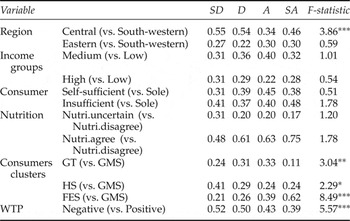
Table 2 reports the differences in mean scores for consumers' trust in food labels for various sample characteristics, including spatial location, income groups, whether or not consumers are also producers of bananas, nutrition attribute, consumer clusters, and WTP for GM bananas. The trust scores were obtained by asking respondents to evaluate the provided trust statement using a 5-point Likert scale as follows: (1) strongly disagree; (2) disagree; (3) neither agree nor disagree; (3) agree; (5) strongly agree. These responses were condensed into four levels (strongly disagree (SD), disagree (D), agree (A) and strongly agree (SA)) at the analytical level. The ANOVA tests (F-statistics) suggest that there is significant heterogeneity in the levels of trust in food labels. Consumers in the central region were more likely to strongly or moderately disagree with the information on food labels than their counterparts in the south-western region. Similarly, the likelihood of having negative attitudes toward information on food labels is somewhat higher for consumers with a negative rather than a positive WTP for GM bananas. Furthermore, a comparison of these consumer clusters with the outcome variable yields interesting results.Footnote 4 Consumers who had confidence in government (GT), those who worried about health safety (HS), and those with food and environment concerns (FES) are more likely to strongly or moderately agree with the information on food labels than those who are concerned with unknown risks associated with the potential benefits of the GM products (GMS). However, no significant differences were observed between the outcome variable and income groups, consumer types and the nutrition attribute.
Cross-tabulation showing the differences in mean scores for consumers' trust in food labels with various sample characteristics

Notes: Four trust levels are compared where: SD, strongly disagree; D, disagree; A, agree; SA, strongly agree. Values indicate mean scores for dummy variables. The F-statistics are from ANOVA of inter-trust level differences. GMS, GM skepticism cluster; GT, government trust cluster; HS, health safety concern cluster; FES, food and environmental safety concern cluster. ***, **, * imply significance at 1%, 5% and 10% levels, respectively.
3.2. Econometric model
We assess individual trust towards the information about food safety and nutrition provided on food labels using the aforementioned trust scores. We analyzed responses using an ordered logit model. An ordered logit analysis was used because of the ordered nature of the dependent variable and no assumption on the distance between two values of the dependent variable. The estimator is used to estimate the relationship between trust in food labelling and a set of explanatory variables. Due to the nonlinearity of the estimator, odds ratios and percent change in odds were used for better interpretation of our results. In doing so we discuss factor changes in the odds of higher outcomes compared to lower outcomes.
The model assumes that the observed response categories of the dependent variable (T i ) are tied to the latent variable, T i *, whose values are unobserved. The series of questions segregates the range in which the individual's true response lies, which is put into one of the following four intervals: (−∞ ,l1), (l 1, l 2), (l 2, l 3) or (l 4, + ∞). In the ordered logit model herein, the measurement model T i with j ordinal categories (l 1,…,l 4) and a latent variable T i * can be written as:
 $${{T_i} = \left\{\matrix{ 1 \hfill & {if\, \, \, T_i^\ast < {l_1}} \hfill \cr 2 \hfill & {if\, \, \, {l_1} \le T_i^\ast < {l_2}} \hfill \cr 3 \hfill & {if\, \, \, {l_2} \le T_i^\ast < {l_3}} \hfill \cr 4 \hfill & {if\, \, \, {l_3} \le T_i^\ast < {l_4}} \hfill \cr } \quad i = 1\comma \; \ldots N \right. }.$$
The latent T i * can be modelled as a linear function given the (N, j) vectors of the explanatory variables X i :
 $$T_i^\ast =\beta X_i +\varepsilon _i $$
where i denotes individual i and ε i is the random error.
The probability of T i being found in category j given the characteristics X i of individual i can be expressed as:
 $$\eqalign{prob\lpar {T_i} & = j\vert {X_i} = \left\{\matrix{ {F\lpar {l_1} - \beta {X_i}} \hfill \cr {F\lpar {l_2} - \beta {X_i}\rpar - F\lpar {l_1} - \beta {X_i}\rpar } \hfill \cr {F\lpar {l_3} - \beta {X_i}\rpar - F\lpar {l_2} - \beta {X_i}\rpar } \hfill \cr {1 - F\lpar {l_3} - \beta {X_i}\rpar } \hfill \cr } \right. \cr & \quad {\rm for} j = \left\{\matrix{ 1 \hfill \cr 2 \hfill \cr 3 \hfill \cr 4 \hfill \cr } \right\}}$$
where F(.) is the logistic cumulative distribution function for ε and l 1, l 2 and l 3 are the cut-off points between categories j and j − 1, X i is a vector of explanatory variables, and β is a vector of parameters to be estimated. The ordered logit regression assumes βs to be the same for all the equations, known as parallel regression assumption, which implies that β 1 = β 2 = …= β j−1. As a result, a Brant test was performed to check for the assumption's violation.
3.3. Variables
Provision of sincere information in relation to the food safety and nutritional content of food products through food labels can make consumers better informed, thereby aiding them in making healthier food choices and following healthier diets. However, consumer trust in food labels (negative or positive) may depend on various factors such as: age, education, gender, income, family size, location of the household, consumer types, and other individual characteristics, as reported in other general trust studies (e.g., McLean-Meyinsse, Reference McLean-Meyinsse2001; Huffman et al., Reference Huffman, Rousu, Shogren and Tegene2004; Zerfu et al., Reference Zerfu, Zikhali and Kabenga2009; Johansson-Stenman et al., in press).
We expect age to play a role in that older rather than younger consumers may be more sensitive to food safety and nutrition. Information about food safety and nutrition is vital, and this may increase the trust of older consumers towards such information. Similarly, gender may be important: compared to males, female consumers – who often provide diet to their children – are inclined to attach more value to food labels. Consumers with relatively high levels of education and incomes tend to set high food safety standards; hence the information provided on food labels should meet such standards to maintain their confidence in such information. Besides, the inclusion of both rural (mostly producer-consumers) and urban (mostly sole consumers) consumers of banana located across different regions of Uganda allows us to examine if there are spatial differences in their perceptions towards food labels. Factors that influence consumers' purchasing behavior (e.g., nutrition, and WTP for GM foods (positive or negative)) were also included in the econometric estimations. We hypothesize that consumers who perceive nutrition as an important factor in their food-purchasing decision have positive attitudes toward food labels. Conversely, consumers with a negative WTP for an agronomic trait inserted in a GM banana are more likely not to trust GM food labels. Such consumers are concerned about the production technologies used and this might affect their trust in food labels, especially if the labelling is to be handled privately as is the current status in Uganda. Finally, we also included trust in government and private institutions variables to examine the relationship between the two variables with respect to trust in food labels. We hypothesize that consumers who have high confidence in public institutions will be more likely to trust food labels compared to those with high trust in private institutions, as reported in other studies (e.g., Bahry et al., Reference Bahry, Kosolapov, Kozyreva and Wilson2005).
4. Empirical results
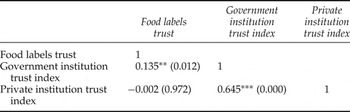
Prior to regression, we looked at the correlation coefficients between trust in food labels and general trust in institutions. As indicated in table 3, trust in food labels is positively and significantly correlated with trust in government institutions, but negatively correlated with private institutions, though not significantly. These results suggest that consumers who tend to have general trust in government institutions are also more likely to trust in food labels, provided they are mandated by the government.
Correlation coefficients between general trust of institutions and trust in food labels

Notes: P-values are in parentheses. ***, ** imply significance at 1% and 5% levels, respectively.
4.1. Ordered logit results
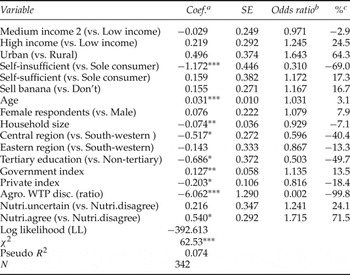
The dependent variable consisted of four categories that were used to rate trust of information about food safety and nutrition on labels, where 1 indicated the lowest trust and 4 the highest. The model was checked for parallel line assumption, where the assumption of no statistical difference in the slopes for all values of the dependent variables was satisfied using the Brant test of the parallel regression assumption following Long (Reference Long1997: 143–144). The test was done for the entire model and for each independent variable; the test confirmed that the proportional odds approach was satisfactory (i.e., χ2(34) = 39.37; Prob > χ2 = 0.242). Table 4 presents the estimated results of the ordered logit model.
Estimated ordered logit regression of consumers' trust in information on food labels

Notes: The dependent variable is ranked between 1 and 4, where 1 = strongly disagree and 4 = strongly agree.
a Raw coefficient. b Factor change in odds for unit increase in the explanatory variable. c Percentage change in odds for unit increase in the explanatory variable.
***,**,* imply significance at 1%, 5% and 10% levels, respectively.
A positive coefficient for an explanatory variable increases the likelihood of trusting the information on labels; a negative coefficient shows the opposite. Odds ratios and percent change in odds were estimated to interpret the results for the ordered logit regression. Individual and household level variables were included in the model. Results indicate that age positively and significantly affects consumers' trust toward food labelling. Keeping other variables constant, the odds of having a higher trust increases by 3.1 per cent for a unit increase in age of the household head. By contrast, household size has a negative and significant coefficient, which shows that for a unit increase in household size, the odds of having trust in the information displayed on food labels decreases by 7.1 per cent. Likewise, higher levels of education lead to less trust. The odds of an increase in trust in relation to food labelling are 50 per cent smaller for people with tertiary education than those with less education. The reason for the negative effect could be that the well-educated people have no trust in the private firms, which are the current source of information provided on food labels. Similarly to other studies, gender (e.g., Zerfu et al., Reference Zerfu, Zikhali and Kabenga2009) and household income (e.g., Horna et al., Reference Horna, Smale and Falck-Zepeda2007; Johannsson-Stenman et al., in press) did not seem to play a significant role in influencing consumers' trust in GM food labels.
We also found that Ugandans' trust in food labelling differs between consumer types and regional locations. The odds of an increase in trust towards food labels are 40 per cent smaller for central region consumers than south-western ones, ceteris paribus. Moreover, the odds of having a higher trust are 69 per cent smaller for self-insufficient adopters than sole consumers, ceteris paribus.
A variable regarding consumers' WTP for an agronomic trait and a nutrition attribute variable were also included in the model. In line with our expectations, the coefficients of the negative WTP (discount) for the agronomic trait and nutrition variables were both significant, but with opposite polarity. It shows that consumers exhibiting negative WTP ratios for GM bananas with an agronomic trait (such as resistance to black Sigatoka disease) are more likely not to trust food safety and nutrition information displayed on food labels. The results reveal that the odds of having a higher trust decrease by 100 per cent. Besides, the odds of having a higher trust in food labels are 72 per cent larger for consumers who consider nutrition an important factor when purchasing food than those who do not. The reason could be that such people are the typical food label readers with higher perception of the healthiness of their diet and so they have developed trust in the information provided over time, as reported by Nayga (Reference Nayga1996); they may also care more about eating GM food carrying a nutritional attribute, as reported in Kikulwe et al. (Reference Kikulwe, Wesseler and Falck-Zepeda2011b).
We also find that trust in food labels is positively and significantly affected by the general trust in government institutions, but negatively and significantly affected by trust in private institutions. This implies that the odds of having a higher trust level in food labels are 14 per cent larger if a consumer has trust or confidence in a government institution. The positive effect of trust in government institutions has also been reported in other studies. Bahry et al. (Reference Bahry, Kosolapov, Kozyreva and Wilson2005) found a positive relationship between inter-ethnic stated trust and trust in politicians. Similarly, Johannsson-Stenman et al. (in press) found a positive relationship between stated trust and confidence in institutions. The negative relationship between trust in food labels and trust in private institutions shows that there is a potential distrust in the private sector handling GM food labelling. The reason could be that such institutions may not be able to provide the necessary information required by the most sensitive consumers, similar to what has been reported in South Africa (Botha and Viljoen, Reference Botha and Viljoen2009).
4.2. Predicted probabilities results
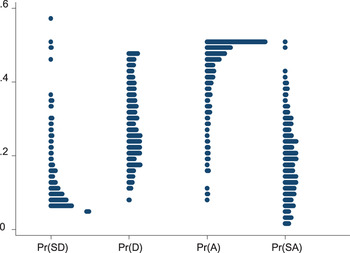
Examining predicted probabilities with the sample provides a quick check for the model. Figure 1 shows the predicted probabilities of the dependent variables, which for the extreme categories tend to be less than 0.2, and with the majority of the predictions for the middle categories falling between 0.2 and 0.5. A few cases have the probability of any outcome greater than 0.5. The results show how the trust level differed amongst the sampled consumers; most consumers moderately trust the information provided on the food labels. This is followed by those who moderately do not trust the information, while those who strongly distrust the information were the least predicted.
Predicted probabilities of consumers' trust in information on food labels

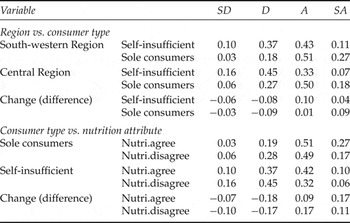
The effect of an independent variable on the dependent variable is ‘a change in an outcome for a change in an independent variable, keeping all other variables constant’ (Long, Reference Long1997). To gain a deeper understanding of our data, therefore, a table of predicted probabilities is created to examine the probability of agreement or disagreement of the trust statement given all possible covariate profiles, while holding other variable constants at their mean values. Three categorical explanatory variables – regional location, nutrition attribute and consumer type – were examined. Table 5 shows how the probabilities change depending on the agreement or disagreement in the trust statement. An examination of table 5 provides some interesting insights showing the degree to which the three categorical variables affect opinions for those averages on other characteristics.
Predicted probabilities for combinations of three categorical independent variables with consumers' trust in information on food labels

Notes: SD, strongly disagree; D, disagree; A, agree; SA, strongly agree. The values show trust probabilities, while varying trust levels. All other variables are held at mean.
Self-insufficient banana growers who complement their own production with market-bought bananas are more likely than sole consumers (who depend on markets to meet their banana consumption) to strongly disagree or disagree with the proposition that information about food safety and nutrition on food labels can be trusted. However, between the central and south-western regions, there is a movement for both self-insufficient adopters and sole consumers towards more positive attitudes about trusting food label information. Similarly, a comparison between consumer type and nutrition factor shows that consumers who consider the nutrition factor important when making their purchasing decisions are more likely than their counterparts to agree or strongly agree with the proposition that labels on food products can be trusted. Between a sole consumer and a self-insufficient farmer, there is a movement towards more positive attitudes about food labels for both consumers who consider nutrition when purchasing and those who do not (table 5).
5. Concluding remarks
We examined the determinants of trust in food safety and nutrition information on food labels in Uganda. Given that there are many ongoing activities aimed at developing biotech crops in Uganda, and Africa in general, understanding consumers' trust toward food labelling is important. Our study tries to answer the question: ‘If food labels for GM food were present, would consumers trust them?’ We found that trust towards food labelling varies across households as more than 50 per cent of all respondents strongly or moderately trusted the information on food labels. Using the ordered logit model, we observed that older household heads, consumers with fewer years of education, and households with fewer members, more strongly trust the information on food labels. Household income and gender have no significant effect on trust. However, those households that do not meet their banana consumption with their own production (self-insufficient adopters) and those located in the central region of Uganda are less likely to trust information on food labels. As expected, consumers opposing GM bananas (negative WTP) were less likely to trust any information on food labels. However, if nutrition is one product attribute that consumers desire, our results reveal a high likelihood that such consumers will trust the information provided on food labels. Likewise, trust in food labels is positively related to trust in a government institutions, but negatively related to trust in private institutions.
Based on our analyses, the following conclusions can be made. First, the findings can be used in designing marketing programs. For instance, Kikulwe et al. (Reference Kikulwe, Birol, Wesseler and Falck-Zepeda2011a) investigated the potential consumers of GM bananas in Uganda. Using a latent class model, they found two segments comprised of the potential consumers (58 per cent) and potential opponents (42 per cent) of GM banana. The opponents were skeptical about the GM technology and show a negative WTP for GM bananas. Similarly, Kikulwe et al. (Reference Kikulwe, Wesseler and Falck-Zepeda2011b) used factor and cluster analysis to identify and classify consumers' attitudes and perceptions toward GM bananas, and analyzed factors influencing them as well as determining their trust in institutions. They found four consumer segments of which three were proponents of GM technology, but one segment (8 per cent) was opponents who were concerned more about the unknown risks than the potential benefits of the technology. The authors also revealed that consumers had more confidence and trust in public institutions than private ones at regulating the GM technology. Both studies call for effective and efficient marketing strategies in order to offset the likely risk perception of GM food opponents. In the current study, we go further by looking at food labels as one strategy of improving the marketing of GM food in Uganda. The results have found that information on food labels may receive less attention from consumers who tend to be younger, well-educated individuals of larger household sizes located in densely populated smallholder farming communities of the central region. Hence, the regulators and policy makers need to devise a better strategy of targeting these individuals.
Second, results of this study may also be used to guide the government on the type of labelling (mandatory vs. voluntary) to be implemented. For example, trust in food labels is high for consumers with high confidence in government institutions, but low for those with high trust in private institutions. This finding is particularly relevant given that Uganda is more likely to implement a labelling program since it is party to the Cartagena Protocol on Biosafety. Consumers who have trust in government institutions also trust the government with respect to food safety regulations. This group of consumers may not demand positive-labelled GM bananas as long as the government considers them to be safe. Consumers with a negative WTP for GM banana also largely do not trust food labels. A mandatory labelling policy – which can only be implemented by the government – may not generate trust among these consumers. Hence, a negative labelling policy (‘This banana is GM free’) designed by the government and voluntarily implemented by the private sector might be the strategy to follow. Positive experiences with voluntary GM-free labelling schemes in other countries such as Austria and Germany provide support for such kind of strategy.
Finally, consumers who had no clear judgment on trust (the uncertain consumers) were omitted in the empirical analysis. This implies that the result of this study only relates to those who expressed an opinion on trust. Similarly, this study has only looked at the level of trust consumers have on food labels in general and it did not specifically refer to information on GMO food labels. Hence, some respondents could have interpreted the question differently. Future studies should address that issue explicitly.