The Crisis Counseling Assistance and Training Program (CCP) was authorized by the 1974 Stafford Disaster Relief and Emergency Assistance Act (Public Law 93-288, amended by Public Law 100-707) and implemented by the Federal Emergency Management Agency (FEMA) across the United States and its territories to provide supplemental monies to states, territories, and federally recognized tribes for short-term crisis counseling services to people affected by disasters. Through an interagency agreement with FEMA, the Substance Abuse and Mental Health Services Administration (SAMHSA) Center for Mental Health Services provides grant administration and program oversight for the CCP, as well as training and technical assistance for behavioral health personnel. The term behavioral health encompasses the fields of mental health and substance abuse.
The CCP is intended to reach large numbers of people, with diverse backgrounds, who are affected by disasters, and with minimal delay. The CCP uses a nonclinical, nondiagnostic, proactive, and community-based model, which is designed to address the short-term behavioral health needs of communities affected by disasters through public education, outreach, and referral to other sources of assistance to address unmet needs. CCP incorporates a strengths-based approach to help disaster survivors’ access and identify personal and community resources that will aid in their recovery process. The CCP suggests that outreach services such as brief interventions and the use of psychoeducational materials build on disaster survivors’ natural resilience, mitigating the need for referrals to mental health or substance abuse treatment services.
Since the 2005 Gulf Coast hurricanes of Katrina, Rita, and Wilma, FEMA funded the CCP’s collection of data with the use of several forms that have received Office of Management and Budget (OMB) approval (OMB#0930-0270) since 2005. The 3 main forms are the Individual/Family Encounter Log (IFEL), the Group Encounter Log, and the Weekly Tally Sheet. The IFEL documents crisis counselor (a paraprofessional from the disaster area trained in the CCP model) interactions with individuals, families, or households that last at least 15 minutes and involve participant disclosure. The IFEL is the most commonly used form in the CCP and has gone through 2 major iterations since its inception in 2005 (ie, OMB expiration in 2012 and the current form with OMB expiration 2015). In its most current version, the form captures encounter characteristics, risk categories, event reactions, survivors’ characteristics, the focus of the encounters, and referrals. The crisis counselor collects this information through active listening, that is, by engaging the service recipient as he or she tells his or her story in a way that reveals stressful experiences, or risk factors, during or after the disaster.
Crisis counselors are equipped with a variety of psychoeducational materials on topics such as problem solving, doing positive things, building social networks, reducing negative thoughts, and referral resources to assist in survivor recovery. After leaving the encounter with the survivor(s), the crisis counselor completes the log on the basis of the information that was shared by the survivor(s). Crisis counselors are encouraged to complete the log as soon as possible after each encounter, but this is not always possible; thus, sometimes the log is completed by the end of the day. In addition, demographic data, such as gender, age, and race/ethnicity, are based on observations by crisis counselors or garnered through social references and comments made by the survivors.
Previously Validated Measures of Disaster Event Reactions
Risk and Resilience in Post-Disaster Contexts
The psychological effects of natural disasters and other traumatic events on survivors have been well documented in the existing literature. Most of these studies have focused on clinically diagnosable, maladaptive responses, most notably post-traumatic stress disorder (PTSD), major depressive disorder, anxiety, and complicated grief.Reference Balaban 1 , Reference Bonanno, Westphal and Mancini 2 In light of the number of recent natural disasters, including the 2012 Kamaishi earthquake, the 2013 Oklahoma tornadoes, and the near-annual wildfires burning in the western United States, it is critical to response and recovery efforts to understand the relationships between these events and the individual reactions seen in survivors.
Although a great deal of research effort has been invested in assessing diagnosable responses, an increasing body of literature acknowledges that the vast majority of survivors of traumatic events in fact show resilienceReference Bonanno 3 , Reference Norris, Stevens and Pfefferbaum 4 or otherwise recover quickly and without the need for intervention.Reference Shalev 5 In one study of New York City residents after the September 11 terrorist attacks, the authors found that the prevalence of PTSD symptomology declined from 7.5% to just 0.6% in the 6 months following the event.Reference Galea 6 Temporary symptoms such as shock, anxiety, dissociation, psychological numbing, heightened arousal, and survivor’s guilt are seen soon after a disaster and are often misattributed to clinical psychoses when they are in fact normal responses to stressful events.Reference Bonanno 3 , Reference Shalev 5 , Reference Guterman 7
Method of Literature Review
The focus of our literature review was to identify psychological screening tools, similar to the IFEL, which have been validated and tested with samples of disaster survivors. Ideally, these instruments should broadly capture the full spectrum of disaster event reactions without the need to assess for clinical diagnoses.
We performed our search using the PsycINFO (American Psychological Association), MEDLINE (US National Library of Medicine), and Health and Psychosocial Instruments (HaPI; Behavioral Measurement Database Services) databases, as well as the Google Scholar (Google Inc) search engine. The primary search terms used were “disaster,” “screening tool,” “questionnaire,” “assessment,” “psychometrics,” and “psychometric properties.” We narrowed our search to studies between 2001 and 2012; however, development and psychometric studies for one tool in particular from the 1970s and early 1980s continue to be prevalent in the research and thus are included in this review. Dissertations and journal articles we were unable to retrieve were excluded from the review.
The search produced an abundance of psychological assessments that had been used in various disaster scenarios and measured symptoms including PTSD, depression, and anxiety. Generally, the tools we found were implemented with adult populations; however, a smaller number had been designed or adapted for use with children and adolescents. This review highlights: (1) those tools we found to be the most widely used in screening for behavioral health symptoms in post-disaster contexts, and (2) tools for which literature was currently available on the tool’s psychometric properties.
Screening Tools Used in Post-Disaster Assessments
The Impact of Events Scale (IES) was originally developed to address the need for an “instrument that measures the current degree of subjective impact experienced (ie, distress) as a result of a specific events,” and is perhaps the most widely studied psychological screening tool currently in use. The original IES assessed 2 subscales of “intrusive experiences” and “avoidance of thoughts and images” in a 15-item, self-report questionnaire.Reference Horowitz, Wilner and Alvarez 8 With the addition of PTSD to the third (1980) edition of the Diagnostic and Statistical Manual, 9 Weiss and Marmar added items to assess symptoms of hyperarousal, thus aligning what would become the newly revised IES-R with PTSD symptomology.Reference Weiss and Marmar 10 Although neither version of the IES is clinically diagnostic, both remain among the most widely used tools for assessing post-traumatic stress (PTS) symptoms following various types of disaster.Reference Yule, Bruggencate and Joseph 11 - Reference Zhang and Ho 15
The psychometric properties of the IES-R have been tested extensively since the original version’s inception in 1979 and have been widely assessed as showing strong validity, test-retest reliability, and internal consistency metrics.Reference Eid, Larsson and Johnsen 13 , Reference Sundin and Horowitz 16 , Reference Vassar, Knaup and Hale 17 While not intended as a diagnostic measure, the IES-R has been shown to correlate fairly well (r=0.84, P<0.001) with other measures of PTSD, such as the PTSD Checklist (PCL).Reference Creamer, Bell and Failla 18 Additionally, the tool’s subscales have been tested with survivors of various disasters,Reference Yule, Bruggencate and Joseph 11 , Reference Eid, Larsson and Johnsen 13 , Reference Echevarria-Guanilo, Dantas and Farina 19 lending support for its continued use in screening survivors of a wide range of traumatic events for symptoms of PTSD.
The Harvard Trauma Questionnaire (HTQ) is a screening tool developed by the Harvard Program in Refugee Trauma to inquire about a variety of emotional symptoms resulting from a particular traumatic event. The items were derived directly from the DSM-IV criteria for PTSD, with added questions that “focus on the impact of trauma on an individual’s perception of his/her ability to function in everyday life.” Currently there are 6 versions of the HTQ in 35 languages, each designed to assess the psychological impact of trauma on survivors of a specific natural or manmade event. 20 Overall, the HTQ has displayed largely robust levels of reliabilityReference Miyazaki, Dewaraja and Kawamura 21 , Reference Mollica, Caspi-Yavin and Bollini 22 ; however, the bulk of the literature examining its psychometric properties specifically in samples of disaster survivors is largely unavailable.
The Trauma Screening Questionnaire (TSQ) is a 10-item, self-report measure designed to screen for PTS symptoms in victims of general trauma. Items were taken directly from the PTSD Symptom Scale—Self-Report (PSS-SR) and fall under 2 categories: “re-experiencing” and “arousal,” to which respondents answer yes or no.Reference Brewin, Rose and Andrews 23 The TSQ has been employed in a handful of post-disaster contexts over the past decade, the aftermath of Hurricane Katrina,Reference Kessler, Galea and Gruber 24 rail crash survivors and victims of crime,Reference Brewin, Rose and Andrews 23 and persons affected by the 2005 London bombings.Reference Brewin, Fuchkan and Huntley 25 Brewin and colleagues reported the TSQ as a highly sensitive instrument to symptoms of PTSD; however, its overall efficiency has been hampered by issues of specificity (for example, in their 2010 study, the probability of a type-I false-positive error was 25.5%).Reference Brewin, Fuchkan and Huntley 25
The Children’s Depression Inventory (CDI) is a 27-item self-report scale used to screen for depressive symptom severity in children and adolescents aged 7-17 years old.Reference Kovacs, Obrosky and Gatsonis 26 While not used to assess symptoms specifically related to trauma, the CDI is one of the more widely used measures of distress in children who have survived a disaster or traumatic event.Reference Balaban 1 Previous uses of the CDI in disaster contexts include studies of children exposed to an industrial disaster,Reference Vila, Witkowski and Tondini 14 Hurricanes InikiReference Chemtob, Nakashima and Carlson 27 and Hugo,Reference Jeney-Gammon, Daugherty and Finch 28 and children exposed to the 1999 Athens earthquake.Reference Giannopoulou, Strouthos and Smith 29 Despite widespread usage of the CDI, very few studies have actually examined its psychometrics in a post-disaster context. Moreover, of those that have looked at the CDI’s properties, test-retest reliability has been shown to be variable across populations and test-retest intervals.Reference Saylor, Finch and Spirito 30
The Revised Children’s Manifest Anxiety Scale (RCMAS)Reference Reynolds, Richmond and What 31 is a 37-item self-report measure of manifest anxiety symptoms in children aged 6-19 years old.Reference Balaban 1 It is one of the more widely used self-report measures of child anxietyReference Boyes and Cluver 32 and has been employed in various post-disaster contexts, including among survivors of Hurricanes HugoReference Lonigan, Shannon and Taylor 33 and InikiReference Chemtob, Nakashima and Carlson 27 and survivors of the Northridge and Wenchuan earthquakes.Reference Zhou, Kang and Sun 34 Although several authors have conducted analyses of the psychometric properties of the RMCAS instrument, results have been mixed, particularly in regards to its internal consistency and convergent validity with other measures of anxiety.Reference Balaban 1 , Reference Boyes and Cluver 32 , Reference Stark and Laurent 35
Current Practices in Post-Disaster Behavioral Health Screening
The psychological consequences on the well-being of disaster survivors are far-reaching. The individual response to traumatic events can range from benign to overtly distressful, even in the absence of clinical psychopathology. All individuals, no matter how resilient, are at risk of experiencing transient emotional distress after enduring a traumatic event.Reference Bonanno 3 In order to provide affected individuals with the appropriate resources, responders must be able to quickly and easily assess a broad range of event reactions for the purpose of screening for potentially clinical symptoms. The need for broader-scope screening is plainly evident in one study of PTSD prevalence after Hurricane Mitch: at a 6-month follow-up, just 5.8% of a sample of affected individuals was assessed with PTSD, whereas over 50% of the same sample reported having sought assistance for behavioral health issues during this same period.Reference Caldera, Palma and Penayo 36
Although there has been much research into the detection and treatment of post-disaster symptoms, the majority of instruments being used aim to assess conditions that may occur in just a small fraction of an affected population. Although many of these tools are invaluable to the assessment of trauma-related pathologies, none are so ideally suited for the screening of a broad range of subclinical symptoms. Moreover, many of the tools currently in use have not been validated fully, or even at all, among samples of their intended populations (ie, disaster survivors). Further research is needed for the development of easily administered, robust, and self-screening tools that have been validated for use among these populations.
The purpose of this study was to examine the psychometric properties of one such screening tool, the IFEL from the CCP. The IFEL is used to collect information from disaster survivors on their reactions to events, after which CCP personnel can refer survivors to needed behavioral health support resources. Items were developed along 4 reaction domains (emotional, behavioral, physical, and cognitive) on the basis of previous disaster behavioral health research on adverse event reactions.Reference Galea, Nandi and Vlahov 37 - Reference Norris, Friedman and Watson 39 This article explores the current factor structure of the event reaction items and tests the consistency of a new proposed structure across disaster types.
Methods
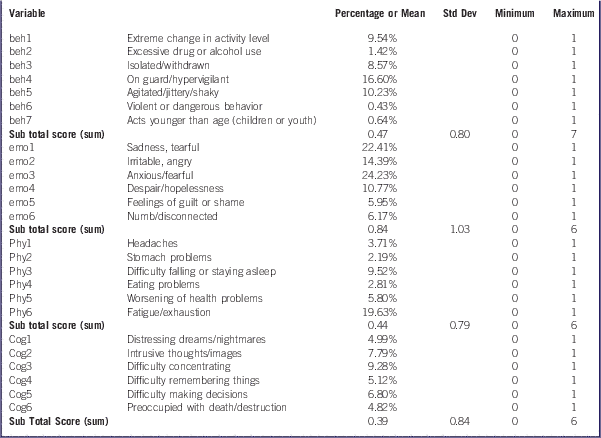
The current study used data collected by CCP crisis counselors following presidentially declared natural disasters that occurred from January 2009 through April 2013. The data collection forms received OMB approval (#0930-0270). The data examined (Table 1) were extracted from the IFEL, which is a screening instrument used to record demographic information; identify specific risks related to the disaster (eg, missing or dead family members, disaster unemployment, shelter in place due to immediate threat of danger); identify behavioral, cognitive, physical, and emotional reactions (eg, isolation/withdrawal, anxiety, headaches, distressing dreams); and document referral information provided to the individuals or family to assist with recovery from the disaster. The IFEL can be found with instructions for use online (http://media.samhsa.gov/DTAC-CCPToolkit/evaluating.htm). Aside from the demographic information, all other information was collected by using checkmarks, thereby making all additional items dichotomous (ie, if checked then “yes” coded 1, if unchecked then “no” coded 0).
Event Reactions on the Individual/Family Encounter Form

Sample
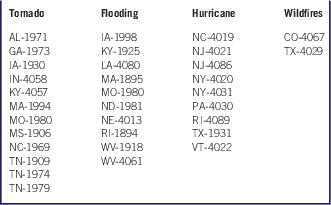
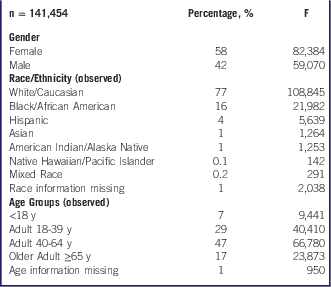
The analysis sample included 141,454 individual records from 32 CCP locations. As shown in Table 2, tornado, flooding, and hurricane accounted for 12, 10, and 9 disaster locations, respectively. Wildfires were represented by 2 locations. We removed earthquake from consideration, because only one Virginia location (VA-4042) was in the database. It is important to note that the original system used for data collection contained data from individuals (of which 30 CCPs were used), whereas the current data collection system used contains data from individuals and families (of which 2 CCPs were used for this study). To remove the influence of subjects who were visited multiple times by counselors, the analysis sample included only the first visit records (75% of the original CCP data collection system, 88% of the current CCP data collection system). Last, we excluded American Samoa and Puerto Rico’s data—as we found these locations to be culturally unique and different from the continental United States—and we also excluded data from New York (NY-4085), a hurricane, because the study team was concerned with the relative size of the sample and its potential impact on the results during this initial examination of the multi-disaster-type data. To keep the unit of analysis consistent at the level of individuals, the current data collection system contributed data only when records were collected from individuals (78% of the first records only data).
Crisis Counseling Assistance and Training Programs by Disaster TypeFootnote a

a Note: MO-1980 appears in 2 columns because it included a flood-affected area and a tornado-affected area. Data from RI-1894 and NJ-4086 were collected by the current Crisis Counseling Assistance and Training Program system, whereas the rest were collected by the original system. The analysis sample excluded American Samoa, Puerto Rico, and NY-4085.
Analysis
The focus of this study was to examine the factor structure of the dichotomous event reaction items in the IFEL instrument. In general, factor analysis (FA) is used to better understand the underlying latent constructs people use to guide responses to observed items. However, Woods noted, “traditional factor analytic methods were designed for use with continuous, not categorical, data, and therefore are suboptimal for most types of item data”Reference Woods 40 (p 215). She continues by outlining 3 major reasons to not use traditional methods with binary data as follows:
-
1) Standard errors and significance tests are biased due to the non-normality of the data;
-
2) Number of factors are overestimated due to clustering of items by both content and threshold (point at which individuals choose one categorical response over the alternative response); and
-
3) Factor loadings are underestimated due to underestimation of the intra-item (φ) correlations.Reference Woods 40
Understanding these issues, we chose to explore FA utilizing a weighted least squares approach, in which each dichotomous item is treated as an observed predictor of a continuous latent construct. These latent constructs and the tetrachoric correlations between the constructs are used in the FA to overcome the issues described above.Reference Wirth and Edwards 41 In order to perform an FA on dichotomous items as described here, we used the Mplus program (version 5.2) developed by Muthèn and Muthèn. This program allows the development of FA for both confirmatory and exploratory models.
Procedure
The IFEL instrument included a set of items on disaster event reactions that were presented under 4 “domain” categories: behavioral, emotional, physical, and cognitive, with 6 to 7 items listed under each. These items were developed with the understanding that event reactions fall under these 4 domains, based on previous research on PTSD. PTSD has been the condition most often measured and observed in these studiesReference Galea, Nandi and Vlahov 37 - Reference Norris, Friedman and Watson 39 , Reference Steinberg, Brymer and Decker 42 ; however the adverse outcomes associated with disasters go far beyond PTSD to include depression, anxiety, and other psychiatric problems, as well as physical complaints, interpersonal problems, and deteriorating psychosocial resources.Reference Galea, Nandi and Vlahov 37 - Reference Norris, Friedman and Watson 39 , Reference Steinberg, Brymer and Decker 42 The full set of items is presented in the Appendix (see Table A1). Our initial efforts were to perform a confirmatory factor analysis (CFA) to determine whether across all disaster types, respondents answered items according to these 4 domain categories. Upon determining that the domains would not be confirmed, we performed exploratory factor analysis (EFA) to determine the number of factors and item-factor relationships. Following a number of iterations, the results of the exploratory model were entered into a CFA for verification, and then the confirmatory model was examined on a disaster-type basis to determine whether it could be applied to each type.
Results
As described in the Methods, the event reaction items were initially examined by using a CFA model to determine whether the respondents answered questions guided by underlying constructs that were similar to the categorical domains in which they were presented. The CFA model for the conceptual model had a marginal fit to the data collected, as determined by goodness-of-fit statistics: χ2=69225.516, df=222, P<0.001; comparative fit index (CFI)=0.905; root mean square error of approximation (RMSEA)=0.038. (A good-fitting model is considered to have a nonsignificant χ2, suggesting that the tested model and data are not different; however, sample size and number of items in the model both contribute to the size of χ2, which is therefore considered too sensitive a measure for complex models. Alternatively, CFI and RMSEA are not as sensitive to sample or model complexity and so a good fit is reflected by estimates above 0.95 for CFI and below 0.05 for RMSEA.) Although the model converged, the resulting latent factor covariance matrix (ψ) was not positive, definitely due to high covariation between factors. Because of these less than desirable results, we decided to reexamine the factor structure of these items by using an EFA allowing the items to load on factors without a preconceived structure.
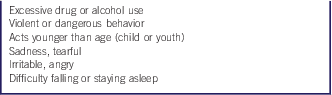
Because we were interested in examining the population as a whole including both children and adults in the same model, we decided to focus on the reaction items that were applicable to both. For this reason, prior to performing the EFA, we decided to remove the item “Acts younger than age” from the analysis. The items were then entered into the EFA model. We used a combination of comparison model fit statistics and eigenvalues to determine the number of factors extracted from the data and used the geomin (oblique) rotation to assess standardized item factor loadings. We initially settled on a 4-factor model, but upon further examination, several items were loading on multiple factors or had low loadings across all factors. We iterated through the EFA process removing the lowest loading item or most co-loaded item one at a time. (Note: It is important to understand that although items were removed from the factor analyses, these items still may be important indicators of the need for community resources and services. Low loadings across the factors just suggest that an individual item is not conceptualized by respondents the same way as other items.) The resulting EFA was presented as a 3-factor model with the items in Table 3 removed.
Items Removed During the Exploratory Factor Analysis Iterated Process

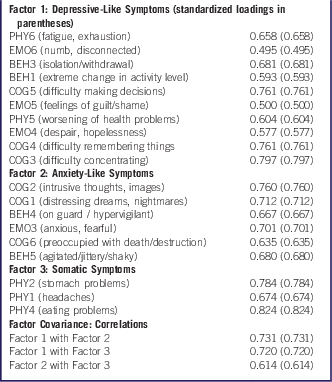
The resulting model was entered into a CFA. The resulting model had a χ2 (df=130)=13467.002 (P<0.000), a CFI=0.946, and a RMSEA=0.027. Although the χ2 was significant (again suggesting that the tested model was different than the data although confounded by sample size and model complexity), the CFI was almost 0.95 and RMSEA was below 0.05, both of which suggested that the model fit the data fairly well. The overall item factor loading and inter-factor correlations are listed in Table 4.
Unstandardized and Standardized Factor Loadings and Intra-Factor Covariances and Correlations

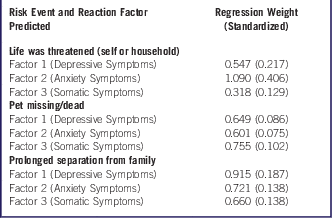
We further tested the factors to verify that the factors were examining different constructs. To do this, we regressed the factors on 3 different disaster risk events that we considered particularly troubling for survivors: (1) life was threatened (self or household), (2) pet missing/dead, and (3) prolonged separation from family. We used the Wald test to examine the equality of the relationships between the factors and each risk factor individually. The results showed Wald test value=3890.148, df=6, P<0.000, which suggests that the individual regression relationships are not equal. The regression weights are presented in Table 5. Note that all estimates differed, which suggests that the constructs underlying the factors were differentially predictive of the event reaction factors.
Unstandardized and Standardized Regression Weights for Regressing Reaction Factors on Specific Disaster Risk EventsFootnote a

a Note: the 3 risk items were binary variables (checked/not checked). The percentage of “checked” for “life was threatened,” “Pet missing/dead,” and “Prolonged separation from family” were, respectively, 22%, 2%, and 5%.
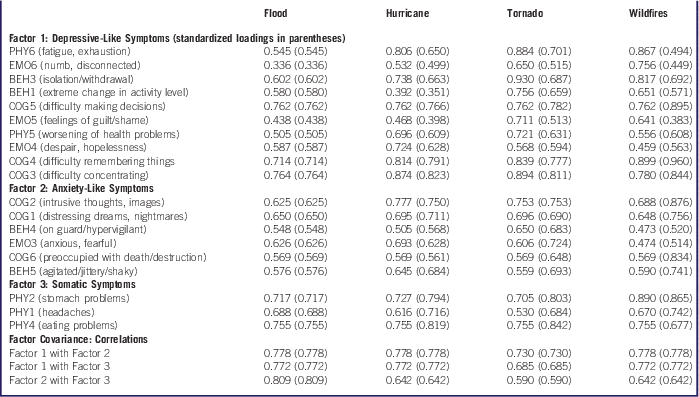
A second focus of the current study was to determine whether the factor structure identified from data collected across multiple disaster types would fit each of the disaster types individually (ie, hurricane, flood, tornado, and wildfire). To test this hypothesis, we used the Mplus group command, which conducted the CFA analysis for all disaster types in the Online Data Collection and Evaluation System within the same model and provided overall output for the entire model. Our initial test model allowed all the item factor loadings and factor correlations to be free, thus allowing the loading estimates and correlations to vary between disaster types. The resulting model failed to be identified because of the extremely low variation within some disaster types. To achieve an identified model, these item loadings were constrained to be the same across all disaster groups; the items that were constrained across groups are identified in the Appendix. The resulting identified (mostly) unconstrained model had a χ2(466)=14903.028 (P<0.000), a CFI=0.928, and a RMSEA=0.030, all which suggested a good-fitting model. Additional model iterations constraining the intra-factor correlations provided us a better model fit with χ2(458)=14370.471 (P<0.000), a CFI=0.931, and a RMSEA=0.029. The final model constrained the same items identified previously and also constrained (ie, held equal) the inter-factor covariances between the first and second factors and first and third factors for flood, hurricane, and wildfire disaster and for the second and third factors for hurricanes and wildfires. These results suggested that while the specific items loaded differently on the same factors, the relationship between these factors was fairly similar for all disaster types with the exception of tornadoes. More simply put, the model demonstrated that although items may reflect the underlying concepts of depression, anxiety, and somatic reaction at varying levels, the structure of which items load on which factors and the relationship between the underlying constructs are the same for hurricanes, wildfire, and floods. Table 6 shows the item factor loadings and the inter-factor covariances and correlations for each disaster type.
Unstandardized and Standardized Factor Loadings and Intra-Factor Covariances and Correlations by Disaster Type

Discussion
Findings from our analyses revealed that the original categorization of the 4 event reactions listed on the IFEL, behavioral, emotional, physical, and cognitive (Table 1), were not discrete categories. However, on the basis of our analyses, these event reactions comprise a 3-factor model of “depressive-like,” “anxiety-like,” and “somatic” symptoms. In addition, these 3 factors were similarly structured in 3 of the 4 disaster types analyzed (hurricane, flooding, and wildfires). As described earlier, the CCP is not a diagnostic program; however, conceptualizing disaster responders’ event reactions in terms of depressive, anxious, or somatic in nature has important implications for the disaster behavioral health field in terms of preparedness, response, and recovery. We know that the majority of disaster survivors are resilient and recover and, in fact, these findings further legitimize disaster survivors’ reactions in a nonpathological way. Yet, the fact that the 3 factors were maintained for 3 of the 4 disaster types can help disaster behavioral health responders better understand that when there is more opportunity for notification, people can better prepare (eg, time to evacuate and secure their homes and belongings). In addition, providing psychoeducational materials prior to and immediately after a hurricane, flood, or a wildfire would likely further mitigate the severity of disaster event reactions on disaster survivors.
Two areas went beyond the scope of our research that we hope can be further investigated in the future. The first is that we chose items that did not discriminate between adults and children (ie, we removed the event reaction “acts younger than age”), but we did not perform comparative analyses of the data about adults versus children. Additional research needs to examine the factors resulting from our study by age, gender, and cultural relevance as well as to determine whether the structure is upheld by these categories (see Table A2). The second area that warrants further investigation is the few, if any, data reported on excessive drug and alcohol use. This was one of the items we removed from the analyses. We wonder if crisis counselors have enough training to assess whether the survivors they are meeting with have excessive drug or alcohol use. Perhaps there is less comfort with inquiring about this issue owing to the lack of comfort and familiarity with this issue. Training crisis counselors on how to ask questions to help determine whether the survivor is excessively using drugs or alcohol needs to be considered. This would help to better operationalize the term excessive and would provide the crisis counselors with increased comfort in making this kind of determination.
Acknowledgments
The authors extend thanks to all of the crisis counseling grant programs that contributed to the data collection effort. A special acknowledgment to Jacqueline Pflieger, PhD, for her tireless efforts editing this paper. The authors completed this article in their private capacity while working at their respective institutions.
Funding
Support for data collection and analysis was provided by HHS SAMHSA Disaster Technical Assistance Center Contract #28342002T awarded to ICF International.
Disclaimer
The views expressed herein represent the opinions and analyses of the individual authors and may not necessarily reflect the opinions, official policy, or position of the US Department of Health and Human Services (HHS), the US Public Health Service, the Substance Abuse and Mental Health Services Administration (SAMHSA), the Center for Mental Health Services, or the Federal Emergency Management Agency (FEMA).