Why do political parties and elected officials behave as they do? Scholars have long pondered the motivations and behaviour of political parties and individual legislators. Downs suggested that parties endeavour to maximize votes, an assumption which fits well with the ‘electoral-origin’ basis of the congressional and comparative legislative behaviour literature.Footnote 1 Others challenge the idea, suggesting that politicians are motivated by the desire to win executive office, either for intrinsic payoffs such as power, prestige and limelight,Footnote 2 or as an instrument to shape public policy.Footnote 3 As Müller and Strøm note, policy, office or votes are often competing goals and parties may have to make hard decisions when determining priorities.Footnote 4 For example, entering government in a parliamentary system provides short-term office gain (chiefly ministerial portfolios) at the expense of longer-term electoral loss. This trade-off causes some political parties to forgo office and policy for the ‘delayed gratification’ of winning more votes at the next election or at least not suffering the ‘electoral costs of governing’.Footnote 5
Scholars tend to treat political parties as unitary actors in the game of forming governments. Yet, as Müller and Strøm acknowledge, parties are, and should be viewed as, ‘coalitions of individual politicians’.Footnote 6 Legislators within the same party may have divergent interests. Consequently, the focus of this study is the individual legislator, and in particular the nature of the relationship between an incumbent’s electoral motivation and the motivation to enter government under parliamentarism.
The novel suggestion is that, in contrast to their co-partisans, politicians who hold ministerial portfolios can simultaneously maximize policy, office and votes – the perquisites of ministerial office can shield ministers from electoral loss by allowing individual officeholders to engage in vote-buying within their constituencies through the delivery of geographically targeted particularism. Although much scholarship has focused on which parties enter multiparty government,Footnote 7 and how and why ministerial portfolios are allocated between parties in government,Footnote 8 we know virtually nothing about the electoral costs and benefits to the individual legislator of holding such positions. This research argues that, in parliamentary systems, incumbent ministers use the perquisites of office for personal electoral advantage.
While a political party may collectively suffer an electoral cost from being in government, the suggestion is that ministers use the spoils of office to insulate themselves from the electoral cost of governing. Thus the key motivations underlying legislators’ behaviour in parliamentary systems and presidential systems are not as divergent as conventionally believed. For some privileged legislators, the suggestion is that it may not be a question of ‘policy, office or votes’,Footnote 9 but an issue of maximizing policy, office and votes.
Observing that ministerial office is electorally valuable has a number of significant consequences for a broader understanding of political behaviour. For example, the argument provides a possible novel explanation as to why political parties value entering government despite knowledge that the very act will likely result in electoral damage to the party at the subsequent general election. The coalition government literature models the decision to enter government as a party choice,Footnote 10 but our argument suggests that the preferences of would-be ministers and the collective parliamentary party differ, even in terms of electoral incentives. Unlike ‘backbench’ colleagues, would-be ministers need not worry about a personal electoral cost when calculating the relative costs and benefits of entering government. In addition, our argument provides an enhanced micro-foundation for disciplined political parties in parliamentary systems. By identifying ministerial office as having an electoral value in addition to the already recognized pecuniary and policy-making payoffs, this study demonstrates an additional rationale for legislators prizing ministerial office, and thus an explanation for why cartelizing their allocation in the hands of the party leadership is such a powerful behaviour-shaping tool.
The remainder of this article is organized as follows: The next section reviews existing literature regarding parties’ and legislators’ motivations. The following section presents the theory and illustration of the mechanisms by which holding ministerial office advances re-election. After that the Irish case is introduced. It employs new data to provide what is believed to be the first systematic empirical test of the electoral impact of ministerial office. The conclusion provides a discussion of the generalizability and broader implications of the argument.
LITERATURE REVIEW: POLICY, OFFICE OR VOTES
Programmatic political parties are corner-stones of modern politics and their desire to win power through competitive elections is a defining characteristic of representative democracy. In the electoral arena then, it seems intuitive to think of parties as having an interest in winning votes – indeed it would be difficult to think of cases in real democracies where political parties would deliberately set out to lose votes during an election campaign.
Yet, general elections tend to be only ‘Chapter 1’ of the electoral story, particularly in parliamentary systems, where the government emerges from the legislature.Footnote 11 But why parties seek the offices of government remains unclear.Footnote 12 Office can have intrinsic value for the rewards and benefits it brings the office holder. Equally, the allure of office may be related to its instrumental value to shape public policy, pointing to another motivation which may drive the behaviour of political parties.Footnote 13 Indeed, the allocation of ministerial portfolios between parties is a significant and strategic decision.Footnote 14 As Strøm notes, no one theory of party motivation ultimately explains much about the real world of party competition and government formation. In reality, he suggests, political parties are likely to have multiple goals shaped by organizational and institutional factors.Footnote 15 This may partly explain why theories of government formation have tended to enjoy only limited empirical support.Footnote 16
Moreover, the goals of policy, office and vote may compete in the degree to which achieving one may require the abandonment of the other. Thus, real parties may confront difficult decisions regarding short-term, medium-term or long-term goals.Footnote 17 Narud and Valen identify a clear ‘adverse incumbency effect’ in European democracies. By the 1990s incumbent parties in Europe were losing 6.28 per cent of the national vote subsequent to entering into government.Footnote 18 Political parties, then, often have to choose between the prize of office and policy or the ‘electoral costs of governing’.Footnote 19 Commonly, some political parties forgo office and policy for the ‘delayed gratification’ of gaining votes in the next election.Footnote 20
A fundamental problem in exploring the goal-orientation of political parties exists. Parties, perceived as unitary actors, consist, in reality, of many differing components. Scholars have long recognized different organizational levels, from the parliamentary party group to the ordinary party membership.Footnote 21 Yet, party goals are only understood in terms of the collective interests and preferences of these potentially heterogeneous groups. From one perspective then, analysing party motivations and behaviour could amount to an ecological fallacy, because scholars focus on the wrong unit of analysis and apply potentially competing micro-level motivations to macro-level observations. One way to understand political parties better is to explore ‘inside the box’ and examine the motivation and goals within different component parts of the party. Indeed, although isolated from the literature on party politics, much scholarship has focused on the motivations and goals of individual legislators. Such an approach seems sensible, given the role of parliamentary party members in shaping party decisions and strategy.
Re-election has long been acknowledged as the proximate goal of individual parliamentarians.Footnote 22 This American-centric electoral incentive thesis has broad general application, producing an entire comparative research agenda that seeks to explain variations in legislative behaviour by studying what legislators must do to get re-elected.Footnote 23 Scholarship building on an analysis of party politics but focusing on parliamentarians suggests that legislators have progressive ambitions or multiple goals, including pursuing re-nomination, re-election and promotion to post-election office within the legislature and party organization.Footnote 24 Martin, for example, finds that the desire for legislative and ministerial office in a parliamentary system can be a more significant motivator for legislators’ behaviour than electoral incentives.Footnote 25 The interaction of these multiple goals and its influence on legislative behaviour continues to be underspecified, suggesting the need for further theoretical and empirical study.
Even less understood is the degree to which legislators from the same party may have different goals or incentives. For example, not all legislators from the governing parties receive ministerial offices. Scholars have only begun the task of explaining which individuals within parties win ministerial office.Footnote 26 While parties have multiple and often competing goals, legislators are assumed generally to have one goal, or goals which complement each other. This potentially creates a puzzle and questions the degree to which scholars understand fully the goal-orientation of legislators and the political parties to which they belong. In the next section I develop an argument which demonstrates that the preferences and interests of legislators from the same party can systematically diverge depending on whether or not the legislator holds a ministerial-level appointment.
THEORY: HOLDING OFFICE AND CULTIVATING VOTES
Clarifying the relationship between legislators necessitates consideration of the goals of three key sets of players: voters, government ministers/officeholders and co-partisan legislators who do not hold ministerial office.Footnote 27 The assumptions are that voters’ interests centre on maximizing personal welfare and, consequently, citizens vote ‘retrospectively’; that is voters analyse the records and past performances of representatives, punishing or rewarding accordingly. Politicians may have multiple motivations but their own re-election is a foremost goal. Within this set of assumptions the key task is to explain why government ministers hold an electoral advantage over their co-partisans.
Two preliminary observations regarding ministerial office and are worth noting. First, ministerial posts are generally the reserved province of legislators belonging to the governing party or parties. Secondly, as already noted, entering government is not a costless exercise for political parties. Governing is demanding and parties in government have opportunities to displease voters, a problem which is of less concern for parties in opposition. In a classic parliamentary system then, while governing may be rewarding it may also be costly in terms of electoral losses at the subsequent general election. Apparently, the electoral costs of governing usurps otherwise successful governments. For example, recent Norwegian governments tended to lose approximately 10 per cent of their vote share at subsequent elections, despite a generally acknowledged scandal-free period of government and having presided over a robust economy.Footnote 28 This study’s key contribution is to suggest that such an electoral cost of governing is not shared equally among all government legislators: ministerial officeholders potentially await a different electoral fate than that suffered by co-partisans.
We suggest that the perquisites of office can shield ministers from electoral loss by allowing individual officeholders to engage in vote-buying within their constituencies.Footnote 29 The key vote-winning perquisite of office available to ministers, but unavailable to co-partisan legislators, is the ability to deliver a distinct form of pork-barrel particularism which I term ‘executive particularism’ – spending secured by government ministers and targeted at their geographical constituencies, which is funded from general taxation. Centrally funded infrastructural projects, such as road networks, airports, bridges and other local infrastructure projects are common examples of such targeting. Government ministers employ executive orders, use ministerial discretion or propose legislation within their portfolios to allocate such spending. The welfare of a minister’s constituents is maximized through such geographically targeted transfers, and constituents reward the minister with votes at election time.
Although most research on particularism seems to have been conducted in presidential systems,Footnote 30 significant evidence of executive particularism in parliamentary systems exists. Suiter and O’Malley demonstrated that in the Irish case, ‘constituencies represented by a government minister receive disproportionate shares of funding for educational infrastructure and sports building projects’.Footnote 31 John, Ward and Dowding find that British ministers ‘use their proximity to the levers of power to ensure their seats get resources’.Footnote 32 In exploring the allocation of regeneration funds, they find that British ministers’ geographical constituencies often receive a disproportionate share of spending, something which cannot be justified on economic grounds. Dahlberg and Johansson find that Swedish governments strategically target local government grants to win votes.Footnote 33 Looking at Italy, Golden and Picci find that powerful individual politicians are disproportionately able to target infrastructure expenditure to their constituencies.Footnote 34 Noting the ‘decision-making influence of cabinet members’, Denemark finds that Australian government spending is disproportionately allocated to ministers’ constituencies.Footnote 35 The spending by quasi-governmental agencies may provide yet another avenue for targeted expenditure. For example, in a number of jurisdictions the allocation of revenue from state lotteries tends to be apportioned either directly by government ministers or by their agents.Footnote 36 Even if government spending requires legislative assent, in a parliamentary system, a select few legislators have control of the content of the relevant legislation. Thus, ministers’ unique endowment allows them to supply particularism, hence the term, ‘executive particularism’.
Due to the nature of cabinet government, the government as a collective body decides how to distribute such particularistic benefits. Thus, we are dealing with a cartel logic in which ministers trade geographically targeted spending from their portfolios among themselves. It is not just that the education minister spends more on education in her constituency; the pattern involves ministers ‘sharing the wealth’ between colleagues (but not co-partisans). This cartel logic is important as some government departments are more likely to be able to target spending: government departments do not have the same budgets and the spending of government departments may be more or less geographically targeted. For example, the budget of most welfare departments in West European countries accounts for a significant portion of the national budget, but the vast majority of this budget is not targetable to a specific geographical region.
The distinction between ‘executive particularism’ and the more conventional ‘legislative particularism’ is not widely understood. Commonly referred to as pork-barrel politics, legislative particularism is a phenomenon most closely associated with US Congressional politics, in which legislators secure for their own districts geographically targeted spending funded by general taxation. Fiscal legislative particularism is a significant tool which Members of Congress use to cultivate personal votes.Footnote 37
A generally accepted notion is that legislative particularism is not a common phenomenon in most political systems due to constitutional provisions giving the government agenda control over financial matters.Footnote 38 Thus, for example, in the British case, only the government can introduce bills into parliament with tax or spending implications. This blocks an individual legislator’s ability to pursue legislative particularism as a personal vote earning strategy. Instead, legislators in such systems tend to rely on non-expenditure, extra-legislative tools such as constituency casework or local ties to build and maintain personal reputations with constituents.Footnote 39 In such systems, holding some ‘mega-seats’ such as committee chairs is potentially electorally disadvantageous, since a focus on policy actually distracts incumbents from cultivating personal votes.Footnote 40
Thus, while government ministers have exclusive abilities to target spending towards their constituents, co-partisan legislators in parliamentary systems typically do not share this resource. Government ministers’ abilities to deliver fiscal particularism are a unique perquisite of office which differentiates ministers from their non-ministerial co-partisans. Constituencies with a minister allocating executive particularism will disproportionately benefit from governmental funding in the form of, for example, better local infrastructure, better investment in education, better local services, and a greater supply of other government-provided but geographically targetable facilities. Critically, voters value such targeted transfers of wealth. Ministers target such spending in order to acquire votes and rational voters reward ministers with those votes.Footnote 41 This relationship between voters and office holders versus ‘backbench’ legislators provides the theoretical basis of this study’s main empirical expectation: holders of ministerial office do not suffer the electoral costs of governing that beset their co-partisans.Footnote 42
Differentiating between the vote-buying perquisites of ministerial office and their co-partisans’ similar inability contrasts significantly with conventional perspectives. Most immediately, the argument recognizes that ‘office’ has the potential to generate individual electoral rewards for the officeholder and emphasizes the need to discriminate between the likely electoral fortunes of office holders and their non-office co-partisans. As such, the electoral consequences of governing should not be a party-level variable, since the minister is sheltered from the electoral cost of governing, and backbench co-partisans suffer greater vote loss than that demonstrated by aggregate-level measures of the electoral cost of being in government.
Ultimately, our novel perspective suggests that policy, office and vote may be contradictory or complimentary goals depending on the particular circumstances of the individual legislator. In support of this argument we focus on the Irish case and build a new dataset of candidate-level electoral results (most existing comparative datasets tend to be at constituency level) to test empirically whether or not ministerial officeholders enjoy an electoral advantage. Other things being equal, the expectation is that those legislators who hold ministerial posts will not incur electoral costs similar to those for ‘backbench’ co-partisans.
EMPIRICAL ANALYSIS
Ireland functions as a classic parliamentary democracy. Deputies to the Dáil (lower chamber of the national parliament) are elected by the Single Transferable Vote (STV) electoral system – a form of preferential proportional representation. Intra-party competition for votes is significant and TDs (Dáil Deputies, or in the Irish language, Teachta Dála) must expend considerable effort to cultivate personal votes.
Constitutionally, the cabinet consists of up to fourteen members. All but two cabinet members must be TDs, and cabinet members continue to hold their parliamentary seats. In addition to cabinet ministers, provision is made for a number of junior ministers – formally titled Ministers of State. Currently, fifteen Ministers of State hold office, and, as with their cabinet colleagues, they come from and continue to sit in the Dáil. Constitutionally, cabinet and junior ministers collectively form the Government.
While localism has long been a feature of Ireland’s political landscape, cultivating personal votes has its basis in constituency case work and other extra-legislative engagements with individual constituents and groups of constituents.Footnote 43 A long-standing assumption is that policy-oriented politicians suffer electorally, because nationally focused politicians lack the time necessary to build a local supportive base to gain re-election.Footnote 44 Notably absent is legislative particularism, arising primarily from the Westminster-inherited rules, which endows the government with a monopoly for decisions pertaining to public spending.Footnote 45
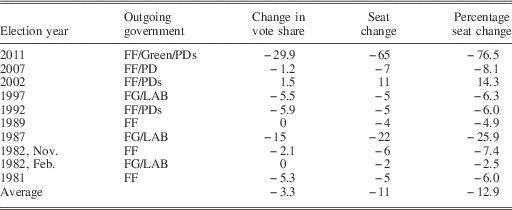
Table 1 reports the electoral fortunes of governing parties in Ireland.Footnote 46 On average, between 1981 and 2011, parties in government lost eleven seats (out of 166 seats) in succeeding elections. Notably, of course, the 2011 general election produced a landslide defeat for the governing parties, largely from voter dissatisfaction with economic management.Footnote 47
Vote and Seat Change for Government Parties in Subsequent General Elections

To test the impact of ministerial office on subsequent electoral performance, I created a database of election results for all Irish general elections between 1980 and 2011.Footnote 48 The unit of analysis is individual candidates for each election. Measuring candidates’ electoral success in the Single Transferable Vote (STV) system requires careful consideration, as voters can express multiple preferences – not all of which need to be counted when election results are being compiled. One obvious measurement of electoral success is whether or not the candidate won. Yet, this relatively crude measure may reflect, in some cases, the small number of votes separating winning candidates from losers. To be elected, candidates generally need to reach a quota of votes, and their share of this quota determines their electoral success. Employing the percentage of the quota which candidates receive in the distribution of first preference votes is a more reflective measure of electoral success in STV systems. The dependent variable is, therefore, the percentage of the quota the candidate received, abbreviated as PerQuota.
Our core empirical expectation is that holding a ministerial office just prior to the general election will provide an electoral reward for those incumbents seeking re-election.Footnote 49 To test this hypothesis, I collected data on all cabinet and junior ministerial posts held between 1980 and 2011, using information from the Irish Government website.Footnote 50 Using these data, I constructed a dichotomous variable, Ministerial Office, equal to 1 if the candidate was a cabinet minister or junior minister prior to the election and 0 for all non-ministerial candidates.
A number of other factors may have had an impact on the electoral success of individual candidates. I controlled for whether or not the candidate was a serving TD to ensure that parliamentary incumbency does not drive any findings regarding ministerial office. The variable Incumbent takes the value 1 if the candidate was seeking re-election or 0 if the candidate was not a TD immediately prior to the election. I control also for candidates’ party affiliation, if any. Electoral success may be driven in part by party affiliation (as was perhaps most clearly evident in 2011). In addition, a significant number of candidates at Irish general elections are non-party candidates.Footnote 51
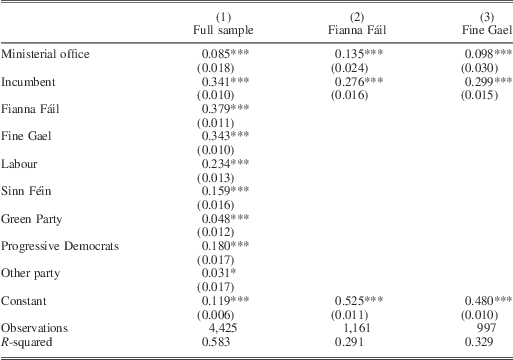
The results of the statistical analysis provide clear evidence that government ministers enjoy an electoral advantage. Table 2 reports the coefficient estimates for the ordinary least squares (OLS) regression of the candidates’ first preference vote as a percentage of the quota on Ministerial Office and key control variables. In all estimated models, the coefficient on Ministerial Office is positive and statistically significant. In the full sample, reported in Column 1 of Table 2, ministerial office increases a candidate’s percentage of the quota by 8.5 percentage points, all else being equal. In short, ministers win more votes than other candidates.
Impact of Ministerial Office on Electoral Performance

Notes: Robust standard errors in parentheses; ***p<0.01, **p<0.05, *p<0.1
It may be useful to look at the effect of ministerial office within specific parties. Column 2 restricts the sample to Fianna Fáil (historically the largest political party), and, consequently, the estimated coefficient on Ministerial Office in Column 2 reports the effect of holding ministerial office among Fianna Fáil candidates. Fianna Fáil candidates who held a ministerial office immediately prior to the general election won more first preference votes than those who did not. More precisely, amongst Fianna Fáil candidates, holding ministerial offices increased the percentage of quota votes by 13.5 percentage points. Ministerial office provided similar electoral benefits for Fine Gael candidates, as reported in Column 3, which restricts the sample to only Fine Gael candidates. Amongst Fine Gael candidates, those holding ministerial office received a quota 9.8 percentage points higher, on average, than Fine Gael candidates without ministerial office.
A few words about the control variables are in order. The variable Incumbent has a robust effect on PerQuota: candidates who are serving TDs receive a higher percentage of the quota than if they had not been a TD, all else being equal. Also, candidates with party affiliations tend to do better than independent candidates, as reported by the positive and significant coefficients on the partisan variables in Column 1. Recall that the excluded category in Column 1 is independent candidates. The results reported in Column 1 thus show that party-affiliated candidates tend to do better at the ballot box than independent candidates, all else being equal.
The results reported in Table 2 illustrate that ministers receive more votes than non-ministers, on average. Yet, the direction of causality cannot be fully determined from the results reported in Table 2. For example, it may be the case that electorally strong individuals are the people most likely to be appointed to ministerial posts in the first place.Footnote 52
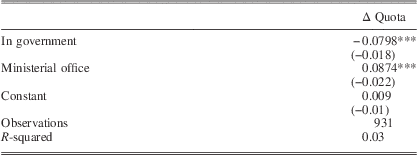
To address this possibility and demonstrate clearly the causal effect of obtaining a ministerial position on subsequent electoral fortunes, Table 3 presents an alternative empirical analysis. In this analysis, the dependent variable is the change in the electoral fortunes of individual parliamentarians. Specifically, the dependent variable, Δ Quota, is calculated as the percentage of the electoral quota received by candidate i in election-year t, less the percentage of the electoral quota received by candidate i in the previous election. This variable, calculated for each incumbent legislator seeking re-election, makes it possible to measure directly the electoral impact of obtaining a ministerial office, holding constant all individual characteristics, such as competency or candidate qualities other than status within the legislature.Footnote 53
Impact of Ministerial Office on Vote Change in Subsequent Election

Notes: Sample includes only incumbent parliamentarians. Dependent variable equals the change in the quota percentage. Robust standard errors in parentheses; ***p<0.01, **p<0.05, *p<0.1
Table 3 includes two important explanatory variables: the first variable, Ministerial Office, is coded 1 for a TD with a ministerial office and 0 for a TD without a ministerial office. The second explanatory variable, In Government, is coded 1 for candidates from parties that are in government immediately prior to the general election and 0 for candidates from parties not in government during the same period. This is an important control variable because candidates may suffer a reduction in their share of first preference votes as a consequence of their party being in government.
TDs suffer electoral losses when their party is in government. This result is evident from the negative and statistically significant coefficient for the variable, In Government. Holding all else constant, being a member of a government party reduces incumbents’ first preference vote share. The electoral costs of being a member of a government party can however be offset by the electoral benefits of holding ministerial office. Crucially, holding a ministerial office increases incumbents’ electoral success, as demonstrated by the positive and statistically significant coefficient on the variable, Ministerial Office, reported in Table 3.
Using the coefficients from Table 3, Table 4 reports the expected changes in incumbents’ electoral fortunes. Incumbents from opposition parties experience only minor change in their vote share between elections. More precisely, TDs from opposition parties experience, on average, a 0.9 unit increase in first preference vote as a share of the electoral quota needed to win re-election. In contrast, ‘backbench’ TDs from government parties experience on average a 7.1 unit decrease in their first preference vote expressed as a percentage of the quota. Amongst incumbents without ministerial positions, only those from government parties experience significant electoral losses. In other words, being in government is electorally costly, as expected.
Change in Electoral Quota, based on Ministerial Office and Government/Opposition Status

Yet, the costs of belonging to a party in government are offset, in part, by the benefits from holding ministerial office. This result is clear from a comparison of the values across Row 2 in Table 4. Row 2 includes incumbent parliamentarians from government parties, who do and do not hold ministerial office. Unlike their co-partisans, ministers gain votes in subsequent elections. On average, ministers experience an increase in their electoral quota of 1.7 percentage points. In contrast, backbenchers from government parties experience, on average, a 7.1 percentage point decrease in their share of the electoral quota needed to be re-elected. Notably, all individual characteristics are held constant in these calculations because the change in share of the electoral quota is calculated for individual candidates. Thus, we can confidently conclude that holding a ministerial office provides an electoral advantage, while being a government backbencher accrues a major electoral cost. In sum, the evidence provides a compelling case for differentiating the electoral fortunes of ministerial officeholders and their legislative co-partisans.
CONCLUSION, IMPLICATIONS AND GENERALIZABILITY
Competing perspectives of political parties as office-seeking, policy-seeking, or vote-seeking have, for well over half a century, dominated conventional wisdom about parties’ goals and objectives. Writing over a decade ago, Müller and Strøm noted that ‘our systematic knowledge of party objectives and behaviour is still quite modest’.Footnote 54 Meanwhile, an almost entirely separate body of literature focused on the goals and objectives of legislators, with an emphasis on the electoral basis of legislative actions. Given that legislators are a core, internal, portion of most successful political parties, it is perhaps inexplicable that these research traditions have tended to exist in relative isolation.
The aim of the current research has been to provide a critical illumination into the black box of legislative party politics. The suggestion is that legislators who control prized post-election offices, such as ministerial positions in parliamentary structures, can use the perquisites of office as shields from the electoral costs of governing. Specifically, government ministers can distribute ‘executive particularism’ as a means to cultivate personal votes, even in the absence of legislators’ abilities to deliver legislative particularism. Using a new dataset, evidence from the Irish case corroborates this expectation: although incumbent governing parties in Ireland tend to suffer a loss of votes in subsequent general elections, cabinet and junior ministers remain largely protected from such electoral losses.
This study, by theorizing and quantifying the electoral returns to ministerial office, provides fresh insights into the significance of ministerial offices in parliamentary systems and those positions’ likely abilities to shape individuals’ and parties’ actions. The wider implications of the argument are significant, as I highlight by discussing how the novel perspective could have a significant impact on the understanding of party leaders’ ability to discipline legislators and of why parties enter coalition government despite the electoral costs that might have been anticipated.
Legislative scholars have long sought to understand roll-call behaviour, often by reference to the internal ideological unity of the party or the ability of the party’s leadership to discipline members into voting along party lines. In parliamentary systems, conventional notions suggest that party leaders have at their disposal a number of incentives and penalties with which to reward or punish members’ roll-call behaviour.Footnote 55 The potential for promotion to legislative or ministerial office could be considered a valuable incentive. The value of ministerial office has long been assumed to relate to obvious pecuniary benefits. In addition, policy-oriented legislators could best influence public policy through promotion. The argument, that holding a ministerial office can enhance a member’s electoral success, has an important implication for understanding the value of these offices to all parliamentarians. Existing accounts, by ignoring the electoral returns to office, have arguably undervalued the degree to which controlling the allocation of ministerial positions is such a powerful tool in the hands of the party leadership.
The literature on coalition government formation, arguably one of the most advanced sub-fields of comparative politics, models the decision to enter government as a party-level choice.Footnote 56 Looking inside parties has been an enterprise of limited effort, focused mostly on a small number of cases. Such research indicated occasional significant tensions between different organizational parts of the party. The preferences of the legislative caucus may differ from the preferences of the broader membership, with the latter sometimes unwilling to compromise an ideological position as a cost for joining a government coalition. This article suggests the need to delve deeper and probe the degree to which different members of the same legislative party caucus have different incentives for entering government. Existing research treats the rewards of governing as a collective benefit and the electoral costs of governing as a collective cost. Yet, the ability of ministers to insulate themselves from the electoral costs of governing alters radically the payoff structure of the government formation game. From the perspective highlighted in this article, would-be ministers face a win–win situation: they enjoy all the benefits of office (policy and pecuniary) and the ability to buy votes to aid their re-election via executive particularism. Meanwhile, co-partisan legislators who will not obtain a ministerial portfolio enjoy neither the status of office, ability to influence policy, or ability to buy votes via fiscal particularism, and consequently are left electorally exposed to voters’ disenchantment with government policies and performance. From this perspective, the puzzle as to why parties enter government knowing that the decision will be likely to have a negative electoral impact at the next general election becomes less bewildering: the likely oligarchic nature of internal party decision making favours the preferences and interests of would-be ministers over those who have most to forfeit from entering government (non-ministerial co-partisans).
How generalizable is the argument that some officeholders are insulated from the electoral cost of governing? To conclude the article, we consider the scope of our argument’s conditions. The broad theory, I suggest, is likely to be unassailable, albeit with possibly different contours depending on the particular institutional and electoral environment. Different institutional conditions are likely to have an impact on the particular causal mechanism but not the fundamental assertion that ministers are able to insulate themselves from the electoral costs of governing.
For example, in Britain, the party-centred nature of the electoral environment makes it difficult for ministers to cultivate personal votes, either by distributing particularistic benefits or employing other mechanisms. However, evidence suggests that British governments allocate funds to marginal seats using, for example, subsidies to specific industries.Footnote 57 Consequently and reasonably, ministers possibly target spending to constituencies to enhance the party’s acquiring votes in ministers’ constituencies – and by so doing enhance ministers’ re-election effort. Indeed, research on the allocation of central government expenditure has found evidence of ‘ministerial pork’ in Britain.Footnote 58
The theory developed in this article could be applied to countries with mixed (for example, Germany) or party-list (for example, Spain) electoral systems. In the latter, and the list-element of the former, voters choose between political parties and who gets elected depends not just on the number of votes each party receives, but also on a candidate’s ranking on the party’s list. All else being equal, being lower down the list makes it less likely to retain a legislative seat. Here, our general point works at its most simple: ministers, as de facto senior members of the legislative caucus are likely to enjoy favour in the candidate-selection stage and gain a place towards the top of the party’s list. If so, those candidates are likely to be the last members of the legislative caucus to suffer any electoral costs of governing; more junior co-partisans are most likely to lose their seats. Importantly, the result is the same (ministers are electorally protected), but the cause may be one or more mechanisms. Future work should expand on these intuitions, as well as exploring further understanding of how differentiating the interests of officeholders and their non-minister co-partisans potentially contributes to answering some of the unresolved puzzles of representative democracy.