

Policy-makers in the United States and elsewhere believe that an earlier focus on the development of children's academic skills will better prepare them for entry into elementary, or primary, school (Stipek, Reference Stipek2006). For example, the Good Start, Grow Smart program launched in 2002 encouraged the development of literary and mathematics guidelines for 3- to 5-year-old children in the United States (Good Start, Grow Smart Interagency Workgroup, 2005). In New Zealand, the Ministry of Education (2008) states that it is seeking to ‘raise literacy and numeracy standards’ (p. 4) in primary-school education and that ‘education in the early years provides a strong foundation in literacy and numeracy’ (p. 6).
However, there is also concern that a focus on children's academic skills will result in a reduced emphasis on other areas of development, such as physical wellbeing (Stipek, Reference Stipek2006). Physical activity of New Zealand children declines between the ages of 3 and 4 years (Taylor, Williams, Farmer, & Taylor, Reference Taylor, Williams, Farmer and Taylor2013), and there is evidence to suggest that it also declines at entry to primary school (age 5 in New Zealand). The decline in physical activity at school entry may be because less time in the school day is devoted to physical exercise than is the case for kindergarten children (Sigmund, Sigmundova, & El Ansari, Reference Sigmund, Sigmundova and El Ansari2009). A reducing focus on physical activities in the early years is likely to contribute to motor difficulties, which tend to be consistent throughout the school years (Losse, Henderson, Elliman, & Hall, Reference Losse, Henderson, Elliman and Hall1991; Sullivan & McGrath, Reference Sullivan and McGrath2003). Losse et al. (Reference Losse, Henderson, Elliman and Hall1991) found that children termed ‘clumsy’ at age 6 continue to have motor problems and school-related difficulties 10 years later.
Gross motor development, involving large muscles of the body, and fine motor development, involving small muscles, are also related to other areas of development; for example, cognitive functioning (Davis, Pitchford, & Limback, Reference Davis, Pitchford and Limback2011; Son & Meisels, Reference Son and Meisels2006). Piek, Dawson, Smith, and Gasson (Reference Piek, Dawson, Smith and Gasson2008) asked parents to complete the Ages and Stages questionnaires for their 4- to 48-month-old infants, and found that the children's cognitive functioning at ages 6 to 12 years, measured using the Wechsler Intelligence Scale for Children (WISC-IV), was predicted by gross motor ability, but not by fine motor ability. Infants from the Northern Finland 1966 Birth Cohort study who were slow to stand showed poorer cognitive functioning at 33–35 years old, measured using computer-based tests of executive function, memory and verbal learning, than infants who stood earlier (Murray et al., Reference Murray, Veijola, Moilanen, Miettunen, Glahn, Cannon and Isohanni2006). The association between age-to-stand and cognitive functioning remained even when gender, social class, and maternal education was taken into account (Murray et al., Reference Murray, Veijola, Moilanen, Miettunen, Glahn, Cannon and Isohanni2006). Six- to 7-year-old children with speech and language problems display poorer gross motor skills than age- and sex-matched controls, and this disadvantage persists until at least age 9 (Visscher et al., Reference Visscher, Houwen, Moolenaar, Lyons, Scherder and Hartman2010).
Preschool fine motor skills predict later academic achievement in general (Dinehart & Manfra, Reference Dinehart and Manfra2013), and stronger fine motor skills predict a more rapid improvement in reading once formal education begins (Cameron et al., Reference Cameron, Brock, Murrah, Bell, Worzalla, Grissmer and Morrison2012). Children aged 9–12 years who have poor gross motor skills are more likely to have low academic achievement (Lopes, Santos, Pereira, & Lopes, Reference Lopes, Santos, Pereira and Lopes2013). In a sample of 12,583 kindergarten children, Son and Meisels (Reference Son and Meisels2006) found that motor skills were related to later cognitive development and were successful identifiers of children likely to underachieve academically. Academic achievement at age 8 years is significantly correlated with motor scores at age 4 (Sullivan & McGrath, Reference Sullivan and McGrath2003). Thus, it appears that gross and fine motor skills are related to both concurrent and future academic achievement and cognitive functioning.
Children with poor gross motor skills are also at risk for difficulties in psychosocial functioning (Emck, Bosscher, van Wieringen, Doreleijers, & Beek, Reference Emck, Bosscher, Wieringen, van, Doreleijers and Beek2012), and particularly for anxiety problems (Shaffer et al., Reference Shaffer, Schonfeld, O’Connor, Stokman, Trautman, Shafer and Ng1985). Boys with childhood motor impairment are 3.29 times more likely to be rated by their parents as persistently anxious in adolescence (Sigurdsson, van Os, & Fombonne, Reference Sigurdsson, van Os and Fombonne2002) and children with inconsistent gross motor development from 4 months to 4 years old are more likely to score highly on parental ratings of anxiety at school (Piek, Barret, Smith, Rigoli, & Gasson, Reference Piek, Barret, Smith, Rigoli and Gasson2010). Motor impairments are more common for young children diagnosed with autism than for typically developing children (for a review, see Matson, Matson, & Beighley, Reference Matson, Matson and Beighley2011). Additionally, children with behaviour problems who enter formal education in the United States have poorer motor skills than those without behaviour problems (Montes, Lotyczewski, Halterman, & Hightower, Reference Montes, Lotyvzewski, Halterman and Hightower2012).
Thus, given the relationship between motor skills and other areas of development, an assessment of a child's motor skills could prove an effective early screen for identification of other problems. Children enjoy motor assessments (Sargisson, Stanley, & de Candole, Reference Sargisson, Stanley and de Candole2013; Semrud-Clikeman & Teeter Ellison, Reference Semrud-Clikeman and Teeter Ellison2009). Tests of motor skills are quick to administer, can help build rapport with shy children (Semrud-Clikeman & Teeter Ellison, Reference Semrud-Clikeman and Teeter Ellison2009), and could be easily administered early in the school year when children are entering formal education.
To extend previous findings with a New Zealand sample, we measured the fine and gross motor skills of an intake of new entrant primary school children (age 5 years in New Zealand) in a medium-sized city and assessed whether these motor skills were related to the presence of behavioural and emotional problems, language development, and other characteristics of the children.
We hypothesised that fine and gross motor ability would be predicted by medical, behavioural, and emotional problems, and language difficulties. Such a relationship would be useful for teachers and special educators in identifying children who may need assistance to more fully develop both their physical and cognitive skills.
Method
Participants
Fifteen primary schools located within, and on the outskirts of, a provincial New Zealand city participated. The schools were located in a variety of socio-economic areas, reflected by the schools’ decile ratings ranging from 1 (the lowest possible) to 10 (the highest possible): See Ministry of Education (2013) for information on decile rating calculations for New Zealand schools. Thirteen of the schools were chosen because they constitute an educational cluster supported by Resource Teachers: Learning and Behaviour (RTLB) from the Ministry of Education (MOE): Special Education (SE). Two schools (Deciles 9 and 10) in the same city were added to balance an over-representation of low decile schools.
Data were collected for 256 children who began school for the first time between February 1 and April 15, 2011 (Term 1), which represents almost the entire intake of new entrant children in those 15 schools in Term 1. The data for 11 of the children were removed because they were absent on the day of the motor assessments. Of the remaining 245 children, 116 were girls, 136 were Pākehā, 75 were Māori, and 34 were of another ethnicity.
Measures
Demographic information
Parents provided the child's name, date of birth, country of birth, ethnicity, gender, main language spoken at home, first and second languages, the number of hours per week the child had spent in each type of Early Childhood Education (ECE) in the 6 months prior to starting school, details of any diagnosed medical conditions, and hearing or visual problems.
Motor Assessment
Glen Gear (SE Adviser; SEA), and a team of RTLB, developed fine (FMA) and gross (GMA) motor assessments specifically for our study. SEAs are MOE special educators, and RTLB assist with the learning of children with moderate learning and behaviour difficulties. The two tasks of the FMA were cutting out a rectangle and a circle and copying four simple shapes: a semi-circle, square, right-angled triangle, and rectangle with a cross connecting each inside corner. The eight tasks of the GMA were skipping, balancing on left and right foot, walking heel-to-toe backward, catching a large bouncy ball and a tennis ball bounced by the child in front of them, kicking a ball rolled towards child, and laterality (bending to touch the toe with the opposite hand). Assessors rated the children's performances on all tasks from 1 (excellent execution) to 5 (failure to execute) using detailed scoring sheets (see Appendix) and a script (available from the first author) for each task.
SDQ
The Strengths and Difficulties Questionnaire© (SDQ; www.sdqinfo.org), completed by a child's teacher or parent, is designed to assess children on five psychological attributes: emotional symptoms, conduct problems, hyperactivity-inattention, peer relationships, and prosocial behaviour. The scale items are based on the DSM-IV (American Psychiatric Association, 1994) and International Classification of Diseases 10th Revision (World Health Organization, 1994) classifications of childhood psychopathology (Bourdon, Goodman, Rae, Simpson, & Koretz, Reference Bourdon, Goodman, Rae, Simpson and Koretz2005). We used the one-sided, informant-rated version for parents or educators of 3- and 4-year-olds (American version). The SDQ correlates with clinical diagnoses of New Zealand children aged between 4 and 15 years (Mathai, Anderson, & Bourne, Reference Mathai, Anderson and Bourne2004) and British children aged between 5 and 10 years (Goodman, Ford, Simmons, Gatward, & Meltzer, Reference Goodman, Ford, Simmons, Gatward and Meltzer2000).
The SDQ assessments were not subject to inter-rater reliability. As classrooms in New Zealand generally have only one teacher, only one teacher would have known the children well enough to assess their current strengths and difficulties in a classroom setting.
TLSA
Speech Language Therapist (SLT), Lynne Bennett (MOE), developed the Tauranga Language Screening Assessment (TLSA) based on the assessment strategy of Blank, Rose, and Berlin (Reference Blank, Rose and Berlin1978). For each of six pictures of adults and children performing everyday activities, SLTs asked the children, in English, four questions that increased in complexity and abstraction about the situation pictured. SLTs recorded the children's utterances verbatim and, later, a team of SLTs scored the utterances. While these scores were not subject to inter-rater reliability checks, SLTs, who administered these items, have formal training in the administration of standardised assessment instruments and jointly reviewed the scores for each child.
Procedure
The University of Waikato's School of Psychology Research and Ethics Committee granted ethics approval (#11/09). The principals and Boards of Trustees at each school gave consent for their school to be included in the study.
For TLSA and motor assessments, usually completed on different days and before the lunch period, assessors accompanied children to a quiet but familiar place within the school grounds or buildings. In accordance with the ethics protocol, every child was informed verbally that they could stop the assessment at any time. On the few occasions that a child refused to participate, they were returned to the classroom.
Teams of RTLBs, Glen Gear, and the first and third authors conducted the motor assessments. None of the children had a known physical disability that prevented them from completing the motor assessments. The children's teachers, who had known the children for between 1 and 3.5 months, completed the SDQ. Trained SLTs employed by the MOE: SE conducted the TLSA assessments.
Data Analysis
Motor Assessments
We averaged scores on each of the tasks in the GMA and FMA to give a total GMA and FMA score for each child. We assessed inter-rater reliability for the motor assessments. A different rater simultaneously, and independently, measured the performance of 5% of the children. The ratings of the two observers were significantly correlated for both the FMA, r(12) = .90, p < .001, and the GMA, r(12) = .92, p < .001, suggesting that the assessments could be reasonably expected to produce similar results regardless of the test administrator.
TLSA
For each child's responses to the six pictures, we assigned a score of 100% for correct, 50% for partially correct, 25% for ambiguous, and 0 for incorrect answers for each of the four levels, and averaged these scores across levels to produce an overall mean score for each picture. A correct answer was one that showed good understanding of the situation, a partially correct answer was one where the child identified only some of the relevant aspects of the situation, an ambiguous answer was one where the child answered in a way that was sensible but did not address the question, and an incorrect answer was one where the child misinterpreted or misunderstood the situation. For example, when asked ‘Why can't we watch TV and listen to our music at the same time?’, an example of a correct answer was ‘Because it will get all mixed up and it wouldn't work.’ A partially correct response was ‘Because you won't be able to hear the TV’, an ambiguous answer was ‘Because they might not sound the same’, and an incorrect answer was ‘Cos then the TV will go off.’ We averaged the mean scores for all pictures to produce a final TLSA score for each child.
Multiple regression analyses
We conducted two multiple regression analyses, one with FMA scores as the outcome variable, and the other with GMA scores. Both analyses contained the same 14 predictor variables: decile, gender, presence of medical, hearing and visual problems, handedness, SDQ conduct, hyperactivity, emotional symptoms, prosocial, and peer problem scores, number of ECE hours attended per week, TLSA, and phonetic awareness scores. There were some missing data for the regression analyses. There was no observable pattern to the missing data. Fewer than 5% of scores were missing for each measure, except for the total TLSA score and the handedness assessment, for which 6.5% and 13.1% of the 245 scores, respectively, were missing. Missing TLSA data were largely due to absences of children on the day of assessment. Missing handedness data can be partly explained by the fact that some children are ambidextrous (4% in a study of Australian children by Johnston, Nicholls, Shah, & Shields, Reference Johnston, Nicholls, Shah and Shields2009), and may or may not come to favour one hand later in life. In some cases, however, the assessors withheld a decision on handedness because of uncertainty. However, for both regression analyses, the data met all assumptions, in that there was an absence of multicollinearity between predictor variables, non-zero variance for predictor variables, and residuals were homoscedastic, linear, and approximated a normal distribution. Additionally, the sample size was large enough to provide adequate power, for the number of predictor variables used, to detect medium to large effects (Field, Reference Field2013).
Results
Fine Motor Assessment
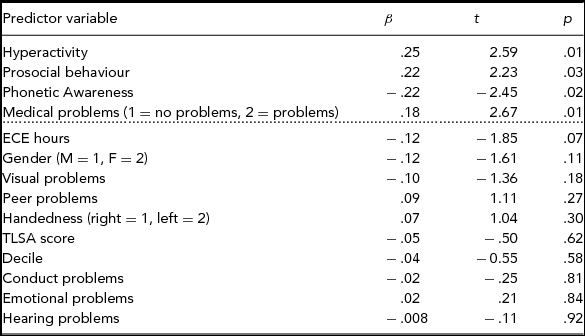
We produced a significant regression model when we used FMA scores as the outcome variable, F(14, 177) = 4.33, p < .001, adj. R 2 = .20. Table 1 displays the beta (β), t, and p values for all predictors in the model. Significant predictor variables, in order of importance were: hyperactivity (β = .25, t = 2.59, p = .01; higher levels of hyperactivity predicted poorer FMA scores), prosocial scores (β = .22, t = 2.23, p = .03; higher levels of prosocial behaviour predicted poorer FMA scores), phonetic awareness score (β = -.22, t = -2.45, p = .02; better phonetic awareness predicted better FMA scores), and medical problems (β = .18, t = 2.67, p = .008; the existence of medical problems predicted poorer FMA scores). TLSA scores, number of ECE hours, gender, decile, the presence of hearing or visual difficulties, handedness, emotional, peer, and conduct scores on the SDQ were not significant predictors of FMA scores.
Standardised Regression Coefficients (β), t, and p Values for All Predictor Variables Used to Predict FMA Scores for New Entrant Children

Note: Predictors below the dotted line were not significant predictors of FMA scores.
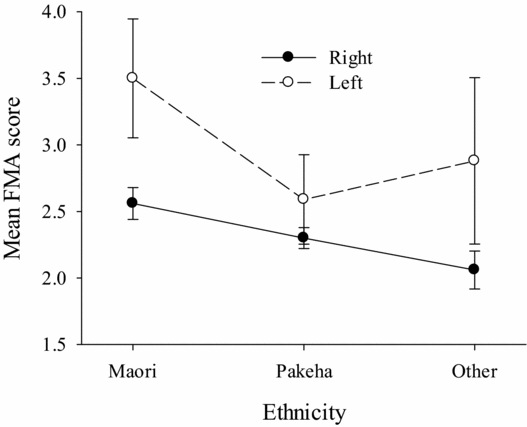
In an ANOVA using gender, ethnicity (Māori, Pākehā, or Other), handedness, and medical problems as independent variables, there was a significant main effect of ethnicity, F(2, 192) = 4.48, p = .01, on FMA scores. Children of an ethnicity other than Māori or Pākehā scored significantly better, M = 2.16, SD = .84, than Māori children, M = 2.66, SD = .96; Tukey's HSD poc-hoc test: p = .02, d = .54, 95% CI (.36, .73), but not better than Pākehā children, M = 2.32, SD = .85, p = .58, d = .19, 95% CI (.06, .33). The FMA scores of Pākehā children were significantly better than those of Māori children, p = .03, d = .38, 95% CI (.25, .51). There was also a significant main effect of handedness, F(1, 192) = 4.43, p = .04, with right-handed children achieving significantly higher FMA scores, M = 2.34, SD = .84, than left-handed children, M = 2.90, SD = 1.15, d = 0.64, 95% CI (.53, .77); see Figure 1. There were no other significant main effects or interactions.
Mean FMA scores, whereby higher scores indicate a poorer performance, for right (closed circles) and left-handed (open circles) children as a function of ethnicity. Error bars show the standard error of the mean.
Gross Motor Skills Assessment
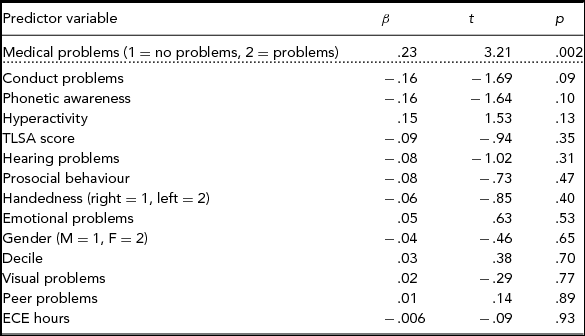
We produced a significant regression model when we used GMA scores as the outcome variable, F(14, 178) = 2.57, p < .002, adj. R 2 = .10. Table 2 displays the beta (β), t, and p values for all predictors in the model. Medical problems was the only significant predictor of GMA scores (β = .23, t = 3.21, p < .002; the presence of medical problems predicted poorer GMA scores).
Standardised Regression Coefficients (β), t, and p Values for All Predictor Variables Used to Predict GMA Scores for New Entrant Children
Note: Predictors below the dotted line were not significant predictors of FMA scores.
In an ANOVA using gender, ethnicity, handedness, and medical problems as independent variables, there was a significant main effect of medical problems, F(1, 192) = 4.81, p = .03, on GMA scores, whereby children without medical problems scored significantly better, M = 2.45, SD = .74, than children with medical problems, M = 3.08, SD = .82, d = .85, 95% CI (.75, .95). There were no other significant main effects or interactions.
Discussion
Phonetic awareness predicted FMA scores. The significant relationship between phonetic awareness and fine motor skills is interesting. Dysfunction in the Broca's area of the brain is associated with deficits in language and imitative behaviour (Iacoboni et al., Reference Iacoboni, Woods, Brass, Bekkering, Mazziotta and Rizzolatti1999), and the ability of infants to imitate body movements is correlated with their expressive language ability (Stone, Ousley, & Littleford, Reference Stone, Ousley and Littleford1997). For the gross motor tasks, children imitated an adult model. However, fine motor tasks were not modelled by the adults, so there may be some reason to think that children with language difficulties also have fine motor difficulties.
The presence of medical problems (as identified by parents) was associated with poorer performance on tasks requiring fine and gross motor skills than for children without medical problems. Seven children were identified as having autism, autistic spectrum disorders (ASD), or symptoms of Asperger syndrome. Green and colleagues (Reference Green, Charman, Pickles, Chandler, Loucas, Simonoff and Baird2009) tested children aged between 9 and 10 with these problems, and the majority displayed impairments in fine and gross motor skills. Thirteen children in our study were identified as having asthma. Asthmatic children were judged by their parents as having poor language, motor, and socioemotional skills, possibly because of reduced opportunities to engage in these activities (Halterman et al., Reference Halterman, Montes, Aligne, Kaczorowski, Hightower and Szilagyi2001). While asthmatic children in our study performed poorly on GMA tasks, M = 2.76, SD = 0.64, compared to non-asthmatic children, M = 2.51, SD = 0.78, this difference was not statistically significant, t(242) = −1.12, p = .27. Asthmatic children did not perform worse, M = 2.38, SD = 0.71, than non-asthmatic children, M = 2.37, SD = 0.90, t(241) = .002, p = .998, on tasks requiring fine motor skills. Whatever the factors contributing to the poorer performance of children with medical problems, our findings support early intervention to identify medical problems so that children can be supported to develop fine and gross motor skills at an early age. Equally, difficulties in motor abilities may be indicative of medical problems.
There was some suggestion that greater hours of attendance in ECE in the 6 months prior to beginning school were related to better fine motor skills but not to gross motor skills, although ECE hours did not reach significance as a predictor of FMA scores. Cashmore and Jones (Reference Cashmore and Jones2008) found that Australian daycare centres restrict gross motor activity through a lack of outdoor space and equipment. Further research into the areas of learning provided and encouraged by ECE providers is important, as it may be worthwhile to place more emphasis on gross motor skills at a preschool level, especially given the links between gross motor ability and cognitive (Davis et al., Reference Davis, Pitchford and Limback2011; Murray et al., Reference Murray, Veijola, Moilanen, Miettunen, Glahn, Cannon and Isohanni2006; Piek et al., Reference Piek, Dawson, Smith and Gasson2008; Son & Meisels, Reference Son and Meisels2006) and psychosocial functioning (Emck et al., Reference Emck, Bosscher, Wieringen, van, Doreleijers and Beek2012; Piek et al., Reference Piek, Barret, Smith, Rigoli and Gasson2010; Shaffer et al., Reference Shaffer, Schonfeld, O’Connor, Stokman, Trautman, Shafer and Ng1985; Sigurdsson et al., Reference Sigurdsson, van Os and Fombonne2002), and academic achievement (Cameron et al., Reference Cameron, Brock, Murrah, Bell, Worzalla, Grissmer and Morrison2012; Dinehart & Manfra, Reference Dinehart and Manfra2013; Lopes et al., Reference Lopes, Santos, Pereira and Lopes2013; Sullivan & McGrath, Reference Sullivan and McGrath2003; Visscher et al., Reference Visscher, Houwen, Moolenaar, Lyons, Scherder and Hartman2010).
Our results support those of other researchers who have shown that children who exhibit hyperactive behaviour may also have problems with motor skills (Dewy, Cantell, & Crawford, Reference Dewy, Cantell and Crawford2007; Piek, Pitcher, & Hay, Reference Piek, Pitcher and Hay1999; Pitcher, Piek, & Hay, Reference Pitcher, Piek and Hay2003; Tseng, Henderson, Chow, & Yao, Reference Tseng, Henderson, Chow and Yao2004). However, we showed a relationship between hyperactivity and fine motor scores, but not gross motor scores. It may be that children displaying hyperactivity spend more time engaged in gross motor activity, but are unable to attend to fine motor tasks. Support for this idea comes from the finding that administering methylphenidate to children with both attention-deficit-hyperactivity and developmental-coordination disorder results in an improvement in manual dexterity in fine motor tasks (Flapper, Houwen, & Schoemaker, Reference Flapper, Houwen and Schoemaker2006). Pitcher et al. (Reference Pitcher, Piek and Hay2003) recommended that boys displaying symptoms of ADHD should be assessed for motor function, and vice versa, because these problems appear to be linked and assessment of each dimension might promote a multifaceted intervention.
Higher prosocial behaviour predicted poorer scores on fine, but not gross, motor tasks. Previous research has suggested that children with impaired motor skills are likely to exhibit lower levels of prosocial behaviour, and that children with better general motor function are more likely to experience a positive emotional adjustment to school (Bart, Hajami, & Bar-Haim, Reference Bart, Hajami and Bar-Haim2007). Thus, our conflicting results are difficult to explain. It could be that children who are socially skilled and helpful towards others as 5-year-olds have spent more time developing social skills, and less time developing fine motor skills. More research is needed to explore the link between social and motor development.
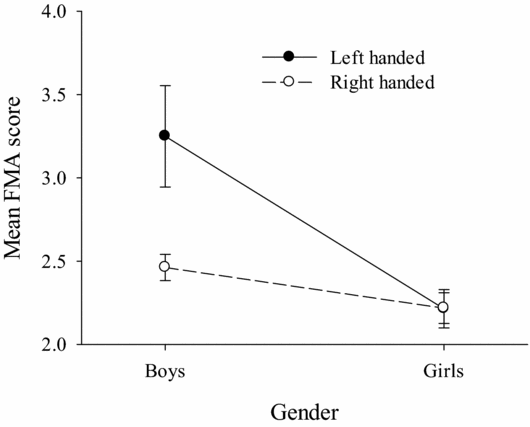
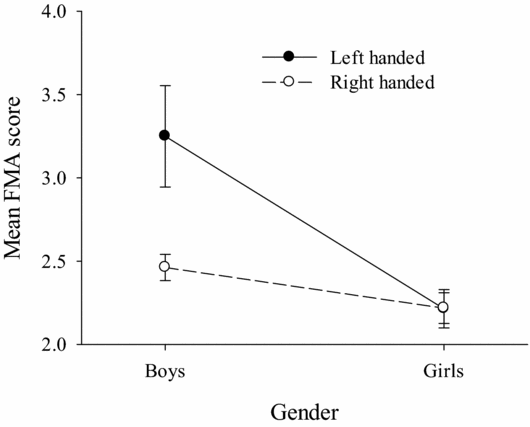
Left-handed children's scores were significantly poorer on fine motor tasks than those of right-handed children. Previous researchers have found a similar result (e.g., Gabbard, Hart, & Gentry, Reference Gabbard, Hart and Gentry1995), but the difference generally results from the poorer fine motor skills of boys, rather than of girls (Giagazoglou, Fotiadou, Angelopoulou, Tsikoulas, & Tsimaras, Reference Giagazoglou, Fotiadou, Angelopoulou, Tsikoulas and Tsimaras2001). Although the interaction between gender and handedness was not significant in our study, F(1, 192) = 3.13, p = .08, Figure 2 shows that being left-handed seemed to have a greater effect on fine motor scores for boys than for girls, who achieved the same mean FMA score regardless of handedness. Due to the small number of left-handed boys (n = 14) and girls (n = 7) in our sample, there may have been insufficient power (1 – β = .42) to detect the interaction effect of gender and handedness on fine motor scores in our study. Future studies should further explore the link between gender, handedness, and fine motor scores to determine whether there is a need for extra assistance to develop the fine motor skills of left-handed boys.
Mean FMA scores, whereby higher scores indicate a poorer performance, for left- (closed circles) and right-handed (open circles) girls and boys. Error bars show the standard error of the mean.
A limitation of our research is that we used novel measurements to obtain an assessment of motor and language ability, and therefore our results are not directly comparable to research using standardised assessments. However, while the psychometric properties of the motor and language tests that we used require further validation, the current results suggest these instruments are useful in identifying children who may be at risk during their first year of school. Future research could aim to replicate our results, or use standardised measures. If the FMA and GMA are used, for ease of interpretation, we recommend that the scale for both measures be reversed, such that a high number represents better performance.
Our results could be of benefit within the schooling system, in regards to screening procedures and interventions for children. Given the evidence for a link between motor skills and other areas of development (Cameron et al., Reference Cameron, Brock, Murrah, Bell, Worzalla, Grissmer and Morrison2012; Davis et al., Reference Davis, Pitchford and Limback2011; Dinehart & Manfra, Reference Dinehart and Manfra2013; Lopes et al., Reference Lopes, Santos, Pereira and Lopes2013; Murray et al., Reference Murray, Veijola, Moilanen, Miettunen, Glahn, Cannon and Isohanni2006; Piek et al., Reference Piek, Dawson, Smith and Gasson2008; Son & Meisels, Reference Son and Meisels2006), identifying children who require assistance with motor skills, and intervening at an early age could reduce the severity of later problems. Sargisson et al. (Reference Sargisson, Stanley and de Candole2013) found that assessing children's gross motor skills was the most efficacious way of identifying children with problems requiring referral to Special Education services, providing further support for the importance of motor skill assessment in the early school years. Additionally, although our results do not imply a causative relationship between motor skills and other areas of development, we would warn against policies that may inadvertently reduce the time that children spend engaged in physical activity in their early years.
Acknowledgments
This research was funded through grants from the Ministry of Education and the Faculty of Arts and Social Sciences at the University of Waikato (grant number E006). We especially thank Glen Gear for designing the motor assessment, Lynne Bennett for designing the language assessment, and the collaborative work of a great number of other people.
Appendix
Scoring Criteria for the Fine and Gross Motor Assessment