

1.1 The Need for Low-Carbon System Transitions and a Reconfigurational Approach
Climate change is a grand societal challenge that in the coming decades will increasingly affect many aspects of society either through its impacts (e.g., droughts, floods, crop failures, fires, sea level rise, heat stress) or through mitigation efforts that attempt to transform energy, mobility, industrial, and agri-food systems in low-carbon directions (IPCC, 2018).
Recognition of the seriousness of these threats and the scale of the mitigation challenges has increased public attention to climate change since the mid-2000s (see Figure 1.1), fuelled by events such as Hurricane Katrina (2005), Al Gore’s movie An Inconvenient Truth (2006), the Stern Review (2006), and the Fourth IPPC Assessment Report (2007). Public attention decreased after the 2007/8 financial crisis, but has increased again in recent years, along with highly publicised events such as the Paris Agreement (2015), protests by school children and civil society organisations (e.g., Extinction Rebellion, Climate Justice movement), and new framings such as ‘climate emergency’ since 2019.
Yearly number of articles in selected UK national newspapers related to climate change (the graph is based on data from a keyword search in the digital archives of these newspapers, using the search string [Text, ‘climate change’ OR ‘global warming’ OR ‘global heating’ OR ‘greenhouse effect’ OR ‘greenhouse gas’ OR ‘climate emergency’ OR ‘climate crisis’ OR ‘decarbonisation’ OR ‘decarbonization’ OR ‘low-carbon’] within the title and first hundred words of the articles. Duplicated articles were excluded. To facilitate visual comparison between different data sets, we normalised the time series to the year with the maximum number of counts)

In response, an increasing number of countries have adopted net-zero greenhouse gas (GHG) emission targets, and broadened and strengthened their low-carbon transition plans. Public attention remained high throughout the COVID-19 pandemic, creating pressures on policymakers, although there is an indication of a slight decrease in coverage during 2020, due to competing societal issues related to the pandemic.
It is now widely recognised that achieving net-zero targets will require system transitions in core societal domains. The Intergovernmental Panel on Climate Change (IPCC), for instance, calls for ‘rapid and far-reaching transitions in energy, land, urban and infrastructure (including transport and buildings), and industrial systems. These systems transitions are unprecedented in terms of scale, but not necessarily in terms of speed, and imply deep emission reductions in all sectors’ (IPCC, 2018: 21).
The European Commission’s long-term climate strategy likewise acknowledges that:
economic and societal transformations are required, engaging all sectors of the economy and society, to achieve the transition to net-zero greenhouse gas emissions by 2050. … This transition will radically transform our energy system, land and agricultural sector, modernise our industrial fabric and our transport system and cities, further affecting all activities of our society.
The European Environment Agency (EEA) also assesses that addressing climate change (and other persistent environmental problems) ‘will require fundamental transitions in core production-consumption systems such as those meeting European demand for food, energy, mobility and housing. Such transitions will necessarily entail profound changes in dominant institutions, practices, technologies, policies, lifestyles and thinking’ (EEA, 2019a: 7).
While the need for low-carbon system transitions is now widely acknowledged, there is disagreement, however, in both public and academic debates, about what system transitions are and how they come about. Building on Geels et al. (Reference Geels, McMeekin, Mylan and Southerton2015), we distinguish three analytical approaches that resonate with different scientific theories and policy approaches: 1) reform, 2) revolution, and 3) reconfiguration.
The reformist approach, which can be found in engineering, modelling, and mainstream economics (Acemoglu et al., Reference Acemoglu, Akcigit, Hanley and Kerr2016; Dangerman and Schellnhuber, Reference Dangerman and Schellnhuber2013; Hawken, Reference Hawken2017; Rockström et al., Reference Rockström, Gaffney, Rogelj, Meinshausen, Nakicenovic and Schellnhuber2017; Stiglitz et al., Reference Stewart and Walker2017), conceptualises transitions as driven by the development and market adoption of low-carbon technologies that substantially lower the carbon-intensity of existing provisioning systems in energy, mobility, food, and industrial production. It sees research and development (R&D), subsidies (to stimulate new technologies), and carbon pricing instruments (to influence company investment decisions and consumer purchases) as the main policy instruments. This approach is ‘reformist’ because it assumes that low-carbon transitions only involve technical component substitution and do not affect other elements of transport, energy, and agri-food systems. Because the approach assumes that the technological substitutions mainly involve rational economic decisions by firms, investors, and users, it also does not pay much attention to political, social, or behavioural dimensions.
While the reformist position rightly emphasises the importance of low-carbon technologies, investments, and markets, it also has several limitations: 1) it has an over-simplistic ‘linear model’ understanding of innovation as ‘pushed’ by upstream R&D investments and ‘pulled’ by downstream market demand (Schot and Steinmueller, Reference Schot and Steinmueller2018), 2) it pays little attention to non-technological kinds of innovations such as social, business model, and grassroots innovations, 3) it pays too little attention to non-market actors such as wider publics, civil society organisations, industry associations, and other lobby organisations, 4) it also pays too little attention to various forms of agency and processes such as institutional change and power struggles, business activities and strategic games, cultural meanings, and demand-side dynamics in social practices.
The revolutionary approach, which involves multiple sub-streams that share deep critiques of the status quo and current policymaking, views low-carbon system transitions as involving the complete overhaul of socio-economic deep structures. Neo-Marxist (Schnaiberg, Reference Schnaiberg1980) and critical political economy scholars (Newell, Reference Newell2021; Paterson and P-Laberge, Reference Paterson and P-Laberge2018), for example, highlight the need to overthrow or transform capitalism (particularly its focus on commodification, market competition, and capital accumulation) and neo-liberalism (particularly its faith in free markets). Scholars within revolutionary strands have proposed a ‘new economics’ (Schor, Reference Schor2014) that includes ‘de-growth’ (Kallis, Reference Kallis2011), more emphasis on third sector and community-based enterprise (Jackson and Victor, Reference Jackson and Victor2011), a shift from GDP measures towards happiness (Gough, Reference Gough2010), and returning the globalised financial system to ‘its role as servant, not the master of the economy and ecosystems’ (Pettifor, Reference Pettifor2019). Cultural and moral critics also call for changes in consumer society and underpinning values, which should be transformed in the direction of frugality and sufficiency (Alcott, Reference Alcott2007; Princen, Reference Princen2005) or towards ‘meaningful’ activities such as ‘fine education, arts, healthcare, childcare and elderly services, […] and community development’ (Vergragt, Reference Verbong, Beemsterboer and Sengers2013: 124). These cultural value changes have been characterised as The Great Mindshift (Göpel, Reference Göpel2016) or The Great Transition towards a new planetary civilisation, which involves a ‘fundamental shift in the paradigm of development – indeed, in the very meaning of human progress. A Great Transition would make solidarity, fulfilment, and resilience the heart and soul of human endeavour’ (Raskin, Reference Raskin2016: iii).
While the revolutionary position rightly draws attention to macro-economic and macro-cultural issues, it also has several limitations. First, these assessments of macro-level ‘deep structures’ are often reductionist because they try to bring complex realities back to single ‘root causes’. Second, they tend to be rather abstract and distanced from concrete experiences of real-world actors. Many, though not all, critical analyses of capitalism or neo-liberalism are disempowering because their focus on an ‘all-encompassing entity can easily come to appear as a kind of gigantic, all-powerful […] force that causes everything else to happen’ (Ferguson, Reference Ferguson2010: 171), which is difficult to alter by situated actors. Third, macro-level analyses of capitalism lack the explanatory granularity to satisfactorily explain why some sectors, such as electricity, have made much more decarbonisation progress than other sectors, such as heat.
Fourth, despite their interest in fundamental change, some sub-streams in the revolutionary position are paradoxically static, restricting analysis to critiques of deep structures or advancing utopian visions of communitarian, local, and sustainable societies. These sub-streams thus offer little insight about change mechanisms or dynamic pathways that could bring about the desired system transitions. Other revolutionary sub-streams place high hopes on the transformative power of community initiatives, grassroots innovations, or social movement activism, but often fail to articulate how local initiatives bring about large-scale system change. Steward (Reference Stephens, Wilson, Peterson and Meadowcroft2018: 100) in this regard notes that ‘Such case studies [of community activism] are certainly impressive and inspiring. However, they do not demonstrate to academic critics that this is a route for a transition to a low-carbon society at a broader level’. O’Brien and Signa (Reference O’Brien and Signa2018: 40) similarly observe an analytical gap between local initiatives and large-scale transformation, noting that there are many studies of the former but few of the latter, ‘There are (as yet) relatively few empirical examples of successful large-scale transformations of socio-ecological systems towards sustainability.’ These strands in the revolutionary position therefore suffer from a ‘lack of empirical grounding’ (Feola, Reference Feola2015: 377), which means that related interpretations of system transition remain more normative and political than analytical.
Because of the limitations of the reformist and revolutionary approaches, this book mobilises a reconfiguration approach, which builds on the general scientific notion that ‘the whole is best understood from a systemic perspective and should be viewed as a constellation of interconnected elements’ (Fiss et al., Reference Fiss, Marx and Cambre2013: 2). Instead of privileging an ultimate cause, reconfigurational approaches imply a commitment to multidimensional analysis that traces endogenous interactions between multiple components and processes that together produce larger outcomes: ‘What makes configurational thinking unique is its insistence on putting particular pieces together into larger wholes’ (Abbott, Reference Abbott2001: 119). Reconfigurational approaches are particularly suited for analysing changes in large-scale systems made up of heterogeneous entities (see Section 3.1), and they often involve processual analyses that explain how outcomes are produced through co-evolving causal processes: ‘This interest in combinations of causes dovetails with a focus on “how” things happen […] to understand causally relevant conditions as intersections of forces and events’ (Ragin, Reference Ragin2008: 109).
With regard to low-carbon system transitions, the reconfiguration approach has been particularly developed in socio-technical transitions research, which focuses on deep changes to socio-technical systems that fulfil societal functions such as mobility, thermal comfort, or sustenance. Drawing on sociology of innovation and evolutionary economics (Geels, Reference Geels2020b, Reference Geels2004), socio-technical systems are conceptualised as heterogeneous configurations of elements including technical artefacts, scientific knowledge, industry structures, markets, consumption patterns, infrastructure, policy, and cultural meanings (Figure 1.2).
Basic elements of socio-technical systems

In this book, we build on socio-technical transitions research and conceptualise low-carbon system transitions as involving substantial changes in both the elements of socio-technical systems and the architecture of their linkages (Geels et al., Reference Geels, Sovacool, Schwanen and Sorrell2017). Taking innovation (in technologies, business models, social practices) as the analytical entrance point, the socio-technical transitions approach follows the emergence, diffusion, and societal embedding of innovations over time and analyses the relevant interactions between technical, social, cultural, political and economic processes and actors (Geels, Reference Geels2005). Socio-technical transitions have the following characteristics (Köhler et al., Reference Köhler, Geels, Kern, Markard, Wieczorek and Alkemade2019):
Multidimensionality and co-evolution: Transitions are co-evolutionary processes involving interactions between multiple socio-technical dimensions. Because it does not privilege one driver or dimension, the reconfiguration position is less reductionist than both the reformist position (which focuses on techno-economic processes) and the revolutionary position (which focuses on macro-economic or macro-cultural ‘root causes’).
Multi-actor process: Transitions are enacted not only by firms and users (as in the reformist position) but also by social movements, wider publics, policymakers, industry associations, and other special-interest groups (Geels, Reference Geels2004). These social groups have different interests and resources, and they engage in multiple activities (e.g., technological exploration and learning, public debates, political power struggle, investment, negotiation, coalition building) which make transitions very complicated processes that cannot be comprehensively understood by single theories or disciplines.
Goal-orientation: Low-carbon transitions are particular kinds of socio-technical transitions because they aim to address environmental objectives rather than mere technical performance or economic objectives. This means that in addition to requiring deep and large-scale system changes, they involve the additional challenge of securing a particular directionality (Kemp and van Lente, Reference Kemp and Van Lente2011). Therefore, policymakers must play a central role in low-carbon transitions by adjusting institutions and policies, including regulations, standards, taxes, and subsidies.
Resistance, conflict, and struggle: Since low-carbon transitions threaten the economic positions and business models of some of the largest and most powerful industries (e.g., oil, automotive, electric utilities, agri-food), such incumbents will protect their vested interests, which may lead to conflict and struggle about the need for, and speed of, transitions and the types and stringency of policy instruments intended to advance them.
Long-term process: Transitions are longitudinal processes that often take decades to unfold. One reason is that radical low-carbon innovations and practices usually take a long time to develop from their early emergence in small application niches to widespread diffusion. Another reason is that it takes time to destabilise and ‘unlock’ existing systems and overcome resistance from incumbent actors (Turnheim and Geels, Reference Turnheim and Geels2012).
Non-linearity, uncertainty, and open-endedness: Because there are multiple low-carbon innovations and initiatives in all socio-technical systems, it is difficult to predict in advance which of these will prevail. Since there are multiple possible transition pathways (Geels and Schot, Reference Geels and Schot2007; Rosenbloom, Reference Rosenbloom2017), future low-carbon transitions are open-ended. Uncertainty also stems from the non-linear character of innovation processes (which may experience failures, hype-disappointment cycles, or accelerated price/performance improvements), political processes (which may experience setbacks, reversals, or accelerations), and socio-cultural processes (which may experience changes in public agendas and sense of urgency).
These characteristics make socio-technical system transitions a special kind of phenomenon that requires a dedicated research approach. This book therefore aims to elaborate the socio-technical transitions approach, which has emerged in the past two decades in the innovation studies and sustainability transitions communities, and to introduce it into the mainstream climate mitigation debates. In doing so, it hopes to transcend the first two approaches that have long dominated mainstream environmental sustainability and climate mitigation debates, which has led to stale dichotomies between strong and weak ecological modernisation (Christoff, Reference Christoff1996) and strong and weak sustainable consumption (Fuchs and Lorek, Reference Fuchs and Lorek2005). Spaargaren and Cohen (Reference Sovacool, Kivimaa, Hielscher and Jenkins2009: 257) criticised these traditional positions as overly limited, characterising them as ‘the dark green romantic dismissal of modernity and the naïve endorsement of market driven liberal eco-technotopias’.
The book also aims to be relevant with regard to ongoing policy debates. The reformist approach is closely tied to the policy orthodoxy, which has long led climate policy debates to emphasise R&D subsidies and carbon pricing instruments to reorient financial investments (Energy Transitions Commission, 2017, 2016; IEA and IRENA, 2017; OECD, 2018; World Bank, 2015). While these generic economic policies are not irrelevant, the increasing emphasis on the implementation of low-carbon innovations and system transition is changing policy debates to focus more on specific innovations, the actors that develop and deploy them, and their real-world social and political feasibility (Meckling and Allan, Reference Meckling and Allan2020).
The European Commission (EC, 2019), for instance, acknowledges that ‘New technologies, sustainable solutions and disruptive innovation are critical to achieve the objectives of the European Green Deal’ (p. 18), that ‘conventional approaches will not be sufficient’ (p. 18), and that ‘there is a need to rethink policies for clean energy supply across the economy, industry, production and consumption, large-scale infrastructure, transport, food and agriculture, construction, taxation and social benefits’ (p. 4). The IPCC (2018) emphasises that climate mitigation policies should address six feasibility dimensions (technological, economic, socio-cultural, institutional, geophysical, environmental-ecological) that shape the real-world implementation and acceptance of low-carbon transitions. And the UK Committee on Climate Change (2021: 33) calls for deeper understandings of real-world implementation processes and actors to support policymaking:
As Government makes the shift to focusing on implementation, the Committee’s task must also evolve towards a focus on real-world progress and tougher scrutiny of Government plans. […] The transition to Net Zero requires changes that go beyond the deployment-related metrics we have tended to track to date. We will seek to broaden our assessment of real-world progress, including public attitudes, corporate commitments, finance and the green recovery, as well as consumption emissions and the factors affecting them.
The socio-technical transitions approach to whole system reconfiguration, which this book will develop, aims to contribute to these recent policy debates.
1.2 The Multi-Level Perspective on Socio-Technical System Transitions
To further conceptualise socio-technical system transitions, we use the Multi-Level Perspective (MLP), which is a middle-range theory that combines insights from evolutionary economics, sociology of innovation, and institutional theory (Geels, Reference Geels2020b, Reference Geels2002). The MLP suggests that socio-technical transitions result from the interplay of developments at three analytical levels: socio-technical systems, niche-innovations, and exogenous socio-technical landscape developments (Geels, Reference Geels2019, Reference Geels2002; Rip and Kemp, Reference Rip, Kemp, Rayner and Malone1998).
Before discussing these levels and their interactions, we articulate some foundational assumptions which build on Geels (Reference Geels2004) who distinguished three interrelated analytical dimensions: 1) tangible elements of socio-technical systems, 2) actors and social groups whose actions maintain, improve, repair, and change the system elements (through research, technology development activities, purchasing, debates, policymaking), and 3) rules and institutions (often called ‘socio-technical regime’) that shape actors’ preferences, strategies, and actions.
To facilitate interdisciplinary bridging conversations with technical, economic, and policy sciences (Cherp et al., Reference Cherp, Vinichenko, Jewell, Brutschin and Sovacool2018; Geels et al., Reference Geels, Berkhout and van Vuuren2016a; Turnheim et al., Reference Turnheim, Berkhout, Geels, Hof, McMeekin and Nykvist2015) and increase relevance for policymakers, we make four simplifying adjustments in this conceptual scheme. First, rather than diffusely focusing on all tangible elements of socio-technical systems, we reformulate the first dimension of the distinction as listed in the preceding paragraph to focus more narrowly on material, technical, and economic elements and flows (e.g., artefacts, infrastructures, factories, flows of inputs and outputs). This resonates with, and gives more emphasis to, Geels’ (Reference Geels2004: 904) observation that ‘Technologies have a certain “hardness” or obduracy, which has to do with their material nature, but also with economic aspects. […] This hardness also implies that artefacts cannot entirely be shaped at will.’ This reconceptualisation also draws more analytical attention to the material and energy flows that sustain socio-technical systems.
As a second adjustment, we reconceptualise socio-technical systems as the entire configuration of the three analytical dimensions (Figure 1.3). This resolves the problem that the previous conceptualisation included three dimensions but had no concept to cover the whole configuration. This conceptualisation means that socio-technical systems have material, relational, and institutional dimensions.
Three ontological dimensions of socio-technical systems

As a third adjustment, we simplify the conceptualisation of rules and institutions, as Section 2.2.3 further explains. Previous conceptualisations (e.g., Fuenfschilling and Truffer, Reference Fuenfschilling and Truffer2014; Geels, Reference Geels2004), which build on neo-institutional theory (Powell and DiMaggio, Reference Powell and DiMaggio1991; Scott, Reference Scott1995), distinguished three kinds of rules and institutions (regulative, normative, and cultural-cognitive) as enabling and constraining actors in different ways. For the purpose of this book, we simplify the conceptualisation to focus more narrowly on ‘policies and governance structures’, which is closer to the old institutional theory’s understanding of institutions as rules of the game (Hirsch and Lounsbury, Reference Hirsch and Lounsbury1997; North, Reference North1990). This conceptualisation of institutions is easier to operationalise and investigate, and intrinsically leads to a stronger focus on policy and politics, which hopefully appeals to readers with a policy interest.
Since we do not want to exclude norms and cultural-cognitive dimensions from the analysis, our fourth adjustment is to endogenise these dimensions in our conceptualisation of actors, which also includes intendedly rational strategic action, behavioural routines, and capabilities, as Section 2.2.2 further explains.
These theoretical assumptions underpin and inform the conceptualisation of the three analytical levels of the MLP and the dynamics of socio-technical transitions, to which we now turn.
Existing socio-technical systems are stabilised by various lock-in mechanisms that constrain incumbent actors and orient their activities towards incremental rather than radical change. These include a) techno-economic lock-in mechanisms such as sunk investments, material obduracy, low cost and high performance characteristic, b) social and cognitive lock-in mechanisms such as routines, heuristics (Nelson and Winter, Reference Nelson and Winter1982), shared mindsets, habits, and lifestyles (Barnes et al., Reference Barnes, Gartland and Stack2004), and c) institutional and political lock-in mechanisms such as existing regulations and standards that favour existing systems and create an uneven playing field for emerging innovations (Walker, Reference Walker2000) as well as institutional procedures that give incumbents more access to policy networks, where they can influence policymaking and protect the status quo (Geels, Reference Geels2014; Kolk and Pinkse, Reference Kolk and Pinkse2007). These lock-in mechanisms stabilise existing systems, which is why system transitions do not happen easily.
Radical innovations, which are the seeds of transitions, emerge in small niches at the periphery of existing systems, through pioneering activities of entrepreneurs, start-ups, activists, or other relative outsiders (Kemp et al., Reference Kemp, Schot and Hoogma1998). Niches form ‘protected spaces’ that shelter radical (technical, grassroots, and business model) innovations from mainstream market selection pressure and nurture learning and development processes (Smith and Raven, Reference Smith, Kern, Raven and Verhees2012). The degree of radicality of niche-innovations depends on how much they deviate from the existing system on technical, social, business model, or infrastructural dimensions.
The struggles between niche-innovations and existing socio-technical systems are influenced by the socio-technical landscape (Rip and Kemp, Reference Rip, Kemp, Rayner and Malone1998), which includes both slow-changing states or developments (e.g., demographics, cultural repertoires, societal concerns, geo-politics, macro-economic trends) and external shocks (e.g., wars, financial crises, accidents, oil price shocks, pandemics) (Van Driel and Schot, Reference Van De Poel2005).
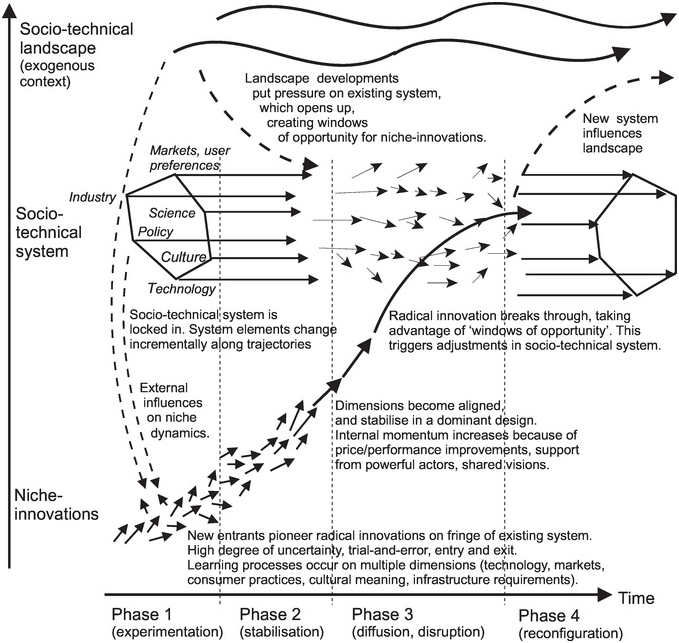
Socio-technical transitions are non-linear processes that occur through the interplay between processes at niche, system, and landscape levels, which unfold over time through four phases (Figure 1.4), which are further discussed in Chapter 2. In the first phase, radical innovations emerge in small niches. They gradually build up internal momentum in the second phase, but often face uphill struggles against entrenched systems. In the third phase, external landscape pressures and bottom-up niche pressures help destabilise the existing system, leading to highly visible struggles in business, socio-cultural, and political dimensions. In the fourth phase, diffusing innovations replace the existing system, trigger wider system reconfigurations, and become settled in a new status quo.
Multi-Level Perspective on socio-technical transitions

Instead of a single cause or driver, the MLP thus emphasises alignments between processes on multiple dimensions and at different levels which together culminate in system transitions. The MLP accepts the importance of technological and economic dimensions (e.g., firms, markets, investments), emphasised by the reformist approach, but is broader in at least two important ways. First, it also acknowledges the potential role of other types of innovation such as grassroots and social innovation (Geels, Reference Geels2019) or business model innovation (Bidmon and Knab, Reference Bidmon and Knab2018; Van Waes et al., Reference Van Waes, Farla, Frenken, De Jong and Raven2018). Second, the understanding of innovation and diffusion processes includes not only techno-economic dimensions but also socio-cultural and political ones such as discursive framing struggles (Hermwille, Reference Hermwille2016; Roberts and Geels, Reference Roberts and Geels2018; Rosenbloom et al., Reference Rosenbloom, Berton and Meadowcroft2016), political coalitions and empowerment (Hess, Reference Hess2014; Markard et al., Reference Markard and Hoffmann2016; Smith and Raven, Reference Smith, Kern, Raven and Verhees2012), and societal embedding (Kanger et al., Reference Kanger, Geels, Sovacool and Schot2019; Mylan et al., Reference Mylan, Morris, Beech and Geels2019).
The MLP’s landscape concept accommodates the potential role of macro-level influences, but unlike the revolutionary position it does not a priori assume that these are the most important or ‘ultimate’ drivers of socio-technical transitions. Instead, the role of exogenous landscape pressures should be empirically investigated and analysed, including how these pressures are interpreted and mobilised by actors at niche and system levels.
1.3 Aims and Contributions of the Book
The book aims to make three scientific contributions to different debates.
1.3.1 The Great Reconfiguration
With regard to the different views on low-carbon systems transitions, summarised in Section 1.1, the book’s first aim is to elaborate and demonstrate the usefulness and validity of the reconfiguration approach. By analysing unfolding low-carbon system transitions, the book demonstrates that this approach better resonates with the empirical evidence and provides a more comprehensive, differentiated, and policy-relevant understanding than the reformist and revolutionary approaches.
One reason for choosing The Great Reconfiguration as the book’s title is thus to highlight that reconfiguration is a fruitful approach for analysing transitions in socio-technical systems. Another reason is that the title relates it to and differentiates it from Polanyi’s (Reference Polanyi1944) book The Great Transformation: The Political and Economic Origins of Our Time, which scholars from the revolutionary position often use as a source of inspiration. Polanyi analysed how fundamental changes in mentalities (e.g., liberalism) and formal institutions (e.g., property rights) in the early nineteenth century helped to create capitalist market societies by dis-embedding economic activity from moral, customary, and religious constraints, which resulted in the commodification of labour, land, and money and the unleashed pursuit of individual monetary advantage. Polanyi also showed how the negative consequences of free market capitalism led to counter-movements in the late nineteenth century, which resulted in some degree of re-embedding of capitalism in the first half of the twentieth century (e.g., anti-trust and banking regulations, welfare state policies).
While we agree with the revolutionary approach that addressing climate change requires deep and fundamental change, we argue that a focus on reconfiguring socio-technical systems offers greater analytical traction and stronger socio-political appeal than the overhaul of capitalism or calls for frugality and sufficiency. We also take inspiration from Polanyi’s notion of the double movement, which suggests that major transitions always involve conflicts and struggles between an initial movement (propelled by actors advocating change) and a subsequent countermovement (by actors with vested interests in the status quo or actors suffering unintended negative consequences). And we refer to Polanyi, because his work demonstrates the importance of longitudinal and historically informed diagnoses of the present, which is something we aim to emulate for low-carbon transitions.
Another reason for choosing the book’s title is that the word ‘Great’ implies that low-carbon transitions require a particular kind of reconfigurational change, which has substantial scope and depth. Substantial scope refers to the breadth of change, meaning that many socio-technical system elements undergo change, that is, not just techno-economic elements but also actors and institutions (Figure 1.3). Substantial depth means, first, that techno-economic changes involve not just incremental but also radical innovations and architectural change; second, that actors do not just change their activities and resource allocations but also their goals, strategies and interpretations; and, third, that institutional change is not just about new settings of existing policy instruments but also involves new types of policy instruments and new governance paradigms (Hall, Reference Hall1993).
1.3.2 Socio-Technical Transitions and the Multi-Level Perspective
With regard to debates about socio-technical transitions and the Multi-Level Perspective (MLP), the book’s second aim is to make important adjustments in the MLP to address relevant criticisms and to conceptualise our Great Reconfiguration approach. One relevant criticism of the MLP is that many empirical studies of low-carbon transitions have focused on the emergence and diffusion of niche-innovations (Berkhout et al., Reference Berkhout, Smith, Stirling, Elzen, Geels and Green2004), which tends to lead to a singular bottom-up (or ‘point source’) view of change (Geels, Reference Geels2018a). Our book therefore shifts the analytical emphasis towards existing systems and how these can be reconfigured in interaction with emerging niche-innovations (see Geels, Reference Geels2018b; McMeekin et al., Reference McMeekin, Geels and Hodson2019 for initial explorations).
Another relevant criticism is that empirical studies of socio-technical transitions have focused too much on supply-side technological development and too little on users and social practices (Hargreaves et al., Reference Hargreaves, Hielscher, Seyfang and Smith2013; Shove and Walker, Reference Shove and Walker2010). This criticism is somewhat misplaced because user practices have from the start been conceptualised as part of socio-technical systems (see Figure 1.2). Nevertheless, to address this criticism and analyse the reconfiguration of entire socio-technical systems, our book will explicitly investigate the perceptions and actions of users and households.
A third criticism is that the socio-technical transitions literature has focused more on actors and institutions as causal factors than on material and economic dimensions (Cherp et al., Reference Cherp, Vinichenko, Jewell, Brutschin and Sovacool2018; Svensson and Nikoleris, Reference Stradling, Carreno, Rye and Noble2018). The book’s Great Reconfiguration approach therefore explicitly analyses techno-economic dimensions as well as actors and institutions, both for existing systems and niche-innovations.
A fourth criticism is that the portrayal of socio-technical transitions as involving a single niche-innovation struggling against a single system (including in schematic representations such as Figure 1.4) is too simple (Andersen et al., Reference Andersen, Steen, Mäkitie, Hanson, Thune and Soppe2020; Papachristos et al., Reference Papachristos, Sofianos and Adamides2013; Verbong et al., Reference Verbong, Geels and Raven2008). Our conceptualisation of whole system reconfiguration will therefore emphasise the role of multiple niche-innovations and multiple (sub)systems, which can interact in various ways.
The various elaborations of the MLP change the transition imagery from singular ‘bottom-up’ disruption towards a more dispersed ‘whole system’ reconfiguration process, resulting from multiple change mechanisms including incremental improvements in existing system components, replacement of system components by niche-innovations, incorporation of niche-innovations into existing systems (as add-ons), changing size of systems, or changing linkages between system components. This creates the possibility of a variety of low-carbon transitions pathways (Geels and Schot, Reference Geels and Schot2007), which can be explored empirically.
While there is an understandable tendency in the socio-technical transitions literature to ‘zoom’ in and focus on particular actors or dimensions (Köhler et al., Reference Köhler, Geels, Kern, Markard, Wieczorek and Alkemade2019), our book aims to demonstrate the importance and fruitfulness of ‘zooming out’, especially for addressing whole system transitions, which has arguably been the original focus of socio-technical transitions research (Elzen et al., Reference Elzen, Geels and Green2004; Geels, Reference Geels2005).
1.3.3 Comparative Analysis of System Reconfiguration in UK Low-Carbon Transition
The book’s third aim is to empirically analyse ongoing low-carbon transitions in three major systems (electricity, heat, mobility) within a single country, and to systematically compare reconfiguration patterns across these systems. We deliberately chose this single country research design because it means that the wider socio-economic, cultural, and political contexts of the three systems are the same. This enables systematic comparative analysis of the three systems, because differences in speed, scope, and depth of low-carbon transitions will relate more to system-specific innovations, actors, and policies than to wider contexts. This research design therefore enables insights about similarities and differences between the systems, as well as reflections about a national style of governance and management of low-carbon transitions.
Methodologically, the book is inscribed within a comparative turn in transitions studies, but it deviates from previous comparisons, which mostly compare one system or technology in multiple countries. Our research design required us to develop a unified operational approach that can be applied to different systems (Chapter 3), and the formulation of a conceptual framework focussed on key dimensions of whole systems reconfiguration (Chapter 2). This ambitious exercise also required us to revisit foundational conceptual debates and offer suggestions for conceptual elaboration (Chapter 2).
The book’s empirical analyses apply our conceptual framework, demonstrating the usefulness of a socio-technical system reconfiguration approach. We have chosen to focus our single country analysis on the UK, which has reduced its domestic greenhouse gas (GHG) emissions by 41% between 1990 and 2019, while the economy grew by 78% (CCC, 2020). These reductions made the UK one of the leading countries in climate mitigation (Le Quéré et al., Reference Le Quéré, Korsbakken, Wilson, Tosun, Andrew and Andres2019), especially when compared to other major developed economies (Figure 1.5).Footnote 1
Indexed CO2 developments of major developed economies, 1990–2019 (1990=1)

Since low-carbon transitions are beginning to unfold in the UK, it is important and interesting to not only analyse the low-carbon innovations that directly shape GHG emissions but also the underlying techno-economic, actor, and policy changes that explain the scope, depth, and speed of associated system reconfigurations. Previous studies of particular innovations and domains have shown that UK decarbonisation journeys were not linear technological deployment processes but are instead full of struggles, setbacks, and tensions (Kivimaa and Martiskainen, Reference Kivimaa and Martiskainen2018; Kuzemko, Reference Kuzemko2016; Lowes et al., Reference Lovio and Kivimaa2020). A socio-technical system reconfiguration approach is hence highly relevant to better understand the UK case.
The UK case is also interesting because GHG emission reductions varied substantially between different systems, as Figure 1.6 shows. Our book focuses on the electricity, heat, and mobility systems, which are among the largest GHG producers and together generated 59% of UK domestic emissions in 2019. The associated socio-technical systems range from production to infrastructure to end-use social practices, which makes them very suited for our whole system reconfiguration approach. This is not the case for industry, the second largest GHG producer in 2019, which includes upstream production (e.g., steel, cement, chemicals) but not end-use social practices. Although we excluded industry from our analyses, future research could fruitfully investigate the low-carbon innovations, actors, and policies in this domain, while also addressing specificities such as capital intensity and low-cost competition on international commodity markets.
UK domestic GHG emissions in metric tons of carbon dioxide equivalent (MtCO2), 1990–2019

The three selected systems have contrasting performances in GHG emission reduction (Figure 1.6).
GHG emissions of the electricity system decreased by 71% between 1990 and 2019, from 204.2 MtCO2e to 58.5 MtCO2e, experiencing steep declines in the 1990s, increases between 1997 and 2006, and another steep decline since 2006.
GHG emissions in the mobility system declined by 4.6% between 1990 and 2019, experiencing steady increases until 2007, a sharp decline after the 2008 financial crisis, some increase between 2013 and 2017, and another decline since then.
Emissions in the heat system decreased by 15.4% between 1990 and 2019, experiencing steady declines between 1996 and 2014, but increasing emission trends since then (Figure 1.5).
So, while a low-carbon transition is clearly unfolding in the electricity system, this is not (yet) the case in the heat and mobility systems. These different performances in GHG emission reductions are the empirical puzzle that the book aims to explain. Using the socio-technical system reconfiguration approach we address the following research questions:
(1) Which innovations and system changes contributed directly to the varying GHG emission performances in the three systems?
(2) What are the underlying techno-economic, actor, and policy reconfigurations, and what do these changes imply for the scope and depth of socio-technical system reconfiguration?
(3) Are the unfolding low-carbon transitions moving in the direction of a Great Reconfiguration, characterised by high scope and depth of system changes?
(4) What explains the different speed between unfolding low-carbon system reconfigurations?
To answer these questions, our book makes in-depth, multi-dimensional analyses of the electricity, heat, and mobility systems, with particular attention to understanding the dynamic interaction of sources of change (e.g., technological, political, and societal innovation) and sources of stability (e.g., structural lock-ins and their enactment in various strategies). For each system, we analyse the lock-in mechanisms, degree of resistance and reorientation of incumbent actors, and gradual developments in the existing system as well as multiple radical niche-innovations that have emerged in the past two or three decades. To understand and assess the momentum of and potential for low-carbon transitions in the present, we thus follow Polanyi’s lead and analyse the longitudinal (multidecadal) developments that have led to present situations in the different systems. The analysis of both existing systems and emerging niche-innovation examines techno-economic developments (e.g., material system elements, technical improvements, market shares, costs), actors and activities (focused on firms, users, policymakers, and wider publics), and institutions (addressing both formal policies and informal governance styles). The book combines quantitative and qualitive analyses to make comprehensive and comparative assessments of unfolding reconfigurations in three socio-technical systems.
Since this kind of analysis of low-carbon system transitions does not yet exist in the literature, neither for the UK nor for other countries, our book makes a major empirical contribution to climate mitigation debates. To be sure, many other kinds of analyses of UK low-carbon transitions do exist, but these mostly focus on particular dimensions, innovations, or actors. Economists, engineers, and modellers, for instance, have made many techno-economic analyses of recent and future UK low-carbon transitions, which focus on the performance and costs of various technologies that are competing in markets, which are shaped by policies (Hardt et al., Reference Hardt, Owen, Brockway, Heun, Barrett and Taylor2018; Skea et al., Reference Skea, van Diemen, Hannon, Gazis and Rhodes2019; Staffell, Reference Sprei2017; Wilson and Staffell, Reference Wilson and Staffell2018). Modellers have also made techno-economic whole-system analyses, which investigate how multiple technologies may interact to change systems in low-carbon directions (Kannan and Strachan, Reference Kannan and Strachan2009; Strachan et al., Reference Stilgoe2009). Since its creation in 2008, the UK Committee on Climate Change (CCC) has also made very informative annual progress reports to Parliament, which factually describe policy, emission, and technical trends, but do not address actors, activities, struggles, or informal institutions, which are beyond its (current) remit. We will use findings from these techno-economic analyses in our book but go beyond them by also investigating the actors and institutions in relation to existing systems and low-carbon niche-innovations.
Socio-technical transition scholars have also made many analyses of unfolding UK low-carbon transitions, but these mainly focus on particular niche-innovations such as solar-PV (Smith et al., Reference Smith, Fressoli and Thomas2013), offshore wind (Kern et al., Reference Kern, Verhees, Raven and Smith2015), electric vehicles (Mazur et al., Reference Mazur, Contestabile, Offer and Brandon2015; Skeete, Reference Skea, van Diemen, Hannon, Gazis and Rhodes2019), or low-energy houses (Kivimaa and Martiskainen, Reference Kivimaa and Martiskainen2018; O’Neill and Gibbs, Reference O’Neill and Gibbs2014). Although these in-depth studies analyse the roles of actors and institutions (e.g., learning, network building, struggles, visions, lobbying), they are limited by their focus on single innovations. But because there are now hundreds of socio-technical analyses of particular UK low-carbon innovations, we can make a next step by using their finding as inputs for the socio-technical whole system analyses we undertake in this book.
1.4 Structure of the Book
The book is structured as follows. Chapter 2 makes conceptual adjustments in the MLP to enhance its analytical traction for investigating whole system reconfiguration. On the one hand, it elaborates the techno-economic, actor, and institutional dimensions in the innovation journey of niche-innovations through the four phases. On the other hand, it elaborates how existing systems can be reconfigured through the incorporation of niche-innovations, the reorientation of existing actors, and adjustments in policies and governance styles. Chapter 3 discusses methodological issues such as the need for a particular explanatory style to investigate multi-dimensional longitudinal change processes in large-scale heterogeneous entities such as socio-technical systems. Chapter 3 also provides an operational analytical template for the empirical analyses in subsequent chapters and discusses the data-sources we used.
Chapters 4, 5, and 6 use the conceptual framework and analytical template to make socio-technical analyses of the unfolding low-carbon transitions in UK electricity, heat, and mobility systems. These empirical chapters, which form the bulk of the book, analyse longitudinal multidecadal developments in both existing systems and multiple niche-innovations, which are summarised in Table 1.1. While some of these niche-innovations are also addressed in techno-economic analyses and CCC reports (e.g., onshore wind, offshore wind, bio-power, solar-PV, heat pumps, electric vehicles), others are not (e.g., smart meters, smart grids, demand-side response, tele-working, car sharing, intermodal transport, and self-driving cars), which means our reconfiguration analysis is also broader in terms of the types of innovations that are considered.
| Electricity | Heat | Land-based passenger mobility | |
|---|---|---|---|
| Systems or sub-systems | - Power generation sub-system - Grid infrastructure sub-system - Electricity consumption sub-system | - Heat supply and heat generation system - Buildings system (which shapes heat demand) | - Auto-mobility system - Railway system - Bus system - Cycling system |
| Niche-innovations | - Onshore wind - Offshore wind - Bio-power - Solar PV - Energy-efficient lighting, including CFL and LEDs - Smart meters - Smart grids - Flexibility-enhancing options: battery storage and demand-side response | - Heat pumps - Biomass heating - Solar thermal heating - Heat networks - Gas grid repurposing to hydrogen or biomethane - Passive house designs - Whole-house retrofits | - Electric vehicles - Biofuels - Tele-working - Car sharing - Intermodal transport (including smart cards and Mobility-as-a-Service) - Self-driving personal cars |
Importantly, we link our analysis of niche-innovations to our analysis of system-level developments, which enables an assessment of opportunities for niche breakthrough and system reconfiguration. Each empirical chapter ends with conclusions about reconfiguration patterns along three socio-technical dimensions: techno-economic reconfigurations, actor reconfigurations, and policy reconfigurations.
Chapter 4 analyses the electricity system, which we divide into three sub-systems (generation, grid, consumption) that are distinct in terms of technologies, actors, and institutions. These sub-systems are closely integrated because electricity generation and consumption need to be closely matched to avoid blackouts. The electricity system is organised along an energy carrier, which can nowadays be used to fulfil multiple societal functions such as lighting, freezing/cooling, hygiene/washing, cooking, and entertainment. In that sense, it differs somewhat from the other two systems, which are linked to single societal functions such as heat and mobility.
Chapter 5 analyses mobility systems, which can be divided into systems for land, water, and air, and for passengers and freight. The book focuses on land-based passenger mobility systems, because these account for the largest part (46% in 2017) of transport-related GHG emissions.Footnote 2 We will analyse four specific mobility systems (auto-mobility, railways, buses, cycling), which are distinct and separate in terms of technologies, actors, and institutions (although there are some overlaps such as shared road infrastructures for cars, buses, and bicycles).
Chapter 6 analyses the heat system, which involves two closely related but separate systems. The dominant UK heating (supply) system is organised around a gas supply infrastructure and domestic gas boilers, which generate heat in buildings. The buildings system, which consists of all the building components and supply chains, shapes heat demand, which in the UK is quite high since many houses are draughty and poorly insulated.
Each chapter also analyses multiple low-carbon niche-innovations (see Table 1.1), which have emerged and developed since the 1990s and have contributed in varying degrees to unfolding low-carbon system reconfigurations. The niche-innovations relate to different parts of the (sub)systems, offering the potential for system reconfigurations with substantial scope and depth.
The analyses of (sub)systems and niche-innovations addresses both techno-economic developments (using many quantitative time-series), actors and activities (which are often more qualitative), and institutions (addressing both formal policies and informal governance styles). All analyses are longitudinal, going back to the post-war decades for the (sub)systems to trace their emergence, stabilisation, and gradual reorientation. Analyses of niche-innovations vary in longitudinal scope depending on specificities of their emergence and diffusion: while these analyses start in the 1990s for some renewable electricity technologies, they start in the 2000s or 2010s for other niche-innovations.
Unlike many other studies of low-carbon transitions, we do not assume that climate mitigation is the only, or most important, concern of various actors. The relative importance of climate mitigation versus issues such as cost, convenience, comfort, energy poverty, energy security, mobility access, safety, congestion, jobs, or business opportunity is an empirical question. Our analysis of actors and institutions will therefore address climate change and other salient concerns, which can both change over time.
The concluding Chapter 7 answers the research questions and provides a comparative analysis of unfolding low-carbon transitions in the three focal systems. It also inductively draws conclusions about cross-cutting topics with salient differences and similarities between the three systems, including: the roles of incumbent firms, governance style and politics, users, wider publics and civil society organisations, and exogenous ‘landscape’ developments and shocks. Chapter 7 ends by discussing future low-carbon transitions, articulating policy recommendations, and offering suggestions for future research.




 Open access