In a 1987 radio broadcast Lou Harrison adamantly stated,
To me, there is only one interest in a work of art, and that is its beauty. What other interest is there in a work of art? I am unabashedly writing melodies, for example. I am a melode. And continue to be. I love ’em.Footnote 1
Harrison's proud confession “I am a melode” provides a lens through which to view much of his music, but this bald declaration also invites misperceptions of the extent of his compositional interests. Critics, performers, and musicologists have remarked upon the melodic impulse of Harrison's music—from his percussion pieces of the 1930s and 1940s to the cross-cultural works written in the last decades of his life—but the tendency has been to equate Harrison's melodic skillfulness merely with an attractive surface lyricism. Peter Garland speaks for many when he says, “What is most characteristic of Harrison's style is that the sense of melody, a constant thread in Harrison's output, is constantly in the forefront of ensemble texture.”Footnote 2 But whereas this widely accepted depiction of Harrison as a “tunesmith” may, in fact, be reasonable, it is limited and misleading.
The characterization of Harrison as a writer of memorable tunes seems to have taken hold as a way to highlight Harrison's West Coast heritage and to differentiate him from contemporary composers writing in the twelve-tone or other formalized compositional methods. But Harrison's claim that beauty, embodied significantly in melody, is the object of art tells us only that he chose never to sacrifice the alluring surface charm of a piece—not that he abandoned form in his approach to composition. As Leta E. Miller and Fredric Lieberman have observed, Harrison used a “range of controls” over his material. The challenge, they argue, was to keep those controls from “tak[ing] precedence over the resulting sound.”Footnote 3
The composition process became, at some level, an intriguing game: carefully formulated “controls” were hidden under decorative outer clothing. Listeners are not likely to be aware of the compositional process. Indeed, reviewers often comment on the semi-improvisatory character of Harrison's works without realizing that beneath the perceived freedom is a carefully built armature.Footnote 4
Harrison sought, in short, to create expressive works in which underlying technical constraints guided his compositional choices but never hindered his melodic inventiveness. As I show in my analysis, beneath the melodic surface of Harrison's music lie intricate “games” revealing an intellectual rigor that has remained largely unexamined.
That compositional complexities abound in Harrison's music comports with his admiration for the music of Arnold Schoenberg. In an astute examination of Harrison's early connection with Schoenberg, Severine Neff observes that even though Harrison “ultimate[ly] move[d] away from serialism,” he retained a “deep respect for and devotion to Schoenberg.”Footnote 5 Although Harrison “definitively rejected the compositional aims of the East Coast, total-serialist movement” by the early 1950s, Neff points to the continued presence of analogous serial techniques in Harrison's paintings as evidence of Schoenberg's lasting influence on the younger composer.Footnote 6 Schoenberg's influence was to be felt everywhere, in fact, throughout Harrison's life.Footnote 7 Harrison may have turned toward a deeper engagement with tuning systems and non-Western music traditions, but his interest in tightly knit, “serialized” musical units did not disappear.Footnote 8 His aim was not to abandon such pre-compositional strategies but to subordinate them to melodic expression and seeming improvisatory freedom.Footnote 9
In this article, I expand upon Miller and Lieberman's contention that constraints were fundamental to Harrison's compositional process by looking for games in the place where they would seem the least likely to exist and the most difficult to execute: namely, in compositions where he mixed Western and non-Western performance traditions. Central among Harrison's East-West fusions are several pieces that combine gamelan music from Java with Western instruments, works that are frequently cited either as exemplars of Harrison's Californian, postmodern musical sensibility or as noteworthy instances of cultural hybridity.Footnote 10 My intent is to show another way of understanding these pieces: namely, as works that incorporate fascinating compositional games underneath and in tandem with simply stated and expressive melody. In the course of my analysis, I demonstrate that Harrison's very definition of melody extended well beyond writing mere “tunes,” as he explored the ability of melody (as opposed to large-scale tonal or harmonic schemes) to create form and serve a central generative function in his music.
Harrison and Gamelan (and Schoenberg?)
Although Harrison first explored gamelan techniques and imitated gamelan timbres in the early 1950s, it was not until the mid-1970s that he studied traditional Central Javanese performance techniques with Kangjeng Pangéran Harya Natapraja (also known as K. R. T. Wasitodiningrat, K. R. T. Wasitodipuro, and familiarly as Pak Cokro),Footnote 11 as well as the West Java Sundanese style with Undang Sumarna.Footnote 12 Invited by Pak Cokro, Harrison began writing works for Javanese gamelan in 1976, and two years later he tried his hand at combining gamelan with Western instruments, producing in 1978 both Main Bersama-sama (for Sundanese gamelan degung and French horn) and Threnody for Carlos Chávez (for Sundanese gamelan degung and viola). These two works mark the start of a ten-year involvement in mixing Indonesian and Western sound resources.Footnote 13 To Harrison, such fusions “seemed perfectly natural. I don't think of it either as a problem or a distinction. It's all part of making music as far as I'm concerned. There's no they and me.”Footnote 14
Harrison's interest in bringing together musical styles and sound resources that ranged across both geographic space and time owed much to the mentorship of Henry Cowell. Writing about Cowell's influence, he recalled his teacher's remark that
we were all part of an ocean of intelligence over which there was . . . a surface tension rather like a thin rubber sheet, and . . . one would rise up over here and another would rise up over there, and they would look across at one another as though separate, but that they were all the time of one nature underneath.Footnote 15
For Harrison, the musical undercurrent was melody. Finding great interest in the compositional forms of Korean classical music, Harrison expressed his belief that, in the West, melody offered an unexplored means for creating cohesive works. He went as far as to claim that, “First in importance to the western mind is the revelation that musical form is melody—that the form of a piece can be one giant melody, evolving as melodies beautifully do, and accumulating lovely decorations as it goes.”Footnote 16 Westerners have a wide range of conflicting ideas about the nature and function of melody and form. Tonality and harmony tend to be emphasized as the primary determinants of large-scale form, with melody in a subsidiary role. Harrison's view may strike many as surprising, even counterintuitive. Yet clearly he believed melody offered more than spontaneity and whimsy; it provided form as well.Footnote 17
Harrison admired the simplicity of gamelan music's structural underpinning—a central skeletal melody referred to as the balungan—and he reveled in working out various elaborations of that guiding melody to create the layered polyphonic texture characteristic of gamelan music. The nature of the balungan has been a focal point of study for many ethnomusicologists interested in developing a deeper understanding of how Javanese musicians recall the melodic shape of a specific piece within this still largely oral musical tradition and how they formulate the elaborating parts in relation to the underlying melodic frame. In Unplayed Melodies, Marc Perlman reveals the complexity inherent in this seemingly simple concept of a guiding structural melody:
Karawitan, the music of the Central Javanese gamelan ensemble, is a highly sophisticated tradition of multipart music. As many as eleven distinct melodic lines create a rich orchestral texture, one that owes nothing to Western principles of harmony or counterpoint. Ethnomusicologists call this texture “heterophonic,” meaning that it presents different versions of a single melody simultaneously. This is a very imprecise term, but it does capture an important truth: Javanese musicians usually consider the many melodic lines of a gamelan composition to revolve around one central melody. Paradoxically, however, it is not obvious what that melody is. Javanese musicians themselves disagree over it; some have suggested that there is no audible melodic basis but only an implicit one, a central melody neither played nor heard.Footnote 18
Comparing the balungan to a cantus firmus, Harrison described the process of fleshing out a gamelan piece as “both enticing and very disciplining.”Footnote 19
The enticement, for Harrison, of working with melody and layers of melodic elaboration is not surprising. But his description of writing a gamelan work as an act of discipline hints at the important but often overlooked facet of his idiosyncratic musical voice recognized by Miller and Lieberman: the need for a controlling compositional method, whether or not that method may be heard or recognized by others.Footnote 20 Harrison's own statements pertaining to his personal assimilation of important musical influences suggest as much. In a 1970 interview with Ives scholar Vivian Perlis, for example, Harrison offered the following sentiment:
Schoenberg was a very great influence on me, too—in some ways more of an influence [than Ives], because in addition to the expressive powers in Mr. Ives and the sense of freedom, there is the need for method. It is to me the friction of the polarity between the free and the controlled that is very stimulating. You have to have both.Footnote 21
Fascinated by the compositional challenges presented by the limited pitch collections of the slendro and pelog scales of traditional gamelan,Footnote 22 Harrison found a personal link between writing for gamelan and his studies with Schoenberg. Recounting an experience from his studies with Schoenberg in Los Angeles in the early 1940s, Harrison voiced a compositional tenet he gleaned from this interaction and subsequently maintained throughout his life:
I'd written myself into a corner and took the piece to him—was bold enough to bring it, because his assistant said he wouldn't look at a serial work. But he didn't bat an eye. He went through the work and we came to my block. It was a big movement, and what had happened was I'd really written myself into a corner by too much complexity. And he said, “No, only the essentials. Thin it out, only write the essential, the basic thing.” And boy, I've never forgotten that—only what is important, that's all I was to write. And I wonder sometimes if writing gamelan isn't exactly what Schoenberg was saying!Footnote 23
Harrison repeated this story many times, but what is so intriguing about this particular retelling is the explicit connection he makes to gamelan. For Harrison, the advice to simplify, to thin out, applied equally to his early use of serialism and to his approach to writing gamelan works decades later. Attracted to the melodic basis and melodic potential that he perceived in gamelan, Harrison, in writing music for this ensemble, found himself drawing upon compositional techniques instilled in him as a young man in his teens and twenties. Only his concern with beauty resulted in concealment of his technical methods by an elegant, and at times playful, aesthetic.
Main Bersama-sama
Written in 1978, Main Bersama-sama for gamelan degung (a Sundanese gamelan ensemble unique to West Java) and French horn was Lou Harrison's first attempt at combining Indonesian gamelan with Western instruments. Its title literally means “playing together” in bahasa Indonesia. Harrison's approach to blending these two traditions, to having them “play together,” was to place melody at the forefront of the musical texture. His emphasis on melodic construction appears in his unusual use of unison writing in the opening gamelan section, in his writing of a solo obbligato line shared by the suling (an end-blown bamboo flute) and French horn, in his method for pinning together the parts, East and West, and in his use of “melodicles” in composing the gamelan parts.Footnote 24
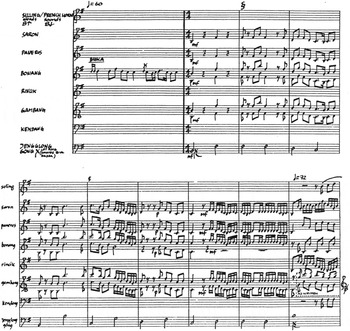
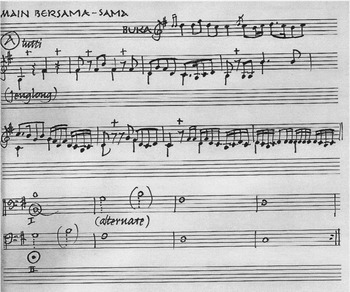
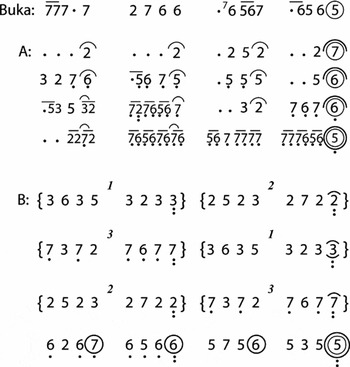
The piece begins with a sixteen-beat buka (introductory phrase) played by the bonang (a fourteen-pot horizontal gong chime).Footnote 25 Then, in direct contrast to the characteristic stratified polyphony of traditional gamelan music, Harrison writes identical material for all of the gamelan parts to play in unison (except for the jengglong, a set of six low-pitched gongs, which consistently articulates a half-note pulse), shown in Example 1. This atypical appearance of homophonic writing for the gamelan perhaps signals that Harrison was searching for a straightforward way of introducing the gamelan's distinctive timbre to an audience unfamiliar with this ensemble. Another possible motivation for this unison texture is that it calls attention to a hallmark feature of Harrison's music: simply stated melody. Given this single melodic line as his main point of reference, one cannot avoid noticing a linear aspect to the music before its texture becomes more complex, with the result that one may be distracted from hearing this linear unfolding of melody. This collective articulation of a single melodic line, labeled A in the individual parts,Footnote 26 foreshadows Harrison's continued interest in the horizontal construction of the music.
Buka and Part A (unison writing), Main Bersama-sama.

In the following section (part B), the music not only shifts into the layered polyphony characteristic of gamelan but also introduces an obbligatoFootnote 27 melody played by the suling, an instrument typically found within a gamelan degung ensemble.Footnote 28 After the suling has completed its melodic statement, the French horn enters to reiterate the same melodic idea. Although the suling and French horn have unique timbres, their commonality as aerophones serves to distinguish their shared melodic line as the featured element in this section.
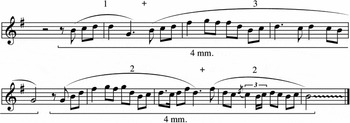
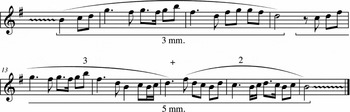
As aural interest shifts to the solo instrumental melody in part B, the previously unified gamelan melody divides into independently moving parts and the gamelan begins to sound (at least to Western ears) accompanimental in function.Footnote 29 Taking center stage beginning with its pick-ups into m. 10, the suling plays two related phrases, subsequently restated by the French horn, after which the two instruments continue to alternate melodic material throughout this section of the work. Although Harrison varies the initial pairing of four-measure phrases found in mm. 9–25 with phrase groupings of three-plus-five measures in the second alternation of identical melodic material between suling and horn in mm. 25–41, he maintains an underlying structure of eight measures per melodic recitation (see Examples 2a and 2b). But whereas Harrison creates flexible phrasing in the shared suling/French horn melody, he designs this solo line to conform to the gamelan's structural framework. It is, in fact, the gamelan that provides phrase structure and organizes the flow of music, specifically through the motion of the gong cycle.
4 + 4 measure construction of 1st melodic line played by suling/French horn (mm. 9–25), Main Bersama-sama.

3 + 5 measure construction of 2nd melodic line played by suling/French horn (mm. 25–41), Main Bersama-sama.

The measured cycling of eight-bar units corresponds with the length of the gong phrase, and each of the above-mentioned melodic statements comes to completion with the striking of the gong. In his Western score of Main Bersama-sama,Footnote 30 Harrison notates these moments of arrival at the gong tone with an “X.” The culmination of each gong cycle thus occurs on the downbeats of mm. 17, 25, 33 and 41, emphasizing the note B (see Example 3). Although only mm. 9–27 are shown here, the same kind of careful patterning occurs throughout the rest of the piece. Harrison also emphasizes the internal subdivision of the gong cycle into two equal halves with the striking of a gong, this time in conjunction with the note G and occurring on the downbeats of mm. 13, 21, 29, and 37. In mm. 9–25 this internal marker coincides with the end of the first four-measure phrase played by the suling and French horn, while the obbligato melody's shift to a three-plus-five construction in mm. 25–41 creates an incongruence with this central division of the gong cycle.
Cycling of jengglong pitches, Main Bersama-sama.

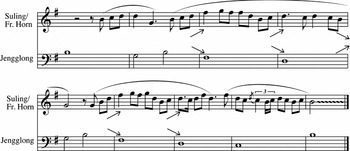
Harrison crafts the cyclic organization of the music not only through the regularity of the striking of the gong but also through the recurrence of a structural melody of half notes and whole notes played by the jengglong. As shown in Example 3, throughout part B the jengglong repeats a ten-note series (the pitches G, B, F#, D, G, B, F#, D, C, and B), thereby establishing the underlying melodic motion of the gong phrase and serving as a point of reference for all of the other instruments. The pitches of this skeletal melody, the balungan, become guideposts for the individual melodic and rhythmic elaborations played by the other members of the degung ensemble. Furthermore, whereas the fixed length of the gong cycle is reflected in the consistent eight-bar phrasing of the suling/French horn melody, the specific pitches played by the jengglong are mirrored in the seemingly free and flexible obbligato line. Far from expressing independence from the gamelan, the solo line can be reduced to the skeletal pitches of the balungan, revealing the remaining pitches to be a melodic ornamentation of that underlying structural melody (see Example 4). The steady occurrence of pitch coincidence between the suling/French horn melody and the balungan is thus a reflection of this shared melodic structure.
Suling/French horn melody an embellishment of the underlying structural melody, Main Bersama-sama.

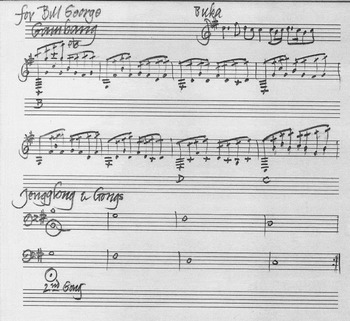
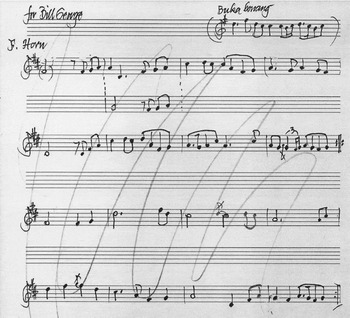
Available sketch material indicates that Harrison's decisions of melodic patterning match the sequence of underlying pitches established by the jengglong. One page from Harrison's personal notebooks shows both the gamelan's “tutti” melody in part A, with the structural pitches of the jengglong written with downward stems, and the jengglong's skeletal framework for part B (see Example 5). This outline of the jengglong's pitches in part B also appears (in a slightly modified form) on another page from the composer's notebooks that maps the gambang part in relation to this melodic skeleton (see Example 6). On a separate page exists a sketch of the French horn melody, written a fourth lower than it appears in the published version of the piece to accommodate the French horn's transposition (see Example 7). Crossed out, presumably by Harrison himself, this sketch reveals an earlier, more simplistic conception of the second half of the melodic material and makes no mention of the presence of the suling as a melodic partner. Absent in the sketches is a direct pairing of the horn melody and jengglong pitch structure similar to that of the gambang and jengglong. Although it is obvious that Harrison linked all parts through a single melody, it remains unclear whether, in his creation of Main Bersama-sama, he moved from West to East, from a Western framework of melody towards the Indonesian concept of balungan, or vice versa.Footnote 31
Sketch of unison melody in Part A (jengglong pitches indicated with downward stems) and the gong cycle, with structural melody played by jengglong, for Part B, Main Bersama-sama. Courtesy Lou Harrison Archive, Special Collections, McHenry Library, UCSC.

Sketch mapping the gambang part to the underlying structural melody, Main Bersama-sama. Courtesy Lou Harrison Archive, Special Collections, McHenry Library, UCSC.

Sketch of French horn melody with a simplified second half (the material presented after the internal repeat sign), Main Bersama-sama. Courtesy Lou Harrison Archive, Special Collections, McHenry Library, UCSC.

Given the evident correlation between the suling/French horn and jengglong parts, it is striking that we do not readily hear the obbligato melody as being derived from the gamelan structure. Although the suling/French horn line may be viewed as one particular elaboration of the balungan, just as the saron, panerus, bonang, rincik, and gambang are elaborations of the structural melody, why does this line stand out as melody rather than simply as a layer of embellishment? The distinctive timbre of both the suling and French horn is the obvious foreground answer. But another answer might lie in Harrison's rhythmic construction of the individual parts. Unlike the almost constant eighth-note or sixteenth-note motion of the accompanimental gamelan parts, the suling/French horn line, comprised of quarter notes, dotted-eighths, and sixteenths, has a distinctive rhythmic flexibility. Moreover, the use of pick-up notes, present at the start of each melodic fragment, directs the melodic motion and contributes a sense of elasticity and freedom, while the slur markings—used only in the obbligato melody—convey its easy, flowing character.
But beneath this simple “tune” lies a complex web of mathematical relationships. Rather than imitate traditional techniques or allow for the flexibility of performance that comes with unwritten elaborating parts, Harrison used his own unique, game-like compositional strategies to construct the gamelan's melodic material.Footnote 32 Harrison's self-imposed compositional game of patterning and of creating limitations through the use of small melodic cells (“melodicles”) can be found throughout Main Bersama-sama.Footnote 33 Although the gamelan parts display typical four-beat groupings of gatra (a metrical unit of four beats), close investigation of Harrison's pitch choices reveals deliberate and intricate patterning in line with many of his works for Western instruments. Harrison experimented with the use of “melodicles” as early as the 1930s, a technique he developed from his studies with Henry Cowell. As Harrison himself recounted, “[Cowell] would give me three or four tone motives and suggest that I use them to construct small model pieces . . . transposing them . . . using the retrograde and inversions and inverted retrogrades, the melodicles either connected by a common tone or separated by a determined interval.”Footnote 34 The importance of this technique as a component of Harrison's compositional style is evidenced by his discussion of such motivic manipulation as the first item in his Music Primer (1971).Footnote 35 This technique permeates the melodic structure of Main Bersama-sama, showing Harrison's personal (and Western) voice in his use of the gamelan.
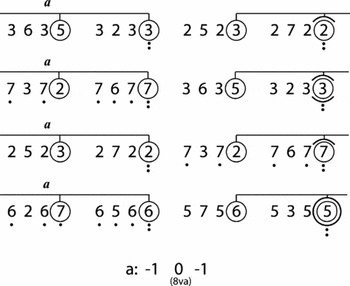
Harrison's rigorous use of melodicles is best seen in the gambang part. A xylophone with wooden bars, the gambang is distinct in timbre from the bronze instruments that typically make up a degung ensemble. Perhaps this timbral contrast drew Harrison to spend compositional energy on the gambang's embellishment of the structural melody. In creating its melodic line, he generates a sort of endless cycle with great inner coherence by limiting himself to two contour patterns at a deep level of structure in part B. Melodic motion in gamelan music moves towards and places emphasis on the last pitch of each gatra—what gamelan scholars refer to as an end-weighted rhythmic sensibilityFootnote 36—and Harrison constructs an intricate pattern built on the fourth, and metrically strongest, pitch of each gatra (see Figure 1). Each contour pattern can be described in terms of interval ascent or descent between pitches, with ascent marked by a plus sign and descent a minus sign, and a number indicating the interval size. Thus, using Javanese kepatihan notation in which pitches are represented by the numerals 1 through 7, the motion from pitch 2 to pitch 3 would be labeled +1. Converting Harrison's Western staff notation into kepatihan notation gives the following pitch approximations: F# = 2, G = 3, B = 5, C = 6, and D = 7.Footnote 37 For practical purposes, each successive step between numbered pitches is counted as an interval size of 1, regardless of the gapped intervals created by the pentatonic pelog degung scale. That is, motion from 7 to 2 and from 3 to 5 reflects successive steps within the melodic framework of the piece, and would be labeled +1.Footnote 38
Two contour patterns, labeled melodicle a and melodicle b, played by the gambang in Part B, Main Bersama-sama.

The first line of Figure 1 reduces to the pitches 5332, with the contour −1, 0, −1, (which I have labeled melodicle a). Lines three and four also follow this pattern; the second line, however, deviates from this pattern and has the contour −1, +3, −1 (labeled melodicle b). Harrison's reason (or perhaps compositional need) for altering the second line derives from his pervasive use of melodicle a. Not only does this melodicle serve as the structure for lines one, three, and four at this architectural level, but it also operates as the bridge that connects each line to the others (see Figure 2). Plainly stated, melodicle a joins the last two pitches of one line to the first two pitches of the following line, resulting in a tightly woven melodic fabric.
Melodicle a, connecting each line to the next, Main Bersama-sama.

Harrison's intricate scheme of overlapping occurrences of melodicle a, however, could not be negotiated flawlessly, necessitating his one break with the pattern in the second line (the presence of melodicle b). If this line were to follow the overriding contour pattern, its pitches would be transformed to 2776 (contour of −1, 0, −1). In order to maintain the use of melodicle a as a connector between lines, the pitches of the third and fourth lines would also face alteration. The original sequence of pitches, 5332 2753 3227 7665, would become 5332 2776 6553 5332. What is immediately noticeable about this transformation is its effect on the cyclicity of the gongan (the basic musical unit between two gong strokes). Harrison's “flawed” version with the use of melodicle b upholds the length of the recurring gong cycle. The transformed (or “correct”) version, on the other hand, results in a cycle of only three-quarters of the established length, which would necessitate a restructuring of the composition's formal framework. Hence, Harrison's insertion of melodicle b preserves the underlying structure of the work while using melodicle a as thoroughly as possible.
Harrison's use of contour as a structural element extends to other layers of the work. By moving towards the surface level, we discover Harrison's awareness of the possibilities for cohesion at various levels of structure. As noted above, the end-directed structure of melodic motion in gamelan music emphasizes the last pitch of each gatra; the second pitch also receives rhythmic/structural prominence, second in strength to the final pitch. Harrison adheres to this metric hierarchy in his writing for the gambang, establishing “pedal” tones on the weak beats of each gatra (beats one and three) akin to the Javanese/Sundanese musical process called pancer.Footnote 39 The second and fourth beats are more active and deserve further consideration.
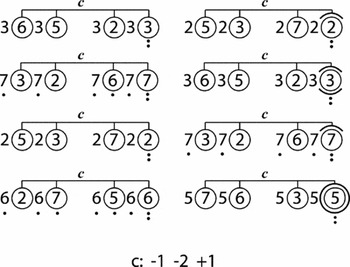
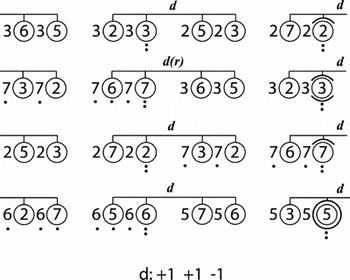
In the melodic progression of the pitches located on strong beats, Harrison's layered organization becomes evident. These pitches all fall into a single melodic contour, labeled melodicle c (see Figure 3). Harrison carefully connects each occurrence of melodicle c with an additional contour pattern. Melodicle d, contour +1, +1, −1, bridges the four-note groupings and is found consistently throughout this section, varied through use of its retrograde in one statement (see Figure 4).
Melodicle c, Main Bersama-sama.

Melodicle d, Main Bersama-sama.

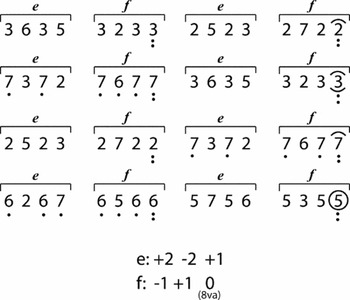
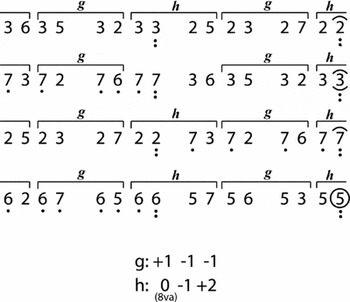
At the melodic surface two contour patterns appear as a result of Harrison's melodic elaboration of the gambang's underlying structure. Melodicles e and f alternate in consistent fashion (see Figure 5), and are linked through the use of two additional melodicles.Footnote 40 Combining the last two pitches of each odd-numbered gatra with the first two pitches of each even-numbered gatra (for example, 3532 as the connector spanning across the first two gatra) results in melodicle g, with the contour +1, −1, −1. Similarly, melodicle h is created through the connection between the last two pitches of even-numbered gatra and the first two pitches of odd-numbered gatra (for example, 3325 formed from the respective halves of the second and third gatra), and each occurrence of melodicle h conforms to the contour of 0 (or octave equivalence) −1, +2. Melodicles g and h alternate in the same consistent fashion as the rotation of melodicles e and f (see Figure 6).
Melodicles e and f, operating at the surface level, Main Bersama-sama.

Melodicles g and h, operating at the surface level, Main Bersama-sama.

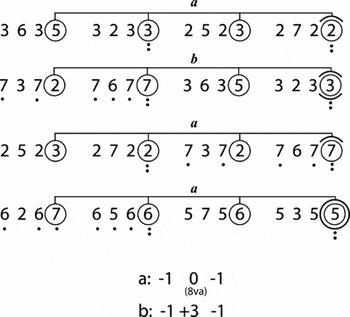
In addition to contour patterning, Harrison further organizes the gambang pitches through the process of repetition. In Figure 7, notice groupings that span two gatra. The first three pairs of gatra repeat, providing another layer of structure to the first three lines. Harrison seems to be playing with groupings of three against two. The fourth line remains more independent from the first three lines. The line, however, is not without ties to other formal aspects of the composition. The final pitch of each gatra in this line (7665) comes from the final pitch of each line in part A.
Melodic repetition in Part B; relationship between Part A and fourth line of Part B, Main Bersama-sama.

As we have seen, Harrison's melodic inventiveness is expressed in a variety of forms in Main Bersama-sama. Taking a single melody (the balungan) as the guiding linear strand for the work, he employs the gong cycle as the frame for melodic motion and thus adopts the structural underpinning of gamelan. But moreover, the piece reveals the rich ways in which Harrison thought about the function of melody. In tying all instrumental parts to the skeletal melody (balungan), Harrison not only explored the writing of graceful lines to be played by the French horn and suling, but he also experimented with creating a mosaic of small melodic cells (“melodicles”) based on melodic contour. Thus Main Bersama-sama shows an elegance of design in its refinement of means, as both flowing melody and tightly knit patterning are derived from the same ten-note skeleton of the work.
Bubaran Robert
Although more widely known as a work for gamelan and piccolo trumpet, Bubaran Robert was originally conceived and published in 1976 for gamelan alone. Only after the passage of five years did Harrison add the trumpet melody, while simultaneously revising the gamelan's melodic structure.Footnote 41 Harrison's interest in melodic expressivity was not confined to his writing for the solo Western instruments, but inhered in his construction of the gamelan parts as well.Footnote 42 That melody served as a generating force for his construction of both entities, East and West, did not mean, however, that a Western listener would necessarily understand the gamelan in melodic terms. In Main Bersama-sama the solo Western melodic lines seem to fulfill Harrison's notion of writing memorable “tunes”; the gamelan balungan, on the other hand, may not be heard as similarly tuneful by Western audiences. Harrison constructed his 1981 revision of Bubaran Robert in such a way that it challenges listeners to confront their ideas of what a melody is.
Specifically, Harrison challenges listeners to hear the gamelan as an equal partner in the musical fabric and not merely as an accompaniment to the Western instrumental line. This is not to suggest that the gamelan serves an accompanimental role in Main Bersama-sama or in any of his other gamelan-plus pieces, but rather that Harrison structured the interaction between the gamelan and solo instrument in such a way that invites the listener to engage more fully with the gamelan on its own terms. This engagement is achieved through the alternation of passages played by gamelan alone and passages played by gamelan and piccolo trumpet, and through the gamelan's maintenance of a single melodic structure in both solo and combined passages. Significantly, Harrison's own melodic interest in the gamelan increased with his addition of a melody for piccolo trumpet, as he tightened the gamelan's melodic structure in anticipation of this substantial alteration to the work.
In revisiting an existing work, Harrison found himself considering anew the melodic potential of a traditional form. In traditional gamelan music, short forms such as the bubaran are governed by the colotomic structure of the gong cycle.Footnote 43 The time-keeping instruments, the kenong, kempul, kempyang, and kethuk, mark internal subdivisions of the gong cycle, and the specific interaction of these instruments establishes the formal structure of the music. Harrison's interest in understanding formal aspects of Javanese gamelan music is evident in Bubaran Robert, with its titled acknowledgment of employing bubaran form, as well as its indication of scale (slendro) and pathet (manyura).Footnote 44 Yet, just as Harrison explored the world of gamelan, keeping an eye towards tradition, he also pursued his own compositional strategies. His 1981 revision of the work is yet another instance of his application of individual compositional strategies to melodic construction. In this revised version of Bubaran Robert, form is determined not only by Harrison's employment of a traditional colotomic structure, but also through melodic patterning. The changes he makes to the gamelan reveal a tightening of structure. Harrison retains his compositional practice of building form through melody, and he overlays a melodic scheme on top of the bubaran structure.
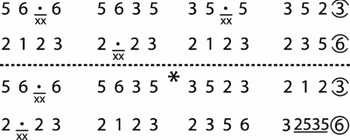
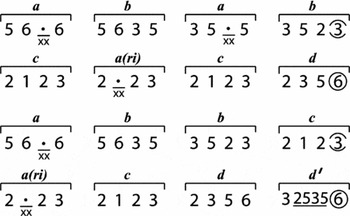
This layering of two formal designs occurs within the gamelan's balungan, as the particular configuration of kethuk, kempul, and kenong iterations provides a backdrop against which Harrison displays his melodic idea. The colotomic instruments create a regularity of pulse and phrase structure, but Harrison establishes a larger pattern of repetition through melodic motion that spans two gong phrases, thereby dividing the entire balungan into two equal halves. The balungan is reproduced in Example 8, and I have indicated the two halves through the use of a dotted line. Harrison writes nearly identical melodic material for each half of the balungan, highlighted by motion to tone 3 at the end of the first gong phrase and to tone 6 at the end of the second gong phrase. The two halves, in fact, follow the same melodic sequence of gatra, differing only by the omission of the third gatra (35.5) and subsequent addition of a new final gatra (325356) in the second half. The location of the omitted third gatra is marked with an asterisk in Example 8.
Two halves of the balungan, Bubaran Robert.

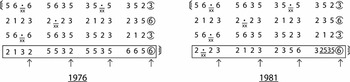
The near symmetry of the two halves of the balungan did not take form until Harrison's 1981 reworking of the piece. The original version of Bubaran Robert, though structurally organized around gong tones 3 and 6, displays a through-composed approach to developing the gamelan's principal melody, with the fourth line expressing independence from what came before it. Example 9 presents the balungan of both published versions of the work. Although the concluding gong tone on pitch 6 is preserved, Harrison changed essentially every other pitch played in this final gong phrase in his 1981 revision.
Changes to the melodic contour of the fourth gongan, Bubaran Robert.

A comparison of the two versions reveals a tightening of formal structure and a pronounced affirmation of the two structural gong tones. The 1976 version of Bubaran Robert highlights the pitches 2, 2, 5, and 6 as the metrically prominent kenong pitches of the fourth line.Footnote 45 The revised version, in comparison, emphasizes the two pillar pitches upon which the entire melody hangs. I have indicated these pitches with arrows in Example 9. Harrison's revision not only refocused the balungan's central pitch structure, but it also showed newfound concern for creating a cohesive form by means of melodic design. Harrison stripped the fourth line of its previous melodic freedom, as he continued the repeated sequence of gatra already established in the third gongan. The resultant binary structure thus replaced the freer form of the original version of the piece. This alteration shows Harrison's characteristic concern with maintaining careful control of form and other parameters even as the music suggests a kind of fluent, even intuitive melodicism.
An analysis of the revised balungan's undulating melody suggests that Harrison organized these core melodic pitches not as long, floating phrases, but as short musical segments to be manipulated and reordered. As noted above, Harrison frequently challenged himself to create melodies or entire pieces from small melodic cells—“melodicles”—throughout his compositional career. Having employed melodicles in his construction of elaborating parts in Main Bersama-sama, Harrison returned to this familiar technique in his second look at Bubaran Robert.
In Bubaran Robert, each gatra stands alone as a small melodic cell and can be described by its internal shape, which is determined by the interval size and direction between two adjacent pitches. Conforming to a handful of such contour patterns, the gatra provide an overall unity to the balungan's structure. The first line presents two melodicles in alternation, labeled a and b (see Example 10). Melodicle a expresses a contour shape of rising one scale degree and then maintaining that pitch level for the final two beats of the gatra (+1, 0, 0). Melodicle b rises one scale degree, descends two scale degrees, and then ascends one scale degree to return to its starting pitch (+1, −2, +1).Footnote 46 The third and fourth gatra of the line repeat melodicles a and b, sequenced down a scale step. The second line introduces two new melodicles, labeled c and d. Melodicle c follows a descent of one scale degree and then changes direction to ascend two subsequent scale steps (−1, +1, +1). Melodicle d follows a steady scalar ascent (+1, +1, +1). In addition to transpositions of melodicles a and b, the retrograde inversion of melodicle a appears in the second and fourth lines. The final gatra presents a more elaborate version of melodicle d.
Pattern of gamelan gatra, Bubaran Robert.

This labeling of gatra according to their melodic contour strongly illustrates the pervasive repetition of melodic material mentioned above and Harrison's overall tightening of form. The two halves of the balungan follow the same sequence of gatra, with the exception that in the third line of Example 10 the third gatra (melodicle a) is omitted and the following material is moved one gatra earlier, resulting in the addition of melodic d′ as a kind of cadential arrival. In analyzing the ways in which Harrison's music incorporates structural principles of gamelan music, Bill Alves points to the deletion of the third gatra of Bubaran Robert as a metric shifting of the following melodicles to earlier time points. Notably, the new melodicle introduced at the start of the second line (melodicle c in my labeling) now falls on the gong, a metrically strong position, at the end of the third line. “This shifting of gatra from metrically weak to strong parts of the formal structure is a favorite trick of Javanese composers as well,” notes Alves, citing Jody Diamond's comparison of Bubaran Robert to the traditional piece Bubaran Rediguntur.Footnote 47
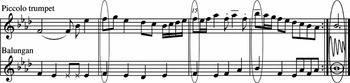
Although Alves and Diamond see this metric shifting as an element of compositional play in both Harrison's writing and in traditional Javanese gamelan music, Harrison's realignment of gatra in the second half of Bubaran Robert suggests another kind of structural “game.” The balungan's binary construction carries over to the piccolo trumpet part, added in 1981. The trumpet plays two highly similar eight-measure phrases corresponding to the two halves of the gamelan, thus highlighting the parallelism already created. Unlike the balungan melody, the trumpet melody maintains its skeletal eight-bar structure in its second phrase and does not eliminate material in order to follow the gamelan's forward leap. As a result, the gamelan and trumpet play “out-of-phase” for much of the second half of the repeated cycle of music.Footnote 48 Harrison eases this tension by loosely tying the two parts together through pitch coincidence, establishing octave alignment on the fourth beat of the thirteenth through sixteenth gatra (on the downbeats of mm. 13–16 in the Western score). Example 11 illustrates Harrison's use of pitch alignment in the final gongan in Western score form, with the salient pitches (and of greatest metric stress) circled.
Pitch coincidence between the balungan and solo piccolo trumpet line in the final gongan, Bubaran Robert.

The “misalignment” of the two melodies creates an interesting juxtaposition of the trumpet and gamelan, as Harrison writes two seemingly independent melodies that operate according to separate principles yet somehow make sense together. It is as if Harrison is making a humorous, if hidden, comment on how two musical traditions can be disconnected yet perfectly in harmony with one another. This hidden “puzzle” is yet another example of the compositional games that lie beneath the beguiling surface in Harrison's music.
Because of his blending of two highly different melodies, Harrison had to find a way for the gamelan and piccolo trumpet to “play together.” His strategy seems to have been periodic pitch coincidence at moments key to the unfolding of this traditional Javanese form.Footnote 49 In revisiting his 1976 version of Bubaran Robert, Harrison chose to maintain the hierarchical structures of pitch and regularity of phrase length originally established in the work. The paired sixteen-beat gongan lead to the gong tones on pitches 3 and 6, and this underlying melodic motion extends to the contour of the trumpet's melody.
In writing the solo trumpet line, Harrison pairs the Western instrument with the balungan, which he has notated in Western staff notation (see Example 12). The slendro scale is represented by the following Western pitch approximations: 1 = D♭, 2 = E♭, 3 = F, 5 = A♭, 6 = B♭. The trumpet comes into alignment with the gamelan's fundamental melody at the gong strokes. These points of coincidence are marked by elongated circles in Example 12.Footnote 50 Harrison's transnotation of the balungan from ciphers to pitches on a staff presents the metrically stressed endpoints of metric units as downbeats. In other words, the gamelan's arrival at its first gong stroke (on tone 3 or F) occurs on the downbeat of m. 5; similarly, the second gongan concludes on the downbeat of m. 9, the third on the downbeat of m. 13, and the fourth on the downbeat of m. 1. The trumpet melody follows suit in its emphasis on the pitches F (3) and B♭ (6) at these structural moments, as Harrison essentially pins the trumpet and gamelan parts together through pitch alignment. Not only does the trumpet simultaneously voice the gong tones, but the extended rhythmic duration of these pitches lends weight to the final tone of the second, third, and fourth gongan (downbeats of mm. 9, 13, and 1).
Structural pitch coincidence between the trumpet and balungan, Bubaran Robert.

Harrison notes in the published score that the final ending of the piece may be taken at the conclusion of either the second or fourth line. As we have seen, these are the two places where the gong corresponds with the structural pitch 6. This indication matches the binary division of the balungan and allows performers a certain freedom in deciding where to end the piece. More importantly, Harrison's performance indication confirms a melodic scheme that spans two gong phrases and corresponds to his belief that melody can provide structure on a large scale. The gamelan thus simultaneously expresses both formal ideas: binary form in its melodic organization and bubaran form in its colotomy or gong phrasing.
Harrison's inclusion of the trumpet, while reinforcing the gamelan's binary structure with its parallel eight-measure phrases, creates a new aural perception of the work's form. Although constructed as two complementary halves, the music is performed as a sequence of interludes in which the trumpet enters intermittently within the gamelan's continuous churning. In an explanatory note accompanying the trumpet part, Harrison indicates that the trumpet is to enter the musical texture only after the gamelan has finished playing the first pair of gong phrases. The trumpet then begins with its second phrase, labeled B in the Western score, proceeds to play the A phrase, and then rests while the gamelan continues with its cycling of the balungan and elaborating parts (refer to Example 12). Following the purely gamelan interlude, the trumpet reenters, now beginning with the A phrase and bridging into the B phrase before resting once again. As Harrison states in the published part, the trumpet is to maintain this ordering of phrases and tacet sections throughout the performance of the piece.
In creating this dynamic between the gamelan and solo Western instrument, Harrison establishes a larger formal structure that is based on his intermittent foregrounding of the trumpet melody. Unlike Main Bersama-sama, which articulates a single solo line shared by the Western instrument and a solo Indonesian instrument that remains prominent above the gamelan polyphony throughout much of the work, Bubaran Robert expresses a shifting musical texture that highlights the alternation of sections of music that include the trumpet with those that do not.Footnote 51 This fluctuation in instrumental forces becomes a central feature of one's hearing of the work, as it emphasizes the added color of the trumpet.
By the same token, the trumpet's absence results in a foregrounding of the gamelan not achieved in Harrison's earlier hybrid works. In writing passages for gamelan alone, Harrison invites the listener to hear the gamelan as melodic in its own right. By juxtaposing two melodies, the piccolo trumpet line and the gamelan balungan, Harrison asks us to consider the nature of melody itself, and also how these two melodies interact (“play together”).
Harrison's deep interest in understanding the structural workings of traditional gamelan music did not, as we have seen, result in an abandonment of melodic invention. Rather, as is consistently the case for Harrison, certain “rules of order” are established—in this case, the colotomic structure of the gamelan—within which he creates music that is melodically driven, but in a very rich sense. The bubaran form functioned as a template into which he could “pour” his melodic creativity.Footnote 52 More importantly, Harrison's interest in melodic expressivity led him to challenge Western-trained ears (perhaps his own included) to hear the gamelan as more than accompaniment.
Conclusion
As early as 1959, Peter Yates contended that Lou Harrison “has been, since Ives, the most fundamentally original of American composers, the one best able to compete in creative ability with the young, radical postwar theorists of Europe.”Footnote 53 Yet Harrison's inventiveness has nonetheless gone unrecognized by the concert-going public and even by many of his peers in part, perhaps, because he did not intend for us to find it.Footnote 54
The possibility that Harrison did not especially care whether listeners discovered the underlying processes of his compositions is suggested by his own comments about his aesthetic aims. In stressing his concern with beauty during a 1975 interview of composer Alan Hovhaness, Harrison reveals that he may actually have been seeking to deflect our attention from his craftsmanship:
Harrison: I think that it is the duty of the composer to make memorable melody, and you're one of the very few who does.
Hovhaness: Well, I'm glad you feel that way, because it's almost a disgrace and has been considered a disgrace, but I don't care. I have long since ceased to care, no matter how disgraceful I am. I have to be natural.
Harrison: . . . May I add that Richard Dee had a beautiful phrase for this a few years ago. He said, “Lou, it seems that every time now that there's a piece that's either attractive or interesting or beautiful, it's immediately described as primitive or archaic.”
Hovhaness: Yes, that's right.
Harrison: [laughing] So we can all go around being primitive and archaic or even disgraceful as you put it.Footnote 55
Harrison's eagerness to describe himself as a “melode” and a writer of “tunes” appears to have made him reticent to address the underlying complexities of his music. Moreover, because his structural games arise out of (or are realized in) melody, it befitted Harrison to subordinate his games in order to assure that the melodies at his works’ surface held the listener's attention securely enough to become memorable.
Simply put: Harrison's games were more than likely private ones, intended only for himself. But even though unheard and heretofore largely unseen, these compositional games link Harrison with Schoenberg and those more typically associated with algorithmic compositional methods, no matter how far from serialism he may have roamed. Precisely because his intent was to play the game so unobtrusively, to avoid letting it detract from his primary goal of melodic expressivity, Harrison accomplished the difficult feat of being complex without seeming so. Knowing for himself the full extent of his rigorous craftsmanship, Harrison was apparently content for us to think his music primitive, archaic, even disgraceful, as long as we also thought it beautiful.