Introduction
The concepts of social exclusion and social inclusion have been introduced into China relatively recently, since about 2000. At that time, the Asian Development Bank published a paper by Nobel Laureate, Amartya Sen (Sen Reference Sen2000) in recognition of the importance of social inclusion in Asian societies. The introduction of these concepts coincides with the dramatic transformation of Chinese society in the past decades, especially in the past ten years. As China achieves tremendous socio-economic development, new social problems have emerged, such as the increasing gap between the rich and poor, rural and urban and regional disparities, unemployed workers, migrant workers, the low coverage of social protection and the intergenerational gap in living standards. The on-going developmental and associated problems call for new social policies to meet the challenges. In contrast to the concept of social exclusion that is related to poverty, deprivation, inequality and discrimination (see Ding Reference Ding2005, for other negative attributes of the concept in the Chinese context), it is the concept of social inclusion that offers a more positive framework for developing new perspectives.
In recent years, social inclusion has provided a useful perspective on social policies, although its full impact has yet to be capitalised (Kennett and Mizuuchi Reference Kennett and Mizuuchi2010). It has been used to analyse the issues of vulnerable groups in society with its main focus on farmers, migrant workers and unemployed workers along such dimensions as economic disparity, social rights, social participation, social integration, loneliness and social support (Feng Reference Feng2011; Li Reference Li2002; Tang Reference Tang2002). But few studies have focused on ageing issues although population ageing is a major issue in modern China and has a fundamental impact on the developmental process. A research finding found evidence of older people social exclusion, especially in rural areas (Feng Reference Feng2011). In fact, the concept of social inclusion can play a more important role in developing social policies for older people and ageing issues. This paper will discuss social inclusion with reference to intergenerational solidarity in China and some of the barriers to social inclusion for older persons. In all of the topics to be discussed in this paper, the social inclusion of rural elders lags behind that of urban elders.
The rationale of applying a social inclusion perspective to intergenerational solidarity is based on two major social changes in China: one is rapid population ageing and the vulnerable situation of older persons in the process of development; the other is the national aim to build a harmonious society that emphasises social inclusion and aims to realise growth that is inclusive.
For older persons in China, social inclusion can be understood in terms of the elimination of poverty where individuals have equal access to the social safety net and enjoy a decent standard of living, the elimination of stereotypes and barriers to social participation, intergenerational solidarity and the sharing of the benefits of socio-economic development. However, the emerging issues for older persons in China indicate that social policies on ageing need to be improved from the perspective of social inclusion, because the social exclusion of older persons is still common during the transitional period from a planned economy to a market economy. For example, most rural older persons are not covered by the social security system, the poverty rate of older persons is the highest of all age groups, the income gap between older people and those of a working age has been increasing, and intergenerational solidarity has become a social issue due to the weaker support that younger family members offer and rapidly changing living arrangements.
Demographic changes
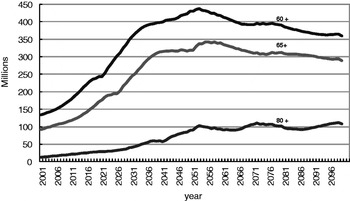
In China, ‘senior citizen’ refers to people aged 60 and over. China's population has been ageing since the 1980s. According to the latest 2010 census data (State Statistics Bureau 2011a), the population aged 60 and over has reached 178 million, or 13.26 per cent of the total population (for comparison, the population aged 65 and over is 119 million, or 8.87 per cent of the total population). The rate of population ageing has greatly accelerated, and this will increase pressure on the society. It is projected that by 2050, the population aged 60 and over will exceed 450 million. By 2100, China will have more than 350 million persons aged 60 or over (see Figure 1).
Population ageing in China, 2000–2100.

Moreover, people in China are living longer. In 2010, the overall life expectancy at birth was estimated at around 74 years, clearly indicating that China has stepped into an era of longevity. The expected life expectancy is even higher in the developed regions of East China, such as Shanghai and Beijing – there, it is about 80 years. According to a national survey in 2006, senior citizens in China generally enjoy good health: 60.3 per cent of the older people population are healthy; 23.2 per cent though not in completely good health, can live with little limitation in terms of Ability of Daily Activities; and only 15 per cent are in such poor health that they are unable to guarantee their daily work and life (Guo and Chen Reference Guo and Chen2009).
In comparison with developed countries, population ageing in China has three distinct characteristics. Firstly, the ageing of the population has occurred when China's economy is still under-developed. Secondly, the older population is the biggest in the world; this will last at least to 2070 – India may exceed China by that time. Thirdly, more than half of the older population live in rural areas. Although China's economy has developed in the past three decades so that the country has become the second economic power in the world; in terms of its per capita gross domestic product (GDP) of US $3,744 (World Bank 2011) it ranks only 95th in the world. For this reason the Chinese government labels itself as a country that is ‘getting old before getting rich’, that is, China's population has aged when it is still a nation with a low per capita GDP (Editorial Board of Population Research 2006).
This judgement has both a positive and a negative impact on the development of social policy. On the positive side, the government should give priority to dealing with the challenges of population ageing, and promote policies of social inclusion more strongly. On the negative side, some scholars have suggested that the term, ‘getting old before getting rich’, is an attempt to rationalise the existing social exclusion, namely the low coverage of social security in rural areas, and the social and economic inequalities between and within generations. They claim that governments may use the general economic condition as an excuse not to take active action to solve ageing problems and to neglect social inequality. As a result, this may slow the pace of establishing a universal social security system in China, just because the nation is not rich enough to do it (Du Reference Du2007). However, from the perspective of social inclusion, the point is not whether China has made a ‘Big Cake’ (rich enough), but whether China has been able to share the ‘Big Cake’ of economic achievements fairly (Li Reference Li2007). This argument shifts the focus from an economic perspective to the concept of social inclusion.
Social changes and the resulting impact on social disparity and social inclusion
The social changes in the past three decades in China include the following key aspects. Firstly, economic reform and the development from a planned economy to a market economy. Starting from a rural area in Anhui province in 1978, China changed from the commune production system to the Household Contract Responsibility system (peasants were given production quotas by contract, what food they grew beyond the quota belonged to them and could be sold on the free market at unregulated prices). In the early stages, both the urban and rural economies developed and played a fundamental role in the reform. However, since the late 1990s, two disparities have emerged in the developmental process. Firstly, the income gap between rural and urban has increased due to a lag in rural economic development compared to urban areas. By the end of 2010, the annual per capita income in rural areas was 5,919 yuan RMB compared to 19,109 yuan RMB in urban areas (State Statistics Bureau 2011b). As a consequence, more and more rural migrant workers move to urban areas. Moreover, in contrast to improvements in social security in urban areas, most rural residents are still excluded from the social security system and older people in rural areas still mainly depend on the informal support of family members.
Secondly, in terms of social reform, China has restructured various systems simultaneously in the past three decades: the social security system, the medical insurance system, the employment system, housing system and the education system. The achievement of rapid social and economic development has also meant that the younger generation is working harder and facing a more competitive career situation. However, these changes have eroded the basis of the informal support systems available to older people. For example, retirees have changed from being a ‘unit person’ to a ‘social person’. Whereas in the past, employers were responsible for providing a pension and services to retirees, now they have no such responsibility and, instead, retirees receive a pension through the banks and have to seek services from the community. Such changes have posed huge challenges to people retiring, their families and their communities.
Thirdly, there have been broad cultural changes that mean that traditional filial piety can no longer meet the needs of older people. Whilst the majority of the younger generation still want to be filial to their parents, they find it very difficult to do so in the traditional way, which would require them to live with their parents, and to provide long-term economic, emotional and care support. In urban areas under the single-child family policy, the younger generation do not have siblings to share the filial obligations, and they prefer to live apart from their parents especially after marriage. By the end of 2010, the household size had shrunk to 3.1 persons per household, and the proportion of older persons living alone has increased.
Increasingly, the younger generation is asking the government to take more responsibility to support the older people. They have difficulty in giving economic support to parents who are not covered by the current social security system. When their parents are sick, they cannot bear the high medical costs, and when parents need long-term care, they cannot leave their jobs to stay at home to provide daily care. Increasingly they are redefining the concept and practice of filial piety by shifting part of their filial responsibilities to the state for the provision of social security, a medical insurance system and the development of a community service system for the older people, a point also noted by Cheung, Kwan and Ng (Reference Cheung, Kwan and Ng2006) in their survey (for a cross-cultural comparison, see Ng Reference Ng and Nelson2002).
The major effects of these social changes are significant. Firstly, there is the increasing income gap between rural and urban older people. Secondly, medical expenses and long-term care expenses have emerged as key issues of informal support, especially in rural areas. Finally, family values and the filial piety norm have changed.
The rapid increase of the older population means that there is an urgent need to tackle ageing issues and improve relevant social policies in order to promote intergenerational solidarity and socio-economic development. Specifically, there are three major tasks facing the social inclusion of elders in Chinese society. The first issue is: how to protect the rights of older people to benefit equally from the socio-economic development and to gain equal access to full coverage by the social security system. Such access will change the formal and informal support systems for the increasing number of older people. The second issue – how to overcome the social exclusion of older people in social participation – requires social policies to involve and enable elders to be active in social development so as to promote active ageing and counter negative stereotypes of older people. The final issue focuses on the need to narrow the social and economic disparities between older and younger generations, to foster harmonious intergenerational relationships in a social context marked by changes in traditional living arrangements to cope with increasing needs for long-term care that place heavy demands on economic resources.
Past and current social policies
It is important to note that most of the barriers to social inclusion are rooted in the existing social security systems and social policies. They are not the result of particular social policies aiming to exclude older persons socially or economically, but, rather, the result of social policies lagging behind the dramatic social changes in past decades. The following introduction provides a backdrop for understanding current barriers to social inclusion for older persons and intergenerational solidarity in China.
Social security
There exists a huge difference between rural and urban in terms of the social security system in China. In November 2010, 50.32 per cent of China's population lived in rural areas (State Statistics Bureau 2011a). At this time, only 28.63 million rural older people – about 27 per cent of older people in rural areas – received pension benefits. By contrast, 63.05 million pensioners in urban areas received pension benefits (Ministry of Human Resources and Social Security 2011a). The current social security system mainly covers public and formal sector workers.
The pension system was established in 1951, and since the beginning of the economic reform of the late 1970s, China has gradually improved the pension system and reformed the fund-raising mode in an attempt to establish a multi-level pension system marked by sustainability and full coverage both in rural and urban areas. The current basic old-age pension consists of two parts: base pension and pension from the personal account.
At the same time, efforts have been made to expand the coverage of basic old-age insurance. Initially, China's basic old-age insurance covered only state-owned enterprises and collectively owned enterprises in urban areas and their employees. In 1999, this coverage was expanded to include the employees of foreign enterprises, private enterprises and other types of enterprises in urban areas. All provinces, autonomous regions and municipalities directly under the Central Government can make provisions to include persons engaged in individual businesses in industry or commerce under the specific conditions of the basic old-age insurance in their localities. In 2002 China expanded its basic old-age insurance coverage to all those who were self-employed in urban areas. By the end of 2010, the total number of people participating in the basic old-age insurance scheme in urban areas reached 257.07 million, 194.02 million of whom are employees, and 63.05 million are pensioners. However, in rural areas, only 102.77 million farmers participated in the scheme (Ministry of Human Resources and Social Security 2011a).
The economic support of senior citizens in China derives from two main sources: family support and assistance, and self-support from the seniors' own income or pension. According to the latest National Population Survey conducted by the State Statistics Bureau in 2009, the percentage of the older people population relying on the support of their family members decreased significantly to 34.4 per cent from 57.1 per cent in 1994, while the percentage of the self-supported population increased from 15.6 to 24.9 (State Statistics Bureau 2010).
Old-age insurance schemes in rural China
Old-age security in China's rural areas is centred mostly on families. In the 1990s, China introduced an old-age insurance system in some of the rural areas in accordance with the actual level of local socio-economic development there. With the understanding that ‘the premiums are paid mainly by individuals themselves, supplemented by collectively pooled subsidies and supported by government policies’, an old-age insurance system with the accumulation of funds taking the form of personal accounts was established. In August 2009, China launched a pilot rural social endowment insurance programme that was expected to cover 10 per cent of the counties by the end of 2009 and the whole country by 2012. Different from the previous pension programme where funding was supplied by the farmers themselves, the new scheme is subsidised by the central and local governments. Farmers over 60 years of age will receive a monthly endowment of varying amounts set according to their local income level after paying a fee to join the programme. By the end of June 2011, 199 million of the rural population has participated in the rural social endowment insurance programme, among whom were 54.08 million older people farmers (Ministry of Human Resources and Social Security 2011b).
As a result of different levels of economic development in various areas, there is an apparent disparity in economic resources available for older people. In 2009, 48.87 per cent of urban senior citizens resorted to a pension as the main source of income compared to only 4.46 per cent for their rural counterparts (State Statistics Bureau 2010). In the 2006 Sampling Survey of the Aged Population in Urban/Rural China conducted by the China Research Centre on Aging, there was a question, ‘What do you worry about?’ The two main worries were financial stress (32.3%), as older people usually no longer work for a salary, and old-age care needs (32.6%), especially for those with health concerns or daily activity limitations (Guo and Chen Reference Guo and Chen2009). An earlier study based on the 2000 Sampling Survey of the Aged Population in Urban/Rural China reveals that financial worries were more pronounced among older people who lived alone. About half of them (48.8%) worried about not having enough money for daily needs. This was higher than those who lived with their spouse (42.2%) or with children and/or others (41.7%) (Wan et al. Reference Wan, Sengupta, Zhang and Guo2007).
The issues for the urban older people are more broad. Their emerging needs are for a richer spiritual and cultural life, keeping pace with the times, participation in society and life-long education. These are largely yearnings for social and cultural inclusion (Yi Reference Yi2008). For the rural older people, the issues are more direct. Most rural older people have to work until an advanced age due to the low coverage of pension schemes and pension levels, the loss of informal support networks in rural areas means that the aged are facing more serious difficulties than those in urban areas and, indeed, cannot be sustained in the traditional way.
Medicare
The existing Medicare system in China consists of two parts: an urban resident's medical care system and a rural co-operative medical care system. The urban system has been developed since 2007 and the rural system has been developed since 2003. By the end of 2010, 432.63 million urban residents are covered in the urban system; and 836 million rural residents are covered in the rural system, accounting for 96 per cent of the rural population (Ministry of Public Health 2011).
In addition to the contribution from each family, the central and local government provide subsidies of 120 yuan RMB (US $19) per person per annum for participating in the Medicare system. The urban scheme requires different contribution levels according to various categories, such as students, children, older people, the disabled and the poor. The rural scheme requires a participant to pay 20 yuan RMB a year and central, provincial, municipal and county governments supply another 120 yuan RMB per person to the fund. When urban or rural residents fall seriously ill, the pooled funds cover part of their medical costs and coverage varies by illness and the actual expenses. Currently, the coverage in urban areas is 50 per cent, while it is 30 per cent in rural areas.
From a social inclusion perspective, the reform of the existing Medicare system is going to unify the reimbursement rate for both urban and rural areas in the near future, and the aim is to establish a medical care system for all Chinese residents by the end of 2011.
The development of the Medicare system is remarkable for it certainly assists senior citizens who are subject to a high prevalence of chronic diseases. Before the system was established many older people with serious illnesses could not afford to receive treatment or had to spend all of their savings to pay medical bills. Often, it was a major reason for people affected to fall into poverty. However, the system does not solve the entire problem. With soaring medical costs, patients still need to pay 30–70 per cent of their medical bills and so illness remains as a major threat to the financial resources of older people. The coverage offered by the government needs to expand further. Therefore, an overall reform on the Medicare system and administrative management system is an urgent task for China.
Community services
Community services have developed rapidly in the past decade. Two major factors have played an important role in this process. First, the community has become a focus of the grassroots-level service providers: almost all seniors have to get services from their local communities rather than their former employers as in the traditional model. At the same time, governments at various levels offer more financial support to the older people to purchase community services from relevant providers. Second, older people living in the community often experience different living arrangements from those in the past. In many urban communities, they account for more than 30 per cent of the population, and many are living separately from their children. As a result, new needs have emerged: older people need meal services, health care at home, household cleaning and helpers, and day care services. Such new demands are a stimulus to the development of community services.
From the government perspective, the government has been changing its role from that of service provider to service purchaser. For example, in Beijing since 2008, the municipal government has given each of the older people aged 80 years and over 100 yuan RMB coupons per month to purchase services in the community. This stimulates the development of community services tremendously. The government's aim in Beijing is that, by 2020, 90 per cent of the older people can live in their own homes with the support of community services, a further 6 per cent can get financial support from the government to purchase community services to take care of them, and the remaining 4 per cent will get long-term care in nursing homes.
By the end of 2010, there were 153,000 urban community service amenities in China (Ministry of Civil Affairs 2011). Family visits, regular mobile services and services at fixed venues are available to provide care and housekeeping services, emergency aid, and other free or reduced-payment services for the aged. However, relative to the huge number of older people in need of institutional care, the current number of available nursing homes is very limited. China has about 39,904 institutions with 3.15 million beds (Ministry of Civil Affairs 2011). The national aim of the current five-year plan is to establish a more comprehensive community service system for older people and increase the number of institutional beds by another 3 million by 2015.
Changes in families and filial piety norms
Family changes in China are reflected in both the family household size and changing living arrangements. The household size has been shrinking while the proportion of older persons living alone has been increasing. From 2000 to 2010, the average household size in China declined from 3.44 to 3.10 persons. By the end of 2009, among households with one adult aged 65 or over, 14.04 per cent have the elder living alone while 16.37 per cent of households were occupied by two older people (State Statistics Bureau 2010). Traditionally, co-residence has been the basic form of living arrangement for older people and a cost-efficient way of providing informal support for the family members. However, co-residence is now difficult to maintain under the pressure of the new trend of living arrangements and the percentage of the older people population living alone is rising.
The traditional way of family support to older people has depended on two preconditions: one is a big family and the other is that children live with their parents. Both preconditions have changed fundamentally in China with the dramatic societal transformation of the past three decades. Due to successful family planning practices, the total fertility rate declined from 2.2 in 1992 to under 1.7 in 2010. The current level is 1.3 in cities and about 1.9 in rural area. There are more than 140 million one-child families or about one-third of all families and the average household size is only 3.1. This means that one young couple has to support four parents in old age, in addition to supporting their own children. Clearly the older people generation cannot depend on their children for support in their old age in the traditional way.
Social change has also impacted on children living with their parents. The trend away from co-residence has been strong in rural areas: the outflow of the rural young generation to the cities or developed areas leaves their older parents at home without their close family. Since 1982, the ageing population has been increasing faster in rural than in urban areas in China. Although the rural older people usually have more children than their urban counterparts, this has not guaranteed family support. In 2009 it was estimated that 27.6 per cent of rural older people do not have any child living with them. In addition to living alone, many rural older people have to take over their children's responsibility of working on the farm. In urban areas, as a result of rapid social economic development, young adults can afford to purchase new flats to live in and many leave their parents living alone in their old home. Hence, although parents and children may still live in the same city, they tend to live apart from each other. Currently, 33.8 per cent of Chinese urban older people live separately from their children (State Statistics Bureau 2010).
It is noteworthy that another fundamental change has occurred among the new cohorts of older people in China: the Chinese baby-boomers are becoming old. The Chinese baby boom, which lasted from 1949 to 1969 means that, from 2009 for the next two decades, this cohort is creating an ‘aged boom’. Compared to previous generations, these baby-boomers have a much better education, greater economic independence as well as being healthier and as a result more of them can afford to live by themselves. Many live away from their children in order to have a greater freedom of lifestyle. For example, according to the 2000 census, there were only 45 per cent of older persons aged 65 and over who had formal education experience compared to 86.9 per cent for the 50–54 age group. This figure increased to 94.0 per cent for the 40–45 age group. The baby-boomer generation will change the composition of pensioners and bring a different outlook to living arrangements, the perception of filial piety and the family support system. According to the 2006 National Sampling Survey on Older Persons, the current cohort prior to the baby-boomers has already started to change their ideas about the traditional norms of the family. For example, in cities, only 36.2 per cent of the older people prefer to live with children, while 41.2 per cent are against it; in rural areas 53.0 per cent of the older people prefer to live with children while 23.2 per cent do not (Guo and Chen Reference Guo and Chen2009). As the baby-boomer generation age in coming years, they may further raise the proportion of those living separately from their children and push the government to take more concrete action to establish social support systems in accordance with social inclusion and social equality.
While older people in urban areas prefer to live separately from their children when they are still healthy, rural older people often have to live alone due to the emigration of their children to urban areas. When they need long-term care, about 16.8 per cent of urban older people prefer to live in homes (institutions) for older people, which would cost them the equivalent of US $100 on average per month; for the rural older people, 15.2 per cent prefer to live in homes for older people, at the average cost of US $18 per month (Guo and Chen Reference Guo and Chen2009). Currently, most of the care is provided by family members as the total number of beds in homes for older people can accommodate only 2.42 million older people, less than 2 per cent of the total. This is why the government has initiated a series of new policies to develop community service systems to support ageing in place for as long as possible, as well as to encourage local government, private enterprise and non-governmental organisations to develop institutional services for the older people who are no longer able to do so.
There is also debate about the extent to which older people can depend on the informal support of their children in the long run. Although young migrants from rural areas send more money back to their parents in villages, they cannot provide daily care to their parents in need. When the rural older people need long-term care, who will be the care provider? While older farmers can still work now as long as they are physically capable, how about the situation in ten or 20 years? How long can they depend on their work income from their farms? In addition to these worries, the changing living arrangements raise another issue, namely the loneliness of older people. In the 2006 National Sampling Survey on Older Persons, 20.8 per cent of urban older people often had a sense of loneliness. The proportion in rural areas was higher – 34.4 per cent – and 25.4 per cent of older people reported that they could not find an intimate person to talk with (Guo and Chen Reference Guo and Chen2009). In the past ten years, a song has gained popularity in China, which reminds young people to Come Back Home More Often to Visit Parents. It reflects how important the intergenerational relationship is to older people and how much emotional support older people need.
The new residential arrangements also have an impact on intergenerational communication. When children live with parents, the older people can learn something new from their children and grandchildren and it enables the older people to keep pace with the rapid social development. However, the new living arrangements have changed this. In the survey of 2006, there were 64.4 per cent urban older people and 77.3 per cent rural older people who felt that they were less able to keep up with social developments. On the other hand, co-residence with children and grandchildren enables the younger generation to learn more from the older people, it is a crucial link in cultural inheritance from the old to the young. Whether living together or not, more intergenerational contacts and communication can play an important role in fostering intergenerational solidarity and filial piety in modern China.
The feeling of loneliness experienced by older people is influenced by living arrangements, economic status and urbanity in China (Li, Chen and Wu Reference Li, Chen and Wu2006). Older people living alone, living in rural areas and having poor economic status are the most vulnerable groups. Compared to the younger generation, they have less education and fewer economic resources, they are unable to use computers or have access to the internet, and have less opportunity for social participation. These are the main reasons why so many older persons feel marginalised and excluded from the mainstream of social development. They are reminiscent of lonely seniors in rural England described by Townsend (Reference Townsend1957) over half a century ago, and both are victims of social exclusion.
Although China has achieved tremendous progress in the past decades, the government is still reluctant to take on the responsibility of formal support. The over-reliance on family support is not unique to China, it was also the practice in a number of countries especially before the advent of an ageing population (Ng 2002). As a developing country with an increasing number of older people, formal support will take up a big share of the government budget and it is doubtful whether the government can maintain rapid economic growth in the long run to generate enough resources to sustain the social security system. This can be seen from the relevant laws. For example, China's first law on protecting the rights and benefits of older people took effect in 1997 and Article 10 clearly stipulates that the support of older people is mainly the responsibility of family members and that family support includes economic support, care and emotional comfort. The current debate proposes to revise the law to require the government to take more responsibility for supporting older people in both urban and rural areas. This initiative, in turn, would require fundamental provisions for extending the social security system to cover all citizens and to establish the basic community service systems for meeting the needs of older people living alone or having special needs in daily living.
The rapid socio-economic development and the ageing of the population are forcing Chinese society to reconsider ideas of filial piety and informal support, although filial piety has been deeply rooted in Chinese culture. It should be noted that whenever filial piety has become a controversial topic, it has usually been during a period of rapid social change when people have been concerned that sons (and daughters) would give up the responsibility of supporting their parents (Chen Reference Chen2009). A recent survey by China Youth Daily of young people born after 1980 reveals that 74.1 per cent of them reported they cannot afford to provide care for their parents due to heavy work pressures while 68.4 per cent worry that they have to care for four old parents. The current debate focuses on the modern definition of filial piety and it is necessary to scrutinise critically its effects on intergenerational solidarity. Traditional filial piety emphasises the child's responsibility to support their parents but neglects the role of government's formal support to help the family.
The new filial piety norm affirms the responsibility of children to respect and support their parents but emphasises the importance of the social security system for economic support to the older people and the importance of mutual respect between generations (Wang Reference Wang2004). Therefore, the role of formal support has become a key part in the new norm. It is important to note that although younger generations in China today still favour the idea of filial piety, more and more young people want to get formal support to help them to realise it, namely the new filial piety norm needs formal support to complement the informal support.
The new filial piety norm also emphasises mutual respect as compared to the norm of traditional filial piety that emphasised the responsibility of the younger generation. For example, in the 24 classic models of filial piety in ancient China, all of the models are sons who sacrifice themselves to take care of their parents. This one-sided view of filial piety that overlooks the roles and responsibilities of parents has attracted wide criticism in modern China. The younger generation also wish the older generation to understand their situation and, if possible, to give a hand to the younger generation. With the increasing number of older people who have a better education background, many are trying their best to foster a new pattern of intergenerational solidarity. This has become a new culture in China and is instrumental in shaping the modern meaning and practice of filial piety (see also Yue and Ng Reference Yue and Ng1999).
The younger generation expects that in order to maintain the important role of filial piety in modern China, their ability to fulfil filial obligations must be supported by the development of formal supports beyond the family. Current debates on intergenerational solidarity and the respective roles of family and government on old-age support have prompted the government to integrate these issues into social policies and developmental strategies on social inclusion.
With the strong tradition of filial piety and informal support systems, the government attempts to maintain the tradition and gradually develop formal support systems in the process of socio-economic development. However, the practice of family planning that has limited births to one child or two children per couple over the past three decades has caused a rapid decline in fertility rates and household size, and economic development over the same period of time has changed the living arrangements of older people. The combined impact of these factors has put pressure on government and society to find a better balance in sharing the responsibilities of older people support between families and society.
Policy and programme developments
In the past decade, the social inclusion perspective has been gradually integrated into social policy making. It also develops simultaneously with China's national development aim of a Harmonious Society, which is to eliminate social exclusion and promote social inclusion (Ding Reference Ding2005). The construction of a Harmonious Society is a socio-economic vision, first proposed by the Chinese government in 2005, to broaden China's focus from economic growth to an overall societal balance and harmony. The fundamental reason is that in the process of rapid economic growth, social inequality also increases. It is widely believed that it would be impossible to build a harmonious society without intergenerational solidarity, the equal opportunity to share the benefits of development and a more universal social security system to cover both urban and rural residents. These objectives will help to narrow the income gaps between rural and urban older people and to ease the burden on the younger generation to provide informal support.
The latest developments in policies and programmes can be summarised as follows. Firstly, the new law on social insurance took effect on 1 July 2011 and was adopted by the National People's Congress in October 2010. The new law specifies a common right for citizens, urban and rural alike, to pay premiums and enjoy old-age pensions and insurance for medical care, work injuries, unemployment and childbirth. This new law and social insurance system will help to narrow the urban–rural difference in terms of pension coverage and medical insurance and change greatly the existing pattern of formal and informal support in China. It is a milestone in the development of social inclusion in China as the rural older people are included in the safety net. Universal pension coverage will be realised in the near future.
Secondly, formal support is going to be enhanced so that a balance of formal and informal support can be achieved. In the proposed revision of the law on protecting the rights and benefits of older people, support for older people will be revised to emphasise the governmental role in sharing more responsibility with family members. The revision of the law has considered the social changes in the new century, including the increasing income gap between regions, smaller household sizes, the increasing proportion of older people living alone, the emerging needs of older people for social participation and the new norm of filial piety. Some developed areas such as Shanghai and Beijing have established a universal pension system and medical insurance system already. As China enters the low fertility era and realises that the old-age support system must be reformed to meet the new challenges of an ageing population, there is a rapid change in government attitudes toward greater state provision to complement family resources in supporting older people.
Thirdly, the establishment of a Social Support Service System has been defined in the 12th five-year plan (2011–15). It is the first time in the history of China that social support has been part of the national five-year plan. The emerging new pattern is to share the responsibility of old-age support between government and family members. Governments will take responsibility for universal social security, the medical care system and basic community services, that is, providing the basic economic support and services, while family members will take the main responsibility for the emotional comfort of older people and long-term care, again, with the help of community services.
Directions for the future
China has the largest number of older people in the world. After 30 years of socio-economic reforms and development, it is impossible to rely on the traditional way of providing family support to the increasing number of older people under the rapidly changing social conditions. China has been exploring ways of redefining the balance of formal and informal support so as to solve the emerging issues related to an ageing population. Filial piety has to be complemented by the development of social security systems so that each can play their respective roles in modern China. The debate on intergenerational solidarity and old-age support has pushed the government to integrate these issues with social policy and developmental strategies towards building a harmonious society in which people of all ages, young and old, are socially included.
Although China has achieved a great deal of progress in policies and programmes, the new social insurance law will provide full coverage for social pensions and medical insurance to both urban and rural residents. This will definitely redefine the concept of filial piety and balance the formal and informal support for older people. This measure will ameliorate the social exclusion of rural older people by removing the rural–urban disparity in social security systems and access to social services.
However, China still faces tremendous challenges and debates continue on various relevant subjects. Therefore, for research in the future, the following key challenges need to be addressed. Firstly, the issues relating to the changing population age structure and social inclusion. At present, China has 180 million older persons and this category will exceed the young sector (0–14 years) of the population in about five years. This trend will bring a fundamental change to Chinese society and the aim of social inclusion will be even more important. Also, the large proportion of the aged within the population generally is compounded by the changing needs of older people. By 2020, China will have a shrinking labour force, an increasing dependency ratio and strained intergenerational relationships.
Secondly, for the existing pension and Medicare system, the benefit level still needs to be raised in keeping with economic development, and the disparity between the urban and rural older people should be further narrowed. For example, although all of the older persons in Beijing and Shanghai are covered by the pension system in 2011, the average monthly pension for retirees is 2,032 yuan RMB in Beijing city and 1,727 yuan in Shanghai city, whereas the pension levels in the rural parts of the cities are only 200 yuan RMB. The reimbursement rate of Medicare costs for an urban resident is 50–80 per cent while for the rural resident it is only 20–30 per cent. From the social inclusion perspective, it is also necessary to eliminate the above disparities. The new social insurance law is a concrete step towards providing the universal coverage of a social safety net for both rural and urban residents. Fundamental progress has been made for more than 50 million rural older people have pension benefits now. However, it still takes time to see the narrowing of the rural–urban gap in terms of pensions. Considering the increasing proportion of older persons living alone in both urban and rural areas, basic community service systems and institutional care systems should be further developed in both areas to meet the increasing needs of the aged.
Thirdly, there is the need to provide more support to help the younger generation to care for their elders. Although it is the most rapid period of development of institutional care in China, there is still much debate on whether China should develop institutional care further or just develop community care services. Obviously, the government is trying to establish more institutions as well as developing community services to meet the increasing needs of long-term care. More professional care service providers need to be trained to replace or help the family care-givers so as to offer more support to the family before someone enters institutional care.
Fourthly, psychological issues and emotional support are emerging needs for the older people living separately from their children. New forms of intergenerational solidarity should be developed to counter the erosion of the traditional form of co-residence.
Fifthly, in terms of social participation, older people need to be actively involved in this transitional period. The increasing number of ageing baby-boomers, who have much better health, experience, education and improved social security coverage, are capable of taking on more participatory roles to counter negative ageist stereotypes. Based on the social inclusion perspective, social policy should create equal social environments for older people to participate in social activities.