Introduction
When interacting with infants, adults adapt their speech in different ways. These adaptations are known as ‘motherese’, ‘baby-talk’, ‘child-directed speech’, or ‘infant-directed speech’ (IDS), and include changes in utterance length and structure, as well as in prosodic patterns. Adults’ utterances to infants are shorter, more redundant, and linguistically simpler than those produced in interactions between adults. Adults produce a large number of questions and frequently include proper names. Regarding prosody, it can be observed at a slower tempo, with longer pauses and more prosodic repetitions. Furthermore, fundamental frequency (F0) values are higher in utterances addressed to infants, with exaggerated prosodic contours and wider F0 variations (see Saint-Georges et al., Reference Saint-Georges, Chetouani, Cassel, Apicella, Mahdhaoui, Muratori and Cohen2013, for a review, and Soderstrom, Reference Soderstrom2007, for an overview on prosodic, lexical, phonological, and syntactic properties of ID speech).
It is well known that infants prefer this type of IDS from the very early stages of their development. Classic studies have shown that even neonates prefer IDS to adult-directed speech (ADS) (Cooper & Aslin, Reference Cooper and Aslin1990). Similar findings have also been reported for 7-week-olds (Pegg, Werker, & McLeod, Reference Pegg, Werker and McLeod1992), 4-month-olds (Fernald, Reference Fernald1985; Werker & McLeod, Reference Werker and McLeod1989) and 7- to 9-month-olds (Glenn & Cunningham, Reference Glenn and Cunningham1983; Werker & McLeod, Reference Werker and McLeod1989). This preference for IDS vs. ADS remains for the first months of life, and some studies suggest that it may begin to decrease by the end of the first year (Newman & Hussain, Reference Newman and Hussain2006). By contrast, other studies reported a U-shaped developmental pattern regarding IDS preference (Hayashi, Tamekawa, & Kiritani, Reference Hayashi, Tamekawa and Kiritani2001) and some data indicate that IDS preference continues during the second year of life (Segal & Newman, Reference Segal and Newman2015).
These adaptations of adult speech when interacting with infants have a key role in several aspects of early language development.
In the first months of life, IDS has arousing properties and increases infant's attention (Kaplan, Goldstein, Huckeby, Owren, & Cooper, Reference Kaplan, Goldstein, Huckeby, Owren and Cooper1995). IDS prosodic characteristics direct an infant's attention towards the linguistic stream, promoting social interaction (Cooper & Aslin, Reference Cooper and Aslin1990; Fernald, Reference Fernald1985; Pegg, Werker, & McLeod, Reference Pegg, Werker and McLeod1992). A recent meta-analysis on IDS effects on language development has shown that IDS prosody is associated with attention (global measures of attention, joint attention, and conditional attention) in infants (Spinelli, Fasolo, & Mesman, Reference Spinelli, Fasolo and Mesman2017). Recent findings suggest that IDS might be more attractive to the infants because it is less predictable than ADS regarding its prosodic features (Räsänen, Kakouros, & Soderstrom, Reference Räsänen, Kakouros and Soderstrom2018). IDS guides infant attention not only to a social partner, but also to an external referent. Senju and Csibra (Reference Senju and Csibra2008) showed that 6-month-old infants followed an adult's gaze towards an external object only when it was preceded by an ostensive cue such as direct gaze and IDS.
Infants’ preference for IDS makes them more responsive, and consequently they are perceived as more willing to maintain a positive and affective interaction with the caregiver. Therefore, IDS fosters the engagement and maintenance of social interaction.
Besides this social-engaging and attention-getting role, IDS characteristics also have a function in emotional regulation. IDS conveys an adult's affective state and influences an infant's emotional state. Mothers use specific pitch contours to modulate an infant's emotional state (Papousek, Papousek, & Bornstein, Reference Papousek, Papousek, Bornstein, Field and Fox1985), and exaggerate those prosodic cues that convey emotional information (Scherer, Reference Scherer1986).
Moreover, several characteristics of IDS facilitate speech processing in different ways. On the one hand, the exaggerated suprasegmental characteristics of IDS speech facilitate syllable discrimination and vowel categorization in the first three months of life (Karzon, Reference Karzon1985). IDS prosody also facilitates word segmentation from fluent speech: infants find IDS easier to segment than ADS (Thiessen, Hill, & Saffran, Reference Thiessen, Hill and Saffran2005). On the other hand, not only prosodic, but also linguistic properties of IDS can influence language development. For example, the tendency in IDS to put target words in the final positions of the sentence helps infants to segment the linguistic stream (Messer, Reference Messer1981). The use of diminutives can facilitate word segmentation and gender agreement learning (Kempe, Brooks, & Gillis, Reference Kempe, Brooks and Gillis2005), and vowel lengthening according to specific language characteristics (Werker, Pons, Dietrich, Kajikawa, Fais, & Amano, Reference Werker, Pons, Dietrich, Kajikawa, Fais and Amano2007) can also facilitate the language learning process (see Saint-Georges et al., Reference Saint-Georges, Chetouani, Cassel, Apicella, Mahdhaoui, Muratori and Cohen2013, for a review).
It seems, therefore, that the characteristics of the IDS can facilitate the language acquisition process. IDS exposure in the early stages of development is related to subsequent language acquisition. IDS is associated with both prelinguistic (rate of response and imitation) and linguistic (lexical, syntactic, and vocabulary productions) outcomes, but the associations with prelinguistic outcomes is stronger (Spinelli et al., Reference Spinelli, Fasolo and Mesman2017). Although the effect of IDS prosody seems to be stronger in children younger than 9 months, little is known about the influence of IDS prosody in older infants.
Ramírez-Esparza, García-Sierra, and Kuhl (Reference Ramírez-Esparza, García-Sierra and Kuhl2014) showed that the raw quantity of parental speech to infants had no effect on subsequent linguistic progress, but the quality of speech input to children was related to children's language development. Specifically, they found that IDS exposure in one-to-one social interaction contexts around the first year of life was related to vocabulary size at 24 months of age. The same influence of IDS quality on language development a year later is reported by Hirsh-Pasek et al. (Reference Hirsh-Pasek, Adamson, Bakeman, Owen, Golinkoff, Pace and Suma2015) for children aged 24 months, and by Rowe (Reference Rowe2012) for children from 18 to 42 months of age.
Cross-linguistic studies have shown that adult speech adaptation appears in very different cultures and in languages with different structures (Soderstrom, Reference Soderstrom2007). IDS can be found in the Western languages as well as in Russian (Kuhl et al., Reference Kuhl, Andruski, Chistovich, Chistovich, Kozhevnikova, Ryskina and Lacerda1997) Korean, (Lee, Davis, & MacNeilage, Reference Lee, Davis and MacNeilage2008), Hebrew (Segal, Nir-Sagiv, Kishon-Rabin, & Ravid, Reference Segal, Nir-Sagiv, Kishon-Rabin and Ravid2009), Chinese (Grieser & Kuhl, Reference Grieser and Kuhl1988), Thai (Kitamura, Thanavishuth, Burnham, & Luksaneeyanawin, Reference Kitamura, Thanavishuth, Burnham and Luksaneeyanawin2002), and Japanese (Fernald & Morikawa, Reference Fernald and Morikawa1993). IDS seems to preserve some characteristics regardless of the language, but some others change according to specific linguistic characteristics. For example, Fernald, Taeschner, Dunn, Papousek, de Boysson-Bardies, and Fukui (Reference Fernald, Taeschner, Dunn, Papousek, de Boysson-Bardies and Fukui1989) found similar prosodic modifications when talking to infants aged 10 to 14 months in French, Italian, German, Japanese, British English, and American English. Parents showed higher fundamental frequency, greater f0-variability, shorter utterances, and longer pauses when speaking to their children than when speaking with an adult. They found also language-specific variations, for example, the difference between the mean f0 of IDS and ADS was higher for American English-speaking parents than for parents in all other languages except Japanese (Fernald et al., Reference Fernald, Taeschner, Dunn, Papousek, de Boysson-Bardies and Fukui1989).
An especially interesting case of language adaptation to infants is the Basque language. Unlike Spanish, which is a Romance language, Basque has an unknown origin. Regarding phonology, Basque distinguishes three types of voiceless sibilants and their corresponding affricates. Basque has five vowels, as in Spanish, although in the dialect of Zuberoa a sixth vowel is used. At a morphosyntactic level, Basque is an agglutinating language, it has an ergative case in the declination, and in general terms it has a neutral SOV structure (Fernández, Reference Fernández2016). Basque and Spanish are very different at the grammar level, Spanish is functor-initial (also called a ‘Head–Complement language’), but Basque is functor-final (also called a ‘Complement–Head language’). Acoustic analyzes have confirmed that Basque follows a functor-final pattern regarding prosody, producing a trochaic pattern within a phrase, whereas Spanish follow an iambic prosodic pattern (Molnar, Carreiras, & Gervain, Reference Molnar, Carreiras and Gervain2016).
The Basque language, when directed to infants, has some specific adaptations not found in other languages. At the phonetic level can be observed the palatalizations of sibilants, to attract an infant's attention more easily. At the morphosyntactic level, we find the suppression of the auxiliary verb and the repetition of the syntagma at the beginning and at the end of the phrase. Regarding the lexicon, there is a general tendency to use specific infantile terms with their corresponding adult words in successive utterances (Santazilia & Zubiri, Reference Santazilia, Zubiri and Salaberri2014).
Although the literature on IDS in Basque is extremely scarce, these specific adaptations and the relevant role of IDS in the family context of linguistic transmission lead us to hypothesize a higher sensitivity to this type of speech on the part of Basque children.
The differences between Spanish and Basque, and the specific characteristics of IDS in the latter, make this comparison very interesting in terms of the differential effect of IDS on children's communicative production, and especially on children's multimodal production.
As we have seen previously, the influence of IDS on language processing has been widely studied, but little is known about how IDS contributes to children's communicative production, i.e., to the deployment of actions aimed at conveying a meaning to another person. Considering that language development as well as early social interaction are multimodal phenomena, the focus of the present study is to analyze the influence of IDS on the multimodal communicative production of children from different languages.
Multimodal communication and language development
As Golinkoff, Can, Soderstrom, and Hirsh-Pasek (Reference Golinkoff, Can, Soderstrom and Hirsh-Pasek2015) pointed out, IDS is not used in isolation but in a social context. IDS is part of a multimodal social frame that promotes interaction, communication, and hence language development. In the context of social interaction, around the first year of life children start to produce intentional multimodal communicative behaviors to convey meanings to others. Even before children start using their first words, they combine gestures and vocal elements in their social interactions. The different communicative elements are tightly integrated from the early stages of language development (Esteve-Gibert & Prieto, Reference Esteve-Gibert and Prieto2014; Romero, Etxebarria, de Pablo, & Romero, Reference Romero, Etxebarria, de Pablo and Romero2017). These multimodal communicative behaviors are related to subsequent linguistic development from the early stages of language learning (Aureli, Spinelli, Fasolo, Garito, Perucchini, & D'Odorico, Reference Aureli, Spinelli, Fasolo, Garito, Perucchini and D'Odorico2017; Cadime, Silva, Santos, Ribeiro, & Viana, Reference Cadime, Silva, Santos, Ribeiro and Viana2017; Igualada, Bosch, & Prieto, Reference Igualada, Bosch and Prieto2015; Murillo & Belinchón, Reference Murillo and Belinchón2012, Reference Murillo and Belinchón2013; Wu & Gros-Louis, Reference Wu and Gros-Louis2014). The use of communicative gestures coordinated with vocalizations and words predicts not only lexical development but also the beginning of the two-word combination stage (Butcher & Goldin-Meadow, Reference Butcher, Goldin-Meadow and McNeill2000; Capobianco, Pizzuto, & Devescovi, Reference Capobianco, Pizzuto and Devescovi2017; Goldin-Meadow & Butcher, Reference Goldin-Meadow, Butcher and Kita2003; Iverson & Goldin-Meadow, Reference Iverson and Goldin-Meadow2005).
Aims and hypothesis
The aim of this study is two-fold. On the one hand, we want to analyze the effect of IDS on children's attention and multimodal communicative production at the beginning of the second year of life. On the other hand, we want to test if this effect (or the lack of) is language-dependent, comparing languages with very different structures: Spanish and Basque.
Considering that IDS prosody facilitates attention to a social partner as well as to an external referent, and increases vocal production, IDS could be related to multimodal communicative behavior production at the beginning of the second year of life. We expect that IDS promotes not only an infant's attention to a social partner, but also directs that attention to an audiovisual target, that is, a referent that does not vary its behavior according to children's actions. At the same time, we expect that this increase in attention will promote children's communicative behavior towards a social partner.
Our hypothesis is that IDS increases infant attention to relevant events of the environment, and promotes children's communicative intention about it. Children will use multimodal communicative resources to share their interest with their social partner.
These multimodal communicative behaviors are more salient for the adult and they are perceived as more communicative than isolated behaviors such as vocalizations or gestures produced alone. Multimodal communicative behaviors will thus have a contingent response by the adult in an attention-shared frame that facilitates lexical development (Fasolo & D'Odorico, Reference Fasolo and D'Odorico2012).
To test if there are any differences in the relationship between IDS and multimodal communicative production depending on the characteristics of the language, we tested these hypotheses in two languages with very different structures: Spanish and Basque. Taking into account the special adaptation of Basque language to children, one could expect a higher effect of IDS in Basque-learning children compared to Spanish-learning children.
Specifically, our hypothesis are as follows:
H1: Children will spend more time looking at the screen in the IDS condition than in the ADS condition.
H2: Children will produce specifically more multimodal communicative behaviors in the IDS condition than in the ADS condition.
H3: The differences found between IDs and ADS conditions in the previous comparisons will be higher in the Basque condition than in the Spanish condition.
Method
Participants
Twenty-four children between 12 and 15 months of age participated in the study (12 girls, 12 boys). Half of them came from monolingual Spanish-speaking homes from Madrid, and half of them from Basque-speaking homes from the Basque Country. In the case of Basque-speaking children, although there are two main languages in the Basque Country – Basque and Spanish – the children chosen for this study were children with Basque as mother tongue and they were enrolled in Basque-speaking schools. Therefore, they were children with a linguistic majority exposure to Basque.
Families were contacted through several daycare facilities, and parents agreed to participate voluntarily and provided informed consent. All the participants were developing typically; they had no history of hearing loss and parents reported no developmental problems or concerns. The characteristics of the participants are shown in Table 1.
Characteristics of the sample

Materials
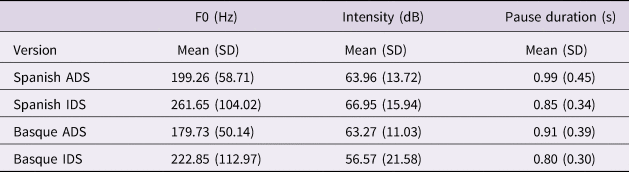
We designed a video with the story of Little Red Riding Hood. The video showed a series of static images depicting several passages in the story. The audio accompanying the images of the story was different for each of the four experimental conditions. All the narrations were performed by the same woman, who was an early childhood teacher and researcher. Her mother tongue is Basque and she is bilingual Spanish–Basque. All the stories had the same duration (3 minutes and 35 seconds) and the same lexical content, but were different in two characteristics: the language (Basque and Spanish) and the prosody (infant-directed vs. adult-directed). The infant-directed version had exaggerated prosodic contours and wider F0 variations than the adult-directed version. The acoustic characteristics of the videos (F0, intensity, and pause duration) are described in Table 2.
Acoustic characteristics of the videos

We had, therefore, a video for each of the four conditions (Spanish-IDS, Spanish-ADS, Basque-IDS, Basque-ADS) (see Supplementary materials for the videos, available at <https://doi.10.1017/S0305000919000412>).
Procedure
We conducted the observation sessions in an isolated room of a children's daycare center. The child was placed in front of a laptop, next to her teacher. A camcorder was located behind the laptop to register the children's gaze and behavior. Once the child was placed in the setting, the experimenter abandoned the room and the teacher started the story in the laptop. We asked the teachers to respond normally if the children tried to interact with them, but not to initiate or provoke the child's communicative behaviors.
Every child watched the two versions of the video (IDS and ADS) corresponding to their mother tongue. The order of presentations was counterbalanced to control for novelty and fatigue effects: half of the children of each group watched the IDS version first, and half of the children watched the ADS version first. There was at least an hour between presentations.
Coding and analysis
We coded the children's gaze and all the communicative behaviors produced by them using ELAN 5.1 software (Lausberg & Sloetjes, Reference Lausberg and Sloetjes2009). We considered as communicative behaviors all the gestures and vocalizations produced to the adult. To be able to identify the vocalizations produced by children, the coders could listen to the audio while coding.
We coded children's gaze by means of a frame-by-frame analysis of the movement of the children's eyes. This analysis allows an accuracy of 40 milliseconds. We considered a ‘social gaze’ to be when the child directed her eyes towards the face of the adult and kept the look for more than 40 milliseconds. We considered a ‘look to the screen’ to be when the child directed her eyes towards the screen and kept the look for more than 40 milliseconds. The fixation of the gaze is identified in a frame-by-frame analysis: as the child establishes eye contact or fixes her eyes on the screen, the image of the eyes of the child stops being blurred.
We considered a gesture to be any action addressed to convey a meaning to another person (Acredolo & Goodwin, Reference Acredolo and Goodwin1988). We coded the gestures as follows:
Point: index finger visibly extended with some extension of the arm.
Reach: arm is extended with hand open and finger straight.
Conventional: gestures produced as social routines such as saying “hello” or “bye”, clapping hands, etc.
Emotive: the child expresses an emotional state – joy, sadness, anger … – facially accompanying that expression with hand and arm movements.
Other: any gesture observed not included in the previous categories or not clearly observable.
We coded the vocalizations of the children according to the following categories (based on Majorano and D'Odorico, Reference Majorano and D'Odorico2011, and Murillo and Belinchón, Reference Murillo and Belinchón2012):
Babbling: the utterance is not similar to any word of the language. It has no sound–meaning regularity and no formal relationship with the referent alluded to.
Word: the utterance is clearly identifiable as a word and has a referential sense. We included in this category onomatopoeic sounds and proto-words, that is, utterances with a stable phonetic structure and a clear relationship with the referent but that does not constitute a word in the adult language.
Other: any vocal sound that was unclear or that could not be included in the previous categories.
Once the gestures and vocalizations were coded using ELAN, we considered a multimodal communicative behavior those behaviors that included some temporal overlap between gesture, vocalizations, and/or gaze towards the adult (social gaze). We considered that there was temporal overlap between two communicative elements when they were coincident in time at some point between the beginning and the end of the two of them. The minimum temporal coincidence allowed by our coding software is 10 milliseconds. We also measured the time that children spent looking at the screen and looking at the teacher. After the coding was done, the data were analyzed using the statistical program SPSS v24 (IBM Corp., 2016).
To ensure the reliability of the coding system, two independent observers coded 10% of the sample, including videos of both languages. Regarding gesture, gaze, and vocalization classification, the overall agreement between coders was 90% (N = 107; k = .77). The agreement for the gestures classification was 100% (N = 9), for gaze was 84% (N = 70), and for vocalization was 78% (N = 29).
Results
We conducted several analyses to explore the effect of IDS in different languages on specific aspects of children's behavior. Preliminary analysis showed no effect of the order of presentation on the variables studied.
Effects of the type of speech and language on children's attention
To test our first hypothesis (H1), we analyzed the effect of the type of speech (IDS vs. ADS) on child's attention, both towards the audiovisual story and towards the social partner. We expected that children found the IDS version of the story more interesting than the ADS version, and consequently would look at the screen for a longer time. We also measured the time that children spent looking at the adult to test if a larger time of looking could reflect a general tendency to look during longer periods in the IDS version, regardless of whether they were looking at the screen or at the adult. The duration of each look at the adult or at the screen was measured by means of the ELAN 5.1 software. We conducted a repeated-measures ANOVA, taking as the dependent variable the time spent looking at the screen, with the type of speech (IDS vs. ADS) and the language (Basque vs. Spanish) as factors. We found a main effect of the type of speech (F(1,22) = 4.52; p = .045; η2 = .17). Infants spent significantly more time looking at the screen in the IDS condition than in the ADS condition (108.41 vs. 93.03 s.). We did not find any effect of language (F(1,22) = 0.88; p = .35), nor of the interaction between type of speech and language (F(1,22) = 2.09; p = .16).
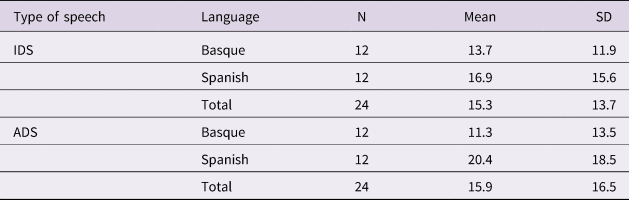
We conducted the same analysis, a repeated-measures ANOVA, but considering the time spent looking at the adult as the dependent variable. The type of speech (IDS vs. ADS) and the language (Basque vs. Spanish) were the factors. We did not find any effect of the type of speech (F(1,22) = 0.046; p = .83), or of the language (F(1,22) = 1.25; p = .27), or of the interaction between the two (F(1,22) = 1.14; p = .29) on the time spent looking at the adult. Table 3 shows the means and standard deviations of the time spent looking at the adult in both conditions and in both languages.
Time spent looking at the adult (s)

Effects of the type of speech and language on multimodal communicative behavior
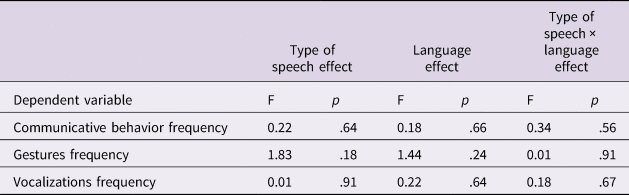
In order to test our second hypothesis (H2), we analyzed the impact of IDS in the general communicative behavior and in the multimodal communicative behavior of the children. We conducted three different repeated-measures ANOVAS, taking as factors the type of speech (IDS vs. ADS) and the language (Basque vs. Spanish). The dependent variables considered were: communicative behavior frequency, gesture frequency, and vocalization frequency. Results are shown in Table 4.
Results of the repeated-measures ANOVAS conducted on the frequency of communicative behaviors, gestures, and vocalization depending on the type of speech and the language

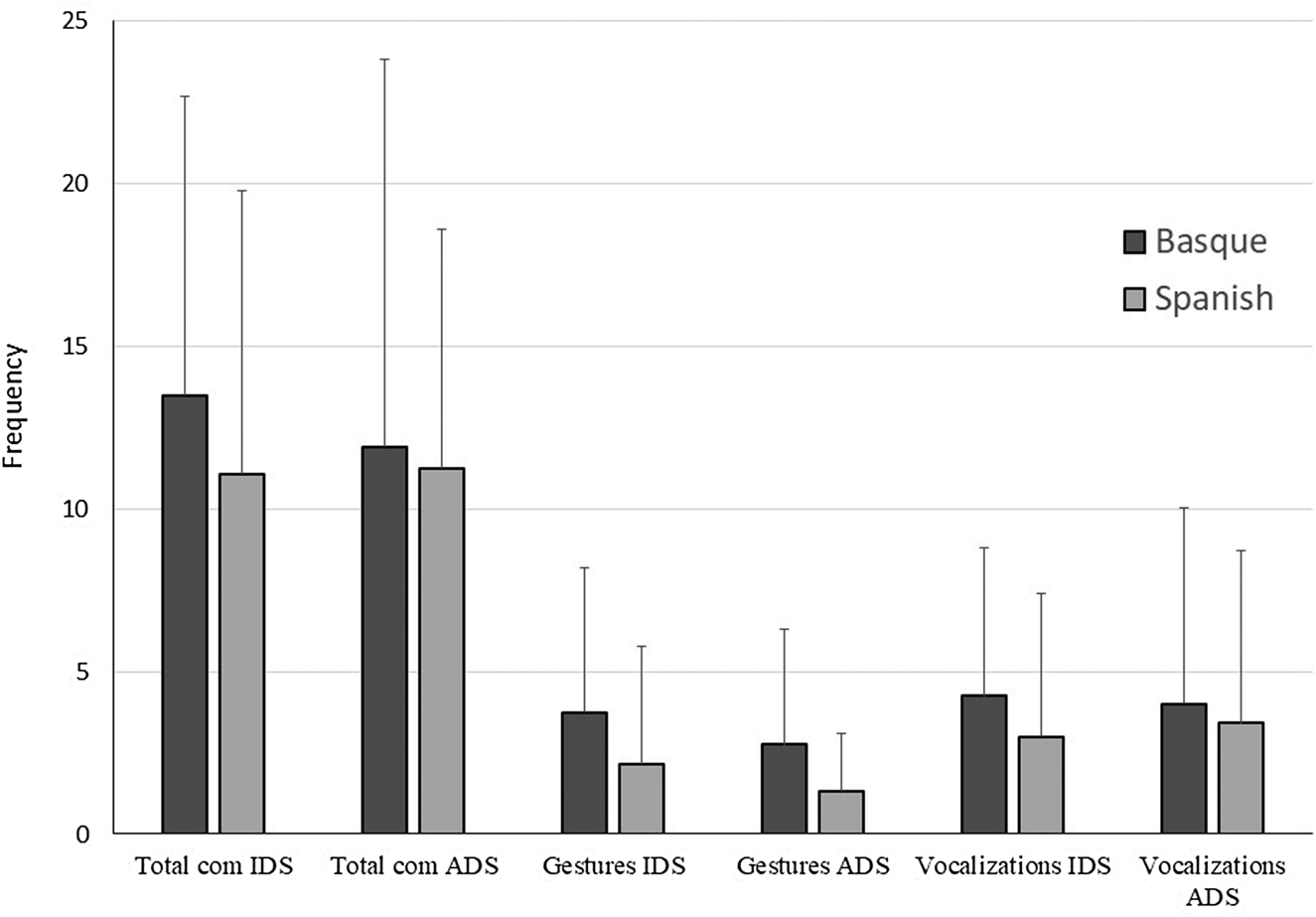
In the first analysis regarding the impact of the type of speech on the willingness to communicate, we took as the dependent variable the total frequency of communicative behaviors produced by the children (total frequency of gestures, vocalizations, and looks at the adult). We did not find any significant effect of type of speech or language, nor of the interaction between them, on the general communicative behaviors produced by children. In the second and third analyses we took, respectively, the frequency of gestures and of vocalizations produced, regardless of whether they were produced in combination or in isolation, as the dependent variable. We found for both variables similar results to those found for the general communicative behavior: no effect of the type of speech, nor of the language or of the interaction (see Figure 1 and Table 4 for details).
Frequency of total communicative behaviors, gestures, and vocalizations in IDS and ADS conditions.

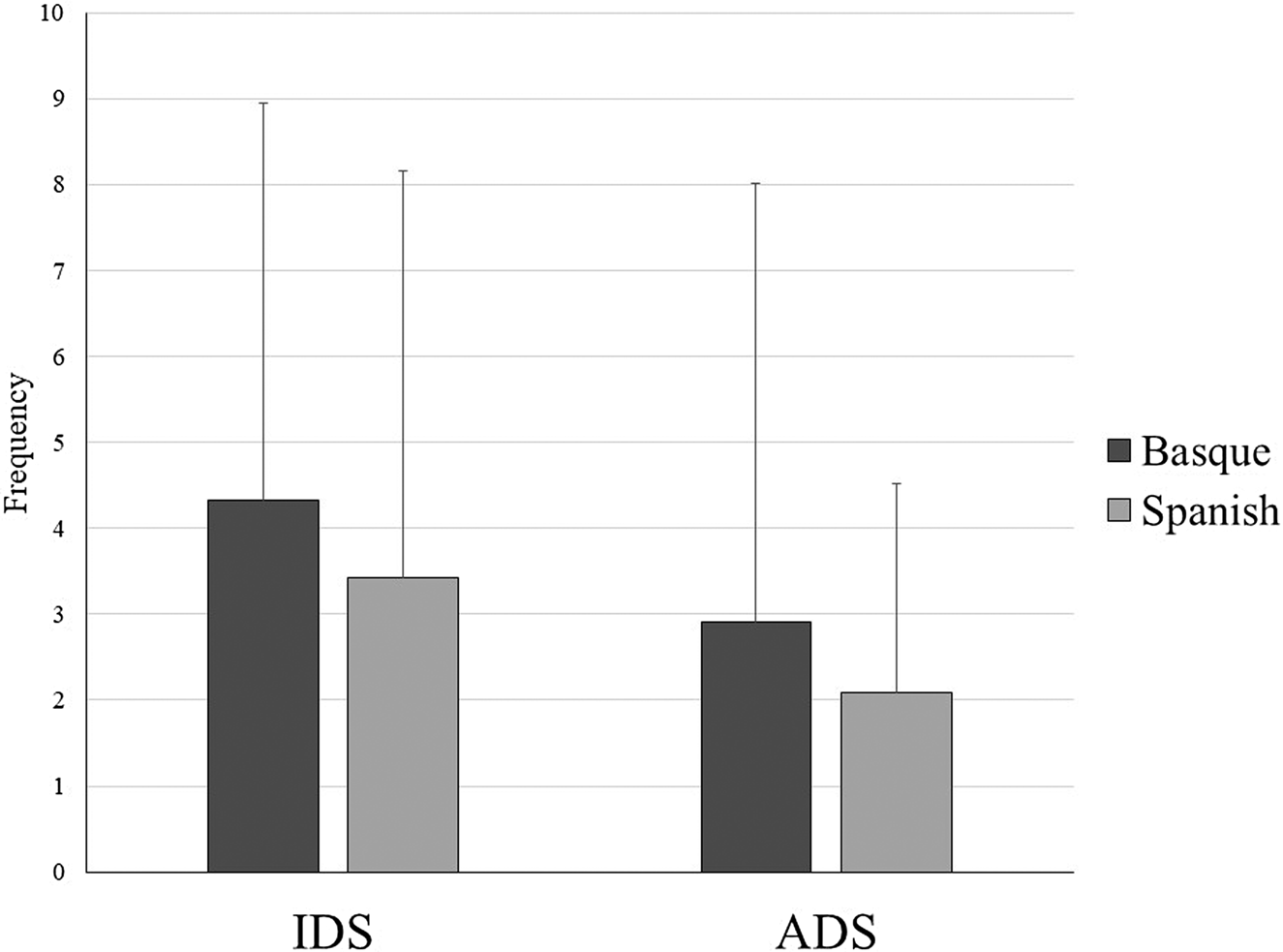
To analyze the effect of the type of speech and language on the multimodal communicative behavior, we took the frequency of multimodal communicative behaviors (that is, the frequency of behaviors that included at least two elements: gesture, vocalization, and/or gaze) as the dependent variable. Once again, we took the type of speech and the language as factors. Figure 2 shows the frequencies of multimodal productions in Spanish and Basque in the two conditions.
Frequencies of multimodal productions in Spanish and Basque in IDS and ADS conditions.

We found a main effect of the type of speech on the frequency of multimodal communicative behaviors (F(1,22) = 5.37; p =. 03; η2 = .19). Children in our sample produced more multimodal communicative behaviors in the IDS condition that in the ADS condition (3.8 vs. 2.5). There were no language (F(1,22) = 0.27; p = .60) or interaction (F(1,22) = 0.005; p = .94) effects.
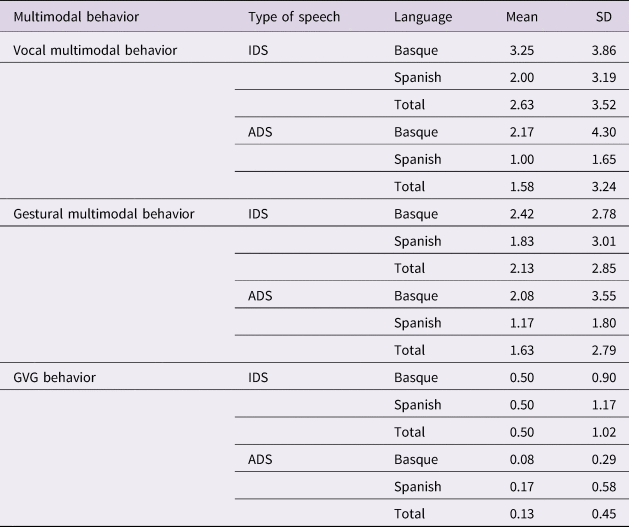
Next, we studied each of the multimodal combinations separately to investigate whether IDS had any effect on the frequency of specific multimodal elements. We took the frequency of vocal behaviors produced with gaze or gesture as the dependent variable, and the same factors as in the previous analyses, and we conducted a repeated-measures ANOVA. The results showed a main effect of the type of speech on the production of vocal multimodal behaviors (F(1,22) = 6.59; p = .01; η2 = .23), with a higher frequency in the IDS condition (2.63 vs. 1.58). Then, we repeated the same analysis but taking as the dependent variable the frequency of gestures produced with vocalizations or gaze to the adult. In this case, we did not find any effect of the type of speech (F(1,22) = 0.92; p = .34) on the multimodal gesture production. Results showed no effect of language (F(1,22) = 0.51; p = .48), nor of an interaction (F(1,22) = 0.10; p = .75). Then, we analyzed specifically the multimodal behaviors composed of three elements: gestures, vocalization, and gaze (GVG). Conducting the same analysis, we found that, although the frequency of GVG behaviors is higher in the IDS condition than in the ADS condition, the differences did not reach statistical significance (F(1,22) = 2.69; p = .11). Table 5 shows the frequencies of each type of multimodal communicative behavior.
Frequency of each type of multimodal communicative behavior

Discussion
Our results showed that IDS had an effect on children's attention and multimodal communicative production at the beginning of the second year of life. Regarding the attention-getting role of IDS, our findings are consistent with previous research. Children in our sample paid more attention to the IDS version of the story, confirming the arousing properties of IDS proposed in previous studies (e.g., Kaplan et al., Reference Kaplan, Goldstein, Huckeby, Owren and Cooper1995). Our work extends the attentional increase towards the social partner of IDS to a non-interactive stimulus, that is, to stimuli whose action is independent of children's behavior. This fact emphasizes the crucial role of IDS prosody on the language learning process, not only in the first months of life (Saint-Georges et al., Reference Saint-Georges, Chetouani, Cassel, Apicella, Mahdhaoui, Muratori and Cohen2013) but still at the beginning of the second year.
Moreover, IDS enhances multimodal social contact with the adult and thus increases the probability of an experience becoming a joint attention episode. In this way, the opportunities for communicative and linguistic exchanges increase in relation to elements that are of interest to the child, and so too do the opportunities for learning a language. In this sense, our findings contribute to establishing an indirect link between IDS processing and productive vocabulary.
Although previous studies have confirmed an increase in children's communicative response to IDS (e.g., Spinelli et al., Reference Spinelli, Fasolo and Mesman2017), our data do not show a general increase in communicative behaviors in children at the beginning of the second year of life. The results concerning the effect of IDS on general communicative behavior frequency indicate that IDS does not increase children's general tendency to communicate.
However, we did find an increase in multimodal production in the IDS condition. The developmental period that we studied is characterized by a progressive increase in multimodal communication (Murillo & Belinchón, Reference Murillo and Belinchón2012; Romero et al., Reference Romero, Etxebarria, de Pablo and Romero2017; Wu & Gros-Louis, Reference Wu and Gros-Louis2014). It seems that children are incorporating their communicative skills especially in those arousing situations which capture their attention.
From all the multimodal combinations, those that include vocal components seem to be more sensitive to an IDS effect. The tendency seen in younger children to vocalize more with IDS and to produce more mature vocalizations with social contingent responses (i.e., Goldstein & Schwade, Reference Goldstein and Schwade2008) has its parallel in multimodal production. In our sample, children do not vocalize more in the IDS condition, but they produce more multimodal behaviors with vocal components. This suggests that in the IDS condition they use their more sophisticated resources to communicate with others. In other words, in an interesting situation ‘they do their best’.
In contrast, our results did not find evidence that the influence of IDS on attention and multimodal production is modified by language. We did not find evidence that the differences between the two languages in their prosodic patterns had an effect on children's attention or multimodal communicative production.
Although our results are very promising and suggest interesting applications at an educational level, our study has some limitations to consider. First of all, the size of the sample is limited. This can affect the power of the analysis and the representativeness of the sample, so results should be interpreted with caution. In this sense, our results must be taken as a starting point for future research. In addition, we do not have direct measurements of the child's gaze, so it would be interesting to broaden the study using an eye-tracking device. The use of an eye-tracker device would allow us to analyze not only the time spent looking at the screen, but also exploratory gaze patterns (time of fixations and exploratory eye-movements) to specific elements involved in the story. This could provide information about how IDS helps to focus on the relevant elements at each point of the story, and about which specific elements elicit multimodal communicative productions. The images employed in the story are static, so it may be interesting to analyze the influence of IDS with dynamic images. Coders had no previous information about the condition, but they could deduce it from the background sound of the recordings. It must also be taken into account that the observation situation is not naturalistic and the voice of the stimulus is not the mother's voice.
It seems, therefore that IDS has an effect on attention and on multimodal communicative production at the beginning of the second year of life. In summary, our results show an effect of IDS on the attention towards an audiovisual stimulus and on specific communicative productions of children in this situation. IDS does not increase the global communicative behavior's frequency, but specifically the multimodal communicative productions. From the multimodal productions, the ones that are more sensitive to IDS are those that include vocal elements. The effect of IDS on multimodal communicative behaviors seems to be independent of the language employed, at least when comparing Basque and Spanish. These findings can be seen as an indirect link between IDS prosody processing and lexical development via multimodal production, and specifically, vocal multimodal behaviors.
Supplementary materials
For Supplementary materials for this paper, please visit <https://doi.org/10.1017/S0305000919000412>.
Acknowledgments
We would like to thank the staff and families from E. I. Caperucita, E. I. Reggio, Alonsotegiko haurreskola, Bekosolo haurreskola, Altzoan haurreskola, Deusto haurreskola, and Zelaieta haurreskola for their invaluable cooperation. We also thank Marta Casla, Jessica Rodríguez, and Celia Méndez for their help in collecting the data, and Jose Manuel Igoa for lending a hand with the manuscript. This research has been partially funded by FEDER, Ministerio de Innovación y Universidades, Agencia Estatal de Investigacion, Project PGC-2018-095275-A-100.