1. Introduction
Are economic perceptions shaped by objective information or in-group biases? The classic economic voting literature assumes that voters evaluate the economy objectively and sanction incumbents accordingly (Fiorina, Reference Fiorina1978, Reference Fiorina1981; Lewis-Beck and Stegmaier, Reference Lewis-Beck and Stegmaier2000). This is at the heart of the sanctioning model of elections, where voters reward governments when the economy is doing well and punish them when it is doing badly (Key, Reference Key1966). Yet, numerous studies of motivated reasoning have found that partisanship creates a “perceptual lens” through which people perceive the world (Campbell et al., Reference Campbell, Converse, Miller and Stokes1960; Zaller, Reference Zaller1992; Bartels, Reference Bartels2002; Redlawsk, Reference Redlawsk2002; Lodge et al., Reference Lodge, Taber, Weber and Redlawsk2006; Bisgaard, Reference Bisgaard2015; Lauderdale, Reference Lauderdale2016). Economic perceptions, they argue, are no exception to this. Voters attached to different parties will perceive the same economy very differently: rosy if their favored party is in government, bleak if it is in opposition (Evans and Andersen, Reference Evans and Andersen2006; Evans and Pickup, Reference Evans and Pickup2010; De Vries et al., Reference De Vries, Hobolt and Tilley2018; Enns et al., Reference Enns, Kellstedt and McAvoy2012; Wlezien et al., Reference Wlezien, Franklin and Twiggs1997; De Boef and Kellstedt, Reference De Boef and Kellstedt2004). The literature on motivated reasoning in political science has focused on the role of partisanship but has paid less attention to the impact of alternative, non-partisan, fault-lines in activating perceptual biases (Leeper and Slothuus, Reference Leeper and Slothuus2014). In this article, we ask: can other salient political divisions also trigger perceptual biases in economic evaluations?
To address this question, we apply the theoretical framework of cognitive dissonance to the 2016 referendum on British membership of the European Union. The historic decision of British voters to narrowly reject the status-quo of four decades of EU membership (“Brexit”) came as a surprise to many and gave rise to salient new political identities linked to the division between “Remainers” and “Leavers” (Evans and Schaffner, Reference Evans and Schaffner2019; Curtice, Reference Curtice2018; Hobolt et al., Reference Hobolt, Leeper and Tilley2020; Richards et al., Reference Richards, Heath and Carl2018). What is more, the Brexit fault-line internally divided the Conservative and Labor parties, each with significant pockets of both Leave and Remain voters and MPs (Evans and Menon, Reference Evans and Menon2017). The Brexit divide, therefore, provides an apposite case to examine perceptual biases triggered by a salient political divide, which cuts across traditional partisan lines.
To test motivated reasoning in the aftermath of the Brexit vote, we combine observational and experimental data. First, we analyze the British Election Study (BES) 2014–2018 panel (Fieldhouse et al., Reference Fieldhouse, Green, Evans, Schmitt, van der Eijk, Mellon and Prosser2018) to compare both current and retrospective assessments of the UK economy by Leavers and Remainers pre- and post-referendum, controlling for partisanship. Second, to determine whether perceptual biases due to Brexit are stronger when the relevant in-group is primed, we designed a survey experiment, fielded with YouGov in July 2018. Finally, we also use the survey-embedded experiment to test whether economic perceptions shaped by the Brexit vote can be corrected by factual information. Studies have shown that partisan perceptual biases are not ameliorated by corrective information, since factual information itself is processed with bias (Kuklinski et al., Reference Kuklinski, Quirk, Jerit, Schwieder and Rich2000; Nyhan and Reifler, Reference Nyhan and Reifler2010; Flynn et al., Reference Flynn, Nyhan and Reifler2017; Lauderdale, Reference Lauderdale2016). We examine if Brexit-related priors are similarly resistant to information.
The findings show that the Brexit referendum created a new “perceptual screen” that shaped people's perceptions of the economy in the UK. Controlling for partisanship, the Brexit divide has an independent effect on economic perceptions. Although Remainers and Leavers did not differ significantly in their economic perceptions in the run-up to the referendum, this changed after the vote: Remainers became more pessimistic about the economy while Leavers remained fairly optimistic in the immediate post-referendum period. The effect is stronger among voters than non-voters, suggesting that the act of voting in the 2016 referendum encouraged people to seek consistency between their vote and their evaluations of the economy. Moreover, results from the experiment show that Leaver/Remainer differences in economic perceptions are further enhanced when their referendum in-group is primed, and persist even when Remainers and Leavers are given identical factual information. This indicates that biased attitudes post-Brexit operate in a similar manner to partisan biases, as they are enhanced by in-group priming and are largely unaffected by corrective factual information.
This study thus contributes to the literature on economic perceptions and economic voting. We extend the work on economic perceptions and motivated reasoning by demonstrating how non-partisan political divisions can shape economic perceptions. The paper also offers important evidence on the role of referendums in generating political divisions that cut across partisan ones and affect electoral accountability. This has broader normative implications for the debate on the role of referendums in modern representative democracies. One of the criticisms of referendums is their majoritarian nature, which can result in societal polarization (Setälä, Reference Setälä1999). The presence of strong perceptual biases along Brexit-lines is one indicator that referendums can deepen social divisions by triggering self- and group-serving processes of justification.
2. Economic perceptions and partisanship
The economic voting model posits that the economy is a powerful driver of voting behavior. It assumes that voters will punish incumbents when the economy is doing well and throw the rascals out when it is performing poorly (Key, Reference Key1966; Tilley et al., Reference Tilley, Neundorf and Hobolt2018). As such, economic conditions provide a powerful heuristic to voters to judge the quality of governments and allow them to hold politicians to account. Although it is too costly for voters to evaluate incumbents’ past records comprehensively, they can more easily review the state of the country's economy. Numerous studies have demonstrated a link between objective macro-economic indicators (e.g., employment, inflation, and real income), subjective individual-level evaluations of the country's economy, and incumbent approval and electoral support. They conclude that incumbents do better when the economy is doing well, and, conversely, lose votes when the economy is shrinking (Kramer, Reference Kramer1971; Fiorina, Reference Fiorina1978; Kinder and Kiewiet, Reference Kinder and Kiewiet1979, Reference Kinder and Kiewiet1981; Kiewiet and Rivers, Reference Kiewiet and Rivers1984; Lewis-Beck and Stegmaier, Reference Lewis-Beck and Stegmaier2000). When controlling for partisanship, however, this relationship seems to weaken or even disappear (Enns et al., Reference Enns, Kellstedt and McAvoy2012; Donovan et al., Reference Donovan, Kellstedt, Key and Lebo2019). This has been explained by positing that partisanship itself could be influenced by governments’ economic performance (Fiorina, Reference Fiorina1981).
However, other scholars suggest that the causal arrow runs in the opposite direction and that economic perceptions are not simply based on objective information of the economy, but rather shaped by individuals’ partisanship (Evans and Andersen, Reference Evans and Andersen2006; Evans and Pickup, Reference Evans and Pickup2010; Enns et al., Reference Enns, Kellstedt and McAvoy2012; Bisgaard, Reference Bisgaard2015). The political behavior literature has documented pervasive motivated reasoning among voters: humans have an innate tendency to selectively acquire and process information. We take longer time in processing counter-attitudinal information and often dispute it through counter-argument or avoid it altogether (Lodge et al., Reference Lodge, Taber, Weber and Redlawsk2006; Redlawsk, Reference Redlawsk2002, Reference Redlawsk2006; Lauderdale, Reference Lauderdale2016). Economic evaluations are not immune to motivated reasoning. Bartels (Reference Bartels2002) finds that Democrats and Republicans diverge in their perceptions of unemployment and inflation, and that their perceptions fail to track the economic reality. Similarly, Evans and Andersen (Reference Evans and Andersen2006) and Evans and Pickup (Reference Evans and Pickup2010) find that political support for the party in government has a very strong effect on sociotropic evaluations of the UK and US economies, whereas examining the inverse relationship from economic perceptions to voting behavior or presidential approval does not yield significant results. In a similar vein, Enns et al. (Reference Enns, Kellstedt and McAvoy2012) demonstrate that Democrats (Republicans) are more optimistic about the economy when a Democrat (Republican) occupies the White House. Moreover, they find that when the partisan component of economic evaluations is filtered out from the time series, economic perceptions are no longer significantly associated with presidential approval. Bisgaard (Reference Bisgaard2015) demonstrates that Labor supporters are more optimistic about the UK economy than Conservative supporters when Labor is in government, and De Vries et al. (Reference De Vries, Hobolt and Tilley2018) further show that government supporters always hold more optimistic views about the economy compared to opposition partisans. Partisans thus appear to polarize over economic performance, instead of converging to the “true” value.
What is more, research has shown that partisan perceptual biases appear to be resistant to factual information: objective information not only fails to change false beliefs but in some cases, it even exacerbates them (the “backfire” effect). Kuklinski et al. (Reference Kuklinski, Quirk, Jerit, Schwieder and Rich2000) show that providing relevant facts on social welfare did not improve the accuracy of experiment participants’ knowledge of welfare facts. Similarly, Bullock (Reference Bullock2007) provide experimental evidence to show that discrediting factual claims can lead to belief perseverance and ideological polarization. In another experiment on the Iraq war, Nyhan and Reifler (Reference Nyhan and Reifler2010) demonstrate that Democrats and Republicans respond differently to corrective information and that corrective information backfires: it leads to an over-reaction from the group most congruent with the misinformation and thus ends up increasing ideological polarization. Accuracy-based reasoning is, therefore, a rare occurrence while perceptual biases are pervasive (Leeper and Slothuus, Reference Leeper and Slothuus2014; Zaller, Reference Zaller1992; Enns et al., Reference Enns, Kellstedt and McAvoy2012; Lauderdale, Reference Lauderdale2016). Bisgaard (Reference Bisgaard2015) finds some evidence of belief updating by Labor and Conservative partisans, but only after facing the incontrovertible economic decline of 2007–8, an information shock produced by one of the worst crises since 1929. However, even then, while voters converged to a similar and truthful assessment of economic reality, they polarized over who was to blame, hindering full accountability (Tilley and Hobolt, Reference Tilley and Hobolt2011).
These findings challenge a core assumption of the classic economic voting model, namely that vote choices are driven by objective assessments of economic performance. Yet, less attention has been paid to whether other political divisions that cross-cut partisanship also bias economic perception in a similar way as partisanship does. It is important to understand whether other political divisions and events can similarly shape how voters evaluate the economy as this has implications for electoral accountability (Campbell et al., Reference Campbell, Converse, Miller and Stokes1960; Conover and Feldman, Reference Conover and Feldman1981; Leeper and Slothuus, Reference Leeper and Slothuus2014; Barber and Pope, Reference Barber and Pope2019). In this paper, we examine this question by looking at economic perceptions in the aftermath of the divisive Brexit referendum.
3. Brexit and motivated reasoning
Partisanship is not the only political divide that can lead to polarized economic perceptions. Building on social psychology, we argue that any high-stakes and the consequential choice situation can induce voters to strongly commit to the choice made, creating incentives to rationalize their actions by, for example, modifying subsequent cognitions, and/or shifting responsibility attributions. Research on cognitive dissonance has shown that individuals seek to actively avoid cognitive inconsistency and consequently they engage in ex-post rationalizations that may distort any new cognition in the direction of a prior one that they need to “defend” (Festinger, Reference Festinger1957; Cooper, Reference Cooper2007). When inconsistencies between two cognitions arise, individuals thus tend to either: (a) modify the incongruent cognition, (b) counter-argue it through the bolstering of congruent items of information, or (c) attribute it to some other factor (responsibility shift). Since concrete behaviors—such as voting—are more difficult to distort, individuals will innately attempt to modify their perceptions of the consequences of their behaviors (Festinger, Reference Festinger1957; Cooper, Reference Cooper2007). These arguments are compatible with arguments from the motivated reasoning literature, which argues that directional reasoning is the result of memory/information searches biased by priors, or by processes of justification construction (Hahn and Harris, Reference Hahn and Harris2014; Kunda, Reference Kunda1990; Lauderdale, Reference Lauderdale2016; Lodge et al., Reference Lodge, Taber, Weber and Redlawsk2006). We argue that motivated reasoning triggered by non-partisan fault-lines has the same properties as party-based directional motivated reasoning: it leads to biases in economic perceptions and resistance to factual information.
The cognitive dissonance framework also argues that not all cognitive inconsistencies will generate cognitive bias: only aversive choice situations have the potential to trigger awareness of cognitive inconsistency and, as a consequence, to trigger the emotional state of dissonance and the need to distort opinions and beliefs (Festinger, Reference Festinger1957; Cooper, Reference Cooper2007). In other words, a choice situation that is not aversive, that is, not likely to generate strong consequences—such as choosing between two yoghurt brands, for example—will not generate the desire to defend one's choice by altering, say, taste perceptions or by reinforcing positive beliefs towards the brand chosen. In the case of electoral choice, the state of dissonance is more likely to arise, and it will be strongest, where contests are particularly salient and consequential. Moreover, perceptual biases are expected to be more severe when “vicarious” cognitive dissonance is also elicited. Vicarious dissonance arises when the individual wants to justify not only his/her choices but also those of an in-group. In choice situations that generate in-group/out-group dynamics, perceptual biases are therefore expected to be even more pronounced (Cooper, Reference Cooper2007). To summarize, cognitive dissonance theory broadly hypothesizes that (a) individuals will bias their cognition in the direction of prior behaviors/actions; (b) the more aversive the consequence of one's behavior, the stronger the cognitive distortions (i.e., perceptual biases); (c) the more one's behavior/action is linked to that of an in-group (i.e., vicariousness), the stronger the cognitive distortions.
As discussed in the introduction, the Brexit referendum created a choice situation that clearly meets the above criteria. Leaving the European Union is an unprecedented eventFootnote 1 which entails significant reforms to many public policy areas. The referendum has exponentially increased the salience of the EU issue dimension and even triggered social identification with “Remainer–Leaver” groupings (Evans and Schaffner, Reference Evans and Schaffner2019; Curtice, Reference Curtice2018; Hobolt et al., Reference Hobolt, Leeper and Tilley2020; Richards et al., Reference Richards, Heath and Carl2018). Due to the significance of the choice situation, we expect that UK voters would distort their perception of the UK's economy performance after the referendum outcome was known, and in the direction of their vote choice.
Following the cognitive dissonance framework outlined above, we hypothesize that perceptual biases would occur only after the referendum, and would be evident both within individuals over time (individual changes in perceptions pre- and post-referendum) and between Remainers and Leavers. After the referendum outcome, Remainers are expected to adjust their perceptions of the economy to view it more negatively, and thereby aligning their perceptions with one of the key arguments for voting Remain, namely that Brexit will have a negative effect on the economy. Having committed—through their referendum choice—to the notion that Brexit would be bad for the economy, they adjust their perception of the economy accordingly, in a process of self-justification. In contrast, we expect Leavers to make either no adjustment to their perceptions of the economy or make a positive adjustment since the economic argument was less integral to the argument for voting Leave and the economic warnings from the Remain-campaign were labeled “Project Fear” by the Leave-campaign (Hobolt, Reference Hobolt2016). Consequently, we expect to see a divergence in perceptions of the economy after the referendum outcome is known. Specifically, we hypothesize that:
H1a: After the Brexit referendum outcome was known, Remainers (who favored the status quo) became more negative in their economic perceptions compared to before the vote, whereas Leavers became more positive.
H1b: After the Brexit referendum outcome was known, Remainers and Leavers start diverging in their economic perceptions, with Remainers perceiving the economy more negatively than Leavers.
These first hypotheses will be tested via panel data analysis, which allows us to track both within and between individual-level changes. To further demonstrate that cognitive dissonance is the mechanism through which the EU issue dimension is biasing economic evaluations, we have designed a survey experiment with a priming treatment, where respondents are reminded of the referendum and their Brexit-related in-groups. Our expectation is that Brexit-induced motivated reasoning is stronger when respondents are reminded of their in-group. This would provide additional evidence indicating that cognitive dissonance is driving the perceptual bias since the triggering of vicarious dissonance is expected to strengthen the need to justify one's actions. We hypothesize the following:
H2: When primed to think about their “Leaver” versus “Remainer” in-group allegiances, the gap in economic perceptions between Remainers and Leavers will be greater than when not primed.
To further examine that Brexit-induced biases in economic perceptions act similarly to partisan ones, we include an experimental factor that manipulates respondent's access to economic information. The expectation is that since both Remainers and Leavers in the information treatment group receive the same information, their economic perceptions should converge. However, if we find that these groups, when exposed to the same factual report on the UK's economic performance, do not converge in their perceptions, it would be an indication that they are less attentive to counter-attitudinal information and are instead bolstering congruent pieces of information in line with their Brexit vote. This would suggest that Brexit-induced biases are similar to partisan ones with regard to resistance to information. However, the baseline hypothesis is that information leads to convergence in economic perceptions.
H3: When individuals receive factual information about the UK's economy, the perceptual gap between Remainers and Leavers on economic conditions will be reduced.
4. Panel data analysis and results
We test Hypotheses 1a and 1b by analyzing the BES 2014–2018 internet panel data (Fieldhouse et al., Reference Fieldhouse, Green, Evans, Schmitt, van der Eijk, Mellon and Prosser2018). To test Hypotheses 2 and 3, we use a survey experiment that was fielded with YouGov in July 2018. The advantage of a panel data analysis is that it allows tracking economic perceptions’ change between Leavers and Remainers over-time as well as change within individual respondents. In the panel data analysis, the unit of analysis is the respondent-wave. The panel follows the same individuals—representative of the UK population—over the 14 waves. Each wave has approximately 30,000 respondents. The main analyses presented below do not correct for panel dropouts and therefore adopt complete case analysis, which simply removes any within-wave missingness and assumes missing records are missing completely at random. However, in Table A2 in the online Appendix, we offer a robustness check using respondents who completed all 14 survey waves, following the suggestion by Verbeek and Nijman (Reference Verbeek and Nijman1992). The number of respondents who completed all 14 waves is 4191. The same regression model was, therefore, run on this small non-attrition sub-sample, and the key results do not change.
We code each respondent as a Leaver, Remainer, or Independent (“Abstainer/Do not Know”) based on their referendum vote intention response to the survey question: “if there was a referendum on Britain's membership of the European Union, how do you think you would vote?”, in each relevant survey wave. Respondents could choose between remain, leave, would not vote/do not know.Footnote 2
The dependent variables—perceptions of current and retrospective economic performance—will be regressed on the interaction between Leave/Remain vote intention—as expressed in each survey wave—and the relevant panel study wave. The interaction is the crucial measure of biased economic perceptions, as it allows us to track wave-by-wave changes in perceptions of economic performance (Bisgaard, Reference Bisgaard2015; Hahn and Harris, Reference Hahn and Harris2014). If there is a divergence between Leavers and Remainers after the referendum, this supports the hypothesis that perceptual biases have emerged as a result of the EU referendum. We, therefore, show patterns before and after the threshold (referendum wave) to investigate whether there is convergence or divergence among Leavers and Remainers, and whether Leavers and Remainers changed perceptions pre- and post-referendum. Importantly, we control for party identification as well as education, personal income, gender, and age. The data are modeled via autoregressive panel ordinary least squares (OLS) regressions with random effects and cluster robust standard errors at the individual level (see Table A1 in the online Appendix).
By examining retrospective as well as current economic perceptions, we can test whether motivated reasoning shapes people's views of the economy in the immediate aftermath of the referendum, without capturing their expectations of what might happen after Britain has left the EU. The retrospective economic evaluation dependent variable is valuable to include alongside current economic perceptions, since the wording of the current economic evaluation survey item may lead respondents to consider the future as well as the current state of the economy, whereas the retrospective evaluation is not easily contaminated by any considerations about the future economic consequences of Brexit.
Economic perceptions are thus measured by the following five-point Likert-scale survey items of the BES:
• Do you think that the economy is getting better, getting worse, or staying about the same?
• How do you think the general economic situation in this country has changed over the last 12 months? Has it: got a lot worse, got a little worse, stayed the same, got a little better, or got a lot better?
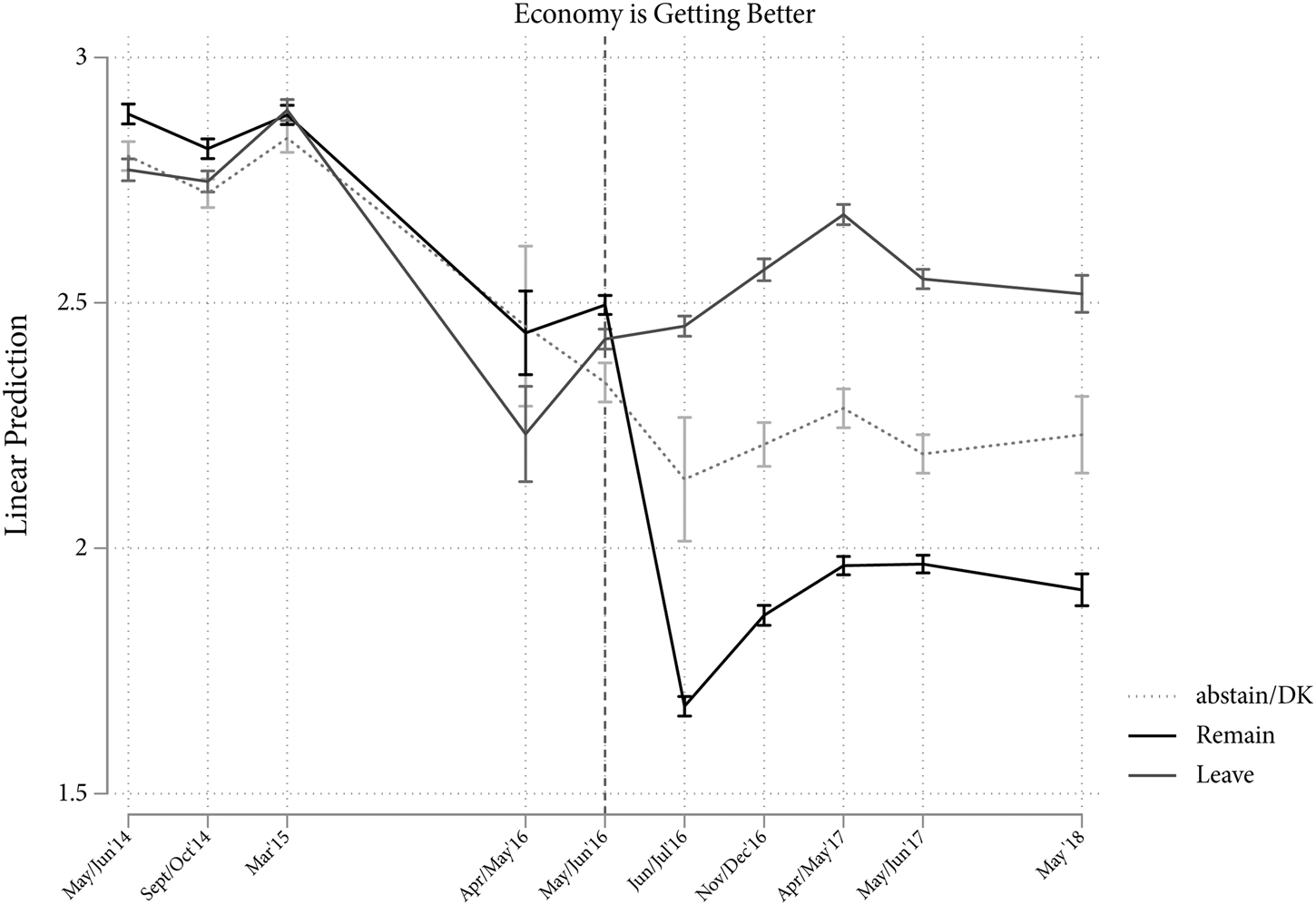
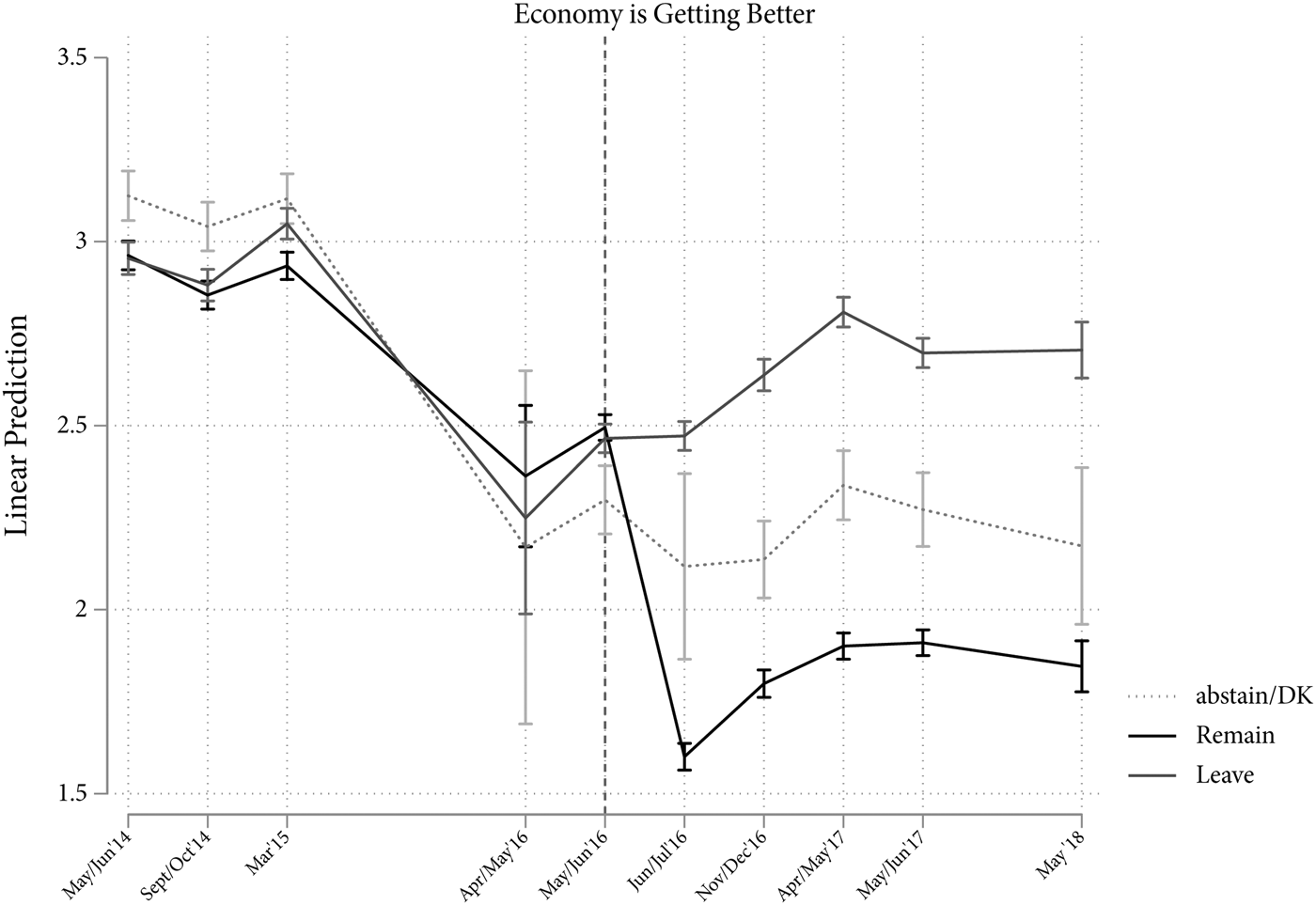
The results highlight that, controlling for party identification, Remainers and Leavers perceive the current state of the economy very similarly to independents (and to each other) before the referendum. Coefficients are small and not consistently statistically significant. When statistically significant, the interactions have similar signs, instead of diverging ones. Remain–Leave vote intentions were, therefore, not acting as perceptual screens before the referendum itself. Perceptions started to diverge considerably post-referendum. From wave 9 (June/July 2016) onwards, Remainers became consistently more pessimistic than independents, whereas Leavers became consistently and significantly more optimistic than independents. The gap in economic perceptions along Brexit-lines thus only appears evident after the referendum, suggesting that these are ex-post rationalizations of the vote.
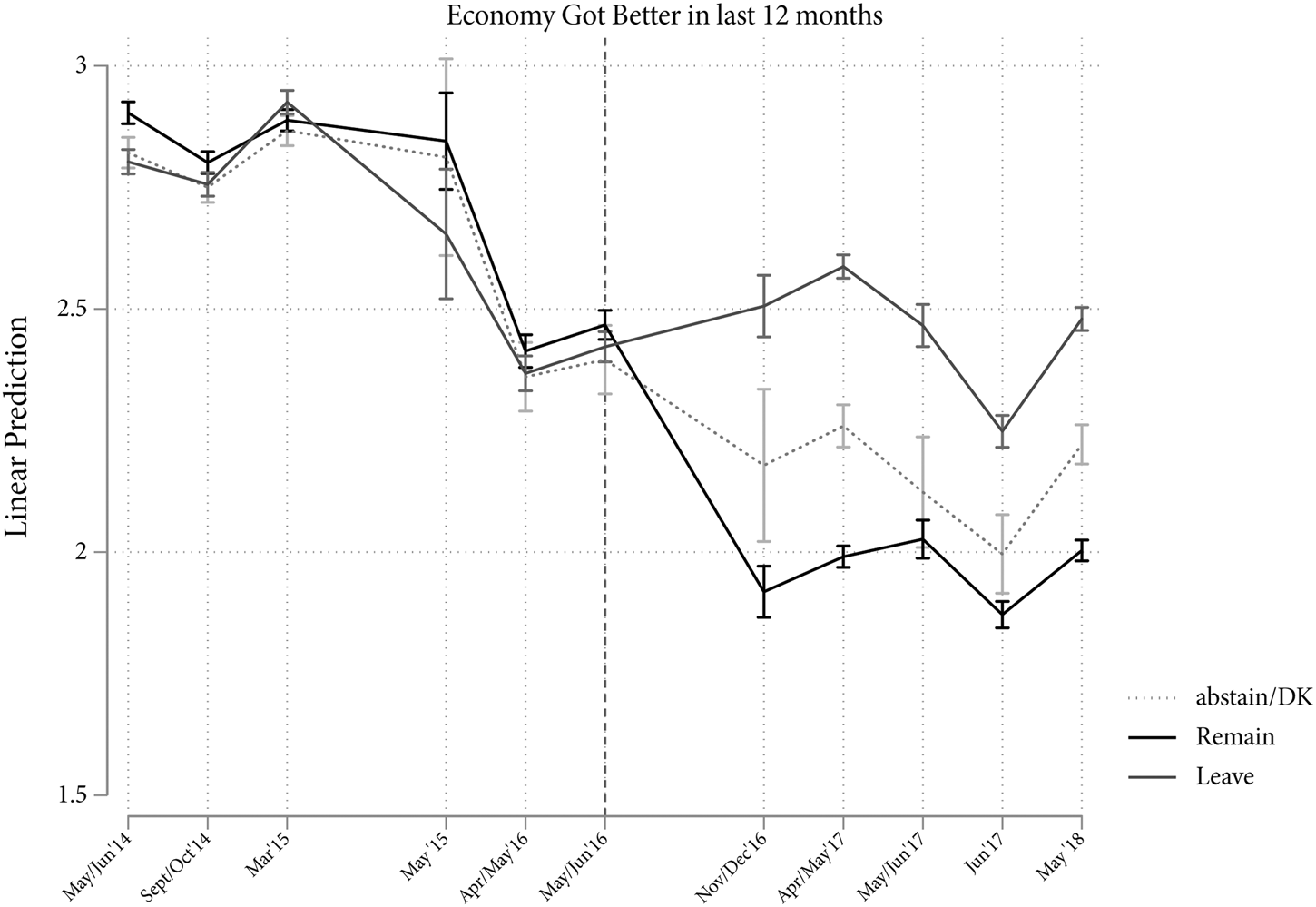
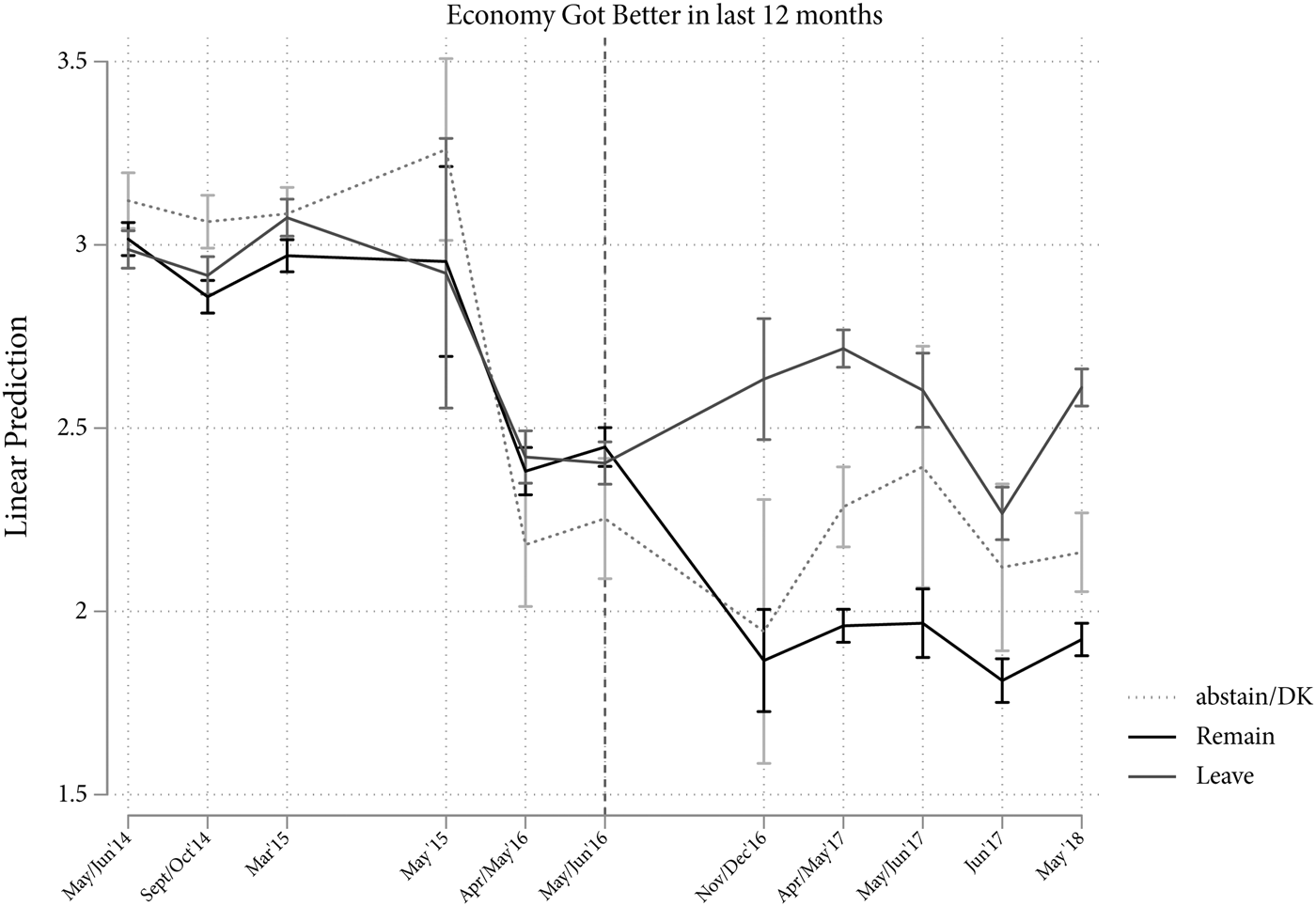
These patterns are confirmed when we try to predict retrospective evaluations of the economy, which provide clearer evidence of biased cognitive processes. If such Brexit-related changes in performance evaluations are at play also when evaluating the UK's past economic situation, it can be more clearly inferred that respondents are biased, in that they deviate from an actual benchmark. Again, keeping party identification constant, Remainers and Leavers did not evaluate the UK's past economy fundamentally differently before the referendum. Comparisons between Leavers, Remainers, and independents (the baseline category) were not robustly significant and when significant, the effects were very small and went in the same direction. However, in wave 10 (November–December 2016), the next available post-referendum wave for the retrospective item, perceptions of past economic performance between Leavers and Remainers start to significantly diverge. In the November/December 2016 wave, Remainers were 0.42 points more pessimistic than independents, whereas Leavers—almost a mirror-image—were 0.24 units more optimistic than independents, thus clearly diverging from Remainers.
The marginal effects graphs (Figures 1 and 2) better illustrate the interaction effects, as they show the gaps between Leavers, Remainers, and independents. The predicted probability graphs show pre-referendum convergence among Leavers and Remainers in both present and retrospective evaluations of the economy, followed by significant perceptual gaps immediately after the referendum. The divergence in economic perceptions of the two camps narrowed somewhat in subsequent survey waves but remained sizable and significant.
Current economy performance. Note: Linear predictions of present evaluations. Higher values indicate more optimism (the economy is getting better). Covariate profile held constant at modal/mean categories: labor, 56–65 age bracket, A-level educational attainment, female, income: 10–20k.

Retrospective economy performance. Note: Linear predictions of retrospective evaluations. Higher values indicate more optimism (economy got better). Covariate profile held constant at modal/mean categories: labor, 56–65 age bracket, A-level educational attainment, female, income: 10–20k

Unsurprisingly, we also find that respondents voting for the party in government throughout this period (the Conservative Party) are more optimistic than independents (the baseline category) on both present and retrospective evaluations, by roughly 0.4 of a Likert scale unit. Voters of the main opposition party (Labor) evaluate the present and retrospective economy more pessimistically than independents, and the same is true for SNP, Plaid Cymru, and Green Party voters as well as voters of other parties. UKIP voters share the Conservative voters’ optimism on the current state of the economy, whereas they are not statistically significantly different than independents on retrospective evaluations. Liberal Democrats’ voters are indistinguishable from independents in current evaluations and slightly more optimistic in their retrospective evaluations of the economy. Hence, the patterns expected by the partisanship literature (economic optimism of election winners and pessimism of losers/opposition) are confirmed here (Anderson et al., Reference Anderson, Blais, Bowler, Donovan and Listhaug2005).
As far as demographic controls are concerned, the more educated and well-off respondents are more likely to view present and retrospective economic conditions positively. Older respondents and females hold more pessimistic perceptions of the current/retrospective economy than younger respondents and male respondents.
To dispel concerns that the multi-collinearity between partisanship and referendum vote intention can bias the estimator we also re-ran the same models without partisanship as a control. The results are available in the online Appendix (Table A4), and the inferences drawn above remain valid when removing this control. Moreover, to further explore the interaction between partisanship and Brexit-related attitudes, we also ran a triple interaction model (see Table A5 in the online Appendix) with partisanship. Figures 1 and 2 in the online Appendix (which summarize the regression model in Table A5) visually demonstrate the results of the three-way interaction. The perceptual gap persists even when examining Leave/Remain in-groups within party groupings: conservative voters grow more polarized on economic perceptions along Brexit lines and, even if their party is in government, conservative respondents that are pro-Remain become more pessimistic on the economy. The same patterns are evident within Labor too (and other parties as well).
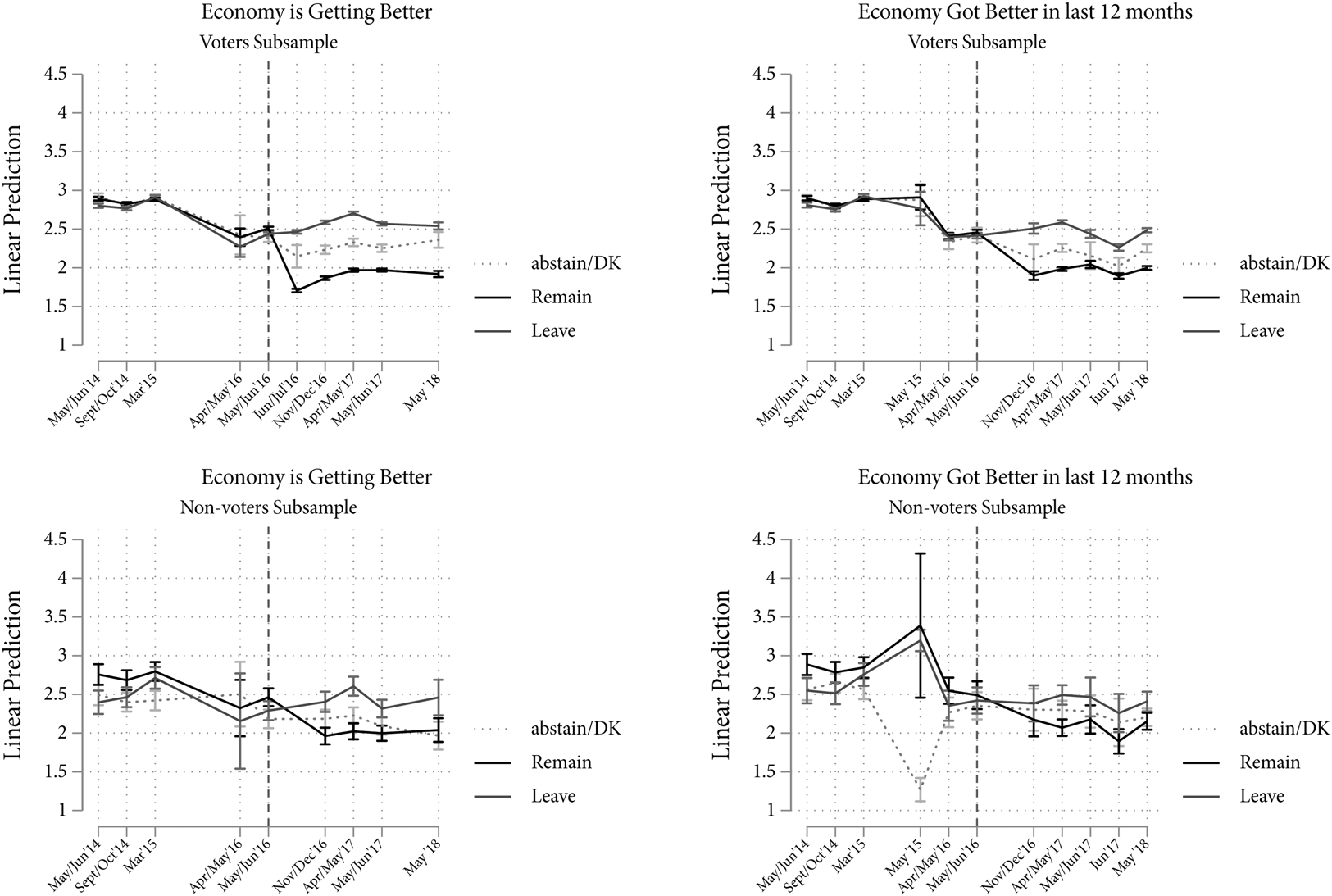
One alternative reading of the results could be that the divergence in perceptions is driven by the increased salience of the Brexit issue in the wake of the referendum. According to this view, it is the increase in the salience of Brexit, together with the diverging expectations of the consequences of Brexit that pushes Leavers and Remainers to update their views on the economy differently in the wake of the referendum outcome. To provide further evidence that the divergence is driven by cognitive dissonance processes, we also run a split sample analysis comparing the trends for actual voters and non-voters, which complements the dynamic analysis of pre-referendum parallel trends and post-referendum divergence provided above. Using the survey item on turnout in the EU referendum (first asked in wave 10—November/December 2016)Footnote 3, we can distinguish between Remainers and Leavers who voted against Remainers and Leavers who reported having abstained. As mentioned above, the classification of respondents as Leavers or Remainers was based on a vote intention survey item, which does not capture the concrete act of voting, but rather pro-Remain and pro-Leave self-identification. The observable implication of our cognitive dissonance hypothesis is that the incentive to engage in the cognitive modification is stronger for individuals who have behaviorally committed to an in-group (in our case, the Leave–Remain camps). Therefore, we should expect that post-referendum perceptual change and divergence among Leavers and Remainers are stronger for individuals who actually voted, and weaker in individuals who—although having a position on Brexit—did not vote.
The results of this alternative specification are presented by way of marginal plots (see Figure 3 below) and the full results are in the online Appendix (Tables A6 and A7).
Economic performance evaluations—voters versusnon-voters. Note: Linear predictions of present evaluations. Higher values indicate more optimism (economy is getting better/got better). Covariate profile held constant at modal/mean categories: labor, 56–65 age bracket, A-level educational attainment, female, income: 10–20k.

The results obtained from the split sample analysis above conform to our expectation as we see a greater perceptual change and divergence among voters (top row graphs) than among non-voters (bottom row graphs). Both voters and non-voters are exposed to the referendum outcome and yet the intensity of perceptual biases differs according to whether an individual actually voted in the referendum. Of course, these results are suggestive, since voters are often more informed and politically interested than non-voters. We have run a robustness check using only the sub-sample of high knowledge respondentsFootnote 4 (see Tables A8 and A9 in the online Appendix) and the main results are unchanged: the Leave–Remain perceptual bias is present among voters, but absent among non-voters, even when keeping respondents’ level of knowledge of EU affairs constant.
In sum, the results obtained from the panel data show that economic perceptions are biased along Brexit lines only after the referendum itself and mostly for individuals who voted in the 2016 referendum. In line with the cognitive dissonance framework, Remainers rationalize their vote choice by bolstering negative aspects of the UK's economy while Leavers do the opposite. This result holds when keeping party identification and relevant social demographics constant. The findings show that while Leavers and Remainers did not differ in their economic performance evaluations before the referendum, polarization is evident after the referendum as Remainers became significantly more pessimistic about the economy while Leavers become more optimistic, in line with our cognitive dissonance expectations.
5. Survey experiment: analysis and results
To further examine the psychological mechanism linking the Brexit referendum to biased economic perceptions, we have conducted an experiment embedded in an online survey of a nationally representative sample of the adult British population. The survey design allows us to test for the presence of vicarious dissonance, by randomly varying exposure to Leave–Remain in-group priming. It also allows us to test whether factual information on the economy can reduce Leaver/Remainer gaps in economic perceptions. By manipulating the information available to individuals about the economy and the salience of their referendum identity, this experiment offers insights into whether the perceptual biases reported above can be minimized by factual information or are as obdurate as partisan ones.
Our fully crossed (2 × 2) survey-based experiment was fielded between 24 and 26 July 2018 by the reputable survey organization YouGov. A total of 3267 UK citizens above the age of 18 took part and were randomly exposed to three experimental and one control condition. The experimental factors are fully crossed, meaning that we have one treatment group exposed to the referendum in-group prime only, a second treatment group exposed to the information condition only, a third treatment group that was exposed to both identity prime and the information treatments, and a group that was exposed to neither condition (control group). The individuals in the control group (no referendum prime and no information) are only asked the economic performance questions. Balance tests demonstrate that randomized experimental groups do not differ in key demographic and attitudinal variables (see Table A10 in the online Appendix).
The in-group priming treatment asks respondents whether they identify as a Leaver or Remainer or neither. This is a (subtle) way of priming respondents to think of Brexit-related social identities. Of those respondents subjected to the priming treatment, the vast majority (82.1%) reported identifying as either a Leaver or a Remainer, highlighting that most people in the UK identify with Brexit identities (Curtice, Reference Curtice2018; Hobolt et al., Reference Hobolt, Leeper and Tilley2020). Only 14.3% reported no allegiance and 3.6% did not answer. The treatment was formulated as follows:
Since the EU referendum, some people now think of themselves as “Leavers” and “Remainers”, do you think of yourself as a Leaver, a Remainer, neither a Leaver nor a Remainer?
In our second treatment, we randomly assign respondents to factual information about UK economic performance. We chose an excerpt from the 2018 report on economic growth by the Office for National StatisticsFootnote 5. This source was chosen as it was the most likely to be perceived as objective by readers. Responses to this treatment are thus expected to be based on the message itself rather than the source. The content is a balanced statement on the state of the UK economy: it reports GDP growth in 2018, but it also reports growth slowing down when compared to previous periods. The general message that it conveys is that the UK economy is still growing, albeit more slowly than usual. The cognitive dissonance model would predict confirmation biases, and hence selective processing of this information: Leavers are expected to bolster the economic growth message, whereas Remainers are expected to bolster the message about how economic growth is slowing down, thus preserving the polarization between them. Hypothesis 3 expects that factual information can act as a corrective and reduce polarization among Leavers and Remainers. If it is rejected, the expectations from the cognitive dissonance model would be corroborated. The information treatment is worded as follows:
The UK's GDP annual growth rate was 1.2% in the first quarter of 2018. The UK Office for National Statistics reports that this is the slowest growth in the UK since 2012.
To measure the outcome variable—perceptions of the UK economic context—the following survey items were used:
1. How do you think the UK's economic growth rate currently ranks in comparison to the other 34 developed countries part of the OECD? Please give a ranking from 1 to 34, where 1 means that you consider the UK to currently be the best-performing economy in the developed world, and 34 means that the UK is the worst performing one. If you do not know the answer, please make your best guess.
2. Do you think that the economy is getting better, getting worse, or staying about the same?
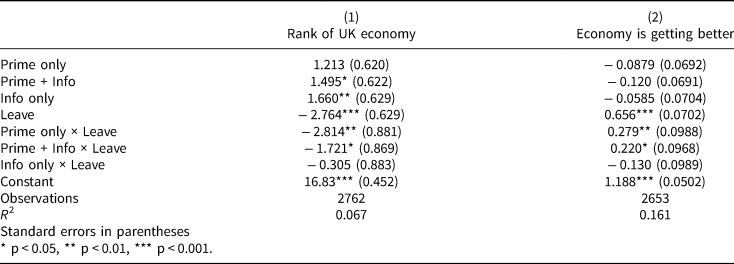
We have included a ranking variable in the experiment both to provide an alternative to the traditional economic perceptions survey item, and to have an objective benchmark. We know that the OECD ranked the UK economy in the first quarter of 2018 as 32 out of the 34 economies in terms of real GDP growth, and we can use this information to check respondent's level of bias and compare Leavers and Remainers’ responsesFootnote 6. In the case of the first dependent variable, higher numbers denote greater economic pessimism (as a rank of 34 would mean that the UK growth was considered to be the worst-performing among the 34 OECD countries), whereas the opposite is true for the second economic perception survey item. The regression table below (Table 1) tests hypotheses 2 and 3, that is, it examines whether priming and/or information have an impact on the Leave–Remain perceptual bias. If the factual information treatment causes Leavers and Remainers to have more similar economic perceptions, that would provide empirical support for hypothesis 3. If the in-group prime treatment leads to further divergence that would support hypothesis 2.
Survey experiment: regression results

Note: OLS Regression. The rank dependent variable (model 1) has no missing observations. Tests on missing observations of dependent variable 2 show no attrition by treatment group and referendum vote
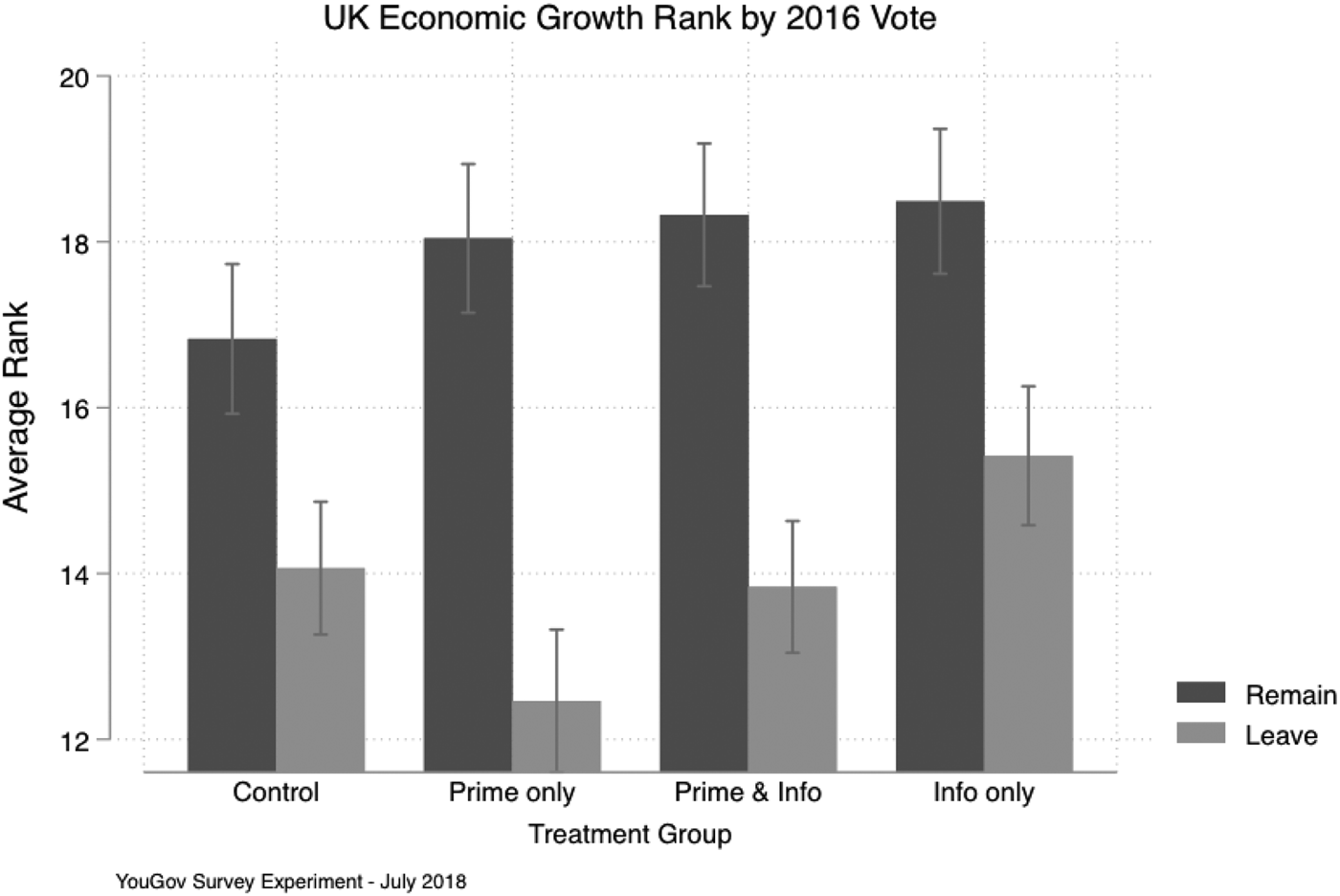
We find strong support for hypothesis 2: priming participants to think about their Remainer/Leaver in-groups statistically significantly increases the divergence in their perceptions of the economy. We do not find support for hypothesis 3: the information treatment does not statistically significantly change the baseline divergence in perceptions of Leavers and Remainers recorded in the control group. We find that Leavers report lower (i.e., more positive) ranks of British economic growth than Remainers, as expected. Leavers’ ranks of the UK economy are further reduced (by 2.8 points) when they receive the identity priming treatment, and by 1.7 points lower when they receive both the priming and information treatment, compared with the control group. Information in conjunction with priming seems to reduce the effect of Brexit-related identities on opinion-divergence, but without neutralizing it. The information-only treatment does not change Leavers’ and Remainers’ divergence in perceptions in a statistically significant way. It does shift both Leavers and Remainers to be slightly more pessimistic, but it is merely an intercept shift since the perceptual difference between Leavers and Remainers remains of the same size. There is, therefore, no evidence of convergence after exposure to identical information. That Leavers and Remainers are engaging in selective processing of specific aspects of the ONS report is, therefore, a real possibility.
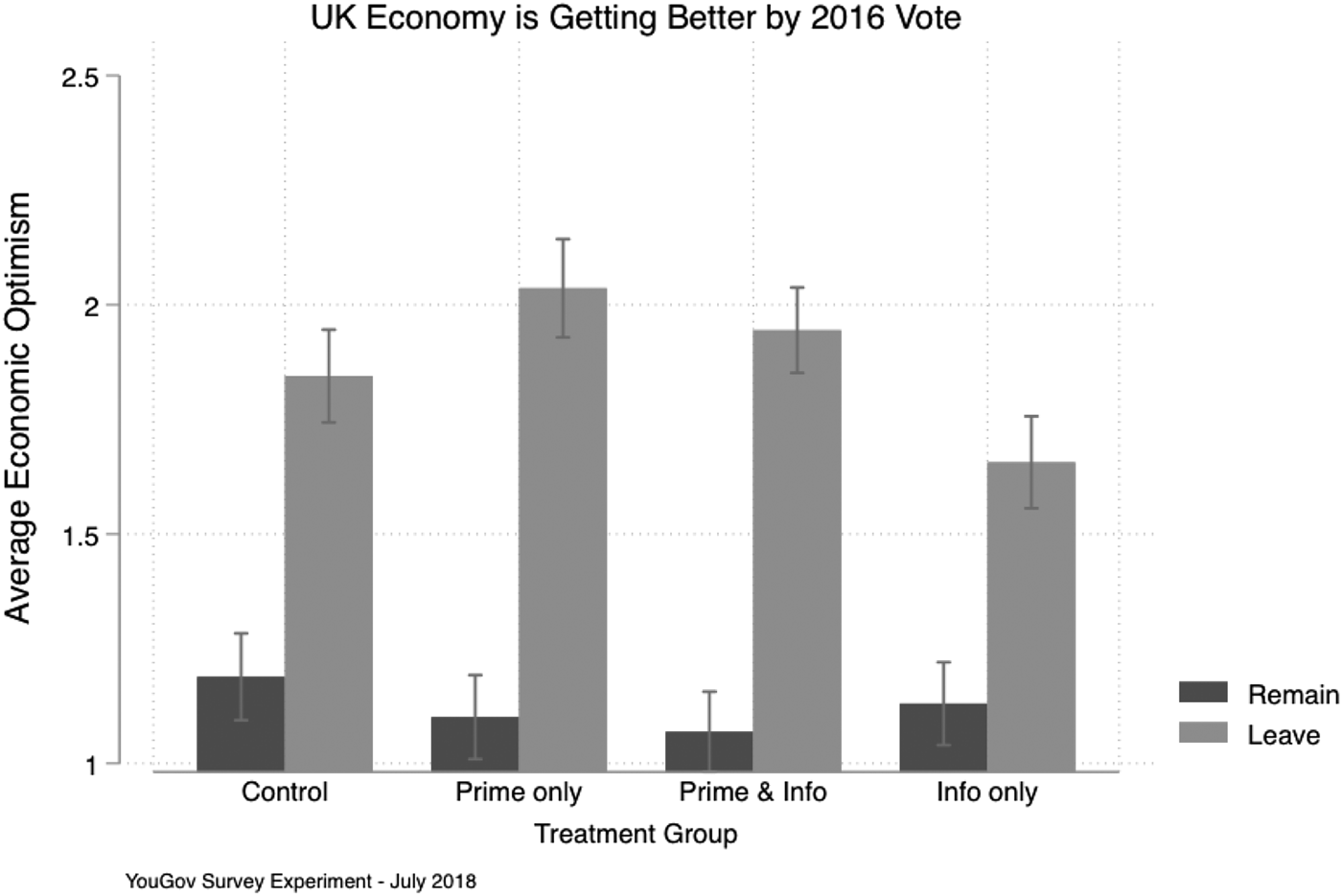
These results are further supported in our analysis of the second dependent variable (“Do you think that the economy is getting better, getting worse or staying about the same?”) where Leavers report 0.65 of a Likert scale unit higher optimism on economic performance than Remainers, a difference that is further increased in the priming treatment (by additional 0.28 units) and in the priming + information treatment (by additional 0.22 units). Again, we find that the information treatment does not statistically significantly change the perceptual divergence of Leavers and Remainers when compared with the perceptual divergence in the control group.
The graphs below (Figures 4 and 5) show average ranks and responses to the economic change question from Leaver and Remainers as well as how the perceptual gap between Leavers and Remainers widens (or narrows) by treatment group. They graphically show that taking the rank question, for example, Leavers report smaller rank values than Remainers (i.e., Leavers rank the UK higher) by roughly 3 units in both the control and the information groups. When primed, however, and irrespective of information exposure, Leavers report rank values smaller than almost 6 units (primed group) and 5 units (prime with information group) than Remainers. Figure 5 shows similar patterns: primed groups are different from both the control and the information groups, and tend to display higher levels of Leaver–Remainer divergence. In contrast, the information treatment merely results in a small intercept shift but does not lead to a reduction in the perceptual gaps. In sum, we find strong support that the cognitive dissonance mechanism is what is driving the EU issue to bias respondents’ perceptions of the UK's economy. The EU issue dimension triggers perceptual biases that are as strong as partisan ones: they are heightened when group allegiance is primed and are not reduced by factual information.
Average UK economy ranks between Leavers and Remainers by treatment group. Note: Dependent variable: How do you think the UK's economic growth rate currently ranks in comparison to other the 34 developed countries part of the OECD?

Average perceptions of economic improvement between Leavers and Remainers by treatment group. Note: Dependent variable: Do you think that the economy is getting better, getting worse, or staying about the same?

6. Robustness test: highly informed respondents
We tested hypothesis 3 using a minimal information treatment: one with no monetary incentives and a relatively short vignette. To further check whether more information can counteract motivated reasoning and reduce perceptual divergence among Leavers and Remainers, we have re-run the same panel analysis above on a sub-sample of highly informed respondents. If the same perceptual biases in economic evaluations are present, this would strengthen our conclusion from the experimental data that is highly informed does not necessarily counteract motivated reasoning. If highly informed respondents are prone to the same perceptual biases as everybody else, then the effect of political divisions on perceptions is not driven by uninformed, inattentive, and impressionable voters and it is unlikely to disappear through the use of information campaigns.
To measure levels of information, we use the EU knowledge items asked in wave 8 (the pre-referendum wave) of the British Election Study (see footnote 4 above for a description of the variable). We assume that respondents who know how the EU works will have based their referendum vote on their assessments of the EU, and would also have a higher capacity to know the Brexit time-line and to more realistically link the effects of exiting the EU on the economy. We also assume that such individuals would be interested in learning about the economy and political developments in general, being knowledge of the EU so technical and generally hard to come by for the average citizen (Hix, Reference Hix2008). It is also important to note that the EU knowledge index was not highly correlated with the EU Referendum vote intention variable. High knowledge respondents were not significantly more likely to be pro-Remain.
Figures 6 and 7 report the marginal effect graphs for both dependent variables. The full regression results can be found in Table A11 of the online Appendix. The key inferences derived from this high EU information sub-sample are very similar to those from the full analysis. Even in this sub-sample of highly informed respondents, perceptions of the UK economy started to diverge among Leavers and Remainers after the referendum result. The conclusions drawn from the minimal information treatment that we run in the survey experiment are replicated with the observational data: high information does not lead to convergence in perceptions among individuals from different sides of a salient political division.
Current economy performance—high EU knowledge respondents. Note: Linear predictions of present evaluations. Higher values indicate more optimism (the economy is getting better). Covariate profile held constant at modal/mean categories: labor, 56–65 age bracket, A-level educational attainment, female, income: 10–20k.

Retrospective economy performance—high EU knowledge respondents. Note: Linear predictions of retrospective evaluations. Higher values indicate more optimism (economy got better). Covariate profile held constant at modal/mean categories: labor, 56–65 age bracket, A-level educational attainment, female, income: 10–20k.

7. Conclusion
There is a wealth of evidence in the literature that partisanship generates a “perceptual screen”, which shapes both perceptions and behaviors. In this paper, we have extended this literature by examining the presence of perceptual biases along non-partisan fault-lines in the aftermath of the Brexit referendum. We find considerable evidence of biases in perceptions of both present and retrospective economic performance along Brexit-lines. While there was no perceptual gap between Leavers and Remainers before the referendum, economic perceptions polarized afterward. Albeit exposed to the same economic context, Leavers and Remainers developed distinct perceptions of the state of the country's economy in the aftermath of the referendum. The panel data analysis shows that once the referendum outcome was revealed, Leavers and Remainers changed their perceptions of the economy in line with their vote choice. As the winners of the vote, Leavers became more optimistic about the economy. As the losers, Remainers developed more negative economic perceptions. This is not due simply to salience and revealed information post-referendum: the perceptual gap is mostly driven by those who voted in the referendum, that is, those who behaviorally committed to the Leave–Remain divide, which is compatible with the cognitive dissonance mechanism. These findings are also compatible with similar studies on the effect of partisanship on economic perceptions, which find that voters’ economic evaluations become more optimistic when the in-group party wins office and more pessimistic when the opposing camp wins the election (Enns et al., Reference Enns, Kellstedt and McAvoy2012; Evans and Andersen, Reference Evans and Andersen2006; Evans and Pickup, Reference Evans and Pickup2010).
The survey experiment further shows that these non-partisan biases in economic evaluations are enhanced by priming in-group identities. Moreover, in line with recent evidence on partisan perceptual biases, we find that providing factual information on the economy does little to reduce the gap in perceptions between Leavers and Remainers (Nyhan and Reifler, Reference Nyhan and Reifler2010; Bullock, Reference Bullock2011; Kuklinski et al., Reference Kuklinski, Quirk, Jerit, Schwieder and Rich2000). The finding is also replicated by carrying out the panel analysis on high-knowledge respondents: the post-referendum biases outlined above hold for high knowledge individuals as well as for low knowledge respondents.
The evidence points to cognitive dissonance as a key psychological mechanism explaining Brexit-related perceptual biases. The timing of the perceptual gap between Leavers and Remainers, and the finding that it is stronger among voters than non-voters, is in line with the hypothesis that perceptual biases are ex-post rationalization of prior actions. Furthermore, the experimental evidence reveals these biases are more pronounced when respondents are reminded of the referendum and, specifically, of their allegiance to the Leave–Remain in-groups, which heightens the psychological state of vicarious dissonance.
The study has several implications. First, it has implications for the economic voting model. Research has shown that governments are rewarded electorally when voters believe the economy is going well. However, the assumption that perceptions of the economy track the economic reality—and that the economic vote is related to actual government performance—is further challenged here. We know from numerous studies that perceptions of the economy are shaped by partisan in-group cues (Bartels, Reference Bartels2002; Enns et al., Reference Enns, Kellstedt and McAvoy2012). In this paper, we have demonstrated that other political divisions can have the same effect, further complicating voters’ perceptions of the economy.
The second implication concerns party system realignment (Abramowitz and Saunders, Reference Abramowitz and Saunders1998). Since economic evaluations matter for government approval and electoral success, and since we demonstrate that economic evaluations may be swayed by issues that internally divide parties, the evidence on Brexit biases indicate that such divisions could create incentives for realignment along Brexit lines. For example, if a party knows that a particular position on Brexit may reinforce the economic message they want to send to the electorate (positive if in government, negative if in opposition), the party may be encouraged to more forcefully pick the relevant stance on the issue, resolving any internal division. The party will then alienate some voters while attracting new ones, and this may lead to a gradual realignment, as we have witnessed in the British context since the Brexit referendum, with Leavers shifting to the Conservative Party and Remainers shifting to Labor and the Liberal Democrats (Hobolt, Reference Hobolt2018). However, this may also apply to other contexts with cross-cutting divisions, such as separatism in Catalonia. Studies have shown that whenever the separatist–unionist divide becomes more salient, separatism changes the parameters of economic voting (Serrano, Reference Serrano2019; Martí and Cetrà, Reference Martí and Cetrà2016; Bosch, Reference Bosch2016; Muñoz and Tormos, Reference Muñoz and Tormos2015). This paper identifies the process through which alternative political divisions can put pressure on the party system.
Finally, the paper has implications for the study of direct democracy. Referendums allow voters to decide directly on policy issues and can be seen as a quintessential democratic exercise. However, we show that referendums can trigger divisions, induce polarization, and perceptual biases. While popular antipathy towards the EU in the UK was long in the making (Evans and Menon, Reference Evans and Menon2017; Curtice, Reference Curtice2017), the salience of the EU issue was far lower than core concerns such as the economy, health care, and immigration prior to the referendum. The referendum itself led to the rise in the salience of the EU issue (YouGov, Reference YouGov2019). What is more, it triggered identification and affective polarization along Remain–Leave lines (Curtice, Reference Curtice2017; Hobolt et al., Reference Hobolt, Leeper and Tilley2020). This study has demonstrated that divisive referendums may trigger, or enhance, perceptual biases in how voters see the economy, which could have long-term consequences that go beyond the policy question on the ballot paper.
Supplementary material
To view supplementary material for this article, please visit https://doi.org/10.1017/psrm.2020.50.