The [Hendrix] “Star Spangled Banner” is probably the most complex and powerful work of American art to deal with the Vietnam War.
—Charles Shaar MurrayFootnote 1For Jimi, it [“The Star-Spangled Banner”] was a musical exercise, not a manifesto.
—Charles CrossFootnote 2His National Anthem. . . is meaningless and constitutes the cheapest kind of sensationalism.
—Pete Johnson (Los Angeles Times)Footnote 3Jimi Hendrix's 1969 performance of “The Star-Spangled Banner” at the Woodstock Music & Art Fair has been interpreted as perhaps the most powerful symbol of rock's potential for protest. Although not particularly controversial in the immediate aftermath of the festival, Hendrix's Woodstock Banner has been ever more deeply inscribed in U.S. cultural memory—propelled by commemorative recordings, tribute performances, and especially the 1970 documentary film Woodstock.Footnote 4 Yet its status as legend also serves to obscure. Myth results in both an exaggeration of the Woodstock Banner's influence as well as a fundamental misunderstanding—and possibly a gross underestimation—of Hendrix's art as political commentary.
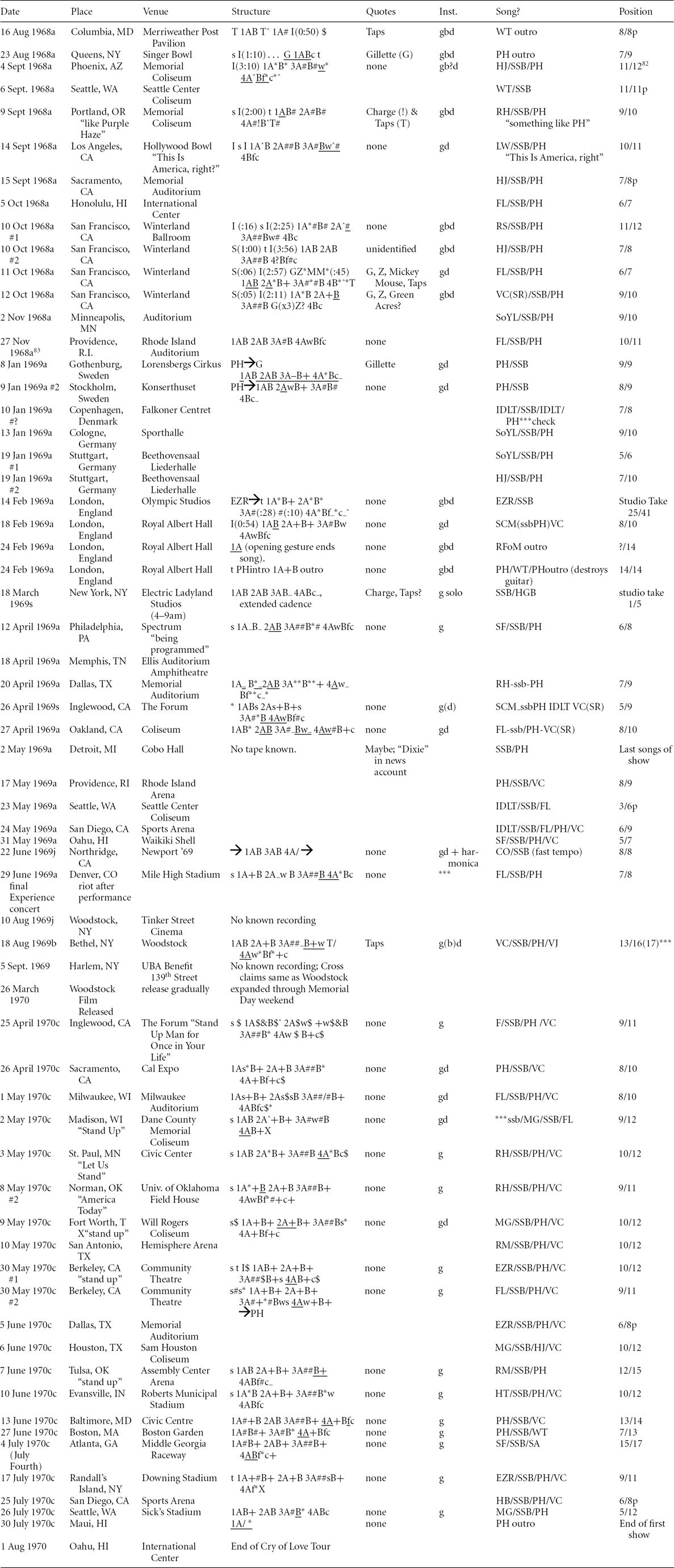
Rather than a single, ecstatic improvisation, Hendrix's Woodstock Banner is more revealingly thought of as part of a simmering process of mourning, celebration, critique, and activism brought forth in more than sixty performances, spanning August 1968 (over a year before Woodstock) to August 1970 (a month before the guitarist's death).Footnote 5 A broader analysis reveals Hendrix's Banner—as I will refer collectively to his many performances of the anthem—as sonic snapshots, taken repeatedly and often to catalog the state of the nation and to call for change. During a period fraught by racism and war in Vietnam, assassinations of national leaders and battles for civil rights, expanding commercialism and intergenerational conflict, Hendrix's Banner amplified and thus made audible the nation's social “static.” This article takes Hendrix seriously as both a composer and social critic. Musical analysis chronicles the guitarist's subjective and uneven journey of understanding: from ex-paratrooper, defender of the United States military, and ardent anti-Communist; to skeptic of U.S. policy, politicians, and commercialism; and finally to anti-war and civil rights activist who overtly supported dissent and desertion and offered a critique of not only the nation but the complacency of his fans. Hendrix's politics were conflicted and complex, bloody and hopeful, and thus resist easy summary. What he offered was less the sound of revolution than the musical re-enchantment of sociality that transcended ideological authority in favor of a participatory and youth-driven psychedelic citizenship.
Myths and Misunderstandings
At least two factors have created confusion surrounding Hendrix's renditions of “The Star-Spangled Banner.” First, Hendrix himself was often elliptical in discussing his anthem performances in major media outlets, defusing criticism and possibly playing into expectations that his drug use and entertainer's lifestyle dulled any intellectual edge he might have. Second, the notoriety of and nostalgia for the 1969 Woodstock Music and Art Fair has collapsed history and effectively silenced the more than three dozen other anthem performances by Hendrix that survive, primarily on little-known bootleg audience tapes, but also on a handful of commercial releases.Footnote 6
Although this evidence, especially the bootleg tapes, must be tempered by uncertain provenance and inevitably poor audio quality, these recordings vastly enrich our understanding of Hendrix's Banner. They not only document Hendrix's creative journey, but also offer clues in the politically charged words he often spoke from the stage to introduce and propel these performances that help decipher the meaning of the guitarist's sonic rhetoric. The tapes also dispel several Woodstock Banner myths, such as the notion that it was a spontaneous improvisation, that the Woodstock Banner was an unqualified negative critique, and even the simple notion that the Hendrix Banner was a guitar solo. Further, locating Hendrix's performance in historical context relative to both the specifics of venue as well as 1960s activism reveals the political impact of the Hendrix Banner to be at once more precise and less radical. Ultimately, listeners can find a range of responses within the rich sonic and semantic tapestry Hendrix wove using Francis Scott Key's song, and certainly his performances retain an enigmatic ethos, yet taken as a whole and in context of the psychedelic counterculture for which Hendrix was a guiding light, the political dynamic of Hendrix's performances of “The Star-Spangled Banner” is both potent and certain.
First Expressions: Columbia, MD, 16 August 1968
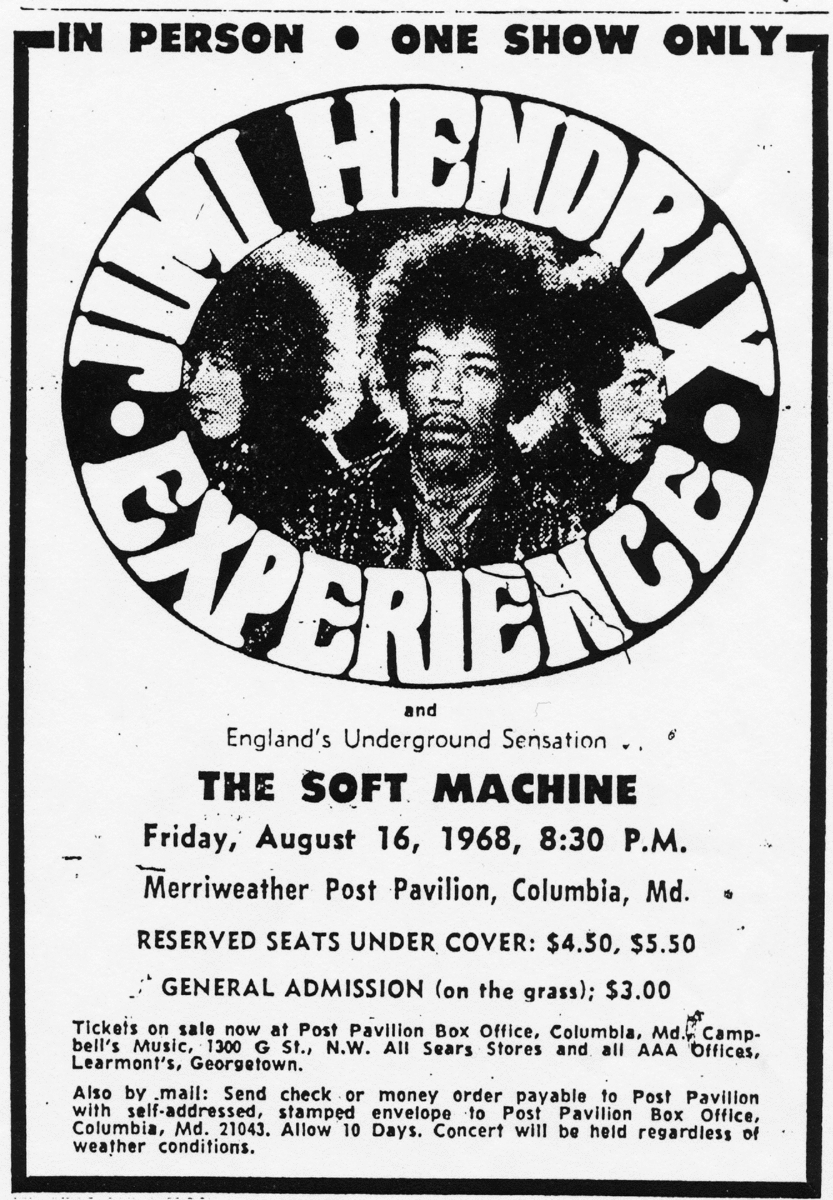
The earliest surviving example of Hendrix making a musical reference to “The Star-Spangled Banner” was captured by an amateur recordist at a 16 August 1968 performance at Merriweather Post Pavilion in Columbia, Maryland (see Figure 1).Footnote 7 Hendrix led the band at this performance—The Jimi Hendrix Experience—playing guitar and singing, while bassist Noel Redding also added vocals and Mitch Mitchell played drums. Near the end of the set-closing cover of “Wild Thing,” Hendrix plays a rising fourth and then slides into a rather slow quotation of the opening phrase of the anthem. Hendrix immediately segues into a full rendition of the Civil War eulogy “Taps” and then repeats the opening gesture of the anthem, followed by an extended and free improvisation that features low rising moans and other feedback. Mitchell's frenetic drumming underlies the entire segment, but becomes especially violent during the improvisation, highlighted by tight rolls and rim shots on the snare drum.Footnote 8 The audience cheers and Hendrix's solo ends somewhat abruptly, suggesting that he may have destroyed his guitar to end the show as he had so famously done at Monterey Pop a year earlier. In retrospect, it becomes clear that the opening interval of a fourth that begins the segment had anticipated “Taps,” making his quotations a musical hybrid of both bugle call and anthem as well as a coda to “Wild Thing.”
Whether spontaneous or pre-planned, even this, Hendrix's first sonic reference to the anthem, contained the basic elements of the Woodstock Banner to appear a year later: the anthem tune, “Taps,” and improvisations that might well offer illustrations of battle and commentary on war, whether at home or abroad. Several elements in this first rendition also imply a significance deeper than improvisatory play or pandering showmanship. By juxtaposing the anthem and “Taps”—the haunting and eloquent bugle call used by the United States military since the Civil War as a farewell tribute to deceased comrades—Hendrix connects the anthem with death and mourning for America's soldiers only a few months after the Tet Offensive had soured U.S. public opinion on Vietnam and changed the course of the war.Footnote 9 The “Taps” reference, however, is potentially laden with irony and thus its meaning depends on Hendrix's view of the military, the Vietnam War, and the domestic battle over civil rights.
Hendrix's Early Support of the Military
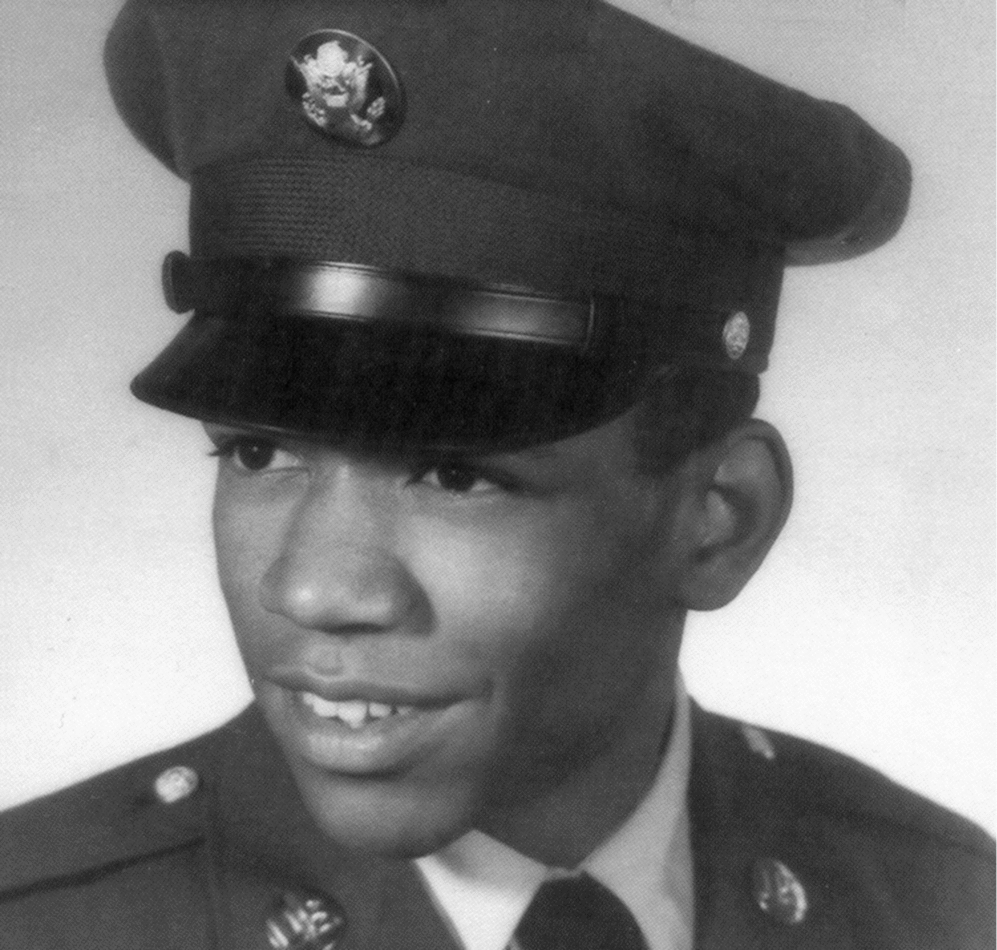
Having enlisted in the Army to avoid jail in May 1961, Hendrix, according to biographer Charles Cross, embraced the structure of military life (see Figure 2).Footnote 10 The enthusiasm of his letters home contradicts later interviews in which Hendrix claimed to hate the army. By January of 1962 Hendrix had completed a challenging course of parachute training to earn his “Screaming Eagles” patch as a member of the 101st Airborne, the unit famed for jumping behind enemy lines on World War II's D-Day in 1944. This achievement was the proud realization of Hendrix's own macho fantasies. He had requested the assignment and when it was granted told his father that he would “try my very best to make this Airborne for the sake of our name.” A subsequent letter states, “Well, here I am, exactly where I wanted to go. I’m in the 101st Airborne.” Later in the same letter he reports that “half the people quit” because of the fear induced by jump school—“that's how they separate the men from the boys.” And he concludes, “I pray that I will make it on the men's side this time.”Footnote 11 Soon afterward Hendrix met fellow soldier and bassist Billy Cox and formed a band; as the guitarist's interest in music returned and with Cox set to be released from duty, Hendrix undertook a dangerous ruse to convince Army doctors he was homosexual—at this time a cause for discharge—in order to pursue his musical career.Footnote 12 Although this escape was successful, Hendrix's admiring fascination with the military and his empathy for his former comrades seems to have remained. It would be celebrated in his iconic dress.
The vintage chic costuming Hendrix donned in the fall of 1966 as an aspiring rock superstar spoke in part to his fascination with military life. Colorful and outrageous, the outfits he purchased from London's hip clothing boutiques, such as “Granny Takes a Trip” and “I Was Lord Kichener's Valet,” put Hendrix at the vanguard of “Swinging London” fashion. His wardrobe featured two historic British military vestments—an eighteenth-century, elaborately styled Royal Hussar jacket (see Figure 3), and a nineteenth-century Royal Army Veterinary Corps dress jacket. Although markers of psychedelic culture and image-making vehicles of his commercial success, these jackets also fascinated Hendrix as military artifacts. He researched each jacket's history and embraced them as personal symbols. Featured in publicity shots, Hendrix's military clothing served not only as a personal marker of identity, of manhood and authority, but also represented a repurposing of martial insignia through affiliation with, rather than rejection of, soldierly life. As Cross concludes, Hendrix “forever held great respect for the military.”Footnote 13
In August 1968 when Hendrix first quotes the Banner melody, his former unit, in fact the entire 101st Airborne Division, had deployed to Vietnam. So his invocation of “Taps” in Maryland that day could well have been a sincere tribute to his comrades and by extension the soldiers who died in Vietnam.Footnote 14 Musical analysis supports a sincere reading. Hendrix used the same basic slow tempo for both anthem and memorial, suggesting that they were intended as a single haunting statement. Also curious is the fact that while “The Star-Spangled Banner” quotation was incomplete and included a wrong note, “Taps” was rendered correctly and in full. The anthem was fragmented; the bugle call complete. Hendrix even elongates the solemn gestures of “Taps,” possibly emphasizing the funereal meaning of text. That the opening gesture of the anthem was then restated before disintegrating into violent musical gestures argues further for the compositional intent of the overall design, as it led into what might be heard as an anguished illustration of soldiers suffering. Thus, this first Columbia Banner can be heard as a kind of eulogy for fallen comrades, as a wrapping of the flag around the anguish of mourning, punctuated by illustrations of war.
Hendrix's few direct comments about the Vietnam War suggest an attitude of jingoistic support for the United States military that further undercuts the likelihood of anti-war critique in his early Banner performances. Asked about Vietnam while living in England in late 1966 or early 1967, Hendrix remarked, “After China takes over the whole world, then the whole world will know why America's trying so hard in Vietnam.”Footnote 15 Soon afterwards, Hendrix told an interviewer from the Dutch magazine Kink, “Did you send the Americans away when they landed in Normandy? That was also interference. . .but that was concerning your own skin. The Americans are fighting in Vietnam for a completely free world. As soon as they [U.S. troops] move out, they [the Vietnamese] will be at the mercy of the communists. For that matter, the yellow [Chinese] danger should not be underestimated. Of course, war is horrible, but at present it's still the only guarantee of peace.”Footnote 16 The reference to Normandy and thus D-Day might even suggest some residual pride in the achievements of the Screaming Eagles. Even a year later, Hendrix was still worried about the Chinese when he told a Swedish journalist from Aftonbladet that “I will hardly get to Vietnam in time. I will probably go direct to China. This little war in Vietnam is just a preparation for what will come.”Footnote 17 The idea that Vietnam was just the beginning of a larger, more devastating conflict might have further inspired Hendrix's Banner/Taps combination.
Hendrix had, in fact, struck this chord of musical eulogy before. During his 3 August 1968 concert in Dallas, a few weeks before the first performance of the anthem melody, he dedicated his autobiographical song “I Don't Live for Today” in his stage banter to “all the soldiers fighting in D.C., Detroit, and, oh yes, all the soldiers in Vietnam. . ..” At this same concert, Hendrix ended a performance of “Purple Haze” with a full rendition of “Taps.”Footnote 18 This earlier Dallas performance is intriguing as it suggests that the first Columbia Banner may not be a rendition of the national anthem at all. Instead it could be a second performance of “Taps,” one illustrated by quotes of the Banner rather than the other way around. Further, the reference to soldiers in D.C. and Detroit invokes another possible meaning of Hendrix's use of “Taps”—to honor those how had died fighting for equality inside the United States. By the time of his August 1968 performance at Merriweather, the year had already been a traumatic one for America and for Hendrix. The assassinations of Martin Luther King (4 April) and Robert F. Kennedy (6 June) had shaken the nation. Peaceful civil disobedience was often met with resistance that disintegrated into violence. Riots erupted across the nation following King's death, which also profoundly affected Hendrix.Footnote 19 Thus, with war abroad and at home, there were all too many objects of intention for Hendrix's eulogistic quotation.
Hendrix's Fascination with Anthems in Transnational Perspective
The notion of performing an anthem or of Hendrix's music as an alternative anthem predates the Columbia performance. As early as Hendrix's first U.S. appearance with the Experience at Monterey Pop on 18 June 1967, he introduced “Wild Thing” as “the English and American combined anthem together.”Footnote 20 “Don't get mad,” he implored the crowd, and said “I want everybody to join in too, alright.” Mitchell then offered a snare drum roll, a traditional militaristic beginning to “The Star-Spangled Banner.”Footnote 21 This performance served to reintroduce Hendrix to America after his London sojourn and thus hinted at a new political perspective gained from living overseas. He closed his performance not with an original composition, but by covering “Wild Thing,” a number one hit by the English band the Troggs originally written by American singer-songwriter Chip Taylor. That is, he ends the show (re)introducing himself to U.S. listeners as an American performing a British pop anthem created by an American.
Hendrix had first performed “Wild Thing” in Europe, so its Monterey Pop performance enacts his transnational journey in song.Footnote 22 He would again tie “Wild Thing” to social identity at a 10 March 1968 performance in the nation's capital. Here, Hendrix introduced the song by asking “everyone [to] stand up and sing along. . . to this international anthem,” and dedicated his performance to “soldiers returning from”—and after a well-timed pause—“Wash D.C.” The line elicited audience laughter. “Instead of guns over their shoulders,” he added, “they have feedback guitars.”Footnote 23 The audience's laughter here may have been spurred by the image of guitar-wielding politicians fighting on the front lines. In “Wild Thing,” and by extension the notion of anthems generally, Hendrix performed transnationally, informed both by his European residency and the New Left and Black Power activism he experienced in the United States.Footnote 24
Hendrix seems to have gained a new awareness of race and place when he moved briefly to Europe in September 1966. Although motivated by the ultimately successful business decision of Hendrix's manager Chas Chandler to launch Hendrix's career from London, this move across the Atlantic did more than make the guitarist a star.Footnote 25 He spent only eight months on this initial sojourn, but found artistic affirmation, a band, and enough commercial and critical success to return to the United States. Furthermore, the transnational perspective Hendrix gained in Europe coincides with a new political consciousness, one that his reference to a combined U.S./English or “international anthem” confirms.
Travel was essential to Hendrix's social awareness. While stationed at Fort Campbell in Kentucky, Hendrix first discovered harsher forms of racial segregation. The army was officially integrated, but soldiers socialized by race and off base Hendrix could perform only for black audiences.Footnote 26 Musical taste in Hendrix's performing world was also divided by race, requiring that Hendrix eschew his rock and roll interests in favor of the blues. The move to London similarly would transform his experience of race from a source of discrimination into musical success—as a marker of artistic “authenticity” as well as an exotic publicity strategy. In London he awed guitarists such as Eric Clapton with his musicianship, while at the same time he was being promoted racially as the “Wild Man of Borneo.”
New York Rock Festival—23 August 1968
Hendrix's Banner made its second known concert appearance exactly a week after the first on 23 August 1968 at the Singer Bowl in Queens as part of the New York Rock Festival. The anthem appeared at the close of “Purple Haze”—the seventh tune in a nine-song set—and seems not to have sparked any particular controversy.Footnote 27 The overflow audience of 18,000 applauded, as the audience tape reveals, in recognition of the arrival of the anthem. The Singer Bowl Banner appears more plausibly an improvisation tossed off as part of a playful outro to one of Hendrix's signature tunes. The tempo was quick and the performance lacked the solemnity of the Columbia version. Although it similarly included melodic mistakes and misintonation, these have the character of simple errors or perhaps reflected the inaccuracy of Hendrix plucking the strings of his guitar with his teeth—a gimmick he deployed in concerts beginning as a teenager.Footnote 28 As a week earlier, he offered only the first phrase of the anthem, but here it was preceded by a stylized version of the Gillette Company's “Look Sharp–Be Sharp” jingle and was followed by another virtuoso bit of fingerwork. “Taps” was absent. A chordal cadence with a decorative trill and feedback closed the performance, while Mitchell switched from the snare work that supported the Banner quote to cymbal crashes for the cadence.
The Gillette quote was both playful and provocative. On one hand, it equated the anthem with an advertising jingle, possibly indicting America's consumerism.Footnote 29 Yet the Gillette melody was also used as the theme song for the company-sponsored show, the Gillette Cavalcade of Sports, which began on radio in 1944 and became one of television's first recurring series, running until 1960. Despite the name, the show primarily featured boxing and was also known as “Friday Night Fights.” It broadcast from Madison Square Garden in New York City and was not only hugely popular, but also was one of the few places blacks were featured at all, not to mention positively, on U.S. television during Hendrix's childhood. Black world champions such as Sugar Ray Robinson and Archie Moore appeared and triumphed. So, for Hendrix the Gillette musical motif also connected with themes of manhood, heroism, courage, and African American honor—ideals that Hendrix pursued in his desire, for example, to be a paratrooper. For Hendrix's mostly white audience, however, the jingle—within the context of a virtuoso outro—most likely evoked humor and technical wizardry.
Hendrix's musical engagement with the Banner developed rapidly. On 4 September 1968, he performed the melody in nearly complete form as part of a five-minute abstract improvisation at Memorial Coliseum in Phoenix, Arizona. The fidelity of this audience tape is relatively clear and thus the contribution of drummer Mitch Mitchell to the performance (already suggested from both of the earlier recordings) is confirmed. Redding may be heard adding pedal tones as well. The opening is loud, eerie and atmospheric, fading to Hendrix alone and featuring some of the musical cries, moans, pealing sirens, and percussive explosions that would be heard at Woodstock. The improvisation grows increasingly violent and, just over three minutes in, Hendrix begins the anthem melody, with wrong notes and expressive (mis)intonation. At each cadence but the first he breaks into noisy, feedback-strewn departures, detuning and extending cadential pitches, always bending them down and then back to pitch. Once the anthem begins, Mitchell maintains a continuous stream of noise, using cymbals, toms, snare, and probably bass drum—apparently everything at his disposal—with unrelenting athleticism. Hendrix skips the second phrase of the anthem (a simple melodic repeat of the first) and moves directly into the third phrase. Here he inserts pictorialisms into the melody at the words “rockets’ red glare” and “bursting in air”; although Hendrix and Mitchell had evoked such images from their earliest Banner renditions, this appears to be the first instance of these gestures specifically illustrating Francis Scott Key's lyric. Shorter than they will be at Woodstock, such tone painting nevertheless reveals that the explosive imagery of the more iconic version and almost every Hendrix Banner to follow was already in place almost a year earlier.
Hendrix's anthem arrangement increasingly shows evidence of compositional choice within a set of structural components. In Phoenix, Hendrix maintained the moaning figures from the first Merriweather performance, but also introduced new elements that would survive in the Woodstock version. These include a heavy pulsing tremolo strumming of the second to last questioning phrase “O say does that Star-Spangled Banner yet wave?”—possibly suggesting a flag waving in the breeze—as well as a long, shaking extension that highlights the word “free” in the final phrase. In this sensitivity to text, as became characteristic of future versions, Hendrix was “singing” the song with his guitar such that the words—well known to most of his listeners—were present in each of his guitar's utterances. This detailed awareness of the anthem text connects with a long tradition of blues-based storytelling (e.g., the talking blues) and draws on the examples of Hendrix's musical mentors such as Howlin’ Wolf and his songs “Moaning at Midnight” and “How Many More Years.”Footnote 30 In such precursors, the distinction between the gravely human voice and gritty instrumental “speech” is blurred.
Stage Banter as Political Discourse: Portland, OR, 9 September 1968
An audience recording made on 9 September 1968 in Portland, Oregon preserves Hendrix's first known spoken introduction to the Banner. Stage banter offers an important and underutilized tool in understanding Hendrix's music. Speaking directly to his listeners, he entertains and engages, but also describes his art. In Portland, he proclaimed, “We’re gonna do this thing, goes something like ‘Purple Haze’,” and then performed Key's anthem. Hendrix thus formalized the connection between the anthem and “Purple Haze” that began at the Singer Bowl and continued to Woodstock and beyond. Approximately two-thirds of his recorded Banner performances treat the anthem as a prelude to “Purple Haze.” A month later at Winterland, he would return to this thematic pairing of the Banner and “Purple Haze” as related musical anthems.
If Hendrix ever musically burned the U.S. anthem in protest, the Portland Banner may offer his most devastating realization. Its opening phrase shakes and closes with cries that prefigure Woodstock, disintegrating into full explosions after the word “gleaming.” As the second phrase begins, the violent sonic imagery expands again, following the words “stars” and “fight.” The whistling descent of bombs and other explosive interpolations obliterate the third phrase of the melody entirely—depicting “the rockets’ red glare” and “bombs bursting in air” without stating the lyric's melody at all. After invoking the opening fourth of “Taps,” Hendrix sounds the first half of the Banner's concluding phrase holding onto the word “wave,” before collapsing into a sonic firefight that includes the bugle call for “Charge.” This final melodic gesture detunes on the last note and leads without pause into a full altissimo rendition of “Taps,” almost miraculously played while the guitar continues to feedback and offer sonic explosions. The melody of eulogy finishes on a pure electronic sine wave sustained for a dozen seconds before disintegrating into “Purple Haze.” He never completes the anthem melody. Its final questioning line is replaced by a paean for the dead.
A Tone Portrait: San Francisco, CA, 10 & 11 October 1968
The heightened emotional intensity of the Portland Banner continued through Hendrix's next five anthem performances, one in Los Angeles and four pivotal renditions at the Winterland Ballroom in San Francisco. These can be heard as further critical reworkings of the anthem arrangement as tone poem or, more accurately, as tone portrait. Each involves stretches of free improvisation, some sort of spoken introduction, and, in two cases, the use of additional quotations. On the heels of the Phoenix performance, each of Hendrix's Banner renditions were at least five minutes long with the second and third Winterland Banners on 10 and 11 October reaching six-and-a-half minutes—the longest versions of the anthem among the recordings I have located. Hendrix's intervening performance at the Hollywood Bowl on 14 September, however, lasted only a bit over three minutes. In L.A. he began with a percussive strumming figure and then asked the crowd. “This IS America, right?” This idea of a sounding national portrait comes to fruition with the four Winterland Banners, and Hendrix would become even more direct in his introductions—labeling these performances not with a question, but with the unequivocal title—“This Is America.”
At Winterland Hendrix's stage banter again offers vital interpretive insights. His introduction to the second show, for example, is unusually long and rambling, but revealing:
We’re gonna’ continue on with a thing called “This Is America,” representing the sounds and the feedback which you’ll hear is a really lost souls and a frustration it seems like to me. I don't know though. We’re just messengers, ya know. And like uh, ya know we’ll see if we can get this feeling across to you maybe through all this racket that some people think we’re making up here. I don't think it's racket. Hell, it's a thing ya know. You get tired of playing notes sometimes so you really want to play. . . or get close to playing exactly what you call a true feeling, regardless of its [illustrates on guitar with descending feedback slide], well ya know regardless of what those [sings: “doo doo doo doo” and plays a clichéd rock guitar lick] ya know those cats [plays surf guitar riff and Mitchell joins in on drums]. Wait! Hold on. Hold on, right, right, right. . . yeah. . .. [tunes] And it begins off. . . that’s. . . that’s. . . that's the a. . . you know. . . You’ll hear the hang up side which will probably be lasting about five or three or two minutes, and then you’ll hear our side of it for which we’d like to say, “thank you very much Owsley” [audience applause].Footnote 31
Hendrix has thus titled his version of the Banner “This Is America,” a kind of sonic portrait of “true feelings” that goes beyond the clichéd discourse of popular culture. He also hints at the reason for pairing the Banner with “Purple Haze” in that the anthem represents the “hang up side,” whereas his original presents an alternative—“our side,” by which he seems to mean psychedelic culture.Footnote 32
Stage banter also reveals Hendrix's recurring interest in connecting with his audience by offering references to local happenings and history. For many at the Winterland Ballroom in San Francisco, for example, Hendrix's expression of gratitude to Owsley may have recalled 1967's Summer of Love. Called “one big LSD party” by historian Charles Perry, this San Francisco happening was fueled by the high-quality and usually free LSD (“acid”) tablets manufactured by underground chemist Augustus Owsley Stanley III. Owsley, as he was known, began making “Purple Haze” and “White Lightening” in 1965. Such countercultural intellectuals as Timothy Leary touted the purported therapeutic and spiritual benefits of LSD, popularizing the mantra “Turn on. Tune in. Drop out.” In Leary's 1983 autobiography the chemist noted, “Unhappily my explanations of this sequence of personal development were often misinterpreted to mean ‘Get stoned and abandon all constructive activity.’” Instead Leary called for a transcendent consciousness through which the activated, self-reliant individual interacted harmoniously with the world and was committed to “mobility, choice, and change.”Footnote 33 Hendrix's banter, however rambling, suggests an affinity for Leary's more nuanced views of drug culture.Footnote 34
The San Francisco concerts at Winterland marked the second anniversary of Hendrix performing with Mitchell and bassist Noel Redding. To mark the occasion manager Michael Jeffery arranged to have the band professionally recorded, resulting in complete, high-fidelity tapes, later commercially released. It may be that Hendrix, knowing that these performances would be preserved, put extra care into his music making for these gala events. Whatever the reason, Hendrix's four Winterland Banners, performed over the course of six shows on three nights, realize the anthem melody within particularly compelling musical statements.
The Winterland Banners explore a pre-composed set of possibilities within a two-part form that had been developed from the Phoenix and Portland Banners: 1) a free, improvisatory prelude and then 2) the Banner melody. Although the first performance at Winterland started off and remained loud, the other three began softly with atmospheric pitch slides and cymbal work. For the first time in the compositional development of Hendrix's anthem settings, Mitchell sat out for long periods. Bassist Noel Redding's contributions are ambiguous; he is never featured, and when his bass is audible, especially in the first two performances, it is in a supporting and often dissonant role but one that contributes to the dystopian effect of the whole. Evoking Ornette Coleman's Free Jazz (1960) aesthetic, each prelude reached a violent climax featuring sonic rhetoric of explosions, bombs, and gunfire that by then had become characteristic of the arrangement. Hendrix also experimented with additional quotations, not only “Taps” and the Gillette theme, but also the TV themes to Bonanza (1959–73) and the Mickey Mouse Club (1955–59). Sixties countercultural figure John Sinclair has associated Hendrix's quotes with a critique of commercial culture,Footnote 35 and indeed they can be heard as mocking capitalist marketing constructs and thus the controls from which radicals would “drop out,” such as the military draft, consumerism, and racial segregation. For his fans certainly, Hendrix symbolized social revolution and new freedoms of sex, substance, race, and thought—notions anathema to the whitewashed images of rugged western manhood and childhood innocence celebrated by the Cartwright Family on Bonanza and the wholesome middlebrow Mouseketeers.
In Hendrix's four Winterland performances, the anthem melody was never presented in its entirety and never sounded the same way twice. Hendrix played its melodic segments in order, interspersing the anthem's motifs with violent pictorialisms, but skipped some phrases. Gone are the pitch errors of the previous performances; perhaps in anticipation of being recorded at Winterland, Hendrix practiced more extensively. Another new element was Hendrix's propensity to ornament the melody with baroque-inspired trills, turns, and other musical appliqués, perhaps borne out of the desire for musical variety. Whatever the motivation, they serve to sonically antique the melody by evoking the classical music tradition. Perhaps such historicity could reference intergenerational conflict, a statement of the anthem being similarly antiquated or representative of a distant elite class. More plausibly, they could simply be musically genuine melodic decorations, especially as Hendrix uses these baroque ornaments in stylistically appropriate ways and without ironic exaggeration or dissonance.
Political Thinking Versus Media Strategy
Hendrix commentators frequently observe that the guitarist avoided speaking about politics, especially when related to “The Star-Spangled Banner.”Footnote 36 Yet this reputation is largely incorrect. Hendrix's public discourse suggests that he made a strategic distinction between in-show stage banter with his fans, conversations with informed rock journalists, and interviews with more mainstream media. The further an utterance was from his listener, the more oblique and ambiguous his statements became. Thus, his most public pronouncements and the comments most likely to have circulated broadly are the least helpful in clarifying his thought. As direct comments to fans, however, the stage banter preserved on bootleg tapes provides an especially valuable window into Hendrix's thinking.
In public interviews Hendrix manipulated answers to communicate with multiple constituencies simultaneously. At the United Block Association (UBA) press conference in Harlem on 3 September 1969, Hendrix was asked “Why did you close with ‘The Star-Spangled Banner,” by an unidentified television reporter. He replied evasively:
Oh, because we’re all Americans, [laughs] ya know, aren't we? When it was written then, it was played in a very very beautiful. . . what they call a beautiful state, ya know. It was nice, inspiring—your heart throbs and you say “Great, I’m American!” [raises fist for emphasis]. But nowadays when we play it, we don't play it to take away all this greatness that America is supposed to have, but we play it the way the air is in America today. The air is slightly static, isn't it?Footnote 37
Particularly telling is the sing-song tone color in Hendrix's voice preserved by a local news channel's tape. Hendrix's voice falls and trails off with each almost patronizing statement, until he reaches the word “but. . .” and then offers an oblique explanation that avoids criticism (for taking away the greatness the United States is supposed to have), but illustrates the social tension of the times (as “static”). Also telling is Hendrix's next answer. Asked, “What is your comment on drug use at the [Woodstock] festival?,” Hendrix replied, “I don't know. . .. I have no opinions at all.” Hendrix clearly had opinions, but took care to choose when and with whom he shared them.
When interviewed by rock music journalists, Hendrix was more forthcoming. While in San Francisco for the Winterland performances, he spoke with a reporter from the then prominent American rock magazine Circus. Hendrix's replies show that he was thinking about politics at this time and, in particular, about the comparison between what was happening in the United States and his experiences in Europe.
I was digging America so much, until I went over there and came back again. . . and saw why people put this country down. I still love America—quite naturally—but I can see why people put it down. It has so much good in it, you know, but it has so much evil, too. And that's because so much of it is based on money. That's really so sick. People here are losing their peace of mind. . .. In Europe, people have a little more contact with one another. There's a little more communication, and everything's not all freaked out. In just saying hello and goodbye, there's more warmth.Footnote 38
Observing that he lived “all over,” such that “no place is really my home,” he expressed his concern for the “blame culture” infecting the United States and concluded with a proclamation of his music as a form of resistance.
The black person argues with the white person that he's been treated badly for the last 200 years. Well, he has—but now's the time to work it out, instead of talking about the past. We know the past is all screwed up, so instead of talking about it, let's get things together now. . .. There are some evil folks around, and they want you to be passive and weak. . .. You have to fight fire with fire. I mean, I’m getting myself personally together in the way of music and what I’m going to do.”Footnote 39
Hendrix also revealed that he was considering writing a song for the Black Panthers that “doesn't just pertain to race but to symbolism. . . and to what's happening today.” His Winterland Banners are not this song, but they similarly comment on contemporary issues using musical symbolism.
In anticipation of Woodstock, Hendrix appeared on The Dick Cavett Show televised nationally on 7 July 1969. The interview provides insight into Hendrix's thinking over that summer, particularly about the political potential of art. When Cavett asked, “Do you think music has a meaning?,” Hendrix replied:
Oh, yeah, definitely. It's getting to be more spiritual so than anything now. Pretty soon I believe that they’re going to have to rely on music to uh like get some kind of peace of mind or satisfaction—direction actually—more so than politics, because like politics is really on an ego scene. That's the way I look at it anyway. [Politics] is the art of words, which means nothing, ya know. So therefore you have to rely on more of a earthier substance, like music or the arts, theatre, acting, painting, whatever.Footnote 40
For Hendrix, music is politics. For most in Cavett's audience, however, Hendrix likely appeared simply a freak. Yet Cavett addresses him as an artist, taking his music and aesthetic seriously. Hendrix responds with unusual candor. The guitarist's ideas take hold within a larger context of psychedelic philosophy by creating alternative socialities that have been explored in depth by a range of countercultural scholars.Footnote 41 Yet as he concludes in this first Cavett interview, “I talk through music.”
Critical Perspective: Hendrix's Banner in Europe, Winter 1969
Beginning in January and February 1969, the Experience toured northern and central Europe, playing twenty-six shows in sixteen venues. Hendrix offered his Banner seven times and made his first studio recording of the anthem. Although such anthem performances outside the United States certainly signaled Hendrix's own U.S. citizenship, they also presented a critical view of the nation in terms of both war and race. Insulated from homeland pressures to be patriotic, Hendrix openly criticized the war from center stage. In his banter, he dedicated shows at the Konserthuset in Stockholm first to the “American Deserters Society” and then to the “American Deserters Organization.” Presumably, these European audiences would have included a few young American men living abroad to escape the draft. Sonic references to U.S. race riots from within his Banner improvisations were muted in Europe. Unlike at Dallas, Hendrix's concert dedications in Stockholm made reference only to the war in Vietnam, not to the riots in Detroit or Washington, D.C.
Musically, Hendrix's European Banner performances are also of a different artistic character. At Gothenburg and Stockholm, the anthem closed his concerts as a coda to “Purple Haze.” In the first, Hendrix performed the entire Banner plucking the strings with his teeth. Missed notes and poor intonation result, and when Hendrix reached the expected pictorial extensions on “air” and “glare,” all he could do was hold a straight tone, unable to perform his by now-typical feedback-strewn imagery with his teeth. These illustrations of violence returned the following night in Stockholm, but only the 18 February performance in London's Royal Albert Hall revisited the tone portrait form Hendrix had developed in September and October of the previous year. Here, however, the opening free improvisation was reduced to less than a minute and references to “Taps” and to U.S. television quotations did not appear, possibly because they might pass unrecognized or otherwise lack their potential for commentary in the ears of European listeners.
Into the Studio: Olympic Studios, London, 14 February 1969
Hendrix's first studio recording of “The Star-Spangled Banner” also took place during this European trip on 14 February 1969 at Olympic Studios in London. Near the end of the twenty-fifth of thirty-five takes for a song the band was working on—an early version of what eighteen months later would become “Ezy Ryder”—the band dissolves into free improvisation that cadences in E-flat major.Footnote 42 Rather than end the jam, Hendrix jumps into the anthem melody. The strongest suggestion that one song would lead to the other is their common key, as Hendrix typically performed the anthem in the sounding key of E-flat or the “home” key of his guitar.Footnote 43 The rendition here might be described as Hendrix's basic version: the full melody, lightly ornamented by feedback, pitch bends, and a few decorative ornaments, plus the regular illustrative departures on “rockets' red glare” and “bombs bursting in air” (the second of which is cut short). The superior audio quality of the take reveals something new, however. While the track proceeds as the regular duet, bassist Noel Redding enters during the pictorial battle scenes strumming repeatedly on a pedal E-flat. He sustains this through all but Hendrix's solo coda, enhancing the overall activity of Mitchell's percussion and broadening the sonic palette and audible intensity. Low-fidelity audience tapes offer scant evidence of this third part in the arrangement, which may well have been common, and powerfully felt by the audience, although not clearly preserved by the portable tape players that fans used to bootleg Hendrix's concerts.
The Record Plant: New York City, 18 March 1969
Hendrix's only other studio version of the anthem offers further evidence of his obsessive artistic engagement with the melody. Tempted by new equipment, he indulged his interest in studio experiments to create a unique multi-tracked anthem as musical fireworks show. Back in New York at the Record Plant on 18 March 1969, Hendrix recorded alone with engineer Tony Bongiovi using the studio's new Ampex machine to create a four-minute solo anthem.Footnote 44 It was the first time in his recording career that Hendrix had access to so many tracks, and he quickly filled all twenty-four with overdubs of himself playing the anthem melody using effects and studio tricks to broaden his palette of sonic colors.Footnote 45 After an opening trill-decorated cadence, the recording moves through a plain statement of the melody, enriched by accompanying parts sounding especially decorative passing tones at cadences. Absent are any pyrotechnic feedback-strewn illustrations of rockets and bombs. A pause before the concluding phrase (“O say does that. . .”) allows for the highest guitar voice to sound what may be fleeting altissimo allusions to the bugle calls for “Charge” as well as “Taps.” The final cadence is drawn out for a full two minutes and although one might hear allusions to sirens or screams in the mix, more prominent are cascades of strumming strings, slides, trills, rhythmic riffs, and bell-like melodies. Throughout this extension, the energy of the song dissipates, disarming any sense of protest. A dancing bass voice (played by Hendrix on guitar using studio tricks) moans to a close. The effect as a whole has an explosive emotional trajectory but not in the vein of a military firefight. It is rather akin to the grand finale of a Fourth of July fireworks display, exploding in delight and lingering in memory.Footnote 46 Here Hendrix foreshadows a vein of patriotic affirmation in his musical conception that would become clear at Woodstock.
The Record Plant Banner is one of a handful of Hendrix's non-Woodstock anthem arrangements to be commercially released in the two decades after Hendrix's death. The Record Plant Banner became part of the new age film Rainbow Bridge (1972), which featured concert footage of Hendrix shot on Haleakala Volcano in Maui, Hawaii. The film traces the journey of actress Pat Hartley, who is welcomed into a commune of young people including surfers, mystics, and musicians that seek an alternative way of life. In part to save the commercial prospects of the film, Hartley is treated to a private concert by Hendrix, Cox, and Mitchell, filmed in August 1970. Rainbow Bridge offered a more optimistic and hopeful look at U.S. youth culture of the late 1960s, as something of an alternative to the Peter Fonda and Dennis Hopper film Easy Rider (1969), which had also featured Hendrix's music but where the search for an alternative path ended in death. In a reference to the murder that closes the Fonda/Hopper film, an excerpt from Hendrix's own “Ezy Ryder” makes a brief appearance in the opening title sequence of Rainbow Bridge when a surfer is shot by a cowboy. The Record Plant Banner appears later in the film to accompany an ecological protest march (in which some carry American flags), but fades to silence after only forty seconds.Footnote 47 That Hendrix's manager Michael Jeffery was among the film's investors and served as “executive producer” likely explains how the soundtrack came to include posthumous Hendrix material not originally conceived as part of the project. By the time of the March 1972 release of Rainbow Bridge, Hendrix's signature guitar sound and the Banner melody were synonymous with Woodstock, the counterculture, and protest, such that the Record Plant Banner still enhanced the filmic discourse, even if artistically it was more patriotic than critical. Its inclusion no doubt also enhanced the soundtrack's commercial value.Footnote 48 In keeping with the dominance of the Woodstock myth in interpretations of Hendrix's anthem, mentions of the Record Plant Banner—despite the radical artistic differences of its multi-track pyrotechnic celebration—are subsumed by the common understanding of the Woodstock Banner as anti-patriotic.
The Banner as Local Critique
In the spring and summer of 1969, during what would be their final tour, concerts by the Experience became increasingly large and unruly. Show organizers grew increasingly concerned about security, and venues often employed police and private security personnel to keep fans—potentially under the influence of drugs—controlled.Footnote 49 Violent confrontations were not uncommon and the tension between fans and force was palpable in the many newspaper reviews that devoted more words to security than to music.Footnote 50 Assembling a counter cultural public effectively, safely, and freely put authorities and audience in opposition and explains one of Hendrix's more notorious anthem performances—the L.A. Forum Banner of 26 April 1969.Footnote 51
“Brainwashed”: the L.A. Forum Banner, 26 April 1969
Hendrix had performed the anthem in Los Angeles before. Reviewing a September 1968 performance at the Hollywood Bowl, Los Angeles Times critic Pete Johnson wrote supportively:
It was one of Hendrix's best appearances locally. . .. Hendrix the Iconoclastic Negro has become a rallying point for youth in their conflict with adult tastes. He heads one of the best trios in rock music, a trio dominated by his screaming guitar and dry husky voice. . .. He embodies rebellion on stage and manages to distill the primitive sensuality of a decade's worth of rock performers into a one-hour show. . .. The Saturday night appearance consisted of old and new tunes, among them “Red House,” “Are You Experienced,” “Let Me Stand Next to Your Fire,” “Hey Joe,” “Sunshine of Your Love” and a mingling of the National Anthem and “Purple Haze.”Footnote 52
Yet a year later (see Figure 4), Johnson had a very different reaction to Hendrix's rendition:
His National Anthem. . . is meaningless and constitutes the cheapest kind of sensationalism. It is meaningless in any context, in fact, since the song is neither a cause nor an effect of what is right and wrong with the country, it is only a symbol. . .. If Jimi Hendrix has anything serious to say, he is starting late and badly. If he has anything serious left to play, he hid it well.Footnote 53
What changed Johnson's perception seems to have been an escalation of the conflict between audience and venue security. In the first review, the critic addressed the inability of the Hollywood Bowl ushers to keep Hendrix's fans in their seats, but he did so only descriptively: “The audience pushed forward, clogged the aisles and stood craning to see the wild man and his guitar.” The next year, however, he opened his review by characterizing the concert as a Cold War battlefield.
The Jimi Hendrix Experience was an unpleasant one at the Forum in Inglewood Saturday night. . .. The unpleasantness began with the audience, many of whom tried to nationalize the seats into a communistic arrangement. When that failed they stood in the aisles so that everyone had equal difficulty in seeing the stage. Hendrix helped the disorder by slurring the rentacops and ushers and by refusing to stop playing long enough for the aisles to be cleared.Footnote 54
Johnson indicts Hendrix's audience as socialists. What had been exuberance is now revolution. Hendrix is implicated as the master puppeteer of these young countercultural forces who stirs the conflict from onstage, and the guitarist's stage banter seems particularly offensive to Johnson, as criticism of his words trumps any discussion of his musical rendition of the anthem.
The National Anthem has become part of his repertoire (he also played it at the Hollywood Bowl last summer) and its performance provided the low point of the evening. “Here's a song that we was all brainwashed with,” Hendrix said. “Remember this oldies but goodies?”Footnote 55
In fact, Hendrix had gone even a bit farther than Johnson could report in print.Footnote 56 The brainwashing comment interrupts an unusually quiet first phrase of the anthem, after which Hendrix plays much louder. In the second phrase, Hendrix goes flat on the final two pitches of the next subphrase, musically dimming the nation's “bright stars.” Possibly preventing a listener from missing his point, he punctuates his performance with the word “America,” effectively undercutting any potential for patriotism by linking his insult of intonation with the nation. At the end of the phrase, following the pitches accompanying the words “gallantly streaming” and likewise going a bit flat, Hendrix offers an additional lyric—a bitter and vitriolic “bullshit.” For Hendrix, who was obsessed with tuning, notes off pitch were either avoided or were expressive; rarely would they be accidental. If one of his strings would detune, Hendrix would play solely on the other five. On occasion he would all but destroy a live show with delays, insisting that before he could continue playing his equipment work properly and his guitar be perfectly in tune. He tuned frequently during performances, even as he played. Thus, striking intonation problems in his Banner performances most likely signal expressive intent. The question remains: why?
Hendrix's stage banter heard on the full audience tape offers an alternative story to Johnson's tale in the Times. Rather than leading the revolt, Hendrix seems caught between his audience and the Forum's security forces. Hendrix's sympathies clearly reside with his listeners, but he similarly struggles to get them back in their seats, if even only to protect them. McDermott calls the crowd “hostile and predominantly stoned,” and the start of the show was reportedly delayed to get the audience seated. As soon as the Experience walked onstage, however, the crowd surged to the front, only to be pushed back by police and Forum security.Footnote 57 Initially, band members ignored the melee, but by the fourth song in the set, Hendrix grew frustrated with the treatment of his fans, dedicating “Spanish Castle Magic” to the “plainclothes cops and other goof-balls.” Next Hendrix plays the Banner, moving as usual into “Purple Haze” in which he substitutes “Excuse me while I kiss that policeman” for the expected lyric.
Rather than a bitter screed against the government, racial discrimination, or the war in Vietnam, Hendrix's profanity and reference to brainwashing in the L.A. Forum Banner is more specifically a response to the concert security service's aggressive tactics. Watching his fans be manhandled, he transforms what begins as an unusually quiet solo version of the anthem's melody (Mitchell did not play) into an anti-police hymn. The rockets and bombs sections of the third phrase are unusually short. Hendrix may be trying to keep the audience calm by reducing the energy of the performance, or he may be reducing the arrangement's reference to war in favor of the local conflict. The sonic imagery that does sound seems to equally balance bombs and (police?) sirens. More suggestive is Hendrix's uncommon move to save his most extended improvisation for the final phrase of the Banner. Following the melody that sets the lyric “land of the free. . .,” Hendrix sustains the last pitch until it fragments, plays several short descending peals, followed by what could be heard as gun fire, a police siren, a human cry, and an explosion. With this imagery, Hendrix seems to reorient his Banner arrangement to offer a critique of the Forum's security crew, questioning the notion that he and his audience were in fact “free.”Footnote 58
After the Banner/Purple Haze combination, Redding can be heard saying, “You should all sit down you know. . . [you’ll be?] messed up otherwise. . .” and Hendrix says, “Ok we’re gettin’ some people uptight there.” From this point forward, the band seems to lose its own connection to the crowd. Rather than jump to the set closer, “Voodoo Child (Slight Return),” Hendrix offers to play more if the crowd will calm down:
So ah, let's just relax, hold on a second, let's just relax and ah, sit down and get the rest of this thing over with ok? If you sit down now we can play a little bit longer cause I feel like playin’, I don't feel like lookin’ at these cats’ blue hats. Yeah don't worry, don't worry. . .. Everything's gonna be alright. Don't worry, we still got the end to come, don't we? Ok settle down. Ok we all feel the same way; we all feel the same way. So let's dedicate this to the Smothers Brothers, and to ourselves, and to the American Indians. And let's call it “I Don't Live Today, Maybe Tomorrow I Can't Say.”
Once the song is over Redding shouts, “Why don't you all sit down!” and by this time the house lights have been raised. Hendrix tries again to placate the crowd:
Listen, listen. Testing 1, 2, 3. Hey listen! We got, we’d like to say. . . We understand how you feel. We want to do the same thing to you, we want to rush up to you and all that kind of stuff. But dig listen to the sounds man. We’re tryin’ to play some sounds. And we don't want all these jokers [security and possibly fans too] up here on stage with us, ok? Yeah I know, don't worry. . . don't worry; ok, ok. They say. . . they say they [security] gonna sit down if everybody [is] off the stage ok? Ok? Don't rush the stage anymore, alright? And then we get rid of the other folks [security], ok? C’mon let's act like we got some sense. It's groovy, you know to get high and all that, but let's act like we got some sense while we do it, alright? Let's just relax and just sit down and dig the sounds. And let's don't start any more trouble, because there's enough already, alright? Let us cause the trouble for you. Let us do “Voodoo Child” for you at least. Alright, I’m. . . I’m very sorry man, we wanted to play some more, but the cat said, you know. . . if we. . . keep rushin’ the.. [member of audience shouts “fuck you” to Hendrix.] I know man, but how can you say that right here, you know? I wish I could fuck her, I wish I could man [plays off color response with guitar to audience laughter], but damn we’re just doin’ our gig. Ok, can we play “Voodoo Child”?Footnote 59
Despite his use of humor to defuse the tension between fans and authority, Hendrix and his band are frustrated with their fans as well. Hendrix supports and even amplifies the statements and ultimatums of the security force. What began as a musical protest has become a partnership. Ironically, both Johnson and Hendrix would likely agree that “the experience was an unpleasant one.”
Pre-Woodstock Threats: “No One Does That in Dallas, Texas”
A black man performing the U.S. national anthem on electric guitar in a mixed-race band as part of psychedelic counterculture threatened American social constructs and, in turn, elicited threats of physical harm. At two earlier performances in Texas, the anthem seems to have pitted security against Hendrix. At Sam Houston Coliseum in Houston, Texas on 19 April 1969, Hendrix began a closing rendition of the Banner just past the 11:00 p.m. curfew. According to Hendrix's booking agent and tour manager Ron Terry, “the cops got weird. As he was playing the anthem, a cop came over and pushed me up against a wall, telling me to instruct them to stop. I said, ‘Hey, he can't stop right in the middle of a song! Don't worry about it. . .’ We got through that night but the vibes backstage after the show were terrible. We didn't know if we were going to get out of there.”Footnote 60
Backstage at Memorial Auditorium in Dallas the next night, five men confronted Hendrix, blocking the entrance to his dressing room. They turned to address Terry, who was white. Terry recalled:
The leader got up in my face and said, “You running this thing?” Jimi was standing right next to me but this guy didn't address him in any way. He just asked me again, and I said, “I guess. . . I don't know.” He said, “Well, you tell that fucking nigger if he plays ‘Star-Spangled Banner’ in this hall tonight he won't live to get out of the building.” I was stunned, replying, “Come on, get serious!” [He replied,] “Did you hear what I said? No one does that in Dallas, Texas and lives to tell about it. We’ll start a riot, and if he don't make it out of the building, that's just the way it fucking goes.”
As reported by McDermott and Kramer, “The confrontation scared both men. ‘Is this real?’ Hendrix asked Terry. ‘I think we really had better think about this,’ was Terry's reply.”Footnote 61
The Dallas incident occurred on Sunday, 20 May 1969—almost four full months before Hendrix would perform his iconic version of the anthem at Woodstock. Yet even at this early date, Hendrix already had been performing “The Star-Spangled Banner” for nine months and its reputation preceded him. A few hours after the confrontation backstage, the Experience opened a sixty-minute set with “Stone Free,” continuing with “Hear My Train” and “Foxy Lady.” Hendrix's solos for “I Don't Live Today” are unusually, maybe nervously, brief, yet toward the end he boldly quotes the opening gesture of the national anthem—possibly testing the crowd's reaction. After “Fire” and “Red House,” Hendrix performs a full version of “The Star-Spangled Banner,” drawing out each cadence with feedback and effects, illustrating the lyric's “rockets,” “bombs,” and flag that yet waves, and seeming to celebrate the word “free”—in tune and with a defiant improvisational extension. Rather than close the melody as expected, he skips the final motto accompanying the text “and the home of the brave” and returns to the melody's third bridge phrase, performing the pitches that would accompany the words “gave proof through the night that our” and finishes with a plagal cadence. It may be that Hendrix slipped up here and made a mistake with the final phrase, but this mistake had never been recorded before. If the melodic exchange was intentional, Hendrix may have offered a final insult to those who had harassed him before the show. Rather than celebrate Dallas as “home of the brave,” he emphasizes the freedom to which that night his very performance offered “proof.” Overall, however, Hendrix's 1969 Dallas Banner is relatively tame, lacking quotations of other melodies or any spoken introduction emphasizing its political content. As was typical, the anthem led without break into “Purple Haze,” and the show closed shortly afterwards with “Voodoo Child (Slight Return).” These three songs made up the standard ending to Hendrix shows on the tour.
Woodstock as Countercultural Affirmation
In his memoir of the Experience, drummer Mitch Mitchell says “We hadn't rehearsed or planned to do the ‘Star Spangled Banner’ at Woodstock but we often played it in America. It's become associated with Woodstock, and that's fine, but we did play it a lot. Sometimes I stuck in a few drums, sometimes not, but I did at Woodstock to keep my hands warm.”Footnote 62 Percussionist Juma Sultan, who joined Hendrix's new band—Gypsy, Sun, and Rainbows—for the concert has similarly said, “We did not have a plan. We didn't know what he [Hendrix] was gonna play. My position was that, if he came out with something I hadn't played before, if I could add my ingredient with continuity, I would play. If I couldn’t, then I wouldn’t.”Footnote 63 Jerry Morrison, a friend of Michael Jeffery, claimed that Hendrix's manager didn't even want Hendrix to play the anthem at Woodstock.Footnote 64 Whether it was preplanned, a spontaneous inspiration, a carefully revised arrangement drawing upon the previous year's experiments, or some combination of these, Hendrix's Woodstock Banner has become one of the most discussed and written about performances in the history of rock. It has also inspired some of the most eloquent writing in rock criticism: Charles Shaar Murray's frequently quoted declaration of its political power, Paul Gilroy's exploration of Hendrix's futuristic aesthetics, and Harry Shapiro's contention that it was a critique not of the establishment, but of the youth movement's passivity.Footnote 65 It has been called a “burning of the American flag,” Footnote 66 a “hate-filled guitar solo,” Footnote 67 “a searing, mind-blowing rendition,”Footnote 68 a “dismemberment of ‘The Star Spangled Banner’,”Footnote 69 and the “triumphal deconstruction of the American Dream.”Footnote 70 Hendrix's Woodstock Banner is all of these, as once a musical performance is released into history it becomes as much a tool of the listener as of its creator. Yet, one possibility remains largely unexplored—that Hendrix's Banner contains a core of hope, that it is a celebration of possibility inspired by the Woodstock festival itself.
Hendrix, in fact, experienced Woodstock as an extremely positive event, both artistically and socially. Immediately after he walked off the Woodstock stage, he was interviewed about his performance and, rather than complain of delays or exhaustion, he chose to list the positive attributes of the festival:
The non-violence, the very, very, very good brand of music, I don't mean good, I mean the very true brand of music, the acceptance of the long waiting crowd. They had to sleep in the mud and rain and get hassled by this and hassled by that and still come through, saying it was a successful festival. . .. That's one of the good things. There [are] so many scores you can add up on this thing. If you added them all up, you know, you feel like a king. They’re tired of joining street gangs, they’re tired of joining militant groups, they’re tired of hearing the President gab his gums away. They’re tired of this, tired of that. They want to find a different direction, they know they’re on the right track, but where the hell is it coming from?Footnote 71
At the United Block Association pre-performance press conference not long after Woodstock, Hendrix suggested that such outdoor festivals should become a regular offering in the rock world to make the music more accessible, especially to those from the “ghetto,” and thus encourage “everyone to mix together.” Music would thus forge racial understanding.
Six days later on 9 September 1969, Hendrix appeared for a second time on The Dick Cavett Show and in primetime.Footnote 72 Cavett asked, “What was the controversy about the national anthem and the way you played. . .” to which Hendrix responded defensively, but then used the deflection of humor instead.
I don't know man, all I did was play it. I’m American so I played it—I used to have to sing it in school, they made me sing it in school, so.. . .It was a flashback.”
Cavett seems not only genuinely interested in Hendrix, but he also attacked certain “hippie” stereotypes likely common among his viewership, by showing Hendrix to be thoughtful and articulate and by emphasizing his military service. He had used this strategy before in the earlier July interview. Here however, the anthem “controversy” served as another opportunity for Cavett to emphasize these credentials:
Cavett: “This man was in the 101st Airborne, so when you write your nasty letters in. . .”
Hendrix interrupted in reply:
Hendrix: “Nasty letters, why?”
Cavett: “When you mention the national anthem and talk about playing it in any unorthodox way, you immediately get a guaranteed percentage of hate mail from people who say ‘How dare you?’”
Hendrix (again interrupting): “Well listen. . . it's not unorthodox. It's not unorthodox. . .”
Cavett: “It isn't unorthodox?”
Hendrix: “No no, I thought it was beautiful, but there you go [audience applause].”
The national reach of Cavett's talk shows presented a precarious situation for Hendrix, who appears a bit uncomfortable throughout. His behavior is polite and humble. Cavett was likewise respectful and seems to engage Hendrix as an artist, rather than some sort of circus act as the guitarist might well have appeared to many in the evening's television audience. Hendrix's answers are at once opaque and potentially revealing. They offer little that could offend and Hendrix avoids the more confrontational explanation he had used in Harlem that his Banner represented “the way the air is in America today. . . slightly static.” Instead, he had invoked this trope of “static” at the beginning of the interview to explain the noise coming from his amp, still turned on nearby but not being used. This is not to say that Hendrix entirely distorted his message; rather, any message he sent to Cavett's audience was encoded in his opening performances of the new anti-war pairing of “Izabella” and “Machine Gun.” These he offered in bold statements without softening the lyrics. Hendrix performed “Izabella” live only four times, whereas “Machine Gun” would become a concert regular throughout his next tour. Rather than play familiar hits for the primetime audience, he performed two new pieces that had yet to be recorded. In his verbal replies to Cavett's questions, however, Hendrix rather deftly avoided triggering the “hate mail” of which his host warned. Hendrix's claim that the Woodstock Banner was “beautiful” might even have been true in the sense that he found playing the Banner artistically satisfying and, possibly, that he hoped his Woodstock audience had experienced it as a message of affirmation.
The Woodstock Banner: Bethel, NY, 18 August 1969
At Woodstock, Hendrix's Banner appeared in its by now standard pairing with “Purple Haze” as the thirteenth and fourteenth numbers of an extended sixteen-song set. Hendrix had already introduced his regular concert ender “Voodoo Child (Slight Return)” as “the new American anthem until we get another one together.”Footnote 73 This was the twelfth song and Hendrix clearly intended to close the set, saying “thank you very much and goodnight. I’d like to say peace, yeah and happiness, happiness, yeah happiness,” as he played. Yet, “Voodoo Child (Slight Return)” developed into an extended free jam closing with a “talking guitar” solo and a crowd pleasing dental coda. He offered no spoken introduction to the Banner, but began the anthem melody in his usual key of E-flat (performed in E with the guitar tuned down a half step). The performance is effectively Hendrix's first encore and since the key is too low for mass singing, it is no surprise that neither he nor the audience sings the lyrics.
Hendrix sounds the opening melodic gesture of the anthem—“O say can you see”— and then holds up his left hand with a two-finger peace sign, looking out to the audience (see Figure 5); the crowd screams in response and claps its approval. Hendrix then completes the first two phrases of the anthem, stretching out the beginning of the last phrase: “o’er the ramparts. . ..” The tempo is even, each note is clear and at full volume, feedback is used but does not distort the melody, and melodic ornaments are restrained. He offers no foreshadowing of the violent sounds to come and stands physically tall and motionless, if anything seemingly disengaged. In fact, a second camera angle reveals that Hendrix is adjusting the tuning of his guitar at each cadence. (He’ll do so again just before sounding “Taps.”) Mitchell supports the power of the initial phrases with active rolls, hits, and cymbal work, and the film reveals that Sultan initially adds a shimmering tambourine and drum strikes, although these are inaudible in the audio mix. Bassist Billy Cox plays tentatively and then lays out, like the rest of Hendrix's band—Larry Lee (rhythm guitar) and Jerry Velez (congas). As a result, the performance is effectively a duo by Hendrix and Mitchell, as was common during concerts by the Experience.
Newspaper advertisement for the 16 August 1968 concert at Merriweather Post Pavilion in Columbia, MD; this concert represents the first known appearance of the Banner melody in Hendrix's performances; courtesy Authentic Hendrix, LLC.

Private James Hendrix at Fort Ord, Hollister, CA, 20 June 1961; courtesy: James Al Hendrix Collection / © Authentic Hendrix, LLC.
Hendrix wearing his elaborate “Royal Hussar” British military jacket standing in front of his apartment in London, England at 34 Montagu Square, United Kingdom (ca. May 1967); photo: © Authentic Hendrix, LLC.
Jimi Hendrix performing at The Forum, Inglewood, CA (26 April 1969); photo: Don Klein / © Authentic Hendrix, LLC
Hendrix, with red, white, and blue stage costume, holding up a peace sign to the audience while performing “The Star-Spangled Banner” at the Woodstock Music & Art Fair, Bethel, NY (18 August 1969). Photo: Allan Koss / © Authentic Hendrix, LLC.
Hendrix retains his pictorial sensitivity to Francis Scott Key's lyric. Immediately after sounding the melodic phrase that would give voice to the words “And the rockets' red glare,” Hendrix swoops upwards, offering a blistering representation of war with crunching explosions, repeated strumming for gunfire, and screams all supported by Mitchell's ecstatic drumming—here mainly snare and bass drum. The Woodstock documentary film makes these sounds particularly dramatic, closing in on Hendrix's face as he mouths his guitar's cries and wails and thus humanizes the sounds of suffering in his stage choreography. Mitchell drops out and Hendrix cuts the effects for the next melodic motif, but after the text “bombs bursting in air” would be sung, he again presents musical imagery, now closer to the sounds of rioting beginning with a tritone siren and then whammy bar bends. Mitchell reenters on cymbals, then snare. Falling bombs and cries follow with Hendrix himself leaning backwards. That Hendrix has presented the opening two phrases relatively quickly and simply, serves to shift emphasis to the imagery of this third, musically illustrated, phrase. Returning to the melody, Hendrix again offers just the tune and Mitchell drops out.
Next Hendrix presents an altissimo version of “Taps,” playing only the first half of the melody, before returning to the opening fourth that begins the last phrase of the anthem—a shared gesture first showcased in Hendrix's original Columbia Banner a year earlier. The interpolation of “Taps” may similarly call out to friends as well as his 101st Airborne comrades serving in Vietnam and echoes his earlier invocation of soldiers at Woodstock. That morning he introduced “Izabella” saying, “I’d like to do a song dedicated to maybe a soldier in the Army, singin’ about his old lady that he dreams about and have that machine gun instead.” As Billy Cox, Hendrix's bassist at Woodstock and another 101st Airborne veteran later remarked, the Woodstock Banner was in no way anti-American:
He was making a statement and he wasn't anti American because, after all, you have to remember we spent three years in the 101st Airborne Division and we went to the military for our country and, whatever came up, we were ready to do whatever was necessary. So we believed in the country, we believed in everything this country represented. HOWEVER. . ., Vietnam was not a popular war. We felt possibly at that time that it was really unnecessary. But nevertheless, he made this statement and it was incredible.Footnote 74
Remarkably, Hendrix had not used the “Taps” quote—so critical to the Woodstock Banner's effect—as part of his many anthem performances since the Winterland sessions over ten months earlier.
For the final phrase of the anthem, Hendrix switches on his wah wah effects pedal to achieve a pulsating, sixteenth-note triplet repeat, used since at least the L.A. Forum concert that year in April. At the end of the first gesture, he pauses on what would be the word “wave,” switches off the wah and uses the whammy bar ever more deeply to depict the fluttering flag as he allows the sound to feedback. After a breath of silence, Hendrix completes the final gesture, holding onto the word “free” (possibly in affirmation) before rounding off the whole with a strong rising plagal-inflected cadence (which he likewise used at the earlier L.A. Forum gig) to segue without break into “Purple Haze.”
The Woodstock Banner presents a concise and powerful reconfiguration of several anthem devices that Hendrix had been working on over the past year, including sonic imagery of violence and the waving of the flag as well as the quotation of “Taps.” Certainly his evocation of violence and death offered a stunning reminder that the United States had serious problems to resolve. However, in assessing the Woodstock Banner and its message of critique, it is just as important to catalog the established musical devices Hendrix does not use. At Woodstock, Hendrix does not use a slow tempo, rubato, or other rhythmic distortions; there is neither strategic expressive (mis)intonation nor inadvertent tuning problems; the melody is full and strong at a loud dynamic throughout and is presented in its entirety, without a single pitch error, and with only limited, tasteful ornamentation. He avoids quoting TV themes and other pop culture references. He eschews crowd-pleasing body tricks, never striking strings with his teeth. He stands still, except while performing the dramatic battle imagery or stepping forward to switch his effects pedals. Finally, the Banner melody begins and ends the performance and there is a strong cadence to affirm the song and close it off as an autonomous statement. Thus Hendrix's Woodstock Banner is not a sonic destruction of flag or anthem. Instead, it carries many patriotic trappings, and with the albeit critical exceptions of its psychedelic pictorialisms, the “Taps” interpolation, and the simple fact that it sounds on an electric guitar, the Woodstock banner is surprisingly close in many ways to a traditional anthem rendition.
In contrast to its reputation, Hendrix's Woodstock Banner reveals a significant amount of respect for the anthem, and thus is consistent with Cox's remembrance. If Hendrix had wished to insult the nation musically, he had much more effective musical means at his disposal. At Winterland, for example, he began the anthem with a slow-burning improvisatory battle, inserted TV theme quotations, truncated the anthem melody, and closed with the “Taps” quotation—leaving his listener in mourning. Other performances, such as Phoenix and Portland in 1968 offered incomplete fragments of the tune with wrong notes and ironic misintonation. In its combination of celebration and critique, Hendrix's Woodstock Banner rather eloquently summarizes the perspective he gained over the previous year. As he explained in Circus magazine, “I still love America—quite naturally—but I can see why people put it down. It has so much good in it, you know, but it has so much evil, too.” Footnote 75 Yet, it also seems that Woodstock restored his sense of optimism for the nation—a signal his peace sign gesture, raised in answer to the lyric's opening question, had given at the very beginning of his performance.
Thus a strain of Hendrix's Woodstock Banner is affirmation—an optimism built upon the overwhelming success of the Woodstock Music and Art Fair as a whole and the thrill of performing for a crowd, even one reduced in size by rain, mud, and repeated delays. For Hendrix, that a half-million young people could come together peacefully indicated the possibility of moving beyond the “walls of nay” to a reality of peace, love, and music. As an artistic statement, Hendrix's Woodstock Banner certainly deserves its legendary status. Its ability to inspire some of the most eloquent of music criticism only confirms and extends its success as a work of art. The Woodstock Banner is without question one of Hendrix's greatest performances, powerful in its expressive range and semantic concision.
Hendrix reprised his Banner for the African American community a few weeks later at the United Block Association benefit concert in Harlem on 5 September 1969. No tape of the performance appears to have survived, although a recording of “Voodoo Child (Slight Return),” which he introduces as the “Harlem National Anthem,” is traded among Hendrix collectors. He does not appear to have played the Banner again for at least seven months. The fall of 1969 was spent mainly in the studio and the precise make up of Hendrix's band was in flux. After the break up of the Experience just before Woodstock, Hendrix took time off from public performance.
A Woodstock Tradition and Its Anti-War Transformation: The Cry of Love Tour
Woodstock marked a turning point for Hendrix, his band, and his art. In many ways, the Woodstock Banner represented a pinnacle of his anthem artistry. Yet, Woodstock also changed the Banner; the notoriety of the performance and especially its function as the climax of the Woodstock documentary film, impacted both the way audiences experienced Hendrix's Banner and the way he performed it. On 25 April 1970 back at the Forum in Los Angeles for the kick off concert of “The Cry of Love Tour”—now in a trio with Mitchell and Cox—Hendrix again performed the Banner as he did for at least twenty-one of the thirty-two concerts of the tour. His arrangement, however, had calcified around the Woodstock structure. He presents the entire anthem melody, always featuring the pictorial departures on “glare” and “air,” the flag waving use of the wah wah pedal and tremolo bar, plus the full rising cadence leading into “Purple Haze.” Nearly always this pairing leads to a performance of “Voodoo Child (Slight Return)” to close the concert. The release of the Woodstock documentary film on 26 March 1970, about a month before the beginning of the tour, or possibly an increasing notoriety of the Hendrix Banner generally seems to have influenced audience expectations. During the first year of Hendrix Banner renditions, his audience was largely unresponsive to the anthem's opening pitches. During this 1970 tour, however, cheers greet the opening notes of the first phrase and sometimes continue for most of the piece.Footnote 76 Its relatively static arrangement may indicate that Hendrix now felt obliged to reprise his Woodstock arrangement or simply that he wanted to conjure again its sentiments of protest and hope.
Musically, his battle pictorialisms retained their intensity, but Hendrix added significant and increasing amounts of ornamentation to the melody, especially to the repeating opening phrases. Hendrix is known to have varied his performances from night to night to sustain his own musical interest, and it is possible that the repeated reprise of a Woodstock-inspired Banner may have worn against the guitarist's artistic sensibilities. These decorative appliqués highlighted Hendrix's facile virtuosity, but risked diminishing the stark power of the Banner. The Cry of Love Banners as a whole seem burdened by reputation and thus too soon burnished by nostalgia.
Maybe in response to his Banner's increasing potential as cliché, Hendrix revitalized his anti-war rhetoric by shifting it to a new composition—“Machine Gun,” first heard on The Dick Cavett Show. Hendrix performed this tune fifteen times on the 1970 tour, but only played it once (in San Bernardino) without the Banner. The Berkeley concerts of 30 May, each of which included both pieces, demonstrate how Hendrix's set list and stage banter worked in combination throughout much of the tour to send a strong anti-war message. What had been a single song that called attention to the violence of war and its central role in forging American identity became just one part of an entire set list of songs that conveyed a more powerful and irrefutable anti-war message of critical patriotism. Placed within an anti-war set, Hendrix's Banner and its mixture of patriotism, critique, and affirmation recaptured some of its latent political power.
Psychedelic Citizenship: A Call to Action in Berkeley, 30 May 1970
Appearing in Berkeley, California on 30 May 1970, a year to the day after 30,000 residents had marched in protest of the killing by police of UC student James Rector and the takeover of People's Park by the National Guard and less than a month after the deaths of four other unarmed students at Kent State University, Hendrix offered back-to-back concerts at the Community Theater. Hendrix made the political resonance in his music particularly explicit in his stage banter that evening. His message of protest was nothing new for Berkeley's audience. What was remarkable was that Hendrix criticized not only the state, but his audience as well.
Hendrix dedicated the first concert “to all the cats that have died for a cause that is gonna happen anyway” and kicked off with the song “Fire.” A few songs later he introduced “Machine Gun”:
But still we got dedications to all the soldiers that are fightin’, in Chicago that are in jail, all the soldiers in a New York, Florida, right here in Berkeley, ’specially the soldiers in Berkeley. Oh yes, the soldiers in Vietnam too. [To all of them] is dedicated. . . a thing called. . . [guitar twang] “Machine Gun.”
The lyrics of “Machine Gun” suggest that supposed enemies are all part of the same human family, a sentiment that had become more explicit since its Cavett Show performance in lines such as “Evil man make me kill ya / Evil man make you kill me.” Following this song and a quick tune up of his instrument, Hendrix offered a new song under development called “Freedom.”
Like to do a thing we like to call a, right now it's a working title, it’s. . . it's more into the jam stages of, or a the boogie stage or whatever you want to call it [guitar twang]. It's a little thing talkin’ about “Freedom.” [twang twang] We’ve been hearin’ that about 200 years too much, ourselves.
Ostensibly a love song like “Izabella,” “Freedom” places its politics at the surface. Lines such as: “Freedom, give it to me / That's what I want now / Freedom, that's what I need now / Freedom to live / Freedom, so I can give” must have had deep resonance for listeners in a city so recently under occupation by the California National Guard.
As he drew the concert to a close, Hendrix thanked the audience for coming and told everyone to stand:
We’d like for everybody to stand up. Everybody stand up on your seats and do one of these things right here.Footnote 77 We’re going to play the American anthem the way it really is.
Hendrix had begun regularly asking his audience to stand for the anthem back at the L.A. Forum to open the tour, saying “Stand up man, for once in your life.” This call signifies on the traditional reverence accorded to the national anthem in which citizens stand, place their hands on their hearts, and sing along. However, the call to stand up “for once in your life” was a call to action and perhaps a critique of the passivity of some fans. Before the 1970 tour, Hendrix had never asked his audience to stand for the Banner.Footnote 78 Yet this call to action, repeated before nearly every anthem rendition that summer, may have expressed Hendrix's frustration that the potential of Woodstock was not being realized. Although such provocation might seem unnecessary in Berkeley, he nevertheless repeated a similar call for the second show later that same night. Indeed, his Banner performances that day seemed to reinforce a sense of frustration. Breaking before the final phrase of the first show's rendition, Hendrix shouted “Big Deal” and then almost mockingly shook the whammy bar to deliver an ironic take on the fourth phrase, “O say does that Star-Spangled Banner yet wave.” In the second Berkeley concert he made a similar comment, although this time it was more explicit: “Our flag was still there, big deal.”
To introduce the final number that afternoon, “Voodoo Child (Slight Return),” Hendrix summarized his political concerns:
Listen man, we all have been at, we’re all in this mess together, we’re all living, trying to grow. Little children taking steps here and there from home [guitar twang]. And some have big dreams and some of those get killed by all this bullshit—old traditional schemes. So that's why we always have to keep our asses together, one kind of way or another, right on together. We got a thing called “Voodoo Child,” and it won't take too long, after awhile. Thank you very much for showing up together. Thank ya, we’ll see ya next time. . .. It's a new a, it's a new American anthem.
During the song, he departed from the lyrics to say “I’d like to say one more time, thanks a lot for showin’ up. Let's try to see if we can have some kind of peace and harmony.”
The trajectory of these concerts, a template that was standard for The Cry of Love Tour, suggests that the social critique evident in Hendrix's Banners was balanced by hope, as it was at Woodstock. By linking the songs “Machine Gun,” “The Star-Spangled Banner/Purple Haze” and “Voodoo Child (Slight Return)” together as an anti-war suite, Hendrix called upon his audience to embrace a new identity based on the alternative aesthetics of psychedelic culture, even going so far as to ask them to take action—“to stand up.” Proclaiming “Voodoo Child” to be a new “American” anthem, he offered a politics of psychedelic citizenship,Footnote 79 an alternative vision of human transcendence and possibility no longer based on the symbolic value of a flag during battle.
Conclusions: Jimi Hendrix as Psychedelic Citizen
Jimi Hendrix's performance of “The Star-Spangled Banner” at the Woodstock Music and Art Fair succinctly expressed the transformational dreams of the countercultural 1960s, its frustrations and its hope. Hendrix's Woodstock Banner has been engrained in U.S. cultural memory, yet its very status as legend distorts its legacy and opens the performance to interpretations at odds with a detailed examination of Hendrix's engagement with the song. In more than sixty performances over twenty-five months, Jimi Hendrix took stock of a nation in violent transition, making this process audible to his listeners as critique, as affirmation, and as call to action. To refer to Hendrix's performance of the anthem at Woodstock as a singular event is to miss the fact that the Hendrix Banner is a plural construction—a multi-site process. In this sense, the Hendrix Banners are not songs or even anthems, but a practice of citizenship in which an artist confronts tradition to inspire the nation. Thus we might consider Hendrix himself as an example of the countercultural citizen—the Psychedelic Citizen—struggling with the possibilities of democratic participation.
For Hendrix, the question was never whether or not his anthem was political. Music and politics or, more accurately, the artistic imagination and the social imagination, were the same. As Hendrix told a reporter in Chicago:
Politics is like a gift. It's a gift of talking, that's all. Which is saying, “I can do this. . . blah, blah, blah. . .”. [Politicians] have a gift for talking, just like somebody else has a gift for dancing or a gift for safe-cracking. Well, I have a gift for music.Footnote 80
It is unsurprising then that Hendrix was fixated on not only “The Star-Spangled Banner,” but on the concept of an anthem itself. After his return to the United States from England, he would announce at least four songs — “Wild Thing,” “The Star-Spangled Banner/This Is America,” “Purple Haze,” and “Voodoo Child (Slight Return)”—as new anthems of one sort of another. He perceived the need for his fans to have a new collective identity, and, for Hendrix, music could provide the answer to their search. That Hendrix's vision for this community kept shifting from one song to another may point to the essence of his aesthetics of citizenship—that it was at once collective and individualistic, unifying and free, participatory and dynamic, utopian and ever changing.
Chart of Jimi Hendrix Banner Performances, 16 August 1968 – 30 July 1970