





Introduction
In 2020, an online survey of rice growers and crop consultants in Arkansas was conducted to determine current industry concerns (Butts et al. Reference Butts, Kouame, Norsworthy and Barber2022). Findings from the survey indicated that the four major concerns facing Arkansas rice growers were control of barnyardgrass, the effectiveness of preemergence or residual herbicides, the need for new chemistry, and the evolution of herbicide resistance in weeds. Historically, barnyardgrass has been the most difficult weed to manage in Arkansas rice production (Norsworthy et al. Reference Norsworthy, Oliver, Smith and Jacquemin2013). Barnyardgrass plants can produce up to 39,000 seeds that disperse easily; grow rapidly in rich, wet, or partially submerged soils; and are extremely competitive with rice (Bagavathiannan et al. Reference Bagavathiannan, Norsworthy, Smith and Neve2012). Infestations of barnyardgrass can reduce rice yields by up to 70%, making its control paramount for successful rice production in the United States (Ottis and Talbert Reference Ottis and Talbert2007; Smith Reference Smith1988).
Barnyardgrass populations throughout Arkansas have shown a high degree of adaptability to both preemergence and postemergence control options. Florpyrauxifen-benzyl, which was a novel herbicide for use in rice production when it was released in 2017, provides the best example of barnyardgrass adaptability. By 2018, populations of barnyardgrass were already found to be resistant to florpyrauxifen-benzyl (Hwang et al. Reference Hwang, Norsworthy, González-Torralva, Piveta, Barber and Butts2022; Takano et al. Reference Takano, Greenwalt, Ouse, Zielinski and Schmitzer2023). Through annual screenings of barnyardgrass, the University of Arkansas has confirmed weed populations that are now resistant to bispyribac-sodium, clomazone, cyhalofop, florpyrauxifen-benzyl, imazamox, imazethapyr, penoxsulam, propanil, and quinclorac (Carey et al. Reference Carey, Hoagland and Talbert1995; Lovelace et al. Reference Lovelace, Talbert, Schmidt, Scherder and Reaper2000; Miller et al. Reference Miller, Norsworthy, Scott and Barber2015; Norsworthy et al. Reference Norsworthy, Griffith and Scott2009, Reference Norsworthy, Scott, Johnson, Norman and Moldenhauer2012a). Barnyardgrass biotypes that are resistant to multiple sites of action, such as imazethapyr (a Group 2 herbicide as categorized by the Weed Science Society of America), quinclorac (Group 4), and propanil (Group 5), further complicate the need for novel postemergence control options in rice (Rouse et al. Reference Rouse, Roma-Burgos, Norsworthy, Tseng, Starkey and Scott2018).
Control of barnyardgrass and other economically impactful weeds in rice production is predicated on the use of preemergence and residual herbicides, particularly clomazone. Clomazone is a 1-deoxy-D-xylulose-5-phosphate synthase-inhibiting herbicide that is applied on over 95% of rice hectares in Arkansas (Talbert and Burgos Reference Talbert and Burgos2007; Norsworthy et al. Reference Norsworthy, Ketchum and Sandoski2026). Clomazone is applied both preemergence and postemergence to provide residual control of annual grasses and small-seeded broadleaf weeds. Additional residual herbicides may be applied to manage problematic weed species. Fluridone, a phytoene desaturase inhibitor, is sprayed postemergence after rice reaches the 3-leaf growth stage, primarily in furrow-irrigated production systems, to provide residual control of Palmer amaranth and suppression of annual grasses (Souza et al. Reference Souza, Norsworthy, Carvalho-Moore, Godar, Fernandes, Roberts and Butts2025). Other residual herbicides must be applied as delayed-preemergence or postemergence treatments due to possible rice injury. Thiobencarb, which inhibits long-chain fatty acid elongase, is commonly applied preflood with propanil in the herbicide premix RiceBeaux (UPL, Cary, NC) (Talbert and Burgos Reference Talbert and Burgos2007). Pendimethalin is also used in delayed-preemergence or postemergence applications to provide residual control of barnyardgrass and other annual grasses, broadleaves, sedges, and aquatic weeds (Miller et al. Reference Miller, Norsworthy, Scott and Barber2015). Because there is now widespread resistance to postemergence herbicides, new effective ones are needed to complement the current residual herbicides. By complementing postemergence herbicides, fields can be maintained weed-free, and the evolution of resistance can be delayed by reducing the selection pressure exerted from repeated use of similar herbicides (Butts et al. Reference Butts, Kouame, Norsworthy and Barber2022; Norsworthy et al. Reference Norsworthy, Ward, Shaw, Llewellyn, Nichols, Webster, Bradley, Frisvold, Powles and Burgos2012b).
Iptriazopyrid is a novel herbicide that inhibits 4-hydroxyphenylpyruvate dioxygenase (HPPD) and was first synthesized by Nissan Chemical Corporation (Tokyo, Japan) (Breugst et al. Reference Breugst, Andexer, Beil, Breinbauer, Dumele, Ernst, Gellrich, Germer, Giese, Gulder, Huy, Hüttel, Kath-Schorr, Körber, Kordes, Kuttruff, Lindel, Meier, Myllek, Schaschke, Pfrengle, Pietruszka, Sebode, Senge, Storch, Straub, Teichert, Waldvogel, Werner and Winter2023). HPPD-inhibiting herbicides prevent the formation of chloroplasts and carotenoids, leading to bleaching in susceptible plants by inhibiting carotenoid biosynthesis (Grossman and Ehrhardt 2007; Pallett et al. Reference Pallett, Little, Sheekey and Veerasekaran1998). When it receives authorization for use in rice production, iptriazopyrid will be the first azole carboxamide herbicide registered for use in the United States, since the herbicide family was disclosed by Bayer Crop Science in 2011 (Jhala et al. Reference Jhala, Kumar, Yadav, Jha, Jugulam, Williams, Hausman, Dayan, Burton, Dale and Norsworthy2023). Iptriazopyrid will serve as the first HPPD inhibitor labeled for preflood barnyardgrass control. The only other HPPD inhibitor, benzobicyclon, available for use in U.S. rice production effectively controls many aquatic weeds, select semiterrestrial broadleaf weeds, sprangletop (Diplachne spp.) species, some sedges (Cyperus spp.), and some weedy rice (Oryza sativa L.) populations, but not barnyardgrass (Komatsubara et al. Reference Komatsubara, Sekino, Yamada, Koyanagi and Nakahara2009; Young et al. Reference Young, Norsworthy, Scott and Barber2017).
The broad-spectrum activity of HPPD inhibitors allows for control of many problematic grass and broadleaf weeds (Starkey et al. Reference Starkey, Norsworthy and Schwartz2015). Iptriazopyrid would be the first preflood HPPD inhibitor for use in rice production, providing a novel option for managing barnyardgrass and other troublesome grasses and broadleaves in rice. However, due to problematic weeds such as annual and perennial nutsedge species, aquatic weeds, and weedy rice, herbicides are often tank-mixed to ensure complete weed control before flooding. Historically, HPPD-inhibiting herbicides have shown strong synergy with photosystem II inhibitors and are often mixed to increase their efficacy and to broaden the spectrum of weed control.
Prior research has shown that HPPD-inhibiting herbicides are antagonistic with acetolactate synthase (ALS) inhibitors, resulting in decreased sulfonylurea efficacy when applied with mesotrione and atrazine due to decreased absorption (Schuster et al. Reference Schuster, Al-Khatib and Dille2007). Additionally, reduced translocation has been noted when HPPD inhibitors are mixed with nicosulfuron (Schuster et al. Reference Schuster, Al-Khatib and Dille2007). Previous research on the use of quinclorac and mesotrione in tank mixtures for goosegrass control observed a decrease in control compared with mesotrione applied alone (McElroy et al. Reference McElroy, Breeden and Sorochan2007). Conversely, additive control of barnyardgrass was observed with florpyrauxifen-benzyl and quinclorac when they were mixed with topramezone (Moore Reference Moore2019).
There are also many documented cases of synthetic auxins, particularly 2,4-D, antagonizing multiple herbicide groups. The addition of 2,4-D has been shown to antagonize grass control of numerous herbicides. Specific examples include decreased glyphosate activity on johnsongrass [Sorghum halepense (L.) Pers.] and decreasing control of giant foxtail (Setaria faberi Herrm.) with rimsulfuron and thifensulfuron-methyl when mixed with 2,4-D (Flint and Barrett Reference Flint and Barrett1989; Isaacs et al. Reference Isaacs, Wilson and Toler2002). Historically, grass control with herbicides that inhibit acetyl CoA carboxylase (ACCase) has been antagonized by 2,4-D (Mueller et al. Reference Mueller, Witt and Barrett1989). Antagonism by 2,4-D on grass species has been observed as a nonchemical interaction, potentially metabolic, via upregulation of cytochrome P450 genes (Han et al. Reference Han, Yu, Cawthray and Powles2013). Previous research has shown that annual ryegrass (Lolium rigidum L.) pretreated with 2,4-D can detoxify the ACCase-inhibiting herbicide diclofop, resulting in an increase of up to 10-fold in tolerance. Foliar uptake of diclofop was not diminished, and translocation still occurred throughout the plant. Additionally, the temporary tolerance to 2,4-D treatments also softened the response to chlorsulfuron, an ALS inhibitor. Malathion, a known cytochrome P450 inhibitor, inhibited the temporary tolerance to chlorsulfuron induced by 2,4-D pretreatment; however, malathion did not inhibit the detoxification of diclofop, suggesting variability in herbicide detoxification by P450 genes (Han et al. Reference Han, Yu, Cawthray and Powles2013).
Herbicide mixtures are often used to control problematic weeds and broaden the herbicide spectrum. Herbicide interactions can be considered additive, synergistic, or antagonistic (Colby Reference Colby1967). However, even potentially antagonistic relationships must be explored and properly weighed to determine whether a mixture can be agronomically valuable, given the potential benefit in herbicide spectrum or reductions in crop injury (Green Reference Green1989). Overlaying residual herbicides is an effective strategy for reducing selection pressure on a weed population and delaying herbicide resistance evolution. By tank-mixing effective postemergence herbicides with residual herbicides, producers are better able to maintain weed-free fields (Norsworthy et al. Reference Norsworthy, Ward, Shaw, Llewellyn, Nichols, Webster, Bradley, Frisvold, Powles and Burgos2012b). Therefore, field experiments were conducted in 2024 and 2025 to determine the interactions between iptriazopyrid in combination with residual or synthetic auxin herbicides labeled for use in rice production.
Materials and Methods
Field Experiments
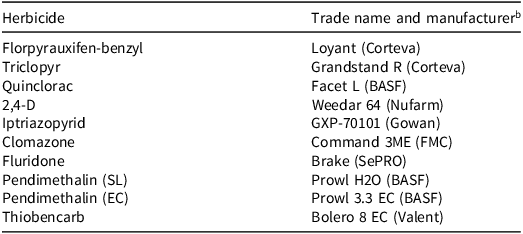
Field experiments were conducted during the 2024 and 2025 growing seasons at Pine Tree Research Station (35.126939, −90.964600) near Colt, Arkansas. The experiments were conducted to determine the potential antagonism between iptriazopyrid and synthetic auxins or residual herbicides labeled for use in rice production. Each experiment was conducted in flooded rice bays with plots measuring 1.71 m wide and 5.18 m long, with rice variety Ozark (University of Arkansas Cultivar Development, Fayetteville, AR) planted with a nine-row drill at 72 seeds per meter row into a Calloway silt loam with a soil composition of 15% clay, 17% sand, and 68% silt, with 1.4% organic matter, pH 6.7. Rice was planted on May 2, 2024, and June 3, 2025. The experimental design was a two-factor factorial randomized complete block design with four replications. The experimental factors were the presence of iptriazopyrid as one factor and the inclusion of an additional herbicide as the second factor, depending on the mode of action. Iptriazopyrid was tested in combination with five herbicide modes of action: with applications of microtubule inhibitors pendimethalin EC (1,110 g ai ha−1) and pendimethalin SL (1,060 g ai ha−1), synthetic auxins florpyrauxifen-benzyl (29.3 g ai ha−1), triclopyr (420 g ai ha−1), quinclorac (420 g ai ha−1), and 2,4-D (1,060 g ai ha−1). Also tested was the phytoene desaturase inhibitor fluridone (168 g ai ha−1), the 1-deoxy-D-xylulose-5-phosphate synthase inhibitor clomazone (336 g ai ha−1), and the very-long-chain fatty acid inhibitor thiobencarb (3,360 g ai ha−1) (Table 1). All tested herbicides, except for iptriazopyrid, were applied at rates listed on the product label and typically used on rice production fields. Throughout each experiment, iptriazopyrid was applied at a set rate of 50 g ai ha−1, with methylated seed oil (100 mL L−1) included with all applications. The 50 g ai ha−1 rate was selected because reduced herbicide rates can lead to measurable interactions that could be overcome or diminished if full rates of herbicides are applied (Hydrick and Shaw Reference Hydrick and Shaw1994; Rhodes and Coble Reference Rhodes and Coble1984). All experiments included clomazone (168 g ai ha−1) as a preemergence overspray to delay grass growth and stimulate annual sedge emergence. All herbicides were applied using a CO2-pressurized backpack sprayer equipped with AIXR110015 flat-fan nozzles (TeeJet, Glendale Heights, IL) that were calibrated to deliver a spray volume of 140 L ha−1 at 4.8 km h−1. All herbicides were applied when barnyardgrass was at the 3- to 4-leaf stage, which was the only weed present across both years of the experiments.
Herbicide information for products used in field experiments. a

Table 1. Long description
The table presents herbicides along with their trade names and manufacturers. It contains two columns: Herbicide and Trade name and manufacturer. The table has nine rows, each listing a different herbicide and its corresponding trade name and manufacturer. Row 1: Florpyrauxifen-benzyl, Loyant (Corteva). Row 2: Triclopyr, Grandstand R (Corteva). Row 3: Quinclorac, Facet L (BASF). Row 4: 2,4-D, Weedar 64 (Nufarm). Row 5: Iptriazopyrid, GXP-70101 (Gowan). Row 6: Clomazone, Command 3ME (FMC). Row 7: Fluridone, Brake (SePRO). Row 8: Pendimethalin (SL), Prowl H2O (BASF). Row 9: Pendimethalin (EC), Prowl 3.3 EC (BASF). Row 10: Thiobencarb, Bolero 8 EC (Valent).
a Abbreviations: EC, emulsifiable concentrate; SL, soluble liquid.
b Manufacturer locations: BASF Agricultural Solutions US LLC, Durham, NC; Corteva Agriscience, Indianapolis, IN; FMC Corporation, Philadelphia, PA; Gowan Company, Yuma, AZ; Nufarm Americas Inc., Alsip, IL; SePRO Ag LLC, Carmel, IN; Valent U.S.A. LLC Agricultural Products, San Ramon, CA.
Weed control and rice injury ratings were taken 1, 2, and 4 wk after treatment (WAT). Visible injury ratings were assessed on a scale ranging from 0% to 100%, with 0% representing no injury and 100% representing crop death (Frans and Talbert Reference Frans and Talbert1977). Rice injury ratings were also recorded to evaluate potential crop injury from the tested herbicide combinations. Weed density in a 1-m2 plot was measured 28 d after application to determine the weed population in each plot.
There was no significant year effect between the two years (P > 0.05); therefore, the data from both years were pooled. Percent expected weed control was determined using Colby’s method to assess interactions among mixtures (Colby Reference Colby1967). Expected control values were calculated using the following equation:
 $$E = (X + Y) - (X \times Y)/100$$
where E represents the expected response the mixture provides, and X and Y represent the responses observed with herbicides X and Y when applied individually. Expected and observed values were compared using a paired t-test in JMP Pro 18 software (SAS Institute Inc.) with a value of α = 0.05. If the observed response was significantly greater than the expected response, the mixture was considered synergistic. If the observed response was significantly lower than the expected response, then the mixture was considered antagonistic. If there was no significant difference between the observed and expected response, then the mixture was considered additive.
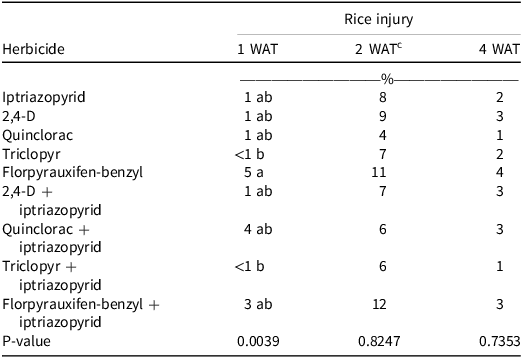
Visible rice injury ratings were subjected to ANOVA using JMP Pro 18 software. Rice injury for mixtures containing synthetic auxins was significant at 1 WAT, but not at 2 and 4 WAT. A significant interaction between herbicide and year was observed at 1 and 2 WAT in the residual herbicide experiments in rice. At 4 WAT, visible injury ratings were no longer influenced by the herbicide-by-year interaction. A Tukey HSD test with an α = 0.05 was used to achieve mean separation in barnyardgrass control and rice injury ratings.
Results and Discussion
Synthetic Auxin Interactions
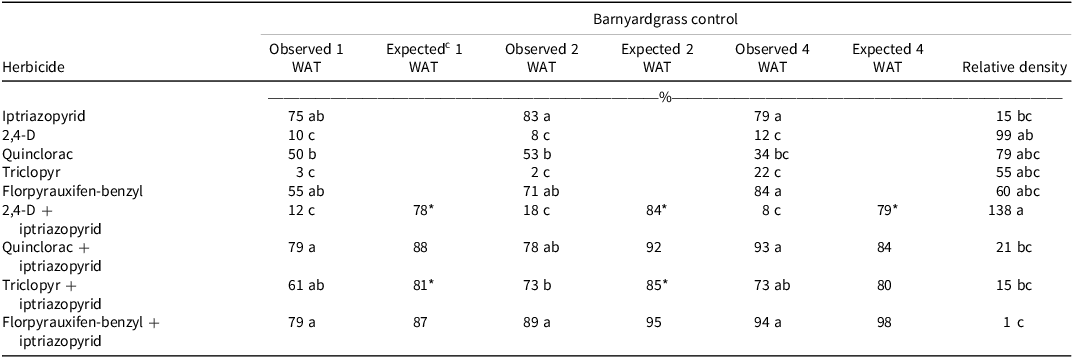
Barnyardgrass control was 75%, 83%, and 79%, respectively, at 1, 2, and 4 WAT when iptriazopyrid was applied at 50 g ai ha−1 (Table 2). The addition of 2,4-D to iptriazopyrid resulted in a strong antagonistic effect, as evidenced by only 12% barnyardgrass control compared with an expected control of 78% at 1 WAT. The antagonistic interaction was consistent throughout the evaluations. In other research, 2,4-D antagonized the effects of ACCase-inhibiting herbicides on annual grasses by upregulating cytochrome P450 genes, thereby enabling rapid detoxification of these herbicides (Han et al. Reference Han, Yu, Cawthray and Powles2013). Cytochrome P450s are known to detoxify ACCase- and HPPD-inhibiting herbicides (Han et al. Reference Han, Yu, Cawthray and Powles2013; Jhala et al. Reference Jhala, Kumar, Yadav, Jha, Jugulam, Williams, Hausman, Dayan, Burton, Dale and Norsworthy2023; Ma et al. Reference Ma, Kaundun, Tranel, Riggins, McGinness, Hager, Hawkes, McIndoe and Riechers2013; Riechers et al. Reference Riechers, Kreuz and Zhang2010;). Therefore, it is likely that the antagonism of barnyardgrass resulting from the addition of 2,4-D to iptriazopyrid is due to the rapid metabolism of iptriazopyrid; however, metabolic studies would be needed to confirm this hypothesis.
Observed and expected barnyardgrass control at 1, 2, and 4 weeks after treatment (WAT) and relative barnyardgrass density at 4 WAT from the interaction of iptriazopyrid and synthetic auxins labeled in rice applied at 3- to 4-leaf barnyardgrass. The study was conducted near Colt, Arkansas in 2024 and 2025. Herbicide-specific paired t-tests were utilized to determine significant differences between observed and expected barnyardgrass control ratings derived through Colby’s method. a,b

Table 2 Long description
A table comparing the observed and expected barnyardgrass control percentages at different weeks after treatment with various herbicides. The table has 10 rows and 7 columns. The columns are labeled as Herbicide, Observed 1 WAT, Expected 1 WAT, Observed 2 WAT, Expected 2 WAT, Observed 4 WAT, Expected 4 WAT, and Relative density. The rows list different herbicides and their combinations. Row 1: Iptriazopyrid, Observed 1 WAT 75 ab, Expected 1 WAT, Observed 2 WAT 83 a, Expected 2 WAT, Observed 4 WAT 79 a, Expected 4 WAT, Relative density 15 bc. Row 2: 2,4-D, Observed 1 WAT 10 c, Expected 1 WAT 8 c, Observed 2 WAT 12 c, Expected 2 WAT 8 c, Observed 4 WAT 8 c, Expected 4 WAT, Relative density 99 ab. Row 3: Quinclorac, Observed 1 WAT 50 b, Expected 1 WAT, Observed 2 WAT 53 b, Expected 2 WAT, Observed 4 WAT 34 bc, Expected 4 WAT, Relative density 79 abc. Row 4: Triclopyr, Observed 1 WAT 3 c, Expected 1 WAT, Observed 2 WAT 2 c, Expected 2 WAT, Observed 4 WAT 22 c, Expected 4 WAT, Relative density 55 abc. Row 5: Florpyrauxifen-benzyl, Observed 1 WAT 55 ab, Expected 1 WAT, Observed 2 WAT 71 ab, Expected 2 WAT, Observed 4 WAT 84 a, Expected 4 WAT, Relative density 60 abc. Row 6: 2,4-D + iptriazopyrid, Observed 1 WAT 12 c, Expected 1 WAT 78*, Observed 2 WAT 18 c, Expected 2 WAT 84*, Observed 4 WAT 8 c, Expected 4 WAT 79*, Relative density 138 a. Row 7: Quinclorac + iptriazopyrid, Observed 1 WAT 79 a, Expected 1 WAT, Observed 2 WAT 78 ab, Expected 2 WAT, Observed 4 WAT 93 a, Expected 4 WAT, Relative density 21 bc. Row 8: Triclopyr + iptriazopyrid, Observed 1 WAT 61 ab, Expected 1 WAT 81*, Observed 2 WAT 73 b, Expected 2 WAT 85*, Observed 4 WAT 73 ab, Expected 4 WAT, Relative density 15 bc. Row 9: Florpyrauxifen-benzyl + iptriazopyrid, Observed 1 WAT 79 a, Expected 1 WAT, Observed 2 WAT 89 a, Expected 2 WAT, Observed 4 WAT 94 a, Expected 4 WAT, Relative density 1 c.
a Letter separation was achieved via Tukey’s HSD with an α = 0.05.
b An asterisk denotes p-value ≤ 0.05 based on paired t-test between both the means of observed and expected response for barnyardgrass control.
c Expected values were calculated using the actual response of herbicide via Colby’s method: E = (X + Y) – (X*Y)/100, where E represents the expected response the mixture provides, and X and Y represent the response provided by herbicide X and Y individually.
Likewise, adding triclopyr to iptriazopyrid resulted in slight antagonism on barnyardgrass at 1 and 2 WAT (Table 2). Barnyardgrass control was 61% and 73% in plots treated with triclopyr and iptriazopyrid at 1 and 2 WAT, respectively, whereas the expected control was 81% and 85%. The antagonism of iptriazopyrid by 2,4-D is not of great agronomic concern because the novel HPPD-inhibiting herbicide is likely to be applied to rice as early as the 2-leaf stage as opposed to 2,4-D, which has a narrow application window from late tiller to before panicle initiation, which restricts opportunities to mix the two herbicides. Furthermore, neither triclopyr nor 2,4-D would increase the spectrum over that of sequential applications of iptriazopyrid alone on common weeds of Arkansas rice (Barber et al. Reference Barber, Butts, Wright-Smith, Ford, Jones, Norsworthy, Burgos and Bertucci2026; Norsworthy et al. Reference Norsworthy, Ketchum and Sandoski2026).
Relative barnyardgrass density assessments support the antagonistic relationship present between 2,4-D and iptriazopyrid (Table 2). Plots treated with iptriazopyrid alone had 15% barnyardgrass density (85% reduction) relative to the nontreated, and no reduction in barnyardgrass density occurred when 2,4-D was added to iptriazopyrid. The initial antagonistic relationship between triclopyr and iptriazopyrid was not detectable based on barnyardgrass density at 4 WAT, matching the visible barnyardgrass control ratings.
The addition of either florpyrauxifen-benzyl or quinclorac to iptriazopyrid resulted in additive responses in the combinations (Table 2). The barnyardgrass control at the rate listed on the quinclorac product label never exceeded 53%, suggesting some herbicide resistance at this location. Postemergence barnyardgrass resistance to quinclorac is widespread in Arkansas, but quinclorac is still widely used, partly due to its activity on a wide assortment of grasses, broadleaves, and sedges, and its residual control (Butts et al. Reference Butts, Kouame, Norsworthy and Barber2022; Hardke et al. Reference Hardke, Barber, Bateman, Drescher, Hamilton, Henry, Mazzanti, Nicolli, Norsworthy, Roberts and Scott2025; Miller et al. Reference Miller, Norsworthy, Scott and Barber2015; Street and Mueller Reference Street and Mueller1993). Considering that iptriazopyrid, especially at the rate tested here, provides a short residual effect, mixtures of quinclorac and iptriazopyrid are likely to be effective for weed control in many rice production systems.
Florpyrauxifen-benzyl has been documented to be an effective control option for Palmer amaranth [Amaranthus palmeri (S.) Wats] in furrow-irrigated rice production (Barber et al. Reference Barber, Butts, Wright-Smith, Ford, Jones, Norsworthy, Burgos and Bertucci2026). In other research, iptriazopyrid has provided exceptional control of Palmer amaranth (Norsworthy et al. Reference Norsworthy, Ketchum and Sandoski2026). Combinations of iptriazopyrid and florpyrauxifen-benzyl could be effective for controlling Palmer amaranth in furrow-irrigated rice systems; however, further testing will be needed to confirm its efficacy.
Among herbicides, all treatments caused similar injury to that of florpyrauxifen-benzyl, except for triclopyr and the triclopyr + iptriazopyrid combination; all applications resulted in <5% injury at 1 WAT (Table 3). At both 2 and 4 WAT, there were no detectable differences in injury among treatments, with no more than 12% injury observed. The lack of injury with iptriazopyrid by itself is unsurprising, given the excellent tolerance rice exhibited in greenhouse and field experiments at application rates of at least 75 g ai ha−1 (Ketchum et al. Reference Ketchum, Norsworthy, Pierce, Barber, Scott and Sandoski2026; Nishio et al. Reference Nishio, Nishijima, Kubota, Furuhata, Nanao, Permana, Furuhashi and Kato2025).
Rice injury for an experiment evaluating the interaction of iptriazopyrid with synthetic auxin herbicides at 1, 2, and 4 weeks after treatment (WAT), averaged over 2024 and 2025 in a trial conducted near Colt, AR. a,b

Table 3 Long description
A table comparing rice injury percentages across different herbicide treatments and weeks after treatment. The table has 11 rows and 4 columns. The columns are labeled 'Herbicide', '1 WAT', '2 WAT', and '4 WAT'. The '1 WAT', '2 WAT', and '4 WAT' columns represent the percentage of rice injury at 1, 2, and 4 weeks after treatment, respectively. The 'Herbicide' column lists different herbicide treatments. Row 1: Iptriazopyrid, 1, 8, 2. Row 2: 2,4-D, 1, 9, 3. Row 3: Quinclorac, 1, 4, 1. Row 4: Triclopyr, <1, 7, 2. Row 5: Florpyrauxifen-benzyl, 5, 11, 4. Row 6: 2,4-D + iptriazopyrid, 1, 7, 3. Row 7: Quinclorac + iptriazopyrid, 4, 6, 3. Row 8: Triclopyr + iptriazopyrid, <1, 6, 1. Row 9: Florpyrauxifen-benzyl + iptriazopyrid, 3, 12, 3. Row 10: P-value, 0.0039, 0.8247, 0.7353. The table shows the variation in rice injury percentages across different herbicide treatments and weeks after treatment.
a Letter separation was achieved via Tukey’s HSD with an α = 0.05.
b The symbol < indicates injury values between 1 and 0.
c No significant differences were detected in rice injury at 2 and 4 WAT due to a p-value > 0.05.
Residual Herbicide Interactions
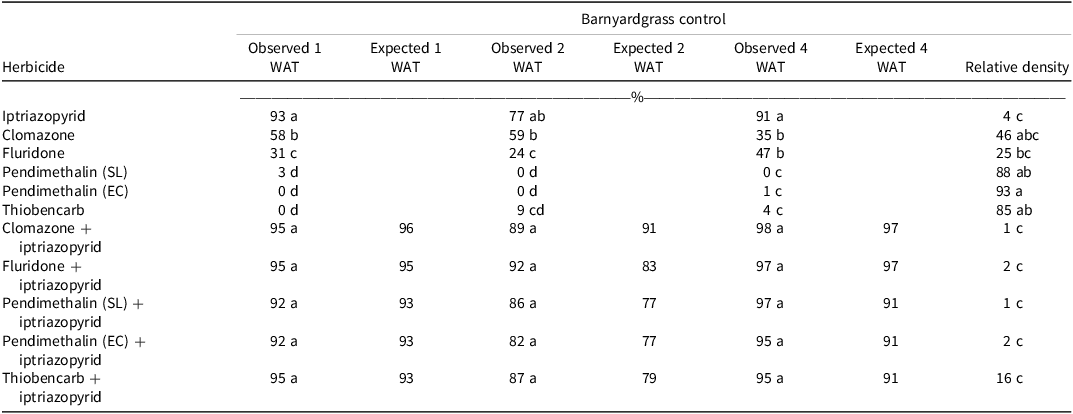
It will be necessary to add residual herbicides to iptriazopyrid as applications of the latter herbicide provides only postemergence control of many common rice weeds (Ketchum and Norsworthy, unpublished observations). For that reason, when residual herbicides are added to iptriazopyrid they must not adversely affect postemergence performance. When applied in combination with iptriazopyrid, none of the residual herbicides provided reductions in barnyardgrass control compared with iptriazopyrid applied alone (Table 4). Furthermore, based on the comparison of observed and expected responses, all residual herbicide combinations with iptriazopyrid were deemed additive for barnyardgrass control. All residual herbicide combinations with iptriazopyrid provided >90% visible barnyardgrass control by 4 WAT, while also providing at least 98% reduction in relative barnyardgrass density, except for thiobencarb (Table 4). Only the iptriazopyrid and thiobencarb combination was observed to have less than 90% reduction in barnyardgrass density. While mixtures of thiobencarb and iptriazopyrid were not deemed antagonistic here, others have recently reported the combination to be less effective on barnyardgrass than iptriazopyrid alone (Connor Webster, personal communication).
Observed and expected barnyardgrass control at 1, 2, and 4 wk after treatment and relative barnyardgrass density at 4 WAT from interactions of iptriazopyrid and residual herbicides labeled in rice applied at 3- to 4-leaf barnyardgrass.a–d

Table 4 Long description
The table presents data on barnyardgrass control using different herbicides and their combinations. It includes observed and expected control percentages at 1, 2, and 4 weeks after treatment (WAT), as well as relative barnyardgrass density at 4 WAT. The table has 12 rows and 7 columns. Column headers are Herbicide, Observed 1 WAT, Expected 1 WAT, Observed 2 WAT, Expected 2 WAT, Observed 4 WAT, Expected 4 WAT, and Relative density. Row labels include herbicides like Iptiazopyrid, Clomazone, Fluridone, Pendimethalin (SL), Pendimethalin (EC), Thiobencarb, and their combinations. Each row provides the observed and expected control percentages at different WAT and the relative density. Notable trends include high control percentages for combinations involving Iptiazopyrid, with most combinations achieving over 90% control by 4 WAT and significant reductions in relative density.
a Abbreviations: EC, emulsifiable concentrate; SL, soluable liquid; WAT, weeks after treatment.
b Letter separation was achieved via a Tukey HSD test with a value of α = 0.05.
c An asterisk (*) denotes P ≤ 0.05 based on a paired t-test between both the means of observed and expected response for barnyardgrass control.
d Expected values were calculated using the actual response of herbicide via Colby’s method: E = (X + Y) – (X × Y)/100, where E represents the expected response the mixture provides, and X and Y represent the response provided by herbicide X and Y individually (Colby Reference Colby1967).
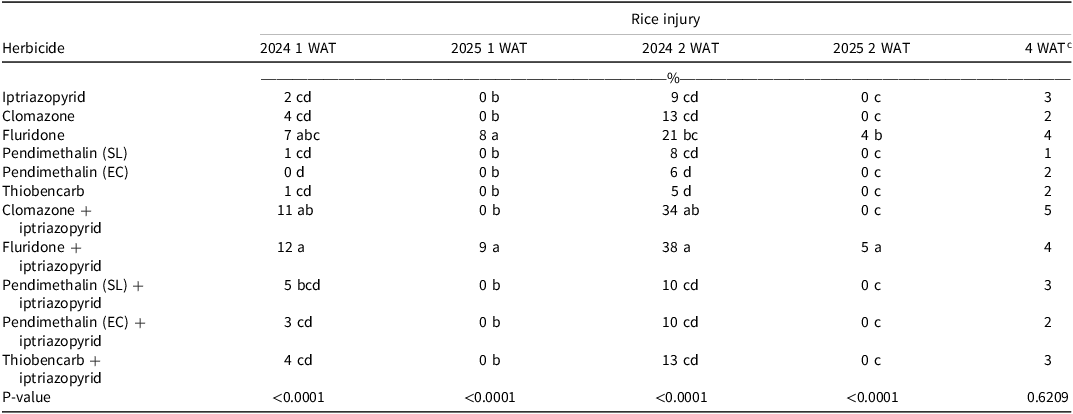
Currently, there is concern about using both clomazone and fluridone in combination with iptriazopyrid, or when bleaching is still present in rice leaf tissue, due to the increased risk of injury (Craig Sandoski, personal communication). There was a significant injury-by-year effect in rice injury caused by rain after application. In 2024, 12.7 mm of rain was recorded 24 h after application, whereas in 2025, 24.6 mm of rain fell 7 d after application. Rain is necessary to activate residual herbicides. When activating rain occurs within 24 h after application, herbicide performance is enhanced compared with later activating rainfall (Sebastian et al. Reference Sebastian, Nissen, Westra, Shaner and Butters2016). The variability in injury was mostly expressed with a single application of clomazone and fluridone, and with combinations containing iptriazopyrid. Injury after fluridone and iptriazopyrid applications ranged from 38% at 2 WAT in 2024 to 5% in 2025, which was significantly greater than other herbicide applications (Table 5). Clomazone and iptriazopyrid applications also resulted in large variability due to interannual rainfall, with 34% rice injury at 2 WAT in 2024, which is statistically similar to injury after applications of fluridone and iptriazopyrid at 2 WAT in 2024, compared with 0% in 2025. Injury ratings were no longer significant at 4 WAT in both years, with all injuries at 5% or less. Although a consistent sedge complex was not present in both 2024 and 2025, research elsewhere has reported antagonistic effects of thiobencarb on iptriazopyrid for the sedge complex (Craig Sandoski, personal communication).
Rice injury for an experiment evaluating the interaction of iptriazopyrid with residual herbicides labeled for use in rice. “Ozark,” a long-grain inbred rice variety, was utilized in both years of the experiment. The experiments were conducted near Colt, Arkansas, and were planted on May 2, 2024, and June 3, 2025. Injury was evaluated at 1, 2, and 4 weeks after treatment (WAT), on a 0-100% scale. a,b

Table 5 Long description
The table presents data on rice injury percentages caused by various herbicides over different years and weeks after treatment (WAT). It includes measurements from 2024 and 2025, specifically at 1 WAT, 2 WAT, and 4 WAT. The herbicides listed are Iptiazopyrid, Clomazone, Fluridone, Pendimethalin (SL and EC), Thiobencarb, and combinations of these herbicides. The table has 11 rows and 5 columns. The columns are labeled as follows: Herbicide, 2024 1 WAT, 2025 1 WAT, 2024 2 WAT, 2025 2 WAT, and 4 WAT. The row labels are the names of the herbicides. Each cell contains the percentage of rice injury observed. Notable trends include higher injury percentages with combinations of herbicides, particularly Fluridone + Iptiazopyrid and Clomazone + Iptiazopyrid. The injury percentages vary significantly between the years and weeks after treatment, indicating the impact of different herbicide interactions and environmental conditions on rice injury.
a Letter separation was achieved via Tukey’s HSD with an α = 0.05.
b Year was analyzed separately for rice injury at 1 and 2 WAT due to significant differences being present within herbicide by year interaction p-value ≤ 0.05.
c No significant differences were detected in rice injury at 4 WAT with a p-value > 0.05.
Practical Implications
It is imperative that the efficacy of iptriazopyrid not be diminished by tank-mix partners, given the need to prevent barnyardgrass escapes due to the proven risk of selection pressure leading to resistance evolution in this weed (Carey et al. Reference Carey, Hoagland and Talbert1995; Lovelace et al. Reference Lovelace, Talbert, Schmidt, Scherder and Reaper2000; Miller et al. Reference Miller, Norsworthy, Scott and Barber2015; Norsworthy et al. Reference Norsworthy, Griffith and Scott2009, Reference Norsworthy, Scott, Johnson, Norman and Moldenhauer2012a). The most recent rice survey in Arkansas reported a 44% failure rate after initial postemergence applications of barnyardgrass, and 55% of respondents indicated the need for two additional applications due to the high failure rate in postemergence control (Butts et al. Reference Butts, Kouame, Norsworthy and Barber2022). Only herbicides that do not diminish efficacy against the most problematic weeds in rice should be used in mixture with iptriazopyrid. For that reason, 2,4-D and triclopyr should not be mixed with iptriazopyrid. Quinclorac or florpyrauxifen-benzyl mixed with iptriazopyrid produced an additive response for barnyardgrass control, and there were no adverse rice injury. Florpyrauxifen-benzyl may delay resistance to iptriazopyrid in barnyardgrass because both herbicides are effective, and it would further provide an option for controlling yellow nutsedge (Cyperus esculentus L.), a weed for which iptriazopyrid alone is not effective (Barber et al. Reference Barber, Butts, Wright-Smith, Ford, Jones, Norsworthy, Burgos and Bertucci2026; Ketchum and Norsworthy, unpublished data).
There were no antagonistic effects of residual herbicides labeled for use on rice when applied in combination with iptriazopyrid. There is variability in injury: the fluridone-iptriazopyrid combination, along with clomazone-iptriazopyrid treatments, caused up to 38% and 34% injury, respectively, when rain fell within 24 h of application. Based on these experiments, iptriazopyrid shows reasonable tank-mix compatibility with all evaluated residual herbicides and two auxin herbicides, but some such as clomazone and fluridone can pose a heightened risk for injury to rice.
Acknowledgments
We thank the University of Arkansas System Division of Agriculture for providing land and assistance for carrying out this research.
Funding
Gowan USA and the Arkansas Rice Checkoff Program provided financial support for this research.
Competing Interests
Craig Sandoski is an employee of Gowan USA.

 Open access

