Introduction
There is growing evidence that cannabis use may increase the risk of developing schizophrenia (Murray et al. Reference Murray, Morrison, Henquet and Di Forti2007; Manrique-Garcia et al. Reference Manrique-Garcia, Zammit, Dalman, Hemmingsson, Andreasson and Allebeck2012), and that individuals with first-episode psychosis with a history of cannabis use have an earlier onset of psychotic symptoms and younger age at presentation to services (Gonzalez-Pinto et al. Reference Gonzalez-Pinto, Alberich, Barbeito, Gutierrez, Vega, Ibanez, Haidar, Vieta and Arango2011; Large et al. Reference Large, Sharma, Compton, Slade and Nielssen2011). Cannabis use has generally been reported to be associated with increased positive symptoms and increase in risk of relapse in patients with schizophrenia, with functional and symptomatic improvements reported to occur on discontinuation (Grech et al. Reference Grech, Van Os, Jones, Lewis and Murray2005; Zammit et al. Reference Zammit, Moore, Lingford-Hughes, Barnes, Jones, Burke and Lewis2008; Foti et al. Reference Foti, Kotov, Guey and Bromet2010; Kuepper et al. Reference Kuepper, van Os, Lieb, Wittchen, Höfler and Henquet2011; Faber et al. Reference Faber, Smid, Van Gool, Wunderink, van den Bosch and Wiersma2012). Cannabis use has also been shown to affect mood (Henquet et al. Reference Henquet, Krabbendam, de Graaf, ten Have and van Os2006), being reported to be associated with depressive symptoms and worse outcome in individuals with bipolar affective disorder (Strakowski et al. Reference Strakowski, DelBello, Fleck, Adler, Anthenelli, Keck, Arnold and Amicone2007; van Rossum et al. Reference van Rossum, Boomsma, Tenback, Reed and van Os2009). To our knowledge, no longitudinal studies have yet examined the relationship of cannabis use to symptoms of mania in patients with first-episode psychosis.
In this study, we examined the temporal relationship of cannabis use to manic and psychotic symptoms and to age at presentation to services in a large UK-based cohort of patients with first-episode psychosis. We hypothesized that cannabis use would be associated with a younger age of presentation to services, and that cannabis use would be associated with a greater level of manic and psychotic symptoms and with poorer daily functioning. We also hypothesized that reducing or stopping cannabis use following the first psychotic episode would be associated with better symptomatic and functional improvement.
Method
Ethical approval for this study was obtained from Wandsworth Research Ethics Committee. The study was conducted in accordance with the ethical standards laid down in the Declaration of Helsinki (1964, 2004). Clinical data were collected using the MiData audit database from seven London-based Early Intervention in psychosis teams, covering the London boroughs of Brent, Camden, City and Hackney, Islington, Kensington and Chelsea, Lewisham, Southwark, Wandsworth, and Westminster (Fisher et al. Reference Fisher, Theodore, Power, Chisholm, Fuller, Marlowe, Aitchison, Tanna, Joyce, Sacks, Craig and Johnson2008; Ghali et al. Reference Ghali, Fisher, Joyce, Major, Hobbs, Soni, Chisholm, Rahaman, Papada, Lawrence, Bloy, Marlowe, Aitchison, Power and Johnson2012). Within each team, clinicians (doctors and care-coordinators) completed training by H.L.F. over a 4.5 h session, including vignettes, practice sessions, and discussion of standardized ratings, and were required to demonstrate high reliability with expert raters (Fisher et al. Reference Fisher, Theodore, Power, Chisholm, Fuller, Marlowe, Aitchison, Tanna, Joyce, Sacks, Craig and Johnson2008). In keeping with standard practice in the UK for first-episode psychosis teams, patient inclusion was based on a history of psychotic symptoms that lasted for more than 7 days. Individuals who only experienced psychotic symptoms during acute drug intoxication were not included in the study, but otherwise no prior assumptions were made about the cause or diagnosis of the psychotic illness. Individuals were assessed at two time points – at entry to the service and after 1 year in contact with the service. On each occasion, the Positive and Negative Syndrome Scale (PANSS; Kay et al. Reference Kay, Fiszbein and Opler1987), Young Mania Rating Scale (YMRS; Young et al. Reference Young, Biggs, Ziegler and Meyer1978) and the Global Assessment of Functioning Scale disability subscale (GAF-d; Endicott et al. Reference Endicott, Spitzer, Fleiss and Cohen1976) were rated. At both time points, the use of cannabis and other drugs of abuse in the 6 months preceding each assessment was recorded using the combined Alcohol and Drug Use scales (Drake et al. Reference Drake, Mueser, McHugo, Sederer and Dickey1996). Each drug was rated by clinicians on an operationalized four-point scale (No use, use, abuse, dependence), as previously described (Drake et al. Reference Drake, Mueser, McHugo, Sederer and Dickey1996). On this scale, ‘use’ is defined as substance use with no evidence of persistent or recurrent social, occupational, psychological or physical problems related to use, and no evidence of recurrent dangerous use. ‘Abuse’ is defined as substance use with the presence of any of these features. ‘Dependence’ is defined as the criteria for ‘abuse’, plus at least three of the following seven items: (1) much time is spent obtaining or using the substance; (2) frequent intoxication or withdrawal interferes with other activities; (3) important activities are given up because of substance use; (4) continued use despite knowledge of substance-related problems; (5) marked tolerance; (6) characteristic withdrawal symptoms; and (7) the substance is used to relieve or avoid withdrawal problems. At the second time point, clinical diagnosis and compliance with medication (where known) were also recorded.
Statistical analyses were completed using R version 2.14.1 (Ihaka & Gentleman, Reference Ihaka and Gentleman1996). We generated a linear model with age at presentation to services as the dependent variable, and level of cannabis use, alcohol use, nicotine use, cocaine use, and stimulant use in the preceding 6 months, gender, ethnicity, social functioning (GAF-d) and symptoms at presentation (PANSS total and YMRS) as independent variables. We then generated four separate linear models with baseline YMRS, PANSS positive (PANSS-P), PANSS negative (PANSS-N) and GAF-d scores as dependent variables and level of cannabis use, alcohol use, nicotine use, cocaine use, and stimulant use in the preceding 6 months, age at presentation, gender and ethnicity as independent variables. In each case, models were simplified using an Akaike information criterion-based stepwise method implemented in R (Ihaka & Gentleman, Reference Ihaka and Gentleman1996). Where cannabis was significantly related to the dependent variable in each analysis of variance (ANOVA), we performed post hoc Pearson's correlations on the level of cannabis use versus the dependent variable, uncorrected for independent variables.
In the follow-up sample, we compared baseline demographics and clinical measures with the full (baseline-only) sample using Student's t test and χ 2 test, where appropriate. We used four repeated-measures ANOVAs to compare YMRS, PANSS (positive and negative) and GAF-d ratings at baseline and follow-up in three groups based on their change in cannabis use over the period of study: (1) patients who reported no cannabis use both at presentation and 1-year follow-up (‘abstinent’); (2) patients who reported a reduction or a discontinuation of their use of cannabis (‘reduced’); and (3) patients who reported a continuation or increase in their use of cannabis (‘continued’). For all analyses, histogram and qq plots of residuals were used to confirm normality of data and two-tailed p values were employed to determine statistical significance.
Results
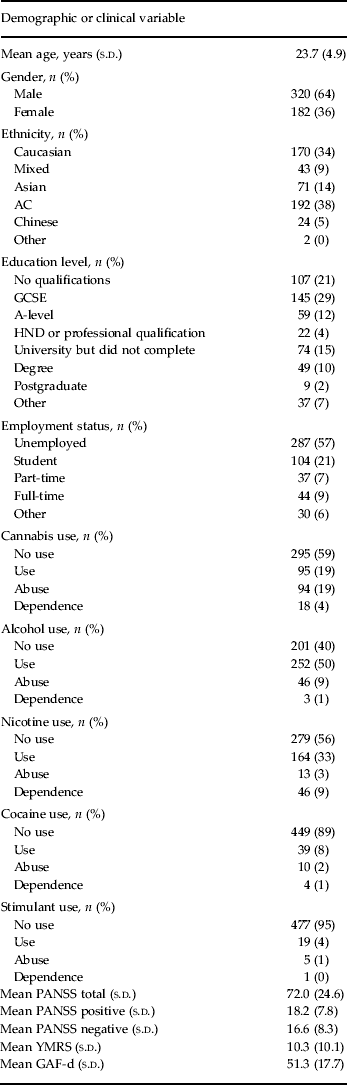
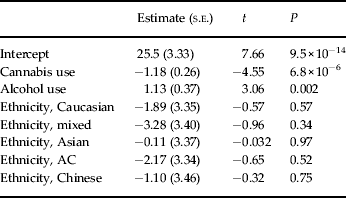
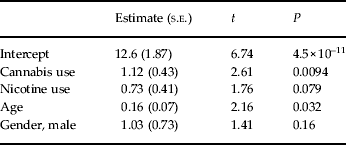
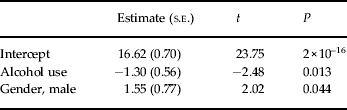
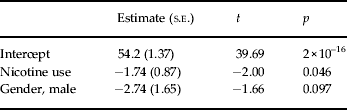
Baseline data on recent cannabis, cocaine, stimulant and alcohol use were available in 502 first-episode patients (320 male, 182 female). Demographic and clinical details are summarized in Table 1. Age at presentation was predicted by a model driven primarily by level of cannabis use in the preceding 6 months (associated with a younger age of presentation; post hoc, uncorrected r = 0.18, n = 502, p = 5 × 10⁻⁵) but also including level of alcohol use (associated with an older age at presentation) and ethnicity (see Table 2). PANSS-P scores were predicted by a model primarily driven by level of cannabis use (post hoc, uncorrected r = 0.16, n = 502, p = 0.0004), but also including nicotine use, age and gender (Table 3). YMRS scores were predicted by a model that was simplified to include level of cannabis use only (F 1,500 = 16.67, r = 0.18, n = 502, p = 5.2 × 10⁻⁵). PANSS-N scores were predicted by a model including alcohol use and gender (Table 4). GAF-d scores were predicted by a model including nicotine use and gender (Table 5).
Demographic and baseline clinical details of EIS psychosis patients

EIS, Early Intervention Services; s.d., standard deviation; AC, black African and African-Caribbean; GCSE, General Certificate of Secondary Education; A-level, Advanced-Level General Certificate of Education; HND, Higher National Diploma; PANSS, Positive and Negative Syndrome Scale; YMRS, Young Mania Rating Scale; GAF-d, Global Assessment of Functioning Scale – disability subscale.
Components of general linear model predicting age at presentation a

s.e., Standard error; AC, black African and African-Caribbean.
a F 7,494 = 5.69 (p = 2.4 × 10⁻⁶).
Components of general linear model predicting PANSS positive scores at presentation a

PANSS, Positive and Negative Syndrome Scale; s.e., standard error.
a F 3,498 = 5.76 (p = 0.0002).
Components of general linear model predicting PANSS negative scores at presentation a

PANSS, Positive and Negative Syndrome Scale; s.e., standard error.
a F 2,499 = 4.634 (p = 0.01).
Components of general linear model predicting GAF-d scores at presentation a

GAF-d, Global Assessment of Functioning Scale – disability subscale; s.e., standard error.
a F 2,499 = 3.954 (p = 0.01).
Post hoc analyses of individual PANSS-P and YMRS components revealed that level of cannabis use was associated at presentation with increased conceptual disorganization, excitement and hostility on PANSS-P; and with elevated mood and increased motor activity, sexual interest, irritability, speech (rate and amount), language (thought disorder), and disruptive – aggressive behaviour on YMRS (all p values < 0.005, n = 502). Of note, cannabis use at presentation was not associated with a significantly greater severity of hallucinations (p = 0.47) or delusions (p = 0.25).
At the 1-year follow-up, data on cannabis use in 271 first-episode patients were available (54% of baseline sample). Of these, 143 (53%) were non-users of cannabis both at baseline and at follow-up (‘abstinent’ group), 80 (30%) were cannabis users at baseline but had stopped at follow-up (‘reduced’ group), and 48 (17%) had either continued or increased their level of cannabis use from baseline to follow-up (‘continued’ group). Out of the 271 first-episode patients with follow-up data, 221 (81%) had a diagnosis of schizophrenia or schizophreniform psychosis, 27 (10%) had a diagnosis of bipolar affective disorder, 13 (5%) had a diagnosis of depressive psychosis, and in 10 (4%), the diagnosis was not recorded. Of those with a final diagnosis of bipolar affective disorder, nine (34%) and seven (26%) were classified as being cannabis abusers and cannabis users, respectively, at baseline. In terms of medication concordance, 163 (60%) patients were recorded as being compliant with medication, 19 (7%) as non-compliant, and in 89 (33%) patients, this information was not available. The sample with baseline and follow-up data did not differ from the full (baseline-only) sample in terms of age (t = 0.91, p = 0.36), gender (χ 2 = 1.16, p = 0.28), ethnicity (χ 2 = 3.415, p = 0.64), PANSS-P [mean (s.d.) = 19.1 (7.7), t = 1.55, p = 0.121], PANSS-N [mean (s.d.) = 17.27 (8.6), t = 1.01, p = 0.31], YMRS [mean (s.d.) = 10.8 (9.6), t = 0.64, p = 0.52], GAF-d [mean (s.d.) = 48.9 (17.3), t = 1.86, p = 0.62], or cannabis use (χ 2 = 1.48, p = 0.69), at presentation.
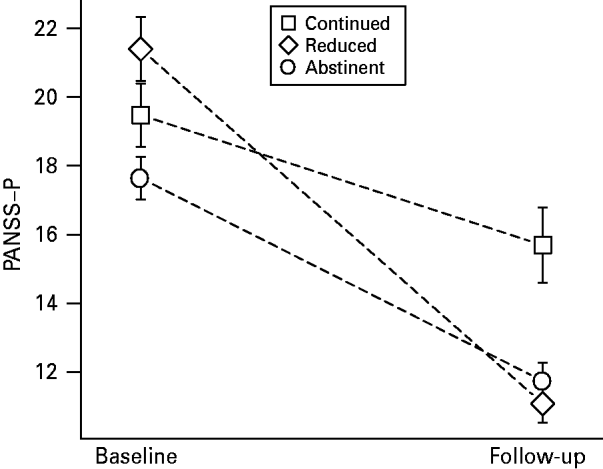
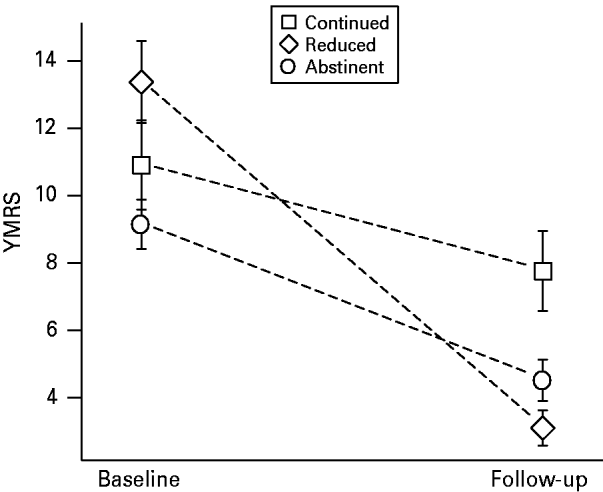
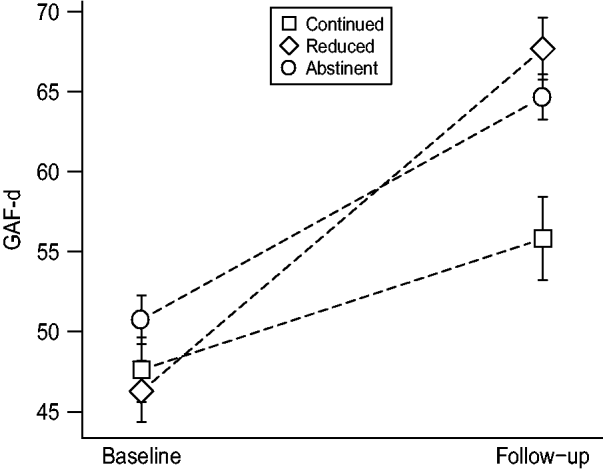
ANOVA revealed a significant within-subjects effect of time for PANSS-P (F 1,268 = 163, n = 271, p < 0.0001), PANSS-N (F 1,268 = 63.6, n = 271, p < 0.0001), YMRS (F 1,268 = 87.3, n = 271, p < 0.0001) and GAF-d (F 1,268 = 136, n = 271, p < 0.0001), with an improvement in all rating scales between baseline and follow-up [mean (s.d.) PANSS-P: 12.2 (6.4), PANSS-N: 12.9 (7.2), YMRS: 4.7 (6.9), GAF-d: 64.0 (17.6); n = 271]. There was a significant interaction between change in cannabis use (‘abstinent’, ‘reduced’, ‘continued’) and time for PANSS-P (F 2,268 = 9.93, n = 271, p < 0.0001; Fig. 1), YMRS (F 2,268 = 9.39, n = 271, p = 0.0001; Fig. 2) and GAF-d (F 2,268 = 6.24, n = 271, p = 0.002; Fig. 3). There was no significant interaction between change in cannabis use and time for PANSS-N (F 2,268 = 2.65, p = 0.07). Compared with individuals in the ‘continued’ group for cannabis use, those in the ‘abstinent’ and ‘reduced’ groups had lower PANSS-P (t = 3.26, 3.77; p = 0.001, 0.0003), YMRS (t = 2.4 3.57; p = 0.02, 0.0007) and GAF-d scores (t = 3.0, 3.66; p = 0.004, 0.0004) at follow-up. Medication concordance was not found to differ with different patterns of cannabis use (90% concordance reported in the ‘abstinent’ group, 90% in the ‘reduced’ group and 86% in the ‘continued’ group; n = 102, 50, 30, respectively; χ 2 = 0.32, p = 0.85).
Interaction plot of the positive subscale of the Positive and Negative Syndrome Scale (PANSS-P) over time. The figure shows PANSS-P scores in patients with first-episode psychosis who reported no cannabis use both at presentation and 1-year follow-up (‘abstinent’), who reported a reduction or a discontinuation of their use of cannabis (‘reduced’), and who reported a continuation or increase in their use of cannabis between baseline and follow-up (‘continued’). Values are means, with standard errors represented by vertical bars.

Interaction plot of the Young Mania Rating Scale (YMRS) over time. The figure shows YMRS scores in patients with first-episode psychosis who reported no cannabis use both at presentation and 1-year follow-up (‘abstinent’), who reported a reduction or a discontinuation of their use of cannabis (‘reduced’), and who reported a continuation or increase in their use of cannabis between baseline and follow-up (‘continued’). Values are means, with standard errors represented by vertical bars.

Interaction plot of the Global Assessment of Functioning scale – disability subscale (GAF-d) over time. The figure shows GAF-d scores in patients with first-episode psychosis who reported no cannabis use both at presentation and 1-year follow-up (‘abstinent’), who reported a reduction or a discontinuation of their use of cannabis (‘reduced’), and who reported a continuation or increase in their use of cannabis between baseline and follow-up (‘continued’). Values are means, with standard errors represented by vertical bars.

Discussion
In keeping with previous studies, these data suggest that cannabis use is associated with a younger age of presentation to services (Gonzalez-Pinto et al. Reference Gonzalez-Pinto, Alberich, Barbeito, Gutierrez, Vega, Ibanez, Haidar, Vieta and Arango2011; Large et al. Reference Large, Sharma, Compton, Slade and Nielssen2011), and that discontinuation or reduction of cannabis use is associated with enhanced symptomatic improvement in patients with first-episode psychosis (Grech et al. Reference Grech, Van Os, Jones, Lewis and Murray2005; Zammit et al. Reference Zammit, Moore, Lingford-Hughes, Barnes, Jones, Burke and Lewis2008; Foti et al. Reference Foti, Kotov, Guey and Bromet2010; Kuepper et al. Reference Kuepper, van Os, Lieb, Wittchen, Höfler and Henquet2011; Faber et al. Reference Faber, Smid, Van Gool, Wunderink, van den Bosch and Wiersma2012).
In contrast, several recent studies of cannabis use in schizophrenia suggest that change in cannabis use may not affect symptomatology to such a great extent. Three studies failed to demonstrate any change in PANSS-P scores with reduction or discontinuation of cannabis, although in all of these studies, discontinuation was associated with improvement in social functioning (Gonzalez-Pinto et al. Reference Gonzalez-Pinto, Alberich, Barbeito, Gutierrez, Vega, Ibanez, Haidar, Vieta and Arango2011; Faber et al. Reference Faber, Smid, Van Gool, Wunderink, van den Bosch and Wiersma2012; Barrowclough et al. Reference Barrowclough, Emsley, Eisner, Beardmore and Wykes2013). Another study found that, although there was no difference in clinical measures between cannabis users and non-users, cannabis users had more frequent hospital admissions (van Dijk et al. Reference van Dijk, Koeter, Hijman, Kahn and van den Brink2012). A further group reported that individuals who continued to take cannabis were more likely to be compliant with medication, but, after correcting for this, cannabis users had higher levels of psychopathology compared with those who discontinued cannabis (Faridi et al. Reference Faridi, Joober and Malla2012).
Thus, although positive symptoms, as rated by PANSS, are not always associated with cannabis use in patients with schizophrenia and first-episode psychosis, all studies have reported an improvement in functioning with reduction in use. It is also clear that cannabis use may have a complex inter-relationship with medication concordance in some patients, although this did not appear to be an issue in the present study. It is interesting to note that, although we found that cannabis did have an effect on PANSS-P scores in the present study, this effect was primarily driven by aggression and disinhibition, rather than the more usually associated symptoms of delusions and hallucinations.
It is possible that the effects of cannabis reduction on illness outcome may be most marked in patients with first-episode psychosis. A recent meta-analysis found that reducing substance intake led to improvements in symptomatology, but that this effect was only present in patients with first-episode psychosis. In patients with more established illness, improvements were not statistically significant (Mullin et al. Reference Mullin, Gupta, Compton, Nielssen, Harris and Large2012).
Although other studies have found that cannabis use is associated with increases in positive affect (self-rated reports of happiness, cheerfulness, relaxation, enthusiasm and satisfaction) in the general population (Henquet et al. Reference Henquet, Krabbendam, de Graaf, ten Have and van Os2006), and that it can worsen outcome in bipolar disorder (Strakowski et al. Reference Strakowski, DelBello, Fleck, Adler, Anthenelli, Keck, Arnold and Amicone2007; van Rossum et al. Reference van Rossum, Boomsma, Tenback, Reed and van Os2009), our study is the first report, to our knowledge, of cannabis use being associated more closely with manic-type symptoms than with hallucinations and delusions in patients with first-episode psychosis.
Our finding of an association between cannabis use and a younger age of presentation to services is in keeping with current evidence that cannabis use may lead to an earlier onset of psychotic symptoms (Large et al. Reference Large, Sharma, Compton, Slade and Nielssen2011). It is possible that individuals with earlier and more severe symptoms may be drawn to take cannabis for other reasons, or that younger individuals may simply be more likely to have taken cannabis in the preceding 6 months due to cannabis use being more prevalent in a younger age group. However, a recent meta-analysis concluded that these possibilities could not fully explain the association between cannabis use and earlier onset of psychosis (Large et al. Reference Large, Sharma, Compton, Slade and Nielssen2011). It should be noted that the 6 months prior to contact with services may have coincided with the onset of prodromal symptoms, and we cannot exclude the possibility that cannabis was used in an attempt to self-medicate.
It is interesting to note that, in the present study, the level of PANSS-P scores at baseline was associated with nicotine use (at trend level) and with age, and that lower GAF-d scores at baseline were also associated with nicotine use. Previous studies have reported an association between nicotine use and a greater severity of positive symptoms, as well as lower social functioning, in patients with first-episode psychosis and schizophrenia (Krishnadas et al. Reference Krishnadas, Jauhar, Telfer, Shivashankar and McCreadie2012; Zhang et al. Reference Zhang, Chen, Xiu, Haile, He, Luo, Zuo, Rosenheck, Kosten and Kosten2012). Although the reasons for these associations have not been ascertained, it is possible that nicotine use may worsen symptoms and levels of disability, or may be used as self-medication in an effort to improve some aspects of functioning in the most unwell patients (Krishnadas et al. Reference Krishnadas, Jauhar, Telfer, Shivashankar and McCreadie2012; Zhang et al. Reference Zhang, Chen, Xiu, Haile, He, Luo, Zuo, Rosenheck, Kosten and Kosten2012). The reason for our finding of an association between age and symptoms in this study is not known, but it is possible to speculate that older individuals were more likely to have been living away from home, with less daily contact from family members, and so their illness may have become more severe before being recognized.
We also found an association between alcohol use and less severe negative symptoms and between male gender and more severe negative symptoms. The finding of an association (albeit weak) between alcohol use and less severe PANSS-N scores has not been previously reported, to our knowledge, and may simply reflect the fact that individuals with lower negative symptoms are more capable of getting access to alcohol. The finding that male gender was associated with PANSS-N scores has been established for many years (Andreasen, Reference Andreasen1982; Abel et al. Reference Abel, Drake and Goldstein2010).
There are limitations to this study, most notably that cannabis and other drug use data were dependent on patient recall and disclosure – the alcohol and drug use scales are self-report scales. Furthermore, the data were recorded by a variety of different psychiatric team members who were not blind to treatment status, though all had received the same training. Only 27 patients were diagnosed with bipolar affective disorder at follow-up; therefore, manic-type symptoms, although associated with cannabis use, were unlikely to have been the primary presenting complaint in the majority of cases. Data on cannabis use at follow-up were not available in approximately 46% of the original sample. This was because follow-up assessments were abbreviated in some instances, with recordings of substance use being omitted, due to time pressures on the clinical teams involved in the study. Although the baseline demographics and clinical measures in patients with substance use data at both time points did not differ significantly from those with data from the first time point only, it is possible that the longitudinal analysis may not be fully representative of the total study population.
Despite these limitations, the findings from this study are derived from a relatively large naturalistic cohort with a good coverage of different London teams and regions and so should be generalizable to other inner-city services in the UK. This study suggests that efforts to identify effective interventions for reducing cannabis use are likely to yield significant health benefits for patients with first-episode psychosis.
Acknowledgements
Initial pilot work within Camden and Islington Early Intervention Services (EIS) was supported by Islington Primary Care Trust (PCT). We are extremely grateful to clinicians and patients from the teams participating as part of the MiData Consortium for their time and enthusiasm: Camden and Islington EIS, EQUIP Team (Hackney EIS), Lewisham EIS, Southwark Team for Early Psychosis (STEP), Wandsworth EIS, Westminster and Kensington & Chelsea EIS, and Brent EIS. There were no funding sources.
Declaration of Interest
A.H.Y. has received research grants, honoraria for educational activities and fees for consultancy services from a number of pharmaceutical companies (AstraZeneca, BCI Pharma, Bristol-Myers Squibb, Eli Lilly, GlaxoSmithKline, Janssen, Novartis, Otsuka Pharmaceutical Co., Pfizer, Sanofi-Aventis, Servier Laboratories and Wyeth). J.M.S. has received a non-restricted academic fellowship from GlaxoSmithKline, and honoraria from Roche, AstraZeneca, Behrenberg Bank and Pfizer.