Today, most Catholics attending Mass come forward to receive communion as a matter of course. But this fact actually belies a very long history of low communion frequency and an institution's often losing struggle to have Catholics regularly receive the body of Christ. Already by the end of the fourth century, communion frequency in the Church, both East and West, had declined rapidly. Thereafter, outside small circles of especially devout communicants, communion at Mass remained for most Catholics an infrequent act.Footnote 1 Yet during the mid-twentieth century, in the space of just a few decades, this situation showed signs of quite dramatic reversal. In the nineteenth century in Australia, average communion frequency among most practising Catholics was relatively nominal—perhaps three or four times a year was typical. On the eve of the Second Vatican Council, however, most Catholics in Australia were partaking of communion fortnightly and even weekly. Why this shift? What happened in the course of a generation which turned around a situation spanning many centuries in the Church's tradition of eucharistic worship?
This paper argues that the underlying reason for this change in communion frequency in Australian Catholicism actually rests with the evolving nature of ecclesiastical discourse. By “ecclesiastical discourse,” I mean the institutional categories and beliefs which defined, structured, and delimited the Church's thinking and, subsequently, its practices. In dealing specifically with communion, the central object of ecclesiastical discourse was the “body of Christ.” How the body of Christ was constructed as a discursive object profoundly impacted upon the understandings and practices of communion within the Church. The Australian Church inherited a dominant anthropomorphic focus on the “real body of Christ,” an emphasis which tended to inhibit higher communion frequency. Following Pius X's great emphasis on frequent communion in the early twentieth century, monthly communion moved toward normative among the laity. However, reception of communion began to increase when, and only when, another discursive construction of Christ's body—the “mystical body of Christ”—became operative within ecclesiastical discourse during the 1940s and 1950s. The liturgical reforms of the Second Vatican Council and, subsequently, weekly reception of communion for most Mass-goers, represent the legacy of this gradual but decisive shift in ecclesiastical discourse. But first, we turn to the question of communion frequency in the nineteenth century. Did the Church actively encourage frequent communion and did the laity respond?
I. A Rejected Invitation
At the beginning of the nineteenth century, few practising Catholics received communion more than a handful of times a year. It is certainly true that the Council of Trent had encouraged Catholics to receive communion at every Mass. Chapter V of the decree on the sacrifice of the Mass stated, “The holy council wishes indeed that at each Mass the faithful who are present should communicate, not only in spiritual desire but also by sacramental partaking of the Eucharist, that thereby they may derive from this most holy sacrifice a more abundant fruit.”Footnote 2 However, subsequent historical developments allowed the minimalist ecclesiastical requirement of one annual communion at Eastertide to remain normative for most Catholics.Footnote 3 According to Peter Nissen, “in the three hundred years between the Council of Trent and the middle of the 19th century, the practice of receiving communion regularly was almost exclusively fostered in the more or less closed circles of religious fraternities and through congregations of Our Lady controlled by the Jesuits.”Footnote 4 Leading moral theologians in the nineteenth century—influential figures such as Antonio Ballerini (1805–1881), Jean-Pierre Gury (1801–1866), and August Lehmkuhl (1834–1918)—expressed the dominant view that frequent communion was reserved for those who were well on the way to spiritual perfection. Lehmkuhl, for example, stressed that receiving communion once or twice a week demanded that the individual be free of inclination even to venial sin, let alone mortal sin.Footnote 5
From the mid-nineteenth century, however, this broad consensus within moral theology was vigorously challenged in some quarters. In France, the influential priest, Msgr. Louis de Ségur (1820–1881), wrote a large number of pious works in which he advocated weekly communion for all the faithful. Effectively turning the wisdom of the day on its head, de Ségur wrote that weekly communion was the means of spiritual perfection not its end. “I am sure that God in His heavenly throne ratifies what I am now going to say,” he wrote, “if you faithfully and piously approach the Sacraments once every week, I promise you that you shall persevere in His service to the end, and that you shall be saved!”Footnote 6 Despite the fact that some French clergy took to burning de Ségur's little tracts in the street, he was vindicated by Pius IX, who in September 1860 publicly congratulated de Ségur on his most popular work, La très sainte communion.Footnote 7
The work of Guiseppe Frassinetti (1804–1868) should also be mentioned, since he undoubtedly influenced the thinking of Guiseppe Sarto, the future Pius X. In his enormously popular pastoral manual, Manuale pratico del parocho novello (1863), Frassinetti promoted the practice of daily communion for all Catholics.Footnote 8 This was a radical position: even those who could see the benefits of daily communion had gone no further than its encouragement within religious communities. For many moral theologians, the potential abuses accompanying daily communion among the laity—for example, the possibility of a sacrilegious communion or the lessened respect for the Blessed Sacrament—counteracted its possible benefits. But Frassinetti's works sold exceptionally well, and his ideas began to take root.
In 1902, just three years before Pius X's decree on frequent communion, Leo XIII issued an encyclical on the “Most Holy Eucharist” entitled Mirae Caritatis. Toward the end of the encyclical, he explicitly commended the practice of frequent communion, endeavoring to extinguish “those vain fears to which so many yield, and their specious excuses from abstaining from the Eucharist.”Footnote 9 This encyclical represented an important papal intervention: the pope officially recognized the validity of frequent communion. However, the failure to move beyond generalities and precisely define frequent communion resulted in the maintenance of differing pastoral positions. To some, frequent communion meant monthly communion; to others, weekly communion; and to a few “radicals,” it meant nothing less than daily communion. What was needed was something clear and unequivocal.
On December 20, 1905, the Sacred Congregation of the CouncilFootnote 10 issued Sacra Tridentina Synodus regarding “the necessary dispositions for frequent and daily reception of Holy Communion.” Short and to the point, the decree consisted of a brief outline on the history of frequent communion, followed by a series of nine simple injunctions. Since controversy over communion practices had continued with “increased warmth,” the decree recounted that “Certain distinguished men, themselves pastors of souls, have as a result of this urgently begged His Holiness, Pope Pius X, to deign to settle, by his supreme authority, the question concerning the dispositions required to receive the Eucharist daily.”Footnote 11 Accordingly, the final injunction of the decree forbade any further controversy following its publication—Rome had spoken, the matter was settled. In this aim, the decree was an unqualified success. Unlike Leo XIII's encyclical, Pius X's decree decisively cut through the debate, lifting the issue out of the mire of theological intricacies and establishing a clear pastoral mandate. For Pius X, frequent communion meant daily communion: “all Christians should be daily nourished by this heavenly banquet and should derive therefrom more abundant fruit for their sanctification.”Footnote 12 In moral theological terms, the dispositions required for daily communion were extremely liberal. The faithful were to approach the sacrament with a “right intention” and be in a “state of grace.” Though freedom from venial sin was deemed preferable, only a state of mortal sin actually prevented one from approaching the “heavenly banquet.” Indeed, through daily communion, the decree argued, the faithful could liberate themselves from the inclinations toward venial sin.Footnote 13
Reflecting on the significance of Sacra Tridentina Synodus, James White argues, “The importance of this document cannot be overestimated. It led gradually to an ever increasing number of laity receiving communion on a weekly basis. This may be the most important reform in Roman Catholic worship in centuries although it is almost taken for granted today.”Footnote 14 It should be stressed, however, that in this decree the practice of communion was not advocated specifically in relation to the Mass; the intrinsic connection between communion and the Mass—a point heavily labored by the liturgical movement in the twentieth century—was absent in the document. The Mass was mentioned only once, as a quotation from the Council of Trent appearing at the beginning of the text.
Following Sacra Tridentina Synodus, a raft of additional decrees concerning the promotion of daily and frequent communion were issued. For example, on February 14, 1906, the decree Urbi et Orbi mandated that daily communicants (those receiving at least five times a week) could gain a plenary indulgence without going to confession every week as previously established.Footnote 15 On August 10, 1906, special indulgences were granted to the Priests' Eucharistic League (PEL) for promoting daily communion.Footnote 16 From September 15, 1906, Sacra Tridentina Synodus was now to include children who had made their first communion.Footnote 17 On December 7, 1906, an important decree partially mitigated the eucharistic fast for those who had been seriously ill and confined to bed for over a month.Footnote 18
It should also be noted that three years later, the Sacred Congregation of the Sacraments issued Quam Singulari regarding “the age of children who are to be admitted to First Holy Communion.” This decree dramatically lowered the minimum “age of discretion” for receiving the sacrament (customarily established by diocesan authorities to be between the ages of ten and fourteen) to a child's seventh year. In doing so, Quam Singulari reversed the ancient order of the sacraments of initiation: from this time, children received first communion (and confession) before confirmation. The decree also encouraged those who had responsibility for children to “zealously see to it that after their First Communion these children frequently approach the Holy Table, even daily if possible, as Jesus Christ and Mother Church desire.”Footnote 19 At the beginning of the twentieth century, then, ecclesiastical perceptions and norms regarding the reception of communion had come full circle. Where previously, weekly, let alone daily, communion was thought reserved for a spiritual elite, they were now perceived as devotional aids to the spiritual life of all Catholics.
Why in the nineteenth century was there such a renewed emphasis on frequent communion? In fact, frequent communion numbered only one among a range of Catholic devotions actively promoted in the nineteenth century: at the heart of this devotional resurgence lay a growing institutional antipathy toward the modern world and its perceived naked rationalism.Footnote 20 The ongoing influence of Enlightenment thought, the French Revolution and its aftermath, and the increasing crown and state control over ecclesiastical affairs all bred a profound mistrust among many in the Catholic episcopacy toward modernity and the liberal reforms made in its name.Footnote 21 Such mistrust reached its apogee in the pontificate of Pius IX who, having lost the Papal States in 1870 to the victorious Risorgimento, infamously condemned the notion that “the Roman Pontiff can, and ought to, reconcile himself, and come to term with progress, liberalism and modern civilisation.”Footnote 22 Accordingly, the devotional revival which emerged in the nineteenth century represented a reactionary spirituality that placed overriding emphasis on otherworldly and even miraculous sensibilities, an emphasis that maximized attachment to the true Church, whichstood against a world that, it was believed, had abandoned faith and morality.
Pius X's pontificate continued this “agonistic” outlook. Indeed, according to Paul Collins, “If Leo XIII's papacy had been a cautious attempt to come to terms with the modern world, then Pius X's was a repudiation of it. There is a real sense in which this papacy belongs to the nineteenth century rather than to the twentieth.”Footnote 23 Pius X's commitment to the “interior life” of the Church was simultaneously a commitment to staunchly defending the Church against the perceived inroads of modernity. In this endeavor, Pius X showed himself to be singularly ruthless. His pontificate is best known for the campaign against “Modernists” within the Church, resulting in a veritable witch-hunt, which significantly undermined the advancement of Catholic theology and biblical criticism well into the twentieth century.Footnote 24 Pius X envisaged the practice of frequent communion as spiritually fortifying Catholics against the dangers of modern, secular society. Sacra Tridentina Synodus hoped that daily communion would “increase and everywhere be promoted, especially in these days when religion and the Catholic faith are attacked on all sides, and the true love of God and piety are so frequently lacking.” According to Quam Singulari, the longstanding failure to bring children to the sacrament sooner rather than later had resulted in dire consequences: “It happened that children in their innocence were forced away from the embrace of Christ and deprived of the food of their interior life,” the decree read, “and from this it also happened that in their youth, destitute of this strong help, surrounded by so many temptations, they lost their innocence and fell into vicious habits even before tasting of the Sacred Mysteries.”Footnote 25 Did this liberal (in moral theological terms) position on reception of communion, promoted at the highest levels of the Church, make its way into the Australian Church?
In fact, historians who have noted attitudes toward communion in the nineteenth-century Australian Church suggest clearly that the conservative ecclesiastical position on reception was never the dominant one. K. T. Livingston, who has written on the history of Australian priesthood, declares that, from the beginning, there was no “Jansenistic fear of the faithful receiving Holy Communion too frequently. On the contrary, people were encouraged to receive the Sacrament.”Footnote 26 Livingston makes the clear argument that institutional attitudes to the Eucharist in the Australian Church reflected a liberal outlook which matched the practical necessities of colonial ministry. For example, up until the 1860s, when a Vatican directive prohibited the practice, it was customary for priests in Australia to carry the Sacrament with them for use with the sick or dying. Similarly, Patrick O'Farrell argued that “a central feature of the Australian mission” was the “ready availability of communion.”Footnote 27 O'Farrell linked this attitude with a broader institutional sensibility which eschewed an over-emphasis on sin in favor of the individual virtues—virtues lacking in their flock—to be derived from greater access to the sacraments: “There was nothing in Australian Catholicism of that distorted obsession with sin, sometimes found in European Catholicism which retreated from frequent communion as improper, given the recipient's unworthiness. Communion was seen as necessary for deprived souls.” Significantly, O'Farrell suggested that confession and communion were a “means towards the personal salvation of the sinner.”
Was the means to virtue—not crowning its end—the Australian Church's typical attitude toward the distribution of communion to its congregations? There is no doubt that it became so. But there may have been a variety of positions among clergy in the mid nineteenth century. Let us take just one example: the pastorals of John Bede Polding, Australia's first bishop.Footnote 28 In these letters, Polding certainly encouraged the faithful to approach communion as a means of Christian virtue. However, he also remained fairly cautious about approaches to the sacrament without recourse to confession first. “By this sacrament man becomes an object of exceeding great love to the eternal Father,” he declared in an 1844 pastoral. He continued, “Our imperfections become melted, and are lost in the abyss of perfections this Sacrament contains.”Footnote 29 Yet his comments also carried a warning, one consistent with the typical moral theology of the early nineteenth century: “But with what awe, with what reverence, with what humility, gratitude and love should man, sinful and worthless man, approach to this holy sacrament. How severe ought to be that self-examination: how rigorous that confession which should precede, lest the thoughtless wretch eat and drink his own damnation.” Indeed, his discussions of communion were often preceded by treatment of the importance of a preparatory confession: “dispose yourselves to have part in the merciful forgiveness granted in the Sacred Tribunal of Penance,” he counselled in his 1853 Lenten pastoral, “So will you be enabled with more abundant fruit to partake of the life giving Sacrament of the Blessed Eucharist.”Footnote 30 In a pastoral penned for Advent in 1850, Polding's words are particularly revealing: “You cannot celebrate the festival of our Lord's nativity in a manner more agreeable to Him, more profitable to ourselves, than by a good confession and, with the permission of your immediate Pastor, by a Worthy Communion.” Here, not only did Polding write of confession preceding communion as an ordinary occurrence, he also suggested that reception of communion at this time—that is, outside the normal requirement of the paschal communion—involved some degree of clerical advice. Furthermore, the notion of a “Worthy” communion represented the corollary notion found within typical moral theology of a “sacrilegious” communion, an act thought particularly dangerous.
But Polding's position on the reception of communion had certainly lost out to the more liberal outlook by the close of the nineteenth century. For example, in the pastoral letter issued by the First Plenary Council in 1885, the frequent reception of communion was encouraged without any mention of confession or laborious self-examination: “With the Holy Sacrifice of the Mass, prophet and Apostle have united the receiving of the Blessed Eucharist. ‘As often as you eat this bread,’ says St. Paul, ‘and drink this chalice, you shall announce the death of the Lord.”Footnote 31 Such an outlook was only reinforced by Pius X's decrees in the early twentieth century. Indeed, the practice of frequent communion was easily absorbed within devotional texts. From 1905 onward, devotional magazines, pious literature, and Church pamphlets actively encouraged the practice of daily and frequent communion. Communion was “good for this world and the next”: it was an aid to daily living, a “divine medicine,” the “antidote” for daily faults, an act of reparation, a “personal visit with Jesus,” a “quota of sacramental grace,” and a means of “delivering a relative or friend from Purgatory.” The Jesuits, through the Apostleship of Prayer and its organ, The Australian Messenger of the Sacred Heart, encouraged daily and weekly communion as part of a general “Eucharistic Crusade” where Catholics were encouraged to join pious unions such as the Crusaders of the Blessed Sacrament for men or the Handmaidens of the Blessed Sacrament for women. Similar to membership in the People's Eucharistic League (PEL), which required Catholics to visit the Blessed Sacrament every month, a Crusader of the Blessed Sacrament promised to receive communion at least once a week.Footnote 32 According to the manual of this body, “the Crusaders of the Blessed Sacrament rally round the person of Jesus Christ and go forth to fight for His glorious cause … the Crusader … is a fighter, and his arms are Prayer, Sacrifice, and above all fervent Holy Communion.”Footnote 33 The understanding of communion as a “spiritual weapon” to be used against the modern world and its secularist moorings was characteristic of such texts.
The promotion of frequent communion in Australian Catholicism did not derive solely from the influence of an agonistic papal worldview. In the mid- to late nineteenth century, domestic colonial affairs also radicalized the agonistic outlook of Australian Catholicism. Sectarianism had surfaced periodically throughout the early nineteenth century, but it was the strong institutional perception that colonial governments were actively seeking to marginalize, even destroy, the Catholic faith which actually confirmed and reinforced the agonistic worldview emanating from Rome. By the end of the 1870s, most colonial governments had ceased providing aid to denominational schools. Such a policy sought the establishment of a universally free and secular colonial system of education.Footnote 34 However, the Australian Catholic Church did not see it this way. Most bishops of the later nineteenth century demanded that Catholics send their children to Catholic schools—a system which only survived because it became staffed predominantly by unpaid religious. “Parents shall make it their business, so far as is possible, to have their children frequent Catholic schools,” declared the pastoral letter of the First Plenary Council in 1885; “Let the priest oppose, by all means in his power, all attempts of the enemies of our faith to influence Catholics to send their children to heterodox schools.”Footnote 35 And in the pastoral letter of the Second Plenary Council in 1895, the bishops declared, “Outside the pale of the Church the Australian people have declared themselves so far on the side of secularism. They favour secularism in the press; they have established secularism in the schools; they connive at secularism in all the departments of national economy. No religious authority except the Catholic Church has made any serious attempt to dispute the ascendancy of secularism.”Footnote 36
The promotion of frequent communion within Australian Catholicism, then, must be contextualized within an agonistic ecclesiastical worldview. It is no coincidence, for example, that the pastoral letter of the First Plenary Council set the promotion of communion within the context of persecution: “During the first persecutions [of the early church], daily Communion was an ordinary practice, in many parts of the Church.” The pastoral continued, “In the days of the penal laws, Mass was seldom said in Ireland or England, that all present did not communicate.”Footnote 37 The inference was clear: in these days of persecution, the Australian Church called its people to receive communion frequently both as a means of spiritual fortification and protective unity.
But was this institutional call to greater reception of communion answered by the laity of the late nineteenth and early twentieth centuries? Certainly official Church documents expressed manifest dissatisfaction with the numbers of communicants in parishes. To return to the pastoral letter of the First Plenary Council in 1885 for example, the archbishops and bishops complained, “At present, daily Communion is seldom found except within the cloister, and the number of even weekly or monthly communicants is not one-fourth of what it should be.” The Council went on to declare, “Christ ‘prepares His banquet, and sends out His messengers to call those who were invited.’ He adds, ‘unless you eat of the flesh of the Son of Man you shall not have life in you.’ Yet many Catholics pass whole years rejecting the invitation and defying the threat.”Footnote 38 In the mind of the institution, the failure of many Catholics to approach the “Holy Table” was judged as a “rejected invitation.” But are there other sources which shed light on communicant numbers?
Fortunately, the Church historian is aided in this quest by a trend in late nineteenth-century Australian ecclesiastical discourse toward greater administrative regularity. Indeed, in the 1880s and 1890s particularly, the laity became subjects of a vigorous new disciplinary regime in which the spiritual state of their souls was to be carefully monitored. The statutes of the First Plenary Council mandated that priests responsible for missions or parishes conduct a religious census of the parish, known as the liber de statu animarum. Priests were also exhorted to keep comprehensive and updated parish registers. The language of this stipulation in the pastoral letter of the Second Plenary Council in 1895 is revealing:
The shepherd must know his flock. Every pastor is bound to ascertain who amongst his people are attentive to their religious duties, and who are remiss. The needs of the young and of the old, of those who are unprepared for the reception of the sacraments of the Blessed Sacrament and Confirmation and call for his attention, and of those who by reason of distance from the church, or ill-health, or old age, are unable to comply with the obligation of receiving Paschal Communion, in a word the particular circumstances of each household and each member of the family ought to be well known to him.Footnote 39
This language was not merely a regularizing of the administrative functions of the priest. It represented, more importantly, an extension of the disciplinary power of the institution, vis-à-vis its visible representative—the priest, into the lives and households of the laity. This drive was itself an expression of agonistic ecclesiastical discourse which sought to counteract the deleterious behavior of indifferent Catholics, those “remiss” in their “religious duties,” by subjecting them to a regime of spiritual “accounting” and disciplinary measures, when necessary. If, then, reception of communion represented a spiritual weapon in fortifying Catholics from the dangers of secular society, rates of reception among the laity needed to be carefully monitored—and surviving records provide a window on the reception of communion in Australian missions and parishes in the pre–Vatican II period.
In 1886, Thomas Carr, who had been bishop of Galway in Ireland since 1883, was consecrated as Archbishop of Melbourne, succeeding James Goold, who had been bishop since 1848. Within months of taking possession of the archdiocese, with its Catholic population of 84,899 in thirty missions, served by fifty-one diocesan priests and ten religious, Carr “had printed forms for reports on the spiritual and material states of each mission.”Footnote 40 Called a “mission return,” this document, which was to be submitted to the annual Diocesan Synod every year, required the priest to provide a range of information about his mission: numbers of Catholics and non-Catholics, state of the church buildings, provision of sacraments and devotions, numbers of baptisms and marriages (including mixed marriages), and even whether the mission possessed a “parochial lending library.” The mission return also required the priest to list the “proximate number of Communions” in the last year. How was this done?
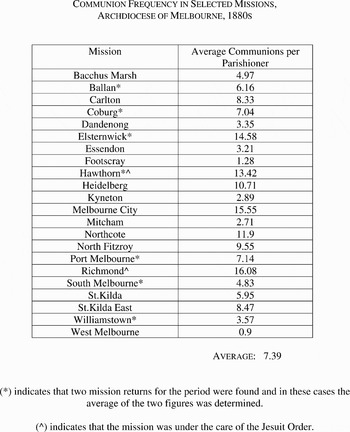
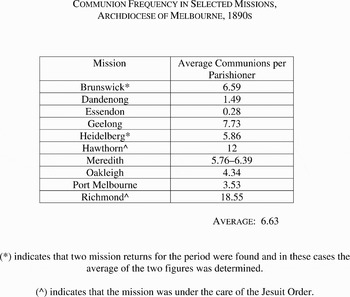
It is likely that most priests simply kept a record of the orders of communion wafers used in mission churches across the year; accounting for the wafers consumed thereby yielded a “number of Communions.” By itself, this figure is relatively meaningless. Only by factoring in the number of Catholics in the mission, can one derive a figure for communions per parishioner for the year. Even so, the historian must treat the resulting figures with due caution. Quite apart from how accurately priests recorded the number of consumed wafers, there remains the problem of how to factor in Mass attendance. Simply dividing the number of communions by the total Catholic population of the mission would be working on the quite dubious assumption that every Catholic regularly attended Sunday Mass, and such a formula would lead to deceptively lower figures of communion frequency for regular Mass-goers. To give a more accurate picture, a Mass attendance figure of 40 percent was factored into the following figures. The mission returns have been grouped into two date ranges: those in the 1880s (which obviously do not predate 1886) and those in the 1890s. Again, this required some guesswork, since the actual returns were not dated. The only date found was in response to a question about when confirmation last took place in the mission.
The average communion frequency for parishioners in the 1880s was around seven communions per year (fig. 1). Interestingly, the highest figure for this period—more than double the average communion frequency (16.08)—was recorded in the Richmond mission, which was under the care of the Jesuits, the traditional promoters of frequent communion. In one mission—West Melbourne—so few parishioners received communion that the average figure was less than one. There were no appreciable changes in the 1890s: communion frequency remained at around seven communions per parishioner per year (fig. 2). While a small body of parishioners always received communion monthly or even weekly in some Australian missions and parishes,Footnote 41 it is reasonable to assume that the above figures provide a rough guide to communion frequency for most practising Catholics in the late nineteenth century. What is striking about these figures is that they fall well below not only daily communion, but even weekly communion and often monthly communion. Clearly, most Australian Catholics fulfilled the paschal preceptFootnote 42 and perhaps received communion at a few other important liturgical times of the year such as Christmas day, the Assumption of Mary or Pentecost, for example.Footnote 43 But it seems that most Australian Catholics were often “rejecting the invitation.”
Source: Melbourne Diocesan Historical Commission.

Source: Melbourne Diocesan Historical Commission.

Nor is there any evidence that communion frequency substantially increased following Sacra Tridentina Synodus in 1905. Episcopal Visitation Records for the archdiocese of Sydney allow the historian to chart changes across the concerned time period. These documents were similar in scope to Melbourne's mission returns. However, they were completed specifically for inspection by the bishop on his official visitation, which he was required to make every four or five years. Where the mission returns only required the priest to list the number of communions, this document requested numbers on those who received monthly or annually, and those who “remained away.” Taking representative parishes in the late nineteenth century, the figures reveal a typical pattern. In the 1894 record for the parish of Bulli, for example, the priest recorded that 40 parishioners attended communion monthly, 240 attended annually, and 50 remained away.Footnote 44 In 1897, 70 attended monthly, 350 attended annually, and 74 remained away.Footnote 45 In the 1896 record for the parish of Concord, the priest recorded 260 monthly communicants, 550 who “went to Easter Communion,” and 240 who “don't attend the Sacraments at all.”Footnote 46 It is significant that ideal communion frequency was equated with monthly rather than weekly or even daily. These figures show that there was usually a body of parishioners who received communion monthly.
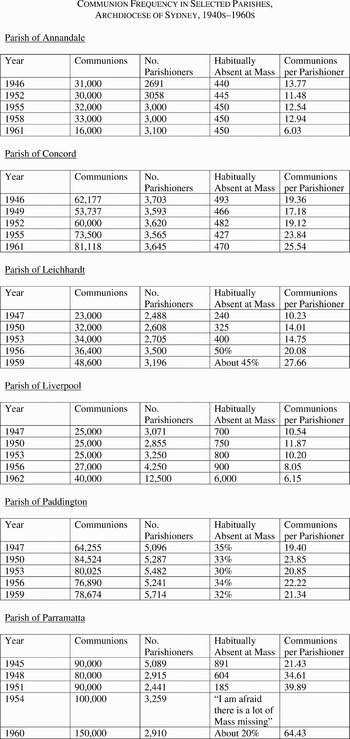
Unsurprisingly, post–1905 Episcopal visitation records often required parish priests to be more specific in detailing figures of communion frequency. Returning to the parish of Bulli, the first document after 1905 required the priest to indicate the numbers for first communicants, frequent communicants, regular communicants, those absent from their paschal duty, and total communions yearly. The documents show that “frequent” usually corresponded to weekly or more, while “regular” often meant monthly. Looking at the figures provided, however, brings home one clear point: the practice of daily or even weekly communion remained confined to a minority group within the parish until well into the 1950s. The 1915 record for Bulli, for example, revealed only 37 frequent communicants, 390 regular communicants, and 340 absent from their paschal duty.Footnote 47 In later years, some records revealed a discernible increase in figures for frequent communicants: the 1927 record listed 250 frequent communicants, 300 regular communicants, and 50 absent.Footnote 48 However, figures fluctuated considerably. The 1942 record revealed 16 “daily” communicants, 350 “monthly” communicants, and “none who go once a year,” though 350 were listed as “habitually absent from Mass.”Footnote 49 The parish of Concord revealed a similar pattern: in 1913, there were 50 frequent communicants, 400 regular communicants, and 85 absentees from their paschal duty.Footnote 50 In 1927, there were 280 frequent communicants, 371 regular communicants, and 357 absentees.Footnote 51 In 1946, there were 100 “average daily,” but 1,500 regular communicants and 300 absentees.Footnote 52
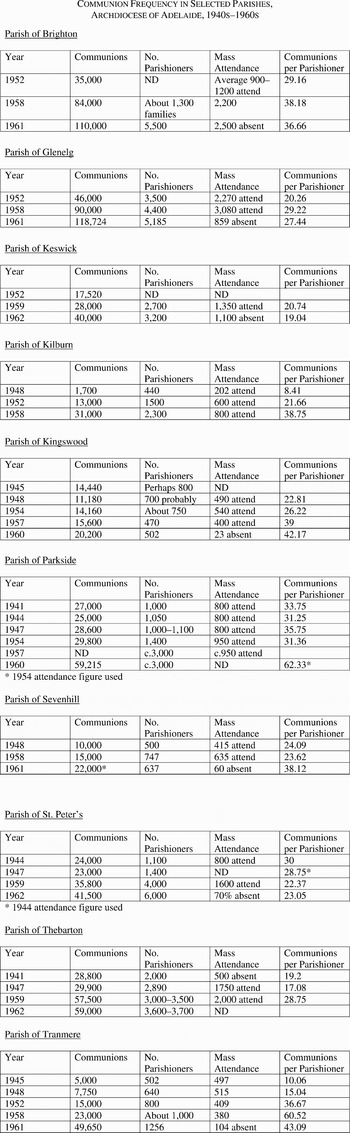
It would seem fair to suggest that a general increase in communion frequency occurred in the early twentieth century: monthly communion was becoming normative for higher numbers of Catholics. Clearly, this was not just the result of intensive promotion of more frequent communion within ecclesiastical texts after Pius X. Increasing numbers of the laity in confraternities and sodalities with the express purpose of bringing their members to monthly communion also explain the significant rise in frequency.Footnote 53 However, it is clear from these figures that weekly, let alone daily, communion remained confined to relatively small numbers of parishioners. This data presents the Church historian with an interpretive dilemma: why the significant gap between practices of communion urged by the institution and the actual practices of reception among the laity? In the mind of the institution, the laity was wilfully “rejecting the invitation.” This may have been true for some of the laity, but, taken at face value, it seems a less than satisfactory explanation. Rather, this paper argues that the nub of the problem derived from a paradox deep within ecclesiastical discourse itself. To understand this paradox, we must first explore the different ways that ecclesiastical discourse constructed what was received in communion, Christ's “real body.”
II. Christ's Real Body
In November 1817, an Irish Cistercian priest, Jeremiah O'Flynn, arrived in Sydney with the impressive but empty title of Prefect Apostolic of New Holland. At the time, Catholics in the colony had been without a priest for over seven years. However, while O'Flynn had procured this title in Rome, he had not been able to secure either official authorization for his ministry from the Colonial Office nor a recommendation from the Catholic bishop of London, Dr. Poynter. Without formal credentials, Governor Macquarie ordered O'Flynn not to minister publicly until the situation was clarified. Ignoring Macquarie, O'Flynn engaged in active ministry among the Catholics of Sydney and Parramatta. When Macquarie learned of O'Flynn's flagrant deception, both in defying his order and promising papers from the Colonial Office which never arrived, the governor had him deported in May 1818. Whether accidental or deliberate, O'Flynn left behind his small silver pyx containing the Blessed Sacrament. The sacred host was kept in the house of William Davis or James Dempsey, depending on the source, and became the center of the fledgling community's devotional life. It was only in November 1819 that one Father de Quellin, who was travelling on the French vessel L'Uranie at the time, consumed the host.
The whole episode is interesting for a number of reasons. It very soon became a story of contested memory, conflicting evidence, and competing interpretations: did Governor Macquarie deport O'Flynn in accordance with sound colonial policy? Did O'Flynn actually intend to leave the Blessed Sacrament behind? Was the Blessed Sacrament kept in the house of William Davis or James Dempsey? These questions have occupied numerous generations of Catholic historians in Australia.Footnote 54 Yet perhaps the more interesting line of inquiry relates to the episode's ongoing rescripting within Australian ecclesiastical discourse. It very rapidly became a story of persecution that spoke of a small Catholic community and its heroic priest struggling against a partisan and bigoted colonial regime. According to John Hosie, “the ministry of O'Flynn, and particularly his leaving of the Blessed Sacrament, acquired a legendary character in Catholic minds. The time came to be regarded as a ‘catacomb era’ for Catholics, with overtones of persecution and deprivation.”Footnote 55
Of greatest interest to this paper, however, is the significance attached to the leaving of the Blessed Sacrament and what this relinquishment reveals about the body of Christ as a discursive object within Australian ecclesiastical discourse. In his monumental History of the Catholic Church in Australasia (1896), Cardinal Francis MoranFootnote 56 recorded Dr. William Ullathorne'sFootnote 57 sentiments: “it is mournfully beautiful to contemplate these men of sorrow, gathered round the Bread of Life—bowed down before the Crucified.”Footnote 58 Moran wrote that William Davis's house “became, by the unforseen accident of a good priest's hurried act, the dwelling place of the most Holy Sacrament for a considerable period.” Though Moran added that the house never became a “public oratory,” he emphasized that “a few, by turns, were privileged to offer to God the homage of their love in that private room, at the true sanctuary of the Divine Presence.”Footnote 59 The story even reached the Vatican. Patrick O'Farrell informs us that Pope Pius XI was so impressed that he authorized the holding of the 1928 International Eucharistic Congress in Sydney.Footnote 60 In his opening address at the Congress, the papal delegate, Cardinal Cerretti, declared, “on this great day of Christ's Eucharistic triumph this humble house in Harrington Street cannot be forgotten, for that simple dwelling was the first Eucharistic sanctuary in Australia.” He went on to say, “since God blessed the house of Obededom because it had held within its walls the Ark of the Covenant, it is not to be wondered that God also blessed abundantly the family that so piously received not simply the Ark of the Covenant, but the Prince of Peace Himself, Jesus Christ in the Blessed Sacrament.”Footnote 61 “Day after day, and week after week they watched,” wrote Rev. William Fox in his 1936 pamphlet. “Jesus was there. He had come to stay with them. He had had pity on their plight. He loved them and they loved him.”Footnote 62
These interpretations of the leaving of the Blessed Sacrament reveal something fundamental: the consecrated host was identified with the person of Christ. In the sacrament, one encountered a host which had assumed anthropomorphic dimensions: the host was “the Crucified,” “the Divine Presence,” “the Prince of Peace,” or just simply “Jesus.” This sort of language reflected the dominant discursive construction of the “real body of Christ” in Australian pre–Vatican II discourse. More precisely, it was the dominant construction within most popular, devotional, and catechetical Catholic literature. However, it is certainly important to note that the Australian Church also inherited a theological tradition that approached the real body of Christ in the sacrament as an ontological reality. It is worth exploring this construction briefly before outlining the anthropomorphic dimension fully.
The Australian Catholic Church inherited a battery of medieval terms and concepts attached to the notion of Christ's substantial presence in the sacrament. In his Companion to the Catechism (1953), Archbishop Mathew Beovich set out five key doctrines pertaining to the “Blessed Eucharist.” In the doctrine of the “Real Presence,” Christ was “really, truly and substantially present under the appearances or species of bread and wine.” This was made possible by a process of transubstantiation in which “the whole substance of bread is changed into the substance of the body of Christ, and the whole substance of wine into the substance of His blood—only the appearances of bread and wine remaining.” Through the doctrine of concomitance, Beovich emphasized that “He is present whole and entire under the species or appearance of either bread or wine.” Following the words of consecration, Beovich outlined a doctrine of permanence when explaining that “Jesus Christ remains under the species not only when He is received, but so long as those species remain uncorrupted.” Finally, the worship appropriate amidst a present Christ fell within the definition of latria: “that Christ in the Blessed Eucharist is to be worshipped with the supreme worship due to God Himself.”Footnote 63
The idea of substantial presence represented an ontological association between the real body of Christ and the consecrated host. In this metaphysical system of thought, best exemplified in the scholastic synthesis of Thomas Aquinas, all things possessed an innate essence, termed their substance, which inhered within the outward and visible qualities or appearance. Through transubstantiation, the body of Christ was present in substance but without any physical qualities, and the bread and wine, consequently, were now present in outward appearance but without substance.Footnote 64 Thus, to say that Christ's body was really present was to say that his body now existed in a new mode of being in what was effectively a metaphysical miracle: Christ was substantially, thought not physically, present in the sacrament.
However, in most pre–Vatican II discourse, the notion of transubstantiation represented more a marker of sectarian identity than a theological concept inviting serious reflection. For example, responding to the statement, “We Protestants believe that Christ's body is really present in the Eucharist, but not by transubstantiation,” Rev. Leslie Rumble in his Radio Replies series declared, “The majority of Protestants believe that His body is really absent. Those who do say that they believe in His real presence yet deny transubstantiation illogically admit an effect yet deny the only process by which it can truly occur.” Rumble was adamant, “If there be no transubstantiation or conversion of the substance of bread into the substance of Christ's body, then the substance of bread remains after consecration, and it is bread and not the body of Christ.”Footnote 65 As this quotation makes clear, the idea of transubstantiation was regarded as an article of faith which sorted the orthodox from the heretical and, from Rumble's point of view, the logical from the illogical.
Much more dominant within ecclesiastical discourse in Australia was an understanding of the real body of Christ as an anthropomorphic entity. The notion of Christ's presence was often linked to the affirmation of Christ's person within the sacrament. For example, Beovich spoke of Christ being present through “His Body and Blood, His Soul and Divinity.”Footnote 66 In his 1917 Manual of Religious Instruction, Rev. P. Power explained this phrasing clearly: “The body and blood of Our Lord are present in the Blessed Sacrament by virtue of the words of consecration, ‘This is My Body’; ‘This is the chalice of My Blood.’” Power went on to write, “His Soul is also present because Christ's body, being a living body, must be animated by a soul. Finally, His Divinity is present, because of the hypostatic union of the Divine nature in the person of Christ, with His Body, Blood and Soul.”Footnote 67
Indeed, in an anthropomorphic idiom, the real body of Christ in the sacrament often gave rise to a play of imagination within ecclesiastical discourse. William Faber, the well-known nineteenth-century English convert and writer of devotional tracts, suggested that Jesus lived “many lives in the Blessed Sacrament”:
There are senses in which He leads in the Blessed Sacrament an active life and a contemplative life, a life of poverty and a life of divine riches, a life of suffering yet also a life of glory. As many states as there are in the spiritual life of the faithful, so many lives are there which He leads in the Blessed Sacrament.Footnote 68
Faber wrote of the body of Christ in the Blessed Sacrament in a way that effectively contradicted the ontological discursive association discussed above. Faber, rather, spoke of the different ways that Christ could be consciously imagined within the Blessed Sacrament. Was this a form of metaphorical play within ecclesiastical discourse? In fact, imagining Christ present in the host often rested more securely on a metonymical association in which the container (the visible host) stood for the contained (the body of Christ). Though not consistent with sound theological tradition—as Christ was substantially present only, he could not be present in any physically discernible ways—in popular devotional Catholicism, the person of Christ could nevertheless be thought of as spatially and locally coextensive with the host as a visible object.Footnote 69 Such an association was most common to devotional texts that sought to enliven pious sentiments in their readers. In such texts, the host became a veritable palimpsest for a range of anthropomorphic signifieds.
Interestingly, such signifieds often operated through certain spatio-temporal frames. For example, playing on the fact that the host was locked in a tabernacle within churches, Christ could be imagined as a “prisoner of the tabernacle.” This metonymical association—which appears to have emerged only in the nineteenth century as an image associated with the embattled papacy of Pius IX, who became known as the “prisoner of the Vatican” after 1870—was commonly found in a range of prayer books and manuals designed for “visits” to the Blessed Sacrament. In A Novena of Visits to Jesus in the Most Holy Sacrament (1927), Brother Stanislaus told readers that “Our days, even the most crowded, should seem for us incomplete without our own special tribute to the Divine Prisoner of Love. True devotion to Our Lord in the Most Holy Sacrament will never rest contented with a daily duty-visit, but most satisfy itself with love visits, brief though they may be.”Footnote 70 In 1925, the Australian Messenger of the Sacred Heart published a poem entitled “Christ in the Tabernacle”:
Imagining that Christ was “enchained beneath the sacred species,” as St. Julian Eymard had once written, invited readers to express sorrow and pity for Christ present in the Blessed Sacrament.Footnote 72
The other end of the metonymical spectrum constructed Christ as a conquering “king.” This particular association appeared most prominently in texts that described the enormous eucharistic congresses that occurred in Australia after the late 1920s. Indeed, ecclesiastical texts that described such congresses sometimes played upon the metonymical shift from prisoner to king, a shift that reflected the emergence of a more aggressive and triumphalist institution. Here was a Church ready to re-assert its authority over secular society. Defining the new feast of Christ the King in his 1925 encyclical Quas Primas, for example, Pius XI noted that “much has been done for the recognition of Christ's authority over society by the frequent Eucharistic Congresses which are held in our age.” “It is by divine inspiration,” he declared, “that the people of Christ bring forth Jesus from His silent hiding-place in the church, and carry Him in triumph through the streets of the city, so that He whom men refused to receive when He came unto His own, may now receive in full Kingly rights.”Footnote 73 Accordingly, in his opening address at Sydney's International Eucharistic Congress in 1928, Cardinal Cerretti spoke of the congress as testimony of Christ's “reign” through the Blessed Sacrament: “This is the power of the Blessed Sacrament, formidable in its transcendency, and it is before the Sacred Presence of Christ the King, in the Sacrament of the Altar that we prostrate ourselves in admiration.”Footnote 74 The metonymical association that cast the host as a king also evidenced descriptions of churches as courts or palaces. For example, after 1929 with the establishment of the Blessed Sacrament Fathers, Melbourne's St. Francis's church became a chapel of continual exposition of the Blessed Sacrament. Newspaper articles often spoke of this church as a “court.” “With the influx of country visitors this month,” the Advocate reported in 1938, “many hundreds more will find their way to the Church of St. Francis, where the Eucharistic King holds court.”Footnote 75
Interestingly, the article also suggested that visits to the church were commensurate with pilgrimage—”Pilgrimage! The word has a homely sound to Catholic ears, with its age-old associations of faith and prayer. Melbourne, too, has its place of pilgrimage, to which hundreds daily throng.”Footnote 76 This reference played on another metonymical association that cast the host as a sacred relic possessed by the Blessed Sacrament Fathers to which Catholics could make a pilgrimage. In the final analysis, devotional texts could mix and match diverse metonymical associations with ease—discursively speaking, Christ's body was a malleable body, a veritable shape-shifter. Emmaus, the organ of the People's Eucharistic League, a confraternity that promoted prayer to the Blessed Sacrament, described visits to the Blessed Sacrament as an eclectic imaginative enterprise:
The practice of visiting the Blessed Sacrament has grown with the realisation of the faithful that in the Blessed Sacrament the Heavenly Christ sits as a King on a throne of Majesty to receive the adoration, love and praise of His subjects and to receive and grant their petitions. A Visit to the Blessed Sacrament is an audience with the King of the World, Who is also the King of our hearts. Naturally when we think of the sins of men, in our visits to the Blessed Sacrament we feel impelled to offer reparation to the One Whom sin so grievously offends and in Whose Presence we find ourselves. Realising that He is the identical Person Who suffered for sin on Calvary, it is an easy transition to contemplate in His Presence the Outrages of His Passion and to speak to Him as though His Heart were still rent with pain and a sense of the ingratitude of men. It is likewise a legitimate trick of the pious imagination to visualise Christ as the Prisoner of the tabernacle, confined for the love of His creatures to a tiny portion of space though He be King of the Universe.Footnote 77
This extract superbly captures the play of metonymies which often characterized discursive constructions of Christ's real body within pre–Vatican II discourse. Such images of Christ—as a conquering King, or a prisoner, or even one in need of reparation—were images that reflected the Church's agonistic worldview, as we have seen. But how did this anthropomorphic construction shape understandings and practices associated with the reception of communion?
III. Receiving the Body of Christ
Raising brevity to an art form, the Catechism of Christian Doctrine—the catechism that had been approved by the Australian bishops at the Second and Third Plenary Councils in 1895 and 1905 respectively—defined a sacrament as “a visible sign instituted by Christ to give grace.”Footnote 78 Each sacrament infused grace into the recipient, resulting in discernible spiritual benefits. So, for example, the catechism taught that “Baptism is the sacrament which cleanses us from original sin, makes us Christians, children of God, and heirs to the kingdom of Heaven.”Footnote 79 Confirmation “is the sacrament which makes us strong and perfect Christians, and soldiers of Jesus Christ.”Footnote 80 When turning to the “Blessed Eucharist,” the catechism defined it as “the sacrament of the Body and Blood, Soul and Divinity of Jesus Christ under the appearances of bread and wine.”Footnote 81 Such is a revealing definition. The catechism was affirming that the grace of the sacrament was not just Christ working through the sacrament, but Christ as the sacrament, the Eucharist as synonymous with the person of Christ. Through the discursive construction of Christ's real body, then, the act of communion represented nothing less than an encounter with the person of Christ himself. In his Companion to the Catechism, Beovich emphasized that “the Sacrament of the Blessed Eucharist is called Holy Communion because when we receive it our souls are joined to Our Lord and made one with Him.”Footnote 82 Communion represented a sacred union between Christ and the individual communicant.
In its efforts to encourage the practice of receiving communion, devotional literature often presented the sacrament as an extremely efficacious encounter with the person of Christ. Rev. Albert Power described the “wonderful supernatural effects produced in the soul” through receiving communion. “Very wonderful indeed,” he began, “is the union that can take place between two intellectual beings.” Though “familiar with daily intercourse with each other,” Power went on to ask, “is it thus that Jesus influences us in Holy Communion?” For Power, “Christ's bodily presence is the instrument of our healing.” In the sacrament, “growth of the soul in Divine Love is effected through personal contact with Jesus in the Eucharist.” “He comes to touch us as He touched the lepers, in order to strengthen us against sin,” Power wrote; “to whisper to us words of comfort as He whispered them to Peter or Magdalen or the dying thief.”Footnote 83 An anonymous author in an article entitled “When you miss one Holy Communion,” appearing in the Monstrance in 1940, listed many missed benefits. For example, one lost a “special increase of sanctifying grace” or “the precious opportunity of having all your venial sins wiped away” or even “deliverance of a relative or friend from purgatory.” But topping the list: “You miss a personal visit with Jesus, the Author of all spiritual energy, and of all holiness.”Footnote 84
If communion benefited the communicant, some devotional literature also suggested that it benefited Jesus. A 1944 Australian Catholic Truth Society pamphlet entitled Abide in My Love being excerpts from the Writings of Blessed Peter Julian Eymard, included a section on “Consoling Jesus,” which opened with the declaration that “to communicate for Jesus is to console Him for the neglect of His creatures.”Footnote 85 In another section entitled “Jesus wants our intimacy,” readers were told, “if you do not experience in Communion the consolations of Jesus, it is because you give Him no time, no room, in your heart… . What Our Lord wants from us is an intimate intercourse as between friends.”Footnote 86 Such sentiments were part of the agonistic pretensions that underpinned much pre–Vatican II piety. Since much of the humanity—Protestants worst among them because they knew better—denied the truth of Christ's person in the sacrament, faithful Catholics were called upon to make “reparation” to Jesus and “console” him for such grave “insult.” Receiving communion provided a perfect opportunity to do so.
Most significantly, the idea within ecclesiastical discourse that communion brought together the communicant with the very person of Christ made of the sacrament a most awesome and sacred occasion. “The greatest privilege of man on earth,” declared Rev. John Perkins in his 1948 pamphlet, “is to receive his God in Holy Communion.” Perkins went on to write, “It is important, therefore, both for reverence due to our Divine Guest and for our own greater spiritual profit, that we prepare for Holy Communion as well as we can.”Footnote 87 Inevitably, the perceived gravity of the occasion evinced great concern in ecclesiastical discourse over the purity of the communicant's body. If Mary Douglas's insight that we may read beliefs and rituals governing the human body as an analogue of cultural and societal values is correct, then the preparatory regime and regulations imposed upon the prospective communicant reveal much about pre–Vatican II ritual culture.Footnote 88 Such regulations, however, were themselves the product of a discourse which actively constructed the communicant's body as an index of Christ's person because communion represented a union of bodies. In this penultimate occasion, the communicant's body became one with Christ. So an irreverent body didn't merely represent a transgression of purity codes, but, more dangerously, a discursive unmaking of the real body of Christ in the sacrament. And it is here that the resident paradox within ecclesiastical discourse becomes clear. The spiritual efficacy attributed to communion because it represented a personal union with Christ—the very reason that ecclesiastical texts urged the laity to receive communion as often as possible—also resulted in extraordinary emphasis being placed on a disciplined body as the necessary condition of such union—an emphasis which tended to make more frequent reception of communion exceedingly difficult. In essence, the seemingly different positions on the reception of communion discussed earlier in the paper, from the conservatism of nineteenth-century moral theology to the extremely liberal position advocated by Pius X, betrayed a common discursive heritage. They were essentially differences in degree not kind, since both operated through a discursive construction of Christ's real body within the sacrament. Accordingly, Pius X's reforms were fundamentally quantitative rather than qualitative: no real change in the understanding of communion had taken place, merely an attempted intensification of its practice. This is why the reforms were not able to affect the sort of dramatic shift in communion frequency which the pope had clearly hoped for.
We can imagine that the overriding emphasis within ecclesiastical discourse on the disciplined body did not make it easy for the laity to approach the “Holy Table.” Returning to the Catechism of Christian Doctrine, for example, “Lesson 23—On Holy Communion” outlined responses to twelve questions: eight of the twelve dealt specifically with matters of necessary preparation or lack of it:
3. How must we be prepared for Holy Communion?
4. When is a person in a state of grace?
5. What do we mean by a right intention?
6. Is anything else required of us when we are going to Holy Communion?
7. How should we approach the Holy Table?
10. What do you mean by receiving unworthily?
11. Is it a great sin to receive unworthily?
12. What must a person do if he be in mortal sin before Holy Communion?Footnote 89
This was typical of the disciplinary regime imposed upon the laity wishing to receive communion. But what forms did this disciplinary regime take?
Given the union of bodies within communion, the disciplinary regime centered on the whole person of the communicant—body, mind, and soul. In terms of the soul, texts emphasized the necessity of spiritual purity. In A simple Course of Religion or Religion by Letter (1955), Most Rev. M. Sheehan explained to first communicants the necessity of confession. “On the day before your First Communion,” he advised, “you should go to Confession. You should tell all your sins, because you want to make your soul as clean and beautiful as you can before Jesus comes to you.”Footnote 90 Now Sheehan made it clear that only mortal sin needed to be confessed; this qualifying emphasis was an attempt to combat the more traditional rigorist position that all trace of sin should be removed. The problem remained, however, the fine line between what was allowed (reception with venial sin) and what was recommended (reception without venial sin). For example, an Instruction entitled “For those who are to be admitted for the first time to Holy Communion,” appearing in the Australasian Catholic Record in 1911, emphasized that confession of both mortal and venial sins was desirable. “In order to enjoy abundantly the effects of this Sacrament,” the Instruction explained, “it is required that you approach it without affection for any venial sins, and, moreover, with fear, and with love, towards Our Lord.”Footnote 91 Despite the reforms of Pius X, ecclesiastical texts could still tend toward the absence of venial sin as a de facto requirement.
Of course, the physical body of the communicant also needed to be properly prepared. In his study of the consecrated host in texts of early modern Catholicism, Piero Camporesi suggested that the stomach occupied “a crucial place in all theological meditations on the Eucharist.” “This fleshy bag,” Camporesi wrote, “is the organic terminus where the ultimate and definitive prodigy of the supernatural metamorphosis occurs. With concern and anxiety, theologians follow the descent of Christ's body into the antrum, the damp and smelly bowels.”Footnote 92 Camporesi explained that the primary act of purification was the eucharistic fast. In Australia until the early 1950s, a strict fast from food and water was required for those intending to receive communion, running from midnight until the time of communion itself. Now one might expect texts to emphasize this fast as a form of physical purification. Interestingly, many texts were at least silent on such an understanding. Rather, the eucharistic fast was understood more as an act of respect toward an affirmation of the union with Christ in communion. For example, the theologian James Madden explained that “The law of the Fast before Communion is enjoined to promote reverence towards the Body of Christ which is received as the food of our souls. An absolute fast before Communion is expressive of our faith in the Real Presence. It shows that we truly distinguish the Eucharist from earthly bread.”Footnote 93
The final dimension of the disciplinary regime governed the behavior of communicants before and after reception of Christ's real body. However, as the structure of many lay prayer books reveal, this period could be overlayed across the entire eucharistic celebration. One of the most popular texts, The Key of Heaven, included a number of options for Mass: Catholics could use the “Ordinary of the Mass,” “prayers at Mass,” or “Devotions for Holy Communion.” What is already telling in such a structure is the separation of prayers for Mass and for communion; in fact, the prayers at Mass omitted any reference to reception of the sacrament. By corollary, the devotions for communion were of sufficient length to occupy much of the celebration, running some nineteen pages.Footnote 94 Indeed, one can find whole texts devoted solely to preparation and thanksgiving for communion.Footnote 95 Clearly, the sheer gravity of communion, with greatest emphasis placed on the union of the communicant with the person of Christ, tended to necessitate an appropriately long and reverent preparatory procedure. Many texts emphasized that the degree of preparation corresponded directly to the spiritual efficacy derived from the encounter. So it was not uncommon that texts included voluminous anticipatory prayers that ran right up to the very moment of reception.
In his A Simple Course of Religion, Bishop Sheehan explained to first communicants “how to receive Holy Communion”:
Walk up to the alter-rail slowly, with your hands joined and your head bowed. Say to yourself, “Dear Jesus, I am coming.” Kneel at the altar-rail. Take the Communion Plate when it is passed to you by the child next to you; hold it with both hands under your chin. Close your eyes. Open your mouth; let the tip of your tongue just rest on your lower lip, but not coming forward. When the priest has placed the Holy Communion on your tongue, draw back your tongue and close your lips. Pass the Communion Plate to the next child. Let the Holy Communion moisten on your tongue for a moment or two, then swallow it. Stand up, join your hands; go slowly back to your place in the church, saying to yourself as you go: Jesus, You have come to me. Jesus, You are within me. Welcome, Jesus! Jesus, I thank You. Jesus, I love You!” When you come to your place, kneel down. Say the same words over again, and as often as you like. Think of Jesus and all that He has done for you.Footnote 96
Sheehan's text is typical in constructing a disciplined body. Every movement, every gesture represented a bodily index of the union with Christ in the sacrament. The clear instruction to swallow the host reflected the traditional injunction against chewing the host, which, however untheological it may have been, only mirrored the metonymical associations discussed earlier in relation to the real body of Christ and the consecrated host. Chewing the host was thought akin to chewing Christ himself, breaking his body. Many texts invited communicants to work themselves into a heightened emotional state before receiving the host. Hymnbooks for first communicants consisted of numerous renditions that equated reception of the host with a veritable epiphany. One of the more traditional and well known was entitled “Jesus, Thou art Coming.” Verses one, three and eight follow:
The emphasis on being unworthy—”I have sinned against Thee / Often, grievously”—in a text for children speaks clearly of the utmost importance placed on the disciplined body.
Gender undoubtedly played a role in the construction of the disciplined body, especially in those critical moments of reception. In her study of Australian Catholic spirituality, Katharine Massam suggested that prayer manuals directed specifically at men tended to evince less consciously emotive sentiments in regard to receiving communion. The Manual of the Holy Name Society, for example, invited men after reception to “Pray for a quick, strong faith, and pray for confidence. Think. Don't simply read the prayers before and after Communion: Think, and think deeply and long.”Footnote 98 This stood in contrast to the Loreto Manual, a text aimed at daughters of middle class families, which invited its readers after reception to “burn with an ardent desire that Jesus may take entire possession of your heart, soul and all your affections.”Footnote 99 Though gender differences should not be overdrawn, as Massam warns, such distinctions in texts so specific to a given gender are revealing. Indeed, the emphasis on the union of bodies within discourse undoubtedly brought the question of gender into play. While the Manual of the Holy Name Society centered more on the cognitive dimension of union, inviting men to “think,” the Loreto Manual did not hesitate to play on the somatic, even romantic, dimension of union, inviting women to allow Jesus “possession” of their “heart” and “affections.” Such observations may be extended to the contrasting dress codes of first communicants, for example. Young boys typically wore a suit or shirt and pants, sometimes with a commemorative sash. Such dress was probably symbolic of first communion as a rite of passage, a union that made boys more like men. Girls, on the other hand, typically wore a bridal dress, replete with veil—more symbolic of a marital union with Christ.Footnote 100
Finally, the disciplinary regime extended to those brief moments after the reception of communion. In some ways, this was when the indexical relationship between the body of Christ and the body of the communicant was most pronounced—Christ was “within” the communicant at this most auspicious of moments. Prayer books and manuals invited Catholics to lose themselves in the occasion. The Manual of the Children of Mary advised readers not to use a prayer book for some time after reception: “These are the most precious moments of your life. Jesus Christ says to you: “Speak to me as you would to your dearest friend.”Footnote 101 The Treasury of the Sacred Heart, using extracts from the work of St. Alphonsus Ligouri, also stressed to readers the supreme value of the time following reception. “We should be persuaded that prayers after Communion have greater value and merit before God than those that are offered at other times,” it explained; “for then the soul is united to Jesus Christ, and her acts derive value from his presence.”Footnote 102 A litany of prayers could follow, as provided by most prayer books and manuals, but the precious moments of union would soon past. Quoting one Father Balthasar Alvarez, the Treasury reminded readers that, as Christ said to his disciples when on earth, “But you have not me always with you.”Footnote 103
While the intensely anthropomorphic construction of Christ's real body remained singularly dominant within ecclesiastical discourse, along with the resultant emphasis on the disciplined body of the recipient, frequent (meaning weekly or more) communion would probably remain an elusive phenomenon. If this situation was to change—and it would never do so while the institution reckoned that the laity need only gratefully accept the invitation—then it needed to occur at the level of discourse. In specific terms, this meant a shift in the discursive construction of Christ's body itself.
IV. Christ's Mystical Body
Archbishop John Polding's pastoral letter on eucharistic devotion introduced and warmly recommended the Forty Hours Prayer to Australian Catholics. The Forty Hours' Prayer—also known to English speaking Catholics by its Italian name as Quarant'Ore—first originated in Milan between 1527 and 1537 as a form of reparative prayer directed against the threatening overtures of Protestant reformers and Islamic Turks.Footnote 104 Based upon the belief that Christ's body had remained in the tomb for a period of forty hours, the devotion constituted a continuous forty-hour period of prayer before the Blessed Sacrament.Footnote 105 As a devotion that was both a veneration of the Blessed Sacrament and a ritual expression of reparative and expiatory sentiments, it was vigorously promoted in the nineteenth century. It was, of course, centered on the worship of Christ's real body within the sacrament. And this is how Polding wrote of it: “Before the light and beauty of the Holy One who has been placed over the altar of our churches,” he declared, “we meditate with remorse on our poor response to the love and sacrifice that have placed Him there.”Footnote 106 There is nothing particularly striking about such words; Polding joined his contemporaries in using anthropomorphic language to describe Christ's real body in the sacrament. What is striking, however, is that Christ's body as a discursive object also appeared in Polding's pastorals and occasional letters as a “mystical” body. In his Lenten pastoral of 1860, for example, Polding implored Australian Catholics to realize their membership of the Church in these terms: “Think, too, again, Dearly Beloved, of your relation to the Church, which is the mystical body of Christ, and find in it, if you can, anything to excuse indifference and cowardice of Christian perfection.”Footnote 107 Here, Polding was clearly not talking about the body of Christ as an anthropomorphic entity confined to the Blessed Sacrament—but what did he mean by the “mystical body of Christ”?
Firstly, Polding's use of the adjective “mystical” should not go without comment. Though Polding drew upon Pauline terminology in referring to Christians as the body of Christ, his use of the term “mystical body of Christ” represented a medieval notion. According to Henri de Lubac, the term corpus mysticum derived from the Carolingian era and originally referred not to the Church but to the Eucharist.Footnote 108 By corollary, the term corpus Christi actually referred to the Church. This is highly significant. In these terms, the body of Christ as a discursive object was not associated singularly and exclusively with the sacrament but, rather, represented a visible ecclesial reality that was thought “mystically” constituted by the celebration of the Eucharist—“The Eucharist makes the Church.”Footnote 109 In the twelfth century, theological discourse manifested a gradual shift in terminology or, more precisely, a “chiastic” reversal, as Michel de Certeau puts it.Footnote 110 Given the increasing difficulties of affirming Christ's presence in the sacrament using symbolic language, in tandem with growing devotion to the humanity of Christ, medieval discourse began referring to the sacrament as corpus Christi, while concomitantly designating the Church as corpus mysticum. Now the real body of Christ, the corpus verum, was thought located in the consecrated host (and wine, though increasingly withheld from the laity). The term corpus mysticum remained an ecclesiological concept of some relevance, but in the post-Tridentine Church it was increasingly subsumed within ecclesiologies that stressed more clearly the hierarchical and juridical dimensions of the Roman Catholic Church.Footnote 111
For Polding, understanding the Church as the mystical body of Christ drew all Catholics together in bonds, “set[ting] at naught obstacles of time and space.”Footnote 112 In other words, the body of Christ drew Catholics together in a way that transcended mere voluntary membership in an association. In addition, the “health” of this body was reliant upon all members: “as truly as correct as a corrupt ulcer disfigures and sickens the whole body, so do impenitent, wicked worldly, formal Catholics, deface and enervate the Church.”Footnote 113 In Polding's understanding, therefore, the term did not represent just a useful ecclesial metaphor: “When our Lord's Church is called a body, we are using no mere figure of speech.”Footnote 114 The work of the Holy Spirit mystically bound it together. Importantly, understanding Christ's body as mystical did not erase hierarchical distinctions. Just as human bodies are constituted of different parts with different functions, so too the Church as the mystical body saw every member “assigned his due place.” Accordingly, the Pope, for example, was the head, “the visible representative of the Lord Jesus Christ in this visible kingdom of his, which he came to establish on earth, and which is called His Church, His mystical body.”Footnote 115 This marriage of the mystical and juridical would find a prominent place in Pope Pius XII's later encyclical on the doctrine.
According to the editors of Polding's pastoral letters, his use of the doctrine of the mystical body “set him apart as a bishop far from typical of his time.”Footnote 116 This is certainly a fair comment. The recasting of Christ's body as mystical within ecclesiastical discourse may be traced to early nineteenth-century German Catholic Romanticism, best exemplified in the work of Johann Mohler, who attempted to bring together Christology and ecclesiology in a creative synthesis, which pushed beyond the institutional and juridical dimensions of the Church.Footnote 117 For Mohler, the Church represented a continuation of the incarnation in space and time and, in this sense, even the faithful were part of the body of Christ.Footnote 118 Mohler's theology was picked up by other theologians—Giovanni Perrone, Carlo Passaglia, Klems Schrader, Johann Baptist Franzelin and Matthias Scheeben, in particular—who attempted to “synthesise biblical, patristic and scholastic themes” in forging an ecclesiology of Christ's mystical body.Footnote 119 However, such theology did not receive widespread acceptance. Perrone and Schrader's initial draft of the First Vatican Council's Schema on the Church, a draft whose first section was entitled “The Church is the Mystical Body of Christ,” attracted significant criticism; the next draft clearly subordinated this theme to the Church conceived as a perfect society.Footnote 120 It was not until the 1920s and 1930s that an ecclesiology of the mystical body of Christ began to receive significant attention in international theological journals.Footnote 121 Polding was well ahead of his time in even referring to the mystical body of Christ in his post–1860s pastorals.
Though there is clear evidence of this discursive construction in Australian ecclesiastical discourse from the late 1920s and 1930s, it began appearing with greatest frequency after the early 1940s. In 1943, Pope Pius XII issued the encyclical Mystici Corporis, which declared categorically that “we shall find nothing more noble, more sublime, or more divine than the expression ‘the Mystical Body of Jesus Christ.’”Footnote 122 Predictably, the papal encyclical adopted a relatively conservative line: this body was constituted “organically and hierarchically”—”that those who exercise sacred power in this Body [the priests, the bishops, and, ultimately, the pope] are its first and chief members, must be maintained uncompromisingly.”Footnote 123 Incorporation into Christ's mystical body did not extend to any who consciously remained outside the Catholic Church: “Actually only those are to be included as members of the Church who have been baptised and profess the true faith… .”Footnote 124 While the encyclical dealt with an apparent connection between the Church as Christ's mystical body and the liturgy, the bulk of it outlined how different “members” of the body were interrelated and, finally, what pastoral responsibilities and duties derived from these bonds.
Mystici Corporis represented a decisive moment in twentieth-century ecclesiology, signalling clear papal endorsement of the doctrine of the mystical body of Christ. From this time, the mystical body of Christ emerged as the dominant ecclesiological model, though it joined the image of the Church as a hierarchical institution rather than replacing it. It could certainly appear in ecclesiastical texts as an abstract notion. For example, Rev. W. Frean's 1949 Commentary on the Catechism included a separate section on the mystical body, appearing between his section on matrimony and a section on death and judgement.Footnote 125 In a series of pages, he quoted Pius XII's encyclical extensively but without enumerating how the “new” theology might impact the laity.
It is also evident that the notion was initially plagued by misunderstandings among the clergy as to its precise meanings. In 1946, the Australasian Catholic Record published an extended explanation of the mystical body of Christ in its notes section. The theologian James Madden, who wrote the piece, noted that many “inaccuracies” had arisen “from the want of clear notions as to what the Mystical Body really is.”Footnote 126 Madden stressed that the doctrine represented a “Truth,” which nevertheless “we cannot fully understand.” Despite this disclaimer, he went on to make some clear arguments about its precise meaning. Madden affirmed that “the Mystical Body of Christ is His Church, a visible society knit together by supernatural bonds, vivified by a supernatural Principle, founded by Jesus Christ for a supernatural end.”Footnote 127 He sought to elaborate this dense statement by outlining the different ways of understanding the term “body.” One could speak of body in a “literal” sense: “Christ, being a perfect man,” Madden declared, “had a body like ours.” This understanding reflected the discursive construction of Christ's real body, which, according to Madden, “is now at the right hand of the Father in Heaven and is really present in the Blessed Eucharist.”Footnote 128 Secondly, one could speak of body as “a union of individuals joined or banded together for a common purpose under legitimate authority.” In this case, Madden stressed that the word was being used “only by analogy”; nevertheless, it could be related to the Church: “the Church answers to this description of a body, if we consider it exclusively as a visible society…. Should we wish to restrict our use of the term body to this analogous meaning of a moral entity, we could with justification apply to the Church the title Body of Christ.”Footnote 129 Finally, Madden distinguished these two senses of body from the mystical body: “When we call the Church the Mystical Body of Christ, we still use an analogy, for, as stressed above, a body in its primary sense is a physical body; but the analogy is closer than when we speak of a moral body … it is unlike both and surpasses anything in our experience, for it is not natural, but pertains to the supernatural order.”Footnote 130 Members of the mystical body were thus joined together as one through the work of the “Holy Ghost, Who has been described as the soul of the Mystical Body.”Footnote 131
Madden's subsequent treatment of membership within the mystical body of Christ brings us to a critical issue: what was the relationship between this discursive construction and the sacrament of the Eucharist, that is, the reception of communion? Madden affirmed that baptism and confirmation made Catholics members of the mystical body, but he stressed that the perfection of “our union with Him” was only achieved in that great act of “corporate worship,” the Eucharist. Through the discursive construction of Christ's mystical body, then, the act of communion shifted from receiving to becoming.
V. Becoming the Body of Christ
The idea that in communion one became the mystical body of Christ was initially promoted through the liturgical movement. Though tracing its roots to the efforts of Prosper Gueranger in nineteenth-century France and, subsequently, to the various reforms of Pius X, the liturgical movement has often been understood as originating with the work of early twentieth-century Benedictines, most notably Lambert Beauduin of Mont Cesar in Belgium.Footnote 132 Up until the late 1940s, the aim of the liturgical movement was to bring the people to the liturgy, fostering a profound appreciation of the need for lay participation in the liturgy.Footnote 133 However, this was not promoted as an end in its own right. Rather, the full and active participation of the people in the liturgy expressed their membership in the mystical body of Christ, the Church. In the early decades of the twentieth century, the movement exerted slow but increasing influence within European Catholicism, later spreading to the American Church in the 1920s, particularly through Virgil Michel and the Benedictines of St. John's Abbey in Minnesota, and from there to Australia.Footnote 134 With the encyclical Mediator Dei (1947), the movement's aims received cautious papal endorsement and, accordingly, were taken up within the wider Church, though practical shifts in traditional liturgical practices were often slow.
Now, in a discursive regime where Christ's real body represented an anthropomorphic entity, communion revolved around receiving the body. The “august visitor” came to the communicant in that most sacred of moments during reception, and texts presented this as an intensely private and even intimate moment, as we have seen. The recasting of Christ's body within discourse as a mystical body, however, transformed communion into an act of becoming. One did not just receive the body of Christ, one became the body of Christ. Since the mystical body of Christ was the Church, ecclesiastical discourse spoke of communicants being “incorporated” into the Church through this act.
Speaking at Australia's first Liturgical Week, held in Melbourne in 1955, Rev. Percy Jones underlined the centrality of the sacramental system in forming the Church. According to Jones, “To so construct this edifice of His Mystical Body—to restore all things in Him—to build Himself into our souls and our souls into Him, He instituted a system of signs which would be instruments of His union with the soul. These signs we call sacraments.” For Jones, the construction of such an edifice relied ultimately upon the partaking of communion: “the bond of unity between Christians … reaches its supreme expression in the Communion table at which Christ gives Himself as their common food.”Footnote 135 Writing to men in the Holy Name Society, Fr. W. V. McEvoy communicated the same sentiments. He emphasized that “through the identity of what is eaten a peculiar supernatural unity pervades the Family of God. Christ in each makes one of all. The Family of God becomes the Mystical Body of Christ, many members, one common source of supernatural life.”Footnote 136
Within the discursive construction of Christ's mystical body, communion was endowed with a social character. In the above example, Jones still spoke of a personal union with Christ—“His union with the soul”—but the union extended beyond Christ and each communicant alone; the encounter manifested through the sacrament also caused a “unity between Christians.” Other writers expressed concerns over the singular emphasis placed on communion as a private union with Christ. “Our attitude to Communion is still too individualistic,” complained Fr. John F. Kelly in his paper at the Australian Liturgical Week; “Communion is, let us remember, also social in its effects. It causes a closer union of member with member; not only because it, as food, gives us strength to work for one another, but more directly because it is pre-eminently the Sacrament of Love.”Footnote 137 In another piece, written to seminarians, Kelly stressed the bimodal nature of sacramental union: “Communion is union with Christ, assimilation with Him; and union with others, not just a little private quarter of an hour's interview with Christ, as used to be the aspect of it most stressed.”Footnote 138 By the early 1960s, such an emphasis had started to filter into catechetical material. For example, Catholic Catechism: Book One, a text issued by authority of the Australian hierarchy and intended for lower primary schools, explained the “sacred banquet” in these terms: “Just as at the sacred banquet the Chosen People ate together as the family of God, when I go to Communion I am not eating alone; I am feasting with my brothers and sisters at my Father's table. When I go to Communion I show that I am one with all other members of the Church, that I really belong to God's family.”Footnote 139
Within the anthropomorphic construction of Christ's real body, the communicant's body functioned as an index of Christ's person within the sacrament, hence the overriding emphasis placed on the communicant's body as a disciplined body. However, the discursive relation between the mystical body of Christ and the communicant transformed the body of the communicant into an index of “the Church.” This represented an added indexical dynamic within ecclesiastical discourse: concern over the disciplined body was now joined by concern over the integrated body. The idea of an integrated body involved not only a proper interior disposition on behalf of communicants—that, for example, communicants be aware that they were “not eating alone”—but, more importantly, that this awareness be translated into a visible and discernible unity among the communicants themselves, that they be integrated as Christ's body. It was thought important, therefore, that all the laity try to receive communion at every Mass. In an Australasian Catholic Record article entitled “The Sacrament of Glory” (1953), theologian Cornelius Roberts stressed that “the union which the Eucharist causes is that of the mystical body.” He went on to suggest, therefore, that “The Eucharistic symbolism is not displayed fully except when the sacrament is both consecrated and administered, that is, at Mass, and especially at a Mass when all present communicate, as at the Last Supper.”Footnote 140 Roberts's stress on the sacrament being “consecrated and administered” at Mass also reflected another aim of the liturgical movement: to have the intrinsic connection between the Mass and communion reflected in the liturgical celebration itself, rather than communion appearing as an optional extra of the eucharistic sacrifice.Footnote 141
Such a call to communion should not be considered a mere restatement of Pius X's push for frequent communion in his 1905 decree. As we have seen, this decree did not envisage communion as a corporate act; rather, frequent communion was thought an effective means of spiritually strengthening the individual communicant. Indeed, the decree did not link frequent communion with the liturgical integration of the sacrifice of the Mass and the communion rites. But few writers were willing to blatantly criticize a situation where congregations in their entirety failed to partake of communion. In an ecclesiastical milieu where agonistic discourse remained a dominant force, this line was seen as validating Protestant thinking, which, it was thought, regarded communion as the essence of the eucharistic celebration. Pope Pius XII's encyclical Mediator Dei declared it “false doctrine … that the faithful must necessarily communicate together with the priest … on the sophistical contention that the Mass besides being a Sacrifice is also a banquet of a community of brethren: and that the general Communion of the faithful is to be regarded as the culminating point of the whole celebration.”Footnote 142
Nevertheless, in the 1950s there is evidence of moves within ecclesiastical discourse to relax emphasis on the disciplined body and, by corollary, work toward the realization of an integrated body within the context of the eucharistic celebration. In 1953, Pius XII issued the apostolic constitution Christus Dominus. In this document, Pius XII decreed that water no longer broke the eucharistic fast and, giving limited permission for evening Masses, decreed that three hours for food and one hour for water were sufficient fasting for communion at masses after 4:00 p.m.Footnote 143 Four years later, in a Motu proprio entitled Sacram communionem, Pius XII extended the relaxed fasting conditions for evening masses to all masses.Footnote 144 Why such considerable relaxation?
The answer rests ultimately with the discursive construction of Christ's mystical body. We have already noted that this discursive construction represented a different ecclesiological model from the traditional post-Tridentine emphasis on the hierarchical Church, a model which actually left the laity out of “ecclesiological consideration,” as Yves Congar once put it.Footnote 145 By corollary, as the mystical body of Christ became a more dominant model of Church in the 1940s and 1950s, the place of the laity within the Church, and of course within its worship, emerged as a serious matter of theological reflection. It is no coincidence, for example, that the first fully fledged theological work on the laity, Yves Congar's classic Jalons pour une theologie du laicat (later published in English as Lay People in the Church), was published in 1951.Footnote 146 Consequently, after the late 1940s, ecclesiastical discourse began moving in a direction that signalled a greater openness to the possibilities of liturgical adaptation to suit the needs of modern life: where earlier the aim had been to bring the people to the liturgy, now increasingly the aim was to bring the liturgy to the people.Footnote 147 This actually represented a waning of the agonistic outlook, the same outlook that had underpinned Pius X's promotion of frequent communion as a piety against the spirit of modernity. The Church now recognized that achieving greater communion frequency relied upon a pastoral responsiveness attuned to the realities of the modern world.Footnote 148
Accordingly, ecclesiastical authorities recognized the considerable problems posed by stringencies associated with the disciplined body. Christus Dominus, for example, spoke about the circumstances of modern life for many people, who, it was thought, made the eucharistic fast a stumbling block: for priests struggling with “all the heavy tasks which the needs of the faithful demand,” for those “labouring in distant countries,” for those engaged in shift work, for “mothers of families” who “often cannot come to Holy Communion, before they have done the housework,” and for boys and girls who found it difficult to receive before school.Footnote 149 Before outlining the new regulations, the document made its position very clear: “In decreeing this change, We feel confident that We may be able to contribute greatly to the increase of Eucharistic piety, and that all will be hereby moved and stimulated to participate of the Table of Angels, with undoubted advancement of the glory of God and of the holiness of the Mystical Body of Jesus Christ.”Footnote 150
Yet there can be no doubt that tensions emerged within ecclesiastical discourse over the different emphases placed on the disciplined body and the integrated body in the reception of communion. Given the increasing stress on the integrated body, some writers began to warn against excessive preoccupation with the “real presence” when discussing communion. For example, in a discussion session on communion in “sub-primary classes” during the Australian Liturgical Week, the question, “Is the Real Presence as such over-stressed?” was posed. Though there is no record of the discussion within the text, Sister Mary Josepha, the discussion leader, responded, “Yes, I think we are apt to over-stress the Real Presence in Holy Communion.” In the course of her discussion, Sister Josepha suggested that “we should be able to arouse in their hearts a hunger for Holy Communion, not so much for the joy of having Our Lord with them, as to become more like Him, to be strengthened to work for Him, and be united with all those who love God and receive Him in Holy Communion.”Footnote 151 Of course, reactions against over-stressing the corporate character of communion also arose. “Teachers should be warned,” the Sixth National Education Conference declared in 1953, “not to overlook the personal aspect of union with Christ in Communion in their praise-worthy zeal to stress the sacrificial and social aspects of the Eucharist.”Footnote 152
In the same fashion, there is evidence that some writers thought the unity of sacrifice and sacrament in Eucharist was still under-emphasized. Cornelius Roberts put this position very delicately. “The sacrificial character of the Mass,” he declared, “was stressed by the Council of Trent and has been rightly prominent in post-Tridentine theology because Protestants had denied it; and the Council also affirmed the propriety of Masses in which the priest alone communicates sacramentally.” Paying his dues to emphases so central to agonistic discourse, Roberts nevertheless went on to suggest, “but this does not mean that the Mass is not a sacrum convivium. The Mass is at once a sacrifice and sacred banquet, the banquet being a sacrificial one.”Footnote 153 For Roberts, only when all present joined in the sacrum convivium did the Eucharist truly bring into being the mystical body of Christ.
The discursive construction of Christ's mystical body fundamentally altered institutional perceptions of communion: emphasis began to shift from receiving the real body of Christ toward becoming aware of one's membership in Christ's mystical body through the act of communion. This shift also resulted in a decreasing emphasis on the recipient as a disciplined body, in favor of the recipient's integrated body, which was brought into being through sharing communion at Mass. The final question remains, however: did this shift in ecclesiastical discourse result in greater numbers at the altar rails? Were the faithful now more inclined to accept “the invitation”?
VI. Accepting the Invitation
There is certainly clear evidence that the relaxation of the eucharistic fast witnessed increasing numbers at the altar rails. Using the episcopal visitation records from the archdiocese of Adelaide, we can trace the impact of these regulations in the parishes. Significant rises in communion frequency per parishioner in selected parishes are evident after 1958 (fig. 3). Numbers for the parish of Glenelg, for example, seem typical. In 1952, one year before the first relaxation of the eucharistic fast, the parish priest recorded 46,000 communions for the year. Factoring in parishioner numbers and Mass attendance, this came to an average of 20.26 communions per parishioner per year, something short of fortnightly reception. Yet only six years later, the priest recorded 90,000 communions for the year, working out at 29.22 yearly communions per parishioner, not far from weekly reception. Though the following figure for 1961 was somewhat lower, it remained relatively close to the 1958 figure. Overall, of the ten parishes shown in figure 3, only the parishes of Keswick and St. Peter's revealed an inconsistent trend, with figures for communion frequency slightly falling in the late 1950s and early 1960s. In fact, in some parishes, the rises were quite astounding. In the parish of Kilburn, for example, total communions per year from 1952 to 1958 more than doubled, with yearly communions per parishioner rising from 21.66 to 38.75. In Parkside, communions went from 29,800 in 1954 to 59,215 by 1960, a rise in communions per parishioner from 31.36 to 62.33. These figures might appear inflated because the parish was under the care of the Passionists, an order that promoted frequent communion through their parish missions. Nevertheless, the figures suggest clearly that the relaxed regulations of the eucharistic fast were responsible for average communion frequency moving from monthly to close to weekly reception.
Source: Adelaide Catholic Archives.

Figures for selected parishes in the archdiocese of Sydney yield some similar trends. Of six selected parishes, four showed increases in communion frequency per parishioner after 1953 and 1958 (fig. 4). In the parish of Leichhardt, for example, communions per parishioner went from 14.75 in 1953 to 27.66 by 1959, that is, from monthly to over fortnightly reception. Parramatta recorded the most dramatic increases, with 39.89 communions per parishioner in 1951 to 64.43 by 1960. Yet other results were relatively modest, as revealed by numbers for Concord and Paddington. And in Annandale and Liverpool, communion frequency actually decreased. Though one might be tempted to designate falls in communion frequency in some parishes as anomalous, it seems that some explanation is required.
Source: Archdiocese of Sydney Archives.

The relaxation of the eucharistic fast, which represented decreasing emphasis upon the recipient's disciplined body, did not witness the disappearance of an anthropomorphic emphasis upon Christ's real body—and, for this reason, the paradox attending institutional sensibilities over the reception of communion likewise remained characteristic of ecclesiastical discourse in the pre–Vatican II period. In fact, it may even have intensified it. This ongoing paradox can easily be discerned in typical post–1958 ecclesiastical texts on communion.
In 1959, for example, the Australian Catholic Truth Society published Fr. Winfrid Herbst's Frequent Communion and the Eucharistic Fast. What is clear initially about this text is that both discursive constructions of Christ's body were present, though anthropomorphic emphasis on Christ's real body within the sacrament was dominant. Herbst began his pamphlet by writing of the “ardent invitation” extended to recipients of communion by Jesus himself: “Jesus in the Blessed Sacrament wants us; we need Him; what in the world should keep us apart?”Footnote 154 Herbst went on to list the “effects of Holy Communion.” Here, he made reference to Christ's mystical body: “intimate union with Christ and with His mystical body through grace and charity, in which union an essential effect of this sacrament is found.”Footnote 155 The rest of the pamphlet dealt with traditional matters: endorsement of Pius X's call to frequent communion, explanation of necessary preparation, and so forth. However, the last part of the pamphlet dealt with “a danger”—and it is here that the resident paradox again reveals itself. For Herbst, the new fasting regulations were commendable, but also fraught with peril. “Now that many people are going to Communion because of the new Eucharistic fast regulations,” he observed, “there is a danger of a thoughtless, careless, routine reception of the Most Holy Eucharist.” Herbst went on to suggest a panacea: “To offset that danger, let all Catholics make a better preparation and thanksgiving.”Footnote 156 In this text, the clash of two discursive constructions of Christ's body is plainly evident, resulting in pastoral advice, which gave with one hand—come more often to communion—and took with the other—but be more wary of a thoughtless or careless reception.
The traditional injunction of confession before communion also continued to discourage higher communion frequency among some parishioners. Now we must be clear here: the practice of confession before communion did not remain in place because it was directly mandated by the institution. We have already seen how most texts underlined the necessity of confession before communion only in cases of mortal sin. Yet the continued anthropomorphic emphasis on Christ's real body within the sacrament in ecclesiastical discourse actually nourished this sensibility among some of the faithful. It is clear that numbers of the laity continued not to “accept the invitation” because of their concerns over being spiritually pure before reception. Letters written to the Australian Messenger of the Sacred Heart in the late 1950s bear this out clearly. Responding to the question, “Is it wrong not to go to Holy Communion when it is longer than a fortnight since Confession?” the Messenger declared, “It is not wrong in the sense of being a sin; but anyone who does this, and there are still many who do, have a quite false understanding of the wishes of Our Divine Lord, and of His Church.”Footnote 157 Another reader made these observations,
I have heard priests speak thus, “Why don't you come to Communion? If you are in mortal sin you should go to Confession as soon as possible and if you are not then you should go to Communion.” In many cases, it is probable that many people do not like receiving Communion unless they have been to Confession recently, and yet are not conscientious of Mortal sin.
Again, part of the Messenger's reply confirmed the widespread nature of this sensibility: “The sadness of it is that so many, as you say, hold back from Communion, though they have no mortal sin on their souls, only because they have not been to Confession immediately before.”Footnote 158 While the Messenger expressed sadness at what must have appeared as anachronistic scrupulosity, it is clear that the discursive paradox of Christ's two bodies at the heart of ecclesiastical discourse represented the decisive cause of these ongoing sensibilities.
VII. Conclusion
This paper has argued that one cannot really understand shifts in communion frequency in the pre–Vatican II Australian Church without appreciating a critical bimodality at the very heart of ecclesiastical discourse.
While low communion frequency in the nineteenth-century Church was understood by the institution as a “rejected invitation” on behalf of the laity, this paper has suggested that the underlying cause actually rested with a particular way that the “body of Christ” was discursively constructed. In his real body, Christ was thought personally present in the consecrated host. This gave rise to a play of metonymies within a range of catechetical and devotional texts, inviting the faithful to imagine communion as an extraordinary personal union with Christ. But such a sacred and awesome occasion came at a price. Ecclesiastical discourse which operated through this anthropomorphic understanding of Christ's real body in the sacrament effectively transformed the communicant's body into an index of Christ's person and, in so doing, placed principal emphasis on the disciplined body. Those who received communion had to be properly purified and their bodily comportment stringently conformed to the high calling of divine union.
It is the argument of this paper that the awesome nature of communion, in tandem with the considerable disciplinary regime that was built around it, was primarily responsible for the relatively low levels of communion frequency evident throughout the nineteenth and early twentieth centuries. This discursive regime was strong enough to effectively blunt sustained institutional efforts, like Pius X's 1905 decree, to dramatically and rapidly raise communion frequency, though the campaign for frequent communion did result in higher monthly communion levels for some of the laity. Indeed, Pius X's efforts actually exposed a paradox deep within ecclesiastical discourse: greater levels of communion were encouraged because it represented a personal union with Christ himself; however, this very belief actually privileged a disciplinary regime which tended to limit higher communion frequency.
From the 1920s and 1930s, something remarkable happened to Christ's body in ecclesiastical discourse. What had been imagined as localized within the sacrament only, was now increasingly imagined as a supernatural or “mystical” body which incorporated all Catholics into Christ. Promoted by the liturgical movement, this recovered model of ecclesiology won full recognition in Pius XII's 1943 encyclical Mystici Corporis. The influence of this discursive construction upon the understanding, and hence practice, of communion was quite extraordinary. I say extraordinary because it began to roll back a history of low communion frequency nearly as old as the Church itself. No longer considered a union only of the individual with Christ, communion was now understood as the culminating expression of the mystical body of Christ, the Church. In the context of this discourse, the focus started shifting from the disciplined body to the integrated body, best exemplified in the progressive relaxations of the eucharistic fast in the 1950s. Following these regulations, many—though not all—parishes experienced notable increases in communion frequency, in some cases approaching weekly communion among parishioners. It seems that much of the laity was, at last, beginning to “accept the invitation.”
Though the anthropomorphic emphasis on the real body of Christ remained significant in the pre–Vatican II Church in Australia, the emergence of the mystical body of Christ actually signalled a gradual but critical shift in the Church's perception of the modern world. In nineteenth-century Australia, the promotion of communion was thought to bind the faithful closer to the institution in the context of perceived persecution vis-à-vis colonial governments. In the twentieth century, Pius X's campaign for frequent communion had been driven by a strong sense that the modern world was Catholicism's sworn enemy—higher communion frequency would serve as a protective device in the Church's struggle against modern civilization and encroaching secularity. The anthropomorphic constructions of Christ's real body within the sacrament drew their imaginative power from this agonistic worldview. However, the emergence of Christ's mystical body within ecclesiastical discourse led to increasing institutional concern over the place and role of the laity within the Church. This development actually marked the beginnings of a new openness to the modern world. The relaxations of the eucharistic fast in the 1950s, another papal initiative to raise communion frequency, derived from a willingness to begin adapting liturgical regulations to suit the modern needs of the people. As members of the mystical body, it was recognized that the people should now have an equal stake in sharing at the “Table of the Lord.”
In the post–Vatican II Church, it is now rare that Catholics abstain from receiving communion during Mass. This is a remarkable historical development, given the longevity of low communion frequency in the history of the Roman Catholic Church. Yet as a final note of reflection, this return to high communion frequency seems to have developed in inverse proportion to belief in the real body of Christ in the sacrament, however that may be defined. According to recent American studies of popular Catholic beliefs, for example, the majority of Catholics born after Vatican II do not hold to the “real presence” of Christ in the Eucharist, a fact which has Catholic Church leadership increasingly concerned.Footnote 159 Was this the inevitable price of a return to high communion frequency in the modern Church?