Introduction
Coccoids (Hemiptera: Sternorrhyncha: Coccomorpha) are the most invasive group of insects and some of the world's main crop pests. The Black Parlatoria Scale (BPS), Parlatoria ziziphi (Lucas, Reference Lucas1853) has often been a major threat to citrus crops (Citrus spp.: Rutaceae) in various parts of the world and has an important economic impact on citrus fruit production (Talhouk, Reference Talhouk1975; EPPO, 2015; García Morales et al., Reference García Morales, Denno, Miller, Miller, Ben-Dov and Hardy2016; Taibi et al., Reference Taibi, Gacemi, Medjdoub and Medjdoub2016).
P. ziziphi belongs to Family Diaspididae, members of which have some unique features compared with other groups of scale insects. Most are very small to microscopic and are greatly modified (lacking legs and antennae reduced to unsegmented tubercles); their recognition and identification is thus extremely difficult. Another unique feature of the family is the formation of a separate hard armour or scale cover that provides excellent protection from pesticides, desiccation, and natural enemies, which severely hinders the control of diaspidids. The fusion of the posterior abdominal segments into a pygidium with armoured scales is an important feature for taxonomic studies (Miller and Davidson, Reference Miller and Davidson2005).
The systematics of coccoids is based mostly on microscopic morphological details of the slide-mounted adult female cuticle. The diagnostic characteristics of adult female BPSs have been sufficiently described by several authors. Balachowsky (Reference Balachowsky1953), McKenzie (Reference McKenzie1956), and Miller and Davidson (Reference Miller and Davidson2005) reported that the scale cover in females is a sub-rectangular black shield with rounded corners and a posterior waxy fringe made from the exuviae of the previous instar (fig. 1). The female has a membranous elongated oval body with an ear-like lateral lobe on each side of the prothorax level with the anterior spiracles. The ear-like lobes are the best diagnostic character of the adult female BPS under the microscope. Field identification of nymphal stages of BPS, however, remains a challenge, despite the availability of previous excellent illustrative documents on adult females (Balachowsky, Reference Balachowsky1953; McKenzie, Reference McKenzie1956). The characteristics of adult females have been sufficiently described in the literature, but no descriptions of immature BPSs or male instars have yet been reported. Also, distinguishing amongst the immature stages of different Parlatoria species on citrus plants (e.g. the chaff scale, Parlatoria pergandii Comstock, Reference Comstock1881) is difficult. Misidentification of immature BPSs has therefore usually affected field management (e.g. field-scouting programmes and timing of pesticide application) and has reduced the efficiency of quarantine inspections (Grafton-Cardwell et al., Reference Grafton-Cardwell, Striggow and Ouyang1996; Jendoubi, Reference Jendoubi2018).
Colonies of females on orange fruits.

Control of BPS populations is based on the application of agrochemicals at the first-instar crawler stage. This instar is the most vulnerable to pesticides because it lacks a scale cover (Grafton-Cardwell et al., Reference Grafton-Cardwell, Striggow and Ouyang1996; Mangoud, Reference Mangoud2008). Crawlers, however, are the most difficult instar to detect and identify in the field due to their small size, high mobility, and close resemblance to the instars of other Parlatoria species. Control programmes against BPS are consequently mostly ineffective (Grafton-Cardwell et al., Reference Grafton-Cardwell, Striggow and Ouyang1996; Harrathi, Reference Harrathi2008; Jendoubi et al., Reference Jendoubi, Grissa, Suma and Russo2008; Mangoud, Reference Mangoud2008). Effective management of BPS requires accurately studying the morphological features of the life-cycle stages in the field.
Nymphs are difficult to detect unless present in large numbers due to their small size (0.3–1 mm), translucence, and cryptic nature. Adults are conspicuous on pale foliage or on fruit (oranges and lemons), because of the black colour, but are easily confused with dirt particles. BPS is mentioned in quarantine lists and is usually under regular but inefficient monitoring (Burger and Ulenberg, Reference Burger, Ulenberg and Rosen1990; EPPO, 2015). Identification during quarantine inspections requires mounting adult females on slides. This process is lengthy, and accurately distinguishing intricate features requires considerable skill on their derived morphology. There is lack of tools to identify stages beyond adult females. A comprehensive, photographically illustrated reference that adequately describes the field characteristics of all stages of BPS is thus needed by inspectors and other professionals for the rapid recognition of the pest and distinguishing it from other Parlatoria species that injure citrus trees to prevent the further expansion of BPS into new citrus areas. The objective of this study is to facilitate identification of all developmental stages of BPS and to enable recognition of each instar. This study provides the first field description of all life-cycle stages of BPS for both sexes.
Materials and methods
We morphologically diagnosed BPS and studied its life cycle to recognize each developmental stage for defining later the life-history traits of the scale insect in relation to temperature and substrate (e.g. sex ratio, survival, duration of life stages, and fecundity).
Laboratory colonies of BPS were established using individuals collected from orange trees (Citrus sinensis) in the botanical garden at the Mediterranean Agroforestry Institute, Polytechnic University of Valencia, Spain. All scale insects used for this study were reared on potted seedlings (15–40 cm tall) of sour orange or on lemon fruits in an insect-rearing room at 24 ± 1°C, 14/10 h light/dark photoperiod, 75 ± 10% relative humidity (RH), and approximately 5500 lux. The scales were transferred to sour-orange plants by attaching citrus leaves heavily infested with ovipositing females to uninfested leaves of the plants, allowing the eggs to hatch and the crawlers to walk across to the new host (fig. 2). Lemons were first cleaned and then partially coated with paraffin wax. Small pieces of the infested leaves were cut and inserted into fine-meshed muslin, like a small bouquet of flowers, and placed on top of each lemon (fig. 3). Both the fruits and plants were placed in small plastic cages (20 × 15 × 12 cm3) and incubated for 1–3 days in a dark growth chamber at 24°C and 80% RH to encourage crawler movement from infested to uninfested materials. The BPS crawlers moved to the fresh host materials (leaves or fruits), choosing suitable sites for settling and feeding. The fruits and plants with colonies of BPS were moved to appropriate chambers for further observation after the insects had settled.
Rearing of P. ziziphi on leaves of sour orange.

Rearing of P. ziziphi on lemon fruits.

The development of several males and females was visually monitored daily using a hand lens to determine the start and end of each life-cycle stage and to describe the main features of each instar. Photographs were taken using an AxioCam MRc5 camera through a ZEISS Axio Imager M2 Microscope (Carl Zeiss Microscopy, Versailles, France).
Results
Characteristics of the P. ziziphi life cycle
BPS is strongly sexually dimorphic, and post-embryonic development differs greatly between the male and female. Males have a unique form of complete metamorphosis (holometabolism), despite belonging to a hemimetabolous order. They usually have two immature feeding stages and two nonfeeding stages, the prepupa and pupa that develop in a waxy test produced initially by the second instar. Adult males are slender and winged. Female metamorphosis is heterometabolous: they are neotenic and wingless throughout life. They reach adulthood after only two moults, passing through four stages of growth (egg, two nymphal stages, and adult) (Miller and Davidson, Reference Miller and Davidson2005).
Field appearance of common developmental stages
First-instar stage (N1) or crawler
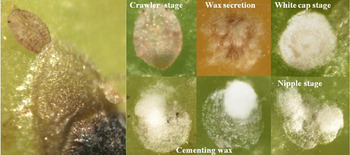
The first-instar nymph is the only stage that is not black and passes through three stages: crawler, white cap, and nipple (fig. 4). BPS crawlers emerge from the flap at the posterior end of the female scale cover. The N1 body is ovoid to elongate, 0.3–1 mm long, and purple, with well-developed legs and usually two single-faceted eyes. The crawler moves over the plant surface, selects a favourable feeding location on a fruit or foliar surface, tucks the hind legs under its body, becomes flattened on the plant surface, and finally inserts its stylets and starts feeding. N1 then becomes sessile.
Development of first instar.

White-cap stage of N1
Fine threads of cottony wax begin to be extruded around the N1 body soon after settlement and commencement of feeding, and this waxy secretion continues until the crawler is completely covered. The crawler produces pellicles of dense, firm wax from the body margins to the centre. The crawlers are now white circular masses scattered on the plant surface (fig. 4). This stage is the ‘white cap’, which starts with the secretion of pellicles of white wax and ends with the wax completely covering the body.
Nipple stage of N1
P. ziziphi crawlers continue to grow and then start to shed their skins; the first step is to cement the wax cover together with excretory products. The derma of the dorsum gradually becomes heavily sclerotized, and the derma of the venter remains membranous. The insect forms a distinct thin oval layer of hard wax topped by a patch of cottony wax, with a triangular extremity at the posterior end, before it is ready to moult (fig. 4). This stage is called the ‘nipple’, characterized by the shape of N1 scales before colouration.
The first-instar nymph has not been demonstrated to differ between the male and female. Exuviation is similar in the male and female, and the first exuviae are sclerotized in the same manner for both sexes.
First moult (M1)
The nipple-stage crawler begins to turn black at the first moult from N1 to the second instar (N2). A thin orange line appears around the armour margin, termed ‘the orange-ring moult’ after the scale cover is completely black and sclerotized (fig. 5). This stage is called M1, where two processes are occurring: the formation of the first exuviae and sexual differentiation. Moulting in the female generally leads to retrogression, with the loss of legs, segmented antennae, and anal setae. Stylets are not withdrawn from the plant tissue, but new, larger stylets are formed after each moult.
First moulting process.

Formation of scale cover
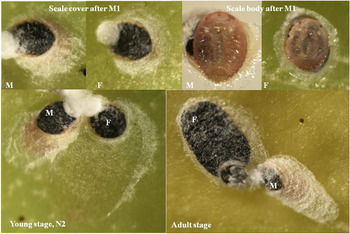
The formation of scale cover in female BPS usually involves combining the cast nymphal skin with waxy exudates from the pygidial glands (Foldi, Reference Foldi and Rosen1990) to form two protective scales; the scale above the body is usually very hard and brittle, and the scale beneath the body near the plant surface is thin and delicate (fig. 6). The female lies between these two layers, which provide protection for her and her progeny from plant barriers and external factors. The adult female body remains covered by the exuviae (scale cover) from the two preceding stages. The scale cover in the second-instar male consists of one dorsal sclerotized exuviae and some amount of waxy secretion, but no protective scale is formed beneath the body.
Protective scales, showing double skins for the female and only one scale cover for the male.

Sexual dimorphism
Sexual dimorphism is now apparent after the first moult (M1) to the N2 stage. The scale covers of the second-instar males and females may differ in colour, size, and shape: male covers are usually paler, smaller, and more elongated than female covers (fig. 7). The second-stage nymph is sessile: females remain in this position for the rest of their lives, and the males until they emerge as adults.
Sexual dimorphism at different stages between male (M) and female (F).

Field appearance of female developmental stages
Second-instar female (N2f)
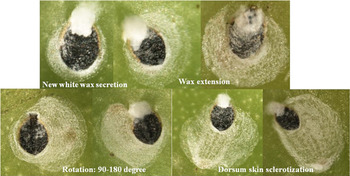
The second-instar BPS remains beneath the exuviae of the first stage, inserts its stylets, and resumes feeding and growth. The pygidium is extended outside the scale cover during this period of growth, and new waxy material is added to the margin to enlarge the cover, extending the secretion produced during the N1 stage. The legless insect shuffles to the left and right in circular movements around the insertion point of the stylet while expanding the scale cover with a thin layer of white wax. The body is regularly rotated alternately from left to right through an arc of up to 90–180°. After the second stage stops growing, the body resumes its initial position, wax secretion stops, and the dorsal derm gradually becomes sclerotic (fig. 8).
Development of second instar.

Second female moult (M2f)
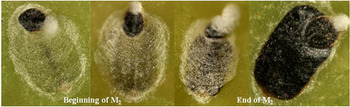
As in the first moult, the second female moult is indicated by the development of black pigmentation on the dorsal cuticle of N2F (beginning of M2F) and then the orange moulting ring around scale cover margin (end of M2F) (fig. 9). In BPS, the derm of the venter remains membranous. Exuviation shrinks the adult female body, which remains entirely between the dorsal and ventral exuviae of the second stage (fig. 6).
Second moulting process.

Young adult female
BPS, being legless, still lies beneath the scale cover, which now contains two exuviae. The second-instar nymphal exuviae is retained and incorporated into the cover, underneath and slightly posterior to the first exuviae.
The adult female resumes growth immediately after moulting, when its stylets are again inserted into the tissues of the host plant for feeding. The female body expands to its maximum size at maturity, and the female starts to produce wax over and around the scale cover; the body is clear, purplish, and rounded-rectangular in form (fig. 10).
Young female.

Mature-female stages
The adult female releases pheromones at sexual maturity to attract males and then extends its pygidium beyond the posterior end of the scale cover for fecundation. If male emergence is delayed, the female produces a fringe of white wax (HJ, personal observation, 2011) before extending much of the pygidium for copulation (fig. 11). If the female has still not mated, the entire body moves from under the scale cover, maintaining its attachment to the plant surface only by the stylets (fig. 12). The size, shape, and colour of the wax fringe change with the biological state of the female, based on observations of 30 female specimens (HJ, personal observation, 2011) (table 1).
Female preparing for copulation.

Female not copulated.

Relation between wax fringe and female stage

Gravid and pre-ovipositing female stages
The gravid female increases in size very rapidly, 2–3 days at 24°C on fruits (Jendoubi, Reference Jendoubi2012). The female prepares her body and scale cover during pre-oviposition for producing eggs. An extra V-shaped wax flap is added to the posterior end of the scale cover to allow the emergence of crawlers. This wax fringe develops gradually at full maturity and the ensuing emergence of crawlers. The gravid female is characterized by a large flap of white wax. The posterior part of the body retracts as reproduction progresses (fig. 13). The abdomen shrinks until it is very small, leaving space under the scale cover behind the pygidium as a brood chamber for eggs and hatching crawlers. The posterior wax flap later discolours to a yellowish brown (fig. 14).
Gravid female.

Pre-ovipositing female.

Ovipositing female stage
The wax flap becomes brown at oviposition, the female body is purplish, the pygidium retracts, and the posterior of the body increasingly swells with the production of eggs (fig. 15). The eggs are barely visible to the naked eye but are perceptible due to the transparency of the tegument. The wax flap later becomes dark brown, and the body becomes dark purple, well inflated, and filled with eggs. Females at this stage start to lay individual eggs to form two symmetric rows of 12 eggs each under the scale cover. The purple eggs are bean-shaped or elongate-oval. They are protected by the upper and lower scale covers, the hardened dorsal scale cover, and the thin undercover attached to the surface of the host plant. The eggs hatch in a few days, and crawlers emerge from beneath the wax flap to the surface of the plant. Females repeat this cycle of producing and laying eggs beneath their scale covers until the end of their lives (fig. 16). The bodies of old females are depleted and dark red after all eggs are laid but remain attached to the plant by the stylets (fig. 17).
Ovipositing female.

Older ovipositing female.

Old female.

Field appearance of male developmental stages
Second-instar male (N2m)
BPS N2M immediately after M1 is very similar to the corresponding female stage. The insect has lost its legs and antennae, as for N2F, but its pygidial structure is quite different. N2M feeds, grows, and starts to differentiate into a typical male body, elongated rather than oval; some white wax is simultaneously produced to form an appendage surrounding the posterior end of the first exuviae. The scale cover of N2M becomes quite different from that of the female, forming an elongate tail to cover the entire male. The body slowly develops into an elongated oval shape with accentuated purplish pigmentation and two large black eyes (fig. 18).
Development of second instar male.

The male remains under the same N2M scale cover throughout the rest of its development while proceeding through the prepupal and pupal stages to reach adulthood. The cover consists of the first black exuviae and the long appendage of hard white wax, which never becomes strongly sclerotized or black.
Pupation and emergence of winged adults
The exuviae from subsequent moults do not form part of the scale cover but are extruded from the posterior end in a small crumpled bundle at the end of each moult. These exuviae are membranous and delicate and can be used as indicators for male developmental stages.
After completing construction of the scale cover, the second-instar male moults and ejects the exuviae (which has a pygidial form, as for N2M) as a slightly V-shaped mass at the posterior end of the scale cover. The presence of the exuviae on the plant surface outside the scale cover indicates the end of M2M and the beginning of the next stage of the pupal instar (fig. 19).
Second male moult.

The prepupal male does not feed but grows and moults again, ejecting the exuviae and advancing to the pupal stage (fig. 20). The prepupa is distinguished from N2M by the differentiation of two parts of the body: the external sheaths of the eyes and legs and a slight squaring of the posterior end (the early development of the genitalia).
Pre-pupal stage.

The prepupal male moults after about 2 days into a male pupa and ejects the exuviae. The third exuviae has distinctly pointed genitalia, similar to the pre-adult (fig. 21). The pupal stage develops antennae, wings, and legs, which are drawn up to the body; the aedeagus is sometimes apparent. The adult male remains under the scale cover after the final moult until it reaches maturity and is ready to emerge through an opening at the posterior end of the cover. The insect slowly emerges from under the cover by vertical contractions (fig. 22).
Pupal stage.

Emergence of male adult.

The male scale cover is white, elongated, and flat, with a relatively large black terminal exuviae. The male body is tiny and delicate, with black, close-set eyes. It is purplish, with one pair of inconspicuous transparent wings and long, feathery antennae. The thorax is wider than the abdomen, with a dark purple bar across the dorsum (HJ, personal observation, 2011).
Conclusion
BPS is probably native to Asia, but immature scales and adult females are predominantly moved to many citrus-growing regions on nursery citrus plants undetected, misidentified, or mistaken for dirt particles, becoming a serious citrus pest. The lack of stringent plant quarantine measures in earlier years, due to the complexity of identification procedures and weak expertise in pest recognition, has resulted in the worldwide distribution of the BPS mainly in the citrus-growing regions. Effective management of BPS requires accurately studying the morphological features of the different life-cycle stages of the species for correct instar recognition.
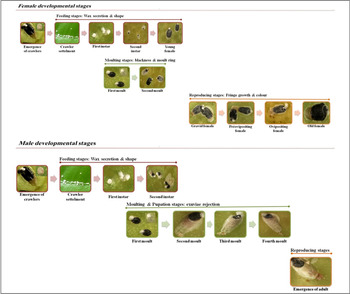
A field guide to the various BPS instars is presented (fig. 23). Specific criteria of life-cycle stages of the species are discriminated for correct instar identification. The colour plates of nymphs and adults provided for BPS male and female will be useful to coccidologists, researchers, extension agents, consultants, growers, pesticide applicators, and farmers for rapid pest detection. Correct identification of BPS life-cycle stages will allow more effective timing of pesticide programmes and quarantine inspections and will aid biological and faunistic studies (e.g. life histories, host–parasite relationships, and economic thresholds). Two groups of life-cycle stages are selected depending on their susceptibility to insecticides. The feeding stages (N1, N2F, N2M, and young female) are most vulnerable to agrochemicals while the dormant and reproductive stages are less susceptible to chemical treatment as are armoured instars or spend less time feeding.
Field identification guide to life cycle stages of P. ziziphi.

BPS, one of the most difficult citrus scale insects to control, requires much more exhaustive field studies in order to define the components of an effective and sustainable integrated pest management strategy against this pest and prevent its dissemination to new citrus areas. The current morphological study is one of the primary crucial steps needed for the control of this pest. Actually, conducting similar studies on other Parlatoria species occurring on citrus plants, mainly at their young stages, would be interesting to distinguish BPS instars from congeners.