Introduction
Tobacco germplasm is an important resource derived from both natural evolution and artificial selection, which leads to wild, local and cultivated varieties (Jiao et al., Reference Jiao, Wu, Chen, Xu and Li2019; Liu et al., Reference Liu, Li, Lv, Yang, Feng, Dai, Tong and Zhang2020). Although tobacco did not originate in China, it has been planted since the Ming Dynasty (1368–1644). Owing to China's vast territory and complicated ecological environments, tobacco germplasm resources have gradually developed through natural transmission and domestication (Qu et al., Reference Qu, Jiao, Li, Wang, Liu, Liu, Tong and Zhang2018). Since China began collecting tobacco germplasm resources in the 1950s, the country has preserved the largest quantity of tobacco germplasm stocks worldwide (Jiao et al., Reference Jiao, Wu, Chen, Xu and Li2019). Nevertheless, desirable characteristics of tobacco germplasm resources, especially their pest resistance, have not been fully exploited (Qu et al., Reference Qu, Jiao, Li, Wang, Liu, Liu, Tong and Zhang2018; Jiao et al., Reference Jiao, Wu, Chen, Xu and Li2019; Long et al., Reference Long, Liu, Wu and Li2020). Hence, exploring the differences in pest resistance among wild, local and cultivated tobacco varieties is important for breeding new varieties.
To increase economic value, humans have changed the evolutionary process of wild plants through domestication (Ladizinsky, Reference Ladizinsky1998; Li et al., Reference Li, Garvey, Kaplan, Li and Carrillo2018a; Paudel et al., Reference Paudel, Lin, Foolad, Ali, Rajotte and Felton2019). To ensure a high yield of domesticated plants, pesticides are used to control herbivore damage. Therefore, after a long period, cultivated plant varieties have gradually lost their adaptability to survive harsh external conditions, leading to a weakening or disappearance of some resistance mechanisms (Tamiru et al., Reference Tamiru, Bruce, Woodcock, Caulfield, Midega, Ogol, Mayon, Birkett, Pickett and Khan2011; Chaudhary, Reference Chaudhary2013; Li et al., Reference Li, Meng, Xing and Li2016, Reference Li, Garvey, Kaplan, Li and Carrillo2018a; Mitchell et al., Reference Mitchell, Brennan, Graham and Karley2016; Rowen and Kaplan, Reference Rowen and Kaplan2016). In contrast, wild plants and herbivores have continued to coevolve, and the resistance mechanisms of wild plants, which are far superior to those of cultivated plant varieties that have been domesticated as crops, have continuously improved (Chen et al., Reference Chen, Gols and Benrey2015; Milla et al., Reference Milla, Osborne, Turcotte and Violle2015; Whitehead et al., Reference Whitehead, Turcotte and Poveda2017; Long et al., Reference Long, Liu, Wu and Li2020). Local varieties are formed from a combination of long-term natural and artificial selection in a certain area (Rodriguez-Saona et al., Reference Rodriguez-Saona, Vorsa, Singh, Johnson-Cicalese, Szendrei, Mescher and Frost2011; Li et al., Reference Li, Garvey, Kaplan, Li and Carrillo2018a). However, when wild plants are domesticated, their interactions with herbivores and the environment are fundamentally changed (Fuller et al., Reference Fuller, Denham, Arroyo-Kalin, Lucas, Stevens, Qin, Allaby and Purugganan2014; Larson et al., Reference Larson, Piperno, Allaby, Purugganan, Andersson, Arroyo-Kalin, Barton, Vigueira, Denham, Dobney, Doust, Gepts, Gilbert, Gremillion, Lucas, Lukens, Marshall, Olsen, Pires, Richerson, de Casas, Sanjur, Thomas and Fuller2014; Li et al., Reference Li, Garvey, Kaplan, Li and Carrillo2018a).
Host plants exert an important influence on insect growth and population dynamics (Li et al., Reference Li, Meng, Xing and Li2016; Rowen and Kaplan, Reference Rowen and Kaplan2016; Schillewaert et al., Reference Schillewaert, Vantaux, Van den Ende and Wenseleers2017). Plant–herbivore interactions have been a key issue in ecological research for many years (Chen et al., Reference Chen, Gols and Benrey2015; Cusumano et al., Reference Cusumano, Zhu, Volkoff, Verbaarschot, Bloem, Vogel, Dicke and Poelman2018). Plants vary in nutrient content, water level and secondary metabolite composition, causing changes in herbivore growth, development and behaviour (e.g., oviposition) that are plant-dependent (Ode, Reference Ode2006; Karban, Reference Karban2011; Li et al., Reference Li, Li and Meng2018b). In recent years, research has focused on the influence of different plant genera on a specific insect (Li et al., Reference Li, Meng, Xing and Li2016; Paudel et al., Reference Paudel, Lin, Foolad, Ali, Rajotte and Felton2019). For example, Luan et al. (Reference Luan, Gu and Li2013) found that tobacco cutworm (Spodoptera litura) that fed on tobacco had a shorter developmental period and lower pupal weight than S. litura that fed on soybean; however, it took longer to develop and weighed more than S. litura that fed on amaranth. Moreover, Wu et al. (Reference Wu, Yang, Zeng, Yao and Liao2015) found that the diurnal rhythm of the reproductive behaviour of S. litura that fed on tobacco changed greatly compared with the rhythm of S. litura that fed on cabbage. In previous studies on the influence of wild, local and cultivated varieties of the same plant species on herbivores, for plants with different origins, the coevolutionary history between insects and their host plants was short (Chen et al., Reference Chen, Gols and Benrey2015). Wild plants have coevolved with local insect populations for hundreds of years, far longer than cultivated varieties of the same origin. However, because of varying plant origins, wild, local and cultivated plant varieties have not coevolved with local insect populations for centuries; thus, the evolutionary advantages of wild plants cannot be reflected. Currently, few studies have analysed how insect life history is affected by wild, local and cultivated varieties of the same plant from the same origin (Long et al., Reference Long, Liu, Wu and Li2020).
In this study, two wild (‘Bishan wild tobacco’ and ‘Badan wild tobacco’), two local (‘Liangqiao sun-cured tobacco’ and ‘Shuangguan sun-cured tobacco’) and two cultivated (‘Xiangyan No. 5’ and ‘Cunsanpi’) tobacco varieties with similar phenotypes (leaf shape and plant height) and growth periods in the tobacco-growing areas of Hunan Province, China were the research objects. The wild and local varieties have been present in Hunan Province for over 100 years (Qu et al., Reference Qu, Jiao, Li, Wang, Liu, Liu, Tong and Zhang2018), while the cultivated varieties have been planted only in recent years. The target insect was S. litura, the main pest in Hunan tobacco fields over the past century. We determined the influence of wild, local and cultivated tobacco varieties from the same origin on the oviposition preference and offspring performance of S. litura. Our results can provide a reference for the screening of resistant tobacco varieties and will facilitate the development of comprehensive measures to prevent and control S. litura infestation of tobacco plants.
Materials and methods
Plants and insects
In 2018, S. litura individuals were collected from tobacco fields in the suburbs of Shaoyang City, Hunan Province (26.9°N, 111.3°E). The insects were fed an artificial diet in a phytotron under the following conditions: temperature of 26 ± 1°C, relative humidity of 60 ± 10%, and light and dark cycle of 14 h/10 h. Adult moths were kept in nylon organza-covered rectangular cages (23 × 22.5 × 32 cm). They were provided a solution of 10% honey in distilled water on a cotton ball that was replaced daily and paper strips as an oviposition substrate.
Tobacco seeds were provided by the Hunan Institute of Tobacco Science, China. Each plant was placed in a nutrition pot (diameter: 32 cm, height: 20 cm) and cultivated in a large outdoor gauze-mesh enclosure (l × w × h: 10.5 × 6 × 2.3 m). Routine management consisted of watering each plant once every 2 days.
Experiment setup
Because growth periods differ across tobacco varieties, we cultivated the tobacco in batches by variety to ensure that all plants reached the six-leaf stage at the same time.
In order to explore the influence of different tobacco varieties with similar phenotypes on the oviposition preference of S. litura females, the six tested tobacco varieties (six-leaf stage) were randomly placed in a gauze-mesh enclosure (l × w × h: 2 × 1.2 × 1.7 m) in the field; the distance among tobacco plants was 40 cm. After mating, one female S. litura moth was released and provided honey water (10%) as a nutritional supplement. Oviposition of the female moth on the tobacco plant was recorded every 12 h. If the moth laid its eggs on the tobacco plant, then the test was successful and counted as one repetition. However, if the moth laid eggs on the gauze-mesh enclosure or nutrition pot, then the test failed. If the moth did not lay eggs within 2 days, it was replaced with another female moth. After each experiment, the gauze-mesh enclosures were opened for ventilation, and the tobacco plant was replaced. The S. litura oviposition preference experiments were conducted from July to August 2019 with a daily mean temperature of 25–34°C. Thirteen gauze-mesh enclosures were used for simultaneous experiments, and the experiment was repeated 180 times.
Neonate larvae of S. litura were raised in a phytotron to reach the pupal stage. Each larva was raised in an insect-rearing box (diameter: 5 cm, height: 3 cm) covered with moisturising filter paper and was provided fresh leaves daily. The third to fifth leaves from the bottom of the tobacco plant were used as the fresh leaves; these three leaves were always collected at the same time. Neonate S. litura larvae in each treatment group were counted, and successful pupation of a larva was regarded as one repetition. The experiment ended when the number of pupated S. litura larvae on each tobacco variety reached 30. The development period of S. litura larvae (from newly hatched larvae to pupae), pupal weight, pupal stage (from pupation to emergence) and adult dry weight (successfully emerged adults were dried in an 80°C thermostatic drying box for 48 h before weighing) were recorded. Survival rate (30 successfully pupated larvae/total tested larvae) was calculated based on whether S. litura larvae survived to the pupal stage during tobacco feeding. The emergence rate was then calculated according to emerged pupae.
Data analysis
Data were checked for homogeneity of variance, and pupal weight was logarithmically transformed. One-way analysis of variance (ANOVA) was then used to determine the differences in life-history parameters of S. litura larvae among varieties. Multiple comparisons were performed with Tukey's honestly significant difference test. Data on the S. litura larval survival, pupal emergence and tobacco selection for oviposition by the moths were binary data; therefore, a logistic generalized linear model was used to analyse the data. All analyses were performed in R.
Results
Influence of different tobacco varieties on oviposition preference of S. litura females
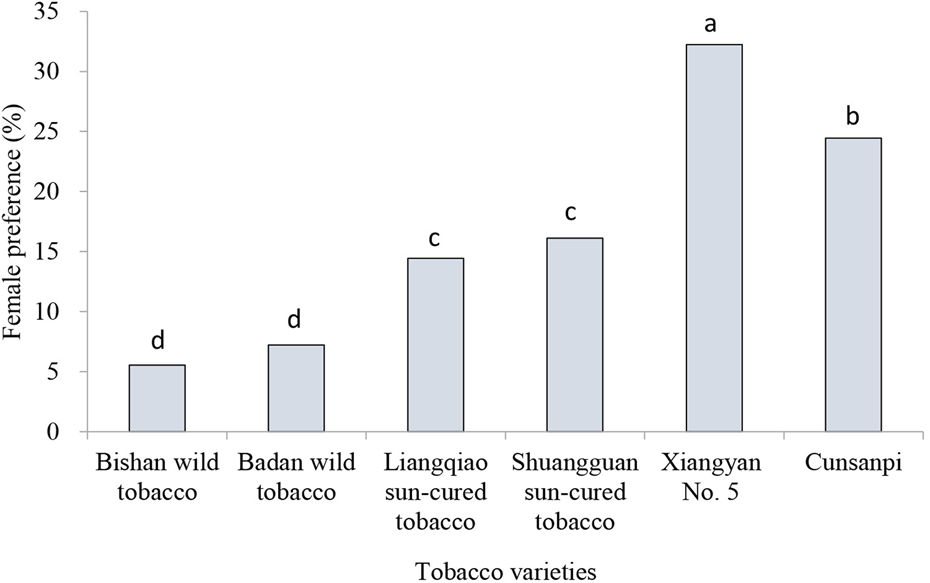
The different tobacco varieties had a significant influence on the oviposition preference of S. litura females (χ 2 = 76.50, d.f. = 5, P < 0.05). The females had the lowest preference for ‘Bishan wild tobacco’ and the highest preference for the cultivated tobacco ‘Xiangyan No. 5’, with a significant difference between them (P < 0.001). The oviposition preference of S. litura was significantly different among the cultivated, local and wild tobacco varieties (P < 0.05) (fig. 1).
Female preference of Spodoptera litura on different tobacco varieties. Columns with the same lowercase letter do not differ significantly (P > 0.05).

Influence of different tobacco varieties on larval survival rate
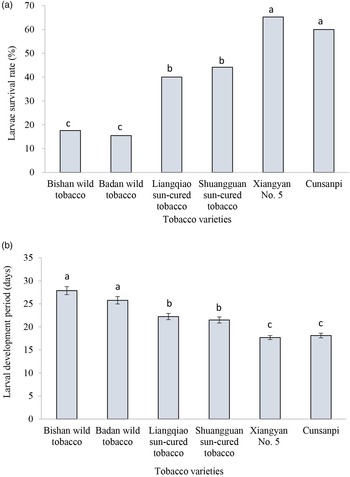
The different tobacco varieties had a significant influence on the survival rate of S. litura larvae (χ 2 = 88.93, d.f. = 5, P < 0.05). The survival rate differed significantly among the wild, local and cultivated tobacco varieties (P < 0.05), but there was no significant difference within the two wild, two local or two cultivated varieties of tobacco (P > 0.05). The survival rate of larvae was lower when reared on wild varieties than when reared on local and cultivated varieties. The larvae that fed on ‘Badan wild tobacco’ had the lowest survival rate, followed by those that fed on the local tobacco varieties, with the survival rate of larvae that fed on the cultivated variety ‘Xiangyan No. 5’ being the highest (fig. 2a).
Survival rate (a) and development period (b) of Spodoptera litura larvae that fed on different tobacco varieties. Bars indicate means ± SE; columns with the same lowercase letter do not differ significantly (P > 0.05).

Influence of different tobacco varieties on larval development period
The different tobacco varieties had a significant influence on the development period of S. litura larvae (F 5, 175 = 36.87, P < 0.05). The larval development period was longer when reared on wild varieties than on local and cultivated varieties. The larval development period was the longest on ‘Bishan wild tobacco’ and shortest on ‘Xiangyan No. 5’, and the 10.18 days difference between them was significant (P < 0.05). The development period of S. litura larvae was significantly different across the wild, local and cultivated varieties of tobacco (P < 0.05), but there was no significant difference when comparing within wild, local or cultivated varieties (P > 0.05) (fig. 2b).
Influence of different tobacco varieties on pupal weight
The pupal weight of S. litura was significantly affected by the different tobacco varieties (F 5, 175 = 369.90, P < 0.05). The pupal weight of S. litura was lighter when reared on wild varieties than when reared on local and cultivated varieties. The larvae that fed on ‘Badan wild tobacco’ produced the lightest pupal weight, whereas the larvae fed on ‘Xiangyan No. 5’ produced the heaviest pupal weight, with a significant difference between them (P < 0.001). The pupal weights of larvae that fed on ‘Cunsanpi’ and ‘Liangqiao sun-cured tobacco’ were not significantly different (P > 0.05). However, there was a significant difference between the remaining tobacco varieties (P < 0.05) (fig. 3a).
Pupal weight (a), pupal stage (b), pupal emergence rate (c) and adult body weight (d) of Spodoptera litura that was fed on different tobacco varieties. Bars indicate means ± SE; columns with the same lowercase letter do not differ significantly (P > 0.05).

Influence of different tobacco varieties on pupal stage
The different tobacco varieties had a significant effect on the pupal stage of S. litura (F 5, 77 = 15.1, P < 0.05). The pupal stage of S. litura reared on wild varieties was longer than that of S. litura reared on local and cultivated varieties. The larvae that fed on ‘Badan wild tobacco’ had the longest pupal stage, whereas the larvae that fed on the cultivated tobacco variety ‘Cunsanpi’ had the shortest pupal stage, with a significant difference between them (P < 0.001). There was no significant difference in S. litura pupal stage between the cultivated and local varieties of tobacco (P > 0.05) (fig. 3b).
Influence of different tobacco varieties on emergence rate
The emergence rate of S. litura was significantly affected by the different tobacco varieties (χ 2 = 18.64, d.f. = 5, P < 0.05). The emergence rate of S. litura reared on wild varieties was lower than that of S. litura reared on local and cultivated varieties. The larvae that fed on ‘Badan wild tobacco’ produced adult moths with the lowest emergence rate, whereas larvae that fed on the cultivated tobacco variety ‘Xiangyan No. 5’ produced adult moths with the highest emergence rate, with a significant difference between them (P < 0.001). The adult emergence rate was significantly different among the tobacco varieties (P < 0.05) (fig. 3c).
Influence of different tobacco varieties on the dry weight of S. litura adults
The dry weight of S. litura adults was significantly affected by the different tobacco varieties (F 5, 77 = 53.33, P < 0.05). The dry weight of S. litura adults reared on wild varieties was lower than that of S. litura adults reared on local and cultivated varieties. The adult dry weight was the lowest when the larvae fed on ‘Badan wild tobacco’ and the highest when the larvae fed on ‘Xiangyan No. 5’, with a significant difference between them (P < 0.001). The dry weight of adults showed no significant difference between ‘Cunsanpi’ and ‘Liangqiao sun-cured tobacco’ (P > 0.05) and between ‘Bishan wild tobacco’ and ‘Shuangguan sun-cured tobacco’ (P > 0.05). However, there was a significant difference among the other tobacco varieties (P < 0.05) (fig. 3d).
Discussion
In the present study, we found that wild, local and cultivated tobacco varieties significantly affected the life history traits of S. litura. After S. litura larvae were fed on cultivated, local and wild varieties of tobacco, the survival rate, pupal weight, emergence rate and adult dry weight increased in the following order: wild varieties < local varieties < cultivated varieties, whereas the pupal stage and development period decreased in the following order: wild varieties > local varieties > cultivated varieties. Therefore, the plant variety consumed at the larval stage has an important influence on S. litura growth and development. Nutrients accumulate during the larval stage, generally, consuming plants with high nutritional content during the larval stage improves survival, shortens the development period, increases body size and increases egg production (Ode, Reference Ode2006; Li et al., Reference Li, Li and Meng2018b; Long et al., Reference Long, Liu, Wu and Li2020). Conversely, if S. litura larvae consume a resistant plant, they develop into small-sized adults, exhibit low survival, grow slowly and exhibit a delayed developmental period (Long et al., Reference Long, Liu, Wu and Li2020). Therefore, our results indicate that the wild tobacco varieties had the highest resistance to S. litura, followed by the local varieties; the cultivated varieties exhibited the lowest resistance.
The effect of different host plants on insect growth and population dynamics has been a key issue in ecological research for many years (Li et al., Reference Li, Meng, Xing and Li2016, Reference Li, Li and Meng2018b; Paudel et al., Reference Paudel, Lin, Foolad, Ali, Rajotte and Felton2019). Domestication often improves yield or taste, but typically leads to low pest resistance (Gols et al., Reference Gols, Bukovinszky, van Dam, Dicke, Bullock and Harvey2008; Sujana et al., Reference Sujana, Sharma and Rao2012; Li et al., Reference Li, Garvey, Kaplan, Li and Carrillo2018a). Compared with wild varieties, cultivated crops are more vulnerable to attack and feeding by herbivores, and insects that consume cultivated varieties have significantly higher growth and development than those that consume wild varieties (Chen and Bernal, Reference Chen and Bernal2011; Hare, Reference Hare2011; Whitehead et al., Reference Whitehead, Turcotte and Poveda2017). For example, Halitschke et al. (Reference Halitschke, Stenberg, Kessler, Kessler and Baldwin2008) found that cultivated tobacco varieties were unable to produce some secondary metabolites that impart pest resistance, thus leading to improved growth and development of insects that fed on the cultivated varieties. Another study showed that wild tomatoes had higher resistance to Manduca sexta than cultivated tomatoes, indicating that the wild tomato was not conducive for the growth and development of the tobacco hornworm (Li et al., Reference Li, Garvey, Kaplan, Li and Carrillo2018a). Furthermore, wild soybeans in China had higher resistance to S. litura than local or cultivated varieties (Yang, Reference Yang2016). Rosenthal and Dirzo (Reference Rosenthal and Dirzo1997) also reported that cultivated maize is less resistant to insects than its wild relatives (teosintes), which is indicative of a trade-off between productivity and defence. Thus, in different plant species, wild plant varieties are more resistant to herbivores than local and cultivated varieties.
Insects locate host plants mainly by their visual organs and olfactory receptors (Rowen and Kaplan, Reference Rowen and Kaplan2016). Although insects can recognize the colour, shape and size of the host plant through their visual organs, they can sense distinct combinations of volatile organic compounds in plants through their olfactory organs, enabling them to accurately locate specific hosts (Rowen and Kaplan, Reference Rowen and Kaplan2016; Xiu et al., Reference Xiu, Pan, Liu, Luo, Williams, Yang and Lu2019; Pashalidou et al., Reference Pashalidou, Eyman, Sims, Buckley, Fatouros, De Moraes and Mescher2020). Human factors have little influence on the growth, development and reproduction of wild plants. To resist the damage caused by herbivores and ensure the reproduction of the population, wild plants have evolved defence mechanisms that involve releasing high levels of volatile organic compounds that repel herbivores and attract natural insect enemies (Rowen and Kaplan, Reference Rowen and Kaplan2016; Li et al., Reference Li, Garvey, Kaplan, Li and Carrillo2018a; Paudel et al., Reference Paudel, Lin, Foolad, Ali, Rajotte and Felton2019). Local varieties that are specially adapted to a certain region exhibit strong resistance mechanisms compared with those of cultivated varieties (Li et al., Reference Li, Garvey, Kaplan, Li and Carrillo2018a), but may remain vulnerable to invasive herbivores. One notable sign of reduced resistance in local or cultivated varieties is a decrease in the levels of volatile organic compounds (Dicke and Baldwin, Reference Dicke and Baldwin2010; Dicke, Reference Dicke2015; De Lange et al., Reference de Lange, Farnier, Gaudillat and Turlings2016; Li et al., Reference Li, Garvey, Kaplan, Li and Carrillo2018a). This study showed that S. litura females preferred to lay their eggs on cultivated varieties of tobacco, consistent with previous research results in which Helicoverpa zea females preferred cultivated over wild tomato genotypes (Paudel et al., Reference Paudel, Lin, Foolad, Ali, Rajotte and Felton2019); M. sexta females preferred to lay their eggs on cultivated tomato varieties (Li et al., Reference Li, Garvey, Kaplan, Li and Carrillo2018a); Nilaparvata lugens preferred to lay their eggs on cultivated rice varieties (Zheng et al., Reference Zheng, Lu, Zhu, Zhang, Tian, Xu, Chen, Nansen and Lu2017); and whiteflies preferred laying eggs on cultivated tomato compared with wild tomato (McDaniel et al., Reference McDaniel, Tosh, Gatehouse, George, Robson and Brogan2016). The oviposition preference of S. litura females in this study confirmed that wild tobacco varieties are the most effective in repelling this insect pest, followed by local and cultivated varieties.
To the best of our knowledge, this is the first study to determine the effects of same-origin wild, local and cultivated tobacco varieties on the life history of S. litura. We confirmed that wild plants and local varieties have higher pest resistance. Domestication of wild plants may affect the ecological environment and evolution of herbivore populations; however, more research is necessary regarding such connections. For example, herbivores that feed on domesticated cultivated plants may evolve more slowly than herbivores that feed on wild plants (Turcotte et al., Reference Turcotte, Lochab, Turley and Johnson2015; Li et al., Reference Li, Garvey, Kaplan, Li and Carrillo2018a), suggesting that we still do not fully understand the potential effects of artificial selection on plant–herbivore coevolution.
In conclusion, the herbivore S. litura exhibited reduced growth and preference on the wild and local tobacco varieties tested. The present study demonstrated some of the benefits of comparing same-origin wild, local and cultivated tobacco varieties for insect resistance, which could be useful for host resistance breeding purposes. Our findings provide insights into how crop domestication influences herbivores and the coevolution of same-origin plant varieties and herbivores. Future research should examine the nutritional contents and volatile organic compounds of tobacco varieties, to determine tobacco defence traits, and to explore the evolutionary differences of same-origin wild, local and cultivated tobacco varieties.
Acknowledgements
We would like to thank Jun Deng, Qian Huang and Qi Yang for their help in the experiments. We also thank the Hunan Institute of Tobacco Science, China for providing tobacco seeds. This research was supported by the National Natural Science Foundation of China (NSFC-31800317), the Scientific Research Project of Hunan Education Department (19B513) and the Natural Science Foundation of Shaoyang (2020NS124).
Author contributions
X.L. and Z.H. designed the study, X.L. performed the experiments, S.W. and X.L. analysed the results and produced the figures, and X.L. wrote the manuscript. All authors have discussed and approved the final manuscript draft.
Conflict of interest
None.