Introduction
The guava fruit fly, Bactrocera correcta (Bezzi) (Diptera: Tephritidae), is an economically important fruit fly that damages both fruit and vegetable crops, and apparently attacks more than 60 species of host plants in 30 families, including guava, mango, cherry, jujube, citrus and chilli (White & Elson-Harris, Reference White and Elson-Harris1992). This insect is native to tropical and subtropical regions of Asia and is distributed in India, Pakistan, Myanmar, Sri Lanka, Thailand, Vietnam, Nepal, China (Yunnan Province) and Bhutan (Wang & Zhao, Reference Wang and Zhao1989; Liang et al., Reference Liang, Yang, Liang, Si Tu and Liang1996; Drew & Raghu, Reference Drew and Raghu2002; CPC, 2012), and is a serious pest, especially in south and southeastern Asia (Anderson & Dixon, Reference Anderson and Dixon2008), as well as in the Oriental, Australian and Oceanic regions (Allwood et al., 1996; Vijaysegaran, 1996). In the Western Hemisphere, B. correcta has been detected numerous times in California (since 1986) and in Florida (since 1999), although has not yet become established in these regions (Anderson & Dixon, Reference Anderson and Dixon2008; Weems & Fasulo, Reference Weems and Fasulo2011). Even so, the species has the potential to become a major pest if an infestation were to go unchecked and become established in the US (Weems & Fasulo, Reference Weems and Fasulo2011). Thus, a rapid and accurate method for identifying B. correcta is urgently needed in quarantine work in order to facilitate decision-making regarding fruit transportation, which can help prevent the spread of B. correcta to non-infested areas.
Traditionally, B. correcta has been identified based on morphological characteristics of the adult; it is differentiated from other Bactrocera species by its brown to black transverse band of facial spots, with the band usually narrowed or interrupted in the median portion (Wang, Reference Wang1996). However, the identification of this species based on its immature stages (i.e., egg, larva or pupa) or its adult body parts, which lack distinct diagnostic characteristics, is very difficult and not reliable (Zhao et al., Reference Zhao, Liang, Liang, Hu, Ma and Lin2007). In quarantine work, it is common to take a few days to rear individuals to the adult stage for identification, which is relatively time consuming and hence disadvantageous for the fruit and vegetable trade in the countries affected (Armstrong et al., Reference Armstrong, Cameron and Frampton1997).
Molecular identification could prove an accurate and efficient approach, and has been applied to the diagnosis of B. correcta. For example, Zhang & Zhang (Reference Zhang and Zhang2007) identified six Bactrocera species, including B. correcta, in the Yunnan Province of Southwest China using random amplified polymorphic DNA (RAPD) markers based on different banding patterns. Even so, the RAPD approach is limited since its reproducibility and stability often depend on the laboratory used (Wang et al., Reference Wang, Yu, Zhang and Lin2010). Wu et al. (Reference Wu, Hu, Zhao, Liang and Liang2005) successfully reported identifying nine species of quarantine fruit flies, including B. correcta, using restriction fragment length polymorphisms (RFLPs) of the mitochondrial DNA cytochrome oxidase II gene (mtDNA COII). Nucleic acid sequence analysis has also been applied to fruit fly species identification. Asokan et al. (Reference Asokan, Krishna Kumar and Abraham2007) reported the identification of Bactrocera dorsalis, B. correcta and Bactrocera zonata using mtDNA COI analyses. Based on such sequence analysis, the so-called DNA barcoding offers a valuable technique for animal identification using a standard COI threshold (Hebert et al., Reference Hebert, Cywinska, Ball and DeWaard2003). However, some recent studies have also used polymerase chain reaction (PCR) with species-specific primers to overcome the need for post-amplification digestion and DNA sequencing which thus allows more rapid identification (Yu et al., Reference Yu, Deng, Chen, Jiao, Zhang, Kang, Yang and Jin2004a , Reference Yu, Zhang, Chen, Zhang and Yin2004b , Reference Yu, Chen, Zhang and Yin2005; Barcenas et al., Reference Barcenas, Unruh and Neven2005; Hosseini et al., Reference Hosseini, Keller, Schmidt and Framenau2007; Chua et al., Reference Chua, Song and Chong2010; Zhang et al., Reference Zhang, Meng, Min, Qiao and Wan2011).
In the present study, we describe a reliable and efficient method based on conventional PCR with species-specific DNA barcode primers, i.e., a single-step PCR for diagnosing B. correcta, which we hope will prove useful for the rapid diagnosis of B. correcta in quarantine and other potentially invasive pest situations.
Materials and methods
Fruit fly collection
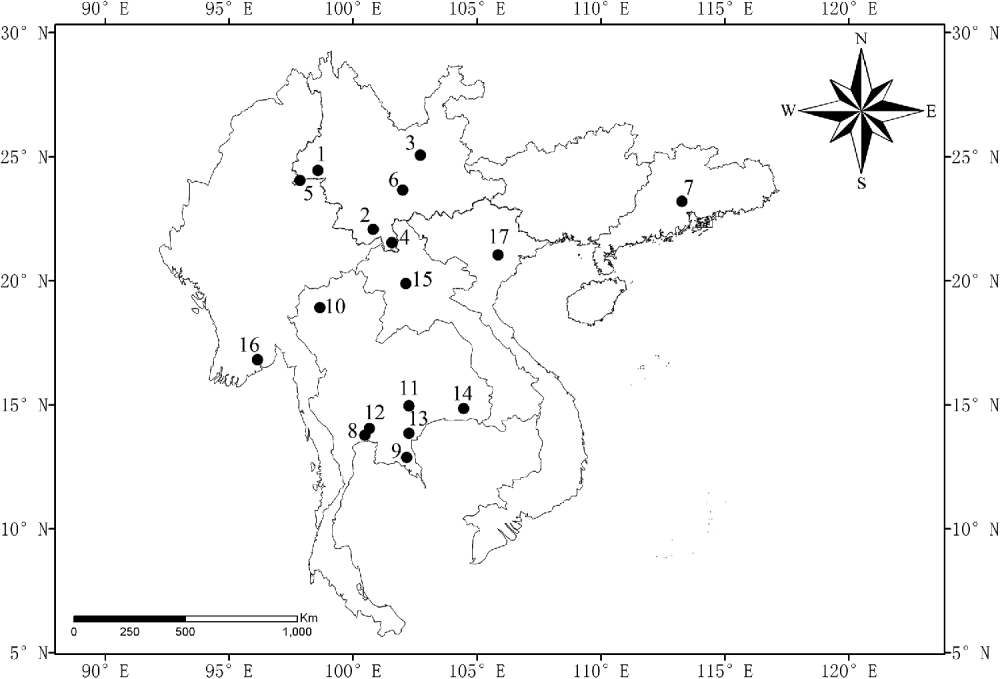
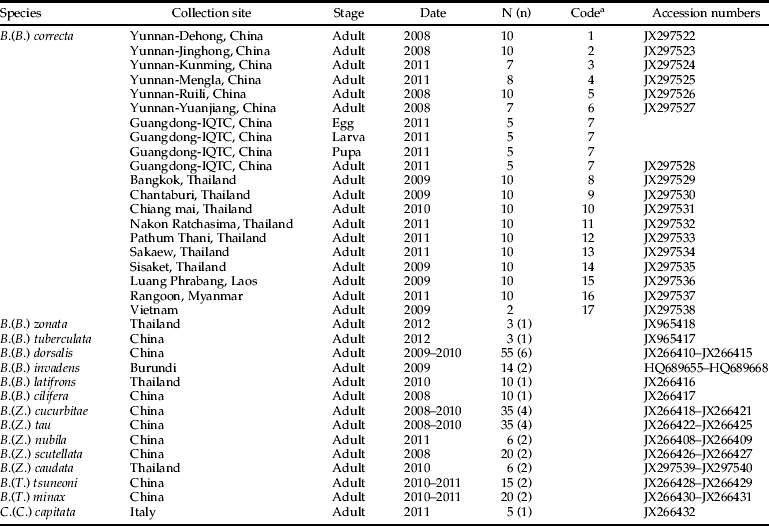
Specimens of B. correcta used in this study are listed in table 1 and fig. 1. Adult specimens were collected from their primary locations of distribution, including China, Thailand, Laos, Myanmar and Vietnam. Immature stages were reared from a laboratory population at the Inspection and Quarantine Technology Center, Guangdong Entry-Exit Inspection and Quarantine Bureau, Guangzhou, China. Other Bactrocera spp. and Ceratitis capitata (Weidemann) (Diptera: Tephritidae) were obtained from field collections. All samples were maintained in 100% ethanol and stored at −20 °C prior to DNA extraction. All the adult species samples were identified using available taxonomic keys prior to conducting molecular analyses (see Liang et al., Reference Liang, Yang, Liang, Si Tu and Liang1996 for details).
Distribution of B. correcta collection sites. The number of each site is shown in table 1. The map was generated using ArcGIS 9.3 software.

Fruit fly species used in primer specificity test.

N: the number of all the fruit fly individuals used in this study.
n: the number of geographical populations of each fruit fly species.
a: Collection site codes corresponding to fig. 1.
DNA extraction, PCR amplification and sequencing
Total genomic DNA was extracted from a single leg, a portion of the body, or from the entire body of individual adults or from a single egg, larva and/or pupa using the TIANamp Genomic DNA kit (DP304, TIANGEN, China) following the manufacturer's protocol for animal tissue, but with slight modifications to increase DNA concentration. For individual adults, larvae and pupae, each sample was digested by 30 μl of proteinase K, and the template DNA dissolved in 50 μl of TE buffer, pH 7.5. For a single leg or an egg, 15 μl of proteinase K and 20 μl of TE buffer were found to be suitable. All DNA template concentrations were estimated by spectrophotometry (NanoDrop 1000 spectrophotometer, Thermo Scientific, Wilmington, USA). The rest of the body and the DNA were stored at −20 °C for morphological and molecular verification at the Plant Quarantine and Invasion Biology Lab in Department of Entomology of China Agricultural University.
PCR amplification of the standard mtDNA COI barcode markers of the 15 species listed in table 1 was performed using the universal primer pairs LCO1490/HCO2198 (Folmer et al., Reference Folmer, Black, Hoeh, Lutz and Vrijenhoek1994). The PCR products were detected in a 1.5% agarose gel containing 1×TAE buffer (40mM Tris-acetate, 1mM EDTA) stained with ethidium bromide (EB) and visualized under UV light. All products were sent to Beijing Aoke Biotechnology Co. Ltd for sequencing with bidirectional reactions.
Specific primers of B. correcta design
The sequencing results were reviewed using Chromas (version 2.33), and sequence assembly was performed with DNAMAN (version 5.2.2.0). Later, we also queried each of the derived sequences in the NCBI and BOLD databases for species confirmation (Liu et al., Reference Liu, Liu, Wang, Ndayiragije, Ntahimpera, Nkubaye, Yang and Li2011). For Bactrocera cilifera (Hendel), Bactrocera nubila (Hendel), Bactrocera scutellata (Hendel), Bactrocera caudata (Fabricius), Bactrocera tsuneoni (Miyake) and Bactrocera tuberculata (Bezzi), we used the method of Yang et al. (Reference Yang, Kucerova, Li, Kalinovic, Stejskal, Opit and Cao2012) to confirm the species because these sequences are absent in the databases. In addition, the sequences of each species, including all of the geographical populations, were submitted to GenBank for accession numbers (table 1). We ensured that the sequence and species of each sample were correct, and a sequence alignment of the B. correcta mtDNA COI barcode gene was performed using homologous sequences, which we obtained and formerly reported in GenBank, from Bactrocera spp. and C. capitata using Clustalx (version 1.83) and BioEdit (version 7.0.9.0). In addition, six mtDNA COI gene GenBank sequences from B. zonata (Saunders) (DQ116357–DQ116362) were considered during primer design (fig. 2). The B. correcta-specific primer pair BCOR-F/BCOR-R (table 2) was manually designed based on a single-nucleotide polymorphism (SNP) site. Oligonucleotide sequences were checked for primer–dimer hairpin structure and false priming sites using Oligo (version 6.0) software. BLAST searches against specific primer sequences were performed using the NCBI database. Primers were synthesized by Beijing Aoke Biotechnology Co. Ltd.
Alignment of the mtDNA COI barcode sequences from the 14 fruit fly species. The location of the B. correcta-specific primer pair is highlighted by the shaded boxes.

Oligonucleotides used for the amplification and sequencing of B. correcta DNA.

Specificity of B. correcta-specific primer test
The specificity of the B. correcta-specific primers was tested by performing PCR assays on 164 B. correcta individuals from 17 geographical populations, 232 additional fruit flies representing 13 other Bactrocera species and five C. capitata.
PCR amplification using B. correcta-specific primers in a total reaction volume of 52 μl was performed using the following components: 35.6 μl of ddH2O, 6.0 μl of 10×reaction buffer (including Mg2+), 2.0 μl of dNTPs (2.5 mM), 3.0 μl of each primer (0.01 mM), 0.4 μl of Taq DNA polymerase (2.5 units μl−1) and 2.0 μl of template DNA. The PCR cycling conditions were an initial denaturation at 94 °C for 3 min, followed by 30 cycles of denaturation at 94 °C for 1 min, annealing at 55 °C for 30 s, extension at 72 °C for 30 s and a final extension at 72 °C for 5 min. The PCR products (5 μl) from each individual were mixed with 1 μl of loading buffer, analysed by gel electrophoresis on a 1.5% agarose gel in 1×TAE buffer, and then visualized under UV light after EB staining.
To confirm the amplified products generated by the B. correcta-specific primers, each positive band product was sequenced by Beijing Aoke Biotechnology Co. Ltd, and the results were then compared with known sequences by searching the NCBI and BOLD databases.
The specificity of the B. correcta-specific primer test was repeated three times for each sample to ensure the reliability and reproducibility of the result.
Sensitivity of B. correcta-specific primer test
To determine the sensitivity of B. correcta identification using this PCR assay, a dilution series of genomic DNA dissolved in TE buffer from an adult B. correcta specimen was used for amplification, and one adult sample from each different geographical population was tested. The template DNA concentrations were 100, 50, 25, 10, 1, 0.1, 0.01 and 0.001 ng μl−1. Double distilled water was used as a negative control. The PCR conditions and the method for checking results were the same as for the specificity test.
Application of intercepted samples
China's port inspection and quarantine services intercepted fruit fly larvae in wax apples from Thailand in May, 2012. We chose three larvae for molecular diagnosis using the B. correcta-specific primer pair BCOR-F/BCOR-R. DNA extraction was performed as described previously. PCR was conducted using the conditions described as above (see ‘Specificity of B. correcta-specific primer test’ section). In addition, live larvae were reared to the adult stage for morphological identification.
Results
DNA quality
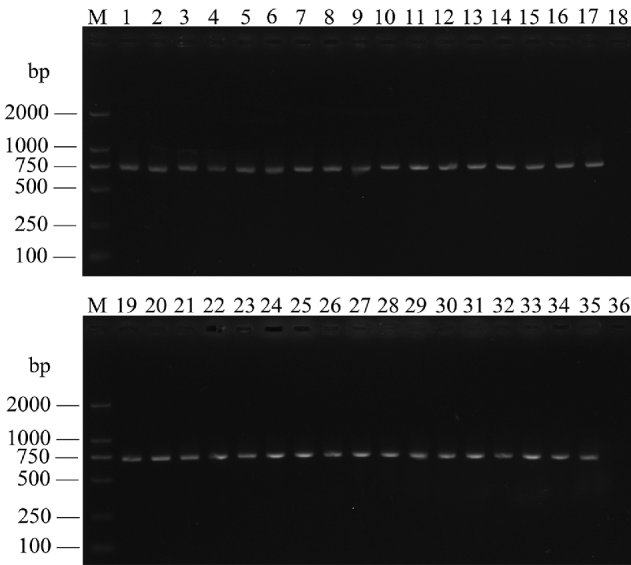
The DNA concentration extracted from a single individual was 150±30 ng μl−1 (adult), 90±20 ng μl−1 (mature larva or pupa), 20±5 ng μl−1 (a single leg from an adult fly) and 10±5 ng μl−1 (from an egg). The quality of the DNA extracted from each individual was high according to the ∼700 bp fragment generated by PCR amplification using the universal primers LCO1490/HCO2198 (fig. 3). Therefore, the absence of a PCR product in the subsequent specificity and sensitivity tests could not come from the lack of DNA template.
PCR results using the LCO1490 /HCO2198 universal primer pair, which was used to test the DNA quality. Lanes 1–21: B. correcta from different geographical populations, corresponding to table 1; Lanes 22–35: Bactrocera spp., corresponding to table 1; Lanes 18 and 36: negative control (ddH2O); Lane M: D2000 Marker.

Sequence analysis and primer selection
By examining the 615 bp sequences derived from the COI barcode gene from 14 fruit fly species, five SNP sites were found among the B. correcta and 13 other fruit flies species, including loci 12, 144, 156, 321 and 396 (fig. 2). Using the B. correcta COI sequence as a reference template, one pair of species-specific primers was successfully designed and named BCOR-F/BCOR-R (table 2, fig. 2). The optimal PCR annealing temperature was determined to be 55 °C according to the Oligo 6.0 software and temperature gradient experiments that tested annealing temperatures ranging from 50 °C to 60 °C.
Primer specificity
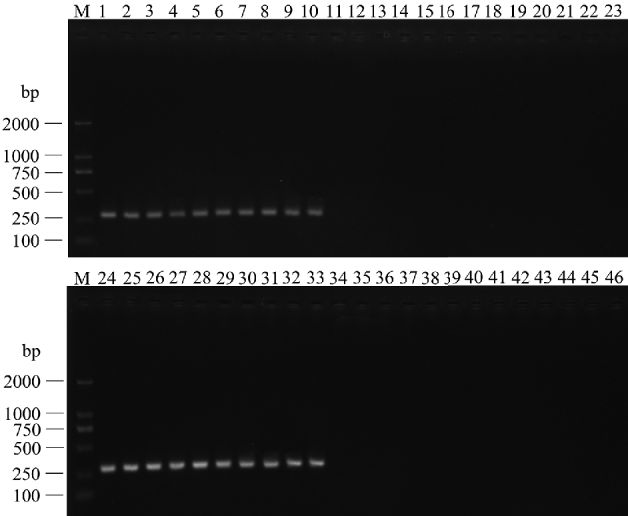
A single ∼280 bp fragment was obtained using DNA from all of the 164 B. correcta individuals from 17 geographical populations, and no bands were evident for any of the other species tested (fig. 4). The results of three replicate experiments were consistent, indicating the high specificity and reproducibility of the BCOR-F/BCOR-R primer pair.
Specificity of the BCOR-F/BCOR-R B. correcta-specific primer pair. Lanes 1–10, 24–33: B. correcta from each geographical population (i.e., 1–7: adults from China, 8–10: egg, larva and pupa, 24–33: adults from Thailand, Laos, Myanmar and Vietnam); Lanes 11 and 34: B. dorsalis; Lanes 12 and 35: B. invadens, Lanes 13 and 36: B. latifrons; Lanes 14 and 37: B. cilifera; Lanes 15 and 38: B. cucurbitae; Lanes 16 and 39: B. tau; Lanes 17 and 40: B. nubila; Lanes 18 and 41: B. scutellata; Lanes 19 and 42: B. caudata; Lanes 20 and 43: B. tsuneoni; Lanes 21 and 44: B. minax; Lanes 22 and 45: C. capitata; Lane 23: B. zonata; Lane 46: B. tuberculata; Lane M: D2000 Marker.

A sequence analysis of the specific amplified product revealed that the B. correcta amplicon was 281 bp, and all of the 281 bp fragment sequences from 164 individuals from 17 geographical populations were 99–100% identical with the B. correcta sequences listed in the BOLD/GenBank databases.
These results indicated that the specific amplified fragment generated by the B. correcta-specific primers belonged to the mtDNA COI region of B. correcta. They also revealed that despite the sequence variation associated with different geographical populations of B. correcta or different life stages, the primer specificity was not affected.
Primer sensitivity
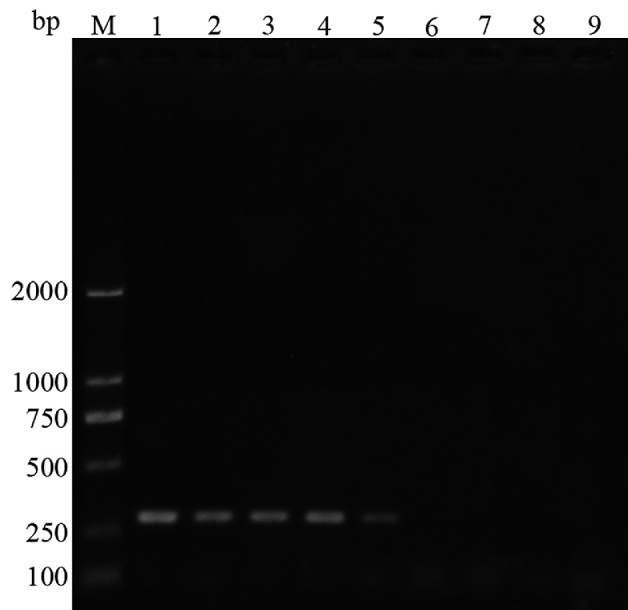
The DNA concentration test results demonstrate that we could obtain a maximum yield of approximately 150 ng μl−1 DNA template from an adult leg sample and at least 5 ng μl−1 DNA from an egg. Thus, the highly concentrated DNA extracted from B. correcta adult samples was diluted in the DNA dissolving buffer TE from 100 to 0.001 ng μl−1 to study the effect of the DNA concentration on the species-specific primer PCR. The detection limit was determined to be 1 ng μl−1, and when the template concentration was ≥10 ng μl−1, the positive band intensities of different DNA templates were the same (fig. 5).
Sensitivity of the BCOR-F/BCOR-R B. correcta-specific primer pair. The template DNA concentrations were as follows: Lane 1: 100 ng μl−1; Lane 2: 50 ng μl−1; Lane 3: 25 ng μl−1; Lane 4: 10 ng μl−1; Lane 5: 1 ng μl−1; Lane 6: 0.1 ng μl−1; Lane 7: 0.01 ng μl−1; Lane 8: 0.001 ng μl−1; Lane 9: negative control (ddH2O); Lane M: D2000 Marker.

For these reasons, regardless of the B. correcta life stage or storage condition of the sample, we could accurately diagnose B. correcta provided that the DNA concentration was ≫1 ng μl−1.
Intercepted samples identification
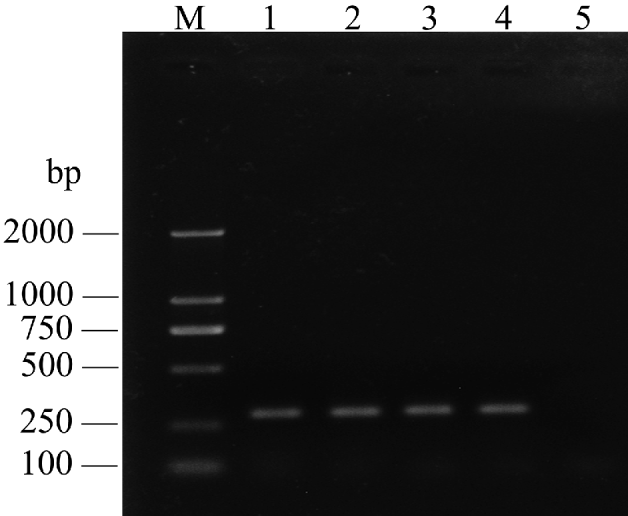
The agarose gel result demonstrated that all three of the fruit fly larval individuals were successfully amplified with the BCOR-F/BCOR-R primers (fig. 6). This result means that the species of the intercepted samples from wax apples from Thailand was indeed B. correcta. The entire diagnostic process took approximately 7 h. Furthermore, two weeks later, the adults were reared out and correctly identified as B. correcta based on their morphological characteristics. The results of the molecular analysis and morphological identification were thus consistent, indicating that our B. correcta diagnosis method using the BCOR-F/BCOR-R primer pair was relatively rapid and effective.
DNA from unknown larvae species was amplified using the B. correcta-specific primer pair BCOR-F/BCOR-R. Lanes 1–3: intercepted fruit fly larvae. Lane 4: B. correcta positive control sample. Lane 5: negative control ddH2O. Lane M: D2000 Marker.

Discussion
As mentioned in the Abstract and Introduction section, the guava fruit fly, B. correcta, is a significant threat because of its devastating appetite for a variety of fruits and vegetables, and it easily spreads by long-distance transport through trade. It could potentially cause enormous economic harm if it were to become established in countries or regions where it is presently absent. Thus, a rapid and accurate diagnostic method for B. correcta was deemed necessary by us in order to provide for more effective monitoring and quarantine work. Our research provides a single-step PCR using a pair of specific primers for diagnosing the presence of B. correcta. The specific PCR assay was able to identify B. correcta via the presence of a single band at ∼280 bp, and hence is a simple method for non-taxonomists to use, particularly useful for the species identification of immature stages or partial specimens that lack diagnostic, morphological characteristics and that cannot be identified by traditional means. Moreover, the method consists of just a simple PCR amplification, requires no further sequencing or restriction digestion of the amplified products, so that the process of identification can be completed within 7 h, and only involves widely used PCR equipment, which is readily applied in any quarantine laboratory.
The primer specificity is the key to molecular identification using species-specific COI markers. During the process of specific primer design, we compared the COI barcode sequences of 12 congeneric species, i.e., B. zonata, B. dorsalis (Hendel), Bactrocera invadens Drew, Bactrocera latifrons (Hendel), B. cilifera, Bactrocera cucurbitae (Coquillett), Bactrocera tau (Walker), B. nubila, B. scutellata, B. caudata, B. tsuneoni and Bactrocera minax (Enderlein) with B. correcta, and the divergence was above 80%, particularly for B. zonata, B. dorsalis and B. invadens, which share high sequence similarity (>90%) with B. correcta (Muraji & Nakahara, Reference Muraji and Nakahara2001; Tan et al., Reference Tan, Tokushima, Ono and Nishida2011). This comparison theoretically ensures the high specificity of species-specific primers. Furthermore, our results also show that the BCOR-F/BCOR-R primer pair has high specificity (fig. 4). Owing to the variability of the mtDNA COI gene among different geographical populations of the same species, we tested the efficiency of the BCOR-F/BCOR-R primer pair using B. correcta samples from the 17 geographical populations where this species is distributed. We determined that this method could effectively diagnose B. correcta, as shown in fig. 4.
The molecular identification sensitivity using a species-specific primer pair is important when testing a trace amount of DNA template. This approach is particularly useful when testing imported fruit for the presence of B. correcta because the pest may be present in the egg stage, which is invisible to inspectors. Thus, we developed a sensitivity test for the BCOR-F/BCOR-R primer pair. Successful amplification could be obtained with as little as 1 ng μl−1 of template DNA (fig. 5). This test is highly sensitive for diagnosing the presence of B. correcta with only a single egg sample, which may help stop its spread in China and worldwide.
In conclusion, the B. correcta identification technique as here described is simple, relatively rapid, reliable, cost-effective and more sensitive than previous identification tools. Already, our method has been successfully applied by diagnosing B. correcta larvae in intercepted wax apples from Thailand. We believe that this method could have wider applications for diagnosing B. correcta in the future. Although, because of sampling limitations, we used 14 other related fruit fly species, these included some economically important species such as B. dorsalis, B. invadens, B. cucurbitae, B. tau and C. capitata. Fortunately, B. zonata, a species that is morphologically similar to B. correcta, was involved in the specificity test, and this species could also be differentiated from B. correcta on the basis of the absence of the diagnostic band in the gel profile, while the specificity of the BCOR-F/BCOR-R primer pair was not affected by the presence of B. zonata DNA. Therefore, we believe that the BCOR-F/BCOR-R primer pair has good application prospects in quarantine work for B. correcta. In the future, we will test the effectiveness of the BCOR-F/BCOR-R primer pair on more Tephritid fruit fly species using a wider range of sample collections.
Acknowledgements
We thank Mr Guangqin Liang and Mr Fan Liang, who are fruit fly identification experts in China, for their morphological identification confirmation guidance. We also thank Professor Jay Stauffer from Penn State University, USA, Professor Hugh D. Loxdale, UK, and an anonymous reviewer for their helpful comments on the manuscript, which have greatly improved it. We are grateful to Liang Liang, Lijun Liu, Qianqian Yang, Juntao Hu and Yan Fang for aid with software analysis. Financial support for this research was provided by the National Natural Science Foundation of China (30971916) and the National Science and Technology Support Program of China (2012BAK11B01).