Introduction
The association between unemployment and suicide has been demonstrated in numerous studies (Platt, Reference Platt1984; Yoshimasu et al. Reference Yoshimasu, Kiyohara and Miyashita2008, Li et al. 2011; Milner et al. Reference Milner, Page and Lamontagne2012). There are, however, continuing questions about the causality of this relationship because of the influence of numerous other factors that are common prior causes (confounders) of both unemployment and suicide (Lundin et al. Reference Lundin, Lundberg, Allebeck and Hemmingsson2012; Maki & Martikainen, Reference Maki and Martikainen2012). Pre-existing mental health issues are cited as risk factors for both suicide and unemployment, as those with psychological problems have a greater tendency to leave employment and are also at increased risk of suicide (Li & Sung, Reference Li and Sung1999; Shah, Reference Shah2009).
Mental health can also be affected by unemployment. A past meta-analysis of over 140 studies indicated that mental health worsens after the loss of a job, and that mental health improves once a person is re-employed (Paul & Moser, Reference Paul and Moser2009). Considering this, it is possible that mental disorders are on the causal pathway (i.e. intermediaries) between unemployment and suicide (Lewis & Sloggett, Reference Lewis and Sloggett1998; Blakely et al. Reference Blakely, Collings and Atkinson2003). Changes to mental health status as a consequence of job loss is consistent with theories of social causation, which suggest that changes in employment lead to poor health outcomes (Hudson, Reference Hudson2005).
Notwithstanding a few notable exceptions (Lewis & Sloggett, Reference Lewis and Sloggett1998; Blakely et al. Reference Blakely, Collings and Atkinson2003), studies of unemployment and suicide have generally assumed that illnesses (mainly mental disorders, with a few references to other illnesses or general measures such as sickness absence from work) are confounding variables that are common prior causes of both unemployment and suicide (Mortensen et al. Reference Mortensen, Agerbo, Erikson, Qin and Westergaard-Nielsen2000; Qin et al. Reference Qin, Agerbo, Westergard-Nielsen, Eriksson and Mortensen2000; Lundin & Hemmingsson, Reference Lundin and Hemmingsson2009). Researchers have attempted to adjust for this source of bias statistically by adjusting for pre-existing health status into analytical models (as confounders) (Morrell et al. Reference Morrell, Taylor, Quine, Kerr and Western1999; Qin et al. Reference Qin, Agerbo, Westergard-Nielsen, Eriksson and Mortensen2000; Mortensen et al. Reference Mortensen, Agerbo, Erikson, Qin and Westergaard-Nielsen2000; Fergusson et al. Reference Fergusson, Horwood and Woodward2001, Reference Fergusson, Boden and Horwood2007; Agerbo, Reference Agerbo2003; Kraut & Walld, Reference Kraut and Walld2003, Lundin et al. Reference Lundin, Lundberg, Hallsten, Ottosson and Hemmingsson2010, Reference Lundin, Lundberg, Allebeck and Hemmingsson2012).
There have been two other major reviews on the relationship between unemployment and suicide. One of these was conducted by the authors of the present paper on the topic of unemployment duration, not explicitly considering the influence of mental health problems (Milner et al. Reference Milner, Page and Lamontagne2013b ). The other review assessed literature up to the 1980s and is now considerably outdated (Platt, Reference Platt1984). There have been a number of other reviews in which unemployment was included as a dimension of socio-economic position, but was not the primary focus of analyses (Yoshimasu et al. Reference Yoshimasu, Kiyohara and Miyashita2008; Li et al. 2011; Milner et al. Reference Milner, Hjelmeland, Arensman and De Leo2013a ). Given the general interest in the association between unemployment and suicide, there is a need to assess the implied ‘causal’ associations between unemployment, mental disorder and suicide presented in empirical studies.
Past papers have highlighted the need to consider mental health conditions as possible causes, rather than outcomes of unemployment (Blakely et al. Reference Blakely, Collings and Atkinson2003; Lewis & Sloggett, Reference Lewis and Sloggett1998). However, there are no previous papers that give a detailed exposition of the implicit causal assumptions about the role of mental illness in analytic studies of unemployment and suicide. Drawing on data from high-quality retrospective cohort studies in a meta-analytic review, this paper will examine the temporal relationships between the development of mental health problems in relation to the loss of a job and subsequent suicide. The review also investigates influences based on sex, mental health measures, and the overall exposure to unemployment (e.g. length of time seeking a job). By investigating the temporality of the relationships between key variables in the reviewed studies, we will propose a number of possible causal pathways though the use of direct acyclical graphs (DAGs). DAGs allow researchers to explicitly examine assumptions about the direction of relationships between exposures and outcomes (Glymour, Reference Glymour, Rothman, Greenland and Lash2008). Representing these assumptions in generic causal graphs can provide clarification of what analytic strategies are appropriate for studies on unemployment and suicide, but also may be particularly helpful in studies on mental health and suicide given their complexity in determinants, modifying, and mediating factors.
Method
We chose to focus on deaths rather than attempts, as studies on suicide attempts tend to be confined to small sample areas, or clinical populations, and often are not representative of the general population. Further, most research on unemployment and suicide has been conducted in relation to deaths, rather than attempts. To be included in the meta-analysis, studies needed to provide comparable measurements of mental health in relation to exposure (unemployment) and outcome (suicide) at a population level over time. The review also sought to examine the key analytical and methodological features in studies exploring the association between unemployment, suicide and mental health.
Inclusion and exclusion criteria
Inclusion and exclusion criteria were based upon a past meta-analysis conducted by the authors (Milner et al. Reference Milner, Page and Lamontagne2013b ). Articles were included if search terms were in the abstract or title of the paper and were published in the last 30 years (i.e. 1980 or later), which was when one of the last review studies on unemployment and suicide was conducted (criterion A) (Platt, Reference Platt1984). After a review of the title and abstract, review articles, editorials and papers not in English were excluded. Only peer-reviewed research was considered (criterion B). Duplicates were also removed. The abstract and text were reviewed to assess whether unemployment was a key independent variable (main exposure) of interest (criterion C) and suicide was a measured outcome variable (criterion D). We were particularly interested in studies able to assess a dose–response relationship between unemployment (e.g. time exposed to unemployment) and suicide. Among the remaining articles, studies that measured the temporal relationship between unemployment, mental health and suicide were included, i.e. retrospective or prospective longitudinal cohort studies (criterion E). Following this, articles that did not include suicide deaths only (excluding attempts and ideation) as an outcome variable were excluded (criterion F).
Databases and search terms
The search was conducted using four databases: PubMed, Web of Knowledge, Scopus and ProQuest. These databases were chosen to ensure that the literature search strategy comprehensively examined research from medicine, epidemiology, sociology and psychology. Terms used for the search were: suicid* OR self injur* OR deliberate self harm AND job loss OR unemploy*. A secondary search of reference lists was undertaken from within retrieved articles. Authors were contacted to identify additional statistical details on retrieved studies. The first author of this paper (A.M.) conducted the initial searches and shortlisting. Subsequent searches and checking were undertaken by the other two authors (A.P. and A.D.L.), with mismatches in classification resolved by consensus.
Data extraction
The data extracted from identified studies included the measures of association between unemployment and suicide before and after controlling for mental health. The results of studies were described individually using summary measures such as risk or rate ratios.
Meta-analysis
Pooled effect size and 95% confidence intervals (CIs) were calculated using a random-effects meta-analysis with the inverse variance (DerSimonian and Laird) method. The effects assessed to be eligible in the meta-analysis included hazard, odds or rate ratios. Heterogeneity between studies was assessed using the I 2 statistic, which provided an estimate of the percentage of variability in the outcome due to differences in exposure–outcome association. Adjusted and unadjusted estimates (with 95% CIs) were used and results were stratified by sex. The meta-analysis was carried out in Stata Version 12 (StataCorp LP, USA). A meta-regression was carried out to assess the extent to which the use of different types of mental health measures influenced results. Publication bias and small study effects were assessed through inspection of funnel plots (Harbord et al. Reference Harbord, Harris and Sterne2009).
Results
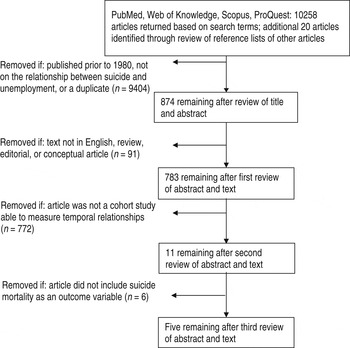
The process for excluding articles can be seen in Fig. 1. After reviewing titles and abstracts, articles were excluded if they did not fulfil the criteria described above. Over 9000 of the excluded studies did not explicitly measure the association between unemployment and suicide, were duplicates or were published prior to 1980. A large number of articles (n = 772) were excluded as they did not measure the temporal relationships between the variables of interest. The final number of studies reviewed for this paper can be seen in online Supplementary Table S1. The majority of these studies were based in Denmark or Sweden from the year 2000 onwards. One study was based in Australia (Morrell et al. Reference Morrell, Taylor, Quine, Kerr and Western1999). Only two studies (Qin et al. Reference Qin, Agerbo, Westergard-Nielsen, Eriksson and Mortensen2000; Lundin et al. Reference Lundin, Lundberg, Allebeck and Hemmingsson2012) assessed male and female cases separately.
Article inclusion and exclusion process.

Study quality
The quality of studies was assessed before inclusion in the meta-analysis based on published recommendations (Sanderson et al. Reference Sanderson, Tatt and Higgins2007). All studies considered used retrospective cohort designs and reported on suicide, unemployment and mental health conditions over time (online Supplementary Table S1). Mental health was assumed to be a confounder, rather than a mediator, of the relationship between unemployment and suicide in all included studies. Retrospective cohort designs capturing data at the population level were deemed to be the highest-quality studies available as these are able to assess temporal relationships between key variables (unlike cross-sectional case–control studies).
Measurement of mental health, unemployment and the characteristics of studies
Most of the studies examined the extent to which individuals were exposed to unemployment (e.g. the amount of time spent unemployed). There were some differences in the indicators used to measure mental health. The majority of studies ascertained information on psychiatric disorders from national hospital databases, which provided historical information on admissions for psychiatric disorders (Mortensen et al. Reference Mortensen, Agerbo, Erikson, Qin and Westergaard-Nielsen2000; Qin et al. Reference Qin, Agerbo, Westergard-Nielsen, Eriksson and Mortensen2000; Agerbo, Reference Agerbo2005; Lundin et al. Reference Lundin, Lundberg, Hallsten, Ottosson and Hemmingsson2010). This is likely to provide information on severe cases requiring medical attention. Lundin et al. (Reference Lundin, Lundberg, Allebeck and Hemmingsson2012) studied the effect of sickness absence from work (through the sickness absence compensation available to all employees earning above US$929.10 annually). This approach would provide a more generalized understanding of possible confounding health influences, as it would include mild mental health conditions as well as more severe illnesses. Even though the study by Lundin et al. (Reference Lundin, Lundberg, Allebeck and Hemmingsson2012) was not specifically related to mental disorder, we decided to retain it in the meta-analysis because sickness absence from work could be driven by either mental and physical illness and previous research by the authors (using the same dataset) found that that sickness absence is highly correlated with psychiatric disorder (Lundin et al. Reference Lundin, Lundberg, Hallsten, Ottosson and Hemmingsson2010). Morrell et al. (Reference Morrell, Taylor, Quine, Kerr and Western1999) also conducted a cohort study of unemployment and employed youth that controlled for mental health by using reported interview scores from the General Health Questionnaire. This paper was later excluded because of its small sample size (which affected the size of the CIs) and because information on mental health was self-reported rather than being drawn from objective accounts such as hospital or sickness absence records at the national level.
Influence of unemployment on suicide after controlling for pre-existing mental disorder or sickness absence
The meta-analysis was conducted on a subset of cohort studies able to provide relatively comparable measures of unemployment, mental health conditions and suicide over time (Mortensen et al. Reference Mortensen, Agerbo, Erikson, Qin and Westergaard-Nielsen2000; Qin et al. Reference Qin, Agerbo, Westergard-Nielsen, Eriksson and Mortensen2000; Agerbo, Reference Agerbo2005; Lundin et al. Reference Lundin, Lundberg, Hallsten, Ottosson and Hemmingsson2010, Reference Lundin, Lundberg, Allebeck and Hemmingsson2012) (online Supplementary Table S1).
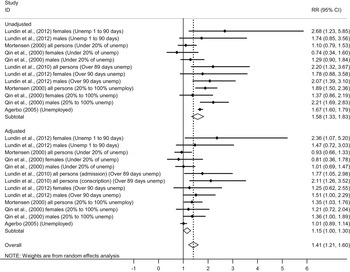
In the overall analysis, the effect of unemployment was associated with a 1.41 relative risk (RR) of suicide (95% CI 1.21–1.60). The results in Fig. 2 show the subgroup estimates for the 12 observations (from five studies) in the unadjusted (without mental disorder) analyses, and the subgroup estimates for the 13 observations (also from five studies) in the adjusted analyses.
Forest plot of suicide risk following unemployment (unemp), before and after adjusting for mental disorder; results of meta-analysis. Reference is the employed population. RR, Relative risk; CI, confidence interval.

As can be seen in the random-effects subgroup meta-analyses before and after adjustment, unemployment (compared with employment) was associated with a significantly higher RR of suicide before adjustment (RR 1.58, 95% CI 1.33–1.83). After controlling for prior mental health problems, the RR of suicide following unemployment was reduced but remained statistically significant (RR 1.15, 95% CI 1.00–1.30).
Results also indicated that greater exposure to unemployment was associated with higher RR of suicide than lesser exposure to unemployment. Greater exposure to unemployment was measured as being over 90 days of unemployment (Lundin et al. Reference Lundin, Lundberg, Hallsten, Ottosson and Hemmingsson2010), or over 20% of time unemployed (Mortensen et al. Reference Mortensen, Agerbo, Erikson, Qin and Westergaard-Nielsen2000; Qin et al. Reference Qin, Agerbo, Westergard-Nielsen, Eriksson and Mortensen2000). Shorter duration of unemployment was measured as between 1 and 89 days (Lundin et al. Reference Lundin, Lundberg, Hallsten, Ottosson and Hemmingsson2010), or under 20% of time unemployed (Mortensen et al. Reference Mortensen, Agerbo, Erikson, Qin and Westergaard-Nielsen2000; Qin et al. Reference Qin, Agerbo, Westergard-Nielsen, Eriksson and Mortensen2000). This was particularly pronounced for males.
The overall pooled RR was 1.51 (95% CI 1.19–1.83) for males and 1.15 (95% CI 0.85–1.45) for females. Results also differed depending on the health variables controlled for in analyses. For example, Lundin et al. (Reference Lundin, Lundberg, Hallsten, Ottosson and Hemmingsson2010) assessed the relationship between unemployment and suicide after controlling for psychiatric disorders noted at an army conscription interview in 1969, or psychiatric diagnosis given at time of hospitalization between 1973 and 1991. The respective odds ratios were 2.11 (95% CI 1.26–3.52) and 1.77 (95% CI 1.05–2.98). It is likely that the higher odds ratio for conscription interview is because data were obtained through self-report methods and may be more sensitive to detecting mild conditions, while hospitalization is likely to reflect more severe conditions requiring medical attention. Also, the interviews covered up to 98% of the population, while only a small proportion (3% of those who were employed and between 5.1% and 7.7% of those who were unemployed) of suicide cases had been admitted for a psychiatric disorder.
Sensitivity analyses
Meta-regression revealed no significant differences between the types of mental health variables (admission for psychiatric disorders, psychiatric disorders given at an army conscription interview, sickness absence, hospitalization for psychiatric disorders, drug abuse) used to adjust for mental disorders (p = 0.7212). Assessment of publication bias and small-study effects indicated that the majority of studies fell within the pseudo 95% CIs (online Supplementary Fig. S1). Small-study effects were apparent in the Eggers et al. (1997) test (Harbord et al. Reference Harbord, Harris and Sterne2009). The estimated coefficient was 0.93 (s.e. = 0.43, p = 0.045). The most obvious source of bias may be the disparate results seen in Lundin et al. (Reference Lundin, Lundberg, Allebeck and Hemmingsson2012). This result could also be influenced by the small number of studies included in the meta-analysis. A further sensitivity test was undertaken to assess the effects of excluding Lundin et al. (Reference Lundin, Lundberg, Allebeck and Hemmingsson2012) from the study. The overall pooled RR of unemployment on suicide dropped to 1.40 (95% CI 1.13–1.57) after this study was excluded. The RR remained significant before mental health variables were considered (RR 1.52, 95% CI 1.23–1.81), but reduced to just below significance after adjustment (RR 1.12, 95% CI 0.96–1.29).
Discussion
This study assessed the extent to which adjusting for prior mental health status affected the magnitude of the RR reported in studies of unemployment and suicide. Below we will discuss the main findings of the review and potential causal assumptions about mental health as a confounder, mediator or effect modifier of the relationship between unemployment and suicide.
Results of a random-effects meta-analyses demonstrated that the relationship between unemployment and suicide was attenuated after adjustment. Prior mental health made a significant contribution to the unemployment–suicide relationship as the RR due to unemployment declined by over 30% after these variables were considered. The review also suggests a dose–response relationship between exposure to unemployment and suicide risk. Increased exposure to unemployment has been identified as a risk factor in two other recent studies (Milner et al. Reference Milner, Page and Lamontagne2012, Reference Milner, Page and Lamontagne2013b ). The greatest risk of suicide is most likely to occur in the first 5 years following job loss (Milner et al. Reference Milner, Page and Lamontagne2013b ), possibly reflecting a longer-term ‘survivor bias’ where those most vulnerable to suicide die in the first 5 years following unemployment (Roelfs et al. Reference Roelfs, Shor, Davidson and Schwartz2011). Consistent with previous research, unemployment appears to be associated with greater suicide risk for males than females (Qin et al. Reference Qin, Agerbo, Westergard-Nielsen, Eriksson and Mortensen2000, Reference Qin, Agerbo and Mortensen2003; Blakely et al. Reference Blakely, Collings and Atkinson2003; Milner et al. Reference Milner, Hjelmeland, Arensman and De Leo2013a ).
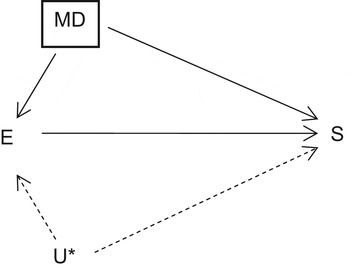
The reviewed cohort studies all assumed that mental health problems were common prior causes of unemployment and suicide (Fig. 3) and adjusted for these as confounding variables. This suggests that prior health increases the likelihood of later unemployment. The selection of healthy and unhealthy people into and out of the workforce, i.e. ‘healthy worker effect’ is also cited in studies showing that those with a history of mental health problems are often unemployed (Weich & Lewis, Reference Weich and Lewis1998; Brown et al. Reference Brown, Demou, Tristram, Gilmour, Sanati and Macdonald2012; Butterworth et al. Reference Butterworth, Leach, Pirkis and Kelaher2012). There is also evidence that people with impaired mental health are likely to lose their jobs or experience future unemployment (Paul & Moser, Reference Paul and Moser2009; Butterworth et al. Reference Butterworth, Leach, Pirkis and Kelaher2012), and that mental health issues are major risk factors for suicide (Bertolote et al. Reference Bertolote, Fleischmann, De Leo and Wasserman2004). This evidence supports the premise that mental disorder can act as a confounder of the relationship between unemployment and suicide. In other words, unemployment may act as one additional factor that increases the vulnerability to suicide in those persons with pre-existing mental health problems.
Mental disorder (MD) as a common cause (confounder) of employment status (E) and suicide (S), with effect measure modification by an unknown unmeasured confounder/s (U*). Adjustment is indicated by the square.

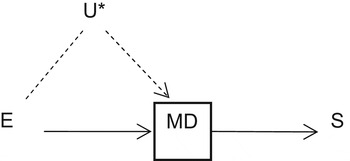
Mental health problems may also be intermediary variables on the causal pathway from unemployment to suicide, reflecting the ‘social causation hypothesis’, which argues that unemployment creates heightened vulnerability for later mental illness and suicide (Hudson, Reference Hudson2005) (Fig. 4). As we noted in the Introduction, there is considerable evidence that mental health worsens after the loss of a job (Paul & Moser, Reference Paul and Moser2009), which indicates that unemployment precedes both a decline in mental health and suicide. However, while conceptually plausible, adjustment for mental disorder as a mediator to assess the degree of attenuation of the association between unemployment and suicide (Baron & Kenny, Reference Baron and Kenny1986) is problematic as it induces selection bias by conditioning on a common effect (Kaufman et al. Reference Kaufman, Maclehose and Kaufman2004). This is referred to as collider stratification bias (Greenland, Reference Greenland2003) where adjustment leads to biased estimates between the exposure and the outcome, due to the induced marginal association between unmeasured confounders and the exposure. This bias is particularly likely to make an impact on studies that do not include a measurement of the temporality of mental health issues and may be more likely to underestimate the effect of unemployment by assuming that mental illness occurred before (rather than after) job loss.
Mental disorder (MD) as an intermediary of employment status (E) and suicide (S). U*, Unmeasured confounders. Adjustment is indicated by the square.

Alternatively, mental disorder may be an effect modifier of the association between unemployment and suicide. A nested cohort study in Demark by Agerbo (Reference Agerbo2005) provides some empirical evidence for this situation. Results of a stratified analysis found that cases admitted for a psychiatric disorder who were unemployed had lower odds of suicide than those who were employed. In comparison, unemployment was associated with increased odds of suicide in the non-clinical general population. This study suggests that the negative influence of unemployment on suicide was most apparent in the general population, but had an inverse relationship among those with a history of mental disorder. Explanations for why unemployment was protective against suicide among people recently admitted (in the year before death) for a psychiatric disorder focused on stigma associated with diagnosis and the potential fear of job loss in the employed population.
The generalizability of the present review was limited by the inclusion of a small number of studies in relatively high-income and well-resourced countries in Europe. Study findings may therefore not extrapolate to poorer areas of the world with different cultural contexts. It is also worth noting that one of the reviewed studies (Lundin et al. Reference Lundin, Lundberg, Allebeck and Hemmingsson2012) had different findings from the other five studies included in the review. It was retained in analysis but it is acknowledged that the disparate results may bias the results away from the null. The design of all the reviewed cohort studies relied on exposure and outcome data collected from existing and routine hospital, health and mortality records. A problem with these types of retrospective cohort studies is that measurements of exposures and confounders can be quite crude and subject to possible misreporting. However, this bias is likely to be non-differential, with an equal likelihood of affecting both cases and controls. In spite of these limitations, the reviewed papers were based on national routinely collected health and mortality datasets and were the highest-quality studies available.
Consideration of the ways in which unemployment and mental disorder may be associated with suicide (as exposures, confounders, intermediaries, or effect modifiers) is important, as this will guide the appropriate analytic strategies required for unbiased (or least biased) estimates. A possible scenario could be a circumstance where a person who has co-morbid depression and alcohol abuse (caused at least in part by the depression) becomes unemployed, and as a result develops an anxiety disorder (unrelated to depression, but related to the reduced income associated with job loss) and starts drinking more heavily. To account for such a situation, the unbiased effect of unemployment (assuming no measurement error) associated with suicide would be the additive difference in risk associated with being unemployed compared with those employed in those with (compared with those without) alcohol abuse; that is, the interaction or joint effect of unemployment, adjusting for prior depression but not adjusting for anxiety.
The fact that these more complex scenarios are not present in the literature may reflect a lack of available data, as many cohort studies have to rely on officially reported information from health and employment registers. A more comprehensive understanding of the pathways by which unemployment influences suicide would require measurement of mental (and physical) illness at multiple points, including across the trajectory of working life, and before and after job loss. The use of causal graphs articulating possible exposure, confounding, intermediary and modifying factors can assist in the conceptualization of study design, measurement, and analytic strategy in studies of the relationship between unemployment, mental illness and suicide (Shrier & Platt, Reference Shrier and Platt2008), clearly underscoring the importance of precise measurement of the temporal associations between exposures and outcomes.
In conclusion, our selected review of cohort studies indicates that unemployment is associated with greater risk of suicide after adjusting for prior mental disorder. We found that greater time spent unemployed was associated with greater risk of suicide. While the generalizability of this review is limited by the small number of studies, findings can be helpful at a policy level and support the idea that the period following job loss should be prioritized for prevention as a particularly high-risk time for suicide (Milner et al. Reference Milner, Page and Lamontagne2012, Reference Milner, Page and Lamontagne2013b ). Future studies need to better conceptualize and measure the complex effects of job loss on suicide risk with attention to duration of unemployment and employment, assessment of mental health and illness before and after job loss, and interaction with life events such as relationship breakdown. These studies should also aim to combine information on individual risks with economic contextual influences at the macro-level. This is important because, as reported in past ecological studies, the relationship between unemployment and suicide at the individual level may be sensitive to overall labour market conditions (Corcoran & Arensman, Reference Corcoran and Arensman2011; Milner et al. Reference Milner, Page and Lamontagne2012). A multi-level approach will allow interpretation at multiple levels of analysis, without committing the ‘ecological fallacy‘(Diez-Roux, Reference Diez-Roux1998). Another important factor would be to assess whether mental health problems were a continuing problem or whether there was a recovery after treatment. This would aid in understanding the contribution of mental health to unemployment and eventual suicide. At the time of writing the present paper, none of the studies included in our meta-analysis displayed the data to support such an analysis. Such studies will be required in the future if researchers are to understand and articulate the complex relationships between unemployment, mental health and suicidality.
Supplementary material
For supplementary material accompanying this paper visit http://dx.doi.org/10.1017/S0033291713001621.
Acknowledgements
This work was supported by a National Health and Medical Research Council Capacity Building Grant in Population Health (grant no.546 248) and McCaughey Centre funding from Victorian Health Promotion Foundation.
Declaration of Interest
None.