Of all the types of music ravaged by modern technologies, few have suffered more than epic song. First sound recordings, then radio and television and now the internet have slowly but surely elbowed this ancient performance practice out of human routine, with a flurry of studies in the last century or so attesting to its demise.Footnote 1 If the modern epic is undergoing gradual extinction despite recent attentions lavished on it, worse has been inflicted on the study of its medieval counterpart. The medieval epic song, rarely mentioned in music histories, is promptly dismissed for lack of surviving notated evidence: all that can be said is that it was sung to ‘simple and adaptable musical material’.Footnote 2 Yet the Germanic epic song was a major musical tradition in the Middle Ages. I take ‘epic song’ to mean any sung or recited narration of heroic events, rather than the narrower sense of a poem in dactylic hexameter, such as Homer's Iliad. This broader definition of epic song not only follows the sense usually found in medieval music historiography,Footnote 3 but also links the ancient and medieval traditions to modern epics, a link now famous thanks to the seminal work of Leo Treitler.Footnote 4
The literary witnesses presented in this article's Appendix testify to the musical fame of Germanic epic song in late Antiquity and the early Middle Ages. Writers distinguish between the solo epic and other war songs such as the choral cry, called barditus by Tacitus (passage 2) and barritus by Ammianus and Vegetius (passages 6 and 7), or the ululatus of Batavian women cheering on their warriors (passage 3). The Germanic solo epic must have been a sophisticated musical tradition – or, more accurately, several traditions – with elaborate systems of modes, techniques of melodic construction and embellishments. Such were surely the songs of the Gauls ‘in praise of the valiant deeds of their ancestors’ first mentioned by Diodorus of Sicily around 50 bc (passage 1). The Greek word έπος and its Latin cognate epos favoured by modern writers, as in the expression ‘epic song’, was not the word that late Antique and early medieval writers used to refer to this music. Diodorus calls the solo epic of the Celts of Gaul a hymnos (ὕμνον, here in the accusative case), and uses related words such as ἐξυμνοῦσι and ὑμνοῦσιν. Subsequent Greek writers tend towards less explicitly religious terms: Priscus of Panium refers to two barbarians’ recitation as a ‘song’, asma (here in the plural ᾄσματα, passage 11); Procopius calls the Gothic harpist's song an ode (ᾠδή, passage 14). Latin writers, however, who comprise the majority of the eighteen witnesses in the Appendix, usually call the Germanic epic song carmina, beginning with Tacitus (passage 2). This matches Diodorus's religiously loaded hymnos; for carmina, meaning both song and charm, was frequently used in ancient Roman religion (e.g., Horace's famous ‘centennial’ hymn the carmen sæculare).Footnote 5 Indeed, one of the contexts for the Germanic epic was the mourning of the dead, songs that Procopius calls laments, threnoi (θρῆνοι, passage 14). Most writers agree that epic songs dealt primarily with the deeds of deceased ancient heroes, both human and divine (see especially passages 2, 4 and 13a).
If Tacitus in the first century ce was already calling the epic songs of the Germans ‘ancient songs’ (carmina antiqua, passage 2), then this tradition must have been well established some time before our earliest witness, Diodorus of Sicily in the first century bc. So the Germanic epic was likely a thousand years old or more when Charlemagne decided to codify what Einhard calls barbara et antiquissima carmina, ‘most ancient barbarian songs’ (passage 17). Charlemagne's collection is unfortunately lost. In fact, despite its fame, no notated example of Germanic epic from the Carolingian period or earlier survives, unlike for the chants of the Roman liturgy. Still, if Charlemagne and the Carolingians actively codified both Gregorian chant and, albeit to a lesser degree, Frankish epic song, did there exist some aural correspondence between these two major musical repertoires? One question is closely related to this one: if Frankish singers adopted Roman chant during the Carolingian era, to what extent did a distinctive Frankish sound enter into their Frankish-Roman hybrid chant? This issue repeatedly comes up through Christopher Page's recent engaging history of the cantor under Gothic rule – from the earliest Gothic liturgies in the fourth century, through events in Vandal Africa in the fifth and the Merovingian mainland in the sixth, to the watershed training of Frankish singers by Roman ones under Carolingian kings Pippin and Charlemagne.Footnote 6 Although it would be naïve to conflate the Frankish cantor with the singer of epics, since each one was trained differently and performed in contrasting milieus, yet considering the prominence of both in ancient Gothic tradition and in Carolingian society, these two vocal traditions must have blended at times. For lack of surviving evidence, however, nothing can be said about the relation between these two musical behemoths of the Middle Ages – Frankish-Roman chant and Germanic epic.
As the passages given in the Appendix make clear, a high point in Germanic epic was the sixth century. Cassiodorus mentions it (passage 12), as do Jordanes (13) and Fortunatus (15). One sixth-century writer not listed in the Appendix is the author of the most famous musical treatise in the Middle Ages – Boethius. While he had little concern for any other music than the learned Greek and Roman traditions that make up the bulk of De instutione musica, Boethius at one point lets slip what appears to be a humorous aside to Germanic song. In speaking of the universal powers of musical modes (1. 1), he writes that ‘even now, those who are rude delight in the modes of the Getae and those who are gentle in moderate ones, although there are hardly any of the latter nowadays’ (‘Nam quae asperiores sunt, Getarum durioribus delectantur modis, quae vero mansuetae, mediocribus; quanquam id hoc tempore paene nullum est’).Footnote 7 Apparently, so reputable was the music of the Germani in his day that even Boethius could not resist mentioning it in his work of Greco-Latin musical erudition.Footnote 8
From its beginnings in Antiquity to its apex in the early Middle Ages, Germanic epic song had become illustrious enough in Charlemagne's day to prompt the Carolingian emperor's epic collection in the early ninth century. From Charlemagne onwards, the once living performance tradition of Germanic epic seems to have morphed into a literary genre whose musical manifestation is the ‘jüngere Titurel’ melody that bears the unmistakable imprint of the late medieval French chanson, as described below. By this time, the beginning of the fourteenth century, the Germanic epic song was a far cry from Tacitus's carmina antiqua, those heroic sagas sung for centuries by Gothic bards.
The Germanic epic
Nearly all the information on the original Germanic bards comes to us from a time already removed by at least four centuries from their original performances, beginning in the period known as the barbarian invasions.Footnote 9 In the century or so leading up to the fall of Rome, various peoples slowly made their way from the Northeast into Western Europe.Footnote 10 Whether these peoples should all be lumped into a single ‘Germanic’ category has rightly been questioned by recent historians. ‘We know much less about the Germanic peoples than older scholarship would lead us to believe’, as Walter Pohl has written.Footnote 11 Unfortunately, surviving sources, nearly all written from the Roman or Greek perspective, describe Germanic peoples in an overly simplified way. Even a Latin Goth such as Jordanes (passage 13) or a Latin Frank such as Einhard (17) presents at best a hybrid, that is, Romanised, point of view.Footnote 12 In fact, the peoples discussed were often very different from one another, often small in number and changing over time, and occasionally even evanescent, as in the Avars who apparently came and went within the space of a generation.Footnote 13 Strictly speaking, ‘Germanic’ denotes those living in the area defined by the Rhine, Danube and Vistula rivers, an area spanning present-day Germany in the West to Poland in the East.Footnote 14 All of this aside, the word ‘Germanic’ is still used today in the broader sense of all the ‘barbaric’ peoples living in Western Europe between the fall of the Roman Empire and the Carolingians, the sense used in this article. The Germanic peoples represented in the Appendix range from the Vandals in Sicily and North Africa (passage 14a) to the Frisians in present-day Netherlands (passage 18).
To cultural outsiders, the solo epic song stood out as the most remarkable type of music made by Germanic peoples. Despite the subjectivity of these Greek and Roman witnesses, they allow us to get a general sense of how Germanic epic was performed. Originally, the epic singers of the Germani had something of a sacred function. In his definitive history of the Goths, Jordanes refers to epic singers as the priests of the Goths (sacerdotes Gothorum, 13c). Five centuries before Jordanes, Diodorus uses the Celtic term ‘bard’ (βάρδους), but also refers to epic singers as ‘singing poets’ (ποιηταὶ μελῶν, 1). The Greek βάρδους is carried over into Latin, bardi, four centuries later by Ammianus when referring to Gothic epic singers (passage 6a). This singing sacerdos or bardos was closely associated with his standard accompanying instrument, the harp. It is first called cithara by Jordanes (passage 13b–c); around the same time Procopius calls epic harp players kithariste (κιθαριστῇ, 14). Fortunatus, the first to use the Germanic word harpa, provides the now classic distinction between that instrument, the Roman lyre and the Briton crwth (passages 15–16). Only one writer, Sidonius, says anything about how the harp was played; ‘barbaricis plectris’ would suggest the use of a plectrum (9). Surprisingly, from the entire period under consideration here only one name survives of a singer of epic songs: the blind Bernlef (or Isbernlef) from a small village in Frisia (18).
Lest we be seduced by the reputation of the solo epic song, there was more to Germanic music than this one genre, as the reports cited in the Appendix also attest. We learn of the following musical genres related to war: solo songs performed during single combat (1), the choral battle barritus or barditus (2, 6b–e, 7), songs by groups of men and women exhorting warriors from the sidelines during battle (3), and even war trumpets (1). Related to these various types of war music are the choral lament (13e, 14b), the solo lament (14a) and the solo eulogy performed with harp (15). Several writers mention hymns sung with lyres (1 and 13c), and one even mentions the wedding songs and ring dances of the Franks (8). Of course, no survey of Germanic music would be complete without drinking songs (16) and general mealtime musical entertainment ranging from choral numbers to solo instrumental pieces (10, 12).
All these musical genres, including the hymn-like solo epic, were performed in a crude Germanic manner, at least according to their educated observers. The clearest and most famous illustration of this comes from passage 16, a relatively well-known excerpt from Fortunatus's preface to his poetic anthology.Footnote 15 A truly remarkable passage, this is the most vivid surviving medieval description of Germanic singers with harps (here as in passage 15 Fortunatus uses the word harpa/arpa). Although he does not mention a specific event, the circumstance most likely connected to this report was Fortunatus's pilgrimage in 566 to the tomb of Saint Martin of Tours in thanks for the saint having healed him of an eye disease. On his way, the poet crossed through territories then recently conquered by the barbarians, and was welcomed at their courts and gatherings. There – perhaps at the court of Sigebert I of Austrasia at Metz where he is known to have stayed for a whileFootnote 16 – he must have experienced first-hand the potency of Germanic song so colourfully related in this passage.Footnote 17 Fortunatus begins by complaining about the perils of his journey into the wild west of barbarian Gaul. He then depicts himself as shown up by the musical performances of his Germanic hosts. Behind the invectives (‘hiss of a gander’, ‘lazy people unproductive and drunk’), one can detect a kind of fascination with ‘the noisy barbarians playing their Germanic songs over and over on their harps’. In an intentionally self-mocking turn, Fortunatus compares himself to a mouse scratching out poetry. The stream of hyperbolic similes in this passage has led some to claim that Fortunatus is here creating a fictitious scenario.Footnote 18 Rather, it would seem that, like Sidonius Apollinaris (passage 9), Fortunatus simply exaggerates the crudeness of Germanic song in order to bring out the learnedness of his own ‘songs’. We could hardly ask for a more vivid contrast between Roman literary versiculos and the performance-based Germanic leudos, Fortunatus's own descriptors of these two traditions in passage 15.
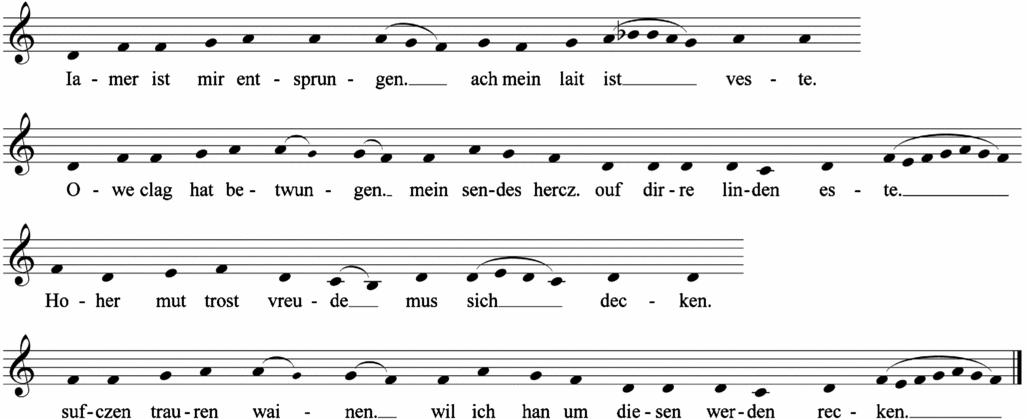
The ninth century marks the decline of the living performance tradition of the Germanic carmina antiqua. It was in the course of the ninth century that the Carolingians set down in writing some of these epic songs that they considered a major part of their Frankish heritage. The Carolingians are responsible for the earliest written redactions of epic: the Old High German Hildebrandslied (unfortunately without music) and the epic-related Evangelienbuch (see Figure 1 and discussion below). Already in these written descendants of the old epic singing tradition the signs of literary decadence are apparent. As Alois Wolf has shown, the famous Hildebrandslied is the distinctive product of Carolingian literary culture, written up in a literary hybrid dialect (‘künstlichen Mischsprache’), ‘a highly artificial koine combining Low German and Upper German linguistic features’; this, along with its striking use of legal vocabulary, makes the Hildebrandslied a distinctively Carolingian literary product, Wolf concludes (‘Kunstprodukt der Karolingerzeit’).Footnote 19 Thus much separates the literary Carolingian masterpiece that is the Hildebrandslied from the ‘ancient songs’ (carmina antiqua) of the Germans mentioned by Tacitus some seven centuries earlier. Following the Carolingians, literary versions of the solo epic such as the Middle High German Nibelungenlied moved further and further away from their orally transmitted ancestors. Written up around the same time as the earliest manuscripts of the Nibelungenlied is the ‘jüngere Titurel’ melody from around 1300, the only legibly notated Germanic epic-related poem. It has a strophic bar form typical of French lyric song of this same time period, AA'BC (see Ex. 1).Footnote 20
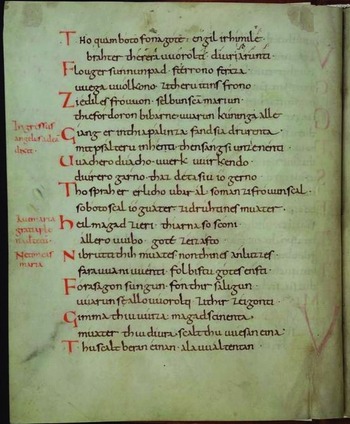
Otfrid, Evangelienbuch, manuscript P (Heidelberg, Universitätsbibliothek, Pal. lat. 52), fol. 17v. Reproduced with the kind permission of the Universitätsbibliothek Heidelberg.

Opening of the fourteenth-century ‘jüngere Titurel’ melody.

The only other relevant specimen, musically speaking, is the late ninth-century Evangelienbuch, an Old High German Gospel paraphrase originally written down around 870 by a Frankish monk named Otfrid von Weißenburg. Like the Hildebrandslied, the Evangelienbuch is a typically Carolingian fusion of Frankish elements and biblical histories.Footnote 21 In the Evangelienbuch, Otfrid explains that he wrote his German gospel paraphrase as an antidote to German secular songs (cantus obscenus), by which he likely means epic song: ‘the chant of this lesson should do away with the frivolity of worldly tunes (secularium vocum)’.Footnote 22 Otfrid intended for his Evangelienbuch to be declaimed somewhere between song and recitation, at one point calling the work a cantus.Footnote 23 Otfrid's concern for the correct declamation of the Frankish tongue shows up in two of the three manuscripts of the Evangelienbuch, manuscript P (Heidelberg, Universitätsbibliothek, Pal. lat. 52) and V (Vienna, Österreichische Nationalbibliothek, 2687), the latter edited by Otfrid himself.Footnote 24 Throughout these two books, we find marks, mostly strokes and dots, placed over certain syllables. These signs appear to be accentual in function rather than strictly musical: rhythmic accents and phonetic accents (‘Rhythmische Akzente’ and ‘Phonetische Akzente’), in the words of the recent editors of manuscript V.Footnote 25 On fol. 17v of manuscript P, however, we find what are clearly neumes, not only single notes but also two-note ligatures, both of the liquescent and non-liquescent type (Fig. 1).Footnote 26 Although earlier scholars have interpreted all of the signs found in manuscripts P and V as implying a musical, Gregorian type of recitation for all of Otfrid's Evangelienbuch, Michael Klaper has more recently argued that this interpretation is wrong, and that it confuses the isolated neumatic notation of fol. 17v with the other strictly rhythmic and phonetic accents all throughout P and V.Footnote 27 Regardless, the presence in a Frankish Gospel paraphrase of signs that very much resemble the punctum and virga of neumatic notation confirms that a strict dividing line between Germanic epic and Gregorian chant was not always maintained and that, as I mentioned earlier, connections of some sort between epic singers and Frankish cantors were likely common in ninth-century Francia, albeit undocumented.
The lost Frankish epic collection of Charlemagne
In the long history of the Germanic epic, Charlemagne's edition of Frankish epic songs – a book or collection of books unfortunately now lost, as already mentioned – constitutes a defining episode: the end of an ancient, thousand-year-old performance tradition and the beginning of a literary genre that would eventually culminate in the late medieval Nibelungenlied. Charlemagne's vanished collection must be understood in the broader context of the Carolingian bookmaking industry from the eighth to the tenth century. By producing a vast quantity of books from the mid-eighth century onwards, the Franks looked to position themselves and their own history as belonging to a literary movement going back to the Roman times. For their books, the Carolingians even devised a unique and highly legible script that modern paleographers have labelled ‘Caroline minuscule’.Footnote 28 In the pre-production phase of bookmaking, they also often used the so-called Tironian shorthand notes. Their voluminous catalogues of the notes, the Commentarii Notarum Tironianum, are the most important remnant of a tradition going back to the Roman Empire.Footnote 29
Carolingian writing produced a staggering range of books covering nearly every kind of literary genre. Best known to musicologists are the Franks’ contribution to liturgical literature, sources that range from collections of liturgical legislation to chant books that contain the earliest known notation in the West.Footnote 30 The ‘explosion of history writing’ (in Rosamond McKitterick's words) under the Carolingians included editions of Roman and early Christian histories, along with new, indigenous works such as the Frankish Annals or the lives of Charlemagne by Einhard the Frank and Notker the Stammerer.Footnote 31 Official and legal works included various collections of regional laws likely first drawn up by stenographers (cancellarii or notarii) trained in the Tironian shorthand system.Footnote 32 Florilegia or miscellaneous books usually contained shorter writings, often of a moralistic or edifying nature.Footnote 33 The Carolingians also revived epistolary genres such as the so-called Mirror of Princes, examples of which include Dhuoda's advice to her son from the early 840s and Sedulius Scottus's On Christian Rulers compiled around 855 for Lothair II.Footnote 34 Latin poetry flourished in the circles of the imperial court, including that of Charles the Bald; one of the better-known works is the anonymous lament written on the occasion of Charlemagne's death in 814.Footnote 35 The Carolingian obsession with Latin grammar resulted in copies of works by Roman authors such as Vergil or Terence along with pedagogical texts such as Donatus's Ars minor.Footnote 36 As for works in Old High German beyond those already mentioned, those that have survived are typically translations of biblical texts.Footnote 37
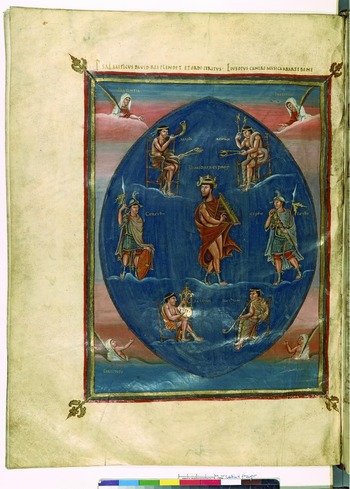
Although Charlemagne's collection of epic songs does not survive, another Carolingian book does that offers tantalising iconographic evidence for the Germanic solo epic. No depiction of an ancient Germanic epic performer with his harp has come down to us, but one outstanding related image has. It is found in the so-called Vivian Bible produced for Charles the Bald, grandson of Charlemagne and the Carolingian emperor from 840 to 877.Footnote 38 The paintings of the Vivian Bible, such as Figure 2, are typical of the Carolingian blend of disparate artistic traditions ranging from the Roman and Byzantine to the early Christian and Germanic.Footnote 39 The artist of our Bible's famous painting of King David has likely drawn on earlier models, creatively re-arranging them to suit his purpose (Fig. 2).Footnote 40 The painting frames a large mandorla centred on a dancing King David, flanked by two guards on the left and right. Above and below the king are his musicians, Asaph, Heman, Ethan and Jeduthun (so named in the painting) with their instruments. King David is here meant to represent the dedicatee Charles the Bald, bearing the emperor's physical features and wearing both the Frankish and the Byzantine garb favoured by Charles.Footnote 41 If the image of David was intended to represent the emperor of the Franks, then certainly for some, if not many, Carolingian readers, the harp held by David–Charles would have readily evoked the harping epic singer from the Germanic lore that mattered greatly to the Franks. Venantius Fortunatus, for example, pictures a performer who knows either the epics of Homer, the ‘holy teachings of David's harp’, or such instruments as ‘the lyre, flute, pipe or reed-pipe’.Footnote 42 While not an explicit depiction of an epic singer, the harping King David of the Vivian Bible acts as a perfect stand-in for his Germanic counterpart. So important is the harp in this depiction that the painter has echoed David's triangular cithara with an oblong and rounded crwth-type held by Ethan on David's lower left. Unfortunately, the painter appears to have mindlessly copied some exemplar or other without much performing experience, as neither harpist is very realistic.Footnote 43 David's harp has the tuning pegs located on the top of the sound chest rather than where the strings terminate, and the short strings are farthest away rather than closest to the player's ears. As for Ethan's fanciful crwth, it is a rather whimsical three-stringed lyre, with no tuning pegs visible on its candelabra-style frame. In short, although presenting some interesting connections to the Frankish epic, this painting does not portray an epic song's performance.
King David playing the harp in the First Bible of Charles the Bald (c.845) (Paris, Bibliothèque nationale de France, f. lat. 1, fol. 215v). Reproduced with the kind permission of the Bibliothèque nationale de France.

As with the Vivian Bible's illustration of David the harping singer, Charlemagne's lost anthology of ‘barbaric and most ancient songs’ (barbara et antiquissima carmina) praising ‘the deeds and wars of the ancient kings’ (veterum regum actus et bella) cited in Appendix passage 17 raises more questions than answers. That a high-grade Carolingian book such as Charlemagne's collection of Germanic epic songs – or Hadrian's Gregorian Antiphonary well known to musicologists, for that matter – has disappeared is no surprise.Footnote 44 The over seven thousand extant Carolingian manuscripts surviving from the ninth century are still only a portion of the total number produced. For example, only a dozen antiphonaries from the eighth and ninth centuries have survived, yet at Reichenau alone, ten antiphoners are recorded for the year 821.Footnote 45 The work relating the existence of the book that Andreas Heusler called ‘Charlemagne's compilation (Sammlung) of heroic songs’ is from Einhard the Frank's Life of Charlemagne or Vita Karoli.Footnote 46 Einhard wrote the Vita sometime in the 820s, shortly after Charlemagne died. The passage in question is preceded by Einhard's description of Charlemagne's dining habits. ‘At mealtime’, Einhard writes, Charlemagne ‘would listen to some musical entertainment (acroama) or reading; histories and the deeds of the ancients were read to him’ (‘Inter cenandum aut aliquod acroama aut lectorem audiebat. Legebantur ei historiae et antiquorum res gestae’).Footnote 47
We find Einhard's mention of Charlemagne's collection of Germanic epic songs a little after this passage, almost at the very end of the Vita Karoli. Having expanded on Charlemagne's love of Roman chant and liturgy, Einhard allows himself in conclusion an outstanding statement about the emperor's love of Germanic secular song, all the more remarkable for its not being mentioned by any other author. Einhard briefly reviews Charlemagne's codification of Frankish laws, and then states that he wrote down ‘the barbaric and most ancient songs’ (barbara et antiquissima carmina) that sang the wars of ancient kings (passage 17). In one sense, Einhard is here merely fleshing out Charlemagne's Frankishness mentioned earlier in the Vita: his dress, his fluency in his mother tongue and his insistence on his children knowing the Frankish customs of horseback riding, hunting and weaponry. Almost without a doubt, the barbara et antiquissima carmina copied down by Charlemagne were Frankish ones. A few sentences before, Einhard mentions his codification of Frankish laws (Franci leges) and, a few sentences after, Charlemagne's institution of month and wind names in the language of the Franks (apud Francos).Footnote 48 More than likely, the epic song collection was not a mid-grade booklet or even loose parchment leaves, but a large, well-bound codex, and probably one of high quality with a fine script and generous layout similar to the Vivian Bible, given the importance of the contents to the emperor himself. The subsequent loss of this imposing collection, some have suggested, may have been due to Charlemagne's son and successor, Louis the Pious. Raised mostly away from his father's court in Aquitaine, Louis preferred learned Latinity to his father's Frankish heritage. Louis had ordered that the vernacular songs (poetica carmina gentilia) forced upon him in his youth ‘should not be read, heard nor taught’, and so perhaps he had Charlemagne's epic song collection destroyed.Footnote 49
Like Charlemagne's prestigious collection, the song of the Germanic epic may be mostly lost, but its importance in the history of early music should not be underrated. Neither should its possible impact on plainchant within this history. As I suggested at the beginning of this article, epic song, one of the oldest known singing traditions in the world, is one of the human musical activities that has most suffered from the plague of modern industry. Written epics go back to the epic of Gilgamesh from the third millennium before the birth of Christ, which was orally transmitted before eventually becoming a piece of Sumerian and Akkadian literature written out on cuneiform tablets.Footnote 50 Epic song is cursed by its dismissal from daily human activity, on the one hand, and, insofar as the music of the Middle Ages is concerned, from the written record on the other.
It is important to recognise that the main reason for the neglect of epic song in medieval music historiography lies in the latter's incessant preoccupation with notated repertoires, with named rather than anonymous composers, and with music resembling the polyphonic art compositions near and dear to historians who first shaped the narrative of medieval music. This preoccupation is clear from the most basic arc of medieval music history as it is still understood today. The story begins with the literary monuments of written chant, ascends to written polyphonies based on the texts of chant, soars on to the heights of graphic extravagance of the Artes nova et subtilior, and ends by landing safely onto the codified masterworks of great composers such as Guillaume de Machaut. This arc of musical progress from the primitive and oral to the complex and literary, bought and sold for consumption in the ever-growing industry of academia, is the perfect mirror of the Western ‘path of rationalization’ that Max Weber once related in his history of capitalism.Footnote 51 In such a history, the written trend in music wins at the expense of un-inscribed music. The latter is considered lost since no trace remains of it. This being the case, the literary witnesses to German song presented below do have a few things to teach us. At the very least, they can help us recover a major scene in the musical panorama of the Middle Ages. What is more, as I briefly implied at the beginning of this article, medieval music history's favoured daughter Gregorian chant may also have something to gain from a little more attention being paid to her prodigal epic sibling.
Appendix: literary witnesses to Germanic song, 50 bc–850 ad Footnote 52
1. Diodorus of Sicily, Library of History, book 5 (c.50 bc )
ὅταν δέ τις ὑπακούσῃ πρὸς τὴν μάχην, τάς τε τῶν προγόνων ἀνδραγαθίας ἐξυμνοῦσι καὶ τάς ἑαυτῶν ἀρετὰς προϕέρονται, καὶ τὸν ἀντιταττόμενον ἐξονειδίζουσι καὶ ταπεινοῦσι καὶ τὸ σύνολον τὸ θάρσος τῆς ψυχῆς τοῖς λόγοις προαϕαιροῦνται. τῶν δὲ πεσόντων πολεμίων τὰς κεϕαλὰς ἀϕαιροῦντες περιάπτουσι τοῖς αὐχέσι τῶν ἳππων. τὰ δὲ σκῦλα τοῖς θεράπουσι παραδόντες ᾑμαγμένα λαϕυραγωγοῦσιν, ἐπιπαιανίζοντες καὶ ᾄδοντες ὕμνον ἐπινίκιον σάλπιγγας δ’ ἕχουσιν ἰδιοϕυεῖς καὶ βαρβαρικάς· ἐμϕυσῶσι γὰρ ταύταις καὶ προβάλλουσιν ἦχον τραχὺν καὶ πολεμικῆς ταραχῆς οἰκεῖον αὐτοὶ δ’ εἰσὶ τὴν πρόσοψιν καταπληκτικοὶ καὶ ταῖς ϕωναῖς βαρυηχεῖς καὶ παντελῶς τραχύϕωνοι εἰσὶ δὲ παρ’ αὐτοῖς καὶ ποιηταὶ μελῶν, οὓς Βάρδους ὀνομάζουσιν. οὗτοι δὲ μετ’ ὀργάνων ταῖς λύραις ὁμοίων ἄδοντες οὓς μὲν ὑμνοῦσιν, οὓς δὲ βλασϕημοῦσι.
Diodorus of Sicily, The Library of History, 3 vols. (Cambridge, MA, 1939), 3:172–8
And when any man accepts the challenge to battle, they then break forth into a song in praise of the valiant deeds of their ancestors and in boast of their own high achievements, reviling all the while and belittling their opponent, and trying, in a word, by such talk to strip him of his bold spirit before the combat. When their enemies fall they cut off their heads and fasten them about the necks of their horses; and turning over to their attendants the arms of their opponents, all covered with blood, they carry them off as booty, singing a paean over them and striking up a song of victory. Their trumpets are of peculiar nature and such as barbarians use; for when they are blown upon they give forth a harsh sound, appropriate to the tumult of war. The Gauls are terrifying in aspect and their voices are deep and altogether harsh. Among them are also to be found lyric poets whom they call Bards. These men sing to the accompaniment of instruments which are like lyres, and their songs may be either of praise or of obloquy.
Diodorus, trans. C.H. Oldfather, Library, 3: 173–5
2. Tacitus, Germania 2. 2, 3. 1 (c.98)
Celebrant carminibus antiquis, quod unum apud illos memoriae et annalium genus est, Tuistonem deum terra editum Fuisse apud eos et Herculem memorant, primumque omnium virorum fortium ituri in proelia canunt. Sunt illis haec quoque carmina, quorum relatu, quem barditum vocant, accendunt animos, futuraeque pugnae fortunam ipso cantu augurantur; terrent enim trepidantve, prout sonuit acies, nec tam voces illae quam virtutis concentus videntur. Affectatur praecipue asperitas soni et fractum murmur, obiectis ad os scutis, quo plenior et gravior vox repercussu intumescat.
Cornelius Tacitus, De origine et situ Germanorum liber, ed. Alf Önnerfors (Stuttgart, 1983), 2, lines 18–20, and 3, lines 6–14
In their ancient songs, which are their one and only kind of record or historical work, they celebrate the god Tuisto who was born on earth They remember Hercules as having lived among them, and sing of him as the greatest of all the mighty warriors who went into battle. They also have songs, by the performance of which – called barditus – they inflame their spirits, and by the singing of which they predict the outcome of a future battle. They can either frighten or be frightened by it, depending on the loudness of its sound, for they consider it less their own voices than a symphony of strength. They aim mostly for a harshness of sound and a subdued roar, holding the shield over the mouth so that bouncing off it their voice can swell louder and deeper.
3. Tacitus, Histories 4. 18. 2–3 (c.106)
Civilis captarum cohortium signis circumdatus, ut suo militi recens gloria ante oculos et hostes memoria cladis terrerentur, matrem suam sororesque, simul omnium coniuges parvosque liberos consistere a tergo iubet, hortamenta victoriae vel pulsis pudorem. Ut virorum cantu, feminarum ululatu sonuit acies, nequaquam par a legionibus cohortibusque redditur clamor.
Cornelius Tacitus, Historiarum libri, ed. Erich Koestermann (Leipzig, 1969), 173, par. 18, lines 14–21
Civilis ordered his own mother and sisters, together with the wives and free children of all his men, to stand in the rear and to encourage victory or shame defeat. The song of the men and the ululation of the women resounded so loudly that the shout returned by our legions and cohorts could in no way equal it.
4. Tacitus, Annals 2. 88. 3 (c.120)
Arminius septem et triginta annos uitae, duodecim potentiae expleuit, caniturque adhuc barbaras apud gentes, Graecorum annalibus ignotus, qui sua tantum mirantur, Romanis haud perinde celebris, dum vetera extollimus recentium incuriosi.
Cornelius Tacitus, The Annals of Tacitus, Books 1–6, ed. F.R.D. Goodyear, 2 vols. (Cambridge, 1981), 2: 60, lines 5 and 11–15
Arminius had thirty-seven years of life and twelve years of power, and he is still sung among the barbarian people; he is unknown in the annals of the Greeks who have such admiration for their history, and barely known to us Romans who praise antiquity without concern for recent times.
5. Julian the Apostate, Misopogon, 337c (c.362)
ἐθεασάμην τοι καὶ τοὺς ὑπὲρ τὸν ‘Ρῆνον βαρβάρους ἄγρια μέλη λέξει πεποιημένα παραπλησίᾳ τοῖς κρωγμοῖς τῶν τραχὺ βοώντων ὀρνίθων ᾄδοντας καὶ εὐϕραινομένους ἐπὶ τοῖς μέλεσιν.
Julian the Apostate, The Works of the Emperor Julian, 3 vols. (Cambridge, MA, 1969), 2: 420–2
Indeed, I have observed that even the barbarians across the Rhine sing savage songs composed in language not unlike the croaking of harsh-voiced birds, and that they delight in such melodies.
Julian, trans. W.C. Wright, Works of the Emperor Julian, 2: 421–3
6. Ammianus Marcellinus, History 15, 16, 21, 26 and 31 (c.390)
-
a) Per haec loca hominibus paulatim excultis, viguere studia laudabilium doctrinarum, inchoata per bardos et euhagis et drysidas. Et Bardi quidem fortia virorum illustrium facta, heroicis composita versibus, cum dulcibus lyrae modulis cantitarunt, Euhages vero scrutantes sublimia, leges naturae pandere conabantur internas. (15. 9. 8)
-
b) Cornuti enim et Bracchiati, usu proeliorum diuturno firmati, eos iam gestu terrentes, barritum ciere vel maximum: qui clamor ipso fervore certaminum, a tenui susurro exoriens, paulatimque adulescens ritu extollitur fluctuum, cautibus illisorum. (16. 12. 43)
-
c) ‘Ut enim mea mens augurat Iustitiaque rectis consiliis adfutura promittit, spondeo quod, si ventum fuerit comminus, ita pavore torpescent, ut nec oculorum vestrorurm vibratae lucis ardorem, nec barritus sonum perferant primum.’ (21. 13. 15)
-
d) Haec sermonis placiditate molliti omnes, qui acriter venerant pugnaturi, signorum apicibus aquilisque summissis descivere libentes ad eum, et pro terrifico fremitu, quem barbari dicunt barritum, nuncupatum imperatorem, stipatumque de more consentientes in unum, reduxerunt ad castra, testati more militiae Iovem, invictum Procopium fore. (26. 7. 17)
-
e) Et Romani quidem voce undique Martia concinentes, a minore solita ad maiorem protolli, quam gentilitate appellant barritum, vires validas erigebant. Barbari vero maiorum laudes clamoribus stridebant inconditis, interque varios sermonis dissoni strepitus, leviora proelia temptabantur. (31. 7. 11)
Ammianus Marcellinus, Res Gestae, ed. W. Seyfarth, 2 vols. (Leipzig, 1978), 1: 61, lines 21–4; 96, lines 24–6; 241, lines 22–24, line 4; and vol. 2, 20, lines 21–6; 178, lines 12–16
-
a) Throughout these regions men gradually grew civilised and the study of the liberal arts flourished, initiated by the Bards, the Euhages and the Druids. Now, the Bards sang to the sweet strains of the lyre the valorous deeds of famous men composed in heroic verse, but the Euhages, investigating the sublime, attempted to explain the secret laws of nature. (15. 9. 8)
-
b) For the Cornuti and the Bracchiati, toughened by long experience in fighting, at once intimidated them by their gestures, and raised their mighty battle cry (barritus). This shout in the very heat of combat rises from a low murmur and gradually grows louder, like waves dashing against the cliffs. (16. 12. 43)
-
c) ‘For, as my mind presages, and as Justice promises, who will aid right purposes, I give you my word that, when we come hand to hand, they will be so benumbed with terror as to be able to endure neither the flashing light of your eyes nor the first sound of your battle-cry (barritus).’ (21. 13. 15)
-
d) Through these calm words, all the men who had come to fight hotly against him were pacified, and willingly went over to his side with the eagles and the tips of their standards lowered; and in place of terrible shouts that the barbarians call barritus he was hailed as emperor; all crowded about him in the customary manner, and together escorted him back to the camp, swearing, in the soldiers’ manner, by Jupiter that Procopius would be invincible. (26. 7. 17)
-
e) The Romans in unison sounded their war-cry, as usual rising from a low to a louder tone, the national name for which is barritus, and thus roused themselves to mighty strength. But the barbarians sounded the glories of their forefathers with wild shouts, and amid this discordant clamour of different languages skirmishes were first tried. (31. 7. 11)
Ammianus Marcellinus, History, trans. J. Rolfe,Footnote 53 3 vols. (Cambridge, MA, 1935), 1: 179–81 and 287–9; 2: 165 and 621–3; 3: 431–3
7. Flavius Vegetius Renatus, Military Institutions 3. 18. 9–10 (c.400)
Clamor autem quem barritum vocant prius non debet attolli quam acies utraque se iunxerit; imperitorum enim vel ignavorum est vociferari de longe, cum hostes magis terreantur si cum telorum ictu clamoris horror accesserit.
Vegetius, Epitoma rei militaris, ed. M.D. Reeve (Oxford, 2004), 101, lines 24–8
But the shout that they call barritus should not be taken up until the armies have come eye to eye. The clamour of the inexperienced or cowardly is to yell from a distance, and yet the enemy is more terrified if the horror of this shout comes at the same time as the sting of weapons.
8. Sidonius Apollinaris, Carmen 5 (458)
Sidoine Apollinaire, ed. André Loyen, 3 vols. (Paris, 1960–70), 1: 36, lines 218–220
By chance, from a hill by the riverbank nearby a barbarian wedding song rang out; and with ‘Scythian’ ring-dances, a young bride, resembling the blond groom, was being married.
9. Sidonius Apollinaris, Carmen 12 (c.461)
Sidoine Apollinaire, 1: 103, lines 1–11
Why – assuming I am worthy – do you order me to make a song in Fescennine verse for DioneFootnote 54 when I sit here among the long-haired tribes, putting up with their Germanic speech and continually forced to praise with a dour countenance what the Burgundian sings, a glutton who rubs rancid butter in his hair? Shall I tell you what disrupts poetic inspiration? Banished by barbaric plectra, the Muse rejects six-foot verse, having seen these seven-foot tall ‘protectors’!
10. Sidonius Apollinaris, letter 1. 2. 9 (c.465)
Sane intromittuntur, quamquam raro, inter cenandum mimici sales, ita ut nullus conuiua mordacis linguae felle feriatur; sic tamen quod illic nec organa hydraulica sonant nec sub phonasco uocalium concentus meditatum acroama simul intonat; nullus ibi lyristes choraules, mesochorus, tympanistria, psaltria canit, rege solum illis fidibus delinito, quibus non minus mulcet uirtus animum quam cantus auditum.
Sidoine Apollinaire, 1: 8.9
To be sure, at mealtime there are sent in low-class entertainers – admittedly not often – on the condition that they disturb no guest with the gall of a biting tongue. Even so, no water organs are heard there, and neither do a skilful concord of singers, under the singing-master, resound a pleasing entertainment; no lute player performs there, no flute player, choir director, nor woman playing the tambourine or cithara. The king finds pleasure only in stringed instruments, whose strength soothes the soul no less than their song does the ear.
11. Priscus of Panium, fragment 13.1, ll. 73–9 (c.474)
ἐπιγενομένης ἑσπέρας δᾷδες ἀνήφθησαν, δύο δὲ ἀντικρὺ τοῦ Ἀττήλα παρελθόντες βάρβαροι ᾄσματα πεποιημένα ἔλεγον, νίκας αὐτοῦ καὶ τὰς κατὰ πόλεμον ᾄδοντες ἀρετάς. ἐς οὓς οἱ τῆς εὐωχίας ἀπέβλεπον, καὶ οἱ μὲν ἥδοντο τοῖς ποιήμασιν, οἱ δὲ τῶν πολέμων ἀναμιμνησκόμενοι διηγείροντο τοῖς φρονήμασιν, ἄλλοι δὲ ἐχώρουν ἐς δάκρυα, ὧν ὑπὸ τοῦ χρόνου ἠσθένει τὸ σῶμα καὶ ἡσυχάζειν ὁ θυμὸς ἠναγκάζετο.
R.C. Blockley, The Fragmentary Classicising Historians of the Later Roman Empire: Eunapius, Olympiodorus, Priscus and Malchus, 2 vols. (Liverpool, 1983), 2: 286
Since it was now evening, pine torches were lit. Two barbarians came and stood before Attila and chanted songs which they had composed, telling of his victories and his deeds of courage in war. The guests fixed their eyes on the singers: some took pleasure in the verses, others recalling the wars became excited, while others, whose bodies were enfeebled by age and whose spirits were compelled to rest, were reduced to tears.
Blockley, Fragmentary Classicising Historians, 2: 287
12. Cassiodorus, Variae 2. 40. 1, 17 (c.506)
Cum rex Francorum convivii nostri fama pellectus a nobis citharoedum magnis precibus expetisset, sola ratione complendum esse promisimus, quod te eruditionis musicae peritum esse noveramus Sed quoniam nobis facta est voluptuosa digressio, quia semper gratum est de doctrina collocari cum peritis, citharoedum, quem a nobis diximus postulatum, sapientia vestra eligat praesenti tempore meliorem, facturus aliquid Orphei, cum dulci sono gentilium fera corda domuerit.
Cassiodori Senatoris Variae, Monumenta Germaniae Historica, Auctores Antiquissimi 12, ed. Theodor Mommsen (Berlin, 1894), 70–2
Although the king of the Franks, tempted by the fame of my banquets, has earnestly requested a lyre-player from me, I have promised to fulfill his wishes for this reason only, that I know you to be skilled in musical knowledge But now that I have had the pleasure of this digression – for I am always glad of learned discussion with experts – let your wisdom select the superior cithara-player who has, as I said, been requested of me. He will perform a feat like that of Orpheus, when his sweet sound tames the savage hearts of the barbarians.
Cassiodorus, The Variae of Magnus Aurelius Cassiodorus Senator, trans. Stephen Barnish (Liverpool, 1992), 38 and 42–3
13. Jordanes, Gothic History (c.551), chapters 4, 5, 10, 11 and 41
-
a) Haec ergo pars Gothorum, quae apud Filemer dicitur in terras Oium emenso amne transposita, optatum potiti solum. Nec mora ilico ad gentem Spalorum adveniunt consertoque proelio victoriam adipiscunt, exindeque iam velut victores ad extremam Scythiae partem, que Ponto mari vicina est, properant. Quemadmodum et in priscis eorum carminibus pene storicu ritu in commune recolitur. (§4)
-
b) Quorum stadium fuit primum inter alias gentes vicinas arcum intendere nervis, Lucano plus storico quam poeta testante: ‘Armeniosque arcus Geticis intendite nervis’. Ante quos etiam cantu maiorum facta modulationibus citharisque canebant, Eterpamara, Hanale, Fridigerni, Vidigoiae et aliorum, quorum in hac gente magna opinio est, quales vix heroas fuisse miranda iactat antiquitas. (§5)
-
c) Unde et sacerdotes Gothorum illi qui pii vocabantur subito patefactis portis cum citharis et vestibus candidis obviam egressi patriis diis, ut sibi propitii Macedonas repellerent, voce supplici modulantes. (§10)
-
d) Dicineus nomen illis pilleatorum contradens reliquam vero gentem capillatos dicere iussit, quod nomen Gothi pro magno suscipientes adhuc odie suis cantionibus reminiscent. (§11)
-
e) Cumque diutius exploratum, ut viris fortibus mos est, inter densissima cadavera repperissent, cantibus honoratum inimicis spectantibus abstulerunt. Videres Gothorum globos dissonis vocibus confragosos adhuc inter bella furentia funeri reddidisse culturam. Fundebantur lacrimae, sed quae viris fortibus inpendi solent. (§41)
Jordanis Romana et Getica, Monumenta Germaniae Historica, Auctores Antiquissimi 5, 1, ed. Theodor Mommsen (Berlin, 1882), 60–1, 65, 73–5 and 112–13
-
a) This part of the Goths, which is said to have crossed the river and entered with Filimer into the country of Olium, came into possession of the desired land, and there they soon came upon the race of the Spali, joined battle with them and won the victory. Thence the victors hastened to the farthest part of Scythia, which is near the sea of Pontus; for so the story is generally told in their early songs, in almost historic fashion. (§4)
-
b) They were the first race of men to string the bow with cords, as Lucan, who is more of a historian than a poet, affirms: ‘They string Armenian bows with Getic cords.’ In earliest times they sang of the deeds of their ancestors made by melodies and citharas: chanting of Eterpamara, Hanala, Fritigern, Vidigoia and others whose fame among them is great; such heroes as admiring antiquity scarce proclaims its own to be. (§5)
-
c) Thereupon those priests of the Goths that are called the Holy Men suddenly opened the gates of Odessus and came forth to meet them. They bore citharas and were clad in snowy robes, and chanted in suppliant strains to the gods of their fathers that they might be propitious and repel the Macedonians. (§10)
-
d) Dicineus gave the name of Pilleati (‘Cap-Wearers’) to the priests he ordained But he bade them call the rest of their race Capillati (‘Long-Haired’). This name the Goths accepted and prized highly, and they retain it to this day in their songs. (§11)
-
e) When, after a long search, they found him where the dead lay thickest, as happens with brave men, they honoured him with songs and bore him away in the sight of the enemy. You might have seen bands of Goths shouting with dissonant cries and paying honour to the dead while the battle still raged. Tears were shed, but such as they were accustomed to devote to brave men. (§41)
The Gothic History of Jordanes in English Version with an Introduction and Commentary, trans. C.C. MierowFootnote 55 (Princeton, 1915), 58, 62, 69, 71 and 111
14. Procopius of Caesarea, History of the Wars (c.560), books 4 and 6
-
a) κιθαριστῇ δὲ ἀγαθῷ ὄντι ᾠδή τις αὐτῷ ἐς ξυμφορὰν τὴν παροῦσαν πεποίηται, ἣν δὴ πρὸς κιθάραν θρηνῆσαί τε καὶ ἀποκλαῦσαι ἐπείγεται. (4. 6. 33)
-
b) Γότθων δὲ θρῆνοι τε πολλοὶ καὶ κωκυτοὶ μεγάλοι ἐκ τῶν χαρακωμάτων ἠκούοντο ἐγνώσθη μέντοι τῇ ὑστεραίᾳ ὡς ἄνδρας δοκίμους ἐς τὰ μάλιστα τοῦ ἐν Νέρωνος πεδίῳ στρατοπέδου Γότθοι ἐθρήνουν, οὓς δὴ ό Βώχας ἐν τῇ πρώτῃ ὁρμῇ ἔκτεινεν (6. 2. 33, 36)
Procopius, History of the Wars, 6 vols. (Cambridge, MA, 2006), 2: 262; 3: 306
-
a) And being a skilful player of the cithara he had composed an ode relating to his present misfortune, which he was eager to chant to the accompaniment of a harp while he wept out his soul. (4. 6. 33)
-
b) From the Gothic camps were heard many sounds of wailing and loud lamentation It was learned on the following day that men of the greatest note from the camp in the Plain of Nero were being bewailed by the Goths, men whom Bochas had killed in his first charge. (6. 2. 33, 36)
Procopius, History, trans. H.B. Dewing,Footnote 56 2: 263 and 3: 307
15. Venantius Fortunatus, poem 7. 8 (c.574)
Venantius Fortunatus, Opera poetica, Monumenta Germaniae Historica, Auctores Antiquissimi 4, 1, ed. Friedrich Leo (Berlin, 1881), 162, lines 62–163, lines 63–64 and 69
May each in his own way beseech and praise you! May the Roman on his lyre and the Barbarian on his harp applaud you, may the Greek in the manner of Achilles and the Briton on the crwth sing to you I give you verses; let barbarians give you their songs.
16. Venantius Fortunatus, Preface to his Poems, §5 (c.600)
Quid inter haec extensa viatica consulte dici potuerit, censor ipse mensura, ubi me non urguebat vel metus ex iudice vel probabat usus ex lege nec invitabat favor ex comite nec emendabat lector ex arte, ubi mihi tantundem valebat raucum gemere quod cantare apud quos nihil disparat aut stridor anseris aut canor oloris, sola saepe bombicans barbaros leudos arpa relidens; ut inter illos egomet non musicus poeta, sed muricus deroso flore carminis poema non canerem, sed garrirem, quo residentes auditores inter acernea pocula salute bibentes insana Baccho iudice debaccharent. Quid ibi fabre dictum sit ubi quis sanus vix creditur, nisi secum pariter insanitur, quo gratulari magis est si vivere licet post bibere, de quo convivam thyrsicum non fatidicum licet exire, sed fatuum? Cum quantum ad mei sensus intellegentiam pertinet, quia se pigra non explicat, brutae animae ipsa ieiuna sunt ebria.
Fortunatus, Opera poetica, 2
During those long journeys I had to judge by my own sense of measure, with no legal representation to defend me, no encouraging companion to entertain me, and no skilled reader to correct me. I might as well have been croaking and screaming rather than singing, because in that place they could not tell the difference between the song of a swan and the hiss of a gander; there were only noisy barbarians playing their Germanic songs over and over on their harps. In their company I was not a poet-musician, but a mouse scratching out bits of song, not singing but babbling my poems while my audience sat holding their maple mugs, drinking to their health and spouting Bacchus-like absurdities. Of what worth could my crafted words be in a place where one is not considered sane unless appearing insane, where one is lucky enough to exit alive after drinking and to leave their company of Bacchus, not prophesying but incoherent? Try as I might, I cannot explain these lazy people, stupid souls who are unproductive and drunk.
17. Einhard the Frank, Life of Charlemagne, §24, §29 (c.820)
Inter caenandum aut aliquod acroama aut lectorem audiebat. Legebantur ei historiae et antiquorum res gestae Item barbara et antiquissima carmina, quibus veterum regum actus et bella canebantur, scripsit memoriaeque mandavit.
Einhard, Vie de Charlemagne, ed. Louis Halphen (Paris, 1967), 72 and 82
At mealtime, he would listen to some musical entertainment or reading. Histories and the deeds of the ancients were recited to him He committed them to record by writing down the barbaric and most ancient songs in which were sung the deeds and wars of the ancient kings.
18. Altfrid of Münster, Life of Saint Ludger, book 2, §1 (c.849)
Cum evangelizandi gratia in Fresia ad quandam villam nomine Helewirt pervenisset Et ecce illo discumbente cum discipulis suis, oblatus est cecus, vocabulo Bernlef (IsbernlefFootnote 57 ), qui a vicinis suis valde diligebatur, eo quod esset affabilis, et antiquorum actus regumque certamina bene noverat psallendo promere.
Scriptores rerum Sangallensium: Annales, chronica et historiae aevi Carolini, Monumenta Germaniae Historica, Scriptores 2, ed. Georg H. Pertz (Berlin, 1829), 412
While evangelising to convert Frisia, he (Ludger) came to a certain village called Helewirt And lo, as he was walking with his disciples, there came forward a blind man named Bernlef who was greatly esteemed by his neighbours because he was kind and knew well how to relate the deeds of the ancients and the battles of kings through recitation.