


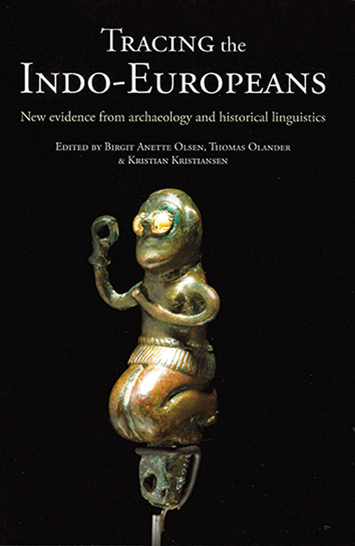
Reviewing this book was in part driven by the desire to learn more about this field, which has, on the back of recent aDNA studies and the renewed migration debates, gained prominence when it comes to European Bronze Age studies. As the search for the Indo-Europeans was strongly connected to some of the crudest forms of early culture-historical archaeology more than 100 years ago, many archaeologists, me included, have been wary of engaging with Indo-European studies. Several highly esteemed colleagues—including those published in this volume—have been much more open to this field of studies, however, and it is thus necessary for archaeologists dealing with the third-millennium BC or Bronze Age Europe to be familiar with this line of research. Tracing the Indo-Europeans delivers a good insight into the potential, and challenges, of ‘archaeolinguistics’.
Several chapters demonstrate how knowledge derived from historical linguistics can shed light on social institutions, kinship structures and ideological systems. It is all in all an exciting and rewarding read. The overall approach of the book is an integration of archaeological and historical linguistic perspectives; it is problematic therefore that the challenges of this approach are not explicitly discussed. The front matter, including the title and introductory chapter posed—for me as a prehistoric archaeologist—a lot of problematic aspects, which still need to be discussed seriously before we can move towards an established field of ‘archaeolinguistics’. The book's title illustrates an underlying reification of the speakers of this reconstructed, very diverse language family into a specific group of people, as the term ‘the Indo-Europeans’ evokes false ethnic connotations that archaeologists have been fighting to overcome for decades. Tracing this imagined group of people as the main goal of the volume builds on an outdated essentialist view of human sociality. The introduction states that the book derives from a workshop aiming to “get a precise grasp of who the Indo-Europeans were, where they came from, and how their language and essential elements of their culture came to dominate Europe and large parts of Asia [emphasis added]” (p. 1). What is not discussed, or questioned, is the idea that language equals culture, that all the different communities using different Indo-European languages had a single unified culture, and that this culture came to dominate Europe and regions beyond. I would have liked to read more convincing arguments about why the Indo-Europeans are a distinct group of people, with a single place of collective origin. As I am not a linguist, it is not self-evident to me that people could not adopt a different language during their lives, speak several languages at the same time, or that languages did not merge. Maybe the answer would be to go and read more literature on historical linguistics, but I was hoping to get just this kind of information from a volume that sets out to ‘trace the Indo-Europeans’. I have the impression that many archaeologists harbour similar doubts, and it will be necessary for the historical linguists to make their case more explicitly to convince us.
The volume includes several interesting papers that illustrate how fruitful collaboration between historical linguists and archaeologists can be. Thomas Olander summarises the debate on the location of the Indo-European homeland, and argues for the validity of the steppe hypothesis (that Indo-Europeans originated in the Pontic Steppe c. 4000–3000 BC), drawing on the reconstructed vocabularies of Proto-Indo-Europeans, which include words for wagons, wool, weaving and dairy technology, all unknown to the early European farmers featuring in the Anatolian Hypothesis (which places the Proto-Indo-European homeland in Anatolia c. 7000–6500 BC). Again, however, I would have expected more explicit arguments disproving the idea that new technologies could have been given names derived from older, semantically connected terms. Too many things are taken for granted; for example, that aDNA would confirm the steppe hypothesis, while it technically only shows that large population movement took place in Europe in the third millennium BC. Some arguments are overly simplified, such as the claim that “like Jamnaja, Corded Ware groups were mobile pastoralists with wagons and horses” (p. 25) to argue that people connected to Corded Ware had a role in spreading lifestyles connected to Indo-European pastoralists. This is, however, not at all supported by the archaeological record.
Other case studies include that of J.P. Mallory (Chapter 3), who discusses differences in representations of different semantic fields in Proto-Indo-European and later Indo-European branches. Birgit Anette Olsen (Chapter 8) explores family structures reflected in Indo-European vocabularies, assuming that they tell us something about European Bronze Age social organisation. Einar Østmo (Chapter 4) and Rune Iversen (Chapter 5) present archaeological accounts of possible indicators for contact between Scandinavia and the steppes (Østmo) and the Danish Single Grave culture (Iversen), contextualising the materials within the question of Indo-European expansion. Dorcas Brown and David Anthony (Chapter 6) present a Late Bronze Age complex of settlements and burials with dog sacrifices that they interpret using Indo-European myths. Similarly, Kristin Armstrong Oma and Lene Melheim (Chapter 7) trace the deep history of yoga in Nordic Bronze Age iconography, proposing inter-regional contacts between India and Scandinavia in that period. In Chapter 9 Anne Marie Carstens postulates the existence of a coherent and diachronically connected social phenomenon of aristocracy, which she traces back to the royal funerals in Ur. These chapters deal with diverse topics and it is not always clear how they connect. They reveal different attitudes to the possibilities of archaeolinguistics, resulting in a somewhat incoherent overall impression of the volume.
Many chapters demonstrate that insights from historical linguistics can be fruitfully used to provide a richer view of prehistoric Europe from the third millennium BC onwards. The volume is overly optimistic, however, and does not explicitly address the challenges discussed above. The bias of assuming a unified Indo-European culture or Indo-European family structure is evident throughout the book. If archaeologists are to take advantage of the exciting possibilities Indo-European studies offer, as documented in this volume, the evolution of language communities in prehistoric contexts needs to be discussed more fully; this should be informed by archaeological and anthropological theory on social group composition.


