Introduction
Due to climate changes and scarcity of some natural resources, agriculture increasingly requires the adoption of conservation and sustainable systems (Struik and Kuyper, Reference Struik and Kuyper2017; Amaral et al., Reference Amaral, Oliveira and Môro2018). In this context, the no-tillage system (NTS) is one of the most promising techniques, as it generates environmental, social and economic sustainability. It is a system that has three basic principles, namely: minimum turning of the soil by agricultural operations, maintenance of straw on the soil throughout the year and the succession and rotation of crops (Ferreira et al., Reference Ferreira, Amado, Rice, Diaz, Keller and Inagaki2016). Therefore, areas under NTS have lower soil loss due to erosion (Luetzenburg et al., Reference Luetzenburg, Bittner, Calsamiglia, Renschler, Estrany and Poeppl2020), higher fertility and better soil structure (Crusciol et al., Reference Crusciol, Nascente, Borghi, Soratto and Martins2015; Moraes et al., Reference Moraes, Debiasi, Carlesso, Franchini, Silva and Luz2016) and the largest carbon sequestration (Plaza-Bonilla et al., Reference Plaza-Bonilla, Cantero-Martínez, Viñas and Álvaro-Fuentes2013). However, in tropical regions, the maintenance of straw on the soil throughout the year is a challenge because, due to the high temperature and precipitations, the degradation of plant material on the soil is rapid (Soratto et al., Reference Soratto, Perez and Fernandes2014). In NTSs, soil mobilization due to agricultural operations is restricted to the sowing row. This fact reduces the oxidation of organic matter, being the main soil cementing agent and supplying nutrients in tropical regions (Ambrosano et al., Reference Ambrosano, Wutke, Bulisani, Cantarella, Raij, Cantarella, Quaggio, Furlani and :1997). Thus, maintaining the organic matter content promotes better soil structure and fertility.
Due to the favourable conditions for the degradation of crop residues in tropical regions, such as high temperature and rainfall, systems with crops succession that present high straw production should be prioritized (Crusciol et al., Reference Crusciol, Nascente, Borghi, Soratto and Martins2015; Souza et al., Reference Souza, Couto Júnior, Flôres, Mingotte and Lemos2019). This is necessary for the establishment and maintenance of an NTS with quality, as one of the principles of this system is to remain with soil cover throughout the year. Thus, the intercropping of agricultural crops with forage species or the cultivation of forages in sole crop, even if it does not promote an initial economic return, is essential for the NTS in tropical regions. In this context, forage species of the genus Urochloa stand out for having high biomass production in tropical regions, exceeding 14.0 t ha−1 in a 5-month period (Flôres et al., Reference Flôres, Amaral, Pinto, Mingotte and Lemos2017). In addition, the use of crops with high straw C/N ratio in rainier periods, such as maize, guarantees an initial economic return for producers and generates a slower straw decomposition on the soil surface in relation to low straw C/N ratio (Soratto et al., Reference Soratto, Perez and Fernandes2014). Both succession and intercropping of crops are practices that aim to promote the production of straw in satisfactory quantities under no-tillage to keep the soil surface covered throughout the year in tropical regions. However, the crop succession refers to the planting of the same or different species at different times in the same area, while the intercropping refers to cultivation in the same area and at the same time for different plant species.
Regarding crop rotation and succession, the different nutritional requirements and the capacity to use nutrients should be considered for the efficient use of fertilizers, especially nitrogen (N). In this respect, the cultivation of common bean (Phaseolus vulgaris L.) can result in saving of fertilizers, as it is a legume crop capable of fixing atmospheric N through symbiosis with bacteria of the genus Rhizobium. N is extracted in large quantities by common bean, which requires approximately 30 kg of N for each 1 t of seeds (Leal et al., Reference Leal, Filla, Bettiol, Sandrini, Mingotte and Lemos2019) and, therefore, has a great influence on yield because, although it is a legume crop, the biological fixation of N by the common bean does not supply 100% of its needs (Müller and Pereira, Reference Müller and Pereira1995).
Common bean has been cultivated with high yield and economic profitability in succession to grasses in the NTS, especially after maize and Urochloa spp. (Flôres et al., Reference Flôres, Amaral, Pinto, Mingotte and Lemos2017; Souza et al., Reference Souza, Couto Júnior, Flôres, Mingotte and Lemos2019). Common bean is a crop of high global importance, being cultivated in more than 100 countries with a total production of more than 30 million tons a year (FAO, 2020). In addition, it is the main source of low-cost protein for the population of underdeveloped and developing countries (Fageria et al., Reference Fageria, Ferreira, Melo and Knupp2014).
Top-dressing N fertilization for common bean is recommended at a dose of 90 kg ha−1 of N in a single application at the stage of three fully expanded trifoliate leaves (V4) (Ambrosano et al., Reference Ambrosano, Wutke, Bulisani, Cantarella, Raij, Cantarella, Quaggio, Furlani and :1997). This recommendation does not take into account the various production systems, soil and common bean cultivars. Therefore, it is necessary to conduct studies about the effect of the cropping successions on the proper management of top-dressing N fertilization in common bean. The management of plant residues from the previous crop may influence N dynamics in the soil, affecting the agronomic performance of subsequent crops (Amaral et al., Reference Amaral, Pinto, Flôres, Mingotte, Lemos and Fornasieri Filho2016; Flôres et al., Reference Flôres, Amaral, Pinto, Mingotte and Lemos2017). Among the alternatives to increase the efficiency of top-dressing N fertilization in common bean in NTS, the split application of this nutrient may be feasible, which may increase the agronomic efficiency of N use and common bean yield, ensuring greater sustainability of the agricultural systems.
Nitrogen split in different agricultural crops has the advantages of reducing nutrient losses in the soil, mainly due to less nitrate leaching (Ruidisch et al., Reference Ruidisch, Bartsch, Kettering, Huwe and Frei2013). Ruidisch et al. (Reference Ruidisch, Bartsch, Kettering, Huwe and Frei2013) evaluating nitrate leaching in horticultural areas observed that the split of nitrogen fertilization can reduce nitrate leaching by up to 59%, generating a higher nitrate content available to plants. In addition, split can increase fertilizer efficiency due to the provision of higher doses in phenological stages that the crop needs most, preventing N from participating in biochemical processes in the soil and becoming unavailable to plants (Viana et al., Reference Viana, Palaretti, Faria, Delgado, Dalri and Barbosa2020).
The hypotheses for the present study are that the intercropping interferes with the yield of common bean cultivated in no-tillage and that nitrogen splitting in common bean increases its yield compared to single-dose application. The objective of this study was to evaluate the effect of the succession to maize and Urochloa ruziziensis cropping successions and of the splitting of top-dressing N fertilization on the agronomic performance and economic viability of common bean crop.
Materials and methods
The study was conducted at the São Paulo State University (Unesp), School of Agricultural and Veterinarian Sciences, Jaboticabal, São Paulo, in 2011/2012 and 2012/2013 agricultural years. The experimental area is located near the coordinates 21°14′33″S, 48°17′40″W, average altitude of 565 m and average annual precipitation of 1425 mm. According to Köppen's climate classification, the climate of the region is Aw that corresponds to a region with rainy season in the summer, dry season in the winter and mean temperature above 18°C in the coldest month (Alvares et al., Reference Alvares, Stape, Sentelhas, Moraes, Leonardo and Sparovek2013). The soil is classified as an Oxisol (Eutrudox), with smooth undulating relief under Cerrado vegetation (Soil Survey Staff, 2014) with 500 g kg−1 of clay.
In relation to the history of the area, the soil had been previously cultivated with annual crops (maize, common bean, soybean and rice) for at least 15 years under the conventional soil management system (scarification + plowing + harrow). Before installing the experiments, soil samples were collected to determine the chemical attributes in the 0.00–0.20 m layer, with the following results: pH (CaCl2) = 5.7; OM (g dm−3) = 22; P resin (mg dm−3) = 53; H + Al, K, Ca, Mg, SB; CEC (mmolc dm−3) = 18, 4.2, 34, 15, 53.2, 71.2; and V = 74.7%, respectively. These analyses were carried out to characterize the soil in the experimental area and serve as information for other authors to compare and explain research results that were carried out on soil with different attributes to those observed here. In the 2009/10 season, conventional soil tillage was carried out to install the NTS in the experimental area. Conventional soil tillage consisted of scarification, followed by plowing with disc plows and two passes of a levelling harrow. After that, the NTS was installed in the area, with no soil disturbance due to tillage operations after 2009/10 season. The conventional soil preparation at the beginning of the NTS was necessary for the incorporation of soil acidity correctors (limestone) and to generate favourable initial conditions for the crops root growth. As the limestone has low mobility in the soil, its incorporation into the soil is necessary to increase the contact area of the product with the soil particles and promote faster the acidity correction. We use limestone to correct soil acidity, as in tropical regions, it is one of the only soil acidity correctives found in satisfactory quantities and prices by producers. Thus, the present experiment evaluated treatments installed 2 years after the implementation of the NTS. After conventional soil tillage in the 2009/2010 season, no further tillage was carried out in the subsequent seasons, with the area being maintained under no-tillage.
The experimental design was a split-plot in randomized complete blocks. The treatments consisted of three cropping successions (CS) and ten combinations of top-dressing N splitting schemes (NS), with four replicates.
The plots consisted of three cropping successions containing maize in sole crop, maize intercropped with U. ruziziensis and U. ruziziensis in sole crop, all preceding the common bean sown in August under irrigation, in the NTS. The subplots were composed of ten combinations of top-dressing N splitting schemes applied to the common bean at a dose of 90 kg N ha−1 as urea, supplied at the time of the first fully expanded trifoliate leaf, in the presence of the third trifoliate leaf and in the pre-flowering, i.e. V3, V4 and R5, respectively (Fernández et al., Reference Fernández, Gepts, López, López, Fernández and Schoonhoven1985) (Table 1). The nitrogen fertilization was split up to the R5 phenological stage according to the fertilization recommendations proposed by Ambrosano et al. (Reference Ambrosano, Wutke, Bulisani, Cantarella, Raij, Cantarella, Quaggio, Furlani and :1997) for Brazil, in which there is no crop response to nitrogen fertilization after this phenological stage.
Description of top-dressing nitrogen splitting schemes (NS) at a dose of 90 kg N ha−1 in common bean in succession to maize and Urochloa ruziziensis in sole crops and intercropped

a Phenological stage; V3 formation of the first trifoliate leaf; V4 presence of the third trifoliate leaf; R5 pre-flowering.
b Absence of top-dressing N.
c Recommended N dose for common bean in the State of São Paulo, according to Ambrosano et al. (Reference Ambrosano, Wutke, Bulisani, Cantarella, Raij, Cantarella, Quaggio, Furlani and :1997). NS, nitrogen splitting.
Each subplot was formed by ten 5 m-long rows of common bean, considering the eight central rows for evaluations, disregarding 0.5 m on each end. To estimate seed yield, four central lines were manually harvested, disregarding 0.5 m at the end of each line. The applied dose of top-dressing N (90 kg of N ha−1) referred to the class of high response as it is an irrigated crop and cultivated after grasses, following the recommendations of Ambrosano et al. (Reference Ambrosano, Wutke, Bulisani, Cantarella, Raij, Cantarella, Quaggio, Furlani and :1997). As a source of top-dressing N, urea was applied in a continuous strip at 10 cm distance from the crop row, with incorporation by a 15 mm water depth through irrigation (Viero et al., Reference Viero, Bayer, Vieira and Carniel2015).
On 18 December 2011 and on 21 January 2013, the maize SC hybrid DKB 390 YG® was mechanically sown at the estimated population density of 60 000 plants ha−1, with rows spaced by 0.90 m. The seeds were treated with fungicide + insecticide recommended for the maize, using the product Standak-Top®. Urochloa ruziziensis (cv. ‘Comum’) in sole crop and intercropped with maize was mechanically sown in the proportion of two rows of forage spaced apart by 22 cm between the rows of maize, simultaneously with sowing of maize, by distributing 7.5 kg of seeds ha−1.
The harvest of maize, in sole crop and intercropped with U. ruziziensis, was mechanically performed on 5 June 2012, and on 4 June 2013. The total area of the experiment was desiccated with the non-selective herbicide glyphosate (1800 g ha−1 a.i.), at 30 days before common bean sowing.
In the two common bean seasons, sowing was performed on 18 August 2012, and 8 August 2013. At the end of the cropping successions preceding common bean, in the 2012 season, soil samples were collected to determine the chemical attributes in the 0.00–0.20 m layer, with the following results: pH (CaCl2) = 5.2; OM (g dm−3) = 22; P resin (mg dm−3) = 67; H + Al, K, Ca, Mg, SB, CEC (mmolc dm−3) = 31.5, 6.1, 23.5, 11, 40.6, 72.1; and V = 56.5%, respectively. Based on these results, it was decided to superficially apply 1.5 t ha−1 of dolomitic limestone with 90% TRNV. In the subsequent season (2013), the results were: pH (CaCl2) = 5.3; OM (g dm−3) = 28; P resin (mg dm−3) = 126; H + Al; K, Ca, Mg, SB, CEC (mmolc dm−3) = 34, 5.4, 36, 20, 61.4, 95.4; and V: 64.0%, respectively.
The common bean cultivars (P. vulgaris L.) used in the winter seasons of 2012 and 2013 were, specifically, ‘Pérola’ and ‘IPR 139’, respectively. In both seasons, the sowing population was adjusted to 230 000 plants ha−1, with spacing between rows of 0.45 m. A no-tillage sowing machine was used for the common bean sowing. The seeds were treated with carbendazim + thiram (45 and 105 g of a.i. per 100 kg of seeds, respectively) and thiamethoxam (140 g of a.i. per 100 kg of seeds). Fertilization at sowing consisted of 300 kg ha−1 of the 05-15-15 formulation. Invasive plants were controlled by applying a post-emergent herbicide based on fluazifop-p-butyl (75 g ha−1 a.i.) at 18 days after the emergence of seedlings (DAE). Pest insects and diseases were controlled with azoxystrobin (40 g a.i. ha−1), lambda-cyhalothrin (30 g a.i. ha−1) + thiamethoxan (14.1 g a.i. ha−1), tebuconazole (136 g a.i. ha−1) + trifloxystrobin (68 g a.i. ha−1), deltamethrin (3.5 g a.i. ha−1) and triazofos (122 g a.i. ha−1), carbendazim (250 g a.i. ha−1) and famoxadone (100 g a.i. ha−1) + mancozeb (1000 g a.i. ha−1).
For both seasons, common bean emerged 4 days after sowing (DAS), with V3 stage occurring at 23 and 19 DAE, V4 at 33 and 25 DAE and R5 at 49 and 53 DAE, in the 2012 and 2013 seasons, respectively. At 94 and 90 DAE, the plants present in the usable area were manually uprooted in each subplot in the 2012 and 2013 seasons, respectively, and then mechanically threshed. Because it is a winter season, the experiment was maintained under conventional sprinkler irrigation, with interval 4 days, using a water depth of 10–20 mm in each event, depending on the stage of plant development, according to Allen et al. (Reference Allen, Pereira, Raes and Smith1998).
The rainfall and daily maximum and minimum temperatures along the winter crops of common bean in the 2012 and 2013 seasons are shown in Fig. 1. In the 2012 season, the average maximum and minimum temperatures were 31.2 and 16.8°C, respectively, with accumulated rainfall of 198 mm. In the 2013 season, the maximum and minimum temperatures were 29.0 and 15.4°C, respectively, with accumulated rainfall of 247 mm.
Daily weather data of the winter seasons of common bean in 2012 (a) and 2013 (b).

At the stage of full flowering of common bean (R6), five consecutive plants were collected in each subplot to determine the shoot dry mass. Also at R6, the third trifoliate leaf with petiole from the middle third of ten plants of each subplot was collected to determine leaf N content (Bataglia et al., Reference Bataglia, Furlani, Teixeira, Furlani and Gallo1983), in order to verify the nutritional status of common bean, as recommended by Ambrosano et al. (Reference Ambrosano, Wutke, Bulisani, Cantarella, Raij, Cantarella, Quaggio, Furlani and :1997). The final population (FP) of plants was estimated at the physiological maturity stage (R9), by counting the plants along 4 m of four rows of each subplot.
At harvest, ten consecutive plants were collected in each subplot to determine the production components number of pods per plant (NPP), number of seeds per pod (NSP) and hundred-seed weight (HSW). HSW was determined by weighing three subsamples of 100 seeds of each subplot, with moisture content corrected to 0.13 kg kg−1. Seed yield was obtained after manual uprooting and mechanized threshing of plants present in the four central rows of each subplot, with seed moisture content standardized to 0.13 kg kg−1.
The relative gain and the economically viable dose were calculated as a function of the top-dressing N splitting schemes in the common bean in each cropping succession, for both seasons. The relative gain was obtained by Eqn (1).

where RG = relative gain; SPf = seed production with N fertilizer; SPnf = seed production without N fertilizer.
The economically viable splitting scheme was established according to the methodology adapted by Pimentel Gomes (Reference Pimentel Gomes1976), which uses the principles of Mitscherlich, also known as the law of diminishing returns, by Eqn (2). Mitscherlich's law, or the law of non-proportional additions, is based on the fact that the increase in seed yield is not proportional (linear) to the increase in the applied nutrient dose, which means that, depending on the applied N dose, or nitrogen splitting, the crop seed yield will not show linear increments. From this, it is possible to say which N splitting is what guarantees the economic viability for the common bean. Since the N dose applied in all treatments was 90 kg ha−1, treatments in which the respective values obtained in X are equal to or greater than the amount of N applied, i.e. 90 kg ha−1, are considered economically viable.

where X* = economically viable dose; u = yield increment promoted by the Xu dose applied (90 kg ha−1 of N) in comparison to the control (without N); W = unit price of the agricultural product (beans) considering the value of US$26.00 per 60 kg bag (Bolsa de Cereais de São Paulo, 2014); t = unit price of nutrient (N) considering the value of US$437.00 per ton of urea (46% of N), i.e. US$0.95 kg−1 of N (IEA, 2020) and C = efficacy coefficient of 0.0049 ha kg−1 of N (Pimentel Gomes, Reference Pimentel Gomes1976). The coefficient C, or efficacy coefficient, has a fixed value for each applied nutrient and crop evaluated. The coefficient C is responsible for the slope of the adjustment of the yield regression curve as a function of nutrient doses. The value of 0.0049 was used for nitrogen fertilization in common bean crop (Pimentel Gomes, Reference Pimentel Gomes1976).
As we used different common bean cultivars in the two agricultural years, we performed the analysis of variance separated by year. Because these are different genotypes, comparing agronomic performance between years was not possible; however, this did not affect the comparison of treatments within each year. The data were subjected to analysis of variance by F test (P < 0.05) and the means were compared by Tukey test (P < 0.05), with the aid of the computer application SISVAR® (Ferreira, Reference Ferreira2011). In cases of significance by the F test, the interactions between cropping successions and N splitting schemes were further analysed.
Results
Final population of plants (FP) and shoot dry mass (SDM) of common bean did not show differences caused by any of the two factors studied (cropping successions and N splitting schemes) or by the interaction between cropping successions and N splitting. The overall mean for the FP was 204 (range 197–214) and 235 (range 230–240) thousand plants per ha for the years 2012 and 2013, respectively. For SDM, the mean values were 22.1 (range 21.1–23.4) and 19.5 (range 19.0–20.0) g per plant for the years 2012 and 2013, respectively. For leaf N content, there was a significant difference by the cropping successions only in the second season (2013), in which the common bean in succession to the cropping successions with maize + U. ruziziensis (38.2 g kg−1) and U. ruziziensis in sole crop (37.4 g kg−1) had higher N content compared to the succession with maize in sole crop (36.1 g kg−1). This may have occurred due to the presence of U. ruziziensis in cropping succession, as exudates released by the roots of plants of the Urochloa genus can suppress the nitrification process and, consequently, reduce losses by nutrient leaching in agroecosystems (Gopalakrishnan et al., Reference Gopalakrishnan, Watanabe, Pearse, Ito, Hossain and Subbarao2009). For the first year, the average N leaf content was 44.8 g kg−1. The higher leaf N content in 2013 compared to 2012 may have occurred due to the different cultivars used in the 2 years, being ‘Pérola’ in 2012 and ‘IPR 139’ in 2013.
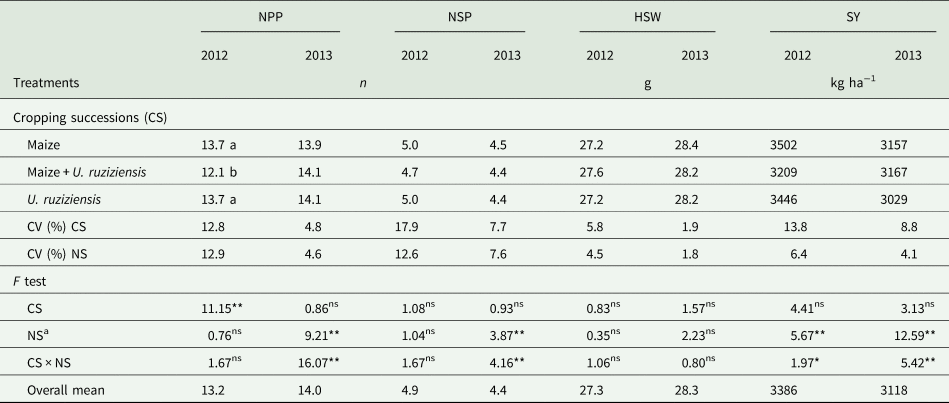
For the seed production (SY) and yield components of common bean, it was observed that only the hundred-seed weight (HSW) did not differ for any factor studied or for the interaction between them (Table 2). The number of pods per plant (NPP) and number of seeds per pod (NSP) were not influenced by the treatments in the 2012 season, with difference only between the cropping successions for NPP. In the second season (2013), NPP and NSP were significantly affected by N splitting and by the interaction between cropping succession and N splitting. Differences were observed in SY as a function of N splitting and of the interaction between cropping successions and N splitting in both seasons.
Number of pods per plant (NPP), number of seeds per pod (NSP), hundred-seed weight (HSW) and seed yield (SY) of common bean as a function of the previous cropping succession and top-dressing nitrogen splitting (NS) in two agricultural years

Means followed by different letters in the column, for each factor, differ by Tukey test (P < 0.05). *P < 0.05, **P < 0.01 and nsnot significant, respectively, by the F test.
aAmount of N applied in common bean as top-dressing at the phenological stages V3 (formation of the first trifoliate leaf), V4 (presence of the third trifoliate leaf) and R5 (pre-flowering), respectively.
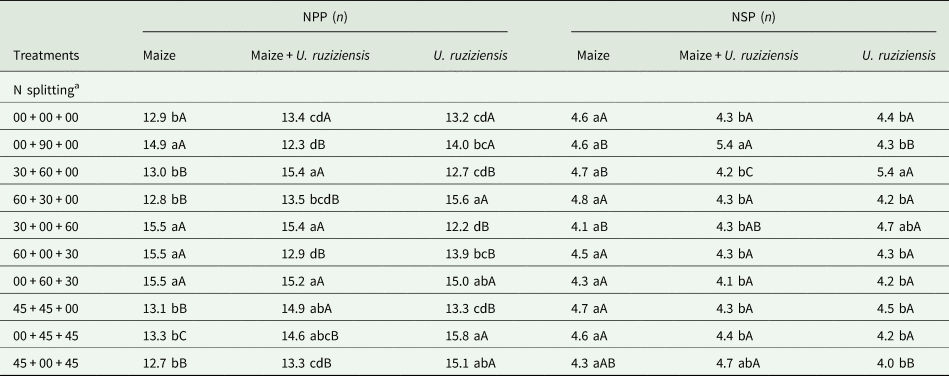
In the 2012 season, NPP was higher in common bean cultivated after maize and U. ruziziensis sole crops than after maize + U. ruziziensis intercrop, but there was no effect of cropping succession treatments on NSP (Table 2). A single-effect analysis of the interaction between cropping successions and N splitting for NPP in the 2013 season showed that, in the succession with maize in sole crop, the application of a single dose at V4 (00 + 90 + 00) and the splitting schemes 60 + 00 + 30, 30 + 00 + 60 and 00 + 60 + 30 promoted the highest values of this common bean production component (Table 3). In the succession with maize and U. ruziziensis intercropping, the N splitting schemes 30-60-00, 30-00-60 and 00-60-30 led to the highest means, while in the succession with U. ruziziensis in sole crop, the splitting schemes 60-30-00 and 0-45-45 resulted in the highest values of NPP.
Analysis of the interaction between cropping and top-dressing N splitting schemes for the number of pods per plant (NPP) and number of seeds per pod (NSP) of common bean in the 2013 season

Means followed by different letters, uppercase in the row and lowercase in the column, differ by Tukey test (P < 0.05).
a Amount of N applied in common bean as top-dressing at the phenological stages V3 (formation of the first trifoliate leaf), V4 (presence of the third trifoliate leaf) and R5 (pre-flowering), respectively.
In relation to the number of seeds per pod, in the 2013 season, there were no differences between N splitting schemes applied in common bean cultivated in succession to maize in sole crop. However, the application of the single dose at V4 increased this production component of common bean in succession to maize + U. ruziziensis, while 30 + 60 + 00 increased it after U. ruziziensis cultivated in sole crop (Table 3).
The higher numbers of pods per plant and seeds per pod in response to top-dressing N splitting schemes in common bean the cultivar IPR 139 in the different cropping successions that occurred in 2013 (Table 3) can be explained by the greater supply of N in the beginning of the reproductive period (Table 1). This occurs because N performs the function of stimulating plant growth, resulting in a greater number of branches and, consequently, a greater number of reproductive structures (Fageria et al., Reference Fageria, Ferreira, Melo and Knupp2014).
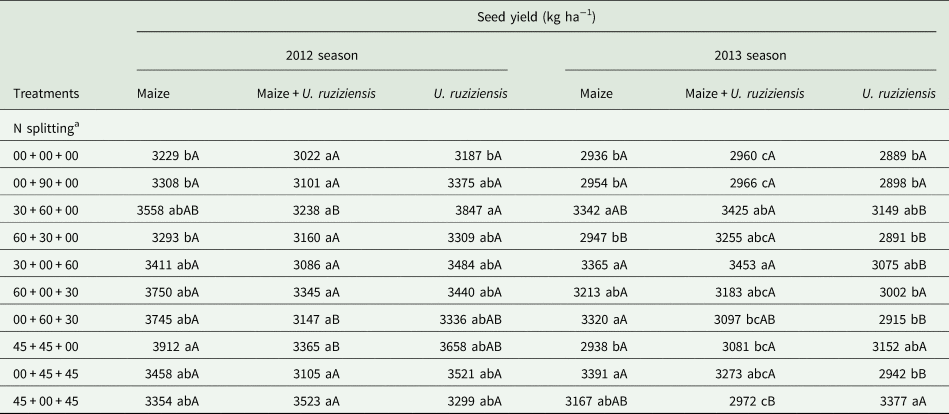
Comparing N splitting management within each crop succession, the split top-dressing application of N interfered with the seed yield of common bean in succession to maize in sole crop, and the treatment 45 + 45 + 00 stood out in relation to the absence of N and its application in a single dose at V4 (00 + 90 + 00) in the 2012 season. In 2013, in succession also to maize in sole crop, good results were obtained with the treatments 30 + 60 + 00, 30 + 00 + 60, 00 + 60 + 30 and 00 + 45 + 45, which did not differ from 60 + 00 + 30 and 45 + 00 + 45 (Table 4), all superior to the doses in single application at the phenological stage V4 and the absence of N. After the intercropping, in the 2012 season, the splitting of top-dressing N fertilization had no effect on common bean seed yield. However, in the 2013 season, the highest seed yields of common bean after intercropping were obtained with the treatment 30-00-60, which differed from the treatments without N fertilization (00-00-00) and single application at V4 (00-90-00).
Analysis of the interaction between cropping successions and top-dressing nitrogen splitting for the seed yield of common bean

Means followed by different letters, uppercase in the row and lowercase in the column, differ by Tukey test (P < 0.05).
a Amount of N applied in common bean as top-dressing at the phenological stages V3 (formation of the first trifoliate leaf), V4 (presence of the third trifoliate leaf) and R5 (pre-flowering), respectively.
Evaluating the crops succession within the N splitting fertilization in the 2012 season, the N splitting scheme of 30 + 60 + 00 led to higher seed yield compared to the others in succession to U. ruziziensis in sole crop. For the 2013 season, the N split fertilization 45-00-45 promoted the highest seed yield of common bean after U. ruziziensis in sole crop compared to intercropping with maize + U. ruziziensis. In general, it was observed that many N splitting schemes, not all of them, led to a higher yield than controls 00-00-00 and 00-90-00, especially in 2013.
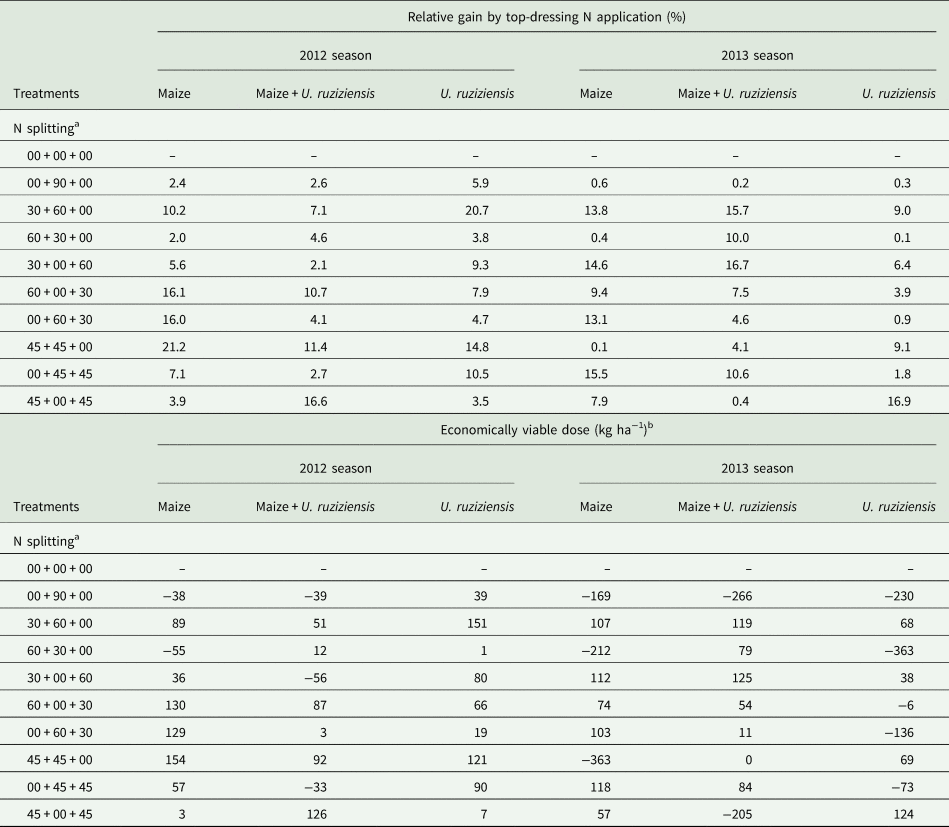
Regardless of the type of succession and season, many N splitting schemes (NS) promoted relative gain of common bean yield compared to the control without N application and also outperformed the management of N fertilization with a single application at V4 (00-90-00) (Table 5). For all types of succession and for both seasons, the relative gain of yield was higher for the treatments 30-60-00, 60-00-30, 00-60-30 and 00-45-45 compared to single-dose application at V4. Separating by season, the 45-45-00 management was the only one that presented a relative yield gain above 10% in all succession systems in 2012, while in 2013, there was greater variability between the managements, with the N splitting 30-00-60 standing out in successions with maize sole and intercropped with U. ruziziensis and management 45-00-45 standing out in succession with U. ruziziensis.
Economic viability of top-dressing nitrogen fertilization based on the relative gain (%) and on the economically viable dose in common bean as a function of the previous cropping succession and top-dressing N splitting

a Amount of N applied in common bean as top-dressing at the phenological stages V3 (formation of the first trifoliate leaf), V4 (presence of the third trifoliate leaf) and R5 (pre-flowering), respectively.
b Treatments in which the respective values obtained are equal to or greater than the amount of N applied, i.e. 90 kg ha−1, are considered economically viable.
For any succession and season, N application in a single dose in common bean (00-90-00) was economically unviable (Table 5). For the 2012 season, the splitting scheme 45-45-00 was the only one that was economically viable for the three successions. In the 2013 season, none of the N splitting schemes were economically viable for common bean in the three successions, because only the treatment 45-00-45 was economically viable for common bean in succession with U. ruziziensis in sole crop. For the succession with maize in sole crop and with the intercropping, the N splitting schemes that were economically viable for the two systems in the 2013 season were 30-60-00 and 30-00-60.
Discussion
In general, it was observed that the cropping successions with maize and U. ruziziensis did not interfere in the agronomic performance and seed yield of common bean cultivated in succession. Evaluating the effect of common bean in succession to maize, maize + U. ruziziensis and maize + Crotalaria, Souza et al. (Reference Souza, Couto Júnior, Flôres, Mingotte and Lemos2019) observed that the common bean yields were similar in succession after maize in sole crop and maize + U. ruziziensis and superior in succession to maize + Crotalaria. This same result was observed in the present study, in which the seed yields of common bean were similar between the grass cropping successions.
Unlike the results obtained by Souza et al. (Reference Souza, Couto Júnior, Flôres, Mingotte and Lemos2019), the common bean successions evaluated in the present study were conducted after cropping successions only of grasses in sole crop and intercropped. As grasses have a higher C/N ratio than legume crops, such as Crotalaria, the degradation of straw from these plants is slower and promotes temporary immobilization of soil N, even if the straw is not incorporated (Liu et al., Reference Liu, Zhang, Zhao, Zhang, Müller and Cai2017; Williams et al., Reference Williams, Wells, Dickey, Hu, Maul, Raskin, Reberg-Horton and Mirsky2018).
The beneficial effects of no-tillage are generally observed over the years, such as higher water retention and nutrient availability (Crusciol et al., Reference Crusciol, Nascente, Borghi, Soratto and Martins2015) and improvement of soil physical quality (Moraes et al., Reference Moraes, Debiasi, Carlesso, Franchini, Silva and Luz2016). In this context, Soratto et al. (Reference Soratto, Perez and Fernandes2014) observed that common bean yield was higher in consolidated no-tillage areas than in initial no-tillage areas. In an area under no-tillage at 5 years after its establishment and in a site near the area of the present study, Flôres et al. (Reference Flôres, Amaral, Pinto, Mingotte and Lemos2017) evaluated the effect of maize and U. ruziziensis cropping successions on common bean in succession and observed that its highest seed yield was obtained after the cropping succession with maize + U. ruziziensis. Likewise, Crusciol et al. (Reference Crusciol, Nascente, Borghi, Soratto and Martins2015) observed that the maize + Brachiaria intercropping increased soil fertility and contributed to higher seed yield of subsequent crops.
Reductions in common bean seed yield were not observed in the present study as a function of the cropping successions with higher grass straw production, such as the intercropping of maize + U. ruziziensis and U. ruziziensis in sole crop, because the soil of the experimental area has high natural fertility. To prove this high soil fertility in the experimental area, studies conducted in areas close to that of the present study have found low response of crops such as common bean (Amaral et al., Reference Amaral, Pinto, Flôres, Mingotte, Lemos and Fornasieri Filho2016; Flôres et al., Reference Flôres, Amaral, Pinto, Mingotte and Lemos2017) and maize (Amaral et al., Reference Amaral, Oliveira and Môro2018) to nitrogen fertilization.
In tropical regions, such as that of the present study, there is high degradation of straw on the soil, due to the high temperatures and precipitations, increasing the microbiological activity of the soil (Elifantz et al., Reference Elifantz, Kautsky, Mor-Yosef, Tarchitzky, Bar-Tal, Chen and Minz2011). Thus, for the correct establishment and continuity of areas with no-tillage, crops with higher biomass production should be used, especially in periods of higher temperature and precipitation, such as summer. Therefore, the use of the cropping successions with U. ruziziensis in sole crop and maize + U. ruziziensis enable greater biomass production for the correct maintenance of NTSs (Crusciol et al., Reference Crusciol, Nascente, Borghi, Soratto and Martins2015).
Regarding the effect of N splitting on common bean yield, it was observed that the response patterns were quite variable. This occurred because the soil of the experimental area has high fertility, as can be observed by the N content in the diagnostic leaf of common bean. For this variable, all treatments, including the one with no top-dressing N fertilization (00-00-00), had N contents above 30 g kg−1, which is the minimum established for common bean not to characterize N deficiency (Ambrosano et al., Reference Ambrosano, Wutke, Bulisani, Cantarella, Raij, Cantarella, Quaggio, Furlani and :1997). However, it was verified that the splitting schemes led to higher seed yield than the single dose of 90 kg ha−1 of N recommended for the common bean in Brazil (Ambrosano et al., Reference Ambrosano, Wutke, Bulisani, Cantarella, Raij, Cantarella, Quaggio, Furlani and :1997). In general, in the 2013 season, the splitting schemes that supplied N doses at later stages of common bean, such as R5, led to the highest seed yields, especially 60-00-30, 00-60-30 and 00-45-45 for the three cropping successions with common bean in succession, except for the treatment 30-60-00, which stood out in succession to maize in sole crop.
The higher common bean seed yield under N splitting management in relation to N single-dose management (00-90-00) can be explained, since the N applied at once reduce the contribution of biological N fixation (BNF) in common bean (Müller and Pereira, Reference Müller and Pereira1995). Thus, in single-dose N applications, fertilization efficiency will be lower and there will be a lack of N at the later reproductive stages of common bean, since the biological fixation in this case will be compromised and the N content in the soil solution will be low.
Besides the increment of yield, the N splitting managements in common bean had the highest economic viabilities, compared to the control without application, while the application of a single dose at V4 (00-90-00) was not economically viable for any succession of the cropping successions in either season. It was observed that, in economic terms, good results were obtained with the splitting schemes 45-45-00, 45-00-45, 30-60-00 and 30-00-60, which encompassed the economically viable managements for the three cropping successions for at least one of the two seasons.
The seed yield differences between crops succession and N splitting in the 2 years can be explained by the production component NPP in 2012 and by the production components NPP and NSP in 2013. This occurs, since in 2012, there were only differences between the factors studied for the NPP, while in 2013, there were differences between the factors studied for the NPP and NSP components. In none of the years were there differences between the factors studied, as well as for the interaction between them, for the HSW. As the experiment was irrigated, water was made available in adequate quantities throughout the common bean cycle, without affecting the grain filling of the crop and, consequently, the HSW. Generally, variations in HSW are observed in studies on irrigation depths or in seasons without irrigation need that may have drought (Cunha et al., Reference Cunha, Silveira, Nascimento and Alves Júnior2013). It is also noteworthy that common bean seed yield is formed by the interaction of the three production components NPP, NSP and HSW (Fageria et al., Reference Fageria, Melo and Oliveira2013), with not only one being responsible for the seed yield variation between treatments. In addition, among the three production components, one that presents the greatest variability due to applied agricultural management is NPP (Flôres et al., Reference Flôres, Amaral, Pinto, Mingotte and Lemos2017; Leal et al., Reference Leal, Filla, Bettiol, Sandrini, Mingotte and Lemos2019), being the only that varied in at least one factor of study in the 2 years in this work.
It is verified that the common bean cultivars present differences in the nitrogen use efficiency and response. Nunes et al. (Reference Nunes, Leal, Mingotte, Damião, Couto Júnior and Lemos2020) found that the cultivar ‘Pérola’, the same one used in 2012 in the present study, is efficient in the N use, but is not responsive to the application of the nutrient. This means that in conditions of low soil N availability, this cultivar produces satisfactorily well, but does not significantly increase its yield with the application of the nutrient. The same authors verified the opposite for the cultivar ‘IPR 139’, the same one used in 2013 in the present study, being an inefficient genotype in the N use, but responsive to its application. These differences in the N use efficiency and responsiveness between cultivars help to explain the fact that in 2012 in some cases the N splitting did not promote increases in common bean yield in relation to the 00-00-00 and 00-90-00 managements, while in 2020 in all crop succession systems at least one N splitting promoted significant increases in yield in relation to the 00-00-00 and 00-90-00 managements. In addition, these differences help to explain why some managements with the application of N doses in R5 are better in 2013 compared to 2012, since the cultivar ‘IPR 139’, used in 2013, is N use responsive.
Conclusion
The cropping successions evaluated did not interfere with the seed yield of common bean as subsequent crop, even at the beginning of the establishment of NTS. However, the cropping successions affect the management of top-dressing N fertilization recommended for common bean. To obtain higher seed yield and economic viability, the N dose of 90 kg ha−1 indicated for the crop must be split and applied among the phenological stages V3, V4 and R5.
Financial support
São Paulo Research Foundation (FAPESP), process number 2011/07840-9.
Conflict of interest
None.
Ethical standards
Not applicable.