INTRODUCTION
Conservation and poverty alleviation
Ecosystem services programmes have been advocated as a way to finance conservation of threatened ecosystems while at the same time improving human well-being (Grieg-Gran et al. Reference Grieg-Gran, Porras and Wunder2005; MA [Millennium Ecosystem Assessment] 2005; Daily & Matson Reference Daily and Matson2008; Luck et al. Reference Luck, Chan and Fay2009; Muradian Reference Muradian, Corbera, Pascual, Kosoy and May2010). While combining these two objectives holds great appeal, there is a lack of evidence that these goals can jointly be reached or that improving human well-being will lead to better conservation outcomes (Adams et al. Reference Adams, Aveling, Brockington, Dickson, Elliott, Hutton, Roe, Vira and Wolmer2004; Agrawal & Redford Reference Agrawal and Redford2006; Brockington et al. Reference Brockington, Igoe and Schmidt-Soltau2006; Gockel & Gray Reference Gockel and Gray2009). In particular, integrated conservation and development projects have been criticized for failing to meet either conservation or development goals (Sunderland et al. Reference Sunderland, Ehringhaus and Campbell2008). In their review of past programmes attempting to achieve these joint aims, Agrawal and Redford (Reference Agrawal and Redford2006) found that the importance of context meant that a successful programme in one area might not translate successfully to another, and that the difficulty of creating adequate measures of improvements in poverty levels or conservation outcomes made it difficult to judge the success of many programmes. Nonetheless, there continues to be support for the idea that conservation programmes are less likely to be successful if local communities do not benefit from them in an equitable way (Brockington & Schmidt-Soltau Reference Brockington and Schmidt-Soltau2004; Kabii & Horwitz Reference Kabii and Horwitz2006; Groom & Harris Reference Groom and Harris2008). Although debate continues about whether development goals should be a part of conservation policies or programmes (Wunder Reference Wunder2005; Gockel & Gray Reference Gockel and Gray2009), focus on payment for ecosystem services (PES) approaches has increased in recent years, with the expectation that they will provide gains in both environmental protection and poverty alleviation (Muradian et al. Reference Muradian, Corbera, Pascual, Kosoy and May2010). A number of definitions exist that specify characteristics of programmes that qualify as PES schemes (for example Wunder Reference Wunder2005; Engel et al. Reference Engel, Pagiola and Wunder2008), however, it has been noted that, in practice, most do not comply with these definitions (Muradian et al. Reference Muradian, Corbera, Pascual, Kosoy and May2010). Here, we use the definition provided by Muradian et al. (Reference Muradian, Corbera, Pascual, Kosoy and May2010, p. 1205) of ‘PES as a transfer of resources between social actors, which aims to create incentives to align individual and/or collective land use decisions with the social interest in the management of natural resources’.
Tallis et al. (Reference Tallis, Kareiva, Marvier and Chang2008) suggested that an ecosystem services approach can contribute to both conservation and development in two ways: (1) where science helps clarify how ecosystems produce services and the quantity produced, it can motivate payments, which can be used to compensate people for economic activities given up in order to protect the services; (2) the protection of ecosystem services can help foster markets for ecosystem goods and services produced by local people which can improve the likelihood of achieving joint conservation and development. Others have supported the idea that PES programmes can have positive development effects, by changing income, consumption, and labour and land markets, all of which influence local livelihoods (Wunder Reference Wunder2006), even if the programmes were not explicitly created to reduce poverty (Kollmair & Rasul Reference Kollmair and Rasul2010). However, whether PES programmes are successful in reducing poverty depends in part on whether there is an equitable distribution of benefits, and whether the levels of compensation are adequate to replace, or substantially improve upon, income earned from previous land uses (Jack et al. Reference Jack, Kousky and Sims2008). This can be impeded by programmes that favour large landowners while providing few benefits to the poor and landless, ‘land-owner biased’ programmes that exclude those who depend on community or public land, or programmes in which inadequate levels of compensation for banned activities or land uses leave participants worse off than they were without the programme (Grieg-Gran et al. Reference Grieg-Gran, Porras and Wunder2005; Kollmair & Rasul Reference Kollmair and Rasul2010, p. 12). Others suggest that adequate inclusion of the poor in PES programmes requires creating prioritization schemes that explicitly incorporate human need, which implies not only focusing on where the payments themselves would benefit the poor, but where the need for ecosystem services is greatest and the ability to pay for non-ecosystem-derived alternatives is low (Luck et al. Reference Luck, Chan and Fay2009).
Conservation landscapes
Another source of debate is the relationship between PES programmes and traditional approaches to conservation. For example, PES can be viewed as working in conjunction with or being complementary to protected area strategies and can play a role as a part of park conservation strategy (Schloegel Reference Schloegel2010) or may serve as support or justification for protected area creation (Salo & Pyhala Reference Salo and Pyhala2007; Benítez et al. Reference Benítez, Blanco, Cole, Ibáñez, Rodríguez and Halloy2010). PES programmes also have the potential to provide an alternative to traditional conservation approaches such as protected areas, which have been criticized for the exclusion of people and traditional livelihoods (Wunder Reference Wunder2006; Goldman et al. Reference Goldman, Tallis, Kareiva and Daily2008; Wunder & Albán Reference Wunder and Albán2008). Kollmair and Rasul (Reference Kollmair and Rasul2010, p. 13), for example, compare PES to policies such as establishing reserves and parks or banning collection of forest products, and suggest that they can be more inclusive. This greater inclusivity has also been argued for by Goldman et al. (Reference Goldman, Tallis, Kareiva and Daily2008), who contrast the focus on setting aside land at the core of traditional approaches to conservation with ecosystem services approaches that aim for broader inclusivity. In this view, PES is seen as a potential means to combine conservation landscapes and working landscapes, allowing participants to continue with some traditional income-generating activities while receiving new income for the provision of ecosystem services. Furthermore, those who advocate the PES approach suggest that traditional conservation approaches do not provide enough value, particularly in the face of declining financial support for protected areas; as such, more innovative approaches that attract private-sector and other sources of funding are needed, and PES is seen as a way to achieve this while helping to improve the livelihoods of poor communities who provide ecosystem services (Wunder Reference Wunder2006).
However, those who are sceptical about PES argue that these programmes will ‘bring back the fences’ (Wunder Reference Wunder2006, p. 27). In this view, PES would facilitate the formation of new types of protected areas that would exclude human uses and promote conservation at the expense of development. Critiques have focused on a number of aspects of PES programmes, including the possibility that they reinforce rather than alleviate poverty through biases against the poor who lack property rights, by favouring larger landowners with higher levels of education, or by causing people to abandon local development (Landell-Mills & Porras Reference Landell-Mills and Porras2002; Zbinden & Lee Reference Zbiden and Lee2005; Wunder Reference Wunder2006). In addition, criticism of the PES approach raises the possibility that people are ‘paid to do nothing’ and that the lower labour-intensity of PES programmes relative to previous land uses will harm employment (Pagiola et al. Reference Pagiola, Arcenas and Platais2005; Wunder Reference Wunder2006). However, Wunder (Reference Wunder2006) suggested that PES programmes can be either activity-enhancing or activity-reducing, with the former creating the possibility of new employment options. In addition, he noted that even those that reduce activity levels can result in new flows of income in areas where it is lacking and that, ultimately, the effects on local activities depend on the land uses promoted by PES, their labour intensity, and the kinds of income they generate relative to the activities they replace (Wunder Reference Wunder2006). Whether land remains in conservation under PES programmes or is returned to other income-generating activities also depends on the relative income difference; if income from PES is inadequate to cover the opportunity cost of the foregone production, land is more likely to be returned to the previous use (Secchi et al. Reference Secchi, Gassman, Williams and Babcock2009).
Providing and sustaining ecosystem services
The broader success of PES programmes depends on how they meet multiple goals, including poverty alleviation and other social objectives. However, those goals must be combined with the ability to meet the biophysical objectives necessary to produce and sustain ecosystem services that are beneficial for society. PES programmes need to deliver the promised environmental benefits in a way that can be measured (Jack et al. Reference Jack, Kousky and Sims2008). Environmental benefits are frequently not judged by direct measure, necessitating the development of appropriate, easily-measured proxy measures that link a particular activity or land use to an ecosystem function, which can then be related to an ecosystem service (Jack et al. Reference Jack, Kousky and Sims2008). However, as PES programmes have expanded rapidly, they are in some cases outpacing the scientific research needed to help determine which land uses will most effectively produce the desired ecosystem services (Ellison Reference Ellison2009). Furthermore, this task is complicated in PES programmes that simultaneously aim to protect multiple ecosystem services as well as biodiversity. Existing research has illustrated examples of trade-offs as well as synergies among various ecosystem services, and it has been noted that the degree to which they coincide will vary from one region to another (Farley et al. Reference Farley, Jobbágy and Jackson2005; Jackson et al. Reference Jackson, Jobbágy, Avissar, Roy, Barrett, Cook, Farley, le Maitre, McCarl and Murray2005; Chan et al. Reference Chan, Shaw, Cameron, Underwood and Daily2006; Turner et al. Reference Turner, Brandon, Brooks, Costanza, da Fonseca and Portela2007; Nelson et al. Reference Nelson, Mendoza, Regetz, Polasky, Tallis, Cameron, Chan, Daily, Goldstein, Kareiva, Lonsdorf, Naidoo, Ricketts and Shaw2009).
Ecologists point to the need for ecological production functions that indicate how much of a given service can be provided under different ecosystem structures or land uses, parallel to the need for clear measures of whether poverty alleviation goals are being met (Tallis et al. Reference Tallis, Kareiva, Marvier and Chang2008; Tallis & Polasky Reference Tallis and Polasky2009). Although scientific understanding of ecological production functions is improving, in many locations where PES programmes are being implemented this information is lacking and knowledge of the impacts of land management activities on individual ecosystem services is limited (Daily & Matson Reference Daily and Matson2008; Luck et al. Reference Luck, Chan and Fay2009). The existence of adequate information on the relationship between land uses promoted by PES programmes and the production of specific ecosystem services can then have a substantial impact on the success of the programmes and the ability to make land use decisions (Daily & Matson Reference Daily and Matson2008). Ruffo and Kareiva (Reference Ruffo and Kareiva2009, p. 3) noted that, while it is only one component of implementing effective PES programmes, it is essential that ecosystem services projects ‘get the science right’ by promoting land use and management strategies that will in fact produce the services promised. Furthermore, in addition to appropriately matching land uses with ecosystem services provision, the ability of PES programmes to monitor these outcomes over time is critical, and a lack of monitoring can impede the ability to determine whether PES programmes are effective in providing services (Goldman et al. Reference Goldman, Tallis, Kareiva and Daily2008). For example, one of the key lessons learned from water funds supported by The Nature Conservancy is the need for a system to measure impacts relative to programme objectives (Benítez et al. Reference Benítez, Blanco, Cole, Ibáñez, Rodríguez and Halloy2010).
The value of the hydrologic services provided by Ecuadorian páramo grasslands has become widely recognized, along with their importance for belowground carbon storage and their high levels of biodiversity and endemism (Buytaert et al. Reference Buytaert, Celleri, De Bievre, Cisneros, Wyseure, Deckers and Hofstede2006; Farley Reference Farley2007). However, two-thirds of the 1.5 million ha extent of these tropical alpine grasslands is outside of the country's system of protected areas, while much of the population in páramos lives in conditions of poverty (M. Lascano, SocioBosque Program Coordinator, Ministry of the Environment, Ecuador, personal communication 2009). As such, páramos have rapidly become the focus of compensation for ecosystem services (CES, the preferred term in Ecuador) programmes. However, without systematic analysis of existing programmes, questions will remain about the effectiveness of different programme designs, and analysis of existing programmes can help contribute to adaptive management (Jack et al. Reference Jack, Kousky and Sims2008; Farley & Costanza Reference Farley and Costanza2010). We address this information gap by evaluating emerging CES programmes in Ecuadorian páramo grasslands, focusing on the following questions:
(1) In what ways do these programmes address possibilities for jointly achieving conservation with poverty alleviation? (What sorts of goals do they pursue? How are they incorporated into programme design?)
(2) What kinds of conservation landscapes do these programmes produce? (Do they function as an alternative conservation approach to protected areas or as justification for or complement to them?)
(3) How do they seek to produce the desired ecosystem services? (How do they account for relationships between land use and ecosystem service production in target areas? How is ecosystem service provision measured and monitored?)
We examine general trends among the nine CES programmes we identified and highlight two case studies where we address these questions in greater depth.
METHODS
Data collection
We collected information on ecosystem services programmes and projects in Ecuadorian páramo grasslands, including any project that provided compensation or payment to land owners or managers to incentivize the conservation, protection or enhancement of an ecosystem service or a land use intended to produce that service. We included all projects where páramos were at least one of the key ecosystems of focus. We used a combination of semi-structured interviews, document analysis and archival research. In the document analysis and archival research, we evaluated policy and programme documents, including proposals for programme development, contracts and agreements establishing the programmes, prioritization plans, management plans, and other relevant documents. Our interviews were purposive, focusing on officials with extensive knowledge of existing CES programmes, and we used snowball sampling, with interviewees frequently identifying other programmes and personnel to contact. We conducted 25 semi-structured interviews with project personnel, policy makers and others involved in the development or implementation of CES programmes in Ecuadorian páramos, including government officials from the Ministry of Environment and other local-level government agencies, non-governmental organization (NGO) representatives and community leaders involved in CES programmes. Interviews were conducted between June 2009 and October 2010; all interviews were in-person, generally conducted in project offices, with the exception of three conducted by e-mail. Following the framework used by Tallis et al. (Reference Tallis, Goldman, Uhl and Brosi2009), interviews identified key programme attributes, focusing on the following components:
• Basic project information, including location, partners and financing.
• Project goals, including targeted and priority ecosystem services, scale of targeted ecosystem services, and other biophysical and socioeconomic goals, such as poverty alleviation, economic or social development.
• Tools, such as permitted, promoted and prohibited land uses; financial and payment structures; and relevant legal or institutional frameworks.
• Valuation and analysis, including existing and planned studies aimed at economic or ecological valuation and determination of baseline and/or desired conditions.
• Monitoring design, including type, locations, frequency, data requirements, personnel and financing.
Interview results were analysed with related documentation and then compiled into a database that outlined each CES programme's prioritized ecosystem service(s), other bio-physical and socioeconomic goals (if any), and primary land management tools adopted to achieve desired outcomes. While conservation and development goals have often been viewed separately or as competing criteria (Sunderland et al. Reference Sunderland, Ehringhaus and Campbell2008), this approach allowed us to evaluate aspects of both within each of the programmes and projects.
Description of case studies
SocioPáramo
SocioPáramo operates at the national level through the Ministry of Environment of Ecuador (Spanish acronym MAE [Ministerio del Ambiente del Ecuador]) and is described as a ‘conservation incentive’ aimed at maintaining páramos and the hydrologic, carbon sequestration and biodiversity services associated with them, while simultaneously reducing poverty (M. Lascano, personal communication, 2009). SocioPáramo is a component of SocioBosque, a programme that began in 2008 with the broad goal of maintaining as much of Ecuador's native vegetation cover as possible. In the case of SocioPáramo, the goal is to bring 800 000 ha of páramo under protection, with priority areas determined by the level of threat, the importance of the area for producing water-, carbon- and biodiversity-related ecosystem services, and poverty levels. All funding for the programme comes from the Ecuadorian state budget, though some financing of the initial phase was contributed through a loan from the German development bank KfW, and the sustainability of the programme will require the identification of new sources of funding, such as REDD (Reducing Emissions for Deforestation and Degradation). Compensation takes the form of a direct monetary payment to individual and community land owners over a 20-year period. The first landowners enrolled in SocioPáramo in June 2009 and, by May 2010, 16 communities and 26 individuals had enrolled. Current and future enrolment periods are expected to attract substantial growth in the number of enrollees, and several of the other CES programmes discussed here are now participants in, or collaborators with, the programme.
Comuna Zuleta
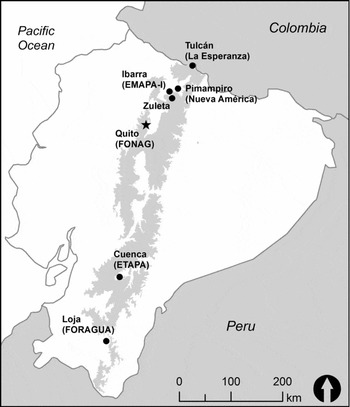
Comuna Zuleta, located in Imbabura province (Fig. 1), is a community of just over 1000 residents, 97% of whom are indigenous. Approximately two-thirds of the community's land is covered by páramo grasslands and Andean forest, and the land includes a protected area (Área de Bosque y Vegetación Protectora Zuleta y Anexos), initiated and established by the community and the neighbouring hacienda in 1995. This protected area was the result of local concern about the advance of agriculture into páramo grasslands and the impacts of intensive cattle grazing, which benefited only a small number of families in the community (Alvear Reference Alvear, Mena and Ochoa2008). Streams and springs that originate in the páramos of Zuleta contribute to the Tahuando River, which forms part of the water supply for the nearby city of Ibarra (PROFAFOR [El Programa FACE de Forestación del Ecuador] 2005). As such, the importance of hydrologic services from this area has been recognized, both for the local and regional populations, and Comuna Zuleta has engaged in a CES programme with the Municipality of Ibarra, which provides for a park guard whose function is to monitor the páramo and ensure that no illicit burning or grazing occurs. Also, a portion of the páramo has been planted with Polylepis racemosa trees through participation with PROFAFOR (Programa FACE de Forestación), a Dutch energy consortium's carbon offset programme in Ecuador. Although Zuleta has maintained these two independent CES programmes over the past several years, it also recently became one of the first communities to enrol in SocioPáramo.
Map of Ecuador illustrating the extent of páramo grasslands (in grey) and the locations of the CES programmes included in this study (excluding the two national-level programmes).

RESULTS
Overview
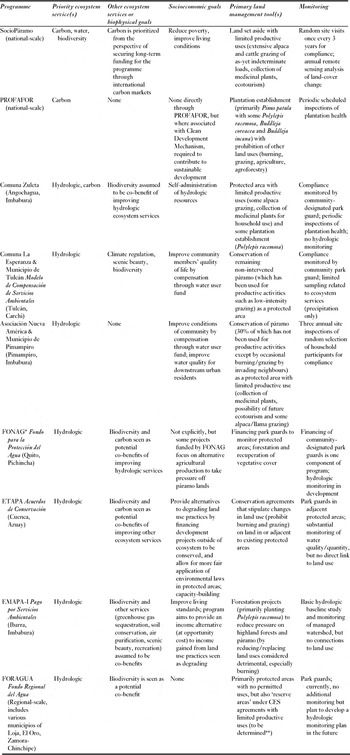
We encountered nine compensation for ecosystem services programmes, either already in progress or in the process of implementation, that focused on páramo grasslands in Ecuador, including two national-scale programmes and seven regional- or local-scale programmes (Table 1; Fig. 1). In terms of incorporating development goals into programme objectives, six of the nine programmes included some socioeconomic goal as a programme component, although those goals took a variety of forms (Table 1). Four of the programmes that included an explicit socioeconomic objective referred to general goals of ‘alleviating poverty’ or ‘improving living standards.’ One programme, PROFAFOR, had links with the Kyoto Protocol's Clean Development Mechanism, which requires that projects contribute to sustainable development in host countries; however, many of their plantations were established prior to the start of eligibility for Kyoto and did not have any aims beyond carbon sequestration. With the exception of the three community-focused projects (Asociación Nueva América, Comuna Zuleta and La Esperanza), programmes were generally seeking to meet these objectives primarily by compensating landowners for the opportunity cost associated with reducing or stopping productive activities on land conserved through CES programme obligations. In contrast, in Comuna La Esperanza and Asociación Nueva América, rather than being compensated for taking land out of production, additional community funds were obtained from nearby municipalities for continuing to conserve their páramo to maintain the hydrologic function and prevent the upward expansion of agriculture. In other cases, the ecosystem services providers were tasked to define how the compensation should be directed. For example, in the case of ETAPA, a municipal water company, the principal strategy behind the use of conservation agreements with communal landowners in the buffer zones surrounding the protected land they own was to provide them with socioeconomic alternatives, and to allow for them to define the type of compensation that best suited their needs. At the same time, not all programmes sought to foster development. For example, representatives from one municipal water company pointed out that its mandate is to provide water, which can improve living conditions in the region, but not to promote development goals more generally.
Description of the CES programmes included in this study. *Quito's FONAG model is also being followed in existing and planned programmes by FONAPA (municipality of Cuenca) and in areas of Tungurahua and Loja provinces. **Because it is a very new programme and páramo constitutes a relatively small portion of their area of interest, many decisions about land management have yet to be made.

In more than half the programmes, there was some link between the CES programme and protected areas, either because the CES programme functioned to support an existing protected area within its buffer zone or because it operated within an area that already had been designated as protected. In other cases, there was no association with an officially designated protected area, but the CES programmes were functioning as land set-asides that limited productive uses. In all nine programmes, land management tools were being used with the aim of protecting enrolled areas from what project personnel regarded to be detrimental uses of páramo, such as frequent/annual burning, intensive cattle grazing and agriculture (Table 1). However, some productive uses were allowed, such as collection of medicinal plants by households and, in some cases, extensive cattle grazing, although the meaning of ‘extensive’ had not been linked with a specified animal load in any of the programmes.
Across programmes, there was consistency in which ecosystem services were prioritized, with the primary focus being on hydrologic services, followed by carbon (Table 1). However, while each project had one ecosystem service that could be considered highest priority, seven of nine projects had expectations that multiple ecosystem services would be produced, and only synergies among services rather than trade-offs were anticipated. For example, personnel from most programmes expected that improvements in biodiversity and possibly carbon sequestration would result from changes in land management intended to improve hydrologic services. As one water company representative stated, when responding to questions about whether or not their CES programme also targeted biodiversity, ‘Targeting watershed services justifies financing the protection of a tangible resource that is much in demand. You cannot justify a funds request for conserving vegetation can you?’ However, data to support these expectations were limited and representatives from these programmes readily acknowledged that they did not have empirical studies to support these assumptions, but rather were basing them on what they considered to be the best current scientific understanding.
Most programmes had not conducted prior ecological analyses to determine baseline conditions, and several project personnel recognized that their baseline and target conditions relied on assumptions about páramo functions that were generally poorly documented. Interviews revealed the perception among some personnel that all páramo is equal in terms of ecosystem services production, perhaps contributing to the limited emphasis on collecting baseline data. However, other reasons cited included the need to initiate programmes while the political will existed. With respect to monitoring conditions following programme implementation, some programmes were collecting basic data (Table 1). For example, although the ETAPA water company did not conduct any prior ecological analyses of the buffer areas, it is now monitoring water quality and quantity of some of those areas, though not in relation to specific land uses. In another case, in La Esperanza, precipitation data were being collected, but the need for a more comprehensive hydrologic monitoring programme was recognized, reflecting a widespread concern of many of those interviewed that hydrologic monitoring was key to conserving hydrologic as well as other ecosystem services.
SocioPáramo
From the outset, SocioPáramo has had a strong focus on joining conservation and development. Poverty reduction is considered to be a key focus of the programme, which highlights the need to improve living conditions for the rural poor (MAE 2009). In order to focus on areas with the greatest needs, poverty was included as one of the variables used in the prioritization scheme developed to determine where the programme should work. Ultimately, the prioritization weighted poverty levels as equal to the level of any of the three individual ecosystem services of interest, and one-third the weight of the level of threat to the area (MAE 2009). According to programme officials, this was due to the fact that poverty, as measured by an index of Unmet Basic Needs, was calculated as ‘high’ in the vast majority of the country, making it difficult to differentiate between relatively more or less impoverished regions. They also indicated that, because there is little spatial variability in poverty at the parroquia census level that was used, weighting poverty more heavily in the prioritization would have effectively raised the total values across the country without providing any further differentiation.
In addition to including poverty in the prioritization scheme, the programme design includes several aspects intended to allow wider participation by poor communities and individuals. For example, according to MAE officials, the payment structure was developed with the intention of attracting small landowners by providing the highest payments (US$ 30 per hectare) for small areas and progressively lower payments per hectare for larger areas. The programme also allows for either individual or community land to be enrolled, and reforms to the programme were made in March 2010 to allow for the inclusion of property belonging to individuals, communities, indigenous groups and others that falls within the National System of Protected Areas but was owned prior to the creation of the protected area (MAE 2010). However, one of the programme requirements is that of land title, limiting the programme to those who have land and can clearly establish their ownership. Finally, for community participants, the programme required an investment plan that outlines how funds would be used (within four general categories of conservation, social/cultural development, organization/community-building and economic development) as an attempt to ensure equitable distribution of programme income. Like some of the other programmes evaluated, this aspect was also intended to provide the opportunity to target funds towards activities that fit within the broader development goals that had been designated by each community.
With respect to the types of conservation landscapes produced through the programme, MAE officials stated that SocioPáramo is seen as a way of expanding the net area of land under some form of protection by including privately held lands. SocioPáramo excludes areas with intensive grazing or monocultures and is attempting to focus on well-conserved grasslands with high levels of ecosystem service generation and threats of conversion. The programme prohibits the use of burning, intensive grazing, cutting vegetation other than for subsistence, or otherwise carrying out activities that would threaten the three targeted ecosystem services on land that has been enrolled, instead requiring that these conservation areas be marked as such and set aside from most types of production (MAE 2009). An exception to this is the allowance of some extensive grazing, to be evaluated on a case-by-case basis, as alpacas and llamas are generally allowed but standards for acceptable cattle grazing loads are still under consideration by programme officials. In interviews, programme officials described early efforts to create guidelines that avoided strict conservation, particularly with respect to the prohibition on burning; however, they concluded that the monitoring required for a system that did not have a consistent prohibition on this land use would be infeasible for a national-scale programme. Therefore, in terms of the way the programme has been conceived and developed, the land enrolled in SocioPáramo would form part of a parallel system to that of protected areas, with an overall aim of activity reduction. However, it is important to note that the programme aims to use payments as incentives to those who are already maintaining well-conserved land, rather than as payments to cover the opportunity costs of taking land out of production. In some cases, this may serve as a substitute income source to replace that derived from banned activities, while in others it will promote a continuation of existing land management. Furthermore, the programme is more flexible in practice than in conception, with field extension officers having the responsibility to decide the status of the páramo being enrolled in each location, what qualifies as a monoculture, and what qualifies as intensive or semi-intensive grazing, which determines whether cattle have to be removed.
In terms of the production of ecosystem services, SocioPáramo seeks to sustain or promote the production of water, carbon and biodiversity in páramo grasslands, primarily through land management that excludes burning and limits grazing. However, the ban on burning and grazing remains a topic of discussion by the programme directors and part of a larger debate about the historical role of fire and current best practices in páramo ecosystems. SocioPáramo programme officials were well aware of these debates and were seeking collaborations to help them develop the scientific basis needed to measure the impact of the programme; however, the initiation of the programme relied primarily on broad expert knowledge rather than on in situ studies providing data on the effects of medium- or long-term exclusion of burning and grazing. For this reason, the design of the monitoring programme was focused primarily on compliance to ensure that enrolled land is managed according to programme requirements, using a combination of annual remote sensing analyses and site inspections at a set of randomly selected locations each year. However, the lack of clear baseline data on the condition of property prior to enrolment may complicate this task, and programme personnel acknowledged the logistical issues associated with compliance monitoring in cases where extensive grazing had been permitted, particularly the need to ‘count cows’ across larger enrolled areas.
Comuna Zuleta
According to community representatives, the establishment of a protected area in the páramo grasslands and Andean forest in Comuna Zuleta, including the removal of activities seen as degrading, derived from a growing conservation consciousness in the community and focused broadly on protecting water sources, both for the local population and for the city of Ibarra and surrounding communities (Alvear Reference Alvear, Mena and Ochoa2008). When the cattle that benefited few families were removed, a new programme began to introduce alpaca in one portion of the páramo, an activity that benefits the wider community. While poverty alleviation was not necessarily an explicit part of Zuleta's páramo management strategy, there was a purposeful attempt to shift to broader community benefits. Furthermore, the community president has explicitly linked conservation with broader social development goals and emphasized community-wide benefits. For example, water resources that originate on communal lands are currently under the management and control of EMAPA-I, Ibarra's water company. Community leaders indicated that they hoped to achieve self-administration of these resources, and thus a portion of user revenue, through the CES programme as a way of exercising sovereignty and control over their own development. In spite of the less explicit inclusion of development goals in the programme, they are in many ways woven into the broader approach of this community, and CES is seen as a potential contributor.
In terms of the conservation landscapes produced, Zuleta provides a somewhat unusual example of a locally-initiated protected area, which is formally recognized by the national government but allows local autonomy to decide which land uses can occur within it. As such, despite its protected area status, the páramos in Zuleta function as a patchwork of protected and working landscapes that include ungrazed and unburned páramo, páramo that is grazed by alpacas, and páramo planted with Polylepis racemosa, a species that is native to highland Peru but is exotic in Ecuadorian páramos. It also includes a mix of activity-enhancing and activity-reducing programmes. The existing carbon-focused CES programme was at least temporarily activity-enhancing, with labour required to establish the plantations. The community had also established a Polylepis nursery, where they were raising seedlings and selling the trees as saplings to other communities in the area, creating a new source of employment and income. The water-focused CES programme also provided employment for the park guard, and although its general focus was activity-reduction, it sought to bring in new income through replacement activities such as raising alpaca in some parts of the páramo. Now that the community has enrolled in and is receiving compensation from SocioPáramo, the emphasis may shift towards greater activity-reduction if the stricter intent of the programme is followed, or may be activity-neutral if the application of the programme in practice proves to be more flexible with respect to existing management practices. Currently, some of the funds are being used towards the payment of park and land managers, supporting if not creating employment.
The issues faced by SocioPáramo with respect to measuring and monitoring the production of ecosystem services also existed in Zuleta. As with SocioPáramo, the assumption had been made that if intensive burning and grazing were understood to cause soil degradation, the reversal of these activities should produce the opposite effect. Specifically, the expectations held by those in the community who were involved with the conservation programme included recovery of degraded páramo over approximately 15 years after the exclusion of burning. However, no data yet exist to verify this assumption, or the assumption that this type of vegetation recovery would correlate with improved production of water-related ecosystem services or biodiversity, which was seen as a co-benefit of this land management strategy. Furthermore, while the plantations of Polylepis racemosa are monitored every six months by PROFAFOR, no data exist to determine whether there is any trade-off between this land use, which is focused on carbon sequestration, and hydrologic function or biodiversity.
DISCUSSION
Conservation and poverty alleviation
To the degree that poverty alleviation is more likely to result where ecosystem services production is high and payments are greater than foregone production (Jack et al. Reference Jack, Kousky and Sims2008), several of the programmes evaluated have high potential. In the case of Zuleta, in particular, the páramo is considered to be valuable for hydrologic services for the surrounding area and the production value of the land prior to creation of the protected area was low and inequitably distributed, suggesting that there is potential for CES programmes there to contribute to development goals.
Further, both Zuleta and SocioPáramo support the contention by Wunder (Reference Wunder2006) that generally only a portion of land is set aside in PES while the remainder continues to be used for production. In these cases, as well as several of the community-based programmes, the options of moving cattle to lower altitudes where production can continue or of developing lower-impact production alternatives within the páramo have been important in allowing conservation to become an option. These cases also appear more likely to avoid the negative consequence raised by Muradian et al. (Reference Muradian, Corbera, Pascual, Kosoy and May2010) of the poor becoming specialized in ecosystem services production at the expense of food production.
Nonetheless, across the programmes reviewed, several reflect the observation by Kollmair and Rasul (Reference Kollmair and Rasul2010) that, although many PES programs focus on marginalized areas that provide high levels of ecosystem services and also tend to have high levels of poverty, they often do not include poverty reduction as a central purpose. In these cases, the ‘money inflows into cash-poor marginal zones’ (Wunder Reference Wunder2006, p. 28) may themselves be viewed as the means to or an indication of improving development conditions. A notable exception is the case of SocioPáramo, which has poverty reduction as a central aim. Overall, many of SocioPáramo's programme features can be seen as attempting to fulfil the potential of PES to meet human needs while simultaneously promoting conservation; however, as noted in other cases (for example Grieg-Gran 2005) the requirement of land tenure, and in this case property maps, generally excludes many of the poorest people. It should be noted, however, that inclusion of land managers who lack title can increase programme costs, such that a potential trade-off exists between inclusivity and efficiency, and that inclusion of land where ownership boundaries are unclear can create conflicts that would likely hinder the success of the programme.
Past efforts at conservation and poverty alleviation have struggled to demonstrate successful outcomes (Agrawal & Redford Reference Agrawal and Redford2006) and the lack of indicators, beyond the information contained in the community investment plans, to judge the degree to which the poverty alleviation objective is being met may leave SocioPáramo in a similar situation. As other studies have noted (for example Muradian et al. Reference Muradian, Corbera, Pascual, Kosoy and May2010), the evidence is mixed, and as yet uncertain, regarding whether these types of programmes will ultimately lead to poverty alleviation, particularly where this aim is not explicitly included. It has been noted that even programmes that target areas with high poverty levels do not always achieve the goal of benefiting the poor (Miranda et al. Reference Miranda, Porras and Moreno2003; Pagiola et al. Reference Pagiola, Arcenas and Platais2005; Zbinden & Lee Reference Zbiden and Lee2005; Muradian et al. Reference Muradian, Corbera, Pascual, Kosoy and May2010), making measures of this outcome all the more necessary.
Conservation landscapes
The cases evaluated illustrate that PES programmes can fall across a spectrum from activity-reducing to activity-enhancing. Most of the programmes could be regarded as activity-reducing relative to the previous uses, although two of the community-focused programmes involved land that had not been used for production prior to the CES programme and, therefore, could be considered activity-neutral. SocioPáramo agreements involve zoning land into separate protected and productive areas or decreasing burning and grazing, separating working and conservation landscapes. However, in general, the programme appears to be largely activity-neutral, and in some cases may even be activity-enhancing where funds received through the programme are used for activities such as employing park guards, building trails or increasing monitoring. Similarly, the potential of PES to provide new income sources (and other new means of compensation), while continuing to maintain some working landscapes that contribute in other ways to local livelihoods, is evident in Zuleta. In this case, the trend towards activity-reduction had begun already and, depending on which activities are allowed to continue under SocioPáramo, CES appears to have potential to support and reinforce local development. As such, the criticism of PES that the programmes would force people to abandon local development or that they are ‘paid to do nothing’ (Wunder Reference Wunder2006) does not appear to be borne out.
Four of the programmes evaluated included afforestation, either as the primary tool or as a component of their land management strategies, with objectives ranging from recuperating degraded vegetative cover to deterring burning to a more specific focus on sequestration of aboveground carbon. These cases, to some degree, combined working and conservation landscapes, and might be considered activity-neutral. However, tree planting is generally less labour-intensive than previous land uses, such as where it replaces raising livestock, making some of these programmes activity-reducing. For example, PROFAFOR now uses 100-year contracts, which bring in additional income from the initial plantation and require labour for maintenance, but much of the expected income will not come until harvesting occurs.
Many of the CES programmes evaluated were linked in some way with protected areas, a finding consistent with Goldman et al. (Reference Goldman, Tallis, Kareiva and Daily2008) who concluded that, compared with traditional biodiversity conservation projects, ecosystem service projects were more likely to include working landscapes but not less likely to include or create protected areas. However, our results suggest that the degree to which programmes are associated with protected areas may not be the best indicator of activity enhancement or reduction. Although most of the programmes reviewed included some form of activity-reduction, the cases where CES funding supported some employment in the area targeted for conservation, in particularly the case of Zuleta, demonstrate that areas designated as protected areas have potential for equal or fewer restrictions than areas that are not.
Providing and sustaining ecosystem services
Muradian et al. (Reference Muradian, Corbera, Pascual, Kosoy and May2010) have noted that, due to the high cost of clearly establishing relationships between land use and ecosystem services provision, decisions for most PES policies are made with incomplete information, particularly in developing countries. The cases evaluated here clearly support this conclusion, with limited information linking land use with ecosystem service production in all cases. Although they share this feature in common with other programmes worldwide, and it has been argued that paying for poorly defined services may be appropriate in some cases (Farley & Costanza Reference Farley and Costanza2010), this likely remains a barrier to development of effective and viable programmes, in particular where the provision of multiple ecosystem services is anticipated.
Burning exclusion is one of the key land management tools in the CES programmes reviewed, and most notably in SocioPáramo. Burning on 1–3 year rotations, particularly in combination with grazing, has been found to cause degradation of páramo grasslands (Verweij & Budde Reference Verweij, Budde, Balslev and Luteyn1992; Poulenard et al. Reference Poulenard, Podwojewski, Janeau and Collinet2001; Podwojewski et al. Reference Podwojewski, Poulenard, Zambrana and Hofstede2002). However, the effects of fire alone on páramo ecosystems are poorly studied beyond the short-term impacts of experimental burns and there is little empirical evidence on the effects of removal of burning from these ecosystems (Ramsay & Oxley Reference Ramsay and Oxley1996; Keating Reference Keating1998). This has led to disagreement regarding whether burning exclusion, or possibly an intermediate level of burning, which in some cases has been found to have positive effects on plant diversity (Ramsay & Oxley Reference Ramsay and Oxley1996; Keating Reference Keating2007), is the best way to achieve the goal of well-conserved páramo grasslands. Further, whether this single land use prescription can produce three different ecosystem services simultaneously remains unclear. Data from other regions has illustrated that synergies among ecosystem services can occur under some scenarios, but trade-offs exist under others (Chan et al. Reference Chan, Shaw, Cameron, Underwood and Daily2006). For example, some land uses can effectively promote carbon sequestration while simultaneously degrading hydrologic function and other ecosystem services (Farley et al. Reference Farley, Jobbágy and Jackson2005; Jackson et al. Reference Jackson, Jobbágy, Avissar, Roy, Barrett, Cook, Farley, le Maitre, McCarl and Murray2005). This is particularly true in grassland and shrubland ecosystems, where carbon sequestration may come at the expense of biodiversity conservation and water supply (Chisholm Reference Chisholm2010).
A second widely used land management tool among the programmes evaluated is afforestation. However, existing studies have demonstrated that trade-offs between carbon sequestration and water yield exist with plantations of some species, in particular pine (Farley et al. Reference Farley, Kelly and Hofstede2004, Reference Farley, Jobbágy and Jackson2005). Some of the CES programmes evaluated, especially those with a focus on hydrologic services, have instead used Polylepis racemosa for plantations, under the assumption that plantations using species that are at least native to the region will have a positive effect on carbon storage without trade-offs with other ecosystem services. However, no data yet exist that demonstrate the medium- or long-term ecosystem effects of plantations with this species, impeding the evaluation of potential trade-offs among ecosystem services where it is planted. And, in other regions, it has been noted that in order to achieve synergies among, for example, carbon sequestration and biodiversity, novel reforestation designs are needed that explicitly seek to maximize multiple services (Kanowski & Catterall Reference Kanowski and Catterall2010). Chisholm (Reference Chisholm2010) has pointed to the need for guidelines regarding where afforestation for carbon sequestration is appropriate, and the need to give attention to potential impacts beyond carbon; the development of such guidelines is particularly needed for páramo ecosystems, where the hydrologic and biodiversity values are large.
Ultimately, the ability of PES to provide the ecosystem services promised will require monitoring based on appropriate proxy measures that link land management to ecosystem functions and services (Jack et al. Reference Jack, Kousky and Sims2008). However, these kinds of proxy measures do not yet exist for most programmes. For SocioPáramo, monitoring is limited to an evaluation of land management, which itself may be difficult to monitor in grassland systems where changes are not as easily detected and observed through remote sensing techniques. In the case of Zuleta, community leaders are seeking basic data to evaluate the status of their conserved land, as well as data to monitor hydrologic function and other ecosystem services more generally, but baseline data are limited. Jack et al. (Reference Jack, Kousky and Sims2008, p. 9467) noted that ‘The long-run viability of PES schemes may depend, in part, on advances in techniques for estimating ecosystem services from easily observable ecosystem properties’. This is likely to be particularly true in small communities like Zuleta, where resources for complex monitoring schemes are unlikely to exist and proxy measures will be necessary to demonstrate the environmental effectiveness of CES programmes.
CONCLUSIONS
The cases evaluated here suggest that, in some cases, PES schemes can support local development rather than forcing it to be abandoned. However, this study also highlights the need for measures of the effects of PES programmes on poverty, both where poverty reduction is a central focus and where it is a desired co-benefit. Without such measures, these programmes are likely to suffer from the same problems as many of the conservation and development schemes that preceded them.
This research also suggests that the dichotomy often presented between protected areas and ecosystem services approaches may not be appropriate. Instead, the degree to which working and protected landscapes are combined under PES depends more on how decisions about programme restrictions and allowances are made rather than whether areas are officially designated as protected or not. As such, a focus on the potential livelihood impacts of a particular set of restrictions and allowances is likely to be more informative with respect to impacts on local populations than whether areas are labelled as protected.
Finally, these cases underscore the idea that scientific understanding of ecosystem production functions continues to be a limiting factor for PES and that the lack of monitoring of outcomes makes it difficult to assess programme effectiveness (Daily & Matson Reference Daily and Matson2008; Goldman et al. Reference Goldman, Tallis, Kareiva and Daily2008). Particularly in cases where relationships between land use and ecosystem services provision are not well documented, the importance of monitoring to judge the environmental effectiveness of programmes increases. Furthermore, much as the integration of conservation and poverty alleviation aims requires that the trade-offs between the two be recognized (Sanderson & Redford Reference Sanderson and Redford2003), both the potential synergies and the potential trade-offs among ecosystem services must be acknowledged in order to create PES programmes that achieve environmental effectiveness with respect to the most highly prioritized services and appropriate expectations with respect to likely co-benefits.
ACKNOWLEDGEMENTS
Many people provided their time and insight; without them, this study would not have been completed. We thank EcoCiencia and Fundación Cordillera Tropical for institutional support. Funding for this research was provided by the National Science Foundation Geography and Spatial Sciences Program, BCS-0852039, and the San Diego State University Grant Program. We are grateful to the editor and anonymous referees for very helpful comments on an earlier version of this article.