Recent advancement in medicine and technology continues to result in increased survival after severe brain injury, and the increased potential of individuals to recover functional status even many years after their injuries (Gontkovsky et al., Reference Gontkovsky, Sherer, Nick, Nakase-Thompson and Yablon2006; Man et al., Reference Man, Lee, Tong, Yip, Lui and Lam2004). Family members and caregivers are thus increasingly experiencing commitment to caring for family members many years following the injury, assisting individuals with brain injury on prevention and health issues and early intervention for medical complications as a life-long process (Murphy & Carmine, Reference Murphy and Carmine2012). Individuals with brain injury are also faced with continued rehabilitation and services needs many years post injury. Man et al. reported that life expectancy following a severe traumatic brain injury is approximately 50 years (2004).
Long-term outcome studies of persons with severe TBI have concluded that patients with moderate and severe TBI show physical and functional improvement but continue to experience cognitive and psychosocial adjustment problems (deGuise et al., Reference deGuise, leBlanc, Feyz, Meyer, Duplantie, Thomas and Roger2008). Although many people show good physical recovery with independence in locomotion and basic life skills, ongoing neuropsychological sequelae of cognitive and behavioural disorders often create difficulty in social reintegration. In very long-term studies (more than 14 years), patients with moderate to severe TBI have been found to continue to demonstrate significant limitations for complex activities of daily living and instrumental activity of daily living tasks. Serious problems in the areas of psychiatric symptomatology, social functioning and family integration have been observed. Although more research looking at long-term outcome is now being published, there are few studies using standardised evaluation tools and outcome measures encompassing a broad range of domains for survivors of severe TBI at least two years post-trauma, and as a result, little is known about the long-term effects of TBI (deGuise et al., Reference deGuise, leBlanc, Feyz, Meyer, Duplantie, Thomas and Roger2008). Consumers must also have appropriate services and access to these services which include transitional living, vocational services, independent living and supportive employment.
Service providers who are treating individuals with brain injury need to be aware of the unique rehabilitation and care needs of the individual and his or her family members. Family members have been found to play a significant role in care-giving and support following the injury of a family member. Due to this important role, family members’ reported needs are also an important component in the development of rehabilitation and service needs plans following brain injury (Sinnakaruppan & Williams, Reference Sinnakaruppan and Williams2001). As clients enter rehabilitation settings, service providers must integrate individual's needs, the environments in which the client will be functioning, and the clients’ concerns into the services provided (Abreu, Zhang, Seale, Primeau, & Jones, Reference Abreu, Zhang, Seale, Primeau and Jones2002).
Information on needs and services for individuals with brain injury usually comes from state needs assessments, such as a survey conducted by New York State Head Injury Association which cited unmet needs related to family support services, special social opportunities, counselling and specialised therapy services (Heinemann, Sokol, Garvin & Bode, Reference Heinemann, Sokol, Garvin and Bode2002). Heinemann et al., (Reference Heinemann, Sokol, Garvin and Bode2002) reported that the relation between services received and unmet needs remains complicated. It is typically found that individuals receiving fewer services also report greater unmet needs; however exceptions have been noted in the literature. There is need for increased rehabilitation counselling-related research focus on the perspectives of individuals with brain injury and their family members on their specific unmet rehabilitation and service related needs, as well as on the barriers they face in accessing the needed services.
The objective of this study was to identify the rehabilitation services needs, the rehabilitation goals, and the barriers that persons with brain injury and their families encounter as they navigate the recovery process. The following research questions were explored in this study: (1) What rehabilitation services do persons with brain injury and their families seek most after the brain injury?; (2) What are the rehabilitation goals of individuals with brain injury and their families?; (3) What are the barriers to accessing rehabilitation services after brain injury?.
Method
Participants and Settings
Participants were 100 individuals receiving outpatient acquired brain injury services (females = 40%, motor vehicle accident injury = 39%; mean age = 43.12 years, SD = 16.43 years, majority ethnicity = 89% White), and their families in a Midwestern state of the US. Among the respondents, 81 (approximately 80%) individuals were survivors of a brain injury, the remaining 19 individuals were family members (spouses and relatives) answering on behalf of the brain injury survivors. The family members included seven mothers, two fathers, seven spouses/partners, and three children of the survivors. A majority of survivors (75%) were unemployed. Duration of time since injury was 10 years or less for approximately 66% of the participants.
Data Collection Instrument
Data on the importance to the participants of various aspects of their acute and long-term rehabilitation experiences were collected using a 9-item scale constructed based on a review of the literature and existing measures (e.g. Family Needs Questionnaire, Kreutzer & Marwitz, Reference Kreutzer and Marwitz1989).
Rehabilitation service experiences
The participants rated the importance of experiences or characteristics of their rehabilitation experience on a four-point scale ranging from 1 ‘Not important’ to 4 ‘Very important’. A Cronbach's alpha of .85 was computed for the scale for this study, suggesting a high level of internal consistency. Participants were then asked to review a list of 15 service options typically provided to brain injury survivors in the state, and to identify (1) which services they were receiving or had received in the past, (2) which services they do not receive, but would like to receive, and (3) how important they think these services are to brain injury survivors on a scale from 1 (‘Not important’) to 5 (‘Very important’). A Cronbach's alpha of .92 was computed for the importance ratings component of this scale, suggesting a high level of internal consistency.
Life goals and goal attainment barriers
Participants reported on their life goals, expected barriers and concerns about the future. Responses were collected through focused interviews. Six interview questions were used to evaluate participants’ responses concerning:
1. Their main concerns about the future.
2. The degree to which the services and supports they received were helpful.
3. Needed improvement in the services and supports they received.
4. The life goals that they would like to achieve in the next two years.
5. The likely barriers to achieving these goals.
6. Services that would be most helpful in reaching their life goals.
Procedure
Permission for the study was granted by the state's institutional review board for the protection of human subjects. The participants were recruited in two phases as described below.
Survey phase
The recruited participants were sent a letter with the consent form and a copy of the survey instrument, with a postage-paid return envelope. In addition to demographic and injury-related data, the survey instrument included several questions about personal and rehabilitation service-related needs and the desired characteristics of brain injury services, developed based on a review of the brain injury literature and existing measures about brain injury services. Participants were also asked to rate the importance of various state-based brain injury supports and services that were available to them. Returned completed survey data were entered into a database for cleaning and analysis.
Focused interview phase
Twenty-two participants were randomly selected from the database of the completed survey data to participate in the follow-up focused interview. The follow-up focused interview was designed to validate the survey results and to develop more comprehensive information on the services and supports that individuals with brain injury need. The interview was described to the participants in the consent form. The interviews were conducted in person or telephone depending on the participant's preference. The participants who preferred telephone interview were contacted using the phone numbers they provided. The researchers who conducted the interview followed a uniform interview protocol, and in order to protect confidentiality, the participants’ identifying information was not collected. Data from the focused interviews were entered in a separate database and analysed for common themes and information on the needs of the individuals with brain injury.
Data Analysis
A mixed method approach was used to analyse the quantitative survey data and the qualitative interview data. Descriptive statistics were used to analyse and present the quantitative data, while qualitative analysis, specifically content analysis, was used to analyse qualitative responses. Content analysis is appropriate for categorising the verbal responses of participants (Berg, Reference Berg2007). After transcription of the participants’ responses, two of the researchers independently read the transcripts to identify common themes (Creswell, Reference Creswell2009). The two researchers who read the transcripts met and discussed the common themes, and then decided on common categories for the responses that represented the experiences of individuals with brain injury and their family. A third member of the research team then independently reviewed the transcripts, resolving any disagreements regarding their categorisation with the first pair of coders.
Results
Rehabilitation and service needs
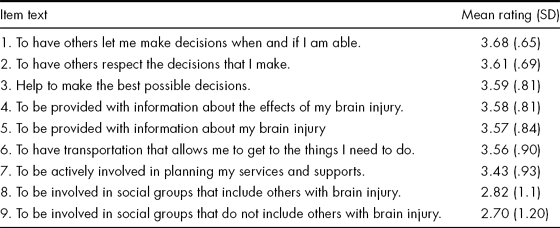
The participants rated the importance of rehabilitation and service-related needs based on a 4-point scale that ranged from 1 (‘Not Important’) to 4 (‘Very Important’). As noted in Table 1, the needs with the highest mean importance ratings included those concerning autonomous decision making and receiving information about the effects of brain injury. There were no significant group differences in ratings between the self-reporting individuals with brain injuries and family members reporting on behalf of their relative with a brain injury.
Service needs and characteristics importance rankings

Note: Mean ratings based on 4-point scale ranging from 1 ‘Not important’ to 4 ‘Very important’.Modal response for all items = 4.
Importance of rehabilitation services received
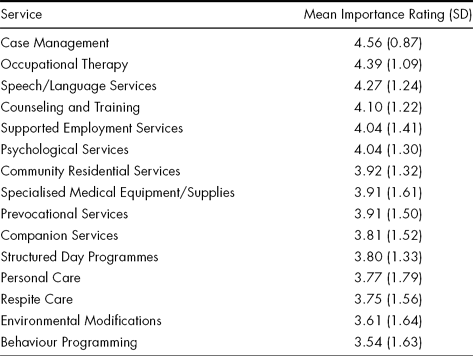
Participants rated the importance of 15 community-based services that are typically provided to brain injury survivors in the state on a 5-point scale that ranged from ‘Most Important’ to ‘Least Important’. We compared the ratings between those participants who reported that they were currently receiving or had in the past received the services, and those who reported that they had not but would like to receive the services. There were no statistically significant differences in the ratings between the two groups. The mean of the family members’ ratings of the importance of the services tended to be higher than the mean ratings of the self-reporting individuals, although the differences were not statistically significant. As noted in Table 2, among the services rated as most important were: Case management (Mean = 4.56), Occupational therapy (Mean = 4.39), Speech/language services (Mean = 4.27), Counselling and training (Mean = 4.10), Supported employment services (Mean = 4.04), and Psychological services (Mean = 4.04).
Mean importance ratings for community rehabilitation services
Note: Mean ratings based on 5-point scale ranging from 1 ‘Not important’ to 5 ‘Very important’.
Concerns about your future
Approximately 16% of the participants had concerns related to work opportunity. About 14% of the participants had concerns about living and functioning independently and 13% of were concerned for their financial needs. Approximately 11% of the participants had concerns about having a place to live. About 30% of the participants identified case management as the most helpful service they received. Transportation-related assistance was less of a concern. Approximately 25% identified money, finances and assistance with paying caregivers as helpful services. Transportation was identified by 13% of the respondents. Training and employment-related services accounted for about 15%, while 5% identified case management services as a helpful service for reaching their goals.
Discussion
Three themes consistently emerged in the areas of rehabilitation and service needs: financial resources, informational resources, and autonomy and acceptance. The rehabilitation and service needs identified by the participants in this study were similar to the needs identified in previous studies (e.g., Bartlett, Lorenz, Rankin, Elias, & Weider, Reference Bartlett, Lorenz, Rankin, Elias and Weider2011; Pickelsimer et al., Reference Pickelsimer, Selassie, Sample, Heinemann, Gu and Veldheer2007; Vaughn, & King, Reference Vaughn and King2001). Lack of financial resources has been cited as a barrier to services for persons with brain injuries and their families by several researchers (e.g., Callaghan, McAllister & Wilson, Reference O'Callaghan, McAllister and Wilson2010; Corrigan, Whiteneck & Mellick, Reference Corrigan, Whiteneck and Mellick2004; Elbogan, Johnson, Wagner, Newton & Beckham, Reference Elbogen, Johnson, Wagner, Newton and Beckham2012; Lehan, Arango-Lasprilla, de los Reyes, & Quijano, Reference Lehan, Arango-Lasprilla, de los Reyes and Quijano2012). Individuals with brain injuries and their families face difficulties paying for rehabilitation through to the point of maximal recovery. Rehabilitation services are frequently fragmented and health insurance coverage is often seen as confusing and limited, and many individuals do not possess health insurance coverage.
The need for information was identified as a major need of families of individuals with brain injury. Family members stated that they needed information during the acute and post acute care of their family member with a brain injury, and needed information on the services and resources available in the community available to help in their adjustment to the new situations associated with the brain injury. As the injury of a family member affects the dynamics of the whole family, professional support of the family members through provision of information that address their concerns is important in helping the family members of a person with brain injury cope with the their new situations (Degeneffe, & Lee, Reference Degeneffe and Lee2010; Lefebvre & Levert, Reference Lefebvre and Levert2012).
The six rehabilitation services reported by the respondents in the present study as most important to them and their family members were case management, occupational therapy, speech/language services, counselling and training, supported employment and psychological services. This finding is also consistent with prior international research (e.g., Man et al., Reference Man, Lee, Tong, Yip, Lui and Lam2004; O'Callaghan, McAllister & Wilson, Reference O'Callaghan, McAllister and Wilson2011; Spearman, Stamm, & Tivis, Reference Spearman, Stamm and Tivis2007). In several studies, individuals with brain injury have reported the following services as very important: medical services, occupational therapy, physiotherapy, vocational therapy and social work.
Persons with TBI and their family members who provide care identified several needs that would increase their recovery. These include: development of a long-term rehabilitation strategy before discharge, having a plan for employment (provision of vocational services, job training return to school), availability of a support group, periodic re-evaluation of progress of recovery, and on-going services that provide help for behavioural, cognitive, and physical problems, and respite services (Rotondi et al., Reference Rotondi, Sinkule, Balzer, Harris and Moldovan2007).
Implications Practice, Advocacy and Research
There is a need to increase educational services by rehabilitation service providers, starting early in the medical and rehabilitation stages (acute, post-acute and rehabilitation stages) in order to help families get a better sense of the challenges and resources available in the community. A greater emphasis on TBI-related services, and on the integral role of family members, is needed in rehabilitation counsellor education in both pre-service and continuing education (Degeneffe et al., Reference Degeneffe, Boot and Kuehne2008) in order to meet the rehabilitation needs of persons with brain injury and their families.
Rehabilitation counsellors and other rehabilitation professionals can increase access to rehabilitation services for individuals with brain injury and their families by providing information on available services and resources, and by seeking service and research grants that result in improved service delivery for persons with brain injury. Targeted and individualised advocacy should be provided especially for persons with brain injury who may have limited opportunities to access services; such individuals include persons with brain injury with low income and those from ethnic minority groups.
Study Limitations
Several limitations in the design of this study should be considered in evaluating the results. These include the relatively small and geographically restricted sample size, the range in duration since time of injury, the use of self-report, and the cross-sectional design. The fact that, in some cases, family members reported for the individual with a brain injury may have resulted in biased reporting. The family members may have been reporting from their own perspectives and not the perspective of the person with brain injury. There were, however, no significant differences in any of the ratings between the two groups.
Conclusion
Individuals with brain injury and their family members have multiple rehabilitation and services needs especially after the acute stage of rehabilitation. The needs are generally met by interdisciplinary rehabilitation professionals through case management, occupational therapy, speech/language services, counselling and training, supported employment services, psychological services, and community residential services. Inherent in the results of this analysis is the integral role that family members play throughout the rehabilitation process, from acute care through long-term recovery. As noted by Bishop, Degeneffe and Mast (Reference Bishop, Degeneffe and Mast2006), the inclusion of family members early in the rehabilitation process, the early evaluation of functional and mental health needs and how to meet such needs, and the assurance of resources and information coordination on behalf of the families remain critical components of effective brain injury rehabilitation.