INTRODUCTION
The term “problematical deposits” (hereafter shortened to “problematic deposits”), was a provisional term coined to designate a range of “special deposits of uncertain function” (Moholy-Nagy Reference Moholy-Nagy1997:302) at Tikal that were neither burials nor caches (Coe Reference Coe1982:49, Reference Coe1990:930–939; Moholy-Nagy and Coe Reference Moholy-Nagy and Coe2008:67–71). Since that time, the term has been expanded to refer to a range of deposits that have puzzled archaeologists. Unlike caches, which are buried, or middens, which are typically found at the sides or backs of structures (or far away from them), problematic deposits tend to be found in prominent locations in monumental centers, often in association with elite residences and plaza floors. Mock (Reference Mock and Mock1998a:115) noted that many of these deposits are located along the central axes of buildings, in doorways, and in the corners of plazas. Although the term problematic deposit is occasionally criticized for being too vague (Lamoureux-St. Hilaire and Snetsinger Reference Lamoureux-St-Hilaire and Snetsinger2020), we believe that in some ways the term's vagueness is an advantage because it does not ascribe function to the deposits nor intention to their deposition (e.g., “ritual deposits”).
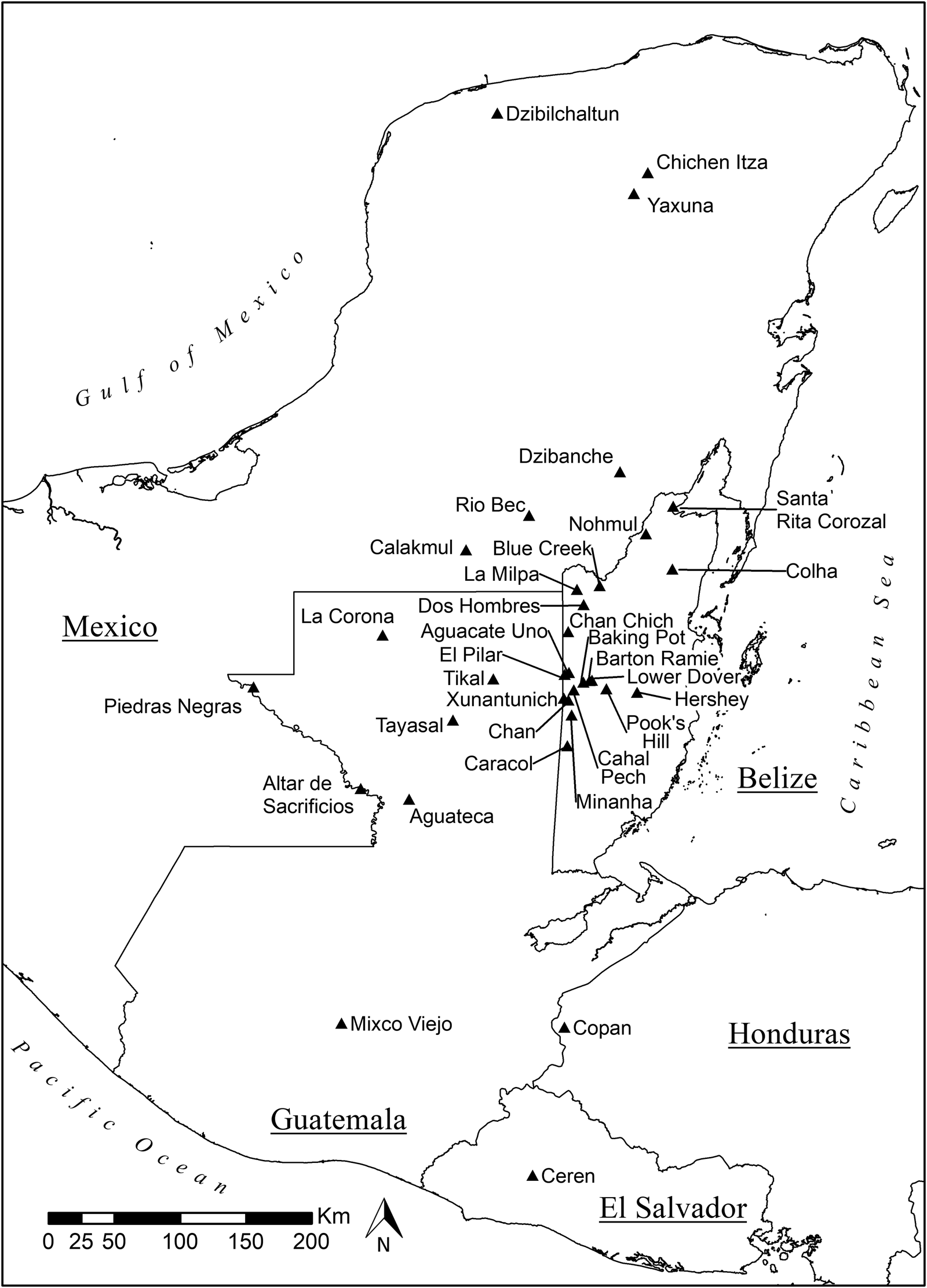
Problematic deposits identified across the Maya lowlands (Figure 1) are often linked to abandonment (Ambrosino et al. Reference Ambrosino, Ardren, Stanton, Brown and Stanton2003; Ardren Reference Ardren and Gubler1999; Brown and Garber Reference Brown, Garber, Kathryn Brown and Stanton2003; Chase and Chase Reference Chase, Chase, Demarest, Rice and Rice2004; Clayton et al. Reference Clayton, David Driver and Kosakowsky2005; Freidel Reference Freidel and Mock1998b; Guderjan Reference Guderjan2004; Houk Reference Houk, Iannone, Houk and Schwake2016; Inomata Reference Inomata, Iannone, Houk and Schwake2016; Mock Reference Mock and Mock1998a; Navarro-Farr Reference Navarro-Farr, Iannone, Houk and Schwake2016; Navarro-Farr et al. Reference Navarro-Farr, Freidel, Arroyave Prera, Stanton and Magnoni2008; Stanton et al. Reference Stanton, Kathryn Brown and Pagliaro2008; Tsukamoto Reference Tsukamoto2017). Similar deposits, however, have also been identified in Preclassic and Early Classic contexts (Hansen et al. Reference Hansen, Howell, Guenter, Stanton and Magnoni2008; Walker Reference Walker and Mock1998), so the use of this term is not restricted only to the remains of the final activities in ceremonial spaces at the end of the Classic period, but may also indicate similar phenomena separated by centuries at the same site (Walker Reference Walker and Mock1998:85). For this reason, archaeologists working in the Belize Valley (cf. Awe et al. Reference Awe, Helmke, Aimers, Ebert, James Stemp and Hoggarth2020a; Hoggarth et al. Reference Hoggarth, Britt Davis, Awe and Helmke2020) prefer to use the term “peri-abandonment deposit” for a variety of features directly associated with abandonment contexts. This term does not encompass problematic deposits not related to abandonment events (e.g., consecration events); it is an umbrella term that is more specific than “problematic deposits” but still does not assume a function for these features.
Map of sites discussed in this issue. Map © 2019 Walter Witschey, with data from the Electronic Atlas of Ancient Maya Sites (http://MayaGIS.smv.org).

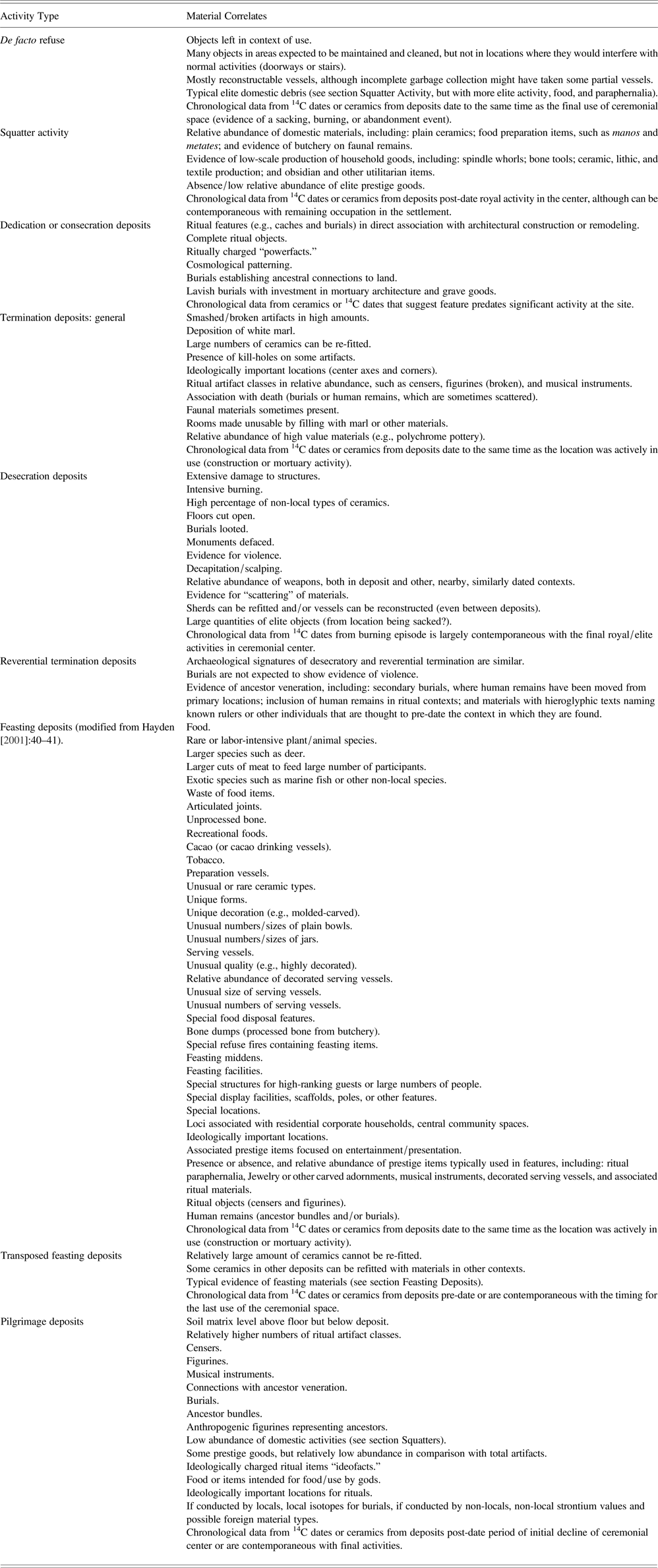
We present a brief typology of problematic deposits in this article and Table 1 summarizes some of the important material correlates of each type. We see two broad categories of problematic deposits: those associated with mundane activities (de facto refuse and artifacts left by squatters) and those associated with dedication and termination rituals, feasting, and pilgrimage, in which broken, smashed, or scattered objects are intentionally deposited in what can be compared to other sorts of sacrificial offerings (Mock Reference Mock and Mock1998b:5). Problematic deposits can be found in elite and non-elite contexts. We do not claim to have identified all the possible behavioral correlates of problematic deposits in this paper.
Archaeological and chronological correlates for behaviors and hypotheses related to problematic deposits.

We caution, as many others have, that artifact content alone is not enough to distinguish the varied meanings that problematic deposits may have had for the ancient Maya—detailed contextual analysis is essential. Furthermore, as Houk (Reference Houk, Iannone, Houk and Schwake2016:205) notes, these deposits “could represent a palimpsest of material, potentially the result of multiple events that spanned days or decades.” For example, Freidel (Reference Freidel and Mock1998a:192) discusses “compound contexts” where “dedication and termination rituals…occur together” (see also Becker [Reference Becker, Saunders and Montmollin1988:122–123] and Navarro-Farr [Reference Navarro-Farr, Iannone, Houk and Schwake2016]) and Aimers (Reference Aimers, Inomata and Webb2003:160) discusses multiple abandonments difficult to separate stratigraphically (see also Awe et al. Reference Awe, Helmke, Aimers, Ebert, James Stemp and Hoggarth2020a, Reference Awe, Ebert, Hoggarth, Aimers, Douglas, Helmke and James Stemp2020b and Aimers and Awe Reference Aimers and Awe2020).
DE FACTO REFUSE
Because problematic deposits are often on or just above floors, in the Maya area they have often been assumed to be de facto refuse representing the last activities conducted prior to a rapid, unplanned abandonment (Inomata and Sheets Reference Inomata and Sheets2000:6). As defined by Schiffer (Reference Schiffer1987:89), de facto refuse “consists of the tools, facilities, structures, and other cultural materials that, although still usable (or reusable), are left behind when an activity area is abandoned.” De facto refuse does not include trash that has been moved from its systemic context. De facto refuse in site cores is expected to reflect the activities of the last elite occupants but, as Schiffer (Reference Schiffer1987:89) notes, “variability in de facto refuse is marked, both within and between settlements” and when using the concept of de facto refuse archaeologists may downplay or ignore some of the complexities of its deposition. For example, evidence from Ceren suggests that de facto refuse is more likely to be found in storage locations (Cameron Reference Cameron, Inomata and Webb2003:208; McKee and Sheets Reference McKee, Sheets, Inomata and Webb2003) than its context of use. Archaeologically, de facto refuse would include objects left in the context of their use, or as Chase and Chase (Reference Chase and Chase2020) describe, materials that were left in a temporary location upon the breakdown of formal removal systems. In site-core deposits, we would expect vessels that are largely reconstructable, with items similar to other elite domestic debris.
Even the concept of “abandonment” becomes complicated in relation to de facto refuse because abandonment varies in speed and range, from individual structures and sites to entire regions (Stanton and Magnoni Reference Stanton, Magnoni, Stanton and Magnoni2008:8). As Cameron (Reference Cameron, Inomata and Webb2003:208) notes, elites and the poor may leave a location first, whereas middle rank people like artisans and merchants may stay longer “because they had little to lose by doing so; they continued to participate in local craft production and trade.” A final issue is that, as Schiffer (Reference Schiffer1987:96) notes, when “archaeologists do find assemblages of apparent de facto refuse; usually on the floors of structures, they can seldom resist the temptation to treat such artifacts as systemic inventories” left in their place of use. Cameron (Reference Cameron, Inomata and Webb2003:207) discusses a number of issues related to rate of abandonment and the number and types of artifacts left behind.
SQUATTER DEPOSITS
Interpretations closely linked to de facto refuse suggests that some problematic deposits are the remains of squatters, usually thought to be non-elite, inhabiting otherwise abandoned site centers. Stanton et al. (Reference Stanton, Magnoni, Stanton and Magnoni2008:234) describe a squatter as “someone who reuses architecture in a domestic fashion after an abandonment episode without the express consent of the previous owners-users.” In this vein, we describe squatter deposits as representing post-abandonment activity that is domestic in nature, often by individuals of a lower status if the locale of study is ceremonial in nature. Suggested archaeological correlates of squatters are found in Table 1. The domestic, non-elite nature of these remains are what sets them apart from de facto remains. Quantitative assessments of artifact assemblages can help identify deposits related to squatter activity. For example, Hoggarth and colleagues (Reference Hoggarth, Britt Davis, Awe and Helmke2020), compare artifact assemblages of deposits in ceremonial areas with typical Late/Terminal Classic household assemblages at Baking Pot. They find that artifacts in ceremonial areas are very different in composition than those related to commoner domestic activities, suggesting that the deposits at Baking Pot are not likely the result of squatter activity.
As noted by Stanton et al. (Reference Stanton, Magnoni, Stanton and Magnoni2008:228) the “squatter model was advanced by Thompson (Reference Thompson1954) over 50 years ago without much supporting evidence” and is not particularly well-supported ethnoarchaeologically. Nevertheless, squatters are sometimes evoked when depositional layers are found above floors but below problematic deposits, suggesting that re-occupation has occurred (Inomata Reference Inomata, Iannone, Houk and Schwake2016:96). Overall, the presence of soil matrix offers important information about the tempo (gradual or abrupt) and nature of the end of activities at a given site. A cautionary finding was made by Inomata (Reference Inomata, Iannone, Houk and Schwake2016) at Aguateca where about 60 centimeters of soil was intentionally deposited in some areas of the site-core prior to the complete abandonment of the center, which suggests that not all soil matrix on floors can be contributed to natural formation processes after abandonment. Several papers in this special issue (Aimers and Awe Reference Aimers and Awe2020; Awe et al. Reference Awe, Helmke, Aimers, Ebert, James Stemp and Hoggarth2020a; Hoggarth et al. Reference Hoggarth, Britt Davis, Awe and Helmke2020) describe a thin soil lens that lies directly on a terminal floor, below the level of the deposit. In those articles, the authors attribute natural versus artificial depositional processes to them, given that they tend to be thicker near corners (where wind-blown dirt might blow in and become trapped) and taper off outward from these areas. The matrix often contains few to no materials that are made or processed by humans. Given the ubiquity of this pattern across sites in the Belize Valley, it is unlikely that human-driven activities would have formed such similar soil formations. Unlike at Aguateca, where the depth of the soil suggests that it was moved to this location, soil matrix in the Belize Valley appears to be the result of natural processes after spaces were no longer maintained.
DEDICATION OR CONSECRATION DEPOSITS
Dedication or dedicatory deposits are also known as consecration deposits because they are related to ritual acts related to the consecration of structures and spaces. Freidel (Reference Freidel and Mock1998a:189) notes that “broadly, what we term “dedication rituals” are acts of ensouling or engendering built places and made things; what we call “termination rituals” are acts of killing, sacrificing, capturing, or exorcising spiritual force from such places or things.” Dedication deposits are typically in the form of caches, but may include deposits on floors (Mock Reference Mock and Mock1998b:6; Navarro-Farr Reference Navarro-Farr, Iannone, Houk and Schwake2016:253) especially when associated with renovation or rededication (Iannone et al. Reference Iannone, Houk, Schwake, Iannone, Houk and Schwake2016:151–155; Walker Reference Walker and Mock1998:83–85). Although the material correlates of consecration and termination may include similar sorts or valued and ritual objects, consecration rituals are “not typically associated with destructive behavior” (Shelton Reference Shelton2008:1). Brown and Garber (Reference Brown, Garber, Kathryn Brown and Stanton2003:159) discuss a possible consecration deposit above a “white marl lens” that included full and partial vessels and may have been the remains of dedicatory feasting (see section Feasting Deposits below).
Dedication deposits are identified within the archaeological record by the presence of ritual objects in direct association with new construction or remodeled architecture (Table 1). Caches can be evidence of dedication activity, particularly when those features exhibit ideological patterning (e.g., directional patterning). Burial activity can also serve to reinforce ancestral ties to land or the legitimization of power (McAnany Reference McAnany and Houston1998), serving as a dedicatory reference point for lineages or households at a site. These may include lavish burials of royal or elite individuals within ceremonial centers.
TERMINATION DEPOSITS: INTRODUCTION
The concept of termination offering was developed by Coe (Reference Coe1959:94–95) at Piedras Negras (also see Mock [Reference Mock1998c]). Several authors (Aimers Reference Aimers, Inomata and Webb2003; Canuto and Andrews Reference Canuto, Andrews, Stanton and Magnoni2008:260; Inomata Reference Inomata, Inomata and Webb2003:44; Walker Reference Walker2002) have noted that, although termination deposits are planned and systematic because they are associated with ritual behavior, they can be mistaken for evidence of rapid abandonment, where large numbers of broken artifacts may be left behind. Termination deposits are associated with the ritual deactivation of various loci from the Preclassic period on (Mock Reference Mock and Mock1998b:5), but as far as we know, no termination deposits have been identified in Postclassic contexts (Canuto and Andrews Reference Canuto, Andrews, Stanton and Magnoni2008:260).
Table 1 lists some of the materials typically associated with termination deposits, including large quantities of smashed or broken items, often of high value. These objects include polychrome and unusual ceramics, musical instruments, greenstone adornments, broken projectile points, manos and metates, spindle whorls, and figurines. Pottery sherds from these deposits are often larger with sharper edges than those in middens, presumably because they were not exposed for a long time: “[u]nlike domestic refuse, which is continually subjected to churning and the process of bioturbation, termination sherds were usually quickly covered, either by new construction following their cleaning powers, or by collapsed architecture” (Suhler and Freidel Reference Suhler, Freidel, Inomata and Webb2003:141–142). Human bone is often found in these deposits (Navarro-Farr Reference Navarro-Farr2009:96), both in scattered form that might be indicative of ancestor bundles as well as in complete and articulated human burials (Hoggarth et al. Reference Hoggarth, Awe, Bednar, Johnson, McKeown, Lonaker, Green, Moraza-Keeswood, Ray, Walden, Hoggarth and Awe2016). Navarro-Farr and Prera (Reference Navarro-Farr, Arroyave Prera, Navarro Far and Rich2014:40) suggest that termination deposits have a “notable absence of faunal bones” and this distinguishes them from middens (see also Houk Reference Houk, Iannone, Houk and Schwake2016:205), but Hoggarth and colleagues (Burke et al. Reference Burke, Tappan, Wisner, Hoggarth and Awe2020; Hoggarth et al. Reference Hoggarth, Zweig, Mzayek, Hoggarth and Awe2014, Reference Hoggarth, Awe, Bednar, Johnson, McKeown, Lonaker, Green, Moraza-Keeswood, Ray, Walden, Hoggarth and Awe2016) have found faunal material in these deposits (see especially Burke et al. [Reference Burke, Tappan, Wisner, Hoggarth and Awe2020]). At Baking Pot, faunal remains represent a relatively low proportion (approximately three to six percent) of the total assemblage in three of the deposits, while the fourth deposit at B6-6, a locale that is located within Plaza B, had a much higher amount (approximately 16 percent). Various sorts of destruction such as architectural burning, structural damage, and smashing/breaking/scattering of artifacts are typically associated with termination deposits (Pagliaro et al. Reference Pagliaro, Garber, Stanton, Brown and Stanton2003:79–80).
Together, regional and site-specific data show a great degree of variability in the artifact assemblages and contexts of deposits, resulting in varied interpretations. As Navarro-Farr (Reference Navarro-Farr, Iannone, Houk and Schwake2016:262) notes, “the challenge here lies in distinguishing termination rituals from a suite of other differentially motivated ritual acts that may on the surface look a lot like ritual termination” (see section Dedication or Consecration above).
Negative or Desecratory Termination Deposits
Desecratory termination deposits are thought to be associated with the ritual decommission of buildings and spaces (Navarro-Farr et al. Reference Navarro-Farr, Freidel, Arroyave Prera, Stanton and Magnoni2008; Schwake and Iannone Reference Schwake, Iannone, Iannone, Houk and Schwake2016; Stanton et al. Reference Stanton, Kathryn Brown and Pagliaro2008; Suhler and Freidel Reference Suhler, Freidel, Inomata and Webb2003). Desecratory termination deposits are typically found at points of transition between rooms, courtyards, or stairways and are often associated with the burning, destruction, or defacement of carved monuments, buildings, and objects. Pagliaro et al. (Reference Pagliaro, Garber, Stanton, Brown and Stanton2003:79–81) describe primary- or secondary-context human remains as key elements of negative or desecratory ritual deposits, which may represent the “purposeful disturbance and/or desecration of elite burials as well as the remains of ritually sacrificed elite inhabitants of a Maya community” (Pagliaro et al. Reference Pagliaro, Garber, Stanton, Brown and Stanton2003: 80).
Reverential Termination Deposits
Freidel (Reference Freidel and Mock1998a:190) sees reverential termination as an intermediate between dedication and termination ritual (see also Walker [Reference Walker and Mock1998]). As Navarro-Farr notes (Reference Navarro-Farr, Iannone, Houk and Schwake2016:263), however, “attempts to differentiate between interpretations of intentional desecrating violence and reverential behavior in ancient Maya contexts are fraught with challenges…From an indigenous worldview, these are not necessarily mutually exclusive domains” (see also Navarro-Farr [Reference Navarro-Farr2009:437]). For example, Mock (Reference Mock and Mock1998b:5) describes the challenge faced by Becker (Reference Becker, Saunders and Montmollin1988:122–123) in distinguishing termination from dedication in reference to Burial 160 at Tikal: “As a source of power, the interment of human skeletal material can animate or ‘ensoul’ the building, yet at the same time the physical act of cutting through the floor of the structure to enclose the burial offering is analogous to the ritual killing or defacement of the existing architectural structure“ (see also Freidel [Reference Freidel, Iannone, Houk and Schwake2016:278] and Schele and Freidel [Reference Schele and Freidel1990:428, n421]). According to Navarro-Farr (Reference Navarro-Farr, Iannone, Houk and Schwake2016), the Late Classic deposits at Waka’ may be termination-related but later Terminal Classic ones may be reverential deposits left by people still living around otherwise abandoned royal spaces. A similar sequence may be present at Minanha, Belize (Schwake and Iannone Reference Schwake, Iannone, Iannone, Houk and Schwake2016:151, 153–154). The material correlates of ancestor veneration include evidence of movement of human bones from their primary interment into a secondary location, inclusion of human bone within ritual contexts, or materials with hieroglyphic texts naming known rulers or other individuals that are thought to predate the context in which they are found.
Pagliaro et al (Reference Pagliaro, Garber, Stanton, Brown and Stanton2003:81) note that the “core signatures” of desecratory and reverential termination are “very similar” and thus distinguishing them is difficult (see also Garber [Reference Garber, Freidel and Robertson-Freidel1986:117]). Houk (Reference Houk, Iannone, Houk and Schwake2016:218) has similarly suggested “avoiding the categories of ‘reverential’ and ‘desecratory to describe the nature of these surface deposits because they often represent multiple events forming a complicated palimpsest of material” but argues, as we do, that the nature of the remains and their context may indicate one interpretation over others (see also Navarro-Farr and Prera [Reference Navarro-Farr, Arroyave Prera, Navarro Far and Rich2014]). When burials are identified in deposits, reverential deposits may include evidence of ancestor veneration, while desecration deposits might exhibit evidence of violence that might include osteological evidence of decapitation or scalping.
FEASTING DEPOSITS
Problematic deposits are sometimes interpreted as the remains of feasts which are defined as events “constituted by the communal consumption of food and/or drink… and are distinguished from daily meals because they are part of a ritual activity” (Dietler and Hayden Reference Dietler, Hayden, Dietler and Hayden2001:3). According to Shelton (Reference Shelton2008:2) “signatures of feasts include, but are not limited to, whole or partial vessels, faunal remains, abundant charcoal, prestige or ritual items, pictorial or written records of feasts, and their placement in a significant spatial location (Hayden Reference Hayden, Dietler and Hayden2001:40–41).” Feasting remains may be in primary context (i.e., de facto refuse; Brown and Garber Reference Brown, Garber, Kathryn Brown and Stanton2003:50; Hansen et al. Reference Hansen, Howell, Guenter, Stanton and Magnoni2008:49–50; Navarro-Farr and Prera Reference Navarro-Farr, Arroyave Prera, Navarro Far and Rich2014:51) or secondary/transposed contexts (Clayton et al. Reference Clayton, David Driver and Kosakowsky2005:128; Sullivan et al. Reference Sullivan, Hageman, Houk, Hughbanks, Valdez, Stanton and Magnoni2008:102; Tsukamoto Reference Tsukamoto2017:1641–1643).
Feasting remains are often associated with ideologically important locations. Material correlates (Table 1) include the remains of food, including recreational and highly-valued foods, unusual pottery forms and/or types with an abundance of (often large) serving vessels. Burke et al. (Reference Burke, Tappan, Wisner, Hoggarth and Awe2020) describe specific faunal correlates that might be used to identify feasting activity. These might include specific skeletal elements that yield more meat, as well as larger species such as deer, rare or exotic animals identified in deposits, or the presence of cut marks or other evidence of butchery.
PILGRIMAGE DEPOSITS
Pilgrimage activity is generally linked to concepts of social memory, “ritual maintenance” (Nelson Reference Nelson, Inomata and Webb2003:78), and ancestor veneration. Visits of contemporary people to ancient sites for ritual activity is well-documented (Brown Reference Brown2004; McGee Reference McGee and Mock1998; Oakes Reference Oakes1951; Tedlock Reference Tedlock1992) and pilgrimage is indicated archaeologically at a number of sites across Mesoamerica, for example at La Quemada (Nelson Reference Nelson, Inomata and Webb2003:88) and Monté Alban (Winter Reference Winter, Inomata and Webb2003:114–115). In the Maya area, Howie et al. (Reference Howie, Aimers, Graham and Martinón-Torres2014) describe stylistic and petrographic evidence at Lamanai suggesting that a large deposit of broken Late Postclassic Chen Mul Modeled system effigy censers were deposited by visitors to the building after its abandonment. Hansen and colleagues (Reference Hansen, Howell, Guenter, Stanton and Magnoni2008:52) discuss pilgrimage activities and the ideas around them:
Terminal Classic residents returned to abandoned Late Classic structures to carry out ritual activities. In the Danta Complex at El Mirador, for example, three Terminal Classic burials were recovered from the crest of a collapsed Late Classic-period mound (Structure 2A8-5), placed there after the Late Classic residential structure had been abandoned and left to fall into ruin. The residential building apparently held sufficient importance in the minds of the living that they retained knowledge of its location and returned there to bury the deceased. This behavior is perhaps similar to that described by Gillespie (2002) in which a small corporate group retains possession not only of property but also of the ancestral spirit by curating the dead in the ancestral place. Such activity would require that the corporate group, in this case a “house” (to infer the extension of a contemporary social norm into the past), maintain a memory of an ancestral place through time.
Archaeologically, evidence of pilgrimage activity would include contextual information that indicates the site had been abandoned prior to the deposition of materials. Evidence of soil matrix above the architecture or floor but below the deposit, as described by Awe and colleagues (Reference Awe, Helmke, Aimers, Ebert, James Stemp and Hoggarth2020a), or gaps in the chronological sequence as indicated by ceramic types or radiocarbon dates, might indicate that deposits are the result of pilgrimage. Finally, isotopic data on human remains or burials within the deposit can help to identify whether the individuals interred within these features were local or from a geochemically different region. The presence of ritually-charged “ideofacts” within deposits (Iannone et al. Reference Iannone, Houk, Schwake, Iannone, Houk and Schwake2016:18) may also be evidence of ancestor veneration and pilgrimage. Another variant of pilgrimage activity are ritual deposits placed in sections of sites by small remnant populations that continue to occupy peripheral sections of the center. This explanation aligns with the process of gradual abandonment described by Stanton and Magnoni (Reference Stanton, Magnoni, Stanton and Magnoni2008:8) for the Yucatan peninsula, by Cameron (Reference Cameron, Inomata and Webb2003:208) for the American Southwest, and by Awe et al. (Reference Awe, Helmke, Aimers, Ebert, James Stemp and Hoggarth2020a) for the Belize Valley.
CONCLUSIONS
The term “problematic deposit” has been used to provisionally designate the remains of a wide range of behaviors. In this brief overview, we have outlined some of the possibilities and problems in the behavioral interpretation of problematic deposits. Other articles in this special section provide more specific examples of the complexities of the interpretation of problematic deposits at a range of sites using a variety of artifact classes. Regardless of one's interpretive perspective, this special section makes it apparent that peri-abandonment and other types of problematic deposits have a widespread geographic distribution in the Maya area (Figure 1). They are present at primary, secondary, and tertiary level centers, as well as within subterranean sites (Awe et al. Reference Awe, Helmke, Aimers, Ebert, James Stemp and Hoggarth2020a). These diverse characteristics make ancient Maya problematic deposits difficult to interpret, but we hope that the papers in this issue will help in the development of more rigorous interpretations of their significance.
RESUMEN
El término “depósitos problemáticos” fue acuñado hace décadas en Tikal para referirse a depósitos especiales que no eran entierros ni ofrendas. Desde entonces, el término se ha utilizado para referirse a una gama de depósitos que han confundido a los arqueólogos. En este trabajo revisamos las diversas interpretaciones que han sido propuestas para estos depósitos incluyendo desecho “de facto,” depósitos de ocupantes usurpadores, y restos de rituales de dedicación o terminación, banquetes, o peregrinación. Sostenemos que la semejanza superficial de estos depósitos puede hacer difícil de identificar la gama de actividades que representan y que el análisis contextual es necesario para distinguirlos. Ofrecemos algunos de los correlatos arqueológicos que se han asociado con diferentes tipos de depósitos problemáticos.
ACKNOWLEDGMENTS
Archaeological excavations at Cahal Pech were conducted under the auspices of the Belize Valley Archaeological Reconnaissance (BVAR) Project, directed by Jaime Awe and Julie Hoggarth. Funding for the research and conservation programs at the site were generously provided by the Canadian Commission to UNESCO, the Gordon Childe Fund of the University of London, the Tilden Family Foundation, the Social Sciences and Humanities Research Council of Canada (Awe), the National Science Foundation (BCS-1460369, Hoggarth), the Belize Ministry of Tourism Culture, and the BVAR Project. We would like to thank Maxime Lamoureux-St-Hilaire and Walter Witschey for the map.